Debra Prinzing

Get the Email Newsletter!

Archive for the ‘Podcast Episodes’ Category

Learn About British Flowers Week with Helen Evans of London’s New Covent Garden Flower Market (Episode 197)

Wednesday, June 10th, 2015
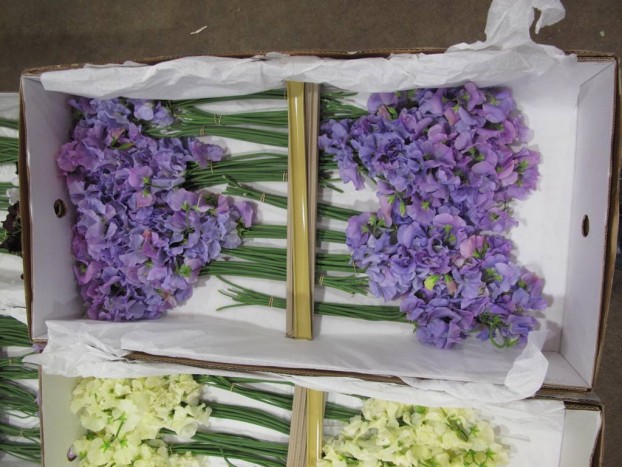
British-grown sweet peas,  available to London's florists in May.

British-grown sweet peas, available to London’s florists in May.

This week we have lots of great news to share and I hope you find the episode stimulating as you think of ways to promote your own floral endeavors.

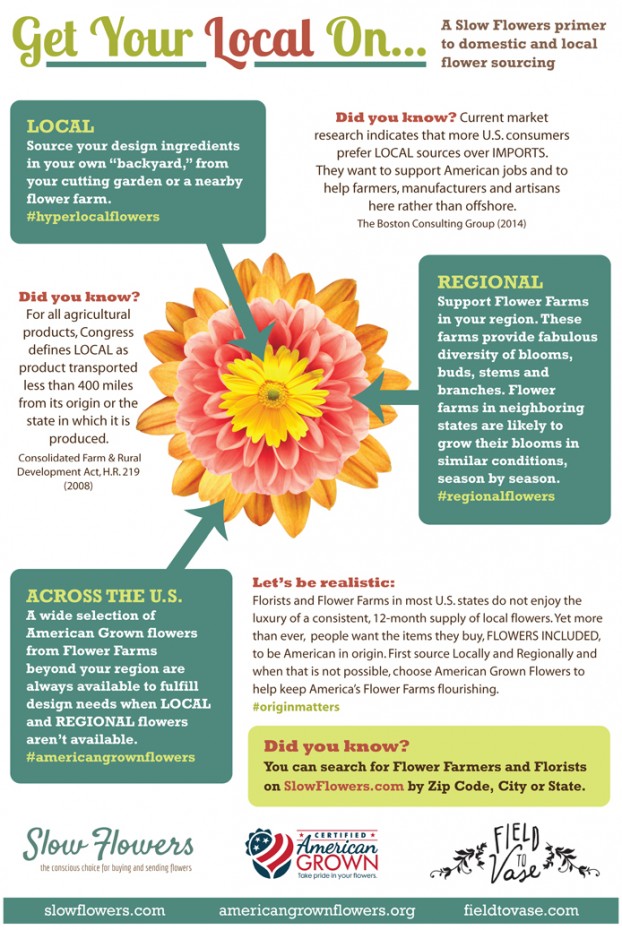
First up, this week I’m unveiling the second infographic in the Slow Flowers series. This piece is called “Get Your Local On,” and it endeavors to capture our philosophy of domestic flower sourcing in a single snapshot. I don’t believe in the black-and-white of things; life is just more chaotic than that, especially when you’re dealing with Mother Nature, climate, environmental forces and living plants.

Print

However, this visual guide explores the continuum from local and regional sourcing to national/domestic sourcing. As I’ve said many times (and I can’t take credit for this but I do like to repeat it), I recommend taking a pebble-in-the-pond approach to floral sourcing. Start close and work your way from there when needed. But please support America’s flower farms!

“Get Your Local On” couldn’t have become such a visually effective piece without the design magic of Willo Bellwood and I want to acknowledge her talents here! If you have a use for this graphic in your own business, please feel free to download the digital file to produce your own copies.

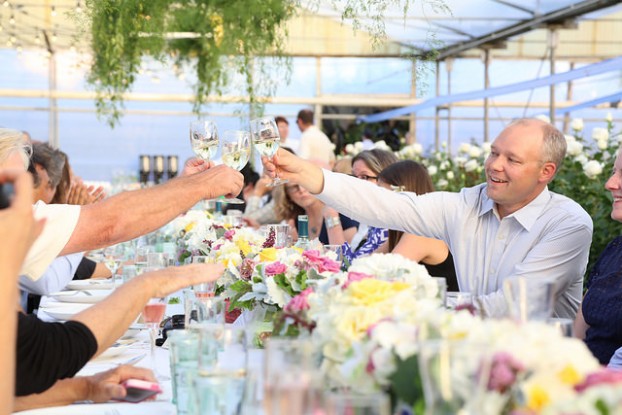
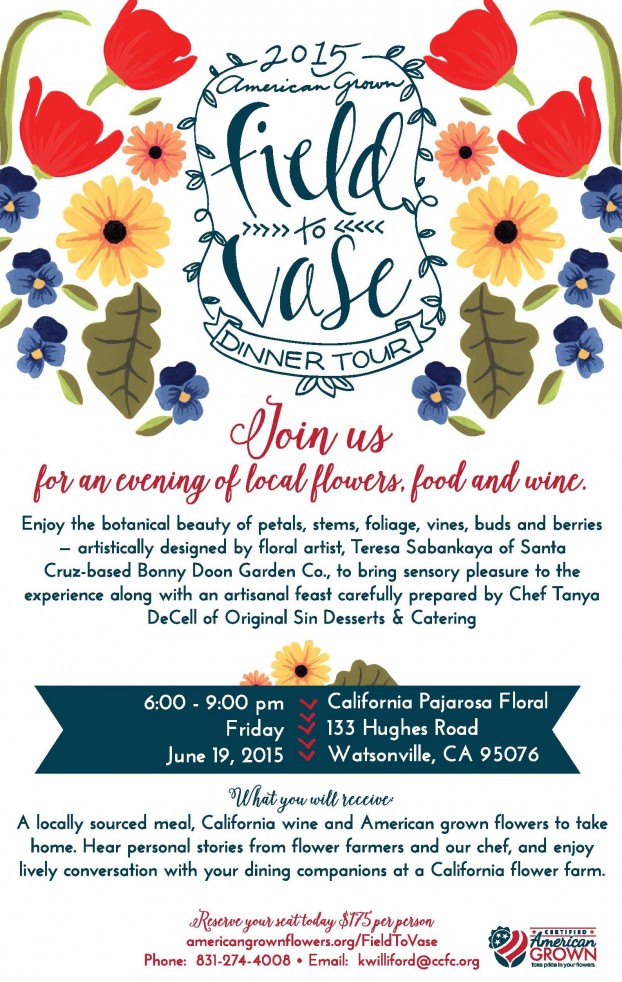
MB_F2V_inviteJune is here and I wanted to share my personal invitation for you to join the third Field to Vase Dinner, which Slow Flowers is co-hosting at flower farms across the country.

This month’s event will take place on Friday, June 19th at Pajarosa Flower Farm in Watsonville, California. Rose farmer Paul Furman is our host and Teresa Sabankaya of Bonny Doon Garden Co., a past guest of this podcast, is the celebrity floral designer who will use all local flowers to install an insanely beautiful tablescape for the meal.

Tickets for this amazing, floral-centric experience are $175 but I want to offer the listeners of this podcast a special promotional code to save $35 off of the ticket price. Click here to reserve your tickets and use SLOWFLOWERS during checkout for the discount.

And don’t worry if you can’t make it to Monterey Bay in June. There are dinners scheduled on flower farms coming up now through October, so check the full schedule for dates that will celebrate local flowers in Colorado, New York, Washington, D.C./Virginia, Washington State, Oregon, California and Michigan.

Layout 1

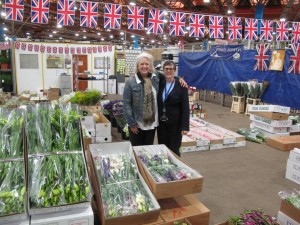
Here I am with Helen Evans of London's New Covent Garden Flower Market.

Here I am with Helen Evans of London’s New Covent Garden Flower Market.

Okay, now to our guest today. Please meet Helen Evans, director of business development and support at London’s New Covent Garden Market.

When I was in London last month, Helen graciously toured me through New Covent Garden, the premiere center for wholesale cut flowers and plants in London’s Vauxhall district.

New Covent Garden Market is the largest fruit, vegetable and flower market in the UK, claiming on its web site: “We are passionate about food and passionate about flowers and pride ourselves on being the focus for food and flowers in London.”

With over 200 businesses, employing over 2,500 people, the Market supplies 40% of fresh fruit and vegetables eaten outside of the home in London and is used by 75% of London florists.

Helen is one of the key persons behind the very exciting program called British Flowers Week, which will enter its third campaign beginning next Monday, June 15th. Listen along as we discuss the state of domestic flowers in the UK – and you’ll find many parallels to what’s happening in the U.S.

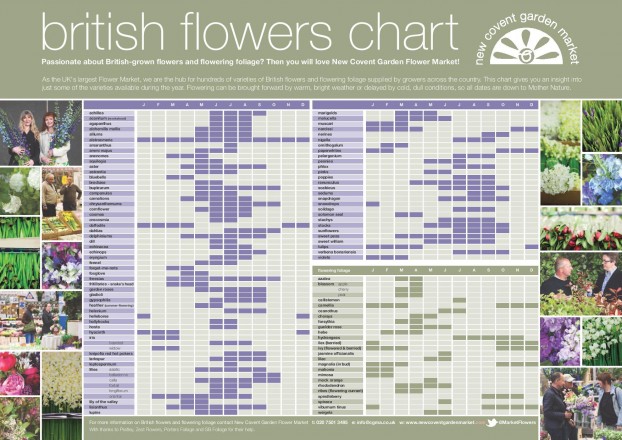
Seasonal Flower Chart of British Flowers -- a very useful marketing tool!

Seasonal Flower Chart of British Flowers — a very useful marketing tool!

On our early-morning visit, while walking through the floors of the enormous warehouse, I learned from Helen that only 10 to 15 percent of flowers sold here are British Grown. Yet the demand and the quantities to supply them are increasing as the wave of homegrown sentiment sweeps through the country, much as we’re seeing with American grown products.

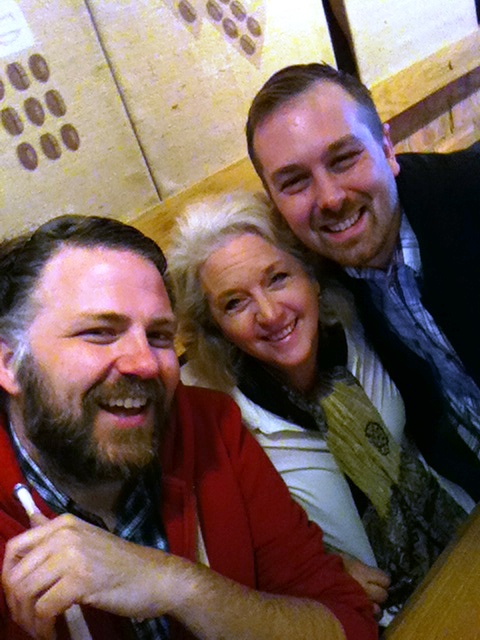
Slow Flowers Members Jimmy Lohr (left) and Jonathan Weber (right) joined me on the tour of New  Covent Garden Flower Market.

Slow Flowers Members Jimmy Lohr (left) and Jonathan Weber (right) joined me on the tour of New Covent Garden Flower Market.

It was completely fortuitous that two Slowflowers.com members joined us that morning. Jimmy Lohr and Jonathan Weber of GreenSinner in Pittsburgh were on their own Chelsea-London excursion. Helen graciously included them in the visit. When we sat down for tea and I turned on the recorder, it led to a completely impromptu interview. You’ll hear Jimmy and Jonathan’s voices jumping in to comment – and that added to the fun of the conversation.

I love how Helen describes the ambitious vision for New Covent Garden Market, to become a destination where people can buy, make, sell, learn and share. That mission is one I do not see happening with any intentionality at many U.S. Wholesale Markets, although I have to say it is very much in line with the mission of the farmer-owned Seattle Wholesale Growers Market.

Yet, with just a few changes of focus, there would be no reason why any wholesaler in our country couldn’t pull this off! I know we’re in the midst of a huge cultural shift in how flowers are sourced and marketed – and those who read the tea leaves and shift more quickly will be the ones who get to redefine the industry practices that others will emulate.

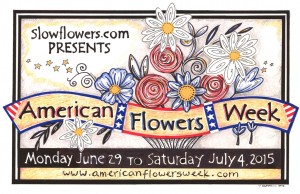
BFW_jpgAs you could tell, by the end of my conversation with Helen, I was thoroughly inspired to launch American Flowers Week – so stay tuned for news on that big dream. (and a note to the men from GreenSinner – as my witnesses, you two are in on that dream, too!)

Here’s a bit more about Helen Evans:

Helen has been at New Covent Garden Market for nearly 20 years.  It’s that sort of place.  Her work is to spread the word about the market, its flowers, its customers, its growers.  The market is not just about moving boxes.  Its about sharing information.  What’s new, what’s in season.  How would it work better.  So, brochures, website, social media – above all, talking.  Helen does a lot of that.  The product is great but for Helen its the people that matter.  Bringing them together.  Sharing.

Here’s a bit more about British Flowers week:

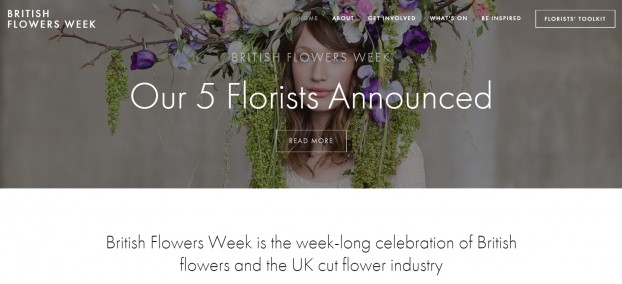
British Flowers Week is the brainchild of the team at New Covent Garden Flower Market, the UK’s largest Flower Market and the hub for British grown flowers and foliage for centuries.

Originally designed in 2013 as a social media campaign for the floristry trade, #BritishFlowersWeek was quickly picked up by florists, growers, wholesalers and media the length and breadth of Britain.

Last year, the hashtag #BritishFlowersWeek achieved a staggering Twitter reach of 1.4 million with British flowers content posted online, on social media, in print and on the radio.

This year’s campaign will involve the British Flowers Week Photoshoot online and on social media, The Garden Museum event, displays at RHS Harlow Carr as well as flower farm tours, flower workshops, flower demos, school flower crown days across the country. For more information visit www.britishflowersweek.com

Starting next week, one new image will be revealed to the media each day, which I’ll  share on the SlowFlowers FB Page as well as here on my web site. You can follow along by searching for the #britishflowersweek hashtag, too.

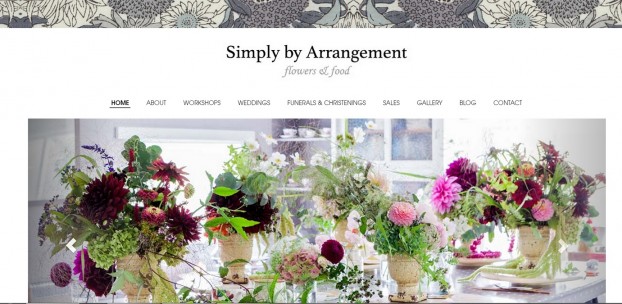
And please join me next week on June 17th for the second podcast episode devoted to British Flowers, in which you’ll meet Sarah Statham of Simply by Arrangement, a floral designer and floral educator who is active in the #britishflowersweek activities taking place next week in the UK’s Yorkshire region.

She’ll have even more photographs and stories to share about the distinctly local and regional efforts of the flower farmers and florists in Yorkshire – as a way to take the conversation out into the United Kingdom to differentiate from what has been otherwise a mostly London-centric campaign.

Thanks again for joining me today for another wonderful conversation. Yes, I am devoted to celebrating American flowers and the designers and farmers who are changing this entire industry for the better. But I’m also thrilled to introduce you to ways we can borrow ideas and inspiration from places like the U.K., where many parallels occur between our two marketplaces.

Listeners like you have downloaded this podcast more than 52,000 times. THANK YOU to each and every one of you for downloading, listening, commenting and sharing. It means so much.

Until next week please join me in putting more American grown flowers on the table, one vase at a time. And If you like what you hear, please consider logging onto Itunes and posting a listener review.

The content and opinions expressed here are either mine alone or those of my guests alone, independent of any podcast sponsor or other person, company or organization.

The Slow Flowers Podcast is engineered and edited by Andrew Wheatley and Hannah Holtgeerts. Learn more about their work at shellandtree.com.

An Artist’s Relationship with Floral Design, Abbie Zabar: Ten Years of Flowers from the Metropolitan Museum of Art (Episode 196)

Wednesday, June 3rd, 2015
In this pencil study, Abbie Zabar captures an exuberant floral arrangement from the Metropolitan Museum of Art's Great Hall.

In this pencil study, Abbie Zabar captures an exuberant floral arrangement from the Metropolitan Museum of Art’s Great Hall.

50kdownloadsThis week we’re celebrating the 50,000th download of the Slow Flowers Podcast.

As of today, we’ve produced 97 episodes bringing you the leading voices in the American Grown floral community – from flower farmers to floral designers, the inspiring people working to save flowers as part of our nation’s agricultural heritage and keep our flowers local, seasonal, sustainable — and American grown.

I am grateful to my past guests, each of whom has shared his or her story with listeners. And I’m so thankful to listeners who regularly tune in, comment, share and like this endeavor.

Students at Sarah Pabody's floral design workshop learn about the origin of the flowers in their lives. (c) Elena Slesarchuk, courtesy of Triple Wren Farm.

Students at Sarah Pabody’s floral design workshop learn about the origin of the flowers in their lives. (c) Elena Slesarchuk, courtesy of Triple Wren Farm.

Before we meet Abbie Zabar, this week’s guest, I wanted to share a text that I received this week from my friend Sarah Pabody of Triple Wren Farms located just north of Bellingham, Washington.

Sarah and her husband Steve Pabody are big promoters of the Slow Flowers Movement. When Sarah leads design workshops at Triple Wren she does something for which I’m so grateful.

Each student is handed one of the Slow Flowers infographics that reads “Where do your flowers come from?”

Then Sarah leads a short discussion about the frightening statistics revealing the small percentage of domestic flowers in the marketplace versus imported flowers, as well as the cost of those imported flowers, both environmentally but also economically, to local communities.

She texted me photos of last weekend’s workshop, which I have permission to share with you.

Even the youngest floral design student learns about the Slow Flowers Movement at Triple Wren Farms! (c) Elena Slesarchuk.

Even the youngest floral design student is introduced to the Slow Flowers Movement at Triple Wren Farms! (c) Elena Slesarchuk.


Said Sarah: “I thought you’d like to see your Infographics in action – at every workshop, I issue a challenge to each person to casually ask another person in their lives (grocery florist, family member, however they can work it into their daily conversation),”Do you know where these flowers were grown?”

If anyone listening to this story feels moved to do the same with their own customers, please follow this link to our graphics, which you are welcome to download and copy. Thanks for the inspiration, Sarah!

SFlowersInfoGraphic_Page1_Web

Abbie Zabar, captured in a familar pose by Rod Marton. She's sketching in a garden, with paper on her lap.

Abbie Zabar, captured in a familar pose at Rodmarton Manor in the UK. She’s sketching in a garden, with paper on her lap. (c) Sylvia Martin

Okay, today’s guest is thoroughly inspiring in a completely different way. When I first read the news that the work of Abbie Zabar, a New York-based artist and longtime virtual friend in the garden-writing world, was going to be celebrated this coming weekend with the opening of an exhibit of her floral drawings, I had to share her story with you.

As you will hear in our conversation, Abbie is a close observer of nature and of flowers, especially. She captures what she observes with colored pencils on sheets of rather ordinary paper or cardboard.

from June 23, 2002

from June 23, 2002

For one decade of her life, from the early 1990s to the early 2000s, Abbie walked from her apartment in New York City’s upper east side to the famed Metropolitan Museum of Art on Fifth Avenue. She entered the impressive Great Hall during the early hours, found a place to sit, and proceeded to sketch the grand floral arrangements on display there each week. (I feel quite an affinity for someone who honored such a creative ritual week after week; after all, I managed to make a bouquet each week for one year and ritualized that practice, but Abbie’s ten-year observance is hugely impressive).

Abbie Zabar. December 6 1994. Collection of the artist

Abbie Zabar. December 6 1994. Collection of the artist

Abbie was enthralled by the five enormous flower-filled urns that stood in the Met’s Great Hall. At the time, the pieces were created by Chris Giftos, the Met’s former Master Floral Designer and Director of Special Events. For more than 30 years, Mr. Giftos was responsible for the beautiful arrangement in the Great Hall. And, as Abbie describes, the flowers occupied four large niches carved from the central piers, as well as the centrally located Information Desk. The weekly arrangements of fresh flowers appear, thanks to an endowment provided by the late Lila Acheson Wallace, who was one of the Museum’s largest single benefactors.

Abbie Zabar. February 4 2002. Collection of the artist

Abbie Zabar. February 4 2002. Collection of the artist

It’s no surprise to learn that Abbie and Chris became good friends. The fondness she had for this floral artist are reflected in each drawing she made in response to his work. Incredibly alluring, her diminutive floral portraits are breathtaking in both their simplicity and their complexity. Abbie’s own experience as a gardener and her innate knowledge of the flowers, fronds and leaves before her allowed her to capture the splendid bouquets with a sure and deft hand, well before the Museum opened its doors for the day.

Abbie Zabar. October 16 1999. Collection of the artist

Abbie Zabar. October 16 1999. Collection of the artist

Working in situ and in pencil—the only implement allowed in the space —her drawings showcase the vibrancy, variety and vitality of the displays, as captured in one quick sitting.

Abbie Zabar at the Manhattan Chapter of the North American Rock Garden Society's Plant Sale, where she was passing around saxifraga "favors." Photo courtesy of Yukie Kurashina.

Abbie Zabar at the Manhattan Chapter of the North American Rock Garden Society’s Plant Sale, where she was passing around saxifraga “favors.” Photo courtesy of Yukie Kurashina.

You will hear more about her process in our conversation, and please visit debraprinzing.com to see examples of the pieces that will be unveiled in this upcoming exhibition.

The show is called Abbie Zabar: Ten Years of Flowers, on view June 7 through October 4 at Wave Hill, a beautiful public garden and cultural center in The Bronx. The event is free with your admission to the grounds.

And here is a little more about Abbie’s background:

Abbie Zabar is an acclaimed artist, graphic and garden designer, and the author of five books. Her first book, The Potted Herb (1988), is now considered a gardening classic.

She has created garden and graphic designs for numerous prestigious companies and organizations, including Bergdorf Goodman, Daniel Boulud’s restaurants and PS 198.

Her landscape collages have been represented by Allan Stone and BlumHelman, and Flowers in the Great Hall of the Metropolitan Museum of Art series has been represented by Ursus Books & Prints and the Horticultural Society of New York.

Abbie Zabar. May 18 1995. Private collection

Abbie Zabar. May 18 1995. Private collection

Abbie’s artwork has been shown at the Museum of Modern Art, the Cooper-Hewitt Museum, the Parrish Museum, the International Paper Corporation, the Louvre, the Institute of Contemporary Arts (London) and the Vigeland Museum (Oslo), and is part of the permanent collections of the Mead Paper Corporation of America, the Brooklyn Museum, the Jewish Museum, the Hunt Institute for Botanical Documentation and the Smithsonian Museum.

Abbie Zabar. May 17 2003. Collection of the artist.

Abbie Zabar. May 17 2003. Collection of the artist.

Abbie’s illustrated articles have appeared in Garden DesignHorticultureFine GardeningGourmet and The New York Times, as well as in numerous esteemed British publications. She received the 2010 Award for Best Newspaper Writing from the Garden Writers Association for her piece “A Vine in the Sky,” published in The Forward.

Abbie Zabar. September 24 2000. Collection of the artist

Abbie Zabar. September 24 2000. Collection of the artist

In 2014, she was honored with the North American Rock Garden Society’s Carleton R. Worth Award, given to an author of distinguished writings about rock gardening and rock garden plants. Zabar is currently the Program Chairperson for the Manhattan Chapter of the North American Rock Garden Society and a Learning Leader at P.S. 198.

Jar with green hyacinths

Jar with green hyacinths

White roses in straight-sided jar.

White roses in straight-sided jar.

White roses, little creamer

White roses, little creamer


As Abbie and I discussed, not only is the exhibition at Wave Hill available for public viewing all summer long, continuing to October 4th, she has a second show in the works, which will run September 16th to October 2nd at W.M. Brady & Co., a gallery at 22 East 80th Street, just a few steps from The Metropolitan Museum of Art.

This collection of drawings includes the series of small floral studies that Abbie and I discussed at the close of our interview (and she generously shares a sneak peek of a few of those pieces here).

From the grand floral arrangements at the Met to these intimate moments of singular blooms captured in small vases, Abbie’s gifts as an illustrator of flowers are evident. And I know you’ll be as enchanted as I am. By the way, many of these pieces will be available for purchase, so please follow the links to the two institutions (Wave Hill and W.M. Brady & Co.) to inquire if you’re interested in a list of available works.

Thank you, Abbie Zabar, for showing us flowers in a new way. Not everyone is an artist or has the ability to use a pencil so masterfully as my friend Abbie. But this conversation has moved me to use my innate skills of observation more acutely, whether I’m on a walk in the park, purchasing flowers from my favorite flower farmer, or tending to plants in my own backyard.

Thanks again for joining me today for another wonderful conversation about flowers. Listeners like you have downloaded the podcast more than 50,000 times. THANK YOU to each and every one of you for downloading, listening, commenting and sharing. It means so much.

Until next week please join me in putting more American grown flowers on the table, one vase at a time. And If you like what you hear, please consider logging onto Itunes and posting a listener review.

The content and opinions expressed here are either mine alone or those of my guests alone, independent of any podcast sponsor or other person, company or organization.

The Slow Flowers Podcast is engineered and edited by Andrew Wheatley and Hannah Holtgeerts. Learn more about their work at shellandtree.com.

Green and Local as a Flourishing Business Model with Bash & Bloom of Seattle (Episode 195)

Wednesday, May 27th, 2015
Meet Eleanor Blackford, owner and creative director of Bash & Bloom (c) Barbie Hull Photography

Meet Eleanor Blackford, owner and creative director of Bash & Bloom (c) Barbie Hull Photography

bashandbloomlogoThis week’s guest is Eleanor Blackford Davis, owner of Seattle-based Bash & Bloom.

Eleanor and I frequent the Seattle Wholesale Growers Market where she is a regular customer and I’m on the board.

A Bash & Bloom emerald green and white bouquet displayed in an ornate chair with photography (c) Courtney Bowlden Photography

A Bash & Bloom emerald green and white bouquet displayed in an ornate chair with photography (c) Courtney Bowlden Photography

It’s always fun and tempting to see what she has loaded in her arms on those early-morning excursions – and there’s often a fabulous related story she shares about a wedding or event in the works.

Eleanor and I got to talking last year about her decision – and her public announcement – to go foam free as a designer.

A Bash & Bloom Table Garland adorns a wedding reception (c) photography by Mark Malijan Photography

A Bash & Bloom Table Garland adorns a wedding reception (c) photography by Mark Malijan Photography

She also believes in sourcing from local farms and through the Seattle Wholesale Growers Market, whose staff members procure only local, seasonal and sustainably-grown flowers from Washington, Oregon, Alaska and California.

My photograph of Eleanor Blackford, with her sample arrangement using local spring flowers and Floral Soil.

My photograph of Eleanor Blackford, with her sample arrangement using local spring flowers and Floral Soil.

Eleanor's finished design, a prototype for her wedding reception.

Eleanor’s finished design, a prototype for her wedding reception.

We continued the dialogue recently while both participating in a workshop to use Floral Soil, a 100-percent plant-based alternative to the conventional foam, invented by Mickey Blake, a past guest of this podcast.

Alicia Schwede of Flirty Fleurs, another past podcast guest, led the workshop on designing elevated centerpieces, and I have to tell you that Eleanor’s piece was stunning! It was also the prototype for her own wedding florals, which took place on May 8th. 

Check out the no-foam elevated centerpiece she created at the workshop with Alicia and Mickey.

But about five weeks ago, Eleanor and I agreed to meet over tea to record our conversation, and I know you’ll enjoy it.

Eleanor's art deco bouquet in white and dark reddish purples was photographed by (c) My Beloved Photography

Eleanor’s art deco bouquet in white and dark reddish purples was photographed by (c) My Beloved Photography

I’m happy that Eleanor has shared so many photos of her floral design work and a few bonus photos from her recent wedding to Matthew Davis (see below).

Eleanor on her wedding day with flowers by Kelly Sullivan of Botanique (Instagram photo from wedding photographer Shane Macomber)

Eleanor on her wedding day with flowers by Kelly Sullivan of Botanique (Instagram photo from wedding photographer Shane Macomber)

Those fantastic elevated centerpieces designed with Floral Soil - adorning Eleanor and Matt's wedding reception. (c) Shane Macomber Photography

Those fantastic elevated centerpieces designed with Floral Soil – adorning Eleanor and Matt’s wedding reception. (c) Shane Macomber Photography

You can find Eleanor at these Social Sites:

Bash & Bloom on Facebook

Bash & Bloom on Instagram

Bash & Bloom on Pinterest

The Greater Seattle Floral Association, the local organization for wedding, event, studio and retail designers in which she is actively involved.

Bouquets for a pink-and-mauve floral palette (c) Alante Photography

Bouquets for a pink-and-mauve floral palette (c) Alante Photography

Here’s how my guest introduces herself on the Bash & Bloom web site:

I’m Eleanor Blackford – a craftster, dog lover, fun haver, and Owner of bash & bloom. My style has been described as having a lush, organic, and creative look and feel. I love to make an event unique, personal, and fun and can’t wait to sit down with you to talk about your vision. I work closely with my couples or party hosts to bring their unique personality and style to their event, primarily using seasonal and local products.

Vivid palette (c) Dana Pleasant Photography

Vivid palette (c) Dana Pleasant Photography

Thanks again for joining me today for another wonderful conversation about American flowers and the designers and farmers who are changing this entire industry for the better.

More flowers from the brighter end of the spectrum, (c) Barrie Anne Photography

More flowers from the brighter end of the spectrum, (c) Barrie Anne Photography

PodcastLogoListeners like you have downloaded the podcast 50,000 times.

I want to stop for just one moment and savor that news. Yes, we just produced our 96th episode and we are very, very close to airing the big one-hundredth episode, just one month from now.

THANK YOU to each and every one of you for downloading, listening, commenting and sharing. It means so much.

Until next week please join me in putting more American grown flowers on the table, one vase at a time. And If you like what you hear, please consider logging onto Itunes and posting a listener review.

The content and opinions expressed here are either mine alone or those of my guests alone, independent of any podcast sponsor or other person, company or organization.

The Slow Flowers Podcast is engineered and edited by Andrew Wheatley and Hannah Holtgeerts. Learn more about their work at shellandtree.com.

Florida-Grown Ferns, Foliage and Greenery with Erik Hagstrom of Albin Hagstrom & Sons (Episode 194)

Wednesday, May 20th, 2015

RHS_CHELSEAThe Slow Flowers Podcast is coming to you this week from Britain, where I’ve been touring the Chelsea Flower Show, reporting on gardening and floral trends for Houzz.com, and speaking to a passionate group of British Flower Farmers. I promise to bring home inspiring podcast interviews to share in the coming weeks.

And if you want to listen to what’s happening in the British-Grown flower movement, including the perspective of both florists and flower farmers, I’ve added links to past interviews here:

Episode 129: Reclaiming our Floral Heritage . . . Lessons from #Britishflowers

Episode 186: The Flower Farmer’s Year with Georgie Newbery of Common Farm Flowers UK

Flowers from the Farm, the UK's nationwide network of cut flower growers

Flowers from the Farm, the UK’s nationwide network of cut flower growers

A special thanks to Gillian Hodgson of Fieldhouse Flowers and the force behind Flowers from the Farm – an organization of British flower farmers, as well as to Sarah Statham of Simply by Arrangement, both of Yorkshire, who created a magnificent itinerary for my visit. You’ll hear from them both in future reports.

And here are a few more pieces of good news, shared by Slowflowers.com members on both American coasts:

First from Mary Coombs, who with her sister Dawn Clark operate A Garden Party based in Elmer, New Jersey:

Subject line: It is Working

“I was meeting with a client last night and I asked her how she found us. Much to my delight, she found us via Slowflowers.com! She is a perfect fit for my company and I am proud to be listed on this site. Thank you for working so hard on this!
I will also be talking about the Slow Flowers movement on Fox 29 Philadelphia on Monday morning. They are coming to film us in the garden for three live segments to air during their news show. I am nervous but excited!”

Mary’s note is so encouraging that I wanted you to hear it – and check out this news clip featuring Mary and Dawn.

“Anything you can get locally grown will be fresher; it will last longer; it’s going to do better in the vase.” — Dawn Clark, A Garden Party.

And next, a note from one of my favorite flower farmers, Joan Thorndike of Le Mera Gardens, based in Talent, Oregon, just outside Ashland. Joan is featured in The 50 Mile Bouquet, and she was an early supporter of Slowflowers.com. She is a farmer and a florist, famous for her summertime Oregon wine-country weddings.

Here’s Joan’s note, a text that arrived on my phone screen:

“Twice last week a potential customer called me because they knew all about your Slow Flowers as a concept – and so wanted to find a source close rather than far. Thank you for what you do!”

Please keep these updates coming – it is your anecdotal stories of customers finding their American grown flowers from Slowflowers.com farms and floral designers that allow me to share the news with others interested in joining this movement.

4th generatoin Fern Farmer Eric Hagstrom.

4th generatoin Fern Farmer Erik Hagstrom.

signI met today’s guest in person – finally – after a long-distance social media acquaintance. Please meet Erik Hagstrom of Albin Hagstrom & Son.

Based in Pierson, Florida, Albin Hagstrom & Son is one of, if not THE, largest American farms growing ferns, greenery and all types of cut foliage for the floral marketplace.

The family-owned business was started in 1928.

Glossy and durable -- Leatherleaf fern.

Glossy and durable — Leatherleaf fern.

ft_ah_14611-e1370480079963Not only did Albin Hagstrom & Son join the Slowflowers.com site very early after we launched, Erik has been a super supportive member. On two occasions, when I was booked to do interviews with Florida radio personalities, I asked him to send a sample box of Florida ferns and foliage to the host. He more than exceeded my expectations.

Such a generous gesture that proved to be a tangible example of the Slow Flowers movement – and in both cases, those radio hosts mentioned receiving those beautiful Florida ferns while we were on the air. That’s the kind of partnership that helps all of us in the movement.

Under the live oak, as I attempted to reach the naturally draped Spanish moss.

Under the live oak, as I attempted to reach the naturally draped Spanish moss.

Last week I spent five days in Orlando, Florida. I was thrilled to have an extra day before I started speaking and designing on the Festival Stage at Disney Epcot’s Flower & Garden Show, and while my two sons went off to Magic Kingdom, I headed north on Interstate, about 75 miles south of where Albin Hagstrom & Sons is located, to find the hamlet of Pierson, population 1,730.

Variegated pittosporum shrubs, growing prolifically under a shade structure.

Variegated pittosporum shrubs, growing prolifically under a shade structure.

I had a fun visit with Erik’s dad, Richard, grandson of founder Albin, who has just turned 80 and is a walking encyclopedia of fern-farming.

Tree ferns, naturalized under the canopy of live oak trees.

Tree ferns, naturalized under the canopy of live oak trees.

Then Erik and I jumped in his pickup  truck to drive through some of the production area, passing through shade structures and then following a narrow road through the “hammock” where ferns grow naturally under the canopy of ancient live oak trees.

Mostera. Beautiful, but I wasn't going to venture too close!

Mostera. Beautiful, but I wasn’t going to venture too close!

Anytime I wanted to take a photo, Erik indulged me by stopping and letting me hop out. However, when we slowed down to view the shade house where Monstera foliage grows, he warned me that rattlesnakes like to hang out in the protective tangle at the base of these tropical-looking plants with such dramatic leaves. Um, no thank you. I stayed in the car! But I did find it interesting that most of Albin Hagstrom & Son’s Monstera goes to the cruise ships that dock in Florida.

The Hagstrom family homestead, built in the 1920s by great grandfather Albin. You can see the Swedish farmhouse influence in its simple lines and appealing symmetry.

The Hagstrom family homestead, built in the 1920s by great grandfather Albin. You can see the Swedish farmhouse influence in its simple lines and appealing symmetry.

And by the way, Erik is a man of many interests. He started his career working for the famous Daytona International Speedway and has an extensive background in promotions and marketing. While he eventually left the world of racing to grow ferns, Erik is still a huge fan of NASCAR events. He is the owner of an American-made pickup truck, a fact that did not escape my notice!

Tree ferns, just picked and ready for shipping to all 50 states.

Tree ferns, just picked and ready for shipping to all 50 states.

I hope you enjoy our podcast interview and gain a newfound appreciation for FOLIAGE — an important source of botanical beauty for floral design. I left with a huge box of samples and was delighted to use the ferns, foliage, grasses and greenery in my demonstrations on the Epcot stage during the following three days. I was proud to tell my audiences that about those American grown, FLORIDA grown stems beautifying my vases. And in a state where nearly all of the imported flowers and foliage flow through nearby Miami International Airport, it was doubly important to have this gorgeous and tangible example of the Slow Flowers movement in my hands.

Thanks again for joining me today and please visit debraprinzing.com to see my photos and to follow links to all Erik’s social sites.

Albin Hagstrom & Son on Facebook

Erik Hagstrom on Twitter: @erikhagstrom

Listeners like you have downloaded the podcast nearly 49,000 times. Until next week please join me in putting more American grown flowers on the table, one vase at a time. And If you like what you hear, please consider logging onto Itunes and posting a listener review.

The content and opinions expressed here are either mine alone or those of my guests alone, independent of any podcast sponsor or other person, company or organization.

The Slow Flowers Podcast is engineered and edited by Andrew Wheatley and Hannah Holtgeerts. Learn more about their work at shellandtree.com.

Minnesota Blooms with Christine Hoffman of St. Paul’s Foxglove Market & Studio (Episode 193)

Wednesday, May 13th, 2015

SlowFlowers_Badge_640x480The Slow Flowers Movement has a lot to celebrate lately – and I want to share with you the very good news that occurred just before Mother’s Day.

While some may view this as a merely symbolic event, I applaud the news that both the Senate and the U.S. House of Representatives passed Resolutions about flowers last week. Seriously!

The opening lines of the Senate Resolution urging support of American Grown Flowers.

The opening lines of the Senate Resolution urging support of American Grown Flowers.

Follow this link to read the entire Senate resolution #166, passed unanimously and introduced by Sen. Dianne Feinstein, with Sen. Barbara Boxer and Sen. Lisa Murkowski.

The document’s first paragraph gets right to the point:

Expressing the sense of the Senate that domestically grown flowers support the farmers, small businesses, jobs, and economy of the United States, enhance the ability of the people of the United States to honor their mothers on Mother’s Day, and that the White House should strive to showcase domestically grown flowers.

It continues:

Whereas people in every State have access to domestically grown flowers, yet only 1 of 5 flowers sold in the United States is domestically grown;

Whereas more people in the United States are expressing interest in growing flowers locally, which has resulted in an approximately 20 percent increase in the number of domestic cut flower farms since 2007;

(c) Washington Post image of California irises and Florida tropical foliage.

(c) Washington Post image of California irises and Florida tropical foliage.

Whereas in 2014, President Barack Obama and First Lady Michelle Obama highlighted their support for domestically grown flowers at the White House State Dinner with French President Francois Hollande, the only White House State Dinner that year; Whereas the 2014 White House State Dinner featured quince branch from Mississippi, weeping willow from New Jersey, Scotch broom from Virginia, iris from California, and alocasia, equisetum, nandina, and green liriope from Florida;

There are many more “whereas” paragraphs that discuss the economic impact of America’s flower farming industry. And then the actual resolution concludes with these four assertions:

Resolved, That it is the sense of the Senate that—

(1) purchasing flowers grown in the United States supports the farmers, small businesses, jobs, and economy of the United States;  

(2) flowers and greens grown in the United States are a vital and integral part of the agricultural industry of the United States;

(3) flowers grown in the United States enhance the ability of Americans to honor their mothers on  Mother’s Day; and  

(4) the White House should strive to showcase flowers and greens grown in the United States to show support for the flower breeders, farmers, processors, and distributors of the United States.

You may be wondering, “What prompted our nation’s leaders to introduce such a Resolution? (And by the way, a very similar Resolution was passed at about the same time by Congress, with language introduced by the four co-chairs of the Congressional Cut Flower Caucus.)

PrintIn addition to congratulating these policymakers and their staff members for doing the right thing for American Flowers, this good news would never have happened if it wasn’t for the determination of Kasey Cronquist, CEO and Ambassador for the California Cut Flower Commission and the flower farmers of his state who have invested time and financial resources to visit Washington, D.C., year after year for the past five years, to engage in conversation with those elected officials.

That is huge and I am pleased to have joined this effort in a small way by joining those delegations in 2014 and 2015. At the helm of this strategy is Bill Frymoyer, of Stewart & Stewart, the man who represents the American Grown effort in our nation’s capital. Bill and Kasey have authored this strategy that of course was crafted to benefit the agenda of California’s cut flower growers, but also creates a ripple effect to benefit everyone in the Slow Flowers community.

JOINING HANDS ACROSS THE FLOWER FIELDS OF AMERICA

When a spotlight in Washington, D.C., shines on domestic flowers it brings attention to you, to your flower farm (no matter what its size). It gives credibility to our cause, the cause of people who care about keeping flowers local, seasonal and sustainable. I encourage you to reach out to your own representative or Senator and let them know that you are a cut flower farmer in their district or state. Take the time. Send a letter. Deliver a bouquet. Thank them for signing onto these resolutions and tell them the support means something to you. And by the way, here is a great resource to help you send that message efficiently and directly.

I am always shocked when someone tries to drive a wedge between the big-idea American grown movement and the grassroots local-flowers movement.  There should be no wedge. We need everyone’s efforts to fight imports. Every single flower farm and farmer; every single florist and designer who makes a mindful choice about sourcing flowers grown and harvested from American soil; every single customer who orders flowers and asks for local or American blooms. That is the rising tide that floats all of our boats. In your own backyard and in all 50 states.

KEEPING IT LOCAL IN THE TWIN CITIES

FOXGLOVE_logo

This blackboard/sandwich board is a message I can get behind. Spotted outside Foxglove Market & Studio, owned by today's guest Christine Hoffman.

This blackboard/sandwich board is a message I can get behind. Spotted outside Foxglove Market & Studio, owned by today’s guest Christine Hoffman.

Now to today’s guest. Chrisine Hoffman is the owner of Foxglove Market & Studio based in St. Paul, Minnesota.

I am thrilled that I was able to visit Foxglove personally when I was in the Twin Cities to speak and teach at the Minneapolis Institute of Art two weeks ago for “Art in Bloom.”

I broke away one afternoon and caught a ride to St. Paul, asking my driver to take me to Grand Avenue, the charming, pedestrian-focused street where Christine’s store is located.

The vintage building has all the character you could want, with high ceilings finished in decorative pressed tin, a bay window in the front where an inviting vignette lures you in, and a lovely mix of old and new, crafted and curated goods.

On her web site, Christine describes the shop and studio as: “Putting a fresh modern spin on an honest folk vibe. Foxglove’s thoughtful aesthetic emphasizes sustainability, utility, community and comfort.”

Local Midwest-grown flowers are at the heart of Foxglove Market & Studio.

Local Midwest-grown flowers are at the heart of Foxglove Market & Studio.

Proprietress and creative director Christine Hoffman.

Proprietress and creative director Christine Hoffman.

Get it, got it, GOOD!

Get it, got it, GOOD!

Welcome to Foxglove, where you can find an artisan gift, take a workshop or gather an armload of seasonal blooms.

Welcome to Foxglove, where you can find an artisan gift, take a workshop or gather an armload of seasonal blooms.

There are three aspects to this business that I find so wonderful interrelated:

First the Marketplace, where an assortment of home goods, books, high quality paper products and findings, as well as Midwest salvage reflect Christine’s aesthetic as a former interior designer, photo stylist and event planner. Then there’s the Studio, where any number of gatherings take place – from floral design workshops and other creative hands-on classes to private pop-up chef dinners. And finally, the Flowers, a complement to every other activity held here. Of the Flowers, Christine focuses her offerings on seasonal flowers grown by local farms.

As she writes on her web site:

Knowing where our food comes from and how it is grown and processed is once again becoming a natural part of our everyday lives. These same issues apply to our cut flowers. The majority of commercial flowers are grown overseas using a mixture of fertilizers, chemicals and preservatives that are anything but natural. Add in worker exposure and ship time and resources, and you’ve got one loaded bunch of tulips. It’s easy to grab a cellophane wrapped bouquet, pop it in a vase, and not give it another thought. Those flowers, however, have a big impact on our environment-both in a broad sense and in your home.

I have a commitment to unique and expressive floral design, happy plants, and a healthy environment. By staying domestic and keeping it simple, Foxglove strives to minimize environmental and social impact. My farmers use sustainable and organic growing methods, and deliver blooms personally to my shop.

  • Support Local Growers
  • Embrace Healthy Homes
  • Celebrate Seasonal Abundance

My mission is a simple one, based on my personal aesthetic and belief that flowers are most beautiful in their natural state. To me it seems counterintuitive to treat soil and plants with artificial fertilizers, chemicals and sprays, and I really don’t want to trail those things into my home and onto my table. It poses a challenge in our cold climate to source everything locally, but it is a better choice for so many reasons.

Foxglove_Christine_DebraI am so pleased to welcome Christine Hoffman to the Slow Flowers Podcast.  Since her days growing up in a river valley, gathering endless bouquets of wildflowers from the woods surrounding her childhood home, Christine has been in love with flowers. Her parents are both gardeners, and their knowledge of plants and flowers settled into Christine with each bed she helped prep (grumbling all the way), and each garden picked bouquet brought into their house.

Follow Foxglove at these social places:

Foxglove Market & Studio on Facebook

Foxglove Market & Studio on Instagram

Foxglove Market & Studio on Pinterest

Foxglove Market & Studion on Twitter

Listeners like you have downloaded the podcast nearly 48,000 times. In fact, in April, we logged the all-time high number of 5,101 episode downloads which only means that the message of Slow Flowers and the farmers and florists who exemplify this movement is reaching more and more listeners.

Until next week please join me in putting more American grown flowers on the table, one vase at a time. And If you like what you hear, please consider logging onto Itunes and posting a listener review.

The content and opinions expressed here are either mine alone or those of my guests alone, independent of any podcast sponsor or other person, company or organization.

The Slow Flowers Podcast is engineered and edited by Andrew Wheatley and Hannah Holtgeerts. Learn more about their work at shellandtree.com.

California Grown-American Grown, with Tony Ortiz of Joseph & Sons (Episode 192)

Wednesday, May 6th, 2015
Tony Ortiz (left), with his parents Mercedes and Joseph Sr.

Tony Ortiz (left), with his parents Mercedes and Joseph Sr.

Today’s guest is an up-and-coming leader in cut flower farming in California and the U.S.-American grown cut flower world.

Tony shows off some of the fresh, just-picked flowers from Joseph & Sons' fields.

Tony shows off some of the fresh, just-picked lisianthus from Joseph & Sons’ fields.

I met Tony Ortiz last year when he and his father Joseph Ortiz, Senior, were part of a delegation of U.S. flower farmers who traveled to Washington, D.C., for meetings with their Representatives. Their family farm, Joseph & Sons, is based in Santa Paula, California (Ventura County), where the vast majority of their flowers are field-grown.

I always have a soft spot in my heart for field-grown flowers, so I was excited to schedule a visit to tour the Joseph & Sons’ operation when I was in Southern California last month. In Santa Paula, they grow 58 acres of flowers, as well another 1 million square feet of greenhouse-varieties.

To get to Joseph and Sons you drive north from Los Angeles on the Ventura Freeway (Hwy 101) and turn east once you hit the city of Ventura. I felt quite a bit of nostalgia heading up to Santa Paula, traveling that same route I drove for four years when our family lived in Thousand Oaks from 2006-to-2010. So may familiar stops that brought a flood of memories along with the sunshine that required me to wear sunglasses (not something that happens much in the winter up here in Seattle).

Beautiful blue delphiniums in the high tunnel.

Beautiful blue delphiniums in the high tunnel.

At Hwy 126 I turned east, away from the Pacific Ocean, and after a few miles, I exited and made my way through agricultural fields growing nursery plants and food crops.

Look at this gorgeous, healthy amaranthus!

Look at this gorgeous, healthy amaranthus!

I arrived at Joseph & Sons on Telegraph Road where Tony met me and led me on a tour of the flower processing and packing facility, then outdoors, through the rows of high tunnel covers that protect tidy rows of Joseph & Sons’ flowers:

  • Amaranthus
  • Bells of Ireland
  • Bupleurum
  • Delphinium
  • Larkspur
  • Lisianthus
  • Stock
  • Snapdragons
  • Statice
  • Bupleurum
  • Iris
  • Matsumoto Asters
  • Pepperberry
  • Queen Anne’s Lace
  • Ranunculus
  • Seeded Eucalyptus
  • Sunflowers
  • Main Blue
Hot pink snapdragons.

Hot pink snapdragons.

By the way, as you’ll hear in my interview with Tony, Joseph & Sons also grows flowers in two other California regions: Lompoc, in Central California, where Joseph & Sons has 280 acres of field grown flowers, and Imperial Valley, in San Diego County, where the company grows 75 acres of seasonal flowers. Joseph & Sons is a Certified American Grown flower farm selling flowers across the U.S.

A birds-eye view of the packing operation.

A birds-eye view of the packing operation.

The family-owned and operated business has more than 50 years of growing and shipping experience. Founded by Joseph Senior, a man who allegedly was born with a green thumb that others have tried in vain to duplicate, these flower growers are dedicated to making sure the best growing practices are followed.

And here are two videos I wanted to share:

First, the Joseph & Sons story on J Schwanke of uBloom’s California Grown Experience Web Series:

And just for fun, follow this link to J’s “Happy Video” ~ you can’t miss Tony (and the rest of his family) dancing to Pharrell Williams’ song!

Here are other ways to connect with Joseph & Sons:

Joseph & Sons on Facebook

Joseph & Sons on Pinterest

Joseph & Sons on Instagram

Listeners like you have downloaded the podcast more than 46,000 times. Until next week please join me in putting more American grown flowers on the table, one vase at a time. And If you like what you hear, please consider logging onto Itunes and posting a listener review.

The content and opinions expressed here are either mine alone or those of my guests alone, independent of any podcast sponsor or other person, company or organization.

The Slow Flowers Podcast is engineered and edited by Andrew Wheatley and Hannah Holtgeerts. Learn more about their work at shellandtree.com.
Farmer-Florists, Mother-Daughter: Meet the Women of Buckeye Blooms (Episode 191)

Wednesday, April 29th, 2015
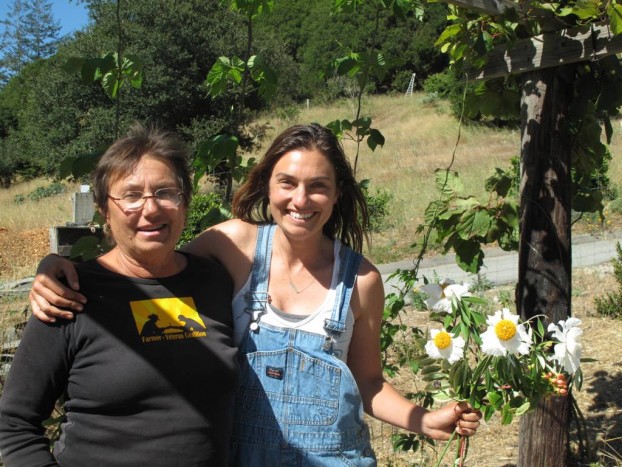
Kay Studer (left) and Susan Studer King (right) of Buckeye Bloms (c) Jason Bowers Photography

Kay Studer (left) and Susan Studer King (right) of Buckeye Blooms (c) Jason Bowers Photography

bb_logoI’m so pleased today to share a long-distance conversation I recorded a few weeks ago with Kay Studer and Susan Studer King, mom-and-daughter farmer-florists based in the Northwest Ohio community of Elida, where they grow and design.

The two are doing exciting things in their community, region and state and I know you’ll learn much from their experience, which they so generously share in the interview.

theflowerhouse_graphicBut first up: A bit of news. You may recall my interview a few months ago with Lisa Waud of Detroit’s pot and box, a studio, wedding and event florist who has taken it upon herself to dream up a project called “The Flower House” – a 100-percent American grown floral installation in an abandoned house in the Motor City.

Lisa has big plans and since our podcast, her first interview ever, she has garnered a lot of attention from the floral design and flower farming community, as well as the media. The Flower House will take place October 16-18, but this weekend, Lisa and her fellow floral artists will unveil their plans at a preview event to be held in a neighboring vacant house. As Lisa promises: “It will whet the whistles of interested florists, curious visitors and potential sponsors.”

I’ll be there to help the designers celebrate the launch of this incredible project. Please check out the links at The Flower House to find out how you can attend – especially if you’re in the Detroit area this coming weekend.

And if you want to get involved, please help FLOWER HOUSE BLOSSOM AND GROW. The team has just kicked off a funding campaign on my favorite crowd-funding platform Indiegogo so you’ve gotta know they’re smart cookies! Follow links to the campaign and donate at whatever level you feel you can. I’m intrigued by the fun perks, ranging from $5 to $5,000.

A few that listeners of this podcast might love:

  • an American-made tote bag straight from Michigan crafters for $40
  • a special fragrance inspired by The Flower House for $75
  • a picture frame made from wood salvaged from The Flower House and made by Lisa Waud’s Dad for $100
  • a private dinner in Detroit hosted by Lisa and her team for $5,000

Some amazing talents are participating in this fabulous project and I am excited to watch it bloom, flourish, blossom and beautify Detroit, to use as many metaphors as I can think of!

The road that leads to Buckeye Blooms in Northwest Ohio (c) Jason Bowers Photography

The road that leads to Buckeye Blooms in Northwest Ohio (c) Jason Bowers Photography

A Buckeye Blooms' grown and designed bouquet.

A Buckeye Blooms bouquet (c) Emily Wren

Okay, today’s guests will be equally inspiring. Kay and Susan are gardeners, farmers and family. They love flowers, of course.

As Buckeye Blooms, the mother-daughter team grows flowers without the use of any toxic chemicals and they express their earth-friendly values season after season by growing high-quality, super-fresh flowers.

“Just as a home-grown tomato tastes better than a store-bought one, we believe the freshest and most beautiful flowers come from the garden rather than the refrigerated section of a big-box store. By purchasing locally-grown flowers, you get fresher, longer-lasting blooms, while supporting Ohio farm families.”

The land on which Kay and Susan operate Buckeye Blooms has been in the Studer family for several generations.

Located in northern Allen County, Dolau Farm features a meadow set aside for permanent conservation, dense woods, mature windbreaks, and an established perennial garden in addition to the large flower field.

More beauty from Buckeye Blooms

More beauty from Buckeye Blooms

The historic 1880’s farmhouse is set back off of the road down a picturesque lane shaded by towering maple trees. Surrounding the house are many species of trees, woody ornamentals, grasses and greenery in addition to dozens of old-fashioned and unusual flower varieties. The Buckeye Blooms flower shop and design studio occupies what used to be the milking parlor of the “big barn.” The shop is also used for farm flower parties and other special events.

Environmental conservation is important to the Studer and King families and it is at the core of their farm operations. Hundreds of hardwood trees have been planted to prevent soil erosion, provide wildlife habitat and combat climate change. Recycling and energy conservation measures are implemented for every step of the flower production process.

“We don’t use toxic chemicals. Period. Plus, we put our money where our mouth is: we donate a portion of our profits to charitable organizations that work on behalf of food security, community gardens and solutions to climate change.”

A floral still-life.

A floral still-life.

BBssk3Here’s a bit more about Susan and Kay:

Inside the studio at Buckeye Blooms (c) Jason Bowers Photography

Inside the studio at Buckeye Blooms (c) Jason Bowers Photography

Susan Studer King’s background is in the environmental nonprofit field.

For more than eight years, Susan worked for Ohio Environmental Council where she led statewide efforts to reform Ohio’s factory farm, wetland and agricultural drainage laws and also served as the Council’s Development Director.

Prior to partnering with her mother to create Buckeye Blooms, Susan and her husband served as Peace Corps Volunteers in Ecuador where they saw firsthand the many negative environmental and social impacts of the commercial rose industry in Ecuador.

One of my favorite designs of Susan and Kay's - love the trailing ribbon.

One of my favorite designs of Susan and Kay’s – love the trailing ribbon.

Upon returning to the U.S., Susan & Jeremy moved back to the farm to start Buckeye Blooms and to live a low-carbon lifestyle.

Susan now splits her time between “the farm” and Granville where she does freelance writing; she serves on the Licking County Local Food Council and tries to steer her toddler out of trouble.

Kay Studer brings a lifetime of gardening experience to Buckeye Blooms.

Kay served as the Horticulture Program Coordinator at Ohio State University Extension Service in Allen County where she managed the Master Gardener program for more than 15 years.

Kay received national recognition and numerous awards for her leadership and programs at the Children’s Garden in downtown Lima.

An expert in diagnosing garden pest problems and an accomplished freelance landscape designer, Kay also has a great eye for floral design.

Kay’s first big floral design job: her daughter Susan’s wedding in 2000. Buckeye Blooms is headquartered on the family farm she has lived on since childhood.

The recent gathering of Ohio's Flower Farmers shows the energy, intelligence, enthusiasm and diversity of this American-grown community. Kay and Susan are pictured in the front row; far right.

The recent gathering of Ohio’s Flower Farmers shows the energy, intelligence, enthusiasm and diversity of this American-grown community. Kay and Susan are pictured in the front row; far right.

Thank you so much for joining me this week and please return again, as I continue to share insightful and educational episodes recorded exclusively for the Slow Flowers Podcast.

Listeners like you have downloaded the podcast nearly 46,000 times. Until next week please join me in putting more American grown flowers on the table, one vase at a time. And If you like what you hear, please consider logging onto Itunes and posting a listener review.

The content and opinions expressed here are either mine alone or those of my guests alone, independent of any podcast sponsor or other person, company or organization.

The Slow Flowers Podcast is engineered and edited by Andrew Wheatley and Hannah Holtgeerts. Learn more about their work at shellandtree.com.
Buckeye Blooms on Facebook

Buckeye Blooms on Instagram

Buckeye Blooms on Pinterest

Earth Day with Updates from Peterkort Roses and Floral Soil (Episode 190)

Wednesday, April 22nd, 2015

Earth-Day-Logo-2015This week’s episode coincides with Earth Day, fittingly symbolic for the Slow Flowers Movement and flower farmers, floral designers and product innovators who are working to change our industry and push for progress to alter the status quo.

So I’d like to share a few news items as well as two follow-up interviews featuring guests of past Slow Flowers Podcast episodes.

Listen closely to find out how you can win prize packages from each of our guests – you’ll want to get in on the good stuff!

First off, if you enjoyed last week’s interview with Jenny Elliott and Luke Franco of Tiny Hearts Farm in New York’s Hudson Valley and Rachel Gordon of Taproot Flowers of Brooklyn, please check out more photos that I’ve added to the show notes. They’re onto something really special and I encourage you to listen if you missed that episode – and enjoy the beautiful flowers the three of them grow and arrange in their worlds.

FRD_posters_2015_photography_loweres2Second, I want to share details about this week’s Fashion Revolution Day, which takes place on April 24th.

If you believe in Slow Flowers, you should also embrace and support Slow Fashion, which has so many parallels in terms of labor practices, environmental concern and trade policy.

Slow Fashion asks questions about the origins of the clothing we wear that are virtually identical to the questions Slow Flowers asks about the bouquets we bring into our homes.

Fashrev2015Fashion Revolution Day 2015 marks the second anniversary of the Rana Plaza disaster in Dhaka, Bangladesh, which killed 1,133, and injured over 2,500 people.

According to Fashion Revolution’s data, one in six people work in the global fashion supply chain. It is the most labor-dependent industry on the planet, yet the people who make our clothing are hidden from us, often at their own expense, a symptom of the broken links across the fashion industry.

Wow, doesn’t that sound identical to the floriculture industry? On April 24th, coordinated teams around the world will challenge global fashion brands to demonstrate commitment to transparency across the length of the value chain, from farmers to factory workers, brands to buyers and consumers.

Zady.com, an innovative online fashion brand based in New York City, is serving as U.S. chair of Fashion Revolution Day. Slow Flowers has been invited to help promote the cause. Check out this Slow Fashion/Fashion Revolution event taking place in Brooklyn. Slow Flowers hopes to have ongoing involvement with Slow Fashion in the future.

unnamed-1

I am inspired by what the fashion industry has done in just two years to mobilize conscious consumers to care about the origins of their clothing — and in the future, I hope the floral industry will be just as vocal. I don’t wish for a fatal disaster to occur at an unregulated flower farm in a distant land to make us all wake up and start asking about the origins of our flowers.

What you can do on April 24th is to use your own social channels to get active. Take a photo of yourself wearing an item of clothing inside out. Tag the brand, share the photo on Facebook, Twitter and Instagram with the hashtags: #whomademyclothes and #fashrev.

Not to take away from this important endeavor, but perhaps you’ll be inspired to ALSO take a photo of yourself holding flowers that came from a US mega-retailer, big box store or supermarket and tag that retailer on your social sites with the hashtags: #whogrewmyflowers and #slowflowers. Just a thought.

Thanks for caring!

READ MORE…

Flowers for Brooklyn (Farmed in Hudson Valley), with Tiny Hearts Farm and Taproot Flowers (Episode 189)

Wednesday, April 15th, 2015
Tiny Hearts Farm of Copake, NY - a Hudson Valley cut flower farm destined for big things!

Tiny Hearts Farm of Copake, NY – a Hudson Valley cut flower farm destined for big things!

Luke Franco, one half of Tiny Hearts Farms

Luke Franco, one half of Tiny Hearts Farm.
Jenn Elliott, one half of Tiny Hearts Farms.
Jenn Elliott, one half of Tiny Hearts Fars.

I’ve often talked about the exciting changes we’re experiencing with the Slow Flowers Movement as a “cultural shift,” not a Trend.

I credit sustainability expert and founder of Ci: conscientious innovation, Kierstin DeWest, the very first guest of this podcast in July 2013, for teaching me this concept. Trends are often momentary; cultural shifts are significant, meaningful and long-lasting changes in the marketplace.

There is a cultural shift taking place that is redefining the relationships consumers, florists and flower farmers have with one another. This is happening at all levels of the flower pipeline, from U.S. Flower Farms large and small seeking Certified American Grown status to brand and label their flowers – in order to satisfy the demands, especially at the mass market – for transparency in flower origin, to the grassroots efforts, region by region, to connect the people who grow flowers with the people who design and sell them.

READ MORE…

Floral Friendship: The Florist (Betany Coffland of Chloris Floral) and The Farmer (Lennie Larkin of B-Side Farms) (Episode 188)

Wednesday, April 8th, 2015
Betany Coffland (left) and Lennie Larkin (right). This photograph captured the friends holding flowers they grew for Chica Bloom Farm (Betany) and Petaluma Bounty (Lennie).

Betany Coffland (left) and Lennie Larkin (right). This photograph captures the friends holding flowers they grew for Chica Bloom Farm (Betany) and Petaluma Bounty (Lennie).

BsidelogoChloris Floral logoAttention emerging flower farmers and #farmerflorists!

A B Side boutonniere.

A B-Side boutonniere.

I know you’ll appreciate this week’s guests because they are both in the early phases of launching their floral businesses.

Either you’ve already been there so parts of their stories will sound familiar or you’re in the thick of building a floral enterprise – farming and/or design – and will draw inspiration from their candor about the challenges, opportunities and decisions about the direction to take.

With planting and harvesting season and months of weddings upon us, I can assure you that our episode is timely. Like all of my guests on the Slow Flowers Podcast, there is much to learn from what they have to share.

Please welcome Betany Coffland of Chloris Floral and Lennie Larkin of B-Side Farm. Together, they embody a unique collaboration for people who are growing and designing American flowers. Be wowed by the collective beauty of their work.

Betany, performing "Carmen" - Photo by Pat Kirk

Betany, performing “Carmen,” photo by Pat Kirk

This episode was recorded in the San Jose hotel lobby after the conclusion of ASCFG’s “Growers’ Intensive” last month.

Betany Coffland has always possessed an artistic soul. Her first career lies in singing opera where she trained at the Juilliard School of Music.

Often gifted with an armload of bouquets on opening night, Betany frequently imagined herself in a Jane Austen novel.

The quintessential professional, Betany has given us permission to include snippets of her operatic performances, including the French art song, “A Chloris.” Check out her professional opera site here. 

After moving to Sonoma County and reading the book, The Dirty Life, she was inspired to volunteer at a local flower farm to see if she would enjoy getting dirt under her nails and having the outdoors as an office.

A Chloris inspiration, photo by Paige Green

A Chloris inspiration, photo by Paige Green

Betany Coffland, portrayed in an scene inspired by Chloris, the Greek goddess of flowers, photo by Paige Green

Betany Coffland, portrayed in an scene inspired by Chloris, the Greek goddess of flowers, photo by Paige Green

Betany swiftly and deeply fell entranced with how stunning and heartbreakingly gorgeous locally grown flowers are.

For 18 months, she co-owned Chica Bloom Farm, acting as the lead designer and wedding coordinator.

She especially loved getting to know her community through delivering weekly flower CSA bouquets.

In the winter of 2014, Betany launched Chloris Floral. The namesake Chloris perfectly combines her two artistic endeavors, classical singing and floral design.

Not only is Chloris the Greek goddess of flowers, she is also the heroine of Betany’s favorite French art song, “A Chloris,” by Reynaldo Hahn.

This song has special meaning because it was performed by a dear friend at Betany’s wedding to her husband Joseph. Now part of Betany’s repertoire, she continues to perform A Chloris.

A Chloris Floral spring bouquet inspired by Vivaldi's Spring Concerto from The Four Seasons

A Chloris Floral spring bouquet inspired by Vivaldi’s Spring Concerto from The Four Seasons

Betany and her floral arrangement, Inspired by Debussy's symphonic work- La Mer

Betany and her floral arrangement, Inspired by Debussy’s symphonic work- La Mer

Chloris Floral is a flower design studio in Sonoma County committed to using 100% local and seasonal blooms grown using organic practices. By supporting and building upon the strength of the local farming community, Chloris ensures the availability of fresh, locally grown blooms necessary to create achingly beautiful old world designs.

A little bit country: flower farmer, Lennie Larkin

A little bit country: flower farmer, Lennie Larkin

A lush B-Side bouquet, by Lennie Larkin.

A lush B-Side bouquet, by Lennie Larkin.

In her “day job,” Lennie Larkin is the community farm manager at Petaluma Bounty, a nonprofit community farm that  works to create a healthy and sustainable food system for everyone in Petaluma, California.

At Petaluma Bounty, Lennie grows lots of vegetables and a seriously beautiful patch of flowers that are sold locally, including at farmers’ markets.

She will share her story, so I don’t want to give too much away, but let me quickly introduce Lennie’s new flower farming business, B-Side Farm.

B-Side Beauty, by Lennie Larkin

B-Side Beauty, by Lennie Larkin

She describes B-Side as a small, bustling flower farm that grew out of her obsession with fragrant blossoms.

It sits on a fertile piece of land in the rolling hills of Petaluma, in the southern pocket of Sonoma County, California. From show-stopping dahlias to rare foliages and simple herbs, B-Side specializes in favorite old-fashioned flowers, picked daily and bursting with dreamy scents.

Lennie’s flowers and arrangement supply a family of local-minded florists and specialty stores in Petaluma, San Francisco, and Oakland, and she welcomes orders of loose flowers and specialty arrangements for pickup straight from the farm. Read Lennie’s extended bio from her new web site.

NBflowercollectiveLennie and Betany are founding members of the North Bay Flower Collective, a group of flower farmers and floral designers in the North SF Bay Area.

I love the motivation that led to the formation of the North Bay Flower Collective: To lean on each other for support and pull our resources together to build a flower growers’ alliance helping each farmer and florist to grow and thrive. 

Here are the links to Betany’s social sites for Chloris, to Lennie’s social sites for B-Side and to the North Bay Flower Collective.

You’ll want to follow these talented individuals and watch how their coming design season unfolds:

Find Betany here:

Chloris Floral on Facebook

Chloris Floral on Instagram

Chloris Floral Web Site

Find Lennie here:

B-Side Farm on Facebook

B-Side Farm on Instagram

B-Side Farm Web Site

Thank you so much for joining me this week and please return again, as I continue to share insightful and educational episodes recorded exclusively for the Slow Flowers Podcast.

Listeners like you have downloaded the podcast more than 42,000 times. Until next week please join me in putting more American grown flowers on the table, one vase at a time. And If you like what you hear, please consider logging onto Itunes and posting a listener review.

The content and opinions expressed here are either mine alone or those of my guests alone, independent of any podcast sponsor or other person, company or organization.

The Slow Flowers Podcast is engineered and edited by Andrew Wheatley and Hannah Holtgeerts. Learn more about their work at shellandtree.com.