Debra Prinzing

Get the Email Newsletter!

Archive for the ‘Plants’ Category

Slow Flowers’ Holiday Special with Musician-Flower Farmer Dennis Westphall (Episode 225)

Wednesday, December 23rd, 2015
Dennis Westphall, musician, songwriter, artist -- and American flower farmer

Dennis Westphall, musician, songwriter, artist — and American flower farmer. Photo (c) Linda Blue

Welcome to our Special Holiday Edition of the Slow Flowers Podcast!

Dennis in his element: guitar in hand; seated in the midst of his flower farm (c) Linda Blue

Dennis in his element: guitar in hand; seated in the midst of his flower farm (c) Linda Blue

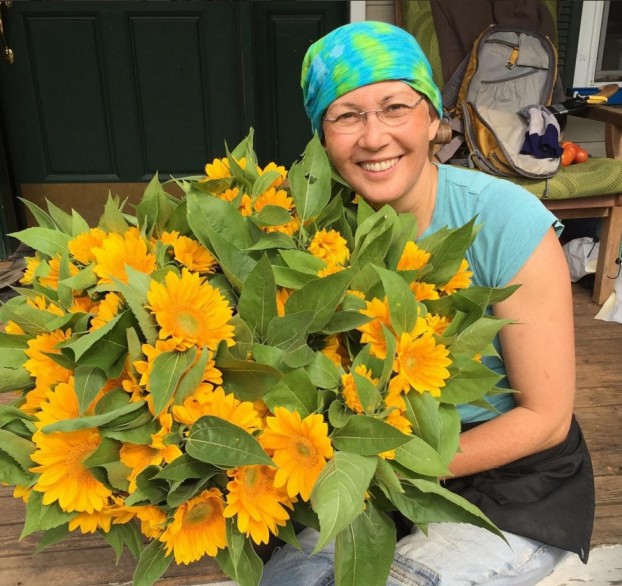
Today’s amazing guest, Dennis Westphall, is co-founder of Jello Mold Farm in Mt. Vernon, Washington, which he operates with his wife and partner Diane Szukovathy. Diane may be familiar to you because she’s appeared on two prior episodes of the Slow Flowers Podcast – and she is the “cover girl” of the 50 Mile Bouquet (along with floral designer Stacie Sutliff).

Dennis is an accomplished mixed media artist and an award-winning singer-songwriter who has nearly 200 original songs to his credit.

I will let you hear the story directly from Dennis, as he shares his inspiring career path, one that takes us from the era when he was a street musician at Seattle’s Pike Place Market to his success as a founding member of the band Tickle Tune Typhoon, to the past decade when he transitioning into a flower farmer, and much much more.

Interspersed between our fascinating conversation, Dennis will perform several songs for your holiday enjoyment.

The first of many Tickle Tune Typhoon albums features Dennis Westphall on the cover with his fellow band members. The album is a winner of the Parents' Choice Gold Award and the American Library Association's Notable Children's Recording Award.

The first of many Tickle Tune Typhoon albums features Dennis Westphall on the cover with his fellow band members. The album is a winner of the Parents’ Choice Gold Award and the American Library Association’s Notable Children’s Recording Award.

Two are original compositions, both lyrics and music, and two are classic songs that have been given the whimsical Dennis Westphall “new lyric” treatment.

I know you’ll love this episode as much as I do — a gift from Dennis to the flower farming and floral design community to enjoy this holiday week.

Check out more details about Tickle Tune Typhoon’s retro vinyl albums and CDs of the foot-stamping, finger-snapping music that has delighted school children and their families for generations.

Thank you so much for joining me today for this very special episode.

I love how Dennis describes flower farming as a botanical art-supply source for the florists who purchase flowers from Jello Mold.

It’s such an appropriate metaphor for the important, interdependent relationship between flower farmers and floral designers — one that brings success to the entire Slow Flowers community.

Watch a recent segment on Seattle’s KING 5 TV (NBC affiliate) with excerpts of Dennis singing

Dennis has generously shared the lyrics to his original song called “Flowers”:

Recorded by Tickle Tune Typhoon on the CD, All Of Us Will Shine
Music and Lyrics by Dennis Westphall

[Chorus]

Flowers aha
Flowers aha
Beautiful colors bloom
Flowers aha
Flowers aha
Blossoms will dance for you

Ah the smell of summer roses
And it’s a dandy day to watch a pansy play
Gracefully they grow
Bouquet on tiptoe
Rising in the sky so blue
Sunflower shines on you

[Chorus]

Flowers grow make the world a grand bouquet
Row on row bringing color to our day
Flowers grow a pleasure to the eye
That fragrance oh it fills the air and makes you sigh
Everybody sigh
I’m so gladiola, you’re gladiola too

Flowers aha Flowers aha
Beautiful colors bloom
Flowers aha Flowers aha
Blossoms will dance
Blossoms will dance for you

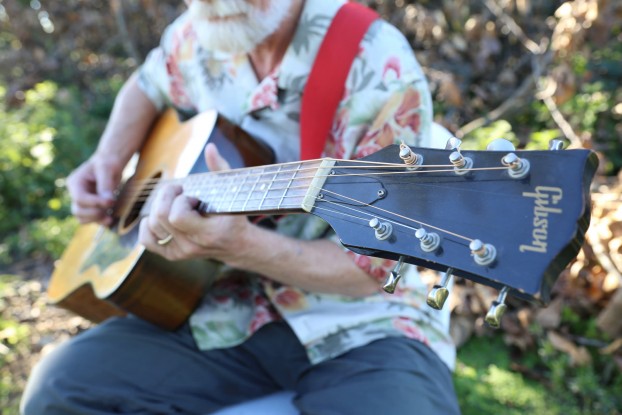
Check out that vintage Gibson guitar!

Check out that vintage Gibson guitar!

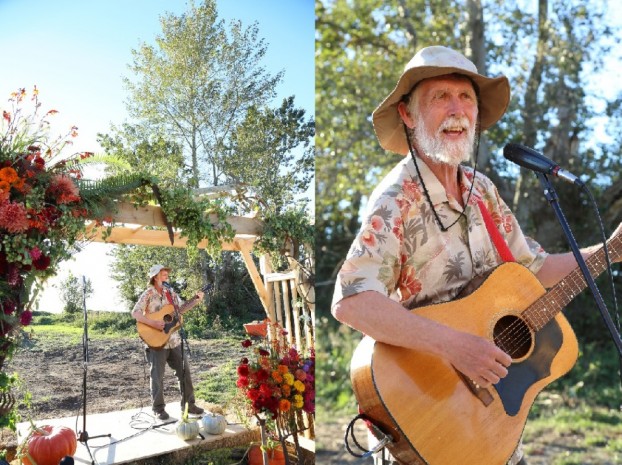
Linda Blue captured Dennis performing at his own farm, Jello Mold, as a special feature of the Field to Vase Dinner Tour in September.

Linda Blue captured Dennis performing at his own farm, Jello Mold, as a special feature of the Field to Vase Dinner Tour in September.

Find Jello Mold Farm on Facebook

Find Jello Mold Farm on Instagram

Hear Diane Szukovathy on Slow Flowers Podcast #103 “Marketing Local Flowers the Co-op Way” and on  #215 “Cooperative Wholesaling Among Farmers”

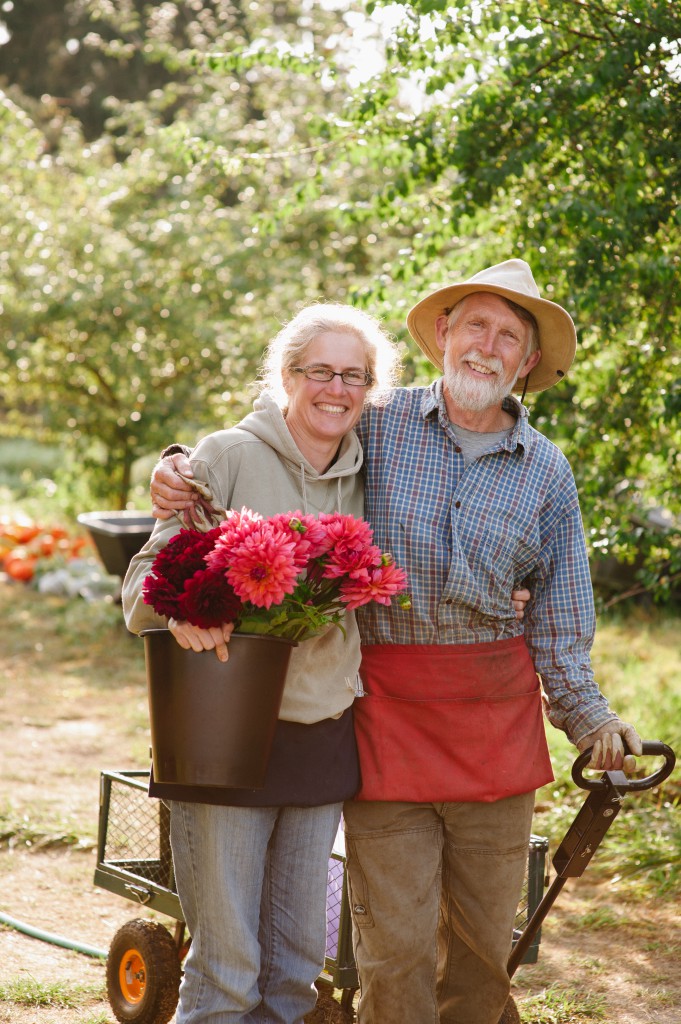
Diane Szukovathy and Dennis Westphall, photographed by Mary Grace Long (c) September 2012 at Jello Mold Farm in Mt. Vernon, Washington.

Diane Szukovathy and Dennis Westphall, photographed by Mary Grace Long (c) September 2012 at Jello Mold Farm in Mt. Vernon, Washington.

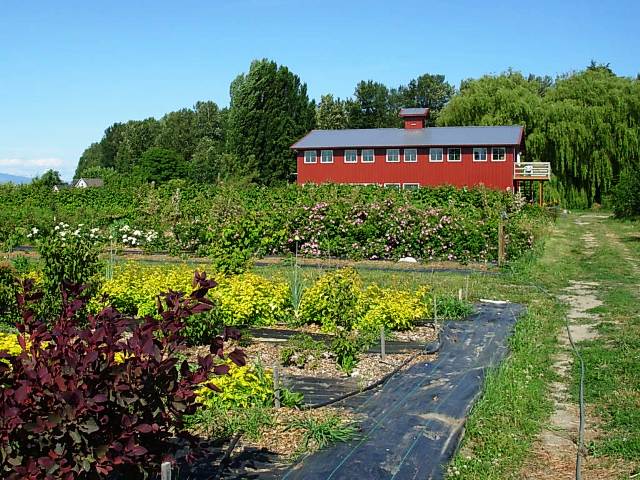
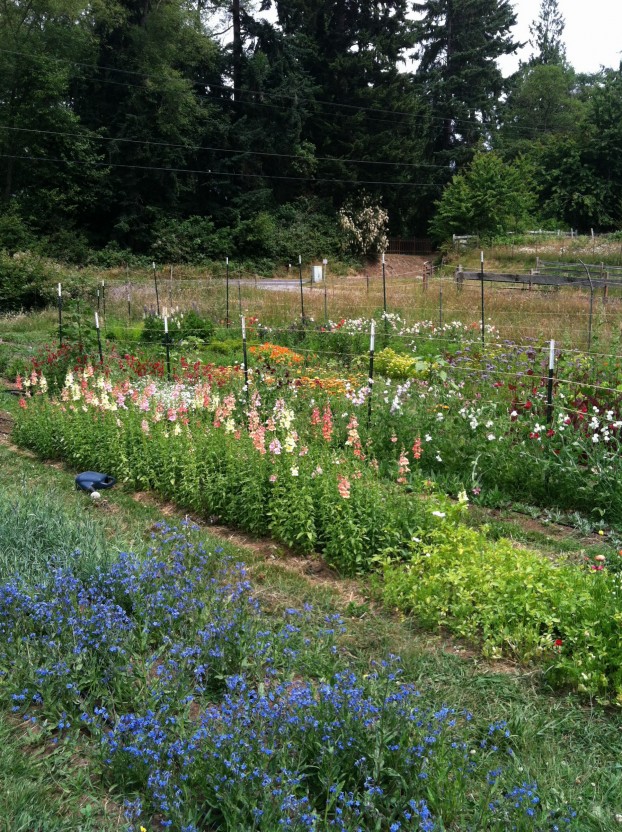
Jello Mold Farm, fields, and barn

Jello Mold Farm, fields, and barn

Next week is our final episode of 2015 and as one year ends and another begins, I will be sharing with you the “2016 Slow Flowers Forecast and Insights.”

In the meantime, I  wish you a wonderful holiday season!

I thank you and others in the progressive American-grown floral community for supporting this endeavor.

Until next week, you’re invited to join me in putting more American grown flowers on the table, one vase at a time. And If you like what you hear, please consider logging onto Itunes and posting a listener review. THANK YOU to each and every one of you for downloading, listening, commenting and sharing. It means so much.

The content and opinions expressed here are either mine alone or those of my guests alone, independent of any podcast sponsor or other person, company or organization.

The Slow Flowers Podcast is engineered and edited by Andrew Wheatley and Hannah Holtgeerts. Learn more about their work at shellandtree.com.

Week 50 // Slow Flowers Challenge

Thursday, December 17th, 2015
Poinsettias as a holiday "cut" -- don't they look dramatic?

Poinsettias as a holiday “cut” — don’t they look dramatic?

The prosaic poinsettia has a new, sexy reputation, especially at a time when floral designers are desperate for beautiful focal flowers to go with all the greenery in our lives.

Begonia + Poinsettia!

Begonia + Poinsettia!

For the past decade the gardening world has watched an explosion of breeding in the poinsettia world. I remember attending a press event in the early 2000s when Molbak’s Nursery in the Seattle area hosted all of us at a breakfast to unveil the new poinsettia colors and varieties (streaked and flecked; and a palette ranging from cream to wine). I wrote that story for The Daily Herald about 15 years ago, so no doubt the news hit the gardening world quite a while ago!

Slowly, floral designers are discovering — and embracing — poinsettias. The flowers are tricky to source as cut options, although I’ve heard from some designers who are able to find poinsettia cuts. We just don’t see them here in Seattle.

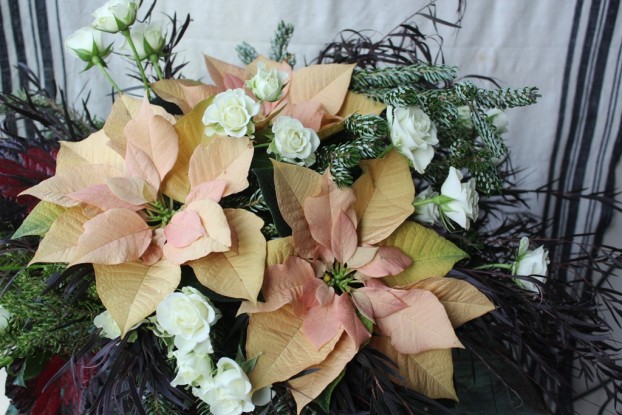
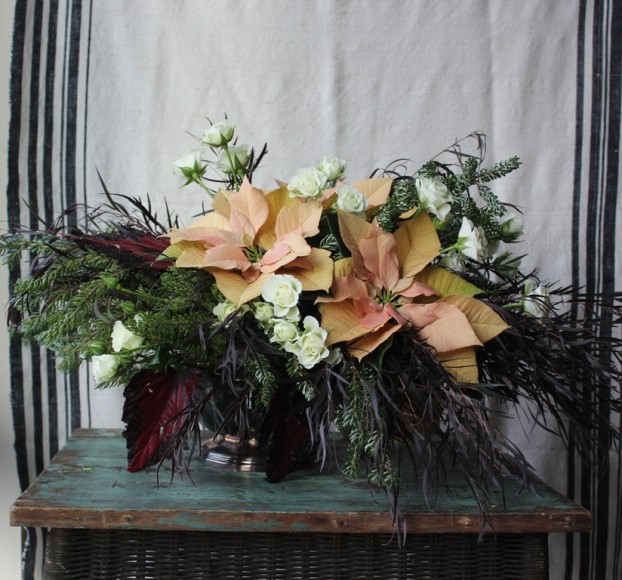
A low silver bowl, tarnished, of course, is the ideal vessel for this holiday centerpiece of poinsettias, spray roses, agonis foliage, rex begonia foliage and Korean fir

A low silver bowl, tarnished, of course, is the ideal vessel for this holiday centerpiece of poinsettias, spray roses, agonis foliage, rex begonia foliage and Korean fir

What’s my other option? I went to Lowe’s this week to find locally-grown poinsettias from Smith Gardens in Bellingham, Washington. I was in search of a soft peachy tone and wasn’t disappointed. The flower I found wasn’t labeled (although I did learn that Noche Buena is the Mexican name for poinsettia).

I found three pots with this beautiful type of poinsettia, $6.98 each. Two of the three had broken stems, with unusable blooms, so Lowe’s sold them to me for $2 each. In all, that netted me 7 huge flowers for $11, which seems like a great price.

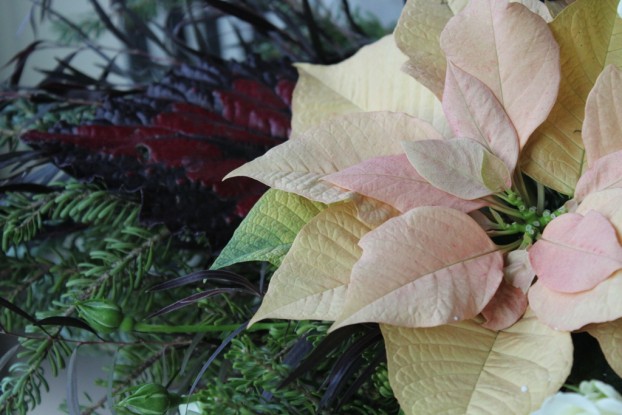
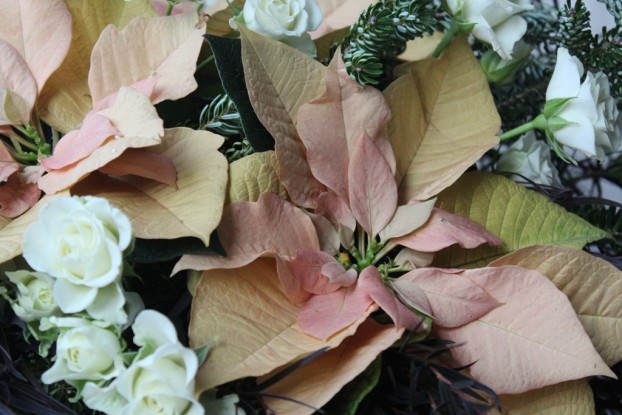
So nice to see these poinsettias as lush cut focal flowers

So nice to see these poinsettias as lush cut focal flowers

Since coming home from the home center, I looked up peach poinsettias online and have decided it’s possible this one is called ‘Visions of Grandeur’, described as a luxuriously rich, yet soft peach/pink/cream plant. But I could be way off because the colors seem to vary as widely as the petals of ‘Cafe au Lait’ dahlias. Either way, it’s lovely, feminine and romantic.

I began my arrangement with a Goodwill purchase from last in August, a silver-plated Gorham fruit bowl. I think I paid $6.99 for it; just found the same bowl on eBay for $35. I’m in bargain heaven with this great-priced bowl and discount poinsettias!

I placed a dome-shaped vintage metal flower frog in the base and added a second “level” of structure with chicken wire, domed at the top of the 9-inch container.

Foliage and branches:

  • Dark purple Agonis flexuosa, California grown, valued for its sultry color and feathery texture
  • A silvery-green fir known in the landscape trade as Korean fir (Abies koreana ‘Horstmann’s Silberlocke’), from Leo’s Trees, a Southwest Washington vendor who sells at the Seattle Wholesale Growers Market. Danielle Bennett, assistant manager at the Market, told me that Leo only brought in two bunches. I understand why because Korean fir is very slow growing so he probably didn’t want to trim so many boughs from the tree! I planted one of these ornamental conifers in a prior garden and I loved its wonderful winter sheen when hit with the afternoon light!
  • Rex begonia foliage, clipped from my houseplant. I love how the raspberry-wine foliage plays off of the Agonis foliage and the scale of each leaf holds its own against the poinsettia blooms.

Flowers:

  • Poinsettias. Following instructions mentioned in my recent blog post about International Poinsettia Day (Dec. 12th), the best way to prepare stems for floral design is as follows: Cut, then dip into hot water 140˚ F for 20 seconds; then plunge into cold water for 10 seconds.
  • ‘Snowflake’ white spray roses, grown by Green Valley Floral in Salinas, California
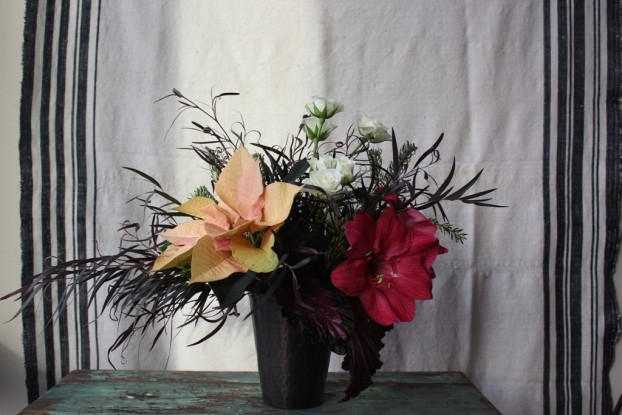
A small bouquet made with "leftovers," including a gorgeous amaryllis!

A small bouquet made with “leftovers,” including a gorgeous amaryllis!

A bonus: I used my leftover pieces to create a couple of small arrangements, which also included the final blooms from two raspberry-hued amaryllis grown by Vivian Larson of Everyday Flowers. I enjoyed these in a larger arrangement last week and the final buds just opened this week.

Celebrate Poinsettia Day with an Incredible “Living” Poinsettia Dress

Friday, December 11th, 2015
Even if you can't fashion your own poinsettia dress for a holiday gala, the good news is that you can cut poinsettias and use them in floral arrangements. 

Even if you can’t fashion your own poinsettia dress for a holiday gala, the good news is that you can cut poinsettias and use them in floral arrangements.

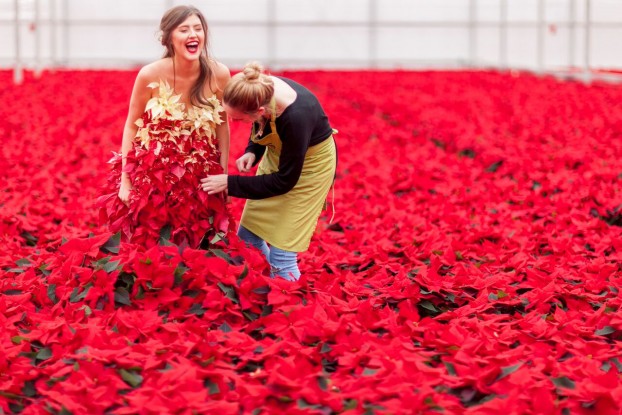
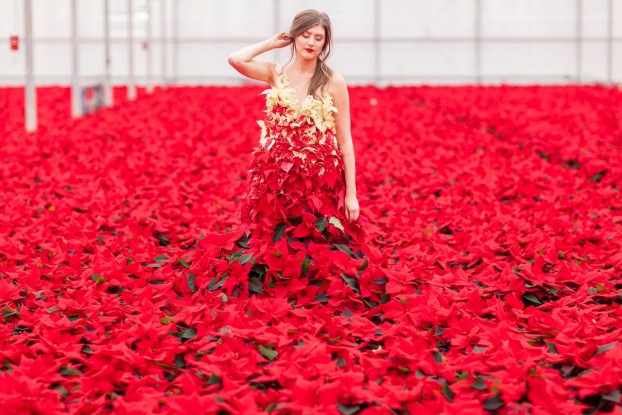
If you’re ambivalent about the traditional Christmas poinsettia, then I’m excited to help change your mind. Check out this gorgous “living” poinsettia gown. Yes, the prosaic holiday potted hostess gift has received haute couture treatment by London-based floral stylists, Okishima & Simmonds, in celebration of International Poinsettia Day, which is tomorrow, December 12th.

Here's a great out-take from the photo shoot as the floral stylist "dresses" her model

Here’s a great out-take from the photo shoot as the floral stylist “dresses” her model

I learned of this holiday from horticulture publicist Liz Anderson and it’s no surprise to learn that she’s also deeply involved in British Flowers Week (the inspiration for our own American Flowers Week).

Hat’s off to Liz and to Chikae Okishima-Howland and Jessica Simmonds, the duo behind Okishima & Simmonds, for bringing a luxe look to the potted Christmas plant. The designers have posted a fabulous behind-the-scenes story of how they created the poinsettia dress, which you can read on their blog here.

I met all three of these talented women when I attended the RHS Chelsea Flower Show earlier this year. They are doing some amazing things to promote British horticulture and floriculture — you can see another of their brilliant executions right here! And aren’t these images by the very talented Julian Winslow quite beautiful?

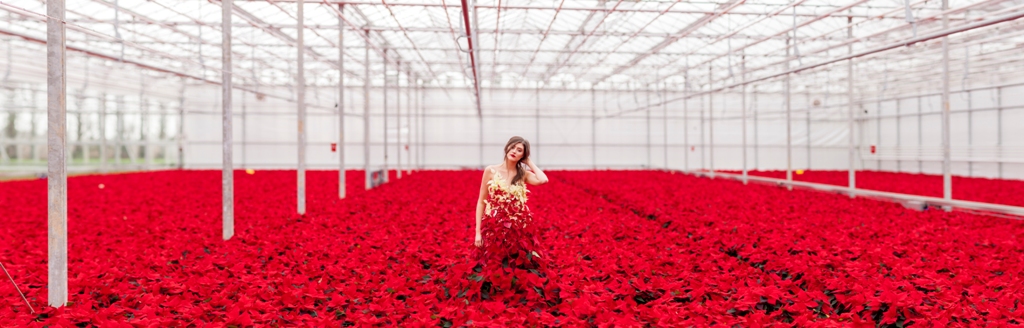
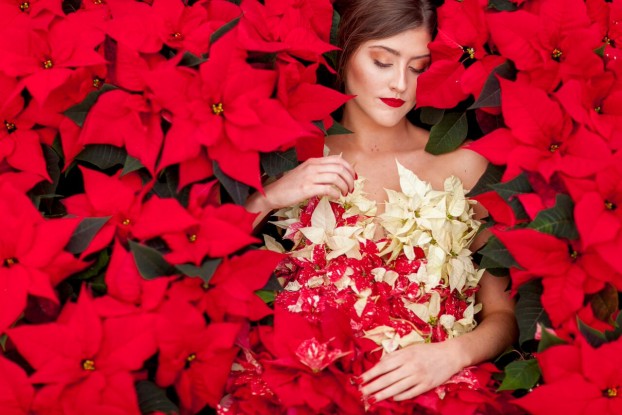
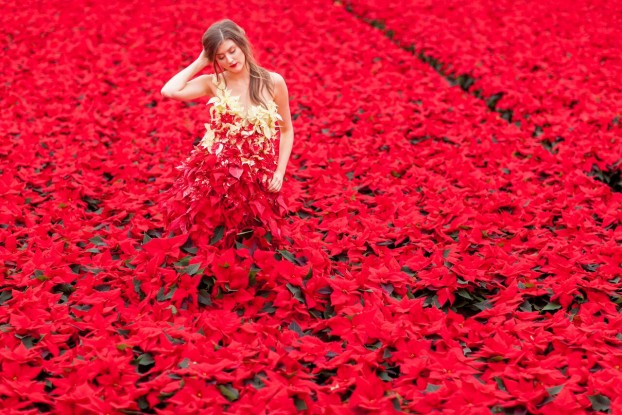
Okishima & Simmonds re-imagined the Christmas classic by fashioning a dramatic ombré gown from over 300 freshly cut stems of red, variegated and cream poinsettia and styling it amongst sea of poinsettia plants.

The sexiest poinsettias I've ever seen!

The sexiest poinsettias I’ve ever seen!

“We love to create unique designs that merge the floral world with the fashion world and International Poinsettia Day has given us an exciting opportunity to do that,” says Simmonds of Okishima & Simmonds, commissioned on the project by Stars for Europe, the EU-wide poinsettia campaign.

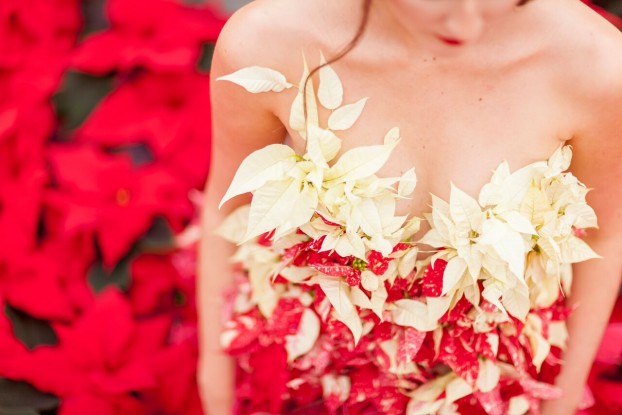
“We wanted the dress to flow so that it looked as though it was growing out of the poinsettia beds beneath, so used the traditional red poinsettia for the skirt and showcased other colors through the bodice.”

Poinsettias are as much a Christmas classic as the Christmas tree itself, and are known as ‘Christmas Stars’ in much of the world.

In 2014, over eight million poinsettia plants were sold in the UK in just two months, an increase of 15% on the previous year, making the poinsettia the best-selling houseplant after the year-round orchid. The poinsettia fashion shoot was set in the vast poinsettia glasshouse of Hill Brothers Nurseries in Chichester.

Bodice detail showing that beautiful ombre styling

Bodice detail showing that beautiful ombre styling

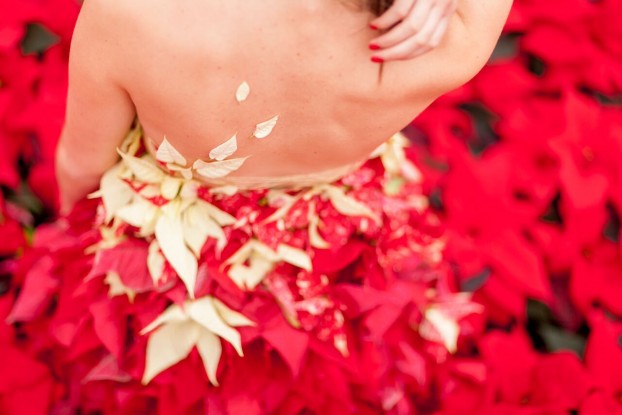
And the back detail is just as lovely

And the back detail is just as lovely

HOW THEY DID IT

After I received the gorgeous photos and Liz’s press material for International Poinsettia Day, I had more questions for her.

She explained: “Our aim was to link the poinsettia with the world of fashion and get people to look at the traditional Christmas plant in a fresh way. The dress looks like being a world first!” (yes, indeed!)

And by the way, just in case you wondered: All the plants used are British grown – the red poinsettias were grown in Chichester and the smaller varieties were grown by Woodlark Nurseries near London.

Fantasy + Fashion + Flowers

Fantasy + Fashion + Flowers

Liz also told me that the poinsettia were cut, then dipped into hot water 60˚C (140˚ F) for 20 seconds then into cold water for 10 seconds. This seals in the sap and makes the poinsettia last longer. Even if you can’t fashion your own poinsettia dress for a holiday gala, the good news is that you can cut poinsettias and use them in floral arrangements.

“Cut poinsettia will last for up to 2 weeks in water if prepared this way. Out of water, such as for this fashion shoot, the cut poinsettia lasted well for 5 hours or so before the leaf bracts started to soften.”

If you’re up for trying a poinsettia floral arrangement, take on the Poinsettia Challenge, just launched by friend Loree Bohl of the fabulous blog “Danger Garden.”

She’s just announced the design-with-poinsettia contest and the deadline is 12/24 to submit photos of your entry! Loree writes:  Send your image to spiky plants at gmail dot com. The contest will close on Christmas Eve, I’ll post the entries during the week between Christmas and New Year’s Day.

wow. just. wow.

wow. just. wow.

About International Poinsettia Day #PoinsettiaDay

International Poinsettia Day is celebrated on December 12th and marks the death of Joel Robert Poinsett, the U.S. diplomat and botanist, who introduced the poinsettia to the United States from Mexico in 1828.

About Okishima & Simmonds                 www.okishimasimmonds.com

Okishima & Simmonds is the partnership of fine art graduates and trained florists, Jessica Simmonds and Chikae Okishima. They use flowers to style weddings, events and fashion shoots from their London studio.

About Hill Brothers, Chichester          
                  
www.hillbrothers.co.uk

The family-owned and managed Hill Brothers Nursery was founded in 1920 and, now based in Chichester, covers over 8 acres of ornamental pot plant production. Hills currently produce approximately 3 million plants a year  – including half a million poinsettias – for the UK consumer and also directly supply UK supermarkets.


Floral stylists: Okishima & Simmonds
Photo credit: Stars for Europe. Photographer – Julian Winslow
Make-up: Harriet Simmonds
Model: Tara Francis-Smith
Grower: Hill Brothers Nursery, Chichester 

Slow Flowers Field Trip to Whidbey Island (Episode 223)

Wednesday, December 9th, 2015
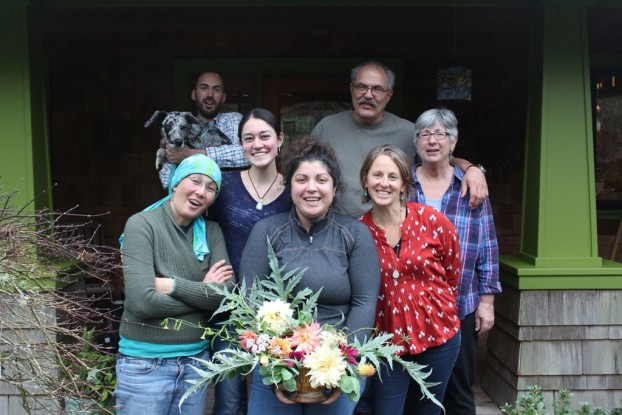
The wonderful Slow Flowers people of Whidbey Island. Front row, from left: Pam Uhlig, Kelly Uhlig, Melissa Brown, Tobey Nelson. Back row: Benjamin Corteau, David Brown and Molly Brown.

The wonderful Slow Flowers people of Whidbey Island. Front row, from left: Pam Uhlig, Kelly Uhlig, Melissa Brown, Tobey Nelson. Back row: Benjamin Courteau, David Brown and Molly Brown.

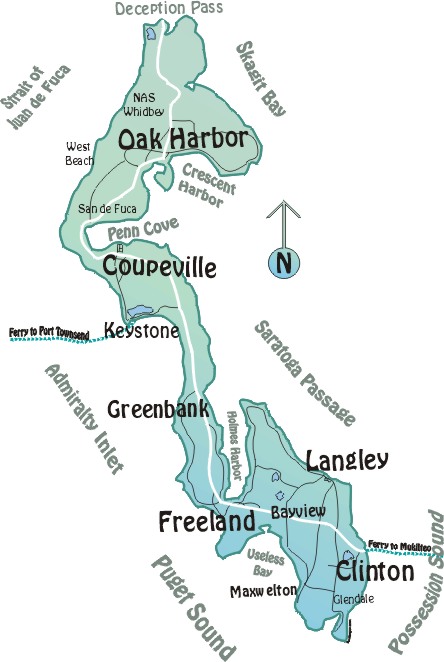
Here's a map of Whidbey Island to orient you! Notice the town of Langley on the southeast portion of the map and you can picture where today's guests live, farm and flower!

Here’s a map of Whidbey Island to orient you! Notice the town of Langley on the southeast portion of the map and you can picture where today’s guests live, farm and flower!

This week we’re introducing a new ongoing feature that I hope to bring to you once a month: the “Slow Flowers Field Trip.”

As you know, I love interviewing flower farmers and florists for this Podcast, but what I love even more is visiting them in person to see them in their element — whether that’s out in the shed starting seeds, in the fields harvesting, or in the studio creating something breathtaking.

As often as possible, I’ll hit the road and visit Slow Flowers members to share a snapshot of a community, highlighting what’s grown in that region, and introducing you to the people who grow and design with those flowers.

For 2016, we’ve already booked a field trip to feature the North Bay Flower Collectivenorth of San Francisco, and several other destinations are in the works.

If you’re interested in bringing the podcast to your corner of the U.S., get in touch and we’ll see what might come together.

While it’s located only 30 miles north of Seattle, visiting Whidbey Island takes a little planning because it is reached via ferry from the mainland. The island is notable as one of the longest islands in the country, at 55-miles long, and it lies between the Olympic Peninsula and the I-5 corridor of western Washington. Whidbey Island forms the northern boundary of Puget Sound.

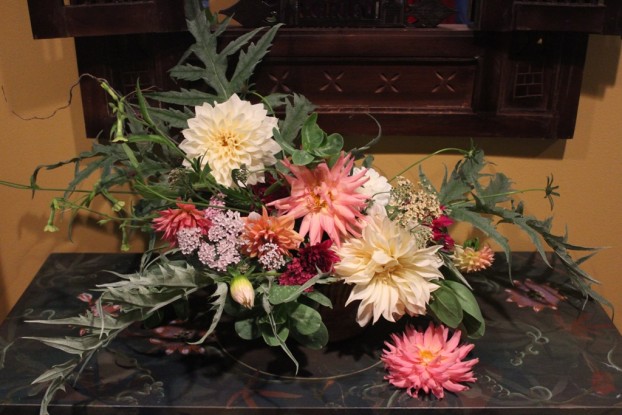
Picked on November 12th - pre-frost! Melissa Brown of Flying Bear Farm grew and designed this lovely arrangement for my visit.

Picked on November 12th – pre-frost! Melissa Brown of Flying Bear Farm grew and designed this lovely arrangement for my visit.

In my earlier years as a garden writer, Whidbey was a magnet for fantastic specialty plant nurseries and private garden tours, so I have spent quite a bit of time there. Now, thanks to the efforts of today’s guests, there is a nascent cut flower farming community, which is essential to Whidbey’s destination wedding scene.

A few weeks ago, I took a day trip to Whidbey, driving north to the waterfront community of Mukilteo, where I caught the 20-minute ferry ride across Puget Sound to Clinton, on the southern tip of the island. My three stops were concentrated on the southern half of the island, in and around the town of Langley, where there’s a mix of tourism, businesses serving vacationers and owners of second homes, as well as small agriculture.

Let me introduce you to the guests you’ll hear in this extended one-hour episode:

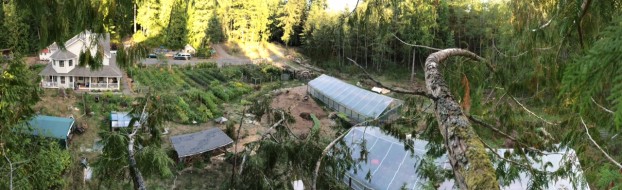
A bird's eye view of Sonshine Farm

A bird’s eye view of Sonshine Farm, photographed by a tree-trimmer who was working there

Kelly Uhlig (left) and mom Pam Uhlig (right)

Kelly Uhlig (left) and mom Pam Uhlig (right)

On my first stop, I visited Pam Uhlig and her daughter Kelly Uhlig, flower farmers who own Sonshine Farm, a specialty cut flower farm that packs more stems into a small homestead than you can imagine.

While pursuing a horticulture degree at a local community college Pam apprenticed with Vivian Larson of Everyday Flowers (a past guest of this podcast) – and that’s where I saw her in action. Kelly, a 4-H superstar who’s herself now a college student, is just as committed to flower farming as her mom. Together the two make a dynamic team; they are now members of the Seattle Wholesale Growers Market, where the local floral community snaps up their gorgeous flowers.

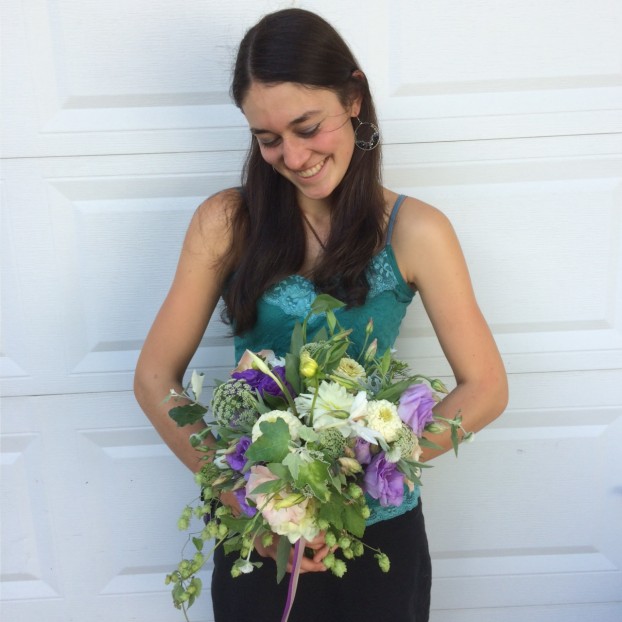
Kelly, with one of her bouquet creations, grown & designed

Kelly, with one of her summer bouquet creations, which she grew & designed

Pam poses with 'Vincent Fresh' ~ a favorite sunflower she grew last summer.

Pam poses with ‘Vincent Fresh’ ~ a favorite sunflower she grew last summer.

Melissa Brown (c) Jenna Bechtholt Photography

Melissa Brown (c) Jenna Bechtholt Photography

After interviewing Pam and Kelly and taking a tour of their farm, I went to meet Melissa Brown of Flying Bear Farm. Melissa is a farmer-florist interested in growing flowers for her own floral design business.

We met up first on a parcel that a friend has invited Melissa to plant with flowers, which is where we recorded our podcast interview.

And then . . . Melissa took me to the Flying Bear Farm headquarters, just outside Langley. That’s where she and her husband Benjamin Courteau have just moved, along with Melissa’s parents Molly & David Brown, into a fabulous compound complete with a barn, two residences, an art studio, and lots of terra firma for growing flowers.

Melissa’s folks treated all of us to a delicious luncheon where the conversation only got better with more creative voices around the table.

Benjamin Courteau, field harvesting for Flying Bear Farm.

Benjamin Courteau, field harvesting Flying Bear Farm’s snapdragons

Here's the land that a friend has lent Melissa and Benjamin to grow flowers on Whidbey Island.

Here’s the land that a friend has lent Melissa and Benjamin to grow flowers on Whidbey Island.

A floral creation from Flying Bear Farm

A floral creation from Flying Bear Farm

A Flying Bear Farm tabletop design ~ lovely!

A Flying Bear Farm tabletop design ~ lovely!

Tobey Nelson of Vases Wild

Tobey Nelson of Vases Wild

After lunch, I grabbed some time with our final guest, Tobey Nelson of Vases Wild.

Tobey and I have been talking about this emerging Whidbey Island flower farming-floral design community for a couple of years so I credit her with pulling together my field trip.

She has an extensive background in landscape design, fine gardening and wedding & event florals, which makes Tobey particularly passionate about sourcing from local flower farms on Whidbey Island.

That said, it’s not unusual for her to jump on an early-morning ferry to come into Seattle where she shops for flowers grown by the farms of the Seattle Wholesale Growers Market.

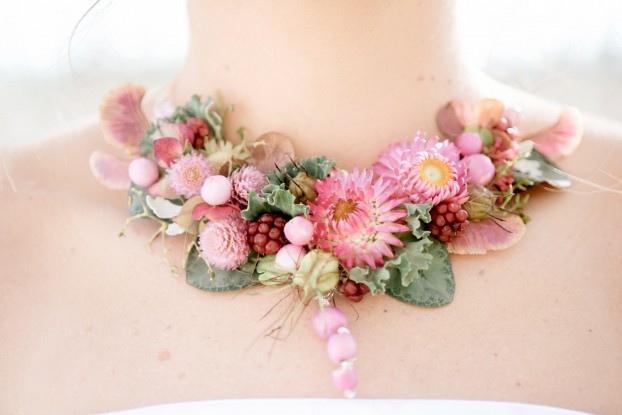
Floral necklace by Vases Wild's Tobey Nelson (c) Suzanne Rothmeyer Photography

Floral necklace by Vases Wild’s Tobey Nelson (c) Suzanne Rothmeyer Photography

Wedding arbor by Vases Wild's (c) image by Scott O'Malley

Wedding arbor by Vases Wild’s (c) image by Scott O’Malley

Bridal bouquet by Vases Wild's Tobey Nelson (c) Mazagran Photography

Bridal bouquet by Vases Wild’s Tobey Nelson (c) Mazagran Photography

Please enjoy each guests’ unique perspective on growing flowers, island style. They are building a creative interdependence that is a small-scale model of what can and should happen in every community where flower farmers and florists come together.

Here’s how you can find & follow the Whidbey Island creatives:

Sonshine Farm, Pam Uhlig and Kelly Uhlig on Instagram

Flying Bear Farm, Melissa Brown and Benjamin Courteau on Facebook

Flying Bear Farm on Twitter

Flying Bear Farm on Pinterest

Flying Bear Farm on Instagram

Vases Wild, Tobey Nelson on Facebook

Vases Wild on Pinterest

Vases Wild on Instagram

Thank you so much for joining me today. Episodes of the Slow Flowers Podcast have been downloaded more than 74,000 times and I thank you and others in the progressive American-grown floral community for supporting this endeavor.

Until next week, you’re invited to join me in putting more American grown flowers on the table, one vase at a time. And If you like what you hear, please consider logging onto Itunes and posting a listener review. THANK YOU to each and every one of you for downloading, listening, commenting and sharing. It means so much.

The content and opinions expressed here are either mine alone or those of my guests alone, independent of any podcast sponsor or other person, company or organization.

The Slow Flowers Podcast is engineered and edited by Andrew Wheatley and Hannah Holtgeerts. Learn more about their work at shellandtree.com.

Orchids for floral design with Joan Bateman of Orchidaceae (Episode 222)

Wednesday, December 2nd, 2015
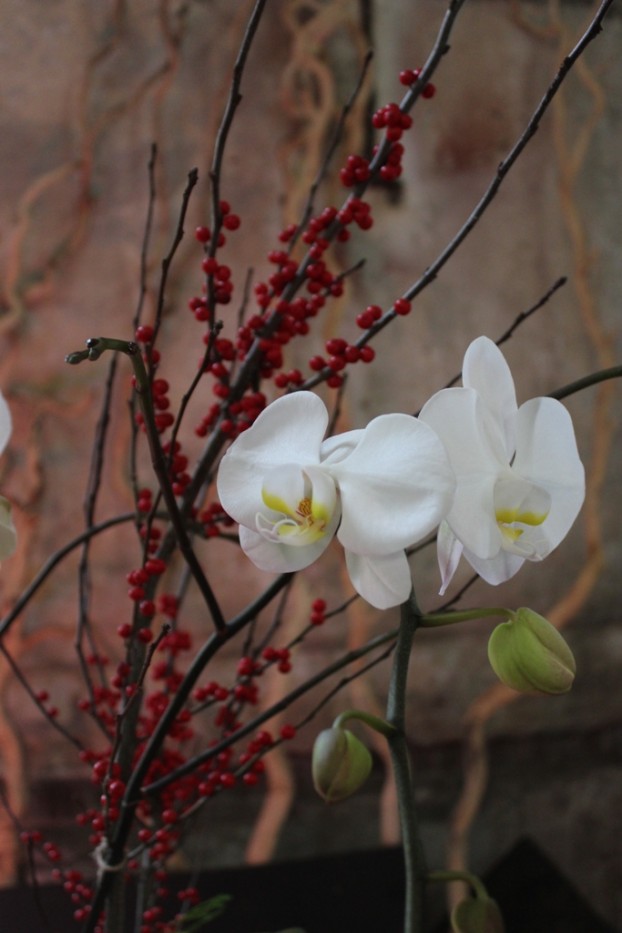
White phalaenopsis from Orchidaceae paired with red ilex from Charles Little & Co., designed by Chad Burnworth of Seattle-based Blue Hummingbird Botanical Studio.

White phalaenopsis from Orchidaceae paired with red ilex from Charles Little & Co., designed by Chad Burnworth of Seattle-based Blue Hummingbird Botanical Studio.

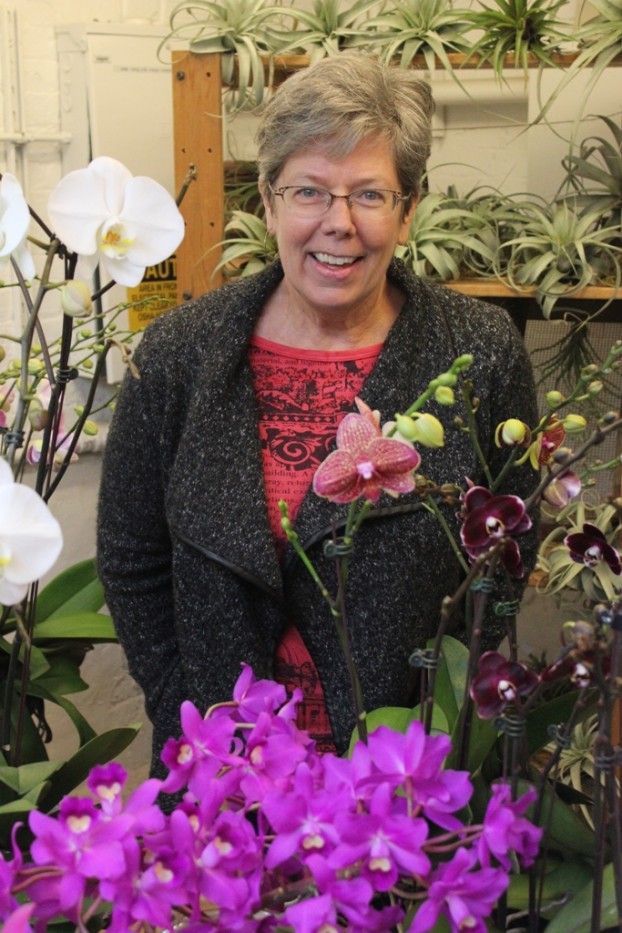
Joan Bateman of Orchidaceae

Joan Bateman of Orchidaceae

It’s not yet officially winter, but orchid season is upon us. And today’s guest will tell us all about growing orchids for floral design.

Please meet Joan Bateman, who with her husband Mark Srull own Orchidaceae.

Joan and I have served together on the board of the Seattle Wholesale Growers Market for two years, and we work closely together on the market’s marketing committee.

I’ve wanted to feature an orchid episode for quite some time!

Joan and I finally sat down a few weeks ago, surrounded by the beautiful plants she and Mark grow, to record this conversation and share it with you.

Here’s a little more about Orchidacead:

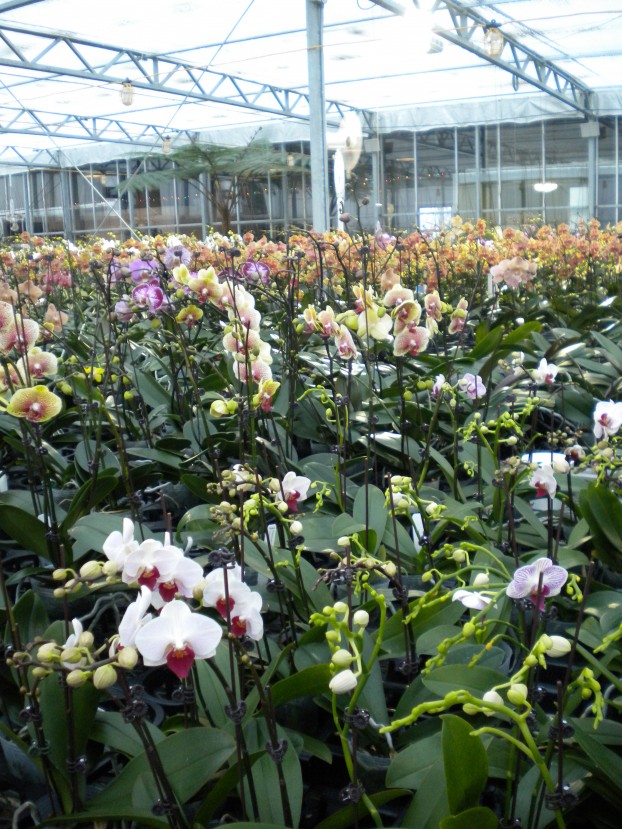
Inside the greenhouses at Orchidaceae in Walla Walla, (eastern) Washington

Inside the greenhouses at Orchidaceae in Walla Walla, (eastern) Washington

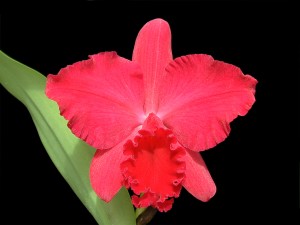
A gorgeous Cattleya

A gorgeous Cattleya

Based in Walla Walla, Washington, Orchidaceae is an award-winning Northwest grower exclusively dedicated to quality orchids.

With over 30 years of experience, Mark and Joan grow and supply orchids for weddings, special events, interior plantscaping, floral arrangements and to collectors around the country in search of esoteric orchid varieties.

In 2002, the couple moved their nursery from Seattle to Walla Walla and embarked on a rural, flower farming lifestyle.

They brought with them extensive experience in graphic design and marketing, and Mark’s enthusiasm for growing orchids, originally as a hobby that’s earned him numerous awards from the American Orchid Society.

Orchidaceae has a reputation for having the most interesting new orchid hybrids. Its breeding program that includes Paphiopedilums, Zygopetalums, Angraecums, Cattleyas and a variety of unique species. The Phalaenopsis are selected to give floral stylists a distinct design edge with stunning color, interesting patterns and unique styles.

Why Walla Walla? “Even though our major markets are in Seattle and Portland, the growing conditions are very positive here, because of the light,” Joan says.  “We’re excited to be a part of the market and have such a broad variety of our orchids available to Seattle buyers.”

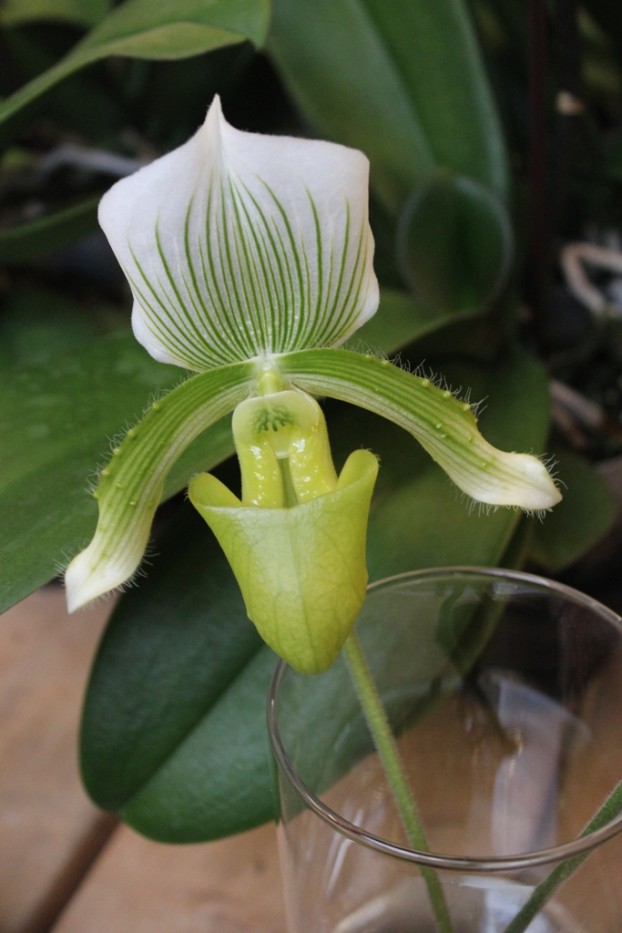
Here is the rare, 1940s-era lady slipper 'Clare de Lune', that Joan and I discussed.

Here is the rare 1940s-era lady slipper ‘Clare de Lune’, that Joan and I discussed.

If you want to learn more about orchid growing and how to have success with orchids, check out the link to Orchidaceae’s answers to the most common questions for orchid care. In the Pacific Northwest you can find Joan and Mark’s beautiful plants at the Seattle Wholesale Growers Market and at the Portland Flower Market.


Listeners of the Slow Flowers Podcast have downloaded episodes more than 73,000 times. I thank you and others in the progressive American-grown floral community for supporting this endeavor.

Until next week, you’re invited to join me in putting more American grown flowers on the table, one vase at a time. And If you like what you hear, please consider logging onto Itunes and posting a listener review. THANK YOU to each and every one of you for downloading, listening, commenting and sharing. It means so much.

The content and opinions expressed here are either mine alone or those of my guests alone, independent of any podcast sponsor or other person, company or organization.

The Slow Flowers Podcast is engineered and edited by Andrew Wheatley and Hannah Holtgeerts. Learn more about their work at shellandtree.com.

Objects of Desire: Best Gifts for Florists and Flower Lovers (Episode 221)

Wednesday, November 25th, 2015

Gifts for flower loversWelcome to the first edition of the Slow Flowers’ “Best Gifts for Florists and Flower Lovers.”

The holiday season is upon us and today’s episode will accomplish several things. I created this special gift-themed segment to highlight some of my favorite artisan-made products that I’ve become familiar with in the past year or longer.

Second, I wanted to share the voices of “makers” with you. All are women this year, but that is just a happy coincidence (I’m sure we’ll find many male makers to highlight in the future). I recorded short conversations with each of these select artisans. Each is driven to create beautiful and high-quality products inspired by flowers, botany and nature.

Please enjoy these conversations and check out these artist-makers, their work, and – most importantly, links to their online stores so you can see their collections of American-made goods for gift-giving. Have an unforgettable Floral Holiday and moreover, be inspired by the creative entrepreneurs you’ll hear from today.

PHOTOGRAPHIC TAPESTRIES

American artist-maker Ellen Hoverkamp

American artist-maker Ellen Hoverkamp

First up, meet botanical photographer Ellen Hoverkamp of My Neighbor’s Garden.

I’ve written about Ellen’s work for the Los Angeles Times and for Garden Design Magazine, so over the past few years, we’ve become friends.

It was especially rewarding to have Ellen attend an all-day workshop I taught at Blithewold Mansion in Rhode Island last fall – and to see how readily this gifted artist moves from one medium to another.

A Connecticut-based artist and former art teacher, Ellen Hoverkamp first started composing images from nature using an early model flatbed photo scanner in 1997, she didn’t even own a camera. Nor did she know the names of most of the plants she used. “It was all about form and color for me.”

jennifers_peonies

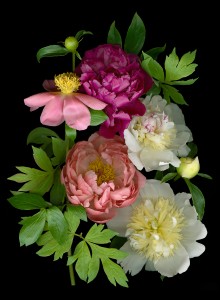
Peonies, a fine art image by Ellen Hoverkamp

tlf_farmstand

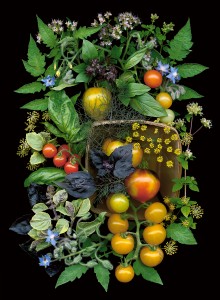
From the farmstand, a fine art image by Ellen Hoverkamp

Fast-forward to 2005 and Hoverkamp’s evocative and artful assemblages of botanicals and edibles were profiled in The New York Times; they’ve since been exhibited in museums and graced covers of books and periodicals.


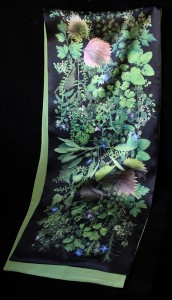
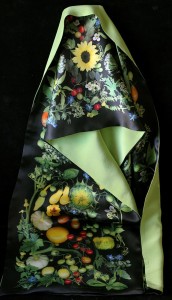
An herb garden, printed on silk as a lovely scarf.

An herb garden, printed on silk as a lovely scarf.

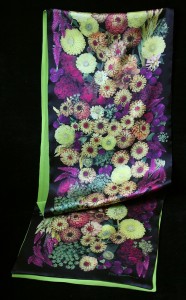
Here's that gorgeous Queen Red Lime Zinnia + Celosia image, printed on silk

Here’s that gorgeous Queen Red Lime Zinnia + Celosia image, printed on silk

A summer kitchen garden on silk

A summer kitchen garden on silk


Ellen arranges flowers, pods, branches, vines, gourds and roots as vivid still-lifes against striking black backdrops.

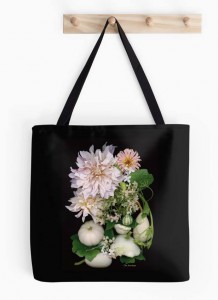
Dahlias printed on black canvas tote bags.

Cafe au lait dahlias, with gourds, printed on black canvas tote bags.

I like to imagine that if Ellen had been born three or four centuries ago, she would have been a Dutch master painter. “I love the hyper-real details of my images,” she says.

Ellen relies on cuttings from public gardens, nurseries and private landscapes to create her pieces. She says that the mission of her work is to bring attention to the efforts of gardeners and to the beauty of nature.

At Ellen’s web site you can find a beautiful online store with her photographic products, including signed prints, note cards and my favorite– photographically printed scarves.

Ellen is a renaissance woman. Her 12-by-58-inch scarves feature seasonal floral and botanical compositions printed on silk charmeuse. The reverse side is hand-died contrasting fabric and Ellen custom sews each one.

In addition to drooling over Ellen’s botanical scarves, I know you’ll want to peruse the fine art work on her web site. You can order prints of most of the floral and veggie compositions there – and there are hundreds to choose from. Ellen posts new work each week on her Facebook page, so check out my link to find and follower her there.

Finally, you can now order her beautiful black canvas tote bags featuring a cornucopia of edibles or a just-picked-from-the-garden floral array. Click here to order.

SEATTLE MADE TO CONTAIN YOUR STEMS

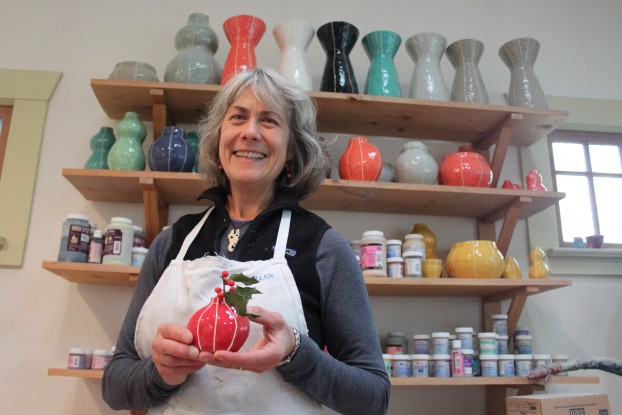
Kristin Nelson, American maker and ceramicist, poses with some of her beautiful vases.

Kristin Nelson, American maker and ceramicist, poses with some of her beautiful vases.

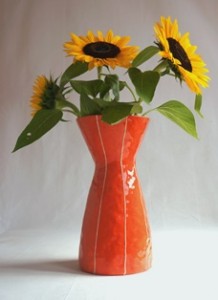
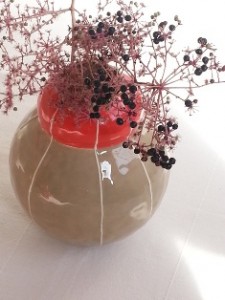
Next up, please meet Kristin Nelson of Kri Kri Studio, a Seattle-based ceramic artist whose vases are popular favorites of the local floral design community here and far beyond, including Barney’s stores in Japan.

I’ve selected Kristin’s vessels to present my All-American floral entries at the Northwest Flower & Garden Show for the past two years. Learn more about her story here.

It seems so fitting to combine locally-grown flowers gathered in vases of equal quality and beauty, made by a talented artisan who touches every single product that leaves her studio.

Eve, the lovely, sensual vase by Kristin Nelson, shown in coral glaze

Eve, the lovely, sensual vase by Kristin Nelson, shown in coral glaze

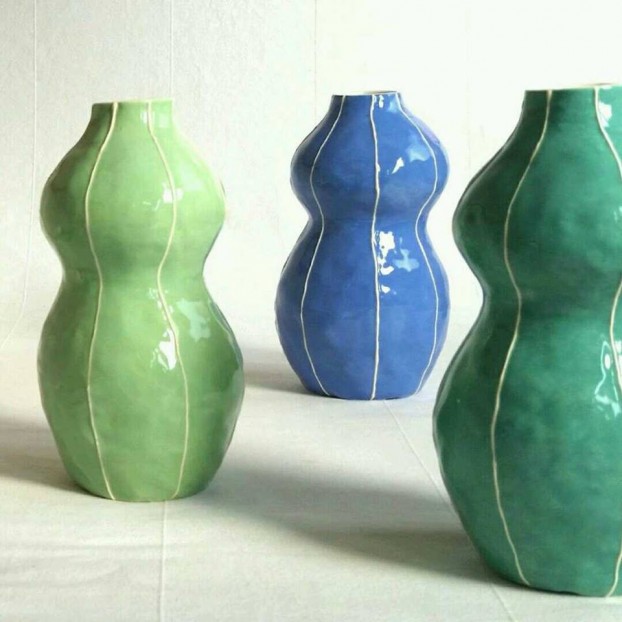
The VIT bubble vase, one of my favorites!

The VIT bubble vase, one of my favorites!

Kristin’s new VIT Collection is modern and clean, inspired by Scandinavian design and a perfect complement to any flower in any season.

I love Kristin’s color sensibility in the glazes she selects — everything from calming neutrals to joy-inducing brights.

If you’re in Seattle, you may want to check out Kristin’s upcoming studio sale in early December where you’ll meet the artist and get to choose the perfectly-imperfect hand-made vase just for yourself or perhaps as a gift for a special recipient. Kri Kri Studio’s Facebook Page will have more details – so check it out here.

Kristin also shared details and links to these upcoming Seattle events, where you can meet the artist and purchase her lovely pieces:

Clementine PoP uP, Nov- Jan

Praxis Arts, Sat. Nov 28th  

Multi Studio Event, Dec 12th & 13th

To be on Kristin’s mailing list for her annual sale, email her at krikristudio@aol.com

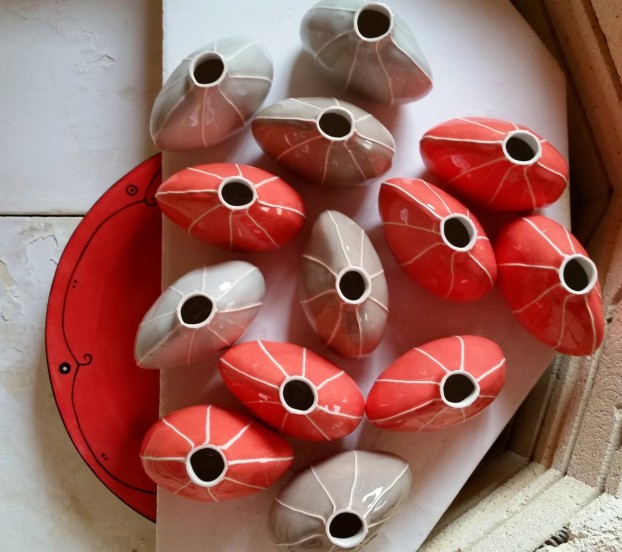
Bud vases look great grouped together!

Bud vases look great grouped together!

VIT Torso Vases

VIT Torso Vases

HAND-LETTERED AND HAND-MADE

Karen Plarisan (left) and Karly Sahr (right) of Vebena Flowers + Trimmings

Karen Plarisan (left) and Karly Sahr (right) of Vebena Flowers + Trimmings

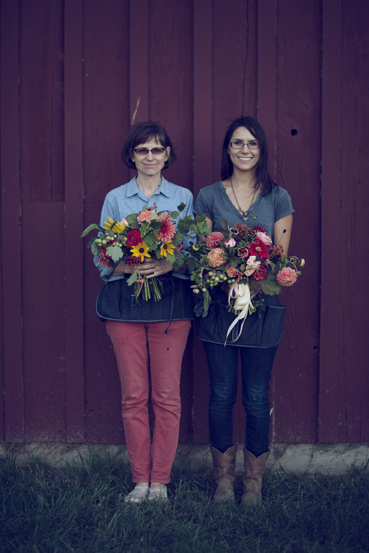
Next up, please meet Karen Plarisan and Karly Sahr of Verbena Flowers & Trimmings based in Roseville, California.

The mother-daughter team lives and breathes flowers. Karly Sahr has a graphic design and art degree from U.C. Davis, while mom Karen Plarisan has a landscape design and horticulture background.

They gather inspiration from being surrounded by nature, so it is only fitting that Verbena has developed into a pesticide-free farm and flower design studio.

In addition to floral design work, the two have added an online store that features Karly’s creative product designs.

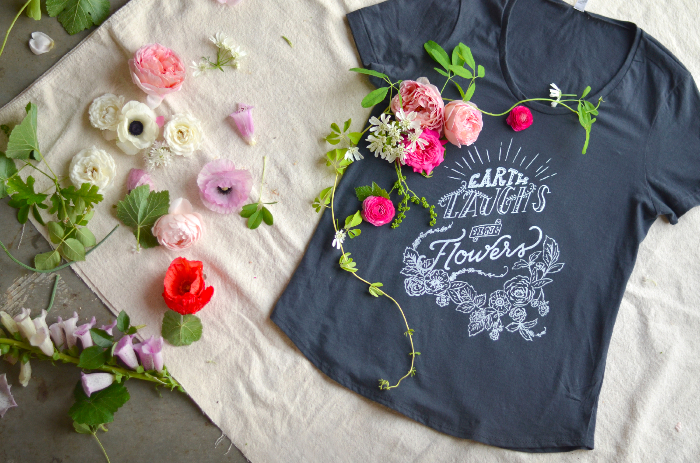
I want to highlight the “Earth Laughs With Flowers” t-shirt featuring Karly’s exquisite hand-lettering.  She and Karen gifted me a very special tote bag with that same screen print last year and I can’t tell you how many people stop and ask me how they can purchase that tote. The totes aren’t available right now, but the t-shirts are. I know the design will resonate with flower farmers and florists alike.

"Earth Laughs in Flowers," a soft, flattering, American-made T-shirt with a charming hand-lettered message.

“Earth Laughs in Flowers,” a soft, flattering, American-made T-shirt with a charming hand-lettered message.

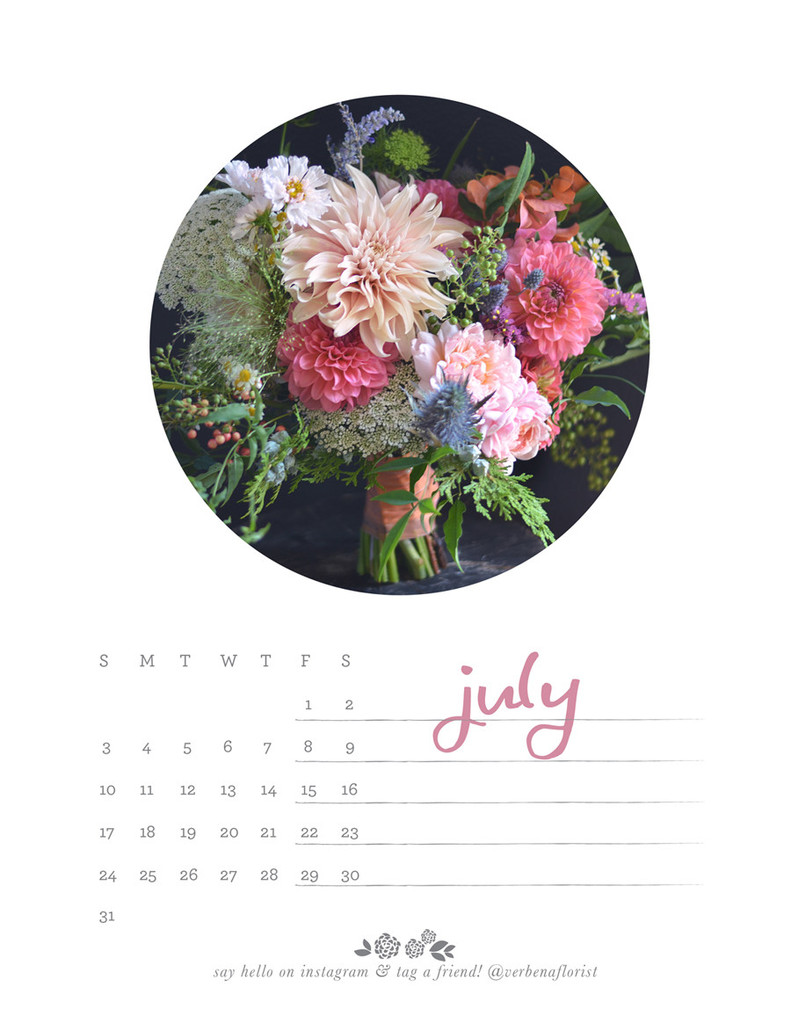
Downloadable 2016 calendar featuring florals by Verbena's mom-daughter farmer-florists

Downloadable 2016 calendar featuring florals by Verbena’s mom-daughter farmer-florists

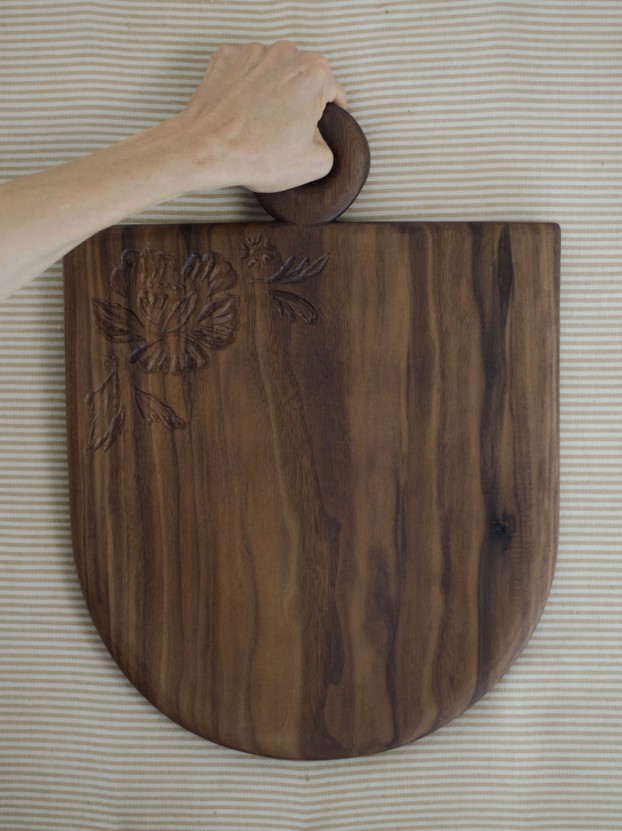
Karly's walnut cutting board designs are modern and make a special gift.

Karly’s walnut cutting board designs are modern and make a special gift.

This week you’ll find a sale going on 30 percent off t-shirts, stickers and all graphic downloadsthrough November 29th. And Karen and Karly are offering a free “Life in Color” download with every purchase. It’s just the thing to add to your own inspiration board or to print and give a friend who needs a creative lift.

LUXURIATE WITH HANDMADE SOAPS & BODY PRODUCTS

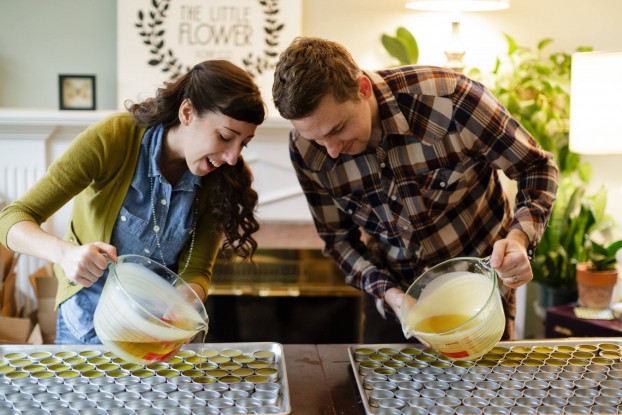
Holly and Justin Rutt of the Little Flower Soap Co.

Holly and Justin Rutt of the Little Flower Soap Co.

downloadNext up, please meet Holly Rutt of the Little Flower Soap Co., based in Michigan. Holly spends most of her time during the warmer months running Sweet Pea Floral Design, serving wedding clients, but when the temperatures drop, she turns her focus to a joint maker-project with her husband Justin Rutt.

The Little Flower Soap Co. is a small batch, body care company established in 2010.

Holly and Justin’s mission is to design products that become must-have, can’t live without favorites. They have developed completely natural, healing recipes that smell amazing, really work and are cutely packaged.

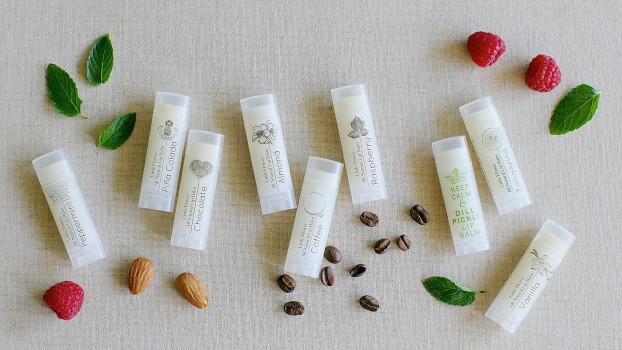
All Natural Chapstick made in small batches with lots of care loaded up with generous portions of the greatest ingredients especially shea butter, jojoba, vitamin E oil & hemp oil

All Natural Chapstick made in small batches with lots of care loaded up with generous portions of the greatest ingredients especially shea butter, jojoba, vitamin E oil & hemp oil

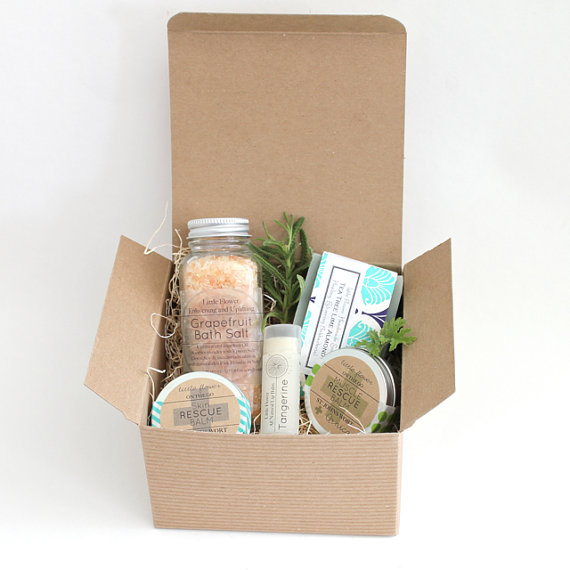
The complete spa gift package - a great gift to give and receive

The complete spa gift package – a great gift to give and receive

Please enjoy this short interview with Holly.

It’s too bad you can’t smell all these wonderful fragrances we’re talking about, but her prices are so affordable that you can easily order a few products to give as gifts, but save one yourself.

Holly’s enthusiasm for her products are contagious. There’s something for everyone cooking up in the kitchen at Little Flower Soap Co.

Check out all of the products here.

And a quick note – you’ll meet Holly wearing her floral designer hat in an upcoming segment of The Slow Flowers Podcast when I interview her about the flower-filled bathroom she designed for The Flower House in Detroit. so stay tuned.

SUSTAINABLE FLORA FASHION

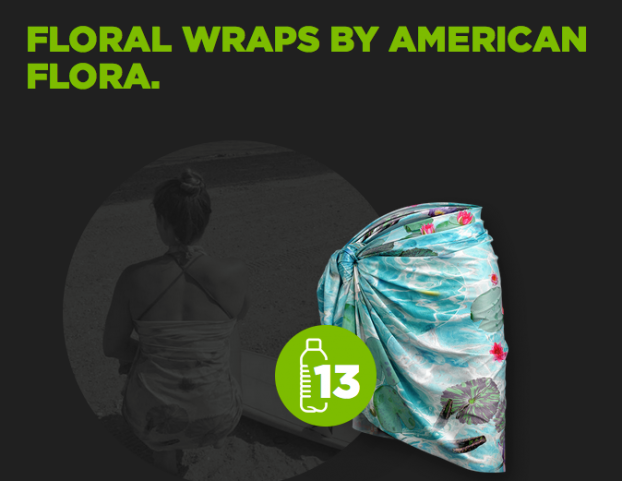
Floral wraps by American Flora ~ made from recycled water bottles!

Floral wraps by American Flora ~ made from recycled water bottles!

Mary Brewster, president and founder of American Flora, a sustainable fashion company and all-American maker.

Mary Brewster, president and founder of American Flora, a sustainable fashion company and all-American maker.

My final gift selection introduces you to Mary Brewster of American Flora, a sustainable fashion company based in Connecticut. I hope you’ll enjoy the story of how we met and about Mary’s goal of sourcing textiles and manufacturing women’s fashion here in the U.S.

I’m so pleased to feature this All-American maker who’s charting new territory in women’s fitness and lifestyle apparel.

Mary’s inspiration for starting American Flora came largely from being a ballet dancer and teacher. She wanted to create pieces that would provide a comfortable feel and feminine look in the studio, and would also pair well with lifestyle wear. She was particularly focused on finding a sustainable fabric.

Mary happened upon a book with a painting she had studied while spending a semester of college in Florence. She says that “Botticelli’s Allegory of Spring had always moved me, but I realized that it also depicted so much of what I wanted for my company. Beautiful Flora, the goddess of flowers is shown scattering her seeds over the world. A symbol of renewal.”

Here's one of the many beautiful Amerian Flora wraps, "Lucky Man"

Here’s one of the many beautiful Amerian Flora wraps, “Lucky Man”

"Cherry Blossom" wrap

“Cherry Blossom” wrap

Her collection uses a fabric called Repreve. It’s made from recycled plastic bottles. Another kind of renewal and positive look to the future.

Flora seemed to roll off my tongue, and was so fitting for the other passion in my life, gardening. After many hours of working on a name for my company, it came to me. American manufacturing was a must in the equation. There it was. American Flora,” she says.

I’m so pleased to feature American Flora and Mary Brewster’s innovative designs. You can shop for American Flora products here.

HAPPY THANKSGIVING

Thank You for Listening!

Thank You for Listening!

Happy Thanksgiving from me to you!

Happy Thanksgiving from me to you!

And thanks for joining me today, the day before Thanksgiving. As you enter this holiday season, I wish you moments of rest and creative contemplation.

We all have been racing through a year of flower farming, floral design, events and professional commitments that are equally wonderful and exhausting. Now it’s time to pause and hopefully reflect and recharge to prepare for a new year.

It is with a spirit of gratitude that I thank each of you in the Slow Flowers community for your support. To me, it’s a confirmation that we are on this creative journey together, changing the way Americans view and value the flowers grown on our domestic farms.

Episodes of the Slow Flowers Podcast have been downloaded more than 72,000 times. I thank you and others in the progressive American-grown floral community for supporting this endeavor.

Until next week, you’re invited to join me in putting more American grown flowers on the table, one vase at a time. And If you like what you hear, please consider logging onto Itunes and posting a listener review. THANK YOU to each and every one of you for downloading, listening, commenting and sharing. It means so much.

The content and opinions expressed here are either mine alone or those of my guests alone, independent of any podcast sponsor or other person, company or organization.

The Slow Flowers Podcast is engineered and edited by Andrew Wheatley and Hannah Holtgeerts. Learn more about their work at shellandtree.com.

Music credits: audionautix.com

Take a Virtual Tour of Four Rooms and their Designers at The Flower House (Episode 216)

Wednesday, October 21st, 2015
Upstairs and downstairs, the open-air porches of The Flower House were designed by Lisa Waud

Upstairs and downstairs, the open-air porches of The Flower House were designed by Lisa Waud

This week’s episode is dedicated to my friend Lisa Waud and to the flower farmers and florists who created The Flower House. Here’s a recap, by the numbers:

(c) Heather Saunders the official photogapher of The Flower House, captured this opening day image from Oct. 16th

(c) Heather Saunders the official photogapher of The Flower House, captured this opening day image from Oct. 16th

theflowerhouse_graphic1 Elderly home, circa early 1900s

15 rooms, closets, hallways and porches

30-plus floral designers

3 days

2,000-plus visitors

25,000 to 40,000 individual stems of flowers and foliage; the count keeps climbing and changing!

hundred of potted plants

dozens of American flower farms and farmers

180 Field to Vase Dinner Guests

And now that the Flower House event is over? There will be one glorious Detroit flower farm called Flower House Farm.

image

(c) Heather Saunders. The doors to The Flower House opened on October 16th.

(c) Heather Saunders. The doors to The Flower House opened on October 16th.

Last week I had the honor and privilege of returning to The Flower House, a project I visited the first weekend in May when creator Lisa Waud and her fellow designers decorated two rooms of an adjacent building, now called “the little house,” for a press preview to introduce the ultimate exhibition to come in October.

That event took place last weekend, a three-day, flower-themed wonderland that has garnered international attention, including a huge story last Thursday in the New York Times.

This podcast has the distinction of being the first media outlet to share the story of The Flower House when we aired the original interview with Lisa Waud this past February.

I now feel like the fairy godmother who granted a tiny wish to help Lisa get the word out — and look what a fantastic and beautiful dream it blossomed into!

Officially, I was at The Flower House in Hamtramck, Michigan, a hamlet just outside downtown Detroit, to co-host the final of 10 Field to Vase Dinners for 2015.

What a perfect way to go out with a huge bang — a floral fireworks show that sold out days in advance (for tour tickets and dinner tickets), making this the most successful Field to Vase Dinner of all.

"Nature Takes Back," the upstairs kitchen of The Flower House, created by Sally Vander Wyst and Courtney Stemberg of Wisconsin Flower Co.

“Nature Takes Back,” the upstairs kitchen of The Flower House, created by Sally Vander Wyst and Courtney Stemberg of Wisconsin Flower Co.

Look at this charming cupboard, which Sally and Courtney styled with vintage goods.

Look at this charming cupboard, which Sally and Courtney styled with vintage goods.

I arrived at The Flower House late last Wednesday, having grabbed a lift from the airport with my Seattle flower gal-pal Bev Burrows. Bev is a Detroit native who works in the floral, events and visual display world here in Seattle and she simply could not stay away from the lure of The Flower House in her hometown.

We jumped out of her brother’s car and started hyperventilating as we saw florist friends new and old (a few of our friends from the PNW had flown in just to volunteer for a few days, Slow Flowers members Adria Sparkhawk of Thicket in Portland and Erica Knowles of Botany 101 in Seattle). Then I found Lisa and greeted her with hugs, smiles and a few tears of happiness.

There was much going on with the opening less than 36 hours away. Lisa was busily installing her 2-story display on the home’s upstairs and downstairs porches (see that portion above).

And 14 other spaces were in various stages of installation, too. Buckets of American grown flowers were stacked everywhere and the orderly chaos promised something huge was about to be unveiled.

A tiny, wild moment in Sally and Courtney's kitchen. "If Mother Nature was a Florist . . . "

A tiny, wild moment in Sally and Courtney’s kitchen. “If Mother Nature was a Florist . . . “

Over the next several weeks I’ll be sharing clips from interviews with as many of the Flower House designers as have been able to record.

Today you will hear from designers of four of the rooms; I grabbed these conversations as the designers introduced me to the specific space they embellished with flowers, and as they described the inspiration, vision and design process.

There is one unifying thread that weaves together these stories. Each designer cares deeply about sourcing American grown botanical ingredients from local flower farms and from farms in other parts of the U.S.

They want to showcase the bounty and beauty of the season and help tell the floral industry and the floral consumer that it’s important to make a conscious choice when buying flowers.

Susan Studer King and Caroline Waller, Ohio designers, in the child's bedroom they designed.

Susan Studer King and Caroline Waller, Ohio designers, in the child’s bedroom they designed.

First up, you will meet SALLY VANDER WYST of the MILWAUKEE FLOWER CO., a Slowflowers.com member who created a Wisconsin-filled kitchen called “Nature Takes Back.”

Then you’ll hear from SUSAN STUDER KING of BUCKEYE BLOOMS, Slowflowers.com member and a past guest of this podcast, and her collaborator, fellow Ohioan CAROLINE WALKER of PASSIFLORA STUDIO as they introduce us to the child’s bedroom entitled “Foraged Foliage.”

The third space I visited was entitled “Sweet Mossy Dreams,” a closet and tiny hallway decorated in a most fantastical way by Slowflowers.com member SUSAN KELLY of THREE SISTERS FLOWERS, based in East Palo Alto, California.

And finally, you’ll meet past podcast guests and Slowflowers.com members JENNIFER HAF and LARISSA FLYNN of BLOOM FLORAL DESIGN, based in Petosky, Michigan, as they describe the vivid and electrifying upstairs bedroom, “Wild, Floral Graffiti.”

The walls of Susan and Caroline's "Foraged Floral"-themed bedroom are banded with wooshes of floral color.

The walls of Susan and Caroline’s “Foraged Floral”-themed bedroom are banded with wooshes of floral color.

A wider view of the bedroom, sunshine pouring through the windows.

A wider view of the bedroom, sunshine pouring through the windows.

I’ll introduce these Flower House designers individually at the beginning of each clip, so follow along and enjoy this first installment and virtual tour of the rooms within The Flower House.

Susan Kelly of Three Sisters Floral Design, tucked into her "Sweet Mossy Dreams" closet and hallway.

Susan Kelly of Three Sisters Flowers, tucked into her “Sweet Mossy Dreams” closet and hallway.

The botanical medallion on the ceiling of Susan's tiny closet space - amazing!!!

The botanical medallion on the ceiling of Susan’s tiny closet space – amazing!!! Incorporating 237 leaves and a sunflower, it was inspired by a ceiling she saw at the Museum of the Hunt in Paris.

I think it’s so exciting that you’ll be hearing from designers who hail from Wisconsin, Ohio, California and Michigan – they’re just a few of the many talents whose voices will appear here in the coming weeks.

I especially love the contagious passion and urge to create that exudes from this project. Whimsy, joy, wonderment, sentiment, poignancy, surprise — all combine in this dream of a project.

Larissa Flynn and Jennifer Haf of Bloom Floral Design in their "Wild, Floral Graffiti" space.

Larissa Flynn and Jennifer Haf of Bloom Floral Design in their “Wild, Floral Graffiti” space.

The floral-inspired graffiti underlay seen on the walls of Jennifer and Larissa's space pays homage to Detroit's street art.

The floral-inspired graffiti underlay seen on the walls of Jennifer and Larissa’s space pays homage to Detroit’s street art.

Love these giant flowers on the walls of "Wild, Floral Graffiti," that complement the all-American flowers.

Love these giant flowers on the walls of “Wild, Floral Graffiti,” that complement the all-American flowers.

My hat is off to all of the designers and especially to Lisa Waud. Once the dust settles and Lisa has transitioned from her role as Flower House creator to urban flower farmer for her successful design business Pot and Box, we’ll invite her back for a recap of the project.

In the meantime, I leave you with this impression that Jen and Larissa shared. It has stuck with me as a perfect description of their room and many of the other rooms within the four walls of The Flower House: In designing their room, the women said they experienced a WILD CRAZY FREEDOM.

Extra dahlias grown by Summer Dreams Farm, a local Michigan resource -- spontaneously woven into the chain link fence in front of The Flower House.

Extra dahlias grown by Michael Genovese of Summer Dreams Farm, a local Michigan resource — spontaneously woven into the chain link fence in front of The Flower House.

And I wish that sentiment for you to experience as well. It can happen when you connect with nature and with flowers that have been grown by the hardworking hands of American flower farmers.

Episodes of the Slow Flowers Podcast have been downloaded 68,000 times. I thank you and others in the progressive American-grown floral community for supporting this endeavor.

Until next week, you’re invited to join me in putting more American grown flowers on the table, one vase at a time. And If you like what you hear, please consider logging onto Itunes and posting a listener review. THANK YOU to each and every one of you for downloading, listening, commenting and sharing. It means so much.

The content and opinions expressed here are either mine alone or those of my guests alone, independent of any podcast sponsor or other person, company or organization.

The Slow Flowers Podcast is engineered and edited by Andrew Wheatley and Hannah Holtgeerts. Learn more about their work at shellandtree.com.

Week 40 // Slow Flowers Challenge

Wednesday, October 14th, 2015
Mums, zinnias, dahlias, gomphrena, amaranth, scented geranium -- all from Washington. I added a few goodies from my friend Cheryl's backyard in Altadena, California (including tree fern fronds and limelight hydrangeas)

Mums, zinnias, dahlias, gomphrena, amaranth, scented geranium — all from Washington. I added a few goodies from my friend Cheryl’s backyard in Altadena, California (including tree fern fronds and limelight hydrangeas)

The flowers spoke to me. Especially that gorgeous dusky pink chrysanthemum, right?

I stopped by the Seattle Wholesale Growers Market last Wednesday to drop off some books and while there, Vivian Larson’s beautiful fall mums said, “Pick us!”

Look at those petals! They are so distinctly formed. I love that the underside of each petal is a paler version of the top of each petal.

Look at those petals! They are so distinctly formed. I love that the underside of each petal is a paler version of the top of each petal.

We’ve been swimming in dahlia season here in the Pacific Northwest, and no one lives dahlias more than I do. But the “next new thing” is always around the corner. And those of us who love everything that Vivian grows at Everyday Flowers in Stanwood, Washington, have been waiting. Patiently. For. The. Mums.

Mums are having a renaissance. I asked Viv if they are any harder to grow than dahlias? No, she said. So why aren’t more people planting them? I’m not sure, but I did tell Viv she needs to up her game next year. I want to have a “Specialty Mum Festival” at the SWGMC next fall, following the late summer Dahlia Festival we’ve hosted for the past 2 years.

Then I picked some other goodies to blend and balance with the unusual pink. What pulled it all together for me were the Queen Red Lime zinnias, which Diane Szukovathy and Dennis Westphall grow at Jello Mold Farm, not far from Viv’s place. That flower has a perfect combination of pink, reddish-maroon and lime green petals. So easy to pull together a palette of flowers and foliage when you can use something like Queen Red Lime.

Love how all the greens enliven this bouquet.

Love how all the greens enliven this bouquet.

For my greens, I added a variegated/scented pelargonium leaf, grown by Pam and Kelly Uhlig of Sonshine Farm on Whidbey Island, Washington. They are new growers whose talents are notable! And I grabbed some lime green amaranth, thanks, Jello Mold.

For my deep reddish-maroon elements, I grabbed a ball-shaped dahlia, grown by Dawn Severin of All My Thyme, in Mt. Vernon, Washington.

Dawn is a girly-girl grower. Everything I see from All My Thyme is feminine and romantic.

Reddish pops continued to catch my eye, including the charming little gomphrenas, grown by Sarah and Steve Pabody of Triple Wren Farm in Lynden, Washington.

Okay. Brought everything home. It was Wednesday afternoon.

I was scheduled to fly to Burbank on Thursday morning to give a talk at the Los Angeles Arboretum for the “Compulsive Gardeners” group, and I clearly did not save time to arrange and photograph my flowers for the (sadly, ignored) Slow Flowers Challenge.

What to do? Well, bring the flowers with me, of course.

Here’s what I did:

I shortened the stems so that everything fit into one black floral bucket and added about 3-inches of water. The bucket rests perfectly inside a vinyl grocery shopping bag. Of course, I dumped the H20 out of the bucket in order to get through security and then re-filled it minutes later. And that’s how these flowers accompanied me when I flew to Burbank on Thursday morning. I couldn’t have been  lucky since Alaska Airlines bumped me up to First Class and the crew made space for my bag of flowers in the First Class closet. They had a little bit of water and fared quite well on the trip.

Top view to show you how huge and lovely the mums appear in this bouquet.

Top view to show you how huge and lovely the mums appear in this bouquet.

Love this glass bowl - it's the perfect vessel for these late-summer beauts!

Love this glass bowl – it’s the perfect vessel for these late-summer beauts!

I arrived at the home of my host and friend Cheryl Bode on Thursday afternoon. While we were chatting in her living room, I spotted this art-glass vase on the bookcase. “Can I use that piece of glass to make you a bouquet?” I asked.

Cheryl indulged me and I set up a flower-arranging bar outside on her potting bench. Her garden is truly world class, a plant geek’s oasis.

I’ve written about Cheryl and her wife Robin Colman’s garden for the Los Angeles Times and for Horticulture magazine, so you can only imagine.

“Is it okay to clip a few of your Los Angeles plants to add to these Seattle goodies?” Again, she said, “Yes.”

So here’s what I created. The bowl is perfect in scale and shape for a low centerpiece. I didn’t want to scratch the inside of the blown glass piece so I opted not to use chicken wire. Instead, I started the arrangement by crisscrossing the scented geranium and amaranth foliage, creating a matrix to sustain the other blooms. It worked out pretty well, I think.

When I left Cheryl last Friday, this arrangement remained on her dining table. I’m so pleased that I could bring these blooms with me to her home – and use one of her own pieces to design my Slow Flowers Challenge bouquet for the week.

Here’s hoping you’re still enjoying the last flowers of summer and that Jack Frost doesn’t show up until November 1st at least!


Riz Reyes on Floriculture as the Gateway to Horticulture (Episode 214)

Wednesday, October 7th, 2015
The hands of my friend Riz Reyes, clipping dahlias recently at the University of Washington Farm in Seattle.

The hands of my friend Riz Reyes, clipping dahlias recently at the University of Washington Farm in Seattle.

Riz shares the floral bounty from the UW Farm.

Riz shares the floral bounty from the UW Farm.

Please meet Riz Reyes, horticultural wunderkind, floral designer extraordinaire and all-around positive influence in the gardening and botanical community here in Seattle and beyond – across North America and internationally thanks to his active presence on social media.

Riz credits an early curiosity about fruits and flowers for turning a young boy from the Philippines into an award-winning garden and floral designer in the Pacific Northwest.

His true interest in gardening began as a seven-year-old watching public television to learn English and gaining an appreciation for the natural world where the art and science of growing plants captivated him.

Riz turned a childhood hobby into a career by earning a BS in environmental horticulture and urban forestry from the University of Washington. Riz gardens in an environment that unveils an overwhelming diversity of plants each season, thanks to the Pacific Northwest typically moderate climate and cultural conditions.

Riz with one of his highly detailed, textured, botanically-inspired bouquet

Riz with one of his highly detailed, textured, botanically-inspired bouquet

After graduation, Riz logged several years working for the University of Washington Botanic Garden’s Center for Urban Horticulture, as well as running RHR Horticulture, his own horticultural enterprise, where he designs, consults, and maintains gardens he helped create.

A Riz-designed wedding bouquet.

A Riz-designed wedding bouquet.

Just a few months ago, Riz joined the McMenamin’s Hospitality group as the Gardens Manager at the about-to-open McMenamin’s Anderson School, a hotel, brewery and pub in Bothell, north of Seattle, where I predict the gardens will wow guests and those plants to which Riz tends will very soon make their way into vases of his own creation.

A sublime bouquet by Riz, using garden flowers, locally-grown farm flowers and a few surprises.

A sublime bouquet by Riz, using garden flowers, locally-grown farm flowers and a few surprises.

Riz supports and collaborates with local cut flower growers and designers to create unique floral installations for venues and special events. He is a regular speaker and writer for various local and national organizations and publications.

Colorful, textural horticultural explosion, in a bouquet by Riz

Colorful, textural horticultural explosion, in a bouquet by Riz

In 2013, Riz was highlighted in Ken Druse’s Organic Gardening article “The New Generation,”  which captured the stories of six notable young horticulturists. Ken described Riz as:  a rising star in the firmament of plant explorers and innovative nurserymen.”

If that wasn’t enough, Michael Tortorello last year interviewed Riz for a New York Times’ story about plant selection, not bad, huh?

Riz with Nicole Cordier Waldquist at the 2014 Northwest Flower & Garden Show

Riz with Nicole Cordier Walquist at the 2014 Northwest Flower & Garden Show

A detail of Riz and Nicole's "People's Choice Award" winning floral design.

A detail of Riz and Nicole’s “People’s Choice Award” winning floral design.

Riz earned a Gold Medal and the popular People’s Choice award at the 2013 Northwest Flower & Garden Show with his amazing display garden and the following year, with his collaborator Nicole Cordier Wahlquist, he won People’s Choice Award for a floral display.

From complex and multilayered . . .

From complex and multilayered . . .

 . . . to quiet and singular.

. . . to quiet and singular.

Just a few weeks ago, Riz presented at the national Garden Writers’ Association symposium in Pasadena on the topic, “Floral as a Gateway to Horticulture.”

I sat in the front row of that presentation, a huge grin on my face, following along on Riz’s personal journey that has brought him — full circle — back to flowers.

A color study in a bouquet by Riz.

A color study in a bouquet by Riz.

As I say during our interview, I’ve wanted to record an episode of the Slow Flowers Podcast with Riz forever. Listening to his presentation at Garden Writers was the incentive to schedule time together to do just that after we both returned to Seattle from Pasadena.

An autumn bouquet with a tillandsia.

An autumn bouquet with a tillandsia, foliage and hips.

More places to connect with Riz:

Riz’s web site, RHR Horticulture. You can subscribe to Riz’s newsletter here.

Riz/RHR Horticulture on Facebook

Riz on Twitter

Riz on YouTube

Riz on Instagram

Details on the October 22nd Farm Dinner at University of Washington Farm

A dreamy bouquet featuring sea holly (Eryngium sp.)

A dreamy bouquet featuring sea holly (Eryngium sp.)

Episodes of the Slow Flowers Podcast have been downloaded more than 66,000 times. I thank you and others in the progressive American-grown floral community for supporting this endeavor.

Until next week, you’re invited to join me in putting more American grown flowers on the table, one vase at a time. And If you like what you hear, please consider logging onto Itunes and posting a listener review. THANK YOU to each and every one of you for downloading, listening, commenting and sharing. It means so much.

The content and opinions expressed here are either mine alone or those of my guests alone, independent of any podcast sponsor or other person, company or organization.

The Slow Flowers Podcast is engineered and edited by Andrew Wheatley and Hannah Holtgeerts. Learn more about their work at shellandtree.com.

Rain Drop Farms of Oregon’s Willamette Valley (Episode 213)

Wednesday, September 30th, 2015
Erin and Aaron of Oregon's Rain Drop Farms, photographed by Linda Blue at the Field to Vase Dinner on Sept. 12th.

Erin and Aaron of Oregon’s Rain Drop Farms, photographed by Linda Blue at the Field to Vase Dinner on Sept. 12th.

10011796_10153933043017542_6146716397999247836_oFall is here and news from our Slow Flowers Tribe is exploding!

There are so many things to discuss and update you about this week. You’ll find that news at the bottom of this post, after I introduce you to Rain Drop Farms.

The heart of the Slow Flowers Podcast are my weekly conversations with inspiring voices in the American flower farming and floral community. Please meet today’s guests, Erin McMullen and Aaron Gaskey, the dynamic duo behind Rain Drop Farms. Based outside Corvallis, Oregon, in Philomath, this husband-wife team of farmers grows a wide array of perennials and annuals on three acres of healthy soil. Allow me to bring Raindrop Farms  — and the sunshine they spread — to you, with the story of lovely, local, Oregon flowers and how one family makes a beautiful and creative living from their land.

Erin McMullen of Rain Drop Farms.

Erin McMullen of Rain Drop Farms, standing — where else? — in her dahlia fields.

Situated in the foothills of the Oregon coast range, Rain Drop has been providing fresh, local, specialty flowers to the Willamette Valley since 2000.

Passionate about growing flowers, Erin and Aaron count dahlias among their favorites. They grow more than 75 varieties and are always searching out more, as well as a wide variety of perennials and many different annuals.

The kids of Rain Drop Farms.

The kids of Rain Drop Farms with some of their beautiful zinnias.

Theirs is a working family farm. As Erin writes on the web site: “We live here, grow here and play here.  Our children have grown up digging in the dirt and chasing rainbows here.  As stewards of this beautiful place we strive to maintain and promote the diversity here.  We use organic and sustainable practices throughout our farm.  It is our belief that growing this way is just the right thing to do. It is the best for our farm, our family and flowers.”

Aaron Gasky at the Rain Drop Farms' farmers' market stall. Notice he's wearing a Slow Flowers t-shirt!

Aaron Gaskey Rain Drop Farms’ farmers’ market stall. Notice he’s wearing a Slow Flowers t-shirt!

I adore this couple. We’ve met in person on a few occasions, most recently when they took what I call a busman’s holiday to drive from Philomath up to Mt. Vernon, Oregon, (about 325 miles away) to spend a few days volunteering at the Field to Vase Dinner held on Sept. 12th at Jello Mold Farm. I simply couldn’t let the opportunity pass and am so thrilled that Erin and Aaron agreed to record this conversation.

Harvest time with Erin!

Harvest time with Erin!

Last week, Erin shared with me a fascinating conversation she had with a Farmers’ Market customer and I think it sums up what so many of us have experienced:

We have had so many people ask us this year if we grow all of the flowers.  Of course we say ‘Yes!  Every last one!’ We are always surprised by how many people seem surprised by this!  Yesterday we had a guy come up and ask if we grew all the flowers; the conversation progressed and he tells us that he works with flowers in LA and didn’t realize that there were people like us who actually grew flowers like these domestically.

His business is selling flowers at college graduations and he said that they buy most things from Ecuador and South America, basically saying that domestic flowers were just too pricey.  

Aaron told me later that he could see me high jump onto my soap box, but I let (the customer) know what I thought of that excuse and that supporting American farmers is a more sustainable long term economic strategy.  

He actually took pause and then asked for our contact info and for the name of the Slow Flowers website again, saying that he was intrigued and would like to learn more.  

I’m telling you this story, though I’m sure you hear this kind all the time, because it was so refreshing to me.  Also, because of you and your efforts, I have become more well informed and confident about my convictions that American flower farmers deserve a chance to thrive in a domestic marketplace.  So, thank you!  So glad that we met and that we’ve had an opportunity to get to know each other a little better!  :)”

Thank YOU both Erin and Aaron! I couldn’t agree more.

Follow Rain Drop Farms on Facebook

Follow Rain Drop Farms on Instagram

More news to share!!!

Here is a just-released clip about The Flower House, created by Hello Future Films, that shows recent footage captured during the installation of the preview exhibit earlier this year – it’s being shown to stimulate ticket sales for The Flower House show dates, October 16-18. If you’re anywhere near Detroit, hop on over to see this amazing display!

And then, with much fanfare, I’m so pleased to share with you “Field to Vase: Santa Cruz,” a 7-minute, 39 second documentary produced, filmed and edited by my friends Haejung Kim and her husband Moon, a LA-based couple of creatives whose probono efforts have beautifully captured the story of American grown flowers and the renaissance we are all helping make happen. Click here to read my recent Q&A with Haejung and Moon.

I have a cameo role in the film, but please don’t take this as blatant self-promotion. It’s all about the cause of promoting American flower farms, American flowers and the florists who create such beauty with intent. You’ll also meet flower farmer Paul Furman whose family owns California Pajarosa Roses and Slow Flowers member Teresa Sabankya, of Bonny Doon Garden Co., who was the guest designer at the Field to Vase Dinner held at Pajarosa Roses this past June. The film is beautiful, poignant and I encourage you to watch it and share it widely.

Martha Stewart American Made Taps Two Slowflowers.com Members

11406783_927429313946323_8650643430552798404_nI want to showcase the many people in our community whose work has earned them FINALIST status on the Martha Stewart American Made 2015 campaign.

I am especially excited that Susan McLeary of Passionflower, a Slowflowers.com member based in Ann Arbor, Michigan, is a finalist – the only floral category finalist – in the Design Category. Check her out here. 

And flower farmer Wanda Fox of Illinois-based Fox & Co. is a finalist in the Craft Category for her beautiful charcuterie boards made from salvaged and reclaimed black walnut lumber. Check her out here.

I also want to put in a plug for my friend Andy Chapman of Stumpdust. Andy is a finalist in the Design Category for Gardening & Outdoor Living, for his unique garden stakes and tools fashioned from salvaged wood. Andy’s work is exquisite and he is the genius behind my American Made shadowbox that I used to display my 2015 Northwest Flower & Garden Show floral entry. You can see photos of that beautiful work here. And please check out Andy & Stumpdust on MSL here.

Get Your Hands on Floral Soil!

im2j860cxbhbir2m86mc

Another Slow Flowers Podcast friend who is near and dear to my heart is Mickey Blake of Floral Soil, the innovative, plant-based, 100% biodegradable alternative to formaldehyde-based flower foam.

Mickey has just introduced a fun new product called “Floral Soil Cupcakes,” a perfect gift or DIY project that is one of the perks in her two-week Indiegogo fundraising campaign that continues through October 10th. Many of us have been waiting for Floral Soil to kick into full-scale production because we can’t wait to get our hands on this earth-friendly design product. By supporting the Floral Soil Indiegogo campaign, for as little as $15 you can get your hands on a cute cupcake-shaped base for planting succulents or arranging flowers – and you can help push Floral Soil to the next level where commercial production of those must-have bricks will begin before the holidays.

Episodes of the Slow Flowers Podcast have been downloaded more than 66,000 times. I thank you and others in the progressive American-grown floral community for supporting this endeavor.

Until next week, you’re invited to join me in putting more American grown flowers on the table, one vase at a time. And If you like what you hear, please consider logging onto Itunes and posting a listener review. THANK YOU to each and every one of you for downloading, listening, commenting and sharing. It means so much.

The content and opinions expressed here are either mine alone or those of my guests alone, independent of any podcast sponsor or other person, company or organization.

The Slow Flowers Podcast is engineered and edited by Andrew Wheatley and Hannah Holtgeerts. Learn more about their work at shellandtree.com.