Debra Prinzing

Get the Email Newsletter!

Episode 299: Celebrating our 200th Show with Floral Artist Max Gill of Max Gill Design

Wednesday, May 31st, 2017

Today, we’re commemorating the 200th episode of the  Slow Flowers Podcast. It’s an amazing milestone worth celebrating!

For 200 consecutive weeks, ever since our first episode on July 23, 2013, we’ve brought you original programming about local, seasonal and sustainable flowers and the people who grow and design with them.

That means you’ve received nearly four years of meaningful and informative content — delivered through your ear-buds — my engaging conversations with flower farmers, floral designers, cut floral and plant experts, authors, entrepreneurs and innovators in the Slow Flowers Community.

And I thank YOU for joining me!
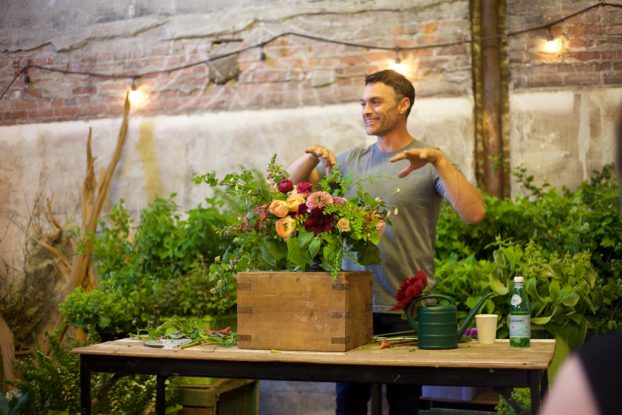
Max Gill, captured by Alicia Schwede’s camera, while teaching at the design Master Class held recently at the Seattle Wholesale Growers Market

I’ve scheduled a very special guest to share with you for this 200th episode: Berkeley, California-based designer Max Gill.

I first met Max during the summer of 2011 while working on The 50 Mile Bouquet. Photographer David Perry and I were in SF shooting a chapter of the book with Susie Nadler and Flora Grubb at Flora Grubb Gardens . . . and Flora asked if I knew Max. I told her no, and she immediately made a connection, introducing us by phone. It was one of those serendipitous threads I am so often given and frequently follow . . . not sure where it will lead but eager to discover that answer.
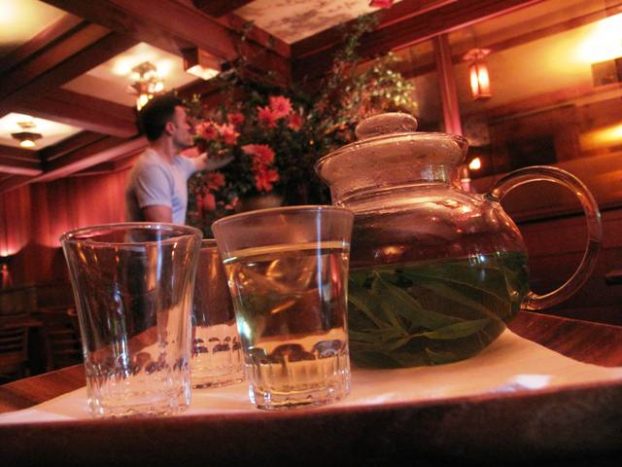
This is a dark photo, but I love it! I snapped it in July 2011 while on location with Max Gill at Chez Panisse, enjoying a pot of just-brewed tea while observing his design process.

Max invited David and me to meet him a few days later and what resulted was nothing short of beautiful. We were able to tour and ultimately photograph Max in his Berkeley studio and personal cutting garden . . . and then he invited us to follow him to Alice Waters’ famed bistro Chez Panisse Cafe & Restaurant, just blocks from Max’s home, to capture him on camera while he created the first of that week’s major floral displays for the restaurant’s interior.
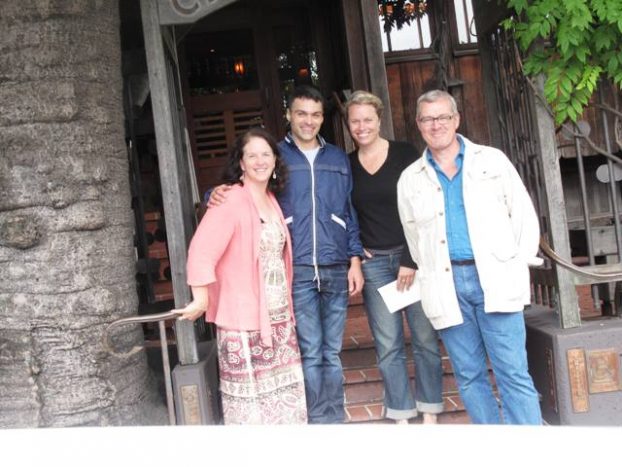
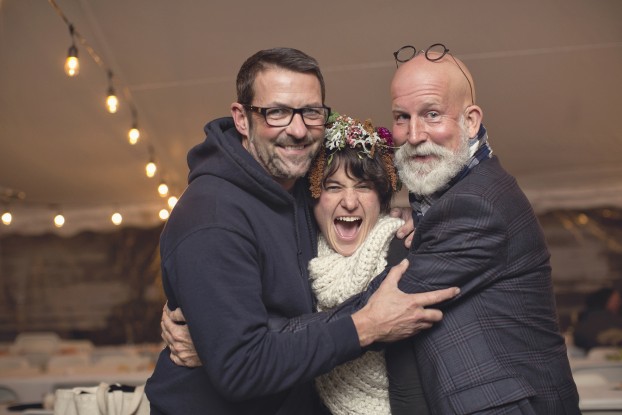
After we wrapped up, David Perry (far right) and I posed for a photo with Max and his friend Wynonah (center)

It was an unforgettable experience for all of us. Later, Alice shared this quote for the story:

Max is an amazing forager – he brings a sense of aliveness and seasonality, reinforcing the principles of the restaurant.”

And his friend, design mentor and occasional collaborator Ariella Chezar told me this:

Max, with his heart of gold, is a genius at creating small, magical worlds that you cannot help but be drawn into. With tenderness and skill, he assembles his elements, resulting in the most perfect balance of haphazard wildness and clear purpose. His arrangements always look just right.”
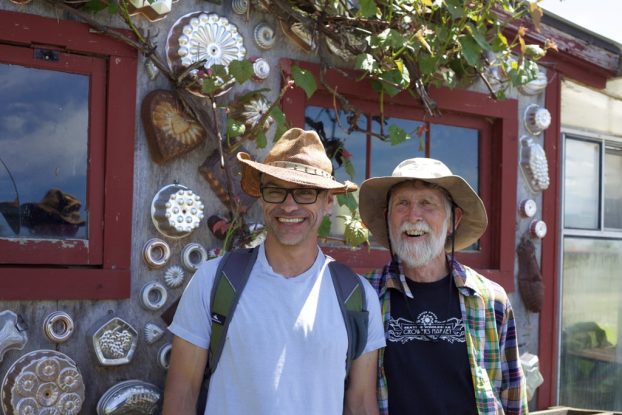
Max spent a few days in Seattle, touring local flower farms and meeting the folks behind SWGM, including Dennis Westphall of Jello Mold Farm (right) (c) Alicia Schwede
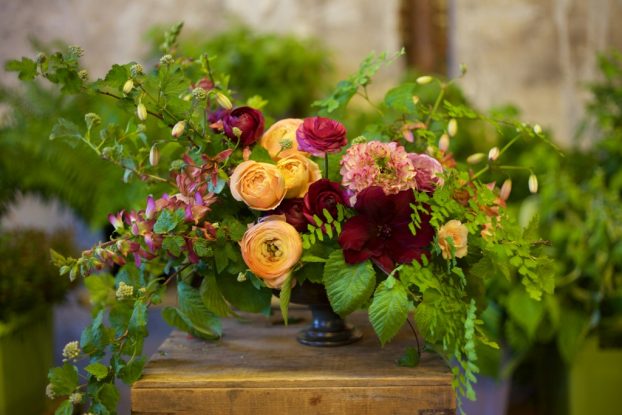
Lush and Seasonal: One of Max’s compote arrangements from his workshop at SWGMC. (c) Alicia Schwede. Check out the palette and diversity of just-picked botanicals!

Max recently visited Seattle to teach a very popular Master Class, followed by an unforgettable design lecture at Seattle Wholesale Growers Market – and while he was in town, I recorded this short conversation with him.

Here’s a bit more about Max, from his web site’s “about” page:

After receiving his degree in Environmental Science from UC Berkeley, Max was compelled by more creative pursuits, eventually finding floral design the perfect medium as it seemed to him to draw from all of his greatest passions: gardening, sculpture, painting and art and theater history. 

Originally from upstate New York, Max has called the Bay Area home for almost 35 years.  Perhaps best known for his work at Chez Panisse where he has done the flowers for over a decade, Max started Max Gill Design in 2005 and now offers full floral services for weddings, special events and private clients including Alice Waters, Michael Pollan, and Lauren McIntosh.  

Informed by natural process, Max’s work is distinguished by his reliance on specialty blooms and botanical rarities gleaned from local growers, his own formidable cut flower garden in North Berkeley, and a long list of Bay Area nurseries.  

He writes this:

My work is always botanically inspired. What I find most compelling in nature is when plants are struggling to find their place in the environment. As they fight to overcome the challenges of space and light, often surprising us with their juxtaposition, they create beauty through adaptation.

Download our PDF of the chapter, “Flowers for Chez Panisse,’ from The 50 Mile Bouquet.
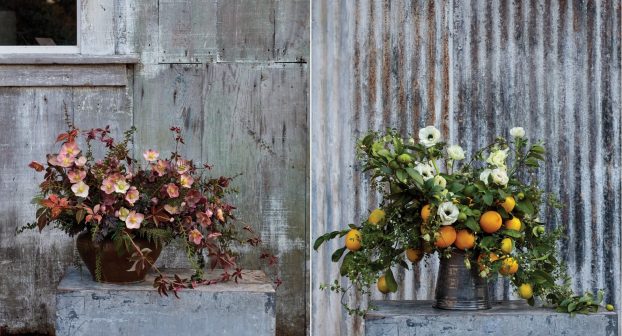
Two of Max’s floral creations, from the pages of In Full Flower (c) Gemma and Andrew Ingalls
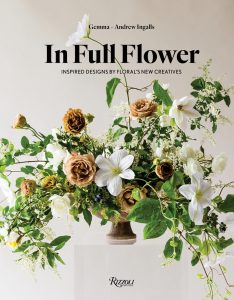
Here’s a peek at two of Max’s alluring botanical designs that appear in the just-released new book, “In Full Flower,” by photographers Gemma and Andrew Ingalls for Rizzoli Books. It’s stunning work that will leave you wanting more.

And you can find more by following along with Max on his Instagram feed.

Thanks so much for joining us today.

Back when the 100th episode of the Slow Flowers Podcast aired in June 2015, I noted that listeners had downloaded episodes 53,000 times since the start of the show.

Having reached the second-hundred-episode mark, even more fans are engaging with the show, with a total of 193,000 downloads to date — meaning today we have nearly triple the number of Slow Flowers Podcast listeners than for the first 100 episodes.

THANK YOU to each one of you for downloading, listening, commenting and sharing. It means so much. If you value the content you receive each week, I invite you to show your thanks and support the Slow Flowers Podcast with a donation — the button can be found on our home page in the right column. Your contributions will help make it possible to transcribe future episodes of the Podcast.
It’s time to sign up for the Slow Flowers Summit and you can find the registration link here.

The information you will gain in a single day at the Summit is an incredible value for just $175 — and members of Slow Flowers receive a great thank-you rate of $135.

Your registration includes all lectures and coffee/light breakfast, lunch and a cocktail reception with speakers — plus a flower lovers’ swag bag and chance to network with the doers and thinkers in our botanical universe.

I can’t wait for you to join us in Seattle on July 2 in the heart of American Flowers Week!

Thank you to family of sponsors:

Arctic Alaska Peonies, a cooperative of 50 family farms in the heart of Alaska providing high quality, American Grown peony flowers during the months of July and August. Visit them today at arcticalaskapeonies.com

Seattle Wholesale Growers Market, a farmer-owned cooperative committed to providing the very best the Pacific Northwest has to offer in cut flowers, foliage and plants. The Growers Market’s mission is to foster a vibrant marketplace that sustains local flower farms and provides top-quality products and service to the local floral industry. Find them at seattlewholesalegrowersmarket.com

Longfield Gardens provides home gardeners with high quality flower bulbs and perennials. Their online store offers plants for every region and every season, from tulips and daffodils to dahlias, caladiums and amaryllis. Visit them at lfgardens.com.

Syndicate Sales, an American manufacturer of vases and accessories for the professional florist. Look for the American Flag Icon to find Syndicate’s USA-made products and join the Syndicate Stars loyalty program at syndicatesales.com.

Johnny’s Selected Seeds, an employee-owned company that provides our industry the best flower, herb and vegetable seeds — supplied to farms large and small and even backyard cutting gardens like mine. Check them out at johnnysseeds.com.

Association of Specialty Cut Flower Growers. Formed in 1988, ASCFG was created to educate, unite, and support commercial cut flower growers. It mission is to help growers produce high-quality floral material, and to foster and promote the local availability of that product. Learn more at ascfg.org.

I’m Debra Prinzing, host and producer of the Slow Flowers Podcast. Next week, you’re invited to join me in putting more American grown flowers on the table, one vase at a time. And If you like what you hear, please consider logging onto Itunes and posting a listener review.

The content and opinions expressed here are either mine alone or those of my guests alone, independent of any podcast sponsor or other person, company or organization.

The Slow Flowers Podcast is engineered and edited by Andrew Brenlan. Learn more about his work at KineticTreeFitness.com.
Episode 294: A Floral Collective of Greater Good: Celebrating and Selling Local Flowers with the Seattle Wholesale Growers Market’s Sixth Anniversary

Wednesday, April 26th, 2017

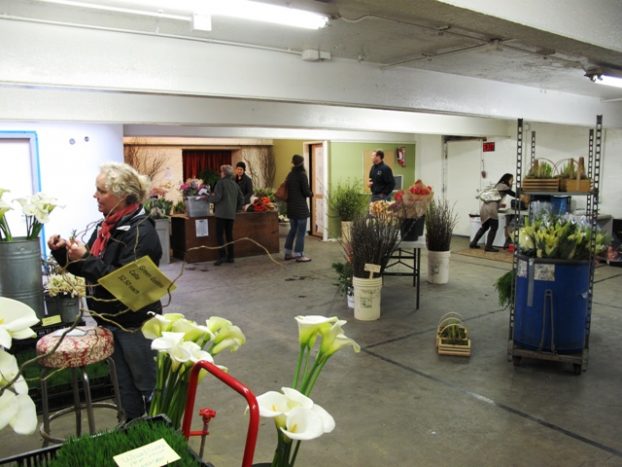
Six years ago this week, a band of intrepid Pacific Northwest flower farmers opened the doors at a cold, nearly empty warehouse in Seattle’s Georgetown District, and the Seattle Wholesale Growers Market was launched.

In the opening days of Seattle Wholesale Growers Market things were a little bare. Here is a photo I snapped on April 26, 2011

I have been along for the wild ride of this pioneering Market that has stimulated an entirely new way of connecting locally-grown flowers with buyers who value seasonal and sustainable botanicals grown with care and respect for the land.

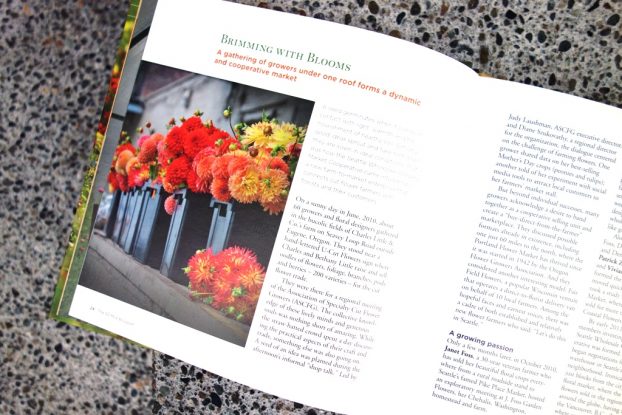
“Brimming with Blooms” documents the origins of the Seattle Wholesale Growers Market in The 50 Mile Bouquet.

Of that beginning, I wrote this in The 50 Mile Bouquet:

A seed germinates when it comes in contact with light, warmth and the nourishment of healthy soil. Similarly, good ideas sprout and take root when they are sown in ideal conditions. That was how the Seattle Wholesale Growers Market Cooperative came into being – a new farm-to-market enterprise that connects cut flower farmers with florists and their customers.

Illustrated by David Perry’s documentary-style photography, the chapter “Brimming with Blooms” tells the story of the origins of SWGMC in June 2010 and the ideas, people and circumstances that led to its actual debut by April 2011.

Today, the SWGMC is anything but an empty warehouse with just a few twigs and flowering branches.

The Market has come into its own as a vibrant, viable economic engine for sustainable agriculture, for offering high quality local products and excellent customer service to the floral community in the greater Seattle area. Beyond this, the Market has continued to instigate, influence and inspire others who have studied its model, adapting lessons for their own regional hubs for selling flowers.

So in honor of the sixth anniversary of the Seattle Wholesale Growers Market, I’ve invited two past guests of the Slow Flowers Podcast to sit down with me and reflect on all that has transpired and all that the Market still aspires to achieve.

Left: Diane Szukovathy and Dennis Westphall; Right: Vivian Larsen (c) Mary Grace Long Photography

Please welcome Diane Szukovathy, co-owner with her husband Dennis Westphall of Jello Mold Farm, based in Mt. Vernon, WA; and Vivian Larsen of Everyday Flowers in Stanwood, WA. Together they have been part of the core group that founded the SWGMC and they serve as co-chairs of the Market board.

Follow and find Seattle Wholesale Growers Market at these social places:

SWGMC on Facebook

SWGMC on Instagram

The Slow Flowers Podcast has been downloaded more than 182,000 times by listeners like you. THANK YOU to each one of you for downloading, listening, commenting and sharing. It means so much.

If you value the content you receive each week, I invite you to show your thanks and support the Slow Flowers Podcast with a donation — the button can be found on our home page in the right column. Your contributions will help make it possible to transcribe future episodes of the Podcast.

Thank you to family of sponsors:

And thank you to our lead sponsor for 2017: Certified American Grown Flowers. The Certified American-Grown program and label provide a guarantee for designers and consumers on the source of their flowers. Take pride in your flowers and buy with confidence, ask for Certified American Grown Flowers.  To learn more visit americangrownflowers.org.

Arctic Alaska Peonies, a cooperative of 50 family farms in the heart of Alaska providing high quality, American Grown peony flowers during the months of July and August. Visit them today at arcticalaskapeonies.com

Seattle Wholesale Growers Market, a farmer-owned cooperative committed to providing the very best the Pacific Northwest has to offer in cut flowers, foliage and plants. The Growers Market’s mission is to foster a vibrant marketplace that sustains local flower farms and provides top-quality products and service to the local floral industry. Find them at seattlewholesalegrowersmarket.com

Longfield Gardens provides home gardeners with high quality flower bulbs and perennials. Their online store offers plants for every region and every season, from tulips and daffodils to dahlias, caladiums and amaryllis. Visit them at lfgardens.com.

Association of Specialty Cut Flower Growers. Formed in 1988, ASCFG was created to educate, unite, and support commercial cut flower growers. It mission is to help growers produce high-quality floral material, and to foster and promote the local availability of that product. Learn more at ascfg.org.

Syndicate Sales is an American manufacturer of vases and accessories for the professional florist. Look for the American Flag Icon to find Syndicate’s USA-made products and join the Syndicate Stars loyalty program at syndicatesales.com.

Johnny’s Selected Seeds, an employee-owned company that brings the best flower, herb and vegetable seeds — and supplies to farms large and small. Check them out at johnnysseeds.com.

I’m Debra Prinzing, host and producer of the Slow Flowers Podcast. Next week, you’re invited to join me in putting more American grown flowers on the table, one vase at a time. And If you like what you hear, please consider logging onto Itunes and posting a listener review.

The content and opinions expressed here are either mine alone or those of my guests alone, independent of any podcast sponsor or other person, company or organization.

The Slow Flowers Podcast is engineered and edited by Andrew Brenlan. Learn more about his work at KineticTreeFitness.com.
Music credits:
Heliotrope; Vittoro
by Blue Dot Sessions
Additional music from:

audionautix.com

Episode 292: From trial lawyer to floral artist and entrepreneur — Meet Amy Kunkel-Patterson of Gather Design Co.

Wednesday, April 12th, 2017

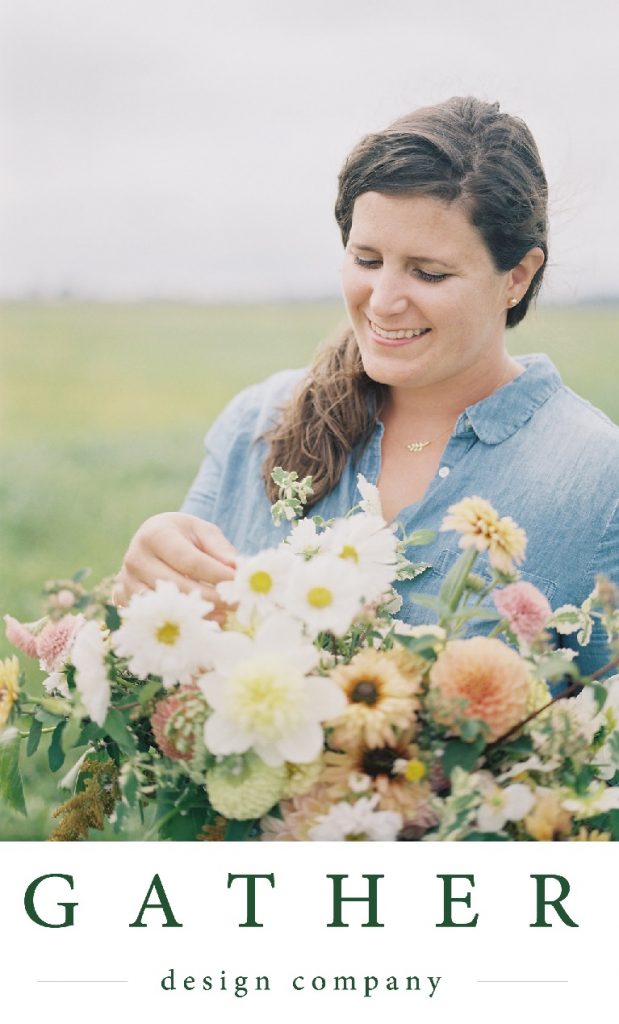
Amy Kunkel-Patterson of Gather Design Co. (c) Heather Payne Photography

I’m so pleased to introduce Amy Kunkel-Patterson of Seattle-based Gather Design Co. as this week’s Slow Flowers Podcast guest.

Before our main interview, I want to quickly share a conversation I recorded earlier this week with Alicia Schwede of the Flirty Fleurs Blog.

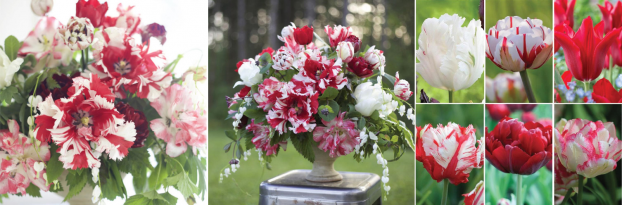
Like me, Alicia is a fellow marketing committee member at Seattle Wholesale Growers Market. We also collaborate with Longfield Gardens on education and promotion of gardening with the bulbs and flowers in their catalog. I was so impressed with the Flirty Fleurs tulip collection that Alicia “curated” for Longfield last year and I asked her about her process.

Be sure to check out images of Longfield’s spring-flowering bulbs, including Alicia’s collection — I’ve posted links at today’s show notes. Longfield has just opened up the online ordering for spring-flowering bulbs. Of course, that seems a little counterintuitive because you’ll be planting them in the fall, right? But some of the hottest varieties will go quickly, so it’s smart to shop now. Note: Longfield’s Tulip Shop will “open” in mid-April.

Alicia Schwede grew and designed with this alluring medly of red-and-white tulips (and companions like bleeding heart). The tulips are part of the Flirty Fleurs collection from Longfield Gardens.

Amy and I met in January 2016 when she participated in a master class with Lisa Waud of pot & box and Flower House Detroit. Lisa was hosted by the Seattle Wholesale Growers Market to teach a large-format installation course and I spent the day interviewing the participants and photographing the process. You can read about that workshop here and listen to the interviews.

Amy impressed me for many reasons, including her enthusiasm for collaboration and her story– she told me she was working full-time as a practicing attorney. And by coincidence, she was at a law firm I knew quite well, having been quite involved as the spouse of a law partner at that firm years ago.

We continued our conversation last summer when Amy volunteered to work with Alicia Schwede to produce her annual “dahlia wall” at SWGMC. Amy jumped in to help her produce it. I was there to film a time-lapse video of the installation and so, we had hours and hours to chat while working.

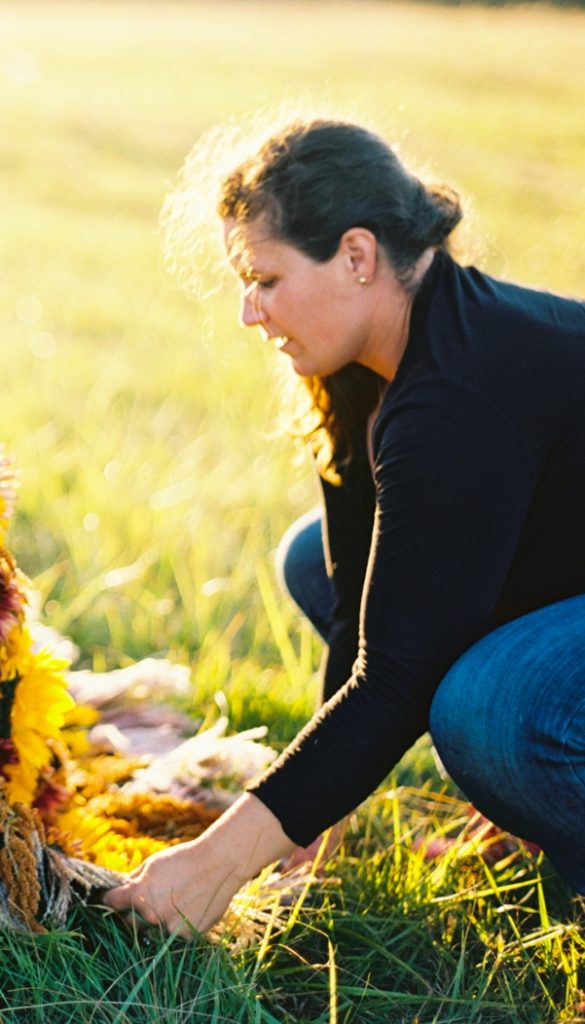
Sneak Peek: I took liberties of cropping just a detail of Anna Peters’ beautiful photograph of Amy Kunkel-Patterson at work on her Americana-themed sunflower gown.

I had just finished up American Flowers Week 2016 and was already scheming what I hoped to achieve for American Flowers Week 2017.

I mentioned wanting to produce several floral-inspired fashion shoots with iconic American flowers like sunflowers, roses, peonies, dahlias and other flowers. Amy spontaneously said: “I’ll make one for you!”

That simple response led to what turned out to be the most amazing design — a high-fashion gown created with a host of flowers supplied by Seattle Wholesale Growers Market.

Amy created something truly beautiful for American Flowers Week 2017 and it has been so hard for all of us involved to sit tight and keep the photography under wraps until we kick off the American Flowers Week campaign.

So you’ll hear us talk about this project a bit — and I promise you will be blown away when we begin to unveil the images, and floral fashions I’ve commissioned from other teams around the country — leading up to June 28 to July 4th.

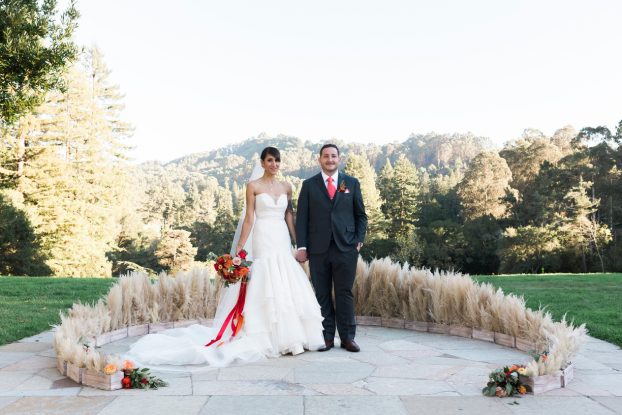
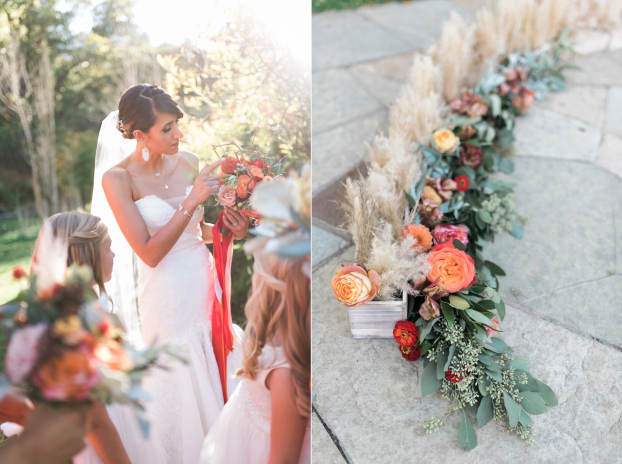
Here’s the Berkeley wedding we discussed, in which Amy used pampas grass to create a ceremony circle. All photos, courtesy Gather Design Co.

More lovely details from the same wedding.

So, let’s meet Amy. Here is her introduction from the Gather Design Co. web site:

I’m Amy; welcome.  My love for flowers runs deep and true.  I grew up ‘helping’ in my mom’s, grandfather’s and great-grandfather’s gardens, learning how to grow flowers, and more importantly, how to pick and arrange them.  

Charming and playful!

This is where the name Gather comes from – I’ve always been good at what my family broadly terms “hunting and gathering.”  I was the kid who couldn’t ever pull myself out of the blackberry patch where I wanted to pick just one more berry, or away from the beach where I spent hours collecting the tiniest, wave-polished pebbles which I called jewels.  

On a trip through Europe, I managed to gather upwards of 40 pounds of rocks, each special in my mind, from beaches my husband and I walked.

I take the same tireless care in gathering vintage vases for my collection and seeking out the most luscious seasonal blooms for my clients.  

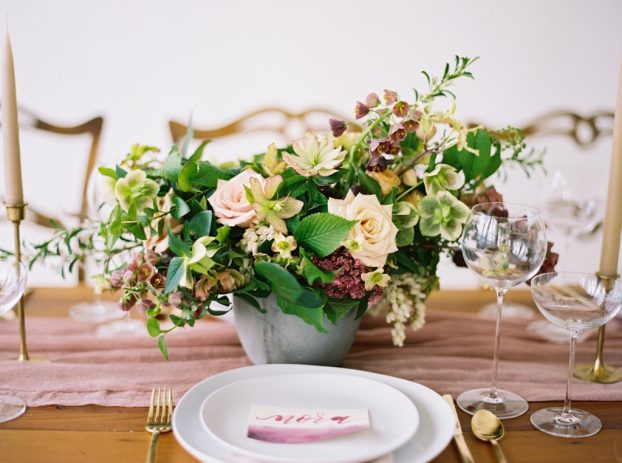
Beautiful spring wedding flowers.

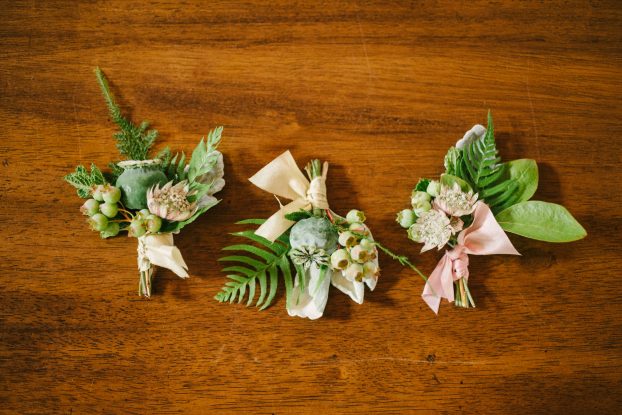
Tiny details for sweet boutonnieres.

Gathering also sparked the event design side of Gather, as I love to start with an idea – color, texture, an heirloom treasure – and spin it into an entire experience, gathering context and detail along the way.

I believe in letting flowers shine as they do in nature.  I let each stem dance and delight in their own loveliness, highlighted and supported by every other bit of foliage and flowers in an arrangement.  My designs are at once unique and timeless, romantic and whimsical, pensive and wild.  I strive to learn about and befriend each of my couples, noting the blooms that bring them joy and the colors that inspire them, so that their flowers embody the essence of who they are.

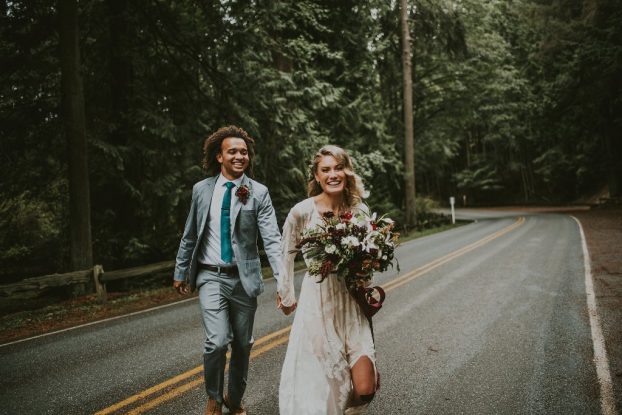
The alluring floral palette uses touches of blue to add depth and dimension.

I purchase from local farmers whenever possible and source safely and sustainably-grown flowers.   I seek out rare and interesting blooms, foliage, berries, seedpods, and other elements to incorporate the season, the place, and the people into each bouquet or arrangement.

Always hungry for the next adventure, I’ve also started hand-dying cotton and silks for table runners, ribbons, and styling pieces.

Romantic, soft, wild — and gathered bouquets, by Amy Kunkel-Patterson

Find Amy at these social places and follow along on her creative journey:

Gather Design Co. on Facebook

Gather Design Co. on Instagram

The Slow Flowers Podcast has been downloaded more than 177,000 times by listeners like you. THANK YOU to each one of you for downloading, listening, commenting and sharing. It means so much.

If you value the content you receive each week, I invite you to show your thanks and support the Slow Flowers Podcast with a donation — the button can be found on our home page in the right column. Your contributions will help make it possible to transcribe future episodes of the Podcast.

Thank you to our garden of Slow Flowers Sponsors

Arctic Alaska Peonies, a cooperative of 50 family farms in the heart of Alaska providing high quality, American Grown peony flowers during the months of July and August. Visit them today at arcticalaskapeonies.com

Seattle Wholesale Growers Market, a farmer-owned cooperative committed to providing the very best the Pacific Northwest has to offer in cut flowers, foliage and plants. The Growers Market’s mission is to foster a vibrant marketplace that sustains local flower farms and provides top-quality products and service to the local floral industry. Find them at seattlewholesalegrowersmarket.com

Longfield Gardens provides home gardeners with high quality flower bulbs and perennials. Their online store offers plants for every region and every season, from tulips and daffodils to dahlias, caladiums and amaryllis. Visit them at lfgardens.com.

Association of Specialty Cut Flower Growers. Formed in 1988, ASCFG was created to educate, unite, and support commercial cut flower growers. It mission is to help growers produce high-quality floral material, and to foster and promote the local availability of that product. Learn more at ascfg.org

I’m Debra Prinzing, host and producer of the Slow Flowers Podcast. Next week, you’re invited to join me in putting more American grown flowers on the table, one vase at a time. And If you like what you hear, please consider logging onto Itunes and posting a listener review.

The content and opinions expressed here are either mine alone or those of my guests alone, independent of any podcast sponsor or other person, company or organization.

The Slow Flowers Podcast is engineered and edited by Andrew Brenlan. Learn more about his work at KineticTreeFitness.com.
Music credits:

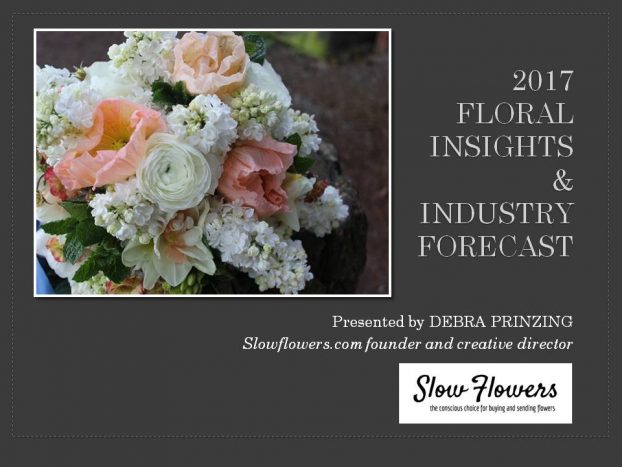
Episode 278: Slow Flowers’ 2017 Floral Insights & Industry Forecast

Wednesday, January 4th, 2017

slide1
Happy New Year and Welcome to the third annual Slow Flowers’ Floral Insights and Industry Forecast.

Unlike most TREND reports, this compilation tracks changing shifts, emerging ideas and new concepts that are taking hold in the American floral world.  Think of it as your Next, New and Now Report. These topics are gleaned from my conversations and interviews that took place with many of you during 2016– Slow Flowers members, including farmers, florists and creatives.  I know some of you have already experienced these emerging developments and your influence has inspired this list.

If you would like a copy of this report, please click here: 2017-floral-insights [PDF download]

I look forward to your reaction, thoughts, and input on the Slow Flowers’ Floral Insights and Industry Forecast, including the ideas and themes I may have overlooked! I invite you to share yours in the comment section below.

Let’s get started:

slide2
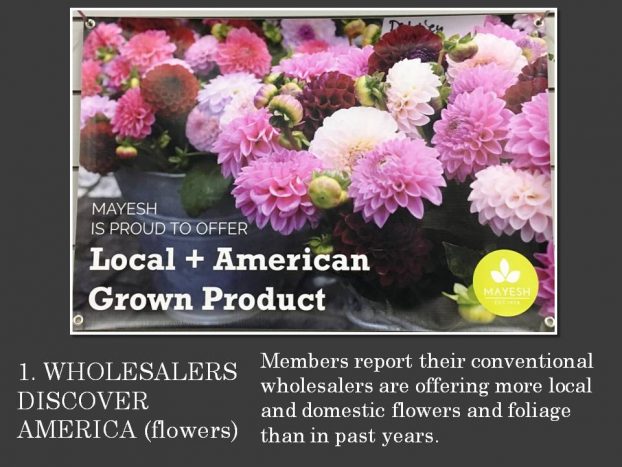
#1 WHOLESALERS ARE DISCOVERING AMERICA
. In the midst of global floriculture, with trade in cut flowers estimated at more than $100 billion per year, $13 billion of which takes place in the U.S., we’ve been seduced by the notion that the world is our oyster (or flower field).

Mellano & Co. is a Certified American Grown flower farm.

Mellano & Co. is a Certified American Grown flower farm.

In many markets around the country, the wholesale florist is the only commercial cut flowers and foliage source for floral designers, flower shops and studios to purchase product.Yet after branding themselves as the only way to access a world of floral options, some wholesale florists are returning to their roots, at least in part. They are proactively sourcing from American flower farms large and small to stock their coolers and shelves. And beyond this step, many are also using signage and labeling to inform buyers of the origin of that product.

I believe the explosion of farmer-florists and the growth of small-scale floral agriculture in markets across North America has occurred in part because of frustration with the lack of or limited local sourcing by conventional wholesalers. Let me say that again: Farmer-Florists and small-scale floral agriculture have stepped into the gaping void created when wholesalers turned their backs on local flower farmers. And now they’re waking up to the missed opportunity.

The success of the Seattle Wholesale Growers Market, well-documented by me and on this podcast over the past several years, as well as the continued growth of the farmer-owned Oregon Flower Growers Association market in Portland underscore that demand for local flowers is already in place.

Now we are witnessing a shift among some conventional wholesalers to align their brand with American Grown and Locally-grown flowers. Mayesh Wholesale Florist is the most active in this arena, with active support for Slowflowers.com, American Flowers Week, Lisa Waud’s Flower House Detroit, and other sponsorships.

When Mayesh opened its renovated Portland, Oregon, branch in early November, the company asked me to make a design presentation. The team there was very supportive of my request for all locally-grown product — hat’s off to Mayesh and I certainly expect that their success at the cash register will motivate other conventional wholesale florists to get onboard.

slide5
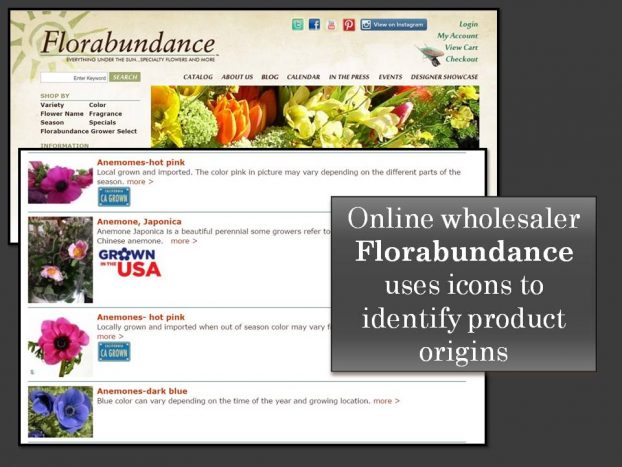
I’ve previously singled out Santa Barbara-based Florabundance, led by Joost Bongaerts, for making the effort to label all California-grown floral and foliage offerings on his online wholesale site. It is an effective tool — one I hope others will emulate. It is certainly a step that demonstrates excellent customer service and an awareness that Florabundance shoppers want to know the origin of the flowers they purchase.

This past fall, I surveyed Slowflowers.com members for their take on a number of topics and trends. When I asked, “If you shop with Conventional Florists, are you finding more American grown and locally-grown product than in the past?” 70 percent of respondents said yes.

Here are a few of the specific comments to elaborate:

  • I request American grown from my Rep, and I think there are more boutique, seasonal items that are coming from smaller farmers
  • I have been asking my conventional wholesalers to bring in more American grown product and I think it is helping. The “American Grown” branding really helps us to know that is happening.
  • It’s definitely taking place and some people at the conventional wholesalers are proud to share that their products are American grown.

This last comment reflects that the industry still has far to go. One member noted:

  • It’s a toss up. They say they want to add more but I’m not sure if they are working really hard at. And they don’t do a very good job at advertising what is local and what is not. My Rep knows that I want American grown but still have to ask every time

slide6
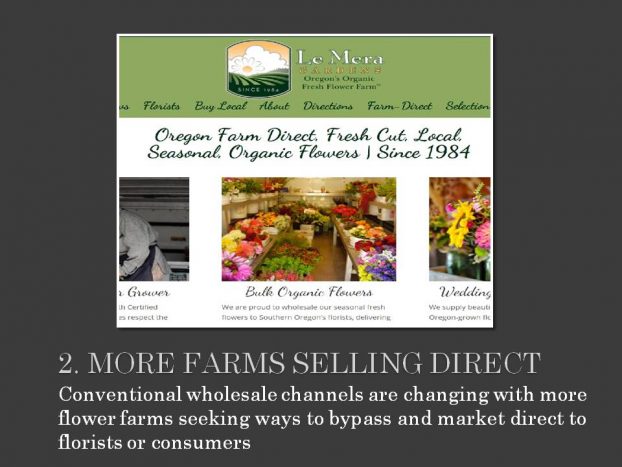
#2 MORE FARMS SELLING DIRECT
. This insight is closely connected with item number one.

In general, the conventional wholesale model is changing, as traditional channels of floral distribution are disrupted. I predict that more flower farms will seek and establish new ways to bypass the conventional wholesale pipeline and market direct to florists and consumers. This is a hot topic and certainly one that’s hard to find anyone willing to go on record to discuss.
Our Slow Flowers survey revealed numerous sales channels among flower farmers. Granted, the majority of Slow Flowers farm-members are small-scale producers, but I believe they are the ones modeling how diversification and direct-to-florist commerce can succeed. When asked about their distribution channels, our respondents cited the following top three outlets:

  • Seventy percent are growing flowers for their own weddings and event clients;
  • This is followed closely by farms selling direct to other florists and wedding designers, at around 67 percent
  • With 53 percent of flower farms reporting they sell to local flower shops
    After this top tier, the percentages drop down to one third of respondents who sell flowers via farmers’ markets and CSA subscribers (basically consumer-direct) and about one-quarter who sell to local wholesalers and grocery/supermarket buyers.There is another farm-direct model, and here’s where I think the disruption is most revealing. A number of large farms are experimenting with direct-to-florist and direct-to-consumer models.

slide9
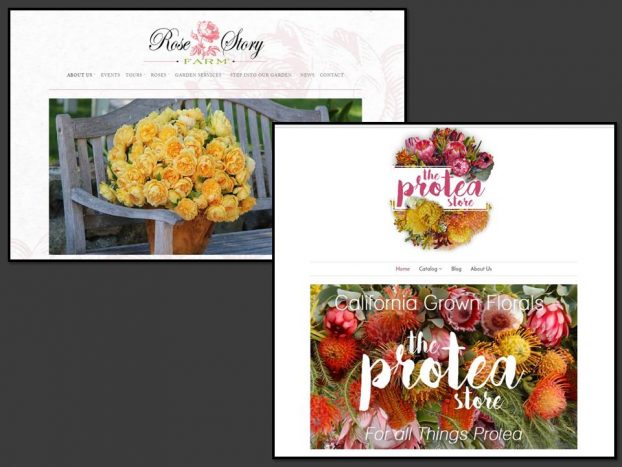
There is another farm-direct model and here’s where I think the disruption is most revealing. A number of large farms are experimenting with direct-to-florist and direct-to-consumer models. A few successful single-crop models have been in place, such as Danielle Hahn’s Rose Story Farm, which in the past few years has shifted almost completely away from selling through wholesalers to florist-direct fulfillment, and many of the Alaska peony growers who sell direct to florists and consumers.

Now, diversified, large-scale growers are beginning to spin off consumer-focused web shops, such as Sun Valley’s Stargazer Barn or Resendiz Brothers’ Protea Store. In the scheme of things, these new ventures are moving only a small fraction of their parent farms’ floral inventory.

But I predict that as large farms bend to demand for farm-direct sourcing of flowers (by consumers and florists alike), the path from field to bouquet will speed up and perhaps take fewer detours through brokers and wholesalers. That means fresher, more seasonal and better value for all floral customers.

READ MORE…

Episode 256 All My Thyme – Dawn Severin’s love affair with garden roses

Wednesday, July 27th, 2016
ScreenShotSFHomePage

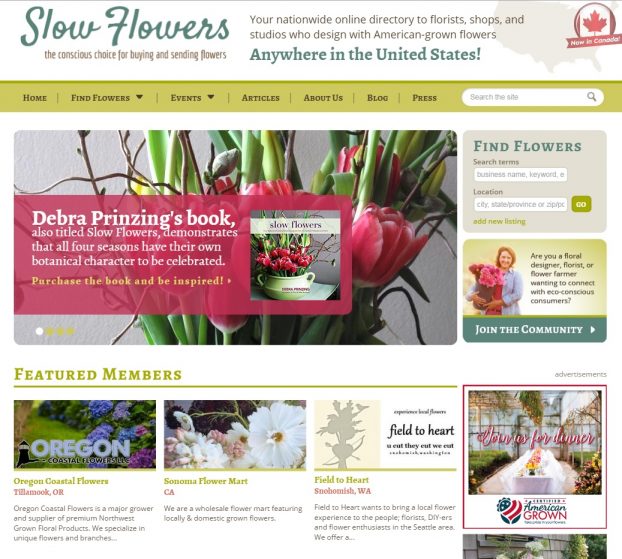
GWA: The Association for Garden Communicators, is honoring Slowflowers.com with a SILVER AWARD of Achievement for 2016

I have some very special news to share with you – GWA | The Association for Garden Communicators — announced last week that Slowflowers.com is a SILVER MEDAL winner in the 2016 Media Awards program.

This follows last year’s Silver Award for our infographic titled: “Where do your flowers come from?”

We’ve poured so much creative effort into developing Slowflowers.com’s valuable, meaningful content and it’s thrilling to receive industry recognition for this important digital resource that connects consumers everywhere with American Grown flowers across the country.

logo_gwa

Please celebrate with me — together we’ve created this success!

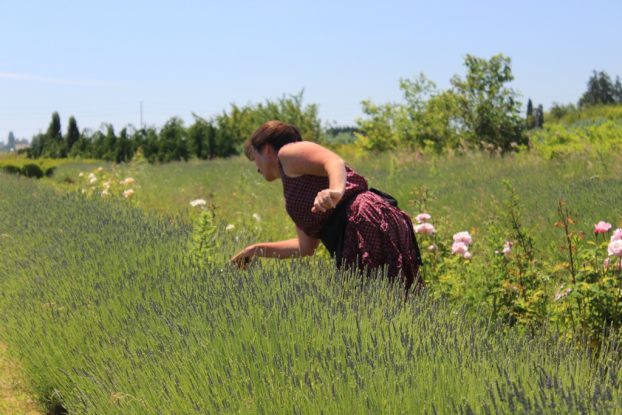
Dawn Severin of All My Thyme, shown with her lavender crop

Dawn Severin of All My Thyme, shown with her ‘Grosso’ lavender crop

2moreup

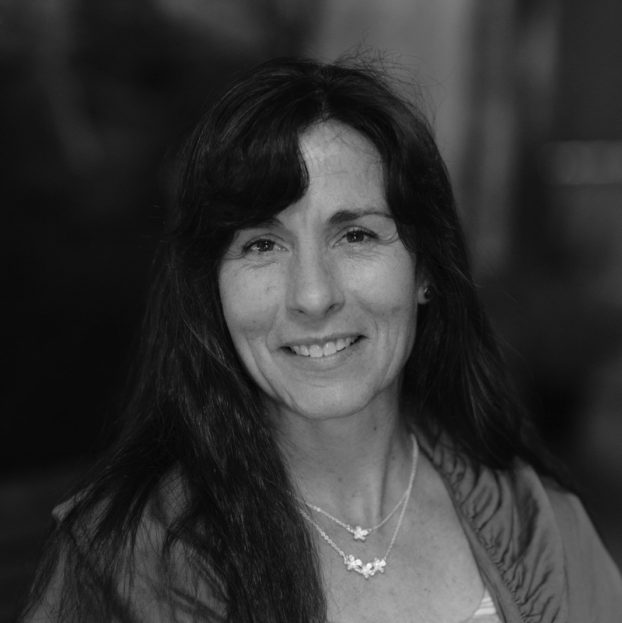
Dawn Severin (c) Mary Grace Long

Dawn Severin (c) Mary Grace Long

Today’s guest is flower farmer Dawn Severin, owner of All My Thyme, which is based in Mount Vernon, Washington.

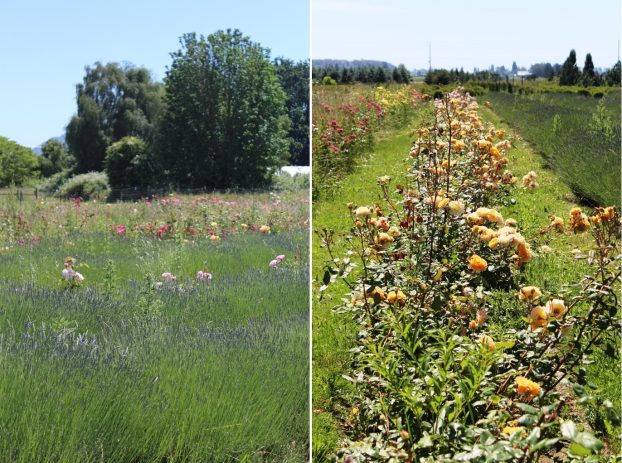
All My Thyme is a wholesale flower farm dedicated to hand-tending English garden roses, a variety of cut flowers and herbs, and fresh and dried lavender — all for the floral trade.

Dawn is a gifted grower — a civil engineer-turned flower farmer and current member of the Seattle Wholesale Growers Market.

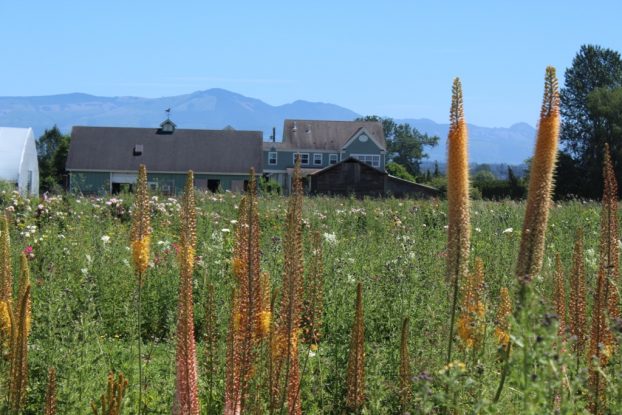
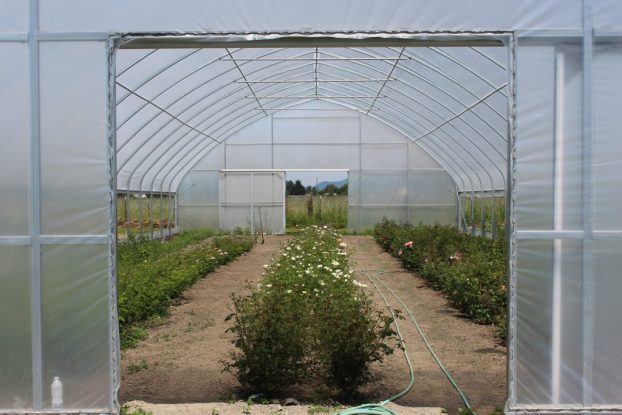
On a recent visit to her farm I saw beautiful perennials, herbs and annuals, and of course, beloved garden roses. Thousands of rose plants occupy the heart of Dawn’s farm, a well-organized layout of rows, beds and one high tunnel cover a four-acres-plus area, part of the 15-acre homestead in Washington’s Skagit Valley.

The tall wands of Dawn's eremurus frame the view of her home and barn in Skagit Valley.

The tall wands of Dawn’s eremurus frame the view of her home and barn in Skagit Valley.

2upAllmyThyme

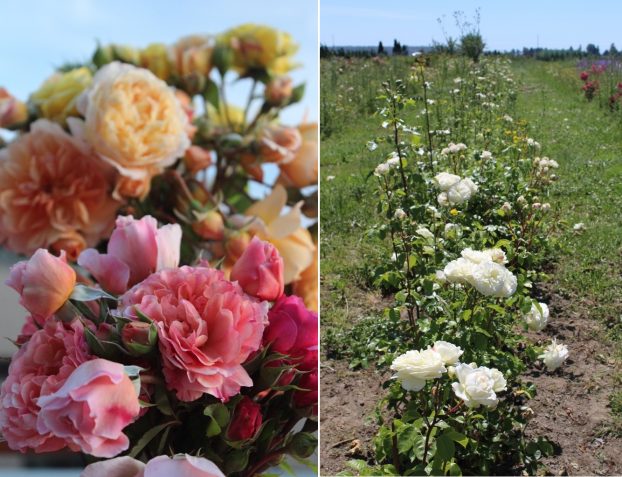
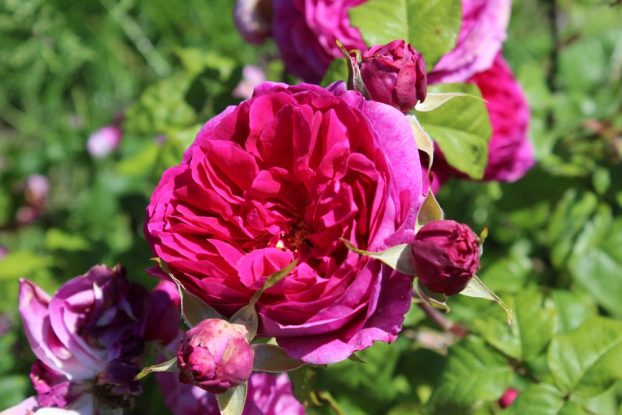
All you have to do is track Instagram to know that roses are more popular than ever before, especially in the wedding floral world. Dawn grows David Austins, Kordes, old-fashioned and hybrids alike, with a petal palette ranging from whites and creams to the deepest burgundies.

sm_IMG_5326It’s really impossible to capture the vast knowledge and expertise that makes All My Thyme’s roses so cherished here in the Seattle marketplace. Her roses are romantic, fragrant, healthy and super fresh. Grown with great care and attention to what her floral customers really want — artistic design elements for their brides and special event clients.

sm_IMG_5464

sm_IMG_5474I have known and loved Dawn’s flowers for a few years, but I only recently set aside time to visit her for a first-person tour of the roses! I turned on the recorder to capture our conversation, which took place while we walked through the farm.

Here is a list of the roses that Dawn and I discussed during our conversation:

A Shropshire Lad (David Austin)

Anna’s Promise (Weeks)

Charlotte (David Austin)

Clair Renaissance (Poulsen)

Crocus Rose (David Austin)

Crown Princess Margareta (David Austin)

Distant Drums (Weeks)

Eglantyne (David Austin)

Hot Cocoa (Weeks)

Ice Girl (Kordes)

James Galway (David Austin)

Jubilee Celebration (David Austin)

Jude the Obscure (David Austin)

Koko Loko (Weeks)

Lemon Pompon (Kordes)

Orange Pompon (Kordes)

Pink Pompon (Kordes)

Sombreuil (David Austin)

Spirit of Freedom (David Austin)

Susan Williams-Ellis (David Austin)

Tranquillity (David Austin)

Wollerton Old Hall (David Austin)

All My Thyme is a Salmon Safe certified flower farm, meaning that all of Dawn’s practices are safe for local waterways and salmon habitats, as evaluated by a third party agency.

The new high tunnel at All My Thyme

The new high tunnel at All My Thyme

The Slow Flowers Podcast has been downloaded more than 109,000 times by listeners like you. THANK YOU to each one of you for downloading, listening, commenting and sharing. It means so much.

sponsor barThank you to our lead sponsor for 2016: Certified American Grown Flowers. The Certified American-Grown program and label provide a guarantee for designers and consumers on the source of their flowers. Take pride in your flowers and buy with confidence, ask for Certified American Grown Flowers.  To learn more visit americangrownflowers.org.

More sponsor thanks goes to Syndicate Sales, an American manufacturer of vases and accessories for the professional florist. Look for the American Flag Icon to find Syndicate’s USA-made products and join the Syndicate Stars loyalty program at syndicatesales.com.
A big bouquet of thanks goes to Longfield Gardens… providing home gardeners with high quality flower bulbs and perennials. Their online store offers plants for every region and every season, from tulips and daffodils to dahlias, caladiums and amaryllis. Visit them at lfgardens.com.

And finally, thank you Arctic Alaska Peonies, a cooperative of 50 family farms in the heart of Alaska providing high quality, American Grown peony flowers during the months of July and August. Visit them today at arcticalaskapeonies.com.
Next week, you’re invited to join me in putting more American grown flowers on the table, one vase at a time. And If you like what you hear, please consider logging onto Itunes and posting a listener review.

The content and opinions expressed here are either mine alone or those of my guests alone, independent of any podcast sponsor or other person, company or organization.

The Slow Flowers Podcast is engineered and edited by Andrew and Hannah Brenlan. Learn more about their work at shellandtree.com.
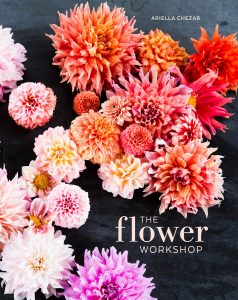
Episode 251: Ariella Chezar’s The Flower Workshop Book and Morgan Anderson of The.Flori.Culture’s PhD in – yes, Floriculture

Wednesday, June 22nd, 2016
Morgan Anderson of The.Flori.Culture (left) and Ariella Chezar (right)

Morgan Anderson of The.Flori.Culture (left) (c) Amber Snow; and Ariella Chezar (right) (c) Corbin Gurkin

This week’s episode delivers double the inspiration as you will hear from two guests — one quite familiar to our Slow Flowers community, Ariella Chezar, and one who is an emerging leader in floral design education, Morgan Anderson.

Both interviews were recorded in May and I’m combining them here for an extended episode that will delight you as a creative person and evoke some new ways of thinking about your business model, be it flower farming, floral design or a combination of both.

MEET ARIELLA CHEZAR

The Flower Workshop BookI am so fortunate to have gotten to know Ariella Chezar over the years. We were first introduced virtually by Berkeley-based designer Max Gill, an incredibly talented floral artist who I profiled (along with the work of photographer David Perry) in The 50 Mile Bouquet.

When I interviewed Max, I asked him to connect me with someone who had influenced his work and he named Ariella. She and I corresponded by email and she contributed a lovely quote about Max’s work for me to use in the chapter about him (and PS, a podcast interview with Max is on my bucket list for the upcoming year).

I promptly ordered my own copy of Flowers for the Table, an evocative book that Ariella created for Chronicle Books in 2002, one that helped propel her into the world of editorial floral design.

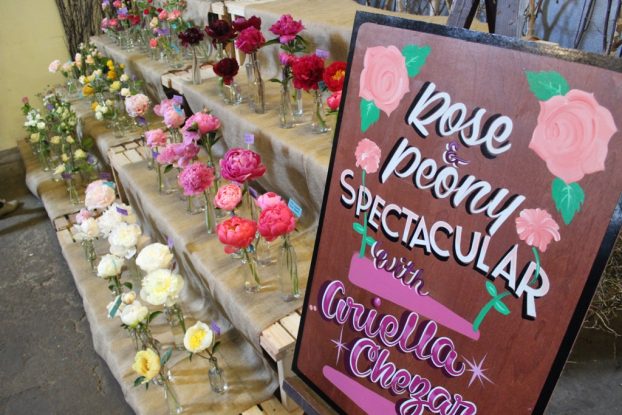
Ariella Chezar was in Seattle to headline the spring bloom extravaganza at SWGMC

Ariella Chezar was in Seattle to headline the spring bloom extravaganza at SWGMC

Ariella and I finally met face-to-face in spring of 2013 at Chalk Hill Clematis in Healdsburgh, California. She was there at owner Kaye Heafey’s beautiful flower farm to lead a design workshop and as it turned out, I was there with Chicago-based photographer Bob Stefko to produce a clematis story for Country Gardens magazine. The following year, I interviewed Ariella for this podcast in her former Ariella Flowers retail studio in New York City (if you haven’t heard that episode, follow this link).

So fun to have Ariella in Seattle and to see her response to the beautiful and local flora!

So fun to have Ariella in Seattle and to see her response to the beautiful and local flora!

That was about the time that Ariella teamed up with her favorite editor, SF-based Leslie Jonath of Connected Dots Media (with whom she had created Flowers for the Table), to begin creating The Flower Workshop, the designer’s long-anticipated second book that Ten Speed Press released earlier this year.

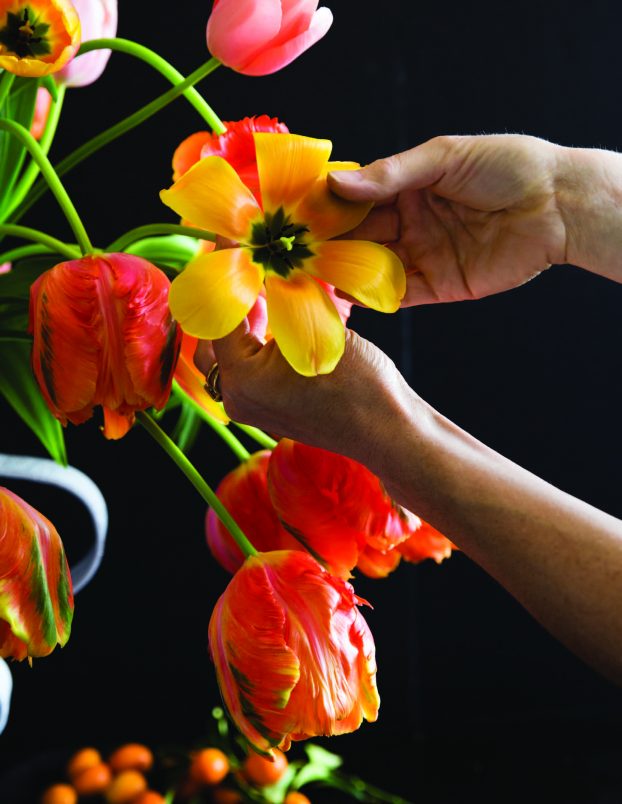
A lovely inside page from "The Flower Workshop," by Ariella Chezar

A lovely inside page from “The Flower Workshop,” by Ariella Chezar: “How to make a tulip ‘float'” – Photography (c) Erin Kunkel

It took about 18 months to bring this lovely tome to life because Ariella and her creative team photographed flowers and her designs in season, on location in both the Bay Area, where Ariella worked in the early days of her career, and in her childhood home of The Berkshires, where she operates a studio and small flower farm in western Massachusetts.

The gorgeous new book expresses Ariella’s lush, whimsical garden style and her true passion for nature, both cultivated and wild.

Why is Ariella’s work so celebrated? In our 2014 podcast interview, Ariella identifies the place (California) and the moment in time (the late 1990s and early 2000s) when she developed, almost unconsciously, her carefree, uncomplicated design aesthetic. Mesmerized by the abundance of carefree, unconstrained vegetation around her, Ariella responded in kind with a loving respect for the elements. In response, her design style was and continues to be unique and iconic.

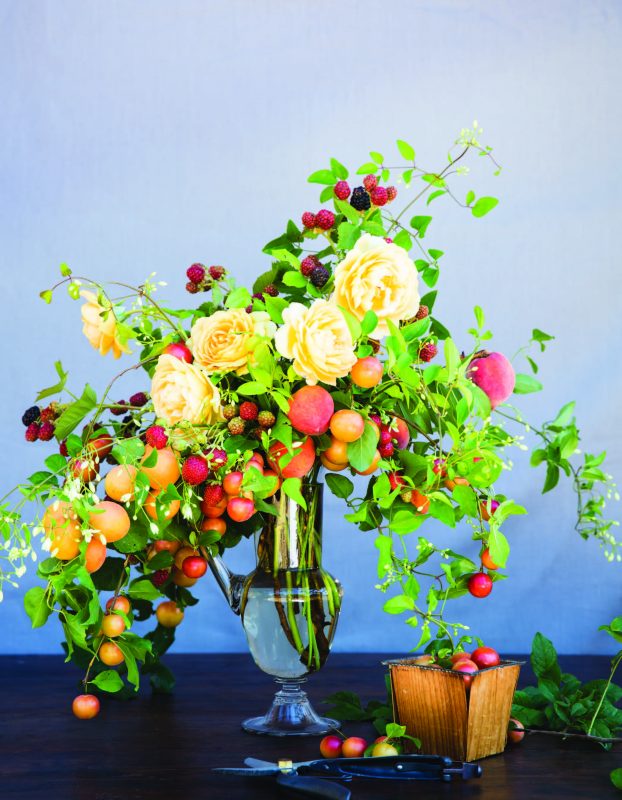
"Summer Fruits," Ariella's interpretation from the orchard.

“Summer Fruits,” Ariella’s interpretation from the orchard. Photography (c) Erin Kunkel

Please enjoy this short interview. It was recorded at the Seattle Wholesale Growers Market on May 25th, after Ariella had spent two full days first touring the flower farms of some of the Market’s members, then teaching a master design intensive based on the content of The Flower Workshop.

READ MORE…

Awed by Allium: The Starring Ingredient of a Stunning Bouquet

Monday, April 18th, 2016
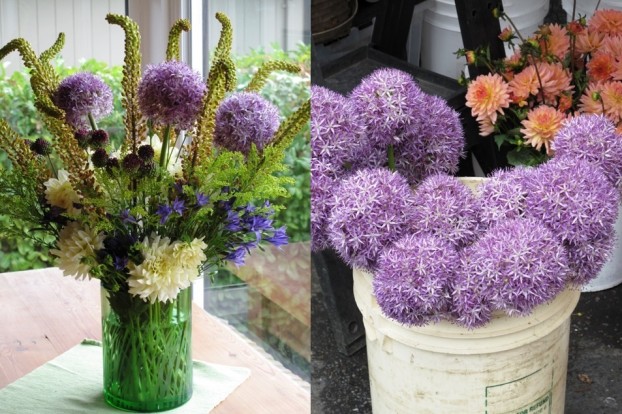
This summertime bouquet features gorgeous alliums and their companions.

This summertime bouquet features gorgeous ‘Globemaster’ alliums and their companions.

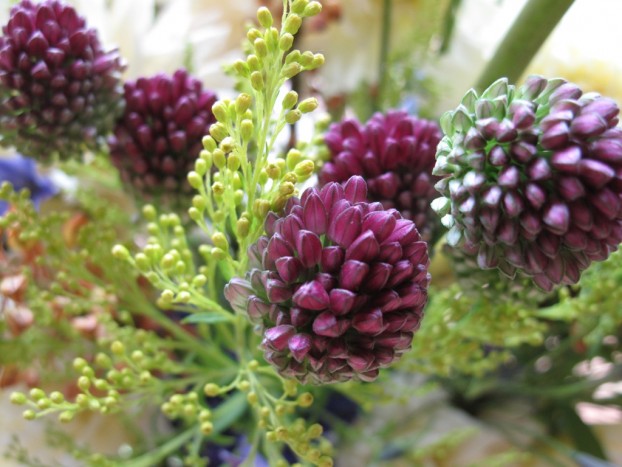
The smaller, darker drumstick allium echoes form and hue of its larger cousin.

The smaller, darker drumstick allium echoes form and hue of its larger cousin.

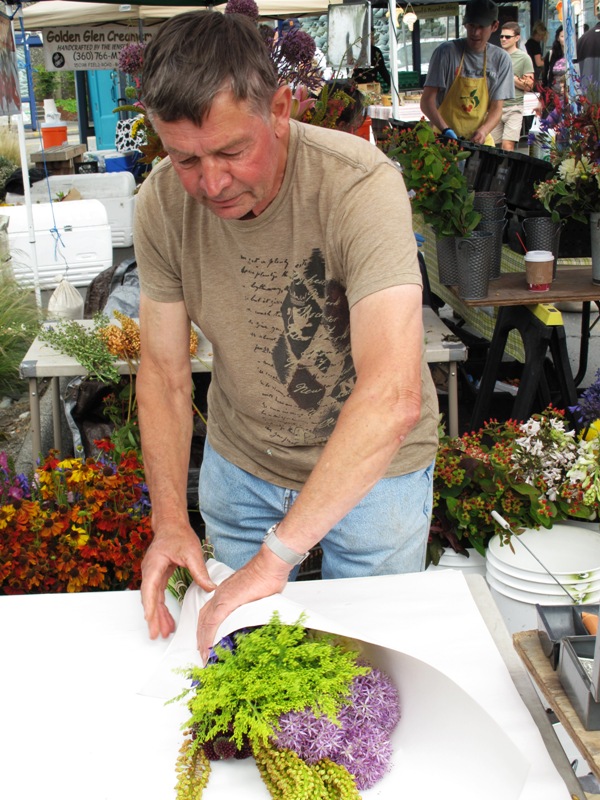
Jan shares his vast knowledge with regular farmers market customers each weekend.

Jan shares his vast knowledge with regular farmers market customers each weekend.

Jan Roozen of Choice Bulb Farms is a good friend and brilliant (not to mention charming) flower farmer.

I’ve known Jan through the Seattle Wholesale Growers Market where he is a member who grows a beautiful variety of flowers.

The selection from Jan and Ritva Roozen’s farm in Skagit Valley north of Seattle features specialty spring and summer bulbs.

Their alliums are some of the best I’ve seen — when I can, I come home with an armload of dramatic blooms and arrange with them.
Jan literally grows 15 varieties of Alliums — can you believe that? Here is the list — click on each cultivar name to see its unique form, color and stature.
Home floral designers can find Jan at the Choice Bulb stall every Saturday at the University District Farmers’ Market and every Sunday at the Ballard Farmers’ Market, both in Seattle.

Fresh-from-the-field, these flowers inspired me to make a summer bouquet a few years ago. I hope you enjoy this textural design in shades of apricot, cream, lemon, lavender and bluish purple and get ready to grow your own alliums (and companions like eremurus and dahlias) in the cutting garden.

READ MORE…

Episode 236: Anne Bradfield of Seattle’s Floressence Studio

Wednesday, March 9th, 2016
Anne Bradfield, owner of Seattle-based Floressence -- captured on the hunt for beautiful and locally-grown Northwest flowers!

Anne Bradfield, owner of Seattle-based Floressence — captured while she was on the hunt for beautiful and locally-grown Northwest flowers!

Love this elevated arrangement!

Love this elevated arrangement!

This week’s conversation is one I’ve wanted to record for a while. You know when you run into someone you really like — and who you want to get to know better, perhaps at the grocery store, or (for me) at the flower market — and you greet one another warmly and say “we should get together for coffee?”

Well that was the case with my friend Anne Bradfield. Owner of a design studio called Floressence, Anne was one of the very first floral designers I found myself chatting with back in 2011 when the Seattle Wholesale Growers Market launched.

A gorgeous Floressence-designed wedding

A gorgeous Floressence-designed wedding

A Floressence Bride

A Floressence Bride

logo1At the time, I was there frequently, both because I was working on my two books, The 50 Mile Bouquet – which featured the stories of many of the flower farmers and floral designers involved with the market, and Slow Flowers, a project that relied on a steady supply of local blooms for my weekly design projects. And I often ran into Anne, who was there shopping for her major wedding and corporate event clients.

Love the inspiration that Anne shares in today's podcast. (c) Laurel McConnell

Love Anne’s inspiration shared in today’s podcast.

Anne soon invited me to speak at a meeting of the Greater Seattle Floral Association, where I met many of our region’s top wedding, event and retail florists. And we kept bumping into one another. . . both always in a rush, and always promising to get together.

You may recognize Anne’s voice because I recorded it for this podcast a few months ago when I interviewed several designers who participated in Lisa Waud’s hands-on large-scale floral art workshop at the Seattle Wholesale Growers Market. And that encounter was the impetus for today’s conversation.

Anne studied interdisciplinary visual art at the University of Washington and she will share how her journey led her through a few career stops before she purchased Floressence thirteen years ago, when she was in her late twenties.

READ MORE…

The Flower House Virtual Tour Part 4 with David Beahm and Daevid Reed (Episode 232)

Wednesday, February 10th, 2016
Daevid Reed (l), Lisa Waud (c) and David Beahm (r), captured in a moment of sheer joy by photographer Heather Saunders at the Field to Vase Dinner, The Flower House, Detroit.

Daevid Reed (l), Lisa Waud (c) and David Beahm (r), captured in a moment of sheer joy by photographer Heather Saunders at the Field to Vase Dinner, The Flower House, Detroit.

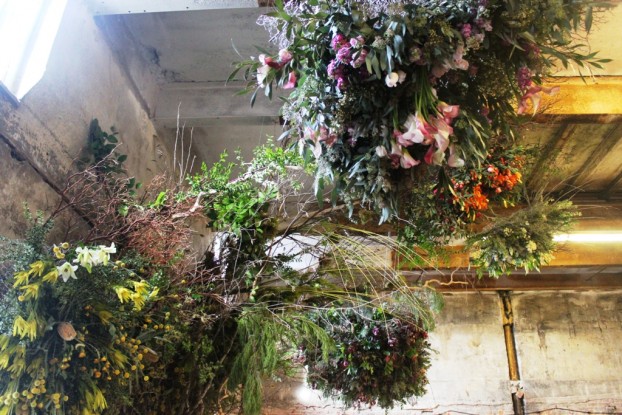
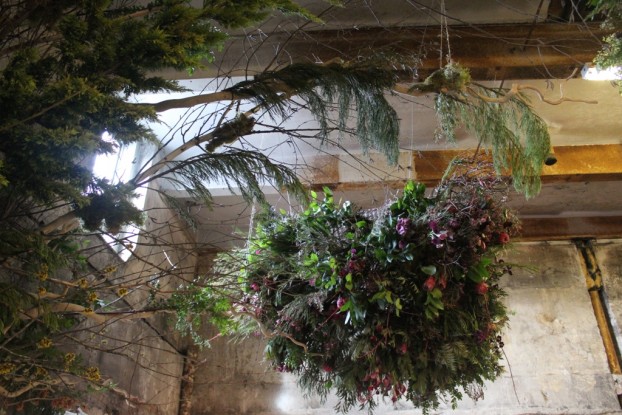
Another view of the hanging pieces

The Seattle floral design community’s reimagined, Flower House-inspired botanical art installation

I have two cool Flower House-related segments to share with you today.

First, I want to share a short conversation with photographer Andrew Buchanan of Subtle Light Photography as we discuss his innovative idea to document the sculptural floral art installation at the Seattle Wholesale Growers Market, which was led by Lisa Waud of The Flower House for the Seattle design community on January 19th. I featured highlights of the January 19th installation day in an earlier episode here.

Enjoy my quick interview that I recorded with Andrew and then view the amazing time-lapse movie that he filmed and edited – shown below. I’m amazed by the power of visual storytelling through this medium and applaud Andrew’s artistry and generosity. I’m honored and grateful that he volunteered his talents for everyone to enjoy!

Based in Seattle, Andrew Buchanan specializes in architectural photography, interiors photography, helicopter aerial photography, land design photography, and hotel and resort photography in Seattle and throughout the Pacific Northwest. Andrew offers photography of architecture, interiors, commercial and public spaces, and other built environments to design and marketing professionals, hotels and resorts, developers, magazines, and advertisers needing compelling, graphic photos of The Spaces Where We Live, Work, and Play. Please start on a Gallery page to see some of Andrew’s work or download his PDF portfolio to keep with youRead more about Andrew here.

ENJOY THIS FABULOUS VIDEO, COURTESY OF ANDREW BUCHANAN:

SeattleWholesaleGrowersMarket-LisaWaud-16Jan from Andrew Buchanan on Vimeo.

You can find the video and all of Andrew’s “motion” work at his online gallery here.

READ MORE…

Floral Spectacle in Seattle, inspired by The Flower House (Episode 230)

Wednesday, January 27th, 2016

“We can imagine it and we can do it,” Diane Szukovathy, Jello Mold Farm & Seattle Wholesale Growers Market

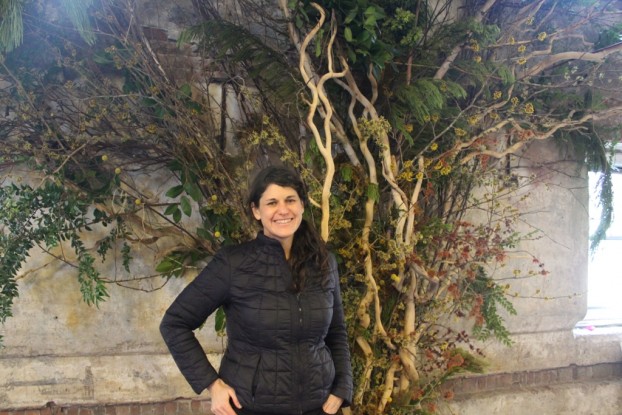
Lisa Waud, artist, innovator, entrpreneur, floral designer and creator of The Flower House (Detroit). She's standing in front of the base of the tree-inspired sculpture installed by her students at the Seattle Wholesale Growers Market.

Lisa Waud, artist, innovator, entrpreneur, floral designer and creator of The Flower House (Detroit). She’s standing in front of the base of the tree-inspired sculpture installed by her students at the Seattle Wholesale Growers Market.

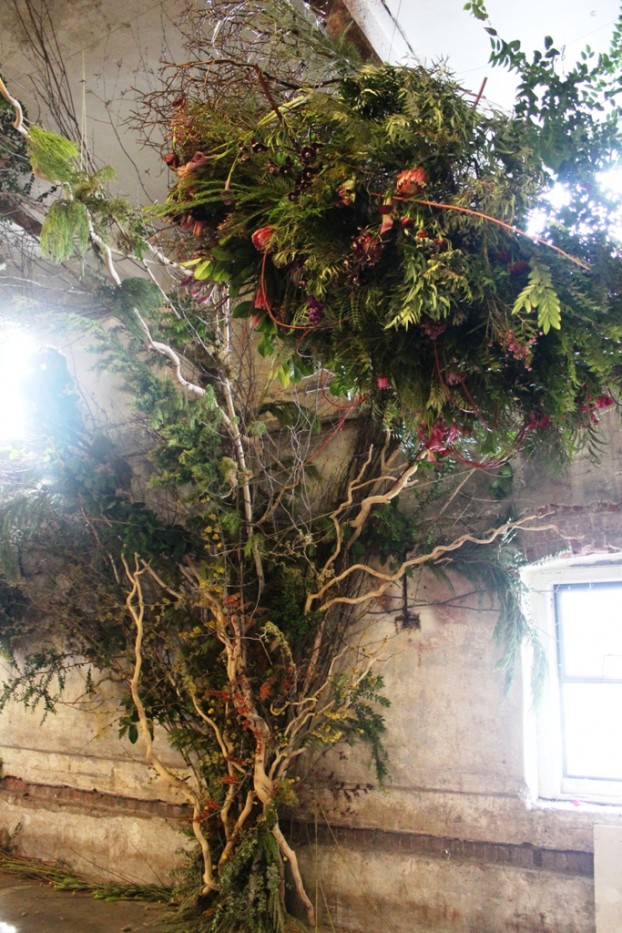
A botanical tree grows up the walls and across the ceiling of the Seattle Wholesale Growers Market

A botanical tree grows up the walls and across the ceiling of the Seattle Wholesale Growers Market

Last week I told you about a series of Flower House activities taking place in Seattle with creator Lisa Waud. As I noted, Lisa has been on a West Coast tour which began on January 19th in Seattle, took her to Olympia and Portland, and continues until early next week in California.

As it turns out, I had a scheduled interview be postponed, so today, I’m bringing you a series of clips, short takes and conversations from the various events held at the Seattle Wholesale Growers Market when Lisa was here. Please enjoy these sound-bites, beginning with remarks from flower farmer Diane Szukovathy of Jello Mold Farm, board chair at the Growers’ Market, as she introduced Lisa Waud’s Wednesday morning lecture.

Diane is followed by Lisa’s introductory remarks; then we’ll jump to several short interviews with designers who took part in a Master Design Class led by Lisa. Thirteen designers teamed up to experience a mini-version of the Flower House installation, creating a massive botanical sculpture within the Market’s walls in just under 4 hours on January 19th.

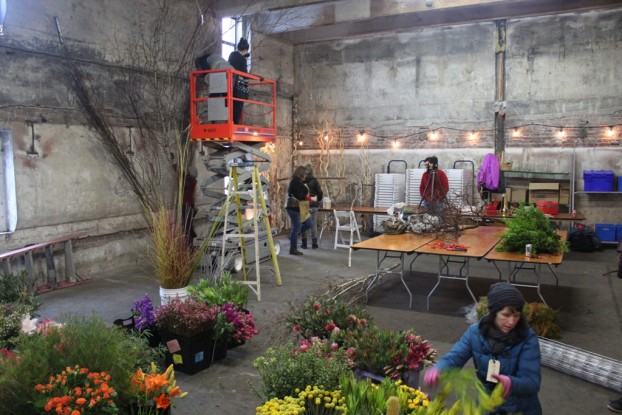
Early in the class, a team started building the "bones" of the sculptural installation, while other designers worked on the floral pieces, called "amoebas"

Early in the class, a team started building the “bones” of the sculptural installation, while other designers worked on the floral pieces, called “amoebas”

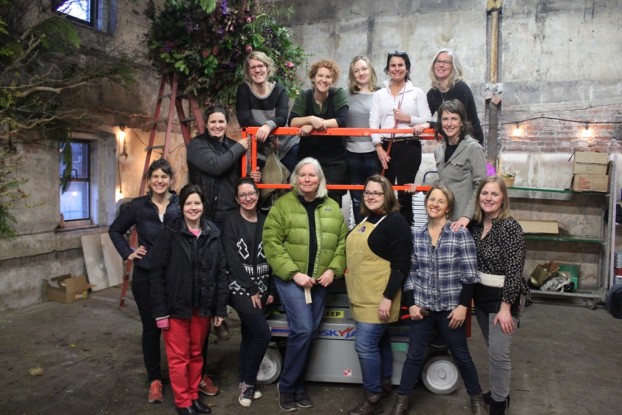
The team of amazing designers who were led through a 4-hour session with Lisa Waud (lisa is front, far left)

The team of amazing designers who were led through a 4-hour session with Lisa Waud (lisa is front, far left)

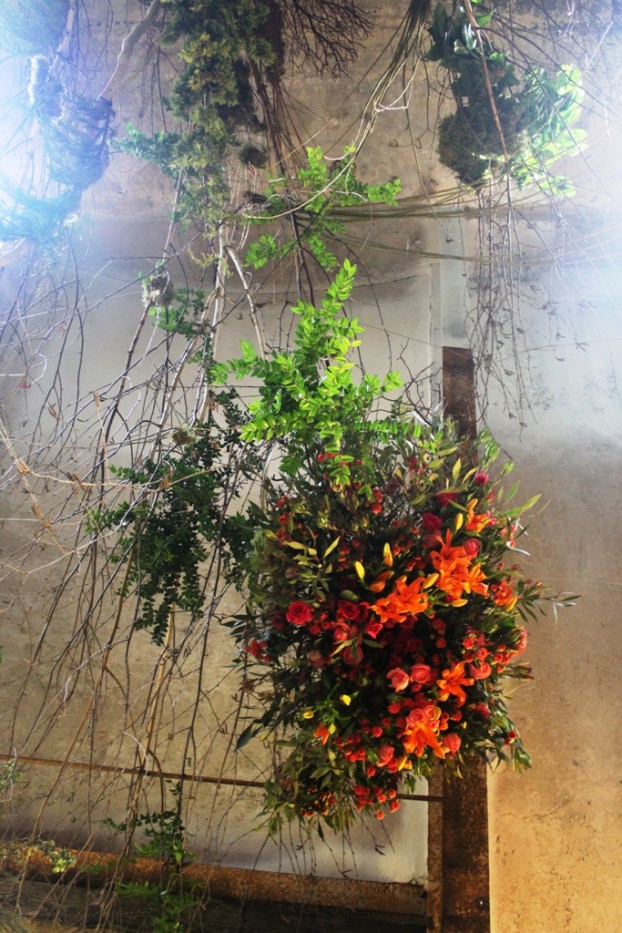
Love this hot, orange-red amoeba palette!

Love this hot, orange-red amoeba palette!

Led by Lisa, the designers went through the entire process that a Flower House designer probably experienced — from visioning, brainstorming, creative problem-solving and execution. Having watched the process first-hand, I have to say it was nothing less than Spectacular!

One of the fun things Lisa threw into the mix was a series of surprises that added pressure and tested the mettle of the designers, much like the Flower House team endured during the 3 days when they installed the Flower House.

So I played along as a member of the press, who showed up unannounced expecting people to stop what they were doing while I conducted an interview. That was just one of the crazy twists Lisa threw at her students. Another of her surprises was to add a “last minute” delivery of flowering branches — and challenging the designers to figure out how to incorporate those elements into an almost-finished composition.

In the end, well, all I can say is, these designers rose to the challenge and proved that the sum of their parts was far greater than anyone could have individually achieved.

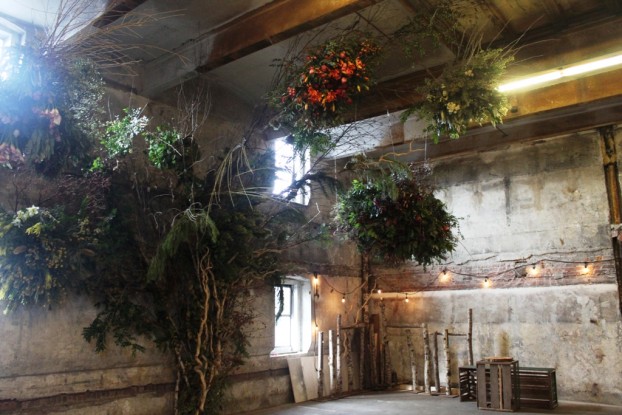
The final installation is gloriously wild and magical.

The final installation is gloriously wild and magical.

The Seattle Wholesale Growers Market's 18-foot-high ceilings are perfect for the installation -- check out the I-beams.

The Seattle Wholesale Growers Market’s 18-foot-high ceilings are perfect for the installation — check out the I-beams.

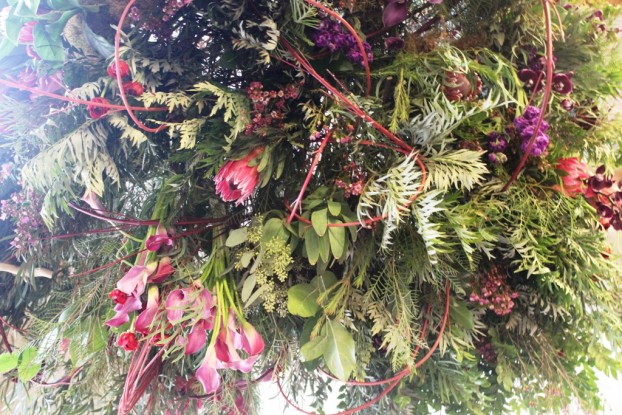
Each of the five "amoebas" were woven with foliage, branches and flowers, with a specific color emphasis.

Each of the five “amoebas” were woven with foliage, branches and flowers, with a specific color emphasis.

Another view of the hanging pieces

Another view of the hanging pieces

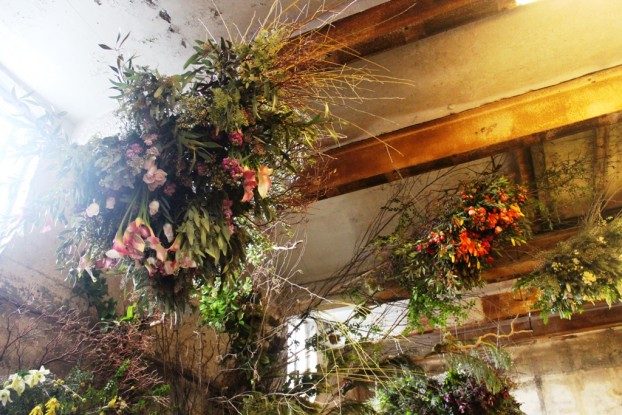
Details of the pink and fuchsia amoeba

Details of the pink and fuchsia amoeba, fashioned with flowers and foliage from the farms that supply the Seattle Wholesale Growers Market

As you hear a series of clips, I will ask each person to introduce herself and her business, followed by a brief series of questions; and then we move onto another group of designers. This patchwork quilt of a podcast episode concludes with a 10-minute wrap-up session, a debrief with Lisa and the 13 designers, as they compare notes about the challenges and results of their time together.

Here is a list all the participants and their social media links — these are women you will want to follow if you haven’t yet discovered them!

Floressence, owned by Anne Bradfield

Terra Bella Flowers, owned by Melissa Feveyear

Splash Floral and Interiors, owned by Lisa Behringer

Columbia City Bouquet, owned by Emily Kopca

Gather, owned by Amy Kunkel-Patterson

Bash and Bloom, owned by Eleanor Blackford

Lola Creative, owned by Emily Ellen Anderson

Camas Design, owned by Erin Shackelford

First & Bloom, owned by Tammy Myers

Smashing Petals, owned by Keita Horn

Melanie Benson Floral, owned by Melanie Benson

Vases Wild, owned by Tobey Nelson

Casablanca Floral, owned by Maura Whalen

Finally, I have to state publicly, that this entire week of events could not have happened so successfully without the leadership and talents of the three staff of the Seattle Wholesale Growers Market: Molly Sadowsky, Danielle Bennett, and Agnes Cwalina. They are amazing!

NEWS TO SHARE

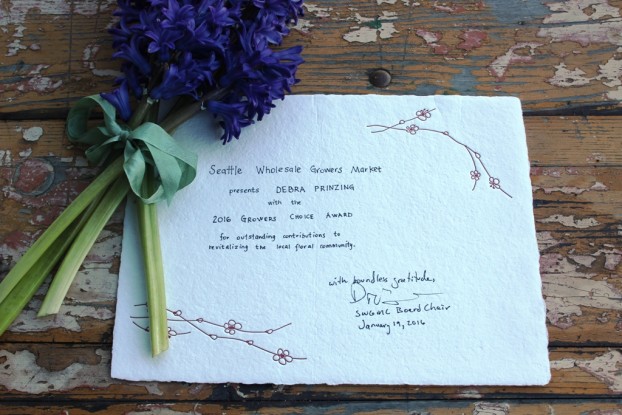
This happened and it came as a total surprise!

This happened and it came as a total surprise!

I want to thank the flower farmers of the Seattle Wholesale Growers Market for surprising me with a huge honor. Here is a link to the Market’s press release.

On January 19th, Slow Flowers hosted a dinner to honor Lisa Waud and to showcase the floral art installation she and her team had installed earlier that afternoon.

At the dinner, Diane Szukovathy took the mic and announced that the farmers had created a new award, called the Growers Choice Award, and that I was the first recipient. Later she told me it was the most fun scheming she’d had in a long time, which puts a huge smile on my face. I truly was astonished to receive this recognition–and the language is most meaningful because it recognizes “outstanding contributions to revitalize the local floral community.”

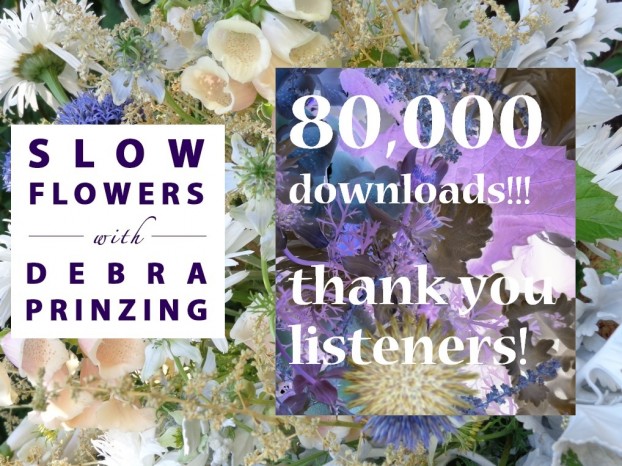
80K

The Slow Flowers Podcast has been downloaded more than 80,000 times by listeners like you. THANK YOU to each and every one of you for downloading, listening, commenting and sharing. It means so much.

Until next week, you’re invited to join me in putting more American grown flowers on the table, one vase at a time. And If you like what you hear, please consider logging onto Itunes and posting a listener review.

The content and opinions expressed here are either mine alone or those of my guests alone, independent of any podcast sponsor or other person, company or organization.

The Slow Flowers Podcast is engineered and edited by Andrew Wheatley and Hannah Holtgeerts. Learn more about their work at shellandtree.com.

Music provided by: Audio Nautix