GIVEAWAY Details Below — Share a Comment and Your Name Will Be Added to the Drawing for The First-Time Gardener: Growing Plants and Flowers
I don’t know about you, but I’ve got spring gardening on my mind! The hellebores are already blooming; the daffodil bulbs are pushing out of the soil an inch or so. I can even see the tiniest bump of my peonies’ deep maroon tips at the crown of each plant. So, sure we’re still 39 days until spring arrives, but who’s going to let the calendar hold us back, right?
A major spring ritual for me has always been participation in local and national garden and flower festivals. Sadly, this year, the closest thing to an indoor spring garden show is going to be over Zoom. Gain inspiration from the replay video of our February 5th Slow Flowers Member Virtual Meet-up, featuring two of our members who are major hellebore experts.
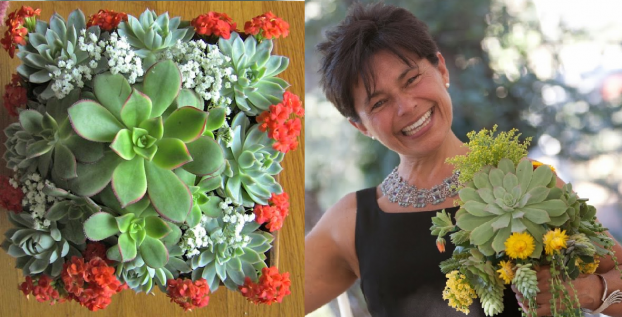
Thank you to Pam Youngsman of Poppy Starts Inc. and Riz Reyes of RHR Horticulture for a fantastic presentation. They share volumes about what to grow, how to grow, how and when to harvest and how to design with hellebores.
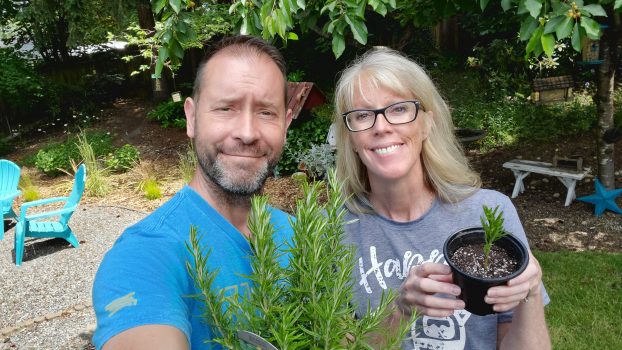
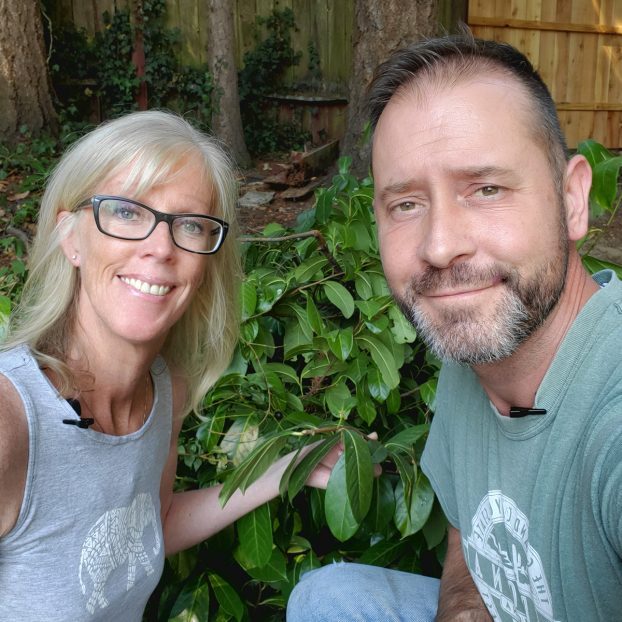
Sean McManus and Allison McManus of Spoken Garden
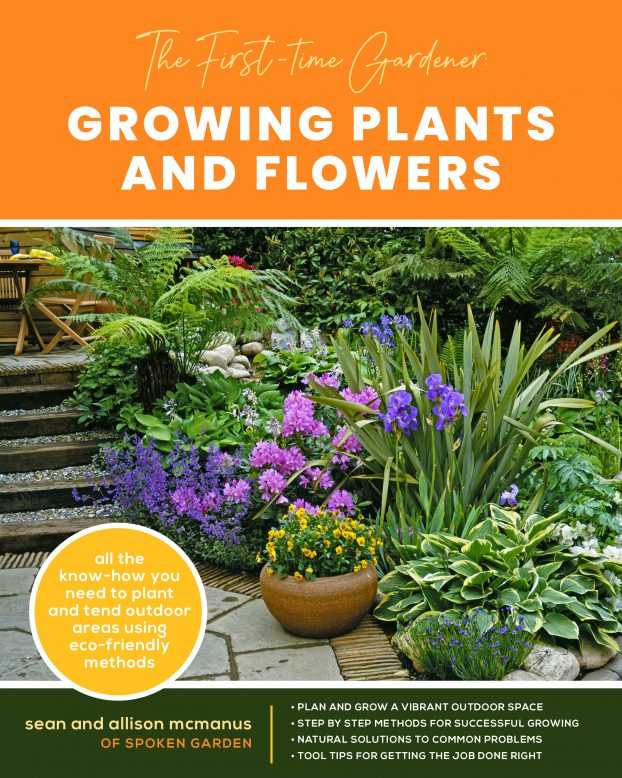
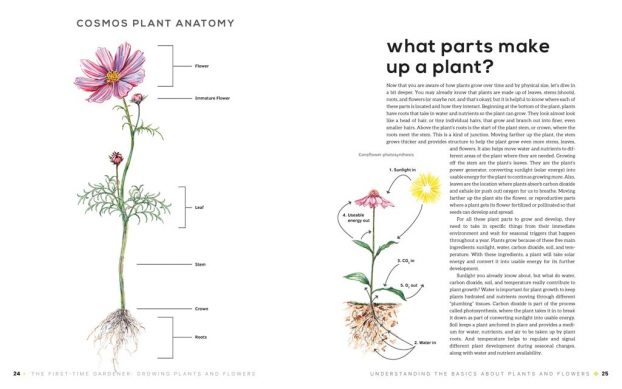
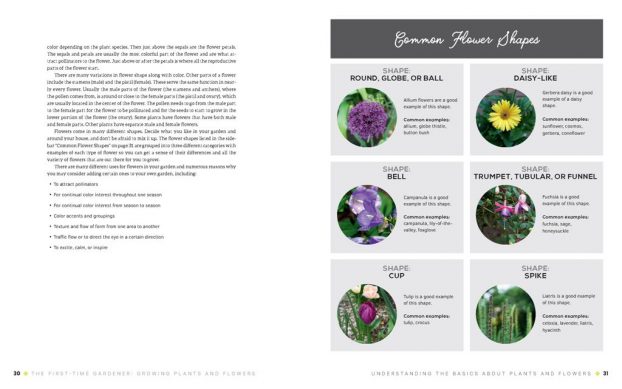
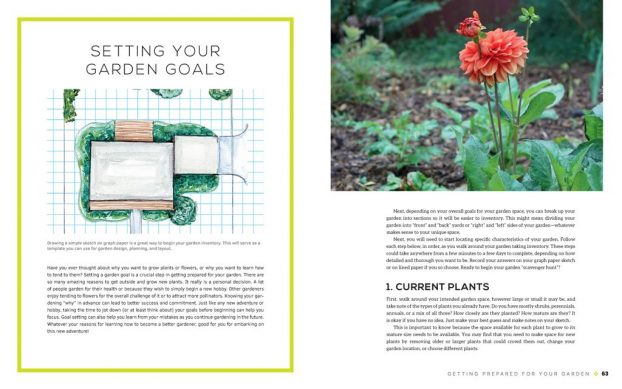
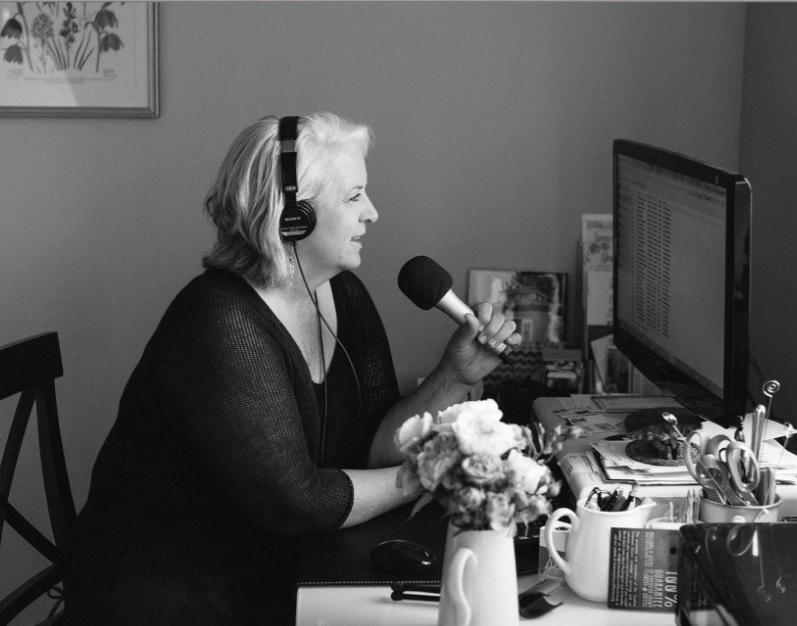
Another perennial ritual of spring is the arrival of a new crop of gardening books. Here at Slow Flowers Podcast, we know we have as many gardener-florists as farmer-florists who listen and learn. And today, I’m happy to welcome first-time authors, Sean and Allison McManus of Spoken Garden. This talented husband-wife duo are busy behind the microphone and camera, teaching ornamental gardening to beginning and curious home gardeners. They have spent the past year writing The First-Time Gardener: Growing Plants and Flowers
The book will be released in March and one lucky listener will win a copy for their bookshelf! Listen to the end of the episode to hear how to add your name to our random drawing and giveaway.
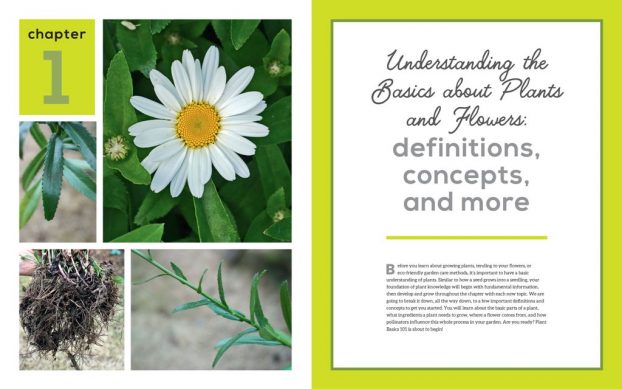
Sean and Allison are the gardening pros behind the popular website, YouTube channel and podcast Spoken Garden. They offer clear, fact-based information, presented in a friendly and accessible way. With step-by-step instructions and full-color illustrations, new gardeners will learn how to select, plant and tend for outdoor plants, the best techniques, how to mulch correctly, pruning do’s and don’ts, tips for effective, eco-friendly gardening, and much more.
Peek inside the pages of their new book:
Here’s a little bit more about Sean and Allison:
Sean has a Master’s in Environmental Horticulture from Washington State University and possesses several other horticulture, landscaping, or gardening-related certificates. Sean has over 8 years of experience in Industrial Garden Maintenance and 12+ years operating a private landscape and consulting company. With over two decades in the field, he dreams to fulfill his lifelong passion for educating others about horticulture and gardening.
Allison has a Master’s in Teaching and is a National Board certified middle school science educator. Through trial and error over the past 10+ years, she has successfully maintained several vegetable gardens and beds full of flowers. She loves attracting all kinds of pollinators and is proud of the fact that their yard is a Certified Wildlife Habitat. She has a passion for photography, animals, writing, traveling, creating content, and lifelong learning.
I know you’ll enjoy their story and be inspired to add to your ornamental garden this spring. Thanks so much for joining me today as Sean and Allison McManus shared their encouragement for beginning gardeners, and actually anyone who wants to develop a more enriching and fulfilling ornamental garden! If you want to be added to the giveaway drawing for their new book, The First-Time Gardener: Growing Plants and Flowers , be sure to post a comment in the show notes below — please share what did you wish you knew when you were a beginning gardener?
Coming up on Thursday, February 18th at 2 pm Eastern, Slow Flowers is teaming up with Johnny’s Selected Seeds to produce a free webinar for flower farmers, farmer-florists and floral designers interested in knowing more about our Floral Insights and Industry Forecast for 2021.
I’ll be joining Johnny’s flower team, Hillary Alger and Joy Longfellow, as we dive into current and upcoming themes in the floral marketplace. We will review four of the top Insights from the Slow Flowers 2021 Forecast and hear more from Hillary, who will share findings from Johnny’s recent survey of flower seed customers — commercial cut flower farmers. We’ll share a nice back-and-forth discussion and as a bonus, Hillary plans to share an update about seed supply and new floral variety breeding programs. You may already have registered – and if so, I’ll see you there. As of today’s air date, the event may be full, but Johnny’s will have a complete recording available on Monday, February 22nd — and I’ll share it with you in a future episode.
And registration is open for the Fleurvana Virtual Summit (March 5th-7th), focusing on Sustainability and Regeneration, which also takes place online. Robin Avni, my partner in BLOOM Imprint, have developed a new course for aspiring floral book authors with a presentation called The Journey From Blog to Book. Our course is designed for every creative person we’ve met dreams of sharing their art, craftsmanship and aesthetic in a book. Registration is free and there are also options to purchase larger packages.
Thank you to our Sponsors
This podcast is brought to you by Slowflowers.com, the free, online directory to more than 830 florists, shops, and studios who design with local, seasonal and sustainable flowers and to the farms that grow those blooms. It’s the conscious choice for buying and sending flowers.
And thank you to our lead sponsor for 2021, Farmgirl Flowers. Farmgirl Flowers delivers iconic burlap-wrapped bouquets and lush, abundant arrangements to customers across the U.S., supporting more than 20 U.S. flower farms by purchasing more than $9 million dollars of U.S.-grown fresh and seasonal flowers and foliage annually, and providing competitive salaries and benefits to 240 team members based in Watsonville, California and Miami, Florida. Discover more at farmgirlflowers.com.
Rooted Farmers works exclusively with local growers to put the highest-quality specialty cut flowers in floral customers’ hands. When you partner with Rooted Farmers, you are investing in your community, and you can expect a commitment to excellence in return. Learn more at RootedFarmers.com.
Syndicate Sales, an American manufacturer of vases and accessories for the professional florist. Look for the American Flag Icon to find Syndicate’s USA-made products and join the Syndicate Stars loyalty program at syndicatesales.com.
Johnny’s Selected Seeds, an employee-owned company that provides our industry the best flower, herb and vegetable seeds — supplied to farms large and small and even backyard cutting gardens like mine. Find the full catalog of flower seeds and bulbs at johnnysseeds.com.
Thanks so much for joining us today! The Slow Flowers Podcast has been downloaded more than 688,000 times by listeners like you. Thank you for listening, commenting and sharing – it means so much. As our movement gains more supporters and more passionate participants who believe in the importance of our domestic cut flower industry, the momentum is contagious. I know you feel it, too.
I value your support and invite you to show your thanks to support Slow Flowers’ ongoing advocacy, education and outreach activities. You can find the donate button in the column to the right at debraprinzing.com
The content and opinions expressed here are either mine alone or those of my guests alone, independent of any podcast sponsor or other person, company or organization.
The Slow Flowers Podcast is engineered and edited by Andrew Brenlan. Learn more about his work at soundbodymovement.com.
Music Credits:
Horizon Liner; These Times; Turning On the Lights; Gaenaby Blue Dot Sessions http://www.sessions.blue
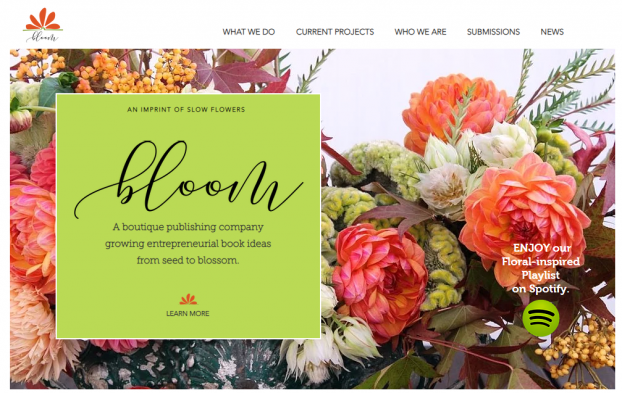
It’s a very exciting day for Slow Flowers and this episode is devoted to some BIG NEWS. I’m thrilled to tell you all about it! I’ve invited Robin Avni, past guest of this podcast, to join me as together we tell you all about our new collaboration — the formation of a boutique book publishing project called BLOOM Imprint.
Debra Prinzing (left) and Robin Avni (right)
BLOOM Imprint emerges from our 15-year professional relationship and friendship. A decade ago, Robin and I collaborated with a talented group of women on a multi-year content and lifestyle consulting project, “Real Women, Real Life.” During that time, we also teamed up to give a presentation on The Female Gardener: Mommy to Maven for the Independent Garden Center Show and co-authored white papers and trend reports about female consumers.
Fast-forward to 2019-2020, when Robin and I produced Slow Flowers Journal – Volume One, a compendium of the “best of” editorial stories and imagery featured in the “Slow Flowers Journal” section of Florists’ Review magazine. That’s where I previously served as contributing editor and Robin served as managing editor of books, producing 10 book titles related to the floral industry.
We’re announcing the launch of BLOOM Imprint today, with me serving as editorial director and Robin serving as creative director. This venture is committed to developing books that express visual and verbal storytelling in equal measures. By pairing my love of the written word and editorial narrative and Robin’s visually strong creative direction talent, we are pretty jazzed about what we have in store for sharing the people, places, flowers and art of our Slow Flowers Community through a new lineup of books.
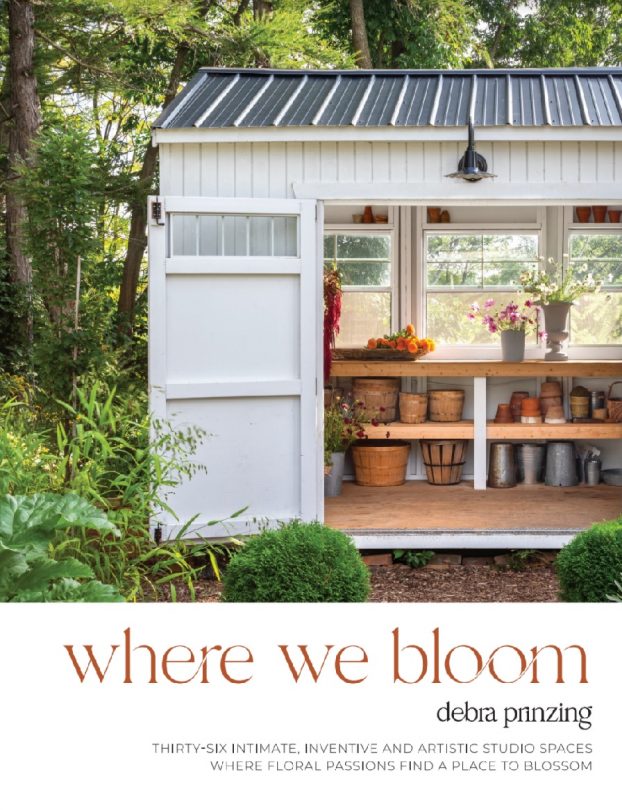
We believe that “setting” is an important facet to making art — and nothing could be truer for floral designers and floral artists. This book profiles the people, art and creative work spaces of designers and makers.
The subtitle is: Thirty-Six Intimate, Inventive and Artistic Studio Spaces Where Floral Passions Find a Place to Blossom
Step inside the personal environments where flowers come to life. “Where We Bloom” showcases beautiful plant- and flower-filled settings of Slow Flowers designers, farmer-florists and growers. Each setting reflects the personality and aesthetic style of its owner, offering great ideas to inspire the design, decor, organization, and of course, functionality of your creative space.
Publication Date: April 2021 Pre-ordering information will be shared soon!
Between us, Robin and I have produced and published more than 20 lifestyle, design, architecture, floral and gardening titles. We formed BLOOM Imprint as a boutique publishing company with the mission of identifying creative entrepreneurial book ideas and growing them — from the seed of an initial concept to a finished product. As we publish new authors and consult with aspiring ones, we believe that producing a book is ultimately one of the most affordable marketing endeavors available to creatives.
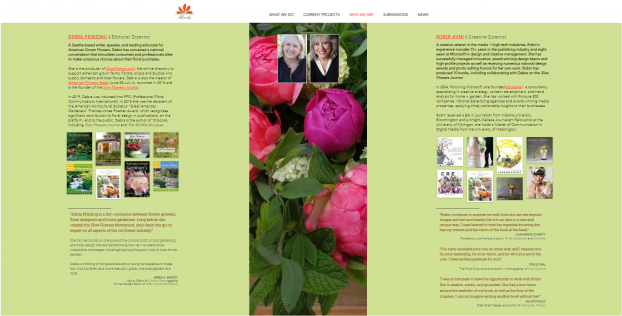
From our “Who We Are” page on BLOOMImprint.com — learn about our backgrounds and experiences, and read what people say about working with us!
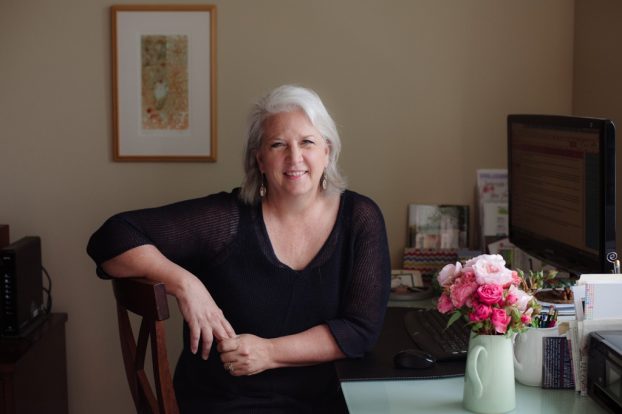
Let me tell you a little more about Robin Avni and then we’ll jump right in and get started:
A creative veteran in the media + high-tech industries, Robin’s experience includes 15+ years in the publishing industry and eight years at Microsoft in design and creative management. She has successfully managed innovative, award-winning design teams and high-profile projects as well as receiving numerous national design and photography editing awards for her own work. Robin has produced 10 books, including collaborating with Debra on the Slow Flowers Journal.
In 2004, following Microsoft, she founded bricolage*, a consultancy specializing in creative strategy, content development, and arts advocacy. She has worked with Fortune 500 companies, national advertising agencies and award-winning media properties, applying timely actionable insights to their businesses. Robin received a BA in journalism from Indiana University, Bloomington and a Knight-Wallace Journalism Fellowship at the University of Michigan; she holds a Master of Communication in Digital Media from the University of Washington.
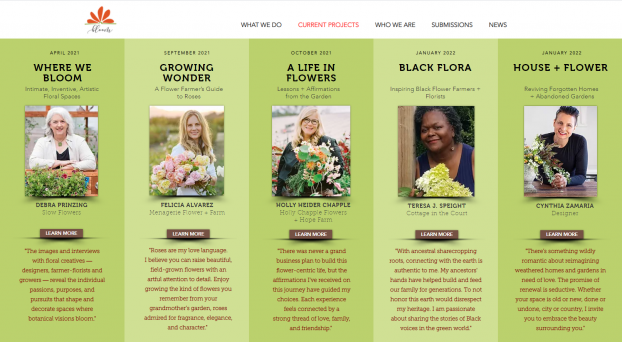
Anticipation! Here are our first five books in the BLOOM Imprint catalog, with titles from Debra Prinzing, Felicia Alvarez, Holly Heider Chapple, Teresa J. Speight and Cynthia Zamaria!
Thanks so much for joining Robin Avni and me as we shared a conversation about BLOOM Imprint.
And remember, you can join us at the Fleurvana Virtual Summit March 5-7, focusing on Sustainability and Regeneration, where Robin and I will present an original new course, From Blog to Book Proposal. The course is designed for every creative person we’ve met dreams of sharing their art, craftsmanship and aesthetic in a book. As a tangible “artifact,” there is amazing social validation that comes with having a book about your work. A book can narrate your story, teach your concepts and document your work. We believe successful books are driven by a Passion that answers the following: What are you compelled to share? What do you have to offer that will make the world a better place? What is your unique point of view?
Thank you to our Sponsors
This podcast is brought to you by Slowflowers.com, the free, online directory to more than 830 florists, shops, and studios who design with local, seasonal and sustainable flowers and to the farms that grow those blooms. It’s the conscious choice for buying and sending flowers.
And thank you to our lead sponsor for 2021, Farmgirl Flowers. Farmgirl Flowers delivers iconic burlap-wrapped bouquets and lush, abundant arrangements to customers across the U.S., supporting more than 20 U.S. flower farms by purchasing more than $9 million dollars of U.S.-grown fresh and seasonal flowers and foliage annually, and providing competitive salaries and benefits to 240 team members based in Watsonville, California and Miami, Florida. Discover more at farmgirlflowers.com.
Mayesh Wholesale Florist. Family-owned since 1978, Mayesh is the premier wedding and event supplier in the U.S. and we’re thrilled to partner with Mayesh to promote local and domestic flowers, which they source from farms large and small around the U.S. Learn more at mayesh.com.
The Gardener’s Workshop, which offers a full curriculum of online education for flower farmers and farmer-florists. Online education is more important this year than ever, and you’ll want to check out the course offerings at thegardenersworkshop.com.
Association of Specialty Cut Flower Growers. Formed in 1988, ASCFG was created to educate, unite, and support commercial cut flower growers. It mission is to help growers produce high-quality floral material, and to foster and promote the local availability of that product. Learn more at ascfg.org.
Thanks so much for joining us today! The Slow Flowers Podcast has been downloaded more than 683,000 times by listeners like you. Thank you for listening, commenting and sharing – it means so much.
As our movement gains more supporters and more passionate participants who believe in the importance of our domestic cut flower industry, the momentum is contagious. I know you feel it, too.
I value your support and invite you to show your thanks to support Slow Flowers’ ongoing advocacy, education and outreach activities. You can find the donate button in the column to the right here at debraprinzing.com
The content and opinions expressed here are either mine alone or those of my guests alone, independent of any podcast sponsor or other person, company or organization.
The Slow Flowers Podcast is engineered and edited by Andrew Brenlan. Learn more about his work at soundbodymovement.com.
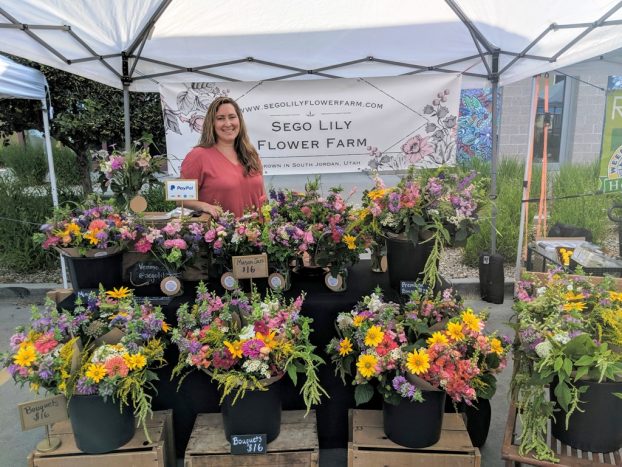
I have a fabulous and informative conversation for you today, with Fawn Rueckert of Sego Lily Flower Farm, based in Utah’s Salt Lake Valley.
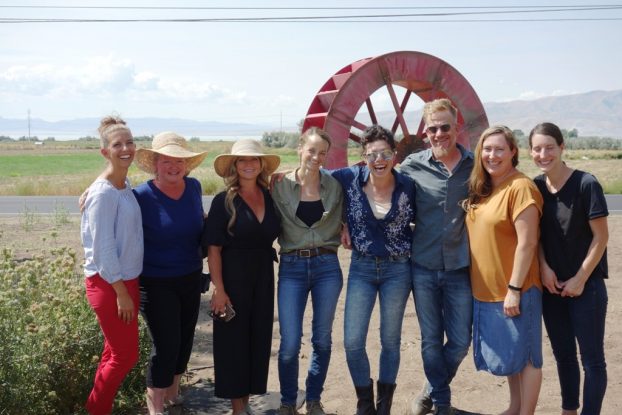
The emerging Utah flower farming community gathered at Poppin’ Blossoms on September 7th. I’m so glad I met everyone! Fawn is seen second from the right.
I first met Fawn in person in September 2019 when I was in Salt Lake City for the annual GardenComm conference. I skipped out one day and rented a car to drive about 30 minutes south of the city to join a gathering of Utah flower growers. Laura Pittard of Poppin’ Blossoms hosted the lovely luncheon and tour of her beautiful cut flower fields and you’ll want to go back and listen to Episode 418 that we recorded prior to the event. There, I met Fawn and learned about her urban micro farm and focus on retail sales of her flowers through a CSA subscription and farmers’ market outlets.
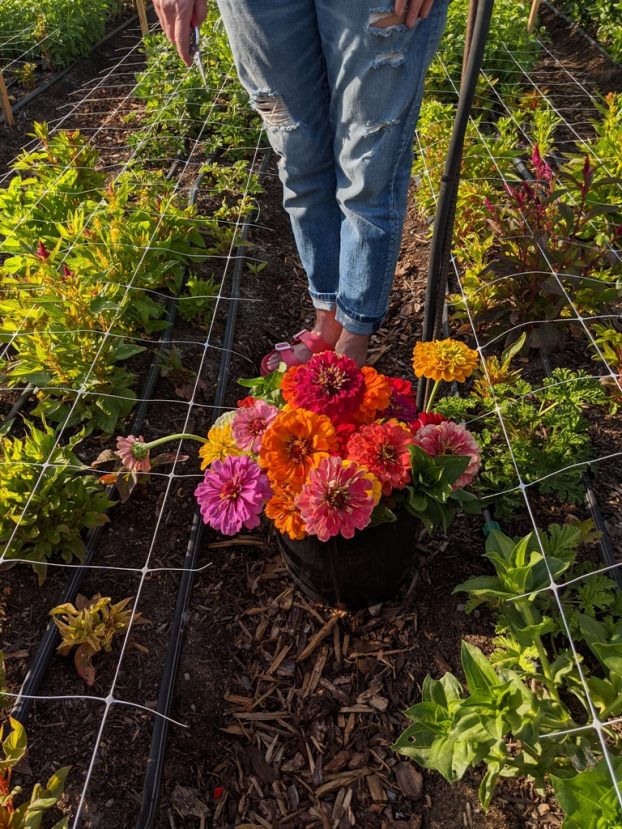
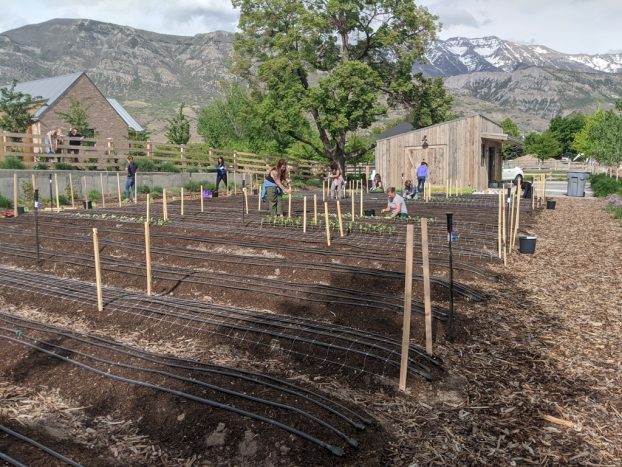
Students of last summer’s popular cutting garden series take home bountiful buckets of flowers like this one
Fawn has been on my wish list to interview. She is vice president of the burgeoning Utah Cut Flower Farm Association and you’ll hear an update about that amazing collection of inter-mountain west flower growers. As it turns out, at that same gathering in September 2019, I met Heather Griffiths of Wasatch Blooms, a colleague of Fawns through the Utah Cut Flower Farm Association. You can hear my interview with Heather in Episode 428 which aired in November 2019, along with an interview with Slow Flowers member Ali Harrison of Florage Utah.
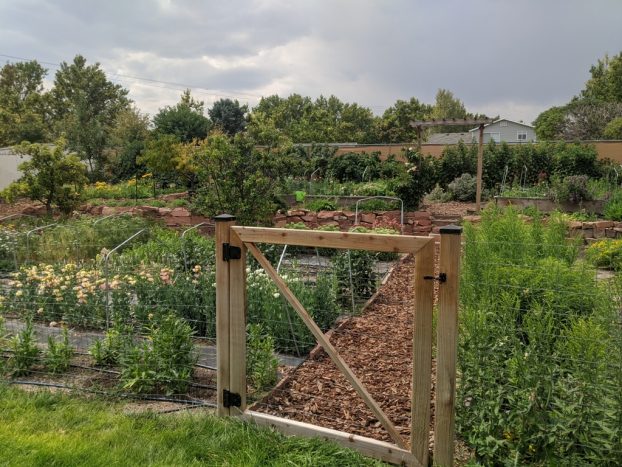
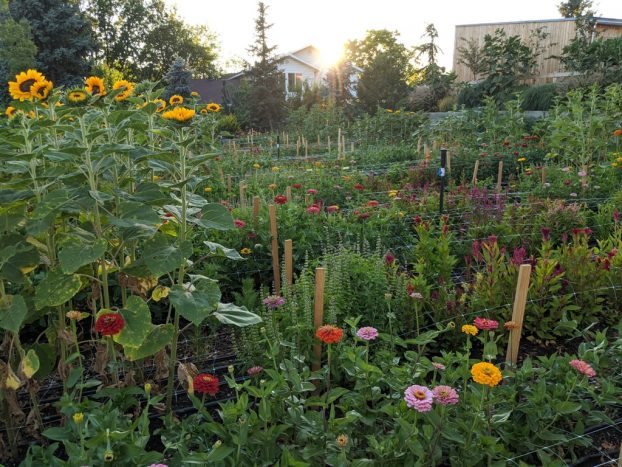
Sego Lily Flower Farm, fenced to keep out the family dog!
There’s a lot going on in this part of the country, an area that Fawn points out is only recently embracing local flower agriculture and sustainable design.
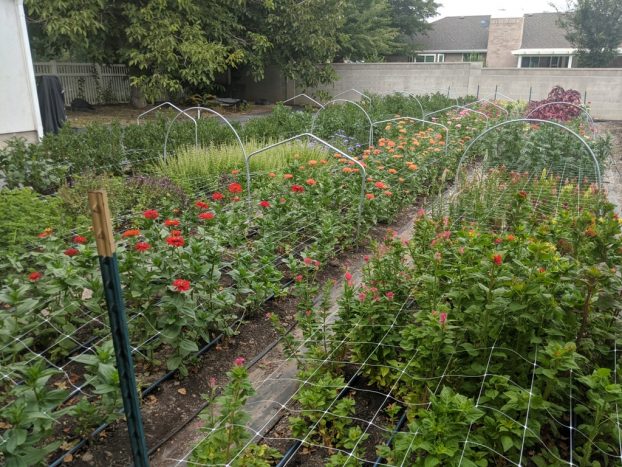
Making the most of a suburban backyard and a “Sister Farm” at the neighbor’s
Fawn shares a lovely “about” essay on her website for Sego Lily Flower Farm, which talks about her childhood wonder of the plant world, and her gardening family roots. She picks up the narrative after moving from Southern California to Utah with her young family, writing:
“We were finally able to purchase our first home, a duplex on a tiny unfinished lot. As we dove head first into landscaping, my childhood dreams were coming true, I finally had my own bit of earth to tend and plant. Only it wasn’t enough, I needed more, so in 2013 we moved to a smaller home on a larger lot. Now with 4 sons in tow, we began designing and building my dream potager, complete with a cutting garden. It didn’t take long to realize that it would be a lot more fun to share the bounty of our garden than keep it to ourselves, and we established Sego Lily Flower Farm in 2017. We focus on growing cut flower varieties that are unique, that wouldn’t survive the rigors of shipping, are most beautiful when grown locally and grow them in a way that is safe for our family and yours.”
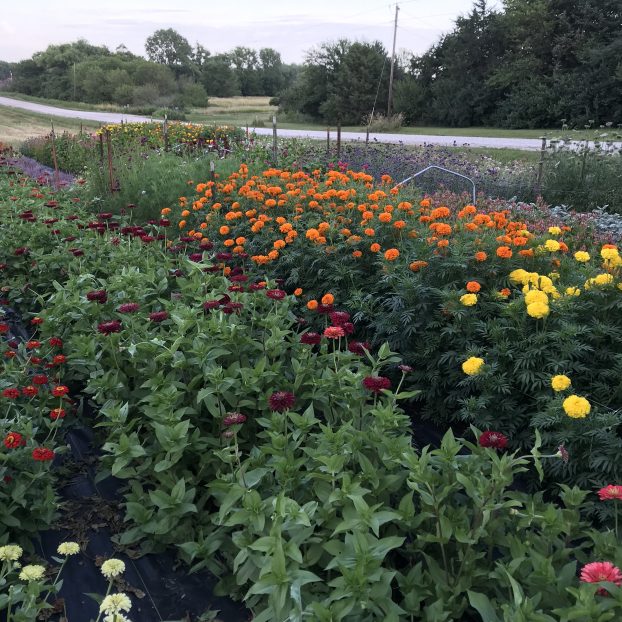
Sego Lily Flower Farm is situated in Salt Lake valley on Fawn’s 1/3-acre suburban lot. We focus on sustainable growing practices, feeding the soil with organic material, and avoid the excessive use of herbicides and pesticides.
I’m excited for you to hear the rest of the story, including how Fawn is branching out into education and workshops. You will find photos of this talented farmer-florist and links to her social places in our show notes at debraprinzing.com for Episode 489. Let’s get started.
If you live in any of the inter-mountain states, Nevada, Idaho, Colorado and Wyoming check out the Utah Cut Flower Farm Association. As Fawn mentioned, there are people and resources for the entire region.
I want to direct you to a few cool video resources that we posted for Slow Flowers members this past week.
First, you can find the concluding post in our eight-part weekly series about all the insights and themes from our 2021 Slow Flowers member survey — on Slow Flowers Journal.com. Karen Thornton and Niesha Blancas joined me for a lively recap Q&A discussing some of the survey’s findings that reveal much more about YOU, our members. We also share many of the comments and questions that members wrote in response to two open-ended questions: What are the key ways in which you have found value in the Slow Flowers member benefits? and Do you have any other comments, questions, or concerns you’d like to share with Slow Flowers? We recorded our Zoom conversation on January 14th and you’ll want to watch. Karen and Niesha added so much to that session, but truly, Edd and Rami, Niesha’s two cats, are the stars of the show! Since Niesha pointed out that she looks for images of your flowers with pets while curating the Slow Flowers Society IG feed, this will come as no surprise!
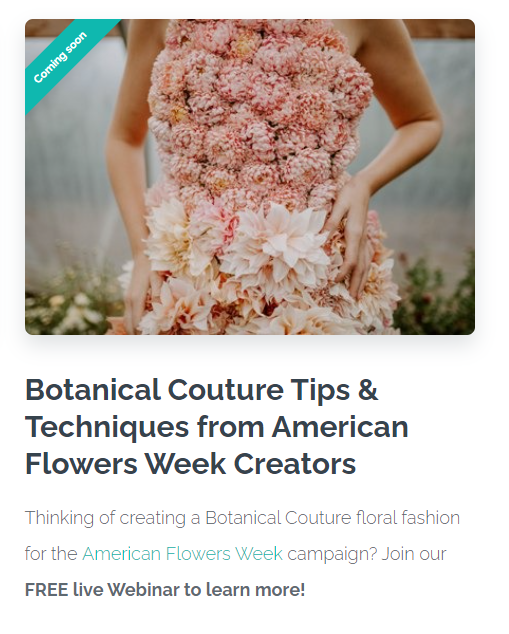
Last week, I also invited you join our free webinar about Botanical Couture fashions for the upcoming American Flowers Week 2021 promotional campaign. It is a fabulous session and I’ve posted the link to our replay video in today’s show notes for you to hear from more than ten past botanical couture creators, each of whom shared how they conceptualized their unique, iconic look for past American Flowers Week collections.
Thank you to our Sponsors
And thank you to our lead sponsor for 2021: Farmgirl Flowers delivers iconic burlap-wrapped bouquets and lush, abundant arrangements to customers across the U.S., supporting more than 20 U.S. flower farms by purchasing more than $9 million dollars of U.S.-grown fresh and seasonal flowers and foliage annually, and providing competitive salaries and benefits to 240 team members based in Watsonville, California and Miami, Florida. Discover more at farmgirlflowers.com.
This podcast is brought to you by Slowflowers.com, the free, online directory to more than 800 florists, shops, and studios who design with local, seasonal and sustainable flowers and to the farms that grow those blooms. It’s the conscious choice for buying and sending flowers.
Rooted Farmers works exclusively with local growers to put the highest-quality specialty cut flowers in floral customers’ hands. When you partner with Rooted Farmers, you are investing in your community, and you can expect a commitment to excellence in return. Learn more at RootedFarmers.com.
Johnny’s Seeds, an employee-owned company that provides our industry the best flower, herb and vegetable seeds — supplied to farms large and small and even backyard cutting gardens like mine. Find the full catalog of flower seeds and bulbs at johnnysseeds.com.
Syndicate Sales, an American manufacturer of vases and accessories for the professional florist. Look for the American Flag Icon to find Syndicate’s USA-made products and join the Syndicate Stars loyalty program at syndicatesales.com.
Thanks so much for joining us today! The Slow Flowers Podcast has been downloaded more than 680,000 times by listeners like you. Thank you for listening, commenting and sharing – it means so much.
As our movement gains more supporters and more passionate participants who believe in the importance of our domestic cut flower industry, the momentum is contagious. I know you feel it, too.
I value your support and invite you to show your thanks to support Slow Flowers’ ongoing advocacy, education and outreach activities. You can find the donate button in the column to the right at debraprinzing.com
The content and opinions expressed here are either mine alone or those of my guests alone, independent of any podcast sponsor or other person, company or organization.
The Slow Flowers Podcast is engineered and edited by Andrew Brenlan. Learn more about his work at soundbodymovement.com.
This Forecast began seven years ago in 2014 when I began documenting shifts and changes in the Slow Flowers Movement. I recently described the origins of this important exercise in my new online course, Taking Stock and Looking Ahead [P.S. follow this link to learn how you can take this free course as my gift to you.]
Here’s how I remember it: In 2014, when I launched slowflowers.com as an online directory of American flowers and the growers and florists who supplied them, I worked with two talented public relations friends to get the word out to the media. While planning a visit to meet with lifestyle and garden magazine editors in New York, one of the PR experts urged me to create a Power Point slide deck that included an overview of floral trends I associated with the emerging Slow Flowers movement.
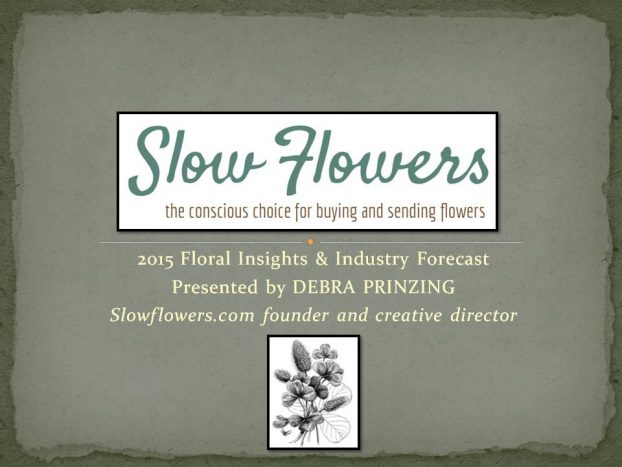
In creating that deck, which became my first forecast for 2015 (see above), I learned a few important lessons. I share this in the context of the social media term “impostor syndrome,” because it’s no surprise — we all feel that sometimes. When Lola and Marla encouraged me to write a trend forecast, at first I thought: Who am I to forecast trends? Isn’t that a role only for the experts?
Their response: You have a point of view and it’s based on hundreds of interviews that you conduct for articles and for your Podcast over the course of each year. See what bubbles up from those topics and themes that excites you about the year to come.
I realized that since I was the one who conducted those interviews and wrote those articles, I was viewing trends through my own lens and filter — the Slow Flowers perspective.
When I shared that Power Point deck with editors and had positive responses (as in, they took it seriously during our meetings), I later decided to post the 10 insights on my blog and record a Slow Flowers Podcast episode about it. You can go back and listen to episode 174 from December 31, 2014
The Power Point deck I shared with editors became a blog post and, as I mentioned, the Podcast show notes. Then I shared it with Slow Flowers members in my monthly newsletter. And then a few floral trade publications picked it up.
As a result, I became an “Accidental Forecaster”, and that has elevated Slow Flowers’ unique and relevant viewpoint in the floral marketplace. I’ve learned some valuable lessons. We’re no longer waiting for Martha Stewart or Oprah or Chip and Joanna to tell us what’s on trend. Each of us can speak with an authentic voice about our observations, key cultural shifts and new creative directions in the floral space. In the end, the forecast is a tool; a roadmap that helps me and others consider what is around the bend or across the horizon. It sparks conversation and sometimes, to be honest, it sparks controversy.
The Pursuit of Nature
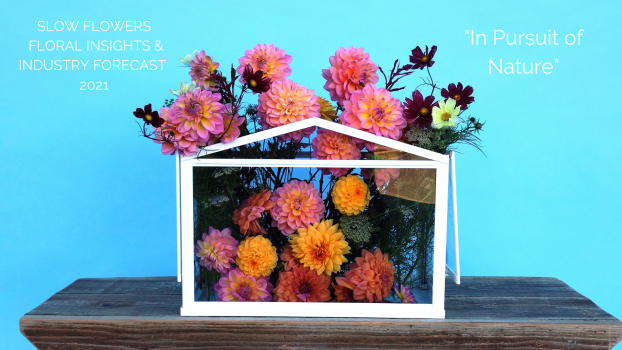
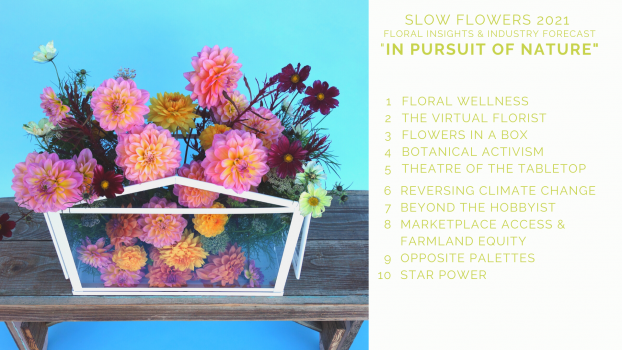
So let’s get started! I have 10 insights to share with you for the year to come. I’m calling our 2021 Report: “In Pursuit of Nature,” and you can understand why, right?
As we enter 2021, at least in the short term, not much will feel different from the past nine months. And if there is anything we’ve learned since mid-March 2020, it’s the essential and irreplaceable role of flowers and plants for our survival. And that’s why my outlook is deeply connected to humankind’s pursuit of nature — and how floral entrepreneurs like you can and should tap into and enhance that pursuit through your efforts.
I learned about the term “Biophilia” in October 2019 when I interviewed Tom Precht and Sarah Daken of Grateful Gardeners. Tom is a big advocate of Biophilia and he opened my eyes to its relevance as we make personal and business decisions that impact our planet’s survival. He discussed the definition when I interviewed him, but here it is again, according to Merriam Webster: Biophilia: “a hypothetical human tendency to interact or be closely associated with other forms of life in nature“
All you have to do is read the headlines of 2020 to see a collective shift toward nature, plants, the environment – and yes, flowers.
A recent article in the Washington Postcaught my attention. The headline reads: “The isolation of the pandemic caused her to form a new and intense relationship to nature. She was hardly alone. The benefits of being outdoors for your physical and mental well-being are well documented, but in this coronavirus era, they may be immeasurable.”
“Studies have proven that even the smallest bit of nature — a single tree, a small patch of flowers, a house plant — can generate health benefits,” said Kathleen Wolf, a UW research social scientist in the School of Environmental and Forest Sciences. “Look closely in your neighborhood, and the bit of nature you may have taken for granted up until now may become the focus of your attention and help you feel better.”
What are we watching for in 2021? The Slow Flowers Community’s experiences of 2020 definitely inform what is top of mind for 2021. Over the past several years, as we’ve devoted considerable time and resources to educate consumers and professionals alike; and thankfully, we are coming off a year when the attention of many turned to the Slow Flowers Movement.
Locally-grown, seasonal and sustainable flowers answer questions about a safe and reliable supply of flowers. Awareness our Movement continues to increased as floral consumers and florists alike shifted their focus to what’s closer to home. Panic over the international floral supply chains has quickly turned to a subtle but significant and newfound understanding that if we don’t nurture and support our local flower supply, there may come a day when farmland has been converted to real estate developments; where commitment to a safer, more sustainable earth has been displaced by convenience.
The anecdotal feedback I’m hearing is heartening. I received an email recently from a leader in, shall I say, “mainstream” floristry, who wrote:
“After two decades of thinking traditional wholesaler connections were the only way to run a floral studio or shop, I’m slowly starting to learn about local flower-farmers and am constantly in awe of their entrepreneurial spirit, and can’t imagine how much hard work goes into what they do. For that, I want to give them as much business as I can! I know that you had a big hand in getting this trend in motion and I thank you for that!”
As we seek new and diverse voices in the Slow Flowers Movement, I believe we will continue to witness a positive shift to a more progressive, inclusive, conscious marketplace for the flowers you grow and design with. And we will continue to document the shift with stories, interviews and resources to encourage you.
I want to thank everyone who took the time to respond to our 2021 Slow Flowers Member Survey, more than 200 of you, who I mentioned during last week’s “Year in Review” report, is triple past year’s participation.
In addition to the Survey, which asked members to share about their floral businesses, including emerging themes and topics important to them, this Forecast is informed by my 2020 storytelling — first-person interviews for print and digital Slow Flowers Journal stories, interviews with more than one-hundred Slow Flowers Podcast guests, and conversations with thought-leaders in floral design, flower farming and related creative professions.
I hope you find these insights and the 2021 forecast valuable to you. You may hear some themes that resonate with you and I’d love to hear your feedback and suggestions about what you agree with and what topics you wish we included.
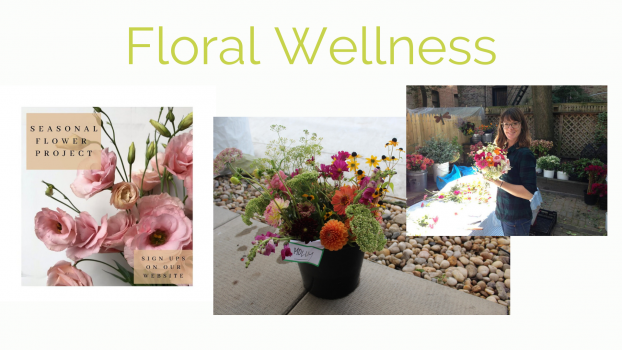
Molly Culver of Molly Oliver Flowers in Brooklyn created the “Seasonal Flower Project” in 2020 — a popular local-flower subscription program that supported her favorite farms and put those flowers in the hands of people eager to connect with nature. Listen to our interview with Molly in Episode 451
The yearning for a connection to nature is truly unprecedented in our society, something many of you witnessed first-hand when Mother’s Day 2020 shattered prior years’ records for floral sales. Demand added up to three words: People. Need. Flowers.
In past Forecasts, I’ve touched on similar themes, including the popularity ofAromatherapy Bars (2018) and the Year of the Houseplant (2019). Floral Wellness is more sweeping in its meaning. More than ever, consumers and their senses are drawn to your blooms. They are drawn for fragrance and scent, for medicinal qualities, for skin and body care benefits, for nutritional meals, palette-satisfying beverages, and for — above all — their mental health.
I defineFloral Wellnessas An embrace of the therapeutic importance of flowers, both in our own environments and as a meaningful way to share with others. Floral Wellness nurtures a positive and habitual desire to have flowers in our lives and as an expression of our desire for others to also experience flowers’ emotional, physical, mental and psychic value.
This idea can be manifested in ways both simple and accessible to your clients, as well as more ambitious endeavors. From the rise of flower workshops (in person at a safe distance or in many virtual forms) to the explosion of CSA subscriptions as more consumers desired more flowers, Floral Wellness took root in 2020 and is yours to nurture and enhance with new offerings to your community in 2021.
A few comments bubbled up from our 2021 Member Survey that underscore this idea and I’ll share them here:
“People want more flowers!” “More local and more of it!” “I believe local will become more desired.” “People want to bring more flowers into their homes and are getting into floral design as a hobby.” “Flowers bring smiles and happiness in times when we need it most.” “I think people will be more oriented towards decorating their living spaces. Also, gifting flowers to loved ones.” “Customers may start treating themselves with fresh flowers.” “As work-from-home becomes normalized, the interest in gardening/flowers/natural world grows.” “I’m seeing a desire for more beauty and more positivity.”
This insight’s key takeaway for you: Use a megaphone to share your story, your flowers, and your belief that flowers are essential to our wellness and health.
#2 The Virtual Florist
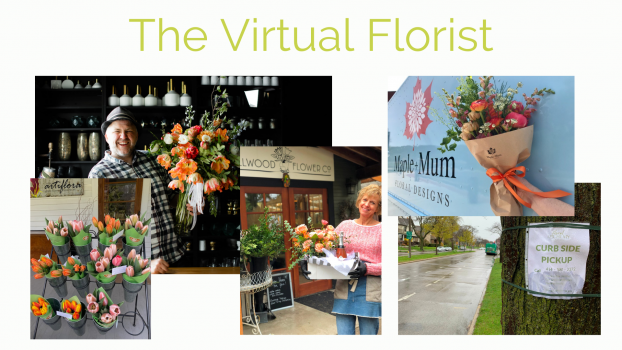
All images from “Designer’s Choice,” a July 2020 Slow Flowers Journal Report in Florists’ Review — featuring (clockwise, from top left): greenSinner, Maple + Mum, Floral Alchemy, Sellwood Flower Co. and Studio Artiflora
What do I mean by the Virtual Florist? We’re living in a world of “virtual” everything, so the term is truly relevant and timely. In the Slow Flowers Community, we spent 2020 covering the ascent of virtual floristry, through our podcast interviews, in Slow Flowers Journal stories, and during our weekly and monthly Slow Flowers member virtual meet-ups. For the Virtual Florist, innovation and creativity meet a marketplaces of Covid-imposed limitations and constraints.
The Virtual Florist is adaptable, flexible and inventive in finding ways to successfully deliver flowers to his or her community. The Virtual Florist utilizes technology and serves customers’ needs where they are. The Virtual Florist disrupts “definitions” of what type of florist you may have been in the past.
This means you might own a retail flower store, but you’ve added an online shop; or, you’re studio-based, but you now offer everyday flowers through contact-free curbside delivery; or, you’ve never grown flowers before, but this year you’ve planted thousands of tulip bulbs to sell from your front porch using only your neighborhood’s Facebook page to get out the word (that’s a real story about one of our members!)
The Virtual Florist consults, teaches and inspires in new ways, too. Virtual floristry is more egalitarian and transparent. Anyone can turn on a camera and film a demonstration or tutorial for IGTV, Facebook Live, YouTube and on other platforms — the field is more level than before. It’s not just the “big names” who are attracting audiences, especially because the return to expensive, in-person workshops will be slow and gradual.
This insight’s key takeaway for you: Dial up your imagination. What may have began as a coping mechanism to stay busy or stimulate creativity is now a new business opportunity. Develop and invest time and resources into at least one virtual component of your floral enterprise. Be ready to connect with your community whose shopping habits have dramatically changed, perhaps forever.
#3 Flowers in a Box
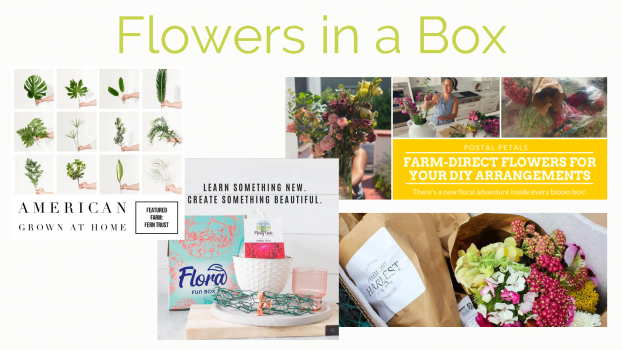
Mail-order Floral Offerings from Slow Flowers members, clockwise from top left: Petals by the Shore, Postal Petals, Harmony Harvest Farm and Flora Fun Box
Shipping flowers is nothing new, but until this moment, only a few successful companies were getting it right.
Now, based on necessity, we are witnessing more models, most consumer-direct, designed to move local and seasonal flowers from point A to point B, with more Slow Flowers members experimenting in the world of boxed and shipped blooms.
Slow Flowers members who had never before shipped flowers began to do so in 2020. The first report we shared about this shift can be heard in early April when I interviewed Mandy O’Shea of 3 Porch Farm about the decision to ship early spring flowers when local farmers’ markets and on-farm sales were impossible. It was a survival strategy that foreshadowed a strategic business shift. You can find a link to that conversation in Episode 448.
Flowers in a Box covers a diversity of methods and formats, from overnight shipping of bulk flowers, arrangements, floral packages for weddings and more.
Members are also experimenting with the shipping of dried flowers and live plants. And others are mixing design tutorials into the mix (a nod to Insight #2 and The Virtual Florist).
This past fall, we published a six-part Slow Flowers Journal series, called New Floral Marketing Models and Platforms. I’ll share the link for you to go back and read the series in case you missed it. One of the series’ most interesting themes – to me – explores how designers and flower farmers are partnering to create boxed floral collections for home-based floral enthusiasts. Check out my stories about Petals by the Shore, Postal Petalsand Flora Fun Boxas examples.
We will be tracking more of this “Flowers in a Box” phenomenon moving into 2021, relying on our membership in CalFlowers, the only national trade group that offers flower farmers and floral designers access to deep discounts on overnight shipping rates. CalFlowers has joined the upcoming Slow Flowers Summit 2021 as a Supporting Sponsor, and we will be sharing more about this organization in future programs.
This insight’s key takeaway for you: Ask yourself: What can you put in a box — perishable or non-perishable — and offer to customers who are not in your physical market, but who want to share and experience your brand?
#4 Botanical Activism
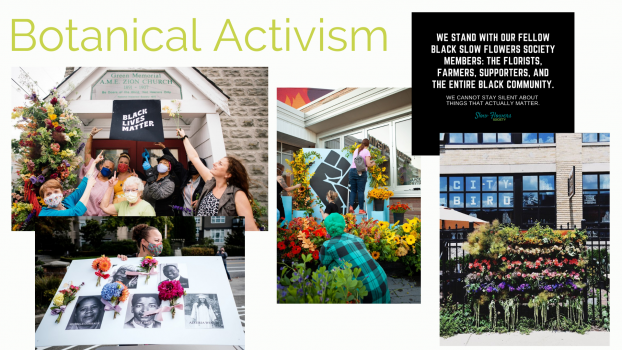
Scenes from Slow Flowers initiatives around the U.S., clockwise from top left: Portland, Maine, installation; Milwaukee, Wisconsin, installation; Slow Flowers’ social media badge; Detroit, Michigan, installation; and Say Their Names Memorial in Kirkland, Washington
2020 was a year in which I stepped back to evaluate whether my beliefs and values were in alignment with our brand. And I know this was the case for many of you, as well.
We highlighted “Cause-Related Flowers” in our 2018 Forecast, citing the news that more flower farmers and florists were investing their talents to help nonprofits and others in their communities through floral philanthropy efforts.
The contributions of so many of our members – growers and designers alike – continue to impact our communities. It began with the simple question: Did you donate your flowers to any causes or charities this past year? So many of you can answer in the affirmative.
But something is different now. We’ve all been touched by the awareness that the social and environmental landscape is dramatically changing. And if we do not step up to walk the talk in our own floral enterprises, I believe we are only deceiving ourselves.
I define Botanical Activism as one expression of social enterprise. For Slow Flowers members, this takes shape in many ways:
Writing a statement of purpose for your brand Committing resources to racial equity, inclusion and representation in your business practice Using your flowers to speak volumes about the issues you care about, from climate change to human rights.
And yes, you may occasionally feel the sting of criticism. I’ve seen it in social media posts, along the lines of this comment: “I just want to see beautiful flowers and I come here for a respite away from the conflict and disagreements I watch or hear on the news. Why do you have to be so political here on a floral feed?”
I believe we can no longer stay comfortable in our safe flower worlds when others are suffering discrimination or injustice. I’m not saying we need to become full-time activists. We have businesses to run, bills to pay, households to support, of course. But even in small and subtle ways, we can be Botanical Activists to signal our values and beliefs.
Your answers in the 2021 Slow Flowers MemberSurvey revealed your beliefs and passion for causes important to your brands:
61% of our Members say they are taking steps to create Inclusion, Representation and Equity policies for their businesses
53% of our Members are aligning their brands with human rights and social justice messaging/activities
46% of our Members’ businesses have participated in cause-related activities to support Black Lives Matter and antiracism campaigns
In 2020, I witnessed the manifestation of these values across the Slow Flowers membership, inspired by so many of you, your efforts to take a stand for social justice, and to show positive support through your flowers.
Moving forward, this isn’t optional. It’s essential. For Slow Flowers, we are adding a sixth statement to the Slow Flowers Manifesto, originally written in 2017 and published on Slow Flowers Journal. Every one of the five original statements in our Manifesto could be considered by some to be radical and norm-busting in the conventional sense. They include:
Slow Flowers commits to the following practices:
To recognize and respect the seasons by celebrating and designing with flowers when they naturally bloom
To reduce the transportation footprint of the flowers and foliage consumed in the marketplace by sourcing as locally as possible
To support flower farmers small and large by crediting them when possible through proper labeling at the wholesale and consumer level
To encourage sustainable and organic farming practices that respect people and the environment
To eliminate waste and the use of chemical products in the floral industry
Today I am adding a sixth statement, long in coming and inspired by the actions of many of our members and colleagues in the green profession:
To proactively pursue equity, inclusion and representation in the floral marketplace, intentionally valuing Black floral professionals (farmers, floral designers and vendors) in our business practice with as much support as we give to environmental sustainability.
I recently came across a wonderful affirmation from SF-based diversity and inclusion expert Arthur Chan of Arthur Chan Consulting and it resonates with this new addition to our Manifesto.
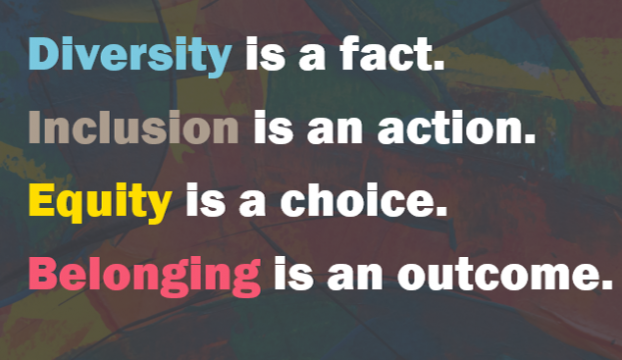
This insight’s key takeaway for you: Belonging implies community and my pledge to each of you is to model this value in all of Slow Flowers’ actions, programs, content and investments, not just for 2021 but beyond. As I said last week in our year-in-review, until the Slow Flowers Society looks more like the communities we live and work in, more needs to be done. So, in the coming year, we will be highlighting your Botanical Activism — what causes are your flowers supporting? How are you enhancing your community and sharing your values? Please keep me posted as I seek stories of equity and inclusion, and continue the conversation.
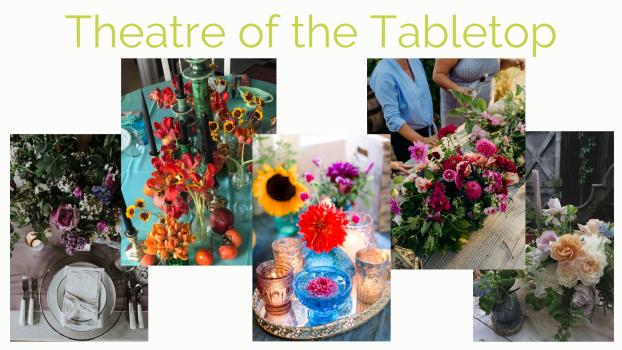
# 5 Theatre of the Tabletop
Designs from left: Tobey Nelson, Tobey Nelson Weddings & Events; Susan Chambers, BloominCouture; Dawn Clark and Mary Coombs, A Garden Party LLC; Beth Syphers, Crowley House Flower Farm; and Kelli Galloway, Hops Petunia Floral
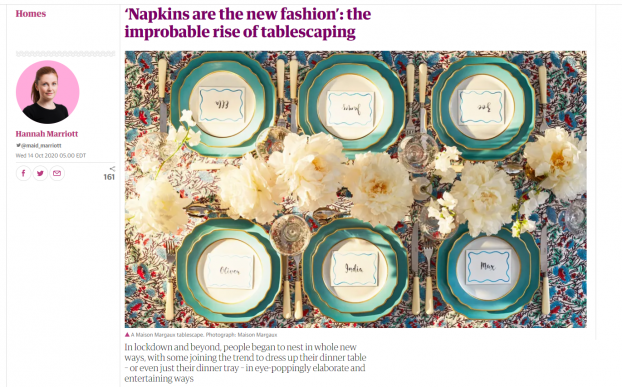
Written by lifestyle reporter Hannah Marriott, the article captured my imagination, as she likens tabletops to our own personal stage for artistic expression.
She wrote: ” . . . it was in lockdown, perhaps inevitably, that tablescaping became a phenomenon. With so many of us working from home, our social lives disappearing and desperate for some comfort, our focus on our homes was never sharper.“
The article continues: “Tablescaping, a small joy that can take a few minutes or a few hours, and makes dinnertime instantly prettier, is part of this national self soothing.”
The person who shared this article with me, my friend Scott Wittman, is a creative director who has spent his own COVID year exiled in the Kent countryside away from his London office. He has invested all of his free time photographing the blooms in his garden to document the passing of time, season by season. It helps that his pre-Georgian cottage is surrounded by an acre of a traditional English garden planted about 40 years ago — that’s priceless inspiration!
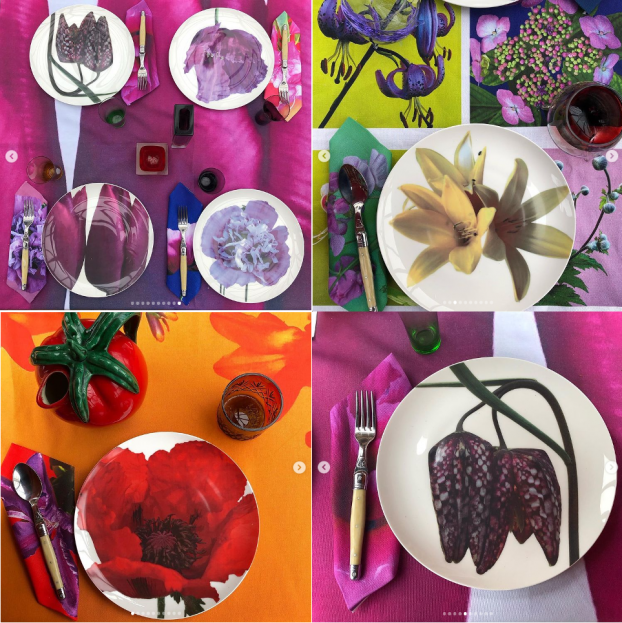
Scott’s garden and his photography project led him to produce an entire product line for the table, including dishes and linen tablecloths and napkins adorned with his graphic and polychromatic botanical photography. He plans on debuting the “Gate Cottage Garden” collection at the 2021 Chelsea Flower Show and I’ve been urging Scott to figure out distribution in the U.S. For now, check out images of his garden-inspired table accessories in our show notes and follow him on IG at @scottwittmanartsculpture
As I pulled together insights for 2021, I couldn’t forget this old-new idea of tablescaping and it came up again in several conversations, including, most recently with Susan Chambers, Slow Flowers florist based in San Francisco. She described to me how her business BloominCouture has changed in 2020, with more residential floristry accounts than ever.
“It goes beyond flowers,,” Susan says. “So much of what I’m hearing my clients say (is) that they want to understand, not just the floristry, but creating that moment at the table. They want me to create the vision, the pomegranates down the table, the privet berries dripping out of the arrangement. They’re wanting that me to come in and create that moment for them before the dinner party.”
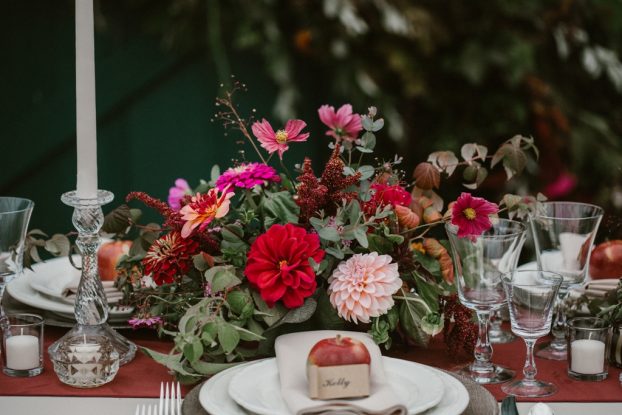
Tablescaping can be the ultimate Slow Flowers expression, as your florals enhance human interactions, mark occasions both special and ordinary, and celebrate the art of dining. Many of you design tablescapes for styled shoots — some of the most adventurous and theatrical meals imaginable. Let’s celebrate the objects we cherish, and create palettes that honor both how food is grown and the origin of the floral decor. I view the theatre of the tabletop as a way to honor the gift of time.
Tablescape designed by Rayne Grace Hoke of Flora’s Muse and Laura W. Tibbitts of Midcoast Blooms
This insight’s key takeaway for you: How can you combine your flowers and floral designs into a full package? Hannah Marriott’s article in The Guardian triggers so many ideas that you’ll want to explore in 2021. She writes: “Thanks to social distancing and unbridled screen time, the ‘tablescapes’ hashtag now has 455,000 Instagram posts and counting, and it is lifting sales during the crisis. In lockdown, with the hospitality industry on pause, tablescaping took a different direction. For one thing, it provided an income stream – or at least a trickle – to companies whose businesses might have capsized in the crisis.”
#6 Reversing Climate Change
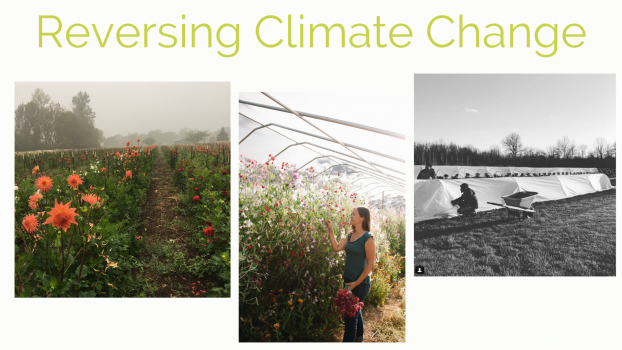
Slow Flowers’ member farms, from left Seattle Wholesale Growers Market dahlia farm shown against the September 2020 wildfire smoke; Stacey Denton of Flora Farm in Ashland, Oregon, using high tunnels to grow sweet peas; at Red Twig Farms in Johnstown, Ohio, low-tunnels for crop protection
Last year, in the 2020 Floral Insights & Industry Forecast, I featured Climate Change for the first time with an insight titled “Responding to Climate Change.” The urgency felt by the Slow Flowers Community is heightened as we move into 2021. Your responses to Climate Change questions in the Slow Flowers Survey reveal that urgency. It can seem overwhelming, but our individual actions and the policies we collectively support are powerful tools to employ as a community.
Last year, Forty-four percent of our survey respondents said they were adjusting growing practices to adapt to climate change. In this year’s Survey, 54% of Members say they are aligning their brands with climate change messaging/activities.
We also asked you to share about How Has Climate Change Affected You and Your Business? Here is a recap:
Nearly 60% of you cite weather irregularities (too much or too little rain)
30% say abnormally warm OR abnormally cold spring seasons
25% cite early frost arrival
Nearly 20% blame disaster-related damage (wildfire, flooding, hurricane, hailstorms, tornados and other weather tragedies)
Another reason cited includes extended hot periods with no precipitation.
One respondent put it this way: “Weather seems more extreme and unpredictable.”
Another wrote: “It’s not at disaster level yet, but the damaging winds and rains devastated my cosmos and the smoke from the fires sullied my white roses and strawflowers.”
What can we do? What active steps are you taking to address Climate Change in your farm, shop or studio? We know about and have covered the importance of No-Till Farming Methods, Cover Crops, Crop Rotation, Raised Beds, Water efficient irrigation. We know florists are more actively than ever rejecting single-use plastics and other chemical-based products in their designs.
What else? In the coming year, Slow Flowers commits to more reporting on your efforts to reverse climate change, efforts that will inspire others and will empower our members to take positive action in small and large ways.
For now, this insight’s Key takeaway for you: Educate yourself. Join me in seeking meaningful change as we strive to protect our climate, environment, communities and planet.
#7 Beyond the Hobbyist
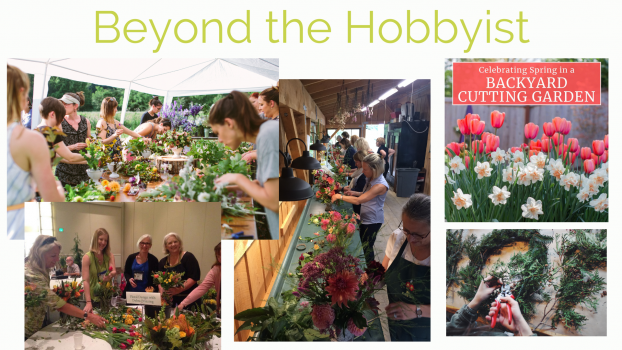
Deeper Learning, clockwise from top left: Farmer-Florist workshop taught by Niki Irving of Flourish Flower Farm; a similar workshop taught by Liz Kreig of Maple Flower Farm; Cutting Garden Design with Longfield Gardens & Slow Flowers; wreath design workshops taught by Sarah Nixon of My Luscious Backyard; and Debra Prinzing floral design to fellow Garden Writers
The DIY trend has been with us for a decade, and according to my friend and publishing partner Robin Avni, after that length of time a trend that was once new, such as do-it-yourself, folds into the broader culture and becomes mainstream. Originally, I wanted to call this insight “Beyond DIY: Figure it Out” and I turned to Robin to help me flesh it out. My idea was that since more consumers than ever are seeking new knowledge, floral enterprises need to be attuned to this reality in order to offer them what they’re seeking.
But a conversation with Robin gave me a new term: Beyond the Hobbyist. Robin is my go-to expert when I want to understand what’s happening in the consumer marketplace; she spent many years working in consumer research managing a portfolio of Fortune 500 clients as a Senior Director and Lead Consumer Strategist at Iconoculture, and as a Senior Ethnographer at The Hartman Group, where she engaged in primary consumer qualitative research. And those of you who have a copy of my new book Slow Flowers Journal-volume onewill know of Robin’s influence as a visual designer — she is the creative director for that publication and my partner in the BLOOM Imprint, the new book-publishing arm of Slow Flowers.
According to Robin, DIY is everywhere, and thus, no longer new. “People feel they can access information on YouTube and figure things out themselves, from painting their walls to building a deck to designing an outdoor space,” she explains.
As an insight, though, Beyond the Hobbyist embodies so much more than DIY, more than saving money or exploring a hobby, Robin explains. “It’s about embracing a skill that gives you a sense of pride and feeds your soul. It’s about having a deeper, long-lasting connection to a skill, such as flower gardening and floral design.”
She continues: “People want to learn new skills, but then, they want to fold it into their lifestyle. They want to go beyond something superficial. They want to know that when they gather flowers from the farm-stand they can replicate at home what they learned in your design class; thanks to your class, they understand why it’s important to support the stems and change the water regularly.”
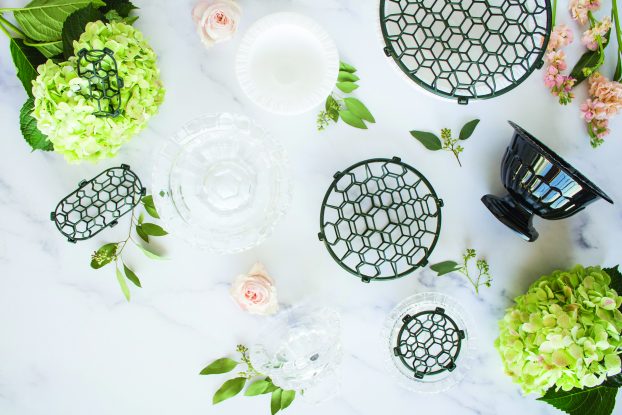
Easy, mechanics from the professional to Beyond the Hobbyist
I suspect this sentiment is a driving force behind the popularity of product lines like Holly x Syndicate’s egg and pillow mechanics, available not just to the trade, but to the enlightened floral enthusiast who wants to use the same tools and supplies that the pros use. Similarly, having the ability to order single units of the Floral Genius pin-frogs means these professional tools are getting into the hands of anyone who wants to elevate their floral design practice.
Beyond the Hobbyist is all about intentionality rather than a random DIY experience.
We will continue to witness this urge to both know a skill AND understand the why and how behind it, Robin explains. “For example, once a customer experiences a flower farm, they want more. They don’t necessarily want to be a flower farmer, but they want to understand how to grow their own cut flowers, and nurture that practice through the seasons for their own enjoyment and to share with friends and family.”
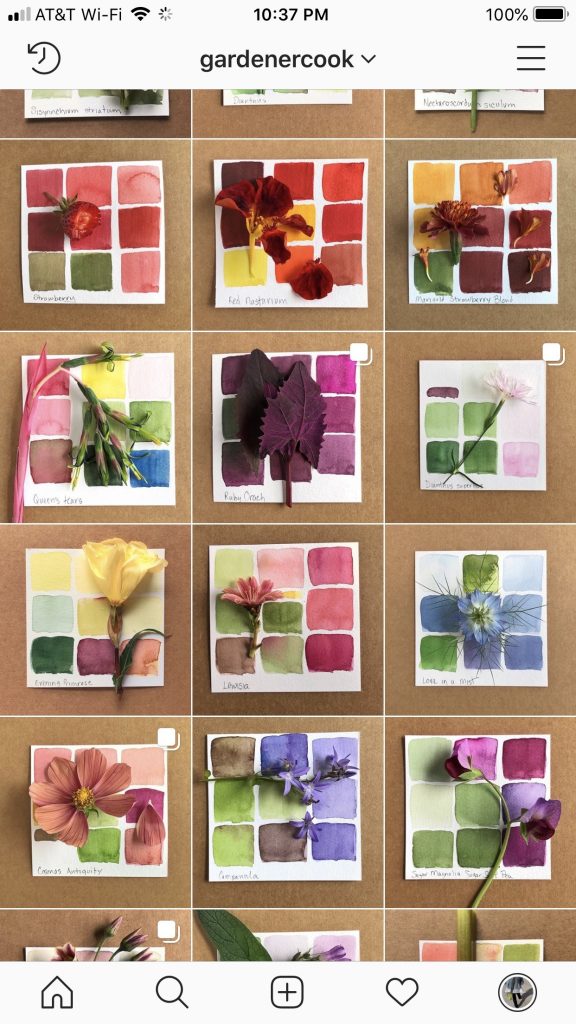
A polychromatic series: Seeing Color in the Garden @gardenercook
We talked about this further and what came to mind is the desire among many consumers to have a “Daily Practice.” And that led to my friend Lorene Edwards Forkner, Seattle Times gardening columnist, author and artist. Lorene’s Instagram feed @gardenercook features her daily practice called #seeingcolorinthegarden. Lorene is a past guest of this podcast and she will share her story and talents at the 2021 Slow Flowers Summit, leading participants in her mindful practice of painting small watercolor studies of plants and other items she collects from nature. You can see more in our Slow Flowers Mercantile, where we have a digital download gallery of Lorene’s work.
While learning a new skill and adopting a practice is useful for all floral professionals, the key takeaway from this insight is actually a challenge question to you: How do you help your customers and clients embrace a more meaningful connection to flowers? How can you create and nurture opportunities that go beyond DIY hobbies and convert your customers into floral practitioners?
When you draw back the curtain and share insider knowledge that your clients and customers can incorporate into their lifestyles, you build deeper engagements. People want to know the professional skills of growing and design; they don’t necessarily want to adopt a new profession, but you can interpret and empower them with skills, knowledge and confidence.
Learning and gathering knowledge is more important than ever. What services, products and experiences can you offer to your marketplace in 2021? What are you teaching and sharing? A final thought, one that I learned while developing online courses for the Slow Flowers Creative Workshop. Teach what you know. Nothing is more authentic.
#8 Marketplace Inclusion & Farmland Equity
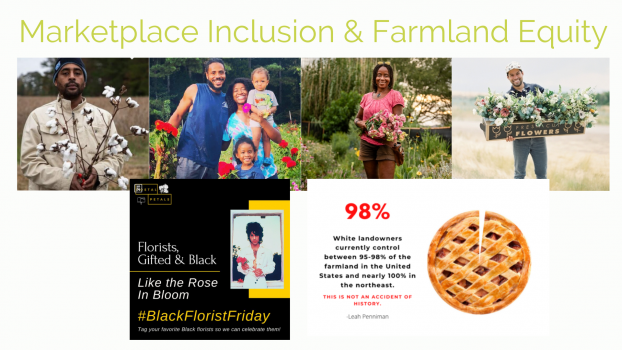
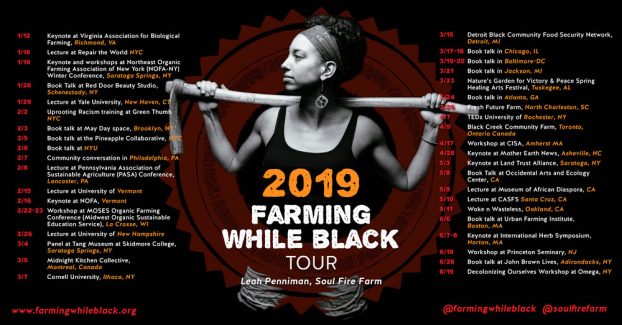
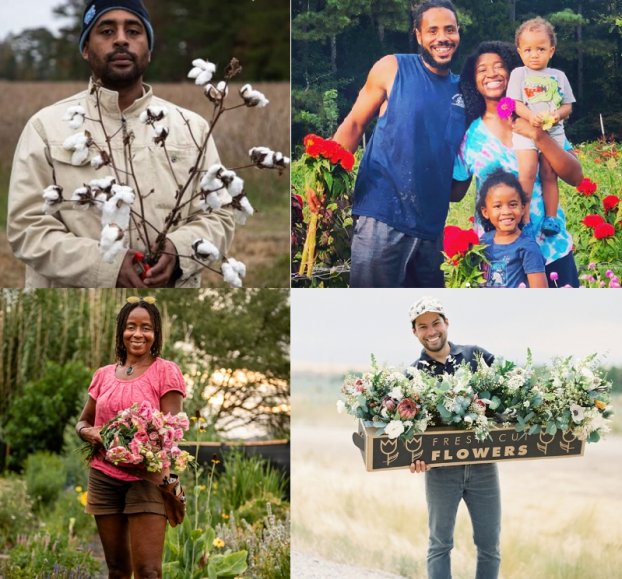
Top Row: Slow Flowers Members who recently presented at the Young Farmers & Cooks Conference: Julius Tillery, Black Cotton U.S.; Taij & VC Cotten, Perry-winkle Farm; Aishah Lurry, Patagonia Flower Farm; and Julio Freitas, The Flower Hat Bottom Row: #BlackFloristFriday social media campaign, created by Talia Boone of Postal Petals and Quote from Leah Penniman of Soul Fire Farm
This insight is closely connected to Insight #4 – Botanical Activism, while also addressing two themes essential to the future survival of the floral economy.
The first topic – Marketplace Inclusion — speaks to the importance of proactively changing our business practices to support floral enterprises owned by the BIPOC community, (that’s Black, indigenous and people of color). For so long, I focused my energies on the belief that our floral profession would survive if only consumers learned to ask “where were these flowers grown” and “what growing practices were used to grow them?”
If there is one important lesson from the racial awareness and awakening of 2020, it’s that my values demand that I ask a different set of questions, such as: “how can I support and shine a light on florists, flower farmers, vendors and customers who look different than me, a middle-aged white woman?” “How can I invest in the success of underrepresented and overlooked talent, and in doing so, ensure their success and my success are equally valued?”
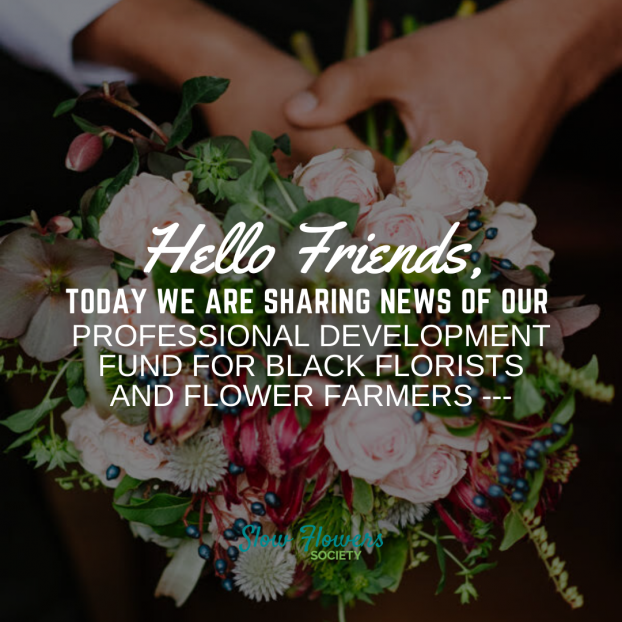
At Slow Flowers, we enter 2021 with an embrace of inclusivity, representation and equity in our profession. As I discussed last week, our Professional Development Fund devotes resources to invite Black farmers and florists to join the Slow Flowers Society. YOU are encouraged to participate in this endeavor by nominating Black farmers and florists in your community to be part of our efforts — please reach out with your suggestions!
Until the Slow Flowers Society looks more like the communities we live and work in, we will not be sustainable.
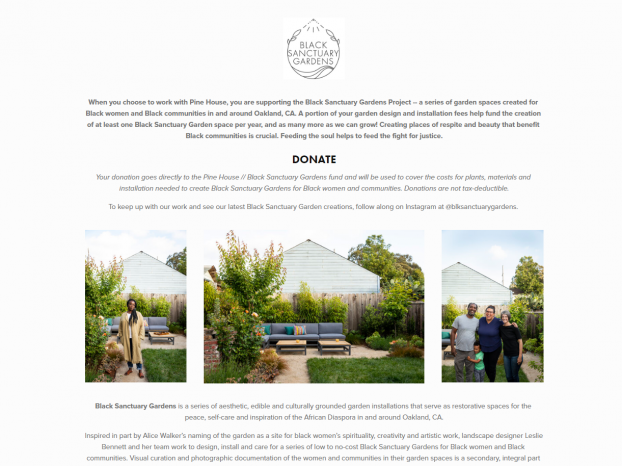
I have learned much from garden designer and Slow Flowers advocate Leslie Bennett, who earlier this year joined me as a return podcast guest. Leslie owns Pine House Edible Gardens, an Oakland-based design-build landscaping studio. She is the creator of Black Sanctuary Gardens, which believes that gardens are places that provide respite and restoration; healing and inspiration. The Black Sanctuary Gardens project creates and documents garden sites where Black women’s creativity, spirituality, and human experience can be cultivated and nurtured.
Slow Flowers donated to the Black Sanctuary Gardens project in 2020 and we feel grateful to learn from the example Leslie is modeling — using her talents and resources to design and build gardens where transformative change can take place, and where we can work to grow the world we want for ourselves and for our communities.
Leslie and the team behind the Black Sanctuary Gardens project are curating their time and talent to create safe and beautiful garden spaces that celebrate Black women’s humanity and the communities they hold dear within the Oakland, California area. Financial contributions allow them to provide their gifts at low to no-cost to these valued community members. This is a model I’d love to see replicated across the community in other regions.
Soul Fire Farm – a life-giving hub for education, advocacy and activism
The second theme included in Insight # 7 is Land Equity. Joining progressive voices in domestic agriculture to advocate for land equity is a cause I believe will benefit the Slow Flowers community as we see much-needed diversity and representation in flower farming.
In 2020, we financially supported Soul Fire Farm. Based in Grafton, New York, Soul Fire Farm was co-founded by past Podcast guest Leah Penniman, author of Farming While Black. She is a Black Kreyol educator, farmer, author, and food justice activist whose mission is to end racism in the food system and reclaim an ancestral connection to land. As co-Executive Director of Soul Fire Farm, Leah is part of a team that facilitates food sovereignty programs – including farmer trainings for Black and Brown people, a subsidized farm food distribution program for people living under food apartheid, and domestic and international organizing toward equity in the food system.
Soul Fire Farm recently provided us with a list of well-established Black-led farming organizations and I’ll share it in today’s show notes for you to check out. Please consider following and supporting the farming organizations in your community as we move into 2021, while seeking a more diverse Slow Flowers community that benefits all.
Contrasting and Complementary Palettes from the Slow Flowers Cutting Garden
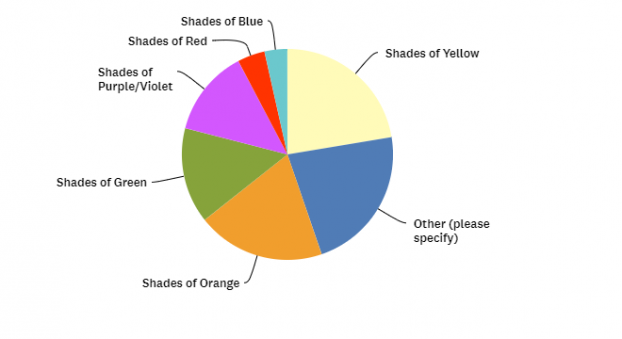
Last year, 24% of our Slow Flowers Survey respondents cited YELLOW as their top color prediction for 2020. Yellow edged out all other colors by single-digit percentages, but there was still no clear standout, leading me to predict a Polychromatic Palette for 2020.
Here we are in January 2021, and Pantone already has declared “Illuminating,” a glowing shade of yellow, as one of two colors for 2021.
For the 2021 survey, both Yellow and Orange topped your list. Specific percentages break out as follows:
Shades of Yellow (23%) “Yellow for optimism.” Mustards and mauves.” “From rich masala yellow in curries to lavish buttercream yellow on cupcakes, the comfort of food will translate to floral expressions.”
Shades of Orange (19.5%) “I think we are seeing hints of orange, and yellow with pinks and blush.” “Everything across the range of citrus tones to fruity apricot.”
Shades of Green (14%) “The clean feeling of green, with foliage in an array of green tones and various shapes.”
Shades of Purple & Violet (13%) “I think we will see a trend towards subdued jewel tones that play off of each other.” “I find the possibilities with purple are both complimentary and contrasting and love finding those matches. People also seem to really gravitate to the purple tones, or at least, that’s what I think, maybe because I like purple flowers so much!”
Shades of Red (4.5%) “Reds, burgundy, pinks monochromatic.”
Shades of Blue (3%) “Mellow, soft blues — the world needs calming tones in these crazy times.”
So what notable color palette do we predict will influence flower farming and floral design in the coming year?
I flipped to the color section of my book Slow Flowers to see what I wrote back in 2013. I quoted Harold Piercy, former principal of the Constance Spry Flower School in England, who wrote this in 1983: ” . . . in flower arranging, I have always found it advisable to discard any prconceptions about colours.” He went on to write: “Keep an open mind and do not be ruled by the colour wheel. You may hit upon unexpected satisfactory results during your experiments.”
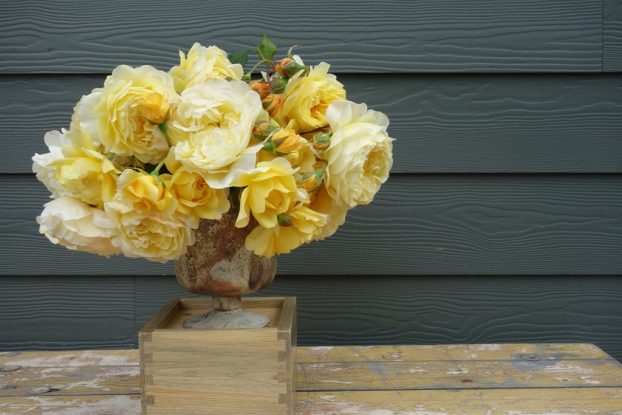
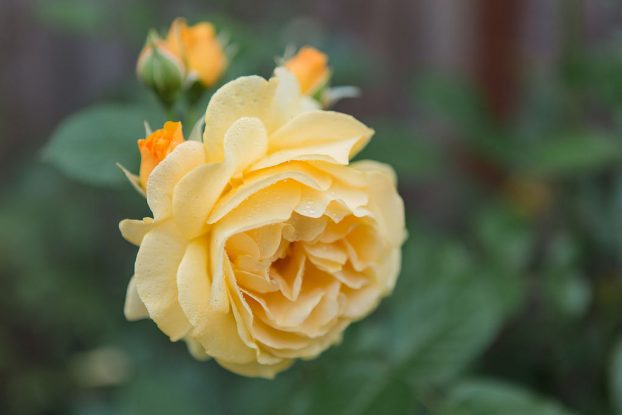
Yellow Roses from the Slow Flowers Cutting Garden
I dove deep into the comments that you shared in response to the survey’s Question#23 — Describe in more Detail Your Floral Palette Prediction.
I have to give a huge congratulations to the many Slow Flowers Survey responses that were spot on about YELLOW. In 2017, Slow Flowers’ Floral Forecast predicted soft yellows in an insight titled: “Beyond Blush.” It has taken four years since then for Pantone to agree! Let me include a few of your comments here so you can congratulate yourself on nailing Pantone’s color declaration for 2021 — an important emerging floral palette we forecasted here years ago!
(c) Missy Palacol Photography
“I’m only wishing. I have lemon chiffon peonies that I would love to see a bump in desire for.” “Into yellow lately.” “Cream-mustard; pale yellow. Happy shades.” “More sunny, happy color.” “Bright, positive, with an endless summer-like feeling.” “Pale yellows to golden tones.” “Yellow is inherently cheery and I think people will want more good cheer. Also, floral designers have been trying to sell clients on yellow and mustard forever — maybe this is our year that clients will finally go for it!” “Orange or yellow. We need some brightness in 2021!” “Soft, buttery yellows.” “Yellow is building momentum! And there are so many shades that blend well with the popular muddy/neutral palettes.” “Soft, light, buttery yellow.” “Seeing more demand for yellow flowers.” “2020 has been a dark year and I think we could all use a little sunshine in our future.” “Warm yellows — amber, mustard, butter – seen alone or with accents in deeper shades.” “After the Pandemic, we want LIFE! We will want color and variety. Yellow was a very big color in fashion just before the Pandemic and I think it will be picked up again after.” “I think the soft yellows and warm golden colors are what we need for 2021! We need a soft glowing hug after 2020!”
Orange & Blue(ish) dial up the palette contrast! (c) Debra Prinzing design and photograph
Clearly, we all love yellow. But of course, we do not want to follow Pantone. Let’s move beyond a single hue and explore what’s coming next:
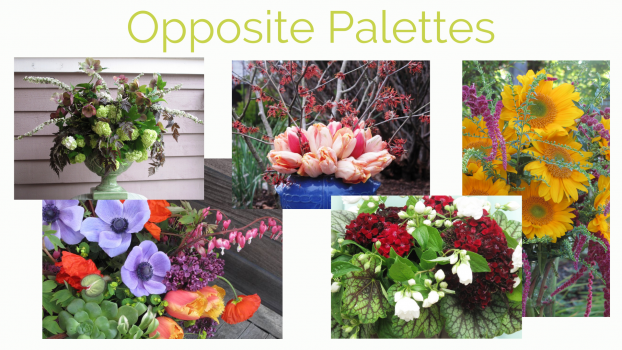
I predict the most exciting floral palettes will feature Complementary or Contrasting Colors. With color pairs that reside opposite each other on the color wheel — combinations and variations of of course Yellow + Purple, but also interpretations of Red + Green; Orange + Blue.
What do you think of “Opposite Palettes”? A few survey comments jumped out to me in agreement:
“Oranges reaching out in different directions — yellow, reds, or complementary purple.” “Purples combined with pale yellows, oranges and whites.” “I find the possibilities with purple are both complimentary and contrasting and love finding those matches.” “Pink, peach, coral, orange, yellow and then contrasting with blue.”
Red & Green Complements (c) Debra Prinzing design and photograph
What is the key insight here? Simply, that we live in a colorful floral world and we need to experiment more! And find ways to excite customers and clients with new, shall we say, contrasts and complements, on the horizon!
At the core of it, this insight reinforces the importance of selling color as a much-desired product. Remember, you and your flowers are ready to meet consumers’ hunger for more color in their lives.
#10 Star Quality
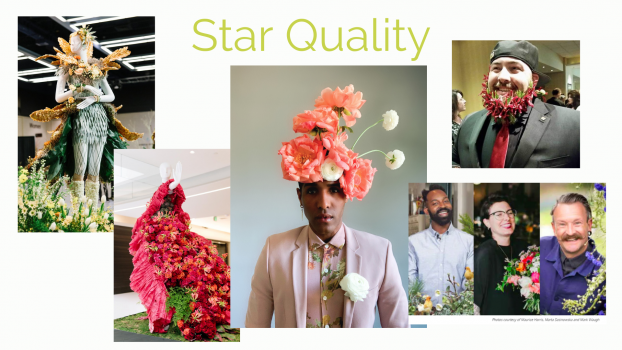
From Left: Fleurs de Villes designs by Tobey Nelson and Thomasi Boselawa; Kristen Griffith VanderYacht of Big Flower Fight; Ace Berry, AIFD, PFCI – a finalist on Full Bloom; the Full Bloom judging panel
All of a sudden, miraculously in 2020, celebrity florists are taking center stage alongside chefs and fashion designers!
Whatever you think about floral competition television, seeing flowers and plants in the hands of professional designers on programs like Netflix’s “Big Flower Fight” andHBO’s “Full Bloom” definitely felt validating. We are witnessing flowers – elevated — in mainstream TV programming! That’s news worth celebrating!
I also enthusiatically rooted for Ace Berry, AIFD, PFCI, another past guest of this podcast, who competed in HBO’s “Full Bloom.” I won’t spoil it for you if you haven’t watched to the finale, but you can learn much more about Ace in Episode 421, originally aired in October 2019.
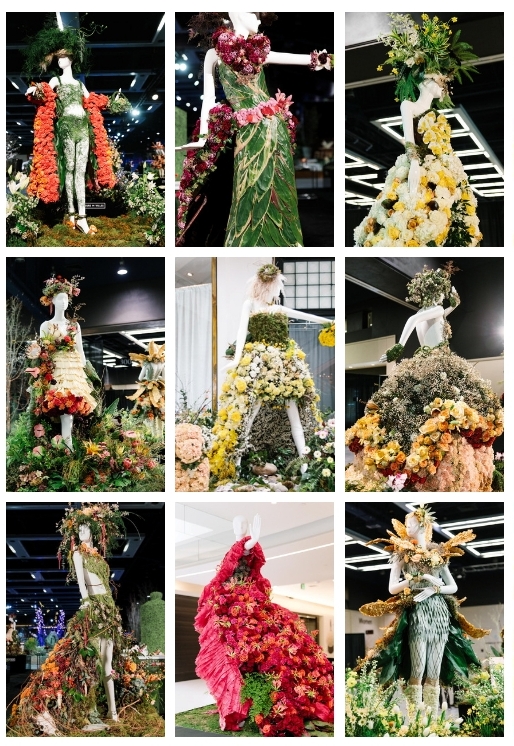
Nine Slow Flowers members designed floral fashions for the 2020 Fleurs de Villes Exhibit at the Northwest Flower & Garden Festival DESIGN CREDITS (c) samanthasmith.photo for Fleurs de Villes Top row, from left: Casablanca Floral, Flirty Fleurs and Garden Party Design Center row, from left: Hazel Landscapes & Design, LORA Bloom, Smashing Petals Bottom row, from left: Terra Bella Flowers & Mercantile, Tiare Floral Design, Tobey Nelson Weddings & Events
I felt quite the same sense of pride earlier this year when the popular Fleurs de Villes exhibition came to Seattle’sNorthwest Flower & Garden Festival. With flowers transformed into wearable fashions displayed on a parade of mannequins — it clearly was the most popular feature of the flower and garden festival. The success of Fleurs de Villes is similar to the buzz created by the two floral competition shows I just mentioned.
What is the magic? I believe that seeing flowers used as an artistic expression ignites the imagination of those who view them. Beyond the sheer scale and beauty of floral installations, massive topiary and botanically-dressed mannequins, flowers are the starting point that connect many consumers with the natural world. And who can argue with that?
For Fleurs de Villes, show-goers were invited to vote for their favorite design. For Big Flower Fight and Full Bloom, viewers rooted for their favorite contestants. There’s buy-in when the audience has a stake in the outcome, and ultimately, more people know more about flowers, which takes us full circle to our Insight #1 — Floral Wellness.
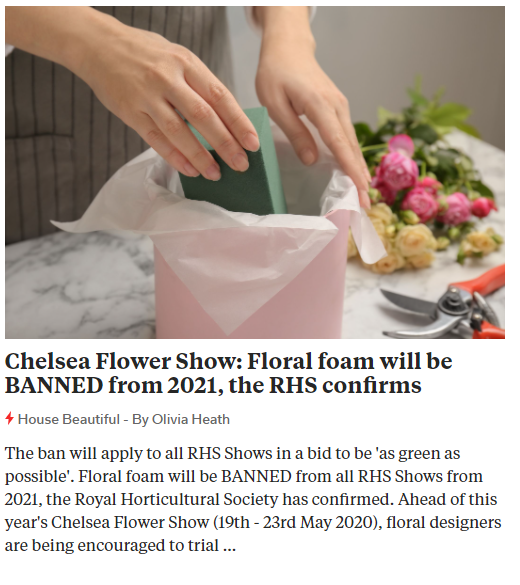
I hope to see all of these floral celebrity projects return to our lives in 2021, but I will offer a vocal plea for one change: Please, No FLORAL FOAM. As we’ve urged the mainstream floral profession for years: please wean yourself from a dependence on foam. Be truly creative and find alternative mechanics to express your art!
It can be done; believe me, we’ve consistently documented no-foam mechanic strategies on this podcast and in our other Slow Flowers channels. For goodness sake’s, even the famed Chelsea Flower Show has declared future exhibitions to be foam-free.
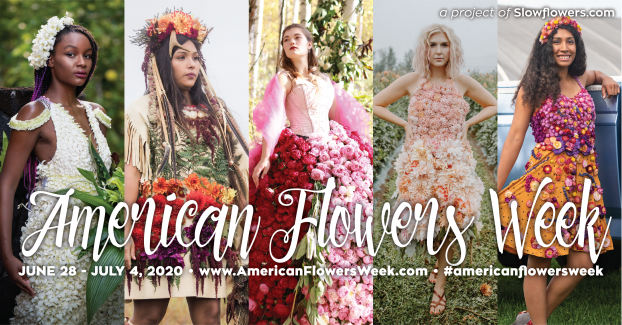
If you’re interested in showing off your own Star Quality, I invite you to join the 2021 American Flowers Week botanical couture creative team. Our creators are Slow Flowers member florists and flower farmers who and produce wearable botanical couture photographed on live models for publication.
On Friday, January 15th, you’re invited to join me for a free webinar and Learn how YOU can participate in American Flowers Week 2021
Hear advice and tips from Slow Flowers member designers and growers! We will discuss how each created an iconic botanical couture look for American Flowers Week, including flower sourcing, model selection and photography. You can join the Webinar to learn whether this opportunity is right for you! The Webinar takes place 9am Pacific/Noon Eastern on Friday, January 15, 2021.
Okay, what an inspiring list of 10 insights! Thank you for reviewing this list with me today. I want to pause here to marvel at what has happened since I began writing down what I viewed on the horizon for the Slow Flowers movement and its followers and members.
The simple act of speaking, writing and sharing one’s perspective is a personal superpower, one you can also claim, because each of us has an utterly unique world view. While it seems trite to seek out COVID’s “silver linings,” you may find meaningful truths to interpret from the past year’s chaos. Use them as a foundation for your 2021 planning. Yes, you want to make resolutions and set goals. You can also set your Intention. And intention can be our rudder to guide us through choppy waters and uncertain times. That’s clearly what we need in this moment.
Thank you to our Sponsors
This podcast is brought to you by Slowflowers.com, the free, online directory to more than 800 florists, shops, and studios who design with local, seasonal and sustainable flowers and to the farms that grow those blooms. It’s the conscious choice for buying and sending flowers.
And thank you to our lead sponsor for 2021, Farmgirl Flowers. Farmgirl Flowers delivers iconic burlap-wrapped bouquets and lush, abundant arrangements to customers across the U.S., supporting more than 20 U.S. flower farms by purchasing more than $9 million dollars of U.S.-grown fresh and seasonal flowers and foliage annually, and providing competitive salaries and benefits to 240 team members based in Watsonville, California and Miami, Florida. Discover more at farmgirlflowers.com.
Johnny’s Selected Seeds, an employee-owned company that provides our industry the best flower, herb and vegetable seeds — supplied to farms large and small and even backyard cutting gardens like mine. Find the full catalog of flower seeds and bulbs at johnnysseeds.com.
Mayesh Wholesale Florist. Family-owned since 1978, Mayesh is the premier wedding and event supplier in the U.S. and we’re thrilled to partner with Mayesh to promote local and domestic flowers, which they source from farms large and small around the U.S. Learn more at mayesh.com.
The Gardener’s Workshop, which offers a full curriculum of online education for flower farmers and farmer-florists. Online education is more important this year than ever, and you’ll want to check out the course offerings at thegardenersworkshop.com.
The Slow Flowers Podcast has been downloaded more than 675,000 times by listeners like you. Thank you for listening, commenting and sharing – it means so much.
As our movement gains more supporters and more passionate participants who believe in the importance of our domestic cut flower industry, the momentum is contagious. I know you feel it, too.
I value your support and invite you to show your thanks to support Slow Flowers’ ongoing advocacy, education and outreach activities. You can find the donate button in the column to the right at debraprinzing.com
The content and opinions expressed here are either mine alone or those of my guests alone, independent of any podcast sponsor or other person, company or organization.
The Slow Flowers Podcast is engineered and edited by Andrew Brenlan. Learn more about his work at soundbodymovement.com.
Music Credits:
Heliotrope; Vittoro; Open Flames; Shift of Currents; Surly Bonds; Gaenaby Blue Dot Sessions http://www.sessions.blue
The Regional Flower Economy panelists, clockwise from top left: Julius Tillery of Black Cotton US, Taij Cotten & VC (Victoria) Edwards-Cotten of Perry-winkle Farm, Julio Freitas of The Flower Hat and Aishah Lurry of Patagonia Flower Farm
Two weeks ago, you heard from Shannon Algiere and Jessica Galen as we discussed the 2020 Young Farmers & Cooks Conference, held last week as a virtual event attracting more than one thousand attendees. Shannon and Jessica shared the story of Stone Barn Center for Food & Agricultureand gave us a preview of the conference. I want to thank Shannon, a Slow Flowers member, Stone Barns Center’s resident flower growing expert, farm liaison manager and co-director of the Arts & Ecology Lab for inviting me to gather together and moderate a flower-focused panel — and I’d like to share the audio of that presentation with you today episode.
You’ll hear from four Slow Flowers members each of whom discussed her or his unique approach to agricultural entrepreneurship. They include Aishah Lurry, Patagonia Flower Farm, Julio Freitas, The Flower Hat, Taij Cotten and VC (Victoria) Edwards-Cotten, Perry-winkle Farm, and Julius Tillery, Black Cotton U.S. As I said at the beginning of our panel, clearly, I am not a YOUNG FARMER, but through my passion for the Slow Flowers Movement I hope to shine a light on several of our members: flower farming pioneers you’ll meet today.
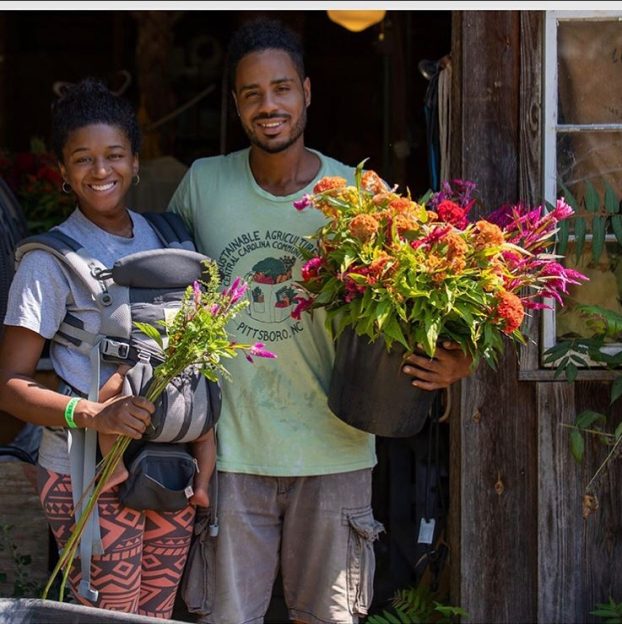
VC and Taij with flowers and little Titus in a baby pack
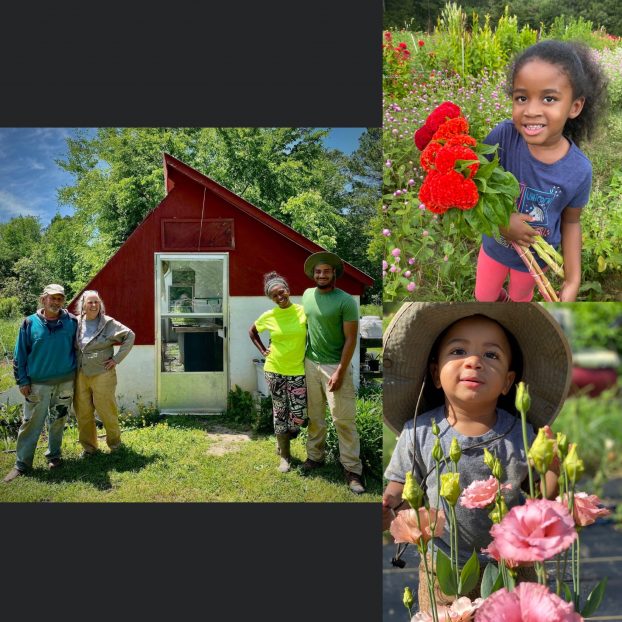
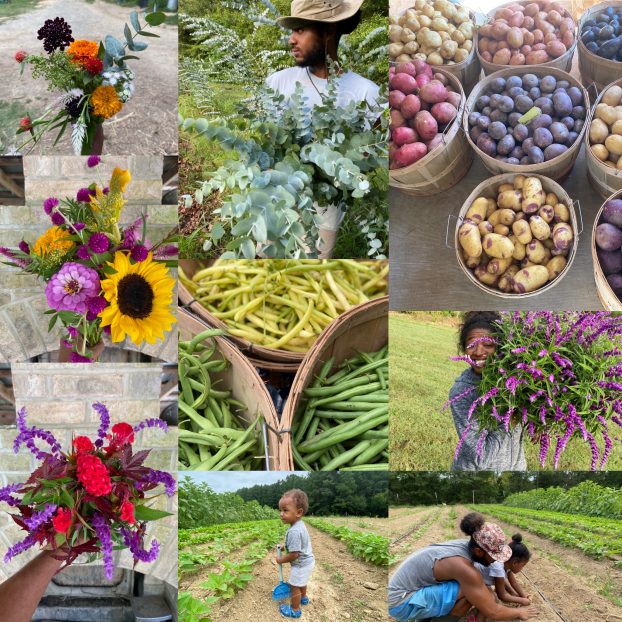
Taij & Victoria (VC) Cotten, of Perry-winkle Farm in Pittsboro, North Carolina
After responding to a Craigslist ad for Valentine’s Day in 2017 at Preston Flower Shop, Taij and Victoria were hooked on flowers. They quit their jobs and traveled North Carolina’s Piedmont farming region, talking with any farmer that had time for them. They quickly realized they wanted to farm.
Above left: Michael Perry and Cathy Jones with Taij & VC Cotten; the Cotten children above right
Now farming alongside their mentors and “farm-ily,” Michael Perry and Cathy Jones of Perry-winkle Farm, the young couple helps sustainably farm 4 acres in Northern Chatham County, North Carolina, specializing in seasonal vegetables, specialty cut flowers and pasture laying hens. Perry-winkle farm attends 3 regional farmers’ markets: Fearrington Village (a seasonal market) and 2 Carrboro Farmers markets (one seasonal and one year round). Taij and Victoria reside in Chatham County, NC with their two adorable, flower-loving children: Carleigh (6) and Titus (1)
I first met Taij and Victoria at the 2018 Association of Specialty Cut Flower Growers annual conference in Raleigh, when destiny made sure we were seated together at the same banquet table. I’ve been following their adventures on social media ever since and am delighted to welcome them today.
Find and follow Perry-winkle Farm and Taij & Victoria
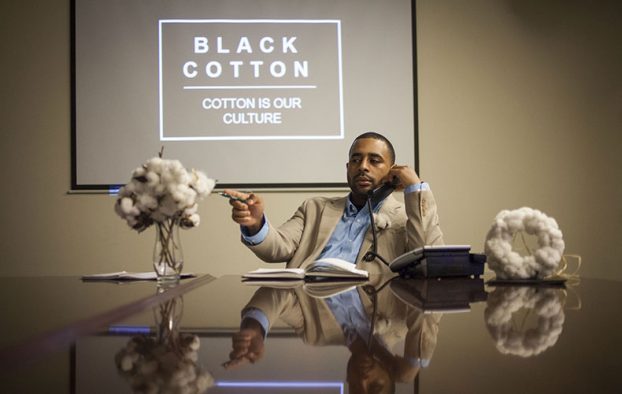
Julius Tillery, founder and CEO of Black Cotton U.S. Julius is the NC State Coordinator for the Black Family Land Trust. He is a 5th Generation life-long row crop commodities producer (cotton, soybeans, peanuts) from Northeastern, North Carolina. He has worked as an advocate and resource provider in the North Carolina agriculture and environmental sectors since 2009. Julius has also worked at Rural Advancement Foundation international and The Conservation Fund. He currently serves on the Southern Administrative Council for SARE (that’s the Sustainable Agriculture, Research and Education Council) and the North Carolina Forestry Advisory Council.
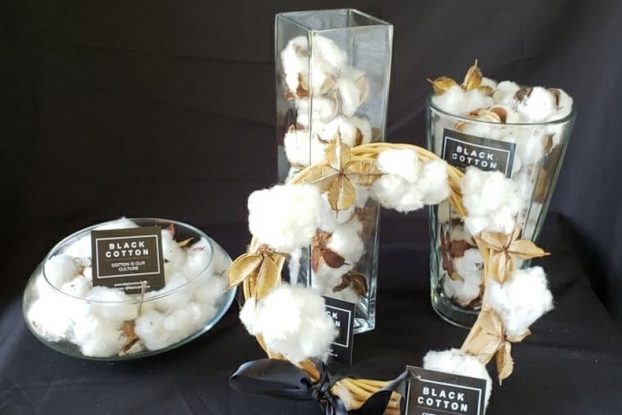
Black Cotton U.S. branding and product selection
Julius is a rural economic development advocate and is also known for his entrepreneurial business role as Founder of BlackCotton U.S. You can find Julius anywhere between his farm working on producing crops, on another farmer’s farm helping consult with new enterprise development, or any meeting that is focused on improving the lives of farmers and farming communities across the USA. Julius is a graduate of the University of North Carolina at Chapel Hill with a degree in Economics and minor in Entrepreneurship in 2008.
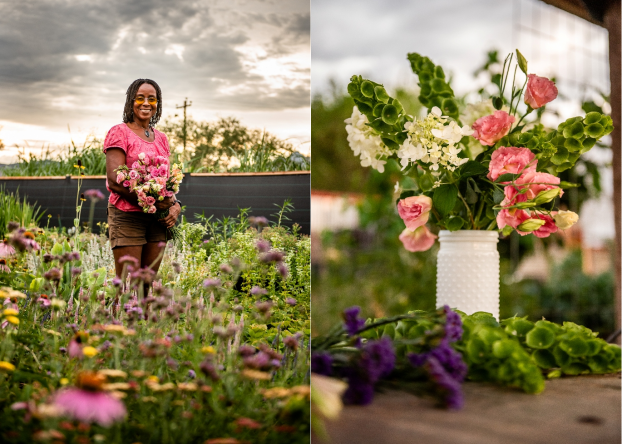
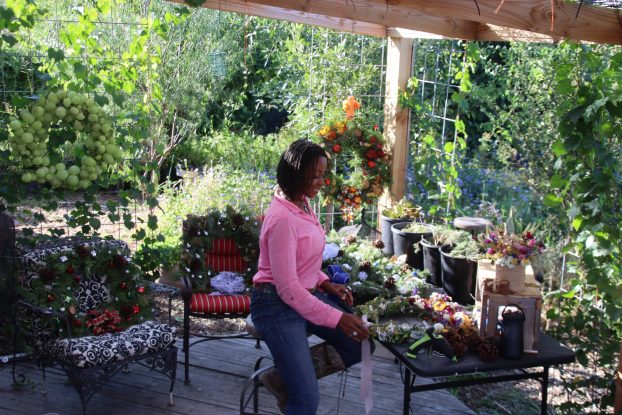
Aishah Lurry, founder and CEO of Patagonia Flower Farms based in Patagonia, Arizona. She is an artistic florist who combines her love for water-wise and organic farming techniques to produce affordable, healthy, and fresh-cut flowers.
Aishah Lurry designing with flowers she grows in the high desert area of Arizona
As a gardener who began her flower farming career in 2017, Aishah started her micro-farm on her home’s property after getting tired of driving 20miles out of town to buy overpriced and imported flowers that she didn’t like. By merging her expertise and knowledge of crop planning, propagation, harvesting, drying, and arranging, Aishah was able to turn her beloved hobby into a thriving business that celebrates eco-consciousness and the local economy.
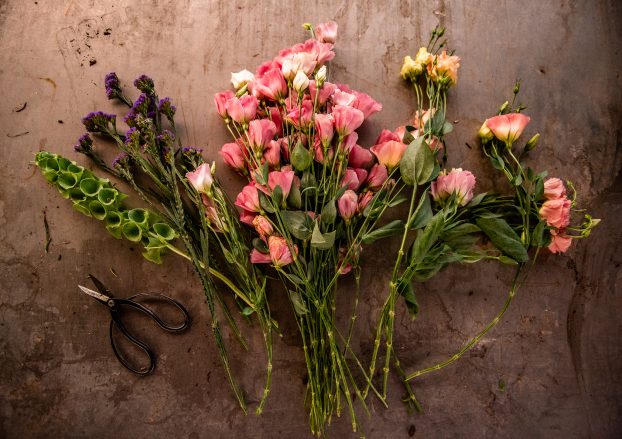
A selection of Patagonia Flower Farm varieties
Aishah has taught several classes about sprouts, micro-greens, and propagation and today serves with Borderlands Restoration Network to further its native species and public education programs.
She considers her flowers a local, affordable, and well-deserved luxury. Each flower in Aishah’s hand-picked bouquets are lovingly grown to ensure health, vibrancy, and longevity of the ingredients.
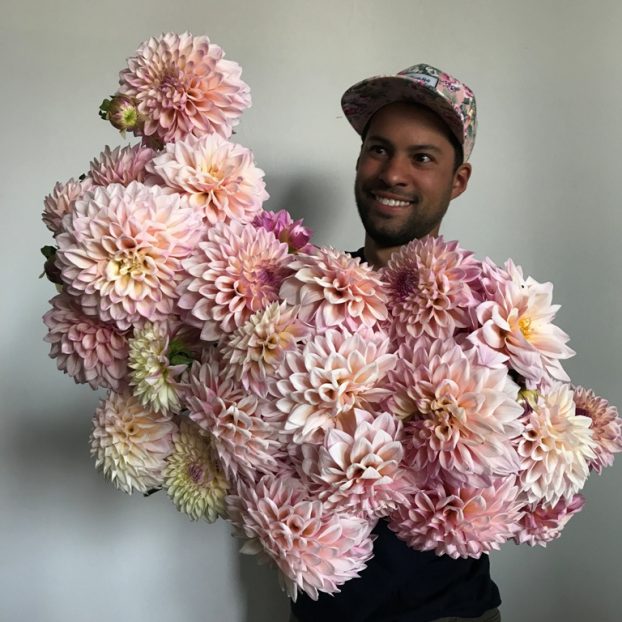
Julio’s armfuls of flowers is a joyous and infectious expression of local flowers.
And finally Julio Freitas, owner of The Flower Hat. The Flower Hat is a floral design studio and flower farm nestled in the beautiful mountains of Gallatin Valley in Bozeman, Montana. The Studio is headed by internationally published designer Julio Freitas, whose design style embraces the seasons to create a loose, natural aesthetic that has graced hundreds of events, including many high profile and celebrity weddings.
Julio with his popular dahlia crop
In an attempt to provide his clients with the best blooms, Julio decided to incorporate a Flower Farming component to the business operation. He started his growing operations on 1,800 sq ft and quickly leased ¼ acre plot for a few years, where he was able to grow and harvest thousands of flowers by using high intensity techniques. These locally grown flowers are truly the treasures that make his designs so spectacular.
Today, The Flower Hat is a thriving company that stays busy during the summer with weddings, selling flowers to florists and wholesalers. The company is also known for its coveted dahlia tubers that sell out in a matter of minutes that go on sale on February 1, 2020. Julio regularly hosts on-farm summer workshop intensive that go deep into the business model that makes The Flower Hat such a successful little company. The classes combine hand-on floral design experience, the business behind weddings and events and small scale flower farming.
Julio also finds room in his schedule to share everything he knows with others through floral design demonstrations as well as presentations about his high-intensity flower farming techniques on his Facebook Group The Flower Hat Exchange.
Flowers grown and designed by Julio Freitas of The Flower Hat
I posed three questions for discussion: 1. First, I asked each panelist to share an overview of their floral enterprise. Who they are, what do they produce/grow? where are they located and how long have they been farming.
2. Next, we talked about how flowers are part of their farm’s business model, how they sell and what market do they serve?
3. Finally, why flowers? Why grow flowers instead of food OR why integrate flowers in into a food-growing operation
Thanks so much for joining us today. What a great session. We did have some audio and technical challenges, so I promise to bring Julius Tillery from Black Cotton U.S. for a full episode in the near future, and I hope to also host a longer podcast conversation with Taij and Victoria.
Coming up, we have just two more episodes for 2020. Next week, on December 23rd, is our annual Slow Flowers Holiday Music Special Episode, featuring the talents of a Slow Flowers member whose life is influenced by both music and flowers. And on Wednesday, December 30th, the final episode of 2020, I’ll share our Year in Review with you. On the horizon, the first episode of 2021 will feature our 2021 Slow Flowers Floral Insights and Industry Forecast.
The Slow Flowers Podcast has been downloaded more than 669,000 times by listeners like you. Thank you for listening, commenting and sharing – it means so much.
Asking for your Support
Tulips in the #slowflowerscuttinggarden from Longfield Gardens (c) Missy Palacol Photography
As our movement gains more supporters and more passionate participants who believe in the importance of our domestic cut flower industry, the momentum is contagious. I know you feel it, too. 2020 has been a challenging year for all of us and we have continued to deliver fresh, original content to you through the Slow Flowers Podcast, week in and week out — since 2013!
Not counting all of the time invested in developing the topics, guests and content, we spend more than $10k annually to bring you this award-winning internet radio program. Your financial support can ensure we continue into 2021. If every listener contributes just $2, those funds would add up quickly to cover our out-of-pocket costs to record, edit, host and promote the Slow Flowers Podcast. Would you consider making a year-end donation? I value your support and invite you to show your thanks to support Slow Flowers’ ongoing advocacy, education and outreach activities. You can find the donate button in the column to the right at debraprinzing.com
Thank you to our Sponsors!
This podcast is brought to you by Slowflowers.com, the free, nationwide online directory to florists, shops, and studios who design with local, seasonal and sustainable flowers and to the farms that grow those blooms. It’s the conscious choice for buying and sending flowers.
Seattle Wholesale Growers Market, a farmer-owned cooperative committed to providing the very best the Pacific Northwest has to offer in cut flowers, foliage and plants. The Growers Market’s mission is to foster a vibrant marketplace that sustains local flower farms and provides top-quality products and service to the local floral industry. Visit them at seattlewholesalegrowersmarket.com.
Association of Specialty Cut Flower Growers. Formed in 1988, ASCFG was created to educate, unite, and support commercial cut flower growers. It mission is to help growers produce high-quality floral material, and to foster and promote the local availability of that product. Learn more at ascfg.org.
The Gardener’s Workshop, which offers a full curriculum of online education for flower farmers and farmer-florists. Online education is more important this year than ever, and you’ll want to check out the course offerings at thegardenersworkshop.com.
I am in love with my greenhouse, designed and built sustainably by Oregon-based NW Green Panels (c) Missy Palacol Photography
The content and opinions expressed here are either mine alone or those of my guests alone, independent of any podcast sponsor or other person, company or organization.
The Slow Flowers Podcast is engineered and edited by Andrew Brenlan. Learn more about his work at soundbodymovement.com.
Flower Grower Shanti Rade, Whipstone Farm & ASCFG’s South & Central Director
Can you believe we are saying good-bye to 2020 very soon?! It has been a year unlike no other and the Slow Flowers Podcasthas been a channel for highlighting, sharing, encouraging and challenging all that our community has faced – from silver linings and pivots to resiliency and change. We are the Voice of the Slow Flowers Movement, focusing each week on the business of flower farming and floral design.
One of my goals for 2020 was to feature voices of leadership from our strategic partner and Slow Flowers sponsor, the Association of Specialty Cut Flower Growers. We got lucky with timing and managed to schedule nearly all of those conversations this year, despite all the distractions.
When I visited in 2017, Shanti led us on a tour of Whipstone Farm, including this pristine high tunnel where stock and ranunculus were blooming.
Shanti represents ASCFG in the “South and Central” Region, comprised of eight states: Arizona, where she is based, as well as Arkansas, Colorado, Louisiana, New Mexico, Oklahoma, Texas and Utah.
In February 2017, I visited my parents in Mesa, Arizona, and during that time, I gathered with a group of Slow Flowers members on a tour of Whipstone Farm. It was such a fabulous day-trip, taken with Morgan Anderson of The Flori.Culture and Anne Jensen of Anne E’s Garden Fresh Flowers — we drove up north, about 115 miles away from the metro area of Phoenix-Scottsdale, and arrived at the high desert food and flower farm operated by Cory and Shanti Rade.
One of the high tunnels at Whipstone Farm
You can hear the episode that Shanti and I recorded that day, as we sat inside the cozy and sunny high tunnel where her ranunculus grew. It’s a great introduction to this experimental and creative flower grower who has developed a market for local flowers through trial and error, and excellent product.
So this episode you’ll hear today offers a great update. Shanti and I discussed what Whipstone Farm looks like today and all the changes that have taken place due to the COVID-19 pandemic.
As we touch on the highs and lows of 2020, what emerges is a year that Shanti and Cory can be proud of. Some of their markets and channels have changed; how they interact with the public and wholesale customers has changed; how their family lives have changed. And yet, the flowers and vegetable crops keep going; the seasons march on; there are CSA boxes filled with delicious, healthy food and vases for fresh, local and seasonal flowers.
You will enjoy this conversation and, I believe, join Shanti and me as we marvel at how much each of us has been able to accomplish by just “figuring it out.”
A lovely gallery from Whipstone Farm’s recent IG Feed
You’re Invited to join us on Friday, December 11th at the Slow Flowers Virtual Meet-Up for December.
The meeting takes place via Zoom at 9 am Pacific/Noon Eastern — click on the button below to join us!
Marialuisa Kaprielian of Urban Succulents puts her own brilliant twist on floral design with sedums, echeverias, kalanchoes and more!
You’ll meet one another and hear from our special guest for DECEMBER: Marialuisa Kaprielian, owner of Urban Succulents, as we talk with her about growing & designing with Succulents!
This monthly gathering is just one of the many benefits of your Slow Flowers Membership, giving you resources to share your story of creativity, sustainability and collaboration.
Johnny’s Selected Seeds has shared some fun items with us for giveaways and you might win a few packages from our favorite seed company if you join this Friday’s Slow Flowers Member Virtual Meet-Up.
And PS, there will be other giveaways as part of our monthly Zoom gathering. But you have to attend to have your name included in the random drawing for the goods!
The Slow Flowers Podcast has been downloaded more than 667,000 times by listeners like you. Thank you for listening, commenting and sharing – it means so much.
As our movement gains more supporters and more passionate participants who believe in the importance of the American cut flower industry, the momentum is contagious. I know you feel it, too. I value your support and invite you to show your thanks and with a donation to support my ongoing advocacy, education and outreach activities. You can find the donate button in the column to the right.
Thank you to our Sponsors
This podcast is brought to you by Slowflowers.com, the free, nationwide online directory to florists, shops, and studios who design with American-grown flowers and to the farms that grow those blooms. It’s the conscious choice for buying and sending flowers.
Our first sponsor thanks goes to Syndicate Sales, an American manufacturer of vases and accessories for the professional florist. Look for the American Flag Icon to find Syndicate’s USA-made products and join the Syndicate Stars loyalty program at syndicatesales.com.
Our next sponsor thanks goes to Johnny’s Selected Seeds, an employee-owned company that provides our industry the best flower, herb and vegetable seeds — supplied to farms large and small and even backyard cutting gardens like mine. Find the full catalog of flower seeds and bulbs at johnnysseeds.com.
Our final sponsor thanks goes to Mayesh Wholesale Florist. Family-owned since 1978, Mayesh is the premier wedding and event supplier in the U.S. and we’re thrilled to partner with Mayesh to promote local and domestic flowers, which they source from farms large and small around the U.S. Learn more at mayesh.com.
I am in love with my greenhouse, designed and built sustainably by Oregon-based NW Green Panels (c) Missy Palacol Photography
The content and opinions expressed here are either mine alone or those of my guests alone, independent of any podcast sponsor or other person, company or organization.
The Slow Flowers Podcast is engineered and edited by Andrew Brenlan. Learn more about his work at soundbodymovement.com.
Jessica Galen (left) and Shannon Algiere (right) – two of the leaders at Stone Barns Center for Food and Agriculture
I’m really excited for this week’s episode – and happy to introduce you to my two guests, Shannon Algiere co-founder of the farm at Stone Barns Center for Food and Agriculture and currently the Farm Liaison manager, and Jessica Galen, Stone Barn’s Communications Manager.
I’ve invited them to give us a snapshot of the history and work of Stone Barns Center and then we’ll preview the upcoming Young Farmers & Cooks Conference, a three-day, all-virtual event produced and hosted by Stone Barns Center for Food & Agriculture and Blue Hill at Stone Barns Restaurant on December 8-10. That’s coming right up next week and you’ll want to take advantage of the extremely affordable pricing to register.
This is an important conference about sustainable farming and food systems, and yes, the subject of Floral and Fiber Agriculture has a role.
Our fabulous Slow Flowers panel, clockwise from top left: Julius Tillery, Taij & VC Cotten, Julio Frietas and Aishah Lurry
On Wednesday, December 9th (8:30 am Pacific/11:30 am Eastern), I’ll be moderating a panel called The Regional Flower Economy: Flower Farming as a Viable and Profitable Facet of Agriculture, featuring a fantastic lineup of Slow Flowers members. They include Aishah Lurry, Patagonia Flower Farm, Julio Freitas, The Flower Hat, Taij Cotton and VC (Victoria) Edwards-Cotten, Perry-winkle Farm, and Julius Tillery, Black Cotton U.S.
Whether you’re a farmer, cook, butcher, miller, preservationist, processor, or anyone else in the food (and floral) chain, this conference is for you.
Here’s a bit more about Jessica and Shannon ~
Jessica Galen is the communications director at Stone Barns Center. In this role she manages relationships with the media and partner organizations, and provides editorial support for programming for young farmers and other key audiences.
She launched her career in branding and communications at a nonprofit consulting firm and an education reform organization. While in graduate school at NYU for a M.A. in Food Studies she worked in the cheese caves at Murray’s Cheese as well as for an organic produce farm and a raw farmstead cheesemaker. She served as the general manager at Lucy’s Whey, then the Upper East Side’s largest artisanal cheese shop, and as wholesale director at New York Shuk, a small-batch producer of Israeli and North African pantry items.
Jessica published an article in the Graduate Journal of Food Studies based on her Master’s thesis entitled “Cheesemongers Over Fearmongers: Toward Data-Driven Cheese Recommendations for Pregnant Women” and was a contributor to the James Beard Award-winning “Oxford Companion to Cheese.” She is on the Advisory Board of Equity Advocates, which provides policy education, advocacy training, and coalition building services to improve healthy food access in urban communities. In addition to her Master’s degree, she has a B.A. From Harvard University in Yiddish and Latin American Studies.
Shannon Algiere, a co-founder of the farm at Stone Barns Center for Food and Agriculture brings over 20 years of experience in holistic farm design, crops production, garden and greenhouse management and farm-based education. Alongside her husband Jack Algiere, Shannon has served many roles at Stone Barns Center in its development.
Most recently as Farm Liaison Manager, Shannon partnered with the center’s farm and programs staff to oversee farmer training, internships and volunteer programming.
She attended University of Rhode Island, was an outdoor educator at the Denison Pequotsepos Nature Center, Greenhouse Manager at Meadowbrook Biodynamic Herb Farm and White Gate Farm, and a volunteer for the Costa Rican National Park Service.
In 2017 Shannon started a floral design and horticultural services business, Potter & Prune, promoting sustainable models in the floral design industry by celebrating the elegance and ecology of connecting regional grower economies with event design. She has taught workshops on growing and marketing cut flowers at NOFA, SBC’s Young Farmer’s Conference, and Oregon State University Small Farms conference. She has also written articles and been interviewed for her work at the intersection of farming and health and wellness. Along with her husband Jack, Shannon is raising two boys and serves on the board of Hearthfire and Ayer’s Foundation.
I hope you’re inspired to register and join the Young Farmers and Cooks Conference, taking place next week, December 8-10th. You can attend the conference for just $25 and you’ll be wowed by the program offerings and speakers.
UPDATE: We’ve just received a $10 off coupon code from Young Farmers and Cooks Conference! When you register, use: YFCCPROMO
You may have heard Jessica mention that the conference is being built around an anti-racist frame, and we fully support these values. When Shannon and her colleagues first approached me to curate a Slow Flowers panel, they explained that sessions are designed in a way that will honor the contributions of Black, Indigenous, and other communities of color throughout history who have shaped the agricultural and culinary topic the program addresses. Programs within the Young Farmers and Cooks Conference are designed to acknowledge the historical and cultural significance of topics; acknowledge and serve the diverse, international audience that will participate; and give space for voices and perspectives that have often been overlooked or underrepresented, especially in the realm of sustainable agriculture. Additionally, no panel will feature only white or male presenters.
And speaking of panels, in addition to our panel on the Regional Flower Economy, here are some of the other presentations I’m excited about: Beauty in Food: Incorporating Edible Flowers in the Kitchen Over time, the farm at Stone Barns Center has developed a robust flow of floral materials from greenhouse, fields, pastures and gardens into the creative hands of artisan chefs at the on-site Blue Hill Restaurant. This panel features demonstrations and encouragement on incorporating the beauty of flowers into dishes, beverages and cakes, presented by growers and artisan makers as they share tips, variety suggestions and artistic technique. Bones, Pigments, Paper and Process This panel introduces three artists applying ecological consciousness to their work and craft. They will take us through their process of land acknowledgement and working with land based materials as well as the steps that transform those materials into cultural objects. Natural Dyes for Farmers and Cooks How can natural dyes both connect us to our complicated histories and serve as a teaching tool? From the blemish of African enslavement to grow both cotton and indigo in the United States to modern textile practices that demand speed and slave wages, we have never gotten textiles right for people and planet. So what are we going to do about it and what are the most logical, equitable and environmental next steps? Join us for a discussion with four leading voices in the natural dye world. Seed Companies, COVID-19, and Our Fragile Foodshed Seeds are a critical first node in every food supply chain, so the people who run seed companies have a unique vantage point when major disruptions occur. The COVID-19 shutdowns led to the same sort of panic buying of seeds as happened in supermarkets with food. This huge increase in demand forced some seed companies to temporarily shut down or curtail operations as seed stocks diminished and experienced workers became harder to muster (with fears of the virus keeping many workers home). Now seed inventories are depleted, demand is higher than ever, and companies are struggling to maintain the diversity and quality of seed their customers expect. At the same time, most companies sold much more seed in 2020 than anticipated, leading to unexpected financial windfalls that allow for expansion, growth, and special projects. This panel features seed luminaries from a range of different companies, each offering their particular perspective and plans for moving forward into an uncertain future.
I hope you’re as inspired as I am. What a great opportunity to expand our understanding of sustainable agriculture at the intersection of art and design! Let’s all strive to be Food AND Flower System Changemakers!
Thank you to our sponsors
As our movement gains more supporters and more passionate participants who believe in the importance of the Slow Flowers Movement, the momentum is contagious. I know you feel it, too. I value your support and invite you to show your thanks and with a donation to support my ongoing advocacy, education and outreach activities. You can find the donate button in the column to the right.
This podcast is brought to you by Slowflowers.com, the free, nationwide online directory to florists, shops, and studios who design with local, seasonal and sustainable flowers and to the farms that grow those blooms. It’s the conscious choice for buying and sending flowers.
Seattle Wholesale Growers Market, a farmer-owned cooperative committed to providing the very best the Pacific Northwest has to offer in cut flowers, foliage and plants. The Growers Market’s mission is to foster a vibrant marketplace that sustains local flower farms and provides top-quality products and service to the local floral industry. Visit them at seattlewholesalegrowersmarket.com.
Longfield Gardens, which provides home gardeners with high quality flower bulbs and perennials. Their online store offers plants for every region and every season, from tulips and daffodils to dahlias, caladiums and amaryllis. Check out the full catalog at Longfield Gardens at longfield-gardens.com.
Rooted Farmers works exclusively with local growers to put the highest-quality specialty cut flowers in floral customers’ hands. When you partner with Rooted Farmers, you are investing in your community, and you can expect a commitment to excellence in return. Learn more at RootedFarmers.com.
The Slow Flowers Podcast has been downloaded more than 664,000 times by listeners like you. Thank you for listening, commenting and sharing – it means so much.
The content and opinions expressed here are either mine alone or those of my guests alone, independent of any podcast sponsor or other person, company or organization.
The Slow Flowers Podcast is engineered and edited by Andrew Brenlan. Learn more about his work at soundbodymovement.com.
Grocery bouquets designed by Roots Cut Flower Farm
Between them, these two flower farmers represent a significant percentage of ASCFG’s membership! Jamie’s region is North & Central U.S., representing Iowa, Illinois, Indiana, Kansas, Michigan, Minnesota, Missouri, Montana, Nebraska, North and South Dakota, Ohio, Wisconsin and Wyoming – whew!
Michelle is ASCFG’s newly appointed Mid-Atlantic regional director, representing flower farmers in Delaware, Maryland, New Jersey, Pennsylvania, Virginia, and West Virginia.
I invited both women to share about what’s happening with flower farming in their regions, and to give us a snapshot of their respective flower farming ventures. As it turns out, they each have cultivated a successful, but different niche, so you’ll learn from Michelle about selling to mass market grocery and you’ll learn from Jamie about serving as a wholesale supplier to floral designers.
Here’s a bit more about each of these guests:
Roots Cut Flower Farm is featured as a local family farm supported by local Pennsylvania grocery stores.
Michelle Elston is founder and owner of Roots Cut Flower Farm. She has loved plants and flowers for as long as she can remember. After studying plant science in college, she and her husband, Mike, moved to Massachusetts. There, they bought a garden center and stayed for 9 years. But after the birth of their first child, they realized that the best place to raise their kids was close to family roots.
So, they sold the garden center and moved back to Michelle’s hometown of Carlisle, Pennsylvania. Time and space soon opened up for her to pursue her dream of farming. What started as a small garden has evolved into a 10-acre farm that produces enough flowers for more than 20,000 supermarket bouquets and 100 weddings/events annually. Now, 13 years later, she realizes she never imagined her seed of an idea would turn into such a thriving small business.
Buckets and buckets of local, Pennsylvania-grown cut flowers gathered into thousands of bouquets at Roots Cut Flower Farm!
Even with such growth, Michelle’s flower philosophy has remained a simple one: to celebrate the natural beauty of every season in South Central Pennsylvania. Flowers are grown sustainably and selected based on their ability to thrive in the region. All of Roots’ bouquets and arrangements are created using only what is grown on the farm. Rather than trendy, the results are timeless designs that are fresh, lush and unique.
Here’s more about Jamie:
Beautiful Nebraska blooms at Harvest Home Flowers, grown by Jamie Rohda
Harvest Home Flowers is a small, family owned flower farm located between Lincoln and Omaha Nebraska. Jamie and her husband Norman have farmed since 1994 and today their family-owned flower farm produces a wide variety of naturally grown, specialty cut flowers for local florists, designers and DIY brides.
Harvest Home Flowers serves Lincoln and Omaha, Nebraska’s florists with fresh, seasonal and sustainable cut flowers
Find and follow Jamie and Michelle at these social places:
Thank you so much for joining today’s episode with Jamie Rohda of Harvest Home Flowers and Michelle Elston of Roots Cut Flowers. The conversation filled me with gratitude for our beautiful and diverse Slow Flowers community of flower farmers and floral designers who come together to bring joy and inspiration to the marketplace of flower lovers.
Lisianthus and dahlia details from Harvest Home Flowers
We have to chase down a few more directors, and given the insanity of this COVID-distracted year, you’ll probably hear those interviews in early 2021!
The Slow Flowers Podcast has been downloaded more than 659,000 times by listeners like you. Thank you for listening, commenting and sharing – it means so much.
As our movement gains more supporters and more passionate participants who believe in the importance of the American cut flower industry, the momentum is contagious. I know you feel it, too. I value your support and invite you to show your thanks and with a donation to support my ongoing advocacy, education and outreach activities. You can find the donate button in the column to the right.
Thank you to our Sponsors
This podcast is brought to you by Slowflowers.com, the free, nationwide online directory to florists, shops, and studios who design with American-grown flowers and to the farms that grow those blooms. It’s the conscious choice for buying and sending flowers.
Rooted Farmers works exclusively with local growers to put the highest-quality specialty cut flowers in floral customers’ hands. When you partner with Rooted Farmers, you are investing in your community, and you can expect a commitment to excellence in return. Learn more at RootedFarmers.com.
Johnny’s Selected Seeds, an employee-owned company that provides our industry the best flower, herb and vegetable seeds — supplied to farms large and small and even backyard cutting gardens like mine. Find the full catalog of flower seeds and bulbs at johnnysseeds.com.
Syndicate Sales, an American manufacturer of vases and accessories for the professional florist. Look for the American Flag Icon to find Syndicate’s USA-made products and join the Syndicate Stars loyalty program at syndicatesales.com.
The content and opinions expressed here are either mine alone or those of my guests alone, independent of any podcast sponsor or other person, company or organization.
The Slow Flowers Podcast is engineered and edited by Andrew Brenlan. Learn more about his work at soundbodymovement.com.
As many of you know, I was very active in horticulture circles as a home, garden and landscaping writer for nearly 20 years, long before I became obsessed with flower farming and floral design. Over the past decade, I have been completely immersed in founding, developing and nurturing the Slow Flowers Movement, which has been the most professionally rewarding experience of my life. And yet, I continue to take side trips back into horticulture. I met today’s guest, Lisa Fiore, CEO of Landscape Hub, on one of those excursions.
We were introduced by a mutual friend, Clint Albin, a nursery industry marketing strategist, who, like me, has an extensive personal network of business contacts who become friends.
Clint attended the 2018 Slow Flowers Summit in Washington, D.C., where he lives, and since then, he has been determined to find a way for us to collaborate as we once did when I was so deeply involved in the horticulture world.
Landscape Hub is proving to be that reason for us to collaborate. Clint introduced me to Lisa Fiore and as I learned what she created with Landscape Hub, I started to understand that there is potential for Slow Flowers members, especially farms and growers, to take advantage of this plant-selling platform.
Here’s the deal: If you are already growing plants for the floral trade, you can potentially use your expertise to also grow plants for the nursery and landscape industry.
We announced a pilot program between Slow Flowers and Landscape Hub and promoted it in our August Slow Flowers newsletter. I’m not sure how many people have even checked out the opportunity that I outlined — to become a grower & wholesale supplier of potted plants through Landscape Hub.
When you listen to my conversation with Lisa, I think it will begin to make sense. Hearing from the person who created a new selling platform for live plants (versus plants cut for the floral trade) may open up your own imagination to a new business channel.
Before we jump into the conversation, here’s a bit more about Lisa Fiore:
Lisa Fiore is Founder & CEO of LandscapeHub, a B2B online marketplace she created and launched in July 2017. A fourth-generation nursery professional, Ms. Fiore realized there was an opportunity to digitize the entire procurement process for the green industry.
Lisa was previously President of Fiore Landscape and Nursery Supply (FLNS), a century-old nursery company. During her sixteen-year tenure, she was responsible for identifying new business opportunities and in leading the company forward during the recession. FNLS significantly grew in revenue and expanded to multiple locations under her leadership.
Lisa holds a Bachelor of Arts degree in English Literature from University of Montana and a Master of Business Administration from Lake Forest Graduate School of Management. She currently serves on the board of directors for the National Association of Landscape Professionals, (NALP); is an advisor to the Women in Landscape Network, (WILN); a member of the Economic Club of Chicago; and a former board director for the Illinois Landscape Contractors Association, (ILCA).
Thanks so much for joining me today for my conversation with Lisa. We know that now, more than ever, our members are seeking new customer channels during the COVID-19 pandemic. I believe that one of those perhaps overlooked or ignored opportunities is to use your farming skills to sell plants (including potted and bare root) into the nursery marketplace, to both trade and retail buyers.
You know how to grow plants – there is no doubt! But have you explored selling plants? I know that some of our members are growing and marketing cutting garden annuals and perennials, vegetable starts, bulb packs and other horticultural products to their customers. Those customers may find you through a grocery store program, farmers’ market, on-farm or pop-up plant sales or through your own retail channel.
As Lisa and I discussed LandscapeHub offers you a potential new channel to sell on this nationwide platform which supplies commercial nurseries and landscapers. LandscapeHub is expanding its online marketplace for the nursery and green industry growers — and you’re invited to participate.
Stay tuned for an upcoming session when I will host Landscape Hub’s team to discuss and demonstrate the platform. I’ll announce a date next week.
Before we wrap up, I want to invite you to join the Fire Relief for Flower Farms effort. During the past 10 days, I’m sure you’ve watched the horrifying images and read devastating reports about wildfires threatening farmland across the West. This is not the first climate crisis to affect the Slow Flowers community in the past few years — season by season, it seems as if every farm is faced with one of them: floods, hailstorms, tornados, hurricanes and wild fires are on the rise seemingly everywhere.
But I can’t help but focus right now on what’s happening in the west — from provinces like British Columbia and Alberta in Canada to states including Washington, Oregon and California in the U.S. It’s so frightening on top of everything else 2020 has thrown our way. Seeing individual Slow Flowers members’ social media posts also makes it highly personal. While it may be weeks or months before the destruction, damage or loss has been calculated, many of you want to help NOW.
Like me, you may be asking: “What Can I Do?” We are an action-oriented community, right?! Farmers and florists are generous people who readily share their knowledge and resources. So here’s one thing you can do in response to news about the recent wildfire threat to farms in the west. Join Slow Flowers as we support the Fire Relief for Flower Farms effort. This is a farmer-to-farmer show of support created by last week’s podcast guest Tonneli Grutter of Salty Acres Farm.
Now might be the time to assess what you have to share with another farm. Seeds can be collected, tubers, rhizomes and bulbs can be dug and divided, cuttings can be taken. Or, maybe you have an excess inventory of drip irrigation or useful supplies you know another farm might be able to use.
Tonneli has volunteered to collect input from those who wish to receive help, register to donate and show support in other ways. With her big heart, tech talents and savvy marketing skills, Tonneli has created a database for collecting information from those of us who want to share support on an in-kind basis. Just days ago, she texted me with an idea: “is there a way we could make a registry or exchange to donate tubers, bulbs, seeds, etc., in response to farms who may have lost it all?” Tonneli continued: “Flower farmers have already had the toughest year (with) no money left to give, but maybe we can help others rebuild in other ways.”
Thank you to our Sponsors
This podcast is brought to you by Slowflowers.com, the free, nationwide online directory to florists, shops, and studios who design with American-grown flowers and to the farms that grow those blooms. It’s the conscious choice for buying and sending flowers.
And thank you to Florists’ Review magazine. I’m delighted to serve as Contributing Editor for Slow Flowers Journal, found in the pages of Florists’ Review. Read our stories at slowflowersjournal.com.
Association of Specialty Cut Flower Growers. Formed in 1988, ASCFG was created to educate, unite, and support commercial cut flower growers. It mission is to help growers produce high-quality floral material, and to foster and promote the local availability of that product. Learn more at ascfg.org.
Seattle Wholesale Growers Market, a farmer-owned cooperative committed to providing the very best the Pacific Northwest has to offer in cut flowers, foliage and plants. The Growers Market’s mission is to foster a vibrant marketplace that sustains local flower farms and provides top-quality products and service to the local floral industry. Visit them at seattlewholesalegrowersmarket.com.
Longfield Gardens, which provides home gardeners with high quality flower bulbs and perennials. Their online store offers plants for every region and every season, from tulips and daffodils to dahlias, caladiums and amaryllis. Check out the full catalog at Longfield Gardens at longfield-gardens.com.
The Slow Flowers Podcast has been downloaded more than 642,000 times by listeners like you. Thank you for listening, commenting and sharing – it means so much.
As our movement gains more supporters and more passionate participants who believe in the importance of the American cut flower industry, the momentum is contagious. I know you feel it, too. I value your support and invite you to show your thanks and with a donation to support my ongoing advocacy, education and outreach activities. You can find the donate button in the column to the right.
The content and opinions expressed here are either mine alone or those of my guests alone, independent of any podcast sponsor or other person, company or organization.
The Slow Flowers Podcast is engineered and edited by Andrew Brenlan. Learn more about his work at soundbodymovement.com.
Floral artist and designer Kat Claar (c) Tell the Bees Photography (left); a paper-and-floral-sculpture (right)
Several months ago, Kathleen “Kat” Claar of From Blossoms reached out to reconnect. We originally met in March 2019 at the Philadelphia Flower & Garden Showwhen I shared a meal with a few Slow Flowers members and other locally-focused flower farmers and designers.
Kat wanted to share how she was coping with Pennsylvania’s then stay-at-home order, which imposed constraints on her floral work. Instead of feeling limited, though, Kat began to film video tutorials which she says allowed her “to succinctly and effectively share her creative process.” Well, I watched those sweet videos and was hooked on Kat’s highly personal style combining floral design with custom-cut paper shapes that result in contemporary abstract works of art.
As she told me, “I would love for more people to consider and notice a daffodil in a new way through my work, but I also think it would be applicable as a project that people could do themselves with something as easily-accessible as a colored piece of paper and a couple stems of flowers from their yard.”
Kat says this recent video is her highest production with puppets, silk flowers and shapes
“My goal is to draw attention to seasonal flowers, ones that are available to anyone really, and to help people see those flowers in new ways by playing with our perception of them.”
In addition to her own studio art practice, Kat is a wedding and event designer for a Philadelphia-based shop called Vault and Vine. We discuss how she balances the two sides of her floral career and how the commercial design work blends with a fine art practice.
Kat’s gold-metal award for floral design entry “Seeing Flowers” at the 2019 Philadelphia Flower Show really wowed me (pictured below with images (c) Love Me Do Photography).
I spent several days at the show and every time I walked past her display I stopped in my tracks, got out my camera and photographed the piece. There are definitely elements – albeit more detailed – of her paper cutout technique.
Above: Kat’s floral entry at the 2020 Philadelphia Flower & Garden Show, featuring plexiglass shapes by Roxana Azar (c) Tell the Bees Photography.
Thanks so much for joining me today for my conversation with Kat Claar. I hope you take a moment to respond to those creative sparks or lightening bolts when they hit you!
It’s the beginning of a new month and like me, you’re probably turning attention to September and beyond. The days here in Seattle are still quite warm, but I can feel the chill of autumn in the morning air and I have mixed feelings about it. I normally love autumn. With COVID limiting our indoor gatherings, we’ve been so reliant on time outdoors. What comes with the changing of the seasons? Some friends of mine just invested in an infrared heater for their deck, to extend their outdoor time as long as they can. I’m seriously ready to order head-to-toe rain gear from REI, to make sure I can be quasi-comfortable when I want to continue gardening during our typically wet season. We’re all adept by now at online everything, and my top wardrobe has expanded while I continue to basically wear the same black yoga pants that you’ll never see on a Zoom call. This is an endless season of change. I sincerely hope the Slow Flowers Podcast has been a source of companionship and encouragement to you — from a distance, as always. This show has been downloaded more than 637,000 times by listeners like you. Thank you for listening, commenting and sharing – it means so much.
As our movement gains more supporters and more passionate participants who believe in the importance of the American cut flower industry, the momentum is contagious. I know you feel it, too. I value your support and invite you to show your thanks and with a donation to support my ongoing advocacy, education and outreach activities. You can find the donate button in the column to the right.
Thank you to our sponsors
This podcast is brought to you by Slowflowers.com, the free, nationwide online directory to florists, shops, and studios who design with American-grown flowers and to the farms that grow those blooms. It’s the conscious choice for buying and sending flowers.
And thank you to Florists’ Review magazine. I’m delighted to serve as Contributing Editor for Slow Flowers Journal, found in the pages of Florists’ Review. Read our stories at slowflowersjournal.com.
More thanks goes to Longfield Gardens, which provides home gardeners with high quality flower bulbs and perennials. Their online store offers plants for every region and every season, from tulips and daffodils to dahlias, caladiums and amaryllis. Check out the full catalog at Longfield Gardens at longfield-gardens.com.
Rooted Farmers, which works exclusively with local growers to put the highest-quality specialty cut flowers in floral customers’ hands. When you partner with Rooted Farmers, you are investing in your community, and you can expect a commitment to excellence in return. Learn more at RootedFarmers.com.
Syndicate Sales, an American manufacturer of vases and accessories for the professional florist. Look for the American Flag Icon to find Syndicate’s USA-made products and join the Syndicate Stars loyalty program at syndicatesales.com.
The content and opinions expressed here are either mine alone or those of my guests alone, independent of any podcast sponsor or other person, company or organization.
The Slow Flowers Podcast is engineered and edited by Andrew Brenlan. Learn more about his work at soundbodymovement.com.