Debra Prinzing

Get the Email Newsletter!

Archive for the ‘Gardening’ Category

Dogs and their sheds

Friday, August 1st, 2008

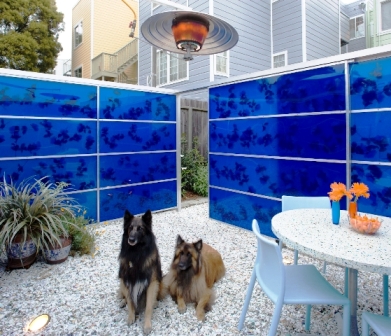
‘Elvis’ and ‘Nico’ are the Pleasure family’s Belgian Tervurens. They’re enjoying the warmth from the overhead heater, as they lounge in their blue pavilion in a San Francisco backyard

Driving behind a Volvo on the Ventura Highway the other morning, a bumper sticker caught my eye: “I love dogs and I vote.”

Not exactly sure what that means, but it started me thinking about the character of a dog owner. And about a funny comment my friend Lin Su made at our Stylish Sheds and Elegant Hideaways book launch party here in Los Angeles.

“I think you had a requirement that everyone included in the book must have a dog in their life!” she maintained. Wow, what a thought. Bill and I didn’t exactly write a canine clause into the scouting notes, but perhaps subconsciously, we were drawn to animal lovers.

There is a sympathetic relationship between people who raise and care for their plants and people who raise and care for their pets. Beloved and cherished, our dogs are often the most patient and forgiving family member in our lives. Our “Zanny” (pictured, left) is certainly the cream of the crop – a rescue Lab, blond and cheerful – found wandering the streets of Yakima, Wash., at six-months of age….brought to an animal shelter in Snoqualmie. My husband Bruce discovered her photo on petfinder.com in 2002 – and she has lived with our family ever since. What a sweet companion and thoroughly accepting of any love she receives, often giving more than we ask of her.

READ MORE…

Pretty in purple

Sunday, July 13th, 2008

July in Southern California dishes up a haze of purple in every hue. I recently snapped a few photos to capture the floral bounty around us.

It’s the weekend; time to be lazy and enjoy a little eye candy. So here we go:

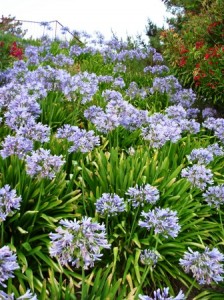
Lavender-blue agapanthus cascades down the hillside in my neighborhood

This time of year, AGAPANTHUS takes over our “East Hills” neighborhood. Seattle gardening friends, eat your eyes and hearts out! When I first visited this neck of the woods, in spring 2006, I was blown away by the appearance — shall I say ‘explosions’? — of lavender-blue agapanthus blooms on every corner of town.

“Okay, I guess I can live here after all,” I thought. I mentioned loving this plethora of agapanthus to my friend Nan Sterman, a California native and author of California Gardener’s Guide, Vol. 2.

“Oh, Debra, they’re gas station plants!” she exclaimed.

As I’ve said before. . . one woman’s gas station plant is another woman’s rare collector plant. Imagine describing it as a commonplace “filler” for the corner convenience store! I know of a few passionate souls in Seattle who willingly forked over $15 for a 2-inch Agapanthus ‘Blue Heaven’ cultivar from Heronswood (or, elsewhere spent $20 to $40 for larger pots of this pretty purple South African native). And then. And then. Well, if my efforts were at all representative, there was the breath-holding that occurred through the wet, chilly winter months, as we pretty much realized the true-blue agapanthus wasn’t going to emerge in great shape the following spring. Like many tender perennials, well, they were pricey annuals. Or, they were in need of massive amounts of pampering, such as potting up the fleshy rhizomes and moving them indoors for the winter.

READ MORE…

It’s all good: Rembering Linda Plato

Monday, July 7th, 2008

I think many of us have experienced that frequent voice whispering in our ear, offering words of wisdom, advice, encouragement and humor — just when we need them. For me, and for many of her beloved friends, that voice belongs to Linda Plato. “It’s all good,” was one of her favorite sayings. Or, her shorthand version of that phrase: “Good times.”

Garden designer, horticulturist, Anglophile, educator, editor, writer and friend, Linda and her bon mots live in our memories and our hearts. Long before cancer took her young life on December 4, 2005 (at the age of 37), Linda’s witticisms and wry look at the world were a source of humor and happiness to me.

She wrote some of her funniest pieces anonymously as the Garden Curmudgeon for “Garden Notes,” the Northwest Horticultural Society’s quarterly newsletter, for which I was editor. Linda later followed me as editor and continued as the GC, often quoting the OGC (the Original Garden Curmudgeon). It took some people years to figure out that she was GC and her dearest friend Greg Graves was the OGC. The columns are collected on the NHS web site.

I’ve been thinking lately that I wanted to write a “Linda’s on my Mind” piece. And over the July 4th weekend, her husband Bruce Forstall sent me a good reason to. Bruce and several family members and friends have sponsored a memorial park bench to commemorate dear Linda. Located in Kirkland, Wash., not too far from Linda’s former design studio, the classy bench will provide respite and peace to many. The logo on the plaque, a container with a triple-ball topiary, is the one Linda designed for her business cards. Her saying,  “It’s All Good,” also appears. (Photos here: courtesy of Bruce Forstall).

READ MORE…

A hydrangea grows in Zone 10

Friday, July 4th, 2008

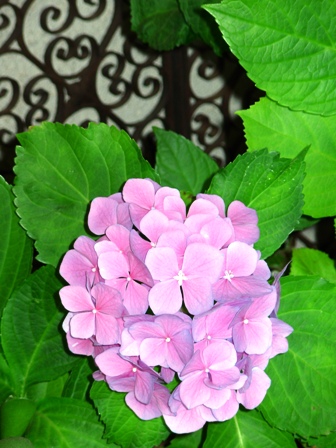
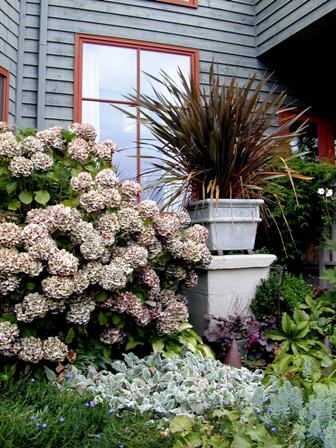
Today, all I have to share are these photographs of my sole hydrangea plant. This pinky charmer lives on our covered porch, surviving the heat, I guess, because of its deeply shaded existence.

It is 90 degrees outside as I write at 7:30 p.m. With adequate water, this hydrangea seems to cope with close-to-the-century-mark temperatures. But if it wasn’t protected by the overhanging roof, it would be miserable.

In contrast, hydrangeas in Seattle can handle a few days of excessive heat, here and there. But their blooms and leaves get crispy when subjected to sustained hot-and-sunny summer conditions. All the more reason why I cherish owning at least one non-crispy specimen here in Zone 10!

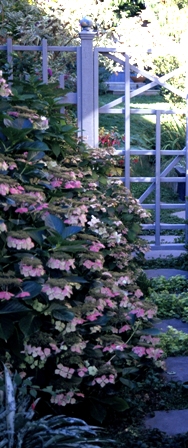
This hydrangea was a “housewarming” gift nearly 2 years ago, given by my husband’s boss on the occasion of our move to SoCal. To me, “Miss Hydrangea,” it seemed ironic to receive a no-name, hothouse variety in a 1-gallon pot, cloaked in that crinkly-metallic florist paper. It nearly toppled over because the few enormous mop-head blooms were wildly out of proportion to the size of the plant itself. In my former garden (seen at left and right), I was lucky to grow several cool Japanese hydrangeas that were gifted to me by friend Richie Steffen of the Miller Garden. These babies seemed to think they were still growing in their native soil because they exploded in size over the period of a few years – only to crowd out the nearby path. (Although, I must confess that the huge mophead hydrangea shown here was also a housewarming gift that arrived in a 1-gallon florist’s pot: It was given by our then-new neighbor David when we completed construction and threw ourselves a move-in party in 1998!).

Back to this pink hothouse hydrangea, which sat on my kitchen counter and seemed to be mocking me. If she could have spoken, she would have said: “You think you’re such a great gardener? Well, guess what? No one here cares that you grew a dozen stunning hydrangea shrubs, not to mention two climbing hydrangeas, in your old Seattle garden. Try keeping me alive here in Zone 10!”

READ MORE…

places to “dwell” in the garden (with bamboo overhead)

Saturday, June 14th, 2008

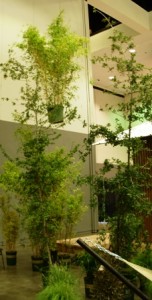
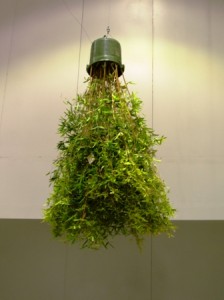
When I toured the Dwell Outdoor section of the trade show at last weekend’s Dwell on Design 08-LA, the first things to catch my eye were some “flying” pots of bamboo. Suspended from the ceiling, resembling broomsticks owned by the Wicked Witch of the West, the potted bamboo plants seemed to be whooshing to and fro, by themselves.

Slightly twisted, this version of a well-behaved, dare I say “garden-variety,” plant display was the brainchild of a few folks at Monrovia. As one of the major sponsors of the Dwell conference, Monrovia was given the task of decorating the vast Dwell Outdoor area, which showcased modern living trends and hot new products.

Monrovia partnered with Sarah Graham, a principal of agps architecture, to create the “Flying Bamboo” theme. “We wanted to design a conceptual landscape for Dwell Outdoor and Monrovia, as a means for visitors to see landscape in a new way,” Graham explained in a Monrovia press release. “As plants, particularly large plants, are usually gravity based, we reversed that normal condition, making it surreal. One cannot help but to notice, to question, and to laugh.”
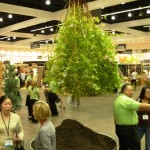
Bamboo foliage nearly tickled the tops of our heads while I chatted with Judy Lynes, Monrovia’s publicist from The Phelps Group, a Santa Monica-based PR agency, and Pamela Wasson, Monrovia’s marketing VP. The women said Monrovia enjoyed creating something that guaranteed a reaction (I guess the only person not excited about the installation was the local Fire Marshall, who had concerns that plants would start dropping from the sky onto conference-goers).

But thanks to secure cables and lots of other precautions, the caper worked! When I walked into the giant shell of a convention hall, the flying plants soared above the displays and visually demanded my attention.
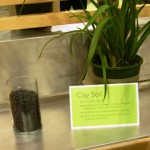
Plenty of lush, healthy Monrovia plants were closer to the ground, too, for easy viewing, including dramatic architectural plants, water-wise and easy-care varieties. By focusing on its selection of 42 custom-blended  soil mixes (using dozen different types of mycorrhiaze, a beneficial fungus), Monrovia educated consumers and landscape professionals about the importance of good soil.

“We work with so many landscape architects and designers, we thought this would be an ideal venue to showcase our plants and soils to those professionals,”  Wasson said.

ARCHITECTURE IN THE GARDEN

Shedista that I am, I was wowed by the many great examples of scaled-down style designed for escaping to the great outdoors. There were some of the wonderfully creative shed-like structures on display below Monrovia’s flying bamboo. I daresay each was a stylish hideaway, deserving of a starring role in the garden:

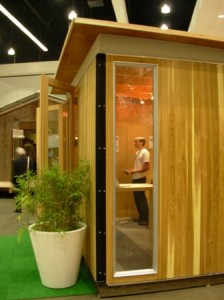
MODERN CABANA
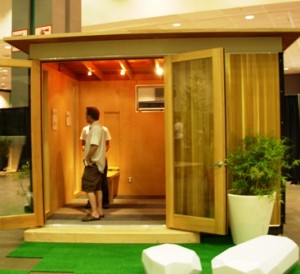
The brochure copy reads like it’s straight out of the pages of Stylish Sheds and Elegant Hideaways, promising: “SPACE TO: Work, Play, Film, Paint, Meditate, Rest, Escape, Research, Read, Create.” Based in San Francisco, Modern Cabana offers pre-fabricated accessory structures made from clear cedar siding (all sorts of design upgrades are available). The clean, modern design comes in 10-by-10, 10-by-12, 10-by-14 and 10-by-16 foot configurations. Multiple units can be connected to create expanded floor plans. “The Cabana can be used as a guest cottage, urban penthouse, desert hideaway, fishing cabin, workshop, sound studio, yoga studio, kids’ playhouse, or exercise room.”

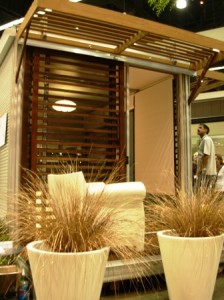
KITHAUS
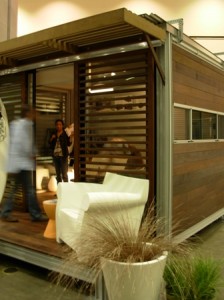
I discovered Kithaus, a cool slat-sided shelter, at the CA-Boom 07 show in Santa Monica and invited the company to be part of our book. But the young shedmaker, which uses a lightweight anodized aluminum frame, Ipe decking and louvers, and a corrugated metal roof to make its nifty, freestanding room, didn’t have a completed and fully installed structure ready in time for our photo schedule. Now, Kithaus has been picked up by Design Within Reach, which is marketing and distributing the prefabricated units. “Wondering where you can use Kithaus? How about anywhere you need a fully insulated, pre-wired comfortable space.”

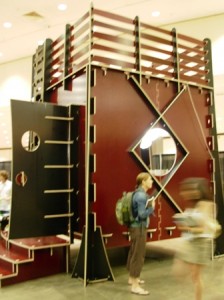
SHELTER SYSTEMS
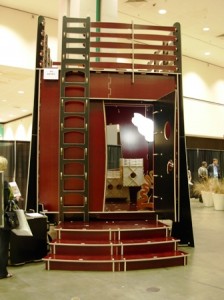
Like a three-dimensional puzzle, the “Comeback Cube” by Culver City, Calif.-based artist-architect Gregg Fleishman, is undeniably part sculpture and part shelter. It is playful and interactive in its design. Yet, it is practical, and I can see it functioning as a contemporary summerhouse. According to press material, the design features: “a full-size single-cube module in 3/4 inch European Birch, measuring 9 ft by 9 ft by 9 ft, with 81 square feet of interior space and an 81 square foot rooftop deck. The single cube is permit exempt, making for a quick and elegant temporary structure, backyard studio, guesthouse, or children’s playroom.”

On his web site, Fleishman speaks further about his design decisions:

“In architecture today, the green movement focuses mostly on the origins of material and use of energy. This work proposes that there is another way to be green in architecture, a way that focuses on process in building going beyond the factory. It is in geometry, with its repeating similar forms, and smaller similar parts that we find the advantages we are looking for. These include greater structural efficiency, manufacturing economies, easier handling, less specialized work force, and lower start up costs. What distinguishes this geometry . . .  (are) the cube and the octagon, more specifically variations of a 3D checkerboard of cubes or ‘rhombicubes.’ When oriented in different ways, these cubes have provided for a veritable bouquet of new and different building types to sprout up using faceted geometrical faces that can provide a new and more natural look and feel to our buildings.”

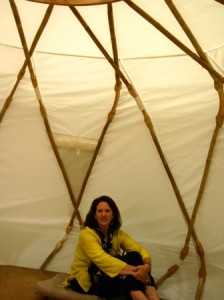
THE NOMAD YURT
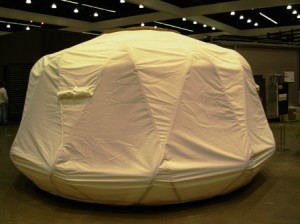
Ecoshack is an LA-based green design studio and manufacturer of architectural products such as the Nomad, a modern take on the traditional Mongolian yurt. I am fascinated by this fabric-cloaked shelter designed for use as a fully-enclosed guest room for 3 to 4, a poolside (or rooftop) lounge that seats 10 to 12, or a spa treatment room. “At night, light the interior to create a magical, private room.”
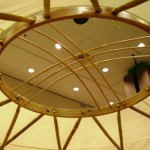
Designed by Ecoshack founder and CEO Stephanie Smith, The Nomad measures 14-ft. diameter, with an interior height just over 7 ft. Its materials include:

— Solid Core Bamboo, a renewable, flexible, strong and light material 50 times stronger than oak but lighter than steel;

— WeatherMAX FR, an advanced, exterior-grade, anti-flammable fabric that delivers “unsurpassed water repellency, mildew and oil resistance without relying on environmentally unfriendly coating compounds.”

Truly, “a yurt reinvented.”

Dwell on Design 08-LA

Tuesday, June 10th, 2008

My pals at Monrovia made sure to add me to the press list for dwell Magazine’s first-ever design symposium in Los Angeles (I think the two previous conferences were held in the San Francisco Bay Area).

Dwell on Design’s hip graphics and giant magazine covers filled the LA Convention Center. The addition of plants, provided by Monrovia, helped soften the ultra-modern flavor of the event and infuse the setting with something living and green.

The four-day conference included panel lectures, home tours and a trade show featuring the best contemporary and sustainable resources for the home and beyond. I missed Thursday’s panels, but met up with Nan Sterman to attend some of Friday’s panels and the trade show.

Having spent many hours of my professional life uncomfortably confined to stiff, industrial-grade chairs while listening to lectures, I was thrilled to see that conference sponsor Lounge22, a Los Angeles-based furniture company, provided v-e-r-y cushy sofas for those of us smart enough to show up on time and get a place near the front of the room. Sleek, low-profile sofas, upholstered in white or black leather, made sitting still an easy (and luxurious) endeavor. Very classy, folks.

Stylish attendees reclining on sleek Lounge22 sofas – it beats a folding chair!

First off, a panel of leading hotel and restaurant designers convened “Home and Away: the nexus of hospitality and domestic design.” Moderated by dwell editor Sam Grawe, the panel featured Cass Calder Smith, principal of CCS Architecture (San Francisco-based), Peg O’Brien, founder/principal of O’Brien Design, and Theresa Fatino, Chief Creative Officer, SBE Entertainment Group.

I asked myself, why do I care about hotel and restaurant design? I haven’t written about the hospitality biz since I was a reporter covering the hotel beat for Puget Sound Business Journal back in the late 80s-early 90s. But I remembered that my experiences reporting on hotel and restaurant trends strongly influenced and shaped my design sensibilities – and helped train my eye to look for creative design influences everywhere around me. I’m pleased to say, it was worth my time to slouch into the white leather sofa, stretch my legs and listen to the presentation.

Of the three panelists, it was Theresa Fatino who blew me away. She has been described as having a sixth-sense for observing cultural tastes and trends. Fatino is a passionate keeper of the faith for her current project, SLS Hotels. As a project of SBE Entertainment Group, the first SLS Hotel is slated to open later this year in Beverly Hills (Las Vegas and South Beach, Florida, properties are also in the works). 

You may ask yourself: What does SLS mean? I finally found a clever reference to the acronym on the company’s web site: Some Little Secrets. The hotel is pursuing a high-touch, but understated niche in the crowded hospitality market.

Fatino is the organization’s key collaborator with master designer Philippe Starck on its hotel, restaurant and lounge concepts. In addition to SLS Hotels, these include the Katsuya restaurant brand, recently-opened S Bar and a yet-to-be-named upscale supper club on the Sunset Strip. She has an impressive resume that includes a fine arts degree from Syracuse University, followed by design positions with Ralph Lauren, Pottery Barn and the W Hotel.

Fatino described the intricate development of SLS Hotels’ “brand” management message, summed up by a list of “emotional touch points.” I might be missing a few of them, but here are the themes I quickly jotted down during her lecture:

Conscience

No Compromise

Internal Reward

New Functionality

Semi-public

pre-Googling

Curated Consumption

Customization

Customer-made

Out-Experience-In

Niche Growth

Online Oxygen

Planned Spontaneity

Buy Now

To me, these ideas are symbolic of broader consumer trends. Far-reaching, such ideas aren’t limited to the hospitality industry. They serve a kind of marketer’s shorthand to describe and highlight the present mood of popular culture, media (and media consumption), technology, product design and art.

Fatino illustrated a few of the ideas:

pre-Googling: This refers to our reliance on the Internet as a “preparation” tool. For example, how many of us “Google” someone in advance of a planned meeting (this could be a work-related contact or even someone you might encounter at a dinner party)? We’re addicted to Google as a verb!

Curated Consumption: As a design writer, I find this one fascinating. Certain arbiters of taste are given the “power” to curate our artistic and aesthetic choices. Fatino describes Pottery Barn as the “curator of casual living,” Williams Sonoma as the “curator of the kitchen,” Oprah as the “curator of the books we read,” and Martha as the “curator of flowers.” “We are following and obeying the new curators of taste and style,” she explains.

Online-oxygen: “How many of us wake up in the morning and before we do anything else, we reach for our Blackberry?” she asked. This habit equates our need to breathe oxygen with our need to constantly access our online lives; it is shaping design decisions made for the new hotel. She illustrated this concept with a slide of a man seated in a Zen garden, using his laptop. Hmmm.

Internal reward: There is a need to balance our “wired” lifestyle with an “unplugged” response. “We need to rejuvenate, nourish the mind, replenish, engage in spiritual activities,” Fatino suggested (at this point in her lecture, I leaned over to Nan and whispered: We all need a Stylish Shed – that will provide ample internal reward, the antidote to everyday insanity!)

After identifying these emotional touch points, Fatino cited a list she called the “catalog of experiences” the new hotel will offer. I suspected her list would be geared to customers willing and able to pay for this level of luxury. But surprisingly, many of them are emotional experiences rather than tangibles. And in a way, that’s what’s so appealing about these ideas. These experiences seem to require an attention to detail rather than a big budget. Here they are:

Elegant

Timeless

Intelligence

Community

Authentic

Human-Spirited

Organic

Respect

Reliable

Humanity

Inspiration

Discovery

Soul

The challenge, said Fatino, is to “translate the ‘experience’ into a physical product,” but to do it with sincerity and integrity (people can easily spot a “copy job,” she says).  

For example, the hotelier has decided to eliminate little plastic bottles of shampoo and lotion and replaced them with high-quality, natural body products in large, glass, refillable bottles. Not only is this environmentally smart, it is a small gesture that communicates the desired guest experience. Some are tangible, such as warm, fuzzy-feeling Egyptian cotton towels or “bronze-tinted” lighting flattering to the face. Others are intangible, such as how guests’ children and pets are treated. “We know when to create a surprise and when to whisper,” Fantino explained.

HOW WILL HEARING THIS NEW INFORMATION CHANGE THE WAY I OPERATE?

I think I will come up with my own “emotional touchpoints” and “catalog of experiences” to describe how I want to live, conduct my life, work, relationships and immediate surroundings. I’ll be tracking SLS Hotels as they open and begin to execute Fatino’s vision.

NEXT UP. . .

I have two more reports to post, but this is already too long. The next one will highlight Dwell Outdoor, the exhibit area featuring landscape and garden design ideas and products. That will be followed by a report on a Sustainable Interiors panel.


Stylish Sheds on Martha Stewart Living radio

Sunday, June 8th, 2008

Thanks to a connection made by my Seattle-based PR whiz-friend Cindy Combs, I was invited to be a guest on “Living Today,” the daily afternoon show on Martha Stewart Living Radio. The segment originally aired on April 28th, the day before Stylish Sheds and Elegant Hideaways was published.

I had a delightful 25-minute conversation with gregarious host Mario Bosquez.  We discussed the ideas and inspiration for one of my very favorite subjects: Creating Your Dream Shed.


The “Living Today” team (from left to right): associate producer Lauren Gould, producer Naomi Gabay, host Mario Bosquez, and engineer Chris Hauselt [MSL Radio photo]

The interview was completely enjoyable, enhanced by Mario’s enthusiasm and constant affirmation, which gave the impression that talking about “elegant hideaways” was to him the most exciting topic on earth!

Obtaining an audio copy of the interview was nothing short of a miracle, however. It involved (a), signing up for a free 3-day subscription to Sirius Radio; (b) setting up my crappy little cassette recorder next to the computer so I could tape the show as it streamed live on the net; and (c) racing into the other room to do the interview by phone with Mario.

Once my segment of the show was finished, I returned to my office and rewound the recording of the interview. Not only was it kind of scratchy and there were all sorts of pinging sounds from my computer (probably some kind of AOL affectation that lets you know if a new message has arrived), I also discovered that the tape ran out before the interview was over. I begged my publisher to try and obtain a professional recording from some kind of media monitoring service, but that request went nowhere.

So, finally, thanks to my wonderful collaborator Bill Wright, who figured out how to convert a cassette recording into a digital file (and who, I’m sure, devoted many hours to clean up the poor quality sound captured by my amateurish recording), we have a reasonable facsimile of the interview. Thanks, too, to Bob Meador, aka the web guru, for further enhancing and editing the file, filtering out background noises where possible, and posting the audio to my web site.

Thanks to the support of my friends, I actually have the interview to share, albeit more than a month after it originally aired. Click here to listen: Debra on MSL Radio.

Living large in 50 words or less

Friday, March 14th, 2008

I thought my big foray into the glossy, over-sized, luxury magazine market here in LA would be exciting. Instead, it kind of left me underwhelmed.

The assignment, by way of a referral from an editor friend whose work I really admire and who handed me off to write for his design deputy, was to report and write three 150-word pieces for Angeleno magazine’s “Living Large” section in its March 08 issue. Measuring 10-by-12 inches, the 300-page issue arrived in my mailbox today. Wow, Ryan Philippe is on the cover looking broodingly handsome.

Angeleno magazine

Quickly, I flipped through the first two hundred or so pages, past full-page ads featuring the beautiful people wearing clothing by Armani, Banana Republic, Dolce & Gabbana and Chanel. Where was my big story?

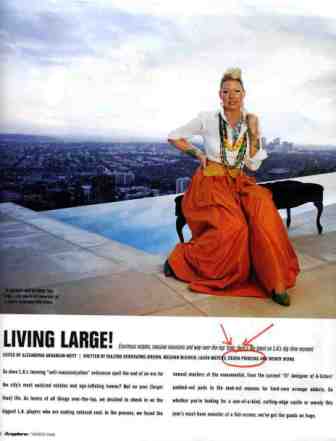
FINALLY. I found the six-page article, chock-full of mini-stories (and I mean mini – you really could call them “sentence stories”) about everything big in architecture, furnishings, interiors, oh, and even plants. Yes, my dazzling prose was boiled down to a caption-length block of text. Only two of the three items I wrote made the “cut,” so to speak. They really don’t resemble anything I composed.

Living Large, the story

if you look veeeerry closely, you can see my byline, circled above

But the good news is that I can publish my original pieces here, thanks to the freedom of blogging. I think you’ll like reading them. One is about super-sized cactuses and succulents; the next one is about how to grow an instant-gratification hedge; and the final one – my favorite – is about Berylwood Tree Farm, a magical nursery owned by Rolla Wilhite, a man who has been growing trees for 40 years. This is the one short story that Angeleno cut. And you know, I’m actually relieved, because Mr. Wilhite is a visionary – and he deserves a HUGE story of his own in a publication that will give him his due. And I intend to write it myself.

Read on for a revealing comparison between how the stories began and how they ended up in print:

STORY ONE (the original):

Looking Sharp: Emulate Lotusland’s exotic century plants and tree-sized aloes or recreate Huntington Botanical Garden’s otherworldly desert displays for your own enjoyment. Stunning as a piece of living sculpture, a prickly tower calls for special care in transporting and planting, says cactus-grower Molly Thongthiraj of California Cactus Center in Pasadena.

“It usually involves some kind of big equipment like a forklift or a crane,” she deadpans. “We sold a saguaro cactus that had to be delivered by helicopter.”

The scale and size of estate gardens call for big impact, which you can achieve with a pair of 4-by-4-foot variegated century plants (Agave americana ‘Variegata’) displayed in large urns. With cream-and-blue-green streaked blades forming a perfectly symmetrical (but wicked-to-the-touch) rosette, you can expect to spend $300 to $600 per plant.

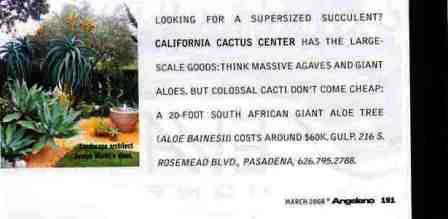
Wish for something even rarer? Thongthiraj suggests a South African giant tree aloe (Aloe bainesii), with a price tag of $30,000 (12-foot) to $60,000 (20-foot). Location: 216 South Rosemead Blvd., Pasadena, CA; 626-795-2788 or www.cactuscenter.com.

How STORY ONE looks in print:

tiny story on big cactuses

STORY TWO (the original):

Fortress mentality: When Suzanne Rheinstein, interior designer and owner of Hollyhock, the West Hollywood design and antique store, wanted to double the size of her Hancock Park backyard for her daughter’s wedding, she removed a wood fence and ripped out an old eugenia hedge in order to “borrow” her neighbor’s yard for the event (that’s a nice neighbor!).

“When (the wedding) was over, we knew we had to put a hedge back, but I didn’t want to use eugenia again,” Rheinstein explains. “Instead, I found espaliered podocarpus trees that were eight feet high and wide, with wonderful dark green foliage.”

If you plant it in a straight line, just about anything – from tree ferns and ficus to holly and bamboo – can be considered a hedge. People want hedges for privacy, enclosure, and to screen objectionable views. Euphemistically called a “living fence,” there’s something kinder about erecting a green hedge rather than a solid wall between you and the neighbors.

“A green hedge benefits the environment more than a block wall,” notes Los Alamitos-based landscape architect Graham Stanley. (It’s also more economical: hedging costs about $20-per-linear-foot versus $100-per-linear-foot for a constructed wall, Stanley estimates.)

Evergreen shrubs with dark-green leaves make for the best hedges. “They set off the garden as a backdrop to the lime and bronze foliage of other plants,” Stanley says. Good choices: Waxleaf privet (Ligustrum japonica ‘Texanum’, 8-10 ft.); myrtle (Myrtus communis ‘Compacta’, 8 ft.); and fern pine (Podocarpus gracilior, 20-40 ft.). Stanley’s current favorite is Japanese blueberry tree (Elaeocarpus decipiens, to 10-15 ft.), “a nice hedging plant with dark green leaves.”

Source: Valley Crest Tree Co., 818-223-8500 or www.vctree.com (to the trade).

How STORY TWO looks in print:

hedging “story”

STORY THREE (the original piece which was dropped from Angeleno’s roundup of all things big):

Trees are the answer:There’s nothing like a 20-foot-tall (or larger) shade tree to give the impression of largess. Use one as a focal point or group several trees to form a bosque or grove – and your landscape will feel instantly established. For mega-specimens, landscape architects and designers here and beyond call Rolla Wilhite, tree purveyor extraordinaire and owner of Somis-based Berylwood Tree Farm.

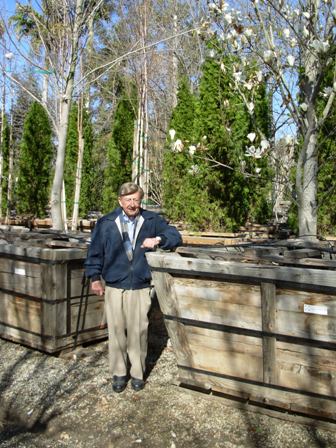
Rolla Wilhite

A UCLA-trained landscape architect and horticultural pioneer who 40 years ago began planting saplings at his 25-acre nursery, Wilhite supplied trees for the Bellagio, Getty Center, Getty Villa and the Smithsonian. While he won’t reveal his most-famous clients, Wilhite slyly hints at the marquee names who have shopped among his verdant rows of stately redwoods, graceful magnolias and tufted blue atlas cedars trained into espaliered forms (Hint: just last month he helped a certain pregnant Oscar-winner choose mature live oaks for “one of her houses.”)

Known as the Rodeo Drive of trees, Berylwood is open only to architects and contractors. Wholesale trees have three- to five-figure price tags. You can’t access an online list of his 8,000 trees (Wilhite keeps that inventory in his head), but staff will email photos of specific varieties upon request.

Then there’s the waiting: After you select a mature, field-grown tree, it may take six months to two years for it to be pruned, dug and boxed for delivery so as to avoid transplant shock. “These trees are my children,” Wilhite confides.

Berylwood Tree FarmSource: Berylwood Tree Farm, 805-485-7601 or btfnurs@aol.com (to the trade).

It’s back to the world of full-length stories for me. I think my Hollywood journalism days are over.

Rain is good

Monday, January 28th, 2008

snowfall in Ventura County Jan 2008

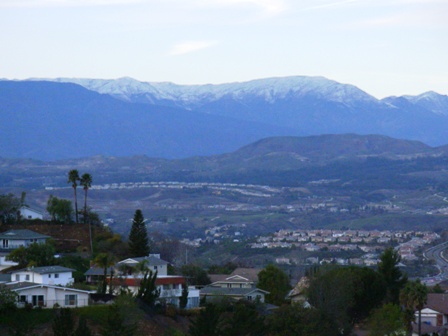
Snowfall frosts the mountaintop, seen from our neighborhood, January 2008

Southern California has received more than seven inches of rain since the start of the New Year. Apparently, this means our area has been blessed with more precipitation in one month of 2008 than we had in all of 2007!

There is something quite delightful about rain when it arrives. Of course, since this happens ALL THE TIME during Seattle winters, we were once desensitized to the cleansing, refreshing spirit of raindrops, sprinkles, showers, softly-falling mists…whatever you want to call it. Now, though, after living here in SoCal nearly 18 months, we do our little “happy dance” when it rains.

Capturing rain is a top priority for cities in the LA area. That’s because the dense network of urban freeways, streets, sidewalks and patios has created an impermeable surface that repels rainfall, washing it down driveways, curbs, and gutters and dumping it into the street drains. On the way, the water picks up pollutants — motor oil, auto fuel, antifreeze — any number of toxins that cling to the concrete and asphalt. So the relatively clean water falling from the sky becomes a chemical cocktail that eventually pours into drainage systems and dumps into the Pacific Ocean.

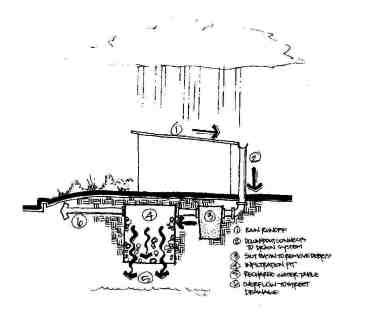
Several municipalities have established incentives to help homeowners (and their landscape designers) to capture and retain water falling on their property. One creative solution is to sink an infiltration system into the yard. As precipitation gushes along rooftops, into gutters and downspouts, and across the driveway, it is directed to this underground vessel that holds hundreds of gallons of water. Then the H20 slowly filters into the ground, replenishing the water-table instead of spilling into the street.

infiltration system

A cross-section of an underground infiltration system, designed by Gaudet Design Group

I took a crash course in Rain Management 101 a few weeks ago when the Los Angeles Times asked me to write a story about creative ways to capture excess rainwater.  I met Peter Jensen of Gaudet Design Group in Santa Monica, a landscape designer who specializes in sustainable solutions. Here is a link to the January 17th article called: “Imagine: Rain, Rain, Stored Away.”

Peter makes something completely functional look very appealing. Here is some of his work:

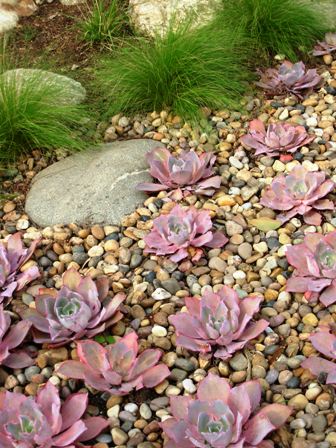
Echeveria “Afterglow”

Echeveria “Afterglow”

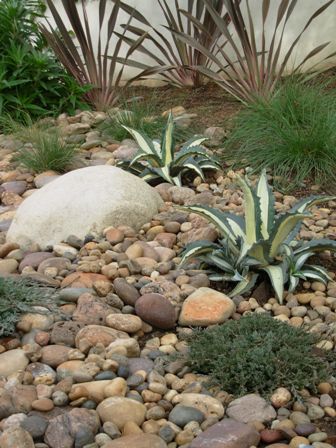
gravel garden

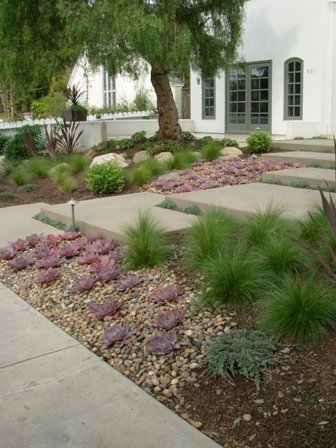
A Santa Monica front yard: In a space once occupied by thirsty turf, an attractive palette of drought-tolerant plants captures rainwater

agaves in gravel garden

On top of the “hidden” in-ground infiltration system, the river-rock is interspersed with Agave americana ‘Varietgata’ and ‘Icee Blue’ spreading juniper (Juniperus horizontalis ‘Icee Blue’)


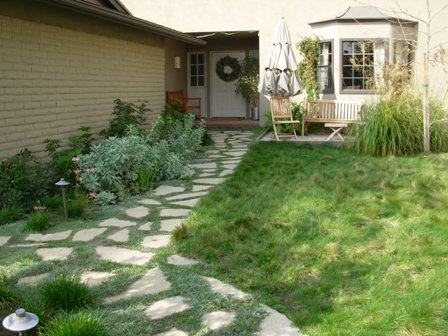
Dymondia between steps

Between “pads” of poured concrete steps, clumps of fescue and dymondia (Dymondia margaretae) encourage rainwater to seep into the ground

Dymondia cushioning broken concrete walk

Dymondia margaretae cushions the spaces between pieces of broken concrete


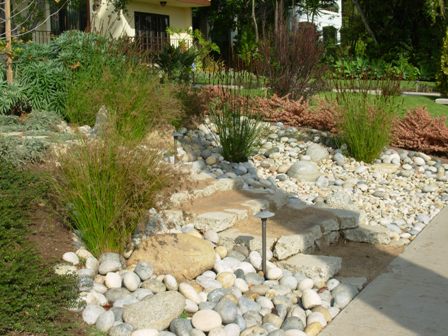
Santa Monica drycreek garden with infiltration

To passers-by, it looks like a dry creek-bed; but this river-rock entry garden is installed above an in-ground infiltration system

Broken concrete rebuilt as permeable driveway

Once a two-car driveway that shed rainwater into city streets, this re-designed drive uses a patchwork of ground-covers and broken concrete to allow rainwater to slowly seep into the ground.

Flower Show season…

Friday, January 18th, 2008

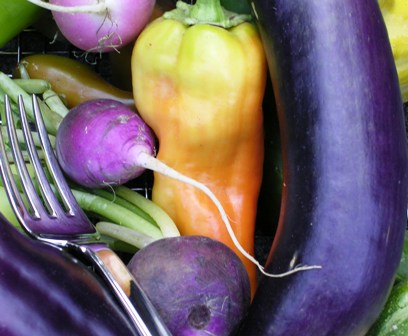
eat your veggies

Eat Your Vegetables: Garden to Table [Cindy Combs photograph]

The minute the calendar page turns to the New Year gardeners don’t read: “January.” They read: “Spring.” It’s silly when so many places are still buried in snow, have sub-freezing temperatures, or even worry (as I am) about occasional frost. But we are busy planning our planting schedules.

Until the soil warms up, however, we can take solace in the piles of seed catalogs that fill our mailboxes. To speed up spring’s arrival, we buy tickets to the pre-season extravaganzas: Flower and garden shows. I liken these green celebrations to the “annual meeting” for plant lovers — especially plant lovers who push the envelope when it comes to defining our gardening season.

I’m deep into planning my February and March travel itineraries for taking in the Northwest Flower & Garden Show (February 20-24) and San Francisco Flower & Garden Show (March 12-16), respectively. I’m excited to gain new inspiration for hot plants, cool designs and inspiring lessons from the show gardens. Here’s where I can revel in horticultural happiness with like-minded souls, because seeing friends, of course, is a huge part of the fun.

For months I’ve been hearing from my Seattle garden friends about the flurry of activity surrounding the Northwest Horticultural Society’s display that will (I think) be the educational organization’s largest ever at the Northwest Flower & Garden Show. As a former NHS board member and past editor of the organization’s newsletter, “Garden Notes,” I have a special place in my heart for its people and programs. Through NHS and its members and speakers, I have gained so much knowledge and inspiration over the years.

NHS has sponsored inspiring art- and plant-filled displays in past years. For 2008, NHS president Nita-Jo Rountree tells me the focus will be on edibles. “Eat Your Vegetables! Garden to Table,” promises to be centered around a tasty and inspiring display garden. Actually, THREE edible gardens. When it opens on February 20th, the installation will be a centerpiece of the Washington State Convention Center’s south lobby entrance.  The goal is to demonstrate to showgoers that edible plants are easy to raise, attractive when mixed with ornamentals in the landscape and, with a few simple preparations, ready to go from the garden to the dinner table.

The 1,200-square-foot display will highlight two huge lifestyle trends — growing vegetables and cooking “fresh,” says Nita-Jo. I called her recently to get the inside scoop on how the garden plans are coming together. The design will feature an chef demonstration stage, plus a trio of edible landscapes: A formal French potager, designed by Robyn Cannon (featuring material and ideas from Lucca Statuary and Lakeview Stone); a contemporary container garden, suitable for balcony and rooftop, created by award-winning designer Wendy Welch; and the ideal patio kitchen garden with a “to-die-for” Aqua Quip kitchen and furnishings supplied by Gillian Mathews and Ravenna Gardens.
“Vegetables, fruits and herbs are the rage in gardening right now,” Nita-Jo says. Interest in growing one’s own food is a response to healthy lifestyle trends — a philosophy that excites and inspires novice and experienced gardeners alike, she points out.

“We’ll have organic cooking demonstrations surrounded by ideas for vegetable gardening and seed starting,” Nita-Jo adds. From Ciscoe Morris’s favorite Brussels sprouts to the recipeses of famed chef Jerry Traunfeld, formerly of The Herb Farm, cooking with seasonal and local ingredients will be presented.

Good design is an important element of appealing edible gardens. “We’re going to have a very cool circular stone patio that Lakeview Stone is installing,” Nita-Jo explains. “It will be surrounded by a tapestry of lettuces and strawberries.” Robyn recently shared with me her exploits in procuring 150 “perfect” dwarf boxwoods, which will knit together the intricate parterre for her potager design. All around, this is an ambitious – and delicious – undertaking.

To think that hundreds of tiny plants are needed to create the perfect edible garden is mind-boggling. A review of the list of vegetable seeds started and forced indoors weeks ago reveals the ambitious scale of this endeavor: Lettuces with names like ‘Outredgeous’, ‘Merlot’, ‘Oak Leaf’, ‘Italian Misticanza’, ‘Yugoslavian red butterhead’ and ‘Black Seeded Simpson’; ‘Bright Lights’ and ‘Golden Sunrise’ chard; ‘Grafitti’ cauliflower; ‘Russian Red’ kale; and ‘Ruby’ cabbage. The bounty of the greenhouse also includes aforementioned Brussels Sprouts, plus onions, leeks, rhubarb, chives, parsley, cilantro, sugar pod snap peas, strawberries, rosemary, a bay tree, fig trees, tomatoes, peppers, beets, spinach, and 10 espaliered apple trees!

Creating a Flower Show display garden is nothing short of a labor of love – one that is created to share with thousands of fellow garden-aficionados. For those of us who desire an edible garden, one that feeds and nourishes our bodies and souls, the NHS display will be even more meaningful. Best of luck building your gardens, NHS!