Debra Prinzing

Get the Email Newsletter!

Archive for the ‘Flower Farming’ Category

Week 12 // Backyard greenery and seasonal blooms

Sunday, March 29th, 2015

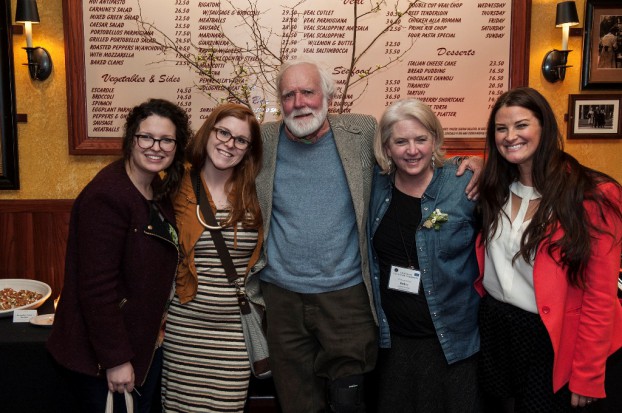
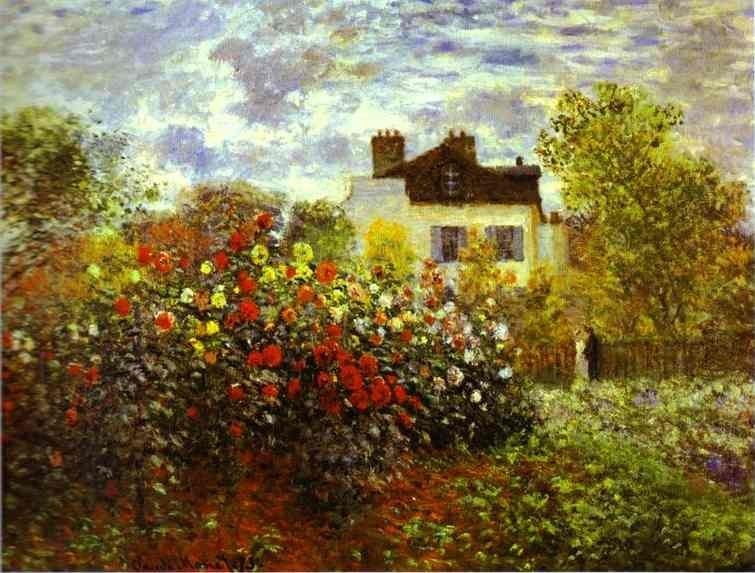
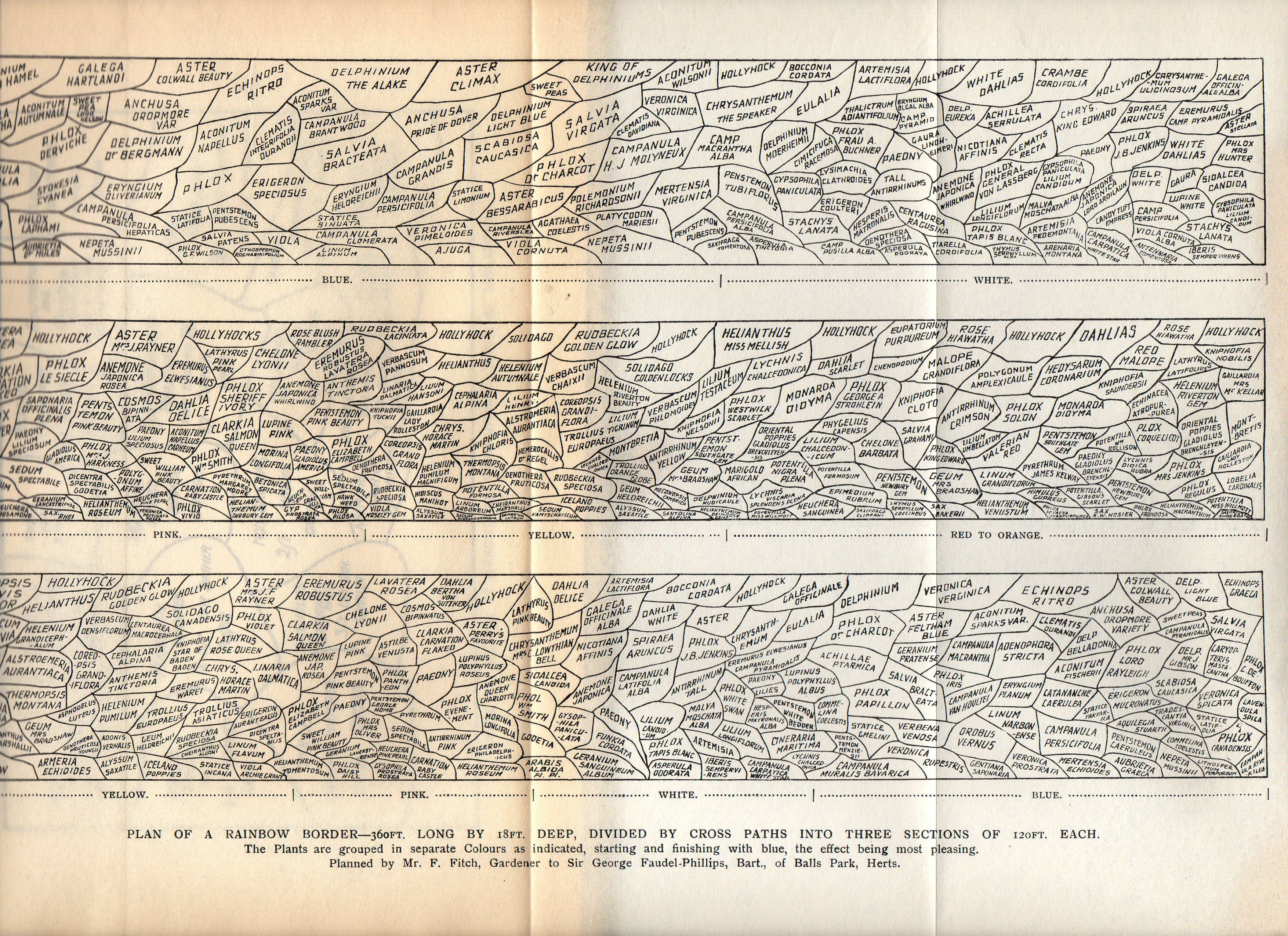
This was a week of flowers, beginning on March 22nd with my “Four Seasons Cutting Garden” lecture at the San Francisco Flower & Garden Show. Here are some one of my favorite images shared in my illustrated presentation.

I call this my "dream cutting garden," painted by Claude Monet in 1873. The Garden at Argenteuil (Dahlias)

I call this my “dream cutting garden,” painted by Claude Monet in 1873. The Garden at Argenteuil (Dahlias)

Overwhelming or Inspiring? A design scheme from a vintage garden book, Hardy Perennials and Herbaceous Borders, 1912. "Plan of a Rainbow Border"

Overwhelming or Inspiring? A design scheme from a vintage garden book, Hardy Perennials and Herbaceous Borders, 1912. “Plan of a Rainbow Border”

I also spent time interviewing several flower farmers and floral designers, which you can hear on the Slow Flowers Podcast in coming weeks. Subscribe here for free downloads from iTunes.

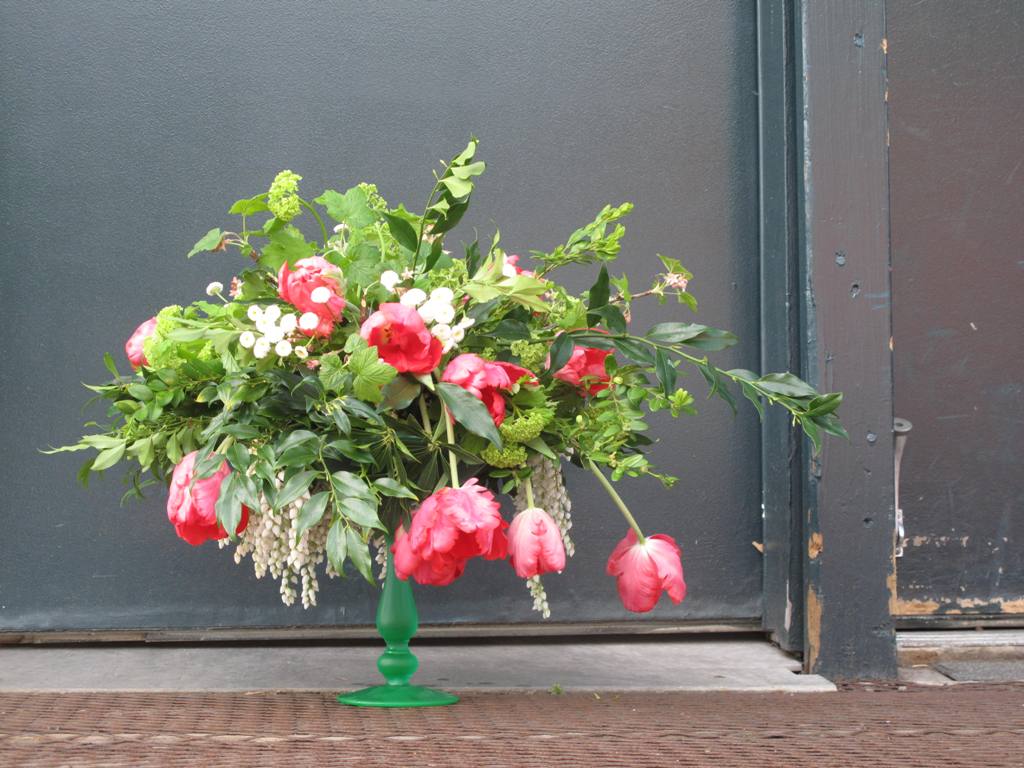
This week I have two arrangements to share with you. The first was created as a demonstration ofFloral Soil, the 100% plant-based, USA-made, compostable alternative to florist’s foam. The occasion was a workshop taught by Alicia Schwede of Flirty Fleurs, focusing on “Elevated Centerpieces.”

Floral Soil’s creator Mickey Blake and I participated in the workshop to gather photos and content for her web site. I brought along my favorite glass compote, a pedestal fruit dish that was my great-grandmother’s.

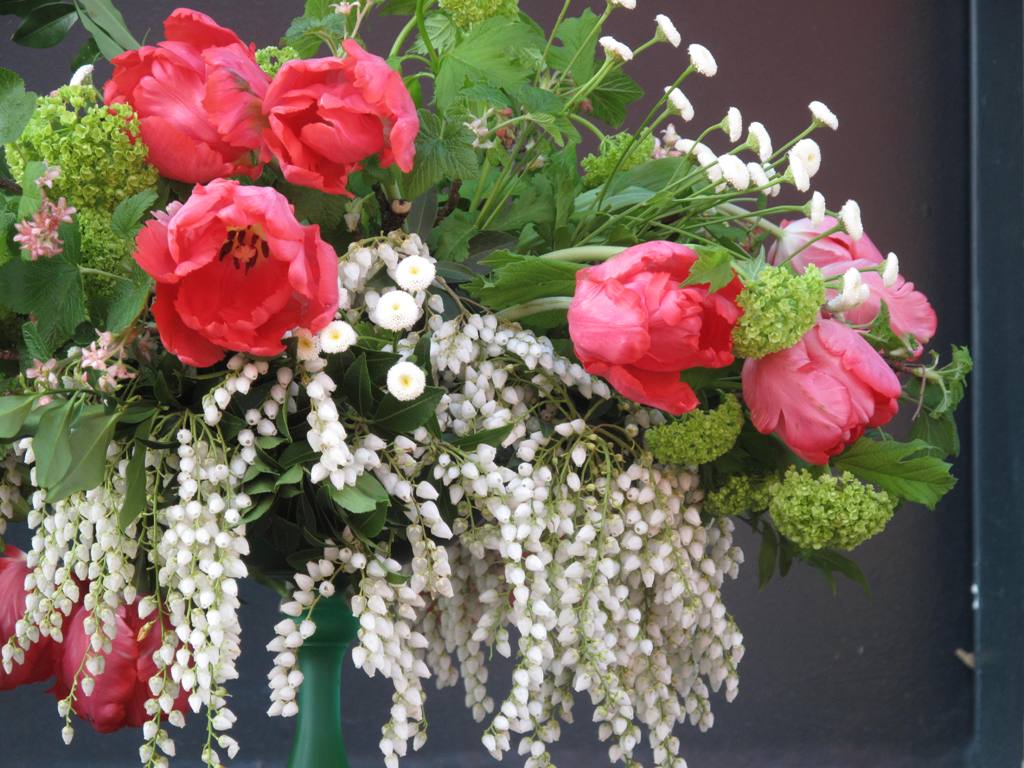
Thanks to very excellent instruction from Alicia, here’s what I created. There are three pieces that created the mechanics to hold the flowers and foliage: (1) a 3-by-4-by-5-inch piece of Floral Soil; (2) a sheet of chicken wire wrapped from rim to rim of the vase; and (3) 1/4-inch waterproof cloth tape to hold it in place.

Such an elegant piece with a slender pedestal that resembles a candlestick holder. It measures 9-1/2 inches tall and the bowl is 10-inches in diameter. It is only 2-1/2 inches deep - just the challenge for NOT using foam!

Such an elegant piece with a slender pedestal that resembles a candlestick holder. It measures 9-1/2 inches tall and the bowl is 10-inches in diameter. It is only 2-1/2 inches deep – just the challenge for NOT using foam!

A combination of my own garden cuttings plus West Coast flowers and foliage

A combination of my own garden cuttings plus West Coast flowers and foliage

Ingredients:

From my garden: White-blooming Pieris japonica, glossy green Sarcococca ruscifolia (also called sweet box); common boxwood; and flowering currant, a native shrub (Ribes sanguineum).

Provided by Alicia: Pink tulips and stems of lime green viburnum (most likely from British Columbia) and button-like white feverfew (Chrysanthemum parthenium), sourced from California.

A Slow Flowers Birthday Bouquet

Vivid details of melon orange and dark plum hues.

Vivid details of melon orange and dark plum hues.

Last year, prior to the launch of Slowflowers.com, I ran a successful campaign on Indiegogo and raised nearly $18,500 from more than 200 supporters.

Each contributor had the option of selecting a thank-you gift for their donation. One of the items was a Bouquet of American Flowers.
It has been fun to make those supporters happy as they redeem this “perk.”
In some cases, my floral friends are helping me to fulfill blooms in their regions (thank you greenSinner and Goose Creek Gardens in the Pittsburgh area AND thank you California Organic Flowers in Chico, California).
For the Seattle folks, I’ve been making the bouquets and yesterday was a chance to give my friend Sue Nevler the flowers coming to her.  She wanted to surprise her husband Steve Gattis with an arrangement of flowers for his birthday. Here’s what I created and where the blooms originated:
Happy Birthday, Steve!

Happy Birthday, Steve!

Agonis foliage, grown by Mellano & Co., Carlsbad, CA

‘Mambo’ Oriental lilies, grown by Oregon Flowers, Aurora, OR

Dark purple parrot tulips, Sonshine Farms, Whidbey Island, WA

Orange double tulips, Ojeda Farms, Ethel, WA

Phalaenonpsis orchids, Orchidaceae, Walla Walla, WA

scroll

The Flower Farmer’s Year with Georgie Newbery of Common Farm Flowers UK (Episode 186)

Tuesday, March 24th, 2015
Georgie Newbery of Common Farm Flowers in the UK.

Georgie Newbery of Common Farm Flowers in the UK.

In the past year, in addition to this podcast’s primary focus on American flowers, farmers and designers, I’ve interviewed a handful of slow-flowers-minded farmers and designers based in the U.K. and Australia.

There are obvious parallels between these folks and our own renaissance and return to domestic flowers. Sadly, as we’ve experienced in our own native land, the floral industry in many industrialized nations has been outsourced and hurt by competition from countries with low labor costs and less stringent environmental practices.

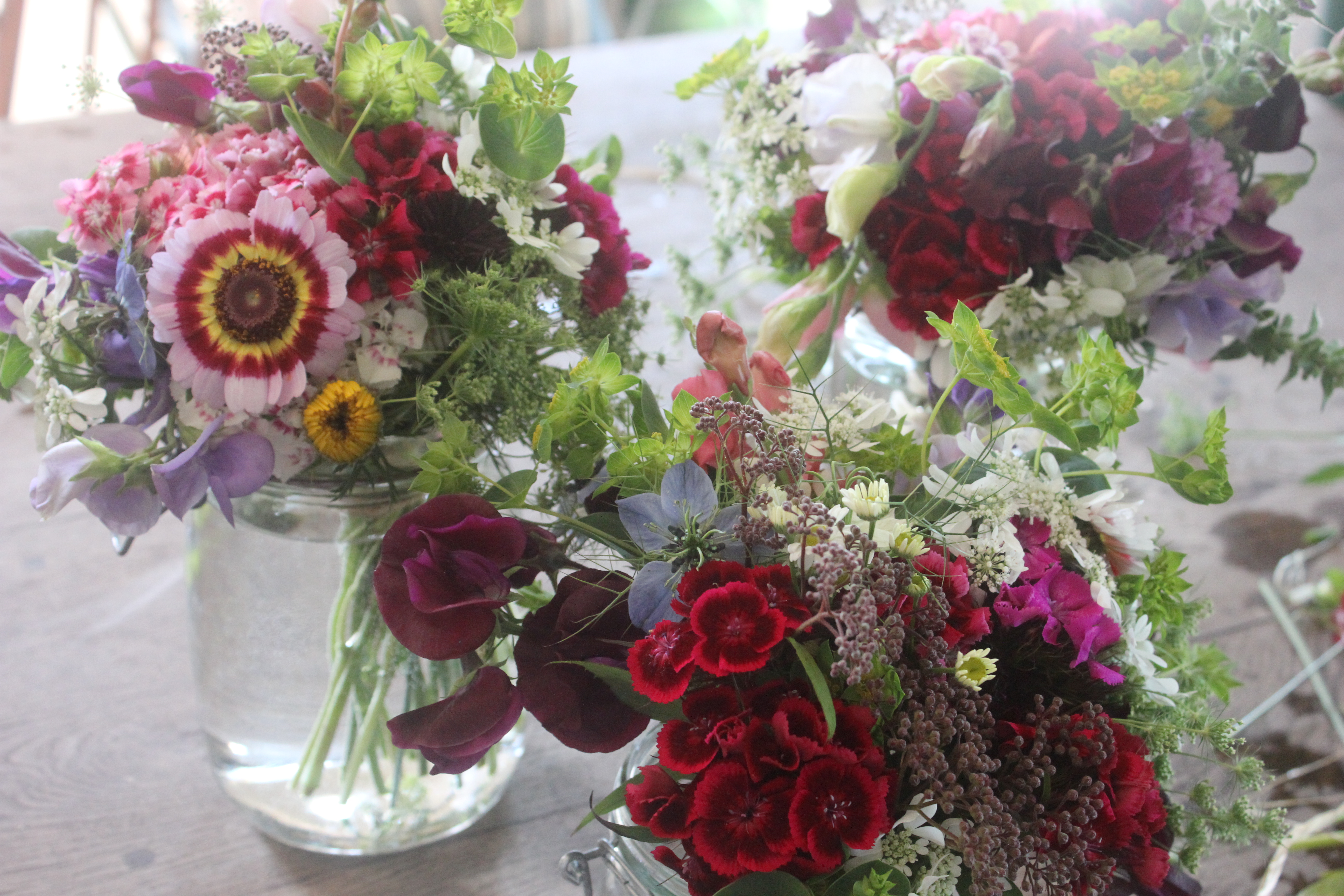
Common Farm Flowers' "jam jar posies."

Common Farm Flowers’ “jam jar posies.”

I’m inspired by the creativity and kindred spirit of all flower farmers who want to rekindle the interest in homegrown flowers and the mindful florists who want to differentiate themselves in the marketplace by sourcing local, seasonal and domestic flowers. Today’s guest is a perfect voice to invite into this conversation.

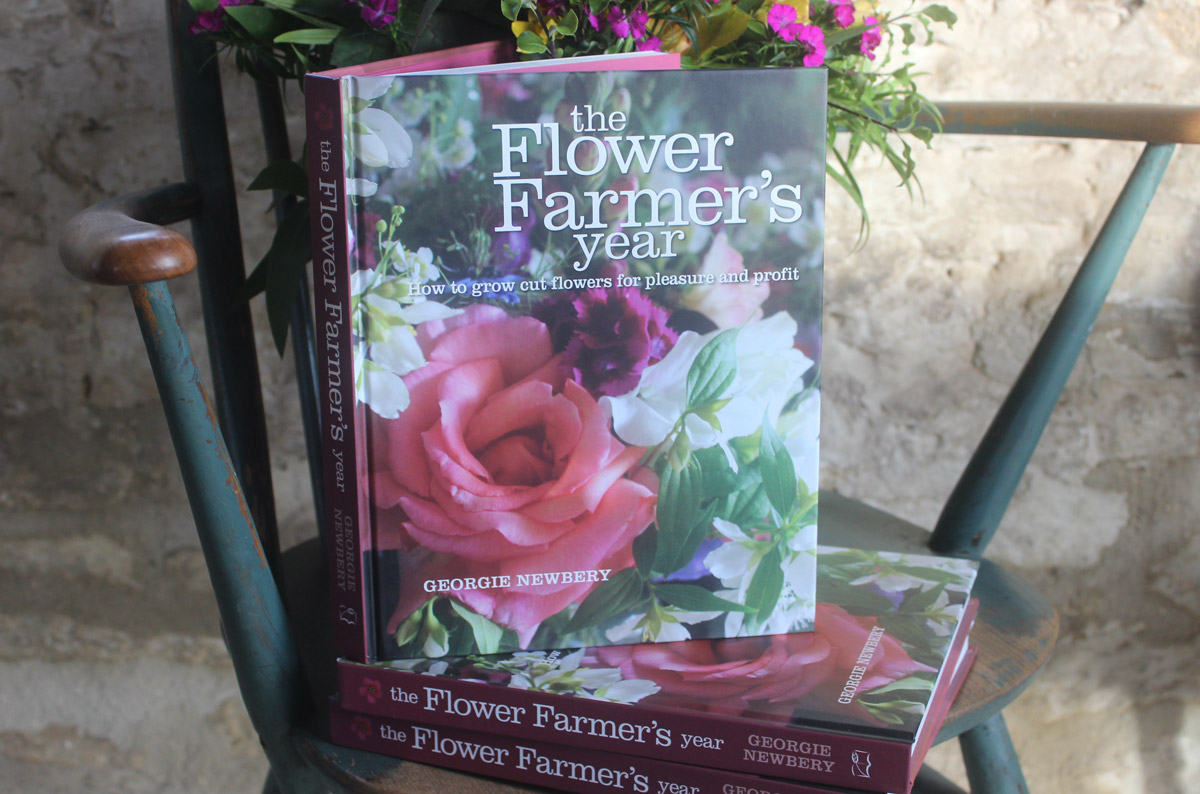
Georgie's new book, "The Flower Farmer's Year," was recently released in the U.S.

Georgie’s new book, “The Flower Farmer’s Year,” was recently released in the U.S.

Please meet Georgie Newbery, a British farmer-florist who owns Common Farm Flowers with her husband Fabrizio Boccha.

This husband-and-wife team grow British cut flowers on a beautiful plot between Bruton and Wincanton in Somerset, a few hours west of London.

The occasion for our interview is the February 15th U.S. publication of Georgie’s brand new book, “The Flower Farmer’s Year, how to grow cut flowers for pleasure and profit,” published by Green Books UK and available online at Powell’s Books and Amazon, among other places.

Common Farm Flowers is an artisan florist company, which means Georgie and Fabrizio grow nearly everything used in their floristry, expressing floral design as “a craft in which artistic flair is combined with imaginative use of the material at hand to make arrangements which are full of life and air, which dance.”

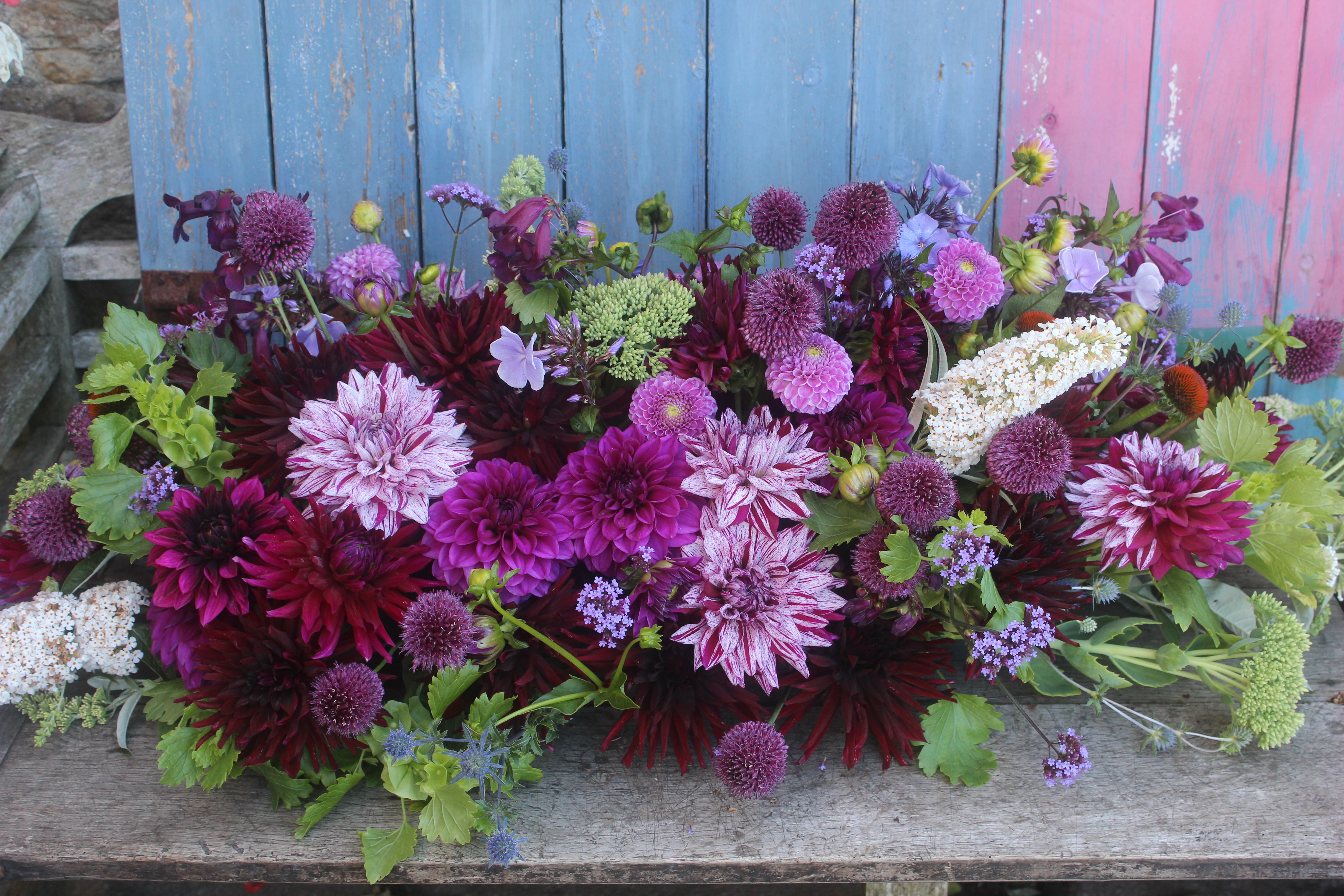
Georgie's color sensibility  is modern and romantic.

Georgie’s color sensibility is modern and romantic.

Launched in 2010, Common Farm Flowers has taken off in the past five years, despite its rural locale. As Georgie writes on the Common Flowers Farm web site: “There’s clearly a market for British grown/eco cut flowers and we’re delighted by the reception we’ve had for the flowers we grow here and the floristry we do.”

Common Farm Flowers sends British flower bouquets by post twelve months a year; it supplies and arranges lush wedding flowers throughout Somerset, the South West, in London and beyond and runs workshops on subjects ranging from Flower Farming for Beginners to Do Your Own Wedding Flowers.

The farm has taken its flowers to RHS Chelsea, RHS Chelsea in Bloom, and has been featured in British Country Living, The English Garden, The Telegraph and more. Georgie frequently gives talks to horticulture societies and gardening clubs on growing cut flowers for the home, planting a cut flower border, and seminars on dahlias and sweet pea cultivation.

Another lovely series of posies by Common Farm flowers.

Another lovely series of posies by Common Farm flowers.

The Flower Farmer’s Year covers how to grow your own cut flowers to fill your house with the gorgeous colors and heavenly scents of your favorite blooms, knowing that they haven’t travelled thousands of miles. Georgie combines boundless passion with down-to-earth guidance and practical advice, drawing on her own experiences as an artisan flower farmer and florist as she takes readers through:

  • how to start a cut-flower patch
  • what to grow: including annuals, biennials, perennials, bulbs & corms, shrubs, roses, dahlias, sweet peas, herbs & wildflowers
  • cutting, conditioning and presenting cut flowers
  • starting a cut flower business
  • where to sell
  • marketing and social media
  • an annual planner

Whether you want to grow for your own pleasure or start your own business, The Flower Farmer’s Year is the perfect guide to add to your library.

Here’s how to find Georgie at her social places:

Facebook

Instagram

Pinterest

I’ve been in San Francisco this past week, to speak at the SF Flower & Garden Show, attend the Association of Specialty Cut Flower Growers meeting in San Jose and to scout gardens and flower farms in the Santa Cruz region for future stories. In the coming weeks you’ll hear from some of the people I’ve met on this trip — and I know you’ll find their stories a source of inspiration for your own endeavors.

Thanks to listeners, this podcast has been downloaded more than 40,000 times. If you like what you hear, please consider logging onto Itunes and posting a listener review.

The content and opinions expressed here are either mine alone or those of my guests alone, independent of any podcast sponsor or other person, company or organization.

The Slow Flowers Podcast is engineered and edited by Andrew Wheatley and Hannah Holtgeerts. Learn more about their work at shellandtree.com


Week 11 // Spring is here!

Saturday, March 21st, 2015
Welcome to Week 11 of the Slow Flowers Challenge!
Welcome Spring!!

Welcome Spring!!

Let’s give ourselves a huge congratulations!

Participants in the Slow Flowers Challenge have made it through the first 11 weeks of 2015 – that’s practically an entire season of winter, right?

And yesterday, March 20th, welcomed spring and all its promises of ephemeral blooms, vivid new green foliage and bud growth, fragrances, forms, textures and hues that we haven’t seen since last spring. It’s enough to make one deliriously happy.

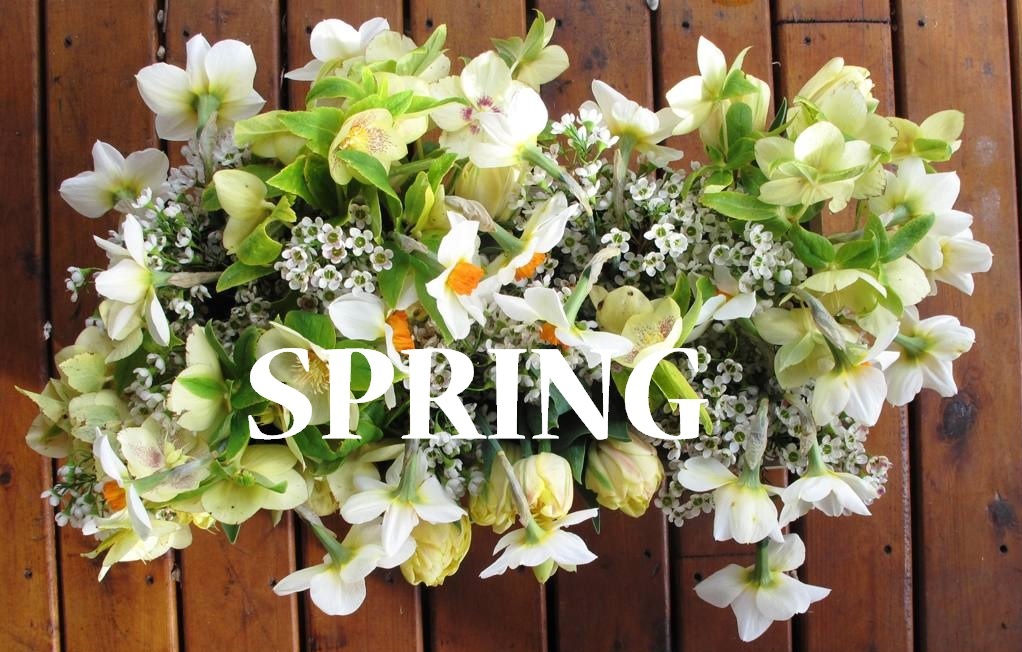
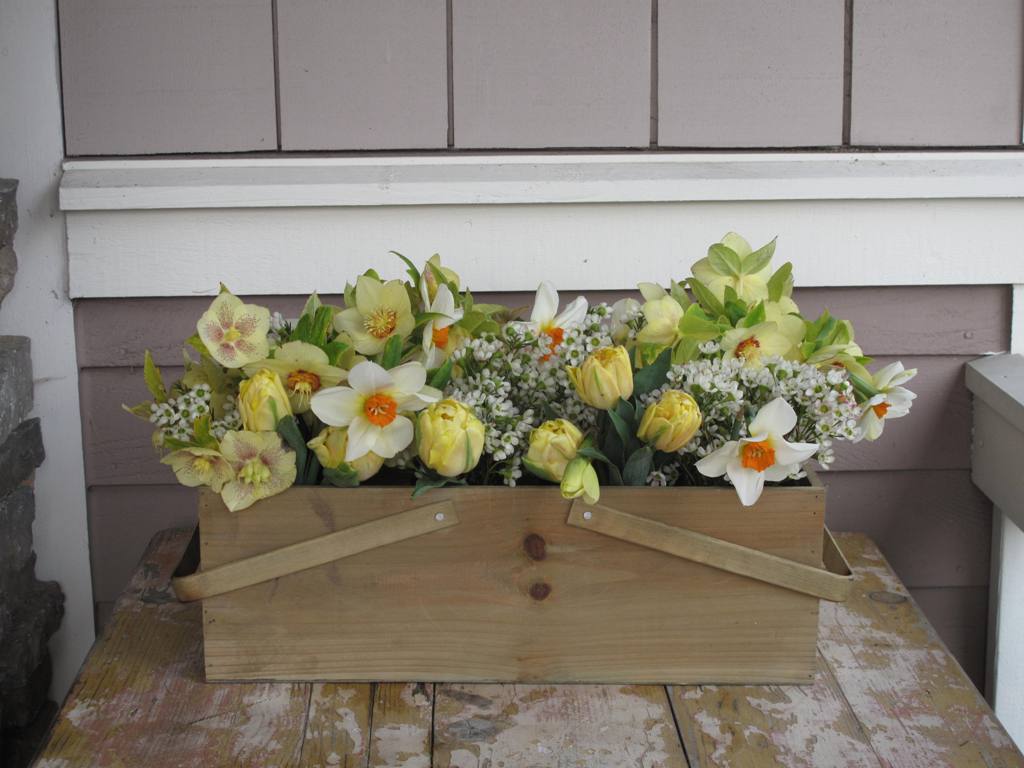
Fresh Pick: a box filled with luscious spring flowers. This design uses 8 Mason jars inside a wooden crate.

Fresh Pick: a box filled with luscious spring flowers. This design uses 8 Mason jars inside a wooden crate.

BALL JARS AND A WOODEN BOX (2-ways)

This week’s  Slow Flowers Challenge  was given to me by my friend  Nancy Finnerty, who threw a baby shower luncheon for our mutual friends  Willo Bellwood  and  Bob Meador  to celebrate the arrival of their sweet baby, Nola.

Willo designed the beautiful  Slow Flowers logo  you see at the top of this page, as well as many of the graphics, as well as the look and feel of my web sites, going back to 2005 (!) And Bob makes it all happen on a navigational and technological front – he is the genius who makes the  Slowflowers.com website actually work smoothly. Nancy asked me to bring some yellow tulips for the centerpiece.  And, well, I took that request a little further as you see here.

This week, none of the cuttings are from my garden, but they are from the farms of the Seattle Wholesale Growers Market. Hey – I had to be there for a board meeting, so it was impossible to resist bringing home  yellow double tulips  grown by  Gonzalo Ojeda of  Ojeda Farms , along with some other pastel lovelies that you see here.

I know I designed with hellebores last week, so apologies for the repeat of flower choice. But the yellow variety of hellebores are quite rare, grown, of course, by  Diane Szukovathy  and  Dennis Westphall of  Jello Mold Farm  . The sweet narcissus with dark orange centers were grown by Jan Roozen of Choice Bulb Farms , located just a few miles away from Diane and Dennis. And one bunch of wispy white wax flower – from Resendiz Brothers in Fallbrook, CA, adds just the right texture to the arrangement.

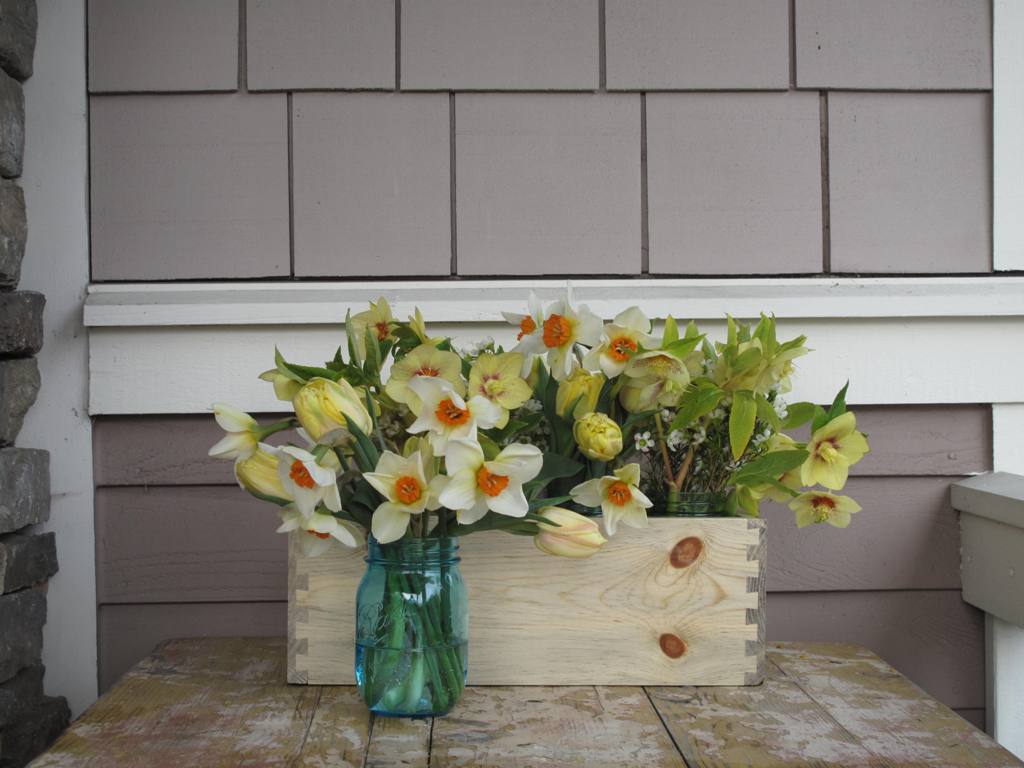
Here's how the jars nest inside the Blue Pine box. Notice the detailed dovetail joinery at the corners.

Here’s how the jars nest inside the Blue Pine box. Notice the detailed dovetail joinery at the corners.

FLORAL DESIGN MADE EASY

I started with a very special Blue Pine box that was hand-crafted in Colorado from reclaimed wood. This piece was designed by Chet and Kristy Anderson’s son (“young Chet”) of The Fresh Herb Co., in Longmont, CO. The Andersons gave it to me as a sample when I visited their farm last November.

The box is exquisitely hand-crafted from distressed pine (also called “beetle kill,” which tells you why the tree was distressed), but that when milled reveals a distinctive “blue” grain pattern. The longer box was designed to hold four Mason jars, – how cool is that?

Start with four jars. Fill them with yellow-and-white blooms. Pop the arrangements into the box. Voila!

Start with four jars. Fill them with yellow-and-white blooms. Pop the arrangements into the box. Voila!

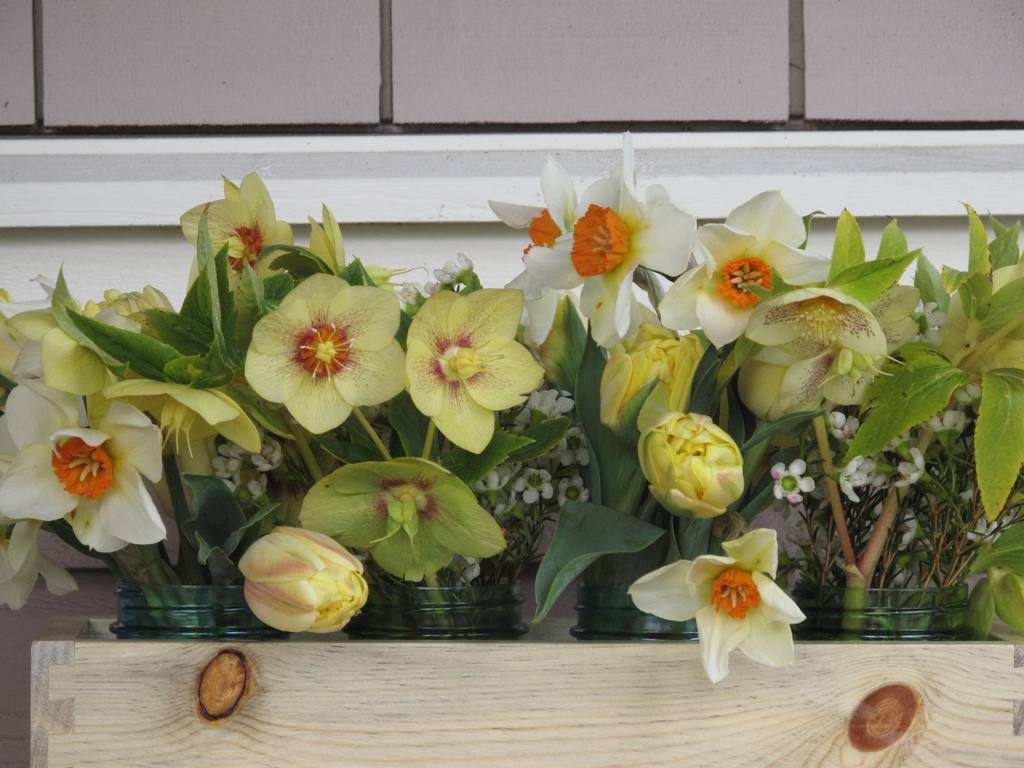
Detail showing the season's exquisite beauty.

Detail showing the season’s exquisite beauty.

ONE MORE

I had a lot of extras, so after I made this first arrangement, I thought: Don’t I have another wood box in the garage? And miraculously, I put my hands on it. This was a much wider box that originally came with a mail-order amaryllis-planting kit. It was large enough to hold 8 Mason jars (two rows of four jars). You can see that design at the top of this letter.

Here is the "flower box," gracing the luncheon table.

Here is the “flower box,” gracing the luncheon table.

I ended up taking this one to the baby shower – nothing like a larger arrangement for more impact. It is simply stunning to have all of these bloom shapes and forms at eye level when you’re enjoying a delicious meal and wonderful conversation. And it’s easy to give each guest one of the “mini” bouquets as a party favor to take home.

scroll

#FarmerFlorist at a Crossroads – Redefining A Business with Emily Watson of Stems Cut Flowers (Episode 185)

Wednesday, March 18th, 2015
Emily Watson, Milwaukee, Wisconsin-based flower farmer, floral designer, entrepreneur -- today's podcast guest.

Emily Watson, Milwaukee, Wisconsin-based flower farmer, floral designer, entrepreneur — today’s podcast guest.

50

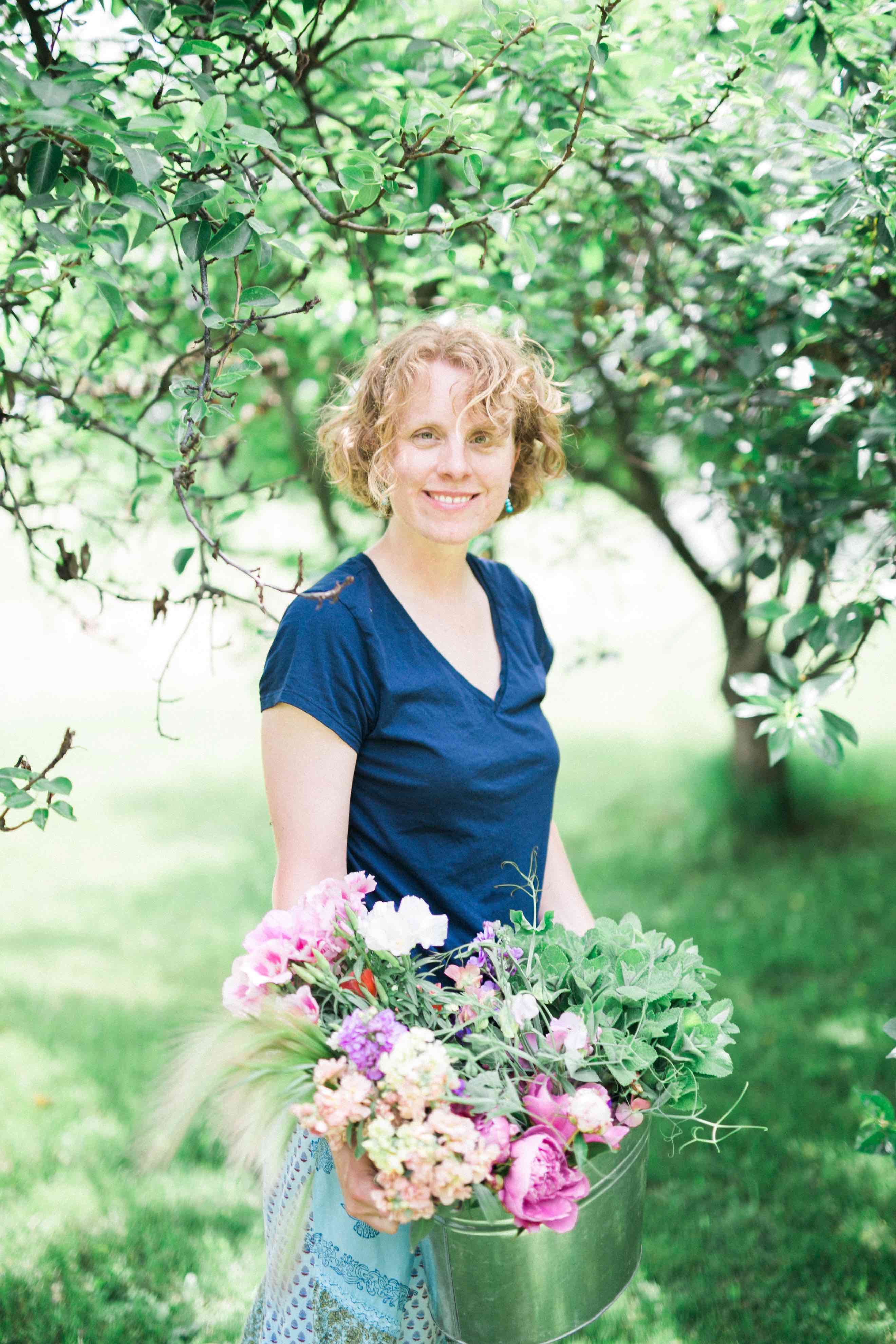
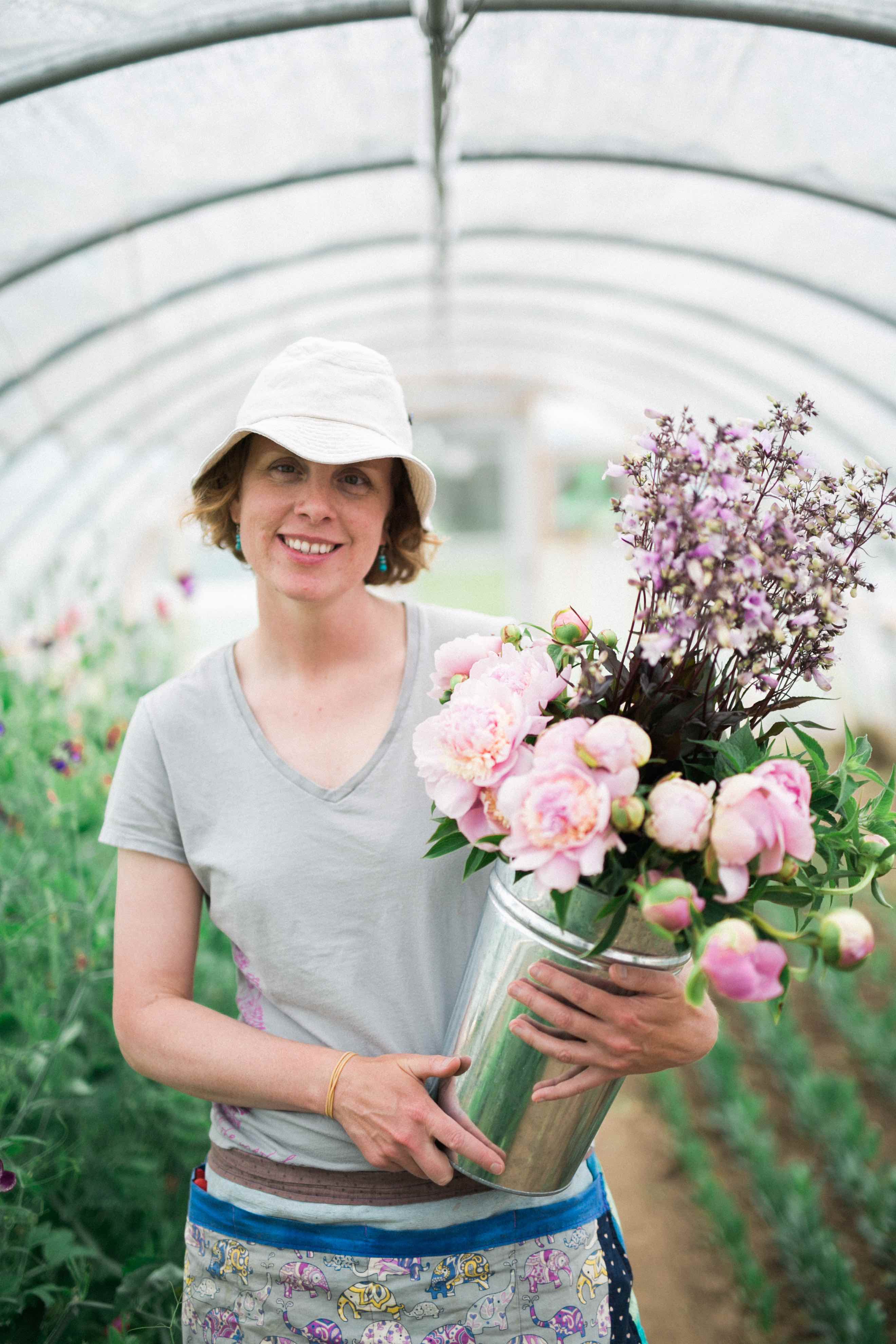
Emily on the farm, with her beautiful Wisconsin-grown peonies

I first met today’s guest “virtually,” when I reached out to her asking permission to use a portion of a online discussion she had started with other flower farmers.

Emily Watson is based in Milwaukee, Wisconsin, and since 2008 she has owned Stems Cut Flowers, a specialty cut flower business based on her grandparents’ farm about 45 minutes west of Milwaukee. She is a founding member of Slowflowers.com, having supported our launch by contributing to the initial Indiegogo campaign.

Emily and I finally met in person last October at the ASCFG national meeting in Wilmington, Delaware, and that was when we spoke further about the possible “course-correction” she was considering as she juggled flower farming and a successful floral design aspect to her business. Recently we connected over Skype for a conversation that I believe you’ll find quite honest and forthcoming.

And ironically, it harkens to that bulletin board comment Emily made in 2011, the one I included in The 50 Mile Bouquet. She posed this question:

“I’ve been growing for less than five years, on a small plot, and I’m wondering if this is a good idea. I’m not looking to get rich overnight, or even at all. But I need to pay the bills, maybe support a family and retire some day (before I’m 90). I do not have a
problem working a few 80-hour weeks but I do not want that to be the norm. Am I crazy for thinking this? The bottom line is I need to know if this is possible before I sink any more money into it?”

The responses Emily received were encouraging and honest; no one tried to sugarcoat the truth about the backbreaking reality of running a small farm. They also revealed that people do not grow and market flowers because it’s lucrative, but at least in part for a love of the land and a passion for the independent lifestyle it brings.

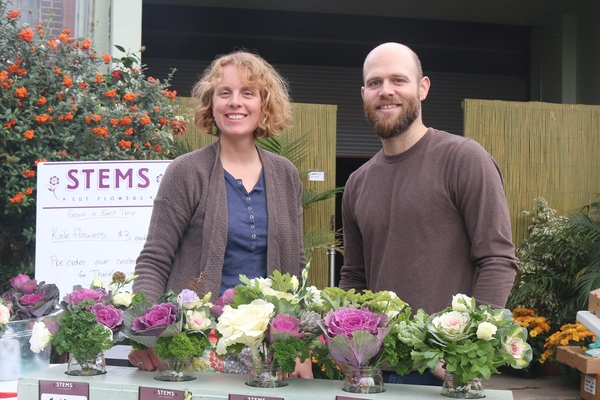
Emily with her husband

Emily with her husband Nich Love

Here’s more about Emily:

Emily's tagline for Wood Violet, her new design studio, is "floral design inspired by nature." How fitting!

Emily’s tagline for Wood Violet, her new design studio, is “floral design inspired by nature.” How fitting!

A May wedding bouquet grown and designed by Emily Watson.

A May wedding bouquet grown and designed by Emily Watson.

She grew up in a small agricultural town not terribly far from Milwaukee with three brothers and lots of cousins nearby, playing outside all the time.

After high school, Emily attended the University of Wisconsin in Madison where that love for the natural world led her to earn a bachelor’s degree in Biological Aspects of Conservation.

She worked as a landscaper, which led to work in a flower shop, which somehow led to managing a Chinese restaurant. As she puts it: “I learned a lot about business at that Chinese restaurant and made a lot of friends, but the call of the outdoors was too strong.

By 2008, Emily had started Stems Cut Flowers at her grandparents farm in East Troy, the town in which she grew up. As a small farming business, Stems flourished into a floral design business.

Emily considers herself lucky enough to live in the city and spend a few days every week at the farm, the best of both worlds.

Spring flowers in a romantic nature-inspired bouquet.

Spring flowers in a romantic nature-inspired bouquet.

Her intention has always been to run a thriving flower farm that sells its crops to florists and to the public at farmer’s markets, picking up occasional wedding design work. The reality, however, is that the idea of “occasional” wedding design has turned into a nearly every weekend occurrence. It soon became evident to Emily that she was running two separate businesses. Last year she decided to create a separate identity for the design portion of her business.

The timing is perfect for today’s interview because Emily is in the midst of launching a floral design studio in Milwaukee. She’s named it Wood Violet, an eco-friendly studio that focuses on locally grown flowers as much as possible, offering wedding flowers and daily deliveries.

As we discussed in the interview, Emily hopes to offer gardening classes and floral design workshops at Wood Violet, inspiring people with the beauty of each season. I admire the way she’s playing to her strengths as both a flower farmer and a floral designer, and I admire that her new hybrid business model includes supporting other local flower farmers in her community while still keeping her fingers in the soil.

Emily Watson-designed wedding flowers.

Emily Watson-designed wedding flowers.

You know, I think Emily has answered the question she posed back in 2011 better than anyone else could have done – and I wish her great success.

Here’s how to find Emily on all her platforms:

Wood Violet on Facebook

Wood Violet on Instagram

Wood Violet on Pinterest

Before we close, I want to give you the news of the week.

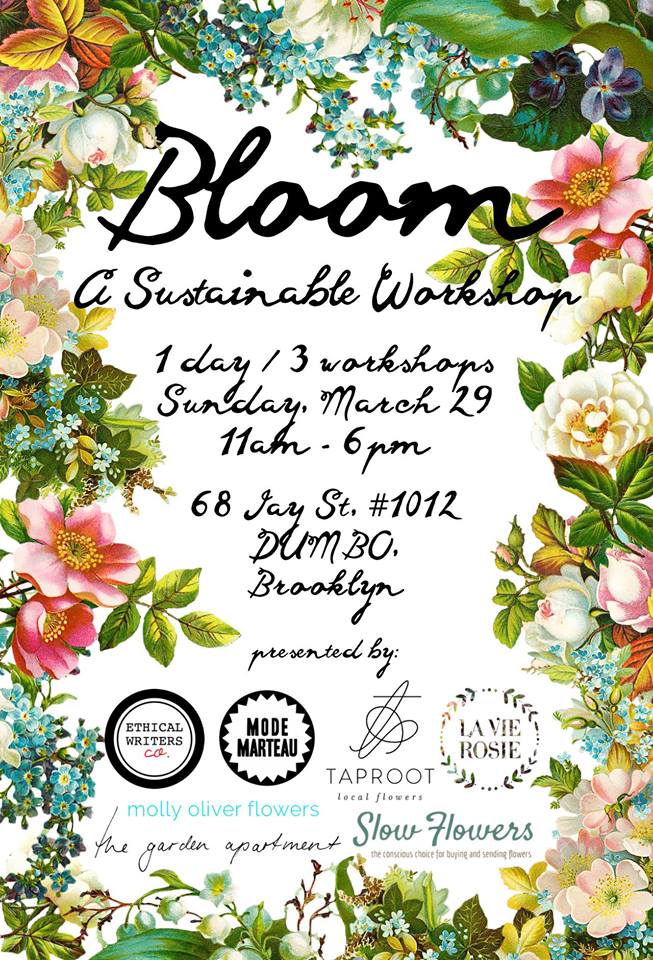
Bloom InstagramSlowflowers.com has partnered with the Ethical Writers Coalition to present Bloom: A Sustainable Workshop, that will take place on Sunday, March 29th at the Mode Marteau Studio in Brooklyn.

Participants can sign up for one or more intimate classes for a hands-on and creative experience in sustainability, and of course, locally-grown flowers.

Learn to make your own fresh flower crown, create a perfect bouquet, or plant a DIY a reclaimed vase at three different workshops.

Three members of Slowflowers.com will join together for the 3rd workshop: Local Flowers 101 with Taproot & Molly Oliver Flowers

Rachel Gordon of Taproot Flowers and Molly Culver and Deborah Greig of Molly Oliver Flowers will teach flower arranging tips & tricks, discuss the importance and sourcing of sustainable flowers, and how to best care for your arrangement. All materials included with the $65 workshop fee.

603730_1735877586638566_7397650793020746231_n

I want to thank the Ethical Writers Coalition for producing this awesome event and for inviting Slowflowers.com to participate. The Ethical Writers Coalition is a very cool group of journalists, writers, and bloggers who seek to support and further ethical and sustainable living online and in print. Through my publicists, I met co-founder Alden Wicker of the EcoCult Blog when I was in New York last October – and she attended a SlowFlowers.com gathering where this event idea germinated.

After we connected, Alder wrote an insightful post about Slow Flowers, which you can read here. Elizabeth Stilwell, who blogs at TheNotePasser.com, has taken the lead on creating Bloom and I have thoroughly enjoyed working with her on this project – sadly, I can’t attend. But I’m so pleased that Slowflowers.com will be well represented, getting the word out about American flowers and the people who grow and design with them.

I love how the roots of sustainable living intertwine so perfectly with the American Grown Flower movement. It’s exciting to see the idea of local, seasonal and sustainable flowers move from the alternative/fringe world closer to the mainstream.

donate-grist-logoLast week Grist.org fellow Ana Sofia Knauf published an interview with me and titled it “There’s a Local Flower Movement Blooming,” and I’d love for you to read it. Check out the link to her piece here.

Thanks for joining me this week and please return again, as I continue to share insightful and educational episodes recorded exclusively for the Slow Flowers Podcast.

The content and opinions expressed here are either mine alone or those of my guests alone, independent of any podcast sponsor or other person, company or organization.

Thanks to listeners, this podcast has been downloaded more than 39,000 times. If you like what you hear, please consider logging onto Itunes and posting a listener review.

Until next week please join me in putting more American grown flowers on the table, one vase at a time.

The Slow Flowers Podcast is engineered and edited by Andrew Wheatley and Hannah Holtgeerts. Learn more about their work at shellandtree.com.

Week 10 // Hellebores!!! (and More)

Friday, March 13th, 2015

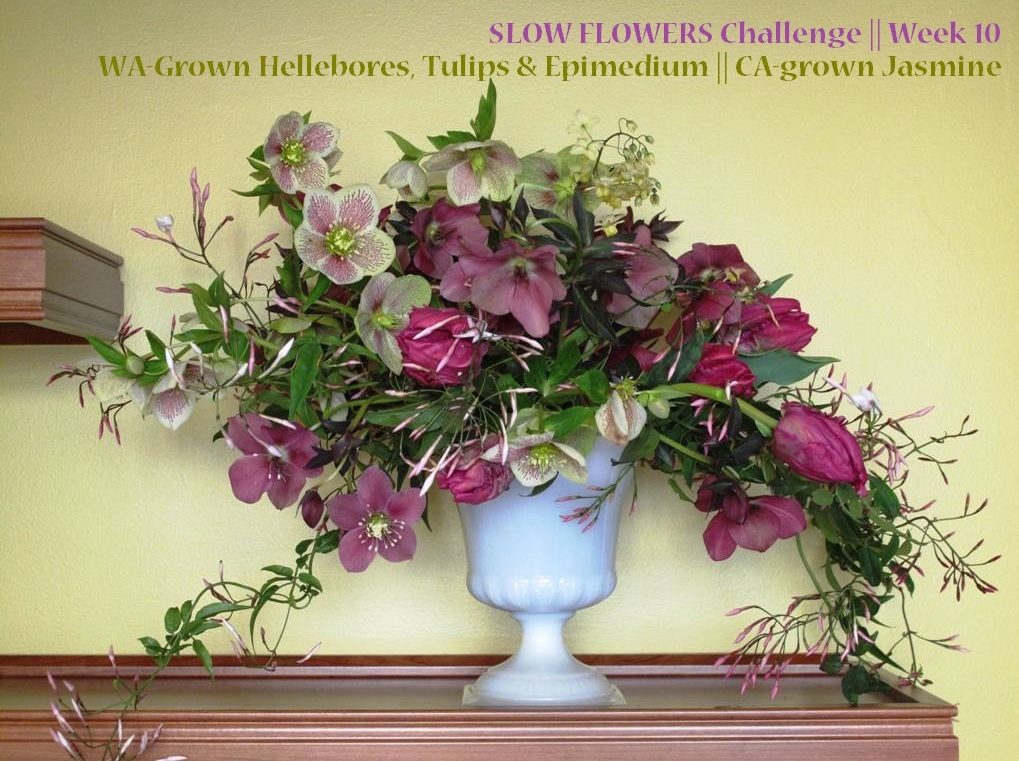
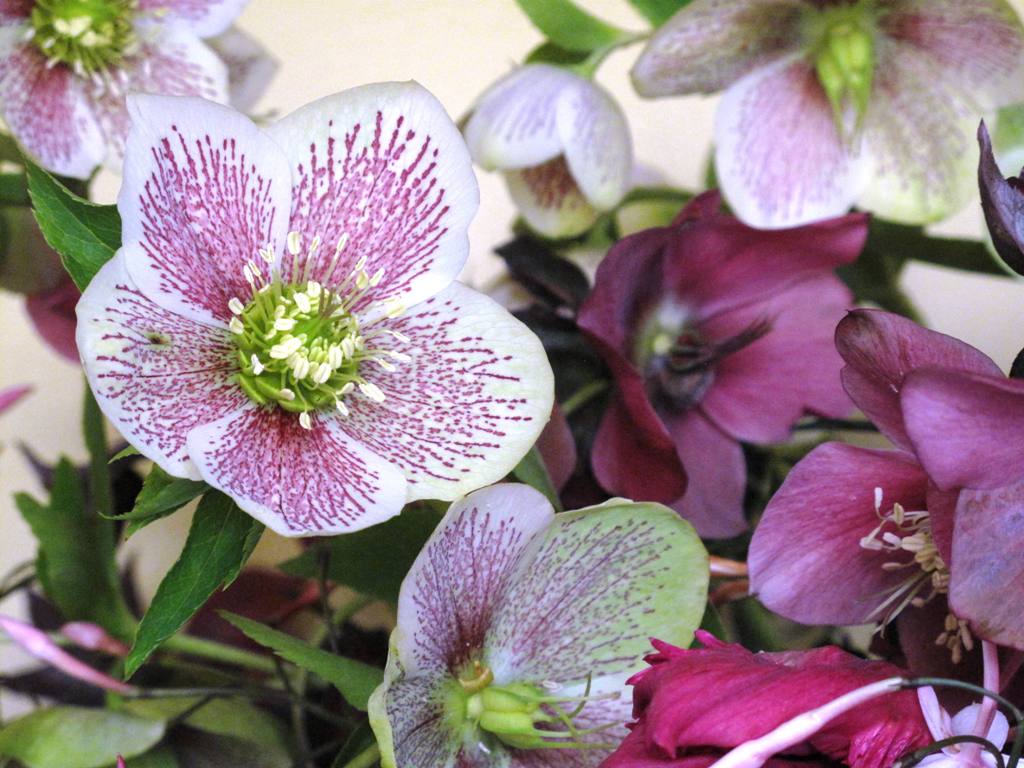
Week10Oh joy! The hellebores are blooming quite early this year.

Up close, the detail is so lovely and intricate

Up close, the detail is so lovely and intricate

For better or worse, Seattle’s uber-mild winter means that many of our early flowers are emerging weeks ahead of schedule.

I’m worried that our gardens and fields will need a lot more water this summer, but we can only say that Mother Nature decided to give us warmer temperatures and extra sunshine this year – more than previous winters in recent memory.

Diane Szukovathy and Dennis Westphall of Jello Mold Farm grew the hellebores you see here – and let me tell you, their luscious blooms were flying out of the Seattle Wholesale Growers Market when they arrived.

I snagged the *last* bunch of the plum hellebores and grabbed only 4 stems of the beautiful pale speckled ones.

Gorgeous specialty tulips also caught my eye – so much more substantial and visually arresting than the hothouse ones coming out of Canada. These were lovingly grown by Gonzalo Ojeda of Ojeda Farms, a member of the SWGMC who farms in Ethel, Washington. One bunch of 10 stems, while short, provided plenty of tulips to add dazzle to two vases.

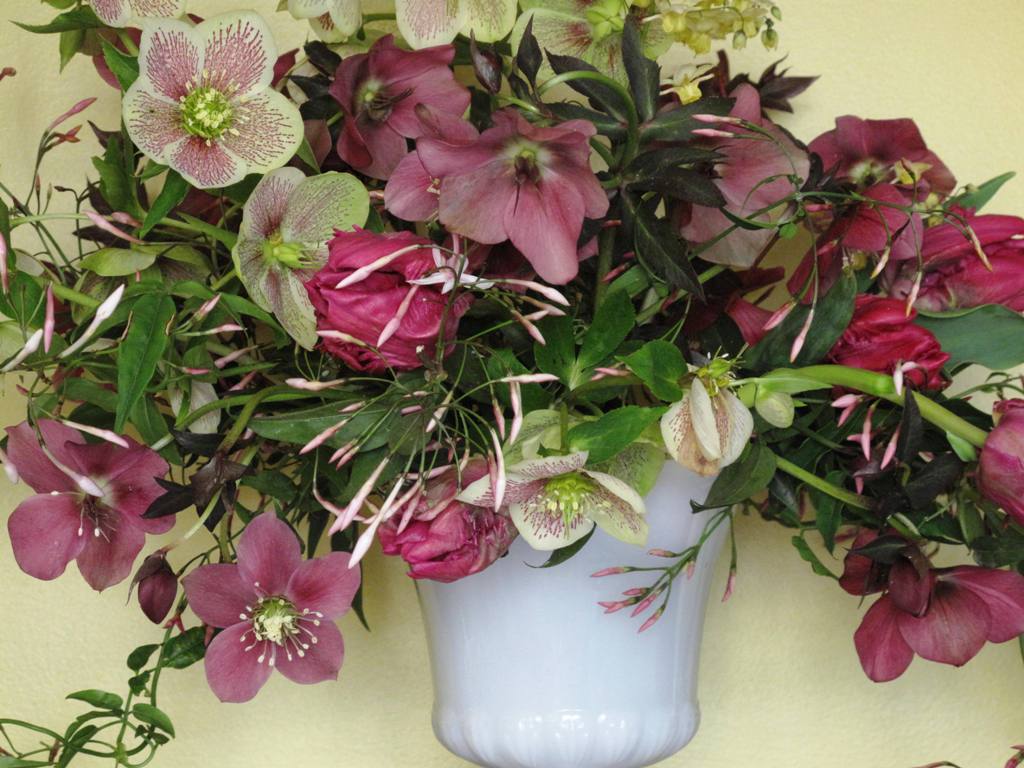
Plum and berry hues with pale green & butter yellow in a vintage white vase.

Plum and berry hues with pale green & butter yellow in a vintage white vase.

Jasmine isn’t winter-hardy here in Seattle, but boy do I remember it clambering over the stucco retaining wall in our former garden in California’s Ventura County. On the first Thanksgiving we lived there – after moving from Seattle in 2006 – my friend Nancy, visiting from Seattle, created our entire Thanksgiving tablescape from the bounty of our new backyard – including that lacy jasmine.

Molly Sadowsky, the SWGM’s manager and principal buyer, has a secret California source for evergreen Jasmine – and the designers here in Seattle absolutely love it! Me, too! I love that the jasmine foliage is also a gorgeous aspect of this arrangement, a bonus to the fragrant flowers and buds.

Oh, and there is one element from my Seattle garden: the delicate pale yellow flowers from Epimedium, a beautiful groundcover. I only had a few stems to add, but their petals echo the Hellebores’ centers, adding a delicate texture.

scroll

Hellebores for the People
Designed by Mick & Olivia Payment,
owners of 
Flowers for the People 

Hellebores with orchids, roses, pincushion protea, jasmine and more - designed by Olivia and Mick Payment

Hellebores with orchids, roses, pincushion protea, jasmine and more – designed by Olivia and Mick Payment

Earlier this week, the SWGM hosted its first Orchid Spectacular to showcase a wide array of Local and American-grown potted and cut orchids. The Market staff invited Mick and Olivia, a brother-and-sister design team, to demonstrate how they design with orchids in arrangements and interior planters.

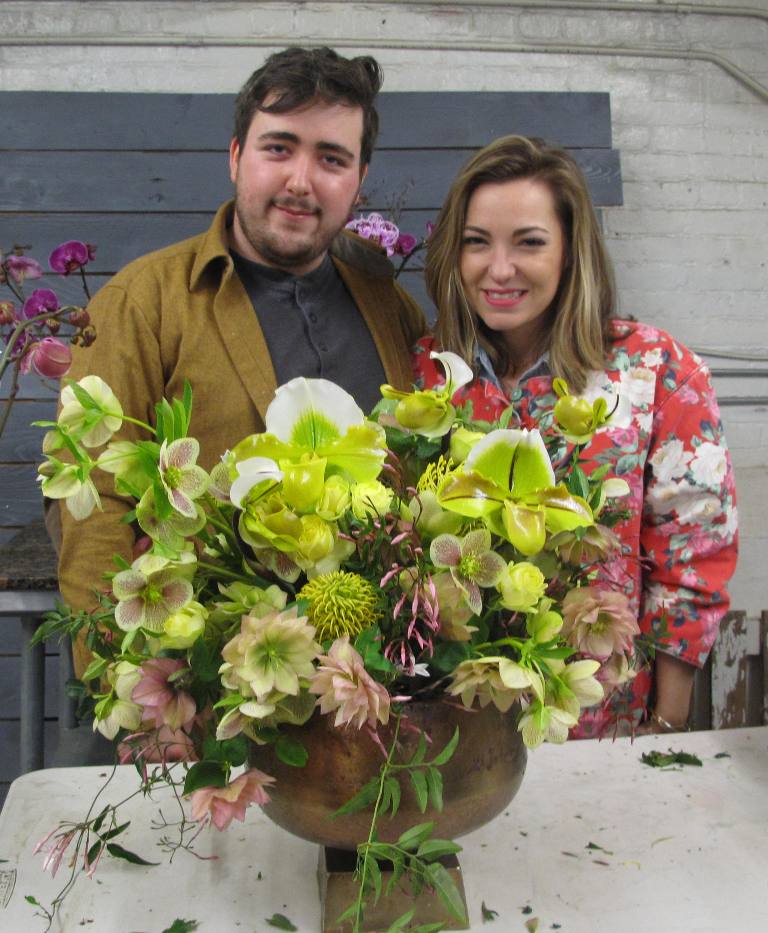
You’ll be wowed by one of their designs pictured here. I wanted to share it because of the diversity of flowers they incorporated, including Lady Slipper orchids from Orchidaceae  of Walla Walla, Washington, and hellebores from Jello Mold Farm (the “leftovers” ended up in my design above).
The yellow-green-pink palette is such a breath of fresh air! Mick and Olivia also used CA-grown roses and pincushion proteas to masterfully express their inspiration to use domestic flowers.
 scroll

Week 9 // Heady Hyacinth for the Slow Flowers Challenge

Sunday, March 8th, 2015
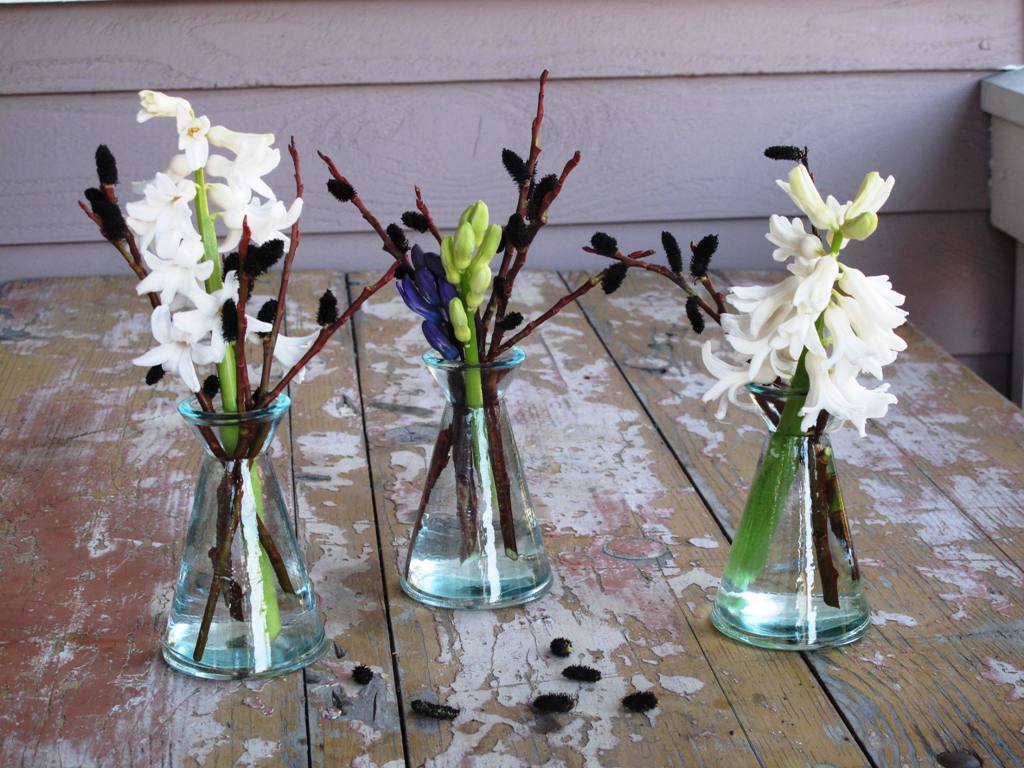
A trio of bud vases displays the season's first hyacinths from my garden, paired with striking black pussy willow twigs grown in Washington by Jello Mold Farm.

A trio of bud vases displays the season’s first hyacinths from my garden, paired with striking black pussy willow twigs grown in Washington by Jello Mold Farm.

It has been a busy few weeks so my floral design time has been limited. Sometimes we put too much pressure on ourselves to create an epic arrangement or centerpiece — and of course, we know that those expectations take the joy out of the total experience.

So this week’s little moment is a reminder that a few stems are often all we need to bring nature indoors and provide a glimpse of beauty when life is crazy!

These vases are widely featured in a charming book released last year by  Nancy Ross Hugo called Windowsill Art: Creating one-of-a-kind natural arrangements to celebrate the seasons (St. Lynn’s Press). Nancy describes this small vase as “the little black dress of windowsill arranging . . . the perfect foundation for whatever else you might add.”

After interviewing her for the Slow Flowers Podcast (click here to find the interview) and spending time reading this lovely book, I had to order my own set of these four bud vases. They are available fromThe Arranger’s Market, an online shop that specializes in hard-to-find, easy-to-use vases and other arranging equipment.

You can order a set of 4 “glass pyramid” bud vases for $24 plus shipping. I believe they are made from recycled glass bottles. Dimensions: Height = 4-1/4″; Width = 2.3/8″; Opening = 7/8″.

scroll


More from Slow Flowers
Seasonal choices

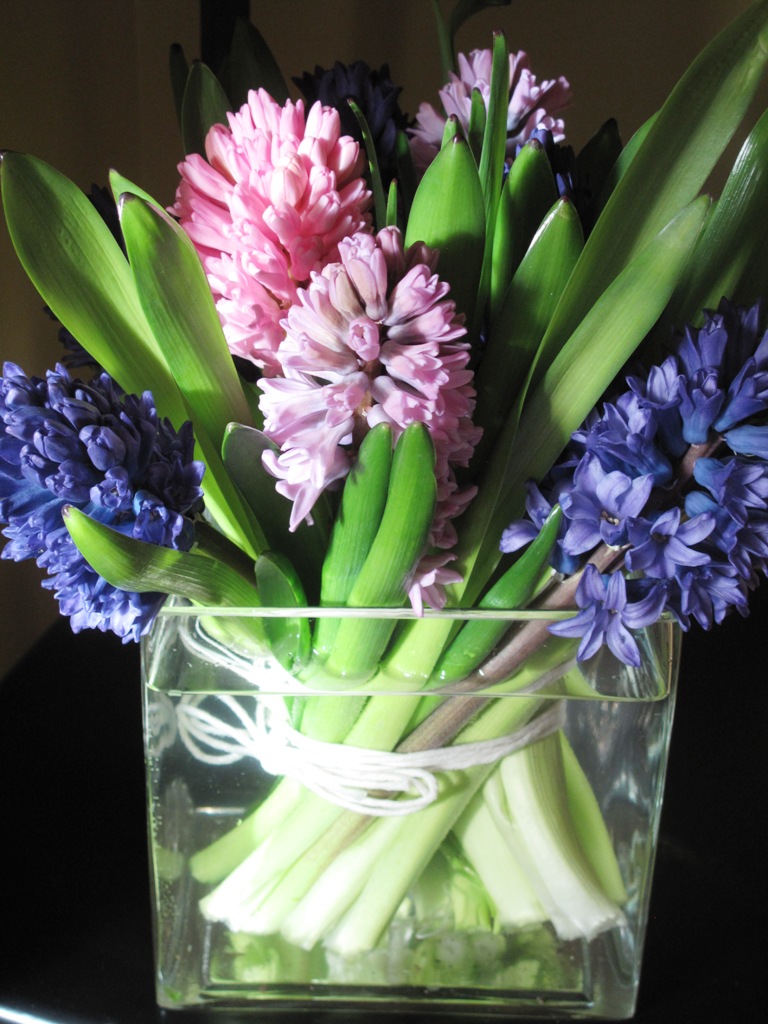
A sweet bunch of spring hyacinths, from Slow Flowers.

A sweet bunch of spring hyacinths, from Slow Flowers.

About the long stems you see here:  The typical garden hyacinth blooms on a relatively short stem – maybe 4-5 inches at the most. This limits the way hyacinths can be used in floral arrangements. According to flower farmer Gretchen Hoyt, of Alm Hill Gardens in Everson, Washington, the way to stretch those stems is to trick them into wanting more light.

“The longer you can deny them light, the more they stretch,” she explains. At the commercial flower farm, this process begins in dark coolers where bulbs are pre-chilled. When they are transferred to the greenhouse, the hyacinth crates are placed (in the shadows) beneath tables where tulips grow. If Gretchen wants to elongate those stems even further, “I’ll throw newspaper over them,” she says. Leaving bulbs on the stems is optional, but some designers do so to give the arrangement a rustic appearance.
To arrange these lovely, farm-fresh hyacinths, I opted for a simple European-style bouquet. I wrapped linen twine around the gathered stems and foliage, tied a bow, and placed the spiraled bunch in a glass vase. Seeing the twine through the glass adds a touch of whimsy to this effortless bouquet.

Flower Farming in the nation’s Capitol with Bob Wollam of Wollam Gardens (Episode 183)

Tuesday, March 3rd, 2015
16085799074_1b531a8830_k

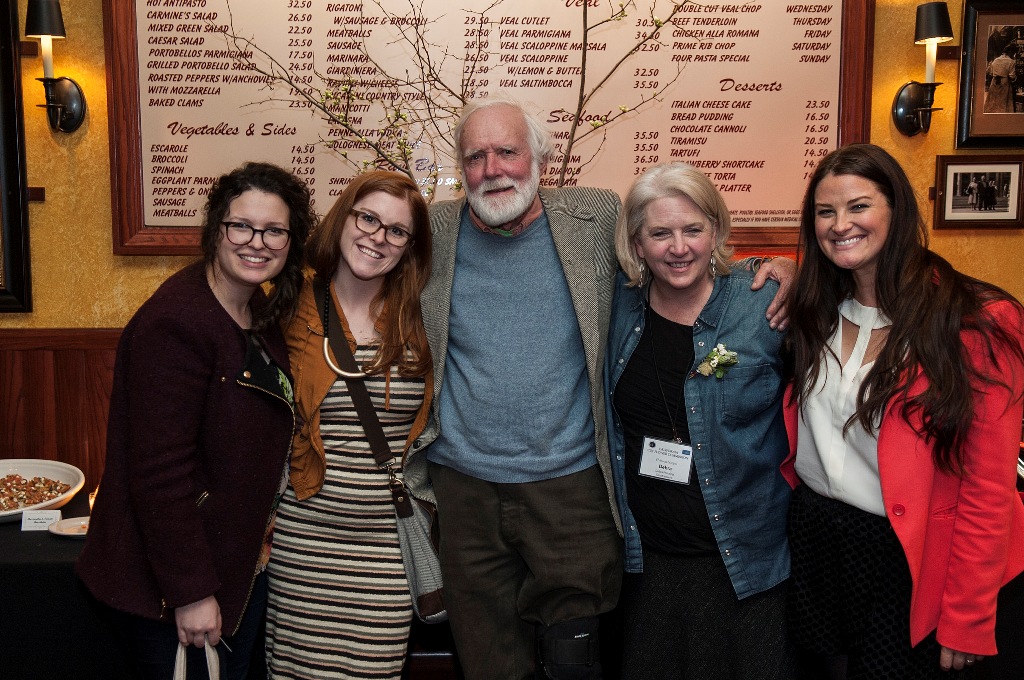
I’m so pleased that Slowflowers.com members Rachel Bridgwood and Lauren Anderson of Sweet Root Village (left) and flower farmer Bob Wollam of Wollam Gardens (center) joined Christina Stembel of Farmgirl Flowers (right) and me at a D.C. reception celebrating American Grown Flowers. (CCFC photograph, used with permission)
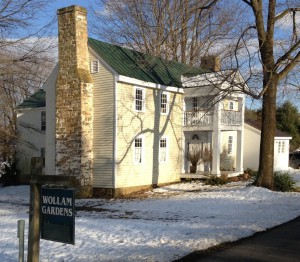
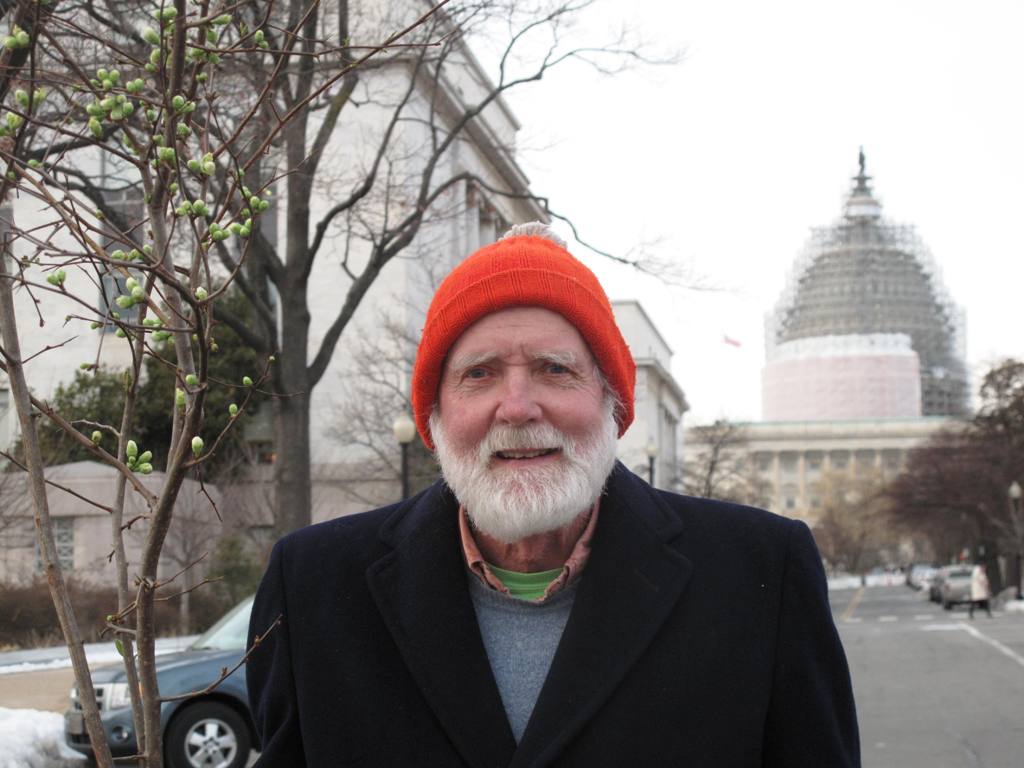
Today's guest is Bob Wollam of Wollam Gardens, which serves  florists, grocery stores, farmers markets and brides around the nation's capitol.

Today’s guest is Bob Wollam of Wollam Gardens, which serves florists, grocery stores, farmers markets and brides around the nation’s capitol.

I returned to Washington, D.C., this past week to join a delegation of flower farmers who invested their own resources of time and money to travel to our nation’s capital to meet with members of Congress and talk about the issues facing our industry.

First of all, I congratulate the folks who do this – they are the ones putting their money where their mouths are to elevate the awareness of policymakers who are in a position to make decisions that affect America’s flower farmers. I was honored to share this experience with them for the second year in a row. And for those of you who question why this is an important step to take, we have a lot of wins to point to.

For all of us, having the bipartisan Congressional Cut Flower Caucus, formed in 2014 and co-chaired four members of Congress who have flower farms in their districts – Lois Capps and Duncan Hunter from California, Jaime Herrera Beutler from Washington State and Chellie Pingree from Maine – means that there is now a tangible body of policymakers that you can ask your own elected officials to join. If you are interested in reaching out to your member of Congress, please contact me offline – and I will help you make that introduction. What is this Caucus doing? For one thing, we have them to thank for keeping the dialogue about seeing local and domestic flowers used for White House functions.

In 2015, the Congressional Cut Flower Caucus has been asked to join the Congressional Wine Caucus – one of the most popular of caucuses (right?) – to host an event where local wine and local flowers will be highlighted. I’ll keep you posted on that event because your participation will be needed to showcase your own region’s cut flowers.
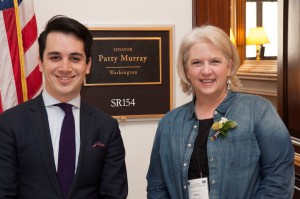
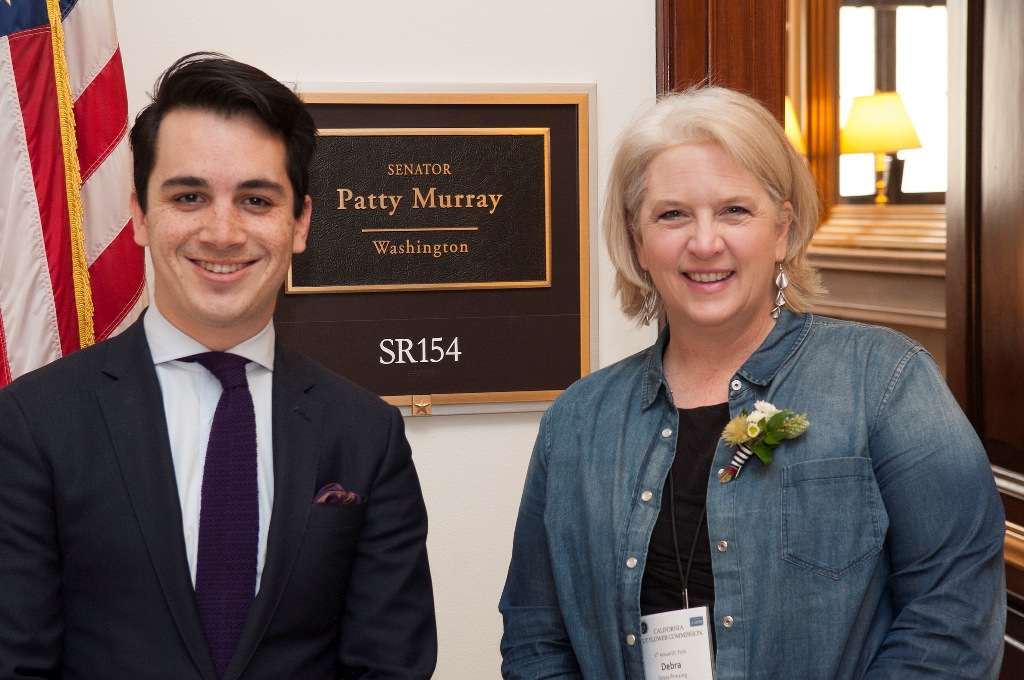
Kevin Stockert (left), a legislative aide for U.S. Senator Patty Murray (Washington), has invested time and interest in listening to and visiting flower farmers in her state.

Kevin Stockert (left), a legislative aide for U.S. Senator Patty Murray (Washington), has invested time and interest in listening to and visiting flower farmers in our state.

Another important reason for these DC visits are the relationships that emerge. When you meet your elected officials, you never know what it will lead to.

For two years in a row, I’ve been privileged to meet with the agriculture policy staff of Senator Patty Murray.

Last year, after my fellow Seattle Wholesale Growers Market board members, flower farmers Diane Szukovathy and Vivian Larsen, and I made those connections, two of the Senator’s staffers took the time to visit our market, meet farmers and enjoy our local flowers. These folks want to know what their constituents are doing in areas such as sustainable agriculture, job creation, economic development and more. We’ve received offers of support for future projects, such as USDA Specialty Crop Block Grant funding we may seek, and I know I can speak for Diane and Vivian that we truly feel there is someone in our nation’s capital who will return a phone call or email and listen to a concern. That is priceless!
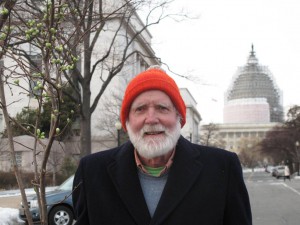
Bob Wollam brought his Virginia quince branches to Washington, D.C. -- they added a lot of local beauty to the conversation at an evening reception!

Bob Wollam brought his Virginia quince branches to Washington, D.C. — they added a lot of local beauty to the conversation at an evening reception!

While I was in DC, I couldn’t miss an opportunity to visit a local flower farm and interview a flower farmer, right? So please enjoy today’s conversation with Bob Wollam of Wollam Gardens, based in Jeffersonton, Virginia.

Bob joined the flower farmer Delegation to meet with his own Virginia congressman, as well as participate in meetings with other offices.

The amazing thing is that the staffers of members of Congress from many states live and work in our nation’s capitol, where Bob sells Virginia-grown flowers at the DuPont Circle Farmers’ Market (where he was a founding member).

So the dots were connected between LOCAL and AMERICAN GROWN – and why they are both so integral in saving our domestic cut flower industry. We suspect that these young legislative assistants will now come find Bob, seeking out the flowers he grows on land less than a 75-mile radius from DC. Like the other flower farmers in our group this past week, Bob is the face of the farmer; the face behind the poppies, ranunculus, anemones, tulips, sweet peas, peonies, hydrangeas, viburnum, dahlias and more. Here’s some more background on our guest today:
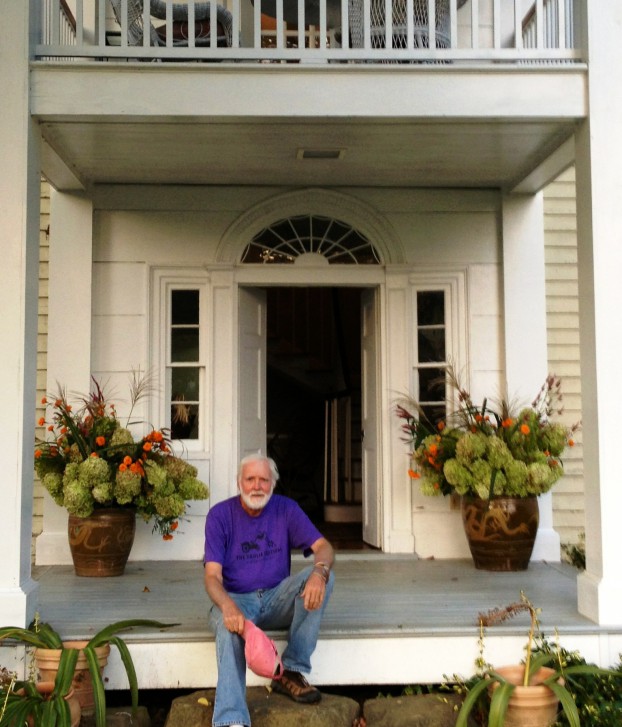
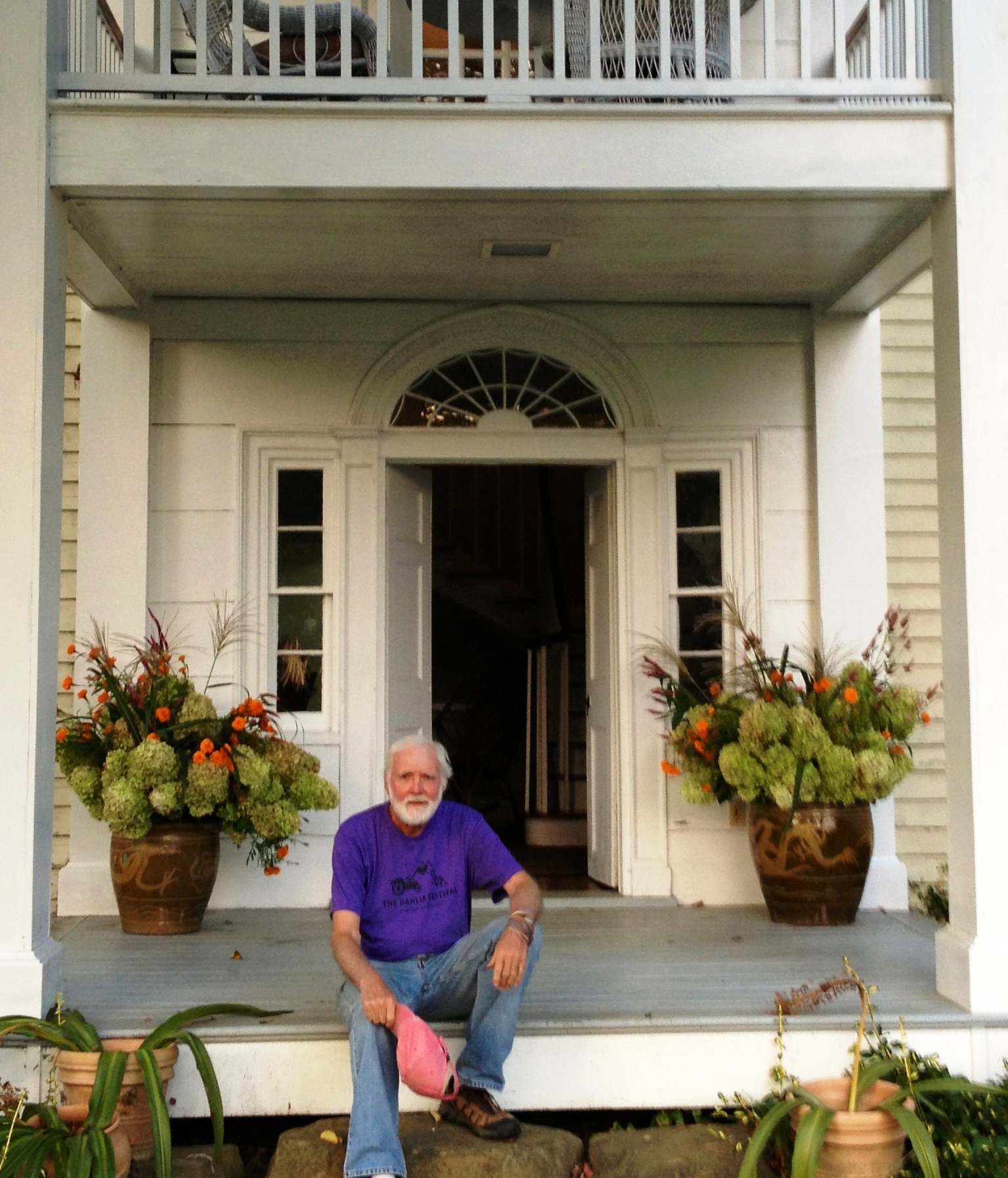
Bob Wollam, seated on the front porch of the historic farmhouse in Jeffersonton, Virginia where Wollam Gardens is based.
Bob Wollam, seated on the front porch of the historic farmhouse in Jeffersonton, Virginia where Wollam Gardens is based.

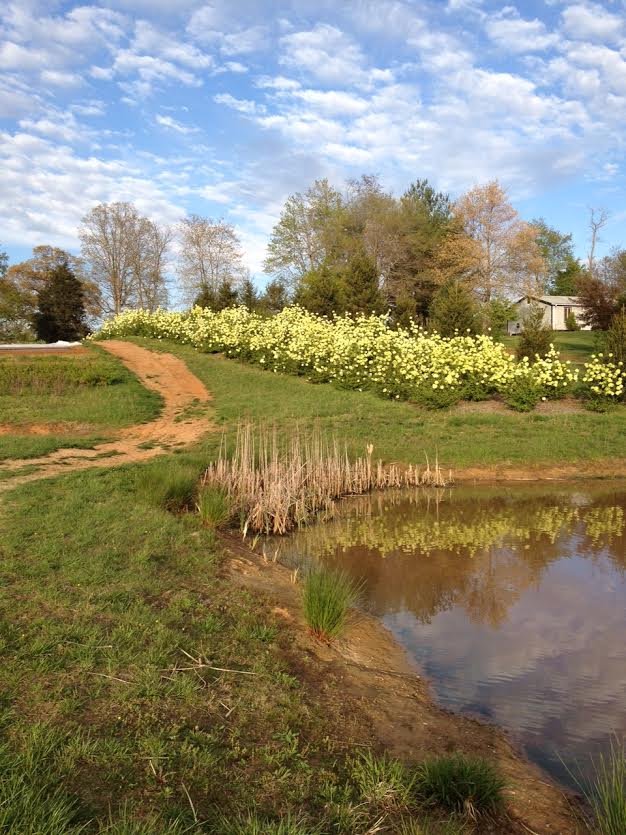
The beautiful green viburnum that bloom gloriously in April at Wollam Gardens.

The beautiful green viburnum that bloom gloriously in April at Wollam Gardens.

Bob Wollam has now been a flower farmer for 21 years. While he will be quick to tell you he had an exciting life before 50, he’ll be even quicker to tell you his addiction to beautiful cut flowers has been nothing but thrilling — and he intends to continue the addiction well into his nineties.

In 1987, Bob Wollam moved to Washington, D.C. This was his first step of an old dream of being a flower grower.  Two years later, he asked a realtor in Warrenton to show him land in Virginia.  He said he wanted at least 10 acres and an old house.   He purchased his historic Farm House with a pre-Revolutionary history and of course 11 acres of farmland in the hamlet of Jeffersonton.

For three years, Bob grew perennials which he sold at the Alexandria, (Virginia) Farmer’s market.  After seeing a small “cut your own” garden during a trip to Central NY, he shifted his energy into cut flowers. Bob began selling to florists in Washington DC and adding more farmers’ markets near, or in, the city. He initiated an internship program in 1994 and has hosted adventurers and flower lovers from around the world.  Many of those are still active in cut flowers, some on their own farm.
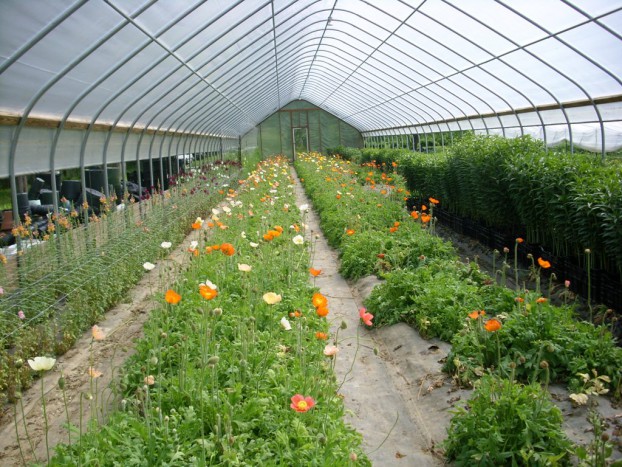
A hoophouse filled with Icelandic poppies at Wollam Gardens.

A hoophouse filled with Icelandic poppies at Wollam Gardens.

In the winter of 2006-2007 he developed a 25 year plan for his flower farm and is well on the way to implementing that plan. Bob is driven to grow unique, difficult to grow and difficult to ship cut flowers for specialized florists, designers and farmer’s market customers.
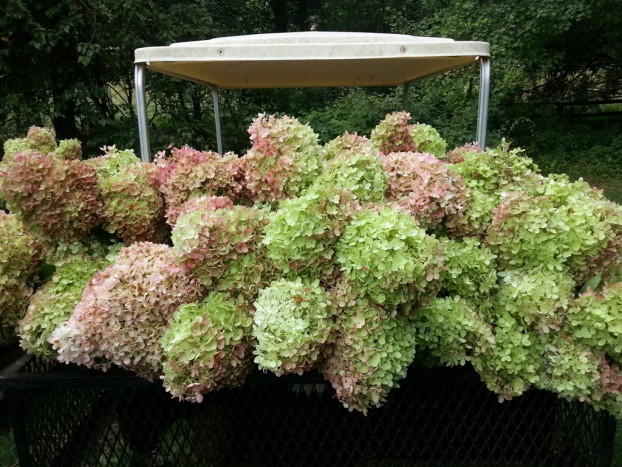
Oh, those hydrangeas!!!
Oh, those hydrangeas!!!

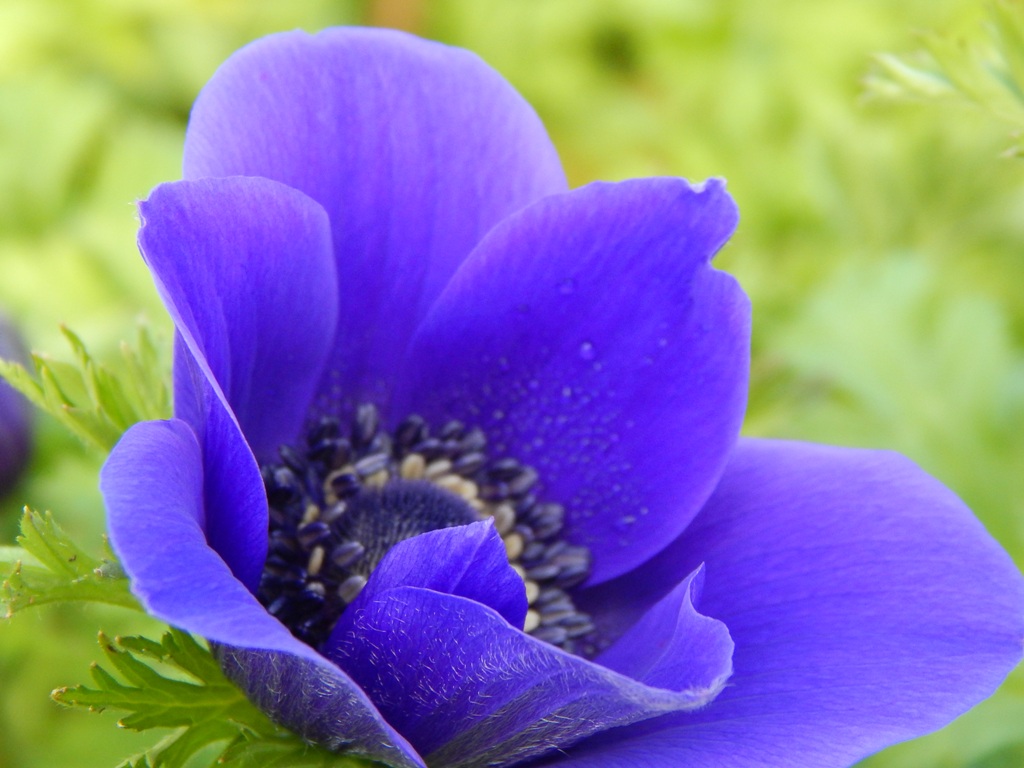
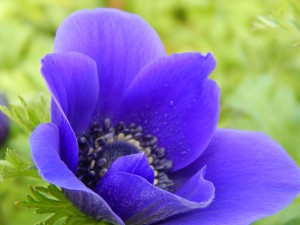
One of Bob's first spring crops is the fanciful and alluring anemone.

One of Bob’s first spring crops is the fanciful and alluring anemone.

With no background in agriculture except a gene handed down from both grandparents, Bob has turned Wollam Gardens into an exceptional destination for flower lovers. He learned quickly by reading everything he could find and with the guidance of other cut flower farmers who  are part of the ASCFG (the Association of Specialty Cut Flower Growers), an association for which Bob served as a 2-term President.

Wollam Gardens now grows over 80 varieties of cut flowers on 11 acres, plus a few acres on his neighbor’s land. In addition 4 cold frames for growing cool season plants like stock, campanula, delphinium, ranunculus, and the well-known Temptress poppies, Bob has a continuing interest in flowering shrubs as cuts (quince, hydrangea, physocarpus, and viburnum), as well as fragrant bulbs (Oriental lily, Mexican tuberose), and, of course, close to 9000 dahlias.
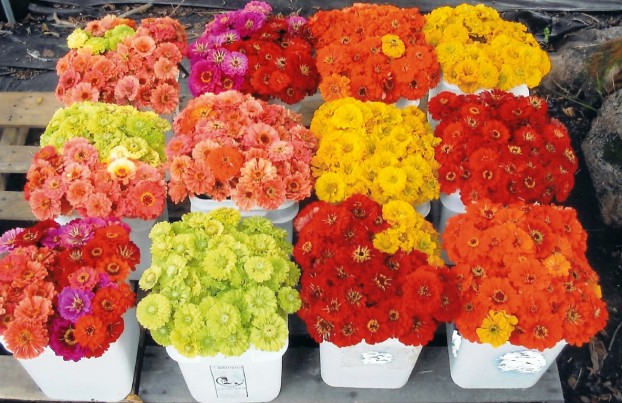
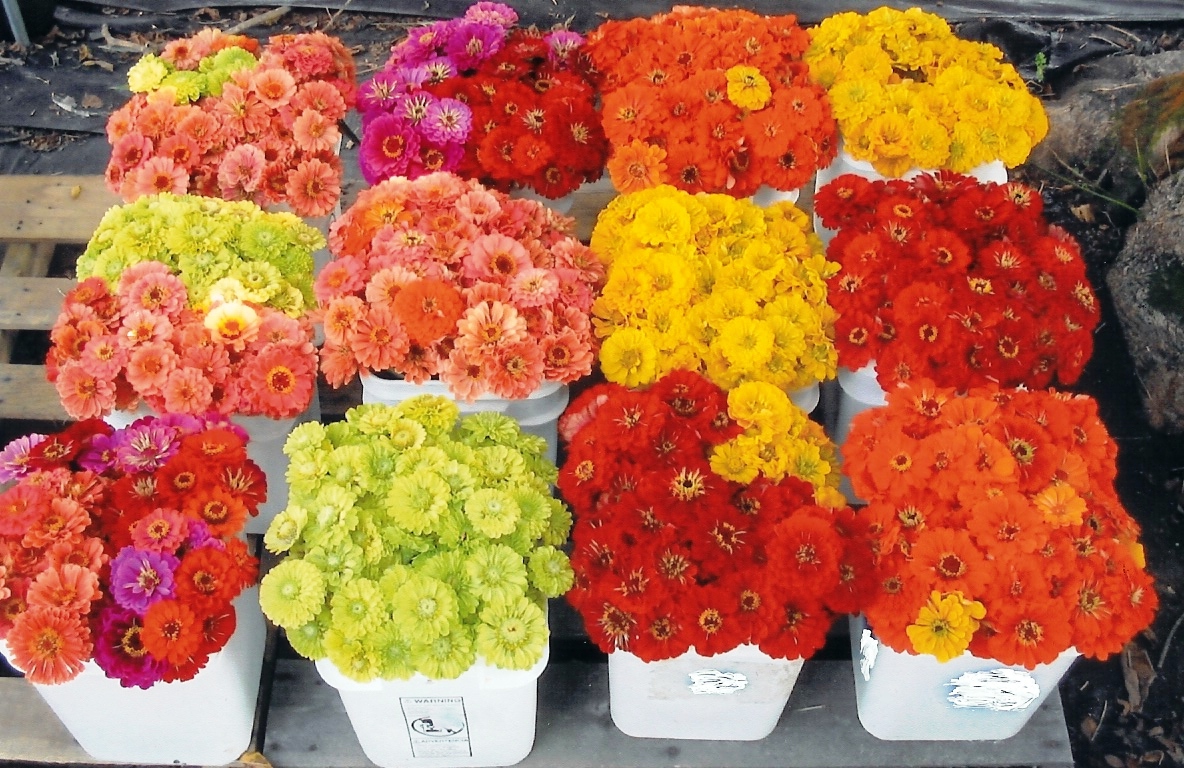
Ready for market: Zinnias galore.
Ready for market: Zinnias galore.

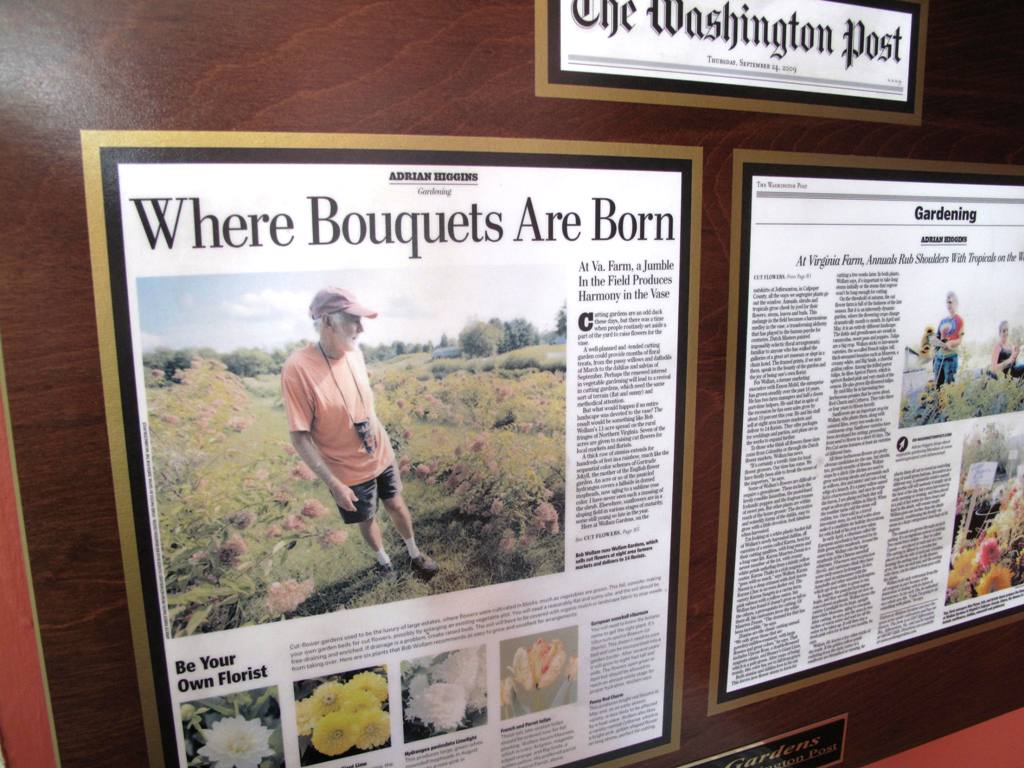
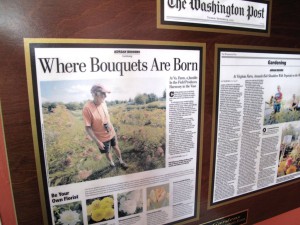
In 2009, the Washington Post featured Wollam Gardens in a big story.

In 2009, the Washington Post featured Wollam Gardens in a big story.

During the season, Wollam Gardens is open to the public for customers who wish to purchase flowers and plants, Monday through Saturday 9-5, and for wedding and event consultations. People are welcome to stroll the property and look for one of the crew or interns to help with their flower needs!

Eventually Bob hopes all sales will be from the farm. Today, he also markets flowers to 15 florists in the DC metro area as well as at 5 area farmer’s markets.

Wollam Gardens’ flowers can be found at select Whole Foods stores in Virginia, Maryland and DC during the most abundant growing months of the season.

New this season, Bob is in the process of restoring a beautiful pavilion using cedar logs harvested directly from our property! It will be an artistic, rustic, and charming venue that will add even more character to this green space.
scroll

Thanks for joining me this week and please return again, as I continue to share insightful and educational episodes recorded exclusively for the Slow Flowers Podcast.

I’ve been on the lookout for good news, wishing to focus on the positive connections in my life rather than those that are less-than-positive. One of those pieces of good news fell into my in-box a few days ago and I just have to share it with you. I hope it makes you smile as much as it did me!

Here’s what my friend wrote: “Funny coincidence. Our mutual friend (let’s call her Susan) has been doing a little online dating. Yesterday for their first meeting, she had lunch with a retired lawyer who . . . is getting into gardening as a second career.  He is taking a propagation course at a Horticultural College in preparation for creating a slow flower and herb farm.  He began by telling Susan how inspired he has been by Debra Prinzing, the Godmother of the “Slow Flower” movement.  He had even brought along a printout of one of your recent online interviews. Susan really surprised him when she told him that she was friend and that you had visited our town and its gardens several times!  Boy, that really boosted his estimation of Susan.  He wants another date, this time to a public garden or arboretum.  So your work is paying off not only in better flowers, but also in better romance!

That was the best news I heard all week and I thank my dear friend who sent me that note!

Thanks to listeners, this podcast has been downloaded more than 36,000 times. Last week’s downloads were more than 1,100, our highest ever since this podcast started in July of 2013.

If you like what you hear, please consider logging onto Itunes and posting a listener review.

Until next week please join me in putting more American grown flowers on the table, one vase at a time.

This podcast is brought to you by Slowflowers.com, the free, nationwide online directory to florists, shops, and studios who design with American-grown flowers and to the farms that grow those blooms.  It’s the conscious choice for buying and sending flowers.

And a special thanks to our lead sponsor for 2015, the California Cut Flower Commission, committed to making a difference as an advocate for American Grown Flowers. Learn more at ccfc.org and American Grown Flowers.

The slow flowers podcast is engineered and edited by Andrew Wheatley and Hannah Holtgeerts. Learn more about their work at shellandtree.com

Get ready for Women’s Day on March 8th with Lane DeVries (Episode 182)

Tuesday, February 24th, 2015

celebrateWomansDay-1024x569There’s a new holiday on the horizon and you may not have heard about it.

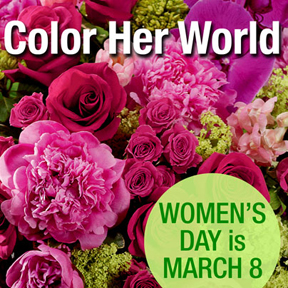
It’s called Women’s Day and it takes place every year on March 8th.

650Wday1As it turns out, this holiday has been observed since in the early 1900’s where it started in New York City.

Over the years, according to today’s guest, while the popularity of Women’s Day waned in the U.S., it flourished in Europe, especially in Eastern European nations. The traditional practice of giving flowers to celebrate all the women in one’s life has been widely adopted – yet not here in the U.S.

Now that’s changing. Lane DeVries of The Sun Valley Group, a cut flower farm based in Arcata, California, learned about Women’s Day from one of his staff members several years ago. He began researching it and discovered the U.S. roots of the holiday, as well as the universal appeal of flower-giving as a way to recognize, honor and show affection for mothers, sisters, daughters, friends and neighbors — any woman in our lives who we want to celebrate.

SV_WDbucket11x7

Why March 8th? That’s not certain, but perhaps it’s no coincidence that March is Women’s History Month. How fitting.

And as Lane tells us, March 8th is a perfect date to promote American grown flowers – because there is an abundant supply of them. Falling several weeks after Valentine’s Day and two months before Mother’s Day, in many parts of the country, there are flowers to harvest and deliver. I know here in Seattle, we are swimming in gorgeous spring bulb flowers.

So consider Women’s Day a bonus holiday that you might want to participate in – and scroll down to find links to resources that you can use to make the most of Women’s Day, in large and small ways.

Let me tell you a little more about Lane’s genius move to bring Women’s Day back into our floral consciousness:

floral-management-cover-223x300A past chairman of the California Cut Flower Commission (CCFC), Lane and others in the U.S. floral industry began in 2010 to promote flower-giving and raise awareness around Women’s Day.

By 2014, the Society of American Florists honored Sun Valley with the “Floral Management Marketer of the Year” for its efforts to raise awareness and industry involvement in Women’s Day. The award has inspired the entire U.S. floral industry to support the holiday.

I always learn volumes when I have a chance to talk with Lane. He is an optimistic guy, not one to whine about the competition that America’s flower farms face. Rather, Lane looks for possibilities. And he LOVES growing flowers.

Check out Lane’s acceptance of the SAF Floral Management Marketer of the Year Award:

I love this point, which Lane points out in his acceptance speech: Half of the population is eligible to receive flowers on Women’s Day. The floral giving potential is far greater than Mother’s Day.

WomensDay_3.inddSAF has prepared a wide array of promotional material for its members’ use this Women’s Day.

It also will boost social media effort to reach new consumers, an effort supported by funds contributed to the SAF Fund for Nationwide Public Relations by Sun Valley Floral Group.

Upon winning Floral Management’s 2014 Marketer of the Year award for the company’s efforts to promote Women’s Day, DeVries returned the $5,000 cash prize back to SAF to use in its efforts to promote the holiday.

To help members drive sales for Women’s Day locally, SAF offers resources and advice, including ideas for sharing on Facebook, web sites, print ads, posts, tweets, fliers, press releases, radio scripts and more inspiration.

If you’re not sure where to start on promotional efforts, just follow SAF’s lead by sharing Women’s Day posts on its Facebook and Twitter sites.

Look for more Women’s Day Posts you can share at California Grown Flowers and American Grown Flowers Facebook sites. And the CAFlowers and AmericasFlowers Twitter sites.

And here’s a link to the Women’s Day promotional resources available from Sun Valley.

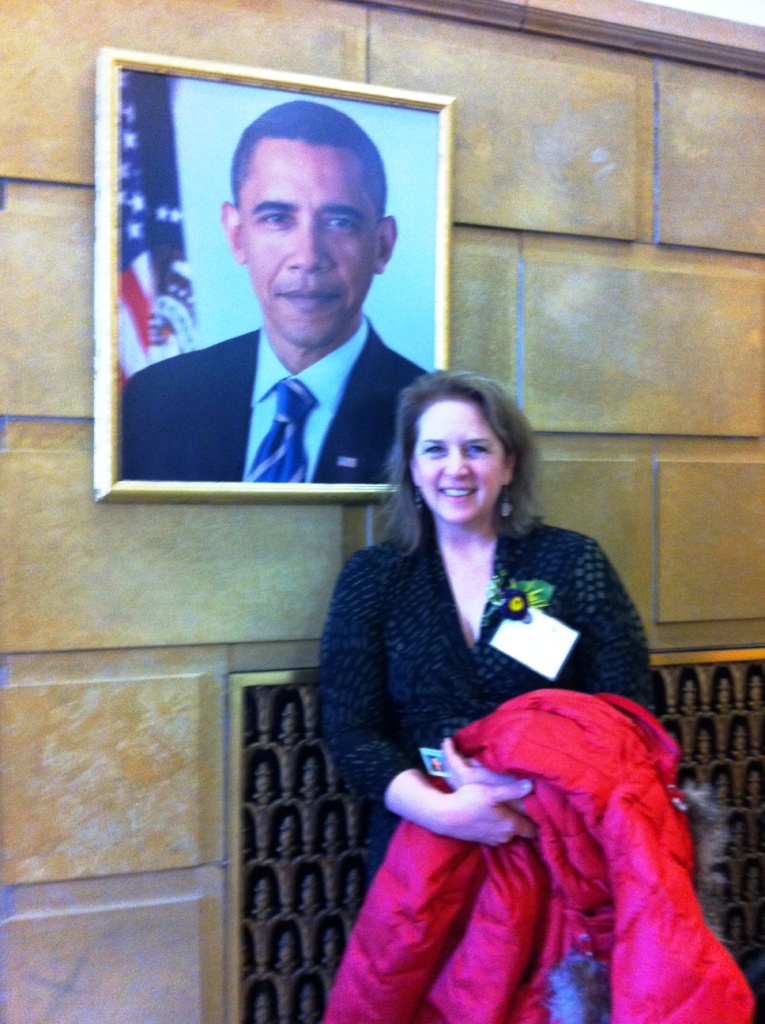
Debra goes to Washington to promote American Grown Flowers!

Debra goes to Washington to promote American Grown Flowers!

While you’ve been listening to today’s podcast, released on February 25th, I’ve been spending time in Washington, D.C., participating in the annual flower farmer “fly-in” to meet and share the American-Grown story with members of Congress and their staffs.

You may recall that I participated in this event one year ago and was invited to speak about Slow Flowers at the press conference announcing the Congressional Cut Flower Caucus. The exciting news is the caucus, under the leadership of Representatives Lois Capps and Duncan Hunter, has attracted new members from additional states where flowers are grown — and I’ll be sure to share an update with you next week.

Thank you for downloading and listening to the Slow Flowers Podcast! I’m encouraged to know more people are learning about the farmers and florists who keeping American-grown flowers flourishing. Listeners like you have downloaded this podcast more than 35,000 times. If you like what you hear, please consider logging onto Itunes and posting a listener review.

The Slow Flowers Podcast is engineered and edited by Andrew Wheatley and Hannah Holtgeerts. Learn more about their work at shellandtree.com.

The Flowering of Detroit, with Lisa Waud of Pot & Box (Episode 181)

Wednesday, February 18th, 2015

After the crazy week of Valentine’s Day, I’m shifting my thoughts to springtime, aren’t you? That’s a little easier for me to say here in Seattle, where the thermometers climbed above 60 degrees last week and flowers are popping up everywhere. But someone reminded me today that spring is only 30 days away. Hold on, everyone!

3babc748-d1e7-406b-a891-00ab62a436c11b43d032-4611-42bd-b9e9-a10ae276a89b


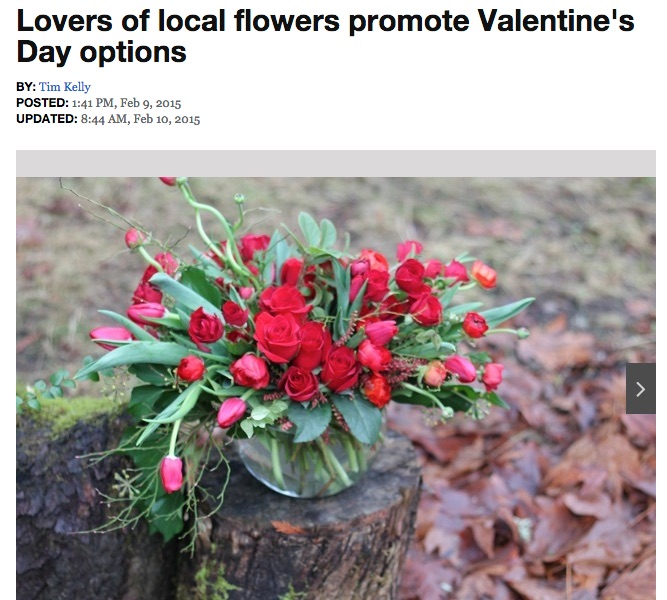
The Slow Flowers Movement and Slowflowers.com attracted major media attention last week – on wire services, television, radio, print and blogs. I am so grateful for the attention that is turning to American flowers, the passionate farmers who grow our favorite varieties and the talented designers who create magic with each local and seasonal stem they choose. Here is a sampling of some of the headlines we saw last week:

75f22c5e-82af-42fb-a9ac-caaa5955e9400a648ac7-07d4-48c0-83a5-1e59c3a6e972


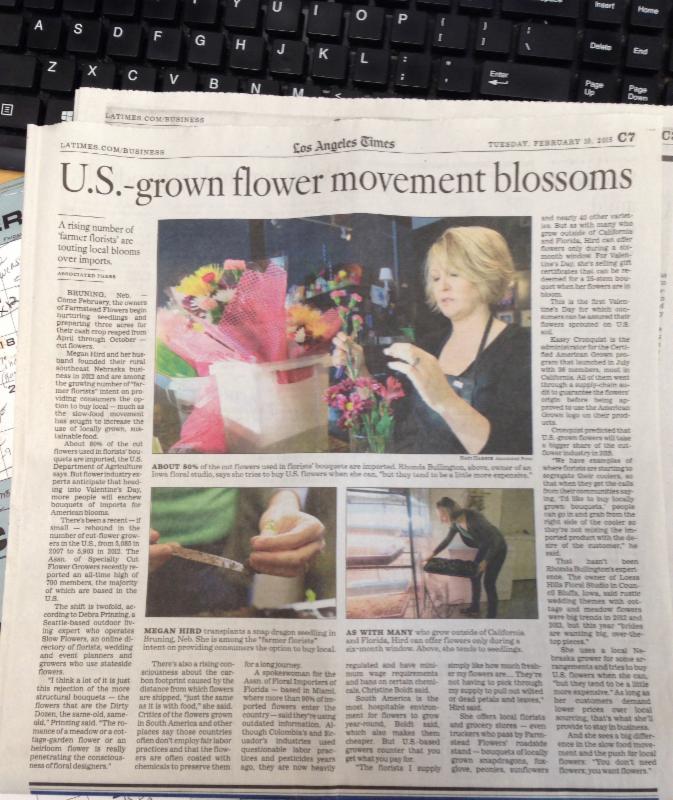
“Slow Flowers Movement Pushes Local, U.S.-Grown Cut Flowers” (that story was written by Associated Press agriculture reporter Margery Beck and it literally went viral — appearing in media outlets large and small – from the Los Angeles Times and Chicago Tribune to ABCNews.com). Slowflowers.com member Megan Hird of Farmstead Flowers in Bruning, Nebraska was also featured in this piece.

7558fd31-720b-47bf-a676-95b386e6c44ab5d671d9-fe9d-4ea7-bdcc-d49fa03a3b25


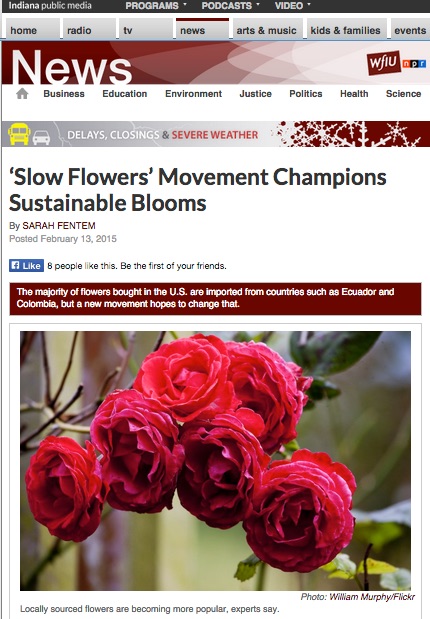
“Slow Flowers’ Movement Champions Sustainable Blooms,” by Indiana Public Radio’s Sarah Fentem. Slowflowers.com member Harvest Moon Flower Farm of Spencer, Indiana was also featured in this piece.

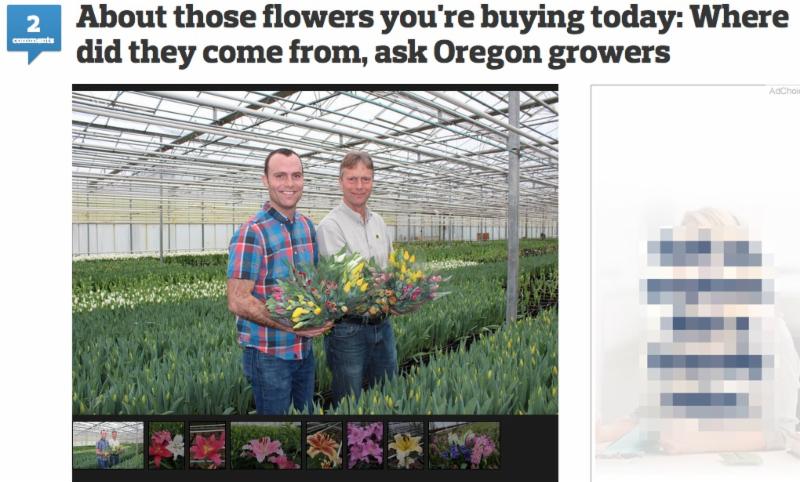
“About those flowers you’re buying today; Where did they come from? ask Oregon Growers” from Janet Eastman of The Oregonian. Slowflowers.com member Oregon Flowers was also featured in this story.

“Just in Time for Valentine’s Day: Introducing Farm-to-Table’s Pretty, Flowery Cousin,” by Sarah McColl on the sustainability blog TakePark.com which also featured Molly Culver of Molly Oliver Flowers in Brooklyn, a Slowflowers.com member.

Denver Post reporter Elizabeth Hernandez wrote: “Colorado farmers, florists seek renaissance for local flower scene,” featuring Slowflowers.com member Chet Anderson of The Fresh Herb Co.

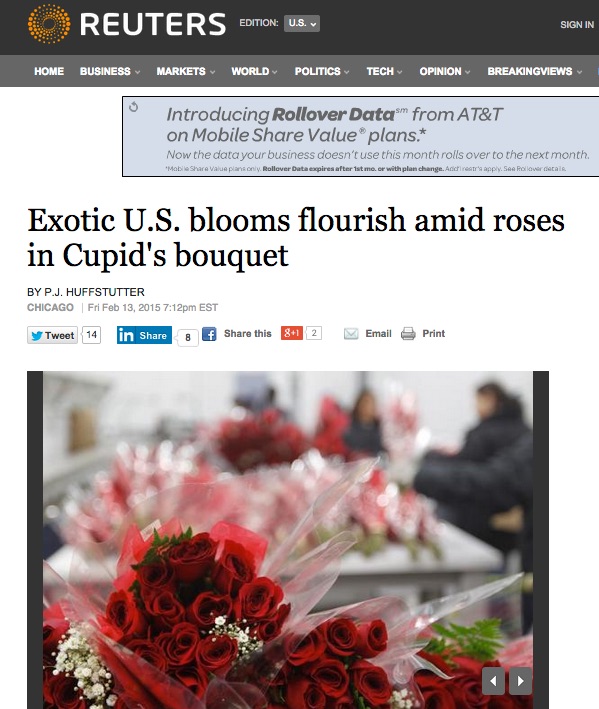
And Reuters writer P.J. Huffstutter’s piece “Exotic US Blooms Flourish amid roses in Cupid’s bouquet,” featuring the “slow flower” movement, as well as the CCFC and ASCFG.

We can’t even tally the tens of thousands of impressions that came from this great media coverage – but suffice it to say that, according to Kasey Cronquist, CEO/Ambassador of the CCFC, “In my tenure at the Commission, I can confidently say that this past week of media attention and interest was greater than all of the my other years of doing interviews and monitoring Valentine’s Day coverage.”

He went on to say: “I can also quickly point to the three things that made the difference this year.

  • Debra Prinzing’s SlowFlowers.com
  • Launch of Certified American Grown
  • Increasing Awareness of Caring Consumers, Designers and Buyers”
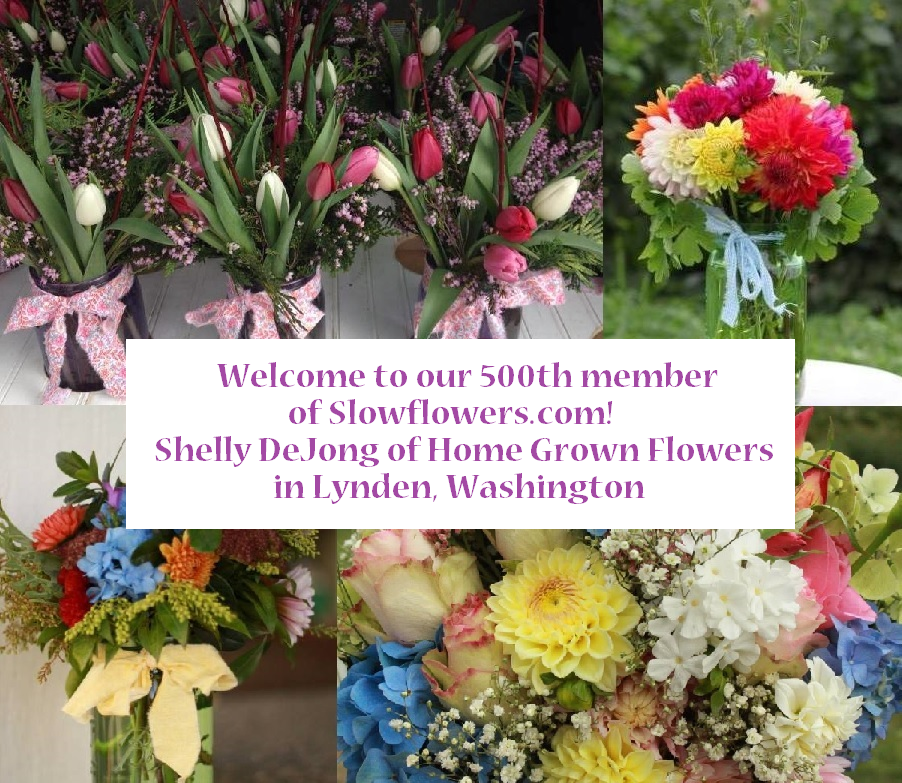
Slowflowers.com is growing with our 500th member!

Slowflowers.com is growing with our 500th member!

On top of all of that excitement, I want to celebrate a major milestone! This week marks the addition of the 500th member to the Slowflowers.com web site. Please welcome Shelly DeJong of Home Grown Flowers in Lynden, Washington. Shelly’s tagline is “Flowers as fresh and local as possible,” and she specializes in ball-jar bouquets delivered to customers in her community, throughout the year and for special occasions. Welcome to Slowflowers.com, Shelly!

We can already feel that 2015 might be THE year when the story of American grown flowers hits an important inflection point. As we witness a critical shift in consumer mindset at the cash register, I believe we’ll also see a change — in a good way — in the behavior of wholesalers and retailers who make those important flower sourcing decisions.

00401_AY_AGF_F2V_Pstr&PC_v3-page-002

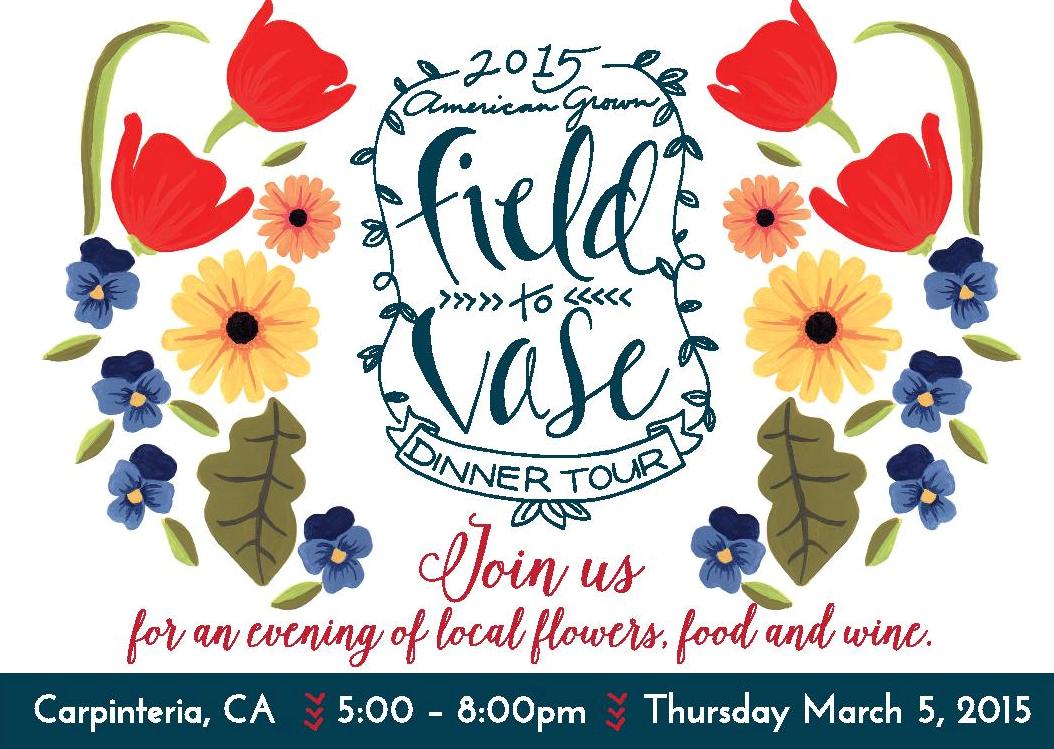
One of the things I’m most excited about this year is a series of flower farm dinners that celebrate American grown flowers, as well as the farms and florists who bring them to life. To hear more about this cool project, called the Field to Vase Dinner Tour, I’ve asked special events manager Kathleen Williford to share details.

As I mentioned, you are invited to take part as a guest at one or more of the flower farm venues. The promo code for a $25 discount is DREAM, so be sure to use it when you order your seat at the flower-laden table.

theflowerhouse_graphic

The Flower House logo, designed by Lily Stotz

Speaking of being flower-laden, our featured guest today has flowers on her brain in a big way. I am so pleased to introduce you to Lisa Waud of Pot and Box, a flower shop and floral and event studio with two Michigan locations – in Detroit and Ann Arbor. Lisa is a member of Slowflowers.com, but I think we originally met when Jill Rizzo of SF’s Studio Choo suggested to Lisa to reach out and tell me about her ambitious project called The Flower House.

Here’s the scoop:

Beginning over the first weekend of MAY, Lisa will host a preview event for an innovative art installation in Detroit.

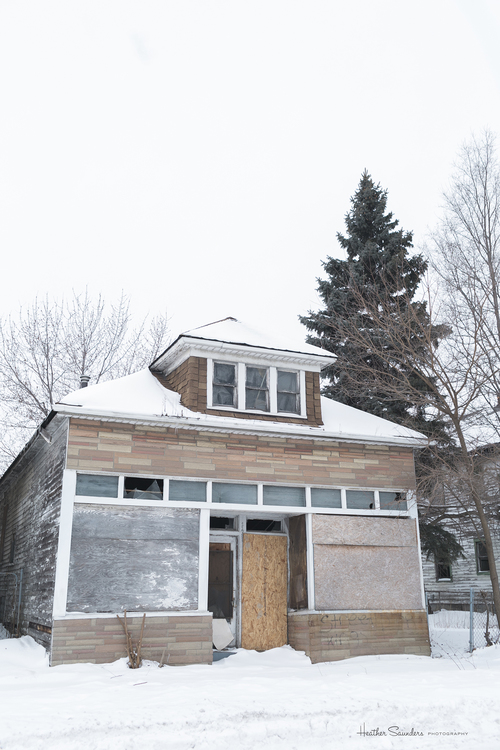
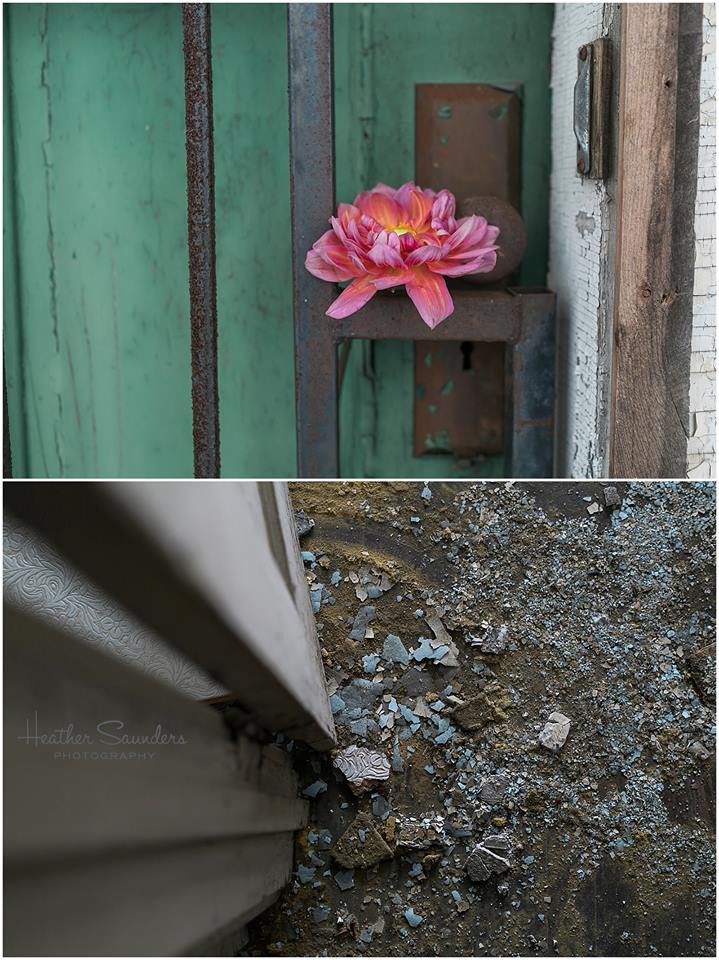
Imagine this abandoned storefront - filled with Lisa's floral dreams. (c) Heather Saunders Photography

Imagine this abandoned storefront – filled with Lisa’s floral dreams. (c) Heather Saunders Photography

There, potential sponsors, partners, friends and volunteers will get a whiff of the “big project” on a smaller scale. In a tiny storefront, they will install a breathtaking floral display, just next door to a once-abandoned urban property where Lisa and fellow designers ultimately hope to transform an aging, 11-room duplex into The Flower House.

“We’ll generally work our future audience into a flower frenzy,” Lisa says of the kickoff event.

When October 16th-18th rolls around, cutting-edge florists from Michigan and across the country will fill the walls and ceilings of an abandoned Detroit house with American-grown fresh flowers and living plants for a weekend installation.

The project will be featured in local, national, and worldwide media for innovation in floral design and repurposing forgotten structures in the city of Detroit.  

Visitors will be welcomed to an opening reception and a weekend of exploration, and a few reserved times will be offered to couples to hold their wedding ceremonies in The Flower House.  

Re-flowering an abandoned home in Detroit - a glimpse of Lisa Waud's grand idea (c) Heather Saunders Photography.

Re-flowering an abandoned home in Detroit – a glimpse of Lisa Waud’s grand idea (c) Heather Saunders Photography.

When the installation weekend has passed, the structures on The Flower House property will be responsibly deconstructed and their materials repurposed. The land will be converted into a flower farm and design education center on a formerly neglected property. 

For more details on The Flower House, follow these links:

The Flower House on Facebook

The Flower House Inspiration on Pinterest

The Flower House on Twitter

The Flower House on Instagram

I feel like I’m saying this week after week, but today’s conversations, with Kathleen and Lisa, are so truly encouraging.

This IS the Year of the American Grown Flower. Please join efforts like the Field to Vase Dinner Tour and Detroit’s The Flower House to get in on the excitement. Both projects are community focused, with the potential for engaging huge numbers of people.

By exposing lovers of local food and floral design to the immense creativity that comes from sourcing our flowers locally, in season and from American farms, we are deepening the conversation, connecting people with their flowers in a visceral way. All the senses are stimulated, as well as our imaginations.

Thank you for downloading and listening to the Slow Flowers Podcast! Each week I share with you our “download” count and we have hit 35,000 downloads to date. I’m encouraged to know more people are learning about the farmers and florists who keeping American-grown flowers flourishing.

So I thank you!!! If you like what you hear, please consider logging onto Itunes and posting a listener review.

The Slow Flowers Podcast is engineered and edited by Andrew Wheatley and Hannah Holtgeerts. Learn more about their work at shellandtree.com

Turning vacant land into flourishing flower farms in Baltimore, with Kristin Dawson and Walker Marsh (Episode 180)

Wednesday, February 11th, 2015
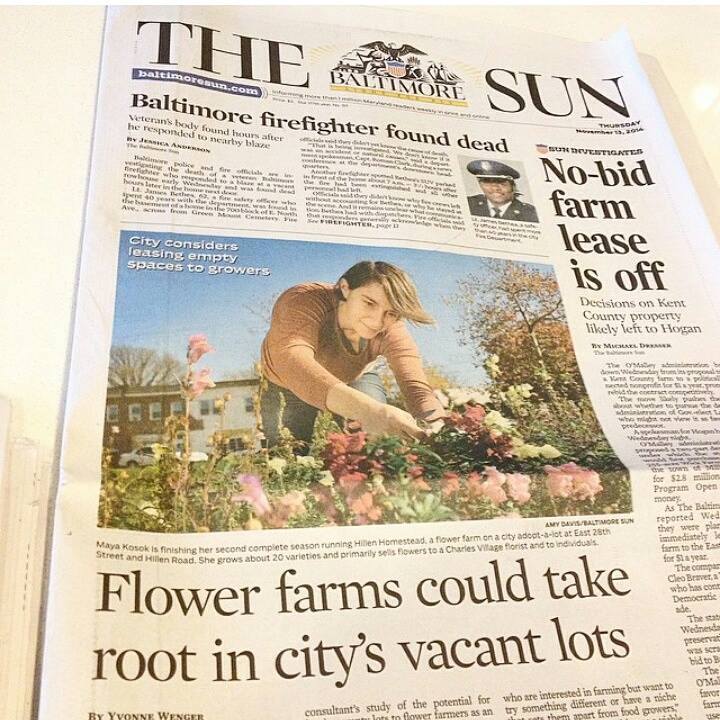
The Baltimore Sun article from Nov. 13, 2014

The Baltimore Sun article from Nov. 13, 2014

Today’s episode invites you to explore one city’s efforts to grow flowers, a tiny parcel at a time.

Many of you may have seen links to an article that ran in The Baltimore Sun newspaper last November called “Advocates hope flower farms will take root in Baltimore.”

Past podcast guest Ellen Frost of Local Color Flowers was quoted in the article as saying “flowers are a good option for people who are interested in farming but want to try something different or have a niche that sets them apart from food growers.”

Cool idea, right?
So when Kristin Dawson reached out to talk with me about the research she was undertaking on behalf of Baltimore mayor Stephanie Rawlings-Blake, I was eager to learn more. Kristin opened my eyes to the fact that there are more than 10,000 vacant lots in the city, which is perhaps more prevalent across the country that you would think.

Kristin formerly worked for the City of Baltimore on vacant property issues (co-authoring a Land Banking plan), as well as food policy/urban agriculture, and other projects.

Her research on behalf of Baltimore had three goals: (a) blight elimination; (b) green jobs and (c) a way to support entrepreneurship in the city. She pointed out: “We’ve learned that cut flowers are one of the most lucrative things to grow.”

After I answered her questions, I turned my microphone to Kristin. I am thrilled to share our conversation with you. UPDATE: Kristin’s research is complete, and now the City’s staff is reviewing the findings and recommendations. The good news is that there will be more flower farming in the future for Baltimore. I’ll share more news as I receive it!

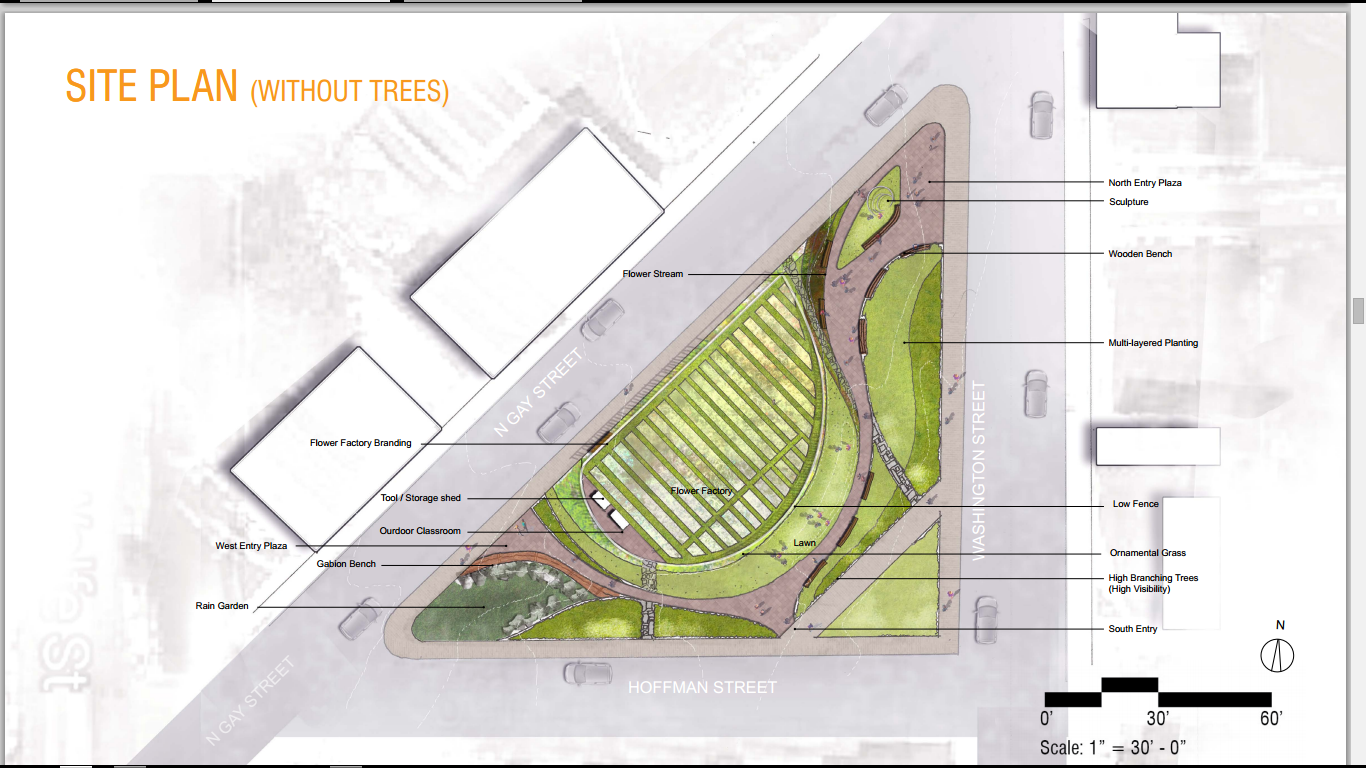
Here's the award-winning site plan for The Flower Factory.

Here’s the award-winning site plan for The Flower Factory.

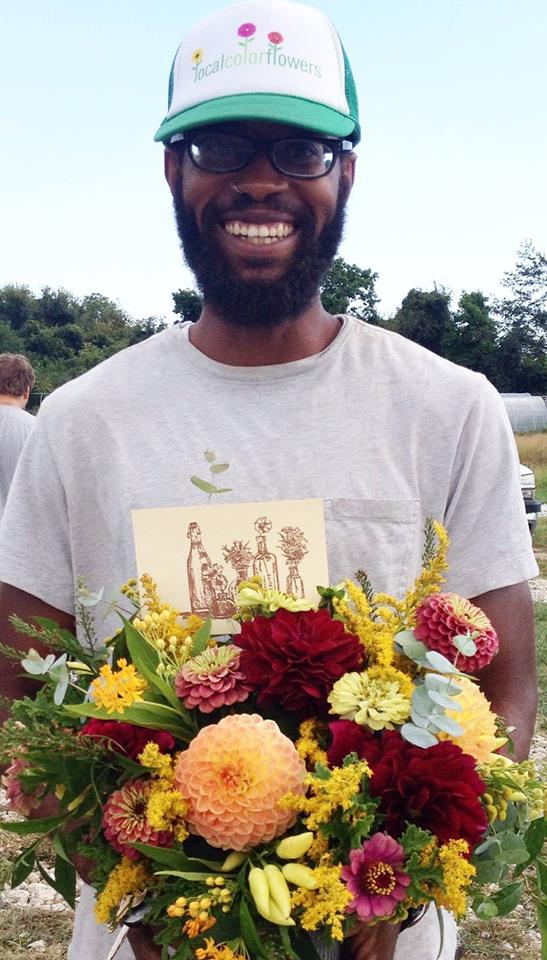
Meet Walker Marsh, emerging Baltimore flower farmer.

Meet Walker Marsh, emerging Baltimore flower farmer.

At Kristin’s suggestion, I have a bonus interview to share. She urged me to reach out to Walker Marsh of Tha Flower Factory.

He’s the first flower farmer who will raise cut flowers on a Baltimore-owned parcel land this year, facilitated by winning the Growing Green Design Competition. Walker’s background is as a field manager for Baltimore’s Real Food Farm.

In The Baltimore Sun article, he describes how he got involved with flower farming: “It is deeper than flowers for me. Once I was into it, I found I could calm myself. You have to have patience and be gentle, all the things that come with farming and gardening.”

Such truth! I know you’ll enjoy hearing his story and meeting this engaging new face of flower farming in the U.S.

ThaFlowerFactoryLogoCheck out Tha Flower Factory’s web site here. 

Follow and LIKE! Tha Flower Factory on Facebook here.

Follow Walker Marsh on Instagram here.

If you have any doubt about the rising excitement for growing domestic flowers, I sure hope that you’re as encouraged as I am by today’s guests.

We’ll have more stories about what’s happening on the Urban, Suburban and Rural landscape for American grown flowers in the coming months. Please send me your suggestions for future episodes.

ANNOUNCEMENTS

There are so many worthy crowd-funding projects going on right now and I urge you to check them out. This week I want to highlight two:

First, BLOOMTOWN.TV is a new reality web series about the mud, sweat and tears of the U.S. horticulture industry. The show’s creators, Eric Light and Stephanie Winslow, are based in St. Louis, Missouri, and have close ties to the floral and horticultural worlds there.

“Not only is there an abundance of rich, entertaining content, but we firmly believe that Bloomtown will encourage more people to buy plants and flowers, which means better sales across the industry!,” they say.

Bloomtown is in the midst of an ambitious Kickstarter campaign that runs through February 28th so there’s still time to check it out and contribute. And whether you can contribute or not, you’ll want to watch Bloomtown.tv’s fun trailer.

Slowflowers.com members Miranda Duschack and “Mimo” Davis of Urban Buds: City Grown Flowers are featured in the clip and the flowers grown by Slowflowers.com members Steve and Cheryl DuBois of Mossy Creek Farm appear, as Steve puts it: “in non speaking parts of the trailer.” Love the energy of this creative endeavor – so please check it out.

Next, not so long ago I featured Sid Anna Sherwood of Annie’s Flower Farm in Sequim, Washington, who had applied for a KIVA loan to purchase the assets of a farm she had been leasing.

Prior to interviewing her, I had not know about KIVA, an innovative “crowd-lending” program. All the funds donated are paid back by the recipient.

Yay! Triple Wren Farms hit the goal of $4,800 funding to expand their flower farm.

Yay! Triple Wren Farms hit the goal of $4,800 funding to expand their flower farm.

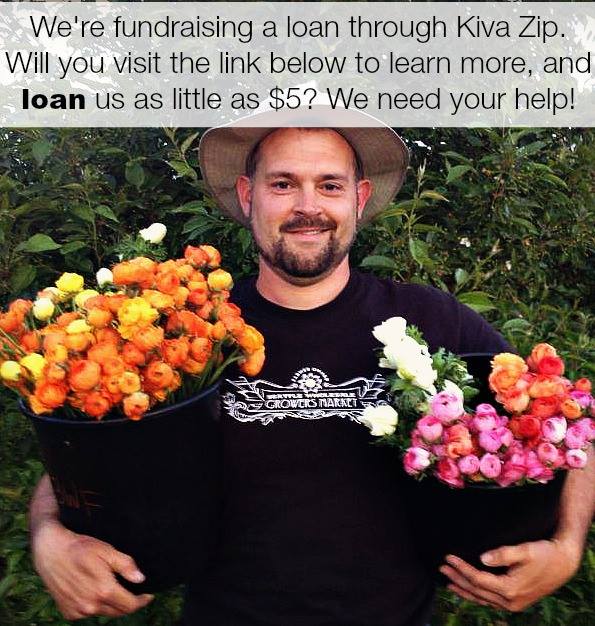
Other friends of Slowflowers.com, and past guests of this podcast, Steve and Sarah Pabody of Triple Wren Farms in the Bellingham, Washington, area, recently applied for a KIVA loan to help get their small flower farm to the next level this coming season.

They’ve raised three-quarters of their $4800 goal with more than a month to go – so it’s easy to help get Triple Wren to their ultimate loan amount, with a long as small as $5.

NOTE: Between the time this episode was recorded and its broadcast on February 11th, Triple Wren Farms achieved 100% funding of its KIVA loan! Whooo Hoo! Congrats Steve and Sarah!

Oh, and one follow-up. Several weeks ago we heard from Jonathan Webber who with his  partner Jimmy Lohr own Pittsburgh’s greenSinner, an urban flower farm and floral design studio.
I asked Jonathan to share details of green Sinner’s Indiegogo campaign for infrastructure funds needed to prepare new land they had just purchased in the city limits of Pittsburgh.

xde2jibx2dhkrxyn2g5tTheir campaign has ended, and greenSinner’s Midsummer Hill Farm raised $4,701 toward their goal.

And I guess I’m going to get on my soapbox right now.  You see, greenSinner didn’t meet their original goal of $10k, but they’re more than happy that the funds that were pledged, nearly one half of that goal, will support their project.

However, if they had launched that campaign on Kickstarter and missed the ultimate goal by even $1, they would not have access to any of those funds.

If you’re considering a crowdfunding campaign for your own floral project, please choose Indiegogo. I’m a huge fan of this platform for reasons too numerous to list here. Contact me offline if you wish to discuss further. And congratulations Jimmy and Jonathan! I know you didn’t reach your goal, but I also know how incredibly resourceful you will be with the funds you did raise! Now go get those seeds in the ground!

Thank you for downloading and listening to the Slow Flowers Podcast!

Each week I share with you our “download” count and we have hit 34,000 downloads to date. I’m encouraged to know more people are learning about the farmers and florists who keeping American-grown flowers flourishing.

As we approach Valentine’s Day, I urge you to Show your Love with a gesture of Local flowers.  We have such a great community and people really seem to want each other to succeed. I take encouragement from the stories I hear – and from the stories I’m able to share with you.

So I thank you!!! If you like what you hear, please consider logging onto Itunes and posting a listener review.

The Slow Flowers Podcast is engineered and edited by Andrew Wheatley and Hannah Holtgeerts. Learn more about their work at shellandtree.com.