Debra Prinzing

Get the Email Newsletter!

Archive for the ‘Flower Farming’ Category

Rain Drop Farms of Oregon’s Willamette Valley (Episode 213)

Wednesday, September 30th, 2015
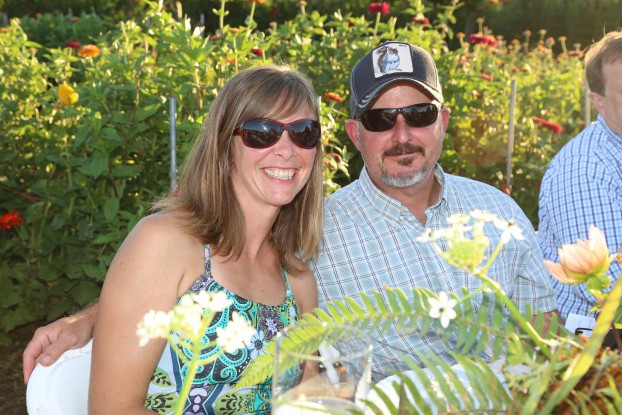
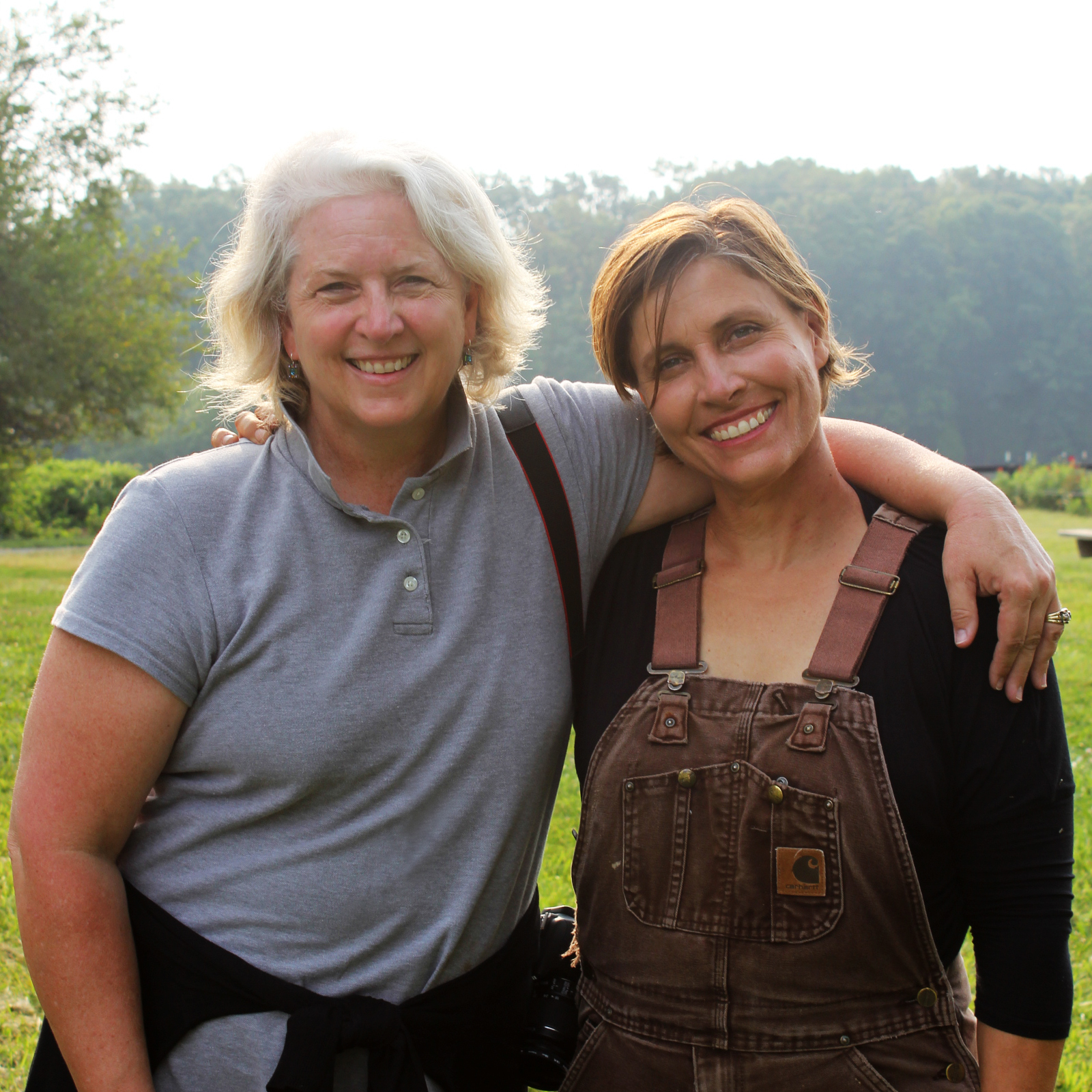
Erin and Aaron of Oregon's Rain Drop Farms, photographed by Linda Blue at the Field to Vase Dinner on Sept. 12th.

Erin and Aaron of Oregon’s Rain Drop Farms, photographed by Linda Blue at the Field to Vase Dinner on Sept. 12th.
10011796_10153933043017542_6146716397999247836_oFall is here and news from our Slow Flowers Tribe is exploding!

There are so many things to discuss and update you about this week. You’ll find that news at the bottom of this post, after I introduce you to Rain Drop Farms.

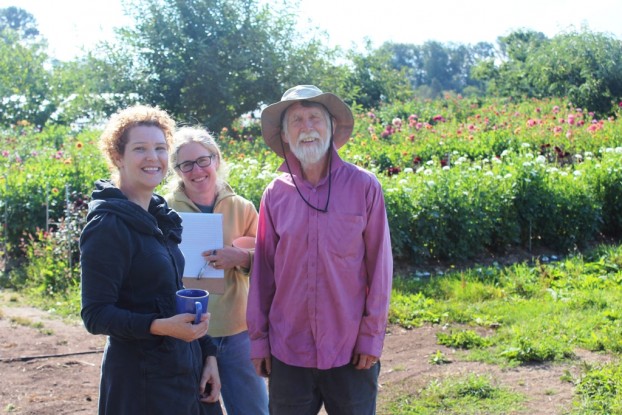
The heart of the Slow Flowers Podcast are my weekly conversations with inspiring voices in the American flower farming and floral community. Please meet today’s guests, Erin McMullen and Aaron Gaskey, the dynamic duo behind Rain Drop Farms. Based outside Corvallis, Oregon, in Philomath, this husband-wife team of farmers grows a wide array of perennials and annuals on three acres of healthy soil. Allow me to bring Raindrop Farms  — and the sunshine they spread — to you, with the story of lovely, local, Oregon flowers and how one family makes a beautiful and creative living from their land.
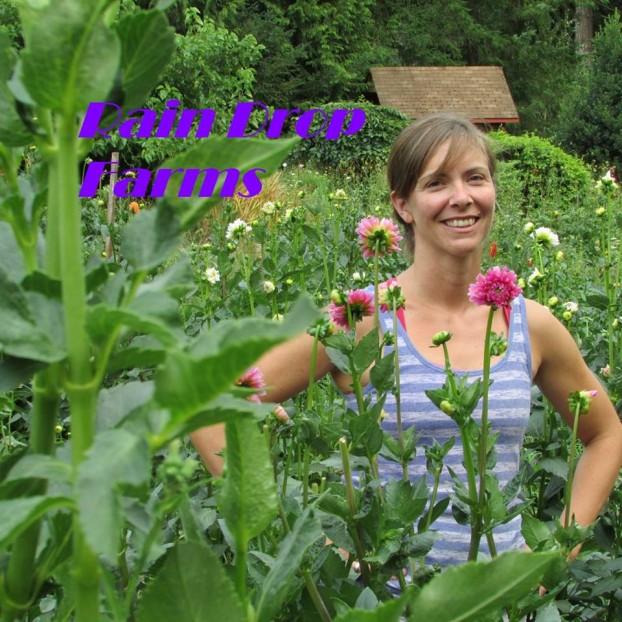
Erin McMullen of Rain Drop Farms.

Erin McMullen of Rain Drop Farms, standing — where else? — in her dahlia fields.

Situated in the foothills of the Oregon coast range, Rain Drop has been providing fresh, local, specialty flowers to the Willamette Valley since 2000.

Passionate about growing flowers, Erin and Aaron count dahlias among their favorites. They grow more than 75 varieties and are always searching out more, as well as a wide variety of perennials and many different annuals.
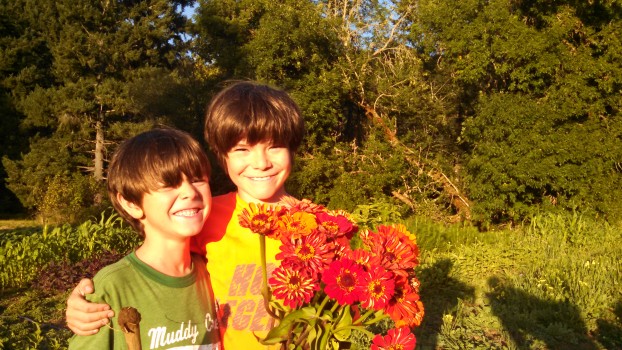
The kids of Rain Drop Farms.

The kids of Rain Drop Farms with some of their beautiful zinnias.

Theirs is a working family farm. As Erin writes on the web site: “We live here, grow here and play here.  Our children have grown up digging in the dirt and chasing rainbows here.  As stewards of this beautiful place we strive to maintain and promote the diversity here.  We use organic and sustainable practices throughout our farm.  It is our belief that growing this way is just the right thing to do. It is the best for our farm, our family and flowers.”
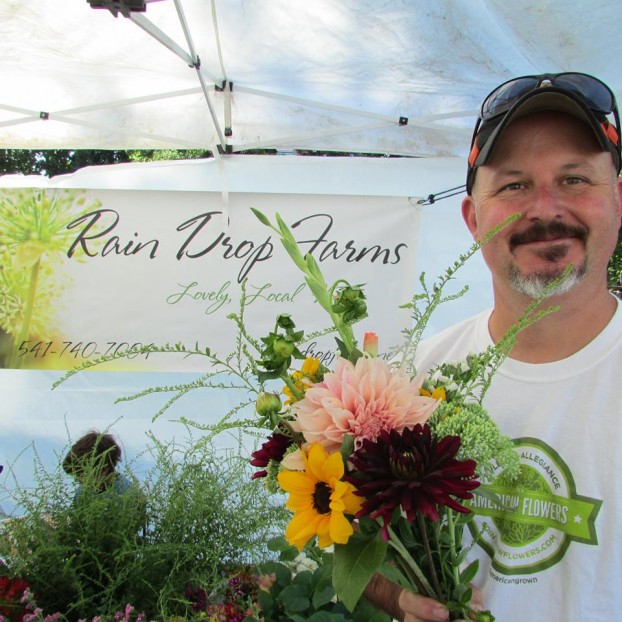
Aaron Gasky at the Rain Drop Farms' farmers' market stall. Notice he's wearing a Slow Flowers t-shirt!

Aaron Gaskey Rain Drop Farms’ farmers’ market stall. Notice he’s wearing a Slow Flowers t-shirt!

I adore this couple. We’ve met in person on a few occasions, most recently when they took what I call a busman’s holiday to drive from Philomath up to Mt. Vernon, Oregon, (about 325 miles away) to spend a few days volunteering at the Field to Vase Dinner held on Sept. 12th at Jello Mold Farm. I simply couldn’t let the opportunity pass and am so thrilled that Erin and Aaron agreed to record this conversation.
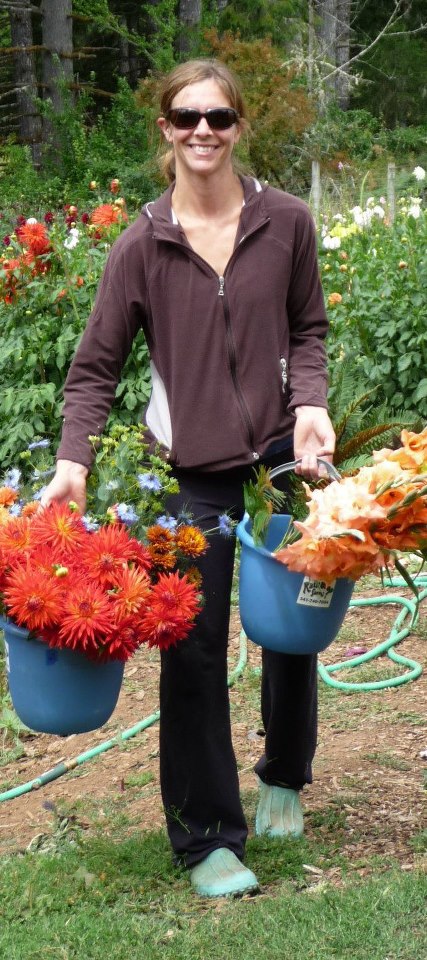
Harvest time with Erin!

Harvest time with Erin!

Last week, Erin shared with me a fascinating conversation she had with a Farmers’ Market customer and I think it sums up what so many of us have experienced:

“We have had so many people ask us this year if we grow all of the flowers.  Of course we say ‘Yes!  Every last one!’ We are always surprised by how many people seem surprised by this!  Yesterday we had a guy come up and ask if we grew all the flowers; the conversation progressed and he tells us that he works with flowers in LA and didn’t realize that there were people like us who actually grew flowers like these domestically.

His business is selling flowers at college graduations and he said that they buy most things from Ecuador and South America, basically saying that domestic flowers were just too pricey.  

Aaron told me later that he could see me high jump onto my soap box, but I let (the customer) know what I thought of that excuse and that supporting American farmers is a more sustainable long term economic strategy.  

He actually took pause and then asked for our contact info and for the name of the Slow Flowers website again, saying that he was intrigued and would like to learn more.  

I’m telling you this story, though I’m sure you hear this kind all the time, because it was so refreshing to me.  Also, because of you and your efforts, I have become more well informed and confident about my convictions that American flower farmers deserve a chance to thrive in a domestic marketplace.  So, thank you!  So glad that we met and that we’ve had an opportunity to get to know each other a little better!  :)”

Thank YOU both Erin and Aaron! I couldn’t agree more.

Follow Rain Drop Farms on Facebook

Follow Rain Drop Farms on Instagram

More news to share!!!

Here is a just-released clip about The Flower House, created by Hello Future Films, that shows recent footage captured during the installation of the preview exhibit earlier this year – it’s being shown to stimulate ticket sales for The Flower House show dates, October 16-18. If you’re anywhere near Detroit, hop on over to see this amazing display!

And then, with much fanfare, I’m so pleased to share with you “Field to Vase: Santa Cruz,” a 7-minute, 39 second documentary produced, filmed and edited by my friends Haejung Kim and her husband Moon, a LA-based couple of creatives whose probono efforts have beautifully captured the story of American grown flowers and the renaissance we are all helping make happen. Click here to read my recent Q&A with Haejung and Moon.

I have a cameo role in the film, but please don’t take this as blatant self-promotion. It’s all about the cause of promoting American flower farms, American flowers and the florists who create such beauty with intent. You’ll also meet flower farmer Paul Furman whose family owns California Pajarosa Roses and Slow Flowers member Teresa Sabankya, of Bonny Doon Garden Co., who was the guest designer at the Field to Vase Dinner held at Pajarosa Roses this past June. The film is beautiful, poignant and I encourage you to watch it and share it widely.

Martha Stewart American Made Taps Two Slowflowers.com Members

11406783_927429313946323_8650643430552798404_nI want to showcase the many people in our community whose work has earned them FINALIST status on the Martha Stewart American Made 2015 campaign.

I am especially excited that Susan McLeary of Passionflower, a Slowflowers.com member based in Ann Arbor, Michigan, is a finalist – the only floral category finalist – in the Design Category. Check her out here. 

And flower farmer Wanda Fox of Illinois-based Fox & Co. is a finalist in the Craft Category for her beautiful charcuterie boards made from salvaged and reclaimed black walnut lumber. Check her out here.

I also want to put in a plug for my friend Andy Chapman of Stumpdust. Andy is a finalist in the Design Category for Gardening & Outdoor Living, for his unique garden stakes and tools fashioned from salvaged wood. Andy’s work is exquisite and he is the genius behind my American Made shadowbox that I used to display my 2015 Northwest Flower & Garden Show floral entry. You can see photos of that beautiful work here. And please check out Andy & Stumpdust on MSL here.

Get Your Hands on Floral Soil!
im2j860cxbhbir2m86mc

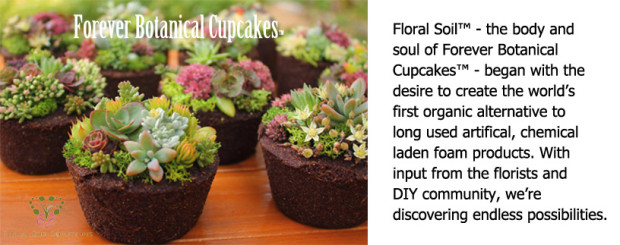
Another Slow Flowers Podcast friend who is near and dear to my heart is Mickey Blake of Floral Soil, the innovative, plant-based, 100% biodegradable alternative to formaldehyde-based flower foam.

Mickey has just introduced a fun new product called “Floral Soil Cupcakes,” a perfect gift or DIY project that is one of the perks in her two-week Indiegogo fundraising campaign that continues through October 10th. Many of us have been waiting for Floral Soil to kick into full-scale production because we can’t wait to get our hands on this earth-friendly design product. By supporting the Floral Soil Indiegogo campaign, for as little as $15 you can get your hands on a cute cupcake-shaped base for planting succulents or arranging flowers – and you can help push Floral Soil to the next level where commercial production of those must-have bricks will begin before the holidays.

Episodes of the Slow Flowers Podcast have been downloaded more than 66,000 times. I thank you and others in the progressive American-grown floral community for supporting this endeavor.

Until next week, you’re invited to join me in putting more American grown flowers on the table, one vase at a time. And If you like what you hear, please consider logging onto Itunes and posting a listener review. THANK YOU to each and every one of you for downloading, listening, commenting and sharing. It means so much.

The content and opinions expressed here are either mine alone or those of my guests alone, independent of any podcast sponsor or other person, company or organization.

The Slow Flowers Podcast is engineered and edited by Andrew Wheatley and Hannah Holtgeerts. Learn more about their work at shellandtree.com.
Slow Flowers wins Silver Award from Garden Writers Association

Tuesday, September 29th, 2015

15-silver-logoI’m thrilled to announce the news that Slow Flowers has earned a 2015 Garden Writers Associaiton SILVER AWARD in the Newsletter/Bulletin/Brochure Category for our Infographic:

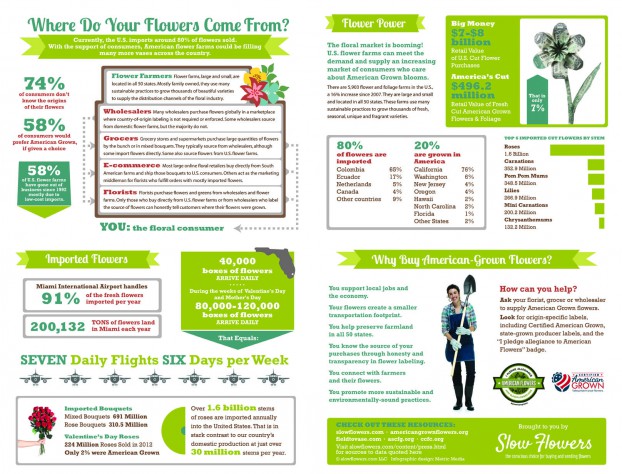
“Where Do Your Flowers Come From?” 

A very special thanks to my design collaborator Willo Bellwood of Metric Media for her amazing talent. Her graphic sensibilities translated this multilayered concept into a powerfully visual piece.

“Where Do Your Flowers Come From?” communicates the facts, fallacies and data about the source of flowers – and inspires consumers to source domestic and local flowers.

Here is our award-winning piece. I encourage you to share it with your own audiences:

Please feel free to use this graphic to promote the Slow Flowers Movement to your own community of flower farmers, florists and customers.

Please feel free to use this graphic to promote the Slow Flowers Movement to your own community of flower farmers, florists and customers.

Week 38 // Slow Flowers Challenge

Thursday, September 24th, 2015
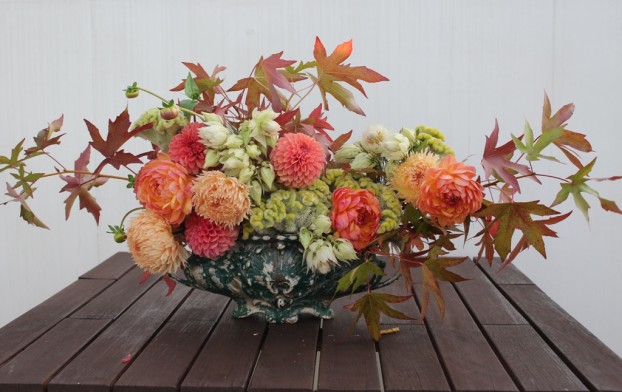
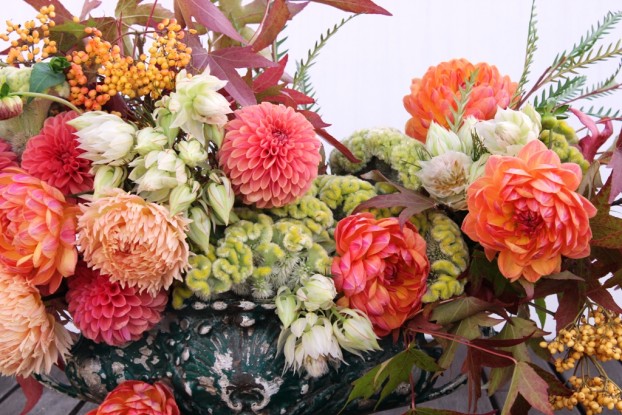
Lush, early autumn colors  of corals, peaches, ivories and celadon green.

Lush, early autumn colors of corals, peaches, ivories and celadon green.

Dahlia season continues here in the Pacific Northwest, where local flower farms in Washington and Oregon have produced bumper crops for 2015.

I’ve been traveling so much this summer in order to co-host and promote the Field to Vase Dinner Tour, that the last four weeks have been a blur. I haven’t posted a Slow Flowers Challenge bouquet since August 27th when I shared Week 34. Yikes! Please forgive me!

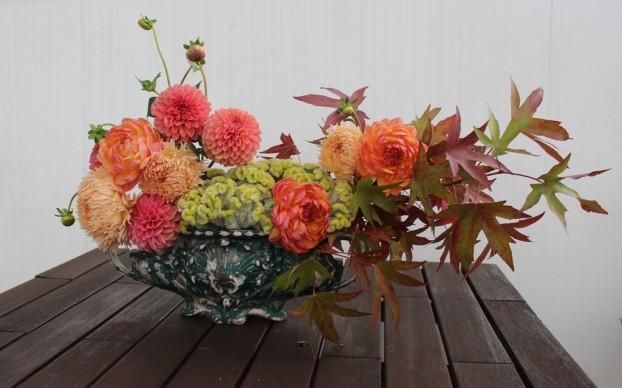
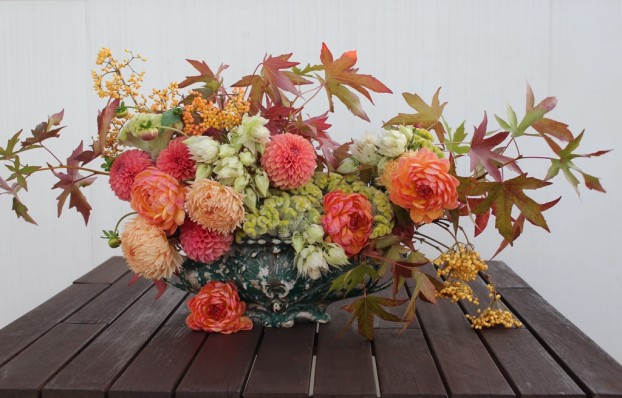
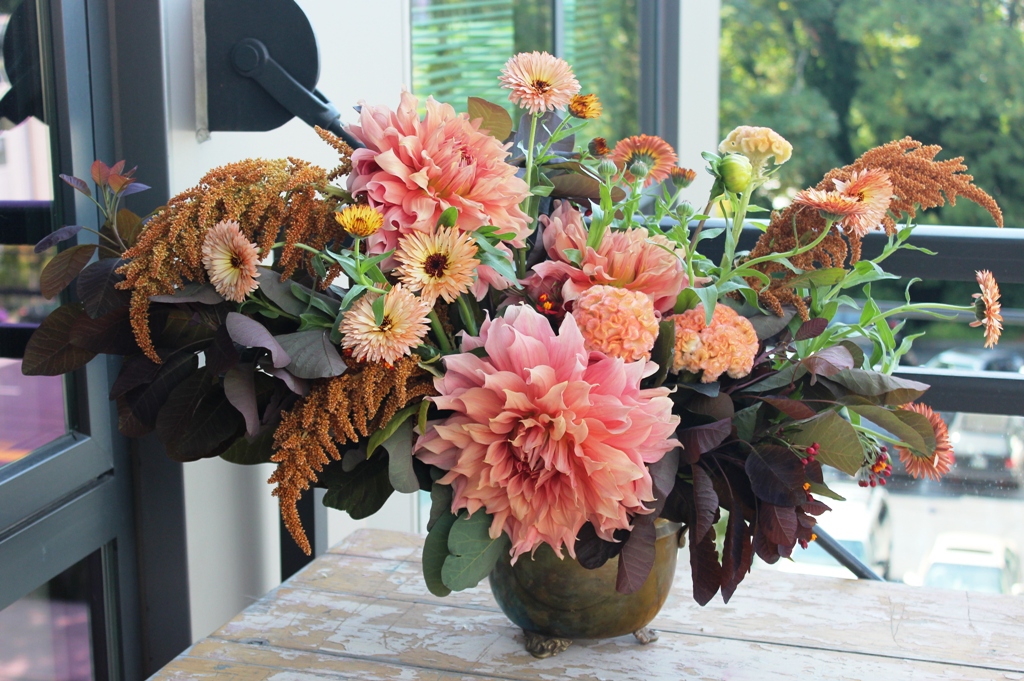
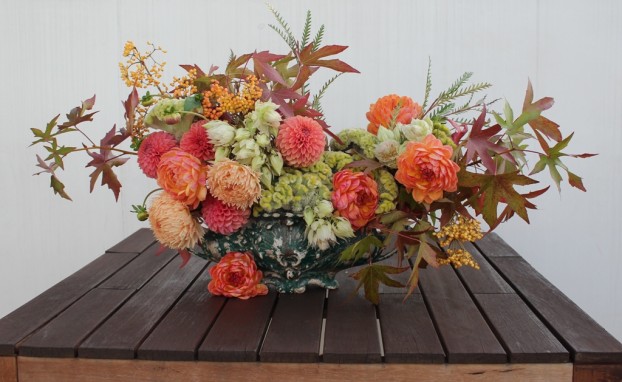
The finished bouquet, shown at its finest in my vintage cast-iron planter

The finished bouquet, shown at its finest in my vintage cast-iron planter

As if that wasn’t enough, we moved in July. Moving into an apartment after selling our home (and its beautiful garden) has been an exhausting transition. We’re getting settled in a place located quite close to downtown (I can see the Space Needle from our apartment!), but I now realize what an effort it takes to procure flowers when one doesn’t grow them oneself.

This move has provided me with a valuable lesson and an important insight about how hard it is to enjoy seasonal flowers in one’s home. It’s so much easier when you can just step outside and clip to your heart’s content.

Thankfully, where I live, I’m able to enjoy outdoor space and fresh air. We have a small balcony attached to our unit and upstairs, there is a massive rooftop deck. These are daily luxuries. Access to flowers is a little more challenging.

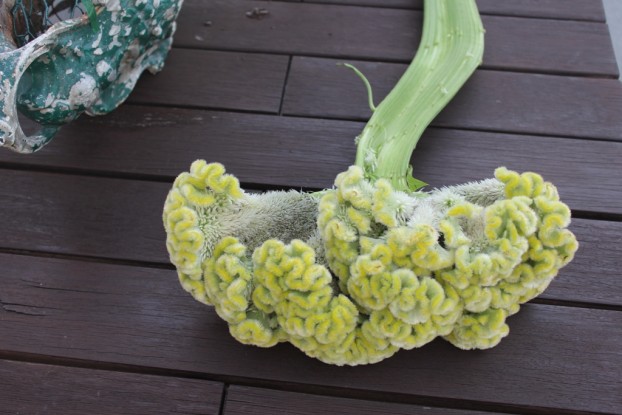
Have you ever seen a celosia this gigantic?

Have you ever seen a celosia this gigantic?

Yesterday, I attended a board meeting at the Seattle Wholesale Growers Market. In exchange for several hours sitting around the table with my fellow board members, I was rewarded with a chance to shop the Market floor afterwards.

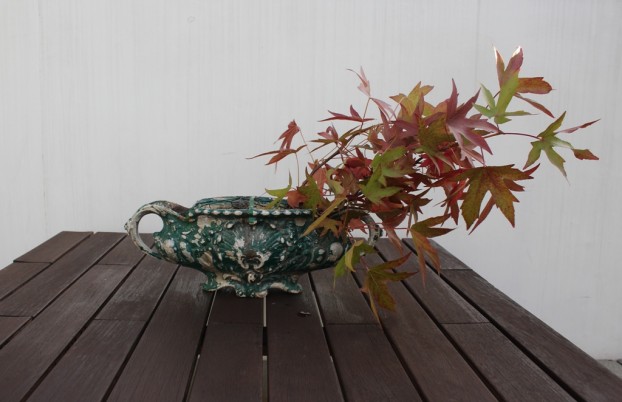
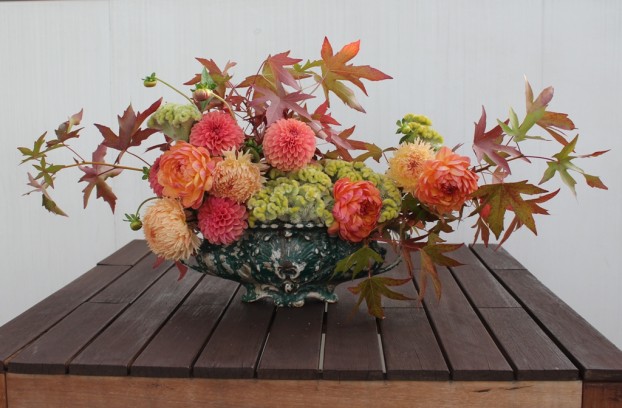
Step One: Start with a few branches of Liquidambar - a sure sign of fall! Place them off-centered to exaggerate the width of the urn.

Step One: Start with a few branches of Liquidambar – a sure sign of fall! Place them off-centered to exaggerate the width of the urn.

You will LOVE the goodies I came home with! This arrangement is constructed using chicken wire inserted into the vintage cast-iron planter.

Dahlia ‘Pam Howden’, a peach-gold waterlily dahlia, grown by Jello Mold Farm

Dahlia ‘Peach Fuzz’, a pale peach novelty dahlia true to its fuzzy moniker, grown by Dan’s Dahlas

Dahlia ‘Narrows Erica’, a peach-orange ball dahlia, grown by Dan’s Dahlias

Sweetgum foliage (Liquidambar styraciflua), foraged by Tosh’s Farm

Pale green Celosia, grown by Peterkort

‘Michael Dodge’ viburnum, with pale yellow fruit, grown by Jello Mold Farm

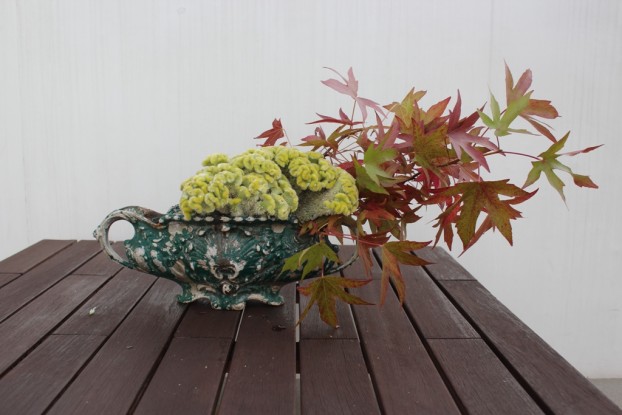
Step two: Insert one enormous pale-green celosia to give weight to the arrangement.

Step Two: Insert one enormous pale-green celosia to give weight to the arrangement.

Muir Ranch

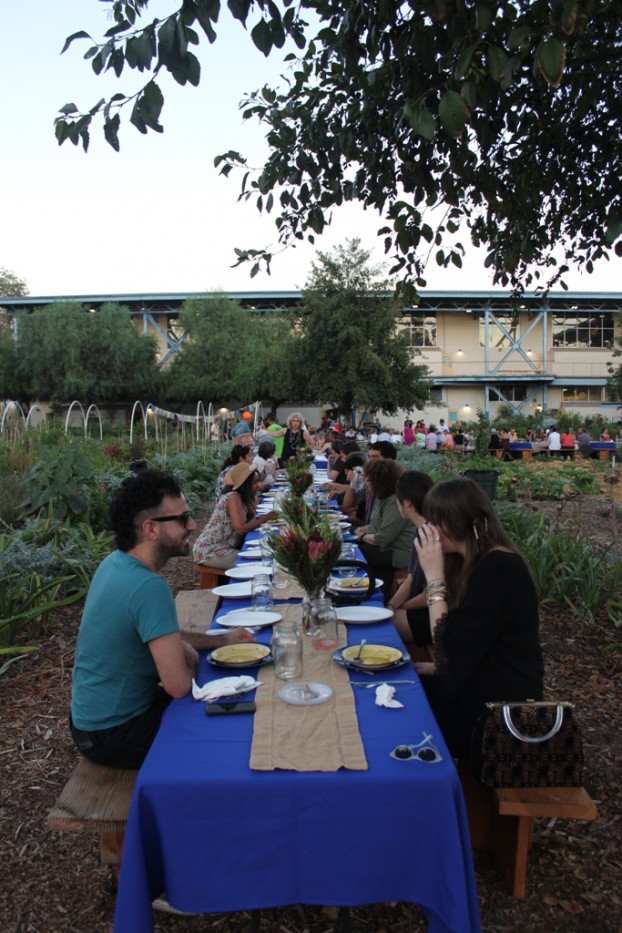
Dining al fresco at Muir Ranch, an urban school’s food and flower farm in Pasadena.

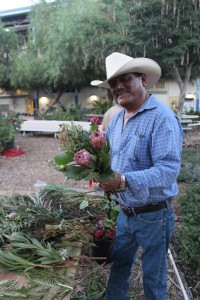
American flower farmer Mel Resendiz

American flower farmer Mel Resendiz

There are also two wonderful “bonus” elements in this bouquet, both California-grown. On Sunday morning, I flew back to Seattle from Burbank with generous bunches of grevillea foliage and Serruria florida ‘Blushing Bride’ in my carry-on bag (of course).

They were gifts from Resendiz Brothers Protea Growers and flower farmer Mel Resendiz. We met up last Saturday night at a special farm dinner held at Muir Ranch in Pasadena, which hosted more than 100 guests who learned all about urban agriculture (see above).

Many of the guests were fellow members of the Garden Writers Association, who were in Pasadena for an annual symposium. They came for dinner and met some very talented high school students who are producing food and flowers for the CSA at John Muir H.S.

Our host Mud Baron, urban-ag activist and creator of “Flowers on Your Head,” invited Mel Resendiz and Diana and Bob Roy of Resendiz Brothers Protea Growers to join the fun. Mel cranked out some beautiful bouquets for the tables and somehow I ended up with the very special ‘Blushing Bride’ to bring home. It is in the proteaceae family and Diana tells me the flowers dry beautifully.

Step Three: Add three types of dahlias, blending colors for depth and interest.

Step Three: Add three types of dahlias, blending colors for depth and interest.

Enhance with a few more stems of Liquidambar and celosia

Step Four: Enhance with a few more stems of Liquidambar and celosia

Step Five: Tuck in clusters of 'Blushing Bride' and notice how much the ivory-cream petals echo the celadon green celosia.

Step Five: Tuck in clusters of ‘Blushing Bride’ and notice how much the ivory-cream petals echo the celadon green celosia.

Step Six: Incorporate 'Michael Dodge' viburnum berries to add sparkle and texture.

Step Six: Incorporate ‘Michael Dodge’ viburnum berries to add sparkle and texture.

I *think* I can get back on schedule for the Slow Flowers Challenge. It has been rewarding to see what everyone else has produced while I’ve been away from my clippers and vases.


American-grown flowers for our nation’s capitol with Andrea Gagnon of LynnVale Farm and Studio (Episode 212)

Wednesday, September 23rd, 2015
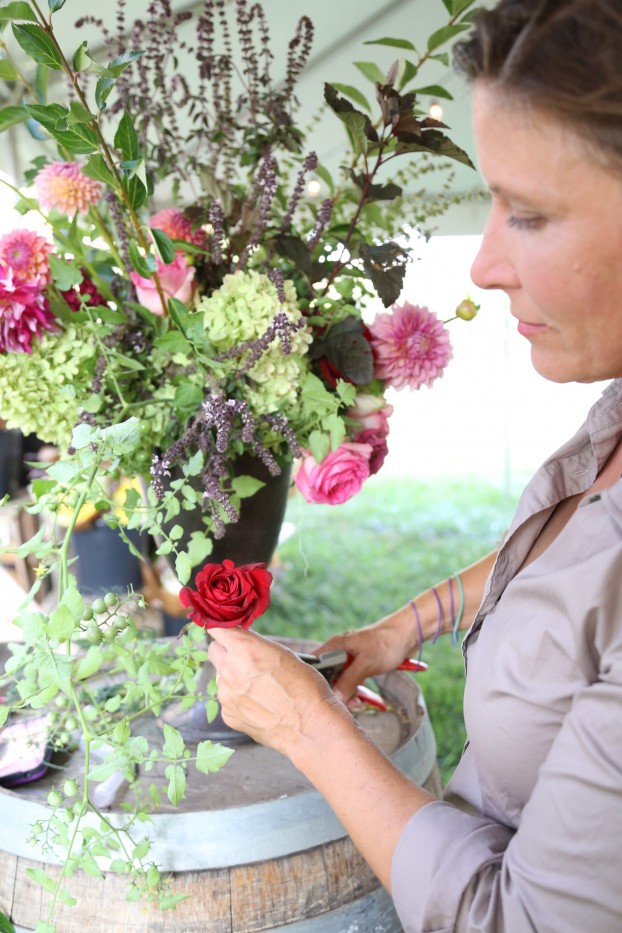
Andrea Gagnon, designing with her just-picked Virginia-grown blooms. (c) Linda Blue

Andrea Gagnon, designing with her just-picked Virginia-grown blooms and Eufloria’s California-grown roses (c) Linda Blue

Earlier this month I spent several days at LynnVale Studios, the farm and art studio owned by Andrea and Lou Gagnon.

The couple graciously hosted the Washington, D.C., area Field to Vase Dinner in their Gainsville, Virginia, flower fields on September 3rd.

Not only was the event a spectacular floral and culinary celebration of local agriculture, it also gave me the chance to spend time observing Andrea’s incredible talents as a flower farmer and designer.

I’ve been wanting to interview Andrea for the past few years and somehow the moment never presented itself for us to record a face-to-face conversation for the Slow Flowers Podcast until now.

Let me tell you a bit more about Andrea:

Andrea Gagnon combines her professional design education with her expertise in floriculture to grow premium flowers and design unique arrangements that range from formal to fantastic. She holds a Bachelor of Architecture degree from Virginia Tech.

d0b21daa-5d38-4954-8959-82f937b868a0Andrea was the invited floral designer whose creations decorated the 2015 Congressional Wine Caucus Reception in Washington, D.C., held at the Library of Congress, where her exquisite floristry featured all American-grown flowers and foliage.

Andrea and Lou manage a thriving art and design studio, floral design studio and commercial cut flower garden surrounded by 100 acres of forest, pasture and crop land.

Founded in 2002, LynnVale is dedicated to the cultivation of creativity and the human spirit through alternative agriculture and fine art.

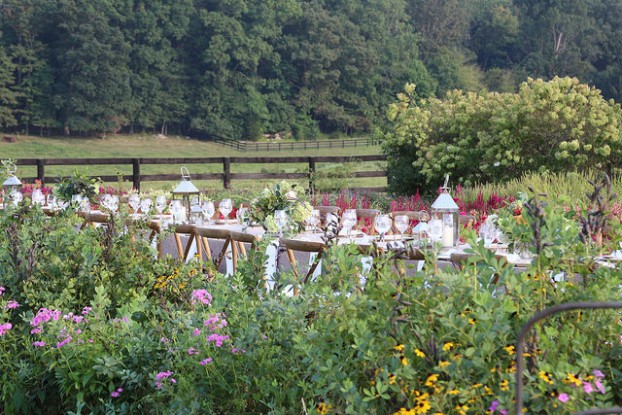
A feast in the flower fields (c) Linda Blue

A feast in the flower fields (c) Linda Blue

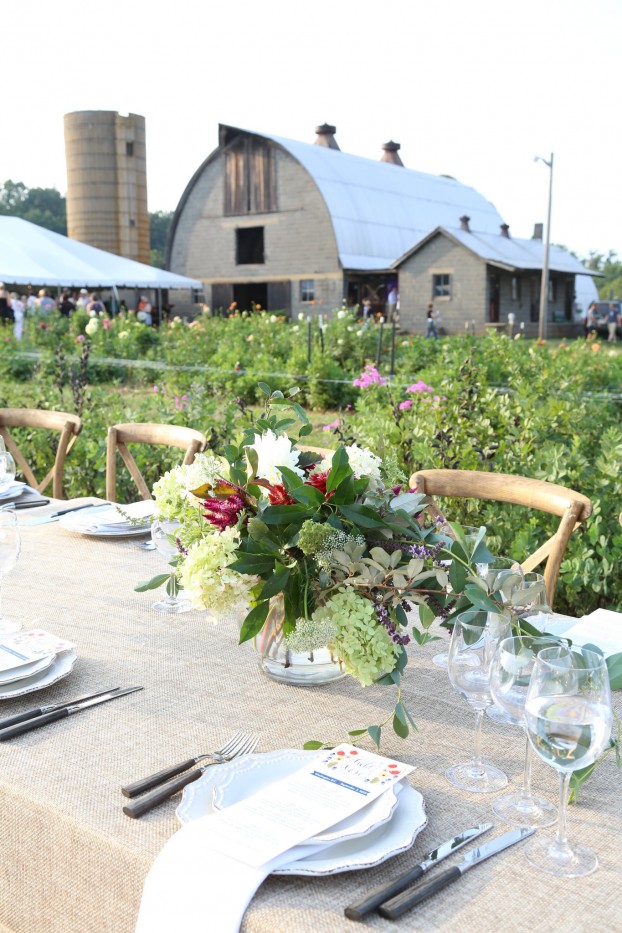
From Field to Vase, with LynnVale Farm and Studios' amazing barn in the backdrop (c) Linda Blue

From Field to Vase, with LynnVale Farm and Studios’ amazing barn in the backdrop (c) Linda Blue

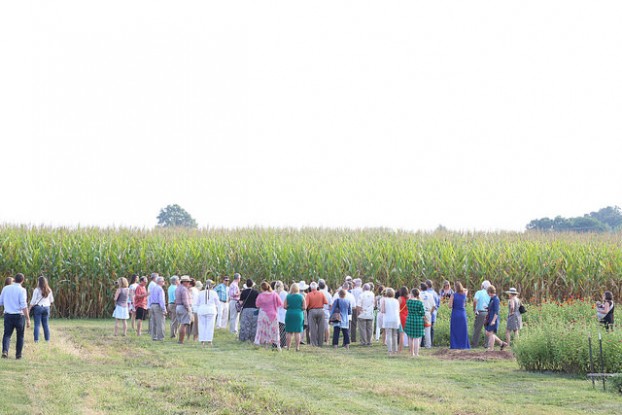
Guests of the Field to Vase Dinner on September 3rd followed Andrea on a farm tour to see her dahlias up close and personal (c) Linda Blue

Guests of the Field to Vase Dinner on September 3rd followed Andrea on a farm tour to see her dahlias up close and personal (c) Linda Blue

The heritage farm is nestled in the middle of an eighth generation family homestead in Northern Virginia. They share this on the LynnVale web site:

“We are committed to sustainable horticulture and ethical labor practices. We hire local high school students, university interns, stay at home parents and floral and garden enthusiasts. For events, we work with some of the best floral designers in the region. We thank you for supporting our effort to keep our farmland open and productive and for helping us cultivate a creative community.”

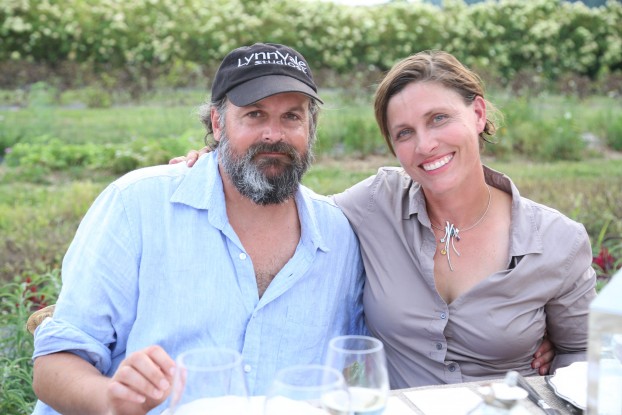
Lou and Andrea Gagnon (c) Linda Blue

Lou and Andrea Gagnon (c) Linda Blue

A LynnVale centerpiece adorned the tables at the Field to Vase Dinner (c) Linda Blue

A LynnVale centerpiece adorned the tables at the Field to Vase Dinner (c) Linda Blue

Each year, LynnVale grows more than 100 varieties of specialty cut flowers, foliages and herbs for sale at farmers markets and to fine florists across the D.C.- metro region.

In addition, with Andrea as the studio’s creative director, LynnVale provides flowers and arrangements, specializing in eco-friendly events and green weddings.

Our interview was recorded inside Andrea’s somewhat noisy delivery van, which happened to be filled with buckets of just-picked hydrangeas, dahlias, celosia and other amazing fresh, local and seasonal blooms.

Screen-Shot-2015-04-21-at-9.21.50-AM1(pp_w640_h563)

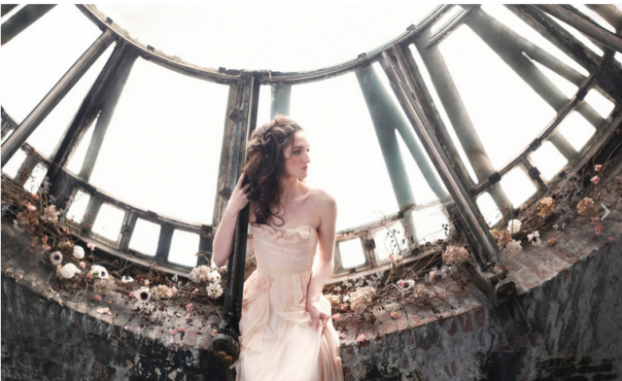
Andrea Gagnon’s winter fantasy design for the “Clock Tower,” by photographer Rebekah Murray

I was in on the secret: those flowers were destined for a very special VIP event in our nation’s capitol – I can’t tell you who ultimately enjoyed them but I am definitely in awe of what Andrea pulled off to fulfill the last-minute request from her floral design client.

A dahlia-centric flower farm (c) Linda Blue

A dahlia-centric flower farm (c) Linda Blue

Thanks so much for joining me today. Please enjoy these photographs of the flowers at LynnVale, of Andrea’s gorgeous floral designs, and of the stunning Field to Vase Dinner held in the fields that she and Lou so lovingly farm.

Read my Q&A profile of Andrea on the American Grown Flowers’ blog.

Learn more about Andrea in this wonderful piece on Flirty Fleurs.

Follow LynnVale on Facebook

Follow LynnVale on Twitter

Follow LynnVale on Pinterest

Follow LynnVale on Instagram

Episodes of the Slow Flowers Podcast have been downloaded more than 66,000 times. I thank you and others in the progressive American-grown floral community for supporting this endeavor.

Until next week, you’re invited to join me in putting more American grown flowers on the table, one vase at a time. And If you like what you hear, please consider logging onto Itunes and posting a listener review. THANK YOU to each and every one of you for downloading, listening, commenting and sharing. It means so much.

The content and opinions expressed here are either mine alone or those of my guests alone, independent of any podcast sponsor or other person, company or organization.

The Slow Flowers Podcast is engineered and edited by Andrew Wheatley and Hannah Holtgeerts. Learn more about their work at shellandtree.com.
One Month to The Flower House Launch with Floral Savant Lisa Waud (Episode 211)

Wednesday, September 16th, 2015
Lisa Waud, pictured at The Flower House press preview on May 1, 2015

Lisa Waud, pictured at The Flower House press preview on May 1, 2015

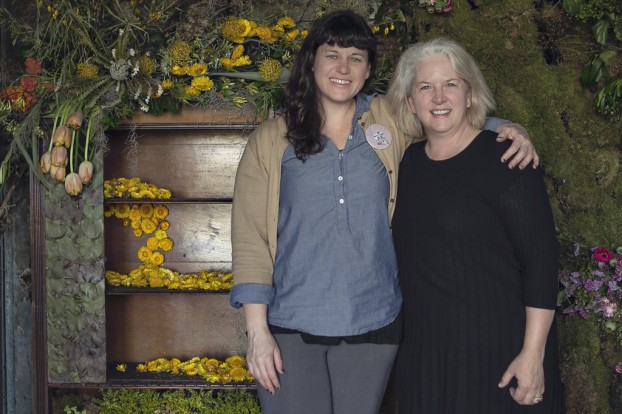
I love this pic of Lisa Waud (left) and me, taken by Heather Saunders at The Flower House press preview on May 1st.

I love this pic of Lisa Waud (left) and me, taken by Heather Saunders at The Flower House press preview on May 1st.

theflowerhouse_graphicI jumped on the phone a few days ago with Lisa Waud of pot & box, the botanical genius and visionary of The Flower House, the floral art installation that will open to the public in mid-October.

Listeners of this podcast heard my original interview with Lisa this past February when the plans and ideas for The Flower House were in their beginning stages. Since then, The Flower House news has been shared widely, but we can proudly say we heard Lisa’s personal story here first on the Slow Flowers Podcast.

Lisa reminded me of the amazing piece created by Hello Future Films, depicting her vision for The Flower House. I want to share it here for you to watch again. I find it so moving, and it makes me so proud to know and support Lisa and this phenomenal project.

Since doors to The Flower House open in exactly one month, on October 16th, Lisa agreed to chat with me for a few minutes to share her updates as preparations are revving up for this phenomenal, must-attend floral event.

We thought this would be a quick 10-minute interview, but the conversation was so engaging and Lisa and I were having so much fun discussing The Flower House that we spoke for a half hour.

Consequently, we’ve adjusted our program lineup and today’s episode is completely devoted to The Flower House and the very special Field to Vase Dinner that takes place on October 16th.

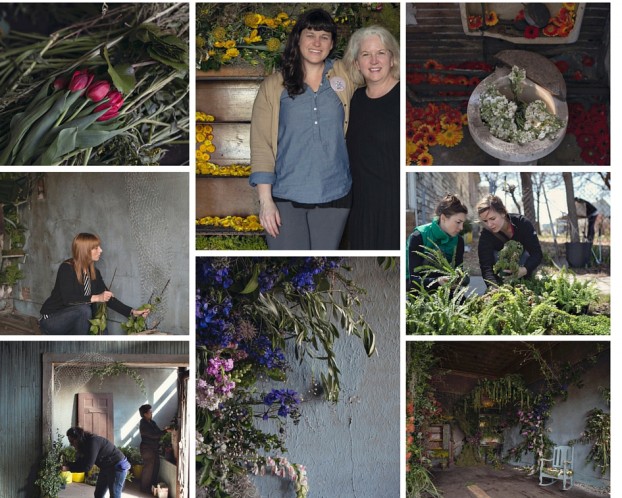
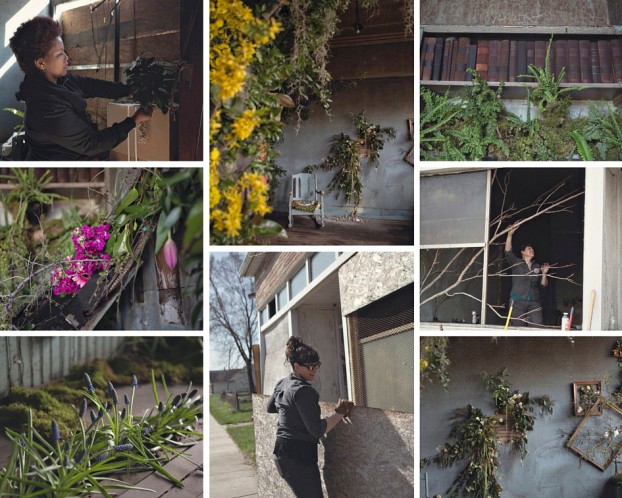
Lisa painted a beautiful picture of what’s to come . . . and here are a few beautiful bonus photographs taken by her cohort Heather Saunders, the official photographer of The Flower House. Your imagination will be stimulated, I promise!

2

1

Here is the link to purchase your ticket to tour The Flower House, Oct. 16-18.

Follow The Flower House on Facebook

Follow The Flower House on Instagram

Follow The Flower House in Twitter

Follow The Flower House on Pinterest

VOLUNTEER at The Flower House

Now is the time to put an X on the calendar and check out flights to travel from your home town to Detroit!

detroit_PC_art

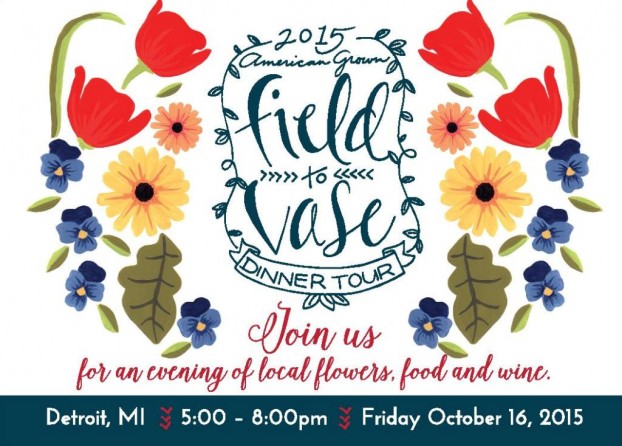
Add a visit to The Flower House and reserve a seat at the table for The Field to Vase Dinner on October 16th. Ticket details are here – and remember that listeners can claim a $35 discount by using the SLOWFLOWERS promotion code upon checkout!

Make the pilgrimage – it’s one of those experiences you won’t want to forget. Florists and flower volunteers, your talents are needed, too! As Lisa noted, there are many opportunities to get involved in this floral event of the year. I’ll be there and I hope you are, too!

Episodes of the Slow Flowers Podcast have been downloaded more than 64,000 times. I thank you and others in the progressive American-grown floral community for supporting this endeavor.

Until next week, you’re invited to join me in putting more American grown flowers on the table, one vase at a time. And If you like what you hear, please consider logging onto Itunes and posting a listener review. THANK YOU to each and every one of you for downloading, listening, commenting and sharing. It means so much.

The content and opinions expressed here are either mine alone or those of my guests alone, independent of any podcast sponsor or other person, company or organization.

The Slow Flowers Podcast is engineered and edited by Andrew Wheatley and Hannah Holtgeerts. Learn more about their work at shellandtree.com.
Melissa Feveyear of Seattle’s Terra Bella Flowers – Pioneering Local and Sustainable Floral Design for 10 Years (Episode 210)

Wednesday, September 9th, 2015
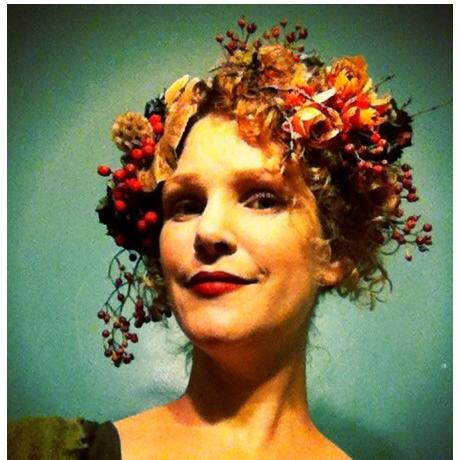
Love this portrait of Melissa, the crown of her head encircled with flowers.

Love this portrait of Melissa, the crown of her head encircled with flowers.

This week’s guest is my very good friend and “flower-sister” Melissa Feveyear, owner and creative director of Terra Bella Flowers.

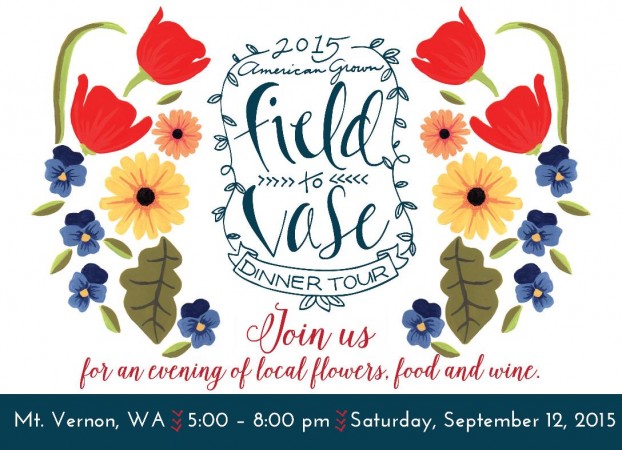
Melissa’s appearance on the Slow Flowers Podcast  is especially exciting this week because she and her work will be showcased at the next Field to Vase Dinner, set for Saturday, September 12th at Jello Mold Farm in Mt. Vernon, just north of Seattle.

Only 10 designers in the country have been invited to create the floral installation for the Field to Vase Dinner series, a very special pop-up, floral-centric dining experience pairing local flowers and local food.

Terra_Bella_Logo_plain_hires


It is fitting that Melissa is the featured designer this week because she is a longtime customer of Jello Mold Farm and the entire floral community of the Seattle Wholesale Growers Market.

You’ll hear us discuss her role in the Market’s origins as the first cooperative marketplace connecting local flower farmers with local florists.

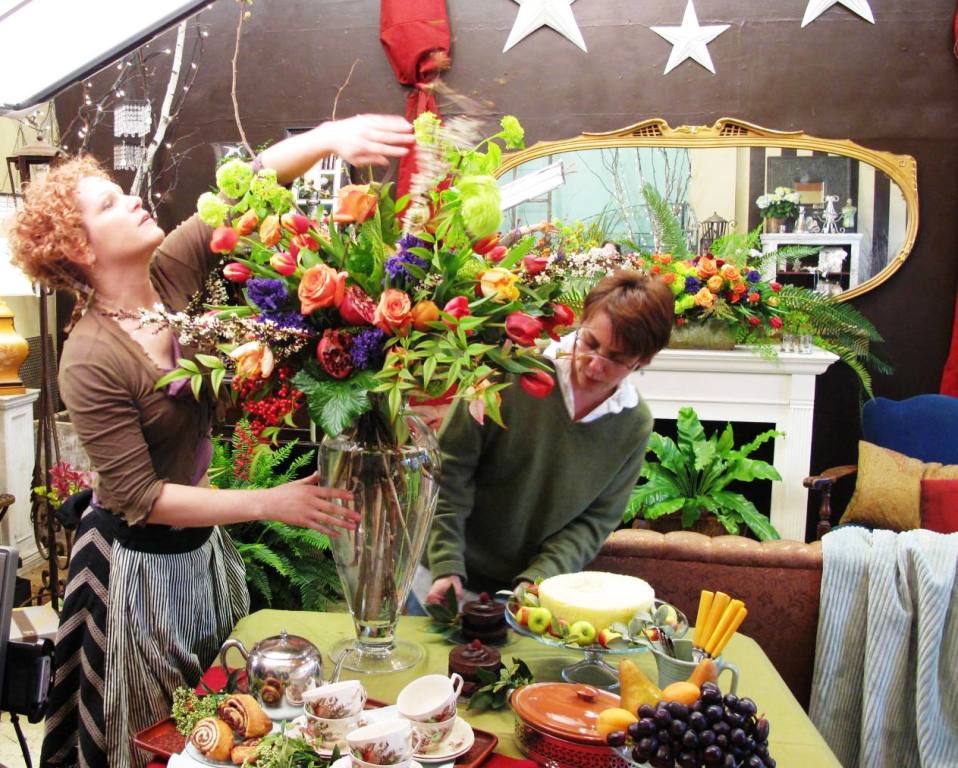
Melissa, left, on location in her Seattle shop during our stylized photo shoot for The 50 Mile Bouquet. My talented friend Jean Zaputil, right, was our stylist.

Melissa, left, on location in her Seattle shop during our stylized photo shoot for The 50 Mile Bouquet. My talented friend Jean Zaputil, right, was our stylist.

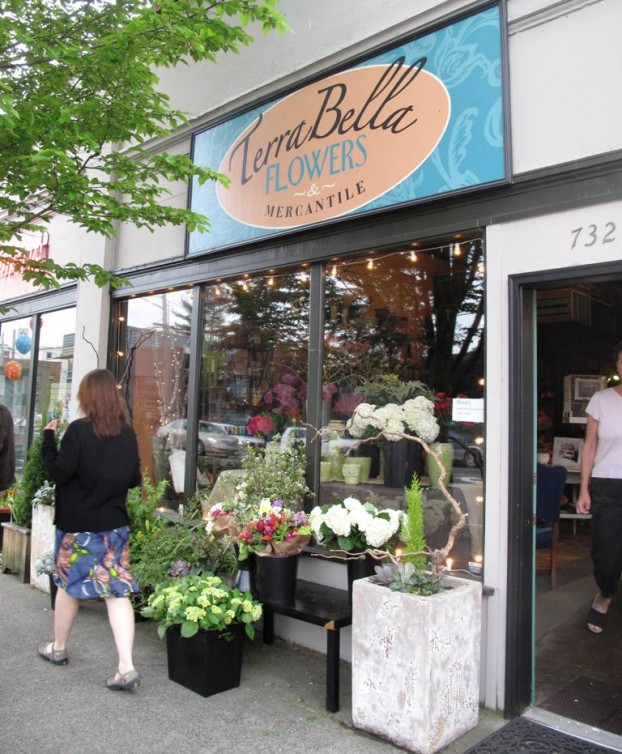
Terra Bella is located in Seattle's Phinney Neighborhood on a busy pedestrian corner.

Terra Bella is located in Seattle’s Phinney Neighborhood on a busy pedestrian corner.

The visionary of Terra Bella Flowers, Melissa combines her obsession with all things rooting and a background in Environmental Studies/Hazardous Waste Management.

After working in the field and becoming aware of the amount of pesticides used in the production of cut flowers, she realized she couldn’t consciously support the conventional side of the floral industry. Melissa created Terra Bella Flowers nearly 10 years ago to prove that the business of flowers can be a beautiful thing, from the time the seed is planted, until her bouquet arrive at your door.

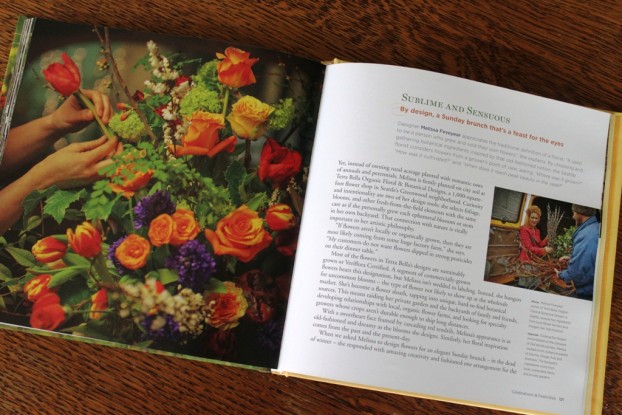
As we discuss in this episode, Melissa and her business are featured in The 50 Mile Bouquet, the book I wrote in 2012 featuring the photography of David Perry. As a special gift to you, I’ve included the free chapter called “Sublime and Sensuous,” which you can download her and read more of her story: MelissaFeveyear_The 50 Mile Bouquet Chapter

Melissa and Tutta Bella appeared in The 50 Mile Bouquet

Melissa and Tutta Bella appeared in The 50 Mile Bouquet

I began that chapter with this description of Melissa:

Curiosity and intentionality are two of her design tools; she selects foliage, blooms, and other fresh-from-the-field elements with the same care as if she personally grew each ephemeral blossom or stem in her own backyard. That connection with nature is vitally important to her artistic philosophy.

“If flowers aren’t locally or organically grown, then they are most likely coming from some huge factory farm,” she said. “My customers do not want flowers dipped in strong pesticides on their dinner table.”

Melissa has been a fabulous supporter of Slowflowers.com from the moment it was just an idea of mine. She has contributed her time and talents, appearing on the 2014 Indiegogo campaign video that helped raise more than $18,000 to launch the online directory (see above).

We’ve also teamed up to promote Slow Flowers on local television and at special events — and I know you’ll find Melissa and her story inspiring.

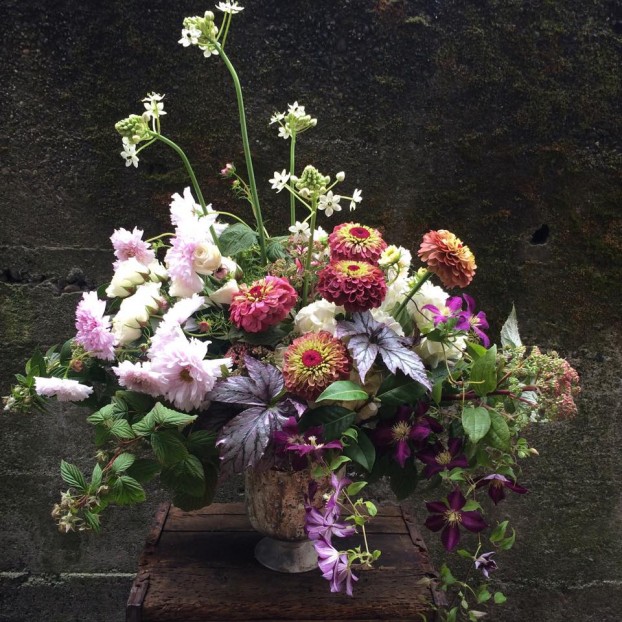
Another lovely seasonal floral arrangement from Terra Bella Flowers.

Another lovely seasonal floral arrangement from Terra Bella Flowers.

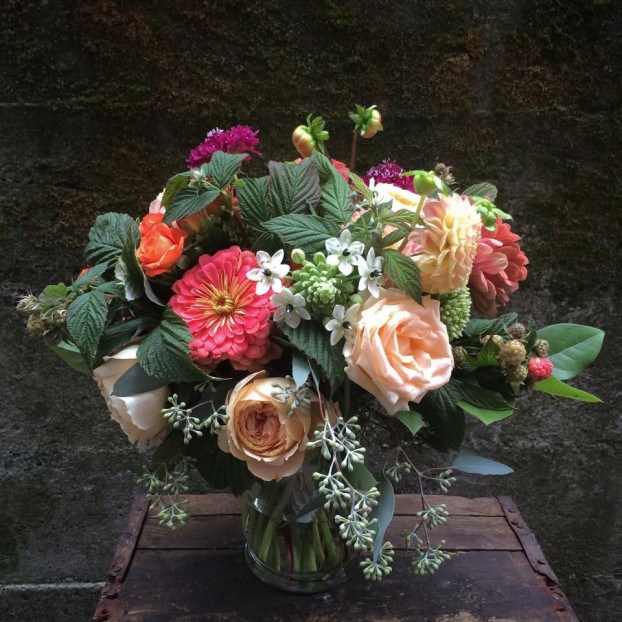
A lush, seasonal summer bouquet from Terra Bella Flowers.

A lush, seasonal summer bouquet from Terra Bella Flowers.

Here’s how you can connect with Melissa and Terra Bella Flowers:

Terra Bella Flowers on Facebook

Terra Bella Flowers on Instagram

Greater Seattle Floral Association

In August, Melissa and I did a pre-F2V Dinner walk-through of Jello Mold Farm with flower farmers Diane Szukovathy and Dennis Westphall - don't they all look happy in the flower fields?

In August, Melissa and I did a pre-F2V Dinner walk-through of Jello Mold Farm with flower farmers Diane Szukovathy and Dennis Westphall – don’t they all look happy in the flower fields?

Seattle-page-001Thanks for joining me today. If you’re in the Northwest and you want to experience the magic of Melissa’s Northwest Gothic floral installation at the September 12th Field to Vase Dinner, there’s still time. A few tickets are still available and I can’t wait for you to be part of the evening on a flower farm. Follow the link to reserve your seat at the table and use the special discount code SLOWFLOWERS to enjoy a $35 discount when purchasing your ticket.

Episodes of the Slow Flowers Podcast have been downloaded more than 63,000 times and I thank the progressive floral community for supporting this endeavor. It is nothing short of inspiring to see the listenership increase each week – and we have received only 5-star reviews on iTunes, 22 in all.

Until next week, you’re invited to join me in putting more American grown flowers on the table, one vase at a time. And If you like what you hear, please consider logging onto Itunes and posting a listener review. THANK YOU to each and every one of you for downloading, listening, commenting and sharing. It means so much.

The content and opinions expressed here are either mine alone or those of my guests alone, independent of any podcast sponsor or other person, company or organization.

The Slow Flowers Podcast is engineered and edited by Andrew Wheatley and Hannah Holtgeerts. Learn more about their work at shellandtree.com.
SLOW FLOWERS Goes to Washington, D.C.

Saturday, September 5th, 2015

This was a red-letter week! For so many wonderful reasons, which all involve flowers, farming and gardening. Rather than write too much, I’m going to let the photos do the talking:

WHITE HOUSE KITCHEN GARDEN

lets_move_logoOn Tuesday, four of us achieved one of those “bucket list” goals!

Yes, we received permission to photograph the White House Kitchen Garden and its champion, Deb Eschmeyer, head of the First Lady’s “Let’s Move” program.

I am so grateful for the people who helped make this happen, including my friends at Certified American Grown and the First Lady’s communications and Let’s Move staff.

With James Baggett, editor of Country Gardens; Nick Crow, the magazine’s art director and photographer Bob Stefko, like me, a frequent freelance contributor to the title, I spent an amazing two hours at this very important kitchen garden. Look for my story in 2016 in the pages of Country Gardens!

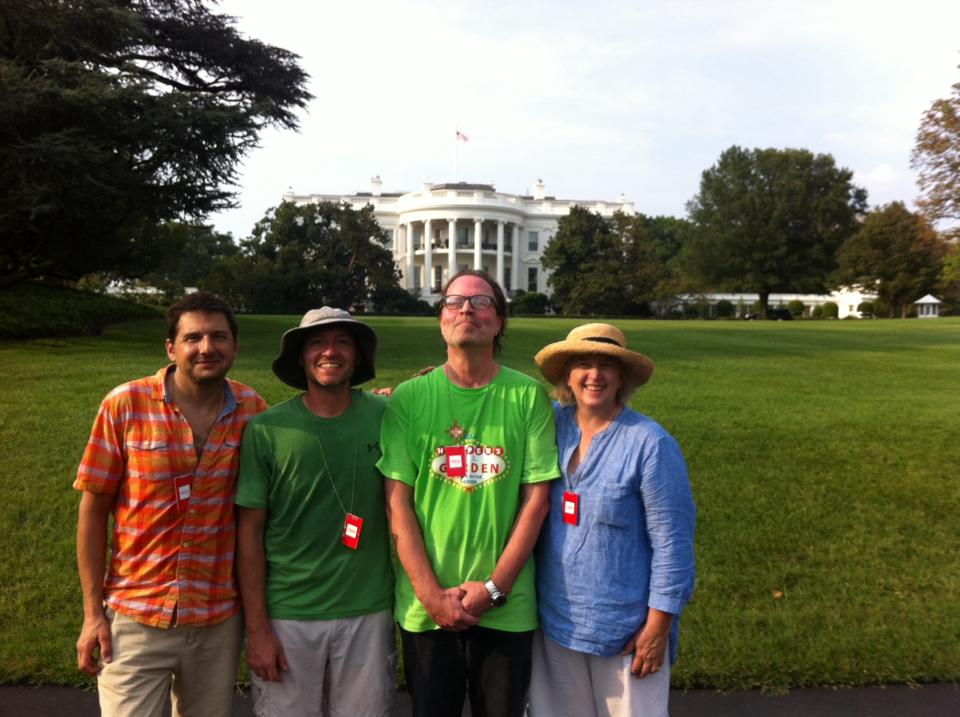
Yes, here we are! Bob Stefko (photographer); Nick Crow (art director); James Baggett (editor) and me -- after our whirlwind 2-hour photo shoot at the White House Kitchen Garden!

Yes, here we are! Bob Stefko (photographer); Nick Crow (art director); James Baggett (editor) and me — after our whirlwind 2-hour photo shoot at the White House Kitchen Garden!

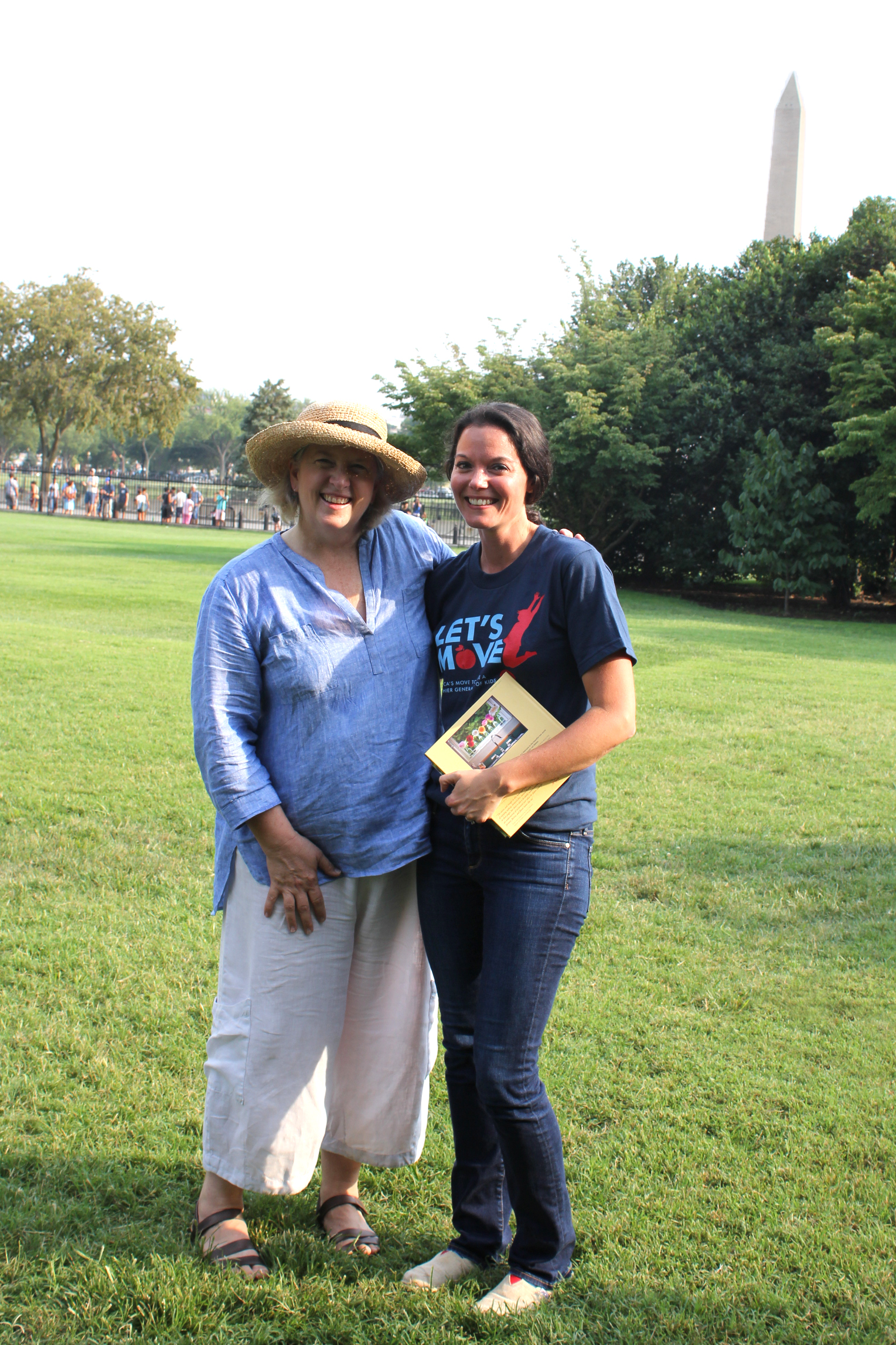
Here I am with Deb Eschmeyer, the new director of the First Lady's "Let's Move Program," at the Kitchen Garden which is part of the program she manages. Notice, I've just given her signed copies of The 50 Mile Bouquet and Slow Flowers. Hopefully, they will inspire!

(c) Nick Crow; Here I am with Deb Eschmeyer, the new director of the First Lady’s “Let’s Move,” at the Kitchen Garden which is part of the program she manages. Notice, I’ve just given her signed copies of The 50 Mile Bouquet and Slow Flowers. Hopefully, they will inspire!

IMG_0989

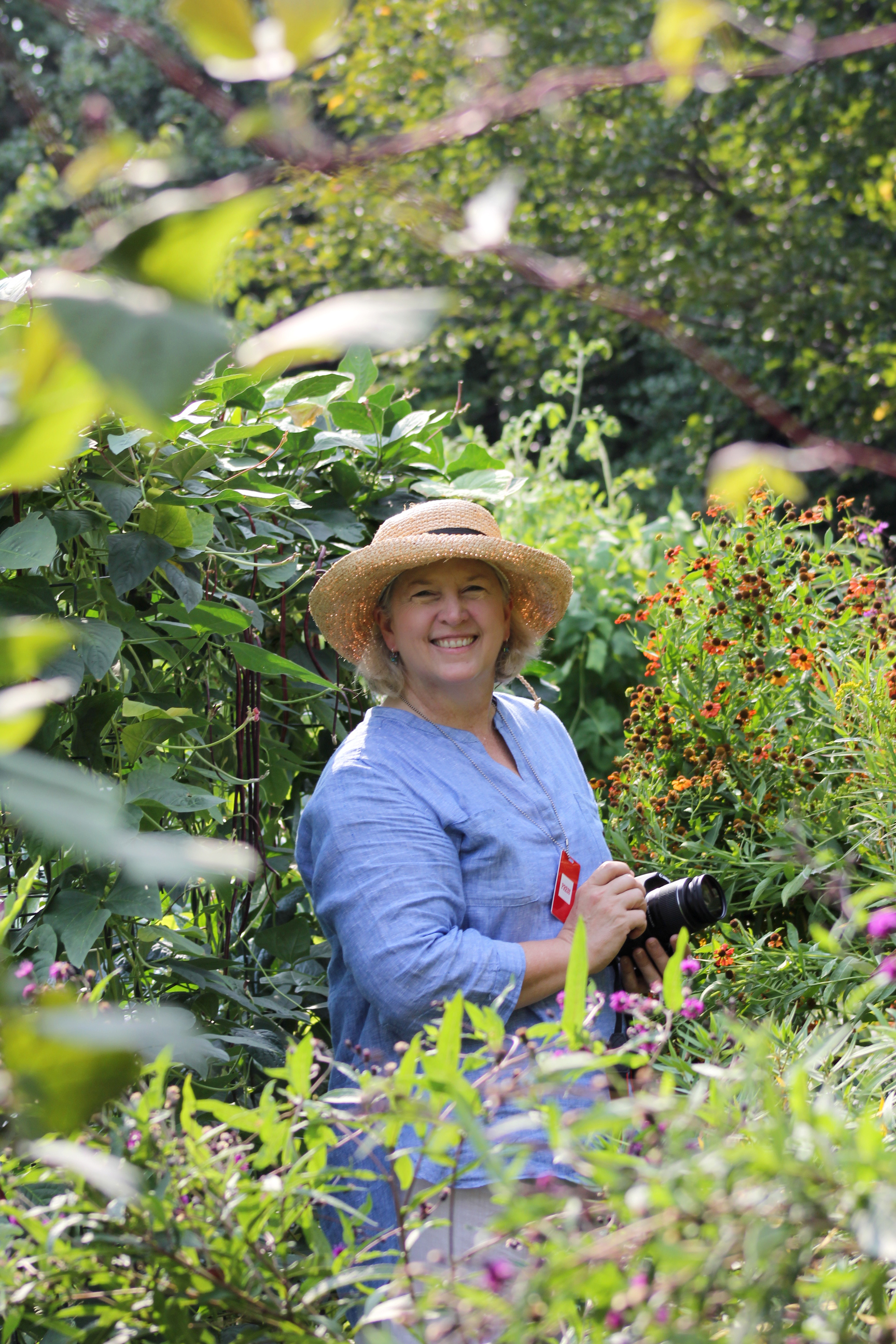
(c) Nick Crow. I am seriously in a dream state here. None of us could believe what we were experiencing!

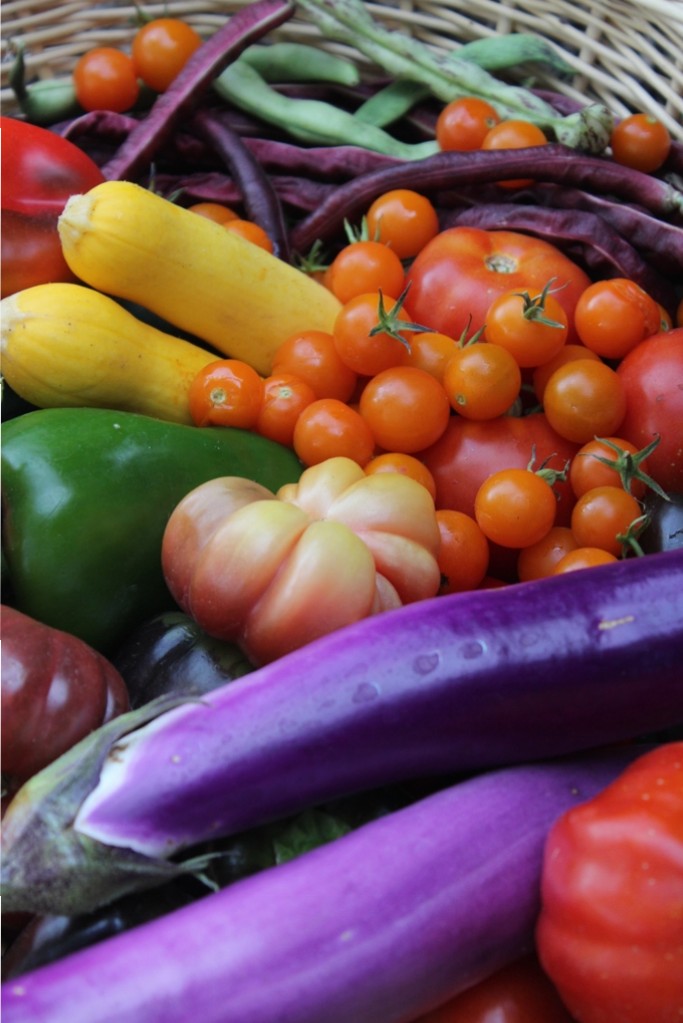
A rainbow of just-harvested organic veggies from the White House Kitchen Garden, just steps from the First Family's residence!

A rainbow of just-harvested organic veggies from the White House Kitchen Garden, just steps from the First Family’s residence!

FARMER-FLORIST PHOTO SHOOT WITH ANDREA GAGNON

On Wednesday, Nick Crow and Bob Stefko joined me at LynnVale Farm + Studios, a Certified American Grown flower farm where we photographed a story with farmer-florist Andrea Gagnon.

It was such a fantastic opportunity to capture Andrea’s farming and design talents. I can’t show you the beautiful bouquets she created because we’re saving them for the print story in Country Gardens, but I can share some lovely flower and farm pics with you. This will be an inspiring and instructional story – you’ll see it in a future issue of the magazine!

With Slowflowers.com member Andrea Gagnon of LynnVale Farm and Studios, on location with Country Gardens magazine (c) Nick Crow

With Slowflowers.com member Andrea Gagnon of LynnVale Farm and Studios, on location with Country Gardens magazine (c) Nick Crow

READ MORE…

NYC Event Maestro David Beahm Adds Flower Farming to His Repertoire (Episode 209)

Tuesday, September 1st, 2015
David Beahm (c) Heidi Chowen

David Beahm (c) Heidi Chowen

I was in New York City in late August for the fifth Field to Vase Dinner, held at The Brooklyn Grange.

DV Flora, a major floral wholesaler and an event sponsor, sent one of its top customers as a guest to Field to Vase.

I found out in advance that their guest was none other than David Beahm. I couldn’t resist. I reached out and invited myself to his studio, asking whether we could record an episode of the Slow Flowers Podcast. And, lucky for you, he said YES!

While I don’t really know David, we are somehow friends on Facebook, so I’m well aware of his creative endeavors.

I think we connected after I gave a presentation about the Slow Flowers Movement at the 2014 Chapel Designers Conference in NYC.

Holly Chapple, founder of Chapel Designers, has involved David in her conferences and during the year I was there, the 75-plus participants gathered at David’s giant production and prop warehouse in the Bronx where they created floral samples for The Knot Dream Wedding.

I watched David in action and was thoroughly impressed by the scale on which he works. Plus, he is just a gracious and kind human being. I watched that, too.

web_db_03-Experiences-V Black

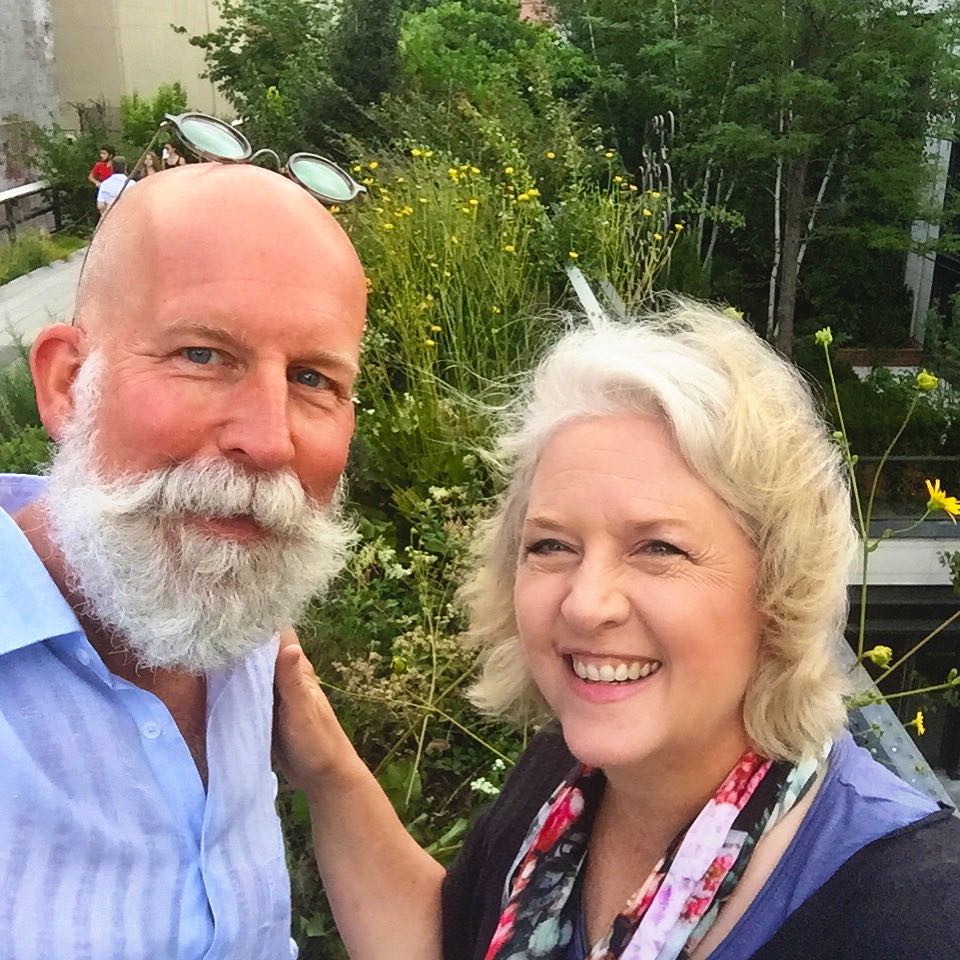
David took our selfie at the Highline after our podcast interview.

David took our selfie at the Highline after our podcast interview.

So two weeks ago, I took a combination of two subways and a bus and ended up at the headquarters for David Beam Experiences, quite close to the now-iconic Highline Public Garden.

What was once Manhattan’s gritty meatpacking district is now populated by high-rent galleries, fine restaurants, designer shops and creatives like Mr. Beam. It was a heady experience just to walk past the Dianne von Furstenburg shop and the Whitney Museum of American Art.

I arrived and rode the elevator to the 11th floor of what probably was once a warehouse but is now a sleek, uber-modern complex, entering David Beam’s atelier where I was warmly welcomed. We were seated in his light-filled office with eclectic furnishings and a comfortable sofa. That’s where we recorded this interview.

READ MORE…

Week 34 // Slow Flowers Challenge

Thursday, August 27th, 2015
Please meet 'Sierra Glow' - isn't she adorable?

Please meet ‘Sierra Glow’ – isn’t she adorable?

'Sierra Glow' detail - sigh.

‘Sierra Glow’ detail – sigh.

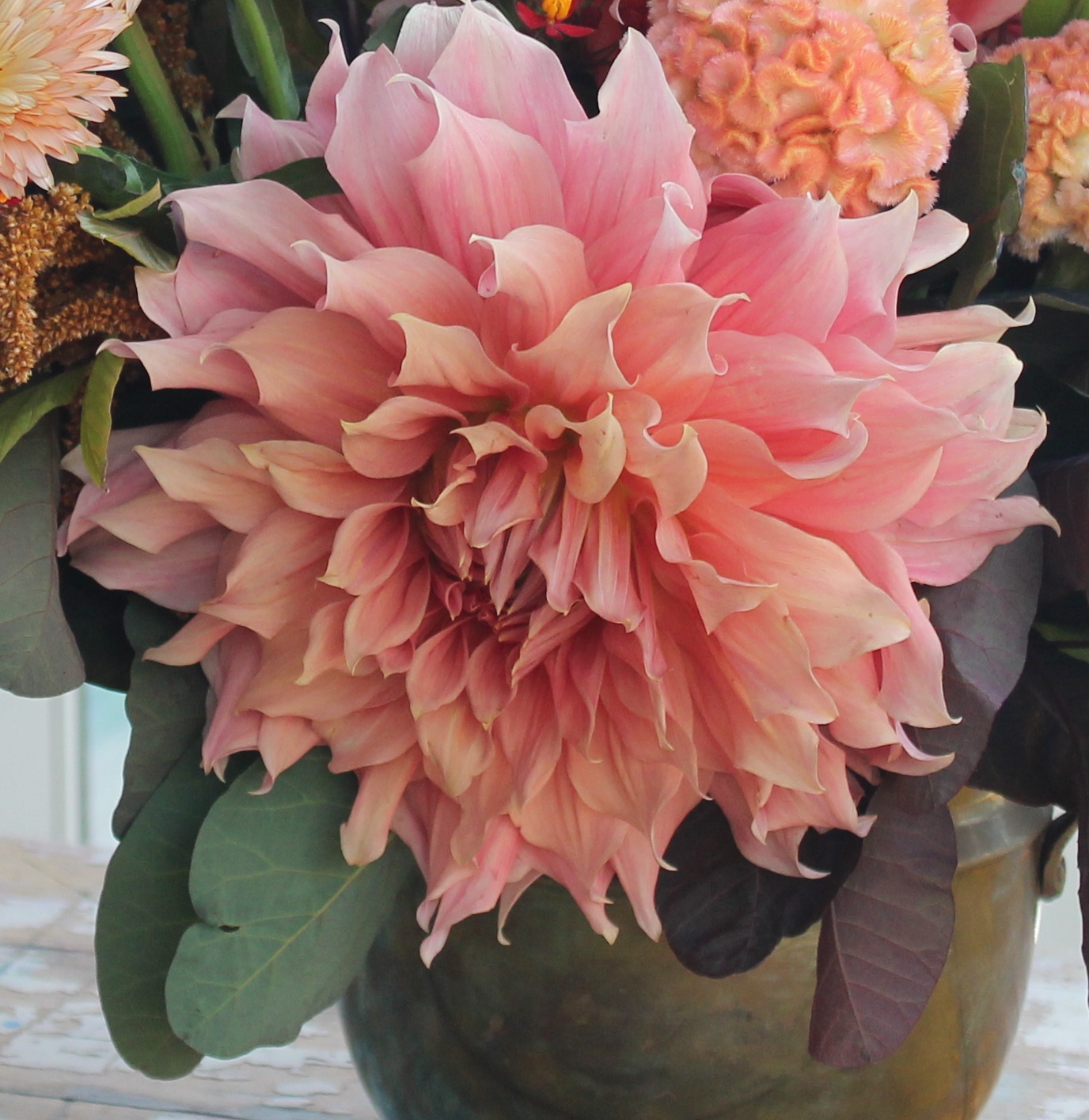
Everybody loves the ‘Cafe au Lait’ dahlia for its showy yet ephemeral beauty, right? This week, I met Miss Cafe’s richer-toned cousin, ‘Sierra Glow’.

My new love has petals that have hints of copper, coral, melon and amber, all rolled into one yummy hue. Dan Pearson of Dan’s Dahlias describes it this way on his website: “Large orange-bronze blooms on strong stems. Very impressive in the garden.”

I picked up a plump bunch of ‘Sierra Glow’ dinner-plate dahlias grown by Jello Mold Farm this week and from there, all the pieces fell into place with the moody late-summer/not-quite-fall palette.

With our recent move and purging of “stuff,” I’ve discovered that many of my wonderful vases and containers are boxed up in the storage unit. But this cool brass planter, from Goodwill, serves the purpose perfectly.

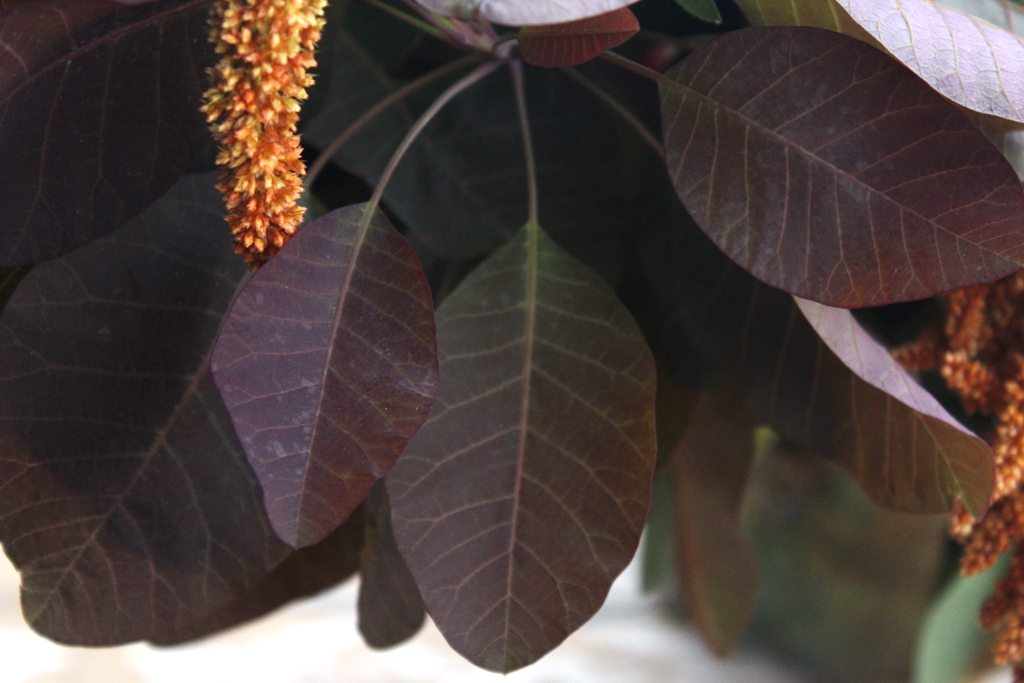
Gotta love this deep burgundy smokebush foliage!

Gotta love this deep burgundy smokebush foliage!

Here’s the recipe:

Supplies: 1 brass planter, measuring and 1 vintage cage-style flower frog

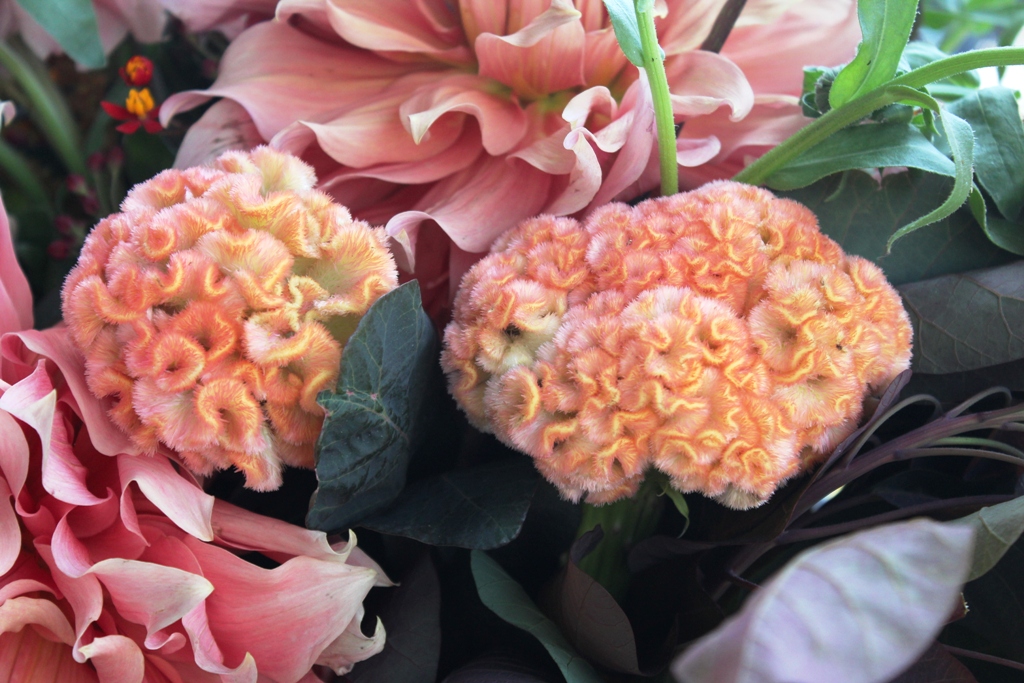
Okay, you had me at coxcomb!

Okay, you had me at coxcomb!

Botanicals:

Smoke bush (Cotinus coggygria ‘Royal Purple”), grown by Jello Mold Farm

Milkweed (Asclepias sp.), grown by All My Thyme

Velvety coxcomb celosia in pale apricot, grown by Peterkort

I believe this Calendula is in the Zeolights series.

I believe this Calendula cultivar is called ‘Zeolights’.

Calendula in the most perfect milky-gold hue, grown by Ojeda Farms

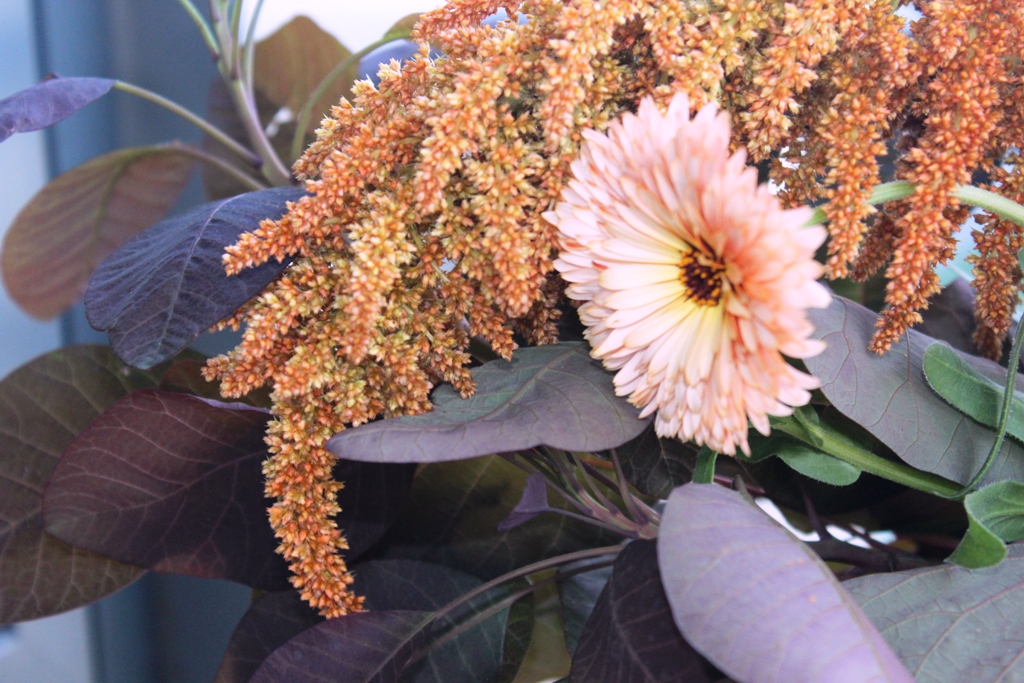
Golden amaranth with such gorgeous form

Golden amaranth with such gorgeous form

Upright bunches of golden amaranth, grown by Jello Mold Farm

‘Sierra Glow’ dinnerplate dahlias, grown by Jello Mold Farm

Grower Wisdom with Flower Farmer Charles Little (Episode 207)

Tuesday, August 18th, 2015
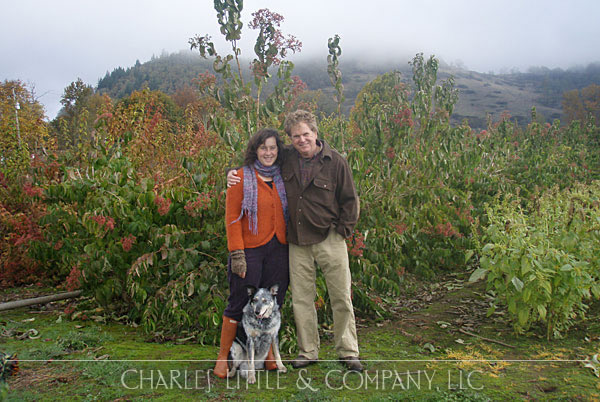
Flower Farmers Bethany and Charles Little

Flower Farmers Bethany and Charles Little

charles-little-and-companyI first met today’s guest, Charles Little, on a sunny day in June 2010, at a gathering of about 60 growers and floral designers who came to the bucolic fields of Charles Little & Co.’s farm on Seavey Loop Road outside Eugene, Oregon.

We were there for a regional meeting of the Association of Specialty Cut Flower Growers.

The full day of farming discussions, a fabulous barbecue and connecting with friends, new and old, ended with a conversation that led to the establishment of the Seattle Wholesale Growers Market the following year. My presence there also gave me a chance to witness the character and generosity of Charles and Bethany Little, our hosts. Later, I wrote these opening lines about the Charles Little & Co. farm, in a section of The 50 Mile Bouquet called “Grower Wisdom.”

“As farmland matures and evolves, so do those who steward it. Just ask Charles Little, who has been tending to ornamental crops in the verdant Willamette Valley since 1986. He describes the 40 abundant acres at the foot of Oregon’s Mount Pisgah, where he and his wife Bethany grow 250 varieties of fresh flowers, fillers, wildflowers, herbs, ornamental grains and grasses, seasonal berries, pods and branches, as a “horticultural paradise with its own thriving ecosystem.” 

“I was one of those young men who wanted to create a hippy commune and be a farmer,” Charles says of his early years. “I’ve always wanted to live and make my living on the land.” More than 25 years after planting his first flower crops, he maintains that “farming is a lifestyle, a stewardship and commitment to the land and a generous consideration of all life around you, from the beneficial microorganisms and insects, to the birds and snakes.”

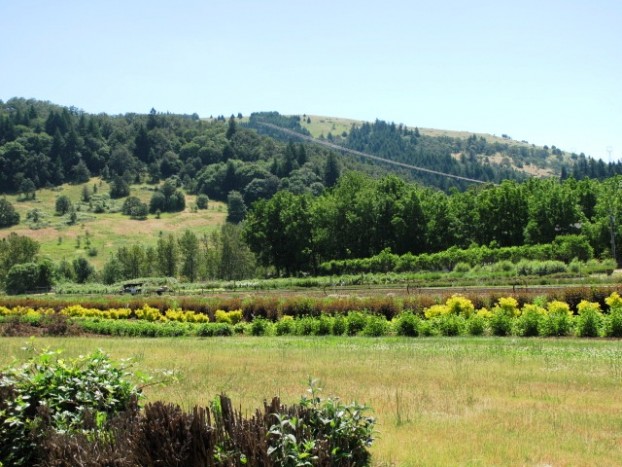
Mt. Pisgah in the distance -- a majestic backdrop for the Willamette Valley (Oregon) flower farm.

Mt. Pisgah in the distance — a majestic backdrop for the Willamette Valley (Oregon) flower farm.

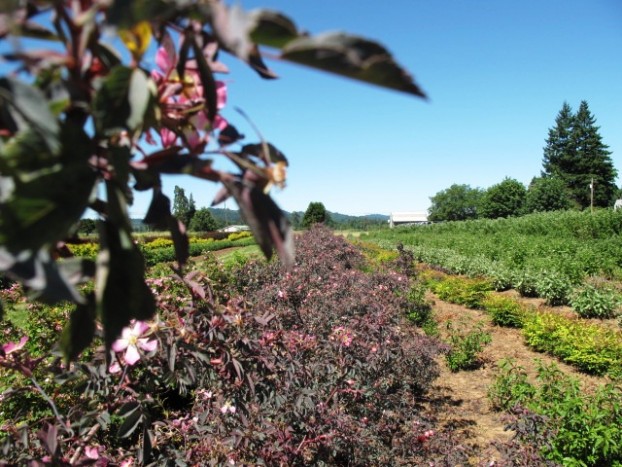
Rosa glauca in the foreground with planting rows stretching beyond.

Rosa glauca in the foreground with planting rows stretching beyond.

From that 2010 tour with Charles Little.

From that 2010 tour with Charles Little.

The farm at Charles Little & Co. consists of acres of the very best river-bottom soil along the Coast Fork of the Willamette River in Oregon.

Crops raised here include flowers and foliages of all kinds; ornamental herbs, grasses and grains, and unique sticks, pods and berries. In-season floral materials are available year round to wholesalers throughout the U.S. And they are in a word, excellent!

Charles and Bethany prefer to work in tandem with the seasons, rather than using heated greenhouses or hoop houses to jump-start or extend their harvest. “The southern Willamette Valley has a growing climate that’s hard to beat, so I cooperate with mother nature,” Charles says.

I visited Eugene on two occasions this summer, and I stopped at Charles Little & Co. farm both times. In late June, I joined a small farm tour and lunch hosted by Bethany.

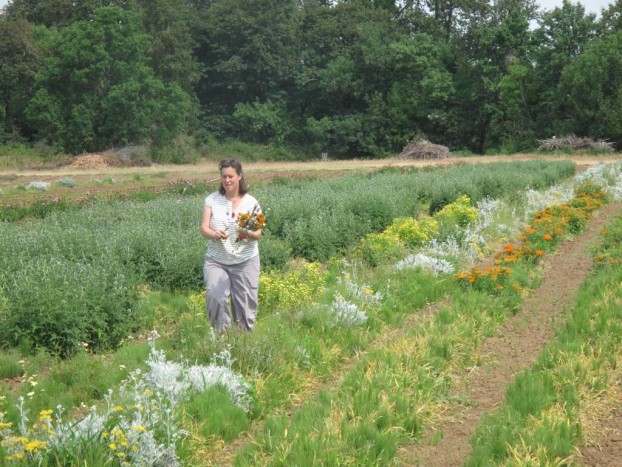
Bethany, harvesting flowers for me to arrange, June 2015.

Bethany, harvesting flowers for me to arrange, June 2015.

web_CL_IMG_4243

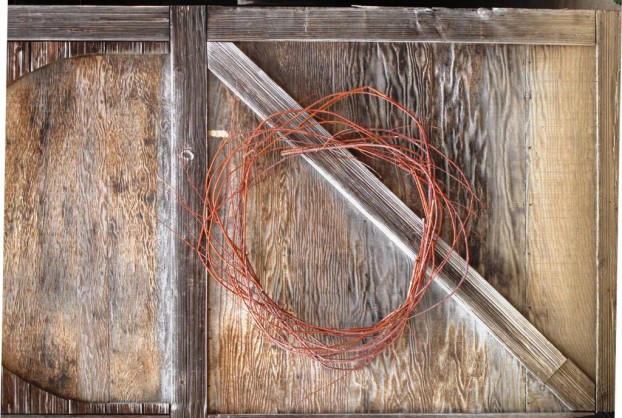
A twig wreath adorns a barn door.

She invited some floral customers and two employees who market Charles Little’s crops at the Portland Flower Market.

Bethany generously allowed a few of us to clip annuals, herbs, perennials and foliage to make a bouquet while there. It was days before I planned on launching American Flowers Week, so I was excited to create a red-white-and -blue-themed arrangement. Bethany is a gifted floral designer, so with her help, it turned out beautifull.

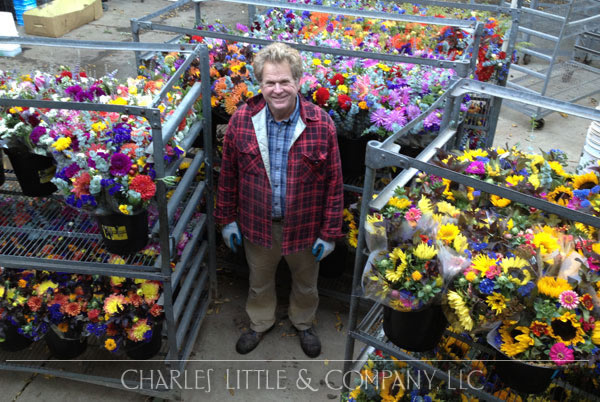
Charles Little with some of his favorite crops, ready to deliver to customers up and down the West Coast.

Charles Little with some of his favorite crops, ready to deliver to customers up and down the West Coast.

Naturalized calla lilies we discuss on the podcast.

Naturalized calla lilies we discuss on the podcast.

Charles wasn’t at the farm; he was off on an extended, once-in-a-lifetime fishing excursion. Bethany wanted me to get Charles in on the podcast interview. So I promised to record them when I knew I was going to come back through Eugene on my way to a photo shoot in Southern Oregon. But that time, Bethany was away, at a summer music festival on the Oregon coast. So I convinced Charles to let me turn on the recorder for what is a fantastic and longer-than-usual conversation.

What I realized, and what Charles and Bethany later confirmed, is that for farming couples, it’s almost impossible for both to travel or take a break from the farm TOGETHER. Someone has to feel the sheep and chickens; someone has to make sure the crops are harvested, processed, bunched or made into bouquets, loaded into buckets and delivered to the customer, right?

That’s what I witnessed during both of my visits. So today, you will hear from Charles. And I promise that sometime in the future, hopefully before the end of this year, we’ll bring Bethany on as a follow-up guest.

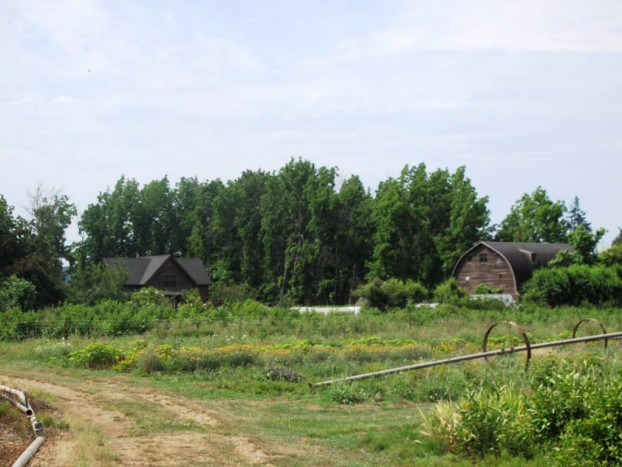
Farmhouse (left) and the soaring three-story barn (right).

Farmhouse (left) and the soaring three-story barn (right).

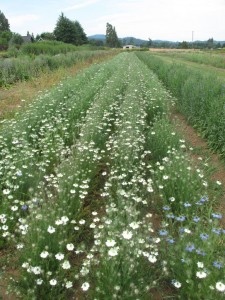
A dreamy (seemingly endless) row of white nigella.

A dreamy (seemingly endless) row of white nigella.

I know you will enjoy our conversation. It took place at the cozy kitchen table inside the hand-crafted farmhouse that’s just steps from the magnificent barn we discuss in our interview.

The flowers harvested from Charles Little & Co.’s fields satisfy demand for nearly every color, form and type of plant ingredient used by wedding, floral and event designers.

There’s always an eye-popping, seasonal assortment to choose from: flowering shrubs, colorful tree branches, evergreen boughs, and yes, a small percentage of dried flowers.

Since not all of you can visit the farm in person, as a special bonus, I’ve added a downloadable about them that appears in The 50 Mile Bouquet. Click here for the file: Grower Wisdom.
 

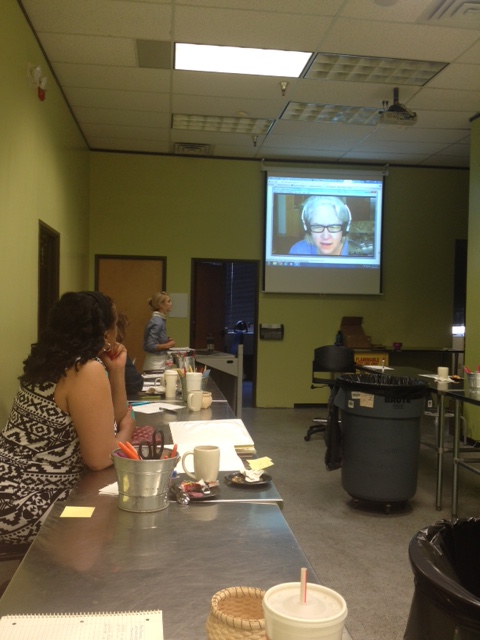
Through the power of technology, I "skype-lectured" for Morgan Anderson's Austin CC "slow flowers" class.

Through the power of technology, I “skype-lectured” for Morgan Anderson’s Austin CC “slow flowers” class.

Before I close, I wanted to give a shout-out and thank you to the fabulous students of Austin Community College’s floral design program who asked me to be a guest speaker (virtually- through the power of Skype) this week.

Their topic: Slow Flowers! The seminar was developed by instructor Morgan Anderson, a PhD candidate in floral design at Texas A&M University (yes, you heard me right) and the owner of The Flori.Culture, a design studio and Slowflowers.com member.

In addition to the Q&A with me, the students have been learning about sourcing local ingredients, specifically focusing on and using botanicals from Texas Specialty Cut Flowers, Pamela and Frank Arnosky’s famous flower farm. They are also evaluating Floral Soil and they promised to send photos of their designs for me to post in the future.

I applaud Morgan because she is leading the way to educate the next generation of floral designers in an entirely different model than most conventional floristry education programs. The enthusiasm I felt from this amazing group of students was so encouraging – and I wish them all great success in their career paths.

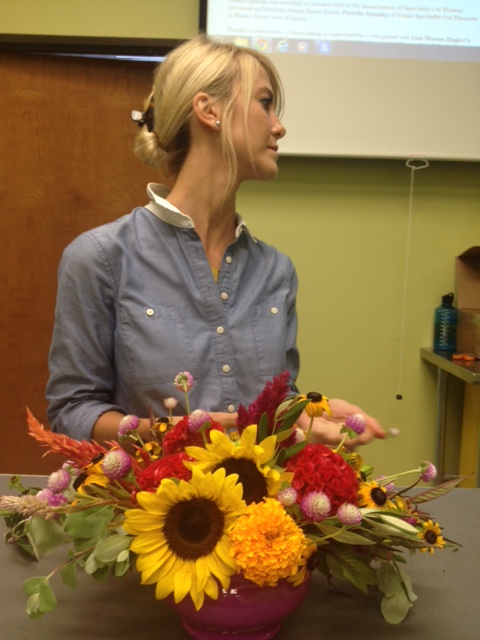
Morgan Anderson, The Flori.Culture, and Austin Community College design instructor demonstrates local Texas-grown flowers.

Morgan Anderson, The Flori.Culture, and Austin Community College design instructor demonstrates local Texas-grown flowers.

Some of the talented students creating their floral designs using eco-techniques.

Some of the talented students creating their floral designs using eco-techniques.


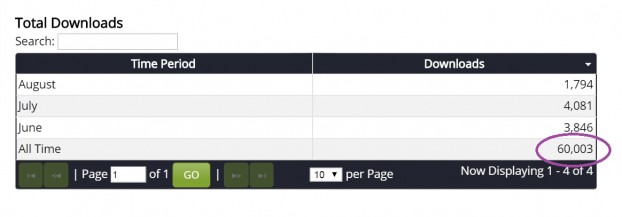
60KThis week was a highlight in another way, too. We broke the record with our 60,000th podcast download. THANK YOU to each and every one of you for downloading, listening, commenting and sharing. It means so much.

Until next week, you’re invited to join me in putting more American grown flowers on the table, one vase at a time. And If you like what you hear, please consider logging onto Itunes and posting a listener review.

The content and opinions expressed here are either mine alone or those of my guests alone, independent of any podcast sponsor or other person, company or organization.

The Slow Flowers Podcast is engineered and edited by Andrew Wheatley and Hannah Holtgeerts. Learn more about their work at shellandtree.com.