Debra Prinzing

Get the Email Newsletter!

Archive for the ‘Plants’ Category

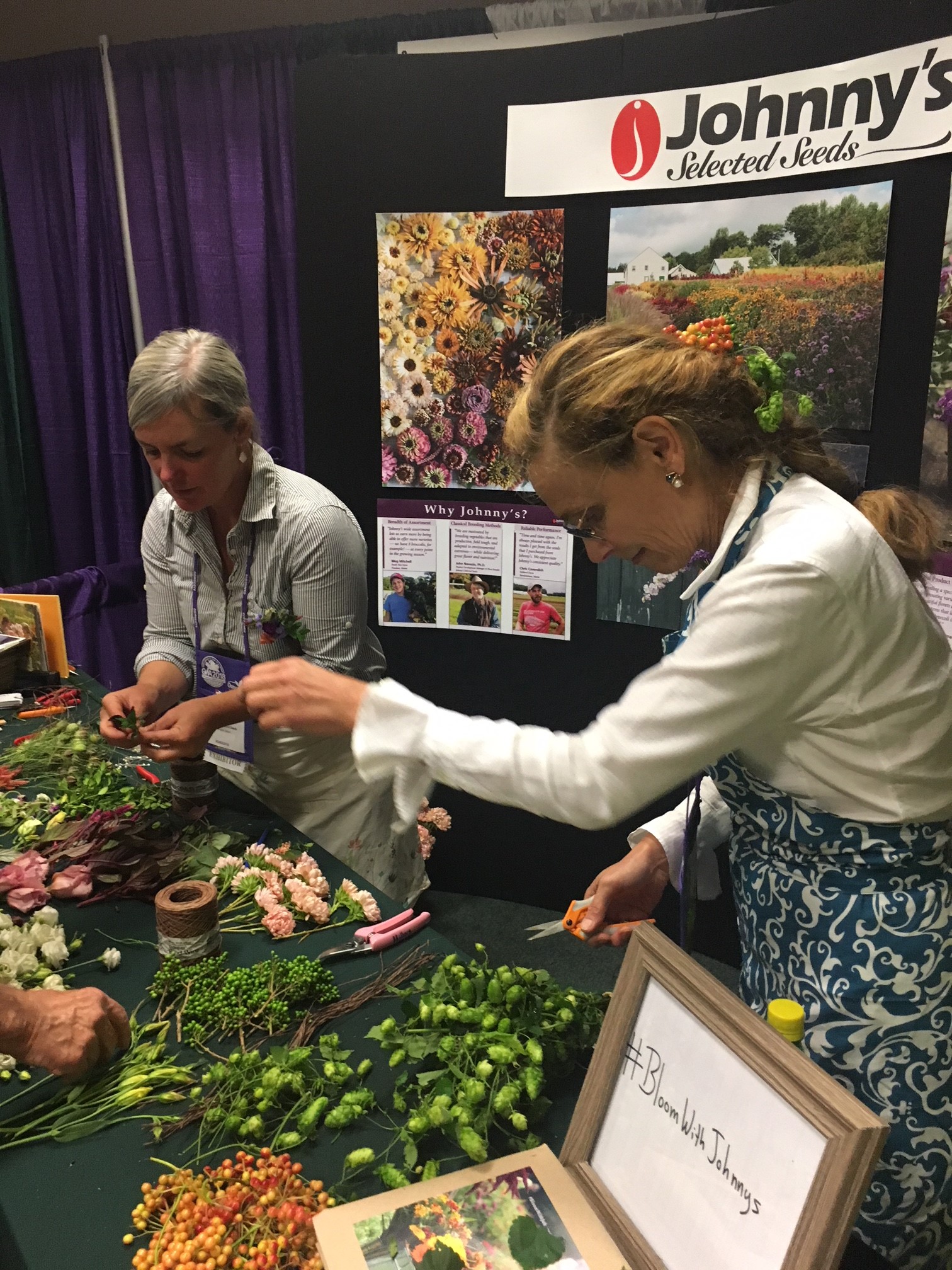
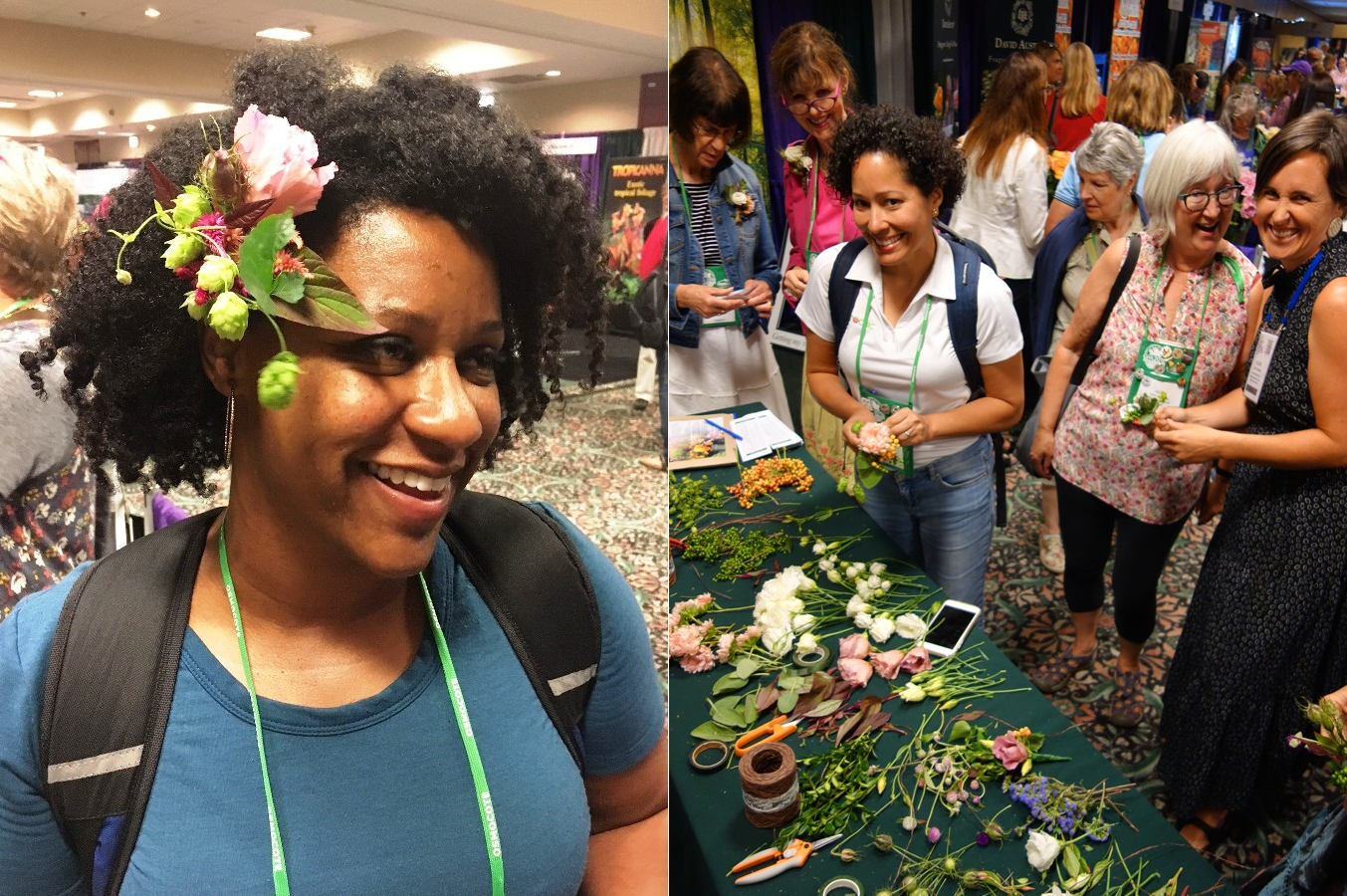
Episode 383: The Joy of Seeds with Hillary Alger, Flowers Product Manager of Johnny’s Selected Seeds

Wednesday, January 9th, 2019

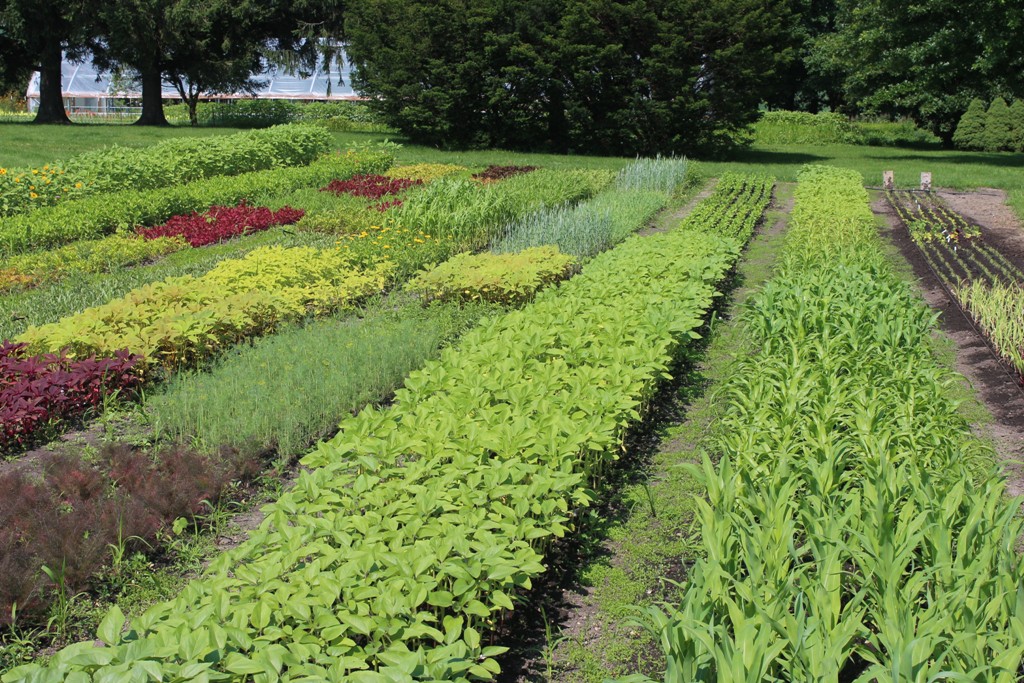
Johnny’s Seeds flower trial gardens in Maine.

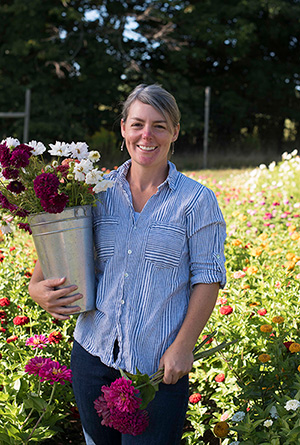
Johnny’s Seeds’ flowers product manager, Hillary Alger

If you’re a regular listener to the Slow Flowers Podcast, you know that Johnny’s Selected Seeds is one of our most supportive sponsors and partners.

I have been pestering today’s guest, Hillary Alger, Johnny’s Flowers Product Manager, to let me record an interview with her for quite a while.

We finally took time over the holiday break to jump on Skype and do it. I’m so pleased because the timing for discussing flower seeds and growing flowers is perfect.

Winter is when we all think about next season’s crops and new varieties to trial.

Whether you have a backyard cutting garden like me or a legitimate flower farm, you probably have visions of beautiful blooms dancing in your head.

And each image we see, whether it’s in a catalog or online, is enough to send our hearts racing as we add just one more variety to the wish list.

Behind-the-scenes at a Johnny’s Seeds’ studio photo shoot

Hillary is here today to discuss that process – how does an established seed company like Johnny’s, which was founded in 1973, select, trial, evaluate and bring to market thousands of varieties of vegetable, herb and flower seeds each year?

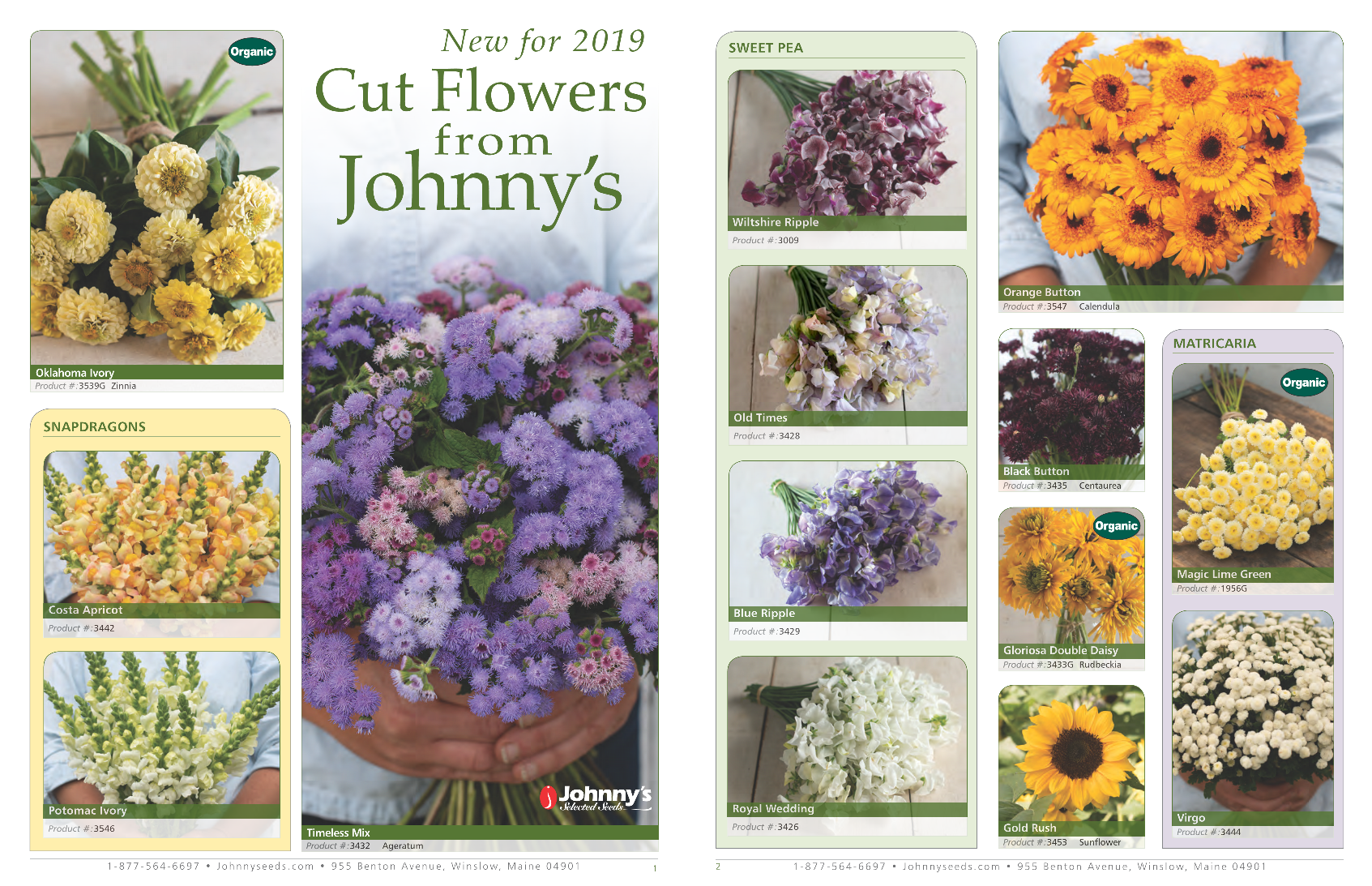
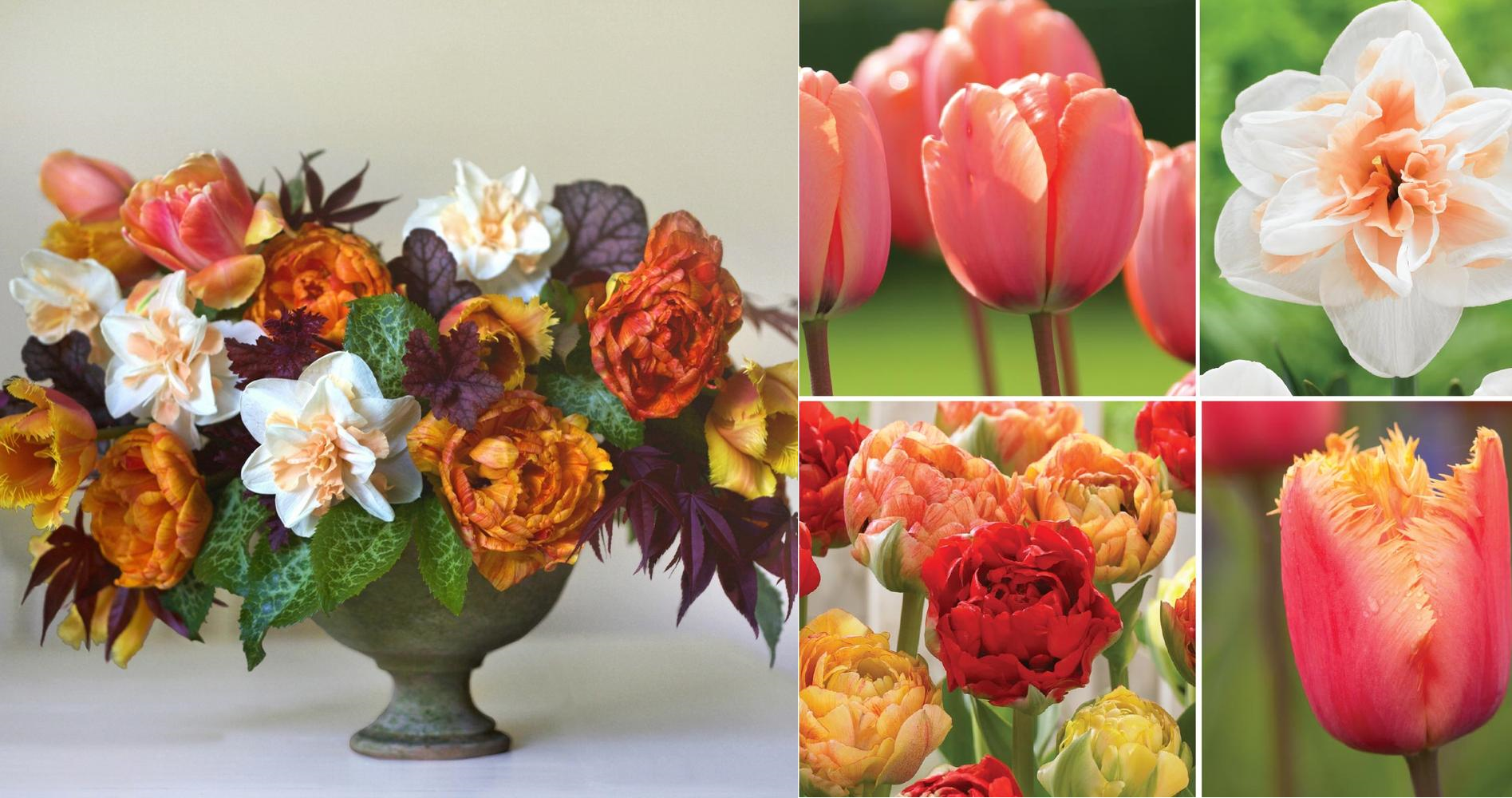
Even if you’re just a bit of a flower geek, this conversation will engage and inspire you. Hillary also discusses some of the more than 25 new annual seed varieties coming online in Johnny’s 2019 catalog, as well as the decision to reintroduce bulbs for cut flower growers. After more than a decade hiatus, the pages of Johnny’s catalog include more than 35 narcissus and tulip varieties. Click here to download a 4-pg PDF of all new new 2019 flowers.

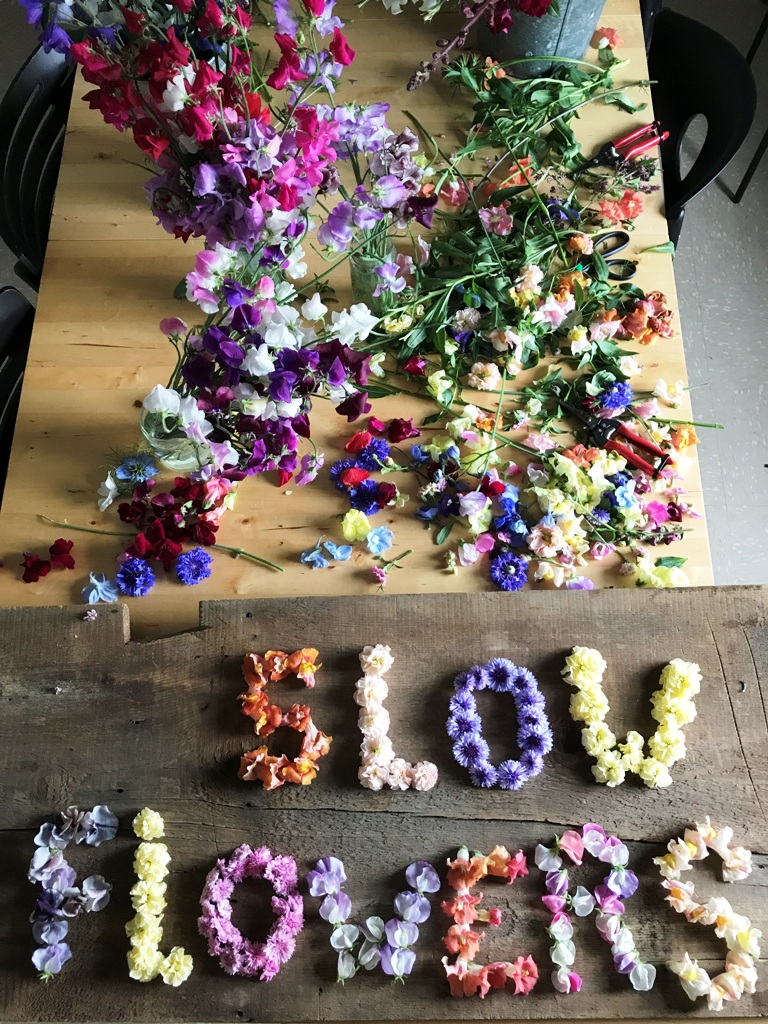
Hillary often styles photo shoots for online and print, including fun floral flat-lays.

With a fine arts background, Hillary has fused her love of painting with her career in vegetable and flower seed promotion. Here is one of her paintings of an heirloom squash.

The Slow Flowers-Johnny’s Seeds partnership is a mutually rewarding one — and I’m so grateful to bring this episode to you today. Click here to read a recent post about Growing a Cutting Garden, with more resources from Johnny’s.

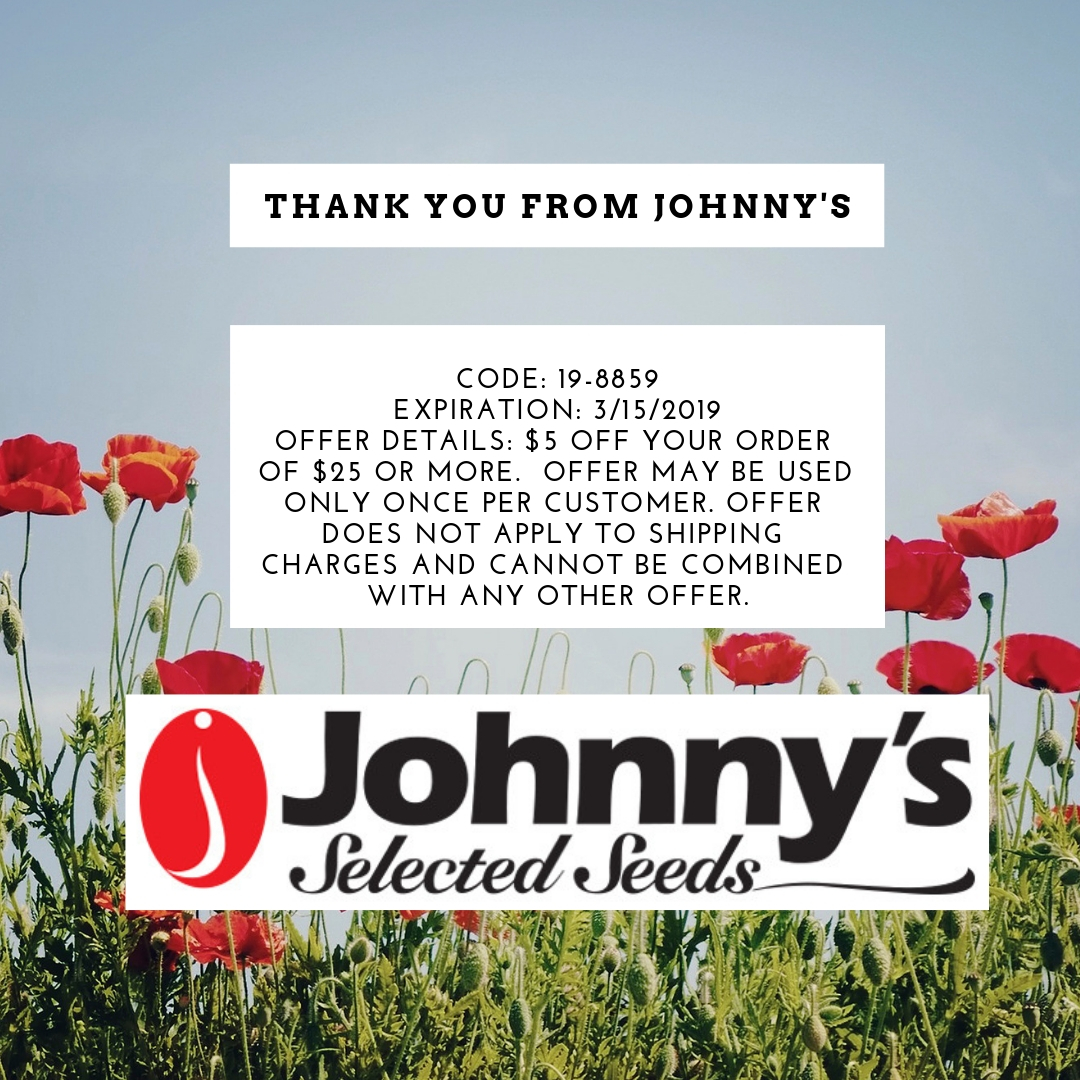
Here’s a bonus gift for listeners of this podcast — Thanks, Johnny’s!

Thank you from Johnny’s

An update about the Slow Flowers Summit:

First of all, we’ve been running an Early Bird ticket promotion for the Slow Flowers Summit 2019 and that opportunity has closed. Nearly 50 of you took advantage of the early bird pricing — and we will sell out the conference at 150 registrations.

So don’t have FOMO — you’ll want to make your way to slowflowerssummit.com to learn all about the many opportunities to join us — from flower farm tours and dinner on a flower farm to business and branding presentations to interactive and inspiring design sessions . . . all designed to serve you! Slow Flowers members will still enjoy discount pricing up until the day of the Summit. Sign up to receive updates at slowflowerssummit.com.

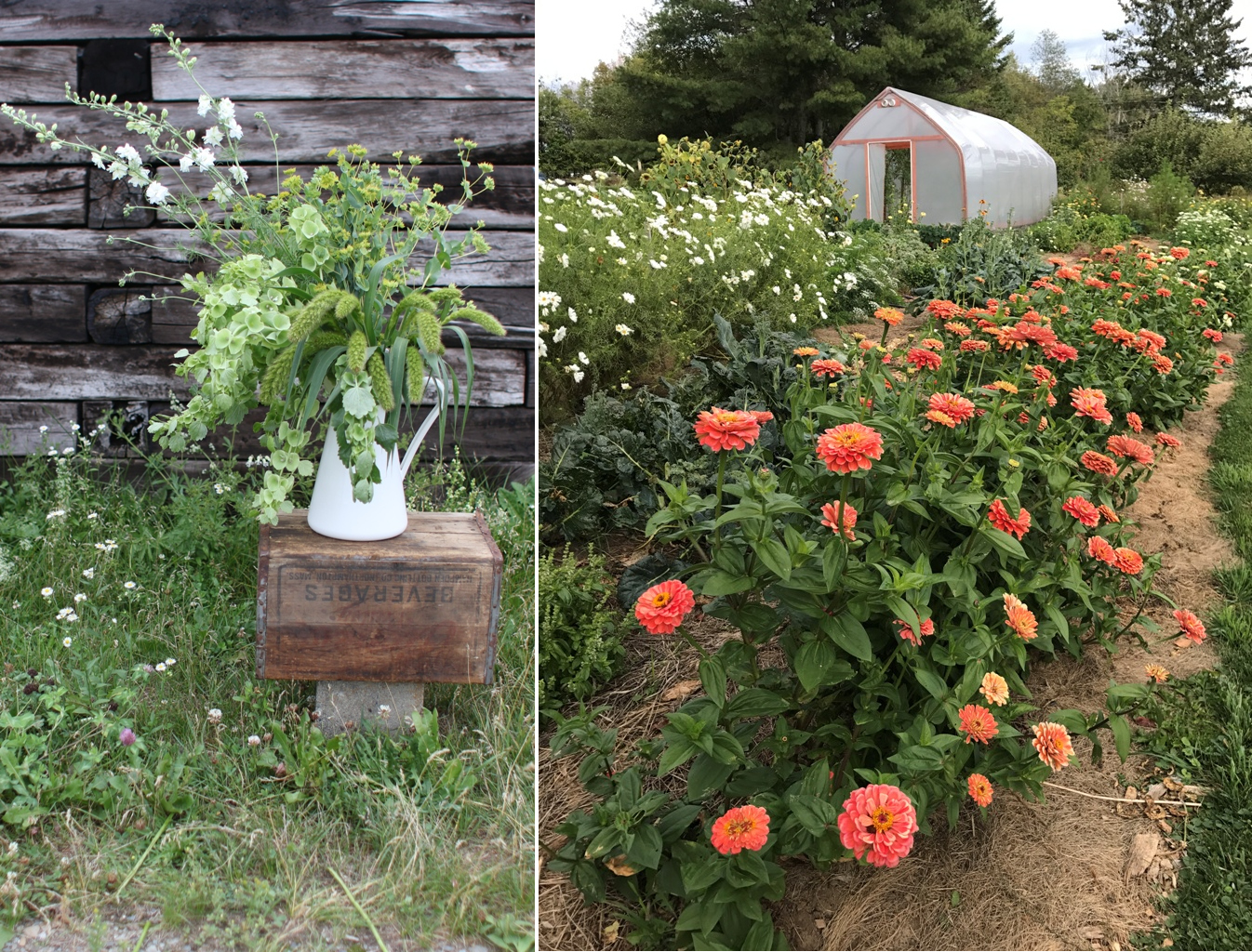
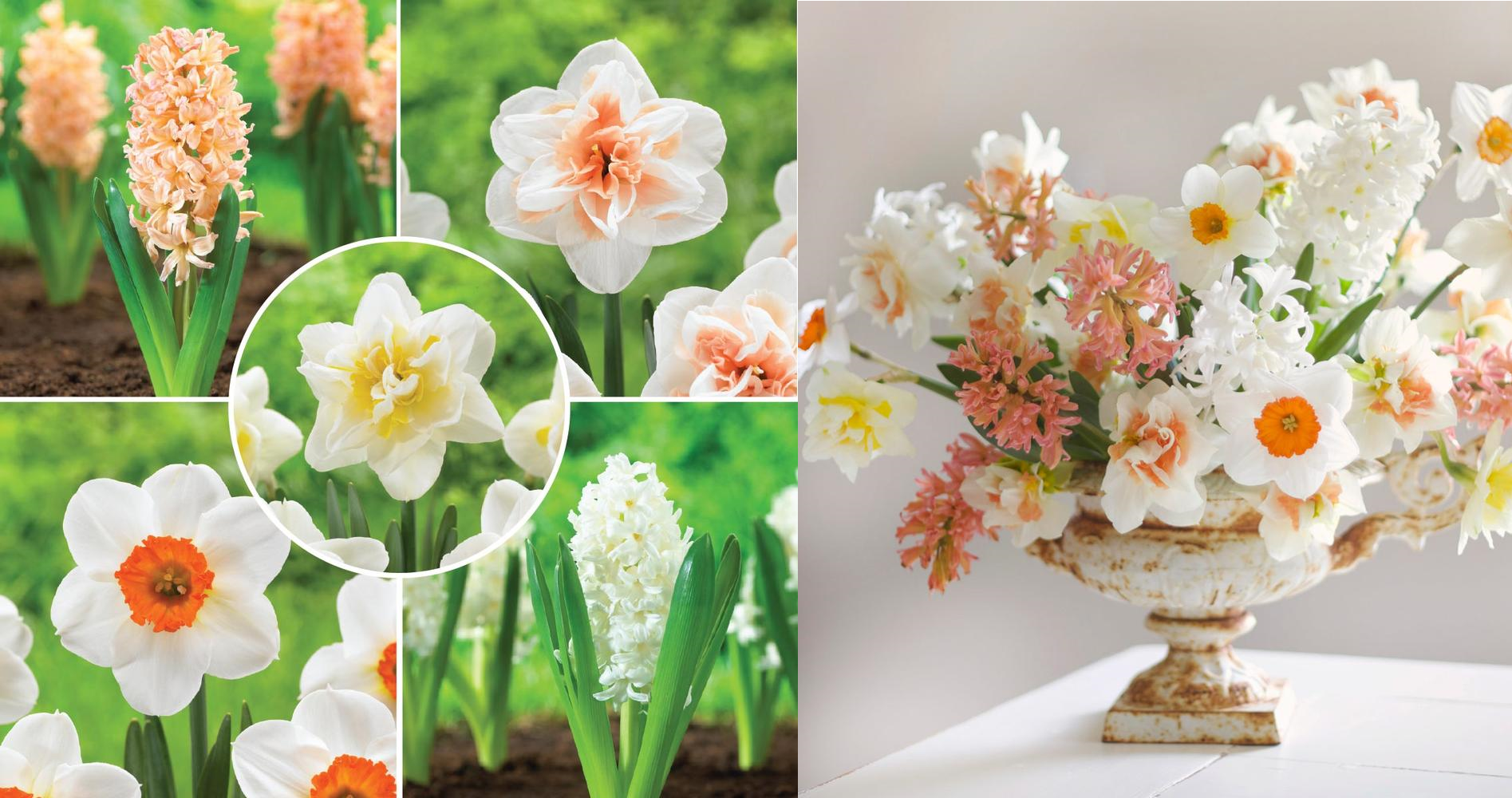
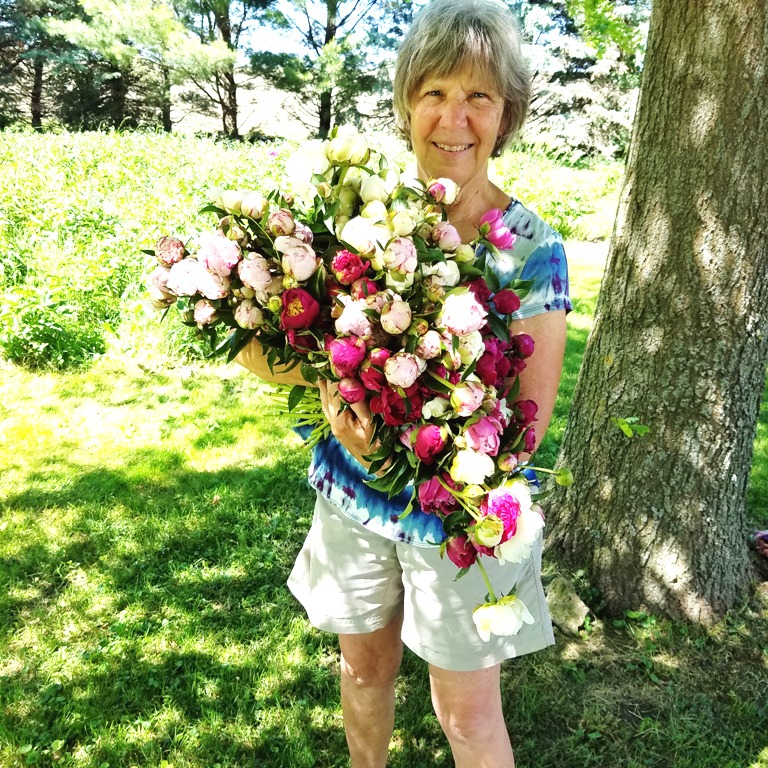
Left: A spring bouquet designed by Hillary for a Johnny’s Seeds photo shoot; right: Hillary’s home cutting garden.

We have a vital and vibrant community of flower farmers and floral designers who together define the Slow Flowers Movement. As our cause gains more supporters and more passionate participants who believe in the importance of the American cut flower industry, the momentum is contagious.

I know you feel it, too. I value your support and invite you to show your thanks and with a donation to support my ongoing advocacy, education and outreach activities. You can find the donate button in the column to the right.

The Slow Flowers Podcast has been downloaded more than 395,000 times by listeners like you. Thank you for listening, commenting and sharing – it means so much. Thank you all!

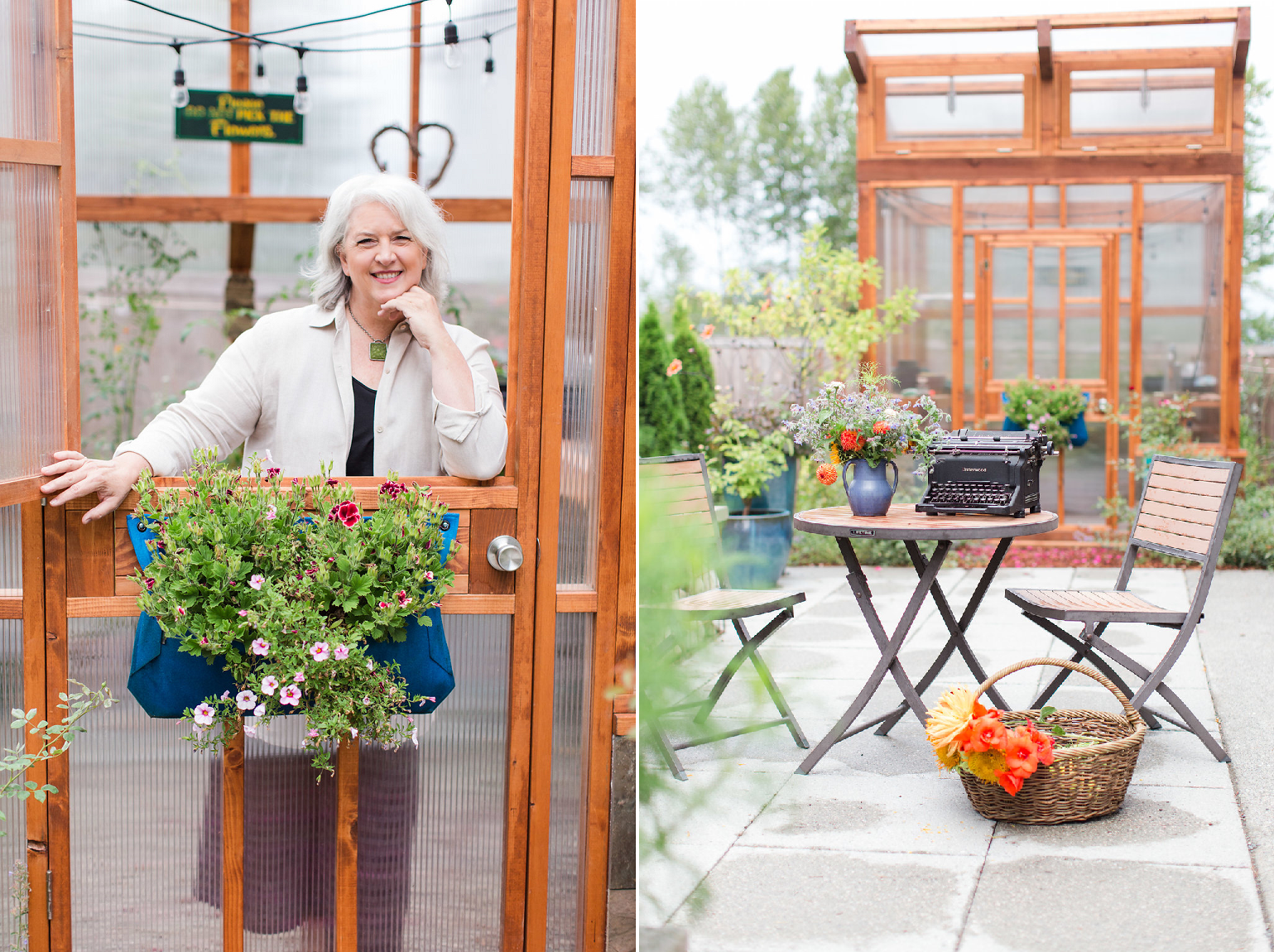
I am in love with my greenhouse, designed and built sustainably by Oregon-based NW Green Panels (c) Missy Palacol Photography

I’m Debra Prinzing, host and producer of the Slow Flowers Podcast.
Next week, you’re invited to join me in putting more American grown flowers on the table, one vase at a time. And If you like what you hear, please consider logging onto iTunes and posting a listener review.

The content and opinions expressed here are either mine alone or those of my guests alone, independent of any podcast sponsor or other person, company or organization.

The Slow Flowers Podcast is engineered and edited by Andrew Brenlan. Learn more about his work at soundbodymovement.com. 

This week’s sponsor thank-you’s:

Mayesh Wholesale Florist. Family-owned since 1978, Mayesh is the premier wedding and event supplier in the U.S. and we’re thrilled to partner with Mayesh to promote local and domestic flowers, which they source from farms large and small around the U.S. Learn more at mayesh.com.

NW Green Panels.  Based in Madras, Oregon, NW Green Panels designs and constructs a wide array of wood-framed greenhouses offering versatility, style and durabilty. They are 100% Oregon-made using twin-wall polycarbonate manufactured in Wisconsin, making NW Green Panel structures a great value for your backyard. The 8×8 foot Modern Slant greenhouse has become the essential hub of my cutting garden — check out the link in today’s show notes to see photos or visit nwgreenpanels.com.

Seattle Wholesale Growers Market, a farmer-owned cooperative committed to providing the very best the Pacific Northwest has to offer in cut flowers, foliage and plants. The Growers Market’s mission is to foster a vibrant marketplace that sustains local flower farms and provides top-quality products and service to the local floral industry. Find them at seattlewholesalegrowersmarket.com

Music Credits:

Episode 382: Slow Flowers’ 2019 Floral Insights & Industry Forecast

Wednesday, January 2nd, 2019

Welcome to the 2019 Forecast!

Happy New Year 2019!

I’ve finally put away the holiday decorations and with my thoughts already turning to the spring garden, it’s time to look to the future. Our BIG NEWS for 2019 is the launch of a one-stop web site for all-things Slow Flowers. Please visit our newly-branded site on the web — SlowFlowersSociety.com.

Check out the NEW Slowflowerssociety.com site!

It is fresh, user-friendly and gives you access to all of the Slow Flowers programs, events and channels in one place.

Why the Society? Our focus hasn’t changed. In fact our mission continues. Which is:  to change the flower sourcing practices of consumers and professionals through outreach and education that highlights the benefits of local, seasonal and domestic floriculture — and to build a movement that promotes cultivation and sales of those flowers while nurturing authentic connections between consumers, farmers, and florists.

Slowflowers.com is now part of the Slow Flowers Society underscores our inclusive community dedicated to preserving domestic floral farms and supporting safe, seasonal and local supplies of sustainablyfarmed flowers and foliage. Our members are engaged in all facets of the U.S. floral industry.

I’m excited to share highlights from the annual Slow Flowers’ Floral Insights and Industry Forecast.

This report originated in the fall of 2014, when I traveled to NYC to meet with garden and lifestyle media as part of the launch of Slowflowers.com. The publicists helping me, Lola Honeybone and Marla Kramer, suggested I produce a powerpoint presentation to help illustrate the central themes of the Slow Flowers movement. It was a great tool to walk editors and writers through our platform, and to discuss shifts taking place in the floral marketplace that directly reflected significant changes in how flowers could be grown, designed and marketed.

When 2015 rolled around just months later, I shared those insights on this Podcast — and it became the first of our annual ritual.

For each of the past five years, I have drawn from a number of sources to develop this annual forecast. Sources include hundreds of my first-person interviews for print and digital stories, input gathered from the Slow Flowers Community, conversations with past guests of the Slow Flowers Podcast and idea-exchanges with other progressive leaders in the floral marketplace — farmers, florists and design creatives — who together inspire this “floral futures” report.

I hope you find these forward-thinking resources important and valuable. I’d love to hear your feedback and suggestions. Find an expanded version of this report, including a free PDF [Download here: Slow Flowers Forecast 2019].

You can also find an executive summary of the report in the pages of the brand new January 2019 edition of Florists’ Review.

A note about our programming change for 2019. Because of so much demand — all good — from podcast sponsors, we are trying something a little different for 2018. Rather than giving you a lengthy sponsor list at the end of the show, I’ll highlight just three sponsors during the episode — at the beginning, our mid-show break – and at the end.

First up: the Association of Specialty Cut Flower Growers.

Formed in 1988, ASCFG was created to educate, unite, and support commercial cut flower growers.

Its mission is to help growers produce high-quality floral material, and to foster and promote the local availability of that product.

Learn more at ascfg.org. And check out the web site for details about the upcoming Focus on the Business of Cut Flowers Conference, set for Feb 18-19 in Denver.

Seven of the experts presenting at the conference are past guests of the Slow Flowers Podcast, so you’ll recognize some familiar names and topics in the lineup!

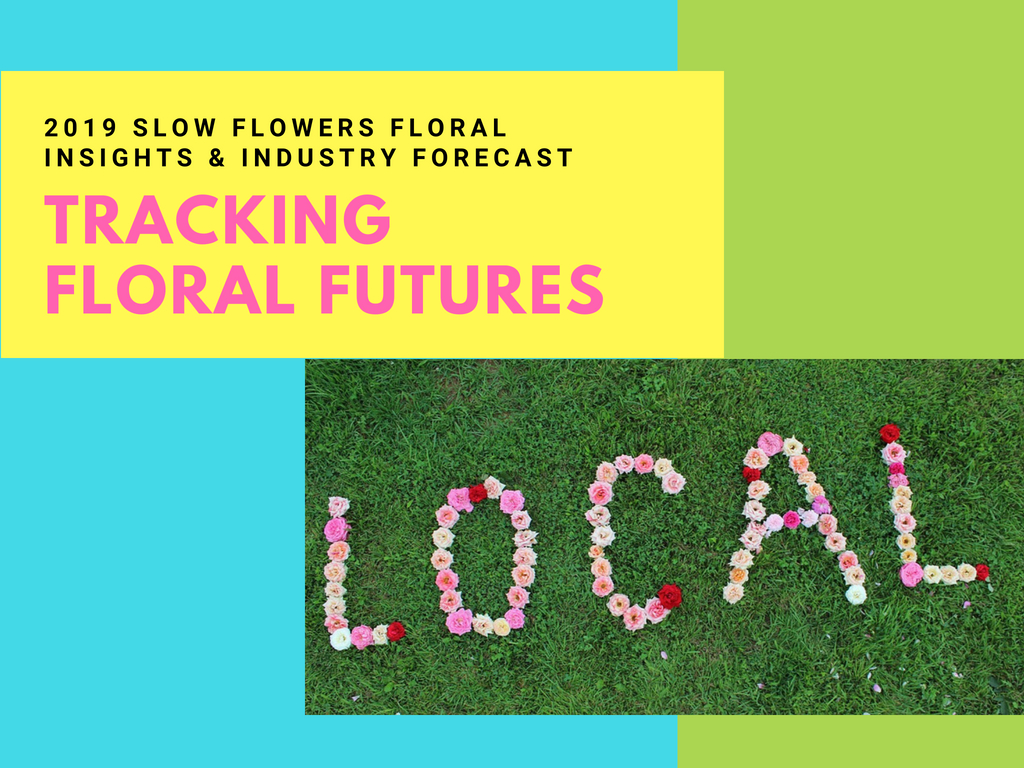
The title of this year’s 2019 Slow Flowers’ Floral Insights and Industry Forecast is TRACKING FLORAL FUTURES

I know you’ll agree with me that the floral professional’s role is to connect consumers with the natural world through artistry and design. So it’s no surprise that this year’s emerging themes include ideas and concepts that strengthen community ties with values-driven consumers, as well as nurture entrepreneurial innovation in horticulture and floriculture. If you’re an “early adopter,” these concepts may resonate or reinforce your current approach to sustainable design.

In recent months, I’ve shared many of these ideas at top industry venues, including Hitomi Gilliam’s Trend Summit 2018, the Association of Specialty Cut Flower Growers‘ annual conference and the Southern Flower Symposium. I’ll also share this report at an upcoming member-only event for the Seattle Wholesale Growers Market on Jan 23rd. Find more details here.

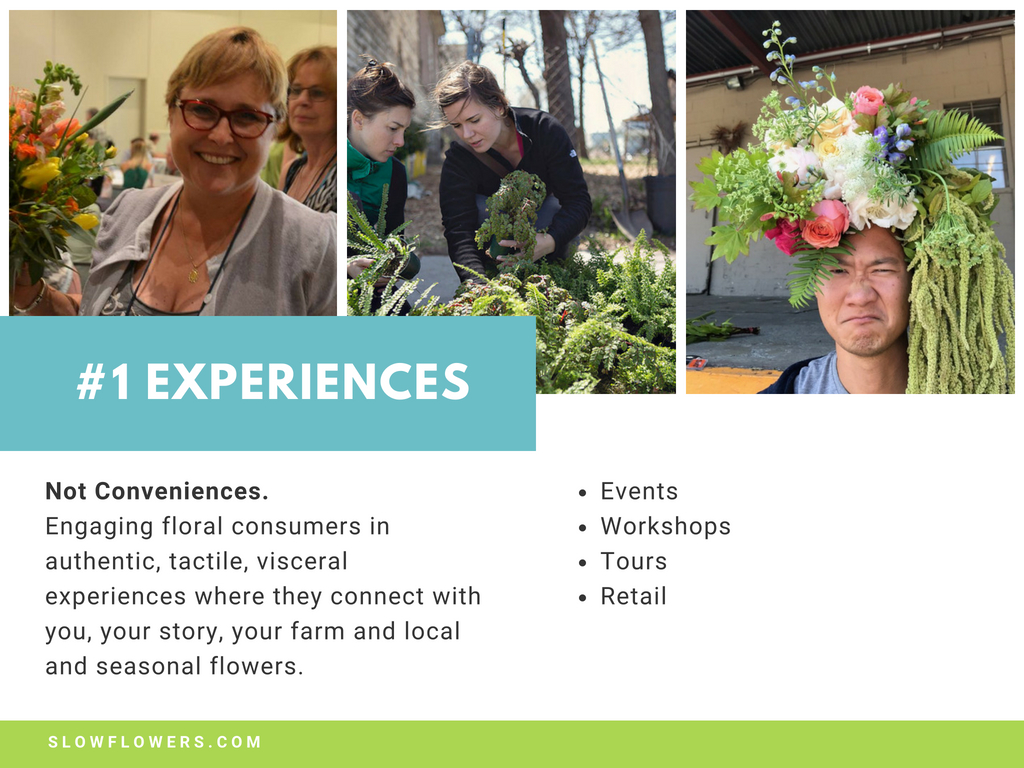
Number #1 Experiences, Not Conveniences

In a retail climate where Amazon is king, those who engage floral consumers in authentic, tactile, visceral experiences will break through the click-and-buy or cash-and-carry mindset. Customers who connect with you, your story, your flowers and the origin of those flowers are the foundation of your loyal tribe.

And while efforts and actions that strengthen our ties with customers isn’t an entirely new concept, it is one you must habitually practice, especially in today’s cluttered and distracting marketplace. Events, tours, workshops and other experiential programming are critical — and much more powerful than touching customers through social media channels alone.

Many of you have a deep understanding of the power of experiences, and my advice to you is to continue investing time, resources and creativity to offer the floral marketplace a chance to forge a relationship with you and your flowers.

A Flower-Filled Community Festival at My Garden Over Floweth — all about EXPERIENCES! (c) Courtney Coriell Photography

For example, Slow Flowers members Teresa Engbretson and Katie Elliott of My Garden Over Floweth, open their Paterson, Wash., farm for two seasonal “Flower Fling” festivals each year. These farmer-florists have created events that provide a sense of community for their customers, while also offering a new venue for other vendors. In their recap post after the Fall Fling, they wrote:

We place so much thought, time and care into planning the best experience we possibly can and we hope that shows!  This is a space and a time where memories are made and we hope each and every person felt a warm welcome. We felt so much love yet again by all who attended, including amazing local vendor family.  Each vendor and their products speak to hard work, quality and friendship, we are so honored to have so many great people surrounding us at our farm!

You don’t have to be a professional event planner to pull off an experience-rich program. Not at all. Start small and open your studio or farm gate to flower lovers — you’ll be positively rewarded.

READ MORE…

Episode 381: A Year in Review – Slow Flowers’ Highlights for 2018

Wednesday, December 26th, 2018

The Slow Flowers Community and listenership of this program have grown larger than ever, with more than 390,000 total downloads since this show launched in July 2013. That’s amazing news and I’m thrilled to share it with you.

(c) Mary Grace Long photography

Every single week this year; in fact, every single week for the past 282 weeks, it has been my privilege to feature the voices of our Slow Flowers community with you.

Unlike any other internet radio show in existence, the Slow Flowers Podcast is tailored to you and your interests, making its “must-listen” programming a habit among flower farmers and floral designers alike.

In producing and hosting the Slow Flowers Podcast, I seek out pioneers and personalities, style-makers and influencers — as well as unsung or little known heroes — who together are changing the floral landscape, disrupting the status quo, and bringing flower sourcing and growing practices, not to mention eco-conscious design methods, to the center of the conversation. And thanks for joining in. Whether you’ve just discovered this podcast or are a longtime fan, I encourage you to take advantage of the immense body of knowledge that can be found in the archives.

As I have done since the beginning of 2014, I would like to devote today to the Slow Flowers Highlights of this past year. Next week, on January 2nd, I will present the annual Slow Flowers’ Floral Insights and Industry Forecast for 2019.

I’m motivated as a storyteller to connect with the Slow Flowers Community in real and personal ways — and that was certainly the case in 2018. Rather than share a chronological travelogue of the year’s calendar, I’m mixing it up today.

I’ve looked in the rear-view mirror to remember 2018 and — wow — the themes bubbling up to the top are impressive. I’m humbled by the warm embrace of the Slow Flowers Community and more than ever, I realize that making authentic human connections with you is what really matters. Each experience is more meaningful because of the relationships we forge with one another.

I’ve identified 10 Top Themes of 2018 that I want to reflect on and share with you today.

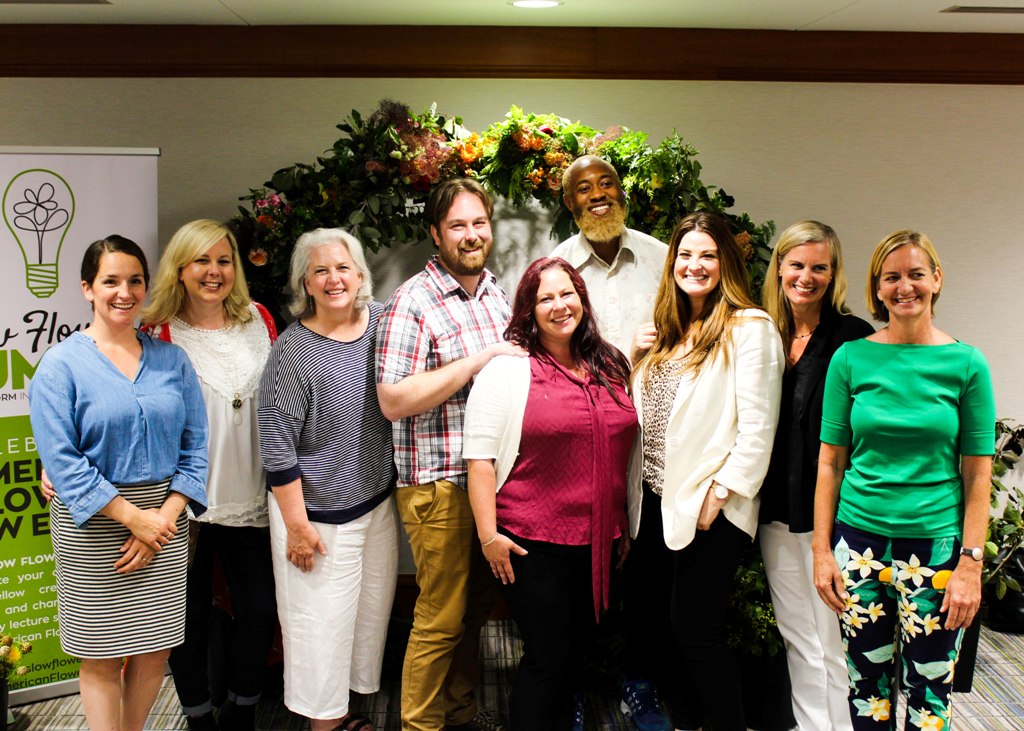
Our speakers, from left: Mary Kate Kinnane, Kelly Shore, Debra Prinzing, Jonathan Weber, Jessica Hall, Walker Marsh, Christina Stembel, Kit Wertz & Casey Schwartz (not pictured: Mud Baron)

NUMBER ONE: the SECOND ANNUAL SLOW FLOWERS SUMMIT

Slow Flowers Summit logoThe Slow Flowers Summit is the LIVE event in the midst of American Flowers Week, created to serve the Slow Flowers community of progressive, sustainably-minded florists and designers and to engage attendees who want to network with one another.

Planning and producing the 2nd Summit was a huge financial risk, especially since it was the first time on the east coast, away from our original Seattle venue.

I knew we could lose money but my heart told me it was important to forge ahead, as I found myself inspired by the amazing sense of inclusion, connection, new ideas, beauty and humanity surrounding our floral-filled lives.

I believed taking that risk was essential. That risk paid off and we actually had a sold-out Summit on Friday, June 29th in Washington, D.C., with a remarkably welcoming venue host – the American Institute of Floral Designers.

I have so many people to thank for helping produce the Summit, so let me get started. First of all, thanks to Bob Wollam and his team at Wollam Gardens for opening up their Virginia farm the day prior to the Summit for tours, lunch and community. That bonus pre-event was so positive that it inspired us to add two pre-event flower farm tours for our 2019 Slow Flowers Summit. THANK YOU all!

Ellen Seagraves, Cathy Houston and Dana Sullivan ~ the talented florists who led our interactive floral installation.

We had wonderful day-of volunteers, but I mostly want to single out Ellen Seagraves of Chic Florals and Dana O’Sullivan of Della Blooms, both Slow Flowers Members and part of Independent Floral Designers of Maryland, for volunteering to create the Summit’s interactive floral installation. We had so many wonderful donations from flower farms to pull this off — including Charles Little & Co., FernTrust, Green Valley Floral, LynnVale Studio & Farm and Resendiz Brothers Protea Growers — as well as EcoFresh Bouquets, which provided wraps for the foam-free installation.

I can’t forget to thank our speakers — without whom the day would have been an empty room, of course. Our keynote speaker Christina Stembel of Farmgirl Flowers wowed us with a frank discussion of building a self-funded floral business through grit and determination.

We enjoyed two visually and intellectually-inspiring design + business presentations geared toward florists who are committed to the Slow Flowers ethos, in their sourcing and in the ways they build community — Thank you Kelly Shore of Petals by the Shore and Mary Kate Kinnane of The Local Bouquet and thank you Kit Wertz and Casey Schwartz of Flower Duet.

Our Flowers + Tech panel introduced a fascinating discussion about the challenges of transportation, infrastructure and shipping — thank you to Jonathan Weber of greenSinner, Jessica Hall of Harmony Harvest Farm and Christina Stembel of Farmgirl Flowers for their excellent presentations and for helping us look toward the horizon of new business models.

And finally, thank you to our final two speakers, men who are passionate about flower farming as a tool for improving the lives of their communities ~ Walker Marsh of Tha Flower Factory in Baltimore and Mud Baron of Flowers on your Head in Los Angeles.

Flowers on my head, courtesy of Mud Baron.

Among other messages, we learned from them about sowing future seeds of hope through flowers. If you were in attendance – or if you followed the fun on social media, you also know that Mud was a flower force to be reckoned with as he festooned our heads with bouquets to fulfill his mission of photographing as many humans as possible for his Flowers on Your Head photographic project.

If you missed the Summit, you can find all the video presentations available to watch for just $48 on Vimeo — a full day of ideas, information, inspiration, inclusion and instigation with each of these speakers.

Watch a free clip of my opening remarks about the origins of the Slow Flowers Summit.

And I can’t finish this section without reminding you to register for the 3rd annual Slow Flowers Summit, taking place July 1-2, 2019 as an expanded conference, offering you more value and benefits for attending.

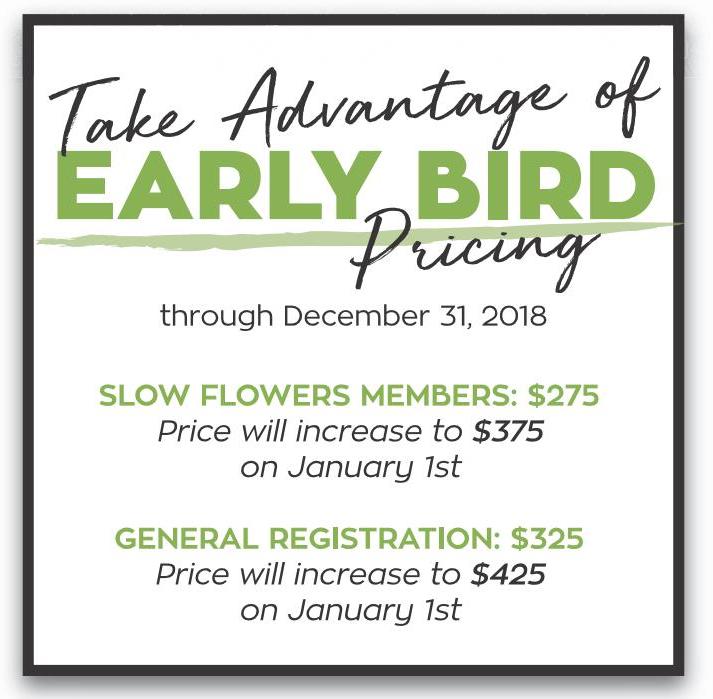
The early-bird pricing continues through Dec. 31st so there’s not much time left to save $100 and grab a seat to join me and some wonderful speakers in St. Paul Minnesota!

NUMBER TWO: AMERICAN FLOWERS WEEK 2018 (June 28-July 4)

This original flower promotion holiday, launched in 2015, celebrated its fourth annual campaign. I was encouraged and inspired by friends behind British Flowers Week to create American Flowers Week (and to continue their generosity, I helped support the creation of Canadian Flowers Week this past September).

This grassroots, all-inclusive campaign provides editorial, branding and marketing resources to flower farmers, florists, designers, retailers and wholesalers who wish to promote American grown Flowers.

And wow, did you participate this past year! We have been tracking engagement on Instagram and Twitter, which this year was tricky because new rules on those platforms restricted our ability to measure the potential engagement of our followers’ followers (IF you saw what happened with Facebook this year, I’m sure that make sense)

Even with those tracking limitations, you and your participation in American Flowers Week generated amazing numbers — 3.6 million impressions in the month leading up to the 2018 celebration. We know the real total engagement was much higher, due to tracking tools not being able to capture Facebook traffic.

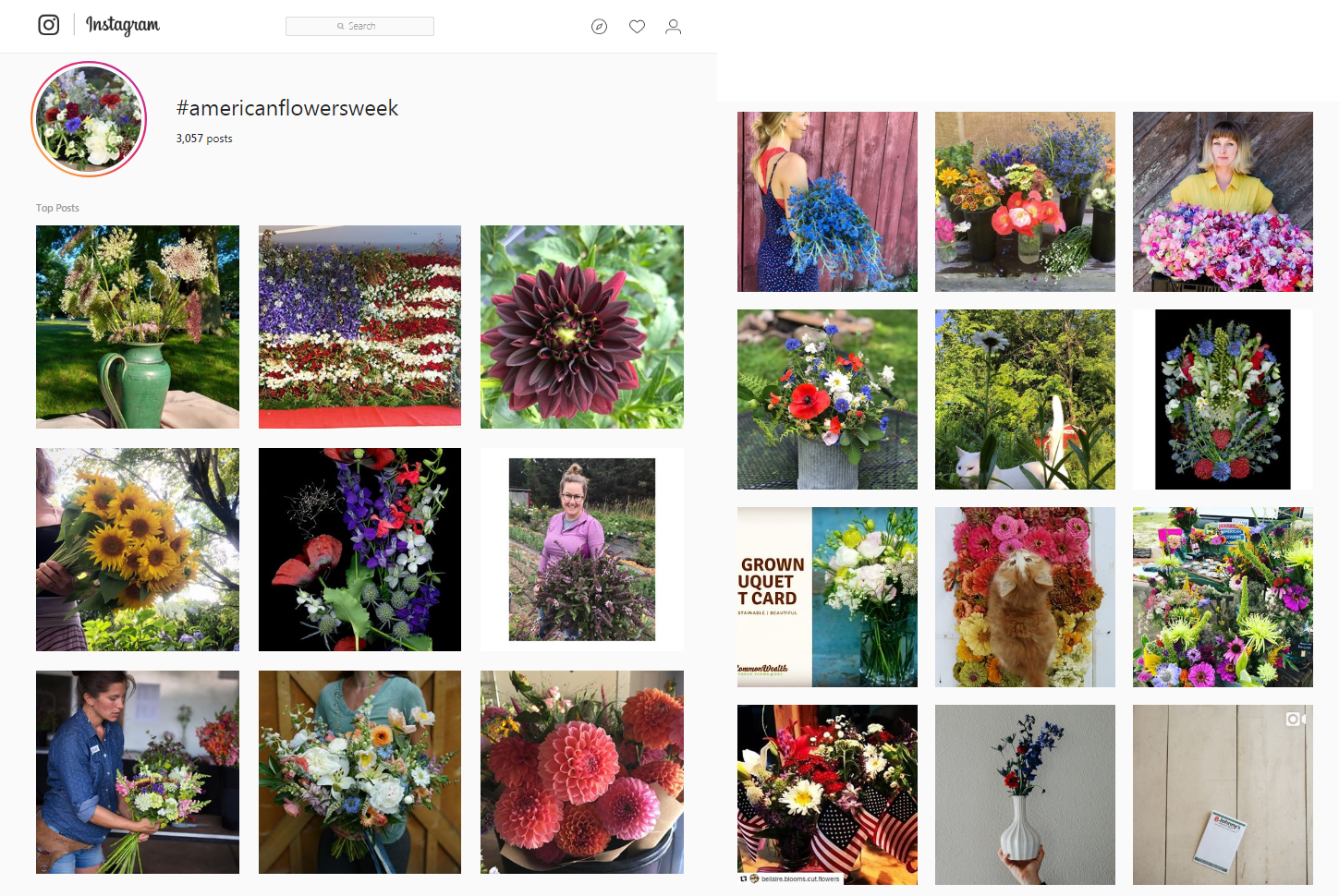
#americanflowersweek on Instagram this week!

All I can say is THANK YOU to each one of you who joined in the fun by designing red-white-and-blue bouquets, taking photos and posting/tagging them as #local #american and #seasonal and #slowflowers.

Rita Anders of Cuts of Color in Weimar, Texas, delivered American Flowers Week bouquets and bunches to Central Market stores in Houston.

Thanks to those of you who ordered our bouquet labels to use on your market and grocery bouquets, and for CSAs and popup events. And thanks for building the buzz to raise awareness about the importance of conscious choices when it comes to buying flowers. The more fun and fashion we can share with flowers, the more their origin becomes a top-of-mind decision at the cash register.

And speaking of fashion, 2018 was the third year of our American Flowers Week – floral fashion collection, a brilliant season of botanical garments revealing the beauty of flowers, the people who grow those flowers and the floral artists who reimagine them into garments.

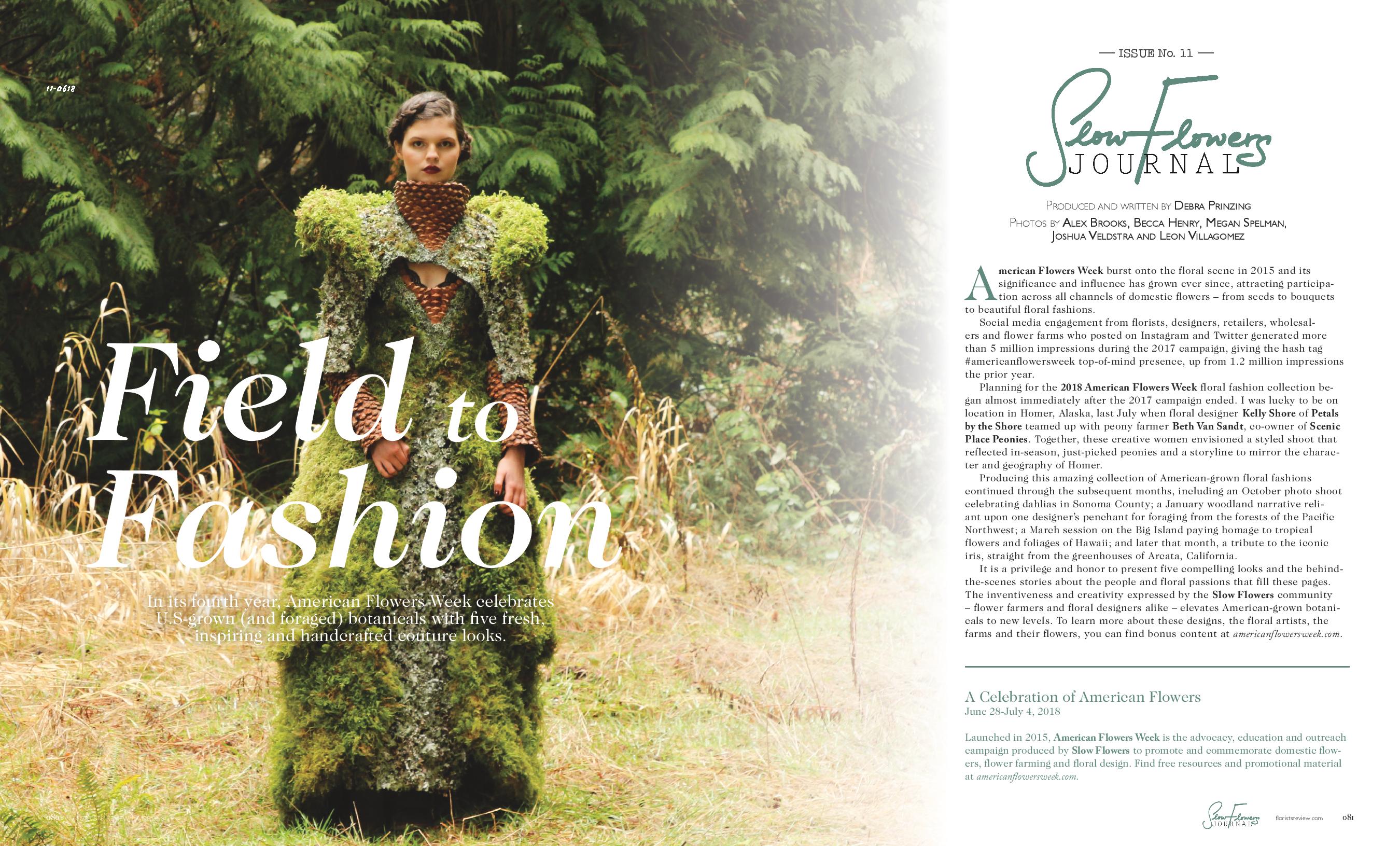
Opening pages of “Field to Fashion,” in Slow Flowers Journal for Florists’ Review (June 2018)

This year, we called the theme “Field to Fashion,” and revealed all five floral couture looks in the pages of Florists’ Review magazine. Producing this floral narrative began in Homer, Alaska, where Kelly Shore of Petals by the Shore partnered with Beth Van Sandt of Scenic Place Peonies to envision a styled shoot reflecting just-picked peonies with a storyline that reflects the character, history and geography of Homer.

The series continued with photo shoots taking place through subsequent months of the year, as designers and flower farmers collaborated to turn cut flowers into haute couture, including a session in Sonoma County, with design talents from farmer-florist Hedda Brorstrom of Full Bloom Flower Farm and dazzling dahlias grown by Kate Rowe of Aztec Dahlias;

a winter woodland narrative reliant upon farmer-florist Carly Jenkins of Killing Frost Farm’s penchant for foraging from the forests and woodlands of the Pacific Northwest and Montana;

Alison Higgins and Nicole Cordier of Grace Flowers Hawaii’s Big Island homage to locally-grown tropical flowers and foliage with two regal looks for male and female models;

and Faye Zierer Krause of Flora Organica Designs’ tribute to the Iris, straight from the Sun Valley Flower Farms’ greenhouses of Arcata California.

It is a privilege and an honor to experience this level of creativity and commitment to American Flowers Week. The inventiveness expressed by the Slow Flowers community — flower farmers and floral designers alike — elevates American-grown botanicals to new levels.

Click here to find the photos of the entire 2018 American Flowers Week collection of botanical fashions, including the stories behind each look.

I also need to thank and acknowledge the talented photographers who made each of these beautiful ideas come to life through their lens, including Alex Brooks, Becca Henry, Megan Spelman, Joshua Veldstra and Leon Villagomez.

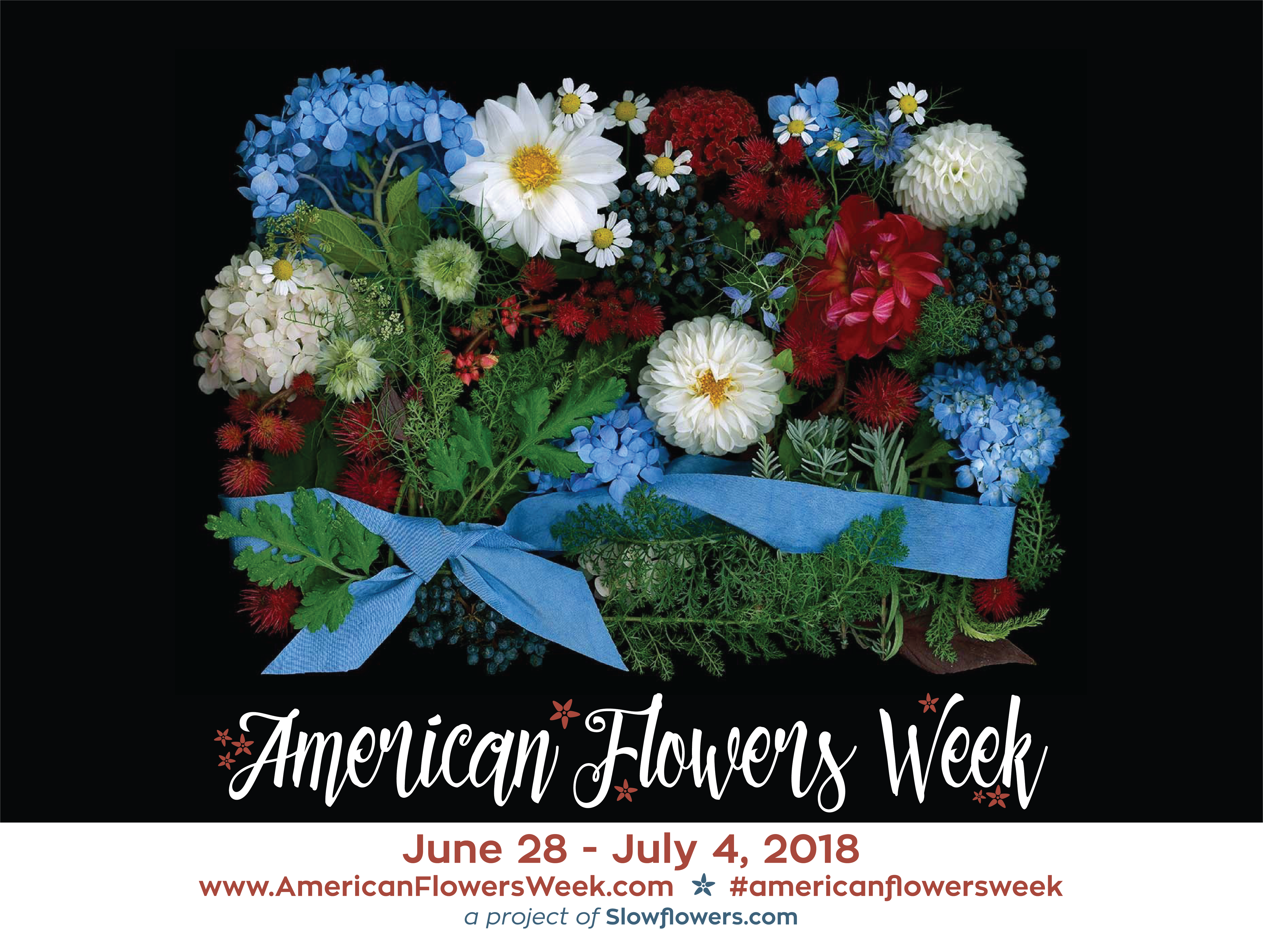
Botanical artist Ellen Hoverkamp created our American Flowers Week 2018 image and branding!

One more artist gets a big thank you for helping make American Flowers Week more beautiful – and that is Ellen Hoverkamp of My Neighbors’ Garden. We invited Ellen, a Connecticut-based artist, to create a red-white-and-blue bouquet using her signature scanner photography technique and the result was a stunning image that helped us promote the campaign all year long. Her all-American botanical tribute wowed everyone and I’m excited to be able to use American Flowers Week as a way to highlight the work of such a talented artist.

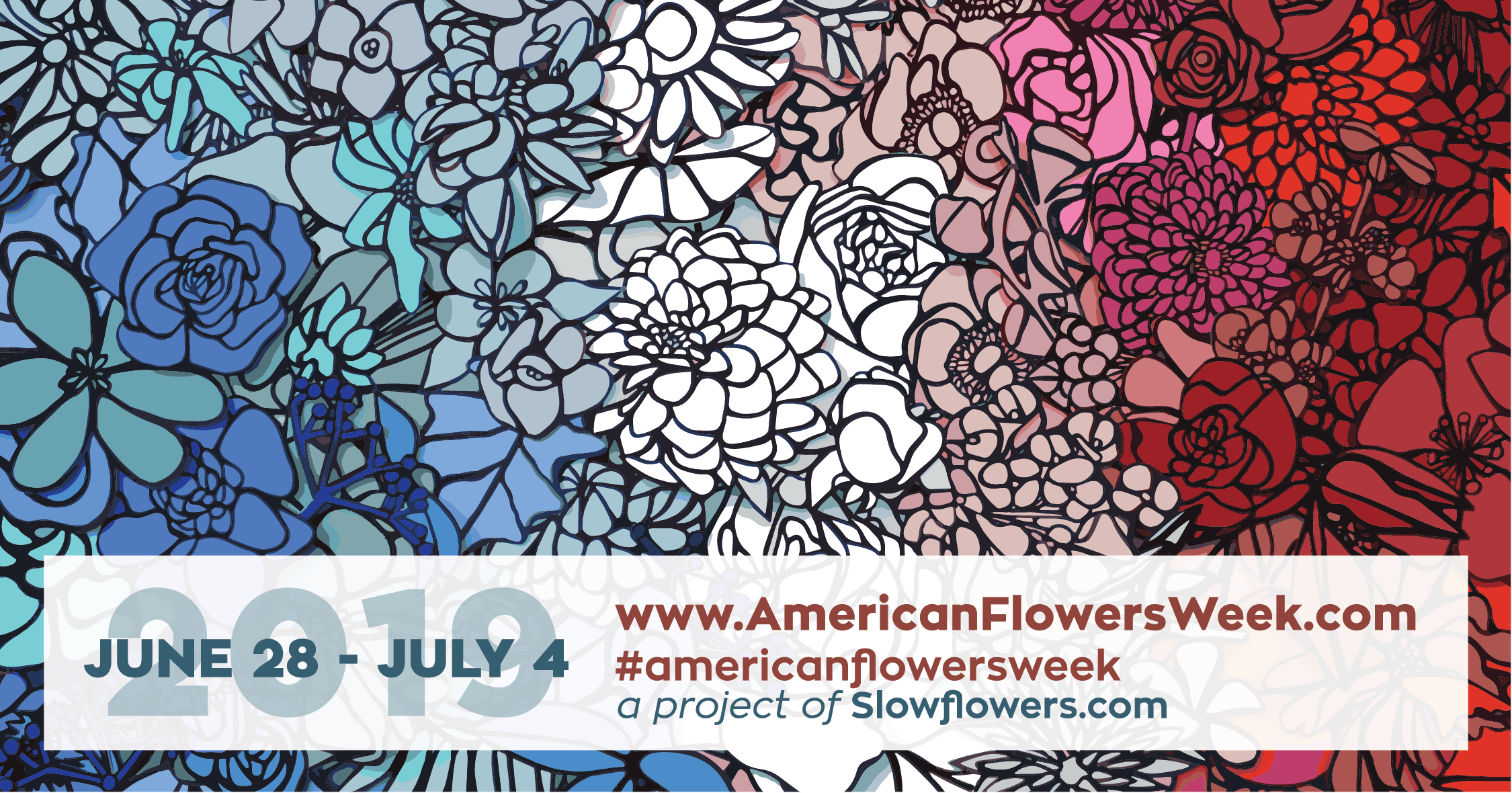
And now’s the time to mark American Flowers Week 2019 on your calendar — June 28 through July 4 — because it will be our fifth annual campaign celebration! I’ll have more to share in the coming months, but you are invited to check out two links I’ll share in today’s show notes — first, a look at the 2019 botanical art branding we commissioned from Josephine Rice, and second, a sneak peek to introduce the florists and flower farmers who are busy creating American Flowers Week botanical fashions for next year’s editorial package.

READ MORE…

Episode 378: Rachael Ackerman introduces Blue Sky Flower Farm in Minnesota, site of the Slow Flowers Summit pre-conference farm tour

Wednesday, December 5th, 2018

Rachael Ackerman of Blue Sky Flower Farm (c) Photography by Red Bird Hills

June 30th may seem like a long way off, but we all know how soon your the flower farming season arrives next spring, followed quickly by wedding and event season for floral designers.

So bear with me as we fast-forward to June 30, 2019, the day before the Slow Flowers Summit takes place on July 1st & 2nd in St. Paul, Minnesota.

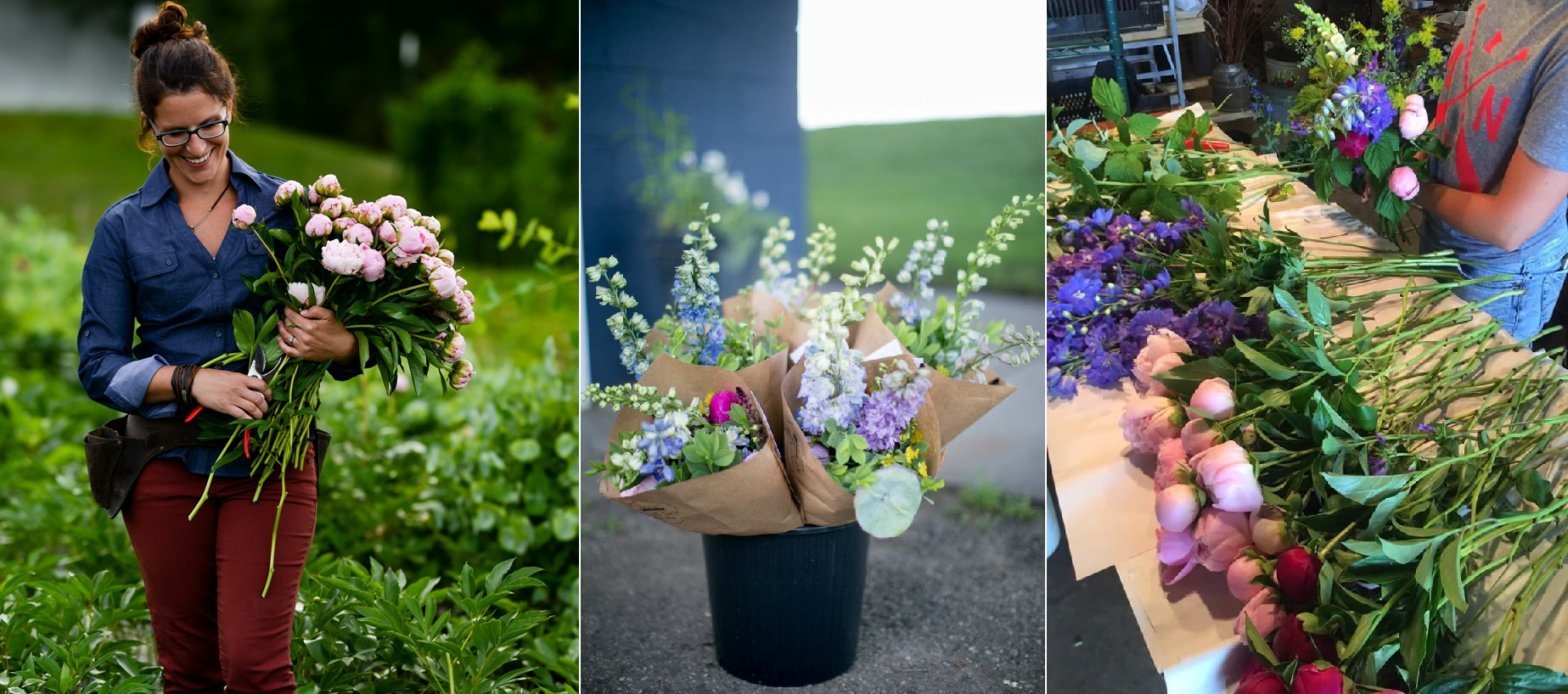
Rachael (left) with her peonies; CSA bouquets (center); the abundant floral harvest (right)

Perhaps you’re planning to arrive in the Twin Cities early and if so, you’re invited to participate in our optional pre-conference farm tours and Slow Flowers Dinner on the Farm, two fantastic opportunities to learn more about the flora of Minnesota, including a lovely and educational visit to Blue Sky Flower Farm, owned by today’s guest, Rachael Ackerman.

I’ll share more details about the actual tour schedule immediately after our interview, but let me start by saying how thrilled I am that horticultural duo Rachael and Jon Ackerman, owners of Blue Sky Flower Farm, will open their farm on Sunday, June 30th for an exclusive tour welcoming attendees of the Slow Flowers Summit.

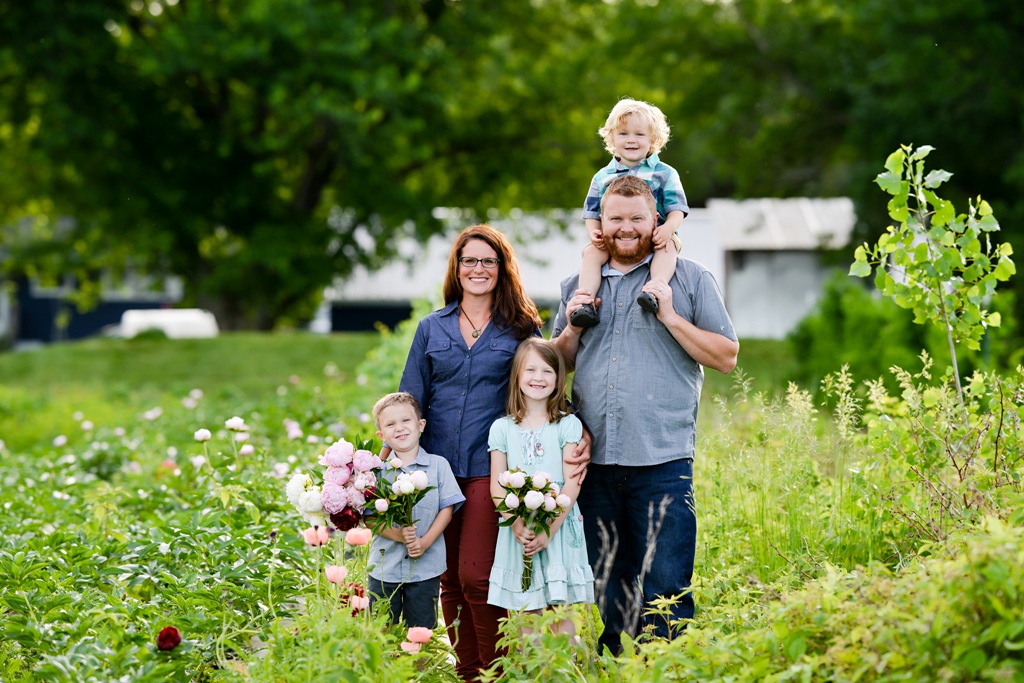
Rachael and Jon Ackerman with their three “minions” at Blue Sky Flower Farm (c) Photography by Red Bird Hills

I met Rachael and Jon in person in 2017 at the ASCFG regional meeting in Ontario, Canada, and soon thereafter, their farm joined the Slow Flowers Movement. They grow a diverse palette of plants on land about 30 miles outside of the Twin Cities in Minnesota and they’re part of the core group of growers who sell through the Twin Cities Flower Exchange, owned by Christine Hoffman, our co-host for the 2019 Summit on July 1st & 2nd.

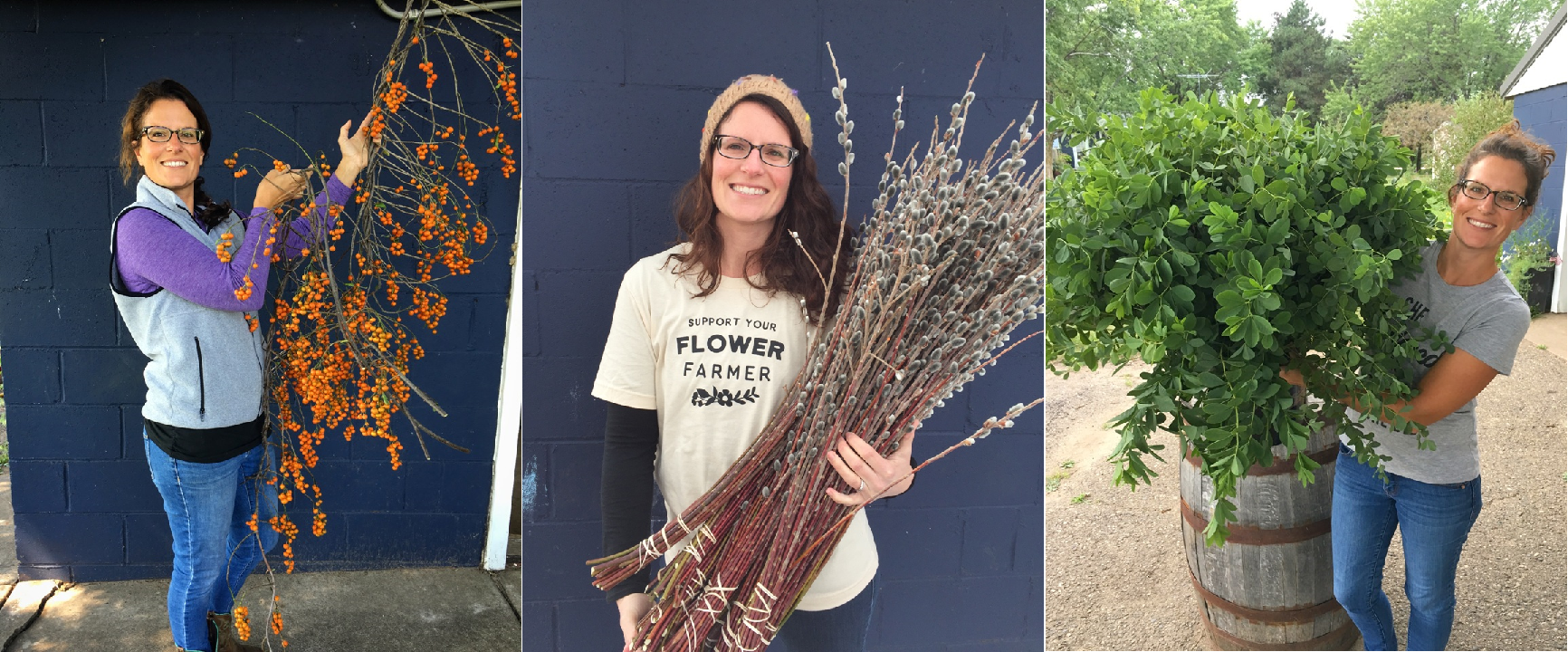
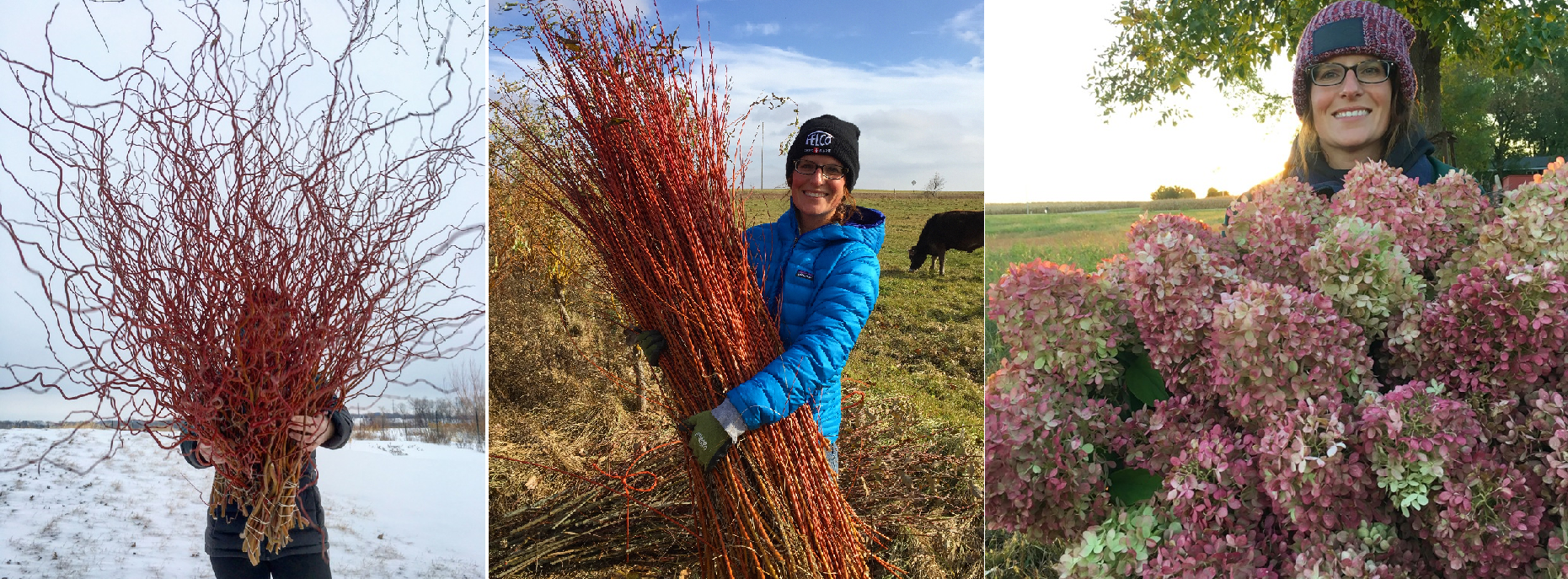
Rachael is often dwarfed by the long branches and prolific foliage she harvests, year-round, at Blue Sky Flower Farm.

I’ve invited Rachael to share their story with us today.

Here’s a little bit more about Blue Sky Flower Farm:

Jon and Rachael dreamed of Blue Sky Flower Farm for many years. They both have horticulture degrees and between them have a combined 30-plus years working in the industry. While working full-time and raising three children, now ages 3, 5 and 7, they started the farm by planting woody cuts, including dogwoods and willows, on Jon’s parents’ dairy farm.

More branches and ornamental blooms! A Blue Sky Flower Farm specialty.

The couple now owns a 10-acre farm near Elko-New Market, Minnesota, south of the Twin Cities, where they have diversified into a year-round operation, with Spring woodies (pussy willows, lilacs, forsythia, mock orange, sweet peas and peonies); Summer crops (ninebark foliage, raspberry foliage, dahlias, baptisia, scabiosa, statice and anemone) Fall crops (bittersweet, sunflowers, rudbeckia, broom corn and unique gourds) and winter crops: flame willows, curly willows, and dogwoods of many colors.

Blue Sky Flower Farm also serves its community through a bouquet shares program each summer. I’ll let Rachael share more about how she and Jon have developed their market channels to serve a number of wholesale clients in both floriculture and horticulture.

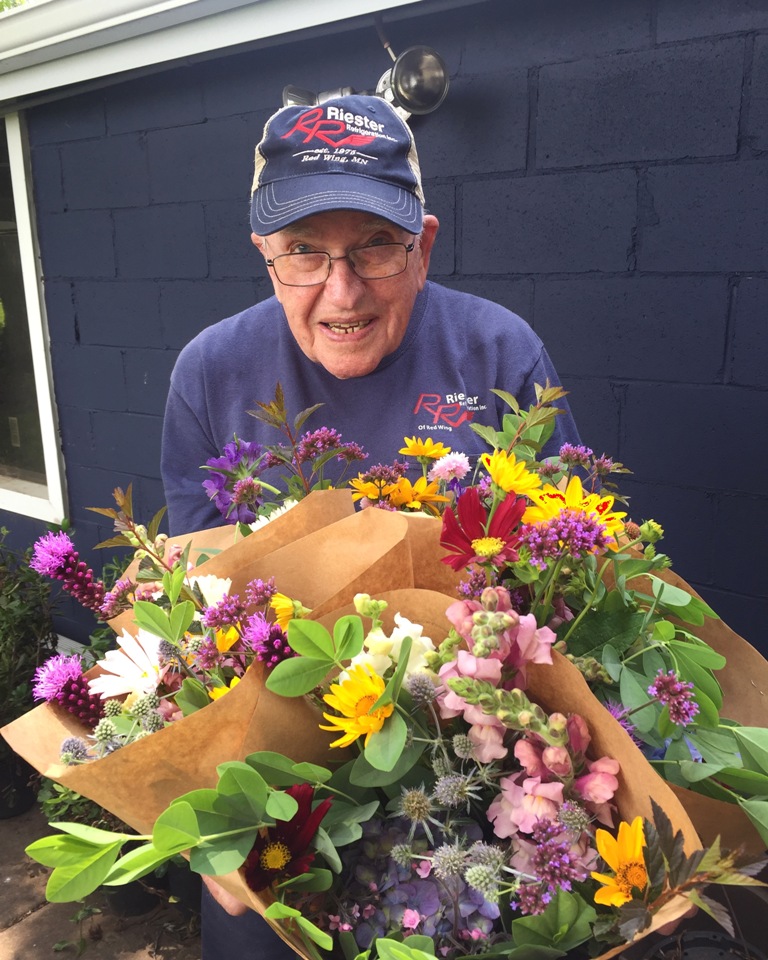
Rachael’s grandfather, who along with her grandmother, helps on the farm once a week.

In the past, before diving deep into flower farming, Rachael and Jon worked in the commercial wholesale nursery industry, including a number of years at Bailey Nurseries Inc., one of the largest plant companies in the U.S.

Because of those ties, it is fitting that we’ve invited Rachael to join the stage at the Slow Flowers Summit and introduce our keynote speaker, Terri McEnaney, president of Bailey Nurseries.

I’m thrilled that Rachael and Jon will open their flower farm and host Slow Flowers Summit’s attendees to experience a summer afternoon on their uniquely beautiful Minnesota flower farm.

Their farm will be open between 1-3 pm on Sunday, June 30th, for self-guided touring — we’ll post more details prior to the Slow Flowers Summit.

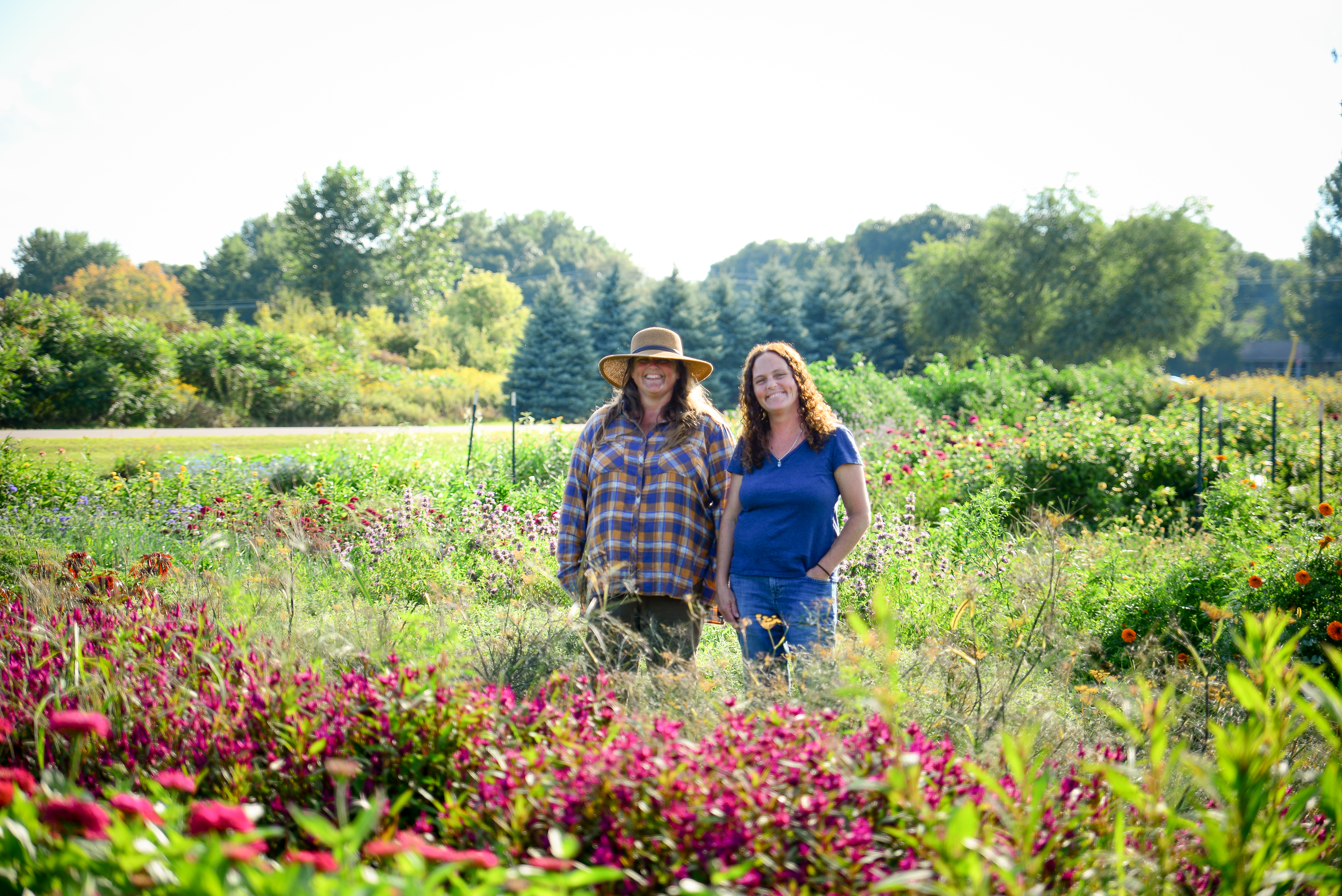
Slow Flowers Dinner on the Farm hosts, Jolea Gress and Jenny of Green Earth Growers

Immediately following our time at Blue Sky Flower Farm, attendees are invited to tour a second venue, Green Earth Growers, a women-owned enterprise specializing in nursery bedding plants, vegetables AND flowers.

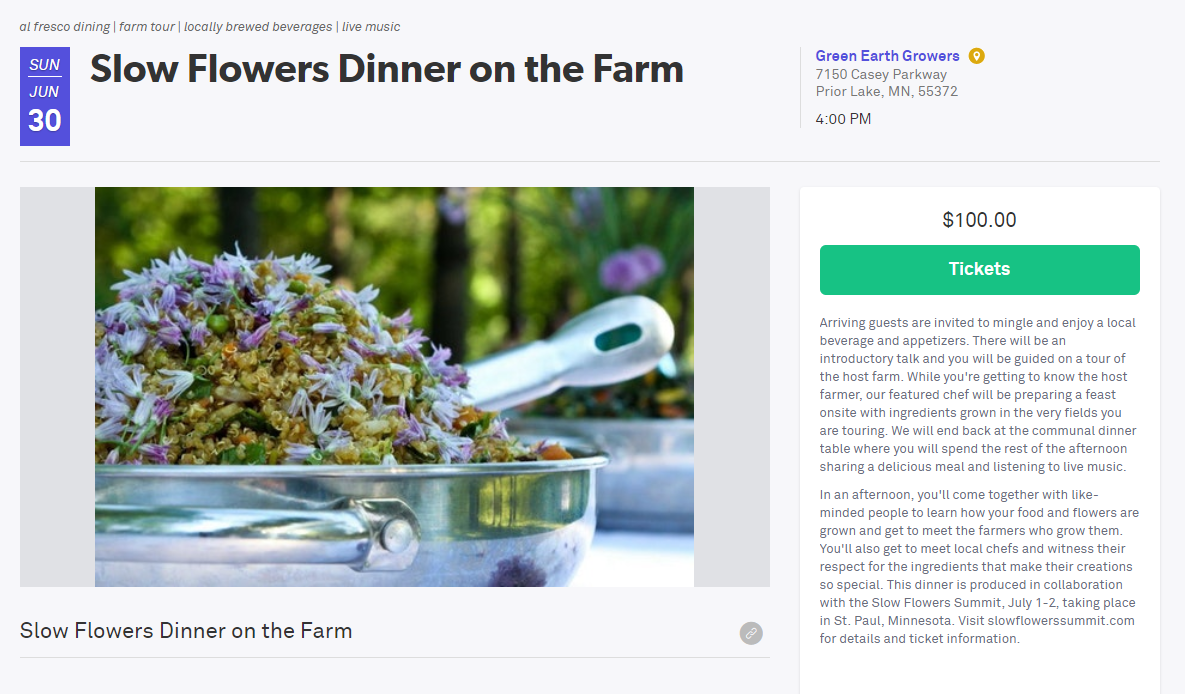
The tour of Green Earth Growers is free, but you’ll need to register separately for the first-ever Slow Flowers Dinner on the Farm, an evening of locally-grown food, flowers, entertainment and camaraderie.

Tickets are $100 inclusive and you can find more details here. We’re partnering with Green Earth Growers’ owners Jolea Gress and Jenny for this event, and I promise to feature them and their stories on this podcast in the near future.

The farm-to-table dinner is a production of Monica Walch, owner of the successful Dinner on the Farm series that takes place each year in the St. Paul-Minneapolis area.

Dinner on the Farm creates unique local food experiences designed to celebrate farmers, growers, chefs, brewers, distillers, makers and artisans dedicated to good, sustainable food. Through a series of roaming culinary events, Monica and her collaborators work to connect people back to the land and to the farmers and artisans who are making their community a better place to live.

If you attend the Slow Flowers Dinner on the Farm, you’ll join with me in an intimate, sensory evening celebrating our true sense of community with other Summit attendees, Slow Flowers members and our Summit speakers in a relaxed environment taking place just prior to the following day’s Summit Conference. I can’t wait to see you there!

December is the month to take advantage of Early Bird Ticket Pricing for joining us at the Slow Flowers Summit.

You can save $100 off if you register before Dec. 31st.

The rate for Slow Flowers member registration is $275, which includes 1-1/2 days of conference sessions, morning refreshments both days, and lunch and a cocktail reception on July 1st, plus a fabulous program, people and flowers.

We have a vital and vibrant community of flower farmers and floral designers who together define the Slow Flowers Movement.

As our cause gains more supporters and more passionate participants who believe in the importance of the American cut flower industry, the momentum is contagious.

I know you feel it, too. I value your support and invite you to show your thanks and with a donation to support my ongoing advocacy, education and outreach activities. You can find the donate button in the column to the right.

The Slow Flowers Podcast has been downloaded more than 385,000 times by listeners like you. Thank you for listening, commenting and sharing – it means so much. Thank you all!

Thank you to our sponsors for supporting The Slow Flowers Podcast.

Florists’ Review magazine. I’m delighted to serve as Contributing Editor for Slow Flowers Journal, found in the pages of Florists’ Review. It’s the leading trade magazine in the floral industry and the only independent periodical for the retail, wholesale and supplier market. Take advantage of the special subscription offer for members of the Slow Flowers Community.

Arctic Alaska Peonies, a cooperative of passionate family farms in the heart of Alaska providing bigger, better peony flowers during the months of July and August. Visit them today at arcticalaskapeonies.com

Seattle Wholesale Growers Market, a farmer-owned cooperative committed to providing the very best the Pacific Northwest has to offer in cut flowers, foliage and plants. The Growers Market’s mission is to foster a vibrant marketplace that sustains local flower farms and provides top-quality products and service to the local floral industry. Find them at seattlewholesalegrowersmarket.com

Longfield Gardens provides home gardeners with high quality flower bulbs and perennials. Their online store offers plants for every region and every season, from tulips and daffodils to dahlias, caladiums and amaryllis. Visit them at longfield-gardens.com.

Syndicate Sales, an American manufacturer of vases and accessories for the professional florist. Look for the American Flag Icon to find Syndicate’s USA-made products and join the Syndicate Stars loyalty program at syndicatesales.com.

Johnny’s Selected Seeds, an employee-owned company that provides our industry the best flower, herb and vegetable seeds — supplied to farms large and small and even backyard cutting gardens like mine. Check them out at johnnysseeds.com.

Association of Specialty Cut Flower Growers. Formed in 1988, ASCFG was created to educate, unite, and support commercial cut flower growers. It mission is to help growers produce high-quality floral material, and to foster and promote the local availability of that product. Learn more at ascfg.org

Mayesh Wholesale Florist. Family-owned since 1978, Mayesh is the premier wedding and event supplier in the U.S. and we’re thrilled to partner with Mayesh to promote local and domestic flowers, which they source from farms large and small around the U.S. Learn more at mayesh.com.

Certified American Grown Flowers. The Certified American-Grown program and label provide a guarantee for designers and consumers on the source of their flowers. Take pride in your flowers and buy with confidence, ask for Certified American Grown Flowers.  To learn more visit americangrownflowers.org.

And the Team Flower Conference – a professional floral event where flower lovers from all over the world gather for networking, learning, and celebration. It’s a special time for the floral industry to come together and whether you’re a farmer, designer, wholesaler, or just love flowers, you’re invited to attend as Team Flowers dreams big for the industry’s future. Head to teamflower.org/slowflowers to learn more about the 2019 conference in Waco, Texas!

PepperHarrow Farm (c) Liz Brown @estorie

I’m Debra Prinzing, host and producer of the Slow Flowers Podcast.
Next week, you’re invited to join me in putting more American grown flowers on the table, one vase at a time. And If you like what you hear, please consider logging onto iTunes and posting a listener review.

The content and opinions expressed here are either mine alone or those of my guests alone, independent of any podcast sponsor or other person, company or organization.

The Slow Flowers Podcast is engineered and edited by Andrew Brenlan. Learn more about his work at soundbodymovement.com. 

Music Credits:

Episode 377: Creating Sanctuary, a conversation with author, gardenmaker and educator Jessi Bloom

Wednesday, November 28th, 2018

Jessi Bloom, author of the new guide, Creating Sanctuary (c) Shawn Linehan

We are well into the holiday season and it’s only November 28th — can you believe it!?

There are so many wonderful things to be thankful for and to celebrate, and yet, the holidays can be stressful and difficult for many of us.

While it can be crushing to think about the natural disasters (or human-caused disasters) that have befallen our floral community in recent seasons, it’s also sometimes overwhelming to find balance and peace in our own daily lives.

I’m so pleased to share today’s conversation with Jessi Bloom, author of the just-released book Creating Sanctuary, because I know the topic will be as timely for you, as it is for me.

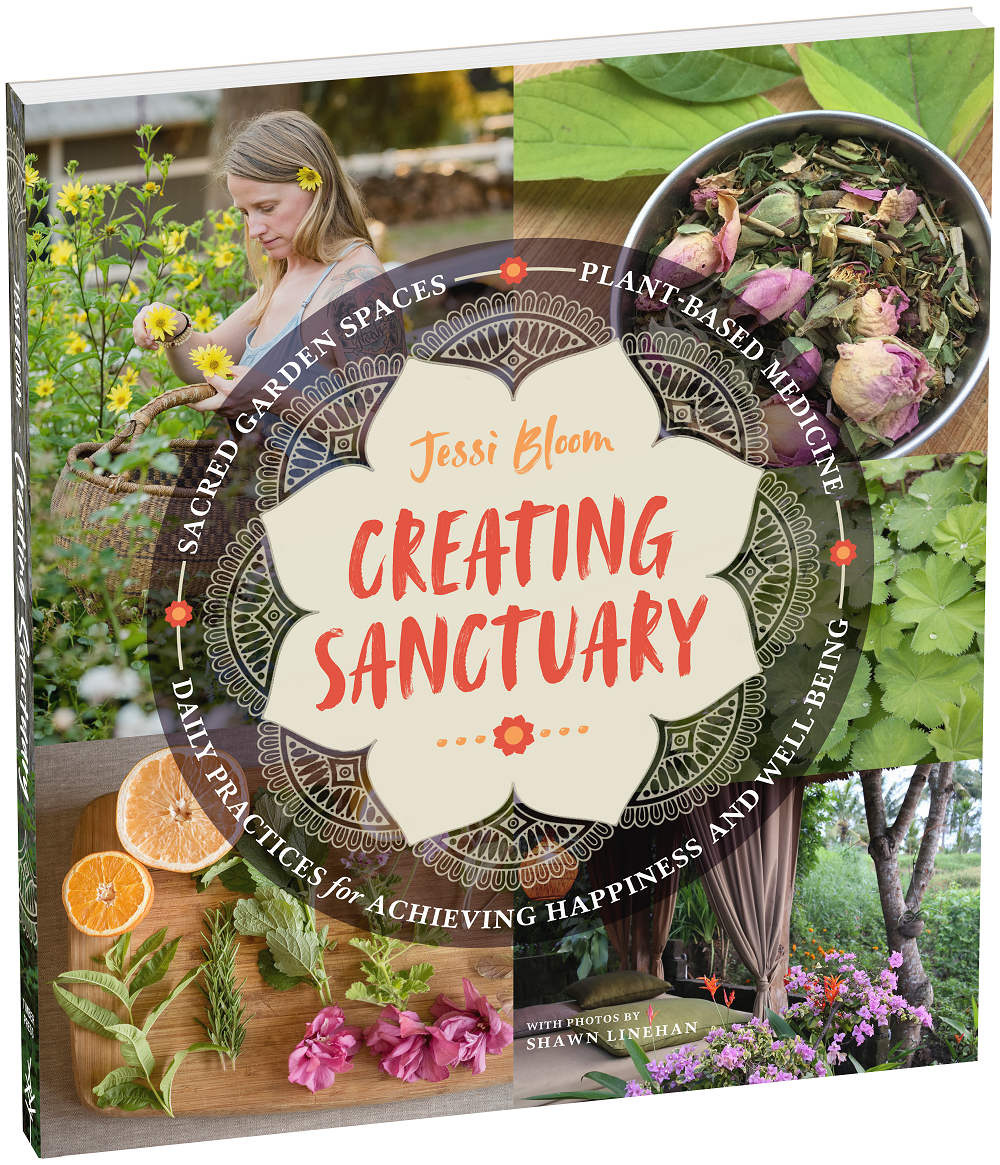
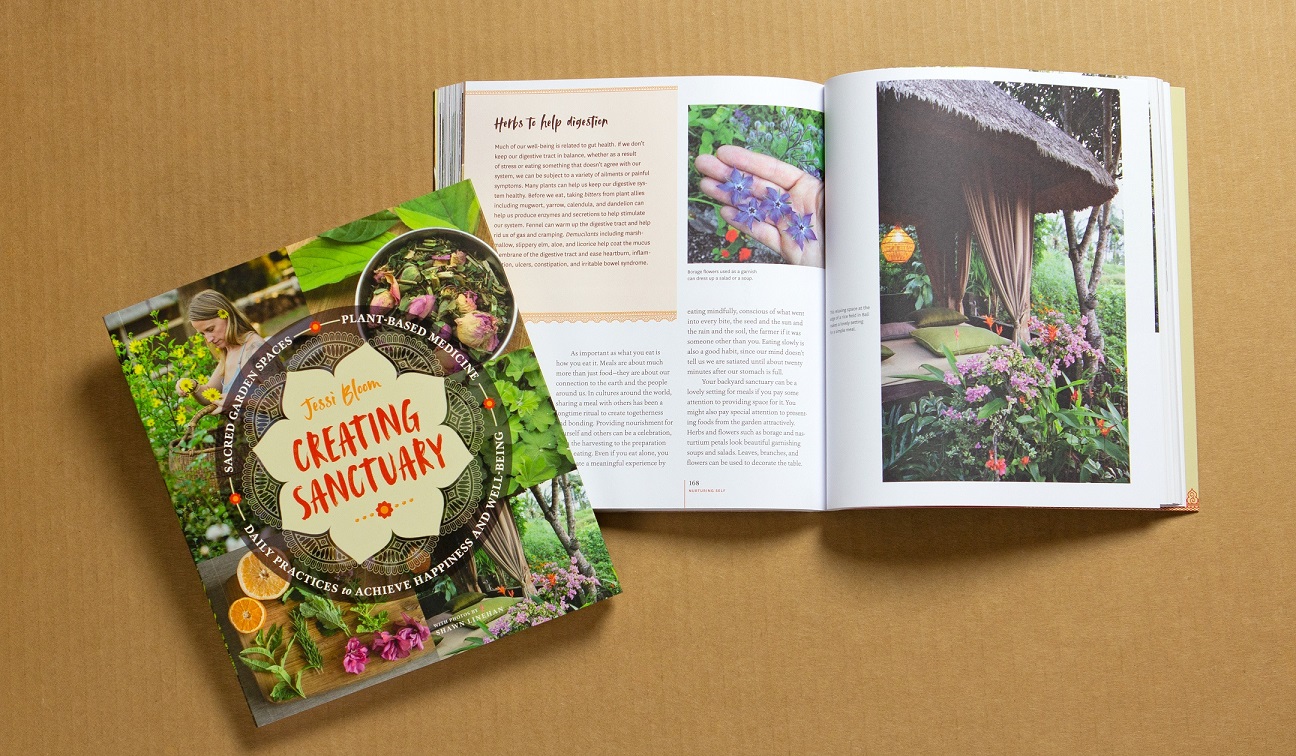
Published by Timber Press, the book’s full title: Creating Sanctuary: Sacred Garden Spaces, Plant-Based Medicine, and Daily Practices to Achieve Happiness and Well-Being, gives you a sense of the inspirational and practical features inside its pages.

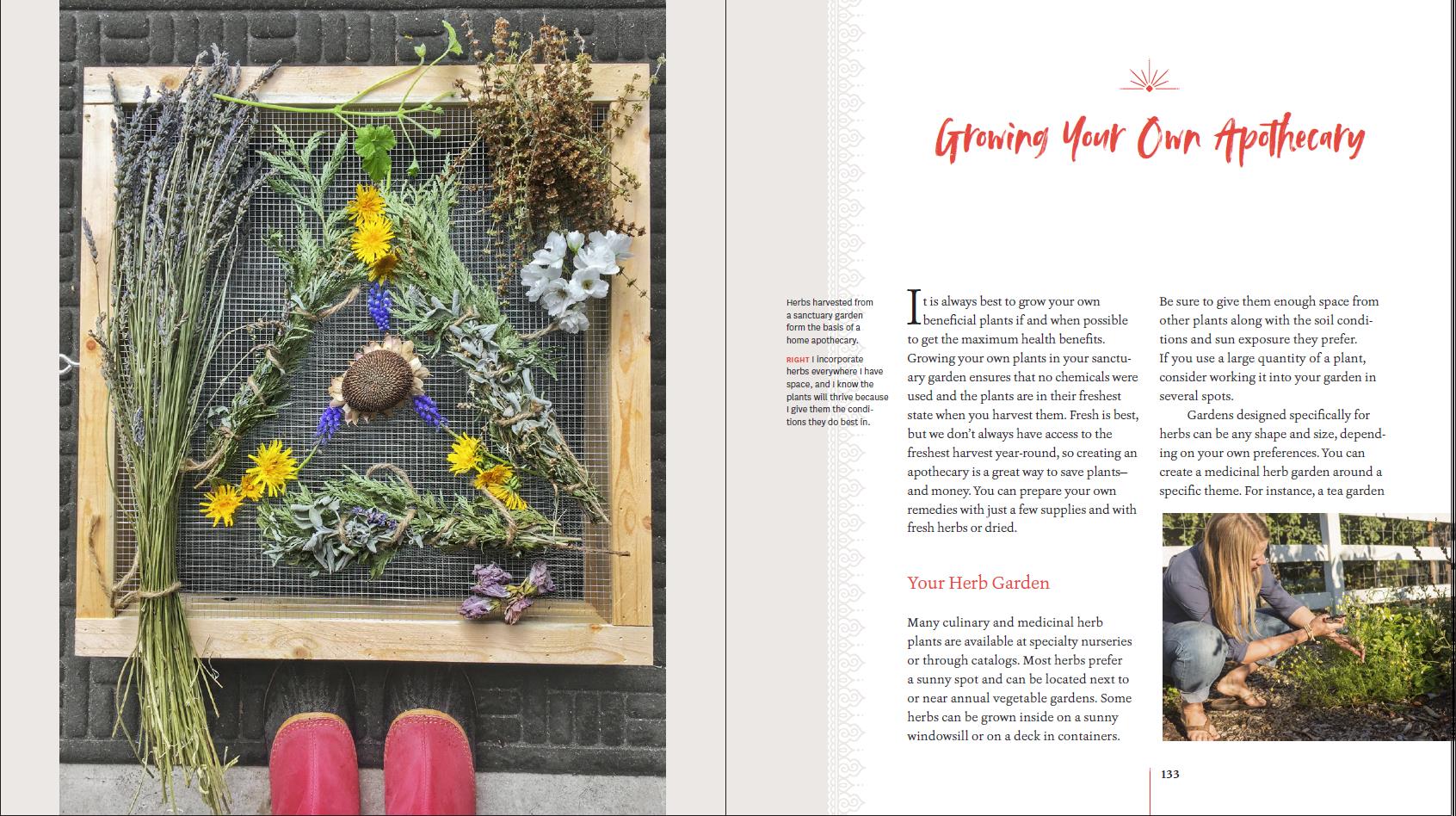
Cover and inside peek of Creating Sanctuary, Published by Timber Books (c) Shawn Linehan

Here’s a bit about the new book:

“We all need a personal sanctuary where we can be in harmony with the natural world and can nurture our bodies, minds, and souls. And this sanctuary doesn’t have to be a far-away destination—it can be in your own backyard. In Creating Sanctuary, Jessi Bloom taps into multiple sources of traditional plant wisdom to help find a deeper connection to the outdoor space you already have—no matter the size. Equal parts inspirational and practical, this engaging guide includes tips on designing a healing space, plant profiles for 50 sacred plants, recipes that harness the medicinal properties of plants, and simple instructions for daily rituals and practices for self-care.”

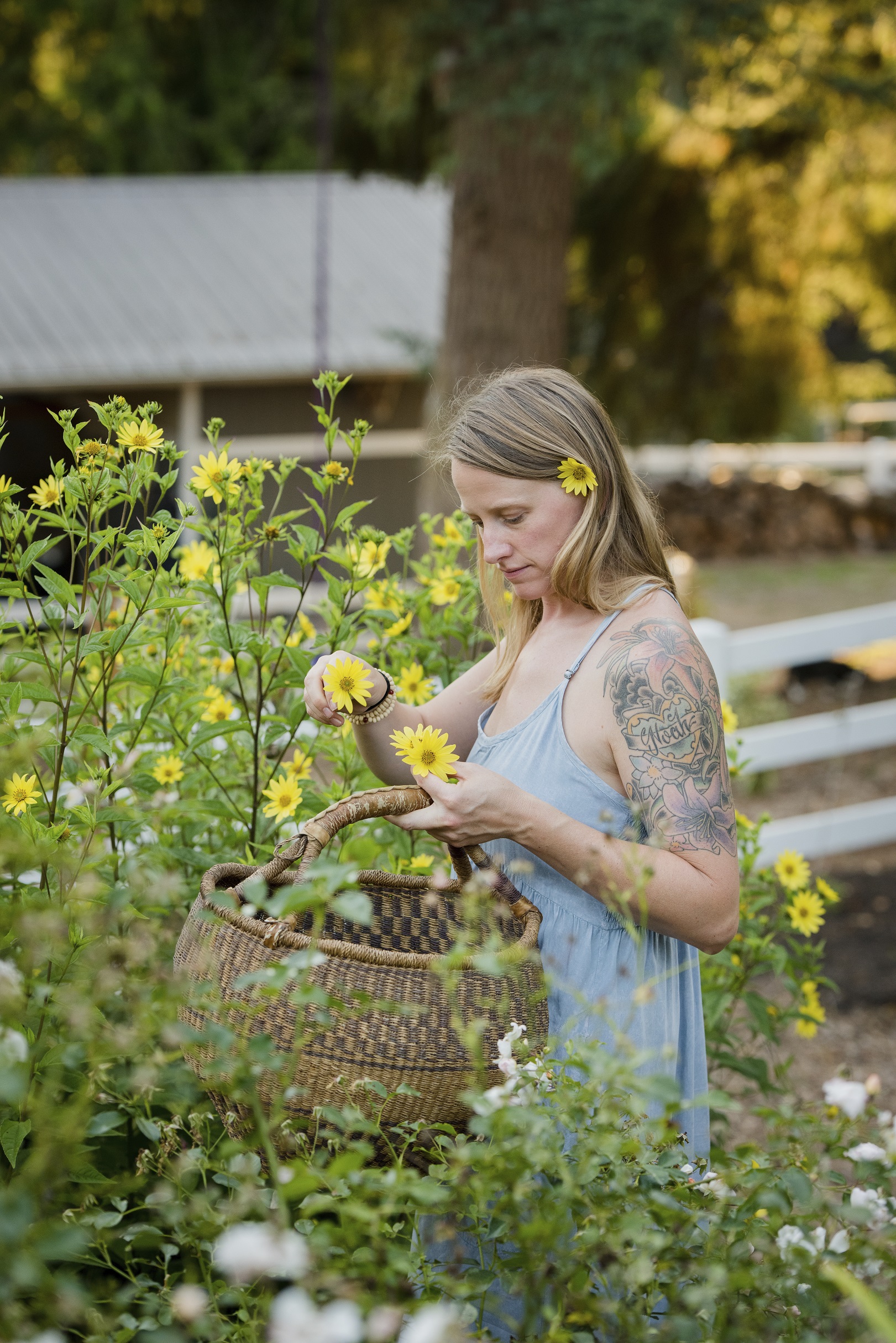
Jessi Bloom, gathering apothecary ingredients in her garden (c) Shawn Linehan

Jessi Bloom is a best-selling author, award-winning ecological landscape designer, and speaker.

A Northwest native, Jessi comes from a strong background of horticulture and environmental sciences.

Her early experience in project management ranged from organizing restoration projects with community volunteers, to high-end residential and commercial landscape design/build.

In early 2000, she decided to start an ethical business in the green industry to fill a niche for organic and ecological landscaping.

Her leadership combined with her artistic design talents have brought N.W. Bloom numerous environmental awards.

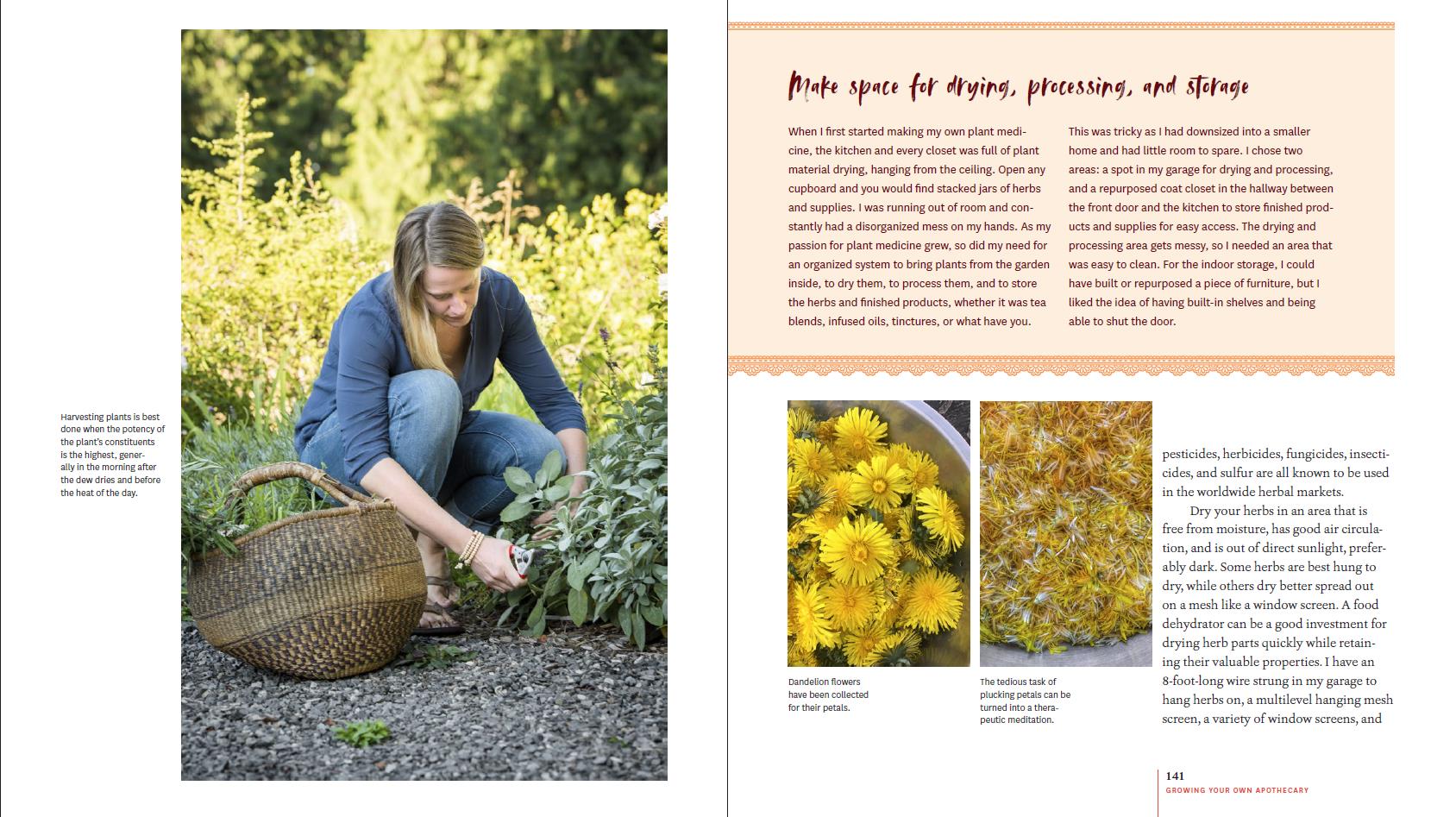
From the pages of Creating Sanctuary, by Jessi Bloom for Timber Books (c) Shawn Linehan

She is passionate about animals, permaculture and making functional gardens beautiful. Jessi’s work has been featured in many national and local media outlets from the NY Times, Better Homes & Gardens, Sunset Magazine, DISNEY, Martha Stewart Living, Mother Earth News, UTNE Reader, Fine Gardening Magazine and PBS’s Growing a Greener World TV. 

Jessi is strongly committed to volunteering in the community and sits on several advisory boards within the green industry and educational/environmental organizations; hoping to empower people, also raising industry standards, and recently helping to develop the EcoPro program for WA State.

She has two boys and spends time with them around their little farm, with a handful of animals and gardens to look after.  When she is not helping others with their gardens, traveling or writing, she enjoys the outdoors: snowboarding, hiking, running, biking and stays strong with Olympic weightlifting.

From the pages of Creating Sanctuary, by Jessi Bloom for Timber Books (c) Shawn Linehan

She has authored two prior books for Timber Press: Practical Permaculture for Home Landscapes, Your Community, and the Whole Earth with Dave Boehnlein; and the bestseller: Free-Range Chicken Gardens: How to Create a Beautiful, Chicken-Friendly Yard.

At the end of our conversation, we discuss NW Bloom’s latest project as the new farmland steward at South 47 Farm in Redmond, Washington, outside Seattle.

There, what was a corn maze for many years will now be a sustainable site nurtured by N.W. Bloom. The first year involves healing the soil from nitrogen depletion, planting cover crops to add biomass and nutrients back to the ground and developing a nursery to provide locally grown (chemical free) plants to the region. I’m excited to learn that Jessi sees the future potential to incubate small-scale flower farming among other value-added CSA crops. More on that as the story evolves.

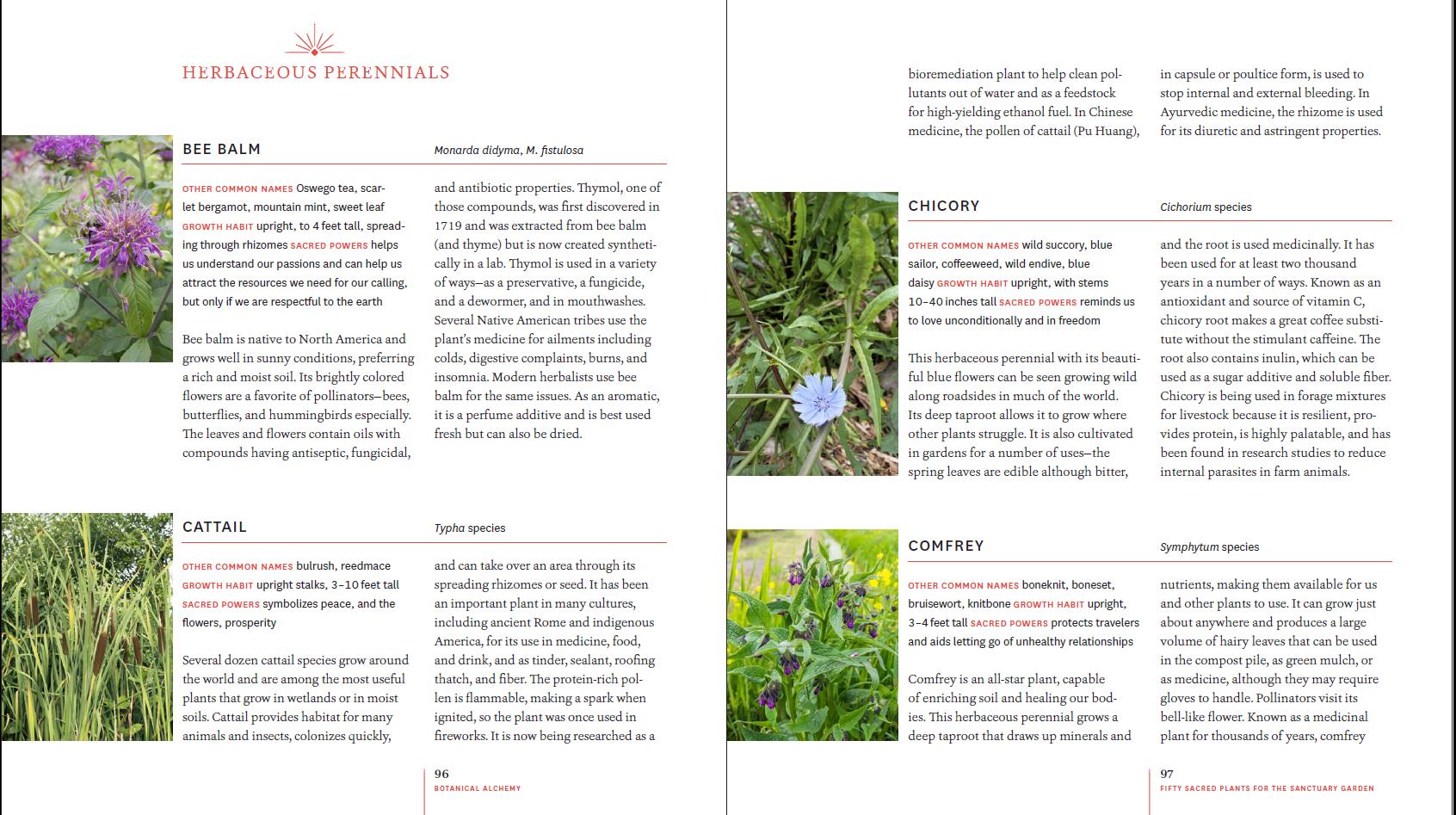
Creating Sanctuary’s essential plant reference section, by Jessi Bloom for Timber Books (c) Shawn Linehan

If you’re in the Pacific Northwest or plan to travel here for the 2019 Northwest Flower & Garden Festival (Feb 20-24), Jessi has fabulous news to share — she has just signed on as a garden creator at the flower show and many of the ideas featured in her new book will be brought to life in that garden for you to see. I’ll be sure to add a link to the NW Flower & Garden Festival at today’s show notes for you to find more details.

I want to encourage you to visit Slow Flowers Summit to learn more about the amazing program, people and flowers you’ll engage with next summer. It’s not too early to save the date and secure your seat! Slow Flowers members receive special discount pricing and everyone receives $100 off with the Early Bird rate, on sale now!

(c) Heather Saunders

We have a vital and vibrant community of flower farmers and floral designers who together define the Slow Flowers Movement. As our cause gains more supporters and more passionate participants who believe in the importance of the American cut flower industry, the momentum is contagious.

I know you feel it, too. I value your support and invite you to show your thanks and with a donation to support my ongoing advocacy, education and outreach activities. You can find the donate button in the column to the right.

The Slow Flowers Podcast has been downloaded more than 385,000 times by listeners like you. Thank you for listening, commenting and sharing – it means so much. Thank you all!

Thank you to our sponsors for supporting The Slow Flowers Podcast.

Florists’ Review magazine: I’m delighted to serve as Contributing Editor for Slow Flowers Journal, found in the pages of Florists’ Review. It’s the leading trade magazine in the floral industry and the only independent periodical for the retail, wholesale and supplier market.

Arctic Alaska Peonies, a cooperative of passionate family farms in the heart of Alaska providing bigger, better peony flowers during the months of July and August. Visit them today at arcticalaskapeonies.com

Seattle Wholesale Growers Market, a farmer-owned cooperative committed to providing the very best the Pacific Northwest has to offer in cut flowers, foliage and plants. The Growers Market’s mission is to foster a vibrant marketplace that sustains local flower farms and provides top-quality products and service to the local floral industry. Find them at seattlewholesalegrowersmarket.com

Longfield Gardens provides home gardeners with high quality flower bulbs and perennials. Their online store offers plants for every region and every season, from tulips and daffodils to dahlias, caladiums and amaryllis. Visit them at longfield-gardens.com.

Syndicate Sales, an American manufacturer of vases and accessories for the professional florist. Look for the American Flag Icon to find Syndicate’s USA-made products and join the Syndicate Stars loyalty program at syndicatesales.com.

Johnny’s Selected Seeds, an employee-owned company that provides our industry the best flower, herb and vegetable seeds — supplied to farms large and small and even backyard cutting gardens like mine. Check them out at johnnysseeds.com.

Association of Specialty Cut Flower Growers. Formed in 1988, ASCFG was created to educate, unite, and support commercial cut flower growers. It mission is to help growers produce high-quality floral material, and to foster and promote the local availability of that product. Learn more at ascfg.org

Mayesh Wholesale Florist. Family-owned since 1978, Mayesh is the premier wedding and event supplier in the U.S. and we’re thrilled to partner with Mayesh to promote local and domestic flowers, which they source from farms large and small around the U.S. Learn more at mayesh.com.

Certified American Grown Flowers. The Certified American-Grown program and label provide a guarantee for designers and consumers on the source of their flowers. Take pride in your flowers and buy with confidence, ask for Certified American Grown Flowers.  To learn more visit americangrownflowers.org.

And the Team Flower Conference – a professional floral event where flower lovers from all over the world gather for networking, learning, and celebration. It’s a special time for the floral industry to come together and whether you’re a farmer, designer, wholesaler, or just love flowers, you’re invited to attend as Team Flowers dreams big for the industry’s future. Head to teamflower.org/slowflowers to learn more about the 2019 conference in Waco, Texas!

I’m Debra Prinzing, host and producer of the Slow Flowers Podcast.
Next week, you’re invited to join me in putting more American grown flowers on the table, one vase at a time. And If you like what you hear, please consider logging onto iTunes and posting a listener review.

The content and opinions expressed here are either mine alone or those of my guests alone, independent of any podcast sponsor or other person, company or organization.

The Slow Flowers Podcast is engineered and edited by Andrew Brenlan. Learn more about his work at soundbodymovement.com. 

Music Credits:

Episode 372: News from Flowerstock and my Conversation with its Creator, Holly Chapple

Wednesday, October 24th, 2018

Holly Heider Chapple at Flowerstock 2018 (c) Sarah Collier

Love this photo, captured by Sarah Collier, of the Flowerstock experience, photographed during one of Holly’s presentations.

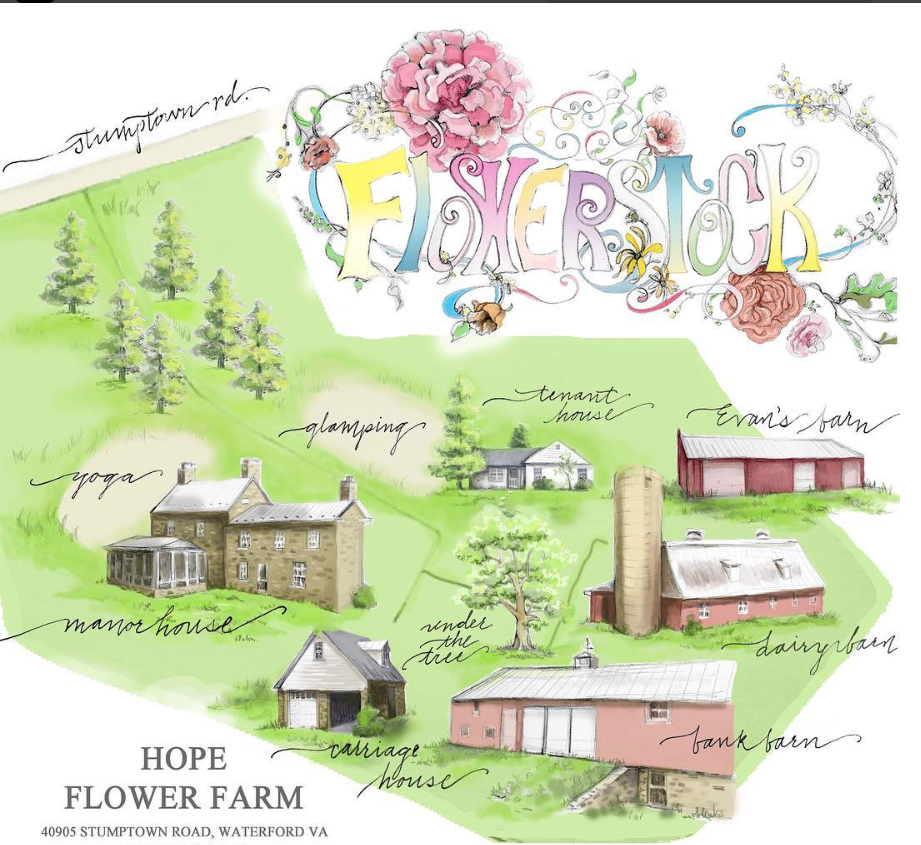
Last week, Holly Heider Chapple welcomed designers and flower lovers from near and far to Flowerstock at HOPE Flower Farm.

Floral professionals and members of the floral community gathered for two days of demonstrations and talks by renowned floral designers, including Holly, Steve Moore of Sinclair & Moore, Nancy Teasley of Oak & the Owl and Alicia and Adam Rico of Bows & Arrows.

It was an honor to join Holly at Flowerstock for the second time as a a teacher.

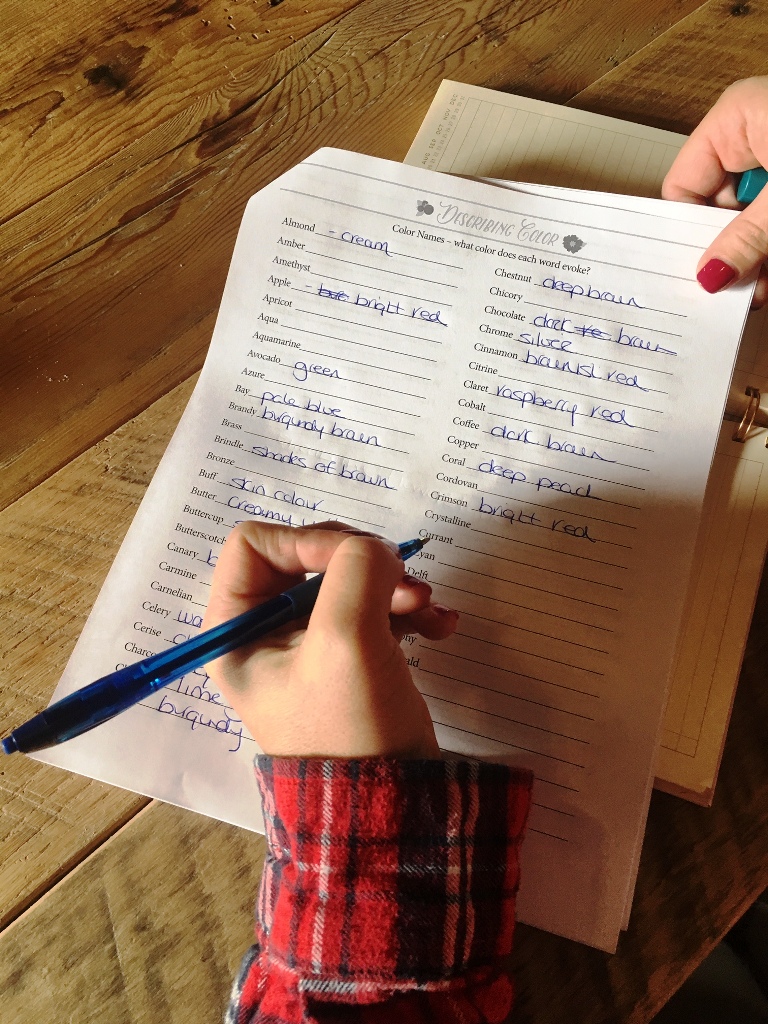
I led a number of creative writing exercises for attendees, guiding floral creatives through various modules of describing flowers, color and memories in a new way.

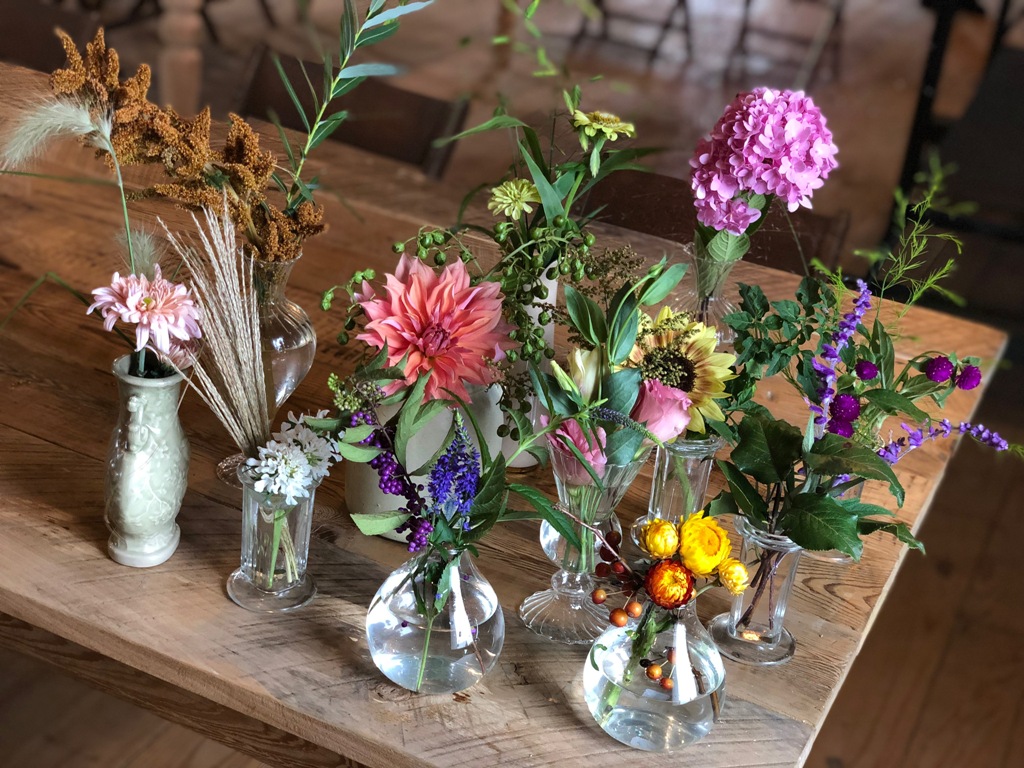
These bud vases, arranged and photographed by Andrea K. Grist, were part of a writing module to describe what we see.

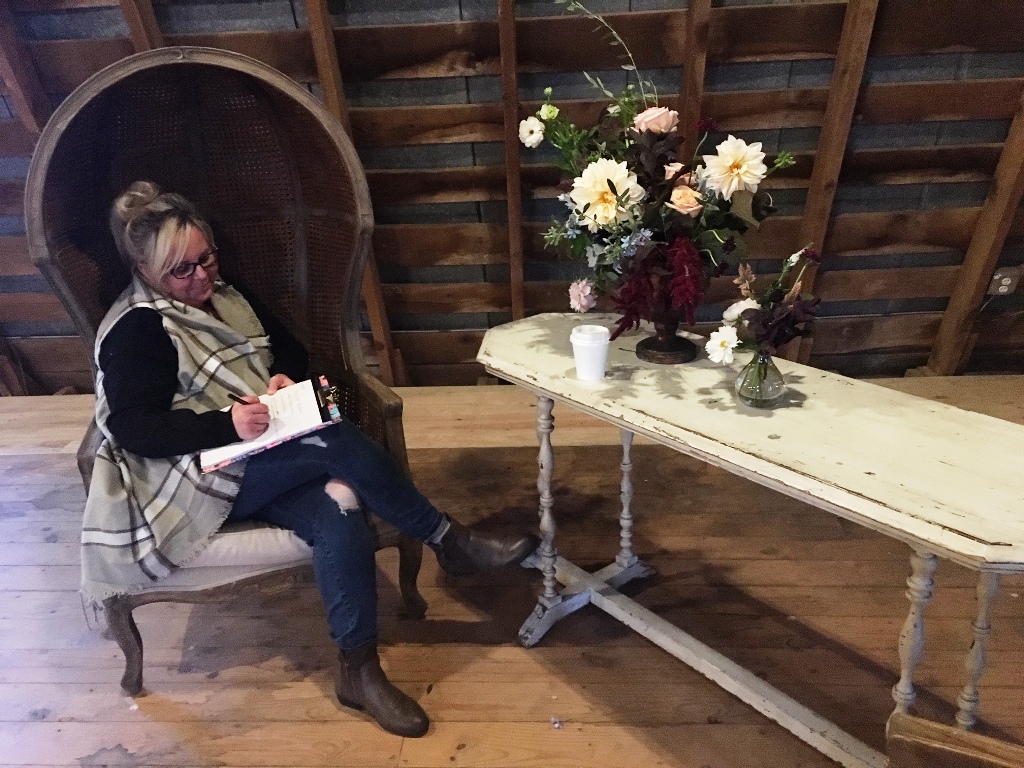
There were many quiet corners for writing, upstairs in the Dairy Barn, which is where I found Kelly Shore with pen, paper and flowers!

Color word-play is an important part of the Creative Writing Process, too, richly expanding our language.

The personal floral narrative is powerful.

We heard this idea many times from my fellow presenters and the timing was perfect for those who brought pens, paper, their open minds and a little vulnerability to the process.

We gathered upstairs in one of the barns, where there was a creative space for writing, photography and floral design. Thank you to all who participated.

I’m eager to read more of your writing!

Before I departed Flowerstock to return to Seattle, I asked Holly if we could sit down for the Slow Flowers Podcast to record an update from her and she agreed.

It was nice to sneak away to the Tenant House, where many of the speakers stayed, and sit in a comfy corner to speak uninterrupted.

We didn’t watch the clock, so this is a longish episode. We’ll forgive you if you listen in smaller units of time.

Sarah Collier captured this party photo of Holly and me, just prior to the final evening’s dinner. What a fun memento!

The first half of this episode focuses on Flowerstock and you can feel our emotions and joy while listening to Holly and I share highlights with one another.

This is the massive arrangement that Holly created at Flowerstock using the new extra-large Holly Pillow, a foam-free mechanic that she designed in conjunction with Syndicate Sales. (c) Sarah Collier

Then, during the second half of this episode, I ask Holly to update me on all that’s has happened in the past year with her new product line created in partnership with Syndicate Sales.

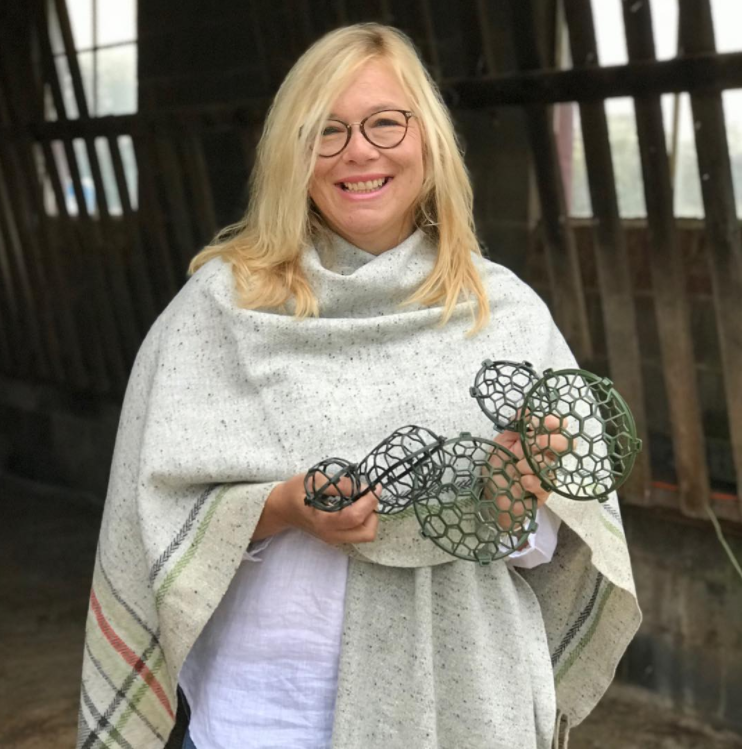
Holly Chapple holding her new grid-format “eggs” and “pillow cages,” designed with Syndicate Sales.

If you’ve missed the news, you’ll enjoy hearing the “backstory” of the Holly Egg and the Holly Pillow, new mechanics that allow efficiency, eliminate the use of foam, and (in Holly’s opinion) lend themselves to higher productivity during the design and production of weddings and events. Click here to learn more about this new product line, called the Holly Heider Chapple Collection by Syndicate Sales.

What a whirlwind of topics and stories ~ thanks for joining us. You can hear my original interview on the Slow Flowers Podcast with Holly, which we mentioned while reminiscing. It was Episode 123, which aired Jan 9, 2014. Wow, has so much happened for both Holly and me in the ensuing years as we’ve both promoting progressive practices in floral design and flower farming — in our own ways.

I want to encourage you to visit the Slow Flowers Summit site to learn more about the amazing program, people and flowers you’ll engage with next summer.

It’s not too early to save the date and secure your seat!

Slow Flowers members receive special discount pricing and everyone receives $100 off with the Early Bird rate, on sale now!

Please come back next week where you’ll hear another amazing episode featuring the leading voices in our Slow Flowers Community.

We have a vital and vibrant community of flower farmers and floral designers who together define the Slow Flowers Movement.

As our cause gains more supporters and more passionate participants who believe in the importance of the American cut flower industry, the momentum is contagious.

I know you feel it, too. I value your support and invite you to show your thanks and with a donation to support my ongoing advocacy, education and outreach activities.

You can find the donate button in the column to the right.

The Slow Flowers Podcast has been downloaded more than 372,000 times by listeners like you. Thank you for listening, commenting and sharing – it means so much.

Thank you to our Podcast Sponsors, including our lead sponsor for 2018, Florists’ Review magazine. I’m delighted to serve as Contributing Editor for Slow Flowers Journal, found in the pages of Florists’ Review. It’s the leading trade magazine in the floral industry and the only independent periodical for the retail, wholesale and supplier market.

Arctic Alaska Peonies, a cooperative of passionate family farms in the heart of Alaska providing bigger, better peony flowers during the months of July and August. Visit them today at arcticalaskapeonies.com

Seattle Wholesale Growers Market, a farmer-owned cooperative committed to providing the very best the Pacific Northwest has to offer in cut flowers, foliage and plants. The Growers Market’s mission is to foster a vibrant marketplace that sustains local flower farms and provides top-quality products and service to the local floral industry. Find them at seattlewholesalegrowersmarket.com

Longfield Gardens provides home gardeners with high quality flower bulbs and perennials. Their online store offers plants for every region and every season, from tulips and daffodils to dahlias, caladiums and amaryllis. Visit them at longfield-gardens.com.

Syndicate Sales, an American manufacturer of vases and accessories for the professional florist. Look for the American Flag Icon to find Syndicate’s USA-made products and join the Syndicate Stars loyalty program at syndicatesales.com.

Johnny’s Selected Seeds, an employee-owned company that provides our industry the best flower, herb and vegetable seeds — supplied to farms large and small and even backyard cutting gardens like mine. Check them out at johnnysseeds.com.

Association of Specialty Cut Flower Growers. Formed in 1988, ASCFG was created to educate, unite, and support commercial cut flower growers. It mission is to help growers produce high-quality floral material, and to foster and promote the local availability of that product. Learn more at ascfg.org

Mayesh Wholesale Florist. Family-owned since 1978, Mayesh is the premier wedding and event supplier in the U.S. and we’re thrilled to partner with Mayesh to promote local and domestic flowers, which they source from farms large and small around the U.S. Learn more at mayesh.com.

Certified American Grown Flowers. The Certified American-Grown program and label provide a guarantee for designers and consumers on the source of their flowers. Take pride in your flowers and buy with confidence, ask for Certified American Grown Flowers.  To learn more visit americangrownflowers.org.

And the Team Flower Conference – a professional floral event where flower lovers from all over the world gather for networking, learning, and celebration. It’s a special time for the floral industry to come together and whether you’re a farmer, designer, wholesaler, or just love flowers, you’re invited to attend as Team Flowers dreams big for the industry’s future. Head to teamflower.org/slowflowers to learn more about the 2019 conference in Waco, Texas!

(c) Missy Palacol Photography

I’m Debra Prinzing, host and producer of the Slow Flowers Podcast.
Next week, you’re invited to join me in putting more American grown flowers on the table, one vase at a time. And If you like what you hear, please consider logging onto iTunes and posting a listener review.

The content and opinions expressed here are either mine alone or those of my guests alone, independent of any podcast sponsor or other person, company or organization.

The Slow Flowers Podcast is engineered and edited by Andrew Brenlan. Learn more about his work at soundbodymovement.com. 

Music Credits:
Betty Dear
by Blue Dot Sessions
Music from:

audionautix.com

Episode 369: The Joy of Bulbs with Longfield Gardens’ Hans Langeveld and Jen Pfau

Wednesday, October 3rd, 2018

It’s time to plan and plant our spring-flowering bulbs! The anticipation of their colors, forms and fragrances in my garden — and vases — will carry me through the wet, gray months of winter! (c) Missy Palacol Photography

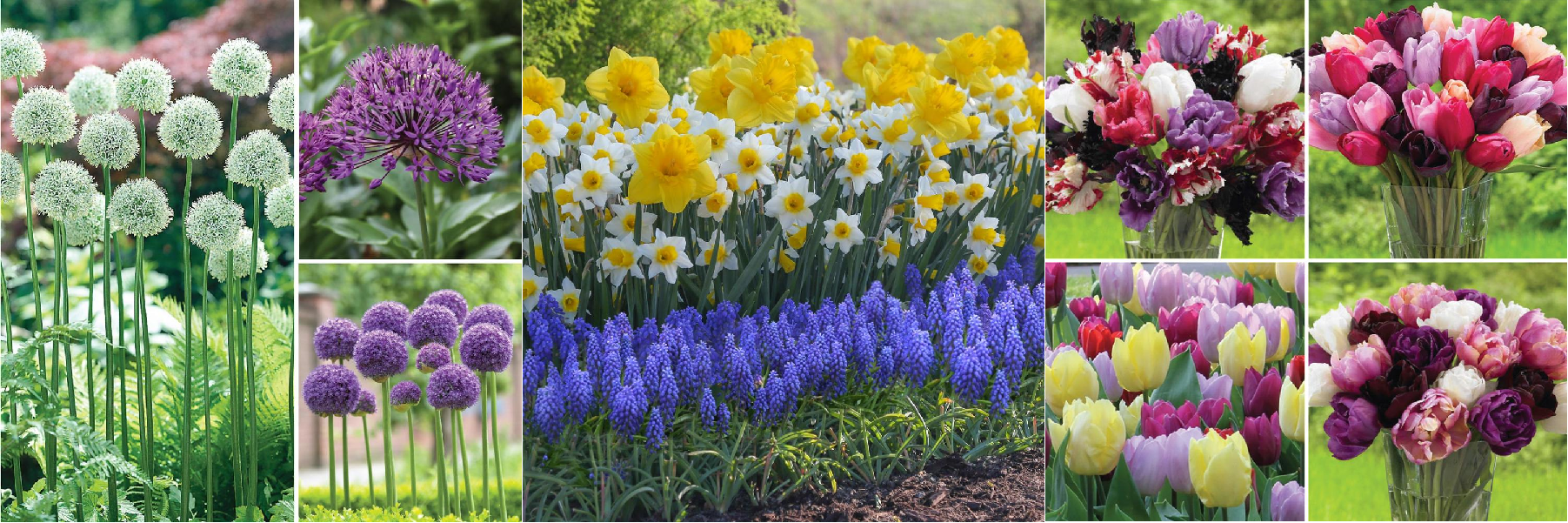
Here are three Longfield Gardens’ collections I’ll be planting in the Slow Flowers Cutting Garden this fall! From left: “Daring Forms” alliums; “Golden Glow” collection of narcissi and muscari; and “Flower Arrangers” tulip collection.

It’s October 3rd and for most of us around the country, it’s time to start thinking about planting our bulbs for next spring!

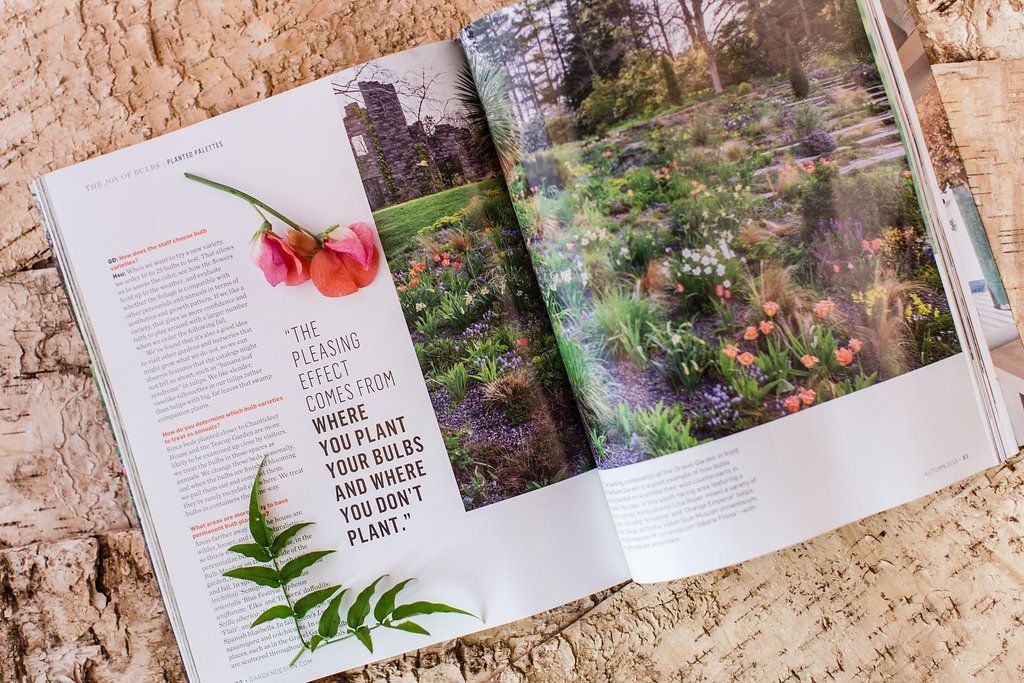
I recently immersed myself in this topic, thanks to an assignment from Garden Design magazine, whose editors asked me to interview Chanticleer Gardens’ plant information coordinator Eric Hsu. The article, “Planted Palettes,” is out in the magazine’s Autumn 2018.

The Fall 2018 issue of Garden Design magazine features my article and Rob Cardillo’s images about spring bulb design at Chanticleer Gardens (c) Missy Palacol Photography

In writing the story, I learned volumes about designing spring landscapes and container gardens with familiar and unfamiliar bulbs. My 14-page article is illustrated with gorgeous images from Rob Cardillo, an award-winning photographer I’ve known for years through the Garden Writers Association. You’ll love every page, and the publication of what Garden Design magazine is calling its “Joy of Bulbs” issue has inspired me to focus on bulbs in today’s podcast.

One of the most dazzling Longfield Gardens collections available to plant this fall! Designed by Alicia Schwede of Flirty Fleurs, the “Baroque” bulb collection.

Another beautiful bulb collection, curated for Longfield Gardens by Alicia Schwede of Flirty Fleurs, called “Somerset”

I’ve wanted to visit Longfield Gardens’ U.S. headquarters in Lakewood, New Jersey, for a number of years. A trip to Philadelphia last week brought me pretty close to that spot, so I invited myself out to the Jersey Shore, about 90 minutes east of Philadelphia, to tour Longfields’ bulb operations and trial/test gardens.

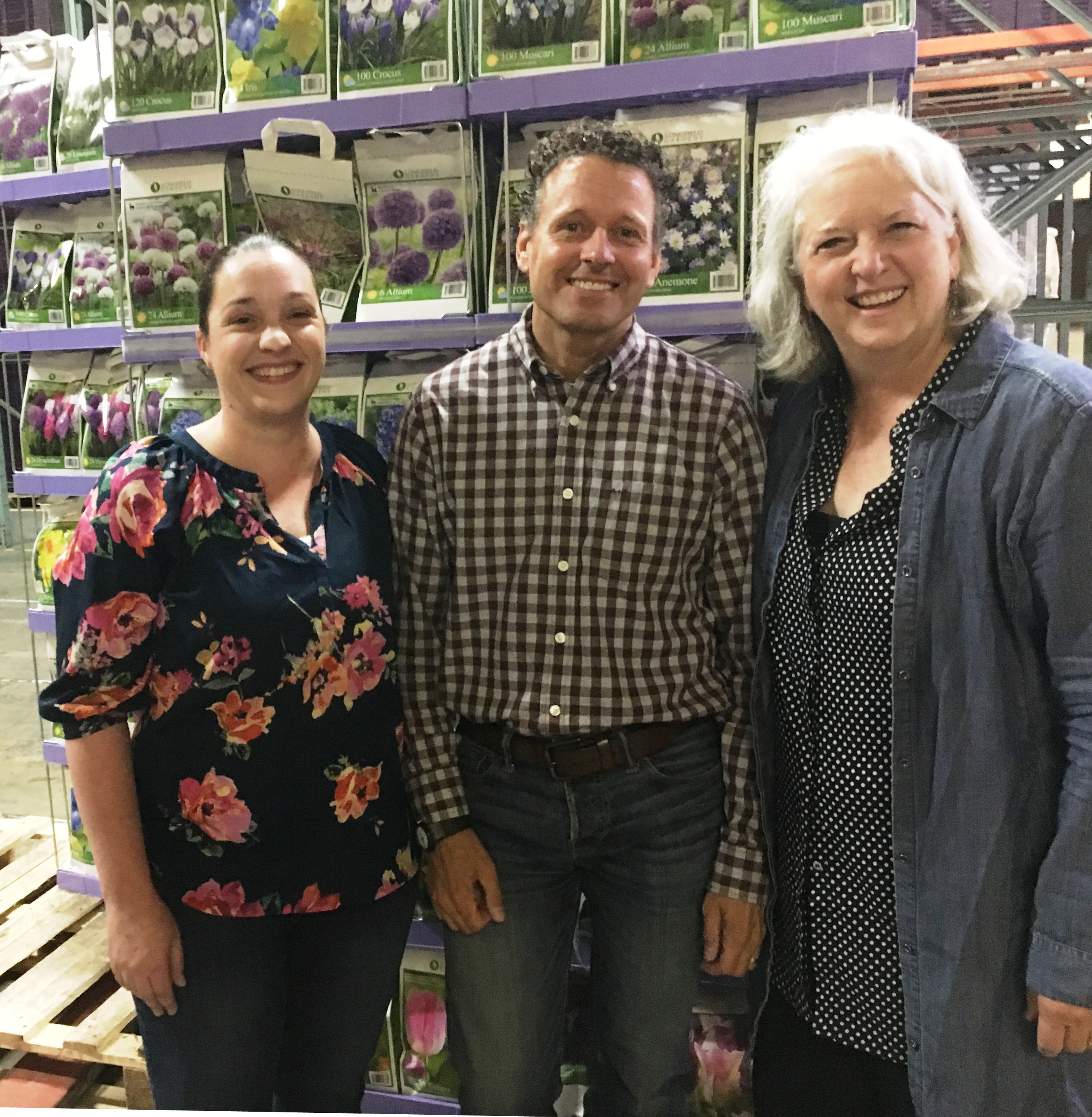
Slow Flowers visits Longfield Gardens! From left, Jen Pfau, Hans Langeveld and Debra Prinzing

My thanks to Longfield for sponsoring Slow Flowers for a number of years. I’ve worked closely with Kathleen Laliberte on bulb-themed stories and promotions  and it’s Kathleen who helped arrange my visit. I’m so grateful that it all worked out to spend a morning there and meet with today’s guests, Hans Langeveld, co-owner of Longfield Gardens, and Jen Pfau, marketing director.

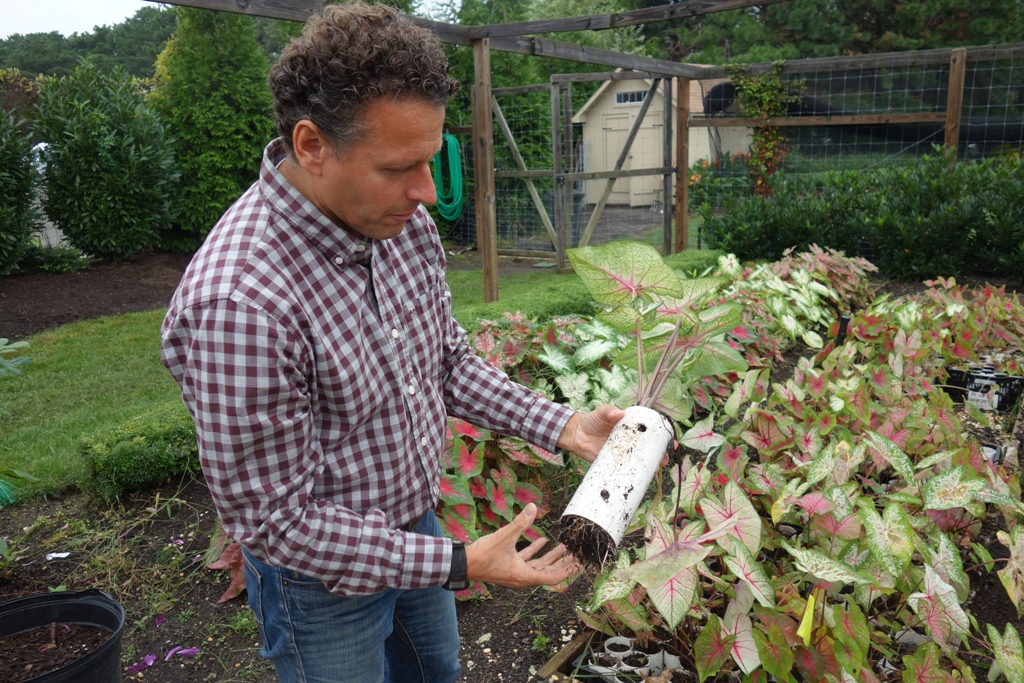
Hans Langeveld showed me how the caladium plants are grown for use in photo shoots! You can just pop these cylinder-planters into the landscape — easy!

Here’s a little bit more about them:

Hans Langeveld grew up in the heart of Holland’s bulb-growing region and has been involved in horticulture his entire professional career. As an enthusiastic gardener himself, he has a unique perspective on flowering bulbs that stretches from the breeders and growers in Holland to his own backyard in New Jersey. At Longfield Gardens, Hans is responsible for account management and quality control.

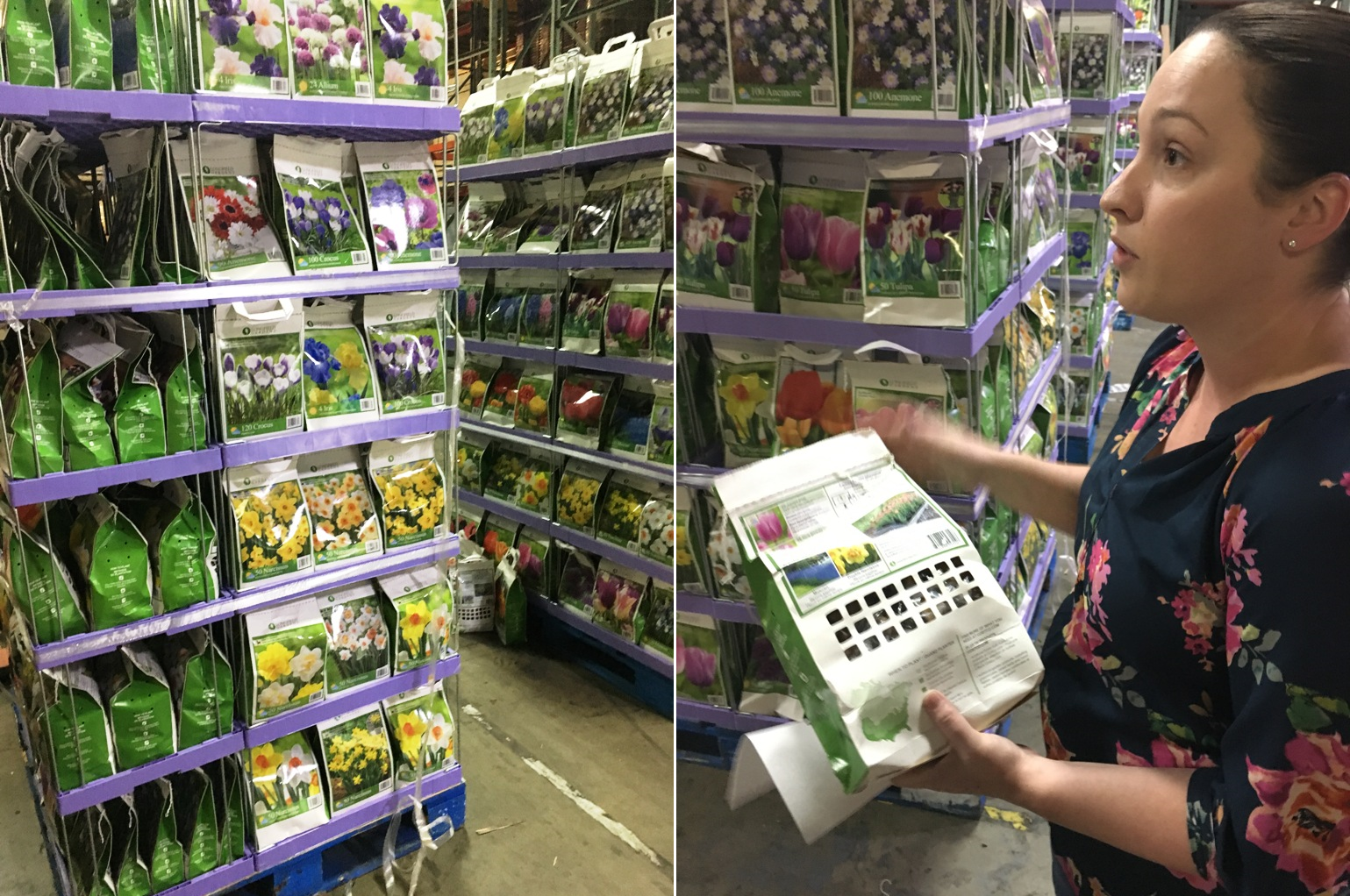
Left: The familiar packaging you’ll see at most Costco outlets this fall. Right: Jen Pfau shows the packaging’s planting and care instructions.

Jen Pfau grew up in a gardening family in New Jersey and graduated from the Cornell School of Agriculture with a degree in marketing. She joined Longfield Gardens in 2009 and launched the company’s online store in 2011. In addition to managing e-commerce, Jen is also deeply involved in the company’s wholesale business, where she oversees product selection, merchandising, marketing and the customer experience. 

Yes, the dahlia season is winding down but the planting beds at Longfield’s Test and Display Garden in Lakewood, New Jersey, are ready for spring bulbs!

Here are some of the online resources from Longfield:

Find Longfield Gardens’ catalog of bulbs to order and plant this fall here.

Library of Resources and Articles about Fall-Planted Bulbs 

Follow Longfield Gardens’ social places here:

Enjoy videos on planting and more.

Longfield Gardens on Facebook

Longfield Gardens on Instagram

Longfield Gardens on Pinterest

Longfield Gardens’ Blog

Fall is in the air and I think we’re all ready for it. That said, there’s still the promise of spring 2019, thanks to visions of bulbs in our dreams! Thanks so much for joining me today as we discussed all the things we need to know about bulb planting for cutting gardens, landscapes and containers.

We have a vital and vibrant community of flower farmers and floral designers who together define the Slow Flowers Movement. As our cause gains more supporters and more passionate participants who believe in the importance of the American cut flower industry, the momentum is contagious.

I know you feel it, too. I value your support and invite you to show your thanks and with a donation to support my ongoing advocacy, education and outreach activities. You can find the donate button in the column to the right.

The Slow Flowers Podcast has been downloaded more than 365,000 times by listeners like you. Thank you for listening, commenting and sharing – it means so much.

Thank you to our sponsors who have supported Slow Flowers and all our programs.

Florists’ Review magazine. I’m delighted to serve as Contributing Editor for Slow Flowers Journal, found in the pages of Florists’ Review. It’s the leading trade magazine in the floral industry and the only independent periodical for the retail, wholesale and supplier market.

Arctic Alaska Peonies, a cooperative of passionate family farms in the heart of Alaska providing bigger, better peony flowers during the months of July and August. Visit them today at arcticalaskapeonies.com

Seattle Wholesale Growers Market, a farmer-owned cooperative committed to providing the very best the Pacific Northwest has to offer in cut flowers, foliage and plants. The Growers Market’s mission is to foster a vibrant marketplace that sustains local flower farms and provides top-quality products and service to the local floral industry. Find them at seattlewholesalegrowersmarket.com

Longfield Gardens provides home gardeners with high quality flower bulbs and perennials. Their online store offers plants for every region and every season, from tulips and daffodils to dahlias, caladiums and amaryllis. Visit them at longfield-gardens.com.

Syndicate Sales, an American manufacturer of vases and accessories for the professional florist. Look for the American Flag Icon to find Syndicate’s USA-made products and join the Syndicate Stars loyalty program at syndicatesales.com.

Johnny’s Selected Seeds, an employee-owned company that provides our industry the best flower, herb and vegetable seeds — supplied to farms large and small and even backyard cutting gardens like mine. Check them out at johnnysseeds.com.

Association of Specialty Cut Flower Growers. Formed in 1988, ASCFG was created to educate, unite, and support commercial cut flower growers. It mission is to help growers produce high-quality floral material, and to foster and promote the local availability of that product. Learn more at ascfg.org

Mayesh Wholesale Florist. Family-owned since 1978, Mayesh is the premier wedding and event supplier in the U.S. and we’re thrilled to partner with Mayesh to promote local and domestic flowers, which they source from farms large and small around the U.S. Learn more at mayesh.com.

Certified American Grown Flowers. The Certified American-Grown program and label provide a guarantee for designers and consumers on the source of their flowers. Take pride in your flowers and buy with confidence, ask for Certified American Grown Flowers.  To learn more visit americangrownflowers.org.

And the Team Flower Conference – a professional floral event where flower lovers from all over the world gather for networking, learning, and celebration. It’s a special time for the floral industry to come together and whether you’re a farmer, designer, wholesaler, or just love flowers, you’re invited to attend as Team Flowers dreams big for the industry’s future. Head to teamflower.org/slowflowers to learn more about the 2019 conference in Waco, Texas!

Debra Prinzing at PepperHarrow Farm on September 9, 2018. Photographed by Liz Brown @estorie

I’m Debra Prinzing, host and producer of the Slow Flowers Podcast.

Next week, you’re invited to join me in putting more American grown flowers on the table, one vase at a time. And If you like what you hear, please consider logging onto iTunes and posting a listener review.

The content and opinions expressed here are either mine alone or those of my guests alone, independent of any podcast sponsor or other person, company or organization.

The Slow Flowers Podcast is engineered and edited by Andrew Brenlan. Learn more about his work at soundbodymovement.com. 


Episode 367: Flowers from the Lowcountry with Charleston, S.C.-based Jim Martin of Compost in My Shoe

Wednesday, September 19th, 2018

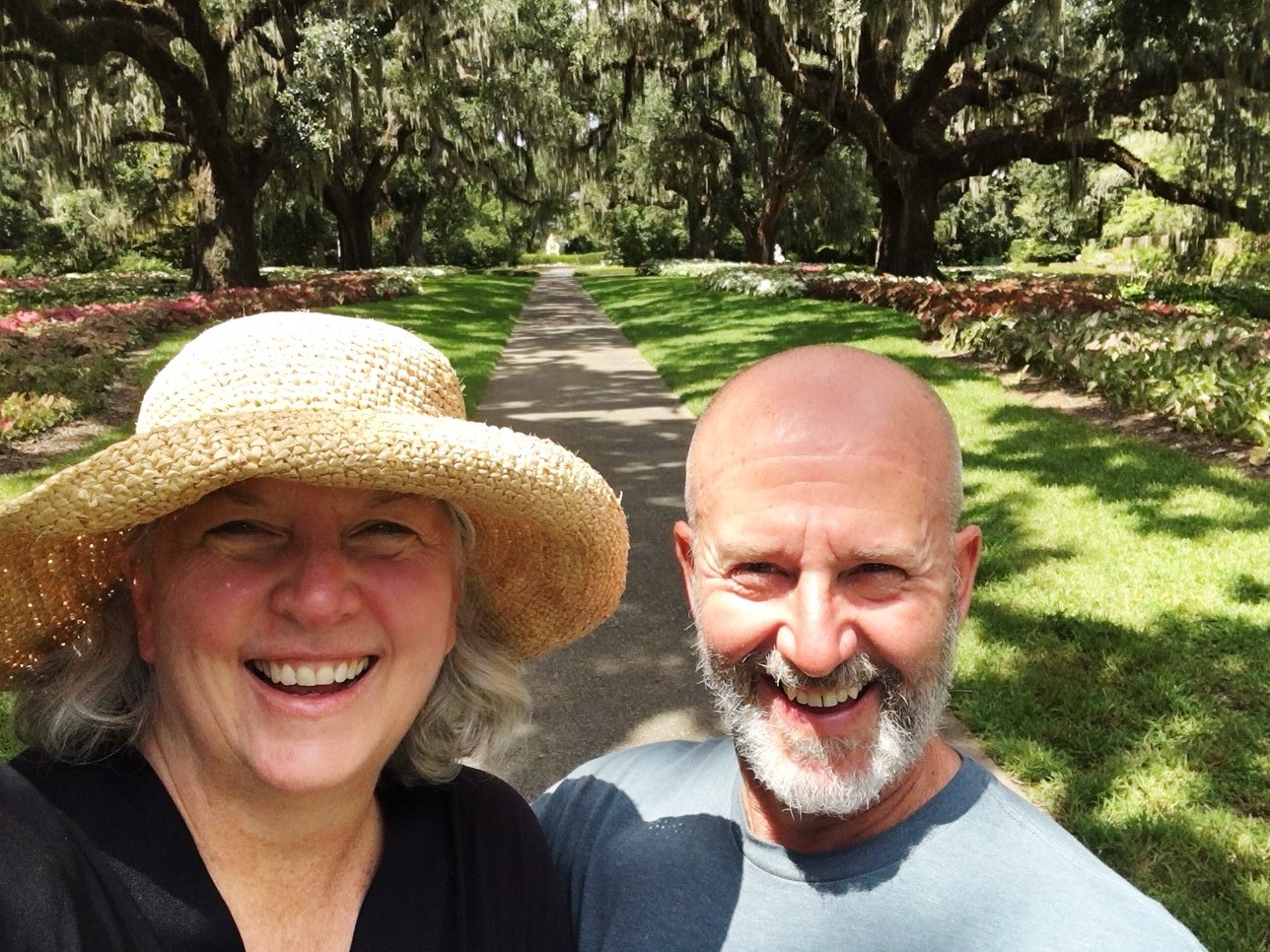
Jim Martin, today’s guest, is an amazing horticulturist and Southern flower farmer. We snapped this selfie at Brookgreen Gardens where Jim once worked.

Less than a month ago, I traveled to Charleston, S.C., where I spoke at the Southern Flower Symposium, hosted by Lowcountry Flower Growers. A number of wonderful and incredibly talented farmers and designers participated in the one-day conference, which was themed: “Future Forward Flower Success.”

After Rita Anders and I gave the morning presentations, the afternoon sessions at Southern Flower Symposium turned to floral design. Here, Anne Graves of Syndicate Sales discusses the company’s commitment to making vases and floral accessories in the U.S. Syndicate donated vessels for the design demonstration.

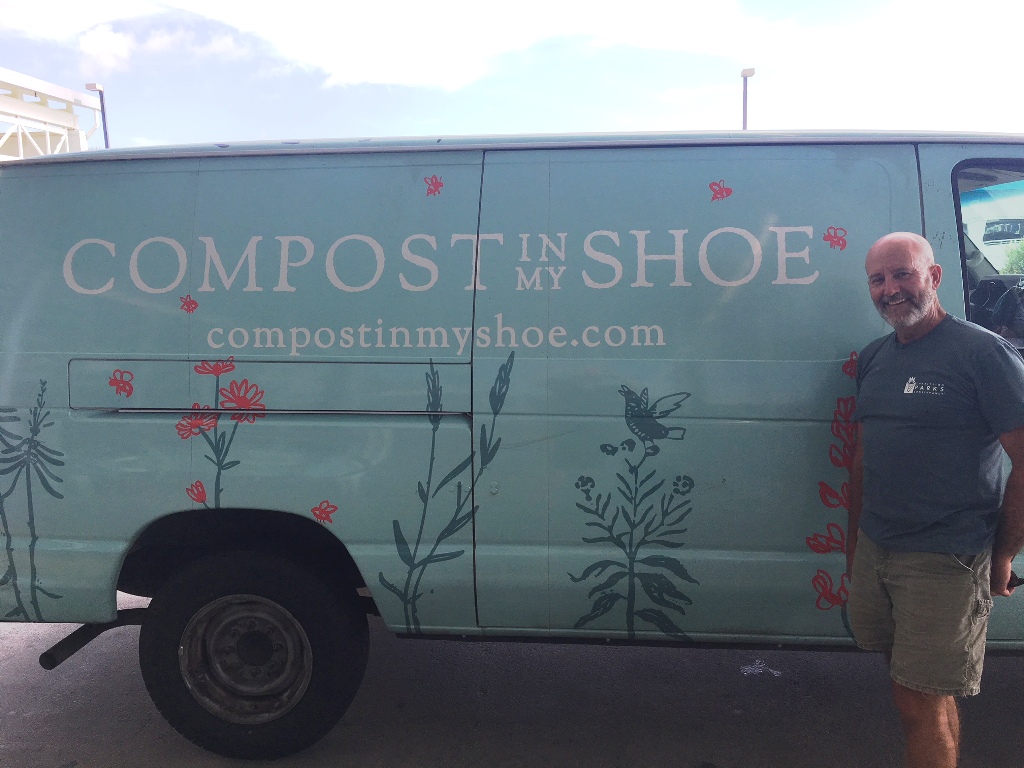
It was a fabulous time and I was honored to be invited by and hosted by today’s guest, Jim Martin. As a veteran horticulturist who has had a long career in public gardens, Jim works as director of programs for the Charleston Parks Conservancy. As a flower and veggie grower, he owns Compost in my Shoe, which originated as a garden blog and is now also the name of Jim’s farming enterprise.

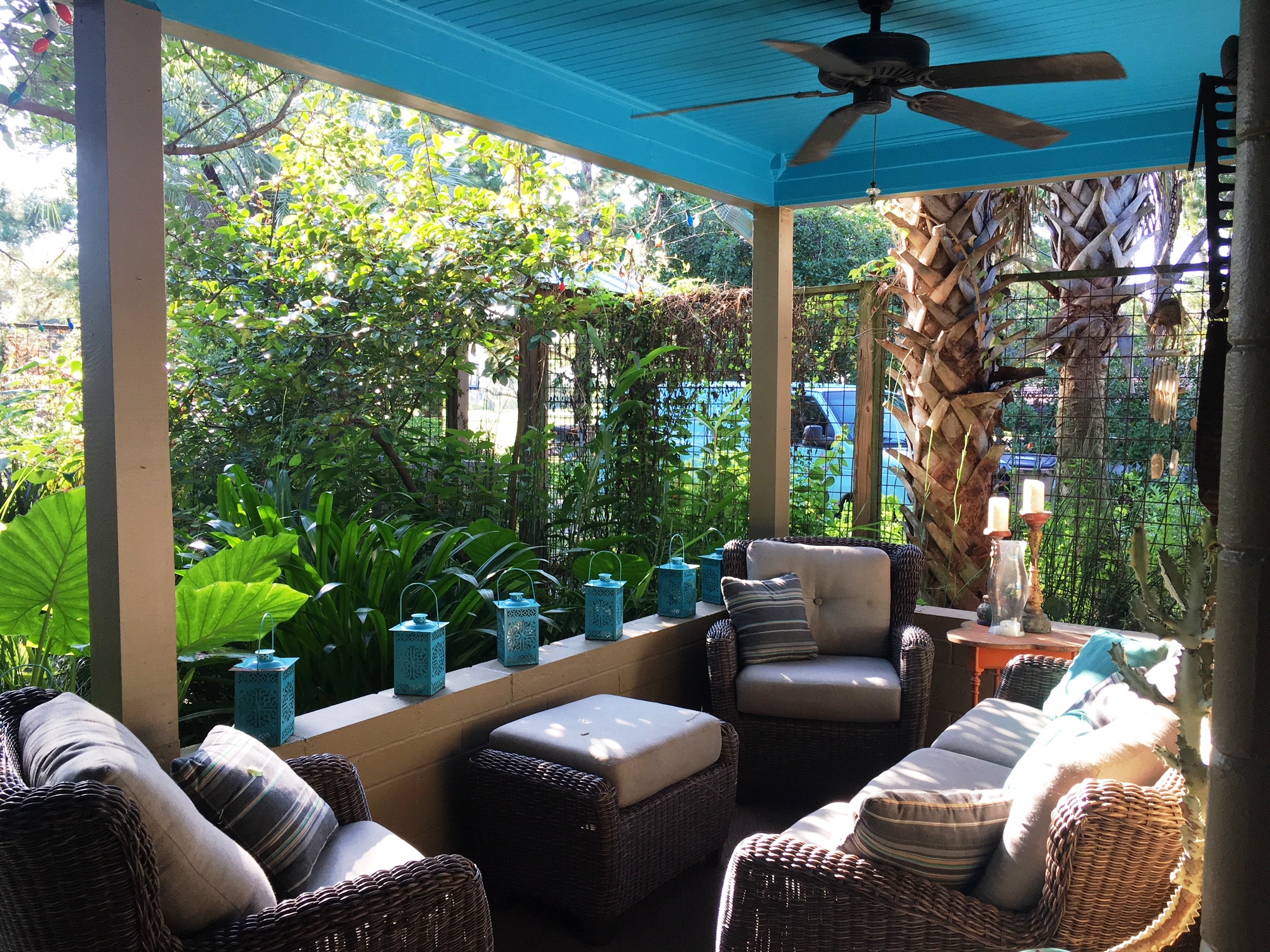
Jim and David’s Southern front porch, inviting, comfortable, private and conducive to wonderful conversations.

Jim and his partner David Vagasky live incredibly creative lives on James Island, where there are lazy fans suspended above one’s bed, where there’s a covered porch with comfy chairs where you can sit and gaze at the lush, green garden, while sipping a glass of wine; Jim and David, along with their three friendly pups, took very good care of me. David is a culinary instructor, talented chef and chocolatier, a pedigree which immediately won me over!

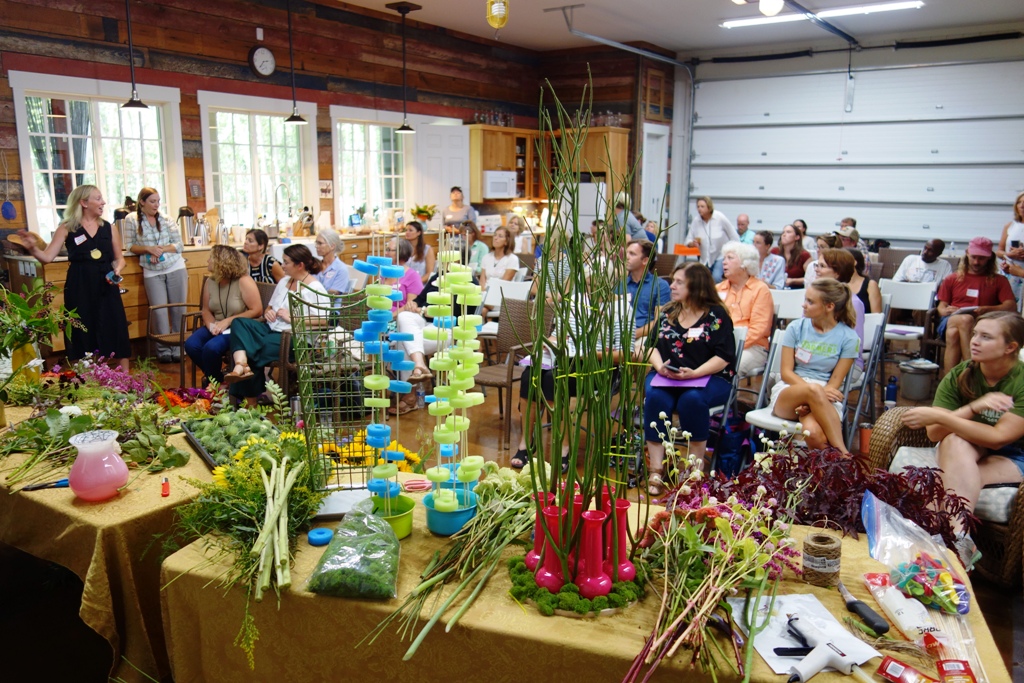
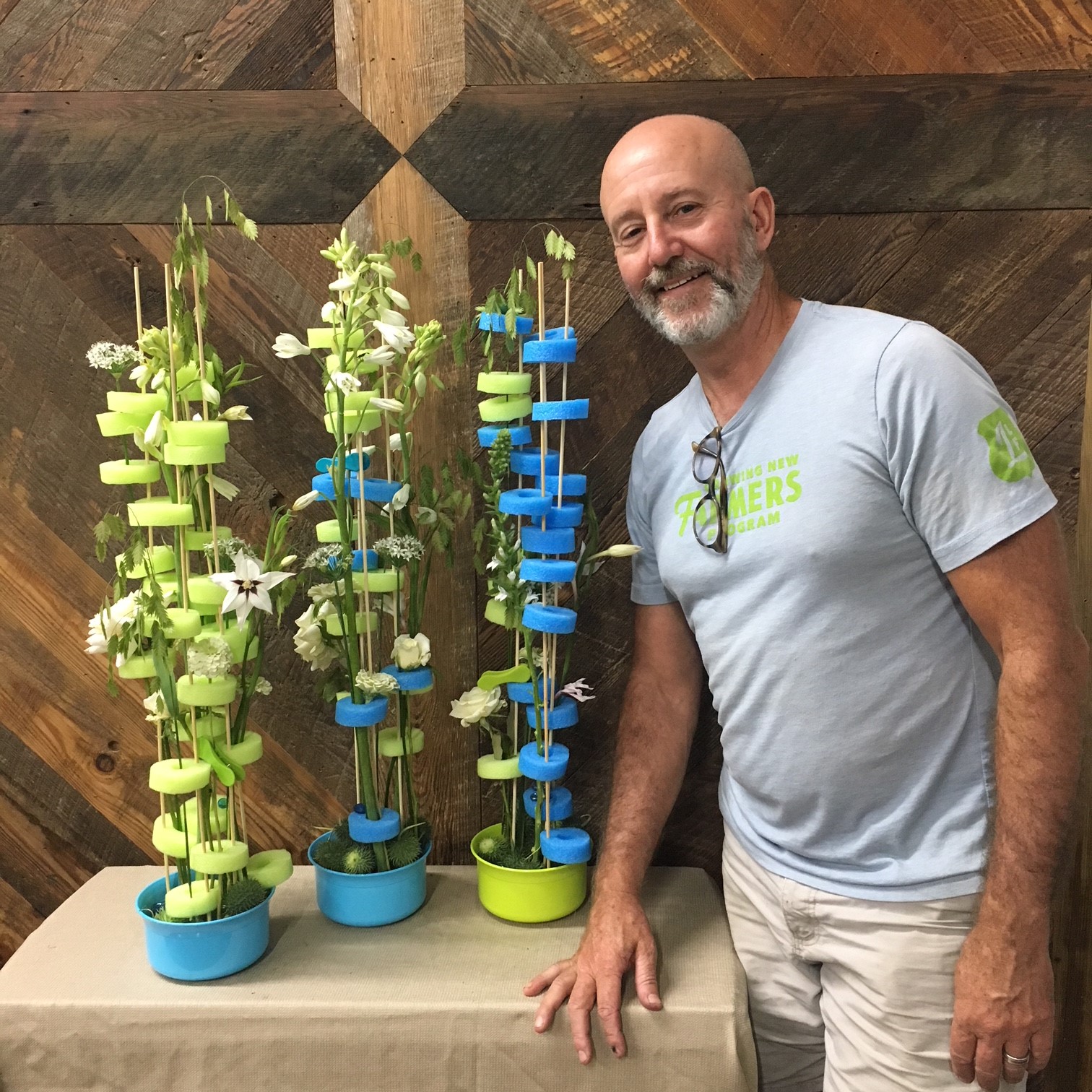
Jim Martin with one of his floral creations inspired by the theme “Structure.” He used all locally-grown flowers and created three rhythmic towers with foam disks sliced from swimming pool “noodles.”

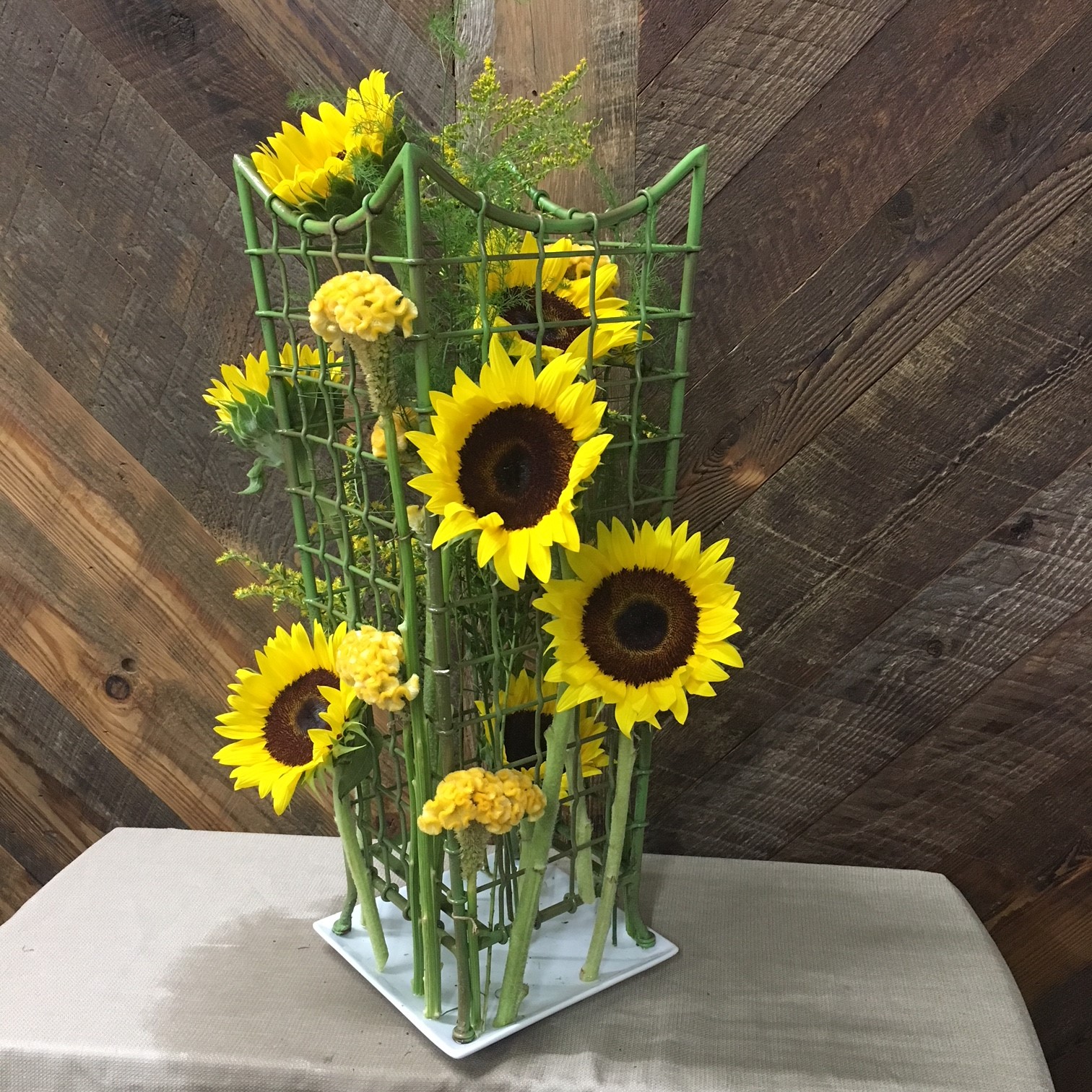
Another beautiful Jim Martin design featuring sunflowers, celosia and goldenrod stems, arranged in a metal frame that was once a wastebin.

Jim took me to tour Brookgreen Gardens near Myrtle Beach, where he once worked. We stumbled across a fantastic Patrick Dougherty installation!

My friendship with Jim dates back about 10 years through the Garden Writers Association, which found us serving on a long-range strategic planning task force in 2011 – a volunteer role that cemented our affection for one another.

How wonderful for me that Jim has always been a student of floral design, having presented on the national stage at past American Institute of Floral Designers conferences.

He is currently a candidate for the European Master Certification with Hitomi Gilliam AIFD and Tomas De Bruyne. Floral design and growing flowers brought us together more frequently than our garden blogs ever did.

I am excited to share Jim’s story today during our podcast — it’s an inspiring convergence of horticulture and floriculture.

Jim Martin, Compost in my Shoe

Here’s a bit more about Jim Martin, from Compost in My Shoe’s “about” page:

Jim Martin’s relationship with the land began on a dairy farm in northern Ohio. Caring for the soil was what they called organic farming.

A move to the Palmetto State at age 13 meant learning to garden in a foreign land. His 25-year career in horticulture is coming full circle with Compost In My Shoe.

His lifelong relationship with the land is shared today through his garden design, boutique farming and teaching/consulting.

Compost in my Shoe is dedicated to growing and developing high quality produce, products and services while nurturing  the life-giving bond we all have with the land.

Jim Martin is a lifelong gardener and horticulturist who has worked in public horticulture for 29 years. During his 12-year tenure as director of horticulture at the Riverbanks Zoo in Columbia, S.C., he played a key role in the development of their nationally-recognized 90-acre Botanical Garden. He also served for 5 years as the vice president of horticulture for Brookgreen Gardens, the first public sculpture garden in America, on Pawley’s Island, S.C. He has been with the Charleston Parks Conservancy since 2007 as Director of Programs.

Jim farms in the Lowcountry through Compost In My Shoe. Other interests include the floral arts, photography and gardening.

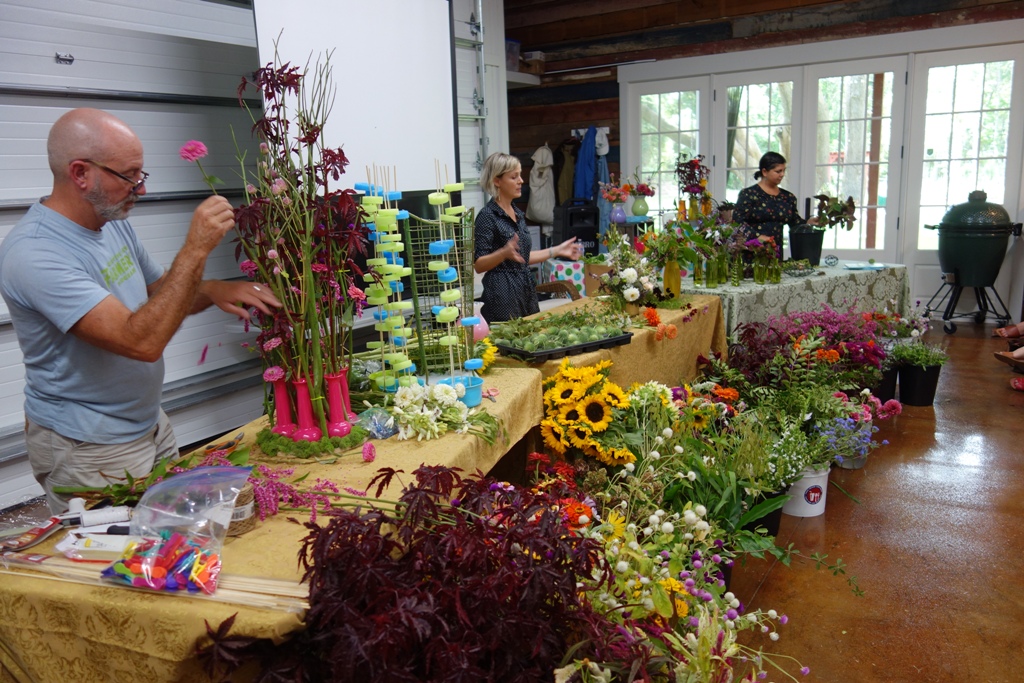
Jim Martin (left), with Ann Cunniffe of Purple Magnolia (center) and Toni Reale (right), presented the floral design portion of the Southern Flowers Symposium.

As I mentioned, Jim is one of the co-founders of the Lowcountry Flower Growers, along with Laura Mewbourn of Feast & Flora Farm and Peachey Trudell of One Wild Acre. Lowcountry Flower Growers is a registered 501(c)3 non-profit dedicated to serving the Charleston and Lowcountry flower farming community through public advocacy and private educational opportunities for southern growers.

In 2017, seven Lowcountry flower farmers met to discuss their commitment to producing beautiful, high-quality floral crops for coastal South Carolina. They knew that locally-grown produce, prized for its exceptional flavor and quality, is a vital part of the Lowcountry economy.  The farmers agreed to work together to set the same high standards for the locally-grown bouquets gracing the tables of their customers.

Lowcountry Flower Growers was incorporated in 2017 and received federal tax exempt status in 2018.  In that brief time, the group has hosted multiple events to raise public awareness about locally grown flowers, particularly during the 2017 and 2018 American Flowers Week campaign. And most recently, they hosted the Southern Flower Symposium.

Our tour of Charleston included a visit to the editorial offices of Garden & Gun magazine, courtesy of Anne Graves. From left: Jim, Debra, Anne and one of G&G’s editors, CJ Lotz.

Before we turn to my interview with Jim, recorded on August 29th when there was no hint of a Hurricane called Florence, I want to update you on our flower farming community in Charleston. Jim and I spoke a few days ago and he reported that the area avoided the worst of the storm; Jim and David and their dogs were not required to evacuate and the hurricane was downgraded considerably last weekend.

Areas between Wilmington and Myrtle Beach were hit hardest and elsewhere, heavy, heavy rains and some flooding occurred. If you’ve heard of any flower farms sustaining damage or loss, please let me know.

Despite Compost in My Shoe’s good fortune this time around, Jim added this: “Most people are clueless about what farmers go through. Everything they’ve worked for can be gone in an instant, changed in a storm, hurricane or flood. And we just start over.”

Profound and humbling to say the least. In our interview, one of Jim’s comments really resonated with me. I think you’ll find it meaningful, given everything that’s going on in our world. He said: “It’s a global world but we have to live in it in a local way.” Profound!

Find and follow Jim Martin at these social places:
Compost in my Shoe on Facebook

Compost in my Shoe on Instagram

Thanks so much for joining me today. Climate’s impact on flower farming is seemingly worse than ever. Last weekend, I also reached out to Melissa Smith of Fraylick Farm in Travelers Rest, S.C., and a leader of the SC Upstate Flower Growers group, many of whom attended the Southern Flower Symposium. She sent this update: “So far, Florence has been a non-event here. Every time I look at the radar, my farm is just outside where the worst rain and wind is hitting in this area. Really grateful that we appear to have been spared this time!”

Next week, you’ll hear from Kim Burton of Denver’s CityGal Farms, who two weeks ago was hit with a freak hail storm, not the first of the area’s 2018 disasters.

Designed by Nancy Cameron of Destiny Hill Flower Farm.

We have a vital and vibrant community of flower farmers and floral designers who together define the Slow Flowers Movement. As our cause gains more supporters and more passionate participants who believe in the importance of the American cut flower industry, the momentum is contagious.

I know you feel it, too. I value your support and invite you to show your thanks and with a donation to support my ongoing advocacy, education and outreach activities. You can find the donate button in the column to the right.

The Slow Flowers Podcast has been downloaded more than 360,000 times by listeners like you. Thank you for listening, commenting and sharing – it means so much.

Thank you to our sponsors who have supported Slow Flowers and all our programs.

Florists’ Review magazine. I’m delighted to serve as Contributing Editor for Slow Flowers Journal, found in the pages of Florists’ Review. It’s the leading trade magazine in the floral industry and the only independent periodical for the retail, wholesale and supplier market.

Arctic Alaska Peonies, a cooperative of passionate family farms in the heart of Alaska providing bigger, better peony flowers during the months of July and August. Visit them today at arcticalaskapeonies.com

Seattle Wholesale Growers Market, a farmer-owned cooperative committed to providing the very best the Pacific Northwest has to offer in cut flowers, foliage and plants. The Growers Market’s mission is to foster a vibrant marketplace that sustains local flower farms and provides top-quality products and service to the local floral industry. Find them at seattlewholesalegrowersmarket.com

Longfield Gardens provides home gardeners with high quality flower bulbs and perennials. Their online store offers plants for every region and every season, from tulips and daffodils to dahlias, caladiums and amaryllis. Visit them at longfield-gardens.com.

Syndicate Sales, an American manufacturer of vases and accessories for the professional florist. Look for the American Flag Icon to find Syndicate’s USA-made products and join the Syndicate Stars loyalty program at syndicatesales.com.

Johnny’s Selected Seeds, an employee-owned company that provides our industry the best flower, herb and vegetable seeds — supplied to farms large and small and even backyard cutting gardens like mine. Check them out at johnnysseeds.com.

Association of Specialty Cut Flower Growers. Formed in 1988, ASCFG was created to educate, unite, and support commercial cut flower growers. It mission is to help growers produce high-quality floral material, and to foster and promote the local availability of that product. Learn more at ascfg.org

Mayesh Wholesale Florist. Family-owned since 1978, Mayesh is the premier wedding and event supplier in the U.S. and we’re thrilled to partner with Mayesh to promote local and domestic flowers, which they source from farms large and small around the U.S. Learn more at mayesh.com.

Certified American Grown Flowers. The Certified American-Grown program and label provide a guarantee for designers and consumers on the source of their flowers. Take pride in your flowers and buy with confidence, ask for Certified American Grown Flowers.  To learn more visit americangrownflowers.org.

And the Team Flower Conference – a professional floral event where flower lovers from all over the world gather for networking, learning, and celebration. It’s a special time for the floral industry to come together and whether you’re a farmer, designer, wholesaler, or just love flowers, you’re invited to attend as Team Flowers dreams big for the industry’s future. Head to teamflower.org/slowflowers to learn more about the 2019 conference in Waco, Texas!

(c) Nicole Clarey Photography for Mayesh Design Star Workshop

I’m Debra Prinzing, host and producer of the Slow Flowers Podcast.
Next week, you’re invited to join me in putting more American grown flowers on the table, one vase at a time. And If you like what you hear, please consider logging onto iTunes and posting a listener review.

The content and opinions expressed here are either mine alone or those of my guests alone, independent of any podcast sponsor or other person, company or organization.

The Slow Flowers Podcast is engineered and edited by Andrew Brenlan. Learn more about his work at soundbodymovement.com. 

Music Credits:

In The Field; Acoustic Meditation; Acoustic Serenity
Music from:

audionautix.com

Episode 364: Meet Perla Sofia Curbelo, Puerto Rico’s Gardening and Wellness Expert

Wednesday, August 29th, 2018

Perla Sophia Curbelo, of Puerto Rico’s AgroChic

Today’s guest shares with us an inside look into gardening and agriculture in the U.S. territory of Puerto Rico. Her name is Perla Sofia Curbelo, creator of AgroChic, a blog in Spanish for Garden Lovers & Agropreneurs.

We’ve become friends through GWA, the Association for Garden Communicators, of which we are both members, and through our mutual love of gardening and digital media. I’ve been so fascinated with her platform, AgroChic, which has become an international forum for Spanish-speakers who love gardening, plants, wellness and more, both on the island of Puerto Rico and around the world.

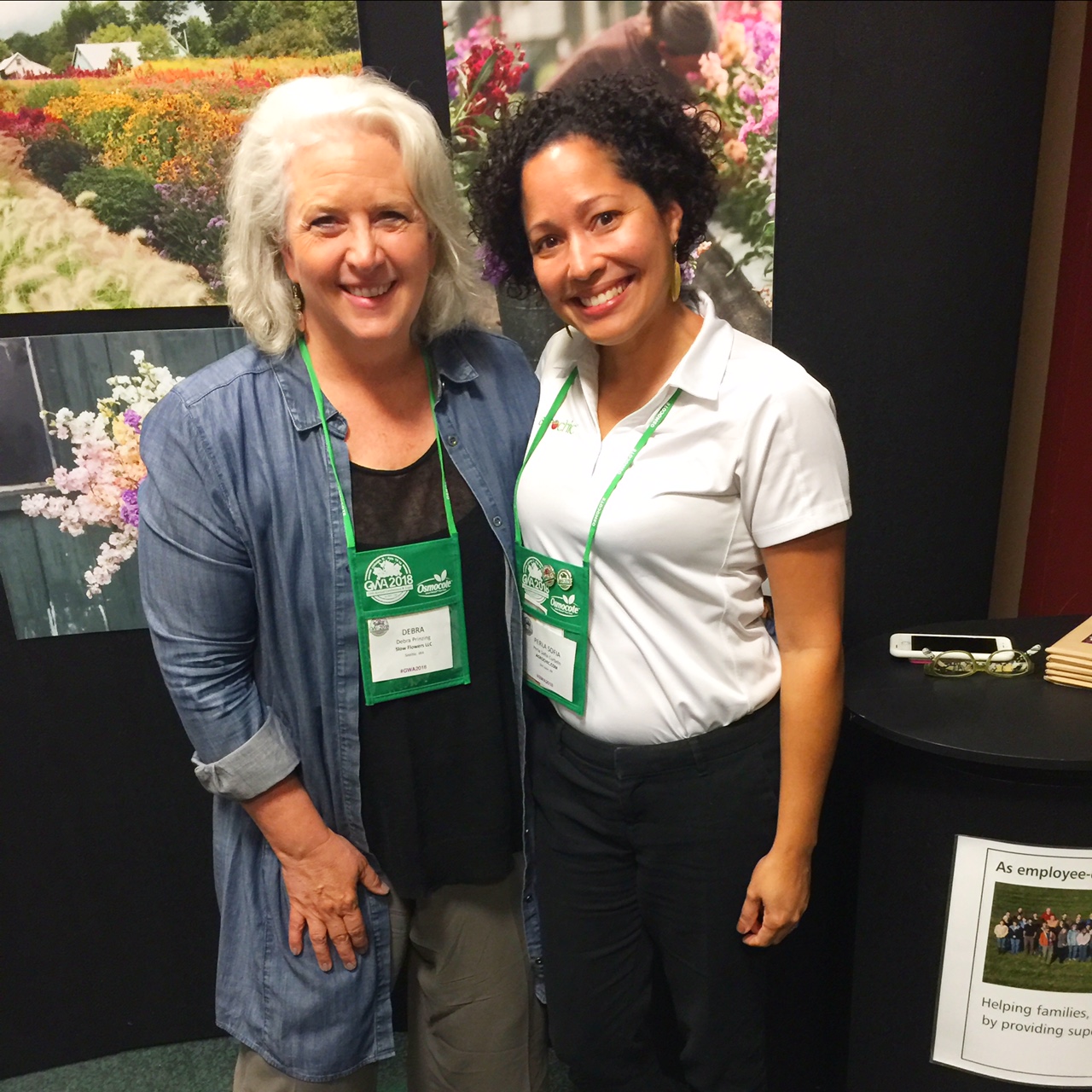
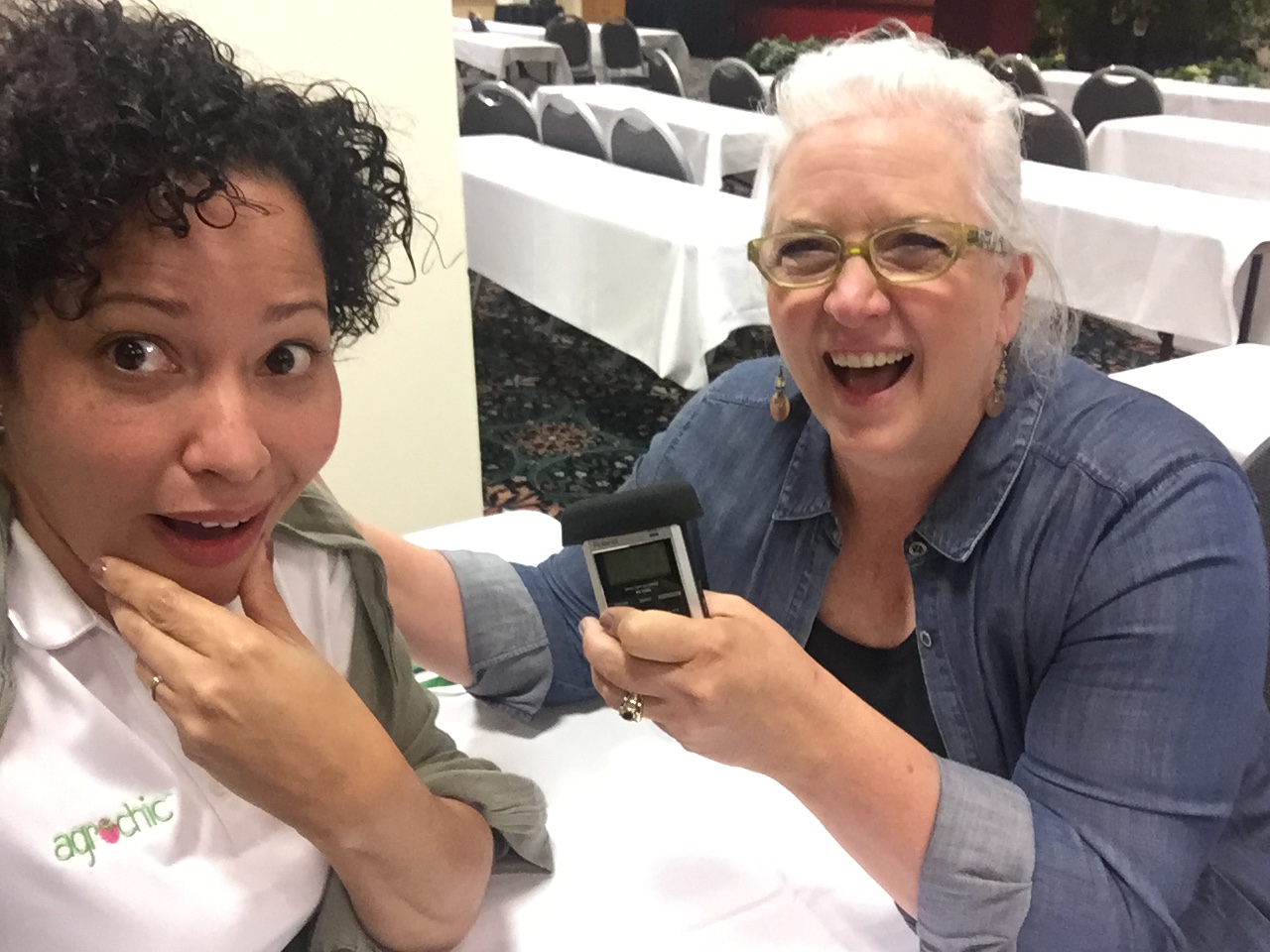
I loved meeting up with Perla Sophia at the GWA Symposium.

When I knew that Perla Sofia and I were going to meet up again a few weeks ago in Chicago, for our GWA conference, I sent her a note asking if she’d be willing to come on the Slow Flowers Podcast as my guest.

It was a bit challenging for us to find the time to do this — and true confessions, we snuck out of another scheduled function in order to sit in an empty meeting room and record this episode.

It was one of the highlights of my time in Chicago and I’m so excited for you to hear Perla Sofia’s story — and her take on gardening, Puerto Rico style. We wanted to share good and inspiring news from Puerto Rico, news that the cable channels and mainstream networks won’t bring you. I encourage you to follow AgroChic at its social places so you can follow along with Perla Sofia and learn more.

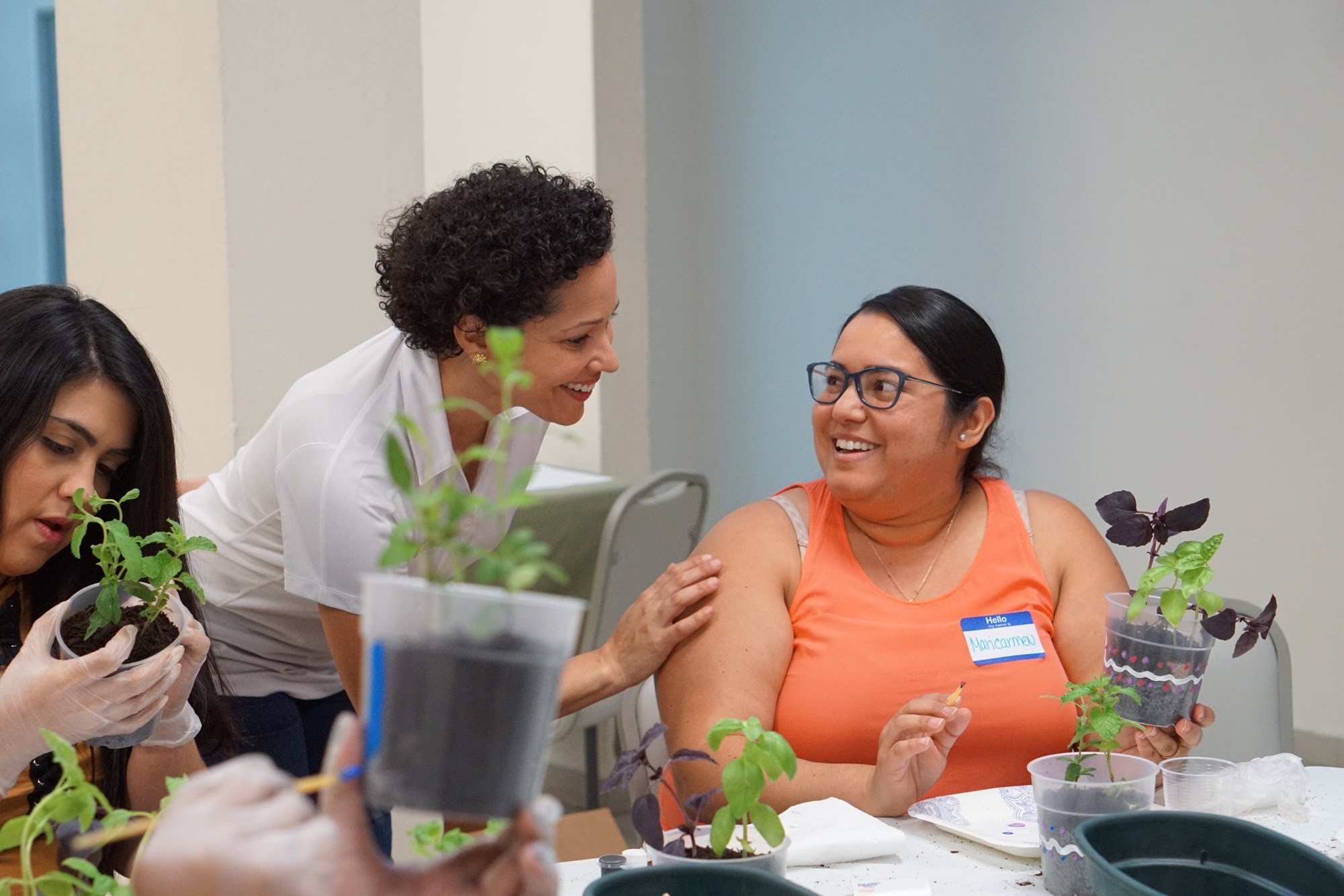
Teaching about plants with AgroChic

Here’s a little bit more about my friend Perla Sofia:

Perla Sofía Curbelo is a Puerto Rican journalist turned mediapreneur. In 2009, she founded Agrochic.com, a gardening blog in Spanish.

Through the website, readers interested in urban agriculture and wellness can check articles, guides and lists on topics like how to take care of your houseplants, how to create a veggie garden in containers and even how to plan your next garden travel.

For the past 30 years, her family had run a monthly paper in Puerto Rico, specialized in Agriculture. They also have a small coffee farm. Her younger brother, Luis, is an agronomist and a flower farmer.

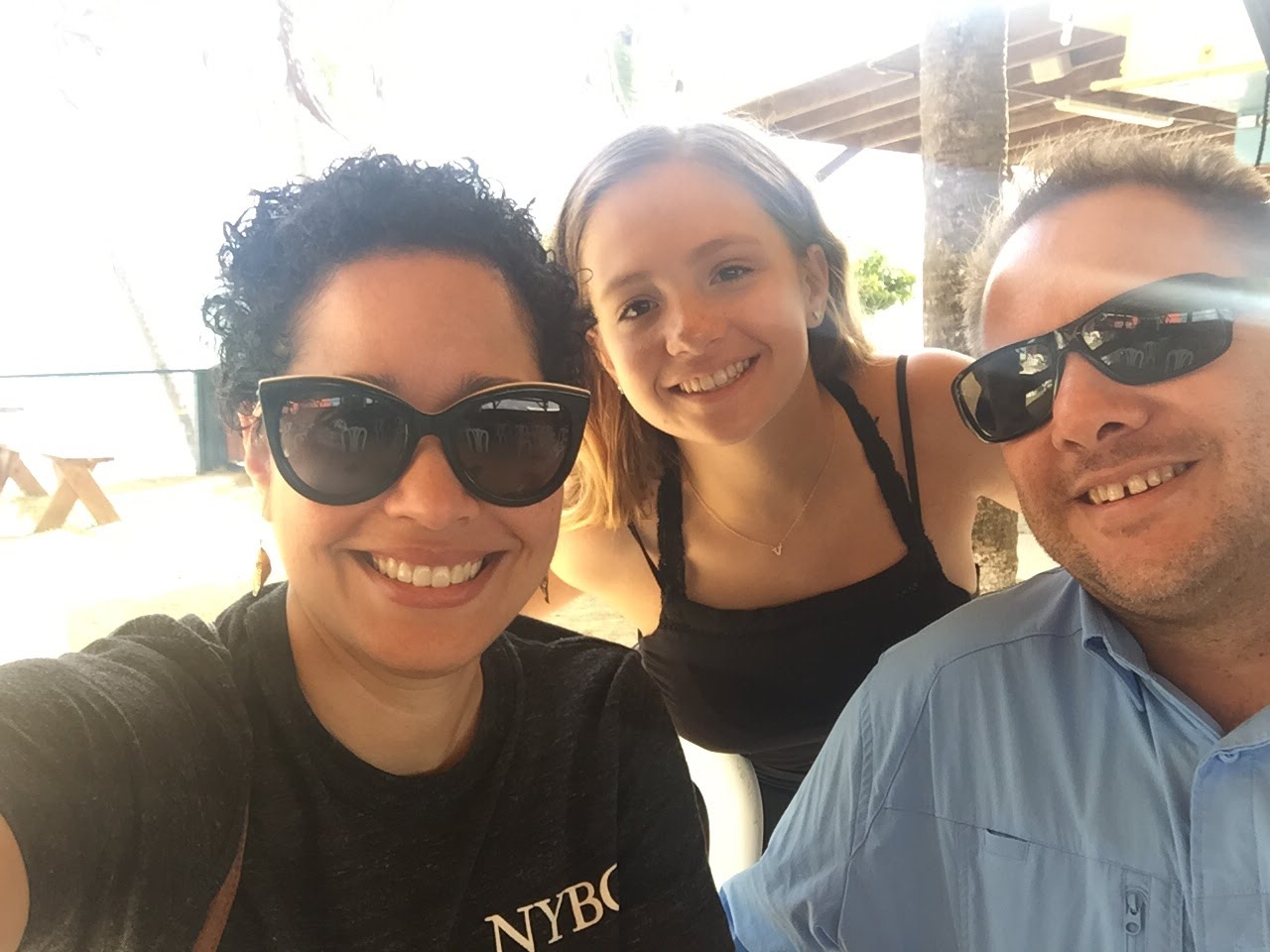
Perla, with her family in San Juan

In 2016, her blog Agrochic was nominated as one of the best Latino health and wellness blogs at the Tecla Awards during Hispanize, the largest annual event for Latino trendsetters and newsmakers in digital content creation, journalism, marketing, entertainment and tech entrepreneurship.

As part of the digital content, she also coordinates gardening workshops in San Juan, Puerto Rico, where she lives with her husband Antonio, her younger stepdaughter Veronica (one of two stepdaughters) and her beloved rottweiler Rocco.

“Today’s Greens” — Perla is a fellow Podcaster!

Perla has a bachelor´s degree in Psychology and a master´s degree in Communication, specialized in Public Relations.

She has worked in publishing, television and radio, and for the last 15 years she focused most of her writing in agriculture and gardening.

This past Summer, Perla started a seasonal podcast (La verdura de hoy, translates “Today´s Greens”), also in Spanish, which you can listen on her blog.

AgroChic’s gardening workshops are popular — and she plans on increasing their frequency.

In 2017, she joined The Association for Garden Communicators and is responsible to translate a monthly column from the GWA´s blog from English to Spanish.

For 2019, she has her eyes on a Horticulture Therapy Certification and she wants to open a gardening studio in Puerto Rico, to multiply the gardening workshops, host garden writers and entertain through all things garden.

You can find and follow Perla Sofia via AgroChic’s channels:

AgroChic on Facebook

AgroChic on Instagram

AgroChic on Twitter

Perla Sofia on Twitter

AgroChic on YouTube

Goofing around while recording our episode, with Perla Sophia Curbelo (left) and Debra Prinzing (right)

Thanks so much for joining me today! I am so grateful to for joining in today, grateful for our entire community of flower farmers and floral designers who together define the Slow Flowers Movement.

As our cause gains more supporters and more passionate participants who believe in the importance of the American cut flower industry, the momentum is contagious.

I know you feel it, too. I value your support and invite you to show your thanks and with a donation to support my ongoing advocacy, education and outreach activities. You can find the donate button in the column to the right.

The Slow Flowers Podcast has been downloaded more than 353,000 times by listeners like you. Thank you for listening, commenting and sharing – it means so much.

Thank you to our sponsors who have supported Slow Flowers and all our programs.

Florists’ Review magazine. I’m delighted to serve as Contributing Editor for Slow Flowers Journal, found in the pages of Florists’ Review. It’s the leading trade magazine in the floral industry and the only independent periodical for the retail, wholesale and supplier market.

Arctic Alaska Peonies, a cooperative of passionate family farms in the heart of Alaska providing bigger, better peony flowers during the months of July and August. Visit them today at arcticalaskapeonies.com

Seattle Wholesale Growers Market, a farmer-owned cooperative committed to providing the very best the Pacific Northwest has to offer in cut flowers, foliage and plants. The Growers Market’s mission is to foster a vibrant marketplace that sustains local flower farms and provides top-quality products and service to the local floral industry. Find them at seattlewholesalegrowersmarket.com

Longfield Gardens provides home gardeners with high quality flower bulbs and perennials. Their online store offers plants for every region and every season, from tulips and daffodils to dahlias, caladiums and amaryllis. Visit them at longfield-gardens.com.

Syndicate Sales, an American manufacturer of vases and accessories for the professional florist. Look for the American Flag Icon to find Syndicate’s USA-made products and join the Syndicate Stars loyalty program at syndicatesales.com.

Johnny’s Selected Seeds, an employee-owned company that provides our industry the best flower, herb and vegetable seeds — supplied to farms large and small and even backyard cutting gardens like mine. Check them out at johnnysseeds.com.

Association of Specialty Cut Flower Growers. Formed in 1988, ASCFG was created to educate, unite, and support commercial cut flower growers. It mission is to help growers produce high-quality floral material, and to foster and promote the local availability of that product. Learn more at ascfg.org

Mayesh Wholesale Florist. Family-owned since 1978, Mayesh is the premier wedding and event supplier in the U.S. and we’re thrilled to partner with Mayesh to promote local and domestic flowers, which they source from farms large and small around the U.S. Learn more at mayesh.com.

Certified American Grown Flowers. The Certified American-Grown program and label provide a guarantee for designers and consumers on the source of their flowers. Take pride in your flowers and buy with confidence, ask for Certified American Grown Flowers.  To learn more visit americangrownflowers.org.

And the Team Flower Conference – a professional floral event where flower lovers from all over the world gather for networking, learning, and celebration. It’s a special time for the floral industry to come together and whether you’re a farmer, designer, wholesaler, or just love flowers, you’re invited to attend as Team Flowers dreams big for the industry’s future. Head to teamflower.org/slowflowers to learn more about the 2019 conference in Waco, Texas!

I’m Debra Prinzing, host and producer of the Slow Flowers Podcast.
Next week, you’re invited to join me in putting more American grown flowers on the table, one vase at a time. And If you like what you hear, please consider logging onto iTunes and posting a listener review.

The content and opinions expressed here are either mine alone or those of my guests alone, independent of any podcast sponsor or other person, company or organization.

The Slow Flowers Podcast is engineered and edited by Andrew Brenlan. Learn more about his work at soundbodymovement.com. 

Episode 363: Grower Wisdom with Jeanie McKewan of Illinois’s Brightflower Farm

Wednesday, August 22nd, 2018

Jeanie and I had a wonderful reunion in Chicago last week. This photograph was taken in front of the Chicago Hyatt after recording our interview.

I’ve been on the road for more than a week and connecting with Slow Flowers members and sponsors has been at the heart of my travel. Before we jump into today’s conversation with a wonderful featured guest, I’d love to thank a few folks with my shout-outs!
First, on August 11 & 12, I was hosted by Christine Hoffman of Twin Cities Flower Exchange in St. Paul, Minneapolis, where I enjoyed a sneak peek into what’s in store for attendees of next year’s Slow Flowers Summit, July 1-2, 2019.

As I’ve mentioned in recent weeks, Christine and the TCFE are co-hosting the Summit in their wonderful Twin Cities, where the local floral scene is alive, well, thriving and growing.

In addition to arranging for me to visit two of the flower farms that sell their botanical harvest through the TCFE, Christine took me to see three potential venues for the Summit sessions next summer. It’s often quite challenging to manage and plan an event long-distance, so this was hugely important.
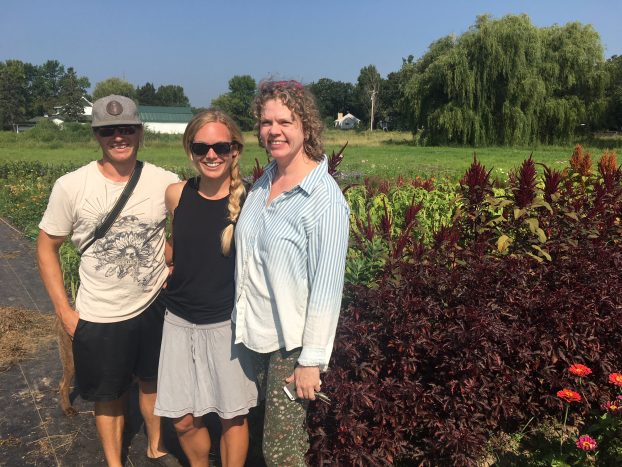
At Beezie’s Blooms, a farm portrait with owners Jeff & Randi, with Christine Hoffman of Twin Cities Flower Exchange
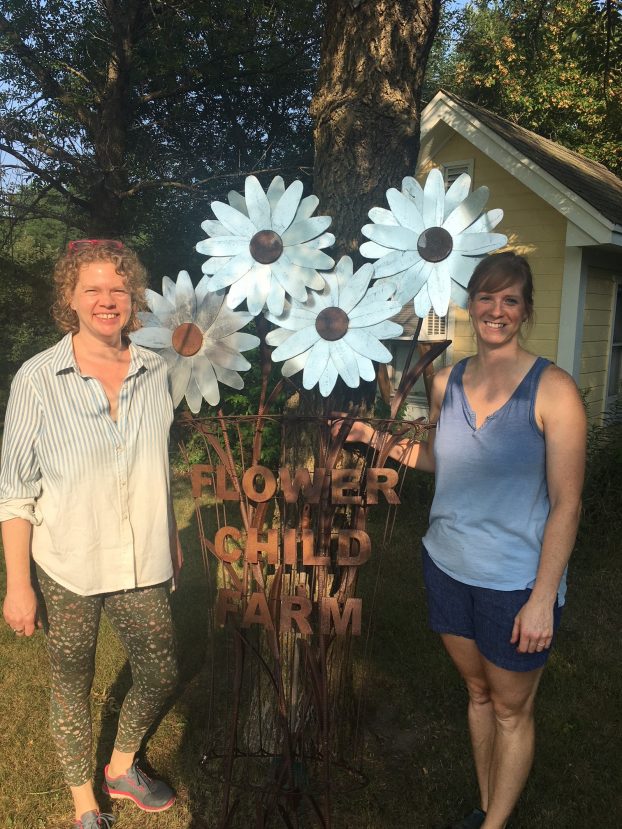
Christine Hoffman (left) and Allison DeRungs at Flower Child Farm outside Minneapolis/St. Paul.

It was a major treat to visit Beezie’s Blooms, a Slow Flowers member farm owned by Randi Greiner, and to tour Allison DeRungs’ Flower Child Farm, both located on beautiful properties north of the metro area.

On Sunday afternoon, Christine hosted a meet-up-style open house to introduce me to the local floral community – farmers and floral designers who comprise the dynamic change taking place there. We tasted signature cocktails with a floral note (of course), sample butters flavored with petals and herbs to spread on delicious local bread, and munched on local veggies, all part of the festive day.

It was inspiring and encouraging – all inside The Good Acre, a certified organic hub for local food distribution. That place holds state-of-the-art equipment and huge walk-in coolers where yes, produce from local farms is processed for distribution to school lunch rooms, but where every Wednesday florists and designers come to shop for flowers from as many as a dozen Minnesota and Wisconsin flower farms.
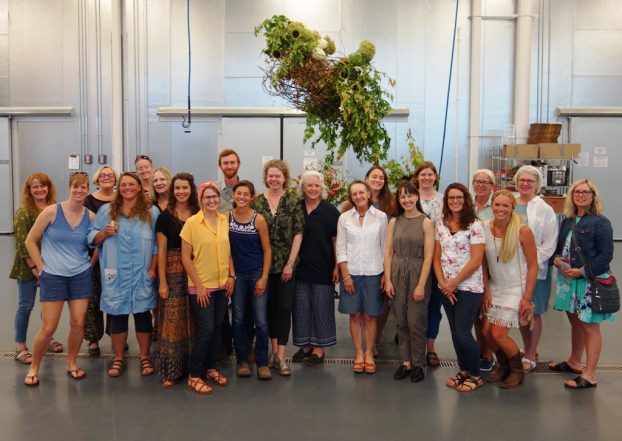
Twin Cities Flower Exchange hosted a wonderful gathering of local flower farmers and floral designers to welcome me to the Minneapolis-St. Paul area! Our gathering took place inside The Good Acre food hub, where flowers make an appearance once a week.

Seeing where it all happens after hearing Christine’s description of the TCFE’s “home” on the Slow Flowers Podcast last year, was such a treat. If you attend the Slow Flowers Summit next year during American Flowers Week, you’ll be able to experience this exciting new economic model taking place first hand, too.
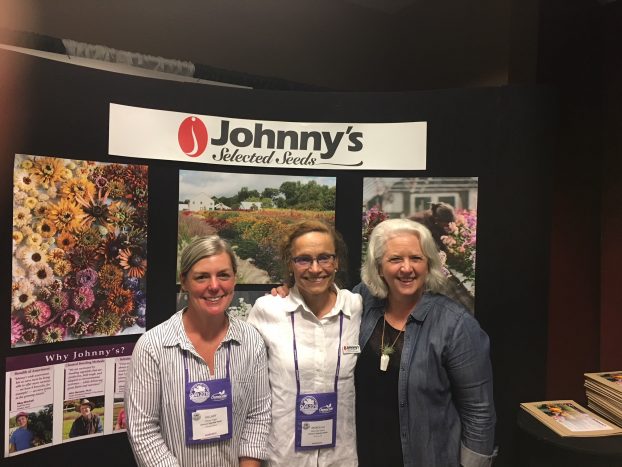
It was so fabulous to partner with Hillary Alger (left) and Marcella Sweet (center) at the Johnny’s Seeds booth during the Garden Writers Annual Symposium last week!
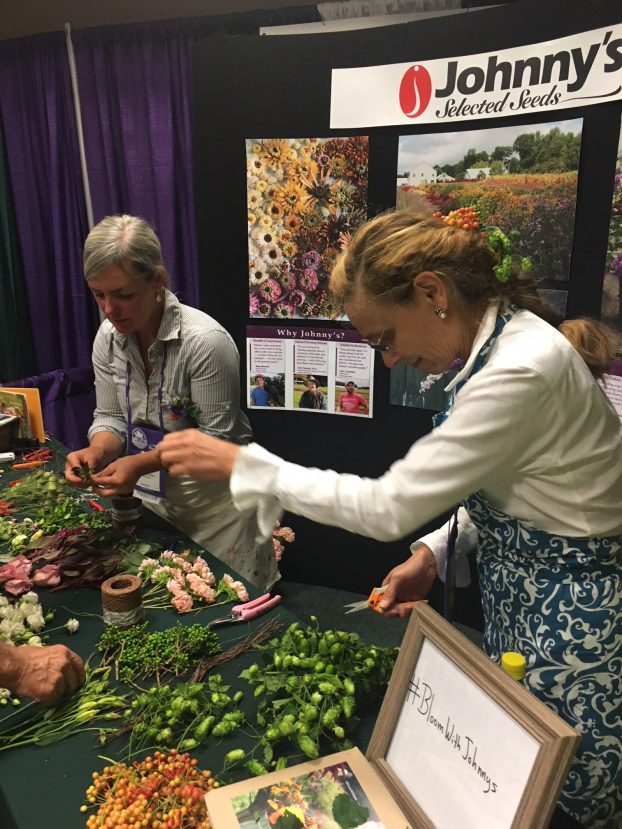
Hillary, Marcella and I hosted the incredibly popular pin-on flower bar at the GWA Chicago Expo, teaching media (writers, editors & bloggers) about cut flower gardening.

I said good-bye to the Twin Cities and headed straight to Chicago last Monday, where I spent most of the week attending the annual Garden Writers Association Symposium & Expo. I’ve been deeply involved in this professional organization – my original Tribe before the Slow Flowers Tribe emerged as a huge part of my life.

At the GWA conference, there is a trade show for two days, where garden and plant vendors exhibit their new products and wares. I joined Hillary Alger and Marcella Sweet of Johnny’s Selected Seeds, a sponsor of this Podcast and all my Slow Flowers channels at that trade show.

I’m so grateful to them and to Johnny’s for investing in bringing the Johnny’s resources and message about growing-your-own-flowers to the garden media – editors, writers, bloggers and broadcasters – my peers – who enjoyed picking up cutting garden tools, plans and images for use in their columns and posts.
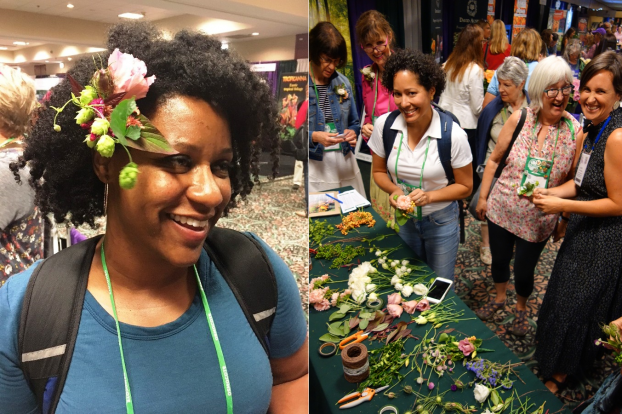
It was so fun to watch my fellow GWA members try their talents at making mini bouquets and pin-on flowers!

Hillary and Marcella and I spoke with hundreds of garden communicators interested in new story ideas, and we spent the 2nd afternoon of the trade show running what we called the “pin-on flower bar,” where we encouraged conference attendees to make their own boutonniere or corsage. What made this hands-on experience more special was the chance to showcase exquisite flowers, herbs, berries and foliage from local Slow Flowers member farms. Thank you to Heidi Joynt and Molly Kobelt of Field & Florist; Jeanie McKewan of Brightflower Farm and Beth Barnett of Larkspur Chicago for sending us their best.

Click here to view and download Johnny’s Selected Seeds’ cutting garden resources.

That only took me through mid-week, and over the course of five days I participated in all sorts of Garden Writers activities. But being in Chicago also afforded me time for the second Slow Flowers Meet-up in the Windy City.
Slow Flowers Meet-Up in Chicago, with flower farmers, floral designers, media, sponsors and me!

Last Wednesday night, thanks to Beth Barnett, about 18 of us joined together in her beautiful new Larkspur Chicago studio for an after-hours meet-up where we talked flowers, shared personal stories and enjoyed drinks and bites while making new connections and renewing established ones. I’m so grateful to the many who made the time to attend: flower farmers who traveled two to three hours into the city for our evening together; florists who closed busy retail shops or broke away from producing flowers in their studios to come for a special gathering of kindred spirits.

Thank you so much to Kath LaLiberte of Longfield Gardens, a sponsor of this podcast, and to Mackenzie Nichols, a writer and floral designer friend from New York, both of whom were in Chicago to attend the conference with me! They joined me in shopping for food and wine and helped Beth and me get everything set up for the fun. It was a great night. Just as I felt leaving the party at the Twin Cities Flower Exchange, it was so rewarding to invest in the time to make face-to-face connections with Chicago’s Slow Flowers Community. Thanks to all who helped make it happen.
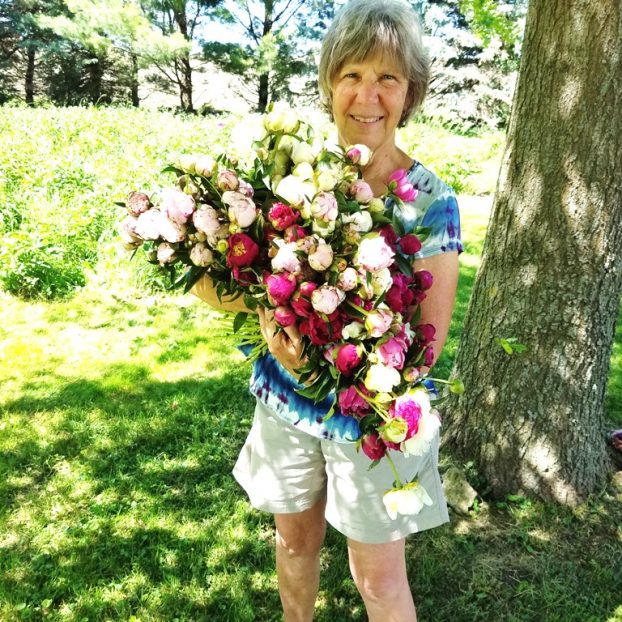
Jeanie and her beautiful peony crops from Brightflower Farm.

NOW . . . Let me introduce today’s great guest, Jeanie McKewan of Brightflower Farm in Stockton, Illinois.

As you heard, Jeanie’s flowers wowed the garden communicators who made their personal pin-on flowers at the conference last week – I have to say, the big hit was privet berry in its green form. That stumped a lot of my friends and prompted a number of internet searches on smart phones before we knew what it was.
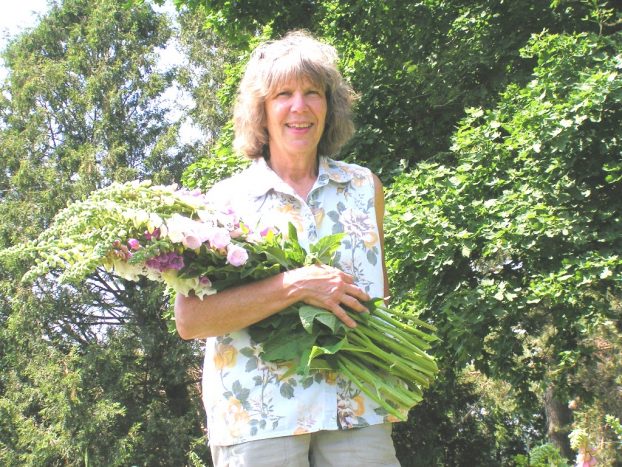
Jeanie McKewan grows cut flowers for Illinois and Wisconsin area flower farmers and Chicago’s Whole Foods stores.

I’ve known Jeanie since 2012, when we met in Tacoma at the Association of Specialty Cut Flower Growers annual conference. You’ll hear the full story in our conversation, so listen closely. I’ve also wanted to host Jeanie on the Slow Flowers Podcast forever, so once we were in the same city I had to grab the chance. The morning after our Meet-Up, I met Jeanie for breakfast and then we recorded this conversation to share with you.
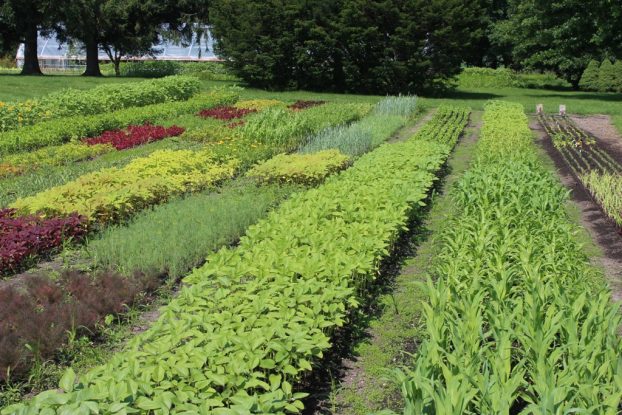
Brightflower Farm in Stockton, Illinois

Let me tell you a little more about this gifted floral entrepreneur:

Jeanie McKewan brings more than a dozen years of horticultural experience, passion and commitment to growing the finest plant materials available. She earned her Environmental Science degree from Willamette University, a Plant Pathology degree from Oregon State University, and is a Certified Landscape Professional (CLP).

Her working career gave her several opportunities to start businesses for entrepreneurs. In 1996 she was General Manager of Montale Gardens in Wauconda, Illinois, and served for nearly two years as Nursery Operations Manager for award-winning Craig Bergmann Landscape Design before founding her own growing operation.
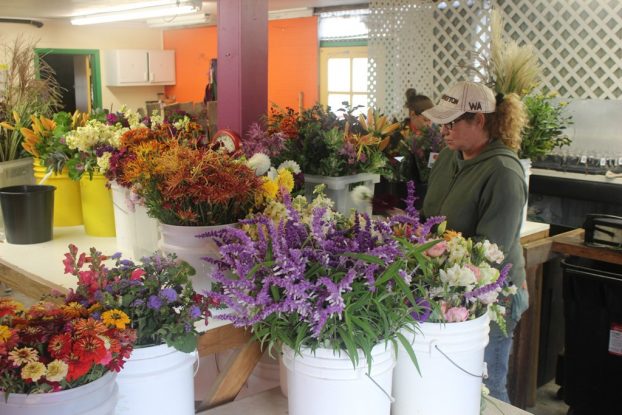
Brightflower Farm’s production studio

As founder of Brightflower Farm, she is devoted to providing beauty and fullness of life through her plants and flowers. Growing plants, eating good, flavorful food, and producing a stunning and colorful array of flowers is her passion and she feels incredibly fortunate to be able to earn a livelihood providing people with all of these things!

You’ll gain volumes from our conversation – I promise. We had a fabulous reunion and even though I’ve interviewed Jeanie in the past, I learn a lot more from her. This fascinating and experienced flower farmer is incredibly open in sharing her insights with others. You’ll hear that, too.
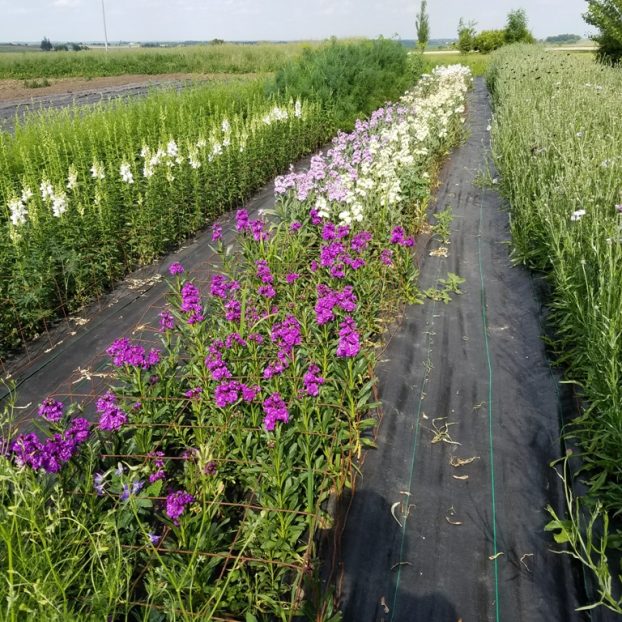
Field crops look healthy and prolific at Brightflower Farm

Follow Jeanie and her flower-filled world at these social places:

Brightflower Farm on Facebook

Brightflower Farm on Instagram

Fair Field Flowers

Here’s more information about the University of Wisconsin-Madison’s  Wisconsin Cut Flower Growers School, where Jeanie teaches each February
Here’s a bonus, too! I mentioned the two of us met in 2012. One of the outcomes of that time together during the ASCFG meeting was Jeanie bidding on a chance to be interviewed by me for a feature story. She’s given me permission to share that story, titled, “Illinois Blooms for Midwest Vases,” which is posted on the Brightflower Farm web site. It was incredibly fun to write and I think you’ll find it fascinating to read.
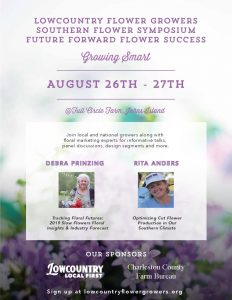
Traveling is often exhausting but I found the past ten days exhilarating and inspiring.

From visiting flower farms to spending time with floral designers to promoting cutting gardens to fellow communicators – it was a packed week, but a rewarding one.

Next up, I’ll be attending the Southern Flower Symposium in Charleston, South Carolina, hosted by many Slow Flowers members and the core group called Lowcountry Flower Growers.

I’ll join Rita Anders of Cuts of Color, a past guest of this podcast, to speak on flower farming, floral design, and my upcoming 2019 Slow Flowers’ Floral Insights and Industry Forecast.

The Symposium takes place August 26-27th so check out links to learn how you can attend.

Last week’s Midwest trip ended at the Garden Writers Association annual awards ceremony where Slow Flowers took home two Silver Media Awards for Excellence in Communications.

I wanted to share that news with you, because this Podcast earned a Silver Award for broadcast programming!

Your support of the Slow Flowers Podcast is what keeps me going week in and week out.

What an honor to also be recognized by my peers.
And our one-year-old project, the Slow Flowers Journal, also received a Silver Award in the Trade magazine category. It’s a monthly commitment to write and produce 10 to 16 pages of original and relevant editorial content for my wonderful publishing partner, Florists’ Review, and receiving accolades from fellow members of the media is an endorsement that motivates me to keep going when deadlines loom!

This role as the Slow Flowers champion is one that fills me with gratitude and I thank the entire community of flower farmers and floral designers who together define the Slow Flowers Movement.

As our cause gains more supporters and more passionate participants who believe in the importance of the American cut flower industry, the momentum is contagious.

I know you feel it, too. I value your support and invite you to show your thanks and with a donation to support my ongoing advocacy, education and outreach activities. You can find the donate button in the column to the right.

The Slow Flowers Podcast has been downloaded more than 350,000 times by listeners like you. Thank you for listening, commenting and sharing – it means so much.
Thank you to our sponsors who have supported Slow Flowers and all our programs.

Florists’ Review magazine. I’m delighted to serve as Contributing Editor for Slow Flowers Journal, found in the pages of Florists’ Review. It’s the leading trade magazine in the floral industry and the only independent periodical for the retail, wholesale and supplier market.

Arctic Alaska Peonies, a cooperative of passionate family farms in the heart of Alaska providing bigger, better peony flowers during the months of July and August. Visit them today at arcticalaskapeonies.com

Seattle Wholesale Growers Market, a farmer-owned cooperative committed to providing the very best the Pacific Northwest has to offer in cut flowers, foliage and plants. The Growers Market’s mission is to foster a vibrant marketplace that sustains local flower farms and provides top-quality products and service to the local floral industry. Find them at seattlewholesalegrowersmarket.com

Longfield Gardens provides home gardeners with high quality flower bulbs and perennials. Their online store offers plants for every region and every season, from tulips and daffodils to dahlias, caladiums and amaryllis. Visit them at longfield-gardens.com.

Syndicate Sales, an American manufacturer of vases and accessories for the professional florist. Look for the American Flag Icon to find Syndicate’s USA-made products and join the Syndicate Stars loyalty program at syndicatesales.com.

Johnny’s Selected Seeds, an employee-owned company that provides our industry the best flower, herb and vegetable seeds — supplied to farms large and small and even backyard cutting gardens like mine. Check them out at johnnysseeds.com.

Association of Specialty Cut Flower Growers. Formed in 1988, ASCFG was created to educate, unite, and support commercial cut flower growers. It mission is to help growers produce high-quality floral material, and to foster and promote the local availability of that product. Learn more at ascfg.org

Mayesh Wholesale Florist. Family-owned since 1978, Mayesh is the premier wedding and event supplier in the U.S. and we’re thrilled to partner with Mayesh to promote local and domestic flowers, which they source from farms large and small around the U.S. Learn more at mayesh.com.

Certified American Grown Flowers. The Certified American-Grown program and label provide a guarantee for designers and consumers on the source of their flowers. Take pride in your flowers and buy with confidence, ask for Certified American Grown Flowers.  To learn more visit americangrownflowers.org.

And the Team Flower Conference – a professional floral event where flower lovers from all over the world gather for networking, learning, and celebration. It’s a special time for the floral industry to come together and whether you’re a farmer, designer, wholesaler, or just love flowers, you’re invited to attend as Team Flower dreams big for the floral industry’s future. You can head to teamflower.org/slowflowers to learn more about the 2019 conference in Waco, Texas!
(c) Niesha Blancas

I’m Debra Prinzing, host and producer of the Slow Flowers Podcast. Next week, you’re invited to join me in putting more American grown flowers on the table, one vase at a time. And If you like what you hear, please consider logging onto iTunes and posting a listener review.

The content and opinions expressed here are either mine alone or those of my guests alone, independent of any podcast sponsor or other person, company or organization.

The Slow Flowers Podcast is engineered and edited by Andrew Brenlan. Learn more about his work at soundbodymovement.com. 

Music Credits: