Debra Prinzing

Get the Email Newsletter!

Archive for the ‘American Grown’ Category

Week 25 // Slow Flowers Challenge

Monday, June 29th, 2015
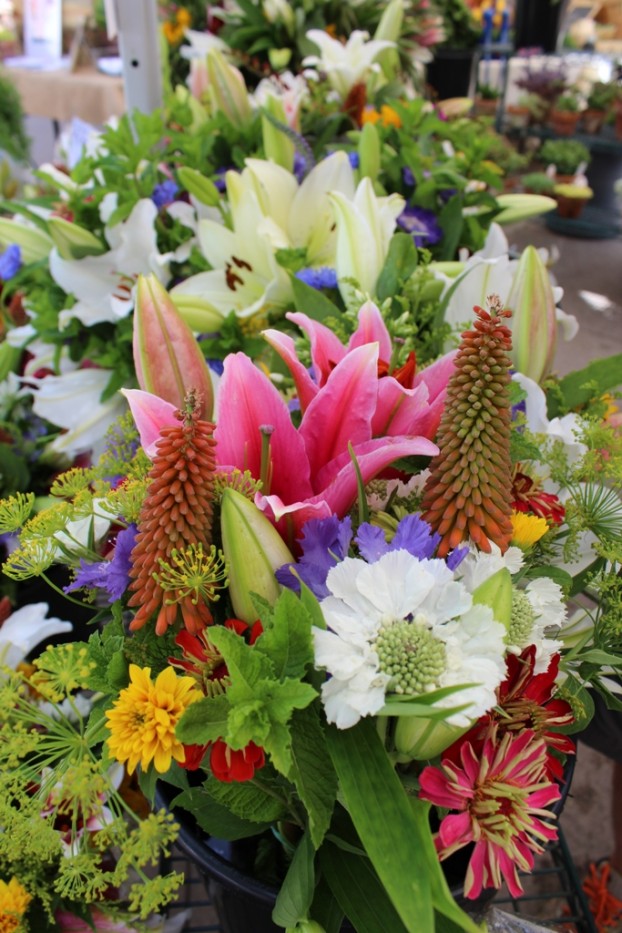
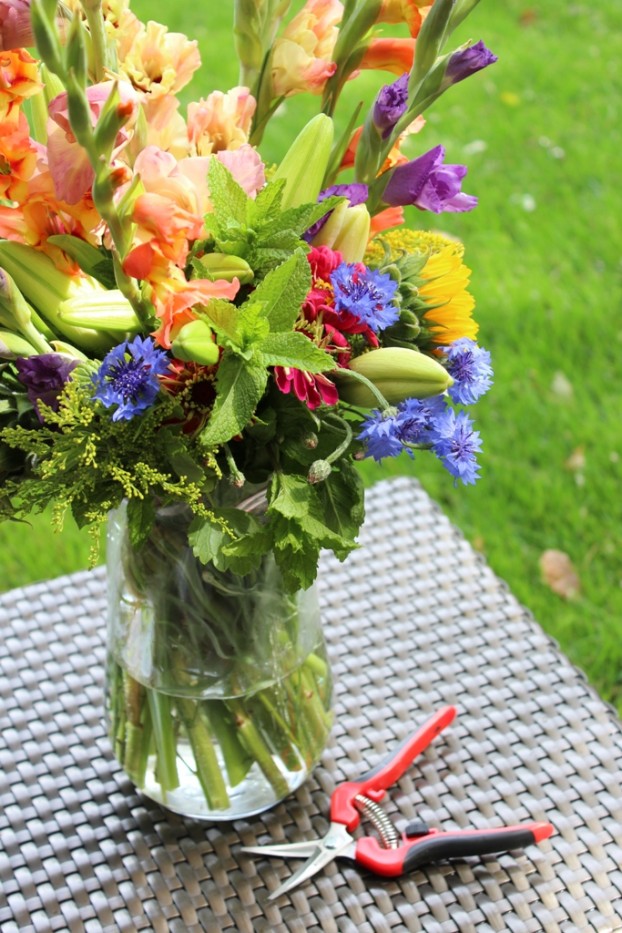
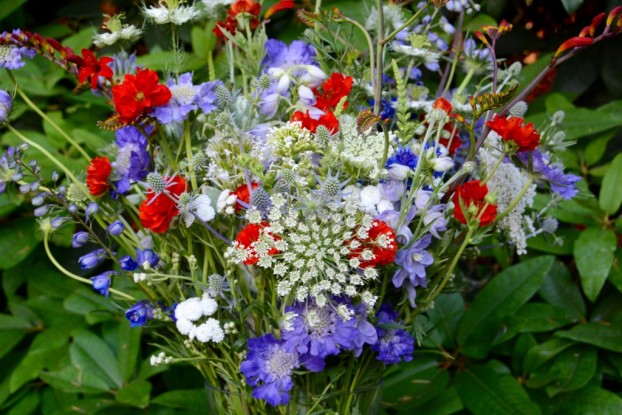
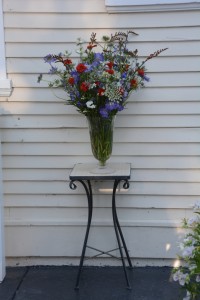
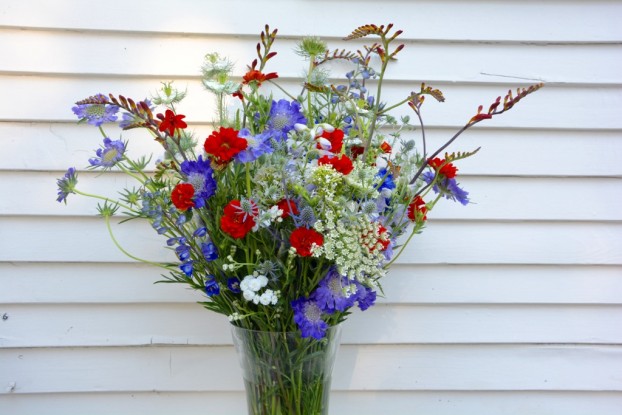
A red-white-and-blue, All-American bouquet!

A red-white-and-blue, All-American bouquet! (c) Tim Gleason

Floral Fireworks for July 4th (c) Tim Gleason

Floral Fireworks for July 4th (c) Tim Gleason

Happy Independence Day!

We have so many opportunities to celebrate local, seasonal and beautiful flowers and there’s no better one than welcoming Week 25 of the  Slow Flowers Challenge which coincides with the July 4th holiday.

Join me in clipping and arranging red-white-and-blue botanicals to honor the holiday.

I am so excited that all of the flowers in this week’s stellar arrangement came from one of my favorite flower farms,Charles Little & Co. of Eugene, Oregon. I visited this past week and received permission from Bethany Little to harvest to my heart’s content. Thank you, Bethany!

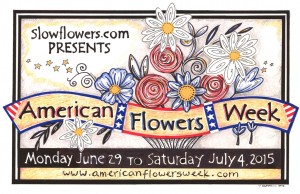
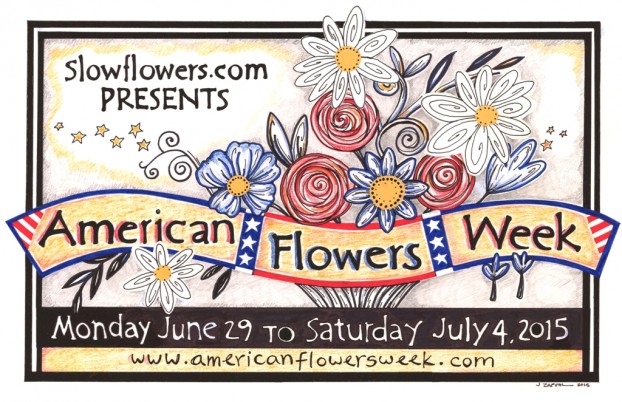
Tomorrow begins the inaugural American Flowers Weekcampaign, a tribute to the farmers who grow flowers in all 50 states, and to the artisans who interpret those flowers in bouquets, arrangements and other botanical beauty.

You are invited to take part in American Flowers Week by posting the flowers you grow and arrange on all social platforms with the hash-tag #americanflowersweek.

web_2015AmericanFlowersWeekLogo

Learn more and download this lovely logo by clicking here.

Here are a few more details about this week’s bouquet:

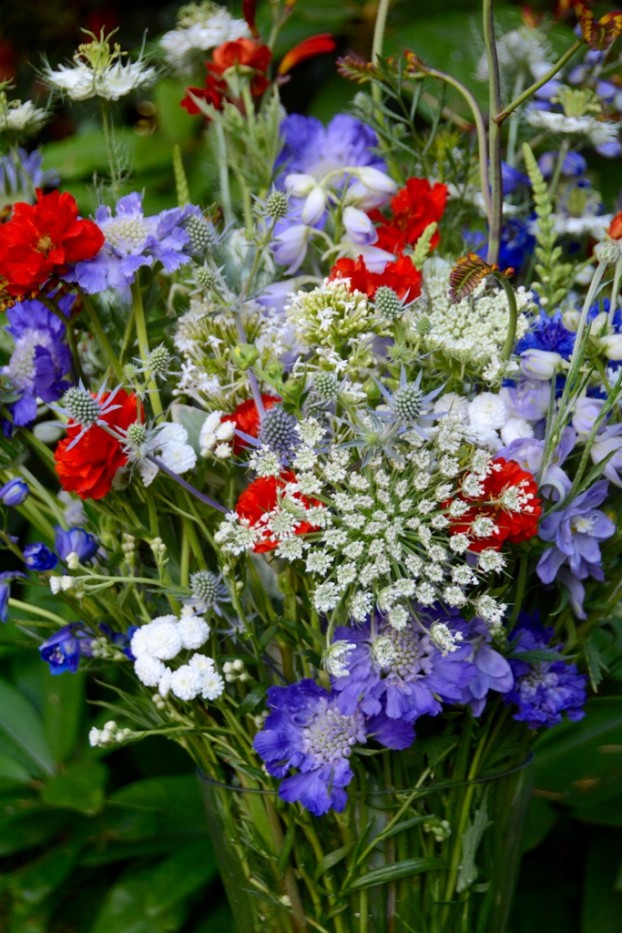
A profusion of red, white and blue annuals and perennials for July 4th (c) Tim Gleason

A profusion of red, white and blue annuals and perennials for July 4th (c) Tim Gleason

web_June_27_2015_DSC_4366White flowers:

  • Variegated green-white sedum as foliage (which you can barely see!)
  • Centranthus
  • Queen Anne’s lace
  • Nigella
  • Double-white Yarrow (Achillea ptarmica ‘Angel’s Breath’)
  • Obedient Plant (Psysostegia virginiana)

Blue flowers:

  • Delphinium – pale and dark blue
  • Scabiosa
  • Cornflower/Bachelor’s Button (Centaurea cyanus)
  • Sea Holly (Eryngium sp.)

Red flowers:

  • Crocosmia
  • Geum


Please enjoy this  Snapshot of an All-American flower farm:

Charles Little & Co., Eugene, Oregon:

Flower farmer Bethany Little, of Charles Little & Co.

Flower farmer Bethany Little, of Charles Little & Co.

At the foot of Mount Pisgah in Oregon's Willamette Valley. Flower farming is hard work, but this daily view makes it worth it!

At the foot of Mount Pisgah in Oregon’s Willamette Valley. Flower farming is hard work, but this daily view makes it worth it!

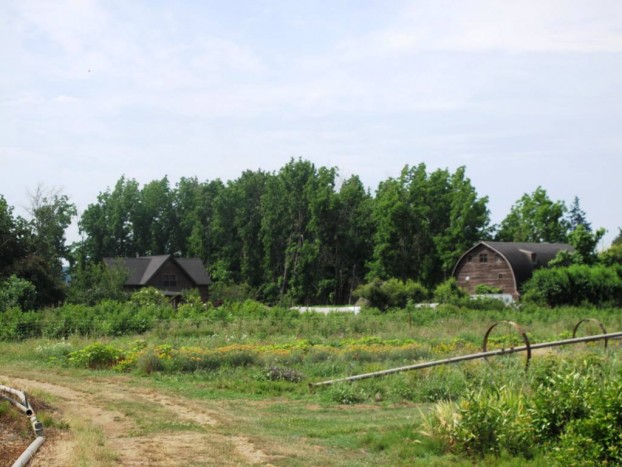
Farmhouse (left) and Flower Barn (right) at Charles Little & Co.

Farmhouse (left) and Flower Barn (right) at Charles Little & Co.

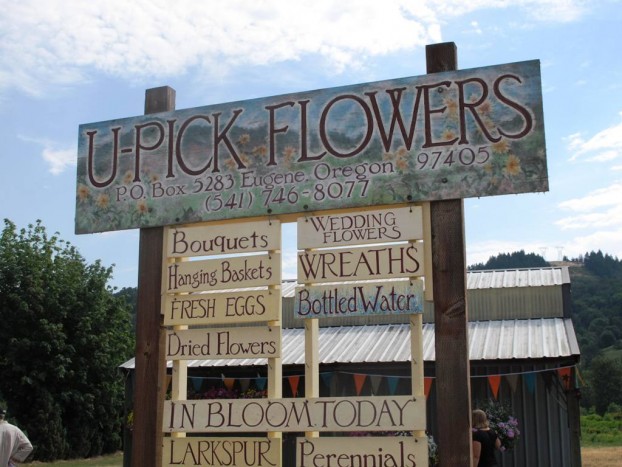
Farmstand Sign offers American-grown Lovelies and more!

Farmstand Sign offers American-grown Lovelies and more!

Presenting American Flowers Week & Introducing Minnesota’s Len Busch Roses (Episode 199)

Wednesday, June 24th, 2015

PodcastLogoToday, we’re celebrating the 100th episode of the Slow Flowers Podcast, a weekly program that’s all about American Flowers and the people who grow and design with them.

Reaching ONE HUNDRED EPISODES represents a significant milestone, as we have brought you hours and hours of programming on the vital topics ranging from saving our domestic flower farms to supporting a floral industry that relies on a safe, seasonal and local supply of flowers and foliage.

To me, it’s all about making a conscious choice and I invite you to join the conversation and the creative community. This podcast is brought to you by Slowflowers.com, the free, nationwide online directory to florists, shops, and studios who design with American-grown flowers and to the farms that grow those blooms.  It’s the conscious choice for buying and sending flowers.

To commemorate the 100th episode of the Slow Flowers Podcast, we’re launching a very cool and I believe significant week-long education and outreach campaign that will kick off next Monday, June 29th and run through Saturday, July 4th.

web_2015AmericanFlowersWeekLogo

Inspired by British Flowers Week, which has been the subject of two recent podcast episodes, the Slow Flowers Podcast and the Slowflowers.com online directory present: AMERICAN FLOWERS WEEK.

We’re kicking off American Flowers Week with a fabulous logo identifying the campaign, designed by Iowa-based illustrator and artist Jean Zaputil of Studio Z Design & Photography.

You are welcome to visit our new American Flowers Week web site where you can download and use the logo and other resources for your own promotional efforts efforts. Click here to find our Press Kit and links to a Flickr gallery featuring local flowers and floral arrangements representing all 50 states.

READ MORE…

Week 24 // Slow Flowers Challenge

Sunday, June 21st, 2015
A garden-sourced Father's Day bouquet for my husband, Bruce

A garden-sourced Father’s Day bouquet for my husband, Bruce

A bucket filled with lovelies from my garden.

A bucket filled with lovelies from my garden.

Greetings and here’s to SUMMER’S arrival today, June 21st! I couldn’t be more inspired to celebrate the Solstice than to take a walk in the garden. I clipped each stem for today’s Slow Flowers Challenge from my Seattle yard this morning and spent a glorious (and blissfully meditative) hour or so arranging.

And since it’s Father’s Day, I’m using the arrangement for tonight’s dinner we’re preparing for Bruce, my husband and the father of our two boys.

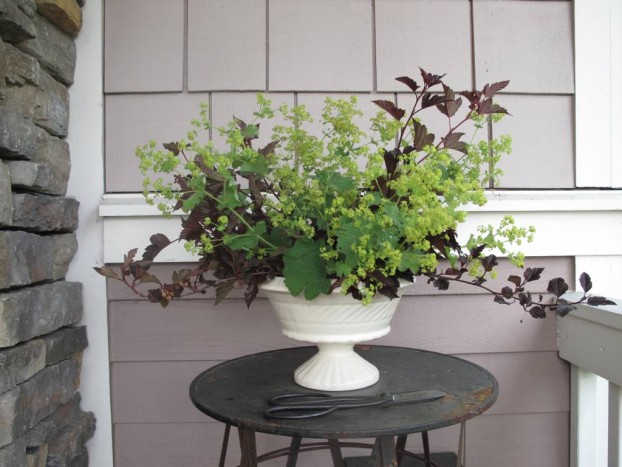
I’ve always loved pairing lime and wine colors together, in garden borders and beds, as well as in container gardens. No surprise that the deep burgundy Ninebark (Physocarpus opulifolius ‘Diabolo’) looks terrific with the acid green Lady’s Mantle ( Alchemilla mollis). Stems from those two create the textural and high-contrast foundation for this design.

Steps one and two: Insert foliage to create the foundation.

Steps one and two: Insert foliage to create the foundation.

By the way, this is a vintage Haeger American-made vessel, a creamy ivory piece that I brought home with me from a trip to Iowa a few years ago. I love the proportions – perfect for a centerpiece. (Here’s a similar one on Etsy  – they’re not too difficult to find.)

To create this design, I placed a large cage-style metal flower frog (also vintage) in the bottom of the bowl. The grid has 5/8-inch openings, ideal for a combination of woody and herbaceous stems as I’m using here.

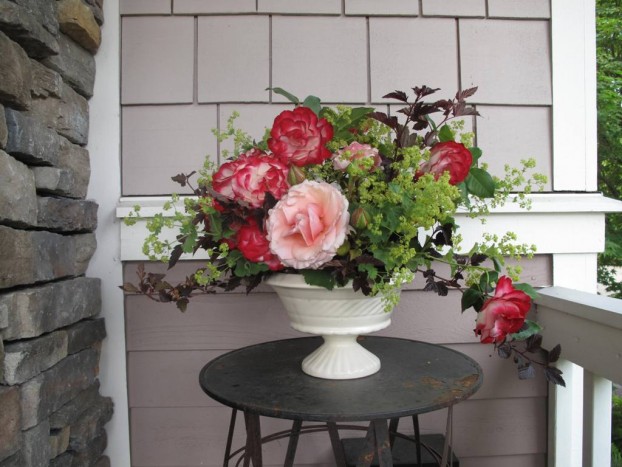
Steps three and four: Adding garden roses, a sweet pairing of a peachy-pink rose with a bicolored white-ruby rose. I inherited these two unknown roses when we moved to this garden four years ago.

Steps three and four: Adding garden roses, a sweet pairing of a peachy-pink rose with a bicolored white-ruby rose. I inherited these two unknown roses when we moved to this garden four years ago.

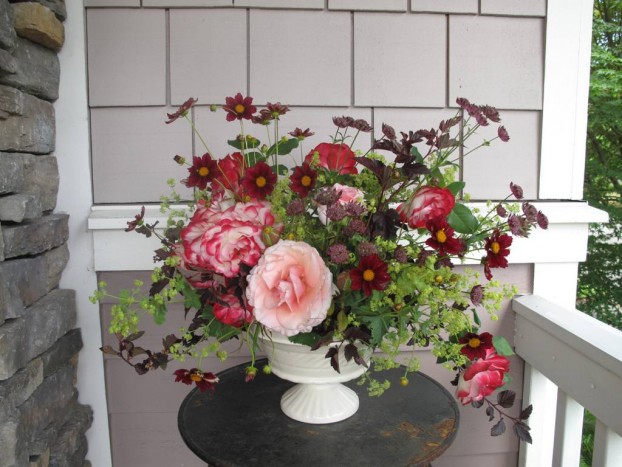
After I added the roses, I wanted to take advantage of some wispy pieces to bring a playful dimension to the design. I incorporated a beautiful, mauve-colored Astrantia and several stems of a burgundy-petaled tickseed with great yellow centers ( Coreopsis sp.).

Steps five and six: Astrantia and Coreopsis for their wispy textures.

Steps five and six: Astrantia and Coreopsis for their wispy textures.

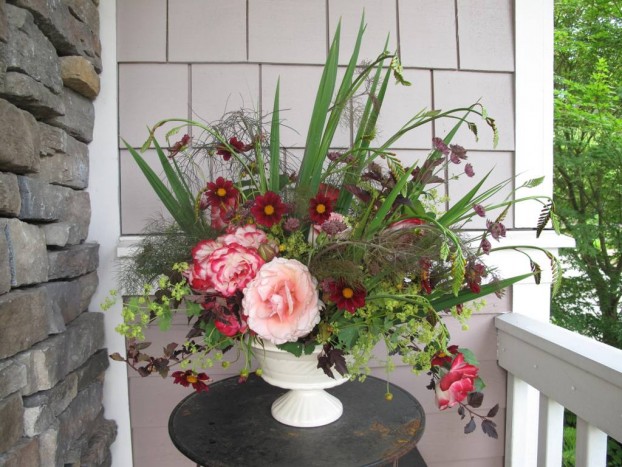
Two final and rather unexpected touches utilize other garden stalwarts: Crocosmia in bud – love the strong lines of it at this stage; and bronze fennel. Now some may argue that bronze fennel is a garden thug, and it is. But the flouncy, lacy texture is pretty fantastic in an arrangement, so I always allow a few stems of it to remain after weeding out the volunteers.

Steps seven and eight: Crocosmia buds and bronze fennel stems.

Steps seven and eight: Crocosmia buds and bronze fennel stems.

Week 23 // Slow Flowers Challenge

Saturday, June 13th, 2015
Sea holly (Eryngium sp.) looking dazzling!

Sea holly (Eryngium sp.) looking dazzling!

This week’s arrangement comes to you courtesy of a special event in which I participated to benefit the King County Library Foundation.

Called an “Author Salon,” the private gathering was one of several offered at the Library Foundation’s recent annual Literary Lions Auction. Library supporters  Elaine & John Hogle  and  Felicia Dixon & Lucas Hoban  hosted the Author Salon last weekend at theBellevue Botanical Garden – one of my very favorite public gardens in the Seattle area. Landscape architect Liz Browning of Swift Company also participated by leading a tour of the newest garden BBG installations area designed by her firm.

The Author Salon team, standing, from left: Felicia, Liz and Elaine; I'm seated in front.

The Author Salon team, standing, from left: Felicia, Liz and Elaine; I’m seated in front.

What a beautiful venue! I was asked to talk about Slow Flowers, the book, as well as the slow flowers movement to source domestic and local flowers rather than rely on imports.

Local flowers and the Slow Flowers book go together well!

Local flowers and the Slow Flowers book go together well!

My publisher, St. Lynn’s Press, generously donated copies of Slow Flowers so that everyone in attendance took home a signed copy. And all the proceeds of the afternoon benefit the King County Library Foundation. Cindy Sharek and Andrea Quigley of the Foundation ensured that we had a lovely reception to hear the message of supporting literacy education!

And about the flowers you see here. I asked – and received special permission – to cut from the famed Perennial Border at the Bellevue Botanical Garden for my demonstration.

While you might think I focused on which blooms to choose first, it was the oak leaf hydrangea that caught my attention before anything else.

My vase had a fairly wide opening of about 7 inches, so I needed larger, structural branches and leaves as my design’s starting point. Plus, I absolutely love the hydrangea’s stage right now. The leaves are large and supple and the flowers are still in bud so they’re the same color green and the foliage.

Susy Hutchison took home the Slow Flowers bouquet.

Susy Hutchison took home the Slow Flowers bouquet.

See my entire plant list below. As I was basically designing on the fly, (I only clipped the blooms 30 minutes before the event!), it occurred to me that I had three primary hues and three secondary hues of blooms — and naturally, that gave me an organizing structure to discuss a bit of color theory.

I had a few longtime friends in the audience who surprised me by attending, people I hadn’t seen for years!

How cool that my friend Susy Hutchison, former news anchor for KIRO-TV (CBS affiliate) won the doorprize to take home my arrangement. Seriously, it was not a fix!

Susy reported to me that the bouquet was “still going strong,” one week after she brought it home. Yes, folks, that’s another great reason for sourcing locally – your arrangement’s vase life will be extended!

The finished "color wheel" bouquet - clipped just steps away from our event.

The finished “color wheel” bouquet – clipped just steps away from our event.

Three sets of complements: Blue & Orange; Purple & Yellow; Red & Blue (with lots of green thrown in for good measure)

Three sets of complements: Blue & Orange; Purple & Yellow; Red & Blue (with lots of green thrown in for good measure)

Three sets of complements: Blue & Orange; Purple & Yellow; Red & Blue (with lots of green thrown in for good measure)

Three sets of complements: Blue & Orange; Purple & Yellow; Red & Blue (with lots of green thrown in for good measure)

Here's that essential oak leaf foliage

Here’s that essential oak leaf foliage

Here is the recipe, with all ingredients from the Perennial Border at Bellevue Botanic Garden:

  • Oak leaf hydrangea foliage & flowers (Hydrangea quercifolia)
  • Lady’s mantle (Alchemilla mollis)
  • Red/Maroon: Astilbe
  • Green: Allium ‘Hair’ (a mutation of  A. sphaerocephalon)
  • Orange: Geum (Geum chiloense) possibly ‘Totally Tangerine’
  • Purple: Catmint (Nepeta sp.)
  • Yellow: Yarrow (Achillea millefolium)
  • Blue: Sea holly (Eryngium amethystinum)
  • Bonus stems: I added a few beautiful stems of pale orange and yellow foxglove
The lady's mantle and oak leaf hydrangea blooms add a touch of lime.

The lady’s mantle and oak leaf hydrangea blooms add a touch of lime.

Week 22 // Slow Flowers Challenge

Saturday, June 6th, 2015
A cool-toned combo for early June, including Acanthus mollis, baptisia, cerinthe and sweet peas - all offset with fragrant mint foliage.

A cool-toned combo for early June, including Acanthus mollis, baptisia, cerinthe and sweet peas – all offset with fragrant mint foliage.

Here's how the entire bouquet turned out. I used a large trophy-like urn to accommodate the scale of the bear's breech.

Here’s how the entire bouquet turned out. I used a large trophy-like urn to accommodate the scale of the bear’s breech.

This week I couldn’t take my eyes off the gorgeous flower stalks of two bear’s breech plants ( Acanthus mollis) growing between our back porch and the pond in a shady area.

This perennial typically belongs at the back of the border where the large glossy foliage can offset smaller and more delicate companions. Deeply lobed, the acanthus leaf is a classical form in art and architecture. I’ve actually used the leaves in winter floral arrangements before. In my Zone 8b garden, the leaves are basically evergreen and winter hardy.

The blooms are also arresting. They are tall and pointed with an overall spiny form and purplish-green bracts. I will say this: They don’t LOVE being cut and plunked in a vase.

The five stalks I cut and used in this bouquet had mixed performance from between one to three days. So if you have bear’s breech in your perennial border, consider it a day-of cut flower.

'April in Paris' sweetpea, grown by Jello Mold Farm. If only you could inhale its perfume!

‘April in Paris’ sweetpea, grown by Jello Mold Farm. If only you could inhale its perfume!

Baptisia (love the sweet pea-like flowers on the tall stem), with honeywort (Cerinthe).

Baptisia (love the sweet pea-like flowers on the tall stem), with honeywort (Cerinthe).

Blue false indigo (Baptisia australis)

Blue false indigo (Baptisia australis)

Curled just like a little shrimp, Cerinthe has a fabulous blue-green/purple flower

Curled just like a little shrimp, Cerinthe has a fabulous blue-green/purple flower

Here is the recipe::

  • Garden mint, grown by Ojeda Farms in Ethel, Washington
  • Honeywort (Cerinthe major ‘Purpurascens’), grown by Jello Mold Farm in Mt. Vernon, Washington
  • Blue false indigo (Baptisia australis), Jello Mold Farm
  • ‘April in Paris’ Sweet Peas, Jello Mold Farm
  • Bear’s breech (Acanthus mollis) flowers, from my garden
Trophy_1_IMG_3954

Everything came together beautifully, including the addition of the mint foliage!

Just for fun, here’s how the Acanthus mollis foliage lent much-needed drama to a December arrangement. I paired it with Callicarpa, curly willow and camellia foliage.
Note the large, glossy Acanthus foliage on the right side of this winter arrangement.

Note the large, glossy Acanthus foliage on the right side of this winter arrangement.

And on its own, the foliage of Blue false indigo (Baptisia australis) is also fantastic. Long after the beautiful flowers fade, you can keep cutting the leaves for arranging:

Baptisia foliage in an August bouquet.

Baptisia foliage in an August bouquet.

An Artist’s Relationship with Floral Design, Abbie Zabar: Ten Years of Flowers from the Metropolitan Museum of Art (Episode 196)

Wednesday, June 3rd, 2015
In this pencil study, Abbie Zabar captures an exuberant floral arrangement from the Metropolitan Museum of Art's Great Hall.

In this pencil study, Abbie Zabar captures an exuberant floral arrangement from the Metropolitan Museum of Art’s Great Hall.

50kdownloadsThis week we’re celebrating the 50,000th download of the Slow Flowers Podcast.

As of today, we’ve produced 97 episodes bringing you the leading voices in the American Grown floral community – from flower farmers to floral designers, the inspiring people working to save flowers as part of our nation’s agricultural heritage and keep our flowers local, seasonal, sustainable — and American grown.

I am grateful to my past guests, each of whom has shared his or her story with listeners. And I’m so thankful to listeners who regularly tune in, comment, share and like this endeavor.

Students at Sarah Pabody's floral design workshop learn about the origin of the flowers in their lives. (c) Elena Slesarchuk, courtesy of Triple Wren Farm.

Students at Sarah Pabody’s floral design workshop learn about the origin of the flowers in their lives. (c) Elena Slesarchuk, courtesy of Triple Wren Farm.

Before we meet Abbie Zabar, this week’s guest, I wanted to share a text that I received this week from my friend Sarah Pabody of Triple Wren Farms located just north of Bellingham, Washington.

Sarah and her husband Steve Pabody are big promoters of the Slow Flowers Movement. When Sarah leads design workshops at Triple Wren she does something for which I’m so grateful.

Each student is handed one of the Slow Flowers infographics that reads “Where do your flowers come from?”

Then Sarah leads a short discussion about the frightening statistics revealing the small percentage of domestic flowers in the marketplace versus imported flowers, as well as the cost of those imported flowers, both environmentally but also economically, to local communities.

She texted me photos of last weekend’s workshop, which I have permission to share with you.

Even the youngest floral design student learns about the Slow Flowers Movement at Triple Wren Farms! (c) Elena Slesarchuk.

Even the youngest floral design student is introduced to the Slow Flowers Movement at Triple Wren Farms! (c) Elena Slesarchuk.


Said Sarah: “I thought you’d like to see your Infographics in action – at every workshop, I issue a challenge to each person to casually ask another person in their lives (grocery florist, family member, however they can work it into their daily conversation),”Do you know where these flowers were grown?”

If anyone listening to this story feels moved to do the same with their own customers, please follow this link to our graphics, which you are welcome to download and copy. Thanks for the inspiration, Sarah!

SFlowersInfoGraphic_Page1_Web

Abbie Zabar, captured in a familar pose by Rod Marton. She's sketching in a garden, with paper on her lap.

Abbie Zabar, captured in a familar pose at Rodmarton Manor in the UK. She’s sketching in a garden, with paper on her lap. (c) Sylvia Martin

Okay, today’s guest is thoroughly inspiring in a completely different way. When I first read the news that the work of Abbie Zabar, a New York-based artist and longtime virtual friend in the garden-writing world, was going to be celebrated this coming weekend with the opening of an exhibit of her floral drawings, I had to share her story with you.

As you will hear in our conversation, Abbie is a close observer of nature and of flowers, especially. She captures what she observes with colored pencils on sheets of rather ordinary paper or cardboard.

from June 23, 2002

from June 23, 2002

For one decade of her life, from the early 1990s to the early 2000s, Abbie walked from her apartment in New York City’s upper east side to the famed Metropolitan Museum of Art on Fifth Avenue. She entered the impressive Great Hall during the early hours, found a place to sit, and proceeded to sketch the grand floral arrangements on display there each week. (I feel quite an affinity for someone who honored such a creative ritual week after week; after all, I managed to make a bouquet each week for one year and ritualized that practice, but Abbie’s ten-year observance is hugely impressive).

Abbie Zabar. December 6 1994. Collection of the artist

Abbie Zabar. December 6 1994. Collection of the artist

Abbie was enthralled by the five enormous flower-filled urns that stood in the Met’s Great Hall. At the time, the pieces were created by Chris Giftos, the Met’s former Master Floral Designer and Director of Special Events. For more than 30 years, Mr. Giftos was responsible for the beautiful arrangement in the Great Hall. And, as Abbie describes, the flowers occupied four large niches carved from the central piers, as well as the centrally located Information Desk. The weekly arrangements of fresh flowers appear, thanks to an endowment provided by the late Lila Acheson Wallace, who was one of the Museum’s largest single benefactors.

Abbie Zabar. February 4 2002. Collection of the artist

Abbie Zabar. February 4 2002. Collection of the artist

It’s no surprise to learn that Abbie and Chris became good friends. The fondness she had for this floral artist are reflected in each drawing she made in response to his work. Incredibly alluring, her diminutive floral portraits are breathtaking in both their simplicity and their complexity. Abbie’s own experience as a gardener and her innate knowledge of the flowers, fronds and leaves before her allowed her to capture the splendid bouquets with a sure and deft hand, well before the Museum opened its doors for the day.

Abbie Zabar. October 16 1999. Collection of the artist

Abbie Zabar. October 16 1999. Collection of the artist

Working in situ and in pencil—the only implement allowed in the space —her drawings showcase the vibrancy, variety and vitality of the displays, as captured in one quick sitting.

Abbie Zabar at the Manhattan Chapter of the North American Rock Garden Society's Plant Sale, where she was passing around saxifraga "favors." Photo courtesy of Yukie Kurashina.

Abbie Zabar at the Manhattan Chapter of the North American Rock Garden Society’s Plant Sale, where she was passing around saxifraga “favors.” Photo courtesy of Yukie Kurashina.

You will hear more about her process in our conversation, and please visit debraprinzing.com to see examples of the pieces that will be unveiled in this upcoming exhibition.

The show is called Abbie Zabar: Ten Years of Flowers, on view June 7 through October 4 at Wave Hill, a beautiful public garden and cultural center in The Bronx. The event is free with your admission to the grounds.

And here is a little more about Abbie’s background:

Abbie Zabar is an acclaimed artist, graphic and garden designer, and the author of five books. Her first book, The Potted Herb (1988), is now considered a gardening classic.

She has created garden and graphic designs for numerous prestigious companies and organizations, including Bergdorf Goodman, Daniel Boulud’s restaurants and PS 198.

Her landscape collages have been represented by Allan Stone and BlumHelman, and Flowers in the Great Hall of the Metropolitan Museum of Art series has been represented by Ursus Books & Prints and the Horticultural Society of New York.

Abbie Zabar. May 18 1995. Private collection

Abbie Zabar. May 18 1995. Private collection

Abbie’s artwork has been shown at the Museum of Modern Art, the Cooper-Hewitt Museum, the Parrish Museum, the International Paper Corporation, the Louvre, the Institute of Contemporary Arts (London) and the Vigeland Museum (Oslo), and is part of the permanent collections of the Mead Paper Corporation of America, the Brooklyn Museum, the Jewish Museum, the Hunt Institute for Botanical Documentation and the Smithsonian Museum.

Abbie Zabar. May 17 2003. Collection of the artist.

Abbie Zabar. May 17 2003. Collection of the artist.

Abbie’s illustrated articles have appeared in Garden DesignHorticultureFine GardeningGourmet and The New York Times, as well as in numerous esteemed British publications. She received the 2010 Award for Best Newspaper Writing from the Garden Writers Association for her piece “A Vine in the Sky,” published in The Forward.

Abbie Zabar. September 24 2000. Collection of the artist

Abbie Zabar. September 24 2000. Collection of the artist

In 2014, she was honored with the North American Rock Garden Society’s Carleton R. Worth Award, given to an author of distinguished writings about rock gardening and rock garden plants. Zabar is currently the Program Chairperson for the Manhattan Chapter of the North American Rock Garden Society and a Learning Leader at P.S. 198.

Jar with green hyacinths

Jar with green hyacinths

White roses in straight-sided jar.

White roses in straight-sided jar.

White roses, little creamer

White roses, little creamer


As Abbie and I discussed, not only is the exhibition at Wave Hill available for public viewing all summer long, continuing to October 4th, she has a second show in the works, which will run September 16th to October 2nd at W.M. Brady & Co., a gallery at 22 East 80th Street, just a few steps from The Metropolitan Museum of Art.

This collection of drawings includes the series of small floral studies that Abbie and I discussed at the close of our interview (and she generously shares a sneak peek of a few of those pieces here).

From the grand floral arrangements at the Met to these intimate moments of singular blooms captured in small vases, Abbie’s gifts as an illustrator of flowers are evident. And I know you’ll be as enchanted as I am. By the way, many of these pieces will be available for purchase, so please follow the links to the two institutions (Wave Hill and W.M. Brady & Co.) to inquire if you’re interested in a list of available works.

Thank you, Abbie Zabar, for showing us flowers in a new way. Not everyone is an artist or has the ability to use a pencil so masterfully as my friend Abbie. But this conversation has moved me to use my innate skills of observation more acutely, whether I’m on a walk in the park, purchasing flowers from my favorite flower farmer, or tending to plants in my own backyard.

Thanks again for joining me today for another wonderful conversation about flowers. Listeners like you have downloaded the podcast more than 50,000 times. THANK YOU to each and every one of you for downloading, listening, commenting and sharing. It means so much.

Until next week please join me in putting more American grown flowers on the table, one vase at a time. And If you like what you hear, please consider logging onto Itunes and posting a listener review.

The content and opinions expressed here are either mine alone or those of my guests alone, independent of any podcast sponsor or other person, company or organization.

The Slow Flowers Podcast is engineered and edited by Andrew Wheatley and Hannah Holtgeerts. Learn more about their work at shellandtree.com.

Week 21 // Slow Flowers Challenge with Mock Orange and Garden Peonies

Saturday, May 30th, 2015
Back Porch Bouquet - with every bloom clipped from my garden.

Back Porch Bouquet – with every bloom clipped from my garden.

After all the traveling I’ve done since March, it’s so nice to be HOME. So for the last week of May, the Slow Flowers Challenge has stuck close by. All of these flowers are straight from my garden. You could call it the “5 Step Bouquet.”

I wish you could inhale the light fragrance of the peonies combined with the sweetly scented mock orange blossoms (Philadelphus coronarius). Wow! It’s a perfect pairing to grace the small table in our home’s entry, allowing me to share the garden perfume and perfection with anyone who might stop by this weekend.
Two types of peonies, a profusion of mock orange, and young hydrangea buds.

Two types of peonies, a profusion of mock orange, and young hydrangea buds.

I especially love using this vintage American-made vase. It is also featured on pages 50-51 of Slow Flowers, where it holds beautiful garden roses that I paired with smoke tree and the ‘Black Knight’ Queen Anne’s lace. The 7-inch tall McCoy jardiniere is from the 1940s era and has a raised design of vertical bands (maybe suggesting picket fencing?) and a rim of flowers. It’s the ideal scale vase for such blousy bouquets!
By the way, here’s that design from Slow Flowers where you’ll spot the familiar vase:
Analogous color palette of pinks, mauves and purples! This design was originally published in my book, Slow Flowers

Analogous color palette of pinks, mauves and purples! This design was originally published in my book, Slow Flowers

Below are a few more images from yesterday’s bouquet. The ingredients:

  • Two types of peonies, both inherited when we moved to this home. So I don’t know the cultivars. I love the pale pink with the fringey yellow centers, but I think I love the single white variety even more, especially for its dense centers, some cream; some rose-tinged.
  • Mock orange branches and blossoms
  • Immature hydrangea stems, used as a lime green accent.
Quite delicious to the eye and fragrant to the nose!

Quite delicious to the eye and fragrant to the nose!

More delicious details!

More delicious details!

Green and Local as a Flourishing Business Model with Bash & Bloom of Seattle (Episode 195)

Wednesday, May 27th, 2015
Meet Eleanor Blackford, owner and creative director of Bash & Bloom (c) Barbie Hull Photography

Meet Eleanor Blackford, owner and creative director of Bash & Bloom (c) Barbie Hull Photography

bashandbloomlogoThis week’s guest is Eleanor Blackford Davis, owner of Seattle-based Bash & Bloom.

Eleanor and I frequent the Seattle Wholesale Growers Market where she is a regular customer and I’m on the board.

A Bash & Bloom emerald green and white bouquet displayed in an ornate chair with photography (c) Courtney Bowlden Photography

A Bash & Bloom emerald green and white bouquet displayed in an ornate chair with photography (c) Courtney Bowlden Photography

It’s always fun and tempting to see what she has loaded in her arms on those early-morning excursions – and there’s often a fabulous related story she shares about a wedding or event in the works.

Eleanor and I got to talking last year about her decision – and her public announcement – to go foam free as a designer.

A Bash & Bloom Table Garland adorns a wedding reception (c) photography by Mark Malijan Photography

A Bash & Bloom Table Garland adorns a wedding reception (c) photography by Mark Malijan Photography

She also believes in sourcing from local farms and through the Seattle Wholesale Growers Market, whose staff members procure only local, seasonal and sustainably-grown flowers from Washington, Oregon, Alaska and California.

My photograph of Eleanor Blackford, with her sample arrangement using local spring flowers and Floral Soil.

My photograph of Eleanor Blackford, with her sample arrangement using local spring flowers and Floral Soil.

Eleanor's finished design, a prototype for her wedding reception.

Eleanor’s finished design, a prototype for her wedding reception.

We continued the dialogue recently while both participating in a workshop to use Floral Soil, a 100-percent plant-based alternative to the conventional foam, invented by Mickey Blake, a past guest of this podcast.

Alicia Schwede of Flirty Fleurs, another past podcast guest, led the workshop on designing elevated centerpieces, and I have to tell you that Eleanor’s piece was stunning! It was also the prototype for her own wedding florals, which took place on May 8th. 

Check out the no-foam elevated centerpiece she created at the workshop with Alicia and Mickey.

But about five weeks ago, Eleanor and I agreed to meet over tea to record our conversation, and I know you’ll enjoy it.

Eleanor's art deco bouquet in white and dark reddish purples was photographed by (c) My Beloved Photography

Eleanor’s art deco bouquet in white and dark reddish purples was photographed by (c) My Beloved Photography

I’m happy that Eleanor has shared so many photos of her floral design work and a few bonus photos from her recent wedding to Matthew Davis (see below).

Eleanor on her wedding day with flowers by Kelly Sullivan of Botanique (Instagram photo from wedding photographer Shane Macomber)

Eleanor on her wedding day with flowers by Kelly Sullivan of Botanique (Instagram photo from wedding photographer Shane Macomber)

Those fantastic elevated centerpieces designed with Floral Soil - adorning Eleanor and Matt's wedding reception. (c) Shane Macomber Photography

Those fantastic elevated centerpieces designed with Floral Soil – adorning Eleanor and Matt’s wedding reception. (c) Shane Macomber Photography

You can find Eleanor at these Social Sites:

Bash & Bloom on Facebook

Bash & Bloom on Instagram

Bash & Bloom on Pinterest

The Greater Seattle Floral Association, the local organization for wedding, event, studio and retail designers in which she is actively involved.

Bouquets for a pink-and-mauve floral palette (c) Alante Photography

Bouquets for a pink-and-mauve floral palette (c) Alante Photography

Here’s how my guest introduces herself on the Bash & Bloom web site:

I’m Eleanor Blackford – a craftster, dog lover, fun haver, and Owner of bash & bloom. My style has been described as having a lush, organic, and creative look and feel. I love to make an event unique, personal, and fun and can’t wait to sit down with you to talk about your vision. I work closely with my couples or party hosts to bring their unique personality and style to their event, primarily using seasonal and local products.

Vivid palette (c) Dana Pleasant Photography

Vivid palette (c) Dana Pleasant Photography

Thanks again for joining me today for another wonderful conversation about American flowers and the designers and farmers who are changing this entire industry for the better.

More flowers from the brighter end of the spectrum, (c) Barrie Anne Photography

More flowers from the brighter end of the spectrum, (c) Barrie Anne Photography

PodcastLogoListeners like you have downloaded the podcast 50,000 times.

I want to stop for just one moment and savor that news. Yes, we just produced our 96th episode and we are very, very close to airing the big one-hundredth episode, just one month from now.

THANK YOU to each and every one of you for downloading, listening, commenting and sharing. It means so much.

Until next week please join me in putting more American grown flowers on the table, one vase at a time. And If you like what you hear, please consider logging onto Itunes and posting a listener review.

The content and opinions expressed here are either mine alone or those of my guests alone, independent of any podcast sponsor or other person, company or organization.

The Slow Flowers Podcast is engineered and edited by Andrew Wheatley and Hannah Holtgeerts. Learn more about their work at shellandtree.com.

Florida-Grown Ferns, Foliage and Greenery with Erik Hagstrom of Albin Hagstrom & Sons (Episode 194)

Wednesday, May 20th, 2015

RHS_CHELSEAThe Slow Flowers Podcast is coming to you this week from Britain, where I’ve been touring the Chelsea Flower Show, reporting on gardening and floral trends for Houzz.com, and speaking to a passionate group of British Flower Farmers. I promise to bring home inspiring podcast interviews to share in the coming weeks.

And if you want to listen to what’s happening in the British-Grown flower movement, including the perspective of both florists and flower farmers, I’ve added links to past interviews here:

Episode 129: Reclaiming our Floral Heritage . . . Lessons from #Britishflowers

Episode 186: The Flower Farmer’s Year with Georgie Newbery of Common Farm Flowers UK

Flowers from the Farm, the UK's nationwide network of cut flower growers

Flowers from the Farm, the UK’s nationwide network of cut flower growers

A special thanks to Gillian Hodgson of Fieldhouse Flowers and the force behind Flowers from the Farm – an organization of British flower farmers, as well as to Sarah Statham of Simply by Arrangement, both of Yorkshire, who created a magnificent itinerary for my visit. You’ll hear from them both in future reports.

And here are a few more pieces of good news, shared by Slowflowers.com members on both American coasts:

First from Mary Coombs, who with her sister Dawn Clark operate A Garden Party based in Elmer, New Jersey:

Subject line: It is Working

“I was meeting with a client last night and I asked her how she found us. Much to my delight, she found us via Slowflowers.com! She is a perfect fit for my company and I am proud to be listed on this site. Thank you for working so hard on this!
I will also be talking about the Slow Flowers movement on Fox 29 Philadelphia on Monday morning. They are coming to film us in the garden for three live segments to air during their news show. I am nervous but excited!”

Mary’s note is so encouraging that I wanted you to hear it – and check out this news clip featuring Mary and Dawn.

“Anything you can get locally grown will be fresher; it will last longer; it’s going to do better in the vase.” — Dawn Clark, A Garden Party.

And next, a note from one of my favorite flower farmers, Joan Thorndike of Le Mera Gardens, based in Talent, Oregon, just outside Ashland. Joan is featured in The 50 Mile Bouquet, and she was an early supporter of Slowflowers.com. She is a farmer and a florist, famous for her summertime Oregon wine-country weddings.

Here’s Joan’s note, a text that arrived on my phone screen:

“Twice last week a potential customer called me because they knew all about your Slow Flowers as a concept – and so wanted to find a source close rather than far. Thank you for what you do!”

Please keep these updates coming – it is your anecdotal stories of customers finding their American grown flowers from Slowflowers.com farms and floral designers that allow me to share the news with others interested in joining this movement.

4th generatoin Fern Farmer Eric Hagstrom.

4th generatoin Fern Farmer Erik Hagstrom.

signI met today’s guest in person – finally – after a long-distance social media acquaintance. Please meet Erik Hagstrom of Albin Hagstrom & Son.

Based in Pierson, Florida, Albin Hagstrom & Son is one of, if not THE, largest American farms growing ferns, greenery and all types of cut foliage for the floral marketplace.

The family-owned business was started in 1928.

Glossy and durable -- Leatherleaf fern.

Glossy and durable — Leatherleaf fern.

ft_ah_14611-e1370480079963Not only did Albin Hagstrom & Son join the Slowflowers.com site very early after we launched, Erik has been a super supportive member. On two occasions, when I was booked to do interviews with Florida radio personalities, I asked him to send a sample box of Florida ferns and foliage to the host. He more than exceeded my expectations.

Such a generous gesture that proved to be a tangible example of the Slow Flowers movement – and in both cases, those radio hosts mentioned receiving those beautiful Florida ferns while we were on the air. That’s the kind of partnership that helps all of us in the movement.

Under the live oak, as I attempted to reach the naturally draped Spanish moss.

Under the live oak, as I attempted to reach the naturally draped Spanish moss.

Last week I spent five days in Orlando, Florida. I was thrilled to have an extra day before I started speaking and designing on the Festival Stage at Disney Epcot’s Flower & Garden Show, and while my two sons went off to Magic Kingdom, I headed north on Interstate, about 75 miles south of where Albin Hagstrom & Sons is located, to find the hamlet of Pierson, population 1,730.

Variegated pittosporum shrubs, growing prolifically under a shade structure.

Variegated pittosporum shrubs, growing prolifically under a shade structure.

I had a fun visit with Erik’s dad, Richard, grandson of founder Albin, who has just turned 80 and is a walking encyclopedia of fern-farming.

Tree ferns, naturalized under the canopy of live oak trees.

Tree ferns, naturalized under the canopy of live oak trees.

Then Erik and I jumped in his pickup  truck to drive through some of the production area, passing through shade structures and then following a narrow road through the “hammock” where ferns grow naturally under the canopy of ancient live oak trees.

Mostera. Beautiful, but I wasn't going to venture too close!

Mostera. Beautiful, but I wasn’t going to venture too close!

Anytime I wanted to take a photo, Erik indulged me by stopping and letting me hop out. However, when we slowed down to view the shade house where Monstera foliage grows, he warned me that rattlesnakes like to hang out in the protective tangle at the base of these tropical-looking plants with such dramatic leaves. Um, no thank you. I stayed in the car! But I did find it interesting that most of Albin Hagstrom & Son’s Monstera goes to the cruise ships that dock in Florida.

The Hagstrom family homestead, built in the 1920s by great grandfather Albin. You can see the Swedish farmhouse influence in its simple lines and appealing symmetry.

The Hagstrom family homestead, built in the 1920s by great grandfather Albin. You can see the Swedish farmhouse influence in its simple lines and appealing symmetry.

And by the way, Erik is a man of many interests. He started his career working for the famous Daytona International Speedway and has an extensive background in promotions and marketing. While he eventually left the world of racing to grow ferns, Erik is still a huge fan of NASCAR events. He is the owner of an American-made pickup truck, a fact that did not escape my notice!

Tree ferns, just picked and ready for shipping to all 50 states.

Tree ferns, just picked and ready for shipping to all 50 states.

I hope you enjoy our podcast interview and gain a newfound appreciation for FOLIAGE — an important source of botanical beauty for floral design. I left with a huge box of samples and was delighted to use the ferns, foliage, grasses and greenery in my demonstrations on the Epcot stage during the following three days. I was proud to tell my audiences that about those American grown, FLORIDA grown stems beautifying my vases. And in a state where nearly all of the imported flowers and foliage flow through nearby Miami International Airport, it was doubly important to have this gorgeous and tangible example of the Slow Flowers movement in my hands.

Thanks again for joining me today and please visit debraprinzing.com to see my photos and to follow links to all Erik’s social sites.

Albin Hagstrom & Son on Facebook

Erik Hagstrom on Twitter: @erikhagstrom

Listeners like you have downloaded the podcast nearly 49,000 times. Until next week please join me in putting more American grown flowers on the table, one vase at a time. And If you like what you hear, please consider logging onto Itunes and posting a listener review.

The content and opinions expressed here are either mine alone or those of my guests alone, independent of any podcast sponsor or other person, company or organization.

The Slow Flowers Podcast is engineered and edited by Andrew Wheatley and Hannah Holtgeerts. Learn more about their work at shellandtree.com.

Week 19 // Slow Flowers Challenge with Flowering Branches

Friday, May 15th, 2015
Some of Springtime's most alluring flowering branches include: Magnolia, Dogwood, Apricot, Quince and Plum.

Some of Springtime’s most alluring flowering branches include: Magnolia, Dogwood, Apricot, Quince and Cherry.

We’re digging into the archives this week for the  Slow Flowers Challenge. That’s what happens when I find myself on too many airplanes, which is ironic, isn’t it? It’s sort of the opposite of my “Slow” aspirations!

However, I’m just back home from speaking and teaching in Orlando, Florida. And now, after recharging for the past five days in Seattle, I’ve re-packed and am heading to the airport tonight to fly to London!!!

That’s right! I’m off to the RHS Chelsea Flower Show. I’ll also be meeting many of the people active in the British Flowers scene – U.K. flower farmers and florists who have many of the same objectives that we have here in the U.S. To put local, seasonal and sustainably-grown flowers at the center of our tables!
Stay tuned, because I promise that next week’s Slow Flowers Challenge will be decidedly British!

The acid green of variegated hostas and euphorbia create a "skirt" effect for flowering magnolia branches.
The acid green of variegated hostas and euphorbia create a “skirt” effect for flowering magnolia branches.

I absolutely love the images you see here. I created these arrangements for a national magazine story that was, sadly, never published. The editors, as they say, went in a different direction.

But my photos live on and I’m delighted to share them with you here.

The vase at left is filled with Pieris and Dogwood; the vase at right has both flowering Dogwod and twig dogwood.

The vase at left is filled with Pieris and Dogwood; the vase at right has both flowering Dogwod and twig dogwood.

Flowering Cherry with Snowball Viburnum.

Flowering Cherry with Snowball Viburnum.

Simple: Quince in two hues, plus swordfern.

Simple: Quince in two hues, plus swordfern.

Flowering plum, paired with Lamb's Ear foliage.

Flowering plum, paired with Lamb’s Ear foliage.

Spring hellebores paired with flowering apricot branches.

Spring hellebores paired with flowering apricot branches.