Debra Prinzing

Get the Email Newsletter!

SLOW FLOWERS Podcast: Fun with Flowers and J Schwanke (Episode 109)

Wednesday, October 2nd, 2013

SLOW FLOWERS Podcast: Fun with Flowers and J Schwanke (Episode 109)

Debra and J Schwanke

I’ve been having fun running into American-grown flower advocate and floral industry personality J Schwanke. He was one of the friendly faces I enjoyed seeing in Miami earlier this year.

The name J Schwanke is synonymous with flowers and floral design and I’m pleased to introduce you to this energetic and super-talented guy. J is the owner and CEO of uBloom.com, a web site devoted to everything flowers – and the platform for J’s weekly web-based flower television show, “Fun with Flowers and J.”
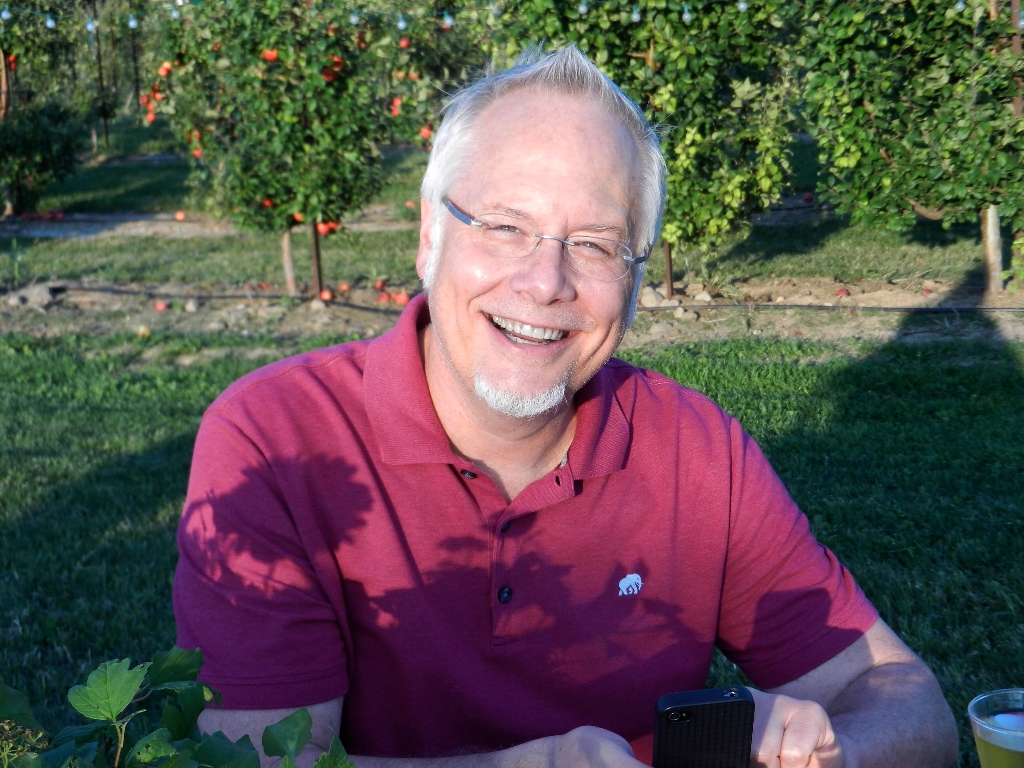
J Schwanke

J Schwanke, photographed on a recent fall day after he created the centerpieces for a Farm-to-Table orchard dinner.

He has been promoting American Grown flowers for so much longer than I have – and I credit J for pioneering the message that I’ve also embraced as my personal cause. It’s wonderful to have someone out there already trumpeting the message – and to join together in promoting the Slow Flowers movement.

Since I come from the gardening and DIY floral world and J is very well known in the professional floral world, I didn’t really know who he was during the years I was reporting and writing The 50 Mile Bouquet book. I first met J on my computer screen when I watched one of his California Grown Experience videos, which he produced in 2010-2011 as a series of online tours of California flower farms and related businesses such a floral wholesalers. That’s when J’s telegenetic personality, passion for flowers, and ability to draw out people and their stories impressed me. “Who is this guy, anyway?” I thought.
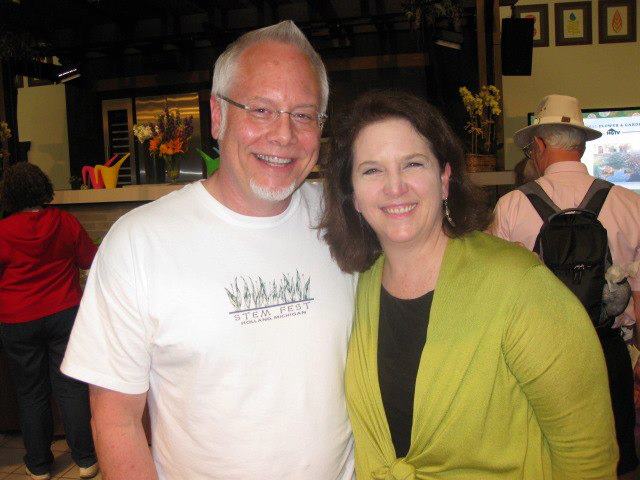
Florida with J and Debra

Kelly Blank snapped this photo of J and me on the day we finally met – in late April – at Disney’s EPCOT flower show.

Through our mutual friend and colleague Kasey Cronquist, I eventually met J via phone conference calls in which we both participated.

Then, earlier this year, J and his partner Kelly James Blank surprised me by attending one of my presentations at EPCOT’s International Flower & Garden Festival in Orlando.

That was pretty serendipitious – and it led to an evening of conversation, cocktails and dinner together – talking about our favorite subject: Flowers (former Garden Design magazine editor Sarah Kinbar was also with us – and that was such a treat to be together!)
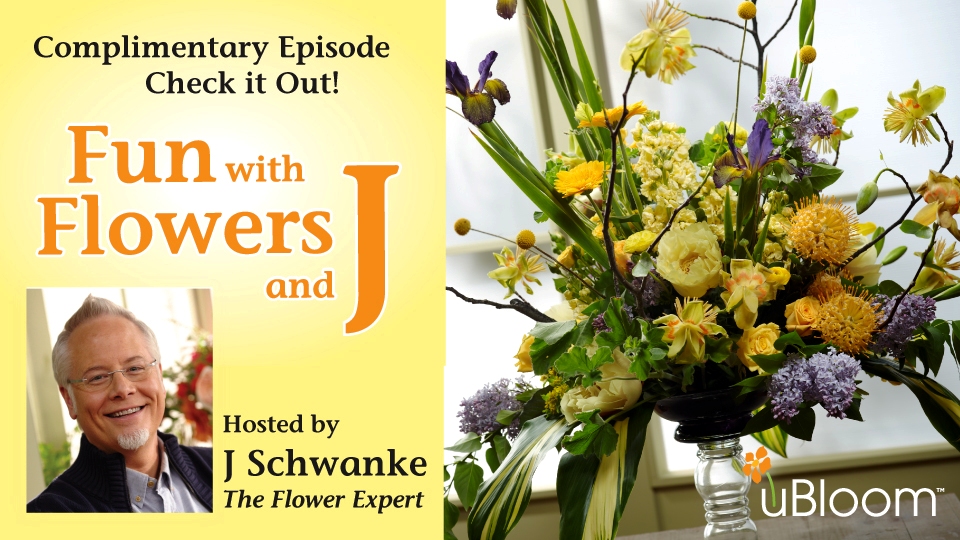
Fun with Flowers and J is the weekly how-to Web series you can find at uBloom.com

Fun with Flowers and J is the weekly how-to Web series you can find at uBloom.com

The California Grown Experience is featured on uBloom.com, the first Web-Based TV Show about Flowers, which J created in 2006 – and which continues to air today. Every Monday, J releases a new “FUN with Flowers” episode.  You can find a collection of more than 500 how-to videos and flower farm documentaries on the site, including a new series called the “Florida Fresh Flower and Foliage Tour.” Previews of all J’s shows are included free on the site; viewers can purchase downloads for $1-$2 or subscribe to uBloom for $30 a year to receive complete access to the entire archive. 

J with mom 1966

1966: J in a greenhouse with his mother. Pretty darned cute~

J has lived his entire life surrounded by flowers, in fact, his mother gave birth to him a flower convention she and his father were running. A fourth-generation florist and foremost expert in cut flowers and foliage, J received the prestigious Tommy Bright Award, lifetime achievement recognition for flower communication. and the Crystal Rose Award, denoting him a “Living Legend” in the world of flowers.

J is a member of the American Academy of Floriculture (AAF) and the American Institute of Flower Designers (AIFD). He is a Certified Flower Designer (CFD) and a designated Professional Flower Communicator International (PFCI). His deep source of energy has sent J around the globe to give presentations, demonstrations and hands-on workshops in all 50 States, Canada, Mexico, and throughout Europe.

I invite you to listen in on our conversation and meet J, too. Then, mosey on over to uBloom.com to learn about all of its features, sign up for J’s free newsletter and learn more about the extensive content offered there. 

One of J’s newest ventures, which we discuss on the podcast, is the Professional Resource Guide. This is a free directory that lets professionals and DIY floral designers find WHERE TO BUY the many products and supplies featured on uBloom.com. Here is the link to that excellent new resource. 
 

SLOW FLOWERS Podcast: Local Color Flowers (Episode 106)

Wednesday, September 11th, 2013

SLOW FLOWERS Podcast: Local Color Flowers (Episode 106)

Today’s interview will introduce you to Ellen Frost, a Baltimore-based floral designer who is committed to using only 100% locally-grown flowers in her work. I am so impressed with her business philosophy and her contagious enthusiasm for using flowers from farmers she knows and supports. 

Vote

Vote for your favorite SLOW FLOWERS florist: Ellen Frost’s Local Color Flowers of Baltimore, Maryland


Our Mission

Ellen_LoCoFlo

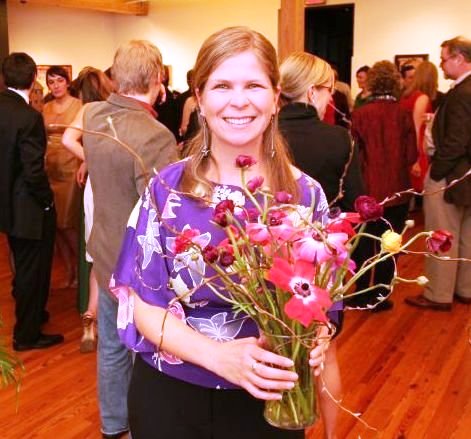
Creative florist Ellen Frost, founder of Local Color Flowers in downtown Baltimore.

Local Color Flowers is a Baltimore-based floral design business. We create personalized arrangements and bouquets from fresh, seasonal, and sustainable flowers cultivated by local specialty growers. We are committed to responsible use of resources, supporting the local economy and promoting neighboring farms. We provide our clients an environmentally and socially conscious alternative when purchasing flowers.

Our Vision

Local Color Flowers seeks to create and support a sustainable community; where people choose local products and services; where flower farms and farm families are thriving; where there is a diverse, strong local economy; and where people are connected to the living world around them.

Our Passion

We love flowers. We love our clients, growers, and partners. We are social entrepeneurs motivated by our relationships and the connections we create. We want our clients to know where their flowers were grown. We want our growers to know how our clients appreciate their products. We want all of our partners to know how we’re green. We want to share our joy and values through our flowers.

IMPORTANT LINKS:

Local Color Flowers’ web site

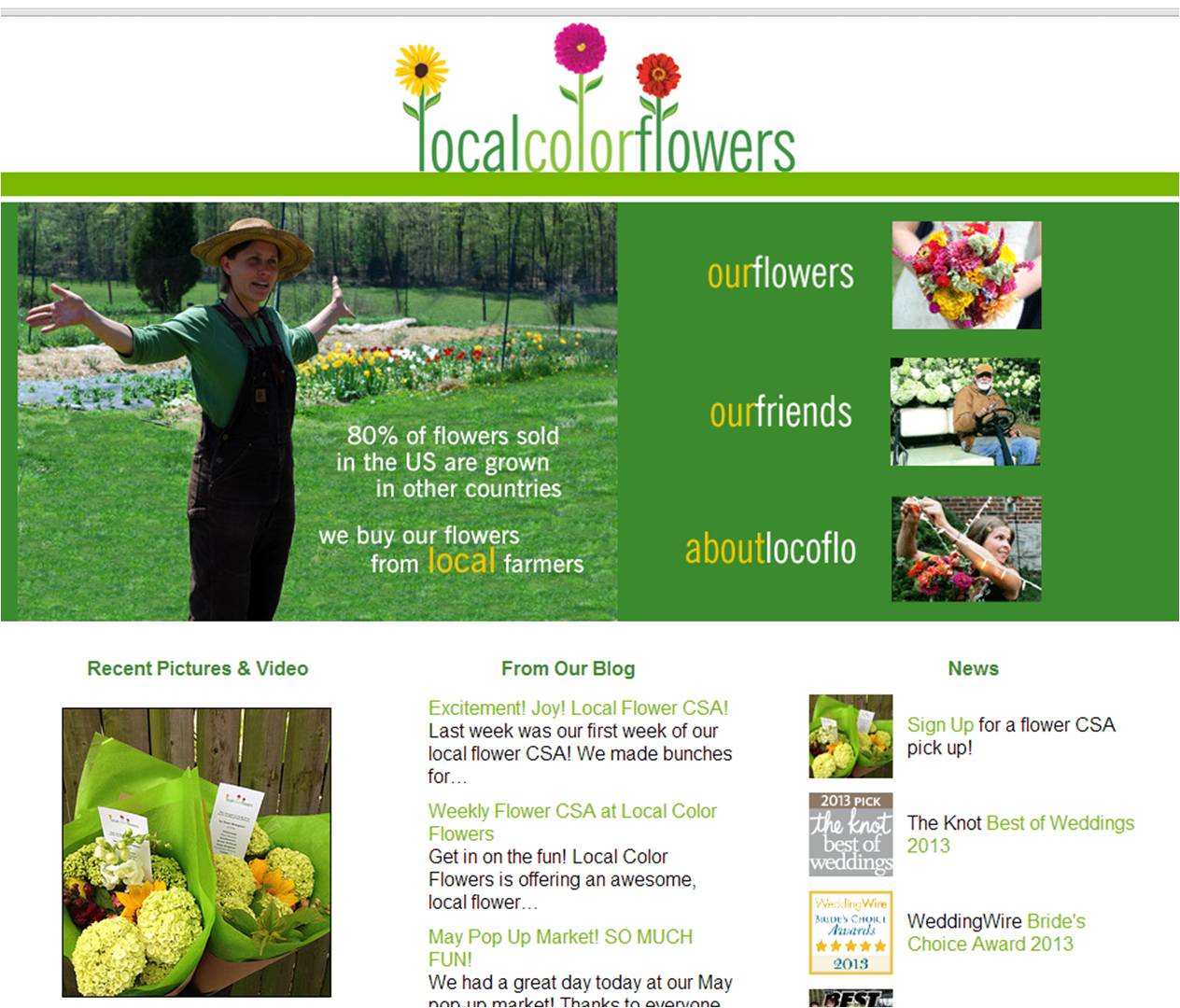
Home page for Local Color Flowers' web site.

Home page for Local Color Flowers’ web site. Note the compelling “promise” shared with customers who visit Locoflo.com


Martha Stewart's 2013 American Made Campaign.

Martha Stewart’s 2013 American Made Campaign.

Vote here for LoCoFlo on Martha Stewart American Made contest.


Ellen at Work

Ellen at work, designing one of 100 weddings and events on her calendar this year.

Into the Garden with Charles Anew

Wednesday, August 28th, 2013
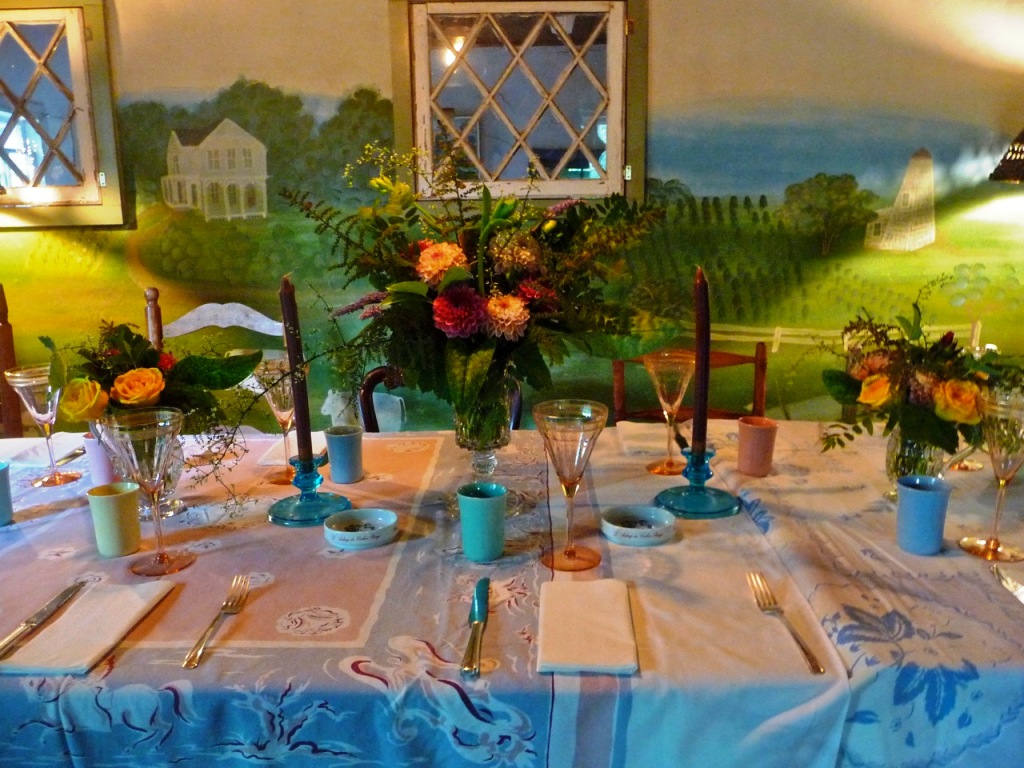
Table Arrangement

A lovely table arrangement where the vases seem to blend into the primitive wall mural of Orient, New York . . . as imagined and painted by Skip many years ago.

Last April 2012, I wrote about the beautiful memoir by my late friend Clyde “Skip” Wachsberger.

The book is called Into the Garden With Charles.  It was first published privately by friends of Skip’s (under the guidance of editor and friend Karen Braziller) in December 2010. Farrar, Straus and Giroux published it commercially in early 2012, although Skip did not live to see that event. Read more about the book here.

I have not been able to visit Orient, New York, or see Charles Dean, Skip’s surviving husband, since January 2012, when I traveled there for the memorial service honoring Skip’s life. I love this place and all of the friends I’ve met through these two men. The garden during summertime at Adsworthy, where Skip and Charles made their home, is very special. And for some reason, my trips in recent years were during fall or winter, so I hadn’t toured that verdant place during its peak since 2005 or so. Too long!

Last week I was fortunate to return for a mere 36 hours. It wasn’t nearly enough time, but every moment was filled with wonder, delight, friendship and memories. 

One of the highlights was getting ready for a big, yummy, community dinner prepared by the man Charles has now found to spend his life with. That is Charles’s very personal story to tell, so I won’t say more. I’ll only add that he is now with a dear, charming person and I’m pleased to see Charles so happy.

Skip’s presence is still very much evident in his garden. I was mindful of his exuberant spirit watching over me as I snipped stems, leaves and flowers from uncommon specimens that he originally selected, planted and tended to over the years. The opportunity to create the centerpieces for our wonderful dinner party was all the more special for the connection I felt between those plants and Skip. While the bouquets’ dahlias came from a local flower farm stand and the yellow roses were a gift to Charles from a family friend visiting his sister, artist Frieda Dean, everything else came from Skip’s garden. I relied on his plants for bold and fine foliage, tiny buds, fern fronds and seed heads. Charles supplied the beautiful cut glass urn and two small cream pitchers for the vases. 

Our table sparkled with vintage linens, pottery, silver and stemware. You can see how it looked above.

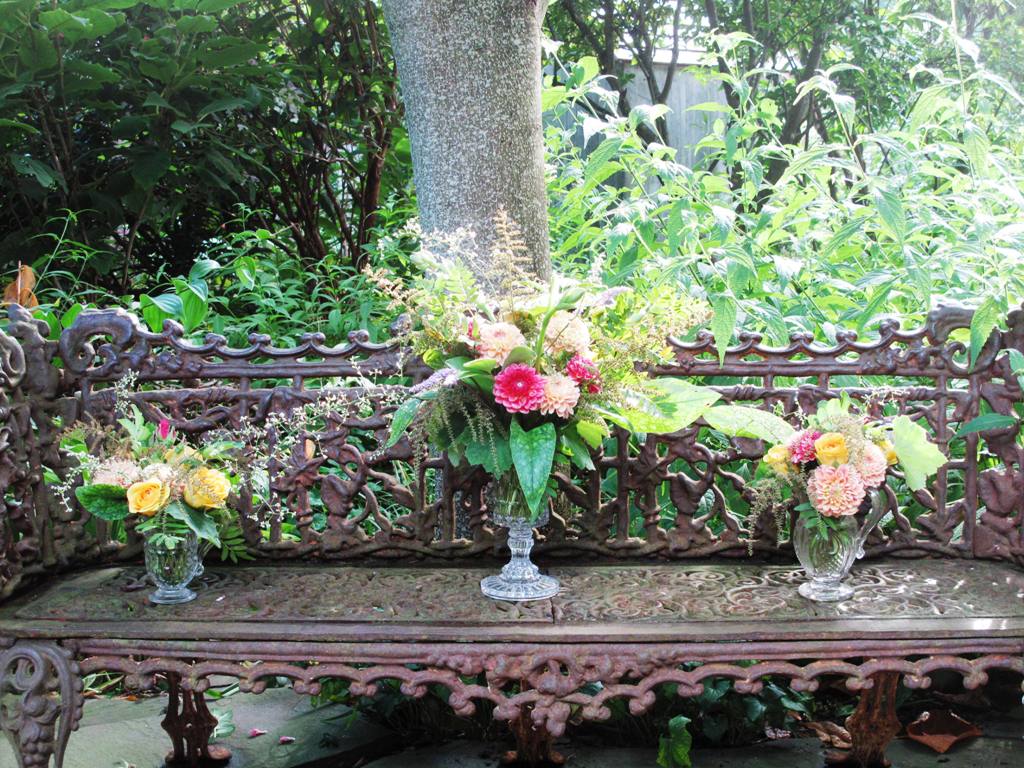
Here are some more images of the bouquets, in the garden:

Bench with three vases

A still life with three bouquets, on a vintage cast-iron bench in the garden.


Small glass pitcher of flowers

A small glass pitcher looks so beautiful in the dappled light that spills onto an iron garden chair.


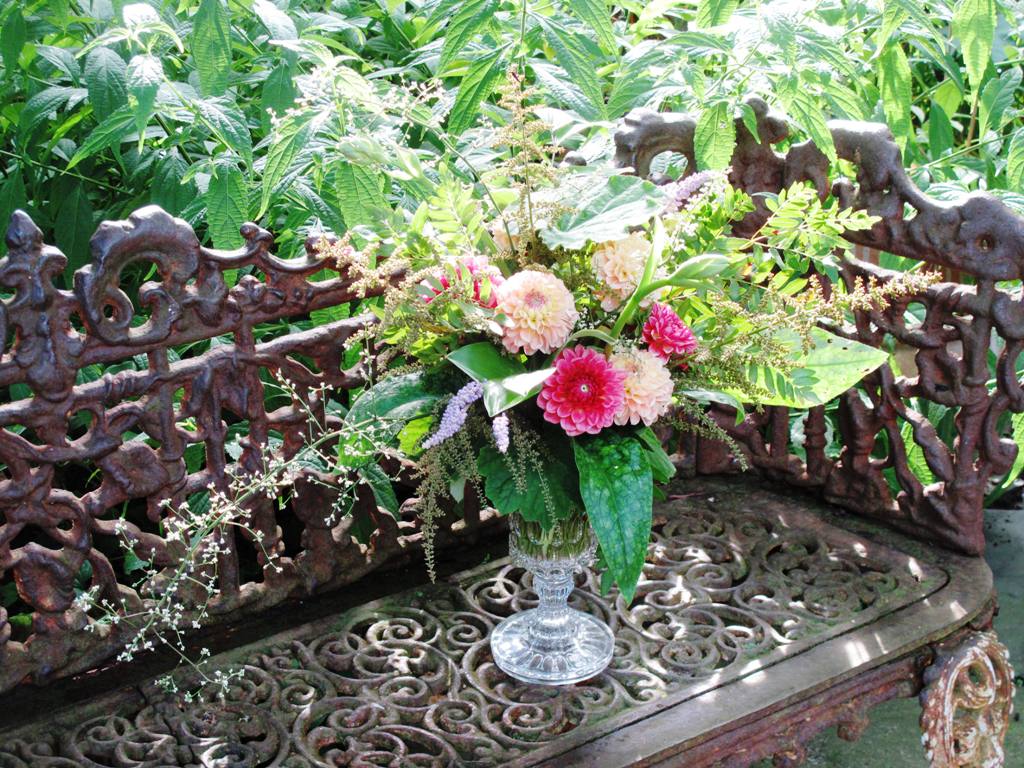
Iron Bench

The larger vase features all sorts of gorgeous leaves, fronds and stems from Skip’s garden.

I’ll close with one of Skip’s quote about his garden, excerpted from Into the Garden with Charles:

 “I had been presented with a blank canvas, a large one at that. For an artist, this was ideal. I gardened the way I painted: I began with a picture in my mind and then I figured out how to create it. The only difference was that my colors and textures were living beings with a thirst for life; they would grow every which way once I had placed them on the canvas. I had no intention of ever finishing the painting.”


Muir Ranch: Food & Flower Power for Teen Farmers

Friday, August 9th, 2013
Sunflower Hat

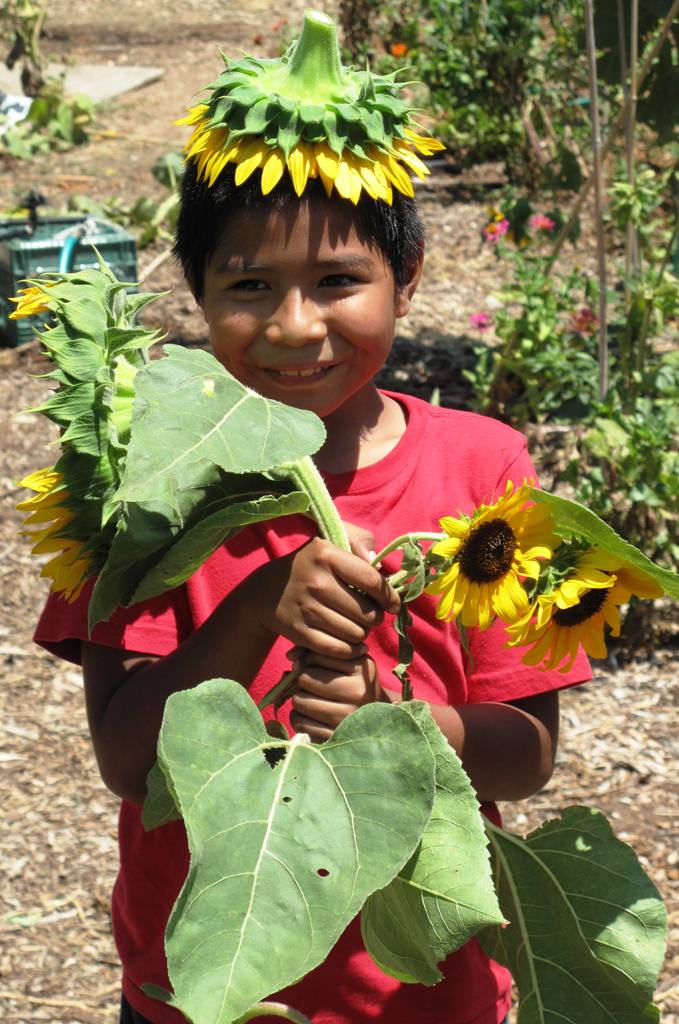
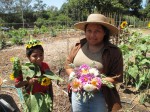
The little brother of a summer teen farmer donned a sunflower hat that Mud Baron gave him at Muir Ranch. Adorable~!

Here’s some more great news about the Urban Farming Movement.

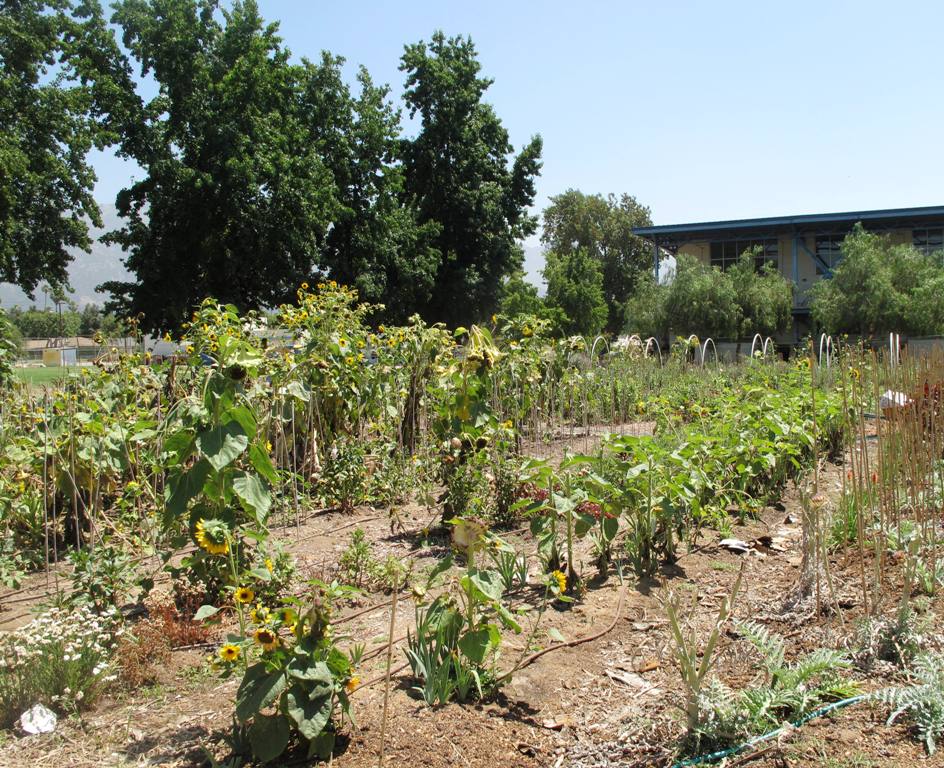
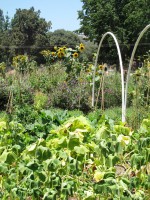
In 2011, a dedicated team of volunteer teachers and students began converting 1.5 acres of Pasadena, California’s John Muir High School campus into a school-based farm.

Today, Muir Ranch grows a variety of flowers, vegetables and fruits that are included in weekly CSA boxes as well as school cafeteria lunches. Students can complete community service or internship graduation requirements by enrolling in classes at the Ranch. Muir Ranch also provides paid internships to students, which are funded by private donations, special events, farmer’s market sales, and subscriptions to the produce box program (CSA).  Every week, Muir Ranch CSA subscribers get a box or bag of about 7-10 different types of fruit and vegetables grown without the use of pesticides or chemical fertilizers. Customers pick their shares up at central distribution sites throughout Pasadena. Muir Ranch CSA partners with several local farms for seasonal fruit and vegetables to supplement what they can produce, providing tax-deductible weekly boxes to over 100 subscribers. It is the CSA program that generates much of the income that keeps this place operating.

Mud Baron

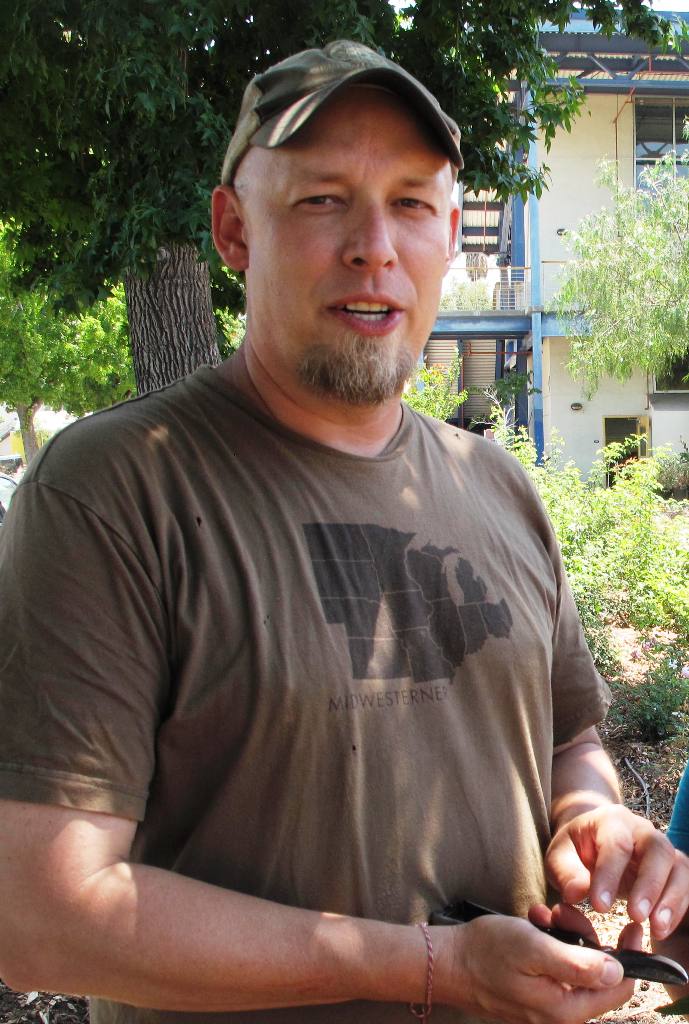
“Mud” Baron, Executive Director of Muir Ranch, is an urban farming activist and proud bouquet-maker.

One of the people at the hub of this fast-rolling wheel is Mud Baron, a passionate school garden advocate who serves as the Executive Director of Muir Ranch. That sounds like a high-falutin’ title, but in all reality, he is true to his nickname. Mud gets down and dirty – and REAL – with his kids, teenagers whose horizons are much brighter after they’ve learned to grow and sell food and flowers to local customers. 

How did this former design-build contractor end up teaching gardening and farming skills to urban youth? I’m still trying to figure out the exact path of Mud’s career, but suffice it to say he’s in his element growing food and flowers. He totally lights up whether he’s shooting the breeze with one of the teen-CSA interns or sharing drinks with me and a board member (Mud ordered the Stone IPA, brewed with dandelion greens).

Board member Leelee Clement Doughty discovered Muir Ranch through the Pasadena Garden Club, which brought expert Rosarians to the farm to teach students about rose growing and rose care. She got hooked and started volunteering. “The best sales pitch is the Ranch itself,” she told me. A lifelong gardener and corporate finance escapee, Leelee digs the lessons she sees young people learning: Cooking and Catering, Marketing, Nutrition, Math and Business, Science and more. Right now, Muir Ranch is a “fiscally sponsored proeject of the Pasadena Education Foundation,” but if Leelee and Mud’s vision is realized, it will soon be a standalone nonprofit. 

The Ranch is situated behind John Muir H.S.

The Ranch is situated behind John Muir H.S.

Many programs besides the CSA are supported under the umbrella of Muir Ranch, such as partnerships CSAs run by with other local schools and learning gardens. Muir Ranch also and hosts monthly “Plug Mobs” to help the community start their own gardens. In Mud’s mind, no Southern California-based teacher should go wanting for school garden supplies. “The Plug Mob program means that finding seeds and plants is no longer a factor for 2,000 schools,” he says. Muir Ranch operates like a plant nursery, helping source and distribute seeds, bulbs and flats of plant starts. Like modern day Johnny Appleseeds, Mud and his supporters share what they have and spread around the love.

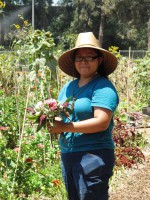
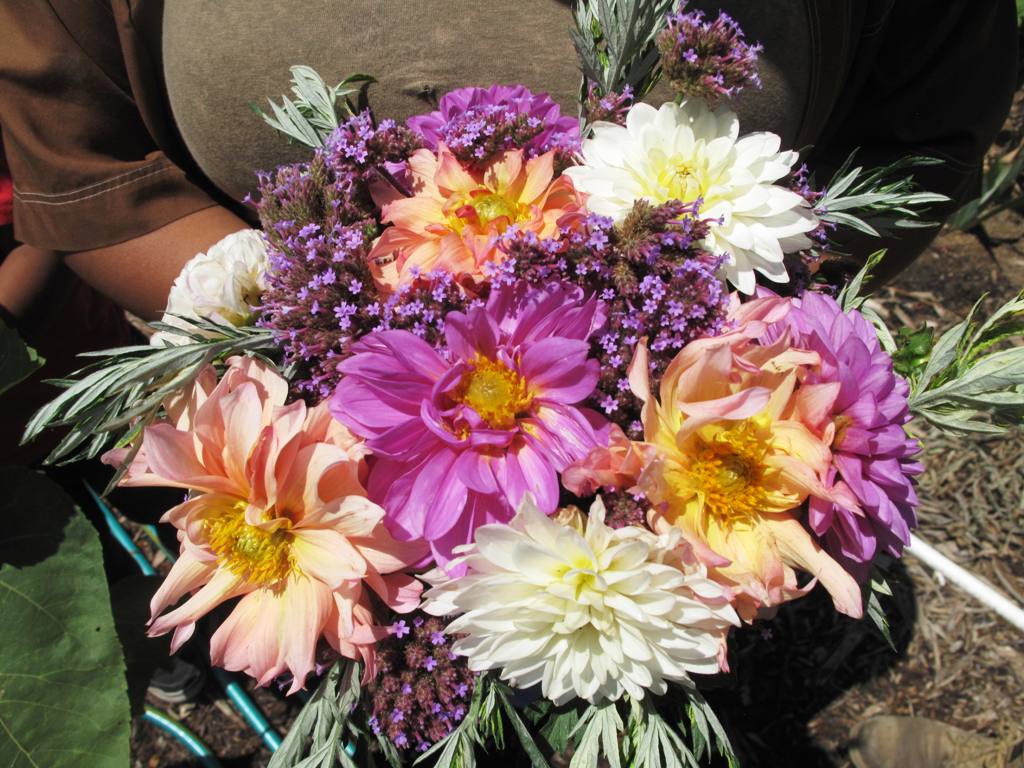
Muir Ranch hopes to add a culinary program that will connect students more closely to food systems. As young people “connect the dots,” they become involved in how food it is grown, distributed, and finally cooked into healthy meals. Besides being a center for education, Muir Ranch hosts a variety of ongoing and special events. The program is known for its floral arrangements, and I love that Mud has taught his interns and student workers how to harvest and assemble bouquets. When I visited last month, he gave two young women a challenge to create a bouquet for me. I loved the ease and confidence with which each gather flowers – mostly annuals and summer dahlias — into a custom-made bunch.

And the word is getting out about Muir Ranch’s flowers. One of Mud’s interns just earned $400 selling wedding flowers to a market customer. According to Mud, that experience has opened her eyes to possibilites for a bright future. 

Here's that beautiful bouquet, an impromptu gift that I cherished.

Here’s that beautiful bouquet, an impromptu gift that I cherished.

Volunteers are welcome (and needed) at this innovative program, especially to weed, prepare beds, turn compost, plant seeds and plugs, move worm “tractors,” maintain irrigation systems, water nursery plants and harvest crops. If you’d like to stop by and help, the regular Muir Ranch Workdays take place Monday-Friday from 8 to 11:00 a.m. 

If you want to feast your eyes on more beauty from this place, follow Mud’s Instagram posts here: http://instagram.com/cocoxochitl

And follow his Twitter feed, here: @muirranch or @muirranchcsa

Footed glass, circa 1978

Sunday, July 14th, 2013
Side view of vases

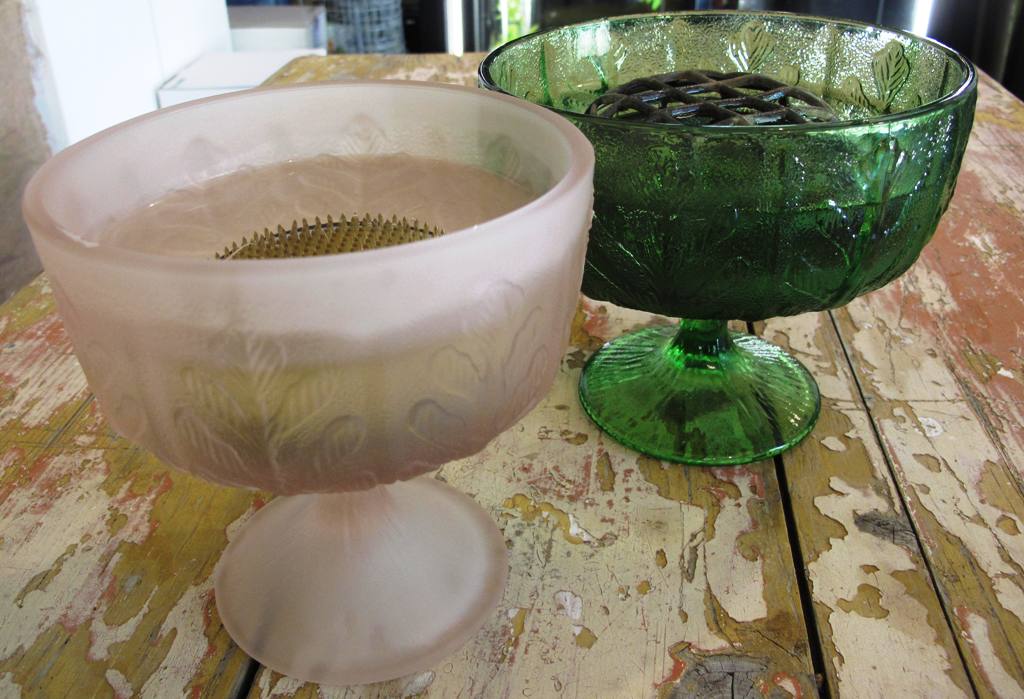
It’s easy to find these not-quite-vintage and not quite-retro, but definitely collectible footed glass vases. I snagged the frosted pink one on eBay for $4.99 and found the green embossed one at my local Goodwill store for even less!

These vases have been identified as FTD florist vases, dated to 1978. The pattern is called “oak leaf” and I’ve found the two colors shown above as well as an amber-gold and milk-glass white, all with the raised embossed leaf pattern.

2 Vases

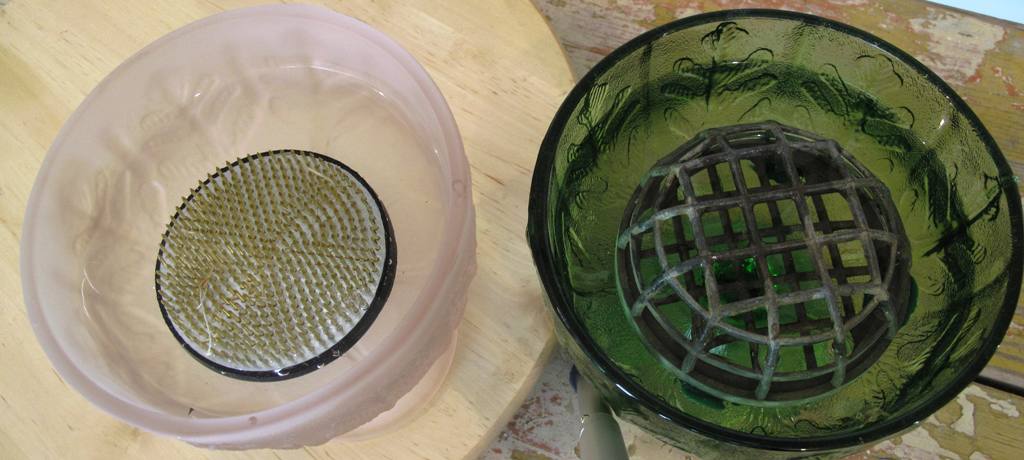
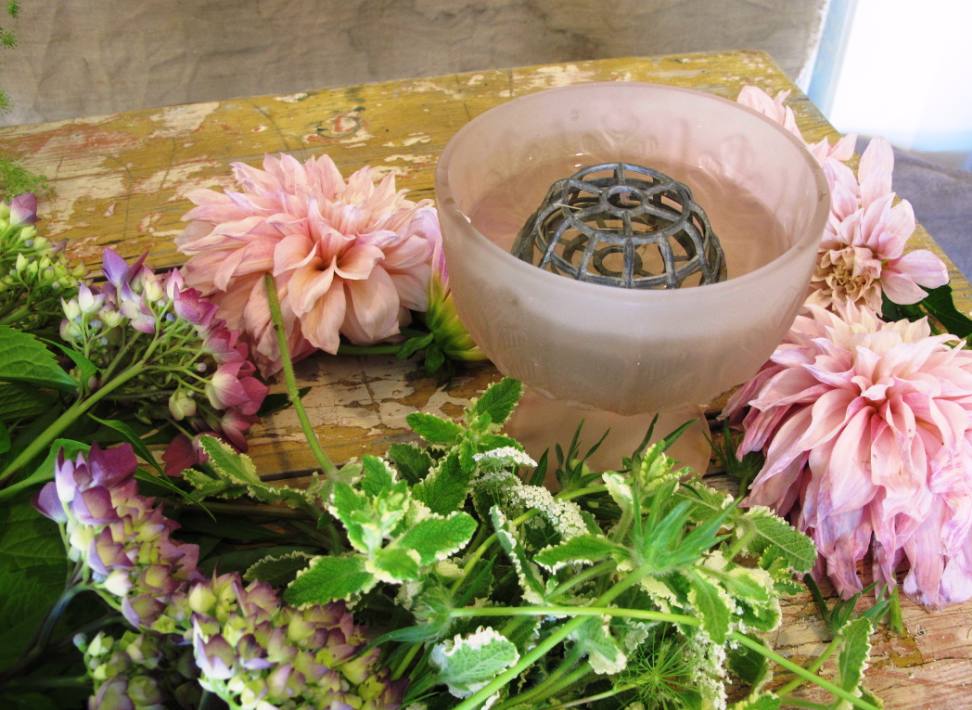
Getting ready by choosing flower frogs to fit inside the two vases.

The first time I used this charming green footed bowl in a demonstration, someone guessed it was Depression glass. There is that pressed-glass quality to these containers, but they’re newer. I like to think FTD was producing them in the U.S.A. and shipping them to mom-and-pop flower shops around the country at a time when those florists were still using predominantly American-grown flowers. The vases are so much more interesting and well made than most of the (probably) made-in-China stuff you see coming out of floral wire services these days. Keep your eyes out at the thrift store or surf on eBay, where I’ve found at least six or seven listings for idential and similar vessels.

I’ve written before about how much I love footed anything for floral arranging. Here is a recent post where I wax eloquently about footed vessels. Today, it was time to play with some flowers and see what I could create. By the way, here are the dimensions on these bowls: overall height, 5-1/2 inches; diameter, 5-1/4 inches; depth of bowl, 2-1/2 inches.

The shallow bowl does require some kind of device to stabilize stems. Back in the day, those 1978 florists were probably blithely cutting up chunks of foam to stick inside. But today we all know how unsafe it is to handle or use florist’s foam for its toxic attributes (formaldehyde being the active ingredient). So out came the metal frogs, as you can see in my bouquets below. Alternately, I could have shaped a section of chicken wire to fit inside, securing it with floral tape. Both methods are quite easy and eco!

Here is my first of two arrangements, using the green vase: 

Green Vase and Frog

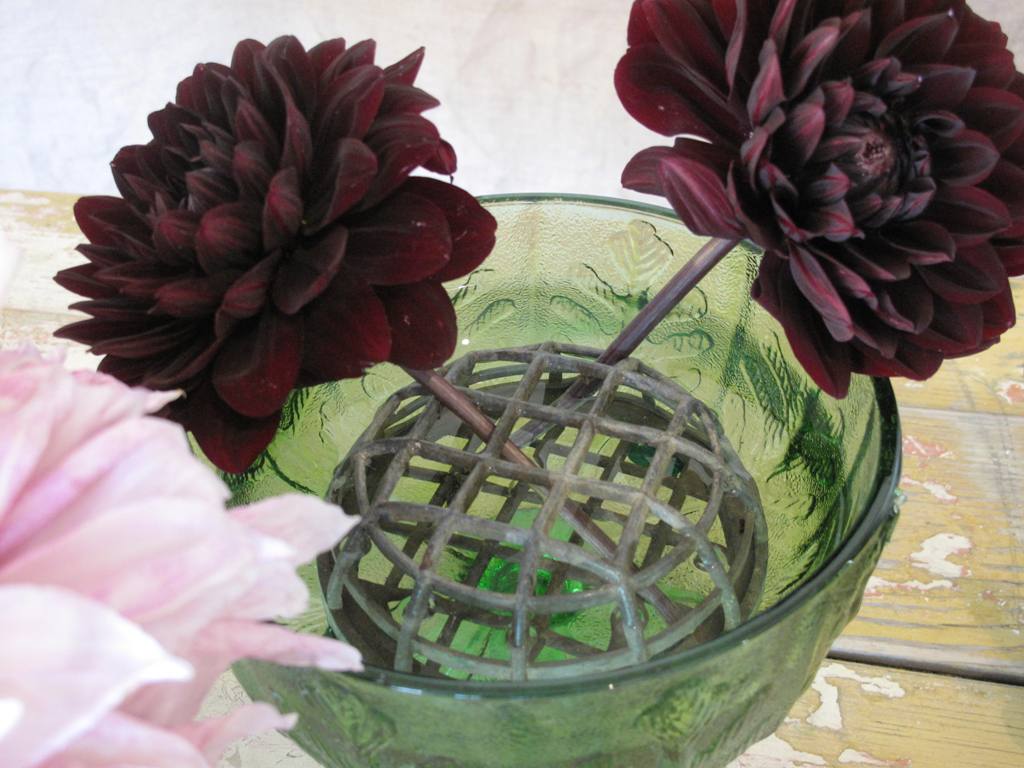
Step One: Insert maroon dahlias into metal frog. Notice how I’ve cut the stems short so that the flower head snugs close to the rim of the vase. 


Magenta and Fuchsia

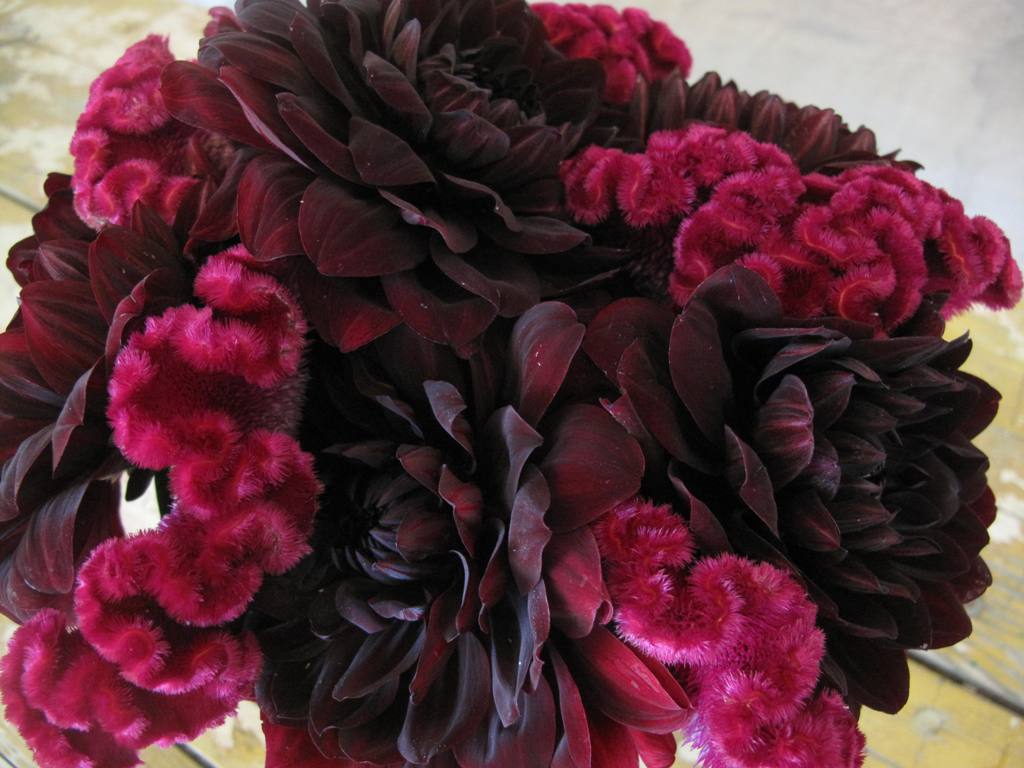
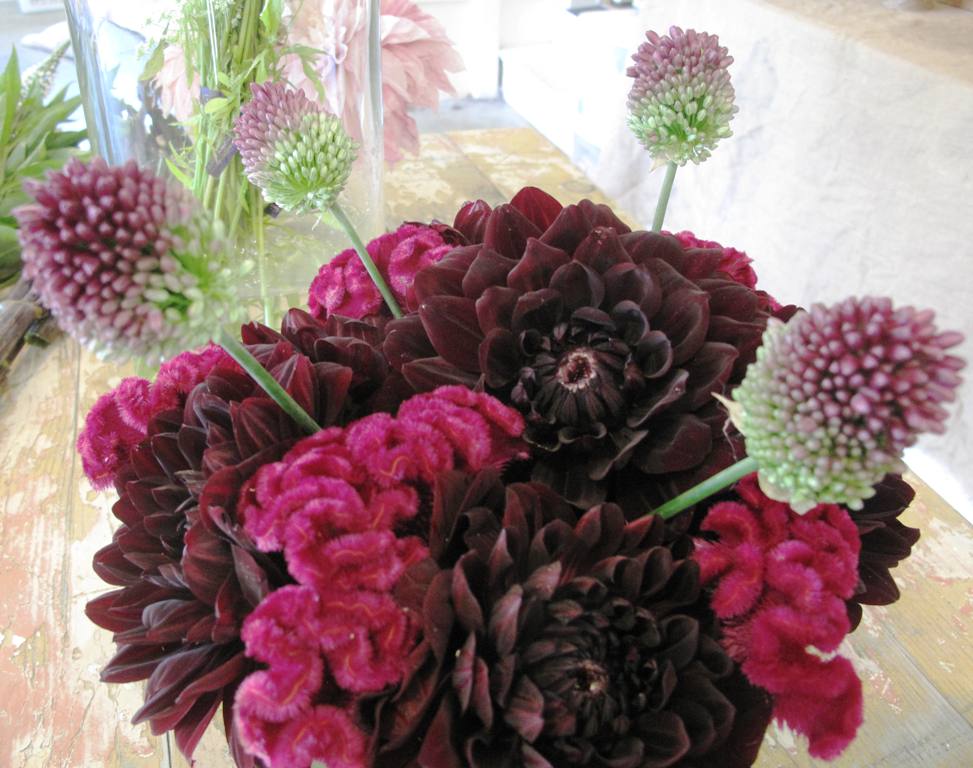
Step Two: After seven dahlias are arranged evenly throughout the opening, I added five lush fuchsia cockscomb celosias inbetween the darker flowers. 


Adding Alliums

Step Three: Insert four drumstick alliums for graphic punctuation. 


Adding Queen Anne's Lace

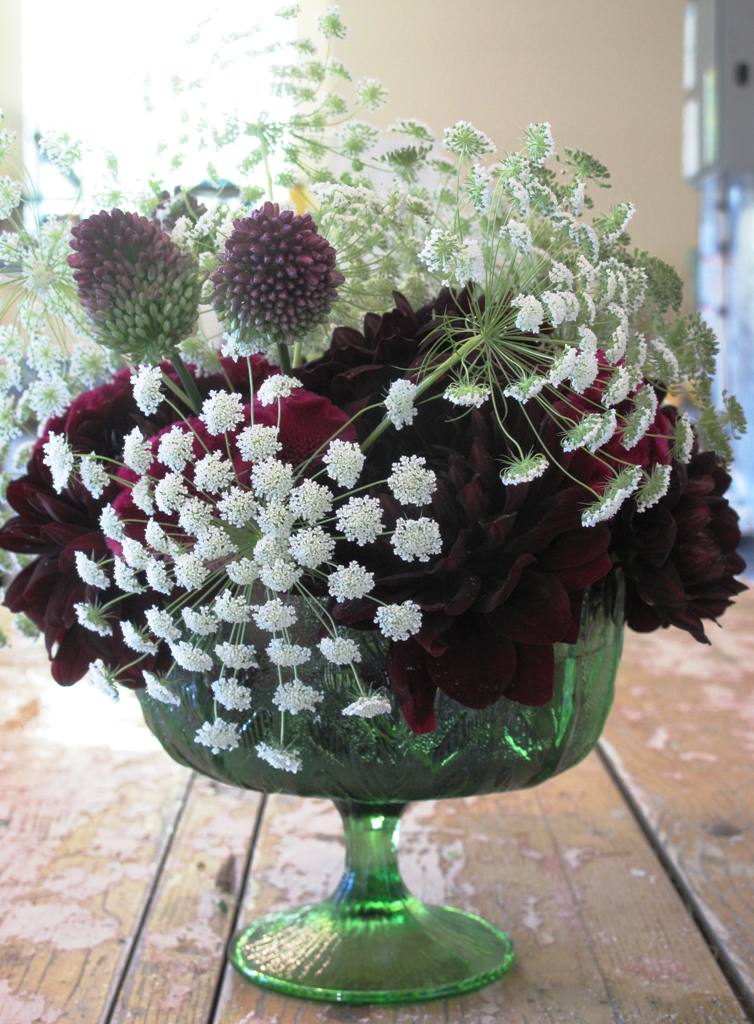
Step Four: Add Queen Anne’s Lace stems so they hover above the darker base of flowers. 


Green Final

Step Five: Finish off the bouquet with a few stems of gooseneck loosestrife (Lysimachia clethroides), a quirky accent that repeats the white from the QA Lace and brings a new texture into the design.

Here how I filled the pale pink frosted vase: 

Pink Vase Starting Off

Getting started. If you compare this photo with the one at the top of this post you’ll see that I switched the frog. The original pin frog I planned on using wasn’t allowing me to insert stems at an angle or sideways, so I replaced it with a metal cage-style frog. 


Pink Final

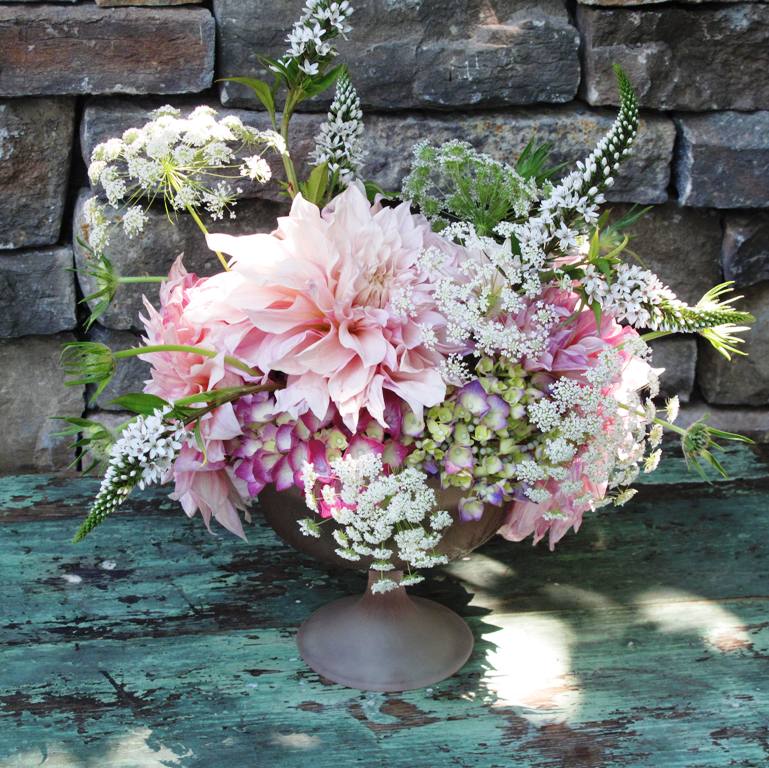
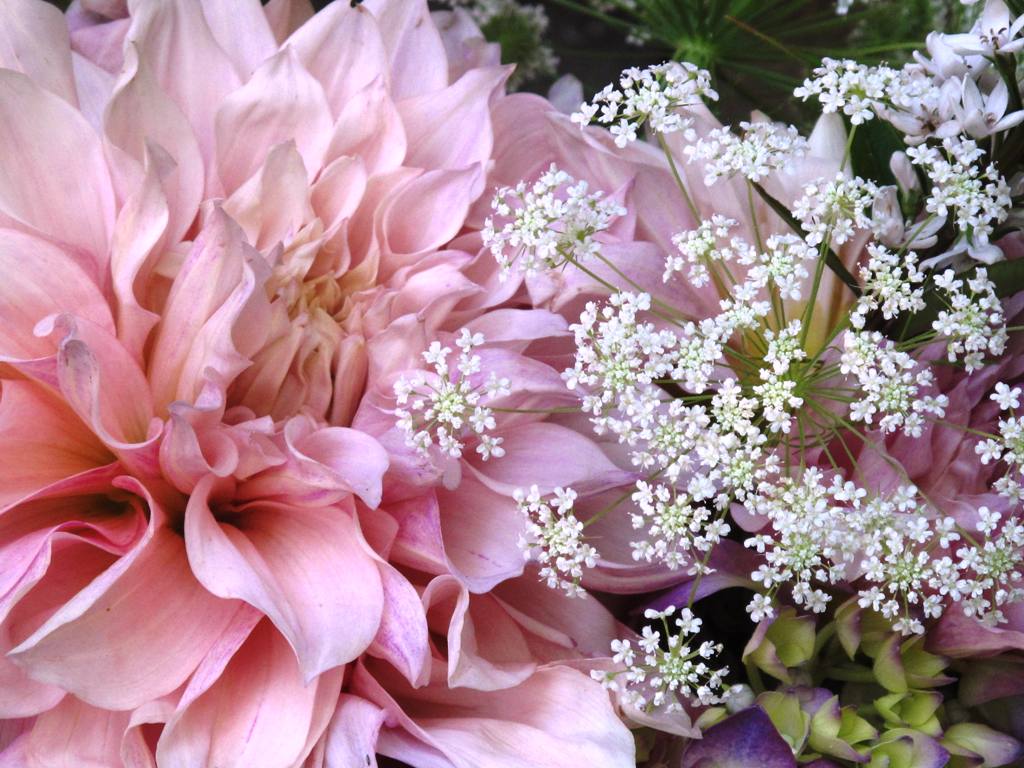
This bouquet came together in much the same way as the first one, so I didn’t photograph all the steps in detail. Notice that I started with a cluster of unopened hydrangea heads, which created a “base” that supports the three ‘Cafe au Lait’ dahlias, making them more prominent. Other ingredients include Queen Anne’s Lace, Scabiosa buds, and the gooseneck loosetrife. Even though similar ingredients are repeated from the first bouquet, this color palette gives it a totally different look and feel. 


Pink Detail

A final grace note, showcasing the delicate beauty of the dahlia and Queen Anne’s Lace.


SLOW FLOWERS: Week 14

Sunday, April 7th, 2013

Chocolate-and-Vanilla

Chocolate and Vanilla Flowers

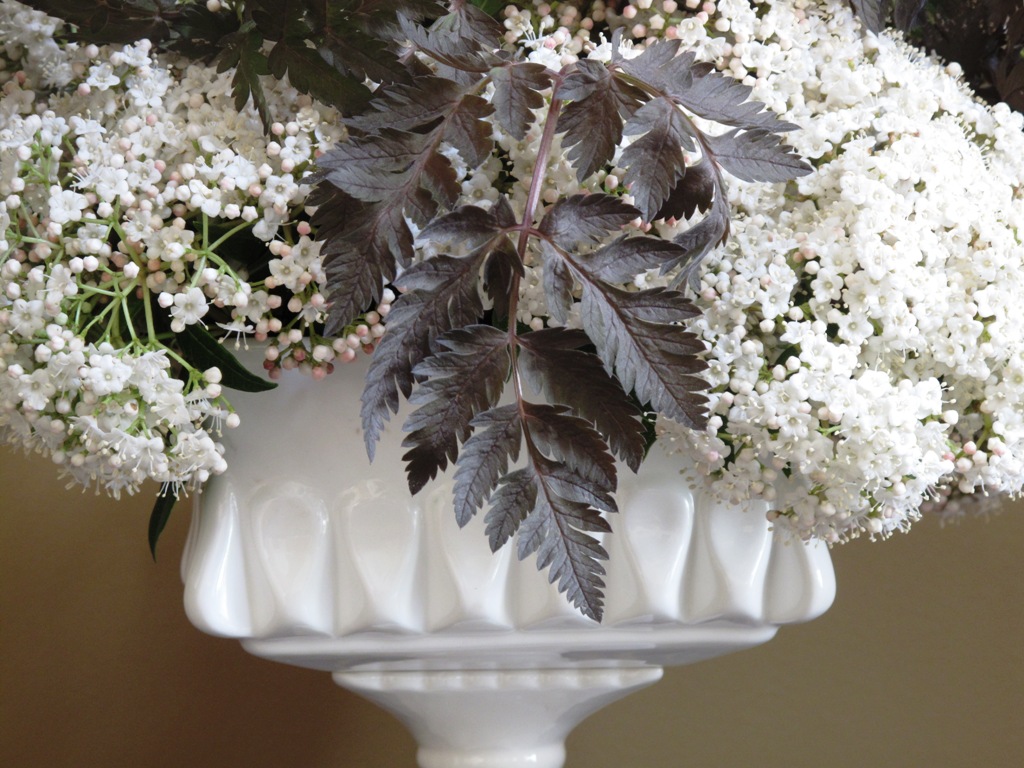
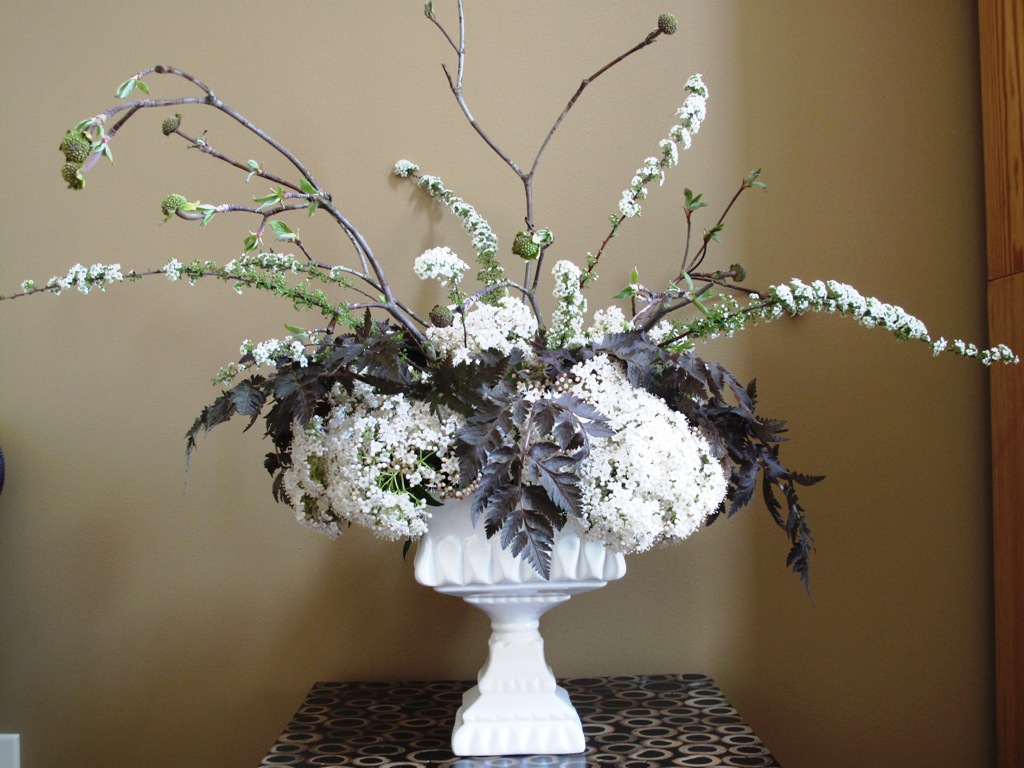
A graphic, fresh combination: dark-chocolate-colored Anthriscus sylvestris foliage with creamy white Viburnum tinus flowers.

A graceful spring bouquet

The white square dish, elevated on a pedestal, makes this simple grouping of flowers all the more special.

Ingredients:

8-11 Viburnum tinus blooms, harvested from Charlotte Behnke’s Seattle garden

6 stems Anthriscus sylvestris ‘Ravenswing’, grown by Jello Mold Farm

6 stems bridal wreath spirea (Spiraea cantoniensis ‘Flore Pleno’), grown by Charles Little & Co.

3 stems green dogwood (Cornus sp.), harvested by Oregon Coastal Flowers

Vase:

6-inch square x 3-inch deep white ceramic nut dish (overall height is 8 inches)

Design 101
Elevate for importance: There’s something appealing about lifting a floral arrangement with a footed vase or dish. It’s like giving your bouquet a little stage or platform to help it rise above its environment. This is especially noticeable with an arrangement designed to be viewed on all sides, such as a centerpiece. If you don’t have a footed dish or urn, you can use a cake plate to elevate your flowers!
NOTE: Each Sunday of this year, I post my photographs, a how-to “recipe” and tip for that week’s floral arrangement, created for my new book, Slow Flowers.
Enjoy the floral journey through 52 weeks of the year~

SLOW FLOWERS: Week 12

Sunday, March 24th, 2013

Zen in Bloom

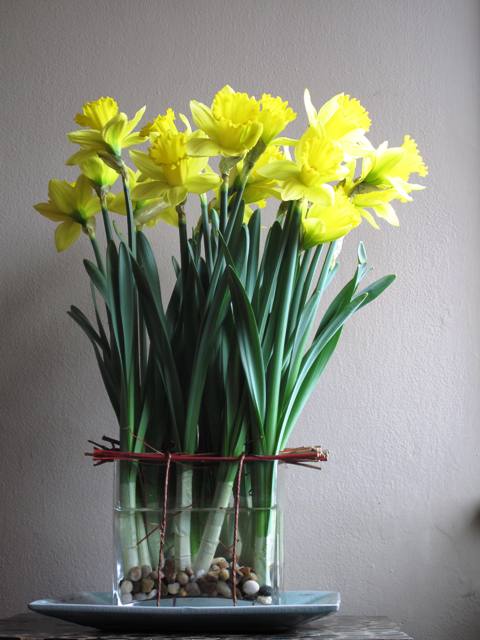
Showcasing a single type of flower - here, it's spring daffodils - this technique is easy and carefree.

Showcasing a single type of flower – here, it’s spring daffodils – this technique is easy and carefree.


Ingredients:

15 stems common daffodils, from my garden

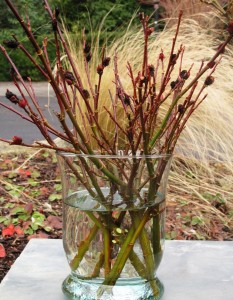
Multiple lengths of coral-pink twig dogwood, cut approximately 2 inches wider than the vase opening. Any straight, woody branch will work, including vine maple, pussy willow or the colorful twig dogwood (Cornus sanguinea or C. sericea)

Vase:

6-inch tall x 6-inch square glass vase (this design adapts to any square or rectangular glass vase)

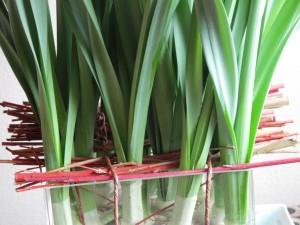
The daffodil stems are stabilized by a "raft" of twigs, lashed to cover the opening of the vase.

The daffodil stems are stabilized by a “raft” of twigs, lashed to cover the opening of the vase.

Other supplies:

Decorative pebbles

Twine-wrapped wire (available at craft stores in natural or green)

Design 101

Borrow inspiration: The idea for this bouquet came from a project featured in Design, a publication of The Flower Arranging Study Group of the Garden Club of America. Whenever you’re inspired by another designer’s technique, it’s important to give it your own twist rather than make a direct copy. For example, the original creation used florist’s foam inside the container, but I found it unnecessary, especially since the pebbles and twigs are enough to hold the daffodil stems in place.

NOTE: Each Sunday of this year, I will post my photographs, “recipe” and tip for that week’s floral arrangement, created for my new book, Slow Flowers.

Enjoy the floral journey through 52 weeks of the year~


SLOW FLOWERS: Week 7

Sunday, February 17th, 2013

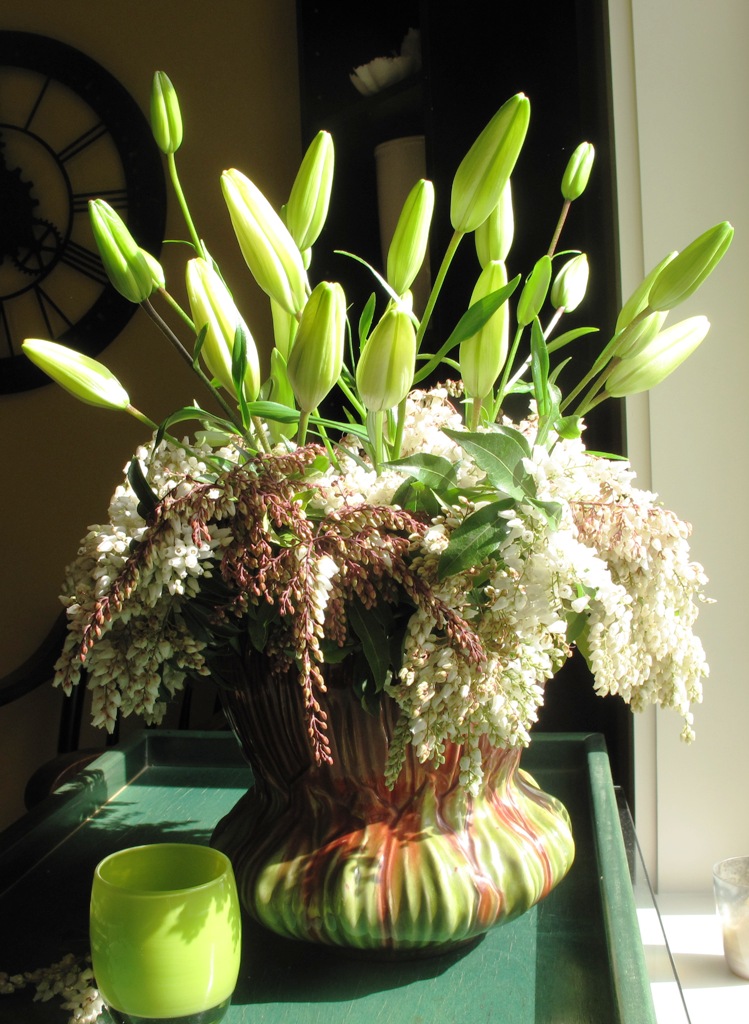
“Lilies, Two Ways”

Two "lily" elements fill my antique majolica cachepot, set in the dining room window to catch the rare winter rays of sunshine

Two “lily” elements fill my antique majolica cachepot, set in the dining room window to catch the rare winter rays of sunshine

Ingredients:
12 stems lily-of-the-valley shrub (Pieris japonica), harvested by Oregon Coastal Flowers
5 stems white ‘Navona’ Asiatic lilies, grown by Peterkort Roses
Vase:
9-inch tall x 9¼-inch diameter majolica cachepot from the late 1800s. I found this unique piece in Palm Springs, in a shop otherwise filled with 1950s art glass. I simply couldn’t resist the botanical charm of the piece, so I splurged and ended up flying home with it on my lap!
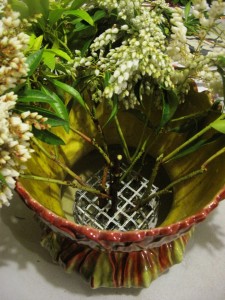
A detail from inside the vase . . .

A detail from inside the vase . . .

Eco-technique

Flower frogs: I’ve made it a personal goal to stabilize flower stems with organic methods rather than the conventional florist’s foam or “Oasis.” That product, I have learned, contains formaldehyde and does not break down in landfills. An old-fashioned flower frog (in ceramic, glass or metal) is a great alternative. You can find flower frogs at flea markets or tag sales for a few dollars (or raid your grandmother’s supply). One of my favorites is a half-dome cage. It sinks to the bottom of the container and has ¾-inch square openings, ideal for woody stems. This is an arranging tool of the past, seriously useful for the present-day!

NOTE: Each Sunday of this year, I will post my photographs, “recipe” and tip for that week’s floral arrangement, created for my new book, Slow Flowers. Enjoy the floral journey through 52 weeks of the year~


SLOW FLOWERS: Week 6

Wednesday, February 13th, 2013

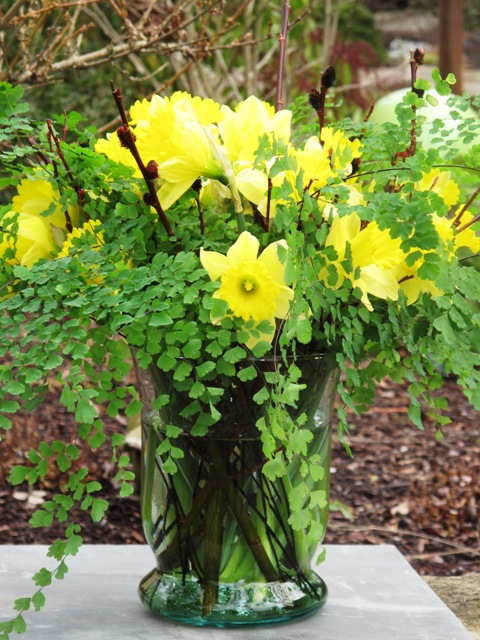
“A Display of Daffodils”

A trio of fresh, enticing elements creates this cheery arrangement

A trio of fresh, enticing elements creates this cheery arrangement

Ingredients:
15 stems black pussy willow (Salix gracilistyla ‘Melanostachys’), grown by Charles Little & Co.
12 stems ‘King Alfred’ daffodils (Narcissus ‘King Alfred’)
7 stems maidenhair fern (Adiantum capillus-veneris), grown by Peterkort Roses
Vase:
8-inch tall x 6½-inch diameter green-tinted glass vase


Start with a framework of twigs...then add other stems of flowers and foliage

Start with a framework of twigs…then add other stems of flowers and foliage

Eco-technique

Timing is everything: I love all three ingredients in this charming arrangement, but there is one drawback to mixing and matching them. The pussy willows gave me two full weeks of enjoyment; the daffodils looked great for a full seven days; and the maidenhair fern began to dry out after just a few days. Maidenhair ferns hail from tropical rain forests, meaning they prefer warm, damp, shaded conditions. Our homes are too dry for their liking.
The best way to extend the life of a maidenhair fern (as a cut ingredient or as a house plant) is to keep it out of sunlight, away from a heat source and frequently misted with water.
NOTE: Each Sunday of this year, I will post my photographs, “recipe” and tip for that week’s floral arrangement, created for my new book, Slow Flowers. Enjoy the floral journey through 52 weeks of the year~

SLOW FLOWERS: Week 5

Wednesday, February 13th, 2013

“Callas and Cherry Branches”

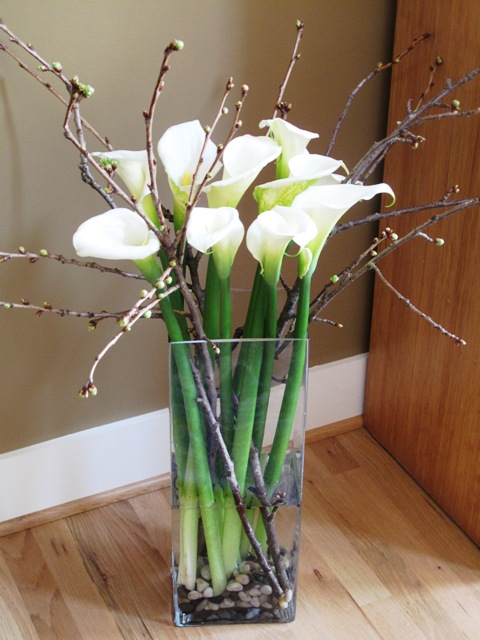
Simple, graceful, seasonal: Calla Lilies and Flowering Cherry Branches

Simple, graceful, seasonal: Calla Lilies and Flowering Cherry Branches

Ingredients:
9 stems white calla lilies (Zantedeschia aethiopica), grown by Oregon Coastal Flowers
6 branches white flowering cherry (Prunus sp.), harvested by Oregon Coastal Flowers
Vase:
20-inch tall x 7-inch long x 5-inch wide clear glass vase
Place a layer of pebbles in the bottom of this vase to give it visual weight
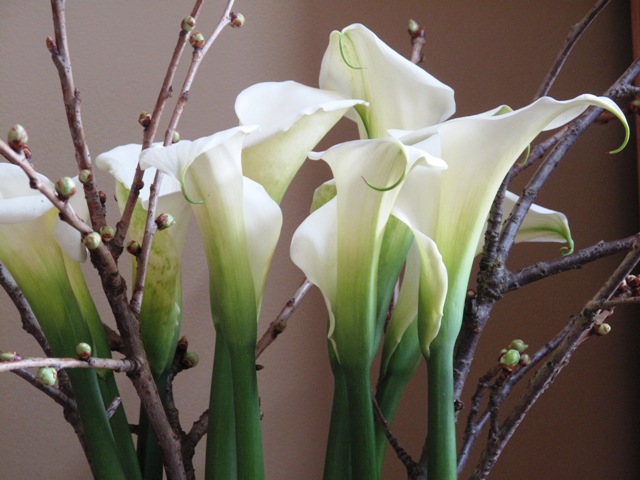
Love the ombre-coloring on these calla lilies!

Love the ombre-coloring on these calla lilies!

From the Farmer
Calla curve: When cut, your callas may have a tendency to curve. Patrick Zweifel says this is normal and can be minimized by storing the cut flowers (heads down) in a box overnight. Also, once they are cut and placed in a
vase, leave the curved flowers toward the container’s outside rim. The callas will naturally straighten up toward the center.
NOTE: Each Sunday of this year, I will post my photographs, “recipe” and tip for that week’s floral arrangement, created for my new book, Slow Flowers. Enjoy the floral journey through 52 weeks of the year~