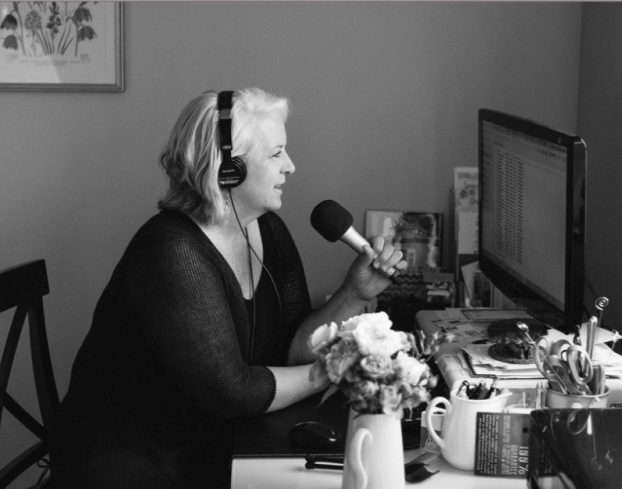
Today’s conversation was originally broadcast in late May by “Sustainability Champions,” an investigative podcast series made for the environmental stewards of the world, produced and hosted by Daniel Hartz. The series defines Sustainability as “the avoidance of the depletion of natural resources in order to maintain an ecological balance” and Champion as “one who supports or defends a cause.” We can all get behind that, right?
Host and founder of Sustainability Champions, Daniel Hartz is an American based in London. He started Sustainability Champions to showcase people around the world working hard to heal the planet through business innovations, community organizing and individual messages of optimism.
Sustainability often makes financial sense and the future of the environment is bright.
daniel hartz, sustainability champions
I am so grateful he invited me to share the story of the Slow Flowers Movement on Sustainability Champions.
In celebration of the Slow Flowers Show’s 8th anniversary, we launched our new, live-stream video format with the goal of sharing the faces and voices of our members, as well as tours of their farms, their shops and their studios — and most of all, their flowers. You can subscribe to our YouTube Channel here.
This show is brought to you by Slowflowers.com, the free, online directory to more than 880 florists, shops, and studios who design with local, seasonal and sustainable flowers and to the farms that grow those blooms. It’s the conscious choice for buying and sending flowers.
Thank you to our lead sponsor for 2021, Farmgirl Flowers. Farmgirl Flowers delivers iconic burlap-wrapped bouquets and lush, abundant arrangements to customers across the U.S., supporting more than 20 U.S. flower farms by purchasing more than $9 million dollars of U.S.-grown fresh and seasonal flowers and foliage annually. Discover more at farmgirlflowers.com.
Rooted Farmers. Rooted Farmers works exclusively with local growers to put the highest-quality specialty cut flowers in floral customers’ hands. When you partner with Rooted Farmers, you are investing in your community, and you can expect a commitment to excellence in return. Learn more at RootedFarmers.com.
Johnny’s Selected Seeds, an employee-owned company that provides our industry the best flower, herb and vegetable seeds — supplied to farms large and small and even backyard cutting gardens like mine. Find the full catalog of flower seeds and bulbs at johnnysseeds.com.
Mayesh Wholesale Florist. Family-owned since 1978, Mayesh is the premier wedding and event supplier in the U.S. and we’re thrilled to partner with Mayesh to promote local and domestic flowers, which they source from farms large and small around the U.S. Learn more at mayesh.com.
(c) Mary Grace Long Photography
Thanks so much for joining us today! The Slow Flowers Podcast has been downloaded nearly 750,000 times by listeners like you. Thank you for listening, commenting and sharing – it means so much. As our movement gains more supporters and more passionate participants who believe in the importance of our domestic cut flower industry, the momentum is contagious. I know you feel it, too.
I value your support and invite you to show your thanks to support Slow Flowers’ ongoing advocacy, education and outreach activities. You can find the donate button in the column to the right at debraprinzing.com
The content and opinions expressed here are either mine alone or those of my guests alone, independent of any podcast sponsor or other person, company or organization.
The Slow Flowers Podcast is engineered and edited by Andrew Brenlan. Thank you so much to Andrew for helping me set up our new Video Podcast platform and teaching me the technology! I’ll be relying more on his talents in the coming days. You can learn more about Andrew’s work at soundbodymovement.com.
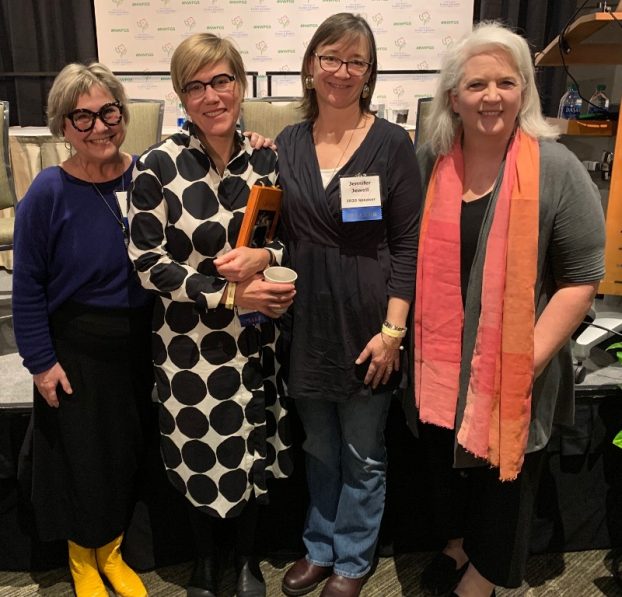
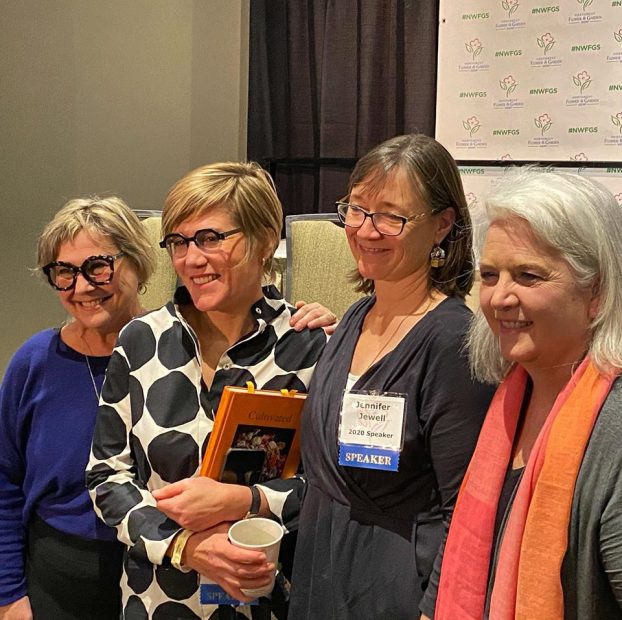
From left: Lorene Edwards Forkner, Christin Geall, moderator Jennifer Jewell and Debra Prinzing at the Northwest Flower & Garden Festival
Jennifer Jewell—Creator and host of the public radio program (and podcast) Cultivating Place, is a past guest of this podcast.
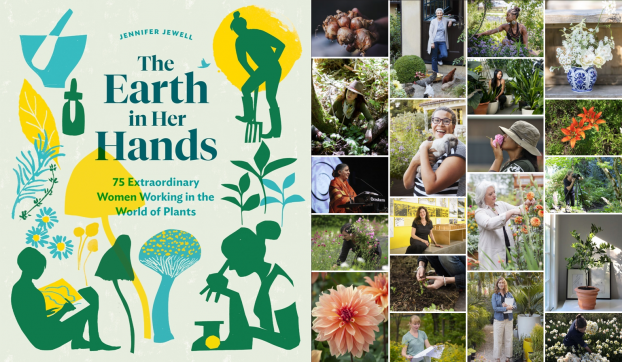
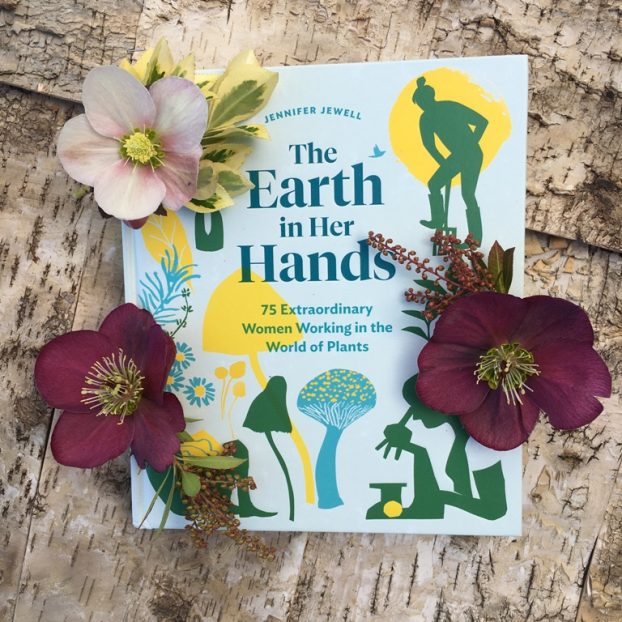
Now, she is also an author and is on tour to promote her book, The Earth in Her Hands, which has the subtitle: 75 Extraordinary Women Working in the World of Plants.
This past week, Jennifer was in Seattle to speak at the Northwest Flower & Garden Festival and, among other appearances, she led a panel discussion that we recorded for today’s episode.
Hot off the Press: Jennifer Jewell’s new book, “The Earth in Her Hands”
In writing The Earth in Her Hands, Jennifer
learned how the women profiled creatively navigated the challenging ideal of
work-life balance. The main lesson? Balance is not a destination but an ongoing
and highly dynamic process.
NWFGF Panel, from left: Lorene Edwards Forkner, Christin Geall, Jennifer Jewell and Debra Prinzing
In the panel, of which I was a part, Jennifer focused our
conversation on many common challenges, coping mechanisms, and solutions that
follow women through their careers in the plant world.
Along with me, the panel included two other past guests of this podcast, so the voices and personalities may be familiar to you. You’ll also hear designer and author Christin Geall, of Cultivated (who I invited on the podcast just a few weeks ago), andLorene Edwards Forkner, author, artist, and Seattle Times garden columnist, and creator of the #seeingcolorinthegardenproject.
These women graciously agreed to this recording and I’ll
just jump right in and let you listen as if you were in the Northwest Flower
& Garden Festival audience last week.
Jennifer Jewell, creator and host of “Cultivating Place: Conversations on the Natural World and the Human Impulse to Garden”
Jennifer Jewellis host of the national award-winning, weekly public radio program and podcast, Cultivating Place: Conversations on Natural History & the Human Impulse to Garden, Jennifer Jewell is a gardener, garden writer, and gardening educator and advocate.
Particularly interested in the intersections between gardens, the native plant environments around them, and human culture, she is the daughter of garden and floral designing mother and a wildlife biologist father. Jennifer has been writing about gardening professionally since 1998, and her work has appeared in Gardens Illustrated, House & Garden, Natural Home, Old House Journal, Colorado Homes & Lifestyles, and Pacific Horticulture. She worked as Native Plant Garden Curator for Gateway Science Museum on the campus of California State University, Chico, and lives and gardens in Butte County, California.
Christin Geall of Cultivated by Christin, designing with a no-foam method
Christin Geall lives on Vancouver Island, along the western edge of Canada. She is a gardener, designer, writer and teacher who grows flowers and shares her designs through Cultivated by Christin, a creative studio launched in 2015.
Christin’s eclectic background includes pursuits that are equal parts physical and intellectual. She apprenticed on a Martha’s Vineyard herb farm, interned at the Royal Botanic Gardens, Kew, and homesteaded on a remote island in British Columbia. Academic studies in ethnobotany, environmental science and a creative writing MFA led to editorships, university-level teaching and a regular gardening column for local newspapers.
Today, Christin’s artistic focus centers around her urban flower farm-design studio in USDA Zone 8, the tiny hub of a multifaceted floral business.
Lorene owned a popular and beloved boutique specialty nursery in Seattle for more than a decade, called Fremont Gardens; she has served on the boards of a number of horticultural organizations, has edited a horticulture journal and is the designer of two gold medal display gardens at the Northwest Flower and Garden Festival.
Most recently, Lorene’s creative life can be found on Instagram, where @gardenercook she shares a series called “Seeing Color in the Garden.” She started this project on April 3, 2018 as part of #the100dayproject as #100DaysofSeeingColorintheGarden. She continued her series with #Another100 DaysofSeeingColorintheGarden.
Thank you so much for
joining today’s episode featuring Jennifer Jewell and two women, who along with
me are featured in The Earth in Her Hands,
Christin Geall and Lorene Edwards-Forkner.
As a special bonus, we’re giving away a copy of The Earth in Her Hands, courtesy of Timber Press, Jennifer’s publisher.
To enter, please leave a comment below about an Extraordinary Woman who influenced your personal relationship with plants. We’ll draw one recipient from among the posted comments on Sunday, March 8th and announce the winner in our March 11th episode. Please note: this giveaway is open to U.S. and Canadian entrants.
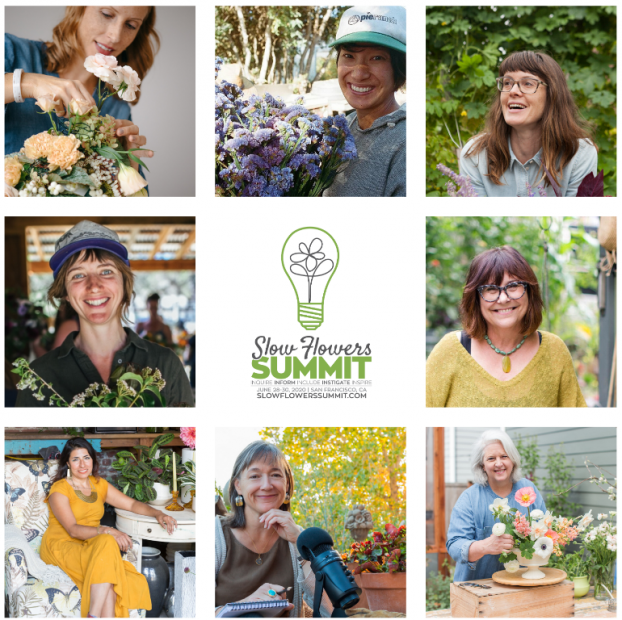
Clockwise from top, left: Susan Mcleary, Kellee Matsushita-Tseng, Molly Culver, Lorene Edwards Forkner, Debra Prinzing, Jennifer Jewell, Pilar Zuniga and Emily Saeger
If you liked the subject of this episode, you’re invited to dig deeper with two of the panelists because they are coming to the Slow Flowers Summit in the SF Bay Area at Filoli- the historic garden and home that is hosting us on June 28-29th. Jennifer Jewell will be our Slow Flowers Summit capstone speaker – and she will speak more expansively on women’s role in shaping our plant world and beyond, as well as sign copies of her new book. Lorene Edwards Forkner will also be one of our Slow Flowers Summit presenters and I’m so excited for you to experience seeing color in the garden through her eyes as you develop your own sensibility and observational skills, learning from color in the garden — from the landscape to the centerpiece.
It will be a special experience and I can’t wait for you to join us!
The Slow Flowers Podcast has been downloaded more than 583,000 times by listeners like you. Thank you for listening, commenting and sharing – it means so much.
As our movement gains more supporters and more passionate participants who believe in the importance of the American cut flower industry, the momentum is contagious. I know you feel it, too. I value your support and invite you to show your thanks and with a donation to support my ongoing advocacy, education and outreach activities. You can find the donate button in the column to the right.
THANK YOU TO OUR SPONSORS
Florists’ Review magazine. I’m delighted to serve as Contributing Editor for Slow Flowers Journal, found in the pages of Florists’ Review. It’s the leading trade magazine in the floral industry and the only independent periodical for the retail, wholesale and supplier market. Take advantage of the special subscription offer for members of the Slow Flowers Community.
Longfield Gardens provides home gardeners with high quality flower bulbs and perennials. Their online store offers plants for every region and every season, from tulips and daffodils to dahlias, caladiums and amaryllis. Check out the full catalog at Longfield Gardens at longfield-gardens.com.
Mayesh Wholesale Florist. Family-owned since 1978, Mayesh is the premier wedding and event supplier in the U.S. and we’re thrilled to partner with Mayesh to promote local and domestic flowers, which they source from farms large and small around the U.S. Learn more at mayesh.com.
Association of Specialty Cut Flower Growers. Formed in 1988, ASCFG was created to educate, unite, and support commercial cut flower growers. It mission is to help growers produce high-quality floral material, and to foster and promote the local availability of that product. Learn more at ascfg.org.
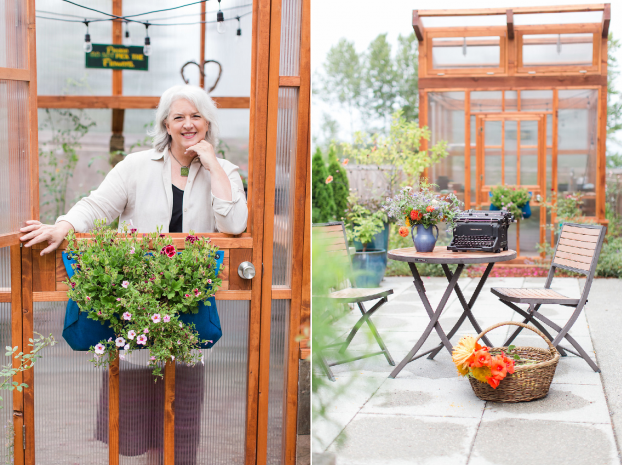
I am in love with my greenhouse, designed and built sustainably by Oregon-based NW Green Panels (c) Missy Palacol Photography
The content and
opinions expressed here are either mine alone or those of my guests alone,
independent of any podcast sponsor or other person, company or organization.
The Slow Flowers Podcast is engineered and edited by Andrew Brenlan. Learn more about his work at soundbodymovement.com.
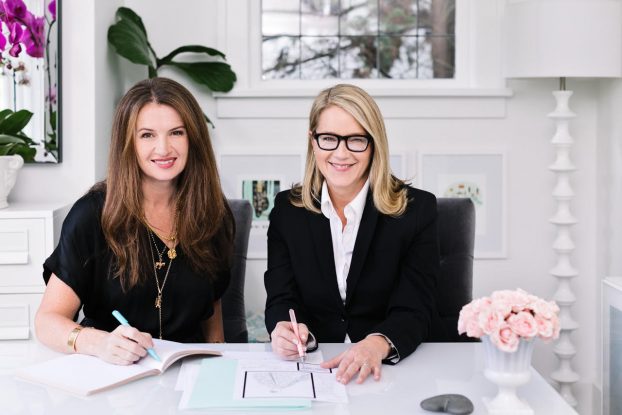
Karen Marshall and Tina Barkley of Fleurs de Villes
In Seattle, we have a rite of springtime called the Northwest Flower & Garden Festival, which always takes place in February when everyone craves the fragrance of flowers (not to mention the scent of potting soil), and the unfurling of foliage, fronds and petals as seen in the excellent garden displays that cover the floor of the Washington State Convention Center.
I’ve been involved in one way or another with this amazing experience for more than two decades. In fact, in 1989 when it was launched by founder Duane Kelly, I covered the story for the local business newspaper where I was a staff reporter. I recall then thinking that I so wanted to join Duane’s world. For years, I covered the Flower and Garden show as a journalist and editor; then, when I made the leap to home and garden writing, I actually spoke at the show in 2002, beginning a recurring gig every year since.
In the past few years, though, instead of speaking, I’ve produced and hosted the Flower Stage at the NWFGF. This role has allowed me to invite Slow Flowers members to participate and engage flower show audiences in the conversation about floral design, local and seasonal botanicals, and more.
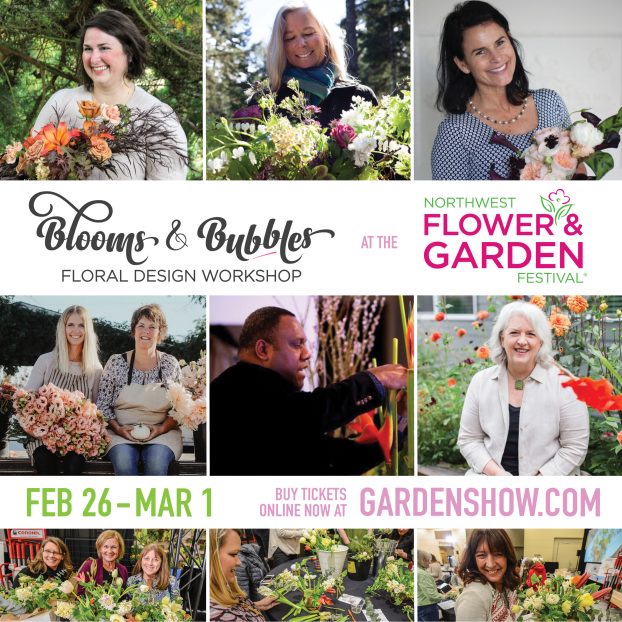
Blooms & Bubbles instructors will appear at the Northwest Flowr & Garden Festival’s DIY Floral Stage
This year, we’re again producing Blooms & Bubbles, a daily DIY workshop series with American-grown and locally-grown “blooms” and a glass of champagne aka “bubbles.” Five Slow Flowers members are teaching and I want to give them a shout-out right now so you can follow along on social as we post workshop images of their classes and students.
They include Thomasi Boselawa, CFD, Tiare Floral DesignStudio; Erin Shackelford, Camas Designs; Maura Whalen, Casablanca Floral; Carolyn Kulb, Folk Art Flowers; and Teresa Engbretson and Katie Elliott of My Garden Overfloweth. Tickets are going fast but you might be able to snag a seat to join us! And PS, even if you aren’t able to sign up for the DIY workshop each day at 2 p.m., there is public seating and you’re invited to watch along! The dates: February 26-March 1.
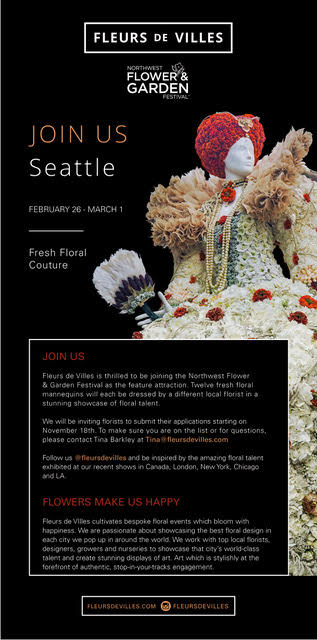
Because I’ve been able to work closely with the management at Marketplace Events, the current owners of the Northwest Flower & Garden Festival, I learned last fall that FLOWERS were taking center stage at the 2020 show. Operations manager Courtney Goetz and I met for lunch and she pulled out a few images to share the secret with me. It’s no secret anymore — and today’s guests will tell you all about the phenomenom called Fleurs de Villes. That’s Fleurs with an “S” and Villes with an “S” – as in “Flowers of the Cities.”
As soon as Courtney showed me photos of flower-clad female mannequins, I knew I had seen the images on my Instagram feed. I soon learned from Courtney that this woman-owned company was based just a few hours to the north of us – in Vancouver, B.C., and that the Northwest Flower & Garden Festival had invited Karen Marshall and Tina Barkley to bring Fleurs de Villes here to Seattle.
I’m so exited to bring you today’s
conversation with two event and marketing experts. Karen and Tina are elevating
flowers in a way that feels fresh, fashion-forward, and inventive.
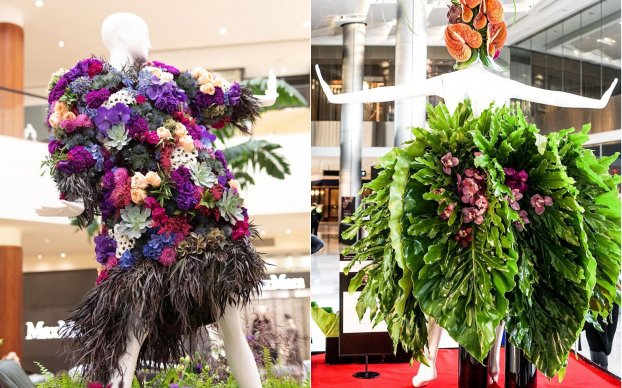
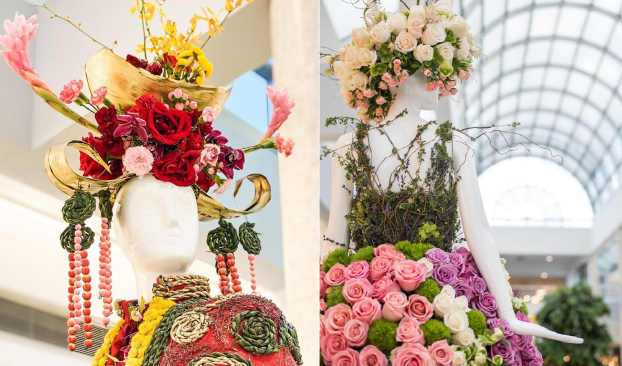
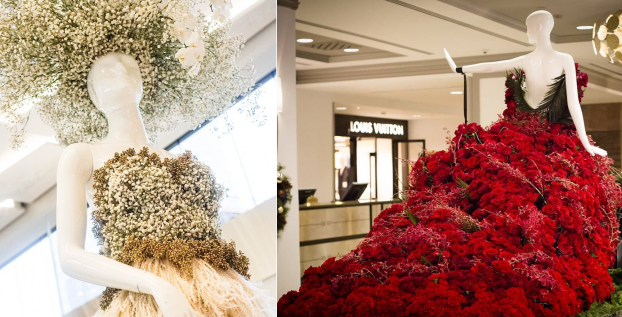
Much like the response people have when they see the photo shoots of real models wearing botanical couture for our American Flowers Week campaigns that Slow Flowers began commissioning in 2016, the botanical couture on Fleurs de Villes’ three-dimensional mannequins takes floral fashion to a new level. That level is different in one key way from what I’ve been doing with American Flowers Week. And it is a feat to pull off, I can tell you. That’s because Tina and Karen are gathering more than a dozen mannequins, each designed and created by an area florist, and each on display for the full run of the Northwest Flower & Garden Festival. I am in awe of the theatrical levels achieved by Fleurs de Villes.
I want to jump right into this
conversation, but first, a bit more about Fleurs de Villes and its founders:
FLEURS DE VILLES combines the love of flowers, local design talent, and bespoke, utterly unique displays, for experiential events like none other. The name speaks to that – Fleurs de Villes – flowers of the cities. Connecting with each city we launch in, we work with top local florists, designers, growers and nurseries, to showcase that city’s world-class talent and create stunning displays of art. Fleurs de Villes not only showcases artful flower displays, we create engagement – with audiences viewing our events, and with the partners who support us, from leading sponsor brands to local and national media, as well as community-based groups. We believe in the power of partnerships and the amplification of messaging that comes when audiences have an experience of the senses. Our team of highly professional individuals is dedicated to ensuring every touch-point is on brand to deliver an event experience people will be talking about – and sharing – for a long time to come.
Floral mannequins from past Fleurs de Villes events
TINA BARKLEY is one of Vancouver’s best known lifestyle experts regularly working with Chatelaine Magazine, Today’s Parent and appearing on TV cooking, styling, decorating. Tina has also been a serial entrepreneur for over 25 years, researching, structuring and building businesses. Creating a brand and building a solid product, strategic partnerships, operational structure, marketing and sales are all areas Tina thrives in. As an effective event builder and planner, Tina has a ‘knack’ for making it happen, and empowering everyone around her.
KAREN MARSHALL has a long term international career in publishing and the digital space. She is a strategic thinker with a laser focus on partnership cultivation. With a belief that no brand is an island she has put together countless programs bringing key organizations and media together to create outstanding promotions. Working for some of the largest media brands in the world and in Canada and within the luxury space with numerous consumer brands across a broad spectrum, her focus is on quality engagement and experiential offerings for all partners.
Thanks so much for joining me today. Find and follow Fleurs de Villes at these links below:
You can find details about the Seattle Fleurs de Villes display — February 26-March 1st at the Northwest Flower & Garden Festival
Future schedule to see Fleurs de Villes around North America and beyond.
As promised, here are the local florists and designers participating as Fleurs de Villes artists. Each will create a floral garment to adorn the lifesize mannequin. It’s no surprise, but a number of them are Slow Flowers members!
First of all, I am thrilled that Melissa Feveyear of Terra Bella Flowers & Mercantile is designing the Slow Flowers-sponsored mannequin featuring all local and domestic botanicals. We are so grateful for Melissa’s longtime membership and support and I can’t wait to see what she creates!
Of course, as anyone who is committed to sourcing domestic and local flowers in the Pacific Northwest in February, which faces a dormant growing season that many of you also experience, I want to just acknowledge what a feat it will be to bring a Slow Flowers sentiment and values to an undertaking like a botanical garment made entirely from fresh and natural materials. I’ve heard anecdotally from several Slow Flowers members as they’ve planned their creations and I know they are committed to sourcing a good percentage of their looks with domestic crops. Let’s cheer them on and see what they create. Including Melissa of Terra Bella, nine Slow Flowers members are participating as Fleurs de Villes designers — more than half of all the dresses you’ll see! They include:
Other Fleurs de Villes florists include: a Natural Design; Fena Flowers; Seattle Floral Design; Zupan’s Markets; Leah Erickson; Ondine; and you’ll see supporting floral installations by Apotheca Design and Soren Events.
Jennifer Jewell is the author of The Earth in Her Hands, which includes a profile of Lorene Edwards Forkner, Christin Geall and Debra Prinzing, among many others.
Jumping ahead to future events . . . the clock is ticking along as we continue to finalize details for the 4th Annual Slow Flowers Summit – June 26-28, 2020 in San Francisco Bay Area at Filoli.
We only have 50 seats
left so I urge you to follow the links in today’s show notes and reserve your
space with the Slow Flowers tribe! Your Ticket Includes: All-Day Sunday, June 28 + Monday, June
29 with 5 Presentations + 7 Fabulous Speakers, all meals,
refreshments and evening cocktail receptions;
Floral Design Demonstrations; an Interactive Floral Installation; Author Book-Signings; Cool Take-Home Gifts . . . and then, on Tuesday Morning, June 30th, a behind the scenes tour at Farmgirl Flowers HQ where you’ll enjoy a Light Breakfast + Coffee, and meet our good friend Christina Stembel of Farmgirl Flowers.
I can’t wait to see you
there!
(c) Mary Grace Long photography
The Slow Flowers Podcast
has been downloaded more than 578,000 times by listeners
like you. Thank you for listening, commenting and sharing – it means so much.
As our movement gains more supporters and more passionate participants who believe in the importance of the American cut flower industry, the momentum is contagious. I know you feel it, too. I value your support and invite you to show your thanks and with a donation to support my ongoing advocacy, education and outreach activities. You can find the donate button in the column to the right.
Thank you to our Sponsors
Florists’ Review magazine. I’m delighted to serve as Contributing Editor for Slow Flowers Journal, found in the pages of Florists’ Review. Our partnership with Florists’ Review is such a valuable one, providing a forum for beautiful and inspiring editorial content in the #slowflowersjournal section – month after month. Take advantage of the special subscription offer for members of the Slow Flowers Community.
Mayesh Wholesale Florist. Family-owned since 1978, Mayesh is the premier wedding and event supplier in the U.S. and we’re thrilled to partner with Mayesh to promote local and domestic flowers, which they source from farms large and small around the U.S. Learn more at mayesh.com.
FarmersWeb. FarmersWeb software makes it simple for flower farms to streamline working with their buyers. By lessening the administrative load and increasing efficiency, FarmersWeb helps your farm save time, reduce errors, and work with more buyers overall. Learn more at www.farmersweb.com.
Our next sponsor thanks goes to Association of Specialty Cut Flower Growers. Formed in 1988, ASCFG was created to educate, unite, and support commercial cut flower growers. It mission is to help growers produce high-quality floral material, and to foster and promote the local availability of that product. Learn more at ascfg.org.
The content and opinions expressed here are either mine alone or those of my guests alone, independent of any podcast sponsor or other person, company or organization.
The Slow Flowers Podcast is engineered and edited by Andrew Brenlan. Learn more about his work at soundbodymovement.com
Music Credits:
Le Marais; Symphony 40 in G Minor; Via Verre; Gaena; Glass Beads by Blue Dot Sessions http://www.sessions.blue
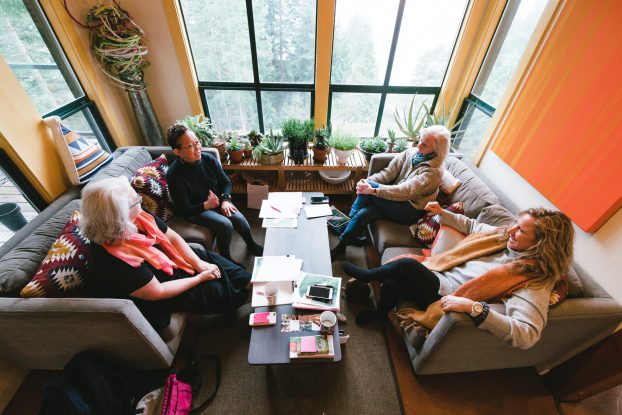
A late December 2019 planning session for Trend Summit — held at Hitomi Gilliam’s home. Clockwise from top left: Hitomi Gilliam, Francoise Weeks, Rebecca Raymond and Debra Prinzing. (c) Colin Gilliam
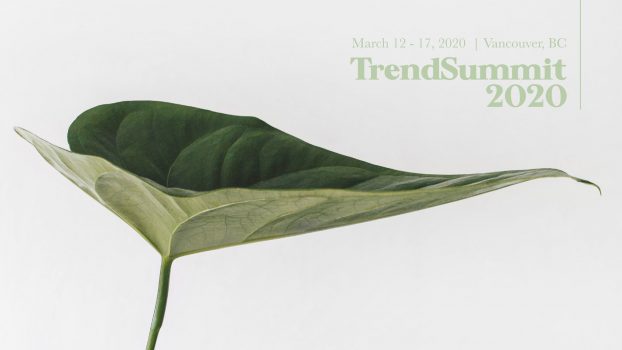
Hitomi Gilliam, AIFD, is a Vancouver, B.C.-based floral design educator and innovator, as well as a fellow contributor to Florists’ Review. In 2011, she launched a collaborative, inclusive conference called Trend Summit, designed as an immersive trend discussion led by a team of influencers, covering a variety of topics including wedding flower trends.
Trend Summit has taken place every two or three years since, mostly in Vancouver (with one year being held in Dallas). The Summit has grown and evolved to the point where it’s almost a full week with numerous floral design workshops and demonstrations — all sorts of ways to draw you in, engage you and connect you. This year it takes place March 12-17, 2020, at United Floral, where the famed Vancouver Flower Auction is based outside Vancouver.
Listen to Hitomi Gilliam as she discusses Trend Summit and how trends take shape.
Hitomi is one of those rare individuals who shares the spotlight and platform with her peers, her students, and her contemporaries. In 2018, she invited me to present the Slow Flowers Floral Insights and Industry Forecast for 2019 during the Trend Summit Symposium a one-day session open to the larger floral community in B.C. and beyond. It was such a great experience and truly an honor to be given a place at the podium in what some might consider the mainstream floral community. I was so touched that Hitomi shined a light on my work with Slow Flowers, adding sustainability, floral sourcing and eco practices to the conversation!
For 2020, there are so many events and activities planned. To kick it off on March 12th and 13th, the Trend Roundtables focus on a variety of themes important to the future of floristry. This is an opportunity to be introduced to some of the newest product from participating vendors and growers, who will also be in the discussion. In addition to Hitomi, I will join Gregor Lersch, Holly Chapple, Susan McLeary, Françoise Weeks, Rebecca Raymondand Colin Gilliam for this riveting event.
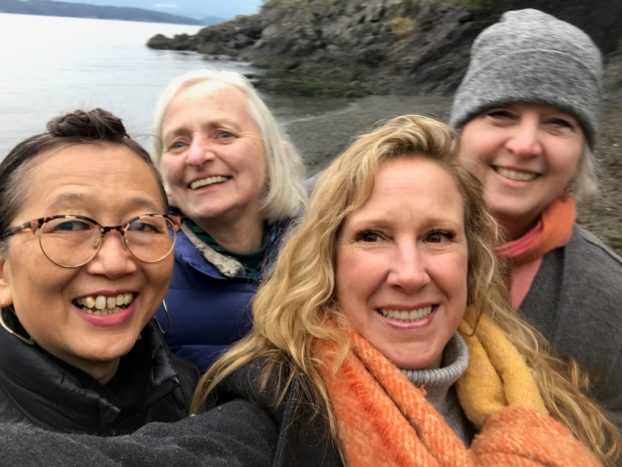
We took in the inspiring natural beauty on a Bowen Island hike one afternoon, too!!
With Hitomi, Colin, Rebecca and
Francois in early December, we spent two full days brainstorming the roundtable
format. We sat in the cozy living room of Hitomi’s delightful home on Bowen
Island, which is located a short ferry ride across Horseshoe Bay north of
Vancouver. With a view of water, mountains, trees and nature, it was a working
session that doubled as an unforgettable retreat.
We cooked up
some of the key topics that will seed the conversations at the Conference:
botanicals, hardgoods and accessories, lifestyle shifts, wedding styles, as
well as emerging floral design styles.
I think you’ll love hearing our dialogue and perhaps you will be
tempted to join us in March.
You might want to attend Thursday Night, March 12th, when Leatrice Eiseman of the Pantone Color Institute will present her insights on color, or on Sunday when all these fabulous design innovators will present during the Symposium.
Quickly, here’s a bit more about the guests you’ll hear in my
conversation today:
Teacher, mentor, floral industry leader Hitomi Gilliam (c) Colin Gilliam
Hitomi Gilliam AIFD is a Japanese-Canadian floral artist, keynote lecturer, demonstrator, educator and a consultant in all aspects of the Art and Business of Floral Design. She is the Creative Director for DESIGN358. She has guest-designed extensively throughout North America, England, Japan, Mexico, Taiwan, Bermuda, Singapore, Hong Kong, Australia, New Zealand, Colombia, Belgium, Korea and India.
She
owned and operated Satsuki’s Florist in Mission, British Columbia for 28 years.
She currently works with her son, Colin Gilliam in an Event & Education
business, DESIGN358 which was established 10 years ago.
Hitomi
has lectured at major art museums and floral shows around North America and
beyond, and she is the founding organizer of the Annual ‘Survival of the
Creative Minds’ Conference in Taos, New Mexico.
Françoise Weeks, born in Belgium, has infused her work with a quintessential European reverence for flowers and nature. Combined with creativity and mechanical ingenuity, she has crystalized her singular style of Textural Woodlands and Botanical Haute Couture pieces, garnering a global following.
Francoise Weeks discusses ‘Plants are Trending’ in the run-up to Trend Summit 2020
Françoise’s
studio is located in Portland, Oregon. Her innovation and love of teaching have
brought her to the Flower School Cohim in China, the Academy of Floral Art in
Exeter, England, studios in Australia and Mexico, workshops at Mayesh and
Florabundance and to the La Jolla and Memphis garden clubs. Her dynamic work
has been published in Nacre, Fusion Flowers, Modern Wedding Flowers, Huffington
Post, Flutter and Millieu.
Her
generosity of knowledge and perspective in use of floral materials, structure
and mechanics, in addition to the business of being a florist, unite to create
rigorous and exciting learning opportunities for her students to explore all
that nature has to offer.
Rebecca Raymond, EMC, floral artist and educator
Rebecca Raymond, EMC, is owner of Rebecca Raymond Floral. She is one of the most respected and sought-after floral designers in the Pacific Northwest.
Rebecca
collaborates closely with each of her clients, gets to know their hopes and
dreams, and then works with color, texture, and architecture to bring their
vision to life. Whether it’s a bridal bouquet or a floral installation, she
sources both seasonal and curated fresh flowers to design beautiful, eclectic
arrangements that reflect the moment and create memories to last a lifetime. As
a member of organizations at the cutting edge of floral design, including
Chapel Designers, she has access to a network of leading designers and ongoing
professional development – and Rebecca is always looking for the latest and
best techniques and design ideas for my clients.
Colin Gilliam
Colin Gilliam, partner with Hitomi Gilliam in Design358 and owner of Colin Gilliam Photo + Design, has been photographing flowers for more than a decade. His work has been published in numerous books, as well as in Florists’ Review and Fleur Creatif Magazine.
I had a chance to discuss my thoughts about Trends during a recent conversation with Hitomi
Clarity in 2020 is knowing where we are at and where we want to go.
Hitomi Gilliam, AIFD, founder of Trend Summit 2020
Hitomi, Francoise and Rebecca have all been guests on the Slow Flowers Podcast. Here are links to those episodes:
Registration continues for Slow Flowers Summit and we’re nearly 50% sold out, which is amazing to me! Please join me on June 28-30th and connect with our fabulous speakers, enjoy the incredibly beautiful venue at Filoli Historic House & Garden, and experience the many features that will immerse you in the people, principles and practices of Slow Flowers.
The Slow Flowers Podcast
has been downloaded more than 568,000 times by listeners
like you. Thank you for listening, commenting and sharing – it means so much.
As our movement gains more supporters and more passionate
participants who believe in the importance of the American cut flower industry,
the momentum is contagious. I know you feel it, too. I value your support and
invite you to show your thanks and with a donation to support my ongoing
advocacy, education and outreach activities. You can find the donate button in the column to the right.
Thank you to our Sponsors
Florists’ Review magazine. I’m delighted to serve as Contributing Editor for Slow Flowers Journal, found in the pages of Florists’ Review. Our partnership with Florists’ Review is such a valuable one, providing a forum for beautiful and inspiring editorial content in the #slowflowersjournal section – month after month. Take advantage of the special subscription offer for members of the Slow Flowers Community.
Association of Specialty Cut Flower Growers. Formed in 1988, ASCFG was created to educate, unite, and support commercial cut flower growers. It mission is to help growers produce high-quality floral material, and to foster and promote the local availability of that product. Learn more at ascfg.org.
Johnny’s Selected Seeds, an employee-owned company that provides our industry the best flower, herb and vegetable seeds — supplied to farms large and small and even backyard cutting gardens like mine. Find the full catalog of flower seeds and bulbs at johnnysseeds.com.
Longfield Gardens, which provides home gardeners with high quality flower bulbs and perennials. Their online store offers plants for every region and every season, from tulips and daffodils to dahlias, caladiums and amaryllis. Check out the full catalog at Longfield Gardens at longfield-gardens.com.
The content and opinions expressed here are either mine alone or those of my guests alone, independent of any podcast sponsor or other person, company or organization.
The Slow Flowers Podcast is engineered and edited by Andrew Brenlan. Learn more about his work at soundbodymovement.com
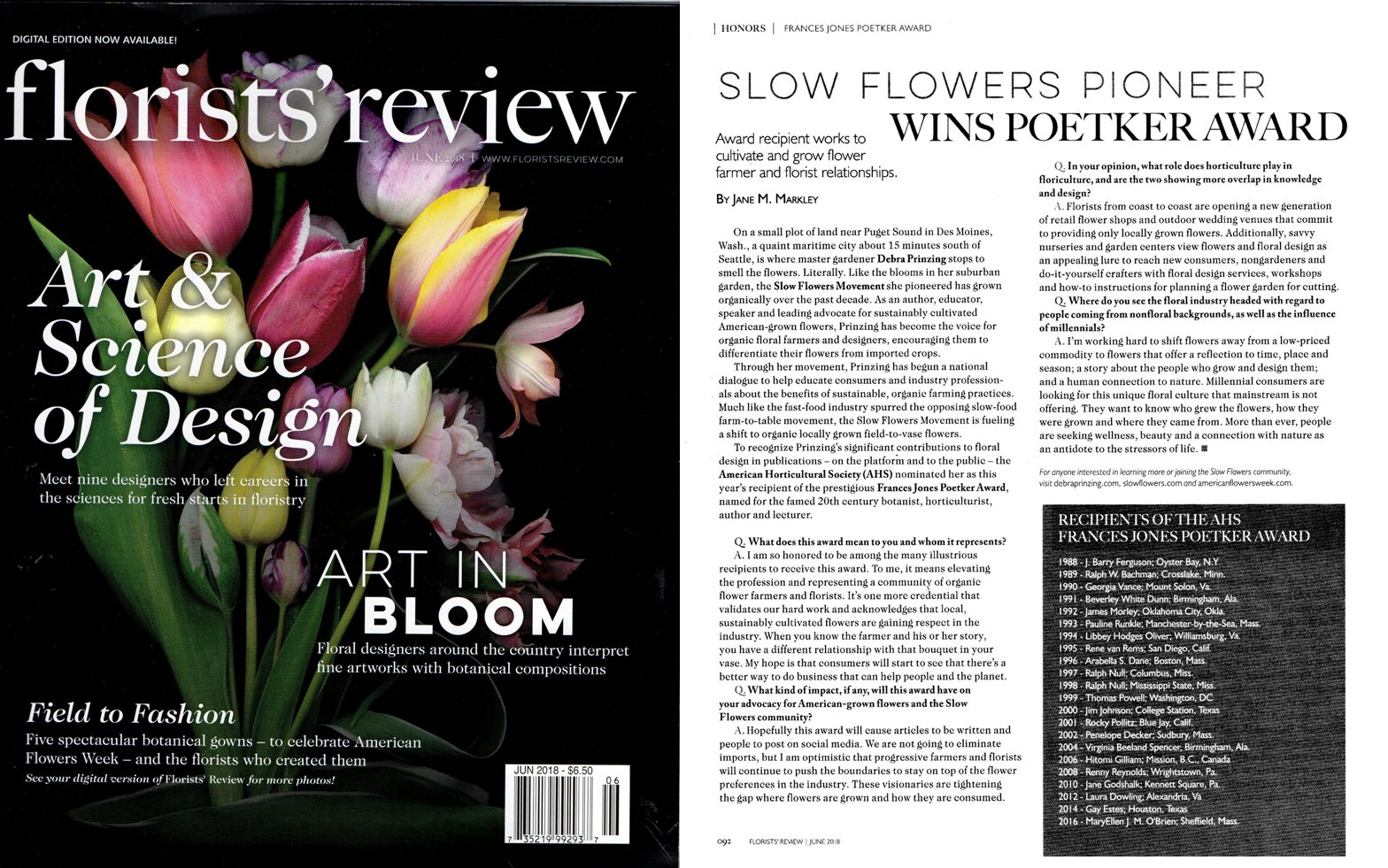
I’m so touched that my friends at Florists’ Review magazine included an article in the upcoming June 2018 issue about the American Horticultural Society recognizing me with its Frances Jones Poetker Award in honor of achievement in the field of floral design.
The award highlights my work advocating for and promoting domestic flowers and recognizes significant contributions to floral design in publications, on the platform, and to the public.
You can read the entire article, “Slow Flowers Pioneer,” written by Jane M. Markley, here.
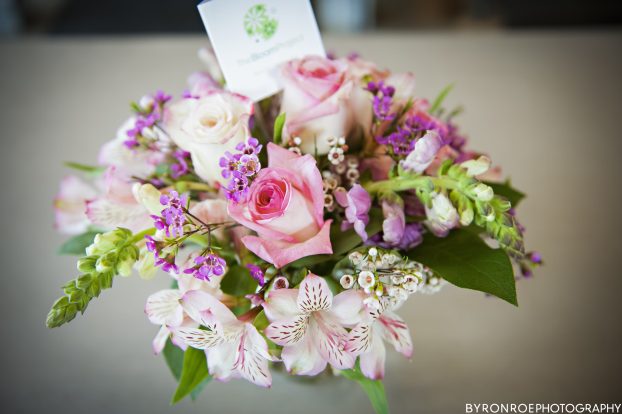
Through flower donations from farms and wholesalers, and through tens of thousands of volunteer hours, The Bloom Project brings flowers into the lives of people in hospice and end-of-life care.
The phrase “flowers feed the soul” is one you often hear, on greeting cards, on hand-painted signs, in all sorts of sentiments.
And in the opinion of today’s guest, flowers not only feed the soul and spirit, they play an important nurturing role in health care. My guest today, Heidi Berkman, is the founder and president of The Bloom Project. Based in Portland, Oregon, The Bloom Project has been giving the gift of fresh floral bouquets to hospice and palliative care patients since 2007.
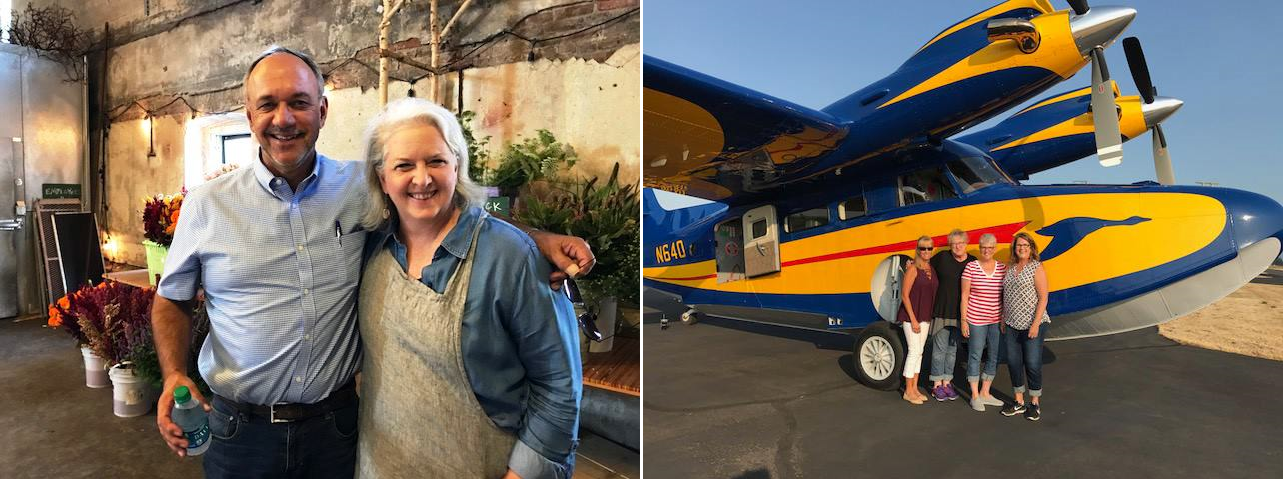
I’m posing with Heidi Berkman (left), who runs The Bloom Project, driven by the mission to harness the healing power of flowers. We gathered earlier this week for a “Seattle Whirlwind” auction package to which Slow Flowers donated a workshop at the Seattle Wholesale Growers Market.
Heidi reached out to me to introduce herself several years ago, and then, through our mutual friend Christina Stembel of Farmgirl Flowers, I really got to spend time with Heidi, both talking about the floral business, but also doing fun things like when all three of us traveled to Detroit last October at Lisa Waud’s invitation to speak at Detroit Flower Week.
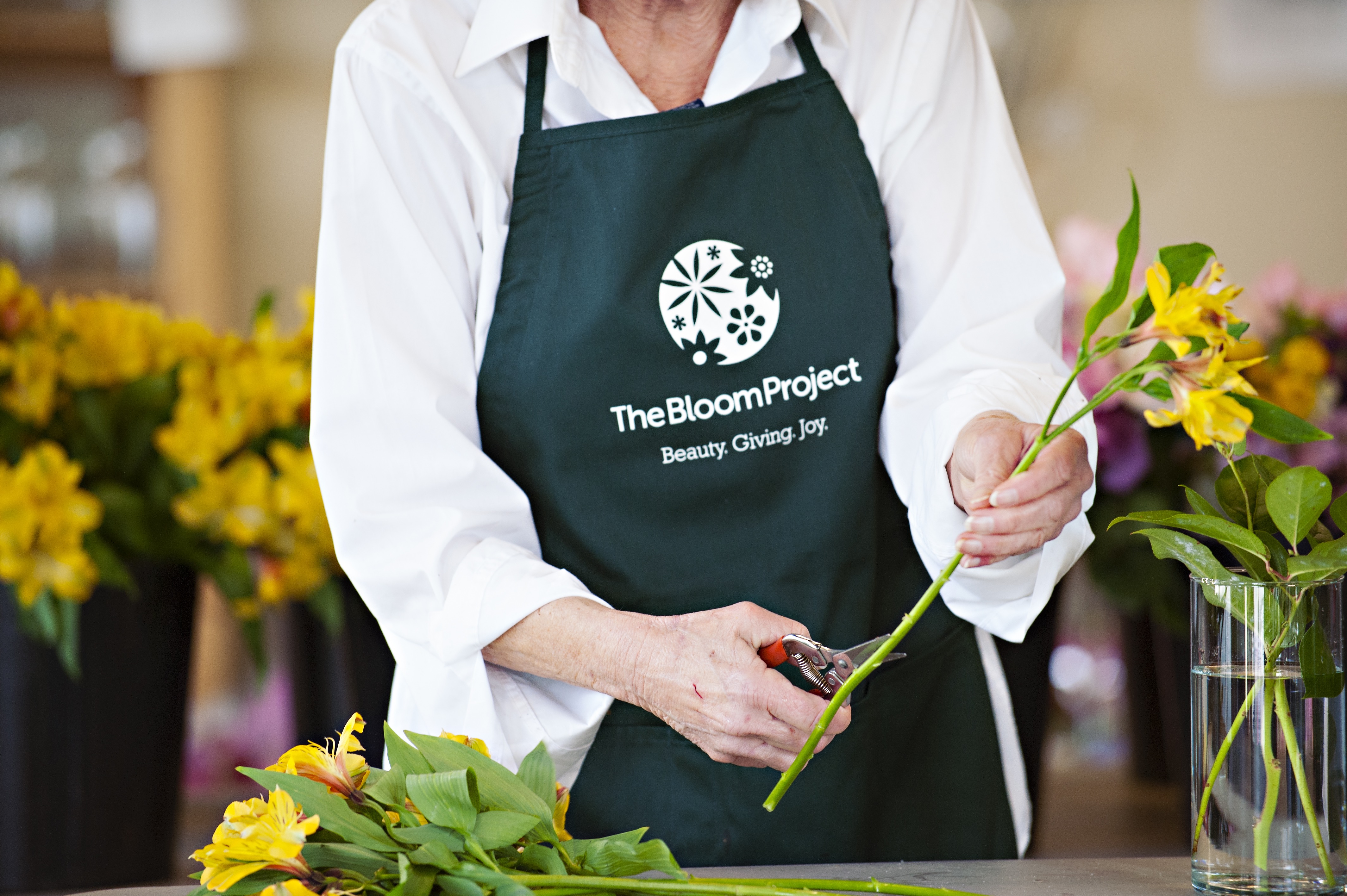
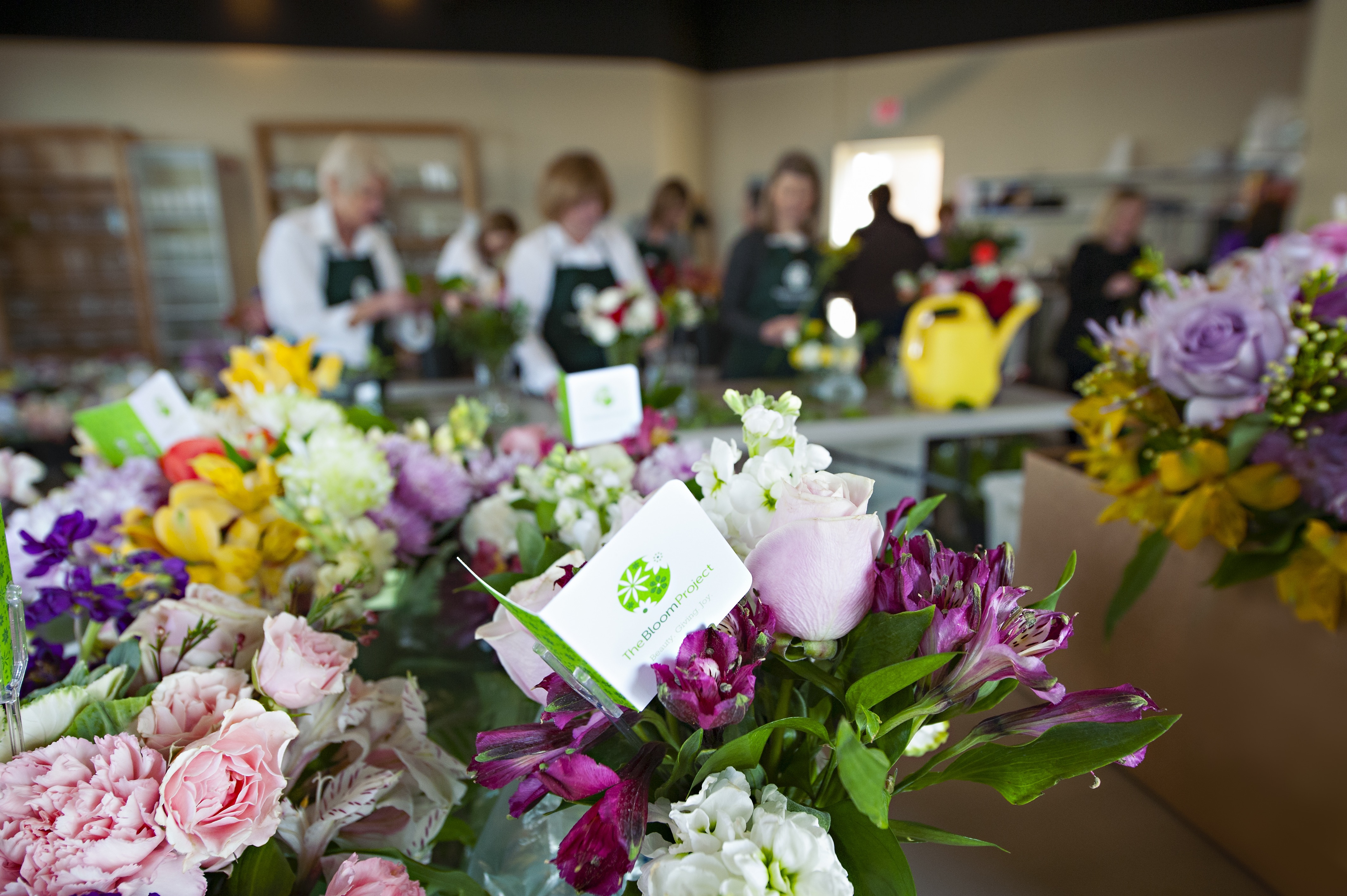
Volunteers make hundreds of bouquets each week for delivery to hospice caregivers. (c) Byron Roe Photography
The first time Heidi and I actually met in person was April of 2016, when I was in Portland to speak at the Portland Garden Club’s annual flower show. Heidi put together a tour and reception for me to learn more about The Bloom Project, and to meet key board members and volunteers, as well as to see the beautiful workshop and studio headquartered at Teufel Holly Farm, just west of Portland. Donated by Larry Teufel, flower farmer and nurseryman, the space is akin to what you’d see at any large production facility, with tall work tables, great light, and plenty of cooler space for the flowers. Pretty impressive to see where The Bloom Project’s volunteers receive and processes donated stems of flowers and foliage, as well as where the gift bouquets are created, packaged and prepared for delivery to the ultimate recipient.
Heidi and I have been talking about when would be an ideal time to feature The Bloom Project on the Slow Flowers Podcast and with our mutual travel schedules, we waited until now. This week, I’ll be hosting a fun event as a Slow Flowers donation to The Bloom Project. At the annual Bouquets of the Heart auction that benefits the organization, I joined Larry Teufel in donating a “Seattle Whirlwind” day-of-flowers package for five guests.
Larry Teufel (left, with me) flew the auction package winners and their guests to Seattle (from Portland), on his beautifully-restored classic aircraft.
This week, Larry, who pilots his own plane, flew the winning bidder and a few of her friends to Seattle . . . I hosted them on a tour of the Seattle Wholesale Growers Market, which gave me a chance to talk about the mission of Slow Flowers and the importance of supporting local, seasonal and sustainable flowers, and the people who grow and design with them.
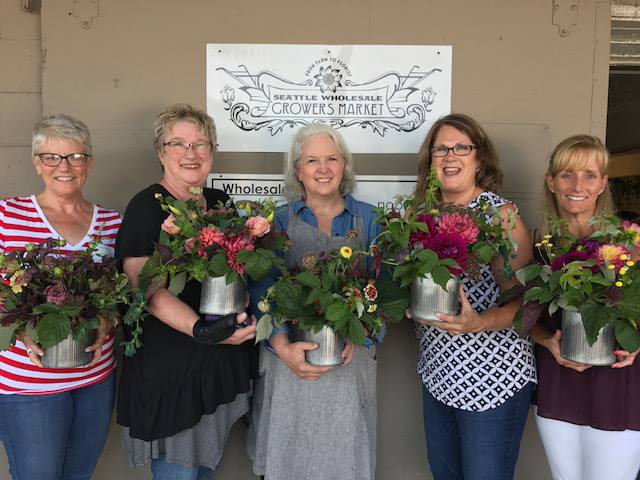
Debbi, Susan, Debra (me), Leianne and Susan — showing off our bouquets in Seattle as part of the auction package benefitting The Bloom Project.
We had a short design session and everyone left holding a bouquet with a story. I think that story — the story of showing compassion through flowers — is what The Bloom Project is all about — and Heidi is a powerful communicator for her cause and mission.
Before we get started, let me tell you a little more about The Bloom Project.
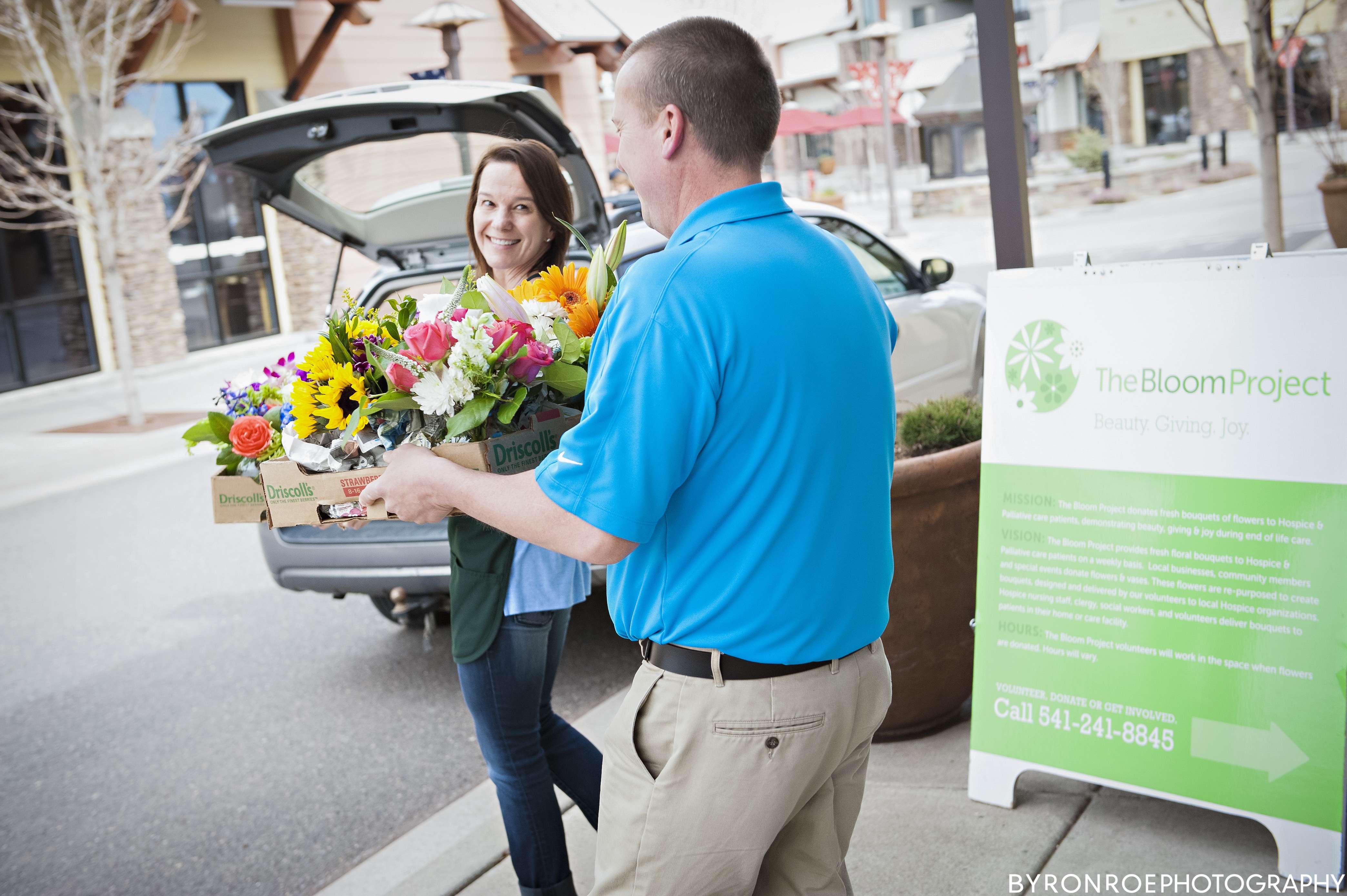
The project started in Heidi’s Central Oregon garage, beginning with a few flowers and a few volunteers who wanted to create something special — bringing beauty and joy to those in end-of-life care. Many, including Heidi, had experienced the loss of a loved one in hospice care, and recognized that they could make use of resources (flowers) that would otherwise be tossed out.
Photos (c) Byron Roe Photography
Over the last decade, The Bloom Project has continued to grow and support hospice and palliative care agencies across the state of Oregon, with the Portland Metro area as its base. Volunteer teams have flourished, supporting the organization’s goal of serving additional patients and families.
Donated workspaces, supplies and equipment, provide a wonderful place for volunteers to come together to create hundreds of beautiful bouquets each week. The Bloom Project relies on a committed group of floral and community partners who support its efforts and mission.
Heidi has twenty-five years of meeting and event planning experience with a strong background in retail marketing and extensive nonprofit experience. Her deep appreciation for the work of hospice comes from the personal experience of watching a loved one being cared for.
She has always enjoyed working with flowers and says she is grateful to be able to create bouquets with donated flowers that can provide encouragement to others instead of being discarded. Heidi’s passion for The Bloom Project has motivated her to share the story and spread the word about the power of flowers.
The Bloom Project’s Bouqets of the Heart event takes place on October 27, 2018, in Portland.
Her vision for the organization is to continue to network people and resources in communities where hospice and palliative care organizations are serving patients and their families during end-of-life care. This simple act of kindness can be given by gathering a team of committed volunteers, sourcing flowers and supplies, establishing a workspace and obtaining the support of the surrounding community to provide in-kind products and services along with financial contributions to support the growth and impact of the organization.
Details on The Bloom Project’sBouquets of the Heartevent, October 27th, in Portland. Maybe I’ll see you there!
Thanks again for joining me today. My take-way from this conversation with Heidi is that we shouldn’t ever discount the impact that flowers have in the lives of our community, team members, customers, and clients. These are more than luxury goods, more than perishable indulgences. A flower contains the expression of life and beauty — and can touch the heart and the senses where words may not be adequate.
The Slow Flowers Podcast has been downloaded more than 225,000 times by listeners like you. Thank you to each one of you for downloading, listening, commenting and sharing. It means so much.
If you value the content you receive each week, I invite you to show your thanks and support the Slow Flowers Podcast with a donation — the button can be found on our home page in the right column. Your contributions will help make it possible to transcribe future episodes of the Podcast.
Thank you to family of sponsors:
Certified American Grown Flowers. The Certified American-Grown program and label provide a guarantee for designers and consumers on the source of their flowers. Take pride in your flowers and buy with confidence, ask for Certified American Grown Flowers. To learn more visit americangrownflowers.org.
Arctic Alaska Peonies, a cooperative of 50 family farms in the heart of Alaska providing high quality, American Grown peony flowers during the months of July and August. Visit them today at arcticalaskapeonies.com
Seattle Wholesale Growers Market, a farmer-owned cooperative committed to providing the very best the Pacific Northwest has to offer in cut flowers, foliage and plants. The Growers Market’s mission is to foster a vibrant marketplace that sustains local flower farms and provides top-quality products and service to the local floral industry. Find them at seattlewholesalegrowersmarket.com
Longfield Gardens provides home gardeners with high quality flower bulbs and perennials. Their online store offers plants for every region and every season, from tulips and daffodils to dahlias, caladiums and amaryllis. Visit them at lfgardens.com.
Syndicate Sales, an American manufacturer of vases and accessories for the professional florist. Look for the American Flag Icon to find Syndicate’s USA-made products and join the Syndicate Stars loyalty program at syndicatesales.com.
Johnny’s Selected Seeds, an employee-owned company that provides our industry the best flower, herb and vegetable seeds — supplied to farms large and small and even backyard cutting gardens like mine. Check them out at johnnysseeds.com.
Association of Specialty Cut Flower Growers. Formed in 1988, ASCFG was created to educate, unite, and support commercial cut flower growers. It mission is to help growers produce high-quality floral material, and to foster and promote the local availability of that product. Learn more at ascfg.org
The content and opinions expressed here are either mine alone or those of my guests alone, independent of any podcast sponsor or other person, company or organization.
The Slow Flowers Podcast is engineered and edited by Andrew Brenlan. Learn more about his work at KineticTreeFitness.com.
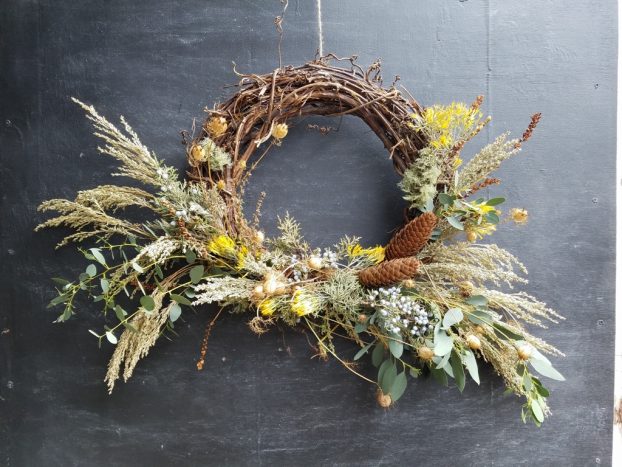
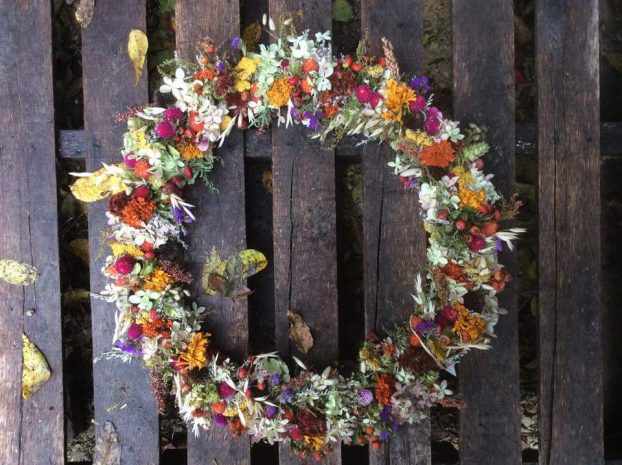
Use a grapevine wreath base to simplify DIY decor. Beth Syphers of Crowley House Flower Farm in Rickreall, OR, taught her student Kaylean Martin how to create a lush harvest wreath with foraged greens and more.
Rediscover dried flowers as they extend the harvest when winter arrives early, such as in Mt. Horeb, WI, where the Larsen family operates Sunborn Flower Farm and Florist.
Put a twist on the ubiquitous carved pumpkin, cornucopia filled with gourds, or poinsettia plants wrapped in plastic and take inspiration from America’s flower farms, fields and meadows when you design for harvest, home and holiday, say members of Slowflowers.com.
NOTE: This is the first of six Editorial Packages that Slowflowers.com will produce in the 2016-2017 season.
Instead of predictable designs or palettes of the past, creative flower farmers and florists suggest fresh and unique seasonal options such as adding hot peppers or ornamental kale to autumn centerpieces or “planting” pumpkins with succulents for harvest tables.
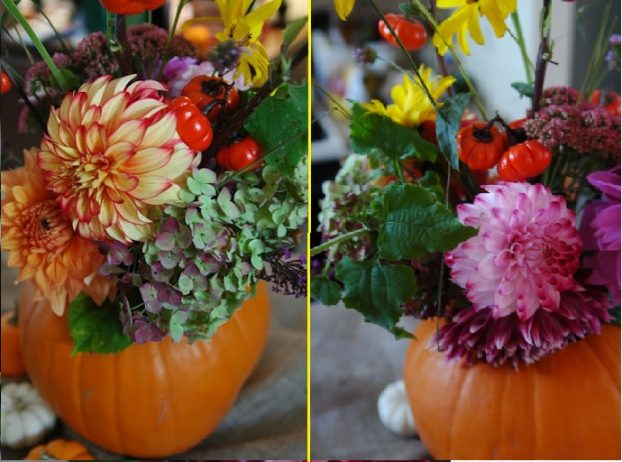
Use everyday pumpkins as vases for seasonal flowers. Deb Bosworth of Dandelion House Flower Farm in Plymouth, MA.
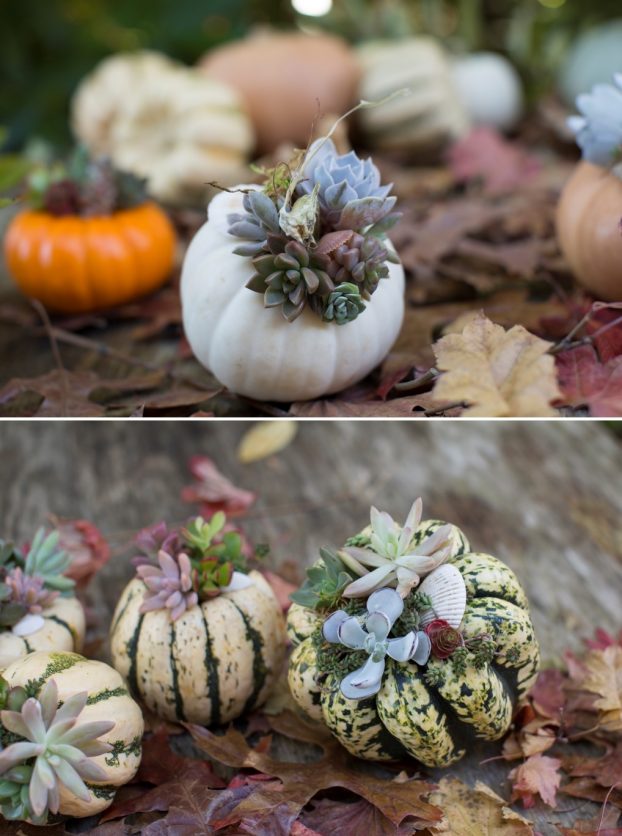
Embellish novelty pumpkins and ornamental gourds with succulents and seashells. Kathleen Barber of Erika’s Fresh Flowers in Warrenton, OR, suggests beginning with an unusually colored or textured pumpkin.
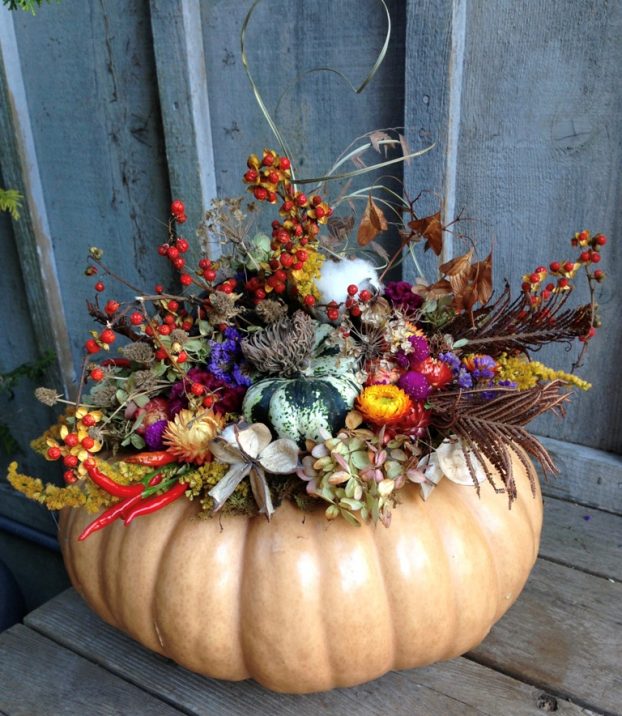
Decorate edible pumpkins with dried flowers. Jane Henderson of Commonwealth Farms in Concord, N.C., decorates pumpkins with foraged and dried flowers, feathers, seed heads and pods, creating a long-lasting harvest arrangement that is far easier than carving.
Come December, Slowflowers.com designers say “Season’s Greetings” is best communicated with updated florals, including snowy white palettes or traditional red-and-green bouquets containing elegant lilies.
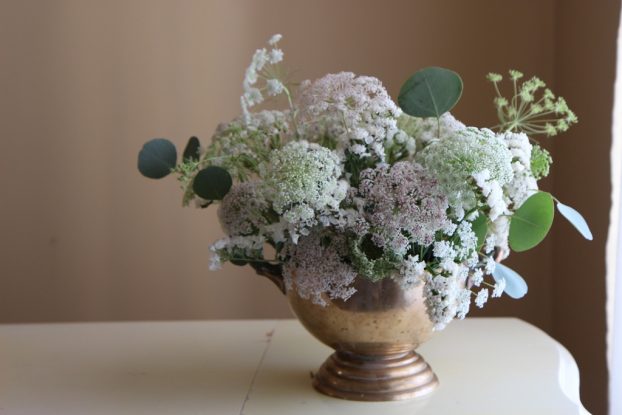
Create a snowy scene with whites and silvery hues. Betany Coffland of Chloris Floral in Sonoma County, California, designed a winter-themed arrangement using white and pink Queen Anne’s lace, white statice and silver dollar eucalyptus foliage.
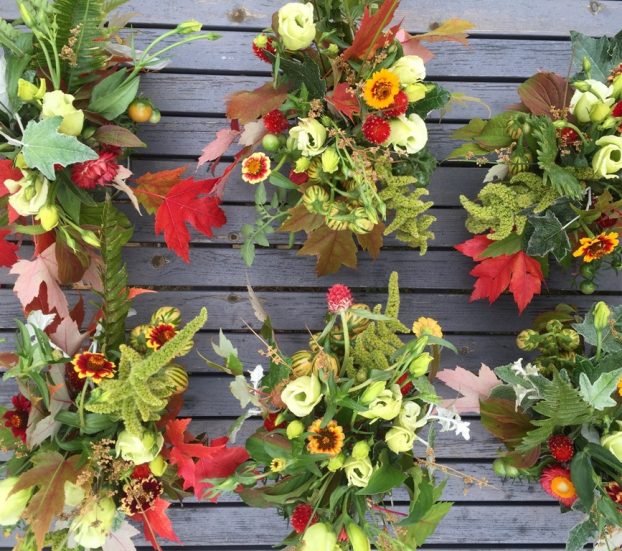
Add scarlet leaves and ornamental grains to convey autumn’s rich palette. Hannah Morgan of Fortunate Orchard in Seattle, WA, tucked vibrant foliage from local maple, oak and liquidambar trees into seasonal centerpieces.
Transform the holiday table, front porch or fireplace mantel with local and seasonal flowers. Nothing is fresher or more long-lasting than just-picked botanicals.The best harvest, home and holiday florals begin with the source, says Debra Prinzing, founder and creative director of Slowflowers.com, which promotes American grown flowers.
There is still space to join me at the Slow Flowers Creative Workshop in Sonoma County!
We’re finalizing all the details for a fantastic 2-day session at Russian River Flower School in Healdsburg, California — coming up on Monday, October 17th and Tuesday, October 18th!
If you’ve been thinking about investing in your creativity and brand-building, now is the time to grab one of the few remaining spaces at this special edition of the Slow Flowers Creative Workshop. Have a listen to my recent interview with Dundee Butcher, my co-host and fellow teacher. We cover all the details of the curriculum, bonus activities and focus on YOU!
This past weekend provided a hugely rewarding experience for my friend Teresa Sabankaya of Bonny Doon Garden Co.and me. We teamed up to teach the first-ever Slow Flowers Creative Workshop at Castle House & Garden, her private, “secret garden” setting in Santa Cruz.
The idea behind our curriculum was twofold:
I wanted to share “Floral Storytelling” techniques and Teresa wanted to share her approach to “Garden-Inspired Design.”
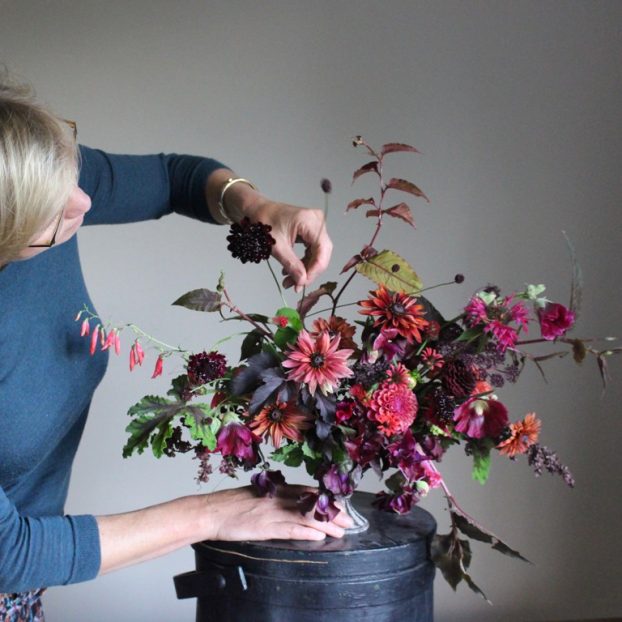
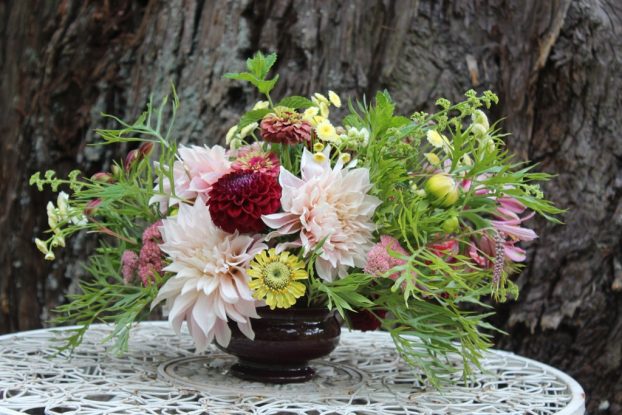
My arrangement, in Syndicate Sales’ black cherry pedestal bowl. The palette inspired me to pick dahlias, grevillea blooms, zinnias and alstroemeria in the same color family.
Floral Storytelling and Garden-Inspired Floral Design concepts are central to the idea of creating a personal brand for flower farmers, floral designers and farmer-florists who support Slow Flowers, local sourcing and sustainable design practices — and who wish to differentiate themselves in a crowded and competitive marketplace.
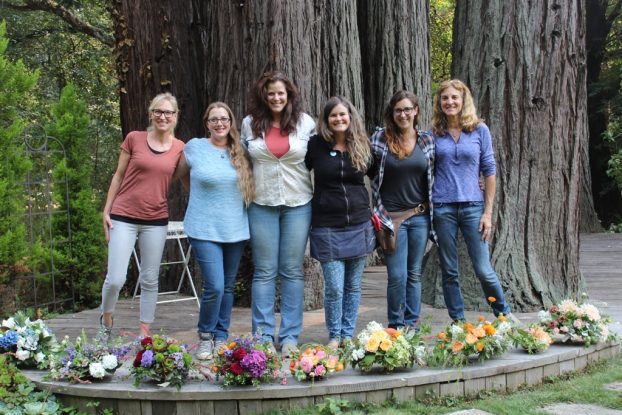
Teresa (center) with several of our students. The group is standing under the massive redwood trees in Teresa’s garden, a perfect source of inspiration. From left: Dyana Zweng, Terri Schuett, Teresa, Daniele Allion Strawn, Laura Vollset and Liz Marcellus. Missing: Michelle Bull, Kellee Matsushita and Dawn Mayer.
SEATTLE AUTHOR AND JOURNALIST WINS GROWERS CHOICE AWARD
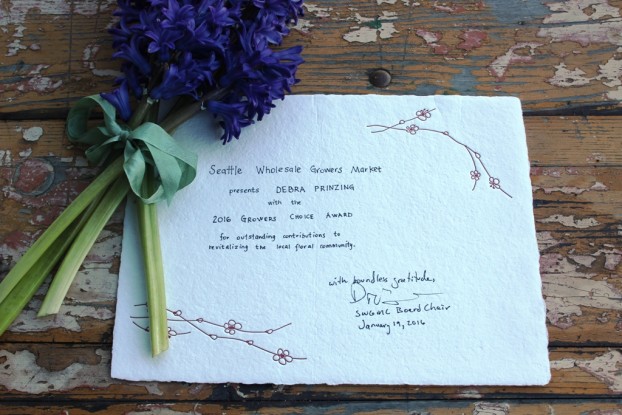
(Seattle, Washington) At a recent dinner attended by florists, flower farmers and industry professionals, the Seattle Wholesale Grower’s Market awarded Debra Prinzing – author of Slow Flowers and The 50 Mile Bouquet – its 2016 Grower’s Choice Award for outstanding contributions to revitalize the local floral community.
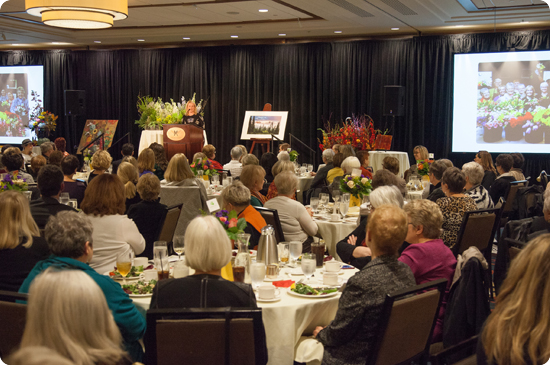
While presenting the award, SWGMC Board Chair Diane Szukovathy cited Prinzing’s three years of service on the co-op’s volunteer board of directors and her continuous efforts to publicize the local floral industry through over 120 Slow Flowers podcasts – as well as numerous blog posts, magazine articles and press appearances.
“Debra helped us to write our company values – including to value the creativity and importance of everyone with whom we work and with whom we do business,” stated Szukovathy, in a warmly delivered address. “She truly works as hard or harder than any farmer we know. From our beginning five years ago, she has been there supporting us, encouraging us and lifting a hand to help us every step of the way.”
Debra Prinzing is a Seattle-based writer, speaker and leading advocate for American Grown Flowers. Through her many Slow Flowers-branded projects, she has convened a national conversation that stimulates consumers and professionals alike to make conscious choices about their floral purchases. Debra is the producer of SlowFlowers.com, the online directory to American glower farms, florists, shops and studios who source domestic and local flowers. Each Wednesday, more than 1,000 listeners tune into Debra’s “Slow Flowers Podcast,” available for free downloads at her web site, debraprinzing.com, or on iTunes and via other podcast services. She is the author of 10 books, including Slow Flowers and The 50 Mile Bouquet.
In addition she is a contributing garden editor for Better Homes & Gardens and her feature stories on architecture and design appear regularly in the Los Angeles Times’ Home section. She writes for top shelter and consumer publications, including Pacific Horticulture, Country Gardens, Sunset, Garden Design, Organic Gardening, Horticulture, Fine Gardening, Cottages & Bungalows, Metropolitan Home, Landscape Architecture, Alaska Airlines Magazine, Old House Interiors, GRAY and Romantic Homes, among others.
The Seattle Wholesale Growers Market is a producer’s cooperative, started by flower farmers in 2011 as a grass roots effort to make local floral products more available to florists and professional buyers in the Puget Sound Area. Since then, it has hired staff, changed its business model and experienced dramatic growth as demand for locally grown flowers has increased.