The Slow Flowers Podcast is the award-winning show known as the “Voice of the Slow Flowers Movement.” Launched in 2013 as the original flower podcast, we’ve devoted more than 10 years to covering the business of flower farming, floral design, and the Slow Flowers sustainability ethos. Listen to a new episode each Wednesday, available for free download here at slowflowerspodcast.com or on iTunes, Spotify, and other podcast platforms.
January 15th, 2014
Podcast: Play in new window | Download
Subscribe: Apple Podcasts | Podcast Index | | More
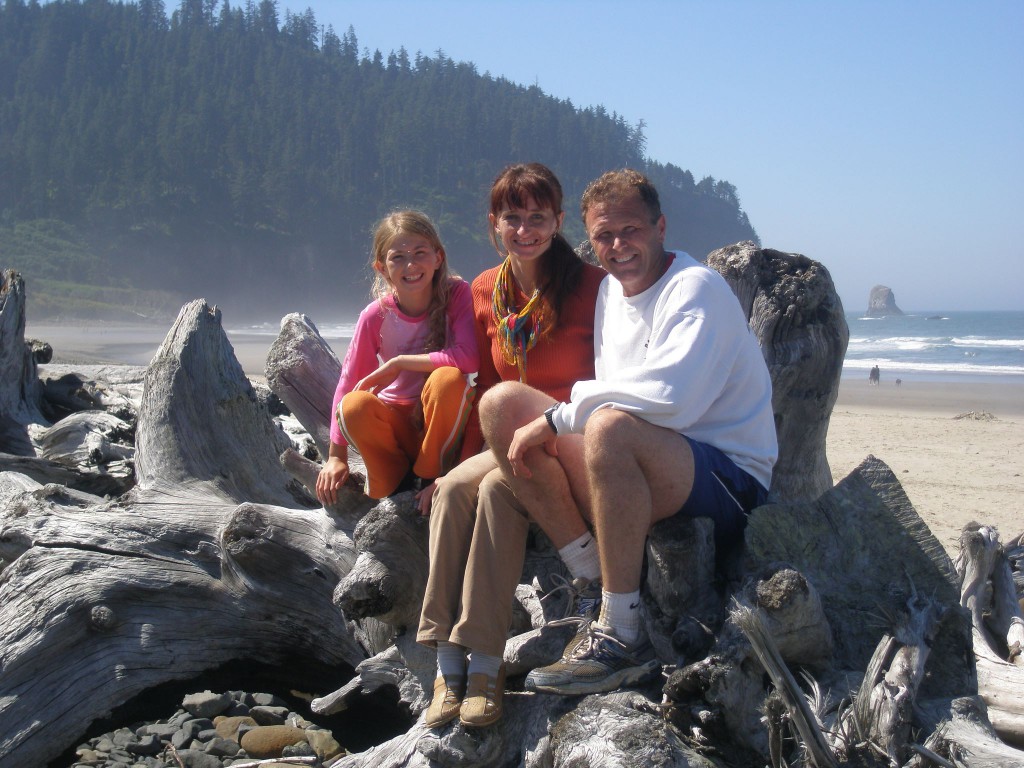
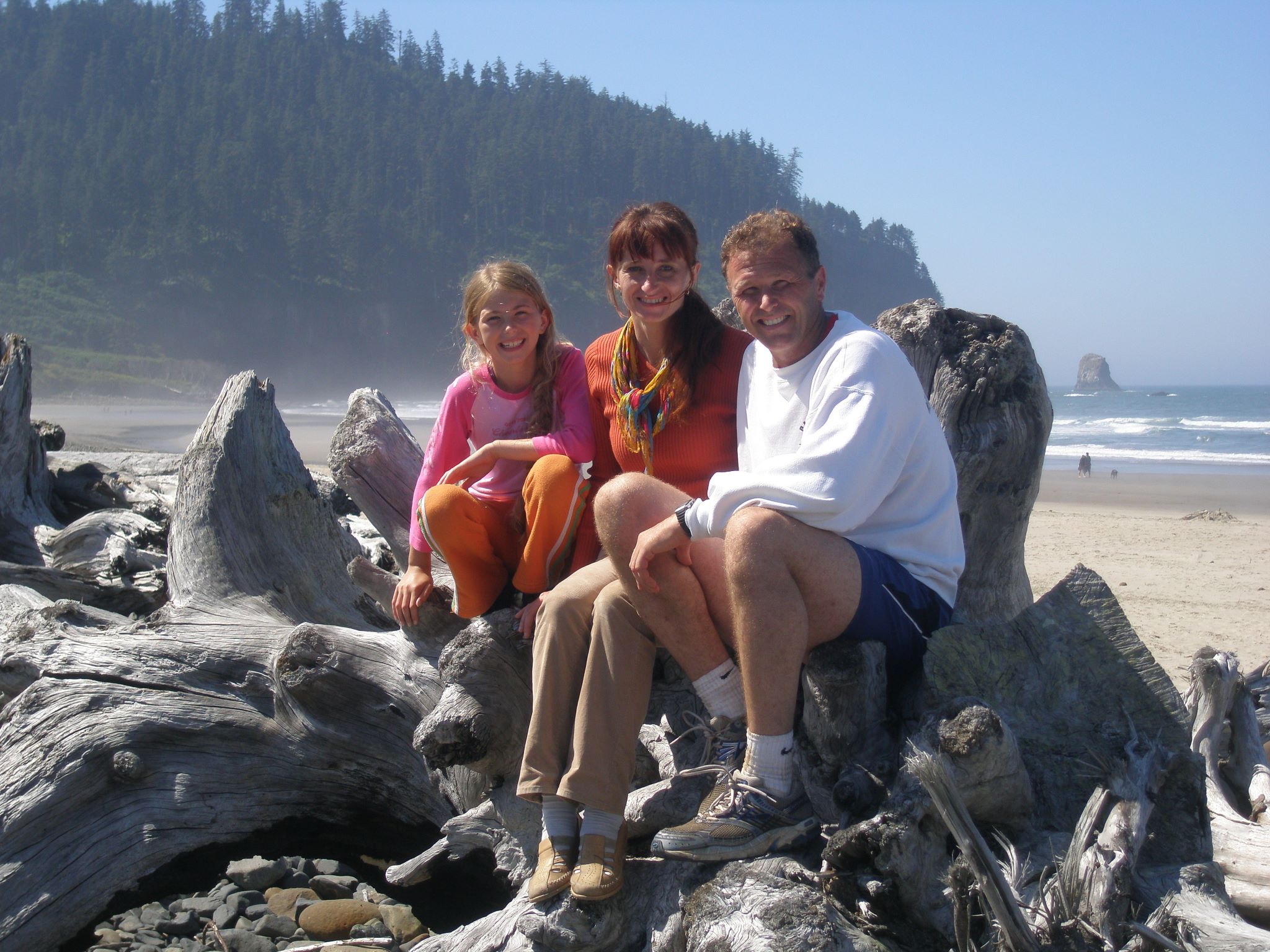
The Zweifel Family enjoys the nearby Oregon Coast, From left, daughter Nina, and Monika and Patrick Zweifel.
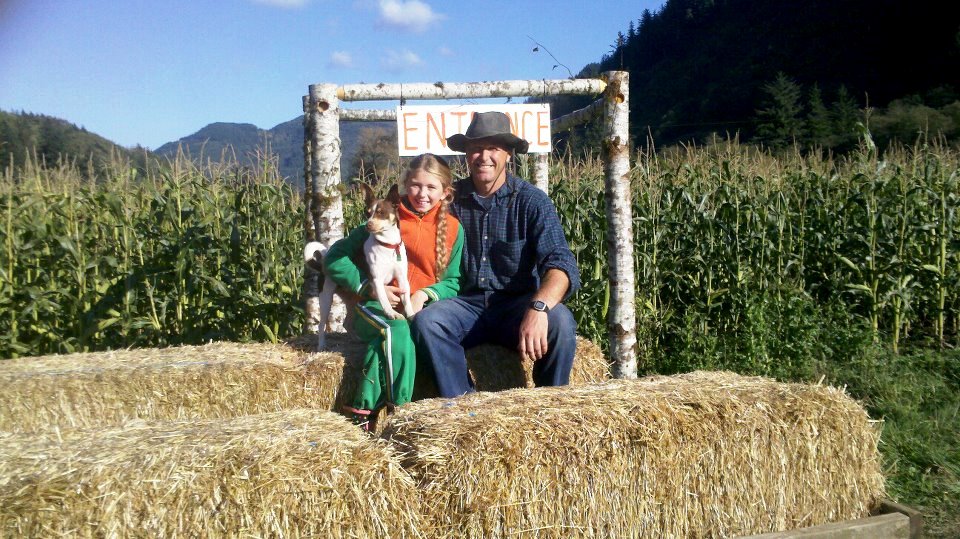
In the fall, there’s a pretty fun Pumpkin Patch and Corn Maze at Oregon Coastal. Here, Patrick poses with his daughter Nina.
Patrick Zweifel’s Oregon Coastal Flowers – his 64-acre, Tillamook, Oregon-based farm – has been well received by florists who shop at the Portland Flower Market, the Los Angeles Flower Market District and the Seattle Wholesale Growers Market where you can find permanent stalls filled with his gorgeous hydrangeas, calla lilies and Oregon forest products.
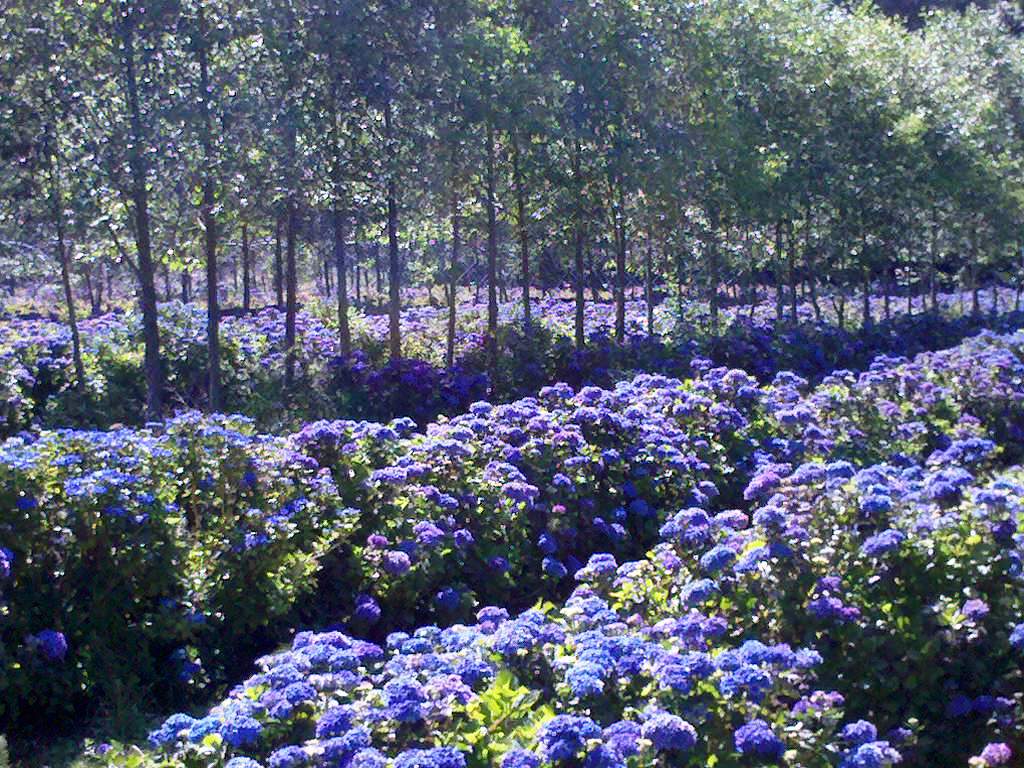
Feast your eyes on the Hydrangea Fields at Oregon Coastal Flowers. Field-grown, true-blue hydrangeas! You can’t get it any better!
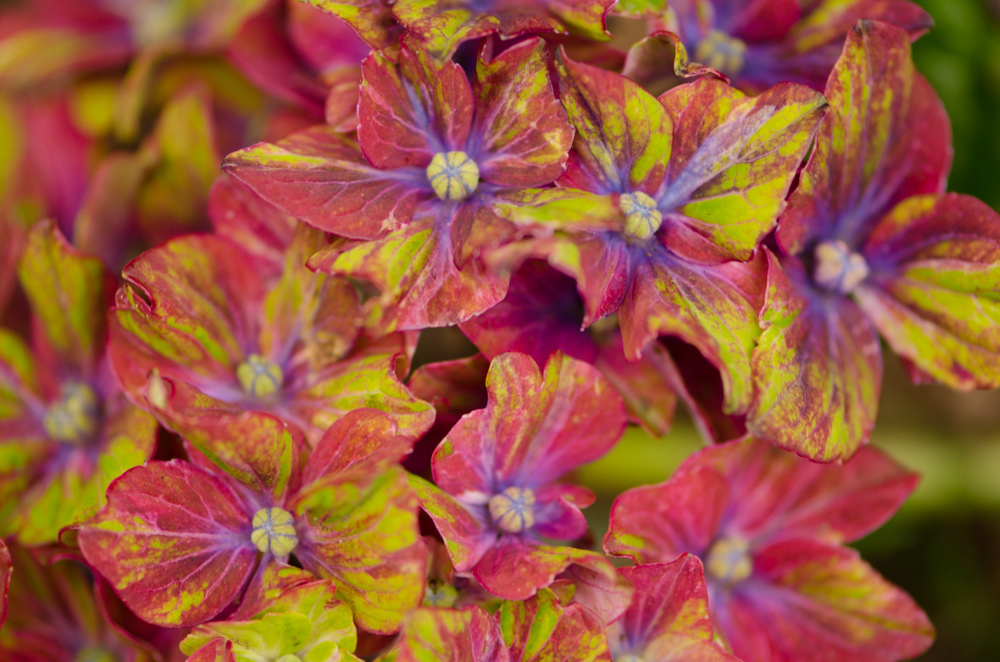
Here’s that awesome new Hydrangea macrophylla ‘Pistachio’ that Patrick talked about in our interview.
I met Patrick in 2010 at the regional
Association of Specialty Cut Flower Growers conference in Eugene, Oregon. That was the very first occasion when he and other farmers dreamed of launching a cooperative
Farmer-to-Florist venture in Seattle. One year later, that little market began: the
Seattle Wholesale Growers Market. Full disclosure: I now serve with Patrick as an industry liason on the Co-op board. That experience has allowed me to get to know this creative farmer better – and watch him at work. It’s impressive!
Patrick is competitive by nature, bringing the intense energy that he once devoted to a college track and field career to his professional life. In the early days of the SWGMC, he told me, “I knew there would be demand if we committed to the [warehouse] lease and took the risk. When you sell face-to-face, when you have a quality product, you have something that’s so much better than what you see on paper or online.” By opening their own market and direct-selling to florists, “we’re cutting out the middleman,” he explains.
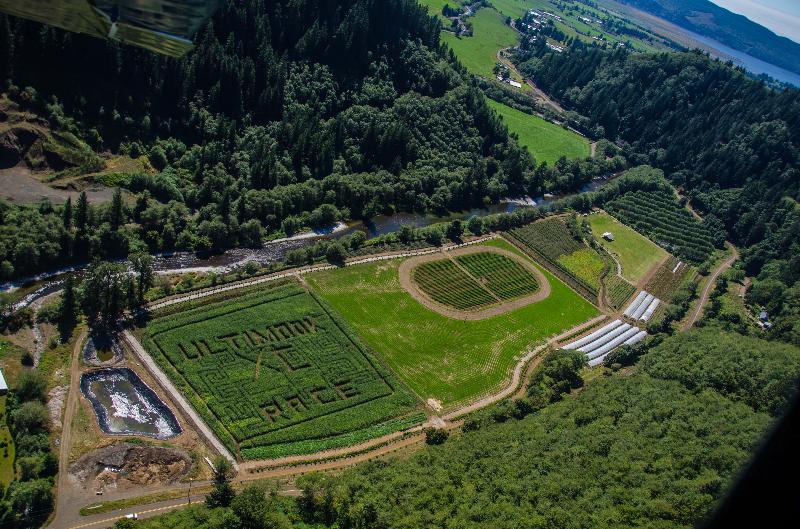
Here’s an arial view of Oregon Coastal Flowers where you can spot the full-size competitive race track amidst the fields.
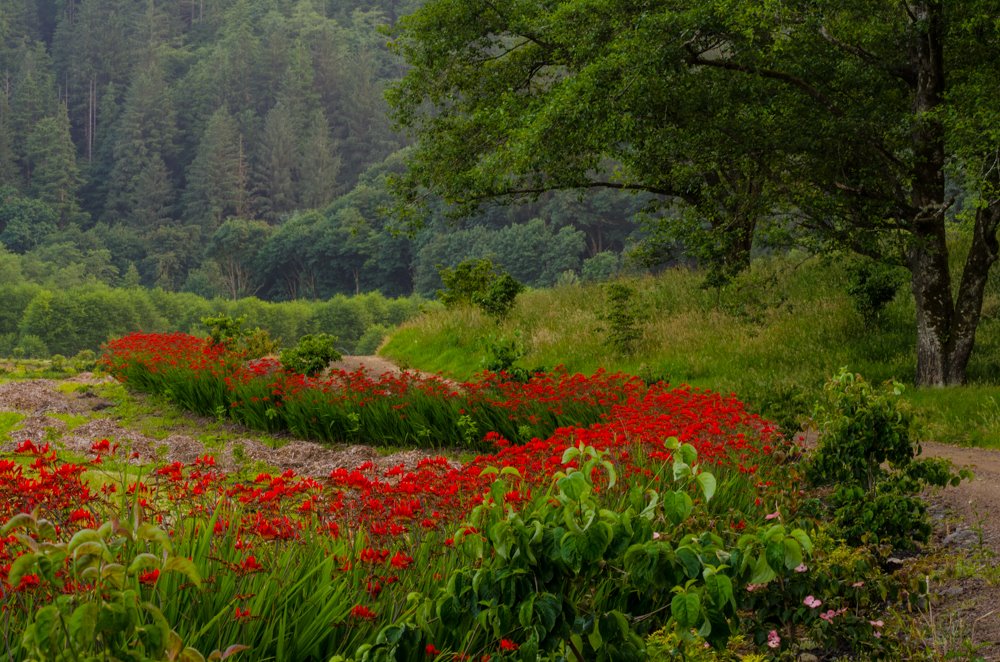
Check out the Crocosmia borders!
His story is revealing because he so generously explains how he has weathered the highs and lows of his business. If you have any romantic notion that being a flower farmer is a dreamy way to commune with nature, I know Patrick’s story will be both inspiring and sobering. It is not an idyllic existence. It is incredibly hard, endless work. It is a choice, but it is not an easy choice.
Patrick’s message is that if you can find your niche and be the very best in that niche, you *might* succeed. Being the best means producing excellent, high-quality botanical and floral elements. It also means the type of customer service you provide and the relationships you build with customers.
But no matter how beautiful or fresh the bloom, domestic farmers face competition on price, especially from importers who buy from low-wage countries, Patrick says. “I was the first person in the U.S. to sell colored calla lilies in a big way. I couldn’t have bought my farm without them. Then the South Americans started selling callas for 30-cents-per-stem against my $1-per-stem product. And they had added incentives, like buy one box, get a second one for free. I just can’t compete with South America on callas, even if my quality is great.” Patrick describes how cheap imports nearly ruined his core business – colored calla lilies. By 2008, he was faced with devastating losses of 85% of his total revenue and Patrick was driven to save his company.
He didn’t give up. He didn’t see that he had a choice. With a mortgage on his farm and family and employees to support, Patrick searched for a way to diversify Oregon Coastal Flowers.
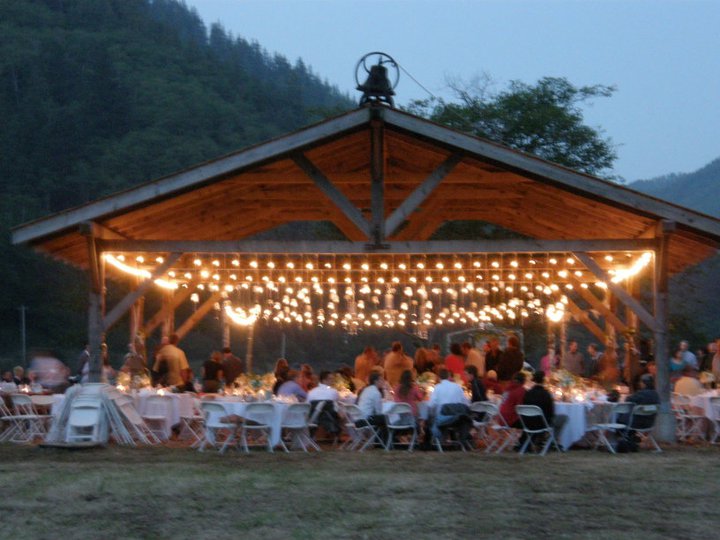
The wedding pavilion at Hydrangea Ranch, a gorgeous event space at Oregon Coastal Flowers.
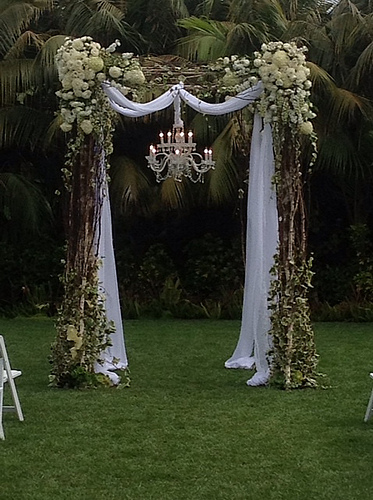
The romantic Alder arbors created at Oregon Coastal Farms from alder poles harvested on local forest land.
Hear the optimistic story of how he’s survived and moved beyond that episode to become even more solid in knowing his niche. This is a story of never giving up – and being smart and resourceful enough to find a solution that satisfies your customers, to provide products that meet a need in the floral marketplace, and to find new marketplaces for those products.
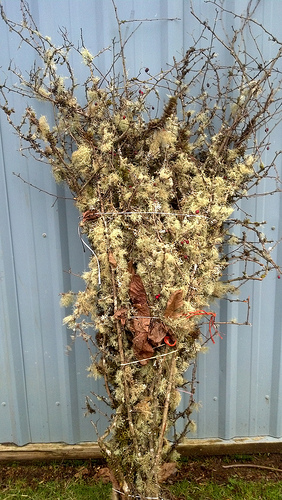
Mossy branches – a signature product offering.
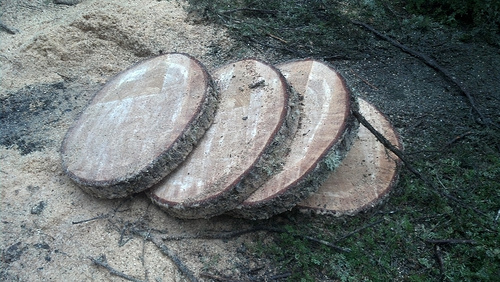
Here are those little log “cake plates” that Patrick has popularized among the floral, wedding & event world.
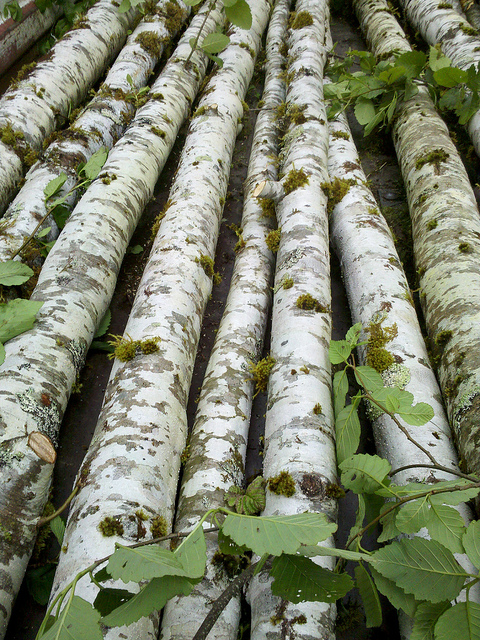
Oh, wow, those Alder logs!

All kinds of goodies from the Oregon forest: mosses, ferns, gnarly surprises!
Patrick credits his ability to quickly change direction for saving his business. He noticed a few years ago that floral designers were snatching up his offerings of Northwest forest products, such as lichen-clad branches, soft green mosses, cone-laden conifer boughs and other woodland items, infusing their bouquets with a naturalistic feel. In the past three years, Oregon Coastal Flowers has increased the variety of specialty forest items, while at the same time shrinking its acreage devoted to calla lily production. With forest service permits that allow him to legally harvest everything from birch saplings to decaying tree trunks, Patrick has seen his sales double from 2010 to 2011.
There will always be people who choose “cheap” first. Yet conscious consumers are voting with their values and their dollars – and focusing on other important product attributes like Seasonal, Local, Sustainable, and, in Patrick’s case, unusual and hard-to-grow or ship from South America. As the American Grown message increases, and as more consumers see value in the origins of the flowers they choose in the marketplace, that playing field will leveled out.
Posted in American Grown, Blog Posts, Creativity, floral design, General, Plants, Podcast Episodes, SLOW FLOWERS Podcast | No Comments »
January 9th, 2014
Podcast: Play in new window | Download
Subscribe: Apple Podcasts | Podcast Index | | More
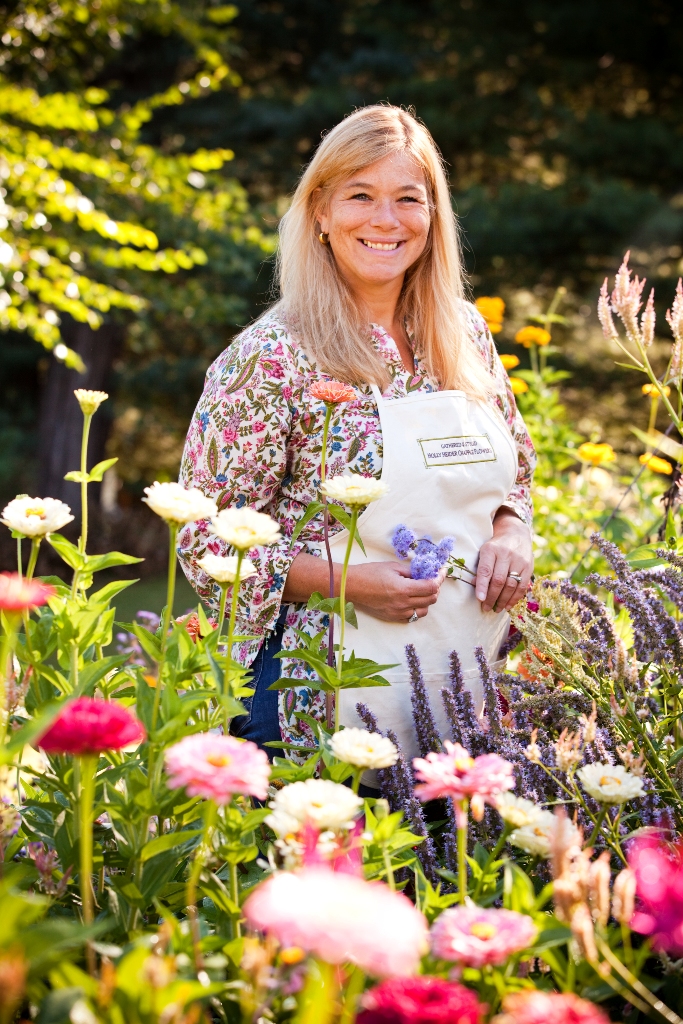
Holly Heider Chapple, in one of her favorite places on earth: Her own backyard flower garden. “The Answer is in the Garden,” she says.
We’re getting the New Year off to a fabulous start with today’s guest, floral designer, social media maven, educator and mentor to studio and wedding florists around the globe, Holly Heider Chapple. Based in Leesburg, Virginia, she is active in the wedding and event industry serving customers in the Washington, D.C., Virginia and Maryland areas.
Like many people who know and follow this talented and engaging woman, I met Holly “virtually” through Facebook or some other social media channel. As soon as she “friended” me, I wrote to Holly and said: let’s have a phone date. We realized our mutual connection is Alicia Schwede of Flirty Fleurs and Bella Fiore, a past guest on this podcast and a new transplant to the Pacific Northwest.
Well that phone date with Holly morphed into today’s podcast – a whirlwind conversation that follows Holly’s life from a childhood helping her parents grow, tend to and sell plants to an amazing family of her own.
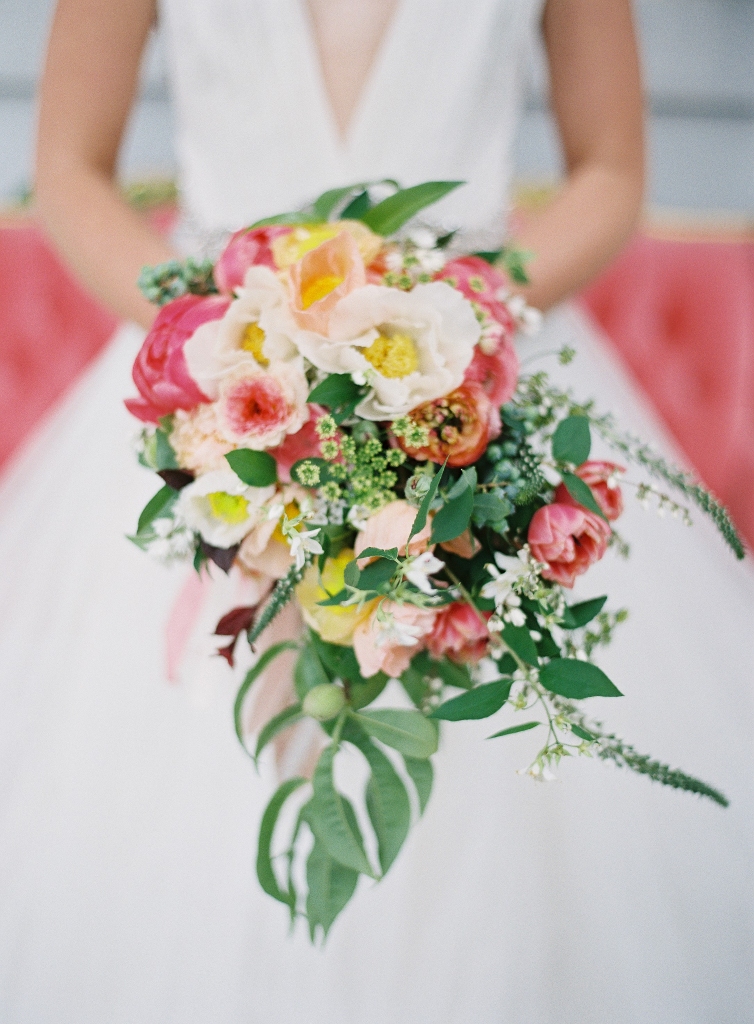
Holly shared several of her designs featuring mostly ingredients from her own garden. Here is one yummy creation.
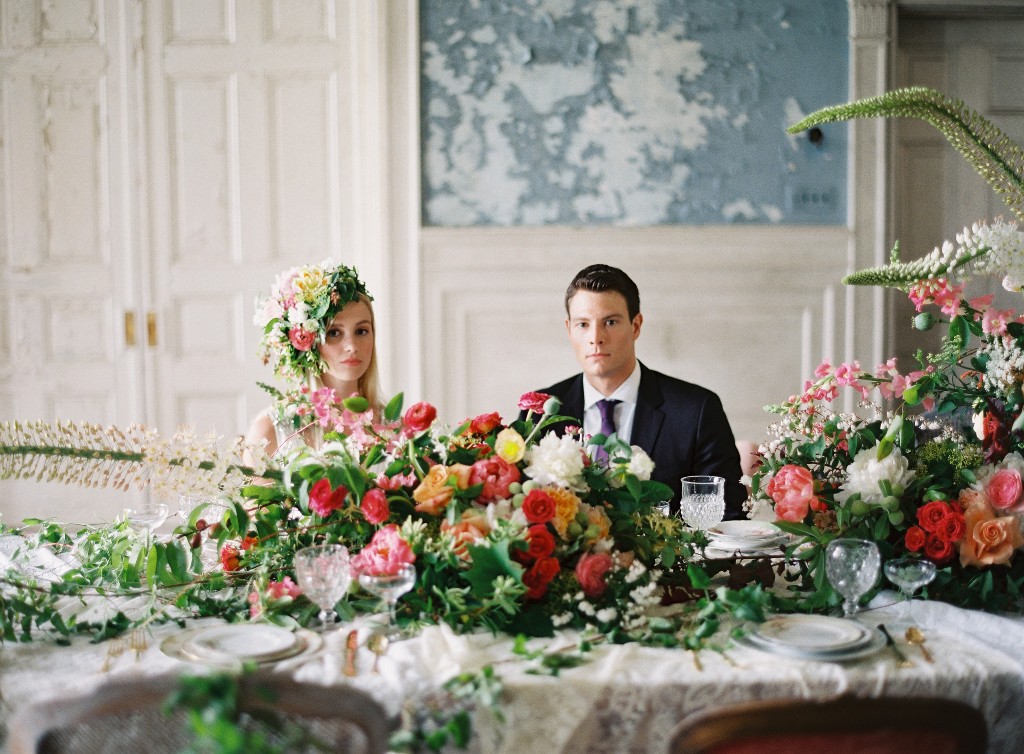
And a garden-inspired wedding dinner, bride and groom included!
We all need a jolt of optimism for the seasons ahead. Whether you’re a floral designer seeking inspiration or an American flower farmer who wonders if the floral industry really cares about all the attention you give to the botanicals you produce . . . I think you’ll find it here.
Holly has a totally fresh take on the world of flowers and I think that’s why she is so successful with some of her new ventures, including the Chapel Designers conference and forum, now in its 4th year. Plus, by her own admission, she is a sharer. She is one of those people who isn’t afraid that sharing her expertise and knowledge with YOU will somehow diminish HER. I subscribe to this approach to my own life and work, which made it so easy to converse, long-distance, with Holly.
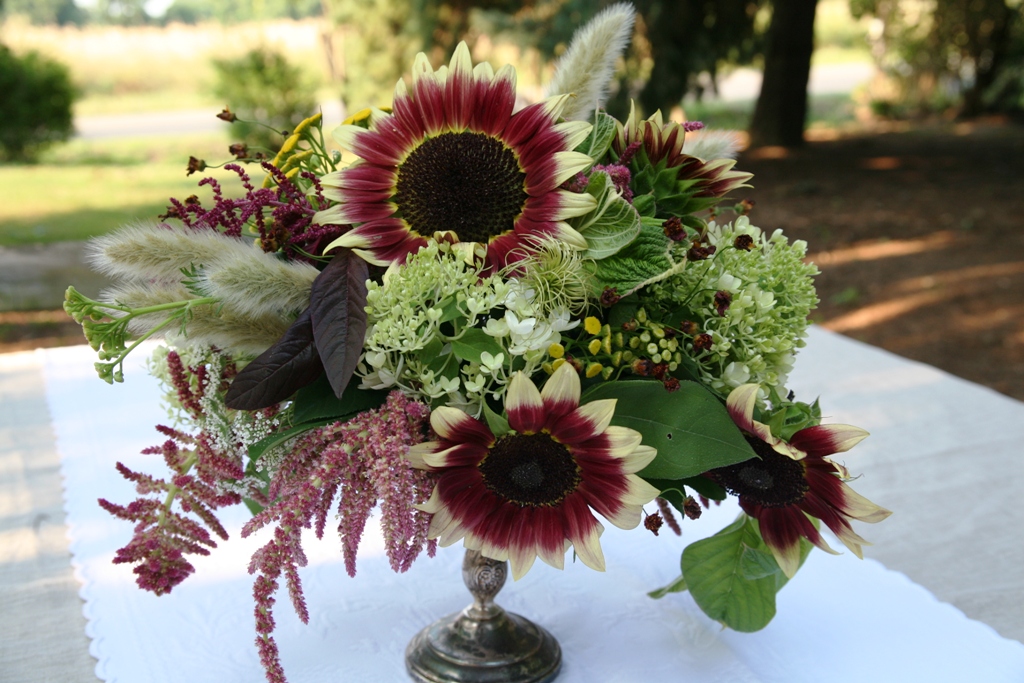
Garden flowers in an urn; all the elements grown in Heidi’s garden.
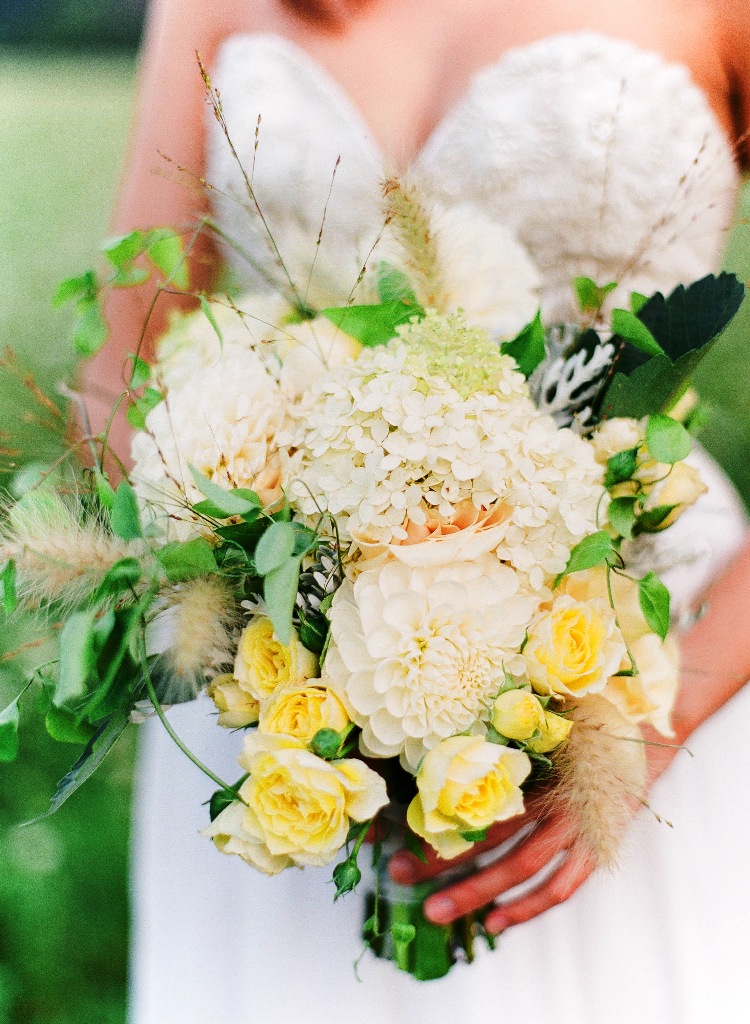
Another luscious bridal bouquet. Everything but the roses come from Holly’s Garden.
Here is her bio:
A dedicated mother, wife and entrepreneur, Holly is the creative visionary behind Holly Heider Chapple Flowers. A longtime resident of Loudoun County Virginia, Holly is a highly recognized and sought after floral designer who’s work has been published in a number of prestigious publications and can regularly be found in top industry blogs. With 21 years of successful business experience behind her, Holly now serves as a teacher, speaker and mentor for other professionals in the wedding industry. Having raised 7 children, and recognizing her most important life role as a mother, Holly appreciates also being known as “Flower Mamma” among her network of industry professionals. Additionally, based on her incredible and unique sense of style, the term “Hollyish” emerged in 2011 as a way of describing designs that possess the elegance, beauty and creativity of those that leave Holly’s studio.
Armed with a strong desire to help other floral designers and event professionals be successful, Holly established the Chapel Designers (a division of Holly Heider Chapple Flowers) in 2011, as an international network of florists and event designers who gather together every year in New York City to collaborate, learn, and create.
What started as a desire to network with other like minded business owners, has blossomed into an incredible group of professionals comprised of longtime designers, up and coming designers, and people just starting their design journey. The Chapel Designers is growing every day and is proud to have members from all over the world.
Remaining dedicated to quality of design and service has allowed Holly Heider Chapple Flowers to be recognized over and over again for exceptional products and client experiences while maintaining an unrelenting desire to drive industry trends. Holly describes her business in her own words: “I have had the privilege of training with great designers across the country and in Europe. One of my most favorite and unique experiences recently was volunteering with the installation of the White House Christmas decorations. All of these experiences combined with running a business from my home, where I can spend quality time with my husband and children has made me into the business owner I am today. I take each of my roles as a mother, mentor and designer seriously and continue to grow every day. My studio has been blessed to have our work published in Martha Stewart, Southern Living Weddings, Weddings Unveiled, Brides, The Knot, Washingtonian, Southern Weddings, Virginia Living, In Touch Weekly Magazine, Elegant Bride, Engaged Magazine, and many local publications, and I can’t wait to see what the next few years will bring. I know there are still big things to come.”
My conversation with Holly was super inspiring and I will thoroughly enjoy2014 as I watch all that she achieves. Please be sure to add her to your “follow” list if you haven’t done so yet.
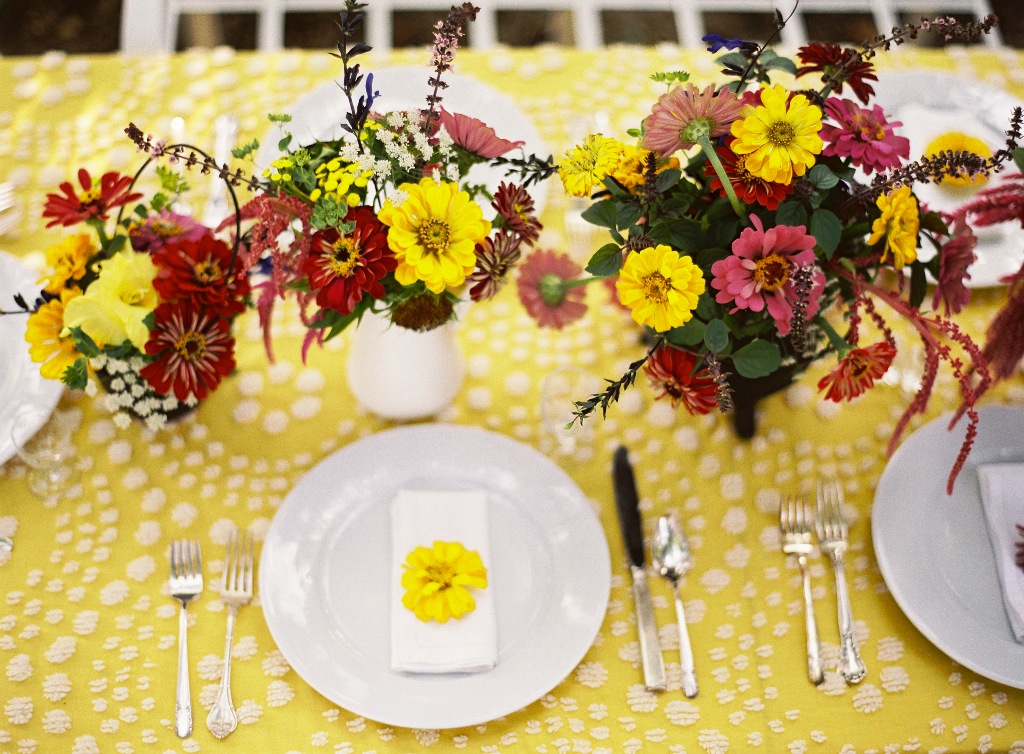
A lovely tabletop of home-grown florals.
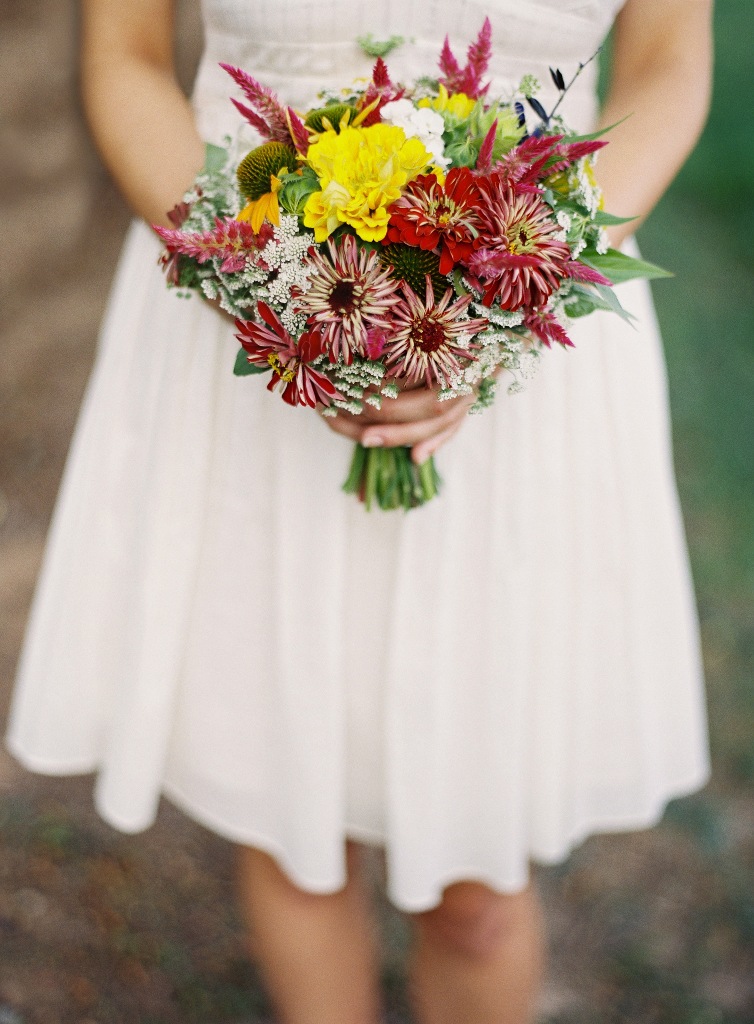
And a seasonal zinnia bouquet that’s inspired by a vivid color palette.
Here are Holly’s platforms to follow:
Her Blog: The Full Bouquet
Twitter: @chappleflowers @chapeldesigners
Facebook: HollyHeiderChappleFlowers
Instagram: Holly Chapple
And thank you for joining me in this episode of the SLOW FLOWERS Podcast with Debra Prinzing.
Because of your support as a listener, we have had nearly 5000 downloads in six months’ time – and I thank you for taking the time to join to my conversations with flower farmers, florists and other notable floral experts.
If you like what you hear, please consider logging onto Itunes and posting a listener review.
Until next week please join me in putting more American grown flowers on the table, one vase at a time.
As we heard from Holly,
The Answer’s in the Garden.
I couldn’t agree more.
The Slow Flowers Podcast is engineered and edited by Hannah Holtgeerts. Learn more about her work at hhcreates.net. All photographs shared here,courtesy of Holly Heider Chapple.
Posted in American Grown, Creativity, floral design, Gardening, General, SLOW FLOWERS Podcast | 2 Comments »
January 9th, 2014
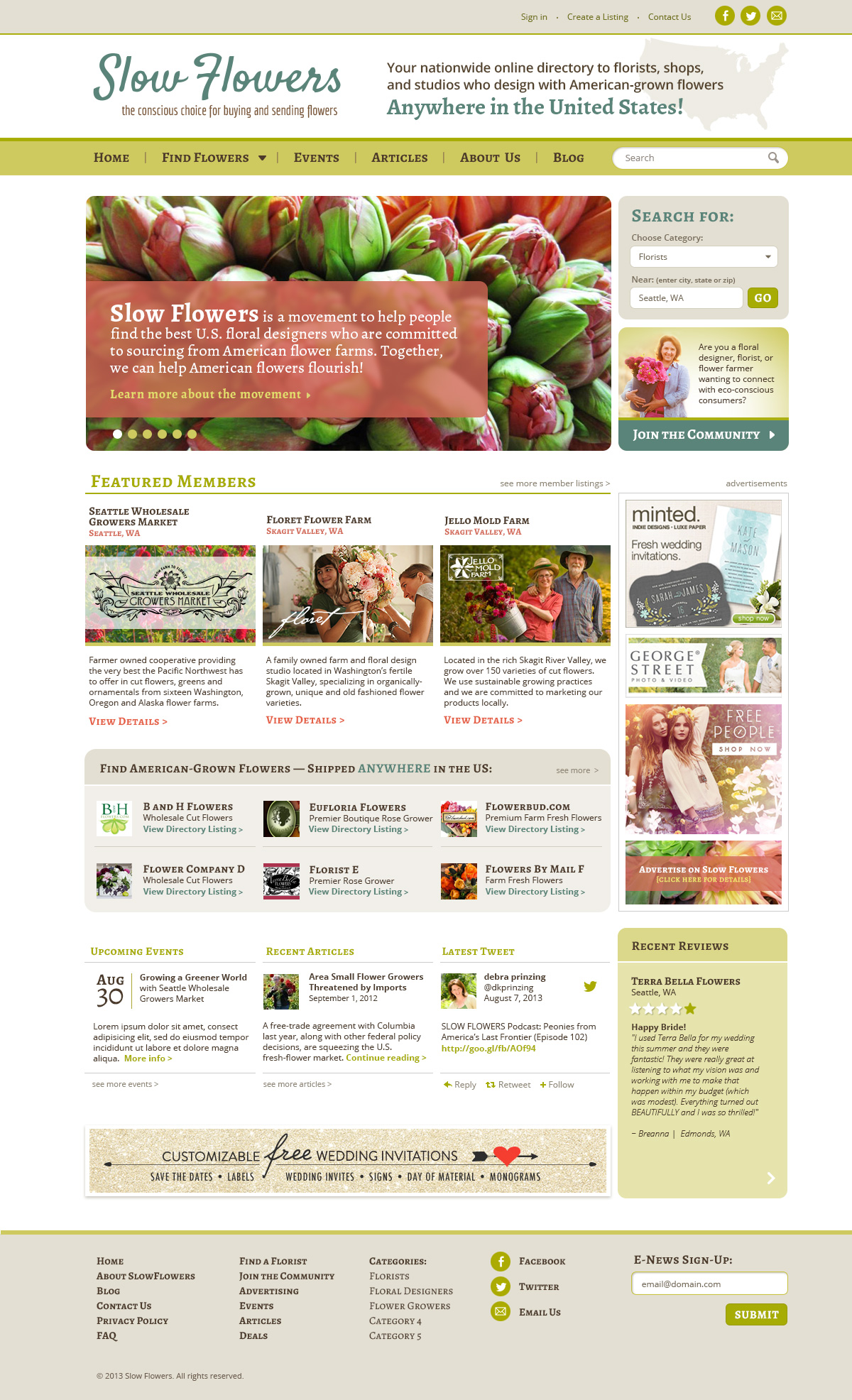
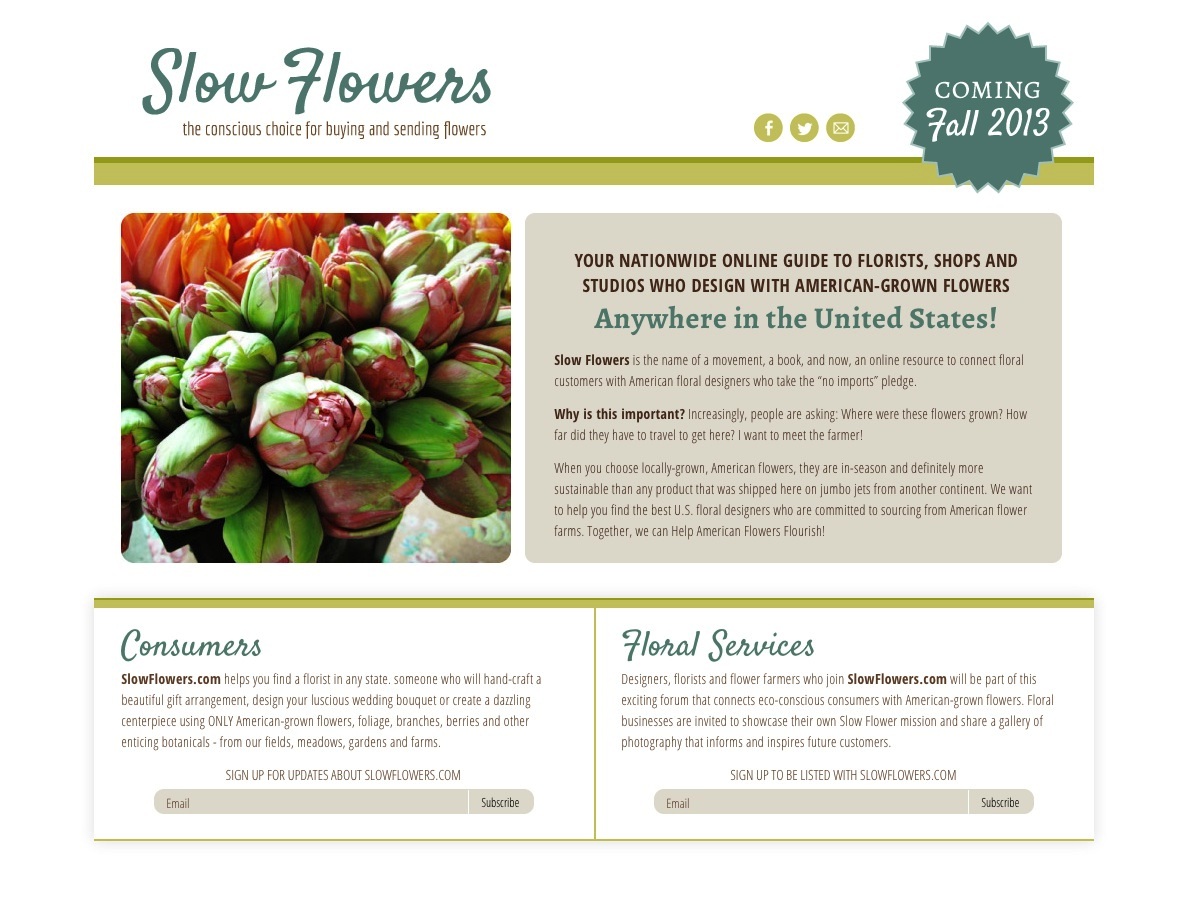
Here is the sample Home Page for the Slowflowers.com site. SAMPLE GRAPHICS are used as a place-holder only and do not imply endorsement.
I’m in the midst of raising money to help fund the launch of Slowflowers.com, a brand new, essential resource that will help connect consumers with American flowers and the people who grow, design with and sell them.
I’ve been living and sleeping flowers, dreaming about this project coming to fruition for so many months, more than a year, really.
And the exciting news is that donors to the Slowflowers campaign on Indiegogo have already contributed more than one-third of the $12,000 goal to this campaign in just four days. I think that’s remarkable. On this pace of $1,000 in donations per day, the goal will be met well before the 45-day deadline – and that means we can launch even sooner!
Here’s why this is such an important endeavor – and 10 reasons why saving American Flowers is important:
1. By supporting “American Grown” flowers, you are ensuring that “places” like this exist in this country and not just overseas.
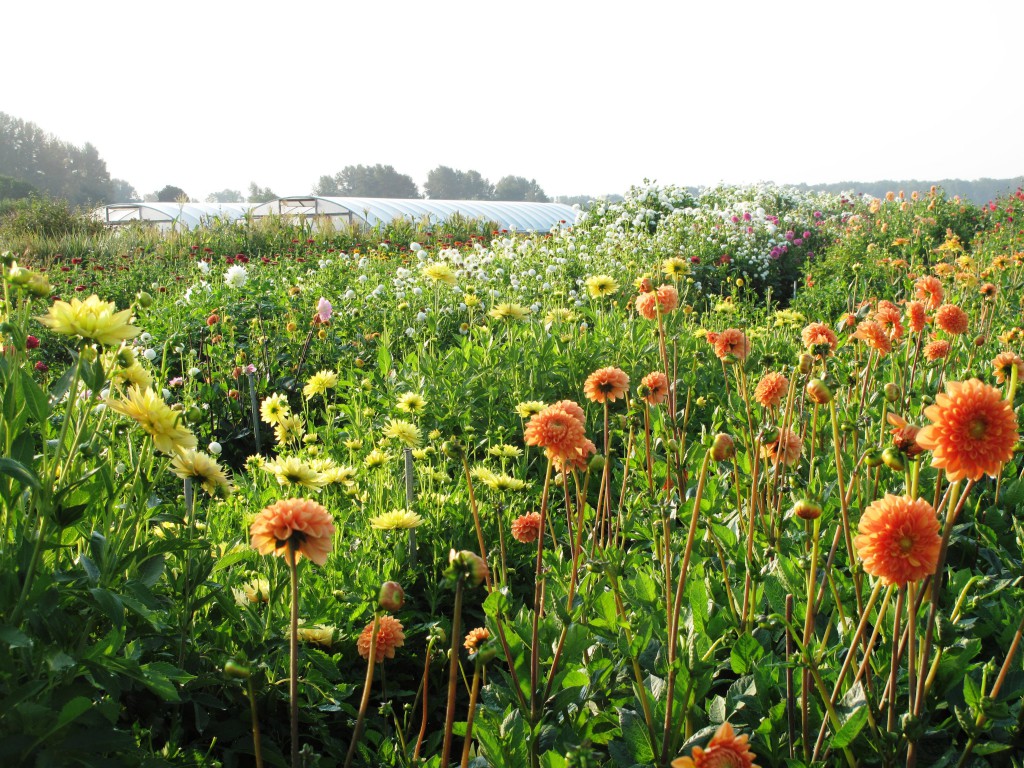
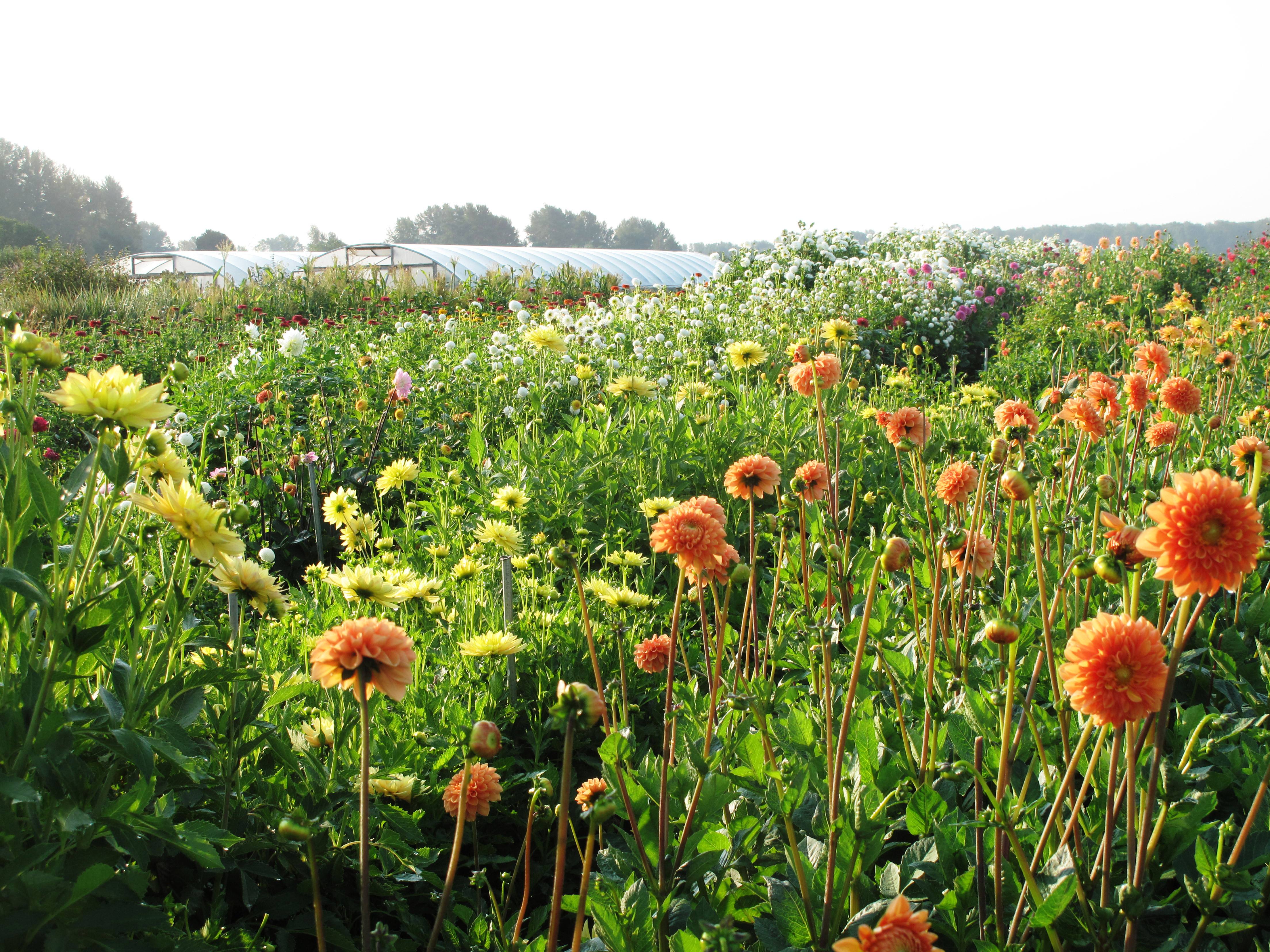
Flower farms preserve open spaces and agricultural land. Like this 7-acre patch of heaven in Mt. Vernon, Washington, home to Jello Mold Farm.
2. By supporting “American Grown” flowers, you are stimulating economic development where it’s desperately needed:
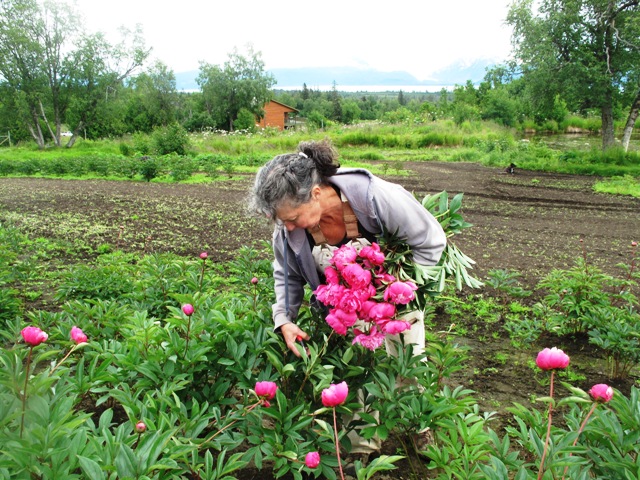
Imagine, a new economic floral industry in Alaska! Here’s farmer Shelley Rainwater harvesting her beautiful peonies in Homer, Alaska.
3. By supporting “American Grown” flowers, you are saving the family farm and the very notion of making one’s living from the land.
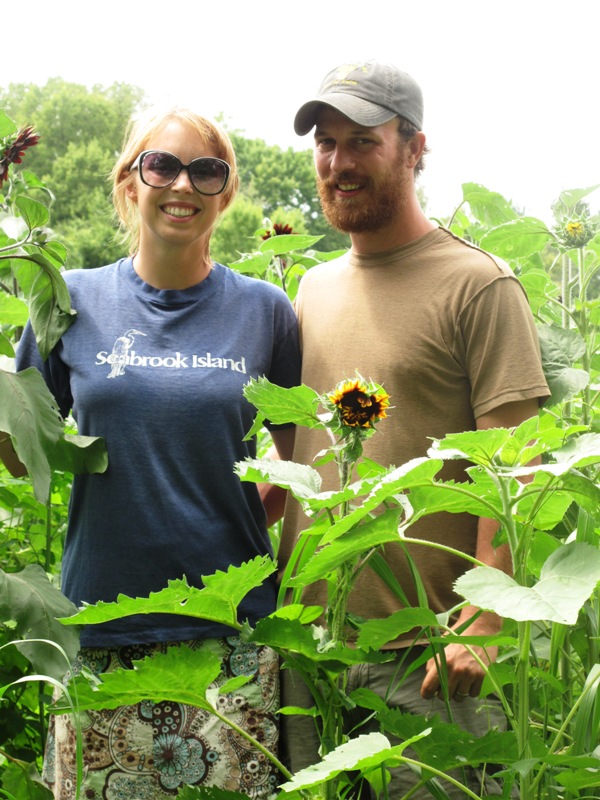
Agriculture in America is alive and well, especially when we can support farmers young and old in making their living from their land. Gretel and Steve Adams of Sunny Meadows Farm outside Columbus, Ohio.
4. By supporting American flower farms, you are ensuring the diversity and variety of choices in the marketplace.
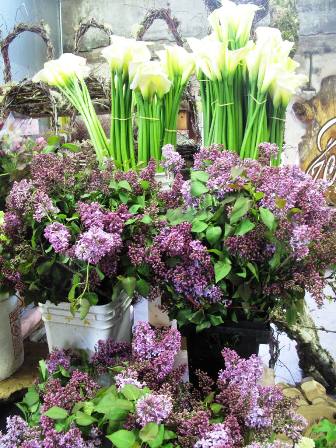
Field grown calla lilies and heady lilacs – Oregon grown and amazingly beautiful, fresh and healthy.
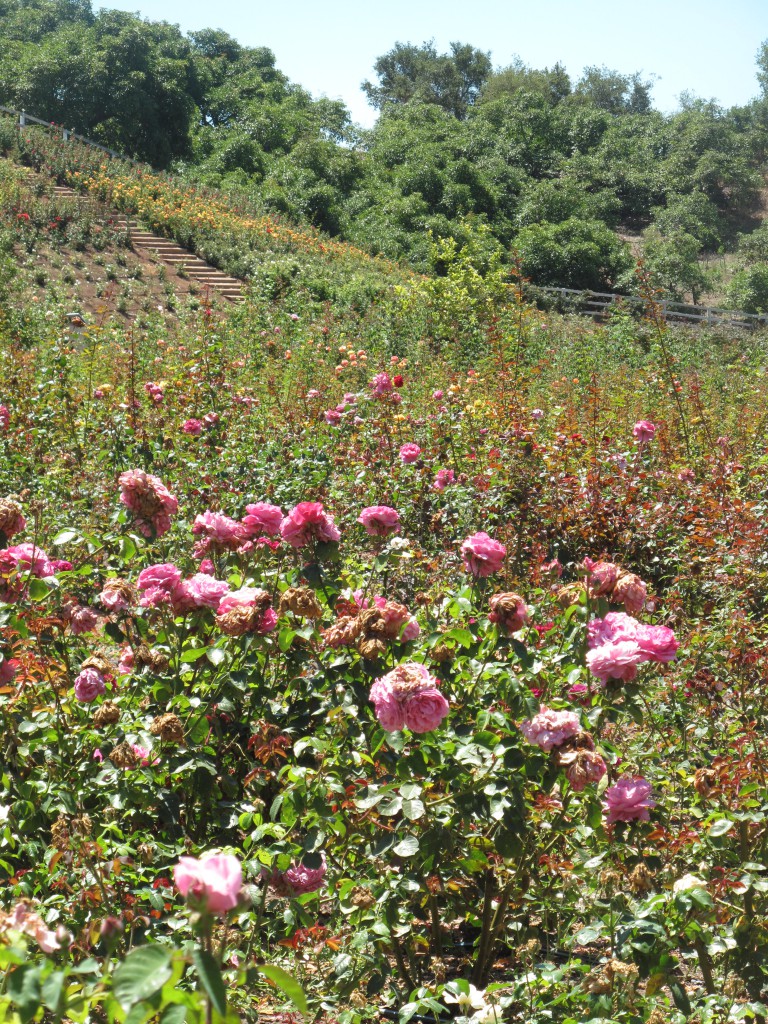
Field-grown old garden and English roses from Rose Story Farm. Hard to resist!
5. By supporting American flower farms, you are giving conscious and creative supermarket floral buyers A CHOICE about where they source their flowers, too.
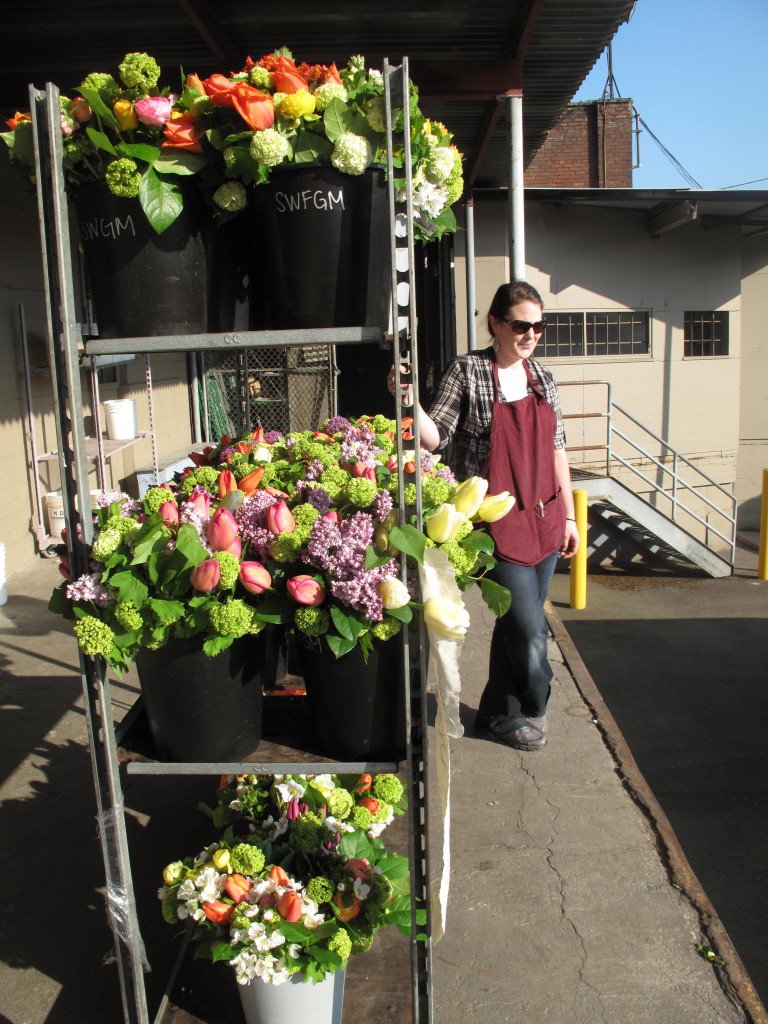
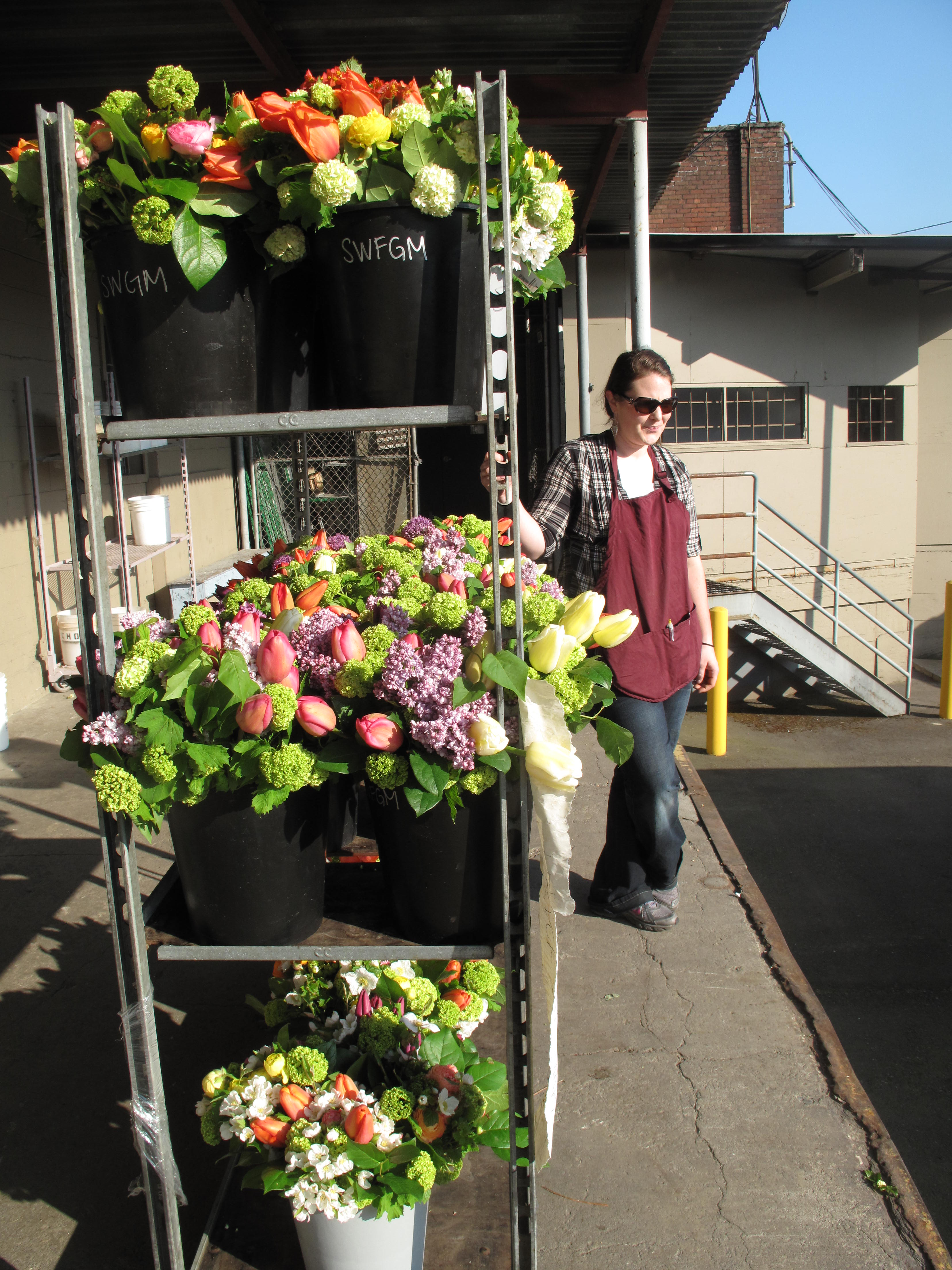
These Northwest flowers are on their way to the Town & Country Supermarket chain where buyers and their customers CARE that their flowers are locally grown.
6. By supporting American Flowers, you are helping to RECONNECT florists with flower farmers – and when that happens, beautiful things emerge!
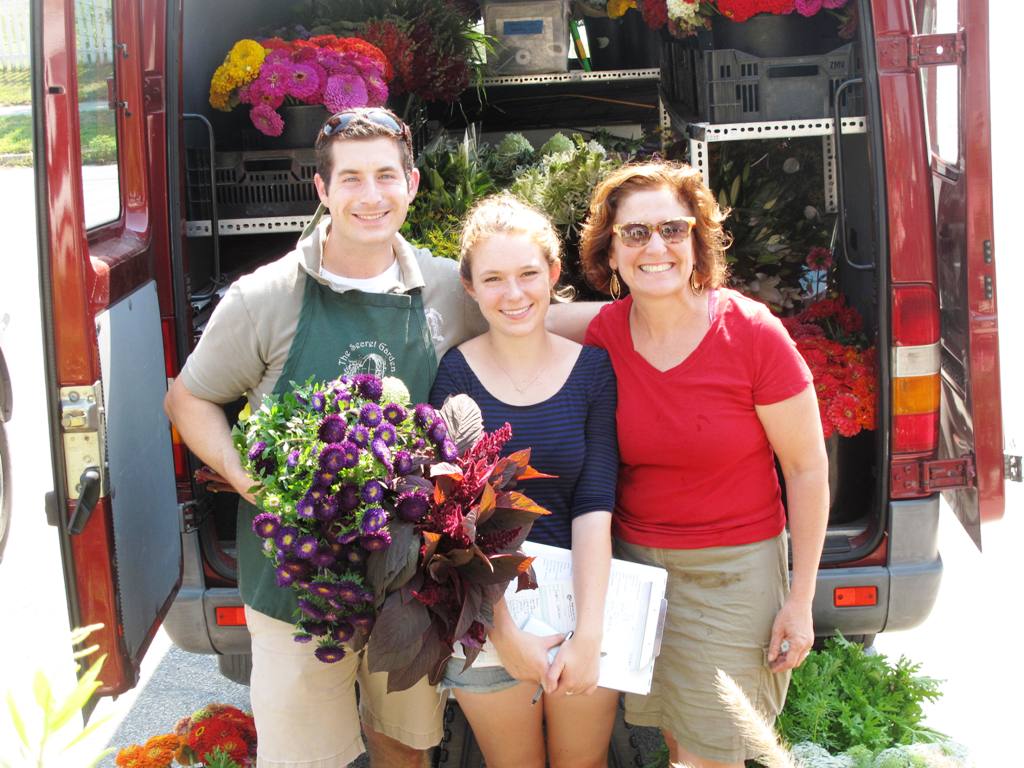
Polly Hutchison (right) of Robin Hollow Farm in Rhode Island makes weekly deliveries to David Urban (left), owner of The Secret Garden – an appreciative customer.
7. By supporting American Flowers, you are making it possible for farms to share their story with consumers, many of whom may never before have visited a flower farm or greenhouse!
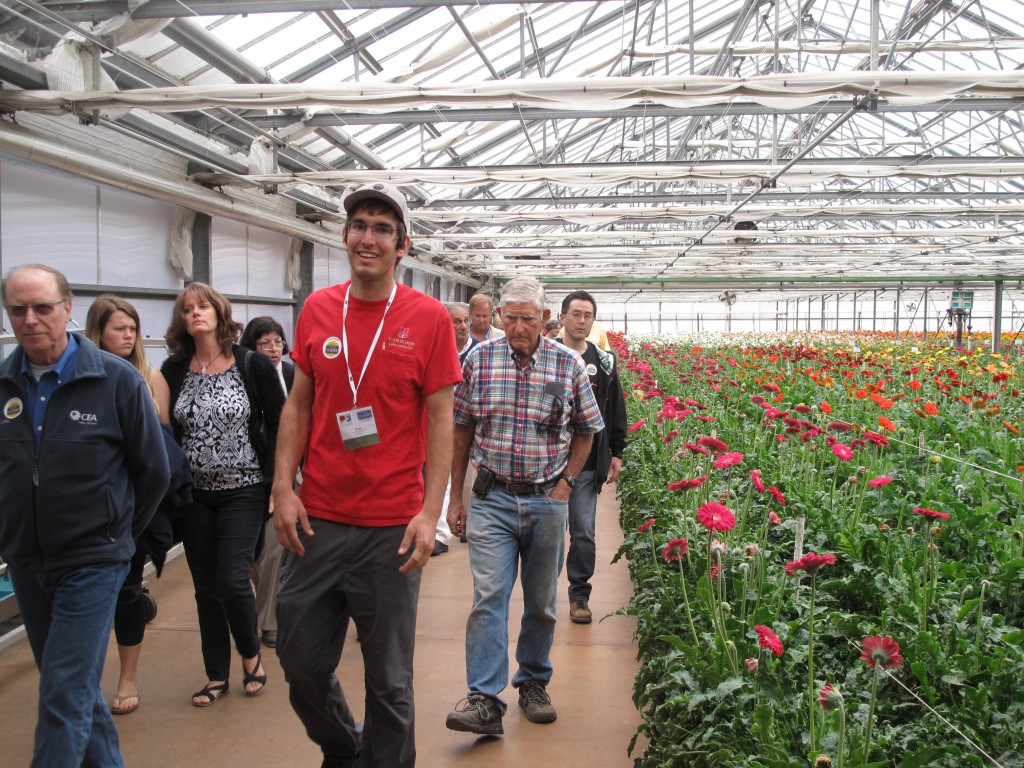
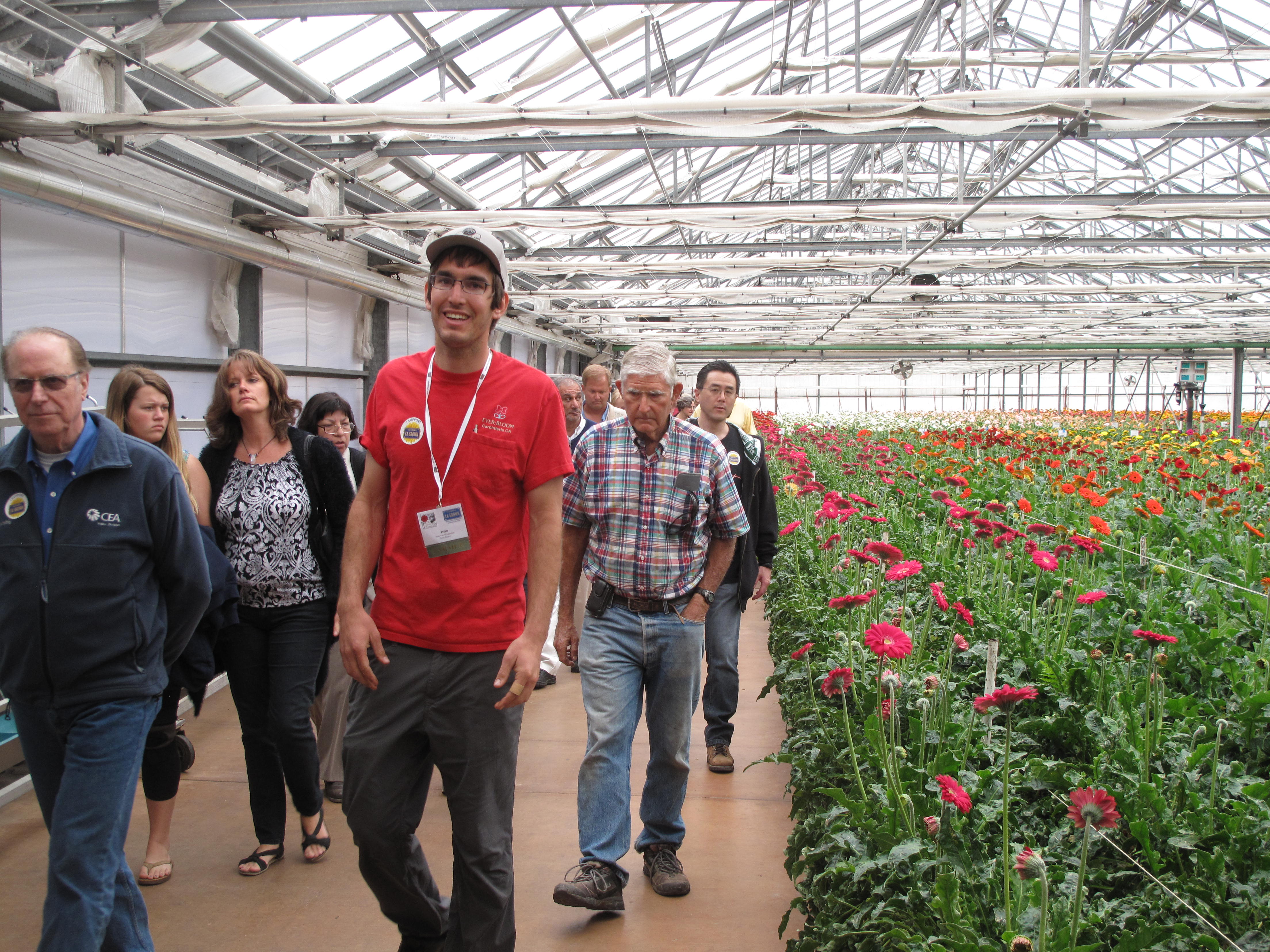
Ivan Van Wingerden of Ever-Bloom in Carpinteria, California, tours visitors through the gerbera greenhouses during the annual open garden event bringing consumers to flower farms.
8. By supporting American Flowers, you’re making sure that LOCAL FLOWERS are part of the FARM-TO-TABLE story!
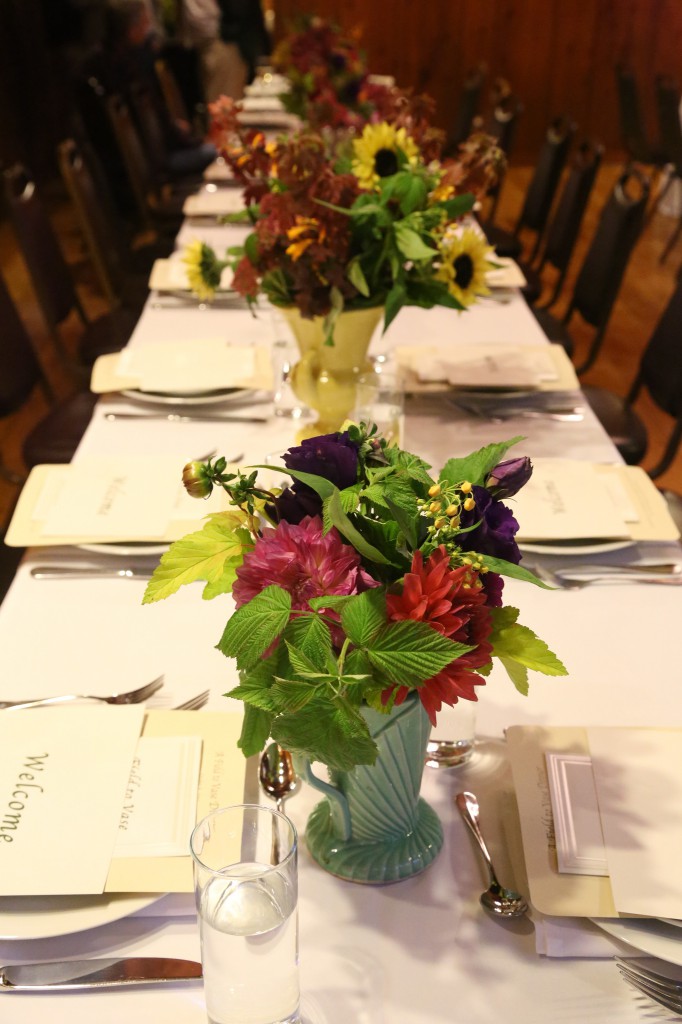
Flowers are an important item on the farm-to-table menu!
9. By supporting American Grown flowers, you are helping an entire industry advocate for change – for transparency and honesty when it comes to COUNTRY OF ORIGIN LABELING on FLOWERS:
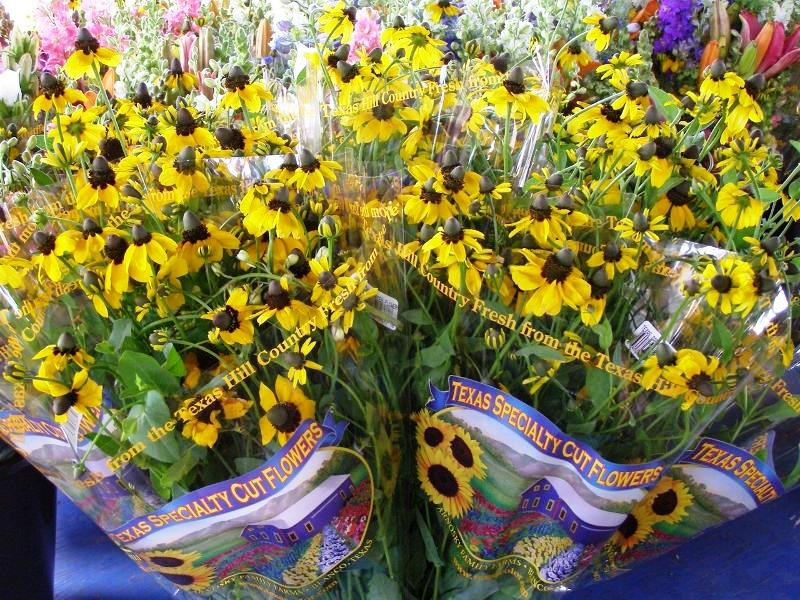
Thanks to honest labeling, there is no doubt that these flowers were grown by local farmers in their local community.
10. By supporting American Grown flowers, you’re putting more flowers on the table, one vase at a time. You’re saving an industry that has been long-neglected by its own elected officials. You’re changing the dialogue and elevating the design aesthetic for the flowers you give to celebrate, congratulate and share love.
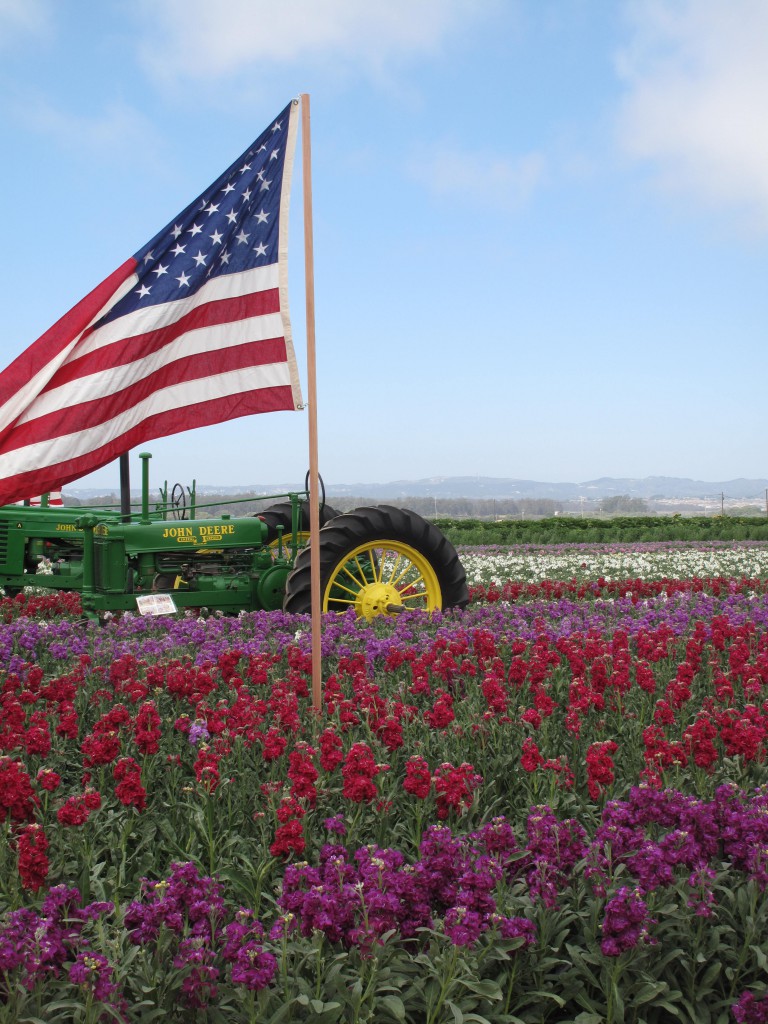
It’s a patriotic notion and an important way of life for generations of Americans.
Tell me . . . WHY do you want to Save American Flowers?
Posted in American Grown, Blog Posts, floral design, General, Slowflowers.com the Directory of American Flowers | 11 Comments »
January 5th, 2014
Every Sunday morning during 2013 I posted the Slow Flowers’ seasonal “bouquet-of-the-week” to share with you. We tracked the seasonal story of floral design, flowers, foliage and the farmers and gardens from which those ingredients came! It was a fantastic year in flowers, wasn’t it?
So what’s up for 2014?
For now, I’m going to take a break from weekly floral postings, but that does not mean I’ll be sitting around with my feet up on the ottoman perusing seed catalogs. No, I’ve been busy for the better part of the past six months working on the upcoming launch of Slowflowers.com.
Today, the funding campaign went live on Indiegogo and I invite you to check it out here. You’ll find lots of background information about why and how Slowflowers.com began.
I have many people to thank for helping me get to this point. Special thanks to Hannah Holtgeerts of HHcreates.net and her brother Luke Holtgeerts for creating the all-important video!
Preview it here:
httpv://vimeo.com/83407503
Special thanks to our on-camera floral designers: Lynn Fossbender, Melissa Feveyear and Sara Jane Camacho
Special thanks to the team at Metric Media, especially Bob Meador, Willo Bellwood and Jacqui Lott for creating the Slowflowers.com look, feel, logo, topography and navigation – and to Martin Fletcher for his expertise and patience with our database!
Special thanks to all the florists and flower farmers who agreed to “endorse” this project for the campaign (Ann Sensenbrenner, Ellen Frost, Debbie Demarse, Polly & Mike Hutchison, and Diane Szukovathy/Dennis Westphall)
Special thanks to Kasey Cronquist of the California Cut Flower Commission and to Christina Stembel of Farmgirl Flowers who lent their voices to the video and so many hours of brainstorming and ideation.
Thanks, too, to the California Cut Flower Commission for sharing visuals and infographics for the SlowFlowers Slide Show.
Special thanks to Dave Salwitz for his last-minute audio recording talents
And mostly, thanks to my husband Bruce Brooks, for his endless support, emotionally and financially, for all my creative projects.
Posted in American Grown, Creativity, Entertainment, floral design, General, Slowflowers.com the Directory of American Flowers | 1 Comment »
January 1st, 2014
Podcast: Play in new window | Download
Subscribe: Apple Podcasts | Podcast Index | | More
Greetings and Happy New Year! This is the first Slow Flowers Podcast episode of 2014 and I have devoted it to an essay about the state of the American floral industry and the critical changes that need to take place in order to save it.
Here are some highlights of my thoughts and ideas:
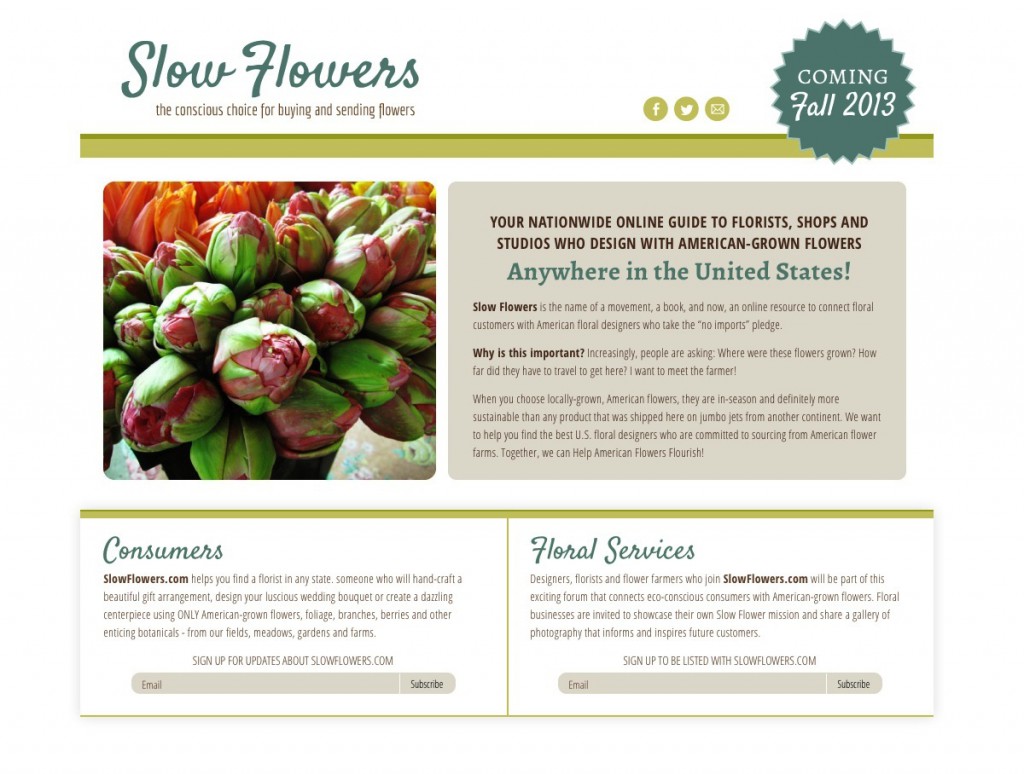
1. In early 2014, as promised for months, I will launch SLOWFLOWERS.com, a free nationwide online directory to florists, shops and studios who design with American Grown Flowers and the family farms who sell direct to the consumer. Please take a moment to sign up for more details – including the Beta Launch later this month.
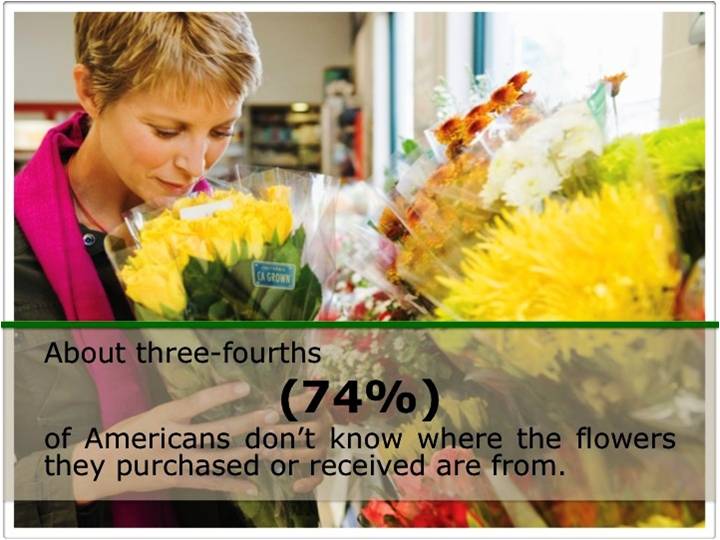
2. Without the kind of valuable information shared by the amazing guests of the SLOW FLOWERS Podcast and without proper country-of-origin labeling on all flowers at the marketplace, American consumers simply do not know where their flowers come from. They do not know WHO grew those flowers. They do not know WHERE those flowers were grown and what SUSTAINABLE practices were used. *Infographic, courtesy of California Cut Flower Commission.
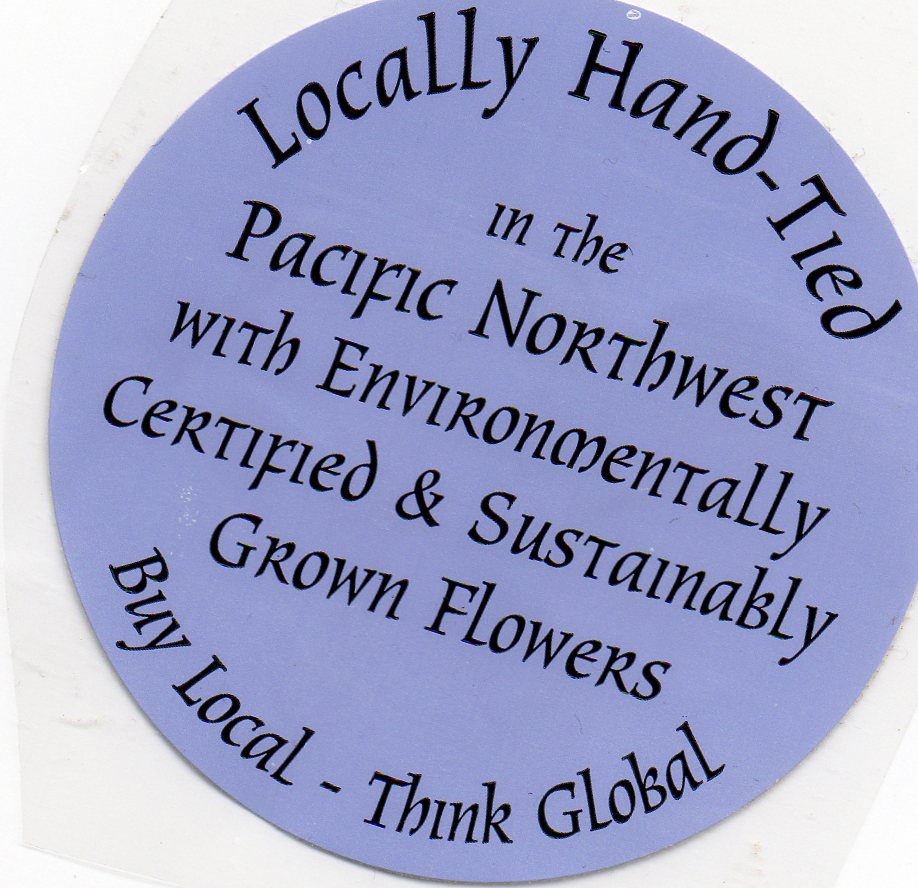
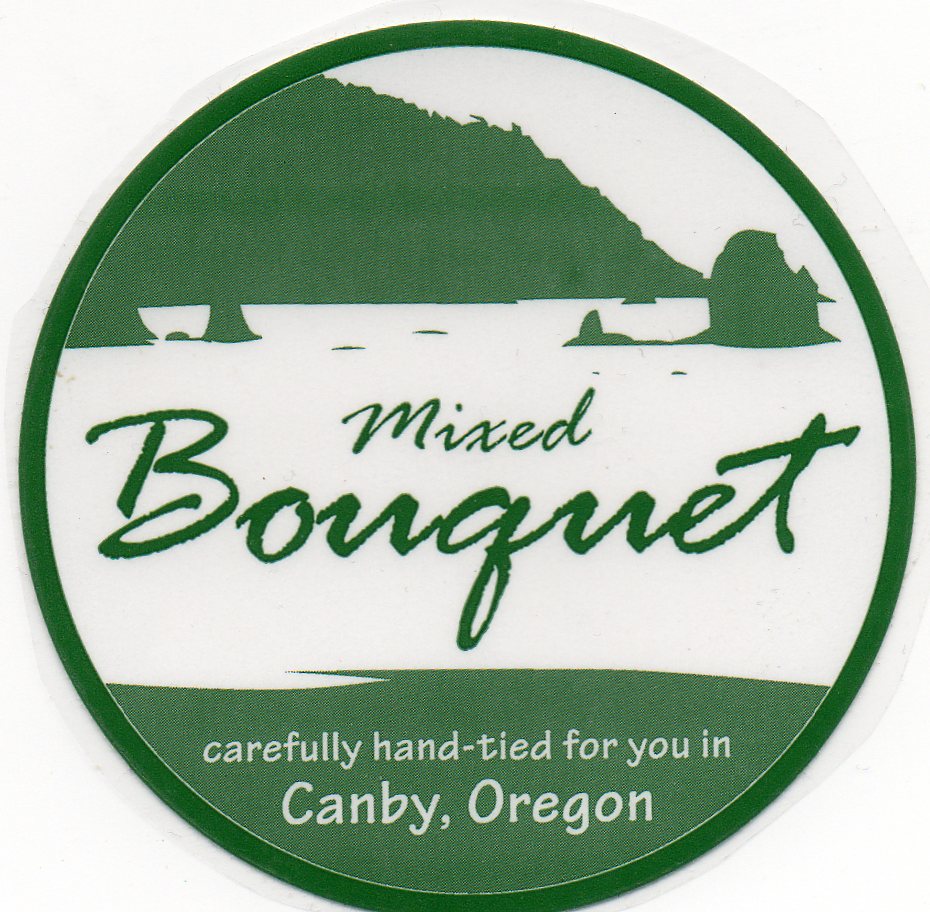
3. Above you will find two types of confusing labeling seen in the marketplace, used by retailers who are trying to ride the wave of American grown. These labels appeared on mixed bouquets of imported flowers. So the implication is that they are “local,” when all that’s local about those bunches was the fact that they were “assembled” with a twistie-tie or a rubber band in some nearby warehouse. It’s disheartening to see lack of leadership in flower retailing. Unless people like you and me object and insist on accurate product information, we will continue to witness this sort of dishonesty at the cash register.
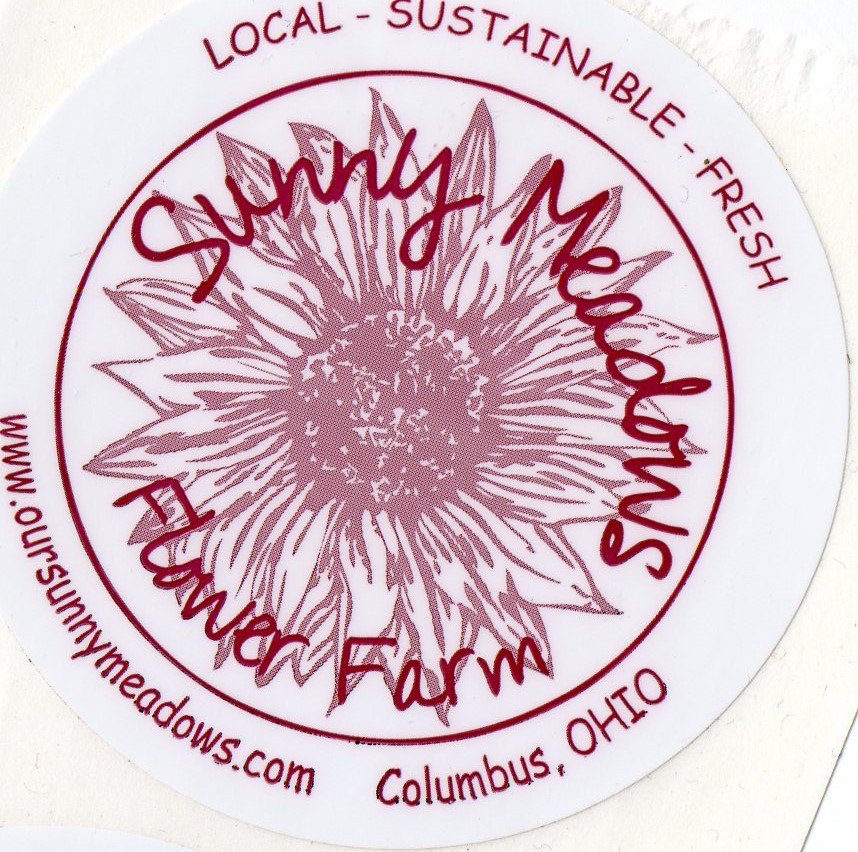
4. Above you will find GREAT labeling from my friends Gretel and Steve Adams, flower farmers at Sunny Meadows Flower Farm in Columbus, Ohio, who promise “Local-Sustainable-Fresh” on all their bouquets and bunches. This is the precise type of information that helps consumers make an informed choice about the flowers they buy. It’s easy for their customers to log onto the farm’s web site and see photos of luscious, abundant fields and greenhouses of flowers growing in their own community.
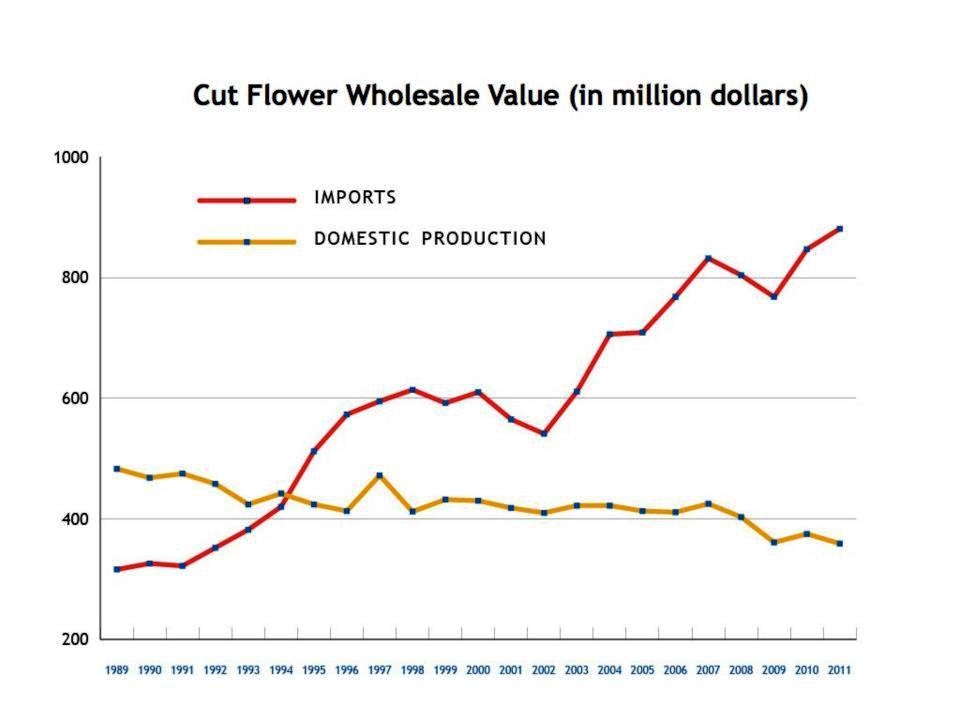 5. The graph above begin in 1989, just prior the the Andean Trade Preference Agreement. You can see the dramatic trajectory of imports and how the U.S. government’s preferential treatment for South American flower producers has devastated domestic U.S. flower production. *Infographic, courtesy of California Cut Flower Commission. Let’s reverse this trend in 2014!
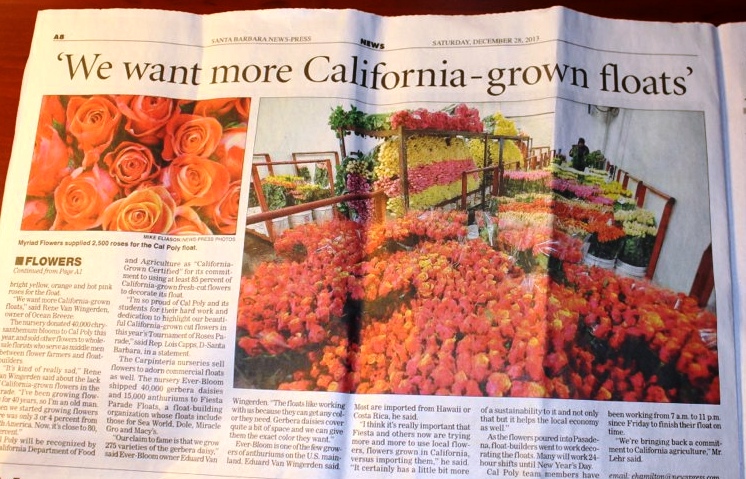
6. Today is January 1st and you may have seen the Pasadena Rose Parade broadcast on television. Tragically, only one out of 45 floats was created with all California-grown flowers. Read more about the status of Rose Floats that use imported flowers in yesterday’s Huffington Post column by Bill Prescott here. Read more about the Cal Poly All-American Float here. *”We want more California-grown floats,’ an article from Dec. 28, 2013 Santa Barbara Free-Press.

7. Please be conscious of your FLOWER MILE as much as you are of your FOOD MILE. *Infographic, courtesy of California Cut Flower Commission.
8. Take the AMERICAN FLOWERS Pledge in 2014! I look forward to sharing more inspiring flower stories from the farms who grow American flowers and the studios/designers/florists who sell and create beauty with American flowers in the coming year!
Thank you for joining me in this episode of the SLOW FLOWERS Podcast with Debra Prinzing.
Listeners have downloaded more than 4,500 episodes of the Slow Flowers Podcast since I launched it in July 2013. I thank you for taking the time to join to my conversations with flower farmers, florists and other notable floral experts.
If you like what you hear, please consider logging onto Itunes and posting a listener review.
Until next week please join me in putting more American grown flowers on the table, one vase at a time.
The Slow Flowers Podcast is engineered and edited by Hannah Holtgeerts. Learn more about her work at hhcreates.net.
Posted in American Grown, Blog Posts, Creativity, floral design, General, Plants, Podcast Episodes, SLOW FLOWERS Podcast | 4 Comments »
December 29th, 2013
FRESH PICKED AND EVERGREEN
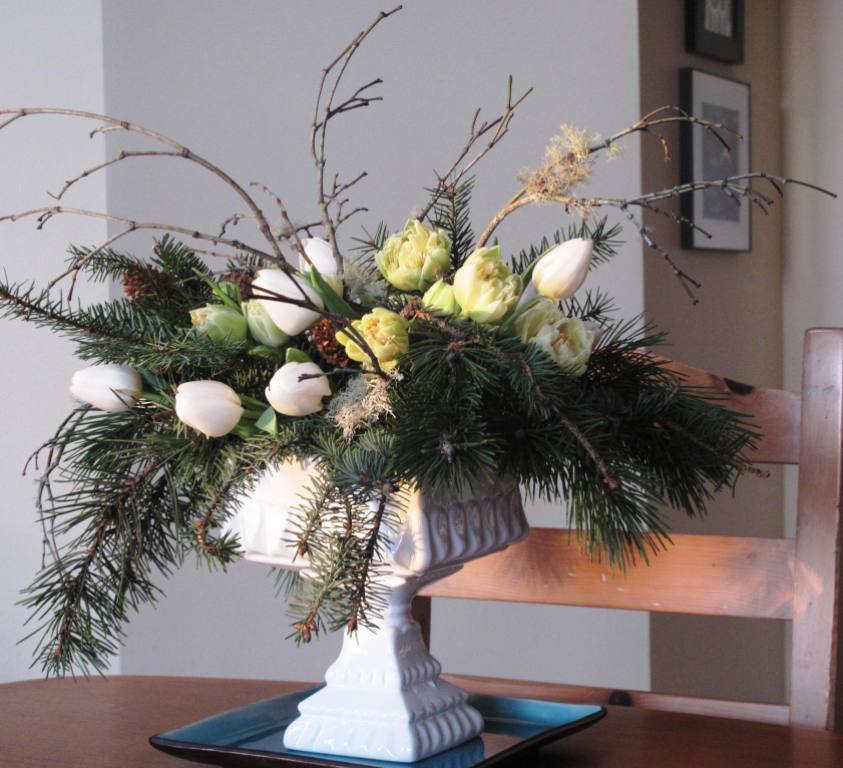
Local Washington tulips fill one of my favorite pedestal vases. The greenery and branches are all from my garden.
Here we are at the final week of the year. And I want to share with you a final look at my year-long project to create, photograph and write about 52 consecutive weeks of local and seasonal floral arrangements.
It was a fabulous ride – and one that rewarded me with so many gifts, friendships and experiences.
Today, I’m sharing a bonus bouquet – created during my one-year odyssey. It didn’t make it into Slow Flowers, but I’m not sure why. I truly love this arrangement, which was created with downed confier branches and bare twigs from my vine maple tree — all free for the taking! They’re paired with two small bunches of white and creamy-yellow tulips grown by Alm Hill Gardens and purchased at Seattle’s Pike Place Market just after Christmas.
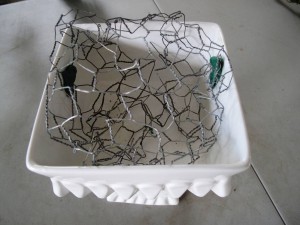
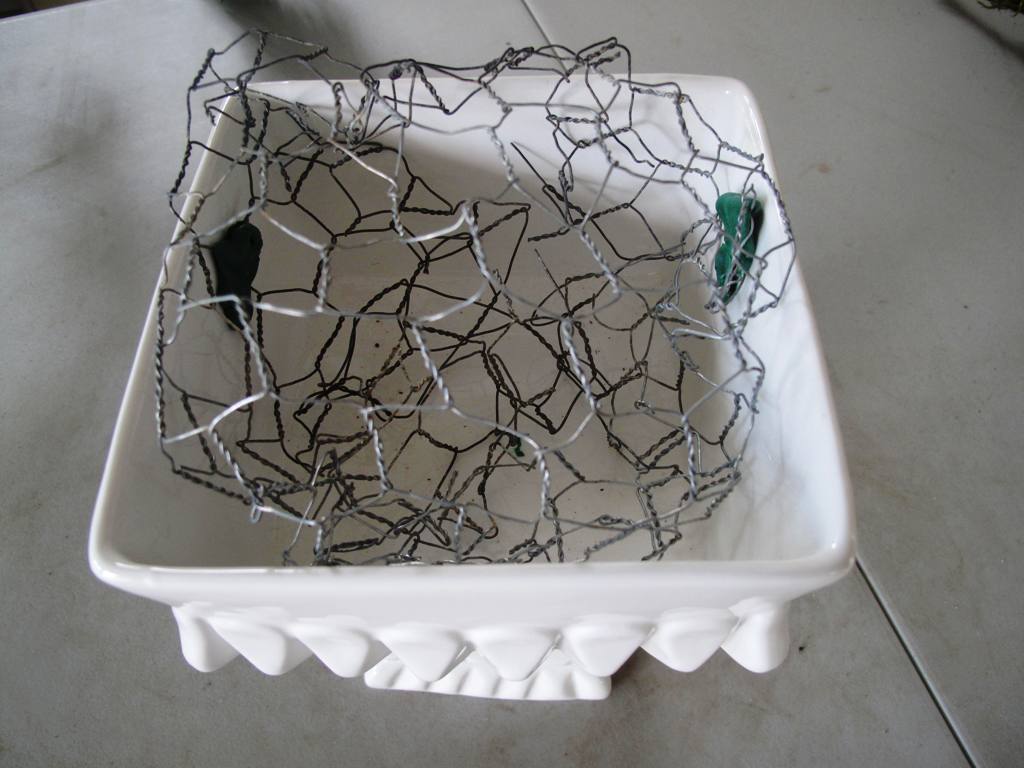
The chicken wire is somewhat inelegant, but you’d never know it by looking at the finished bouquet above.
This is just the sort of shallow vase into which a conventional florist would stick a chunk of foam before arranging the branches and stems. But if you’ve been a reader of this blog for any length of time, you know I am a big hater of foam.
A simple square of chicken wire, formed into a mushroom-cap shape and inserted into the opening of the vase, is the perfect alternative. I use this wire over and over again, rarely throwing it into the recycling bin until I’ve gone through multiple arrangements.
Enjoy! Not sure when I’ll resume this bouquet-a-week project, but I promise to share more of my local, seasonal and sustainable floral projects in 2014.
Posted in American Grown, Blog Posts, Creativity, floral design, General, Plants, Slow Flowers: 52 Weeks | 1 Comment »
© Debra Prinzing, all written and photographic content. Website design/development by Willo Bellwood/Metric Media