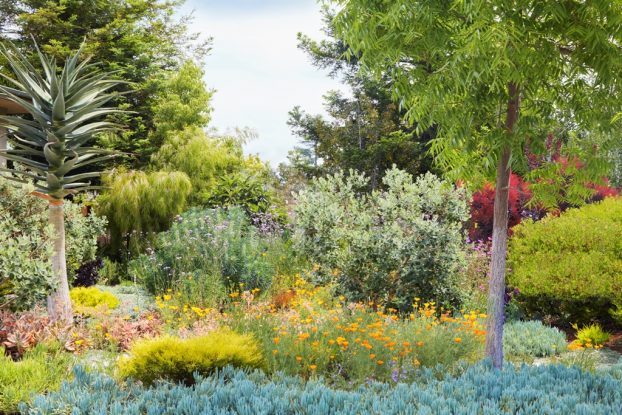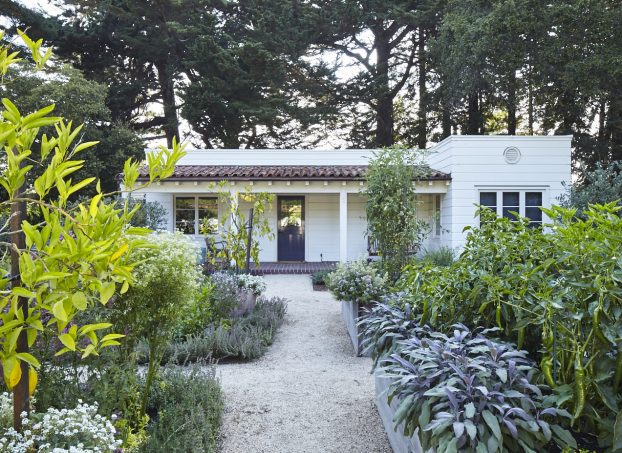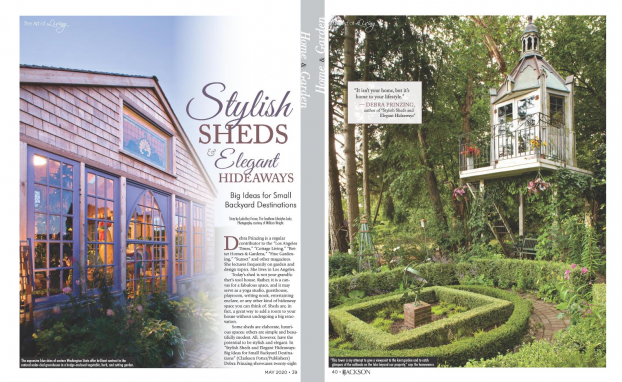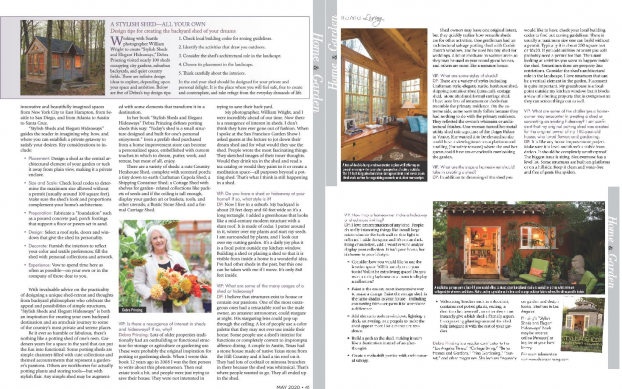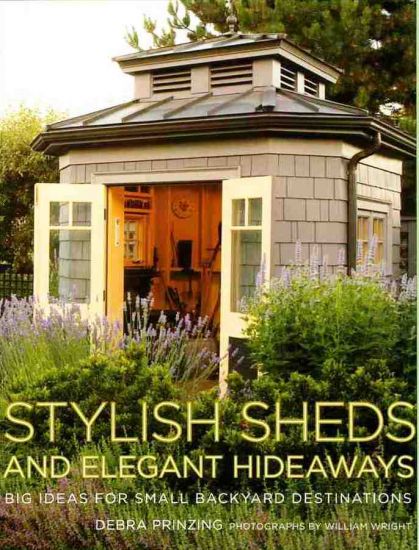
Published in 2008, Stylish Sheds and Elegant Hideaways is more relevant than ever!
In 2008, after a year of scouting the country for “stylish sheds” with my wonderful collaborator, Seattle photographer Bill Wright, and after months of interviewing shed owners, designers and builders, then writing 50k words or some ridiculous amount of text, Clarkson Potter (Random House) published Stylish Sheds and Elegant Hideaways.
We loved that book so much. We loved how beautiful Bill’s photography was, capturing the personalities and stories of each shed owner, not to mention unique geographical and architectural characteristics of each shed. We loved storytelling through my interviews, conversations that dug deep into the psyche of hideaways, retreats and shelters.
Bill and I were truly ahead of our time. We saw around the corner and we believe that Stylish Sheds captured a shift in how people viewed their gardens and the once-neglected huts or sheds that stood there.
Our book documented that lovely shift toward viewing sanctuary not as somewhere you have to travel to, but somewhere that exists just steps away from your backdoor.
Well, 2008 was a financial disaster and the bottom fell out of the real estate market. Our timing could not have been predicted. Ten years later, a number of copycat books emerged on the marketplace. And Bill and I just sat their and thought: Wow, we were visionaries! The promotional machine we needed in the lifestyle media marketplace was in its own crisis when Stylish Sheds was published. That was the era when magazines like House & Garden, Cottage Living, Domino and others suddenly folded.
Eventually, nearly 20k copies of Stylish Sheds were shipped to booksellers, more than any other book I ever wrote. But then, it went out of print a few years later. You can still find this special title on your library shelf and through online sellers of used books.
We were quite suprised recently when Lyda Kay Ferree, a lifestyle writer for a group of magazines in the South, contacted us to see if she could excerpt a few of Bill’s photos and interview me for an April 2020 Home & Garden feature for VIP Jackson Magazine and one of its sister publications.
Lyda Kay definitely “gets” this book. When she contacted me to set up the phone interview, she wrote: “I am fortunate to live in an historic district in a 100-year-old home, complete with the original potting shed with brick walls. (It has electricity but no running water.) I had saved an article about your book as I am getting ideas for my potting shed.”
Well, we had a lovely conversation about Stylish Sheds, and Lyda Kay’s article appears here, with photography graciously provided by Bill. Seeing those beautiful and diminutive structures we documented brings back a flood of memories of that year — between summer of 2006 and summer of 2007 — when Bill and I produced 35 photo shoots in 52 weeks.
Itinerant seekers of inspiration, we felt like we were on a treasure hunt, gathering the best tiny architecture and design ideas to share in our book’s pages.
Lyda Kay has shared the PDF of her article and you can download or read it here. We’re so pleased that she reached out and helped to remind us of this special book and the memories of creating it. Thank you, Lyda Kay!
We are watching our cities in crisis as people struggle for justice during what feels like endless and senseless acts of violence (and worse, murder) against people of color.
There is no other way to say this: The killing of black people by police has to stop.
Until those in white privilege (myself included) address generations of neglect, ignorance, unwillingness to understand, and acceptance of systemic racism in our country. This is the world we brought our children into and this is the world we absolutely have to confront and change.
Along with many friends and colleagues in the Slow Flowers community and the larger horticulture and floriculture community, I feel like I need to do more than speak out. I need to act.
To start, I’ve decided to donate $5,000, all of the Slow Flowers revenue for the month of May, to the Equal Justice Initiative, Bryan Stevenson’s amazing nonprofit legal organization that works in criminal justice reform, racial justice and public education. Based in Montgomery, Alabama, they are literally working on the front lines to end mass incarceration and excessive punishment in the United States, to challenge racial and economic injustice, and to protect basic human rights for the most vulnerable people in American society.
We care about “Stories of Resilience” here, on the podcast and in the larger Slow Flowers community. I thank you for reading this post and encourage you to make a human gesture of support for the marginalized and disenfranchised in your community.
I ask you to join me and find ways to do more than nod or shake your head. I urge you to act in doing this essential work. Let’s do some justice with our flowers. Here is a list of organizations you may wish to consider for your donations, volunteer efforts, and – most importantly – personal education.
This list was compiled by the Slow Flowers Team and will be updated:
Equal Justice Initiative @eji_org The Equal Justice Initiative is committed to ending mass incarceration and excessive punishment in the United States, to challenging racial and economic injustice, and to protecting basic human rights for the most vulnerable people in American society.
Campaign Zero An online platform and organization that utilizes research-based policy solutions to end police brutality in America.
Black Visions Collective A black, trans, and queer-led organization that is committed to dismantling systems of oppression & violence, & shifting the public narrative to create transformative, long-term change.
We also recommend you use this valuable tool when considering a charity to support. Charity Navigator.
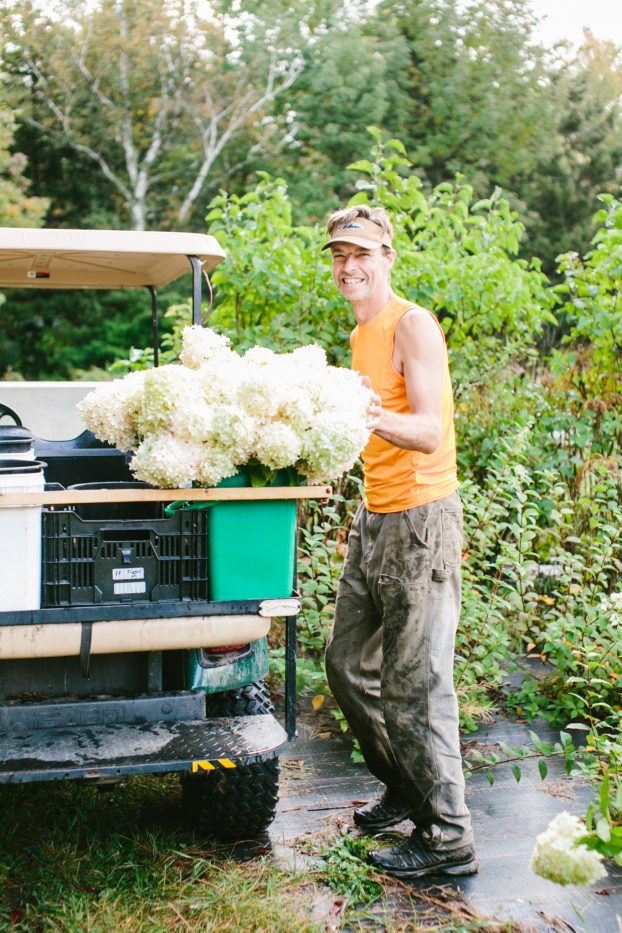
Hydrangea harvest with Walt Krukowski of Mountain Flower Farm (c) Taken by Sarah
This is the 350th episode of the Slow Flowers Podcast brought to you by Slowflowers.com, the free, nationwide online directory to florists, shops, and studios who design with American-grown flowers and to the farms that grow those blooms.
In feeling overwhelmed and uncertain about how the coronavirus pandemic will alter our beloved floral marketplace, perhaps forever, it soon became clear to me that sharing individual stories from our members is one way I could help our community. I don’t have many answers and each voice you hear on the Slow Flowers Podcast may not either, but collectively, as we continue to speak honestly about our challenges and successes, we hope to encourage and support one another.
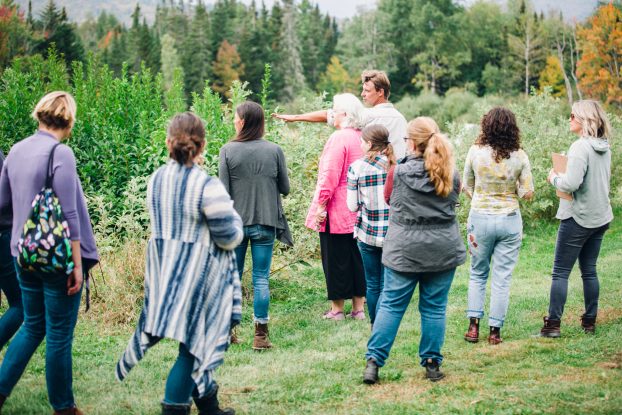
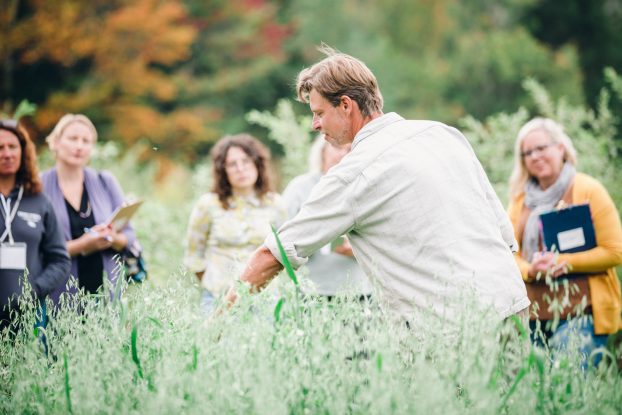
Walt Krukowski of Mountain Flower Farm, leading a tour of his growing fields in late September 2019 (c) Taken by Sarah
Our featured guest this week is flower farmer-entrepreneur Walt Krukowski of Mountain Flower Farm in Warren, Vermont. Walt joined me via Skype to talk about his amazing farm and I’m honored to add his voice to our Stories of Reslience series.
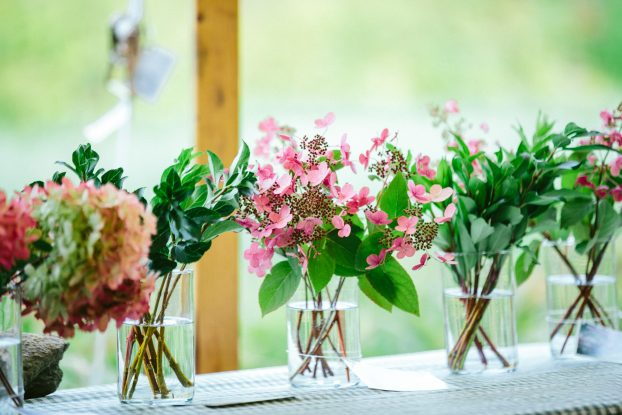
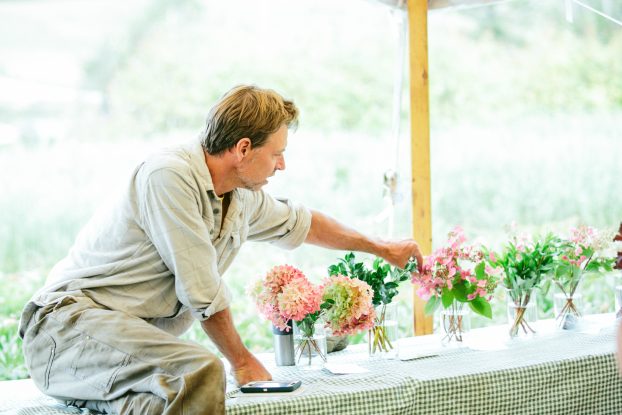
I met Walt last September when I joined a floral sourcing workshop hosted by Kelly Shore of Petals by the Shore and Mary Kate Kinnane of The Local Bouquet. A group of 10 of us gathered for two days of education, including a full day with Walt as he walked us through the beautiful rows of late-summer ornamental crops grown for flowers and foliages. Hydrangeas, viburnum and forsythia for miles, it seemed. A stunning setting and an organic farm where bespoke flowers are grown with care. Sarah Collier of Taken by Sarah photographed the workshop and design sessions and she’s shared some lovely photographs of Walt, his farm and his flowers.
A selection of hydrangeas grown by Walt Krukowski (c) Taken by Sarah
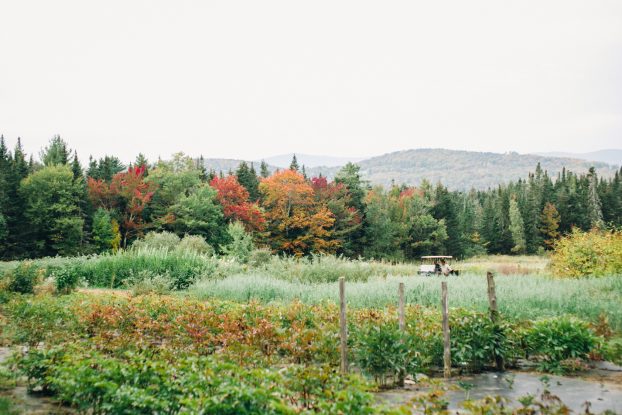
Here’s a bit more about Mountain Flower Farm: Nestled in The Green Mountains of Vermont’s Mad River Valley, the family farm is focused on quality, sustainability, and community. For over 20 years Mountain Flower Farem have served discerning floral designers nationwide with grower direct overnight shipping. Our reputation has been founded on producing exceptional quality seasonal crops, like Peony, Lilac, Snowball Viburnum, and Hydrangea.
The farm adheres to sustainable agriculture techniques like cover cropping, companion planting, and nurturing beneficial insect habitat to provide the backbone of our #beyondorganic farming operations. Crops are grown in vibrant, healthy soil, with a balanced biological ecosystem, certain to contain abundant nutrients, minerals, and live soil microbes. Chemical fertilizers, pesticides, herbicides, or fungicides are never used.
Mountain Flower Farm is located in Vermont’s Mad River Valley (c) Taken by Sarah
Mountain Flower Farm’s bloom schedule is delayed by Vermont’s slow-to-come, cooler summers. When most sources for seasonal cuts have finished for the year, Walt and his crew are just getting started! Of particular note, the farm’s peony crop is harvested from mid June – mid July.
COVID 19’s disruption in our world coincided at almost the same time Walt typically announces Mountain Flower Farm’s seasonal crop availability and opens up the pre-order system for peonies. His communication with his customers via email really struck me as extraordinary and I asked him to join me on the podcast to discuss Mountain Flower Farm’s present, past and future. I know you’ll find it encouraging.
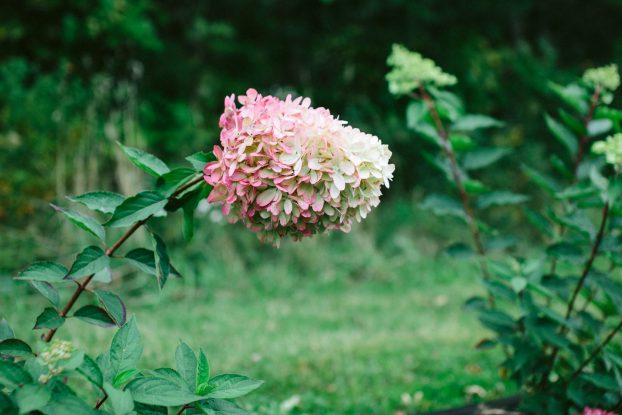
One exquisite bloom (c) Taken by Sarah
Thank you so much for joining me for this special conversation! I believe that now, more than ever, the messages of sustainability and seasonal and locally-available flowers is top of mind — among consumers, flower farmers and florists. Walt wrote this in his first newsletter of the season, dated March 31st: ” . . . one thing for certain is that we will be here toiling away, with our hands in the dirt, flowering fiercely for the future. Mountain Flower Farm is already in action, and we will be here doing whatever it takes to safely put flowers in your hands. Our model of grower direct overnight shipping was made for these times! Social distancing. Door to Door Delivery. Top quality product. Consistency. Value.
“These are not new themes for us . . . in fact, this is what we have trained for and what we have been streamlining and perfecting for over 20 years! We stand ready to help our customers succeed through challenging times.”
The tour continues with Walt at Mountain Flower Farm (c) Taken by Sarah
Just one week later, he continued the story, and this is what inspired me o invite Walt to share more with you today.
“A week ago, in the midst of great uncertainty, we stuck to our schedule and published this season’s cut flower availability. Sending that email was for me, a moment that I was dreading. Questions and doubts were bountiful. We all know by now, life has been turned upside down. The economy is reeling, and the floral industry is one of many hard hit segments.
“It brings me incredible comfort and hope to be able to check in today and report that the response we’ve received has been nothing short of incredible. For that, I am absolutely thankful and humbled. Our community is strong. There is hope, not only for @mountainflowerfarm, but for all of us trying to make it through this time. Thank you all for your generous orders. For your faith in our farm, our team, and our collective future. One thing that really struck me, that I want to share, is the nature of the orders we received.”
He continued, “As many of you know, we preceded our cut flower inventory release with a sliding scale discount offer created to help floral designers persevere. Customers could choose which level of discount they needed. I was very happy to see people taking advantage of this offer. I was also surprised, when I started to receive orders with notes attached saying ‘Thank you so much for this offer. I don’t need any flowers for my shop, but I’m placing this order for peony roots for our home garden,’ or others saying ‘Thank you for thinking of us florists and trying to help . . . I’ve placed orders for the season, but chose to not use any of the discount offers.'”
Walt Krukowski, presenting at last September’s floral sourcing workshop (c) Taken by Sarah
In the 24 hours after releasing Mountain Flower Farm’s discount offer, Walt received literally hundreds of emails. All of them full of appreciation, hope, and positivity. He responded, writing, “For that, I want to stand on the tallest peak and shout “THANK YOU!!!” “THANK YOU!!!” “THANK YOU!!!” We’ve come to a point where, it’s really not abount sales or money anymore. It’s about humanity. It’s about hope. It’s about resilience. Like everyone, I have legitimate fear and worry right now. The outpouring of support that has been received this past week has helped to calm my worries and point my focus towards the future. Our floral community is strong. We are all connected, and for that I am absolutely grateful.”
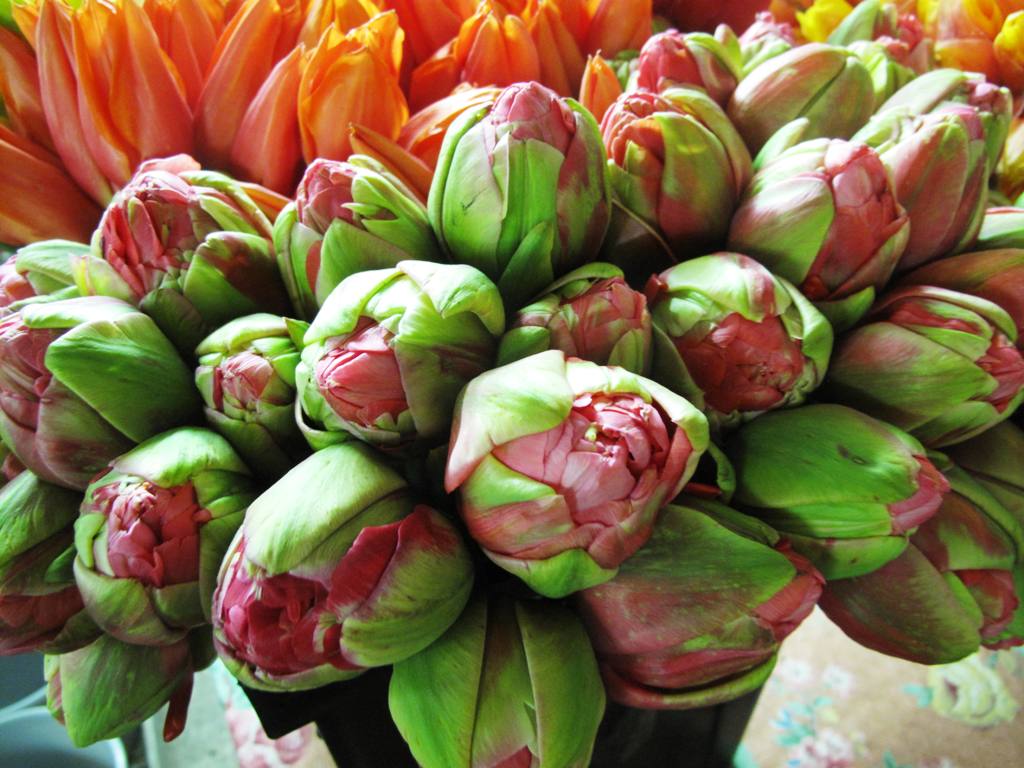
Tulips grown by Gonzalo Ojeda of Ojeda Farms, a farmer I know and trust.
As I said last week, I want the Slow Flowers
Podcast to be a companion to those of you in isolation, away from your physical
community of peers, neighbors, customers and friends. I hope today’s interview
was as inspiring to you as I found it to be for me.
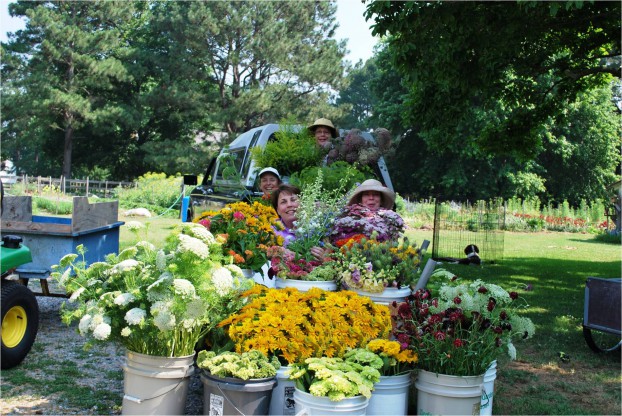
The Gardener’s Workshop Cut Flower Farm: Lisa Ziegler and her family and crew.
Before we wrap today, I want to share a bonus interview with Lisa Ziegler of The Gardener’s Workshop, our newest Slow Flowers Podcast sponsor, announced last week. Lisa is a fellow garden writer, author of Cool Flowers, published by St. Lynn’s Press, the same publisher behind my books, Slow Flowers and The 50 Mile Bouquet. Lisa is a flower farmer, based in Newport News, Virginia, where The Gardener’s Workshop is also home to an online shop offering seeds and supplies for home gardeners and a growing curriculum of online courses for flower farmers and farmer-florists. I invited Lisa to give us an overview and update on The Gardener’s Workshop.
Thanks so much for joining me today as we heard from two flower farmers who have developed their businesses to reflect their passions and fit their lifestyles. And truly, that is what I wish for each of you and your floral enterprise.
Last week we held our third Virtual Member Meet-Up on April 10th. We had a great group in attendance and I thank you for joining us; A special thank you to Holly Chapple of Chapel Designers, Holly Chapple Flowers and Hope Farm, for her guest appearance to talk about how she is adapting during the Coronavirus. You can find the link to the Zoom replay video here. Thank you to each of you who attended!
Join us! Here is the Zoom Replay Video from April 10th
Please join this week’s Slow Flowers Virtual Meet-Up on Friday, April 17th at 9 am Pacific/Noon Eastern. Please join here. We’ll also share the Zoom Meeting Link in our Instagram Profile and on Facebook (Slow Flowers FB Page and Slow Flowers Community Group).
Thank you to our Sponsors
Florists’ Review magazine. I’m delighted to serve as Contributing Editor for Slow Flowers Journal, found in the pages of Florists’ Review. Read our stories at slowflowersjournal.com.
Longfield Gardens, which provides home gardeners with high quality flower bulbs and perennials. Their online store offers plants for every region and every season, from tulips and daffodils to dahlias, caladiums and amaryllis. Check out the full catalog at Longfield Gardens at longfield-gardens.com.
Syndicate Sales, an American manufacturer of vases and accessories for the professional florist. Look for the American Flag Icon to find Syndicate’s USA-made products and join the Syndicate Stars loyalty program at https://shop.syndicatesales.com/.
Rooted Farmers. Rooted Farmers works exclusively with local growers to put the highest-quality specialty cut flowers in floral customers’ hands. When you partner with Rooted Farmers, you are investing in your community, and you can expect a commitment to excellence in return. Learn more at RootedFarmers.com.
The Slow Flowers Podcast has been downloaded more than 596,000 times by listeners like you. Thank you for listening, commenting and sharing – it means so much.
As our movement gains more supporters and more passionate participants who believe in the importance of the American cut flower industry, the momentum is contagious. I know you feel it, too. I value your support and invite you to show your thanks and with a donation to support my ongoing advocacy, education and outreach activities. You can find the donate button in the column to the right.
The content and opinions expressed here are either mine alone or those of my guests alone, independent of any podcast sponsor or other person, company or organization.
The Slow Flowers Podcast is engineered and edited by Andrew Brenlan. Learn more about his work at soundbodymovement.com.
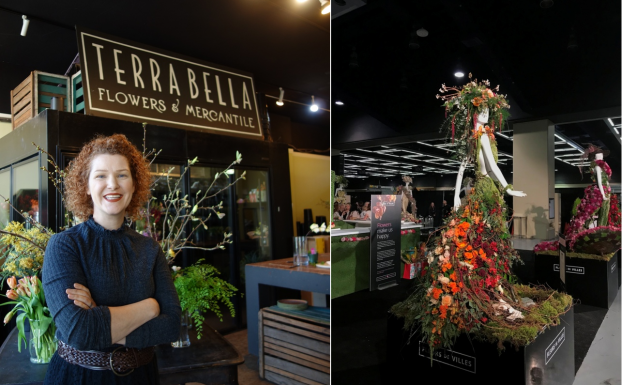
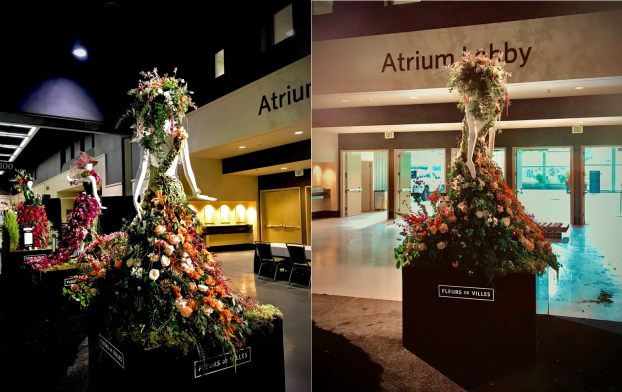
Melissa Feveyear of Seattle’s Terra Bella Flowers (left) with her “Persephone” creation for Fleurs de Villes at the NW Flower & Garden Festival
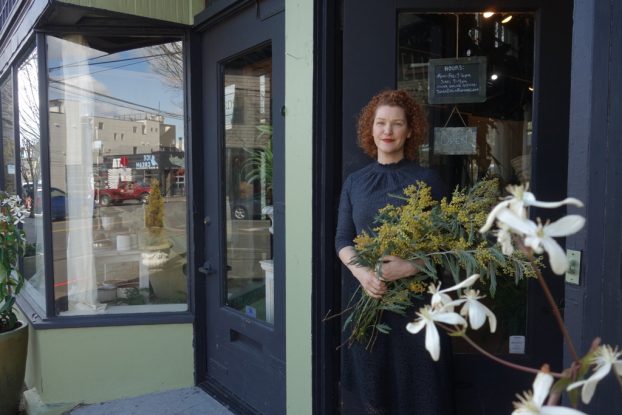
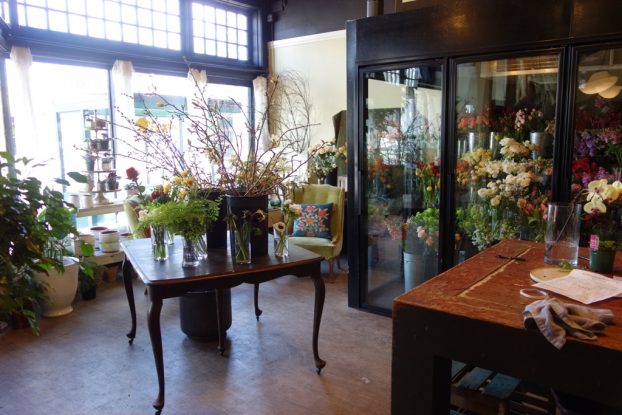
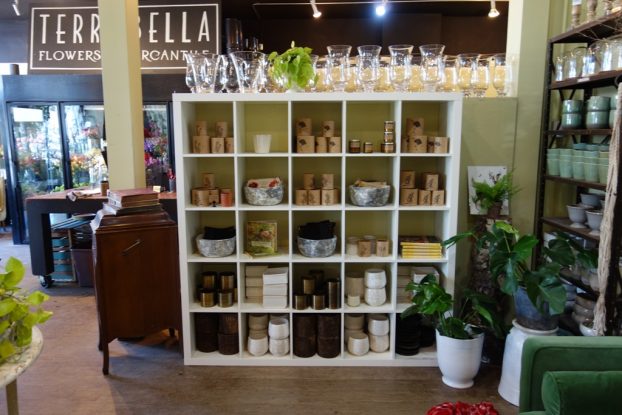
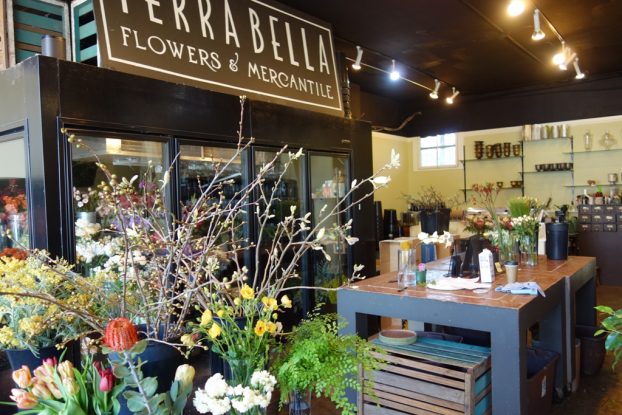
This week, we’re welcoming back Melissa Feveyear, founder and creative director of Seattle-based Terra Bella Flowers, a past guest of the Slow Flowers Podcast. You first heard from Melissa when she appeared as our guest in 2015 — it’s been nearly five years since she and I recorded that episode. Some of you may know Melissa from the pages of The 50 Mile Bouquetas a pioneering leader in sustainable floral design. Recently, Melissa expanded her retail shop in Seattle’s Greenwood/Phinney Ridge neighborhood and I visited her there to record today’s episode.
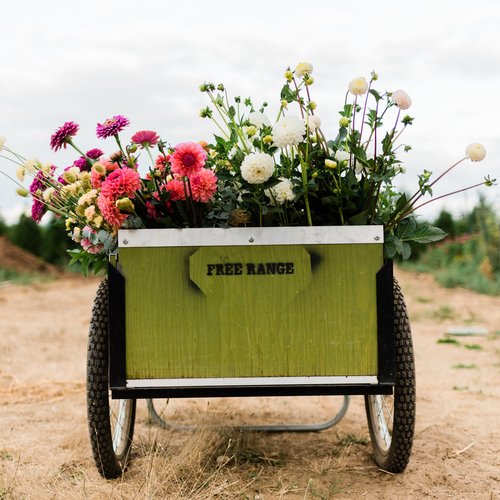
Celeste Monke of Free Range Flowers (c) Caylie Mash Photography
But first, this week marks the launch of a new bonus series on the Podcast called Stories of Resilience. Now, more than ever, the message of sustainability and seasonal and locally-available flowers is top of mind — among consumers, flower farmers and florists.
Yet, due to the unprecedented pandemic and health crisis, many of us are hunkered down at home. Our business plans are in limbo and we’re all trying to get a grasp on what the future — short and long-term — looks like. My heart breaks for us all and so I hope that the Slow Flowers Podcast can continue to be a companion to those of you in isolation, away from your physical community of peers, neighbors, customers and friends. I don’t have many answers, but I do want to keep the lines of communication open and accessible.
Celeste Monke of Free Range Flowers is our first Stories of Resilience guest. I’m so pleased that she joined me for a recorded conversation last week. I had spent much of the prior ten days envisioning ways to help our community through various channels in the Slow Flowers platform. Bringing you the Stories of Resilience series is one low-tech way to support you as we begin adjusting to the new normal — we have always used the Slow Flowers Podcast as a forum for conversation and now, this Podcast will bring you voices of flower farmers and floral designers as we discuss ideas, strategies and resources to help you stay grounded in your purpose and calling through your own floral enterprise. Sustaining your floral enterprise is as important as your sustainable practices.
Harvesting field crops at Free Range Flowers
Here’s a bit more about Free Range Flowers and its farmers. Free Range Flowers is an eight-acre flower farm in Whatcom Country, located just ten miles from downtown Bellingham, Washington, at a ranch founded by Jay Roelof. Jay is described as a dreamer at heart. His long-term vision pulls everything on the farm into order. He is the farm’s anchor. He is also a true grower. Having studied horticulture at Montana State and managed field operations for a large native plant nursery, he has an intuitive sense for what plants need and an agile understanding of mechanics and farm systems.
Celeste and Jay, Free Range Flowers (c) Caylie Mash hotography
Jay’s partner, Celeste Monke is the farm’s full-time farmer and florist. Besides being a grower, she’s a dreamer, a lover, a feeler, an optimist and a bit of a rebel. Celeste made her roundabout way from Arizona to Bellingham, in trying to find a way to live a life of positive production. In spending time as a seed collector and propagator, she found a partner, Jay, with whom she started a cut flower farm. She and Jay operate Free Range Flowers with an emphasis on sustainable practices, wildflowers and native plants. When not outdoors working, she tries to find time to be outdoors playing, talking philosophy, writing poetry and trying to make this world more just.
Free Range Flowers (c) Caylie Mash Photography
Celeste is an at-large board member of WA Young Farmers Coalition, which supports Washington’s young and beginning farmers and farmworkers in their pursuit of agrarian revival by offering unique social and educational events, enabling access to critical resources, and fostering a strong community of allies.
Melissa Feveyear of Terra Bella Flowers — photographed in the doorway of her shop on Seattle’s Phinney Ridge
Next up, my visit to Terra Bella Flowers and a sit-down with Melissa Feveyear. The occasion for our conversation was to discuss the beautiful floral couture dress Melissa designed for theFleurs de Villes display, held in Seattle February 26-March 1 at the Northwest Flower & Garden Festival and at Seattle’s Pacific Place.
Persephone, Melissa’s all-domestic-adorned creation for Fleurs de Villes at the Northwest Flower & Garden Festival
More than a dozen Slow Flowers designers and teams participated as Fleurs de Villes artists to create floral couture that adorned lifesize mannequins. Melissa designed a mythical garment for our Slow Flowers-sponsored mannequin featuring all local and domestic botanicals and I want to share more about that project, as well as hear Melissa’s update on her retail floral business.
Here’s Melissa’s artist statement about
her Fleurs de Villes design:
Persephone, Goddess of Spring, emerges from the underworld and with each step, garden roses, blooming branches and spring blooms awaken and burst into a vibrant display of color. Inspired by Art Nouveau painter Alphonese Mucha, our Persephone is adorned exclusively with American-grown blooms and botanicals.
Terra Bella founder and creative director Melissa Feveyear is a founding member of the Slow Flowers Movement, a campaign designed to inspire the floral industry and its consumers to embrace local, seasonal and sustainable flowers.
Read more about Terra Bella and Melissa’s story here
Terra Bella Flowers
We sat together in two velvet-upholstered vintage chairs and recorded this interview on March 11th. My, so much has happened in the two weeks since. I hope you find the same inspiration as I have from this intrepid and intentional artist.
I know you’ll be inspired by this beautiful, light-filled shop where plants flourish in a conservatory-like atmosphere and the fragrance of flowers greets those who enter
I don’t know what the
future holds, but I do know that the silver lining of the enforced quarrantine
in world at least has led to walks on the beach at Saltwater State Park and my
finally finishing my rose pruning and fertilizing project. Or plants, seeds and
bulbs are oblivious to the madness and for that I take comfort. I send
blessings and a wish that you can be grounded in this time.
Thank You to Our Sponsors:
First, this podcast is brought to you by Slowflowers.com, the free, nationwide online directory to florists, shops, and studios who design with American-grown flowers and to the farms that grow those blooms. It’s the conscious choice for buying and sending flowers.
Florists’ Review magazine. I’m delighted to serve as Contributing Editor for Slow Flowers Journal, found in the pages of Florists’ Review. It’s the leading trade magazine in the floral industry and the only independent periodical for the retail, wholesale and supplier market. Take advantage of the special subscription offer for members of the Slow Flowers Community.
Association of Specialty Cut Flower Growers. Formed in 1988, ASCFG was created to educate, unite, and support commercial cut flower growers. It mission is to help growers produce high-quality floral material, and to foster and promote the local availability of that product. Learn more at ascfg.org.
Longfield Gardens, which provides home gardeners with high quality flower bulbs and perennials. Their online store offers plants for every region and every season, from tulips and daffodils to dahlias, caladiums and amaryllis. Check out the full catalog at Longfield Gardens at longfield-gardens.com.
FarmersWeb software makes it simple for flower farms to streamline working with their buyers. By lessening the administrative load and increasing efficiency, FarmersWeb helps your farm save time, reduce errors, and work with more buyers overall. Learn more at farmersweb.com.
Minnesota-grown roses from Len Busch Roses — featured at the Slow Flowers Summit 2019
The fourth annual Slow Flowers Summit takes place in late June, but I want to make a few comments for those of you who’ve registered or who are planning on doing so. I want to address concerns regarding COVID-19 and coronavirus, concerns that are affecting all of us in our daily lives.
Rest
assured we are working in partnership with the Summit venue, Filoli, to monitor the
options available to reschedule the Summit. We’ll have an announcement on those
plans soon, and I’m as eager as you are to experience a fabulous conference
that’s presented in a safe environment.
The Slow Flowers Podcast has been downloaded more than 590,000 times by listeners like you. Thank you for listening, commenting and sharing – it means so much.
As our movement gains more supporters and more passionate participants who believe in the importance of the American cut flower industry, the momentum is contagious. I know you feel it, too. I value your support and invite you to show your thanks and with a donation to support my ongoing advocacy, education and outreach activities. You can find the donate button in the column to the right.
The content and opinions expressed here are either mine alone or those of my guests alone, independent of any podcast sponsor or other person, company or organization.
The Slow Flowers Podcast is engineered and edited by Andrew Brenlan. Learn more about his work at soundbodymovement.com.
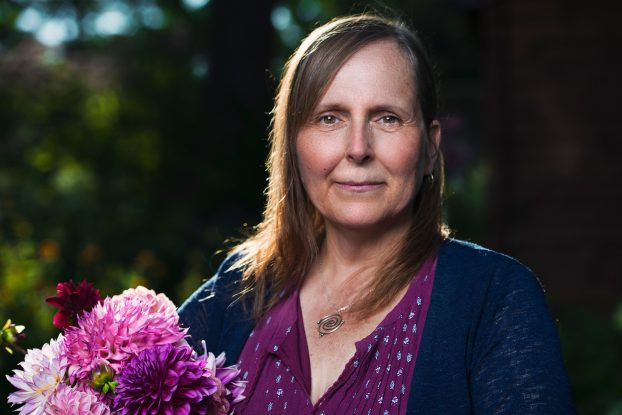
Today’s first guest has been on my “wish list” for a few years, basically since she joined Slow Flowers and I became familiar with her business Alchemy Farm Flowers. I’m so happy today to introduce you to Ingrid Koivukangas, environmental artist, flower farmer, floral designer, educator and innovator.
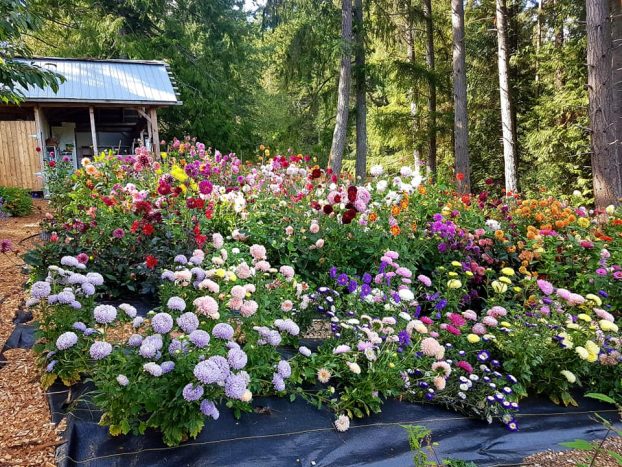
Alchemy Farm on Salt Spring Island, B.C.
As you will hear in our conversation, Alchemy Farm Flowers is based on Salt Spring Island in British Columbia, a destination that’s sandwiched between Vancouver Island to the west and the U.S. San Juan Islands to the east. It’s reached via car ferry or float plane and I am mesmerized by the videos and photographs I’ve seen on Salt Spring Tourism‘s web site. Meeting Ingrid “virtually” only makes me more eager to visit her in person.
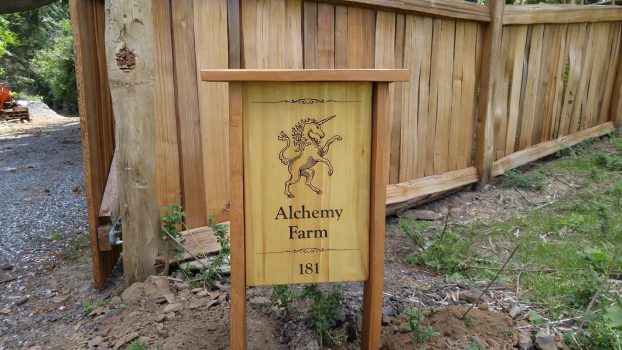
Welcome to Alchemy Farm
Here’s more about Alchemy Farm and its owner:
Alchemy Farm
is situated on ten acres in the beautiful Burgoyne Fulford Valley on Salt
Spring Island. The property was once part of the historic 200-acre George and
Kate Furness homestead, first settled in the 1880s.
Alchemy Farm is owned by award-winning environmental artist, Ingrid Koivukangas, and Robin Logan, a retired UK Homeopath and woodsmith. Both are creatives, healers and dreamers. The couple married on the Winter Solstice and they believe in love and magic – hence their chosen farm name: Alchemy Farm. Ingrid and Robin’s stewardship of this magical property is rooted in their deep love for the Earth and Nature, of becoming self-sufficient, living in harmony with all beings and providing safe habitat for bees and pollinators.
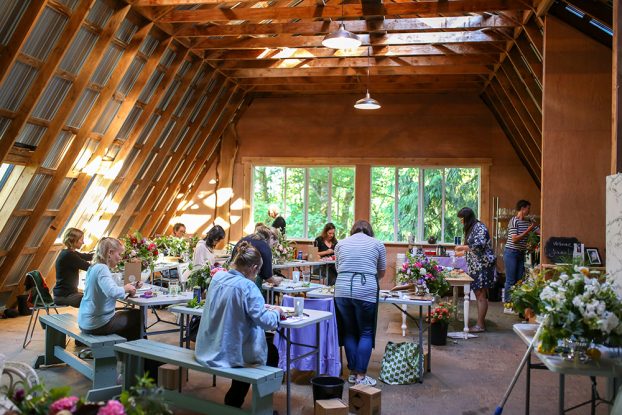
The studio at Alchemy Farm where Ingrid hosts classes and workshops.
From the Alchemy Farm fields there is a spectacular view of Mount Maxwell towering over the Fulford Valley. Eagles circle overhead. Choruses of frogs serenade from the many ponds. The original hedgerows, planted by early settlers, still mark the boundaries of the property along the eastern and western edges. The orchard is rich with apple, pear, plum and cherry trees. Blackberries drape over decaying fences. The land is awake with potential as its stewards continue to create a sustainable flower farm, an oasis of healing.
The farm produces gorgeous flowers in tune with the seasons, grown without chemicals or pesticides to provide safe homes and food for pollinators—plus flowers for humans to enjoy.
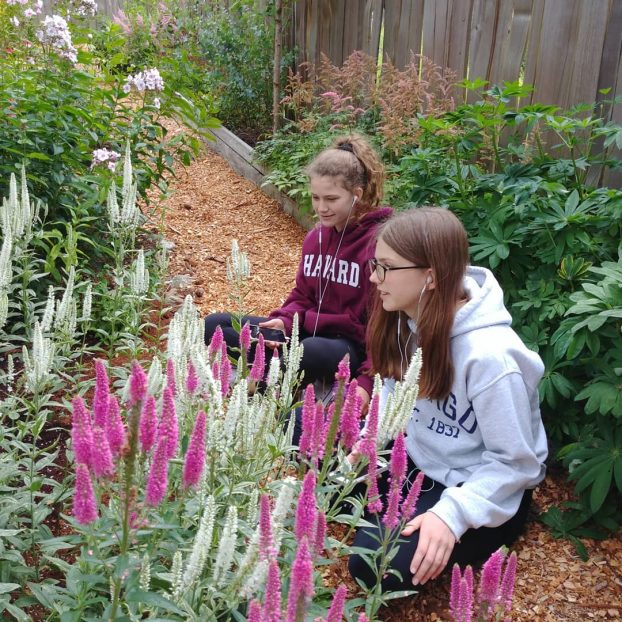
Young visitors are enchanted by the Music Garden at Alchemy Farm, where they can listen to the bioenergy of flowers (note the earbuds!)
Ingrid teaches flower workshops to businesses, groups and private students, incorporating botanicals harvested directly from her gardens. She created the Alchemy Flower Music Garden Tour as an environmental art exhibit that connects visitors to the music created from the bioenergy of flowers! It’s a magical experience. Those who visit the seasonal Farm Stand can shop for flowers, jams, fruits and veggies, from May to September. Alchemy Farm’s online shop offers dahlia tubers, seeds and other products.
Florals grown and designed by Ingrid Koivukangas of Alchemy Farm
Enjoy this tour of Alchemy Farm’s Sound & Music Garden
Find and follow Alchemy Farm at these social place:
Next up, our first interview with one of seven regional directors who are part of the ASCFG leadership — we’ll be recording conversations with all of these folks throughout the coming year. I hope to record as many as possible in person, but we’ll have to see how and where my travels in 2020 take me.
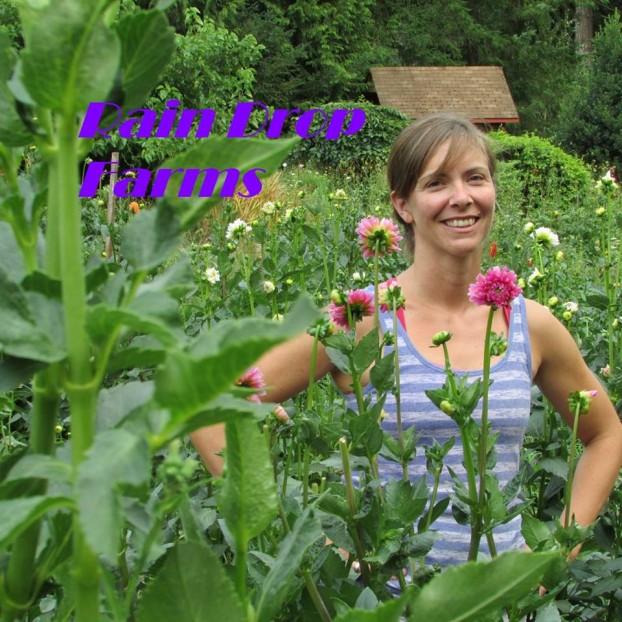
Please meet return guest Erin McMullen of Rain Drop Farms. Erin and her husband Aaron Gaskey are veteran flower farmers in Philomath, Oregon, near Corvallis. Rain Drop Farms was established in 1999 on a one acre plot in their backyard. They had every intention of growing vegetables, and threw in a few dahlia tubers that grandma gave them. Later, after a long search, Erin and Aaron were finally able to purchase their own piece of paradise and move to the farm’s current location, at the base of Oregon’s Mary’s Peak.
Those dahlia tubers made the
move with them and before long they had more flowers than potatoes and the
beginning of a dream. Rain Drop Farm grows flowers in a way that benefits not
only flower-loving customers, but also their natural neighbors. This
means avoiding using harsh chemicals or insecticides and opting for natural and
organic solutions to any pest problems. This all supports their belief
that the flowers that grace our tables should be as healthy as the food we
feed our bodies.
Erin is entering her second year as the West & Northwest regional director, representing the Association of Specialty Cut Flower Growers in Alaska, California, Hawaii, Idaho, Nevada, Oregon, and Washington.
Our book giveaway comes thanks to Jennifer’s publisher Timber Press. Last week, we asked listeners to post a comment about an extraordinary woman who influenced their plant journey. Thank you to all who took the time to comment on our show notes at debraprinzing.com and on Instagram’s @myslowflowers In a random drawing last Sunday, March 8th, I selected the winner: Catharine McCord!
Catherine posted a comment celebrating her friend Shelley who can be found on IG as @artemisiaandrue, as an incredible mentor, herbalist, teacher, and friend, writing: “Shelley has introduced me to many plants, spiritually and medicinally. My life is forever changed as I share this knowledge on how plants can be our emotional, spiritual, and nourishing allies.“
Congratulations Catharine — look for a copy of The Earth in Her Hands coming to you soon!
The Slow Flowers Summit takes place in just four months and you’re invited to join the uplifting experience that has been called a Floral Mind Meld. Our first two days will be hosted at FiloliHistoric House and Gardenin Woodside, California, outside the SF Bay Area, where we will gather on days one and two — June 28-29th. On day three, June 30th, we will enjoy a special tour of Farmgirl Flowers’headquarters in San Francisco, hosted by our friend and past Slow Flowers Summit keynote speaker, Christina Stembel. All in all, it will be special and exclusive — and I can’t wait for you to join us!
Many of you have been asking about lodging – and I’m happy to announce that our event manager Karen Thornton has just posted details about room blocks under the Travel & Accommodations tab at Slowflowerssummit.com.
Teresa Sabankaya in her garden in Bonny Doon, California
We’ve also included details about a special, limited, pre-Summit opportunity that’s just been announced. Our co-host Teresa Sabankaya of Bonny Doon Garden Co.in Santa Cruz, and her husband Nezih Sabankaya, are throwing a Speaker Dinner in their private gardens in the Santa Cruz Mountains. The dinner will take place on Saturday, June 27th, the night before the Summit begins, and it is separately priced. The seating is limited, so if you’re interested, follow the link at the Summit website.
It promises to be an intimate evening for anyone who travels to the area early and wants to connect with fellow attendees and speakers. Thank you, Teresa and Nezih Sabankaya for creating this lovely opportunity.
Designed by Nancy Cameron of Destiny Hill Flower Farm.
The Slow Flowers Podcast has been downloaded more than 586,000 times by listeners like you. Thank you for listening, commenting and sharing – it means so much.
As our movement gains more supporters and more passionate participants who believe in the importance of the American cut flower industry, the momentum is contagious. I know you feel it, too. I value your support and invite you to show your thanks and with a donation to support my ongoing advocacy, education and outreach activities. You can find the donate button in the column to the right.
Thank you to our sponsors
Florists’ Review magazine. I’m delighted to serve as Contributing Editor for Slow Flowers Journal, found in the pages of Florists’ Review. It’s the leading trade magazine in the floral industry and the only independent periodical for the retail, wholesale and supplier market. Take advantage of the special subscription offer for members of the Slow Flowers Community.
FarmersWeb. FarmersWeb software makes it simple for flower farms to streamline working with their buyers. By lessening the administrative load and increasing efficiency, FarmersWeb helps your farm save time, reduce errors, and work with more buyers overall. Learn more at www.farmersweb.com
Syndicate Sales, an American manufacturer of vases and accessories for the professional florist. Look for the American Flag Icon to find Syndicate’s USA-made products and join the Syndicate Stars loyalty program at syndicatesales.com.
Longfield Gardens, which provides home gardeners with high quality flower bulbs and perennials. Their online store offers plants for every region and every season, from tulips and daffodils to dahlias, caladiums and amaryllis. Check out the full catalog at Longfield Gardens at longfield-gardens.com.
The content and
opinions expressed here are either mine alone or those of my guests alone,
independent of any podcast sponsor or other person, company or organization.
The Slow
Flowers Podcast is engineered and edited by Andrew Brenlan. Learn more
about his work at soundbodymovement.com.
Music Credits:
Castor Wheel Pivot; Alustrat; Great Great Lengths; Gaena; Glass Beads by Blue Dot Sessions http://www.sessions.blue
From left: Lorene Edwards Forkner, Christin Geall, moderator Jennifer Jewell and Debra Prinzing at the Northwest Flower & Garden Festival
Jennifer Jewell—Creator and host of the public radio program (and podcast) Cultivating Place, is a past guest of this podcast.
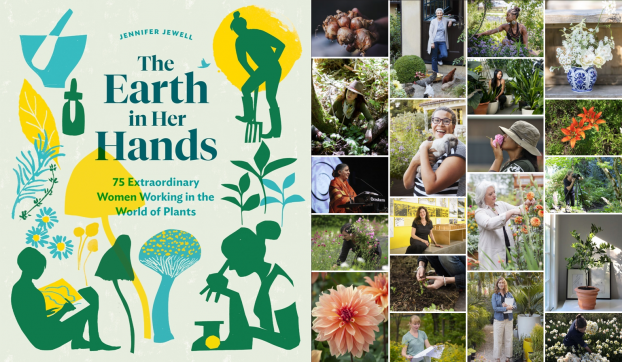
Now, she is also an author and is on tour to promote her book, The Earth in Her Hands, which has the subtitle: 75 Extraordinary Women Working in the World of Plants.
This past week, Jennifer was in Seattle to speak at the Northwest Flower & Garden Festival and, among other appearances, she led a panel discussion that we recorded for today’s episode.
Hot off the Press: Jennifer Jewell’s new book, “The Earth in Her Hands”
In writing The Earth in Her Hands, Jennifer
learned how the women profiled creatively navigated the challenging ideal of
work-life balance. The main lesson? Balance is not a destination but an ongoing
and highly dynamic process.
NWFGF Panel, from left: Lorene Edwards Forkner, Christin Geall, Jennifer Jewell and Debra Prinzing
In the panel, of which I was a part, Jennifer focused our
conversation on many common challenges, coping mechanisms, and solutions that
follow women through their careers in the plant world.
Along with me, the panel included two other past guests of this podcast, so the voices and personalities may be familiar to you. You’ll also hear designer and author Christin Geall, of Cultivated (who I invited on the podcast just a few weeks ago), andLorene Edwards Forkner, author, artist, and Seattle Times garden columnist, and creator of the #seeingcolorinthegardenproject.
These women graciously agreed to this recording and I’ll
just jump right in and let you listen as if you were in the Northwest Flower
& Garden Festival audience last week.
Jennifer Jewell, creator and host of “Cultivating Place: Conversations on the Natural World and the Human Impulse to Garden”
Jennifer Jewellis host of the national award-winning, weekly public radio program and podcast, Cultivating Place: Conversations on Natural History & the Human Impulse to Garden, Jennifer Jewell is a gardener, garden writer, and gardening educator and advocate.
Particularly interested in the intersections between gardens, the native plant environments around them, and human culture, she is the daughter of garden and floral designing mother and a wildlife biologist father. Jennifer has been writing about gardening professionally since 1998, and her work has appeared in Gardens Illustrated, House & Garden, Natural Home, Old House Journal, Colorado Homes & Lifestyles, and Pacific Horticulture. She worked as Native Plant Garden Curator for Gateway Science Museum on the campus of California State University, Chico, and lives and gardens in Butte County, California.
Christin Geall of Cultivated by Christin, designing with a no-foam method
Christin Geall lives on Vancouver Island, along the western edge of Canada. She is a gardener, designer, writer and teacher who grows flowers and shares her designs through Cultivated by Christin, a creative studio launched in 2015.
Christin’s eclectic background includes pursuits that are equal parts physical and intellectual. She apprenticed on a Martha’s Vineyard herb farm, interned at the Royal Botanic Gardens, Kew, and homesteaded on a remote island in British Columbia. Academic studies in ethnobotany, environmental science and a creative writing MFA led to editorships, university-level teaching and a regular gardening column for local newspapers.
Today, Christin’s artistic focus centers around her urban flower farm-design studio in USDA Zone 8, the tiny hub of a multifaceted floral business.
Lorene owned a popular and beloved boutique specialty nursery in Seattle for more than a decade, called Fremont Gardens; she has served on the boards of a number of horticultural organizations, has edited a horticulture journal and is the designer of two gold medal display gardens at the Northwest Flower and Garden Festival.
Most recently, Lorene’s creative life can be found on Instagram, where @gardenercook she shares a series called “Seeing Color in the Garden.” She started this project on April 3, 2018 as part of #the100dayproject as #100DaysofSeeingColorintheGarden. She continued her series with #Another100 DaysofSeeingColorintheGarden.
Thank you so much for
joining today’s episode featuring Jennifer Jewell and two women, who along with
me are featured in The Earth in Her Hands,
Christin Geall and Lorene Edwards-Forkner.
As a special bonus, we’re giving away a copy of The Earth in Her Hands, courtesy of Timber Press, Jennifer’s publisher.
To enter, please leave a comment below about an Extraordinary Woman who influenced your personal relationship with plants. We’ll draw one recipient from among the posted comments on Sunday, March 8th and announce the winner in our March 11th episode. Please note: this giveaway is open to U.S. and Canadian entrants.
Clockwise from top, left: Susan Mcleary, Kellee Matsushita-Tseng, Molly Culver, Lorene Edwards Forkner, Debra Prinzing, Jennifer Jewell, Pilar Zuniga and Emily Saeger
If you liked the subject of this episode, you’re invited to dig deeper with two of the panelists because they are coming to the Slow Flowers Summit in the SF Bay Area at Filoli- the historic garden and home that is hosting us on June 28-29th. Jennifer Jewell will be our Slow Flowers Summit capstone speaker – and she will speak more expansively on women’s role in shaping our plant world and beyond, as well as sign copies of her new book. Lorene Edwards Forkner will also be one of our Slow Flowers Summit presenters and I’m so excited for you to experience seeing color in the garden through her eyes as you develop your own sensibility and observational skills, learning from color in the garden — from the landscape to the centerpiece.
It will be a special experience and I can’t wait for you to join us!
The Slow Flowers Podcast has been downloaded more than 583,000 times by listeners like you. Thank you for listening, commenting and sharing – it means so much.
As our movement gains more supporters and more passionate participants who believe in the importance of the American cut flower industry, the momentum is contagious. I know you feel it, too. I value your support and invite you to show your thanks and with a donation to support my ongoing advocacy, education and outreach activities. You can find the donate button in the column to the right.
THANK YOU TO OUR SPONSORS
Florists’ Review magazine. I’m delighted to serve as Contributing Editor for Slow Flowers Journal, found in the pages of Florists’ Review. It’s the leading trade magazine in the floral industry and the only independent periodical for the retail, wholesale and supplier market. Take advantage of the special subscription offer for members of the Slow Flowers Community.
Longfield Gardens provides home gardeners with high quality flower bulbs and perennials. Their online store offers plants for every region and every season, from tulips and daffodils to dahlias, caladiums and amaryllis. Check out the full catalog at Longfield Gardens at longfield-gardens.com.
Mayesh Wholesale Florist. Family-owned since 1978, Mayesh is the premier wedding and event supplier in the U.S. and we’re thrilled to partner with Mayesh to promote local and domestic flowers, which they source from farms large and small around the U.S. Learn more at mayesh.com.
Association of Specialty Cut Flower Growers. Formed in 1988, ASCFG was created to educate, unite, and support commercial cut flower growers. It mission is to help growers produce high-quality floral material, and to foster and promote the local availability of that product. Learn more at ascfg.org.
I am in love with my greenhouse, designed and built sustainably by Oregon-based NW Green Panels (c) Missy Palacol Photography
The content and
opinions expressed here are either mine alone or those of my guests alone,
independent of any podcast sponsor or other person, company or organization.
The Slow Flowers Podcast is engineered and edited by Andrew Brenlan. Learn more about his work at soundbodymovement.com.
Desert Collection, designed by Morgan Anderson, Ph.D., of The Flori.Culture (c) Macey Sierka
Happy New Year 2020! Last week’s podcast commemorated the close of 2019 with an extensive Year in Review episode. And while I couldn’t highlight and thank every single person who made last year a special one, I touched on many of the bright spots in our full year of Slow Flowers. Please go back and have a listen if you missed it.
I’m excited to share highlights from the sixth annual Slow Flowers’ Floral Insights and Industry Forecast — the 2020 edition, but before I do so, we have a special guest to welcome, Teresa Tibbets of Dandelion Floral, based in Lander, Wyoming.
All during 2019, our Fifty States of Slow Flowers series brought you a diverse range of voices and experiences from Slow Flowers members across the U.S. This ambitious series doubled the number of Slow Flowers Podcast guests we brought to you during the course of the year. Thank you to each of our state guests for their willingness to share their personal floral narrative with listeners. Together their stories amplified the thriving message that our Slow Flowers Movement is taking place everywhere and anywhere that people, gardens, soil and sunshine exist.
Teresa Tibbets with a bouquet of fall flowers (c) Kristy Cardinal Photography
Today, that series comes to a close today. Even though it’s January 1st 2020, due to a few scheduling hiccups, I couldn’t quite fit our final state – Wyoming – into 2019, so today, please meet Teresa Tibbets of Dandelion Floral.
left: Teresa designing with her Wyoming-grown blooms (c) Kim Branagan Photography; right: this boutonniere is made with lisianthus, amaranth, and aspen (c) Teresa Tibbets
Teresa is a flower farmer and studio-based wedding and event florist who specializes in growing heirloom and ephemeral flowers. She also raises “xeric natives,” such as yarrow, coneflower and rudbeckia; and she forages locally for Aspen, juniper and sage.
left: June Peony Bouquet (c) Blushing Crow Studio; right: a Dandelion Floral bridal bouquet, photographed at Karisa Mountain Lake. The anemone and ranunculus was grown on Teresa’s farm in Lander, Wyoming (c) Apartment10
Teresa says: “My designs are inspired by nature’s form and structure, embracing the whimsical and wild. The aesthetic of the Rocky Mountains is loose and light, balancing the soft with prickly; the fine with bold. We take our cues from the deserts and the mountains. An arrangement full of lush, shiny, deep green foliage looks artificial and contrived here, in my opinion. Instead, we embrace the blue-grays of sage and juniper; the delicate texture of golden grasses and twinkling yellow-green of Aspen.”
A Dandelion Floral bouquet with lilac, tulips, and anemone, which Teresa calls “the harbingers of the beginning of the flower season.”
Find and follow Dandelion Floral at these social places:
It has been
a privilege to feature this important series and I thank you for joining me. As
I mentioned last week, we missed a few — namely Hawaii and Delaware — but I’ll
do my best to add voices from those states in the coming months.
Next up: I’m
excited to share highlights from the annual Slow Flowers’ Floral Insights and Industry Forecast.
This Forecast began six years ago and I’m more inspired than ever about the focus of this project. Since 2013, I have tracked and documented the shifts and changes in the Slow Flowers Movement, devoting considerable much time and resources during the past several years while also educating about and advocating for locally grown, seasonal and sustainable flowers. As a result, the awareness of our Movement has also increased. More farms are producing more domestic flowers; more designers are selecting domestic flowers as artistic elements of their work; and more consumers are asking for local flowers.
Traction, momentum and change can be measured
incrementally, so you will notice that in this year’s 2020 Forecast some of the
topics and key insights represent subtle rather than seismic shifts from past
year’s themes, or at the very least, an expansion of them.
I’ve titled the forecast Green Horizons.
To develop this report, I began by
surveying Slow Flowers members and social media followers last fall, asking
questions about their floral businesses, including emerging themes and topics
important to them.
I drew further insights from my 2019 storytelling — first-person interviews for print and digital Slow Flowers Journal stories, interviews with more than one-hundred Slow Flowers Podcast guests, and attitudes gathered from conversations with thought-leaders in floral design, flower farming and related creative professions.
I hope you find these
forward-thinking resources important and valuable. I’d love to hear your
feedback and suggestions about topics missed.
Download a PDF of the 2020 Forecast from Canadian Florist
A sentence jumped out to me a few months ago as I read a Time magazine profile of Rose Marcario, CEO of Patagonia. It went like this: “Today’s customers want their dollars to go to companies that will use their money to make the world a better place.”
A fitting statement, given that Patagonia, which recently surpassed $1
billion in annual sales, donates 1% of its sales to environmental groups. To
me, that story about Patagonia underscores a theme that resonates with that of
our 2020 Slow Flowers’ Floral Insights
and Industry Forecast:
“Belief-driven buyers choose a brand on the basis of its position on social issues.”
Time interview with Rose Marcario, CEO of Patagonia
If you think this is a fringe topic, you’re wrong. According to market consultancy Edelman, nearly 2 in 3 consumers are belief-driven buyers.
Let’s review 2 0 1 9 before we welcome the New Year!
Thank you for being part of the Slow Flowers Community and tuning into the Slow Flowers Podcast during 2019. I’m honored and humbled that you take time to join me each week — especially in the midst of an ever-more-crowded and cluttered environment for information.
Listenership of this program has grown more sizeable than ever. Last year at this time, I told you the Slow Flowers Podcast had been dowloaded more than 390,000 times since this show launched in July 2013. Fast-forward to today and that number has climbed to 560k. With an average monthly count of more than 14k episode-downloads, I’m incredibly encouraged that this Podcast remains relevant and essential, as we deliver the voices, stories and information you crave and enjoy.
Every single week this year; in fact, every single week for the past 334 weeks, it has been my privilege to feature heroes from the Slow Flowers community. Unlike any other internet radio show in existence, the Slow Flowers Podcast is tailored to you and your interests, making its “must-listen” programming a weekly habit among flower farmers and floral designers alike.
In producing and hosting the Slow Flowers
Podcast, I seek out pioneers and personalities, style-makers and influencers —
as well as unsung or little-known heroes — who together are changing the floral
landscape, disrupting the status quo, and bringing flower sourcing and growing
practices, not to mention eco-conscious design methods, to the center of the
conversation.
A highlight of 2019 was our expansive and inclusive series: Fifty States of Slow Flowers! We’ve nearly made it through the entire alphabet — from Alabama’s Lisa Thorne of Thorne & Thistle to Wyoming’s Teresa Tibbets of Dandelion Floral— who you’ll hear next week on New Year’s Day.
This ambitious series doubled the number of Slow Flowers Podcast guests we brought to you in 2019. Thank you to each of our state guests for their willingness to share their personal floral narrative with listeners. Together their stories amplified the thriving message that our Slow Flowers Movement is taking place everywhere and anywhere that people, gardens, soil and sunshine exist.
Click here to find our show archives dating back to the first episode, which aired on July 23, 2013.
Sally and Courtney, photographed just as they completed the upstairs kitchen at Flower House in 2015.
Today, we’ll start the show by introducing you to Wisconsin’s Sally Vander Wyst of The Milwaukee Flower Co.
Sally is a past guest of this podcast; you met her back in 2015 when I interviewed many of the floral artists who created botanical rooms for Flower House Detroit.
Sally and her collaborator Courtney Stemberg discuss their design for the upstairs kitchen at Flower House, a beautiful botanical installation entitled: “Nature Takes Back.”
It’s so hard to believe here we are four years later — and Milwaukee Flower Co. has a lot of news to share!
Wisconsin’s Slow Flowers Community has always been a strong one and I’m grateful for growers and designers who are committed to seasonal and local blooms in the upper midwest — including Sally Vander Wyst.
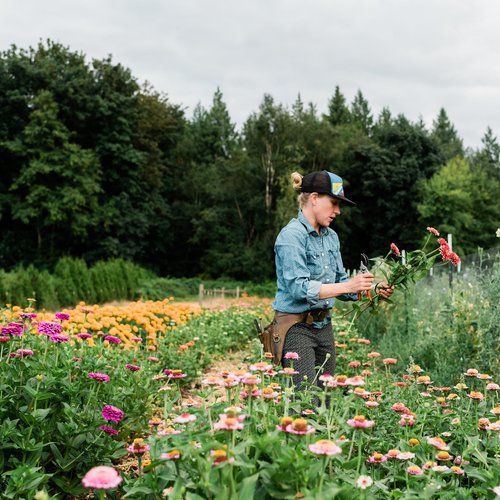
Sally Vander Wyst of Milwaukee Flower Co. — harvesting zinnias in her mini-farm/cutting garden
I’m so happy I could catch up with Sally – you’ll want to stay tuned for her return to this podcast when she has more to report on the upcoming “Floral Spectacle” — a collaboration with fellow Slow Flowers member Liz Egan of Floral Alchemy, also based in Milwaukee. The two are cooking up something big and flowery to occur during the Democratic National Convention in Milwaukee next summer. I can’t wait to learn more.
Left: A bridal bouquet featuring flowers from Milwaukee Flower Co.’s garden, from other Wisconsin farms and roses sourced from California. all-American grown (c) GE Creative; right: Sally in her cutting garden (c) @autumnsilvaphotography
Next up: As I have done since the beginning of 2014, I
would like to devote today to the Slow Flowers
Highlights of this past year. Next week, on January 1st, I
will present the annual Slow
Flowers’ Floral Insights and Industry Forecast for 2020.
Last year at this time, we reflected on the highlights of 2018 with 10 Top Themes. The sentiments I shared with you then are no truer today. In fact, given the world in which we live, they are more meaningful to me than ever. One year ago, I said this:
“More than ever, I realize that making authentic human connections with you is what really matters. Each experience is more meaningful because of the relationships we forge with one another.”
Please know how valuable that statement is —
relationships are the connective tissue that ties us together — no matter
where we live geographically and no matter which role we play in the floral
marketplace.
What did we do in 2019? Each of our four
content channels and our live programming have added up to an incredible year
of engagement, interactivity, relationships and more. The year began with the
unveiling of our new Slow Flowers
Society branding and web site — a central hub for all of our Slow Flowers
projects.
Why the Society? Our focus hasn’t changed.
In fact, our mission continues:
“To change the flower sourcing practices of consumers and professionals through outreach and education that highlights the benefits of local, seasonal and domestic floriculture — and to build a movement that promotes cultivation and sales of those flowers while nurturing authentic connections between consumers, farmers, and florists.”
This name change was long in coming. Yet it
didn’t happen impetuously or overnight. Launched at the start of 2019 when we
were already turning a calendar page and thinking about a clean re-boot, the
new Slow Flowers Society branding brings clarity to the Slow Flowers platform.
Since I wrote the book Slow Flowers, a lot has happened
with these two words: Slow. Flowers.
These two words now symbolize an entire
movement. A movement that hundreds of thousands of florists, flower farmers,
retailers and designers use as short-hand to reflect their belief in local,
seasonal and sustainably-grown botanicals.
After the book’s publication, and as it became clear to me that there was an opportunity to position Slow Flowers as an industry standard, new ideas inspired me to bring the following channels and programs to life. With five channels and programs, each of which has its own exclusive web site things were getting a little unruly. And truth be told, those individual and focused web addresses still exist and they are continually updated with dedicated content. By building a “front door” — via slowflowerssociety.com — we helped connect the dots for all of our activities. I hope you find it helpful, too.
About Slowflowers.com. With the help of Lisa Waud of pot + box, a longtime member and all-around organizational genius, I tackled a major cleanup of the Slow Flowers membership database in 2019, which allowed me to pivot the focus and energies of Slowflowers.com to support and encourage those of you who have invested your time, creativity and financial resources as members. We wrapped up 2019 with nearly 650 active and engaged members representing flower farmers, farmer-florists, designers, wholesalers, collectives, and more.
We recently
established Slow Flowers International, an International
Affiliate program for like-minded organizations in other countries. And it is
with great pleasure that in 2019, our friends at SLOWFLOWERS ITALY joined as
our first International Affiliate!
Founded in 2017, SlowFlowers Italy members are part of a network of professionals, of people who carry the values of respect and attention to the environment, local territories, traditions and community development. Welcome and Congratulations! We can’t wait to partner with you in raising awareness about seasonality, sustainability and the benefits of supporting local floral agriculture!
Member Benefits
Slow Flowers is both a community and a branding platform and clearly, one of the most visible tools available to our members is Slowflowers.com, the online member directory. But there are so many other members benefit from your Slow Flowers’ association. Sharing those resources with you will be the focus of 2020 as we will use the Slow Flowers Podcast and the Slow Flowers Journal online magazine to feature ways to leverage your membership, and communicate the Slow Flowers member Values and Benefits.
I’ve found that the number one goal of our
members is to tell and share their story, and because I’m a storyteller, we
have lots of opportunities to shine a light on our members. In a marketplace
filled with conventional flowers, our members are able to differentiate
themselves and their floral enterprises by associating with the passion and mission
of keeping flowers local, seasonal and sustainable — and inspiring the
imagination of flower lovers and floral consumers who learn more about that
narrative.
To that end, in 2019, we produced two
year-long projects. Those series allowed me to feature Slow Flowers members all
across the U.S. and Canada with special themes.
Visually, we featured the flowers grown and designed by Slow Flowers members who contributed to our monthly Houzz.com series in 2019. We planned a full year of Slow Flowers Galleries, with each month’s floral theme published as a “Best of” collection of design inspiration based around specific seasonal blooms. Check out this link to the full 2019 gallery. In all, we shared more than 250 floral images with Houzz.com readers — publishing an ongoing, consistent message that local and seasonal botanicals are superior.
Our other series, Fifty States of Slow Flowers, succeeded beyond all of my hopes and dreams. We were able to visit members in nearly every state — I think we skipped just two — and perhaps 2020 will allow me to catch up with the states we missed. But think about it — the chance to hear from flower farmers, floral designers and farmer-florists across North America also reinforces the significance of Slow Flowers. Click here to find the full list of our state guests for you to find and listen again.
MEDIA & PRESS
The big media news for Slow Flowers in 2019 happened when Wikipedia added an entry about Slow Flowers and the Slow Flowers Movement. This achievement was a long time in coming and it’s wonderful to see become a reality. As a digital information source, Wikipedia is of growing importance, primarily because it is a free, universal resource, one of the first examples of a usable encyclopedia that is built collaboratively by the public.
Today, when someone types “slow flowers” into their search engine, two entries appear: One is the directory Slowflowers.com, but typically, the Wikipedia story about Slow Flowers pops up first. It’s not everything, but it’s a pretty cool something, because in today’s digital reality, showing up on Wikipedia is a great endorsement. And a special thank you to writer Myriah Towner for shepherding this project with her research, reporting talents and attention to detail.
In the News
More press exposure made this a fabulous year for Slow Flowers in the News — and I just want to take a moment to mention how many outlets expressed interest in our platform. This is by no means comprehensive, but I’ll mention some highlights here. Added up, it’s pretty impressive:
. . . And of course, our ongoing editorial features about Slow Flowers members in each month’s Slow Flowers Journal, found in the pages of Florists’ Review. Let’s pause and reflect on the Slow Flowers-Florists’ Review partnership – it is an incredible one that has been pivotal in moving the conversation about local, seasonal and sustainable flowers – and sustainable design practices – to the mainstream.
We have a seat at the table, and I am so grateful to publisher Travis Rigby and editor-in-chief David Coake for this ongoing opportunity. I am also part of the editorial teams for SuperFloral, a bimonthly magazine geared to mass market/supermarket floral retail; and Canadian Florist, a bimonthly magazine for professional florists in Canada. I’m so thankful for the opportunity to contribute original articles about Slow Flowers members and their creative business ventures to these titles during 2019.
All of this work as a professional communicator opened up another great opportunity for me and Slow Flowers in 2019. In September, I was inducted into the PFCI, Professional Floral Communicators International, a Society of American Florists’ organization. What an honor, that again, brings Slow Flowers into the mainstream as an authentic channel in the floral marketplace.
Producing the Third Annual SLOW FLOWERS SUMMIT occupied so much of our creative energy in 2019. As an event designed for you, our membership, it exceeded all expectations. For those of you who joined us this past year in St. Paul, Minnesota, aka the Twin Cities, I hope you agree. And I thank you for showing your support by attending, engaging, contributing to the conversation and cheering us on. It was a beautiful thing to experience.
As you know, the Summit is the LIVE event in the midst of American Flowers Week, created to serve the Slow Flowers community of progressive, sustainably-minded florists and designers and to engage attendees who want to network with one another.
Planning and producing the 3rd annual Summit was made possible by the contributions of so many people. We must thank our host, Christine Hoffman of Twin Cities Flower Exchange, along with all the flower farmers who sell through that regional floral market, for welcoming us so warmly. More than 135 of us, to be precise. The pre-Summit farm tours of Blue Sky Flower Farmand Green Earth Growersgave everyone a first-hand experience of two incredibly beautiful and prolific Midwest flower farms. Thank you so much to Jon and Rachael Ackerman of Blue Sky Flower Farm (above) and thank you to Jolea Gress and Jenny Hotz of Green Earth Growers for the tour of your fields and greenhouses — and for hosting the first-ever Slow Flowers Dinner on the Farm – a delicious experience to say the least.
We enjoyed 10 fabulous speakers, experts in their fields and experts as teachers and communicators. Due to the intimate size of the Summit attendance, everyone has a chance to meet our speakers personally. That’s one of the key benefits of being part of our Slow Flowers Community. Making in-real-time connections is a top-cited benefit, according to past Summit attendees.
Presentations and demonstrations from Tobey Nelson, Carly Jenkins and Whit McClureensured that floral design was at the heart of the Slow Flowers Summit. Ourattendees and speakers also collaborated on a large-scale, foam-free floral sculpture using seasonal, domestic and foraged botanicals. It was a highlight!
We enjoyed a business-focused keynote from Terri McEnaney, CEO of Bailey Nurseries, and a social media panel with our own social media manager Niesha Blancas, our Summit photographer Missy Palacol, and Missy’s frequent collaborator Kalisa Jenne-Fraser.
And we learned volumes from three innovators involved in the emerging category of locally-focused wholesale floral hubs across the U.S., including Christine Hoffman of Twin Cities Flower Exchange, Amanda Maurman of Michigan Flower Growers Cooperative and Kelly Morrison of Piedmont Wholesale Flowers.
On Day Two of the Summit, attendees were invited to tour the Twin Cities Flower Exchange where florist and event designers and floral designer Ashley Fox shared her personal approach to shopping The Exchange for a floral demonstration using all-local blooms! We also visited the last rose-grower in the Midwest with an afternoon at Len Busch Roses steeped in more Midwest-grown flowers.
If you missed joining us, I have a treat for you. You can watch the free videos of all of the 2019 Slow Flowers Summit presentations — follow this link for the full lineup.
I can’t wrap up mention of the Slow Flowers Summit, without reminding you to register for the Fourth Annual SLOW FLOWERS SUMMIT, taking place June 28-30, 2020 at Filoli Historic House and Garden in Woodside, Calif., outside San Francisco.
Clockwise from top, left: Susan Mcleary, Kellee Matsushita-Tseng, Molly Culver, Lorene Edwards Forkner, Debra Prinzing, Jennifer Jewell, Pilar Zuniga and Emily Saeger
It is going to be an incredibly creative experience, and we’re offering you more value and benefits than ever before. The Early-Bird pricing continues through Dec. 31st so there’s not much time left to save $100 and grab a spot to join me and some wonderful speakers in the Bay Area! Follow this link to reserve your seat and join us!
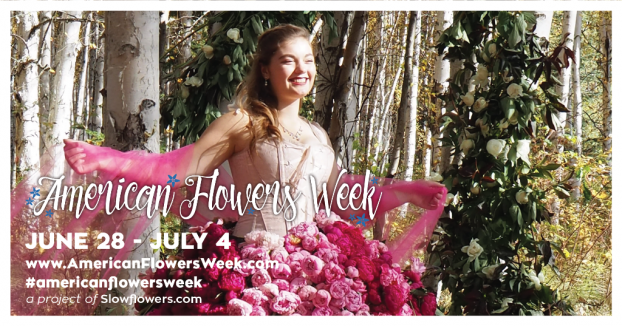
We celebrated the fifth annual AMERICAN FLOWERS WEEKduring June 28-July 4, 2019 — and you and your flowers were at the heart of this fabulous and important campaign.
Slow Flowers created this original U.S. flower promotion holiday, launched in 2015. Our grassroots, all-inclusive campaign provides editorial, branding and marketing resources to flower farmers, florists, designers, retailers and wholesalers who wish to promote American grown Flowers.
Highlights of 2019 include our fourth year to commission botanical couture fashions, with nine creative looks featured in the June 2019 issue of Florists’ Review as “Red, White & Bloom.”
Thank you to the floral designers and
flower farmers who collaborated on this project of flowering our nation
during American Flowers Week. The
inventiveness expressed by the Slow Flowers community — flower farmers and
floral designers alike — elevates American-grown botanicals to new levels.
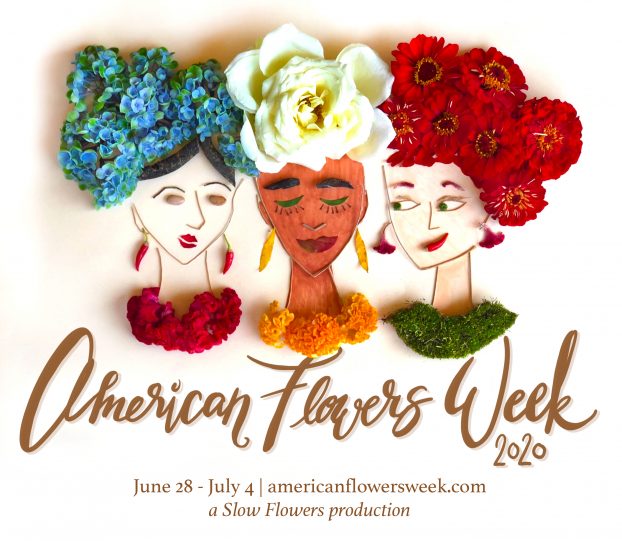
And now’s the time to mark American Flowers Week 2020 on your calendar — June 28 through July 4 — because it will be our sixth annual campaign and celebration! I’ll have more to share in the coming months. For now, check out the 2020 botanical art branding we commissioned from Tamara Hough of Morning Glory Flowers — featured in last week’s Slow Flowers Podcast — and why not download the graphics to share on your web site and via social media? Help me to start building interest and excitement for the 2020 American Flowers Week campaign. And be sure to use the #americanflowersweek hashtag so we can see your posts!
Team Slow Flowers, from left: Jenny Diaz, Andrew Brenlan, Niesha Blancas, Karen Thornton and Lisa Waud
THE PEOPLE of SLOW FLOWERS
Truly, people make the Slow Flowers Movement so successful — you and your tribe coming together with other similar tribes in regions and communities all around, both here in North America – and beyond. We share information, ideas, encouragement, key resources, tips, answers, experiences and more.
We are united in a common belief that local and seasonal flowers, grown sustainably and with minimal harm to the planet, is a practice worthy of our energies.
In 2019, my personal universe was filled with a few key people whose presence and expertise helped me further shape Slow Flowers from what was originally just a concept, a title of a book, into a multimedia, multifaceted content organization and brand platform for others’ use.
In late March, Lisa
and I participated in a spontaneous mind-meld with two other flower friends.
Part getaway; part workation, the gathering of four women creatives in small
and large ventures, from different generations and walks of life, was an
electrifying experience to say the least. What emerged from our time together
was a new collaboration for Slow Flowers, with Lisa joining me to manage a
project I simply did not have time or bandwidth to tackle. I had been yearning
for someone who could help me untangle the crazy knot of our Slow Flowers Member Database. For
many, this would be a mind-numbingly boring, clerical, rather than creative
task. Yet for Lisa, this was a challenge that called her in — and rise to the
occasion, she has.
Other key Who’s include the Slow Flowers Creative Team with whom I work all year long:
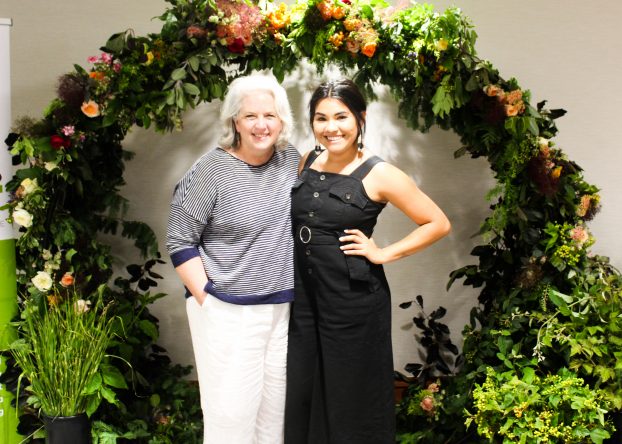
Thank you to Jenny Diaz, our uber-talented graphic designer, whose artistry helps us communicate and represent the ideas and ideals of Slow Flowers. She has consistently supported my projects since I asked her to create our Membership and Sponsor Collateral in 2015, followed quickly by the iconic American Flowers Week branding in 2016 (our campaign’s second year). Our collaboration has expanded to include all of Slow Flowers and American Flowers week branding, advertising, collateral material and now — I’m so excited to be working with Jenny as the designer of the Slow Flowers Journal – Volume One book, out in 2020! More on that later in this episode.
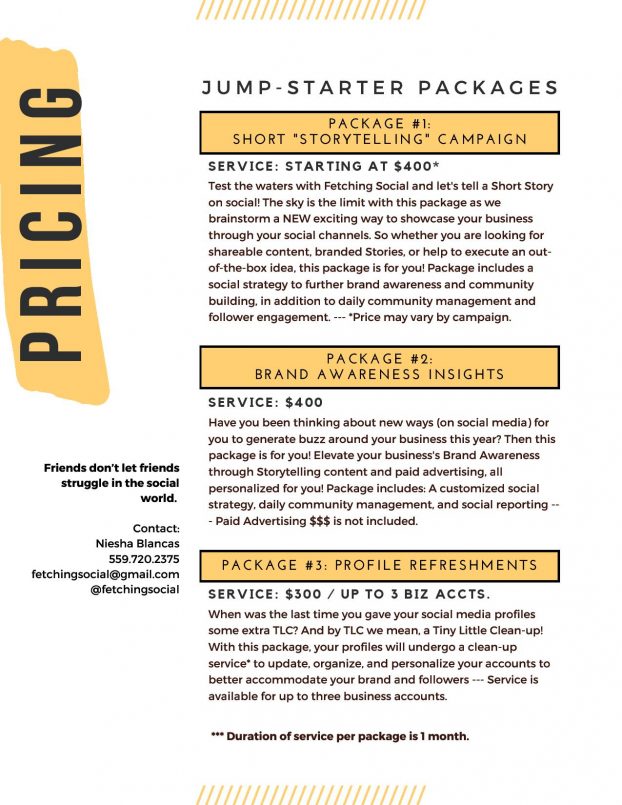
Thank you to Niesha Blancas of Fetching Social Media, our social media maven, who I’ve also known and worked with since 2015. Niesha took over our IG and FB social media strategy two years ago and I couldn’t be more pleased. Under her leadership, talent and attention to detail, Niesha has nurtured the @myslowflowers channel on IG and Facebook’s Slow Flowers page, exponentially increasing our engagement with you, our community. Niesha has been with the Slow Flowers Summit team from the very first conference in Seattle in 2017 and she was also a presenter this past year in St. Paul, Minnesota, at our third annual Slow Flowers Summit. I am so grateful for her creativity and positive influence as we take this Slow Flowers journey together.
Thank you to Karen Thornton of Avenue 22 Events, the steady hand on the tiller of the Slow Flowers Summit since 2018, our second conference. Karen is the secret sauce to my being able to realize a vision for a “multifaceted, interactive and live, in-person experience” that takes place during the heart of American Flowers Week. She is one of my fiercest defenders and the brand advocate I’ve needed to round out the Slow Flowers Team. For 2020, Karen is coming onboard to manage the entire Slow Flowers administrative suite of projects, making sure we stay on time, on budget, on point and more. I couldn’t be happier with the contributions of the four women I just thanked.
And yet, there is one other key person I need to thank!
He’s our dedicated, talented and supportive Podcast Engineer, Andrew Brenlan. Thank you Andrew! Hannah Brenlan was my original producer and after about one year, she handed the weekly production over to her husband Andrew Brenlan. As I said last year: Andrew has taken our audio to new levels, with beautiful musical transitions and his patient and loyal efforts to improve my limited technical skills! Let’s face it: I know how to find great guests and I know how to interview them. But beyond that, this podcast would not exist without Andrew! He’s a new father, too — as Hannah and Andrew welcomed baby Francis to their family. Congratulations, Andrew and thank you so much for making our Podcast so successful in 2019!
As we come to a close, I want to thank our 2019 Sponsors
Slow Flowers sponsors support our work to connect consumers with florists, shops, studios, and farmers who supply and source domestic and American-grown flowers, Made-in-USA floral hardgoods and accessories and related businesses.
I just want to take a minute to thank them for their financial support in 2019 and to tell you a little bit about how each partnership is uniquely tailored to meet mutual goals of promoting American flowers:
You’ve already heard about our partnership with lead sponsor Florists’ Review — but I’ll thank Travis Rigby, editorial director David Coake and art director Kathleen Dillinger here. They and the rest of the Florists’ Review team are a joy to work with and I respect and value our relationship!
Coming up in early 2020 is our first book collab with Florists’ Review: Slow Flowers Journal – Volume One, created with the amazing talented support of Robin Avni as editor and our own Jenny Diaz as designer. I can’t wait to share more but here is a sneak peek of the book cover art (featuring Missy Palacol’s photography) in today’s show notes!
Thank
you to these amazing sponsors:
The peony farmers of Arctic Alaska
Peonies, who supported this Podcast and Slow Flowers Journal in 2019.
The Seattle Wholesale Growers Market and its amazing group of Northwest flower farmers and market staff.
Longfield Gardens for connecting florists to gardening and connecting gardeners to floral design.
Johnny’s Selected Seeds for producing high quality flower foliage and herb seeds for cutting gardens and flower farms of all sizes.
Syndicate Sales for supporting florists
with an incredibly diverse selection of USA-made vases, design mechanics and
accessories.
The Association of Specialty Cut Flower
Growers for its support and leadership in growing flower farming as an
important profession.
Mayesh Wholesale Florist has again supported the Podcast and American Flowers Week and we’re so grateful for their industry support.
Northwest Green Panels, the Oregon-based greenhouse builder which is responsible for my charming 8×8 modern slant greenhouse.
And Farmers’ Web, the software company that came onboard mid-year as a Podcast and Newsletter sponsor.
Slow Flowers is the term most widely used in the floral marketplace to communicate and convey seasonal, local and sustainable floriculture.
It has been another record-setting year in so many ways. According to keyhole.com, our tracking service, Slow Flowers’ metrics are higher than ever. Our social media maven, Niesha Blancas of Fetching Social Media, has worked tirelessly to represent Slow Flowers and its members through the medium — with great results!
In the past 365 days, on
instagram and twitter combined,
Slow Flowers has appeared in more
than 75k posts, up from 47k in 2018.
and has stimulated social media engagement of 2.3 million, up from engagement of 1.4 million in 2018.
Tulips grown by an American farmer I know and trust.
To that I say, What are YOU Waiting For? We’d love you to join Slow Flowers and put your resources, creativity, personal engagement and passion to work for a Movement that gives back to you in volumes. You can start the new year with a commitment to supporting Slow Flowers and you can join us for as little as $50 a year to enjoy the many programs and benefits for members. Follow this link to join us!
Thank you for being a part of
this movement and I hope you’ll make the next step by investing in the
continued relevance and success of this brand
The content and
opinions expressed here are either mine alone or those of my guests alone,
independent of any podcast sponsor or other person, company or organization.
The Slow Flowers Podcast is engineered and edited by Andrew Brenlan. Learn more about his work at soundbodymovement.com.
Well that’s it, folks. As our year comes to a close, I wish you a warm and restorative holiday season and share my hope for a peaceful and productive 2020.
Music Credits:
Basketliner; Betty Dear; Delamine; Gaena; Glass Beads; Highride; Perspiration by Blue Dot Sessions http://www.sessions.blue
This year-long project is coming to a close and it has been so rewarding to bring you a large cross-section of voices and stories of passionate Slow Flowers Members.
I love it that we can approach conversations about floral ventures from two perspectives: from a designer’s point of view and from a grower’s viewpoint.
That’s what today’s interview accomplishes as we check in with two members in Virginia.
Today, I’m thrilled to feature Shanda Zelaya of Flor de Casa Designs, based in Arlington, Virginia (serving the DC Metro area in the Northern part of the state) and Kate Meyer of Chatham Flower Farm in Painter, Virginia (on the Chesapeak Bay/Eastern Shore). Together, they give us a portrait of to the city and the country and how flowers factor into both areas.
Studio wedding and event florist, Shanda Zelaya of Flor de Casa Designs
First, let me introduce ShandaZelaya. We met in 2018 when she attended the Slow Flowers Summit in Washington, D.C., and we recently reconnected at Holly Chapple’s Flowerstock. I’m delighted that you can hear Shanda’s story and her path to floristry.
Born in Costa Rica, flowers have surrounded Shanda since infancy. It wasn’t until she married her best friend in 2015 that she realized just how much she loved flowers. A year later, Flor de Casa Designs was born. Inspired by comments from a complete stranger, Shanda’s Northern Virginia based floral studio caters to brides that have a taste for natural beauty.
She specializes in fine art floral design and offers a design style for couples wanting loose, organic, textured and free-flowing flower arrangements that take inspiration from the beautiful blooms we find in nature. No roundy-moundy’s found here, folks, Shanda insists.
Shanda Zelaya of Flor de Casa Designs, one of our Virginia guests!
Flor de Casa Designs has been featured in several publications, including: Washingtonian Weddings, United with Love, Wedding Chicks and Baltimore Magazine (June 2019 Issue) among others.
Find and follow Flor de Casa Designs at these social places:
That was fun! Hearing about anyone’s path to
flowers is inspiring. Of course, each person’s story is unique. But there is
often a common and universal thread that threads Shanda’s story to my story; my
story to your story and on it goes. That is a
yearning to connect with nature, to express ourselves creatively and
artistically, and to find a profession in balance with a lifestyle of beauty.
Don’t you agree?
Kate Meyer and John Fitzpatrick of Chatham Flower Farm (left) and a field of their dahlias on Virginia’s Eastern Shore (right)
So that thread continues with our second guest, Kate Meyer of Chatham Flower Farm. Kate has an equally fascinating journey to share and you’ll find yourself wanting to put Virginia on your travel list for 2020 just to see where she farms and lives.
Kate Meyer and her husband John Fitzpatrick I knew they wanted to settle on the Eastern Shore a few years back when John came to harvest straw with his brother’s company Aden Brook. They had spent many summers there in Virginia during straw season, extending the length of time each year. After both spending many years traveling for work, Kate says they needed to feel grounded in a place of their own. It was just a matter of finding not only the perfect location, but a home as well.
The historic Chatham Flower Farm.
They found themselves unsuccessful after months spent trying to purchase another farm on the shore – and started a new search. In one day they looked at 13 properties and Chatham Farm was the last one they visited.
The barn serves many purposes, from farm-to-table dinners to art shows.
As Kate writes on Chatham Flower Farm’s web site: “We knew as soon as we walked in the door that we had found our home. This farm was perfect in virtually every single way and has given us an amazing base to build from. By adding our growing in the same ground, we are able to add to the farm’s long history. The land is the framework for our dream of growing beautiful Flowers, Lavender and Herbs, all while combining the Barn Studio , flower and artist workshops to support the history of this land and area of Virginia.”
Chatham Flower Farm’s late-summer harvest adorns tables during a Meet me at the Table community farm dinner.
Find and follow Chatham Flower Farm at these social places:
In all, there are 20 members – floral designers and flower farmers – in Virginia and we’ve been able to feature several of them here in the past — including Lisa Mason Ziegler of Gardener’s Workshop, Andrea Gagnon of LynnVale Studios, Bob Wollam of Wollam Gardens, Holly Heider Chapple of Hope Flower Farm and Jessica Hall and Chris Auville of Harmony Harvest Farm. Click on the links above to listen to those past Virginia episodes!
Photographed at Everyday Flowers in Stanwood, Wash. (c) Missy Palacol Photography
I wrote and recorded the introduction and transition segments for today’s episode last Friday, Black Friday, I guess, when everyone is supposed to be shopping or putting up holiday decorations. My husband walked into my office and found me at the computer at around 7:30 am and he said: “You’re already working?” I thought about it for a split second and answered: “It’s not work if I love what I’m doing.”
That’s truly how I feel. I bounce out of bed every morning eager to continue this passionate endeavor of nurturing my Slow Flowers relationships in our community and promoting the Slow Flowers Movement as far and wide as possible. It is an honor and a continual source of joy and satisfaction. And PS, I didn’t sit at the keyboard all day. I set aside plenty of time to plant the last 100 or so tulip and narcissus bulbs!
It has been a whirlwind season, not only because of the holidays, but because on Monday, December 2nd, we kicked off the Early Bird Ticket Sales for the 2020 Slow Flowers Summit. That’s right — take advantage of grabbing your registration for the 2020 Slow Flowers Summit and save $100 off your ticket price if you purchase by December 31st.
FILOLI: the recently-renovated “High Place” at Filoli in Woodside, Calif., destination for the Slow Flowers Summit 2020
If you’ve not yet checked out details, you can find links to all the exciting news about our partnership with Filoli Historic House and Garden, our venue for days 1 and 2 of the Summit (that’s June 28 &29) and our fabulous speaker lineup. By the way, Day 3 is an exclusive, behind-the-scenes tour led by our friend Christina Stembel, CEO of Farmgirl Flowers. This is rare access, folks, available only to Summit attendees.
The Slow Flowers Podcast is brought to you by Slowflowers.com, the free, nationwide online directory to florists, shops, and studios who design with American-grown flowers and to the farms that grow those blooms. It’s the conscious choice for buying and sending flowers. This Podcast has been downloaded more than 553,000 times by listeners like you. Thank you for listening, commenting and sharing – it means so much.
As our movement gains more supporters and more passionate
participants who believe in the importance of the American cut flower industry,
the momentum is contagious. I know you feel it, too. I value your support and
invite you to show your thanks and with a donation to support my ongoing advocacy,
education and outreach activities. You can find the donate button in the column to the right.
THANK YOU TO OUR SPONSORS
Florists’ Review magazine. I’m delighted to serve as Contributing Editor for Slow Flowers Journal, found in the pages of Florists’ Review. Our partnership with Florists’ Review is such a valuable one, providing a forum for beautiful and inspiring editorial content in the #slowflowersjournal section – month after month. Thanks to Florists’ Review, you can now order a subscription for yourself + give one as a gift this holiday season. Set your 2020 intention to enrich your personal and professional development! You can find the Buy-One-Gift-One special offer for members of the Slow Flowers Community.
Longfield Gardens, which provides home gardeners with high quality flower bulbs and perennials. Their online store offers plants for every region and every season, from tulips and daffodils to dahlias, caladiums and amaryllis. Check out the full catalog at Longfield Gardens at longfield-gardens.com.
Association of Specialty Cut Flower Growers. Formed in 1988, ASCFG was created to educate, unite, and support commercial cut flower growers. It mission is to help growers produce high-quality floral material, and to foster and promote the local availability of that product. Learn more at ascfg.org.
Our final sponsor thanks goes to Johnny’s Selected Seeds, an employee-owned company that provides our industry the best flower, herb and vegetable seeds — supplied to farms large and small and even backyard cutting gardens like mine. Find the full catalog of flower seeds and bulbs at johnnysseeds.com. You can also find a link to our latest article for the November Johnny’s Advantage newsletter. Johnny’s asked me to write about Sustainable Floral Design after hearing Tobey Nelson’s presentation at the 2019 Slow Flowers Summit. My Q&A with Tobey is inspiring and chock-full of “better choice mechanics and techniques for foam-free floristry” and more resources.
The content and opinions expressed here are either mine alone or those of my guests alone, independent of any podcast sponsor or other person, company or organization.
The Slow Flowers Podcast is engineered and edited by Andrew Brenlan. Learn more about his work at soundbodymovement.com.
If you’ve followed along with me for any length of time, you won’t be surprised to know that my trusty digital recorder is always tucked into my backpack when I travel. That’s because I’m on the alert for great Slow Flowers Podcast guests to share with you.
When I joined Holly Chapple at Flowerstock last month, I fully intended on connecting with a few Slow Flowers members to interview for this podcast. You’ve already heard my conversation with Kendra Schirmer of Laurel Creek Florals in South Carolina a few weeks ago — she was part of the Fifty States of Slow Flowers series. And coming up, you’ll meet Liz Krieg of Vermont’s Maple Flower Farm, who I also interviewed while at Flowerstock.
Maura Sheehy of Maura’s Cottage Flowers in Tralee, County Kerry, Ireland
Fiona Liston, Meadowsweet Flowers, Dunnaman, Croom, County Limerick, Ireland
But I could never have predicted meeting Fiona Liston of Meadowseet Flower Farm (left) and Maura Sheehy of Maura’s Cottage Flowers (above), the two women I want to introduce you to right now.
As you’ll hear us discuss, one chilly night at Holly and Evan Chapple’s Hope Flower Farm, I found myself sitting on a log-bench around the campfire — next to Maura and Fiona. We had a lovely conversation about why they decided to attend Flowerstock and their personal floral journeys.
Maura and Fiona told me they were members of the core group who recently founded Flower Farmers of Ireland — and of course, my interest was piqued!
They agreed to join me the following afternoon
during a break so I could record this episode. I’m so excited to share the
back-story of Ireland’s local flower renaissance and the increasing popularity
of farmer-florists like Maura and Fiona.
“We are an all-Ireland support and advice group for the country’s commercial cut-flower and foliage growers. Our aims are to promote the cultivation, marketing, sale and use of Irish-grown cut-flowers and foliage and to support and act as an advocate for the growers. We promote the growing of seasonal Irish cut-flowers and foliage in a sustainable manner with respect for the environment and the people working in the industry. We intend to be a national voice for the development of this industry in Ireland.“
Maura Sheehy, Maura’s Cottage Flowers
Maura Sheehey is the award-winning artisan flower farmer and florist who runs Maura’s Cottage Flowers which caters for
weddings, corporate floral requirements, local deliveries and flower arranging
classes.
Maura grows flowers and designs for local business clients and destination weddings, among other customers.
Located on an idyllic, sheltered hillside site just
outside Tralee in County Kerry, Maura takes great pride in farming the same
parcel of land that has been tended by several generations before. She
manages the flower-farm sustainably and offers a bespoke service creating
arrangements that are unique yet distinctive with an eye for color. Her flowers
are scented, natural and always reflect the seasons.
After rearing seven children, Maura followed her dream to study
horticulture through distance learning with The Organic College in
Dromcollogher, County Limerick.
More botanicals from Maura’s Cottage Flowers
Today, Maura’s passion for flowers is evident in every
element of her designs. Customers have called her creations “original,
breathtaking and stunning”. She loves to feel that her floral creations convey
a message of thoughtfulness to the recipients for any occasion.
The above two photos feature event design by Maura’s Cottage Flowers (c) Ciara o Donnell
In 2017 she launched “Bloom with Maura,” offering classes to
individuals and groups on flower-arranging in her studio and beyond. In
addition to flower-farming and floristry, Maura is a columnist with Country
Living magazine and she often contributes to other publications. She has
received a number of prestigious awards, though her my most treasured the The
Kerryman Business award for Heritage and Environment.
Fiona Liston, photographed while designing at the Firenza Flower workshop, 2018, at Springfield Castle, Dromcollogher, Co. Limerick. (c) Belle and Beau Photography
Fiona Liston owns Meadowsweet Flowers, a unique floristry design service that uses homegrown flowers to create vintage and rustic-style bouquets and floral arrangements.
Fiona lives with her husband John on an organically-certified
beef and dairy farm in Dunnaman, Croom, part of rural County Limerick. They are passionate about protecting the
natural environment and working with nature to encourage wildlife such as
birds, bees, butterflies, and hedgehogs.
Dahlias at Meadowsweet Flowers
Nature has always been a source of inspiration for Fiona. With a
degree in Fine Art from the Limerick School of Art & Design, and a
certificate in Interior Design, she has developed a keen eye for color, texture
and form, and her customers often comment on the natural
flair and creativity evident in my floral displays.
Fiona supplies flowers to restaurants, businesses and homeowners
in the Croom, Adare, Ballingarry, Bruff, Bruree, Charleville and Limerick city
areas.
Her greatest passion lies in designing wedding flowers and
through Meadowsweet Flowers’ bespoke design services.
Sweet Peas at Meadowsweet Flowers
I’m so delighted to introduce you to my new friends from across the Atlantic, part of the ever-expanding movement that’s radically redefining the global cut-flower industry by producing locally-grown, seasonal, scented blooms for people who love their flowers to look and smell as if they were freshly picked from the garden that morning. It’s a Slow Flowers Celebration, Irish style.
Maura Sheehy (left) and Fiona Liston (right), photographed during their trip from Ireland to Holly Chapple’s Flowerstock
Thanks so much for
listening in on this lovely conversation with Maura Sheehy and Fiona Liston —
what a true delight it was for me to spend time laughing and sharing with these
two new friends.
Dahlia from Meadowsweet Flowers, an organic flower farm in Ireland
I think you’ll love
this description that I want to share from the Flower Farmers of Ireland
“about” page on its web site. I know it will resonate with you:
Seasonal,
scented, freshly-harvested Irish cut flowers and foliage, grown with love and
arranged with flair…this is what’s at the heart of the Flower Farmers of
Ireland association, whose members can be found all around Ireland, from the
wilds of west Cork to the damp meadowlands of Leitrim. Whether it’s a
bouquet of sweetly perfumed narcissi in spring, a delicate tangle of roses and
scented sweet pea in summer, a fiery-hued arrangement of dahlias, in autumn or
a wintry Christmas wreath embellished with decorative seedheads, we pride
ourselves on growing and arranging the freshest and most beautiful seasonal
blooms and foliage for market as well as for both public and private
events.
Georgia Monroe of Basecamp Farm Flowers — our TEXAS Voice
Located just 10 miles from South College Station, Basecamp Farms grows specialty cut flowers for the Brazos Valley and surrounding region. Georgia and her husband Jordan grow and sell seasonal, high quality blooms to florists in the Brazos Valley and North Houston, as well as selling flowers to the public and hosting farm events.
Find and follow Basecamp Farm Flowers at these social places:
The SLOW FLOWERS PODCAST is the weekly podcast about American Flowers and the people who grow and design with them. It’s all about making a conscious choice and I invite you to join the conversation and the creative community as we discuss the vital topics of saving our domestic flower farms and supporting a floral industry that relies on a safe, seasonal and local supply of flowers and foliage.
This podcast is brought to you by Slowflowers.com, the free, nationwide online directory to florists, shops, and studios who design with American-grown flowers and to the farms that grow those blooms. It’s the conscious choice for buying and sending flowers. The Slow Flowers Podcast has been downloaded more than 544,000 times by listeners like you. Thank you for listening, commenting and sharing – it means so much.
As our movement gains more supporters and more passionate
participants who believe in the importance of the American cut flower industry,
the momentum is contagious. I know you feel it, too. I value your support and
invite you to show your thanks and with a donation to support my ongoing
advocacy, education and outreach activities. You can find the donate button in the column to the right.
THANK YOU TO OUR SPONSORS
Florists’ Review magazine. I’m delighted to serve as Contributing Editor for Slow Flowers Journal, found in the pages of Florists’ Review. Our partnership is such a valuable one, providing a forum for beautiful and inspiring editorial content in the #slowflowersjournal section – month after month.
Thanks to Florists’ Review, you can now order a subscription for yourself + give one as a gift this holiday season. Set your 2020 intention to enrich your personal and professional development! Click here to find the Buy-One-Gift-One special offer for members of the Slow Flowers Community.
Johnny’s Selected Seeds, an employee-owned company that provides our industry the best flower, herb and vegetable seeds — supplied to farms large and small and even backyard cutting gardens like mine. Find the full catalog of flower seeds and bulbs at johnnysseeds.com. You can also find a link to our latest article for the November Johnny’s Advantage newsletter. Johnny’s asked me to write about Sustainable Floral Design after hearing Tobey Nelson’s presentation at the 2019 Slow Flowers Summit. My Q&A with Tobey is inspiring and chock-full of “better choice mechanics and techniques for foam-free floristry” and more resources.
Association of Specialty Cut Flower Growers. Formed in 1988, ASCFG was created to educate, unite, and support commercial cut flower growers. It mission is to help growers produce high-quality floral material, and to foster and promote the local availability of that product. Learn more at ascfg.org.
Longfield Gardens, which provides home gardeners with high quality flower bulbs and perennials. Their online store offers plants for every region and every season, from tulips and daffodils to dahlias, caladiums and amaryllis. Check out the full catalog at Longfield Gardens at longfield-gardens.com.
The content and opinions expressed here are either mine alone or those of my guests alone, independent of any podcast sponsor or other person, company or organization.
The Slow
Flowers Podcast is engineered and edited by Andrew Brenlan. Learn more
about his work at soundbodymovement.com.