SUMMER GLOW


I placed my beautiful bowl of zinnias on the kitchen counter, in front of a botanically-inspired tile triptych by artist Paula Gill of Red Step Studio
This bouquet, which is featured on page 77 of Slow Flowers (Autumn|Week 3), features a framed trio of hand-carved and colored tiles that I purchased from one of my very favorite Northwest artists, Paula Gill. Paula owns Red Step Studios, and anyone who has attended the Northwest Flower & Garden Show or San Francisco Flower & Garden Show over the years has inevitably fallen in love with her beautiful tiles. I have a collection of them and I’ve given them as gifts to many friends. Check out her work here: Red Step Studio.
After the book was published, I sent Paula a copy so she could see how her artwork looked with one of my arrangements. Out of the blue, a big envelope arrived in my mailbox recently – and much to my surprise, I found inside a set of hand-printed notecards from Paual. She wrote:
“Hi Debra, Your book was so delightful that I savored it over several days after you sent it. And then you inspired me! Your arrangements ignited a creative spark. These images were made with ‘stamps’ I cut from blocks. Thank you – and I hope you’ll enjoy. All the best, Paula”
Thank YOU, Paula~! You have, as always, a whimsical touch to your artwork. I love how you reinterpreted these vases and flowers of mine with new eyes, using distinct graphic shapes and a playful style. How can something two-dimensional look so three-dimensional! It must be the way you cut the little blocks and layered them as you made the prints. Oh, and your use of color is sublime!
I’ve got to share them here. These little works of art will put a smile on your face:

So happy that Paula chose “Tulips & Twigs,” the first bouquet of Spring – and the cover art for Slow Flowers.

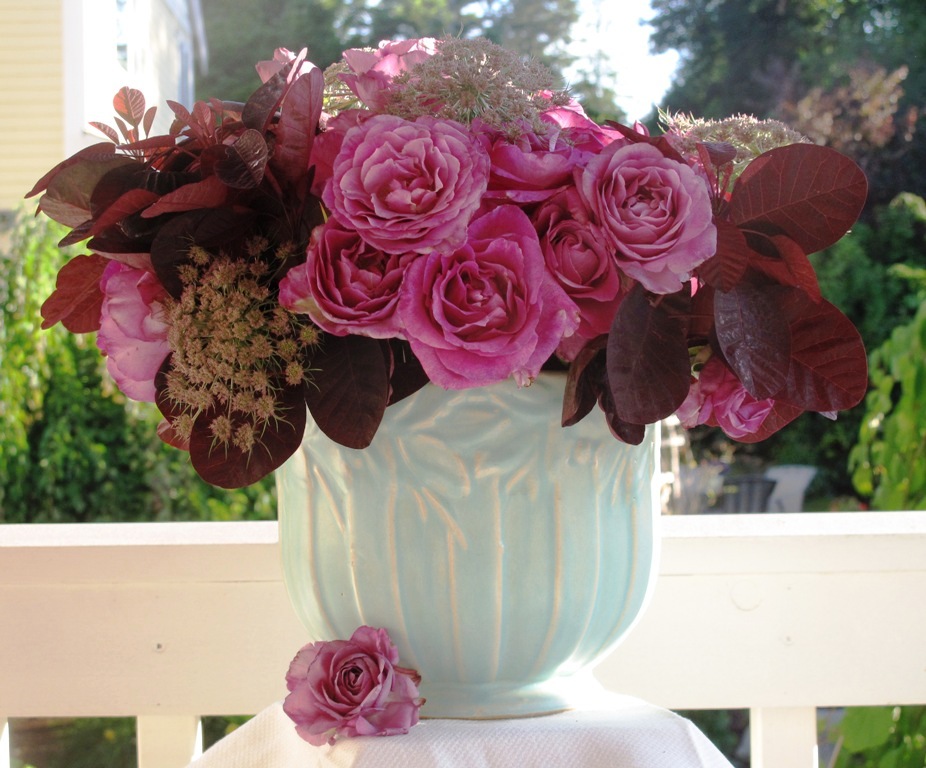
American Roses with purple smoke bush, Week 4, Summer. Love the way Paula rendered my McCoy flowerpot.
Happiness is going on here at my house today, thanks to this generous and unexpected gift from a friend. Clearly, I am having selfish thoughts about NOT sending these cards to anyone, but perhaps I will frame them for my office wall. Isn’t that a great idea?

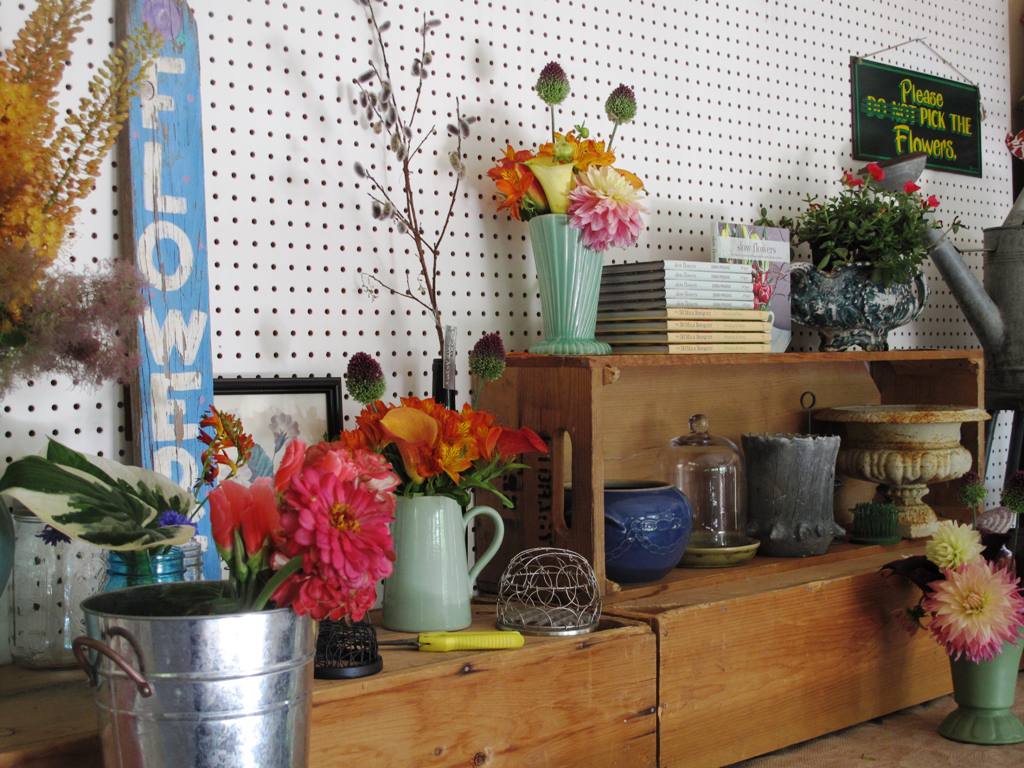
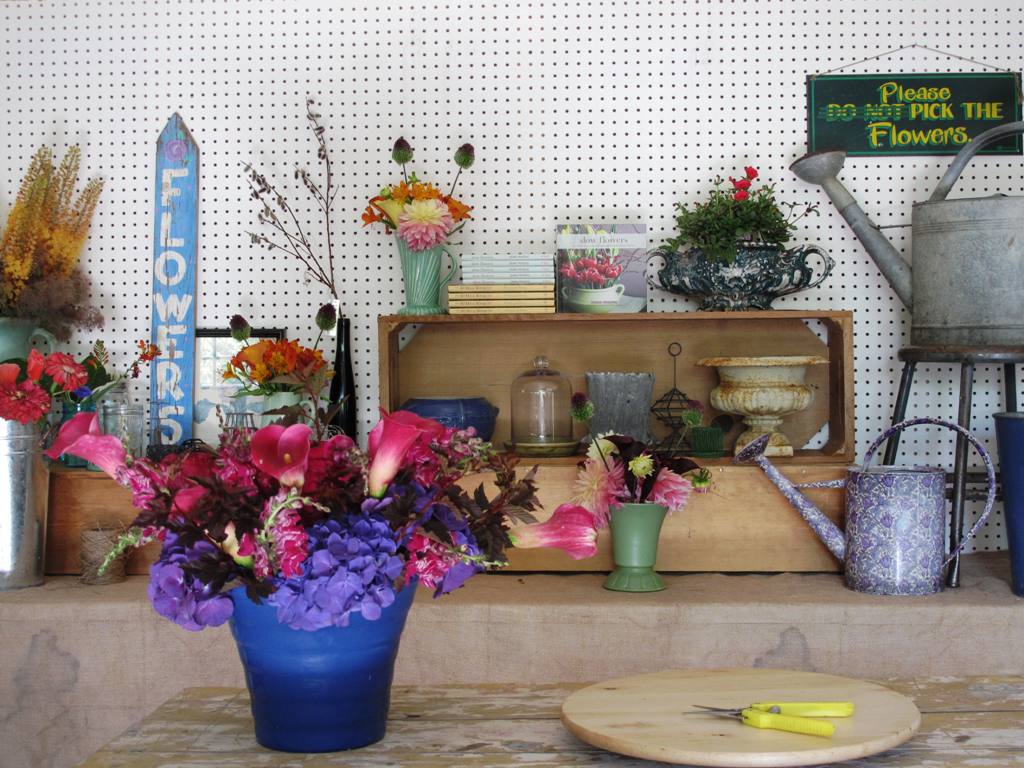
After I found this sign in a garden shop, I took the liberty to cross out the words “DO NOT” so the message better fits my philosophy of floral design!
I’ve been eating, sleeping, breathing, writing and speaking about SLOW FLOWERS for so long that it’s good to sometimes be reminded that not everyone understands what that phrase means. Recently, one of my flower farmer friends emailed to ask: Tell me again what Slow Flowers mean. I know it’s USA flowers but SLOW?
Fair enough. With all due respect to my fellow garden writer Felder Rushing, who coined the phrase “Slow Gardening,” let me outline my personal definition of SLOW FLOWERS. This is excerpted from my introduction to the book, Slow Flowers: Four Seasons of Locally Grown Bouquets from the Garden, Meadow and Farm (St. Lynn’s Press, 2013).
Thanks to the culinary pioneers who popularized the Slow Food movement, it now seems like you can put “slow” in front of any term to convey a different philosophy or approach to that subject. When I say the phrase “slow flowers,” there are those who immediately understand it to mean: I have made a conscious choice.My blooms, buds, leaves and vines are definitely in season; not, for example, grown and brought in from elsewhere in the world during the wet, cold winter months in my hometown of Seattle. So, come December and January, my commitment to sourcing locally-grown floral materials sends me to the conifer boughs, colored twigs and berry-producing evergreens – and the occasional greenhouse-grown rose, lily or tulip, just to satisfy my hunger for a bloom.Slow Flowers (the concept and the book) is also about the artisanal, anti-mass-market approach to celebrations, festivities and floral gifts of love. I value my local sources. If not clipped from my own shrubs or cutting garden, I want to know where the flowers and greenery were grown, and who grew them. Having a relationship with the grower who planted and nurtured each flower is nothing short of magical. I call so many flower farmers around the country my friends. They are the unsung heroes – the faces behind the flowers we love.Finally, Slow Flowers reflects life lived in the slower lane. My family, friends and professional colleagues know that it’s almost impossible for me to do anything slowly. I’m the queen of multitasking; I just can’t help myself. There are too many exciting opportunities (or bright, shiny objects) that command my interest. But this “year in flowers” was altogether different. I can only compare it to the practice of praying or meditating. I didn’t realize that those few hours I spent each week, gathering and choosing petals and stems, arranging them in a special vessel, and then figuring out where and how to capture the finished design through my camera lens, would be so personally enriching.
So I guess you can also say that the idea of “Slow Flowers” is also a resource that I hope many will find useful. Here is the description of this project:Join the Slow Flowers Movement, an All-American philosophy that supports grown-in-the-USA flower farms as well as floral designers, florists and retailers committed to using American-grown ingredients.
Origin matters! Slowflowers.com is a free, searchable database that makes it easy for customers to find designers who share their values and ethos. Log onto our home page to add your listing. Let’s tell consumers that there is a better way to beautiful – and they can find it at Slowflowers.com.
Slowflowers.com enables users to:
* Search by state or city and by keyword for the type of florist they seek.
* Find studios and retailers who specialize in green weddings, weekly subscriptions and eco-florals.
* Discover local flower farms that sell direct to the DIY consumer.
* Access coupons and promotions from individual studios, shops and farms.
* Provide reviews and raves about great American flower sources and comment on
experiences.
* Map the location of a desired destination.
I hope this helps! I invite you to add your own thoughts about “Slow Flowers” and what it means to you.

Ruffly ‘Green Spice’ heuchera foliage pulls together the mocha-colored vintage vase and the deep burgundy sweet William flowers
I never thought I would be such a proponent of the American Grown-American Made movement, but after writing The 50 Mile Bouquet and Slow Flowers, I have gained newfound appreciation for companies that provide jobs to American workers. We should all make an effort to both value and promote domestic farms and domestic manufacturers. Hey – even my books are printed in North American (not Asia!), on FSC certified paper with soy-based inks. I have my publisher to thank for making the choice to not print overseas.
Here, for you, I have compiled a list of my must-have floral design tools and accessories. Sadly, it has been a challenge to find all the Made-in-the-USA products I want. For example, I can’t find any women’s gardening gloves that weren’t made in Asia (yes, there are some leather glove makers still around in the US, but those products are intended for a more rugged gardening activity than floral design!)
And then there are those companies that label their packaging with phrases such as: Designed in the USA; Assembled in China. That’s not really what I’m looking for either. Nevertheless, I am here to share some glimmers of hope that American manufacturing is alive and well in the specialized world of floral design.
Here are my favorite floral design products. I recommend you check them out and make a conscious choice with your dollars! When you read a sentence like this one: “. . . carefully manufactured in Seattle by skilled craftsmen paid a living wage,” from apron designer Janna Lufkin (Raw Materials Designs), you really want to support her spirit and her faith in her company’s lifeblood, the workers who turn her ideas into tangible products!
Florian floral snips (for herbaceous and woody stems), $25.95 plus tax & shipping. This fine point scissor shear is made in the USA and is an excellent hand pruner. It is ideal for flower arranging, Ikebana, Bonsai and other precise hand pruning activities. This hand pruner shear features precision ground stainless blades and comfortable polypropylene ribbed grips with a brass thumb lock. Size: 7 1/4″ long. Florian also makes a fine rachet pruner, which you’ll find useful for cutting thicker branches of trees and shrubs. *Rachet Pruner is $36.95 plus tax & shipping.

Love that this tool was designed by a woman florist with her product-designer husband – and they have it manufactured by a woman-owned company.
Garden Party’s Thorn strippers (for stripping rose stems), designed by a floral designer and made in the USA, $11.95 plus tax & shipping. This colorful and lightweight tool has a spring-action handle to protect your hands from thorns, while the finger supports ensure a non-slip grip. Durable metal blades are honed to reduce tearing or peeling of the rose stem. Size: 6 inches long.
READ MORE…
Ingredients:
5 stems dark purple lilacs (Syringa vulgaris), grown by Sunshine Crafts and Flowers

I created this bouquet as a birthday gift for my friend Carrie Krueger. The soft and feminine
gathering of blooms, paired with a vintage butter-yellow Wedgwood Jasperware trumpet vase, makes a complete package.
There’s a lot of wisdom to be found in the Dining pages of today’s New York Times. Mark Bittman’s “The Flexitarian” column focuses on changing our relationship with meat, learning to eat less and re-thinking our food dollar.
You can basically take the term MEAT and replace it with FLOWERS to come up with a very credible explanation about what America’s flower farmers are up against. You know, that notion recently shared by none other than our nation’s Vice President Joe Biden about how cheap, imported flowers are “good for U.S. consumers.” No, Mr. Vice President, they are not. Cheap anything has a huge price. In the case of flowers, if you believe that cheap flowers are good, that means you aren’t concerned about living wage farm jobs in the U.S., about preserving farm land or about encouraging rural economic development. So there is a price to pay. For food writer Mark Bittman, the story of meat gives me a great analogy for flowers. I’ve taken the liberty of changing his story so you can see what I mean. Read on. . .
I feel best when buying from a farmer or farmer’s representative I know, or think I know. But even assuming this is possible, it has what at first appears to be a decided drawback: cost. It’s difficult to nail down averages, but if commodity meat (FLOWERS) — I’m talking about red meat (ROSES) here, but most of what follows could be argued about almost any product — costs something under $10 a pound (PER DOZEN) in most cases, and national brands from humanely treated animals like that from Niman Ranch or Coleman Natural (DOMESTICALLY PRODUCED FLOWERS) cost maybe twice as much, meat GARDEN ROSES from local farmers costs considerably more. It’s not uncommon to spend $25 or more a pound (A DOZEN) on beef (FLOWERS LIKE ROSES) from a trustworthy DOMESTIC source.
The immediate response that we as consumers have to this is “ouch.” Counterintuitive as it may seem, this is good for everyone.
Relatively large-scale sustainable and “natural” or “organic” or “humane” farmers might raise 500 pigs (UNDER 10 ACRES OF FLOWERS) in a year— they are not getting rich. We want these farmers to earn a living; they are stewarding the land in a manner we appreciate and they are providing us with the kind of food (FLOWERS) we want to eat (ENJOY, GIVE TO LOVED ONES, BRING INTO OUR HOMES); they are not using antibiotics (CHEMICALS) routinely or torturing animals (DAMAGING THE ENVIRONMENT). Nor are they likely to be receiving, directly or indirectly, federal subsidies. And they are providing us with meat (FLOWERS) that tastes better (ARE HEALTHIER, FRESHER, LOCAL AND SUSTAINABLE).
All of which may not make up for spending $30 instead of $15. But there are other reasons you can live with these higher prices.
It’s widely accepted that large quantities of red meat may be problematic, health-wise , and
We know that many people have made it a goal to eat less meat (CONSUME DOMESTIC FLOWERS) because large-scale industrial FACTORY FLOWER production is damaging to the environment. This is to a great extent what flexitarianism BEING A LOCAFLOR is about, after all.
Here’s a way to think about it: The price of food in general is what economists call “inelastic” — you’re going to eat something no matter the cost. But The price of any particular food like meat (FLOWER) is elastic — you will buy less as it becomes more expensive. Though it may at first seem paradoxical, this is a good thing from nearly every perspective.
I am saying this: Spend the same $30, or $50 or $100 or $300 on meat FLOWERS that you now spend each week or month, but buy less and buy better. You might compare this to an annual purchase of 20 $5 T-shirts made bychild labor (CHEAP, IMPORTED FLOWERS GROWN BY LOW-COST LABOR) versus one of five $20 T-shirts (BOUQUETS) made by better-paid and better-treated workers from organic cotton AMERICAN FLOWER FARMS. Expensive meat from real farms is a more extreme example of this less-is-better policy.
I hope you can follow where I’m going with this word-play. The takeaway message to me is that American Grown flowers might cost more, but they are higher quality, they will last longer, AND, they are sustaining American flower farms.

Why do we love poppies so much? Perhaps it’s because of their pure, vibrant petal colors with the charming button-like centers.

Tight flower heads, soft foliage that doesn’t bruise easily, and interesting textural elements – add up to a wedding bouquet for a friend far away.
A dear friend of mine is getting married today, in a state halfway across the country. None of her close friends are there to support her, mostly because she only recently moved away from Seattle to be close to her sweetheart. But at least she’s going to hold a bouquet of flowers I made Wednesday and sent via FedEx overnight delivery service. Her new husband will be wearing a sweet little boutonniere I sent along.
Here’s how to successfully make and send a long-distance gift of flowers:
1. Select durable flowers with fairly tight buds. I chose all Northwest-grown flowers in a cream-to-peach-to-coral palette:
READ MORE…
© Debra Prinzing, all written and photographic content. Website design/development by Willo Bellwood/Metric Media