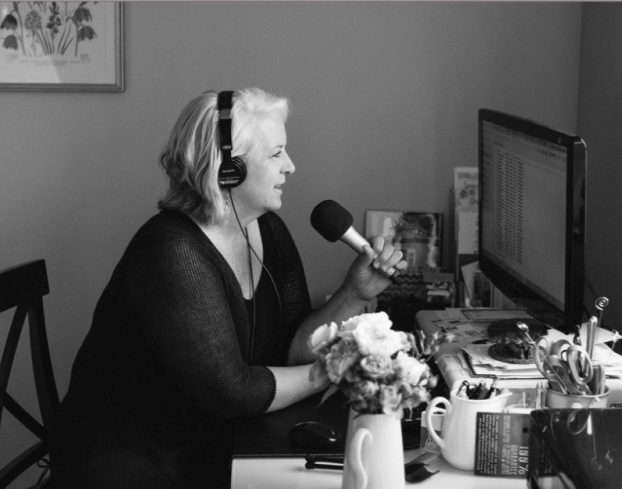
The Slow Flowers Podcast is the award-winning show known as the “Voice of the Slow Flowers Movement.” Launched in 2013 as the original flower podcast, we’ve devoted more than 10 years to covering the business of flower farming, floral design, and the Slow Flowers sustainability ethos. Listen to a new episode each Wednesday, available for free download here at slowflowerspodcast.com or on iTunes, Spotify, and other podcast platforms.
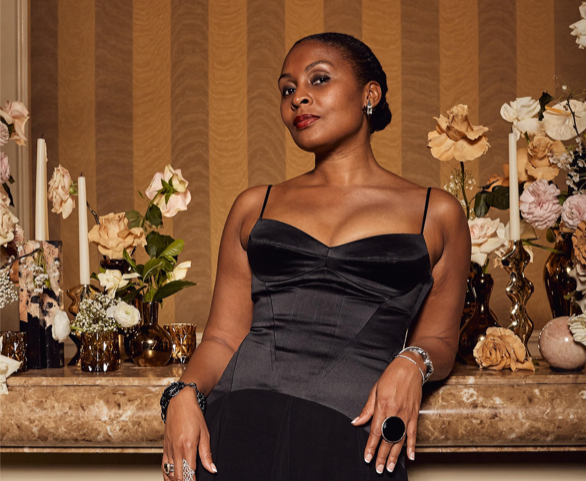
I met today’s guest, Talia Boone, when two other Slow Flowers members reached out to tell me about her and her new floral venture. As soon as I learned about Talia and her Los Angeles-based company Postal Petals, I thought — “we need her to join Slow Flowers” because her mission is i100% alignment with ours. Thank you to Yoni Levenbach of Flowers Without Bordersand Whit McClure of Whit Hazen, who separately connected me with Talia earlier this summer.
Talia is a veteran marketing, communications and branding strategist whose background is in professional sports and entertainment. About three years ago, she formed INTER:SECT, a creative, tactical solutions agency that serves as a catalyst for pioneering ideas, collaboration and creative opportunities at the intersection of sports, business, technology, consciousness, culture and the arts, with the goal of promoting socially and culturally relevant conversations and collective action.
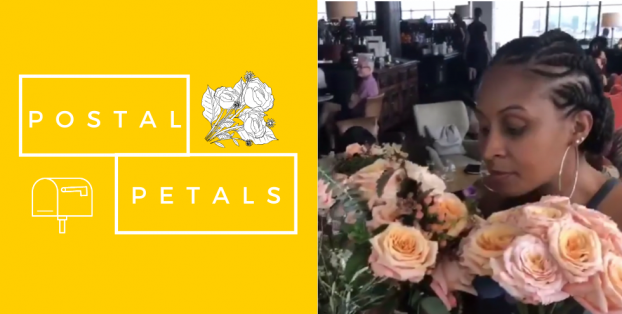
Up until now, Talia’s focus has been the intersection of sports, business, culture and social impact. And now, FLOWERS. Her new business, Postal Petals, has a social impact mission and I’m excited to share her story in our conversation today. Talia is a self-described floral enthusiast and DIY floral arranger. Since she’s based in Los Angeles, she often shopped at the Los Angeles Flower Market during public hours, bringing home flowers to arrange and enjoy — as part of her personal creativity and mental health practice.
You’ll hear how COVID is to blame for Talia’s newest venture, provoked by the closure of the Los Angeles Flower Marketand her search for farm-direct flowers to fill her flower fix.
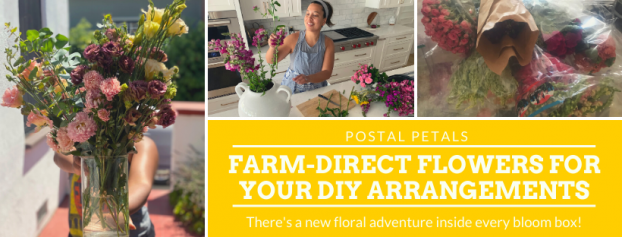
Postal Petals’ origins began with that search. Launched online in September, here’s how Postal Petals is described: Think of us as a farm-to-table produce box, but for fresh flowers! Postal Petals connects flower lovers directly to farms to receive fresh flowers at a competitive price point when compared to the retail marketplace. Each stem is handpicked and cut just hours before they are carefully packaged and shipped to you for delivery within 36 hours of harvest, ensuring quality and freshness. Once you open your Petal Box, you can build those beautiful loose blooms into stunning arrangements with a quick video tutorial or virtual hands-on workshop with one of our professional florists. Each Petal Box includes vibrant flowers sourced domestically from eco-friendly farms. From calla lilies to cheery sunflowers to picturesque peonies, there’s a new floral adventure inside every Postal Petals box.
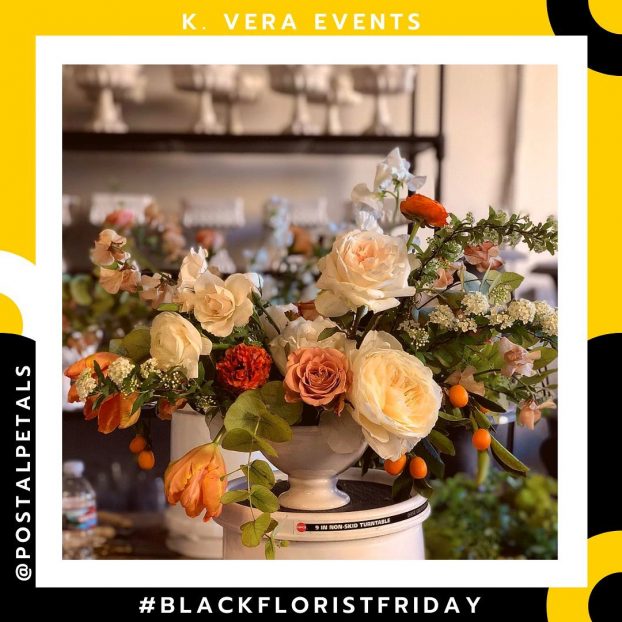
Follow #blackfloristfriday to meet designers who are part of Postal Petals’ Black Florist Directory
Thanks so much for joining us today. There is so much inspiration packed into a conversation with Talia Boone! I jotted down one of her references, and it’s worth restating here: If you want to go fast, to alone; if you want to go far, go together. That is the true message of Slow Flowers and for everyone who is part of our community!
As I mentioned, you can read more about Talia in today’s show notes. Today we also posted a feature story about Postal Petalsin Slow Flowers Journal — that’s at slowflowersjournal.com. Earlier this week, we started a six-part editorial series called New Floral Marketing Models & Platforms, beginning with Amelia Ihlo of Rooted Farmerson Monday and Rachel Heath of Flora Fun Box yesterday. After today’s feature on Postal Petals, the series continues for three more days as we profile: American Grown at Home, a project of Kelly Shore and Petals by the Shore; Zap Bloom, Sally Vander Wyst’s new venture, and Tammy Meyers of LORABloom. I know this series will interest you because there’s inspiration for flower farmers, florists and designers to consider diversification in their own enterprises. And, I am pretty sure this series will prompt others to reach out and let me know who they are and tell me about their new models!
Okay, whew. Does October seem like the year’s busiest month so far? I feel it and you might, too. Flowers are still blooming in my garden – so far! Our expected first-frost date won’t come for another few weeks. One flower farmer recently told me that October 15th is his “frost date,” whether the thermometer is down to freezing or not. He’s ready for a break and I don’t blame him. The zeitgeist of anticipation in our lives is undeniable, and some (maybe most) of it comes with a side order of anxiety. How do we move forward with so much uncertainty? Taking positive action is sometimes the best antidote to that feeling.
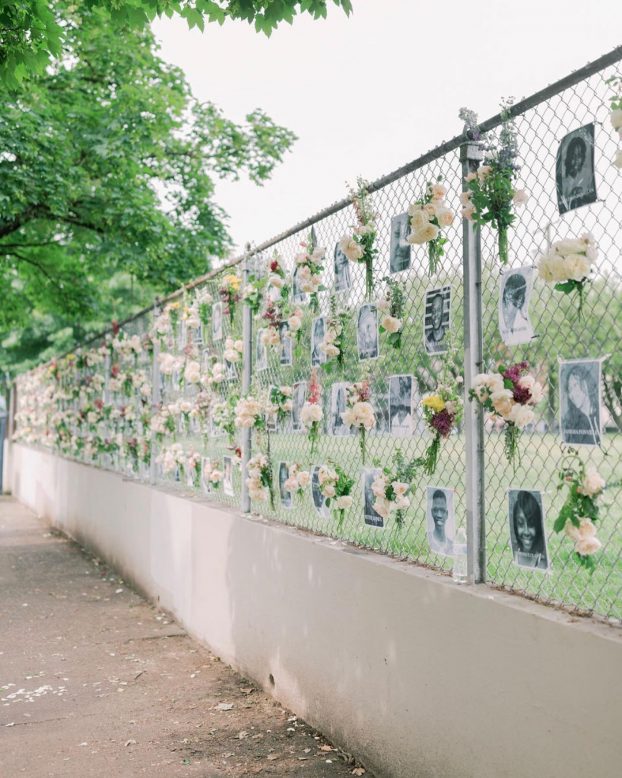
The first Say Their Names Memorial in Portland, Oregon
To that end, I’m thrilled to share that next week on October 20th, our friend Karen Thornton of Avenue 22 Events is leading the installation of a new Say Their Names Memorial in Kirkland, Washington, a suburb of Seattle. Karen is Slow Flowers’ operations and special events manager — many of you have met her during our regular Zoom Meet-Ups or in-person at the past two Slow Flowers Summits. Karen also recently took over Slow Flowers membership management from Lisa Waud, who has taken a step back for other important projects.
I want to let you know about the Say Their Names Memorial because it continues the good work of Portland-based wedding and event designer Joy Proctor, who began the memorial on Juneteenth when she and others mounted black-and-white portraits of more than 200 Black women and men whose lives were lost due to racial injustice. Flowers play a role in the powerful and sobering gallery of faces and names, as each portrait is commemorated with a small bouquet.
Slow Flowers and several of our member florists and farmers are supporting the October 20th installation. Here is Karen’s Go Fund Me link and I invite you to contribute, and provide support.
More announcements
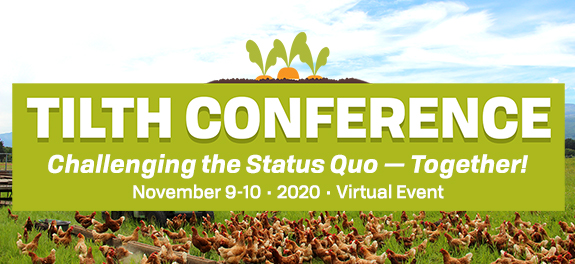
Before we get started, I want to announce the winner of our 2020 Tilth Conference registration giveaway, announced last week. I asked you to post a comment in last week’s show notes to tell us the one thing you are doing in your floral enterprise to address climate change. Our winner, Aishah Lurry, past guest of this podcast, commented: Patagonia Flower Farm is located in the high desert of Arizona; when we first started thinking about flower farming, the most important thing to us was water conservation. We have found that using landscape fabric slows down evaporation and has allowed us to use a minimal amount of water. It does this by blocking the sunlight In turn keeping the soil moist for a much longer period of time. Thanks for the great comment — and congratulations, Aishah! You’ll be attending – virtually – the 2020 Tilth organic farming conference on November 9 & 10! I’ll send you all the details for your complimentary registration.
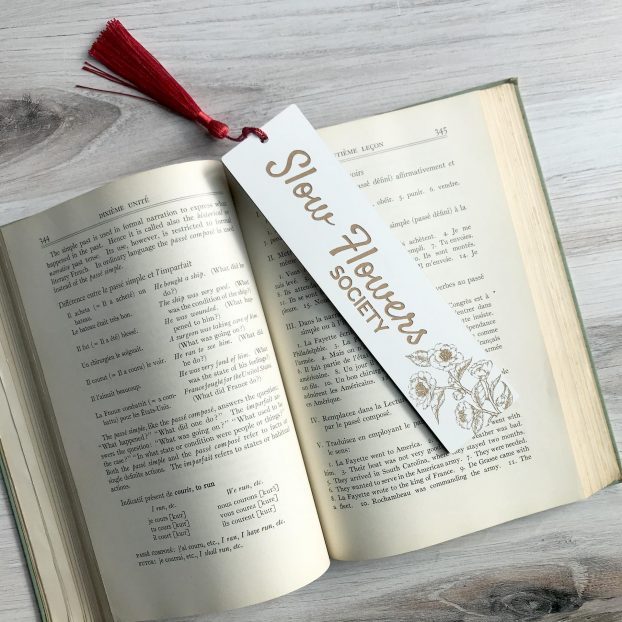
To thank you for sharing your time to take the survey, we’d like to send you an etched Slow Flowers Society botanical bookmark – and enter your name into the drawing for one free registration to the 2021 Slow Flowers Summit, valued at $599! But you must give us your name and contact information to receive the bookmark and enter the drawing — if you choose to respond anonymously, we can’t bestow our gifts!
Tomorrow, October 15th, registration begins for my first online course, Slow Flowers Creative Workshop: Floral Storytelling. You can learn more details and watch a video message from me here. The course begins November 1st so check out link above and take advantage of the $200 off introductory promo code — SF97 –, meaning you can enjoy this course for just $97. It includes three modules, 11 lessons, six worksheets and three writing templates. I’m excited to see you in the course!
On Friday, October 16th, the 2020 Flowerstock, Virtual Edition launches. A combination of live presentations and pre-recorded presentations from a wide range of florists, designers, and more, Flowerstock is the brainchild of our friend and Slow Flowers member Holly Chapple. I’ve developed new module for my session “A Bouquet of Words,” recorded specifically for Flowerstock attendees. Follow this link to see the full program and register for just $297.
From Sunday, October 25th to Wednesday, October 28th, I’ll return to Fleurvana, a virtual floral conference that first took place in late August. Fleurvana Holiday Summit follows much of the same format, but has all new presentations and a combination of new and returning speakers. I’ve developed an entirely new presentation called Taking Stock: Writing your 2020 Year in Review & 2021 Forecast with Creative Intention. As with last time, you can register for a free pass to attend Fleurvana during October 26-28. And you can purchase a VIP Pass to access private speaker roundtables and watch the presentations at your own pace.
The Slow Flowers Podcast has been downloaded more than 649,000 times by listeners like you. Thank you for listening, commenting and sharing – it means so much.
As our movement gains more supporters and more passionate participants who believe in the importance of the American cut flower industry, the momentum is contagious. I know you feel it, too. I value your support and invite you to show your thanks and with a donation to support my ongoing advocacy, education and outreach activities. You can find the donate button in the column to the right.
Thank you to our sponsors
This podcast is brought to you by Slowflowers.com, the free, nationwide online directory to florists, shops, and studios who design with American-grown flowers and to the farms that grow those blooms. It’s the conscious choice for buying and sending flowers.
And thank you to Florists’ Review magazine. I’m delighted to serve as Contributing Editor for Slow Flowers Journal, found in the pages of Florists’ Review. Read our stories at slowflowersjournal.com.
Syndicate Sales, an American manufacturer of vases and accessories for the professional florist. Look for the American Flag Icon to find Syndicate’s USA-made products and join the Syndicate Stars loyalty program at syndicatesales.com.
Johnny’s Selected Seeds, an employee-owned company that provides our industry the best flower, herb and vegetable seeds — supplied to farms large and small and even backyard cutting gardens like mine. Find the full catalog of flower seeds and bulbs at johnnysseeds.com. We have a new Slow Flowers article that dropped last week in Johnny’s Advantage, Johnny’s monthly newsletter. It’s all about Pricing and Profitability and features advice from five Slow Flowers growers. You’ll want to read it!
Mayesh Wholesale Florist. Family-owned since 1978, Mayesh is the premier wedding and event supplier in the U.S. and we’re thrilled to partner with Mayesh to promote local and domestic flowers, which they source from farms large and small around the U.S. Learn more at mayesh.com.
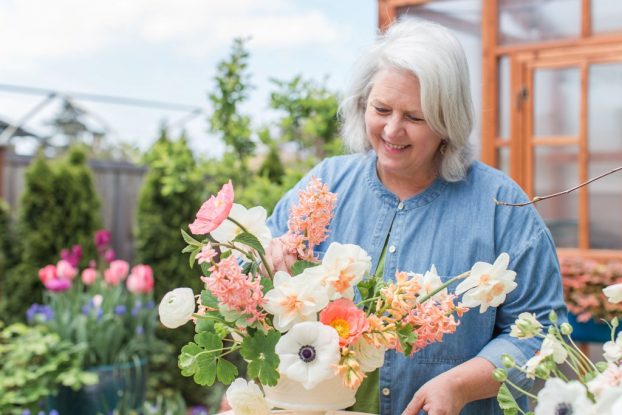
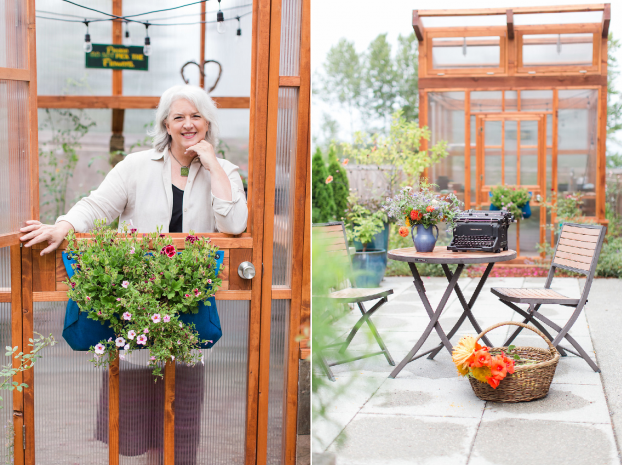
I am in love with my greenhouse, designed and built sustainably by Oregon-based NW Green Panels (c) Missy Palacol Photography
The content and opinions expressed here are either mine alone or those of my guests alone, independent of any podcast sponsor or other person, company or organization.
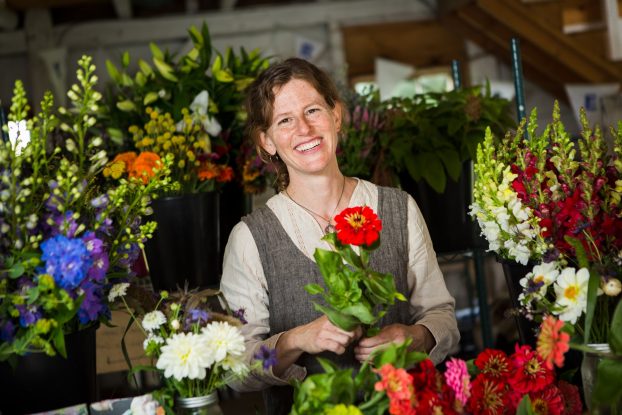
Stacy Brenner, co-founder of Broadturn Farm in Scarborough, Maine, a candidate for Maine State Senate’s 30th District
There is no denying that 2020 has been an insane year. I feel like the constant topics of conversation include resilience, reinvention, adaptation, innovation, not to mention pivoting or survival. UGH.
There’s also no denying that many of you, have, like me, been deeply moved by what’s happening in our world — from social and racial justice to saving the planet, as well as keeping ourselves safe from the ever-present threat of contracting COVID.
It has been so encouraging to hear from guests throughout the past seven months, who have generously shared their personal stories around resilience — flower farmers, florists and designers, and everyone touched by the wedding and events industry. The theme comes through in every episode and I’m grateful that the Slow Flowers Podcast has been a place to convene these conversations in a respectful and thoughtful environment.
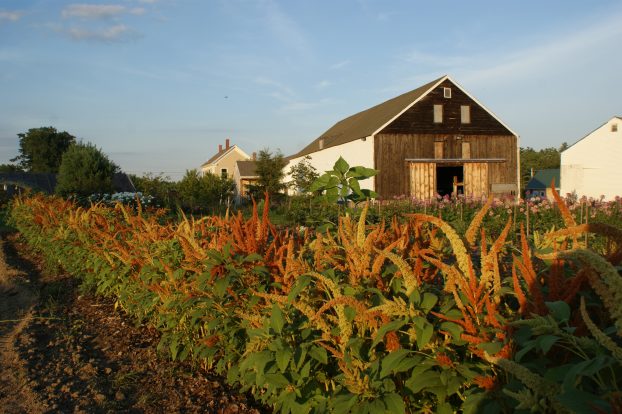
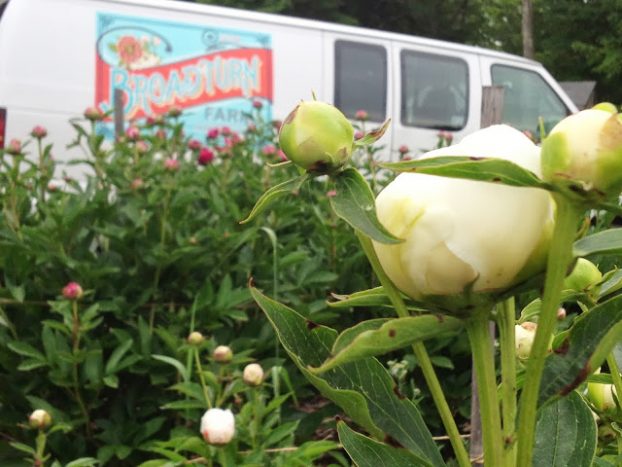
Broadturn Farm, Scarborough, Maine
The year is not over, especially as those of us in the U.S. are entering the final weeks of what I believe to be a life-and-death election season. Against the backdrop of taking action to change our world for a better place, I’m delighted to introduce you today to Stacy Brenner, organic flower farmer, nurse midwife and candidate for Maine State Senate’s 30th District.
Stacy joined me last February 2019 to discuss the theme of social entrepreneurship, and you listen to that episode here.
Here’s more about Stacy, excerpted from her Stacy for Senate about page:
Stacy Brenner is an organic farmer and small business owner who co-founded and now operates Broadturn Farmin Scarborough. She is a graduate of the University of Arizona, where she studied agriculture and plant sciences. Stacy holds two nursing degrees from the University of Pennsylvania. She spent her early working career as a nurse-midwife, tending to the births of hundreds of babies at Mercy Hospital in Portland. She is a board member of Maine Farmland Trust and Board Vice-President of the Maine Organic Farmers and Gardeners Organization (MOFGA).
Raised in a working-class suburb in New Jersey, Stacy spent her childhood romanticizing country life. When she wasn’t watching reruns of “Little House on the Prairie,” Stacy would escape the suburban chem-lawns of her neighborhood to explore the wooded edges of the development with her brother. She always wanted to be a farmer. Like so many other folks from away, she was drawn to the state of Maine by its verdant landscapes, its supportive business climate, its thriving agricultural network and the amazing, hard-working people she met.
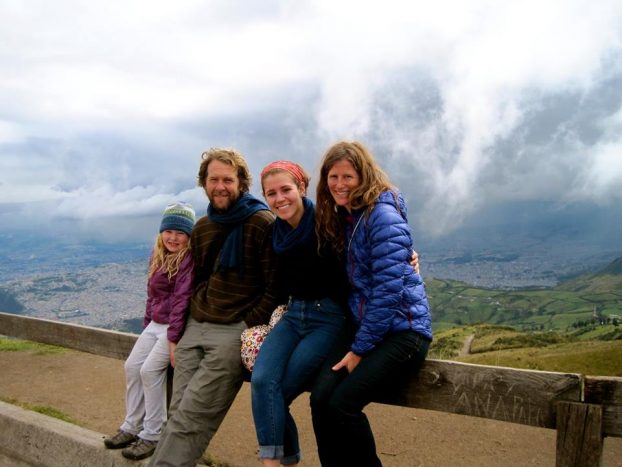
John Bliss and Stacy Brenner of Broadturn Farm, with their daughters
In 2002, Stacy, her five-year-old daughter Emma, and her husband, John Bliss, moved to Maine to become first-generation farmers. They entered the MOFGA farmer journeyperson program designed to support new entry growers, and taught themselves how to be farmers. In 2006, Stacy and John opened Broadturn Farm, which produces cut flowers and organic vegetables, hosts weddings, and runs a summer day camp focused on connecting youth with sustainable agriculture. Now employing 30 people at the height of the season, the farm is a thriving example of economic development on farmland protected with an agricultural easement funded in part by the Land for Maine’s Future program.
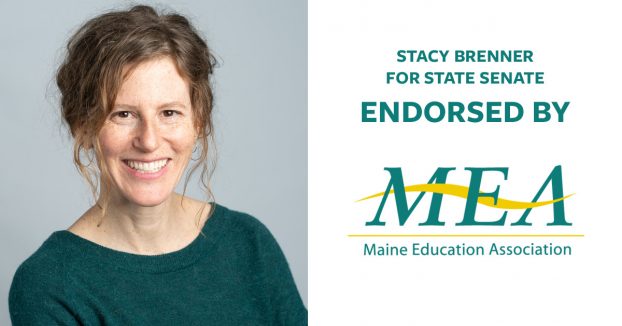
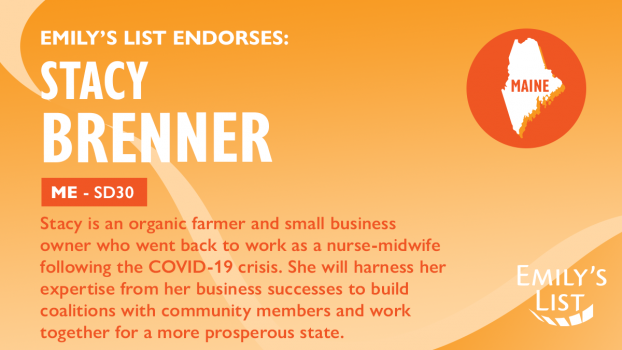
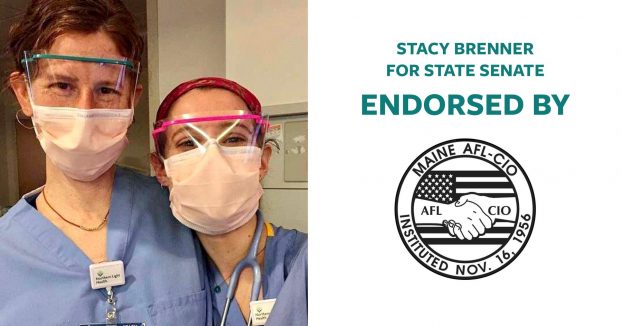
I’ve been watching along on social media as Stacy’s campaign for Maine State Senate has gained traction, with amazing endorsements from a diverse group of supporters, including the Sierra Club, Emily’s List, Maine Conservation Voters, Maine Education Association, several unions, Emily’s List, Equality Maine, Planned Parenthood and other groups.
What follows is a fascinating discussion that to me, at its core, looks at the question: What can one person do to make the world a safer, more equitable, inclusive and healthy place for all?
Stacy’s path may not be your path, but I know you’ll be inspired by the way she and John have chosen to operate Broadturn Farm with a mission-focused approach that reflects their values. Thanks so much for joining me today. I was struck by Stacy’s comment: “What are you going to tell your kids when they ask: ‘Where were you, Mom, when the planet was burning?’ Do I say, ‘I was watching Netflix and drinking wine?’ I’ve gotta do something!”
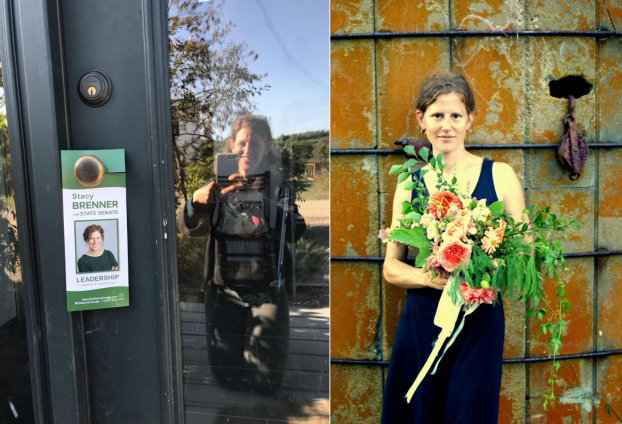
Stacy Brenner on the campaign trail (left) and as a farmer-florist (right)
That hits home! Stacy’s strengths rest in her dedication to building meaningful relationships with people in her community. She understands that the first step in creating connection is by listening to the concerns of constituents. She promises that when elected, she will collaborate and engage with local community members to help build a strong, inclusive, prosperous Maine. Let’s wish Stacy all the success and do check out her campaign website for volunteer opportunities.
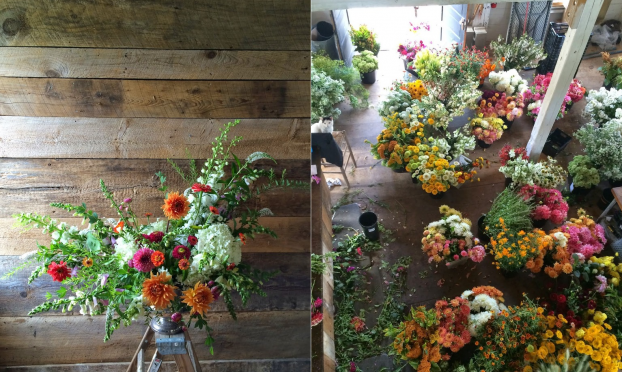
Organic and sasonal floral design and production at Broadturn Farm
Find and follow Stacy Brenner for Maine State Senate on Facebook
You’re invited to join me this coming Friday, October 9th, for our OCTOBER Slow Flowers Member Virtual Meet-Up! We started the Virtual Meet-Ups on a Weekly basis during the early days of COVID in late March.
After eight consecutive weeks of gathering with our community and special speakers through the end of May, we shifted to a monthly meet-up on the second Friday of each month.
Alicia Schwede of Flirty Fleurs (left) and Kath LaLiberte of Longfield Gardens (right)
This week, join me at 9 am Pacific/Noon eastern, Friday, October 9th — on Zoom — follow this link to join us!
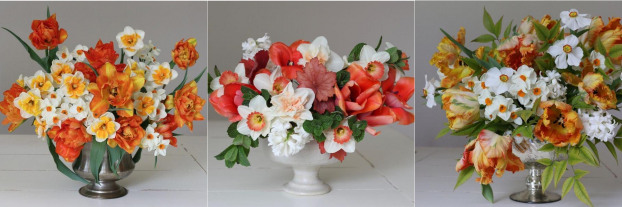
Three of the growing Flirty Fleurs collection for Longfield Gardens
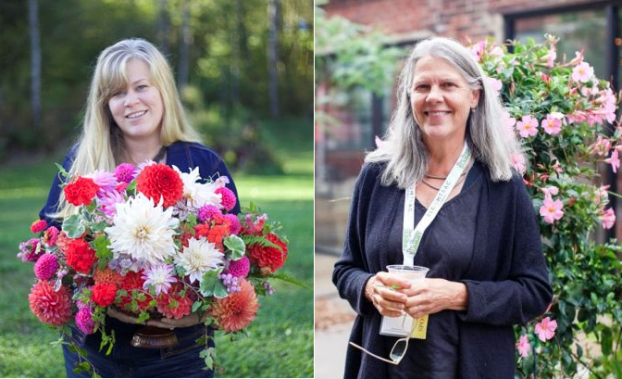
The topic is fall bulb planting — yay! I couldn’t be happier that it’s nearly time! My SPECIAL GUESTS include Slow Flowers member Alica Schwede ofFlirty Fleursand Kathleen LaLiberte of Longfield Gardens, a Slow Flowers sponsor. Bring your bulb selection, planting and design questions to the community! I’ve heard that we might be sharing some bulb collections as our giveaways — so you won’t want to miss that chance!
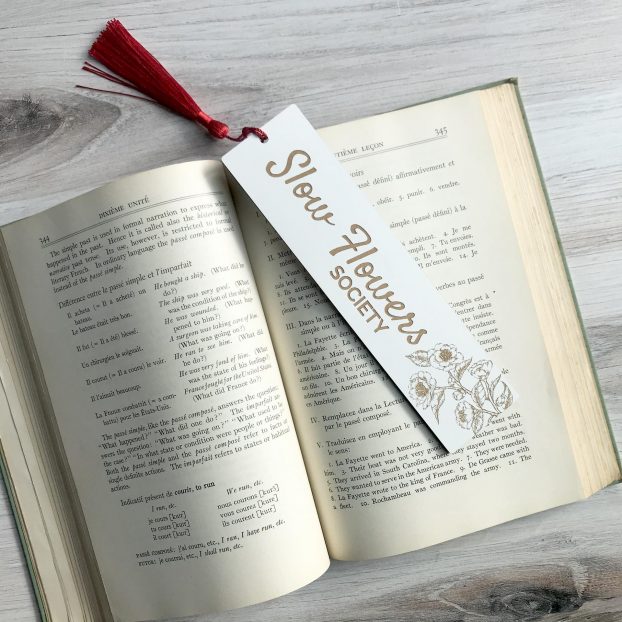
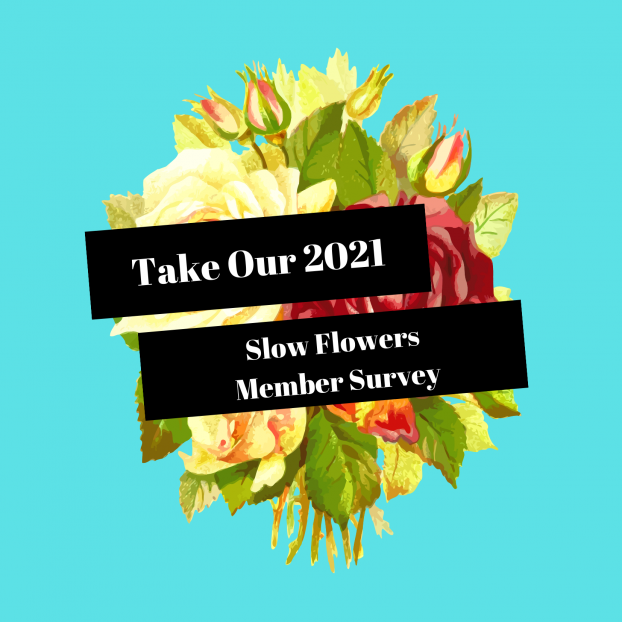
And speaking of gifts, did you see the beautiful etched Slow Flowers Society botanical bookmark we’re sending to each of you who responds to our 2021 member survey. I hope you take a moment to click on the survey if it lands in your in-box — we are eager to glean insights and input from you to help shape the coming year’s themes and programs.
And all respondents who complete the survey and share their contact information with us will be entered into a drawing for a full registration to the 2021 Slow Flowers Summit, valued at $599. Deadline for participation is November 1, 2020.
The Slow Flowers Podcast has been downloaded more than 647,000 times by listeners like you. Thank you for listening, commenting and sharing – it means so much.
As our movement gains more supporters and more passionate participants who believe in the importance of the American cut flower industry, the momentum is contagious. I know you feel it, too. I value your support and invite you to show your thanks and with a donation to support my ongoing advocacy, education and outreach activities. You can find the donate button in the column to the right.
Thank you to our sponsors
This podcast is brought to you by Slowflowers.com, the free, nationwide online directory to florists, shops, and studios who design with American-grown flowers and to the farms that grow those blooms. It’s the conscious choice for buying and sending flowers.
And thank you to Florists’ Review magazine. I’m delighted to serve as Contributing Editor for Slow Flowers Journal, found in the pages of Florists’ Review. Read our stories at slowflowersjournal.com.
Seattle Wholesale Growers Market, a farmer-owned cooperative committed to providing the very best the Pacific Northwest has to offer in cut flowers, foliage and plants. The Growers Market’s mission is to foster a vibrant marketplace that sustains local flower farms and provides top-quality products and service to the local floral industry. Visit them at seattlewholesalegrowersmarket.com.
Longfield Gardens, which provides home gardeners with high quality flower bulbs and perennials. Their online store offers plants for every region and every season, from tulips and daffodils to dahlias, caladiums and amaryllis. Check out the full catalog at Longfield Gardens at longfield-gardens.com.
Rooted Farmers works exclusively with local growers to put the highest-quality specialty cut flowers in floral customers’ hands. When you partner with Rooted Farmers, you are investing in your community, and you can expect a commitment to excellence in return. Learn more at RootedFarmers.com.
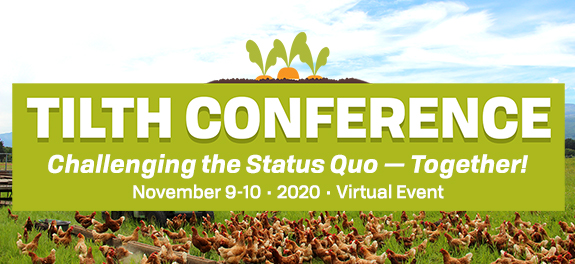
And now, all about the giveaway: Listen for details at the end of this episode for entering the drawing for a free registration to The 2020 Tilth Conference, which will be Virtual this year on November 9-10. The theme is Challenging the Status Quo-Together, with two days of presentations tailored to farmers, food system professionals, researchers and educators have the opportunity to learn from one another and share best practices. I’ve waived my speaker honorarium in exchange for giving away one free registration to a Slow Flowers member! One of the benefits of turning an in-person organic farming conference into a virtual one means that you don’t have to be Pacific Northwest-based to enter!
I’ll be presenting along with some amazing speakers, including keynotes from Chris Newman, co-founder of Sylvanaqua Farms in Virginia’s Chesapeake watershed. He is a farmer and a member of the Choptico Band of Piscataway Indians. And I’m excited to also hear from Dr. Kathleen Merrigan, former assistant secretary of Agriculture in the Obama administration — who I had a chance to meet a few years ago, and Executive Director of the Swette Center for Sustainable Food Systems at Arizona State University.
To enter our giveaway drawing, please comment in the show notes below about the one thing you are doing in your floral enterprise to address climate change. I’ll draw one winner from all those who comment on Sunday, October 11th, at midnight Pacific Time — and announce the name on next week’s episode.
The content and opinions expressed here are either mine alone or those of my guests alone, independent of any podcast sponsor or other person, company or organization.
The Slow Flowers Podcast is engineered and edited by Andrew Brenlan. Learn more about his work at soundbodymovement.com.
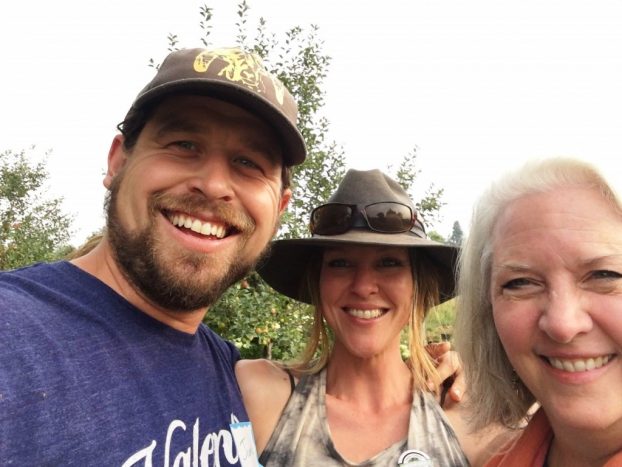
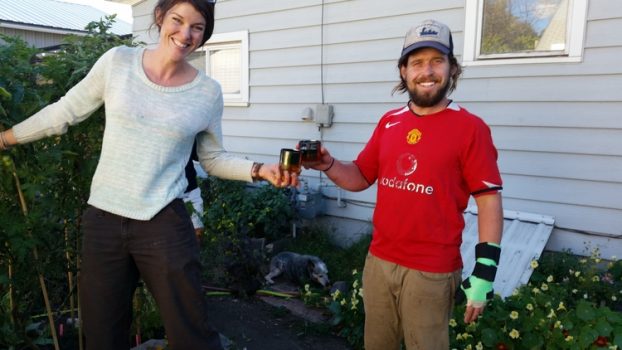
Jamie Rogers and Carly Jenkins of Killing Frost Farm, with me (right)
The conversation I recorded recently with today’s featured guest began much earlier this year. I learned so much from flower farmer Jamie Rogers, one half of Killing Frost Farm, while pulling together a segment of a lecture about flower farm diversification. And much of what Jamie and I discussed when I called him back in February was in some ways prophetic. At the time, we could not have predicted the COVID-19 pandemic and what it would mean to the floral marketplace.
Jamie and his partner Carly Jenkins founded Killing Frost Farm in Missoula, Montana, in 2012. Carly shared some of their story when I first interviewed her for the Slow Flowers Podcast, episode 296, aired in May 2017. I’ll be sure to share a link to that episode, and to a subsequent appearance when she and I discussed the woodland-inspired lichen and moss gown for American Flowers Week 2018, episode 355.
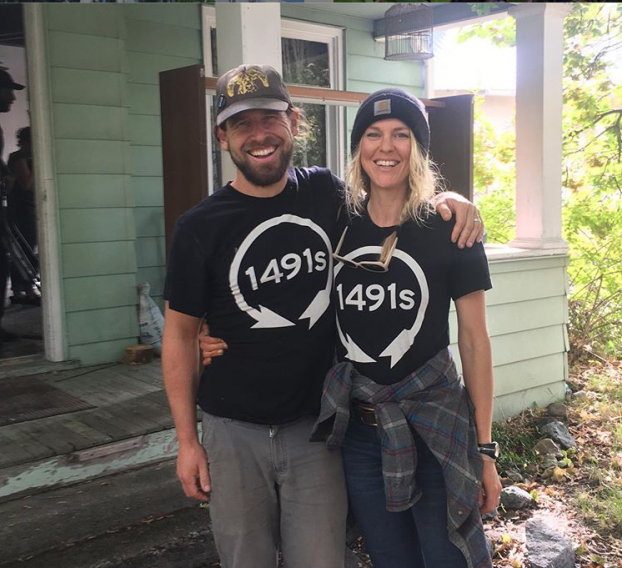
Jamie Rogers and Carly Jenkins of Killing Frost Farm
Here’s a bit of their background, which originally appeared on their website a few year’s back: In 2012, Carly and Jamie bought a house on a single city lot in Missoula’s Westside neighborhood. The soil was rocky, ant-infested and barren. They tilled, weeded, and with a truckload of compost, began growing tomatoes, herbs and flowers.
In 2014, the house next door went on the market, and after a bit of financial finagling, the couple made an offer. With more soil to work, their gardening ambitions grew, and before long, taking care of their plants was not only tough on schedules, but hard on the wallet. A financially savvy friend recommended Carly and Jamie find a way to form an LLC, sell some of what they grew and treat those mounting gardening expenses as a business expense. By the fall of that year, they grew their first batch of microgreens. A week after the ground was frozen, they delivered some to a neighborhood restaurant, and Killing Frost Farm was born.
When I first posted that introduction to Jamie and Carly, back in 2017, I concluded: A lot has happened since then, including forming established relationships with local chefs and growing other types of produce for them. Carly and Jamie also upped the number of flower beds and sold edible flowers . . . before narrowing their focus to cut flowers for floral arrangements.
As they wrote on their web site: “It has been a frightening, stress-inducing, humbling ride so far, but it’s allowed us to quit our old jobs and spend our days working in dirt, together.”
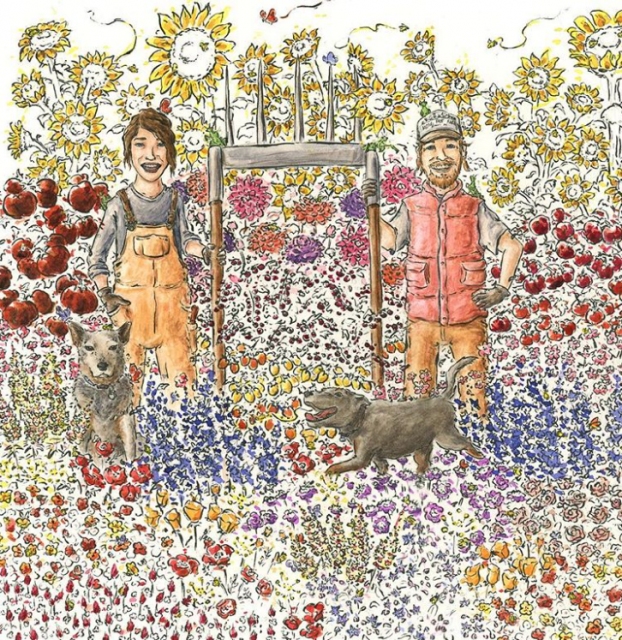
Love this adorable illustration of Jamie and Carly, by Portland artist Ryan Bear (shared with his permission) @ryanbearart
Today’s episode will catch you up on what Jamie and Carly have been up to in the past few years. They moved to Potomoc, a town about a 30-minute drive east of Missoula, where Killing Frost now has 2-plus acres for its cut flower production.
Carly and Jamie of Killing Frost Farm.
As you’ll hear in this conversation, the couple now focuses almost entirely on selling flowers wholesale through their weekly Market in Missoula, where florists can shop off the floor and pick up pre-orders. To grow, they began in earnest delivering flowers to customers (studio and retail florists) in Butte, Bozeman, Helena and often to other markets when supply allowed.
They just wrapped up the 2020 season for running a Montana-grown delivery program, marketing Killing Frost’s fresh flowers as well as crops grown by a number of other farms. Spearheaded by Jamie, the program will not stop just because dahlia season is over. As he discusses in our interview, there are plans to add dried flowers and holiday greenery to the product availability list moving forward through the end of the year.
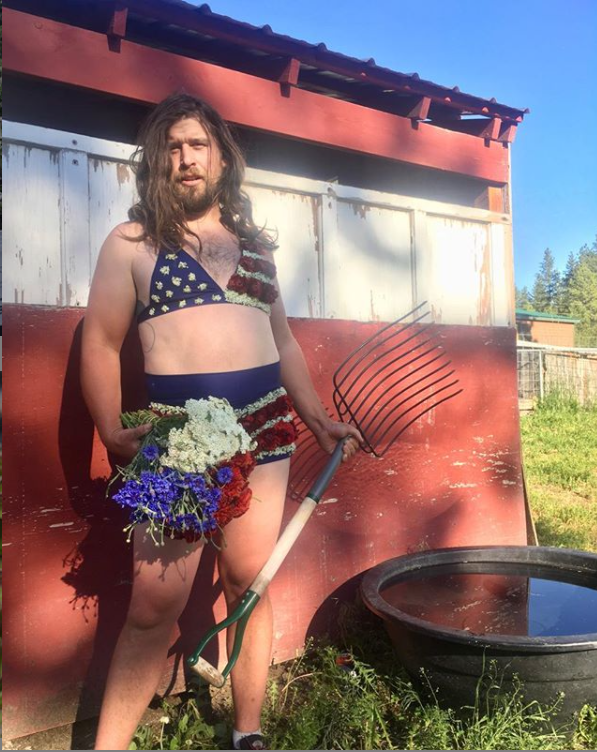
Jamie Rogers modeled Carly’s red-white-and-blue floral bikini during American Flowers Week 2016! What a guy!
I think you’ll pick up on the fact that Jamie is personable, committed to excellent customer service, and a whole lot of fun. As he shares, the Killing Frost model is based on one originated by Ralph Thurston and Jeriann Sabin, founders and former owners of Bindweed Flower Farm.
Our conversation is an honest one and I appreciate Jamie’s transparency about the challenges of building a bucket truck route in a marketplace where customers have not had access to locally-grown flowers for decades. As he told me earlier: “We need them more than they need us. If you get that notion, Jamie said, you’ll be rewarded, because remember: they have just been buying flowers from someone else for nine months of the year.“
Thank you so much for joining me today! At the end of our interview, I had a big grin on my face — Jamie has a way of lifting my spirits. I hope you pick up on his enthusiasm and passion for getting more Montana-grown flowers in to the hands of the state’s florists on a regular basis. As he told me about his sales and customer service strategy: “We have to make it as convenient for them as possible. We are really lucky that they want to buy our flowers.”
Before I close, I want to highlight a couple of items and ask you to keep an eye out for our October happenings. Our October newsletter launches this week, as does our 2021 member survey. I hope you take a moment to click on the survey if it lands in your in-box — we are eager to glean insights and input from you to help shape the coming year’s themes and programs. To sweeten the deal and thank you for your investment of valuable time, we will send a special gift to everyone who completes the survey. And all respondents who complete the survey and share their contact information with us will be entered into a drawing for a full registration to the 2021 Slow Flowers Summit, valued at $599.
The Slow Flowers Podcast has been downloaded more than 645,000 times by listeners like you. Thank you for listening, commenting and sharing – it means so much.
As our movement gains more supporters and more passionate participants who believe in the importance of the American cut flower industry, the momentum is contagious. I know you feel it, too. I value your support and invite you to show your thanks and with a donation to support my ongoing advocacy, education and outreach activities. You can find the donate button in the column to the right.
Thank you to our Sponsors
This podcast is brought to you by Slowflowers.com, the free, nationwide online directory to florists, shops, and studios who design with American-grown flowers and to the farms that grow those blooms. It’s the conscious choice for buying and sending flowers.
And thank you to Florists’ Review magazine. I’m delighted to serve as Contributing Editor for Slow Flowers Journal, found in the pages of Florists’ Review. Read our stories at slowflowersjournal.com.
The Gardener’s Workshop, which offers a full curriculum of online education for flower farmers and farmer-florists. Online education is more important this year than ever, and you’ll want to check out the course offerings at thegardenersworkshop.com.
Mayesh Wholesale Florist. Family-owned since 1978, Mayesh is the premier wedding and event supplier in the U.S. and we’re thrilled to partner with Mayesh to promote local and domestic flowers, which they source from farms large and small around the U.S. Learn more at mayesh.com.
Association of Specialty Cut Flower Growers. Formed in 1988, ASCFG was created to educate, unite, and support commercial cut flower growers. It mission is to help growers produce high-quality floral material, and to foster and promote the local availability of that product. Learn more at ascfg.org.
The content and opinions expressed here are either mine alone or those of my guests alone, independent of any podcast sponsor or other person, company or organization.
The Slow Flowers Podcast is engineered and edited by Andrew Brenlan. Learn more about his work at soundbodymovement.com.
Hermon Black of HB Fiore, a floral designer based in Arlington, Virginia
I’m so pleased today to welcome Hermon Black, a floral designer I first met when she attended the 2018 Slow Flowers Summit in Washington, D.C.
Flowers on her Head! Hermon Black, photographed at the 2018 Slow Flowers Summit by Mud Baron
Hermon is based in Arlington, Virginia, where she runs a design studio serving weddings and private clients. She tells a beautiful story of growing up in East Africa (Addis Ababa, Ethiopia) where her mother allowed her to cut and arrange flowers from their garden, and encouraged young Hermon in her floral design interest.
Hermon, photographed at a Petals by the Shore design workshop at Wollam Gardens, in Jefferesonton, Virginia (c) Beth Caldwell Photography
I love how her journey has brought Hermon full circle back to her childhood love of flowers. It’s a story to which many of us can relate. Enjoy our conversation as we discuss how Hermon developed her design studio HB Fioriand how she has adapted her focus due to the challenges of 2020 and the COVID-19 pandemic.
A beautiful, late-summer arrangement by Hermon Black
Enjoy this gallery of Hermon’s seasonal arrangements. Her subscription floral program sources 100% locally-grown flowers from farms in Virginia and Maryland.
Thank you so much for joining me today! I’m so encouraged by the conversations I record to share with listeners of the Slow Flowers Podcast. We are in complicated times, friends. And there is so much stress and pressure, uncertainty and worry facing each of us. I hope you find comfort in being part of our larger community of people who care about the planet, about equity for all, and about the importance of nurturing our creativity.
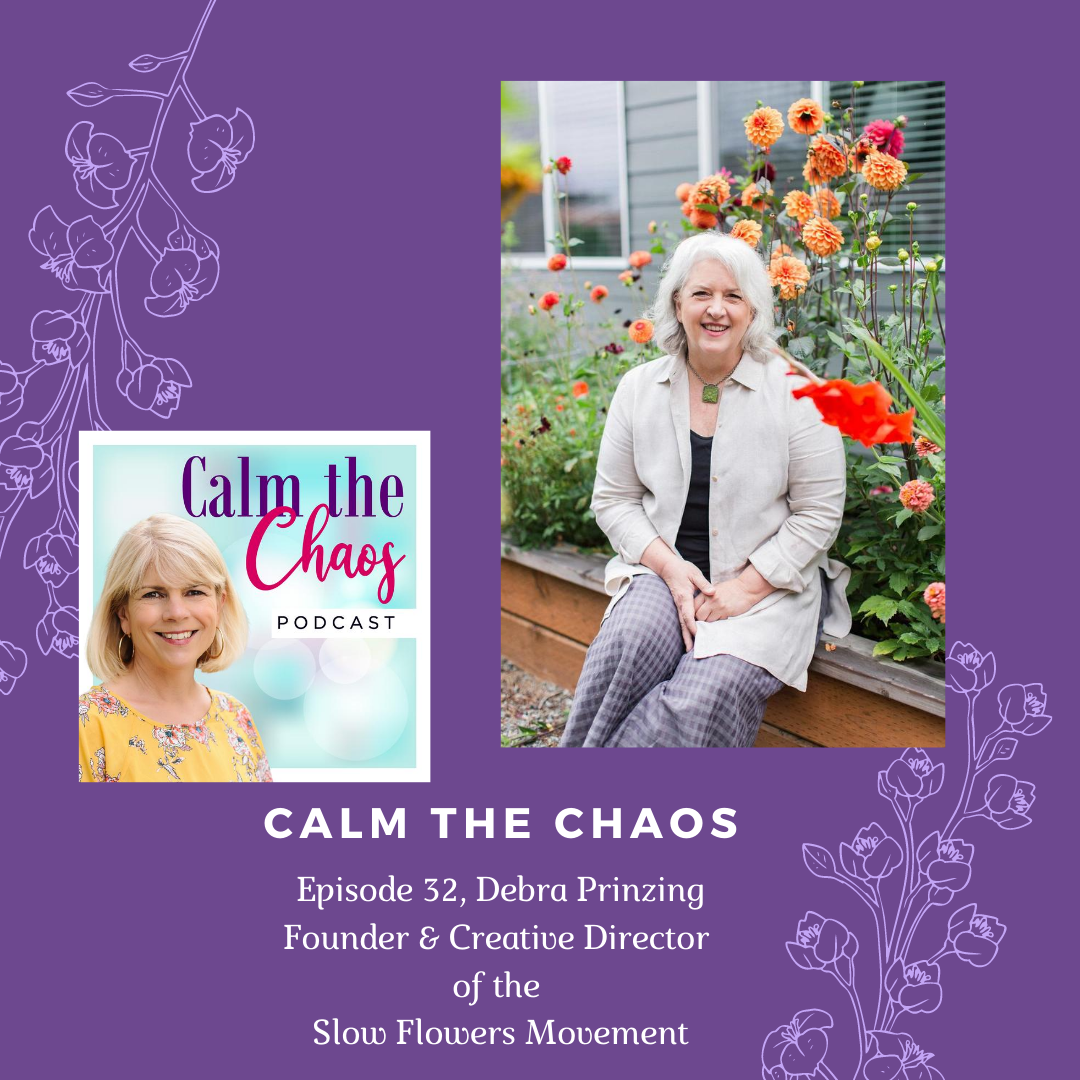
NEW PODCAST
Deborah Voll, flower lover and host of the “Calm the Chaos” Podcast, recently turned the tables on me — and I was the one answering her questions.
It was a fun experience to join Deborah, a life coach who specializes in helping women find purpose and passion after 50 (um, yes, that would be me!).
Click on this link to hear our conversation — and subscribe to future episodes, as Deborah hosts so many interesting women guests who are pursuing fulfillment in their “chapter two” careers.
The Slow Flowers Podcast has been downloaded more than 643,000 times by listeners like you. Thank you for listening, commenting and sharing – it means so much.
As our movement gains more supporters and more passionate participants who believe in the importance of the American cut flower industry, the momentum is contagious. I know you feel it, too. I value your support and invite you to show your thanks and with a donation to support my ongoing advocacy, education and outreach activities. You can find the donate button in the column to the right.
Thank you to our sponsors
This podcast is brought to you by Slowflowers.com, the free, nationwide online directory to florists, shops, and studios who design with American-grown flowers and to the farms that grow those blooms. It’s the conscious choice for buying and sending flowers.
And thank you to Florists’ Review magazine. I’m delighted to serve as Contributing Editor for Slow Flowers Journal, found in the pages of Florists’ Review. Read our stories at slowflowersjournal.com.
Syndicate Sales, an American manufacturer of vases and accessories for the professional florist. Look for the American Flag Icon to find Syndicate’s USA-made products and join the Syndicate Stars loyalty program at syndicatesales.com.
Rooted Farmers, which works exclusively with local growers to put the highest-quality specialty cut flowers in floral customers’ hands. When you partner with Rooted Farmers, you are investing in your community, and you can expect a commitment to excellence in return. Learn more at RootedFarmers.com.
Johnny’s Selected Seeds, an employee-owned company that provides our industry the best flower, herb and vegetable seeds — supplied to farms large and small and even backyard cutting gardens like mine. Find the full catalog of flower seeds and bulbs at johnnysseeds.com.
The content and opinions expressed here are either mine alone or those of my guests alone, independent of any podcast sponsor or other person, company or organization.
The Slow Flowers Podcast is engineered and edited by Andrew Brenlan. Learn more about his work at soundbodymovement.com.
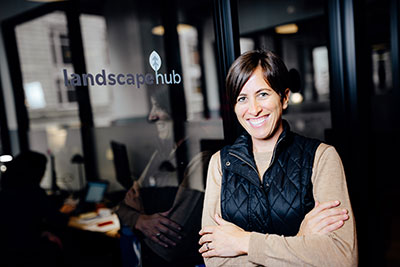
As many of you know, I was very active in horticulture circles as a home, garden and landscaping writer for nearly 20 years, long before I became obsessed with flower farming and floral design. Over the past decade, I have been completely immersed in founding, developing and nurturing the Slow Flowers Movement, which has been the most professionally rewarding experience of my life. And yet, I continue to take side trips back into horticulture. I met today’s guest, Lisa Fiore, CEO of Landscape Hub, on one of those excursions.
We were introduced by a mutual friend, Clint Albin, a nursery industry marketing strategist, who, like me, has an extensive personal network of business contacts who become friends.
Clint attended the 2018 Slow Flowers Summit in Washington, D.C., where he lives, and since then, he has been determined to find a way for us to collaborate as we once did when I was so deeply involved in the horticulture world.
Landscape Hub is proving to be that reason for us to collaborate. Clint introduced me to Lisa Fiore and as I learned what she created with Landscape Hub, I started to understand that there is potential for Slow Flowers members, especially farms and growers, to take advantage of this plant-selling platform.
Here’s the deal: If you are already growing plants for the floral trade, you can potentially use your expertise to also grow plants for the nursery and landscape industry.
We announced a pilot program between Slow Flowers and Landscape Hub and promoted it in our August Slow Flowers newsletter. I’m not sure how many people have even checked out the opportunity that I outlined — to become a grower & wholesale supplier of potted plants through Landscape Hub.
When you listen to my conversation with Lisa, I think it will begin to make sense. Hearing from the person who created a new selling platform for live plants (versus plants cut for the floral trade) may open up your own imagination to a new business channel.
Before we jump into the conversation, here’s a bit more about Lisa Fiore:
Lisa Fiore is Founder & CEO of LandscapeHub, a B2B online marketplace she created and launched in July 2017. A fourth-generation nursery professional, Ms. Fiore realized there was an opportunity to digitize the entire procurement process for the green industry.
Lisa was previously President of Fiore Landscape and Nursery Supply (FLNS), a century-old nursery company. During her sixteen-year tenure, she was responsible for identifying new business opportunities and in leading the company forward during the recession. FNLS significantly grew in revenue and expanded to multiple locations under her leadership.
Lisa holds a Bachelor of Arts degree in English Literature from University of Montana and a Master of Business Administration from Lake Forest Graduate School of Management. She currently serves on the board of directors for the National Association of Landscape Professionals, (NALP); is an advisor to the Women in Landscape Network, (WILN); a member of the Economic Club of Chicago; and a former board director for the Illinois Landscape Contractors Association, (ILCA).
Thanks so much for joining me today for my conversation with Lisa. We know that now, more than ever, our members are seeking new customer channels during the COVID-19 pandemic. I believe that one of those perhaps overlooked or ignored opportunities is to use your farming skills to sell plants (including potted and bare root) into the nursery marketplace, to both trade and retail buyers.
You know how to grow plants – there is no doubt! But have you explored selling plants? I know that some of our members are growing and marketing cutting garden annuals and perennials, vegetable starts, bulb packs and other horticultural products to their customers. Those customers may find you through a grocery store program, farmers’ market, on-farm or pop-up plant sales or through your own retail channel.
As Lisa and I discussed LandscapeHub offers you a potential new channel to sell on this nationwide platform which supplies commercial nurseries and landscapers. LandscapeHub is expanding its online marketplace for the nursery and green industry growers — and you’re invited to participate.
Stay tuned for an upcoming session when I will host Landscape Hub’s team to discuss and demonstrate the platform. I’ll announce a date next week.
Before we wrap up, I want to invite you to join the Fire Relief for Flower Farms effort. During the past 10 days, I’m sure you’ve watched the horrifying images and read devastating reports about wildfires threatening farmland across the West. This is not the first climate crisis to affect the Slow Flowers community in the past few years — season by season, it seems as if every farm is faced with one of them: floods, hailstorms, tornados, hurricanes and wild fires are on the rise seemingly everywhere.
But I can’t help but focus right now on what’s happening in the west — from provinces like British Columbia and Alberta in Canada to states including Washington, Oregon and California in the U.S. It’s so frightening on top of everything else 2020 has thrown our way. Seeing individual Slow Flowers members’ social media posts also makes it highly personal. While it may be weeks or months before the destruction, damage or loss has been calculated, many of you want to help NOW.
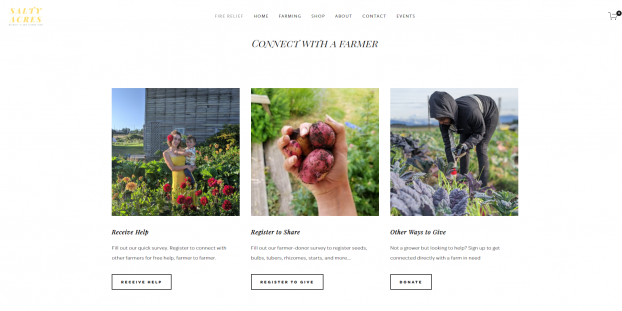
Like me, you may be asking: “What Can I Do?” We are an action-oriented community, right?! Farmers and florists are generous people who readily share their knowledge and resources. So here’s one thing you can do in response to news about the recent wildfire threat to farms in the west. Join Slow Flowers as we support the Fire Relief for Flower Farms effort. This is a farmer-to-farmer show of support created by last week’s podcast guest Tonneli Grutter of Salty Acres Farm.
Now might be the time to assess what you have to share with another farm. Seeds can be collected, tubers, rhizomes and bulbs can be dug and divided, cuttings can be taken. Or, maybe you have an excess inventory of drip irrigation or useful supplies you know another farm might be able to use.
Tonneli has volunteered to collect input from those who wish to receive help, register to donate and show support in other ways. With her big heart, tech talents and savvy marketing skills, Tonneli has created a database for collecting information from those of us who want to share support on an in-kind basis. Just days ago, she texted me with an idea: “is there a way we could make a registry or exchange to donate tubers, bulbs, seeds, etc., in response to farms who may have lost it all?” Tonneli continued: “Flower farmers have already had the toughest year (with) no money left to give, but maybe we can help others rebuild in other ways.”
Thank you to our Sponsors
This podcast is brought to you by Slowflowers.com, the free, nationwide online directory to florists, shops, and studios who design with American-grown flowers and to the farms that grow those blooms. It’s the conscious choice for buying and sending flowers.
And thank you to Florists’ Review magazine. I’m delighted to serve as Contributing Editor for Slow Flowers Journal, found in the pages of Florists’ Review. Read our stories at slowflowersjournal.com.
Association of Specialty Cut Flower Growers. Formed in 1988, ASCFG was created to educate, unite, and support commercial cut flower growers. It mission is to help growers produce high-quality floral material, and to foster and promote the local availability of that product. Learn more at ascfg.org.
Seattle Wholesale Growers Market, a farmer-owned cooperative committed to providing the very best the Pacific Northwest has to offer in cut flowers, foliage and plants. The Growers Market’s mission is to foster a vibrant marketplace that sustains local flower farms and provides top-quality products and service to the local floral industry. Visit them at seattlewholesalegrowersmarket.com.
Longfield Gardens, which provides home gardeners with high quality flower bulbs and perennials. Their online store offers plants for every region and every season, from tulips and daffodils to dahlias, caladiums and amaryllis. Check out the full catalog at Longfield Gardens at longfield-gardens.com.
The Slow Flowers Podcast has been downloaded more than 642,000 times by listeners like you. Thank you for listening, commenting and sharing – it means so much.
As our movement gains more supporters and more passionate participants who believe in the importance of the American cut flower industry, the momentum is contagious. I know you feel it, too. I value your support and invite you to show your thanks and with a donation to support my ongoing advocacy, education and outreach activities. You can find the donate button in the column to the right.
The content and opinions expressed here are either mine alone or those of my guests alone, independent of any podcast sponsor or other person, company or organization.
The Slow Flowers Podcast is engineered and edited by Andrew Brenlan. Learn more about his work at soundbodymovement.com.
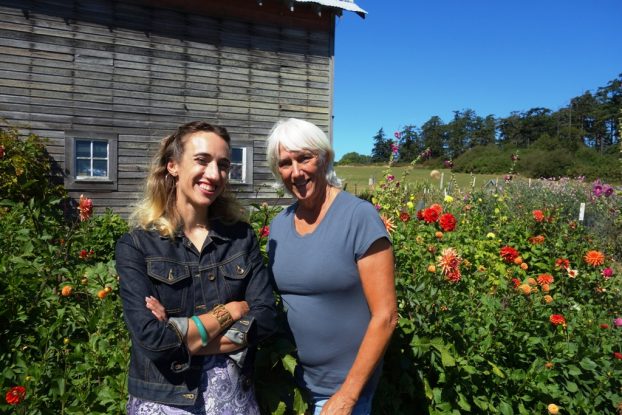
Tonneli (left) and Kim (right) at Salty Acres Farm, Coupeville, Washingon
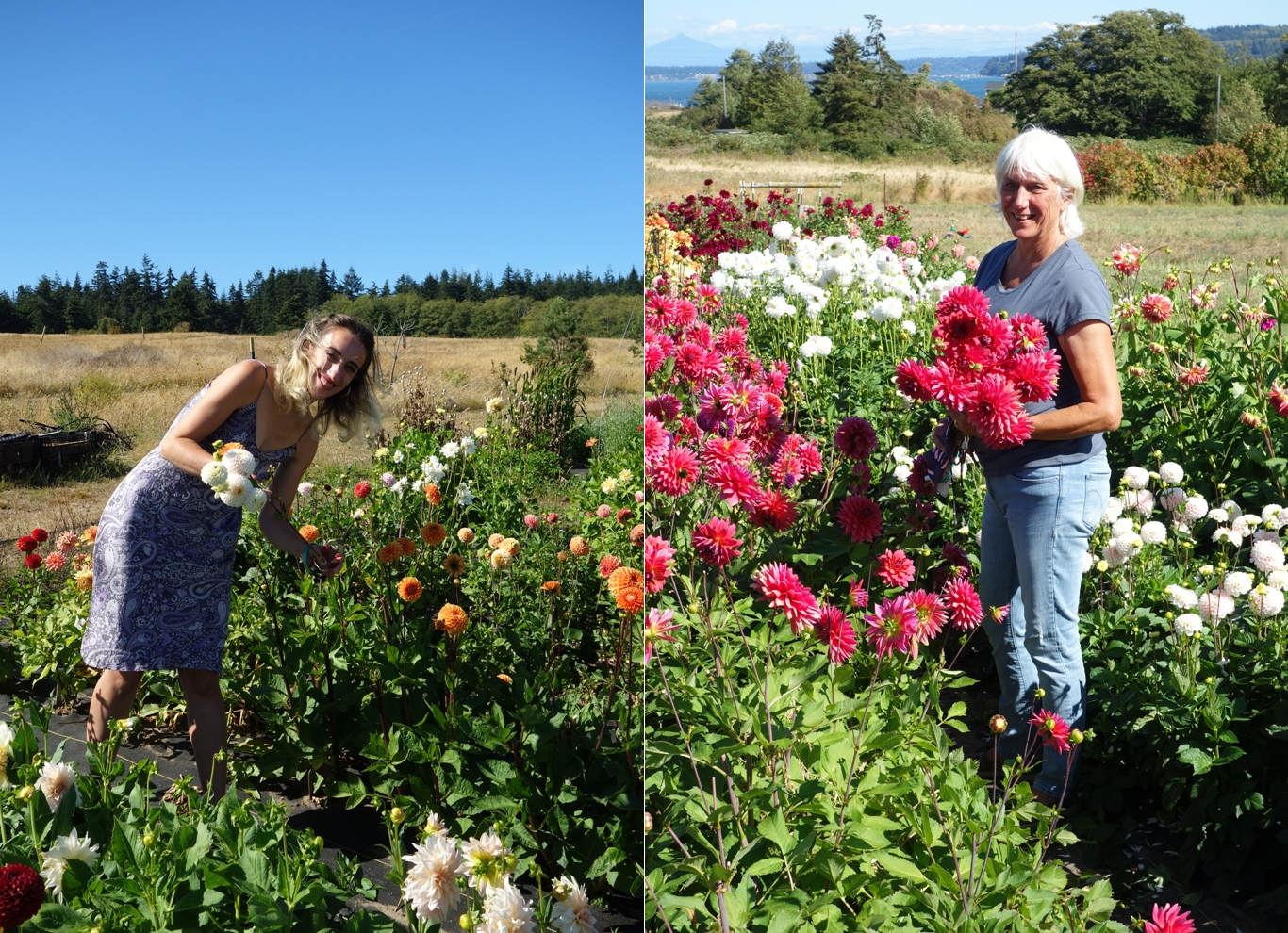
In early 2019, I reconnected with Kim Gruetter of Salty Acres Farm at a Washington Flowers Project florists’ gathering. She reminded me that we’d had a few email exchanges back when I first launched Slow Flowers in 2014, and introduced me to her daughter Tonneli Gruetter. Together, with their spouses, Kim and Tonneli own Salty Ares Farm in the town of Coupeville, Washington, on Whidbey Island.
Kim’s husband and Tonneli’s father Paul Gruetter and Tonneli’s husband John Loughman, are definitely part of the diverse family-owned farm and little guy Sauvie is the youngest human living on the family farm.
Tonneli (left) and Kim (right), photographed on our visit to their fields at Greenbank Farm
We had a great conversation about what they both were doing and I learned it was not just flowers! Kim told me about the “salt” of Salty Acres, which is one of their signature agricultural products along with edible flowers.
Tonneli, who calls herself a millenial, fascinated me with her story of working in the sales, marketing and branding in the tech industry, a fabulous skill set that she brings to Salty Acres.
A few months later, Travis Rigby of Florists’ Review asked me if had any suggestions for a new digital marketing position he had created. Did I know anyone who might be a good fit for the job? For some amazing reason, Tonneli popped into my memory and I introduced the two of them. For the past year, Tonneli has collaborated with Florists’ Review on all sorts of projects, including the magazine’s social media, which you can’t miss if you follow them on Instagram. Tonneli’s enthusiasm has spilled over into the floral community and to many, she is the face of Florists’ Review on its IG stories, events and sponsorships.
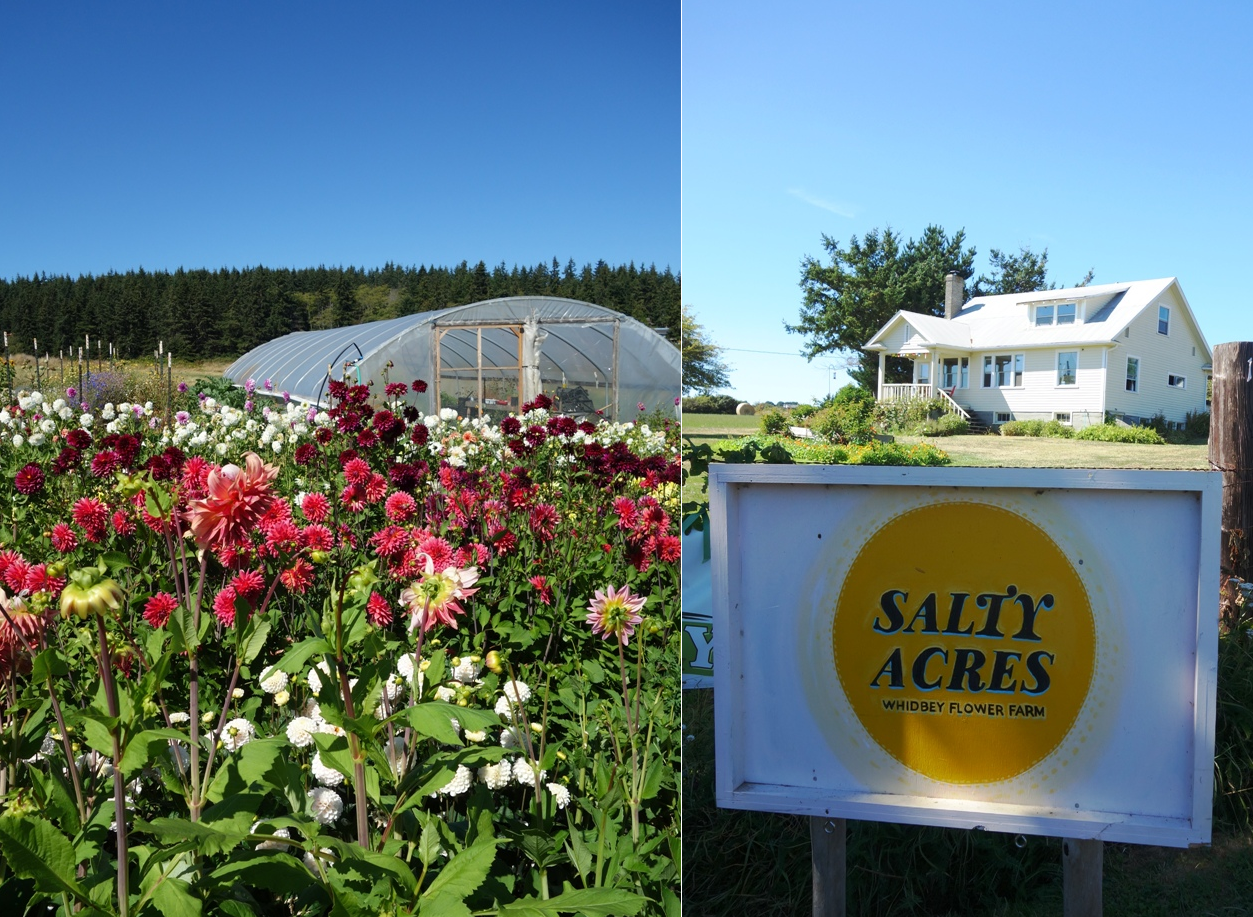
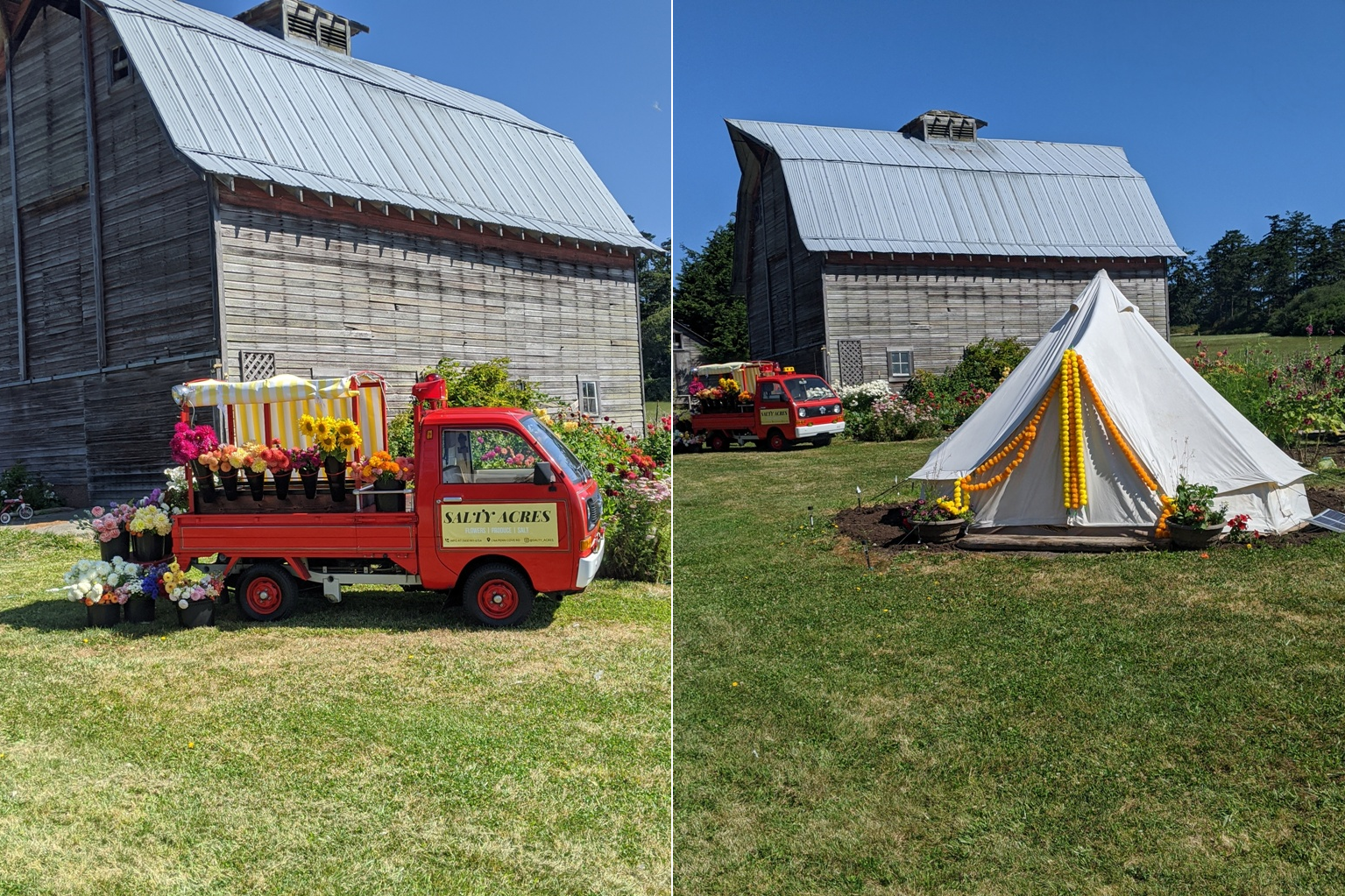
Salty Acres Farm operates at two locations on Whidbey Island. Left: at Greenbank Farm, a community-owned agriculture and tourism destination; right, at a historic farmstead in Coupeville.
When I knew I was going to have a minication getaway on Whidbey Island in late August, I invited myself to Salty Acres Farm. The farm is located on historic Penn Cove, outside the historic Coupeville. Here’s a bit more of their story, from the “about” page on Salty Acres’ website:
Originally brought to the island by the Navy, Tonneli and John thought their farming roots were somewhere in the past when the opportunity of a lifetime appeared: a new start at a historic farm on Penn Cove. It didn’t take long before the magic of the place got to them, and their thoughts of Whidbey as just another Navy posting faded.
The honor stand on Penn Cove Road, designed and fabricated from an old pony cart by Paul Gruetter
Around this same time Kim and Paul were facing another story all too common for farmers. Rising property costs and rapid urbanization were forcing farmers (themselves included) away from Oregon’s Willamette Valley where they had farmed for generations. Seeing this shift Tonneli and John urged her parents to visit Whidbey Island. “Imagine a place where you can farm and the community supports you,” Tonneli urged her parents.
For Paul, who learned to farm from his father who had immigrated to Oregon’s Sauvie’s Island to work the land, moving roots wasn’t. Upon arriving on Penn Cove it only took a single sunrise over the water to convince them, this was home and a new agricultural collective calling for the whole family.
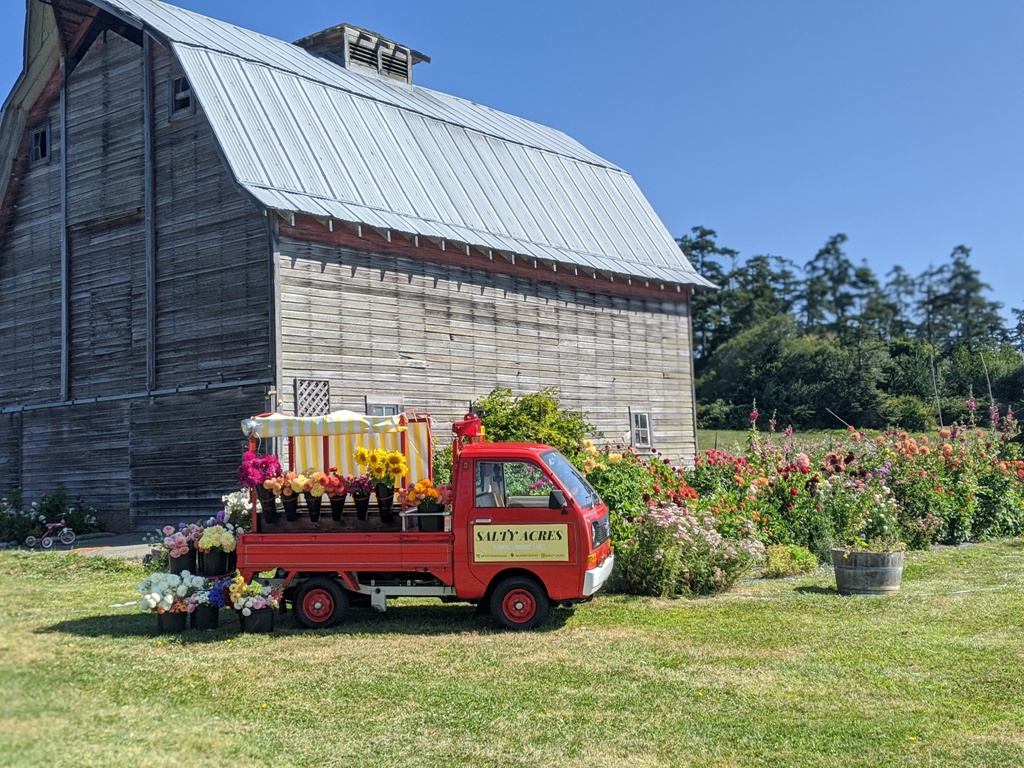
“Salty,” the vintage Japanese fire truck that shows up at farmers’ markets and other pop-up events. Kim and Tonneli also offer Salty as a fully staffed mobile flower cart experience. Customers book the truck to wow their event guests with fresh bouquets, floral confetti, & individually sized sea salt party favors. Booking includes use of PA system, spot lights, and sirens. (c) Tonneli Gruetter photograph
Today, Salty Acres, specializes in locally-grown flowers, small batch sea salt, foraged ocean greens, & specialty produce. From June to October customers can shop at their permanent farm stand on Penn Cover Road, at pop-up sales around the Coupeville area, and at their community greenhouse on the historic Greenbank Farm campus.
With COVID this year, the women have had to adapt some of their offerings, especially on-farm events, workshops and their regular stall at the Coupeville Farmers’ Market. But the requests continue and they are currently reimagining what 2021 may look like. Keep an eye out for announcements by following Salty Acres on social media.
Salty Acres Farm, tricked out for a private event. The farm’s agritourism offerings include salt making classes, flower farm tours, floral design workshop and cider making parties (pre-COVID, of course – and to be resumed as state guidelines allow) (c) Tonneli Gruetter photograph
Thanks so much for joining me today for my conversation with Kim and Tonneli. My head is spinning when I think about their energy and their passion – and how they seem to create entrepreneurial opportunities out of thin air.
I hope the time you spent with this episode is equally overflowing with new ideas. The thread of community is woven through all that this dynamic mom-and-daughter team are doing, along with Paul, who is equally involved in the operations of Salty Acres.
Check out some of Salty Acres’ collaborators and flower outlets, which we discussed in the episode:
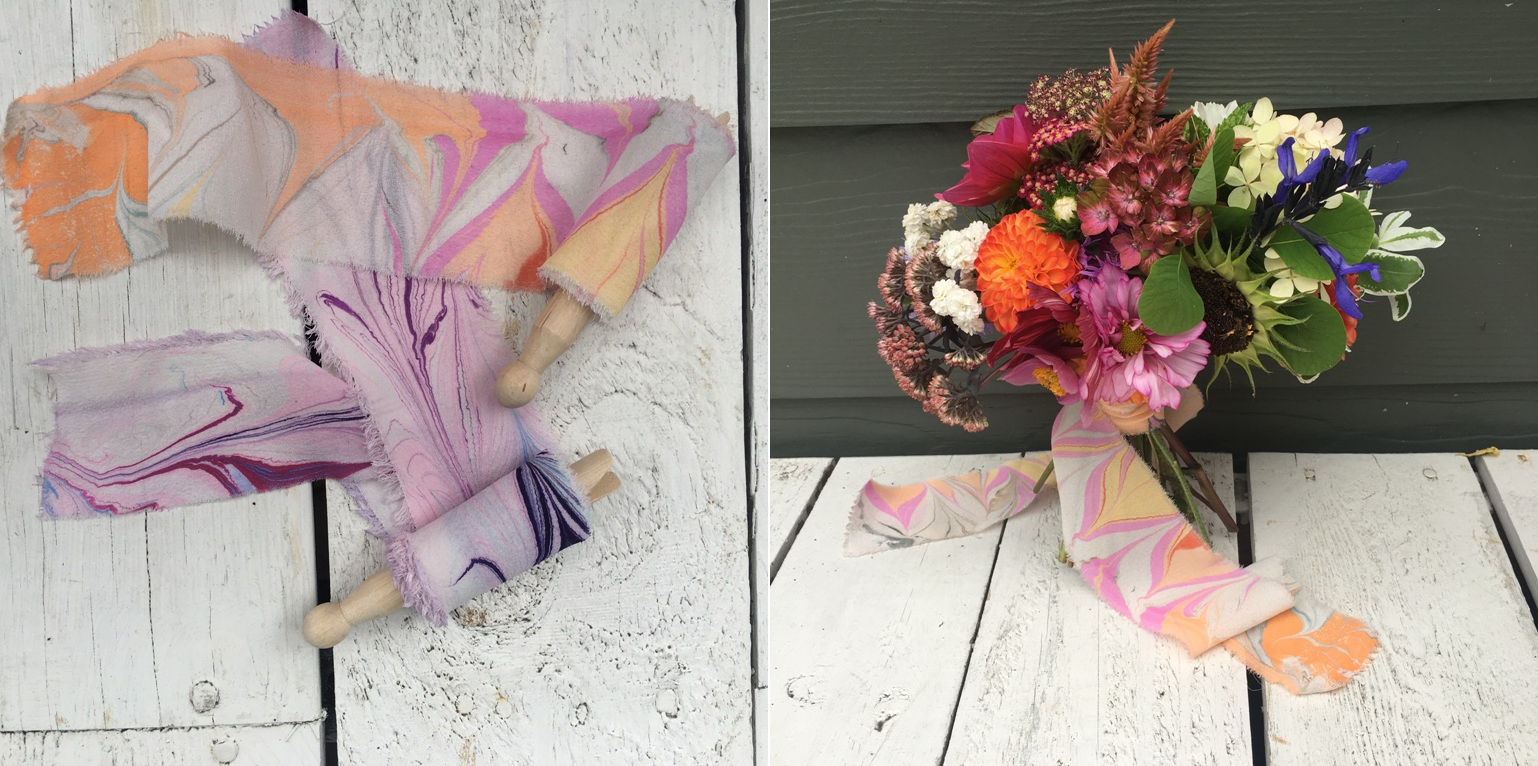
Custom-silk bouquet ribbon – a collaboration between Salty Acres Farm and Go Marbley of Coupeville, Washington (with a bouquet from the Slow Flower Cutting Garden)
JOIN US AT THE SEPTEMBER SLOW FLOWERS MEMBER (VIRTUAL MEET-UP
TJ McGrath will be our guest presenter at the September 11 “Slow Flowers Member (Virtual) Meet-Up”
Now, More than Ever, Your Slow Flowers Membership Gives You an Important Story to Share with Your Community and Your Customers. Our monthly Slow Flowers Member Virtual Meet-Up is coming right up this Friday, the 11th of September — on Zoom.
I’m excited that we’ll enjoy some seasonal design inspiration with special guest, TJ McGrath. TJ is the lead designer and content creator for the Blue Jasmine Floral studio, a Slow Flowers member studio led by Paulina Nieliwocki in Berkeley Heights, New Jersey. All summer long, I’ve been enchanted by the floral designs that TJ posts on his personal IG feed @tjmcrathdesign. I asked him to demonstrate one of his signature foam-free arrangements and talk about his philosophy and style.
You’re invited to join us. Click here for details. Bring your insights and ideas to the community. I’ll share the link in today’s show notes — 9 am Pacific/Noon Eastern. And, like all of our member meet-ups, we’ll have some giveaways to sweeten the deal!
THANK YOU TO OUR SPONSORS
This podcast is brought to you by Slowflowers.com, the free, nationwide online directory to florists, shops, and studios who design with American-grown flowers and to the farms that grow those blooms. It’s the conscious choice for buying and sending flowers.
And thank you to Florists’ Review magazine. I’m delighted to serve as Contributing Editor for Slow Flowers Journal, found in the pages of Florists’ Review. Read our stories at slowflowersjournal.com.
Johnny’s Selected Seeds, an employee-owned company that provides our industry the best flower, herb and vegetable seeds — supplied to farms large and small and even backyard cutting gardens like mine. Find the full catalog of flower seeds and bulbs at johnnysseeds.com.
Mayesh Wholesale Florist. Family-owned since 1978, Mayesh is the premier wedding and event supplier in the U.S. and we’re thrilled to partner with Mayesh to promote local and domestic flowers, which they source from farms large and small around the U.S. Learn more at mayesh.com.
The Gardener’s Workshop, which offers a full curriculum of online education for flower farmers and farmer-florists. Online education is more important this year than ever, and you’ll want to check out the course offerings at thegardenersworkshop.com
This show has been downloaded more than 639,000 times by listeners like you. Thank you for listening, commenting and sharing – it means so much.
As our movement gains more supporters and more passionate participants who believe in the importance of the American cut flower industry, the momentum is contagious. I know you feel it, too. I value your support and invite you to show your thanks and with a donation to support my ongoing advocacy, education and outreach activities. You can find the donate button in the column to the right.
The content and opinions expressed here are either mine alone or those of my guests alone, independent of any podcast sponsor or other person, company or organization.
The Slow Flowers Podcast is engineered and edited by Andrew Brenlan. Learn more about his work at soundbodymovement.com.




 You’re invited to join me this coming Friday, October 9th, for our OCTOBER Slow Flowers Member Virtual Meet-Up! We started the Virtual Meet-Ups on a Weekly basis during the early days of COVID in late March.