The Slow Flowers Podcast is the award-winning show known as the “Voice of the Slow Flowers Movement.” Launched in 2013 as the original flower podcast, we’ve devoted more than 10 years to covering the business of flower farming, floral design, and the Slow Flowers sustainability ethos. Listen to a new episode each Wednesday, available for free download here at slowflowerspodcast.com or on iTunes, Spotify, and other podcast platforms.
February 10th, 2010
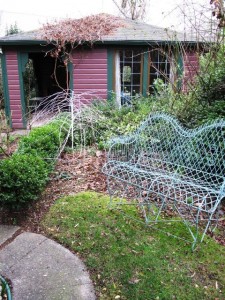
In a winter scene in a city garden, Jon's plum-and-green garden house is quite handsome
Seattle’s historic Georgetown settlement isn’t really known for being a residential neighborhood, but rather for the fact that a freeway runs through it, a bunch of warehouses populate its main streets and – oh yeah, if you look really close, there are a few pretty amazing lanes where Early Seattle architecture still stands.
Behind one of these cottages is an irresistible gentleman’s oasis, its exterior painted dark plum with pine-needle green trim. It has a comforting hip roof overhead, on top of which is a decidedly non-urban weather vane.
Jon Dove, the gentlemanly owner of this garden house, is an estate gardener and talented plantsman who grew up in Georgetown as a kid and found that as a grownup, he didn’t want to leave. Jon has restored and revived a 1905 cottage-style farmhouse here, planting a voluptuous, beautiful tangle of a garden in front, on the side, and in the back.
I first met Jon through Jean Zaputil, my good friend and garden muse. They had volunteered at the Washington Park Arboretum display at one of the flower shows and found they were kindred spirits. One July, many years ago, Jean and I went on the Georgetown Art & Garden Walk – a walking tour put on by the neighbors rather than one of those fancy affairs with shuttle buses.
We stopped by Jon’s to visit his postage-stamp-sized garden filled with perennials and shrubs as tall as me. Glorious! Around back, a one-car garage occupied a too-important chunk of space, similar to the way my husband’s baby grand piano occupies a too-important chunk of our living room. (It’s there, it’s nice to look at, but it’s in the way.)
On my trip last week to Seattle, I was presented with an unexpected gift of afternoon tea in Jon’s new garden house. Yup, in that former garage, which Jon says is only a little younger than his house, maybe from the ‘teens.

Jon Dove, showing off his old-new garden house
An Old-New Shed
Here’s how I returned to Georgetown to discover Mr. Dove’s Delightful Garden House.
Daniel Mount, another gentleman gardener (and a superb, dreamy writer, too – check out his blog), invited me to have tea when I came to Seattle. This was going to be tough, due to my schedule. But Daniel dangled the carrot from a stick: “We could meet at Jon’s – I want you to see his new shed.”
Oh, Daniel. You definitely know how to tempt a shed aficionado like me!
So after finishing up a photo shoot with David Perry (for our new book project – more on that later), and before joining my friend Jan Hendrickson for a lovely dinner, I made my way down I-5 to Georgetown. Jean was supposed to join me, but since she had just logged six or seven hours helping us as a stylist for the aforementioned photo shoot, she needed to take a pass. Of course, since she lives in Seattle, she can go see Jon anytime.
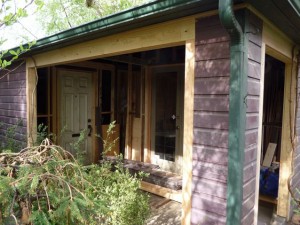
A work-in-progress photo, courtesy of Jon. This shot illustrates how the carpenter cut away the side of the garage to create a covered porch
Jon says it started to bug him that the useless garage was taking up a chunk of space otherwise deserving of something more attractive. As is the case with many people (I should know – I live in California where it happens for everyone), the garage was just a repository for stuff. After not looking at or using that stuff for a decade or so, Jon wondered if he really needed it after all. Voila! Out with the junk, in with the garden antiques.
To get there, Jon sketched out a new floor plan for the squarish building. He intelligently carved three useful spaces out of the 20-by-20 foot structure. Its back section is separated by a wall (and door) to a long, narrow area for bicycle storage, garden supplies and tools.
The original sliding garage door opens to the alley, so this application was a perfect way to leave the utilitarian stuff facing away from the garden.
Left with about three-quarters of the footprint to work with, Jon then sliced that space into two sections – one larger, which becomes the main interior room; and one smaller, which is the corner that juts into the garden.
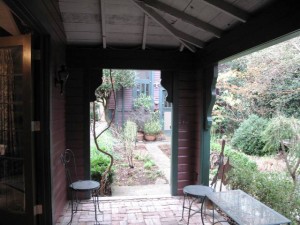
Finished with a brick floor and fanciful bracket-trim, it's a sheltered spot to sit in any weather.
He worked with a carpenter-friend to cut away an exterior side opening and “doorway” in that corner, essentially creating a covered porch. It is now carpeted with a pattern of recycled brick, set in sand.
By adding decorative corbels to the upper corners of the two openings, the space feels like a grand porch beneath an overhanging roof. “I wanted to be able to sit outside even when it rains,” Jon says. Cozy, comfortable, thoroughly delightful.
Now we shall step into the inner sanctum, through the French doors and into the room where tea was promised. A glance at Daniel’s face revealed that he had a secret I didn’t know quite yet. Inside, I understood why he was grinning. I forgot about the promise of tea and drank in the decorative sitting room.
Jon is a scavenger, like many of us. He found large, divided-paned doors to enlarge a tiny window space into a picture window. In the winter, it’s nice to see the bones of the garden revealed. What stands out is a graceful, curved metal bench, its lines echoed in the arched canes of chalk-white ghost bramble (possibly Rubus thibetanus).
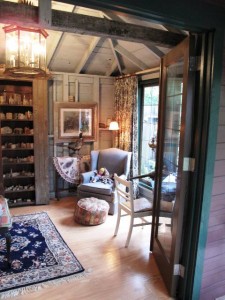
A peek inside: Elegant, refined, inviting
Jon used plywood to cover the floor and then sealed the inexpensive material with clear, water-based semi-gloss Verithane. The light colored wood floor contrasts nicely with the dark, stripped-down ceiling beam (original to the garage).
An oversized vintage brass lantern hangs at the peak of the room, dominating the scene in a very pleasing manner. Because of the ceiling’s volume (I’m guessing it’s approximately 10-feet tall at its peak), there was plenty of space for Jon’s carpenter to add an upper ledge where birdhouses are now displayed.
Against one of the two solid walls is a garden bench painted pea green. Daniel somehow obtained the bench from the set of a Chekhof play and brought it here as a gift for Jon. The three of us started dreaming about moving the bench to the covered area outdoors so as to make room for a daybed. But then, maybe not, because everyone who visits Jon will yearn to nap in this garden house (me included).
UPDATE: Jon sent me this note last night. . . reading it put a smile on my face:
Oh Debra, I forgot to mention after your visit, I moved the bench from inside the Garden House to the porch. I then moved the my guest bed to the Garden House, I spent a night out there, was cozy. Looking forward to spending summers there. You’re a whirlwind of great inspiration.
Again, thank you!
Jon
Above the bench is a fantastic objet – a cast iron circle that measures about 48 inches across. There’s a mirror at the center, which reflects the garden’s foliage and flowers into the room. Turns out, the scrappy piece of metal was once the base of a stove that Jon took out of his home when he modernized it. He saved it – for no inexplicable reason other than it was strangely shaped and interesting – and, voila! Now it’s this dramatic wall detail. Ironically, an old mirror from a vanity or hutch fit perfectly into its center.

I'm glad Jon hung onto this until he found a perfect use for the cast iron circle, cum mirror frame.
It’s amazing how many great design ideas reside inside a few hundred square feet, including some recycled toile ceiling-to-floor draperies that Jon inherited from friends. They add style, warmth and privacy when pulled across the French doors. I’ll let my photos show you some of the other nice details Jon has added.
Jon says he spent around $5,000 to $6,000 for construction (labor and materials) and about $2,000 to have the garden house painted. To me, it seems like a great investment that adds a whole lot of character, interest and function to his urban garden.
Finally, I couldn’t take my eyes off of his collection of architectural miniatures that fill an old canning cabinet. The cabinet is ancient, dating back to the very first settlers in Georgetown. The Horton family platted Georgetown in the 1870s. A friend of Jon’s rescued the wood cabinet from a home once owned by the Horton daughter. The square-head nails hint at its pedigree.
The shelves are filled with tiny wooden buildings that Jon cuts from scraps and covers with beautiful, intricately painted details in black – windows and doors, of course; but also molding, corbels, cornices, all rendered with tiny brush strokes.
Here are some close-up details of his whimsical, wonderful miniatures.
Posted in Architecture, Creativity, Gardening, General, interior design, Landscape Design, Plants, Sheds & Havens | 8 Comments »
January 28th, 2010
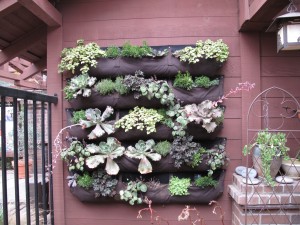
A Woolly Pocket wall of succulents adorns the retail shop at Descanso Gardens near Pasadena
Designed in Los Angeles, fabricated in Kansas, and soon to hang on a wall near you, the Woolly Pocket is a soft-sided planting envelope that makes it possible to have a lush wall of vegetation without having to hire a structural engineer.
Vertical gardening is all the rage, so here’s a way to bring plants into your home (indoors or out) with a breathable fabric container that is easy to hang and maintain.
Fill the 15 x 24 inch pocket with a little potting soil, plant it with lush greenery and allow the vines or foliage to spill over the top edge. Combine multiple pockets to create a living wall as is shown in these photographs.
WHAT IS THE WOOLLY POCKET?
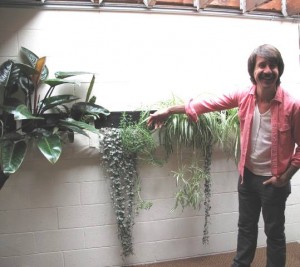
Miguel shows off a 5-pocket Woolly planter
I met designer Miguel Nelson at his studio in Culver City earlier this week and took a tour of Smog Shoppe, his event space where the Woolly Pocket was created.
Miguel was trained as a sculptor, but he obviously thinks about sculpture in a completely different way than artists whose work stands on a pedestal in the garden or in the foyer of a home.
The type of sculpture Miguel conjures is an entire building and outdoor courtyard that contains green events. He and Sherry Walsh, his wife, retrofitted an unsightly garage used to do emissions tests on cars (thus, the clever Smog Shoppe name).
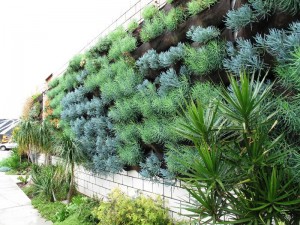
The analagous blue-green plant palette nearly covers the exterior of Nelson's Smog Shoppe event space in Los Angeles
Used for private and corporate events, the warehouse-y space needed to be softened up. And so Miguel and his brother Rodney created huge wall-hangings with pockets and stuffed them with succulents, tropicals and other plants that cascade and drape. The hangings look like those large shoe-organizer pocket panels, but are oh-so-much more elegant.
Over two year’s time, the plants have thrived, nearly obscuring the concrete block walls and the black wool pockets. Once partygoers started asking if they could buy the planting system for their own homes and gardens, Woolly Pockets was born.
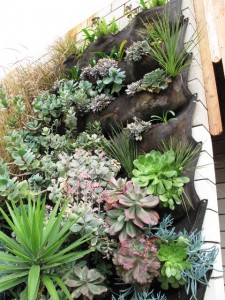
A detail shot reveals how happy these plants look
Instead of wool felt like the original system, Miguel and Rodney now use an industrial-strength USA-made felt from recycled plastic bottles (it is available in chocolate brown, black and cream – with a promise for more colors in the future). The pockets have a built-in moisture barrier that allows the plants to breathe while keeping moisture off your walls or floors.
The blogosphere and a few design magazines have discovered Woolly Pockets, which are priced at $49 for a single. Multiples range from $125 (3-pocket, 68 inches) to $188 (5-pocket, 112 inches).
Miguel’s eco-publicist, Corey Scholibo, is convinced that this green gardening solution will capture the imaginations of non-gardeners. It is a cool interior design application that is at the same time retro (think indoor plants of the 1970s) and futuristic (plants will save the planet!).
“You can now garden any time, anywhere, with little or no skill,” Corey says.
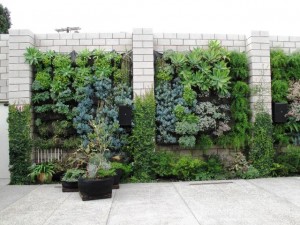
Interior walls of the courtyard are planted top-to-bottom
The team is inventing all sorts of new iterations of the Woolly Pocket. There is a Vagabond, which I wrote about last month for LA At Home (think “Garden Container meets Handbag”) and at this weekend’s Accent on Design in New York, Miguel will introduce a 5-sided wee-woolly tabletop planter and a gorgeous, free-standing 6-, 8- or 10-sided planter that has zippered sides so you can unzip sections to accommodate sculptural tree branches poking out. Those items appear to be ideal for the interior space and are a lot more attractive than some of the plastic, clay or faux planters I see hanging around garden centers.
You can mostly find Woolly Pockets online, but Miguel expects to sell through several retail channels by later this year.
“I see all these amazing living wall installations in public spaces,” he points out. “But you never read about a vertical garden you could have yourself. Now, even with just one Woolly Pocket, you can grow plants on your wall.”
With a cluster of them, arranged like a giant patchwork quilt, pretty soon you can have your own living, green wall.
I have four dark-brown Woolly Pockets to try out and I’ll report back soon on how they are doing. I’m going to hang them outside to try and mask some of that ho-hum tan stucco we’re so lucky to have here in SoCal.
Posted in Architecture, Creativity, Entertainment, Gardening, General, interior design, Plants, Playfulness | 10 Comments »
January 24th, 2010
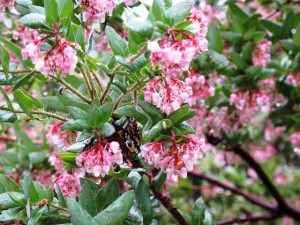
I competed with a hummingbird to get up close and personal with this gorgeous Manzanita. Katherine has a trio of them, small multi-trunk trees, in full January bloom.
Katherine Greenberg is a passionate native plant expert whose naturalistic landscape in the East Bay community of Lafayette has inspired hundreds of tourgoers and garden club students who have taken her workshops about growing California natives in the domestic environment.
I have known Katherine for about five years through our association as fellow board members of the Pacific Horticulture Society (she is former board president). Although we only see one another two or three times a year at board meetings, there is always a friendly connection as fellow horticulture enthusiasts. And also as writers.
Katherine has just signed on to completely revise and expand a classic title, Growing California Native Plants. Written by the late Marjorie G. Schmidt in 1980, the guide originally introduced the idea of using native plants as elements of the landscape. Tens of thousands of copies have sold, but over the course of the book’s 30-year run, lots has happened in the cultivation of natives. More growers are propagating and breeding native plants and there has been an explosion of interest in changing how our yards and gardens look.
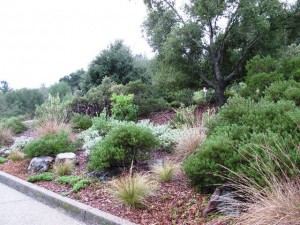
Katherine's entry garden in winter.
Lucky for California homeowners, University of California Press asked Katherine to create a new version of Growing California Native Plants. Uber-organized as she is, Katherine just signed the contract this past fall and has the entire book mapped out with most of the plant profiles rewritten (with a greatly expanded plant list, as one would expect). She is going to include many of the original illustrations and add up to 200 photographs in the new guide, expected out in 2011. Keep an eye out for its release.
Katherine’s own garden, approximately one-acre in size on a ridge above a seasonal creek called Happy Valley Creek, is a laboratory for living with natives, celebrating the seasons, and encouraging harmony with nature. It was profiled last spring in Diablo, the East Bay lifestyle magazine. You can read “Going Native,” the story, and see Saxon Holt’s lovely photography here.
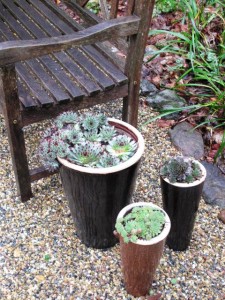
I love the sweet display of drought-tolerant, cold-hardy hen-and-chicks in tall vessels
I had a quick trip to Oakland this past Wednesday and Thursday and Katherine graciously hosted me for an overnight before I gave a talk to the “Dirt Daubers,” an Orinda-based garden club.
Even though it was dreary and rainy out, I made sure to take a loop through Katherine’s garden. Seeing a native garden in winter is really a joy because the plants in fruit or in bloom are like little sparkling jewels that catch your eye against the silver-grey and green foliage and mahogany and white bark.
In the Diablo magazine article, written by Sandra Ann Harris, Katherine explains her commitment to designing with California natives:
“Gardening with these natural treasures is a way we can play a big role in preserving endangered plants and in making a connection to the place we live,” Greenberg says. “My garden won’t be complete in my lifetime, but it’s a celebration of our natural heritage.”
Here’s a little gallery of wintry photos to calm and sooth you. Thoughts of spring are accelerating as we catch glimpses of new growth emerging on stems and in swelling buds (especially after all the rain California has had – six consecutive days of it!).
-
-
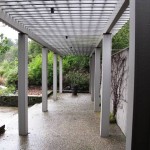
The entry pergola has an urn at its terminus
-

-
Another winter garden surprise: Silk tassel (Garrya elliptica)
-

-
A view along the bridge to the path below Katherine’s garden
-

-
Active from winter rains, Happy Valley Creek, as seen from the wooden footbridge
-

-
Snowberry (Symphoricarpos mollis)
-
-
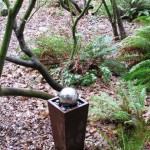
Katherine designs with a light hand, including her use of ornamentation. Yet when I looked outside the guest bedroom window in the morning, this small gazing ball amid ferns caught my eye
-
-
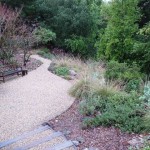
The pathway through the lower garden widens at the center to create a gravel gathering space, complete with bench
-

-
I competed with a hummingbird to get up close and personal with this gorgeous Manzanita. Katherine has a trio of them, small multi-trunk trees, in full January bloom.
-
-
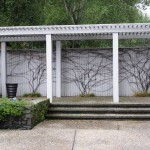
The entry pergola is stunning and yet simple in its design
Posted in Creativity, Gardening, General, Landscape Design, Plants, Writing | 5 Comments »
January 9th, 2010

I’ve been contributing to a fabulous daily blog called “Lifestyle Insights. Real Women. Real Life,” which a group of us launched last September. It’s something completely different than my other writing projects and has allowed me to do some fun, memoirish, essay writing in addition to writing about outdoor living and gardening topics. But since it’s still a blog post, I have had to learn how to communicate my ideas in 300 words or less! And in today’s world of bite-sized journalism, I guess that’s a good skill to have.
To work with a dozen incredibly talented women – each highly accomplished in her own field – has been so rewarding and inspiring. Each of us is committed to communicating contemporary trends and ideas for women like us. Together, we have a powerful voice that we hope will inspire and influence how corporations communicate with their audiences.
The group was founded by Robin Avni, a multi-talented, idea-a-minute galpal. I remember reading Robin’s home+technology design stories in the Seattle Times long before I was fortunate enough to meet her – which I recall was on a press preview of the former Seattle Interiors Show in 2004 or so. Thanks to the miracle of LinkedIn, we reconnected last year and got together a few times when I was in Seattle on business or to give a lecture. Robin invited me to join her dream team of 12 lifestyle experts. We are part of a creative media and consulting agency “specializing in consumer insights, trend analysis, research and content for the MOMMY TO MAVEN™ market.” You can read more about the firm here.
I’ve added Lifestyle Insights to my blogroll at the right (under “My other blogs”), so I hope you’ll subscribe to our newsletter and also check in from time to time to discover a fabulous recipe from Jean Galton, our food expert; a perfect organizing tip from Janna Lufkin, our simplicity expert; an insightful parenting tip from Kavita Varma-White; entertaining, beverage and spirits ideas from Kat Spellman; sustainability news from Celeste Tell, our green goddess; technology insights from Molly Martin, our tech-savvy mentor (Molly, a former health and fitness columnist, also keeps us “balanced” and healthy); wonderful stories told by Sherry Stripling, whose words capture the universal connections of women in all generations; explore fashion and twentysomething trends spotted by Alexandra Smith; and get the “big picture” from Robin Avni, who ties it all together with a finger-on-the-pulse instinct about women and their lifestyle choices. Our visual storytellers include photographer Angie Norwood Browne and Valerie Griffith, our video producer. It is an honor to share the page (screen) with these talented communicators.
Here are two of my recent essays, in time for a quiet winter’s read. I hope you enjoy them:
The Scarf Society
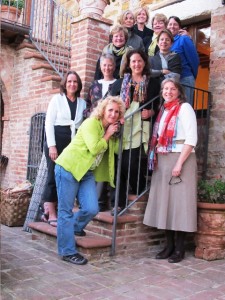
Here are the Italy Gals, with a few of us in our scarves.
My recent visit to a medieval village in Tuscany (where I spent a week with ten of my girlfriends in a rented villa) is symbolized by a soft, colorful scarf.
Each woman had in common a friendship with me; some have been pals since my early twenties, while others are more recently dear. Individually, we couldn’t have been more different from one another. Throughout the week, though, we bonded as a group. We spoke with a familiar friendship-language, punctuated with laughter, and enhanced by delicious food, good wine and unforgettable scenery.
And there was something else: Our Italian scarves.
Street vendors in Siena and Florence offered a tempting array of scarves – cashmere-and-silk textiles woven of gold and maroon; apple green and sapphire blue; solid or paisley-patterned. Pretty soon, most of us had joined what I called the Scarf Society. It was October, so the soft cocoon of fabric draped over the shoulder was appropriate. But it wasn’t all about getting warm.
The scarves, shawls and pashminas made us feel sophisticated. Even the less-flamboyant women in our group gravitated toward the look. Wrapped once or twice around the neck; used as a shawl around the shoulders; or worn asymmetrically with the ends twisted together, these lengths of fabric had a way of making even a t-shirt and jeans look glamorous.
Was it the scarf or the place? Was it the mutual experience of kindred spirits or a fashion statement? I’m not sure. But now that I’m back at home, I feel elegant when I wear my woven tapestry with threads of pale yellow and dark green. And I will always remember the warmth of my friendships.
You could call it a fringe benefit of an unforgettable vacation.
And this one, called Labryinths:
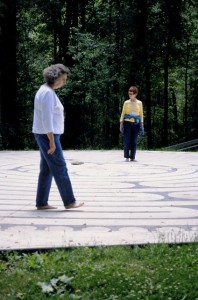
I was so moved by watching the labyrinth walk at a "God in the Garden" conference that I spoke at a few years ago.
Centuries, or perhaps millennia old, the labyrinth is linked to both mythical and religious practices of many cultures. Where a traditional maze is designed with dead-ends and false pathways, a labyrinth is made of concentric rings, interconnected to form a single, continuous journey.
In modern times, the labyrinth is used for meditation and contemplation – a device to slow one’s step and encourage quiet, inward focus. I’ve walked on grass labyrinths shaped by a lawn mower, pebble beach labyrinths designed by unseen hands, and carved concrete labyrinths installed in church floors and on the forest floor, surrounded by trees. Intricately made or constructed for temporary use, the labyrinth is a gift to be cherished.
To walk a labyrinth, I am required to step away from the chronological clock and get lost in the moment. I enter and follow the path to the circle’s center. I pause to say a prayer or quietly murmur “thank you” or “peace.” Slowly, I retrace my steps, returning to the beginning. I discover that time has almost stood still. I feel a spiritual connection to nature and a lightening of the heart.
I once met an artist who required the use of a wheelchair. He meditated with a “visual” labyrinth. Installed in the center of his garden was an 18-inch-square miniature mosaic labyrinth. This incredible man journeyed the labyrinth with his eyes, beginning and ending at the same point, and experiencing the same meditative benefits as when I walked a full-scale labyrinth.
The return of this ancient pattern is really no surprise. We are busy people, with a lot on our minds. Consider how hard it is to unplug, silence internal or external chatter, and isolate ourselves long enough to listen to our inner voice. Perhaps you, too, will find peace by walking the labyrinth path.
Posted in Creativity, Gardening, General, Landscape Design, Plants, Spiritual Practices, Writing | 5 Comments »
January 6th, 2010

In a setting of snow on the last day of 2009, the Phipps Conservatory makes a grand statement
An amazing garden under glass, The Phipps Conservatory is a delightful destination in the heart of urban Pittsburgh.
I visited last week when the outdoor daytime weather averaged 20-degrees Fahrenheit.
But once we walked indoors, of course, the “season” changed. Blooms more likely to be seen in my Los Angeles backyard were thriving in the conservatory’s dozen-plus “rooms,” including the tropical-like Palm Court, Fern Room, Orchid room and Sunken Garden.
The Desert Room looked oh-so-familiar to me, with agaves, aoeniums, aloes and opuntias poking through the sand-colored gravel floor.
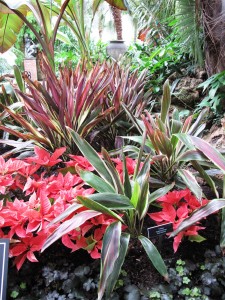
This was a new combination to me: Ti plants (Cordyline sp.) with Poinsettia
I visited on New Year’s Eve day and was delighted to learn that the Phipps actually remains open until 10 p.m. on New Year’s Eve, welcoming those more interested in a serene, candlelit celebration than louder festivities.
Right now, many of the plant displays here are dotted with glass sculptures by an artist named Hans Godo Frabel, who is know for his “realistic and otherworldly glass figures.”
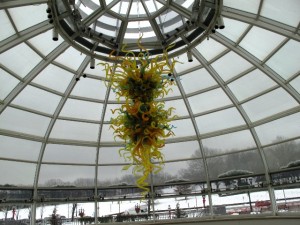
Chihuly's brilliant chandelier in mimosa yellow hangs from the ceiling of the new entry
Glass of a different sort was presented here in the past – the Dale Chihuly sort – and a few of his pieces remain in the permanent collection, which my photos show here.
My son Alex, who is 12, was very intrigued by Frabel’s alienlike glass creatures, as well as by his realistic glass flowers and salamanders. We took lots of “alien” photos.
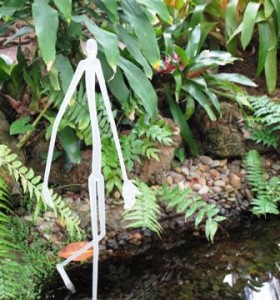
One of the eery glass aliens by Hans Godo Frabel
Fortunately, these disparate works of art were grouped together to present little stories in distinct wings of the conservatory. Otherwise I would have been completely confused.
In the 2000 book Crystal Palaces: Garden Conservatories of the United States, Anne S. Cunningham profiled the remaining major glass gardens. She wrote:
“Phipps Conservatory is a reminder of Pittsburg’s greatness in the time when Andrew Carnegie and Henry Phipps helped transform the American landscape with steel, steam engines, and civic philanthropy. Among his many contributions, Phipps (1839-1930) gave the city a conservatory “for public instruction and pleasure” in the newly developed Schenley Park.
When it was built, the Phipps Conservatory was the largest of its kind in the country. The shimmering Romanesque-style edifice made of steel, cypress, stone and glass reached 64 ft. tall and covered more than 43,000 square feet. It was originally filled with plants chosen at the World’s Colombian Exposition in Chicago. Writes Cunningham: “. . . the entire tropical plant display was shipped by train across the Midwest in time for the debut of the conservatory.”
From the height of fame to unfortunate neglect, this place barely survived subsequent decades. Sadly, the glorious conservatory fell into disrepair during the Depression. According to Cunningham: “by the 1930s, rats and weeds competed for space; a savage storm in 1937 damaged the big glasshouse and destroyed the greenhouses in back. By 1940, WPA crews had reconstructed the production houses, but the conservatory continued to suffer from natural deterioration and inconsistent community support.”
The Phipps’s renaissance came in 1993 when a private foundation purchased it and began to restore and revive the grand garden under glass. The Phipps seems to have come full circle with the 2009 highlight of hosting President and Mrs. Obama and the G-20 summit last September. The conservatory was the site of the opening dinner and reception for the world’s leaders. How wonderful that a garden was the backdrop for this powerful gathering.
The rebirth of this grand conservatory is indeed cause for celebration. Here are some impressions from our visit last Thursday:
-

-
Another unusual holiday combo: Poinsettias, ivy and flowering plectranthus
-

-
A Chihuly piece entitled “Cattails”
-

-
Oh how we envy the towering tree ferns
-

-
This is elegant: a red poinsettia + white orchid + green maidenhair fern in a black estate urn
-

-
A snow-white phalenopsis orchid
-

-
For some reason I loved this poinsettia’s green-red marbling
-

-
A delicate orchid, photographed by Alex w/the macro feature
-

-
Gorgeous and inspiring – a hanging tillandsia “ball”
-

-
A delicate little flower, in sweet pea colors, blooming on a tillandsia
-

-
another gem in the Orchid Room
-

-
Paphiopedilum aka beautiful orchid
-

-
True confessions: I don’t recall the name of this hothouse plant, but I sure love its stripy foliage
Posted in Architecture, Book reviews, floral design, Gardening, General, Landscape Design, Plants | 4 Comments »
January 3rd, 2010

An unlabeled dark pink Camellia in winter at Descanso Gardens
Camellias are oh-so-beautiful, delicate and almost porcelain-like in their perfection.

Deb and Anita (Mom) in Japanese garden
On the day after Christmas, my parents and I visited Los Angeles’s most established camellia collection at Descanso Gardens.
The mature camellia shrubs (many of which are tree-like in their proportions) are protected from Southern California’s harsh heat and sunlight because they’re planted in the understory of even more mature sycamore and live oak trees. They are happiest in the cooler months of the year.
Here, you really do feel like the paths lead through an established woodland. It’s actually an urban woodland, just off of the junction of two freeways. But that’s LA for you.
When we moved to Los Angeles in August, 2006, we got off the plane at Burbank Airport and while waiting for luggage, I noticed a huge DESCANSO GARDENS billboard above the luggage claim area. I remember thinking, “what kind of garden could exist among all this concrete?”
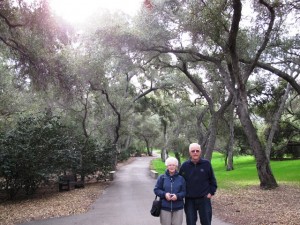
Anita (Mom) and Fred (Dad) at entrance to Oak-and-Camellia Forest
Later, I was lucky enough to visit. Descanso Gardens is a 160-acre natural woodland and botanical garden located just north of Burbank in a community called La Canada-Flintridge. It’s about a one-hour drive east of where I live in Thousand Oaks and about 20 minutes west of Pasadena. If you plan a visit to the Huntington Botanical Garden, you can easily add a side trip to Descanso.
I was invited to give a talk at Descanso a few summers ago and was blown away by its immense scale, as urban gardens go. But until last week, I had never visited during the winter Camellia season.
Descanso’s founder, E. Manchester Boddy, publisher and owner of the Los Angeles Daily News, preserved the land (gardens, woodland and chaparral) to share Southern California’s natural beauty with future generations. This is where he lived, building a home in 1938 with views of the San Gabriel mountains. The Boddy family left the house in 1953 when they sold Descanso to Los Angeles County.

A beautiful pink camellia display
About the Camellia Forest:
Thousands of camellias grow in the understory of a 20-acre oak forest. Boddy began planting camellias in the late 1930s, originally to supply the florist trade.
Many plants were purchased from F.M. Uyematsu, a Japanese-American nurseryman whose camellias were well known to the trade. Other plants came directly from china, including Camellia reticulata cultivars, imported by Boddy in 1948. Camellias bloom here from October through May, so you can actually enjoy them most of the year except for summer.
Here are some more of the flowers and garden features that we enjoyed on our winter visit. I especially love the glossy red container plantings of Camellia sasanqua ‘Setsugekka’ because they remind me of the same ones growing in my former Seattle garden, espaliered against the fence for a beautiful winter floral display.
-
-
A winter container display with white-flowering Cameliia sasanqua ‘Setsugekka’
-

-
Camellia hiemalis ‘Showa-No-Sakae’
-

-
Camellia japonica ‘Daikagura’
-

-
A small stone temple on a bed of mondo grass
-
-
Flower and leaf petals on the Zen garden’s gravel
-
-
Camellias at the gateway to Descanso’s Japanese garden
-
-
A gorgeous Belgian fence of crabapple trees (Malus x adstringens ‘Hopa’)
-

-
A few remaining crabapples left for the birds
-

-
A pristine, white camellia (unlabeled) with a smudge of soot
Posted in Gardening, General, Landscape Design, Plants | 4 Comments »
© Debra Prinzing, all written and photographic content. Website design/development by Willo Bellwood/Metric Media