The Slow Flowers Podcast is the award-winning show known as the “Voice of the Slow Flowers Movement.” Launched in 2013 as the original flower podcast, we’ve devoted more than 10 years to covering the business of flower farming, floral design, and the Slow Flowers sustainability ethos. Listen to a new episode each Wednesday, available for free download here at slowflowerspodcast.com or on iTunes, Spotify, and other podcast platforms.
April 29th, 2010

I posed with the larger-than-lifesized Mickey and Minnie topiaries who stand amid Epcot's bodacious vegetable patch
Mickey-Minnie-‘n’-Me
For the past couple of years, whenever I learned that a garden-communicator-pal was invited to speak at Epcot’s International Flower & Garden Festival in Orlando, I would think: How do I get in on that great gig?
And so it seems: good things come to those who wait.
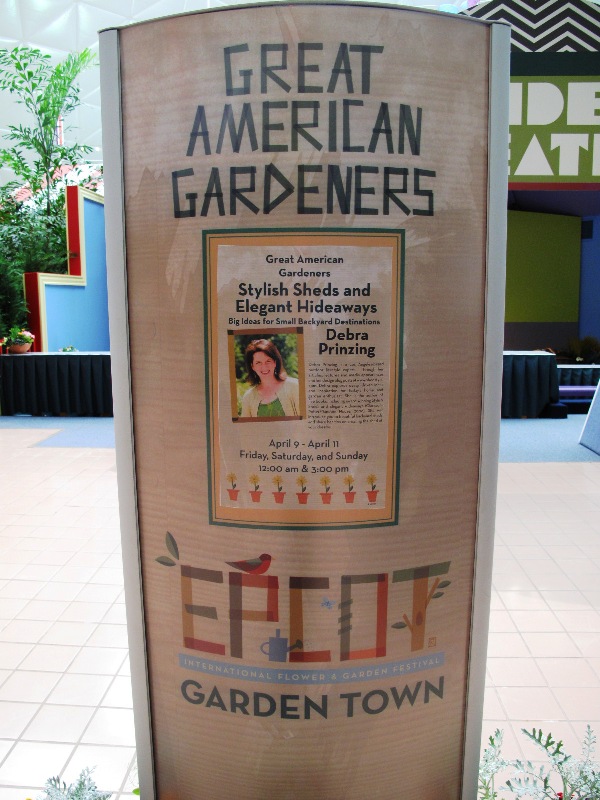
Last fall, Debbie Mola Mickler, the horticultural program planner for Epcot’s nearly three-month-long spring gardening festival, contacted me with an invitation to participate in the 2010 “Great American Gardeners” lecture series.
She and her colleagues wanted me to come and talk about Stylish Sheds and Elegant Hideaways. It was a pretty awesome invitation to speak six times over a three-day period.
And how cool that it coincided with spring break, which allowed my husband Bruce, and our youngest son, Alex (and his pal Philip) could come along and take advantage of the myriad adventures: water parks, animal kingdoms, magic kingdoms, fireworks, and lots more! We also got to see some good friends who’ve lived in Orlando for many years. And I was able to connect with most of the staff at Garden Design magazine, who are headquartered at nearby Winter Park, Florida. Lots of great reasons to come to Orlando… the fact that it was still “spring” here was a huge one. Warm and a little humid, but certainly better than summer here.
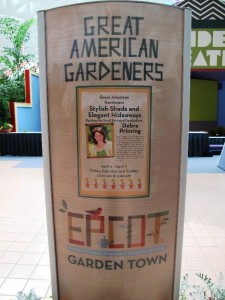
Great American Gardeners at Epcot
We stayed at Disney’s BoardWalk Resort, just across a “lake” from Epcot’s “Future World” and its iconic sphere. Our hotel’s Atlantic-City-inspired setting was gorgeous. My friend Lanny Wood, an architect, told me that famed American architect Robert A.M. Stern designed the boardwalk-style resort, with its white clapboard siding, striped awnings, and pristine lawns. There really is a fantasy world here and it’s so easy to be drawn into the playfulness, forgetting that there’s reality beyond the perimeter of Disney.
The plant displays, topiaries, and tropical landscaping are superb. When I first met Debbie by phone, I asked her why the flower festival had never come to Disneyland here in Southern California. She explained to me that it is merely a matter of real estate. Anaheim is land-locked by freeways and over-development. There seems to be little room to grow gardens at a Southern California amusement park.
Whereas in Orlando, there’s plenty of acreage! Over the past three decades or so, the talented horticultural staff at Disneyworld has created a beautiful, arboretum-like setting as a backdrop to no fewer than six theme parks and countless resorts.
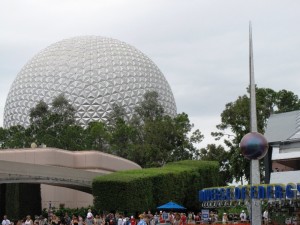
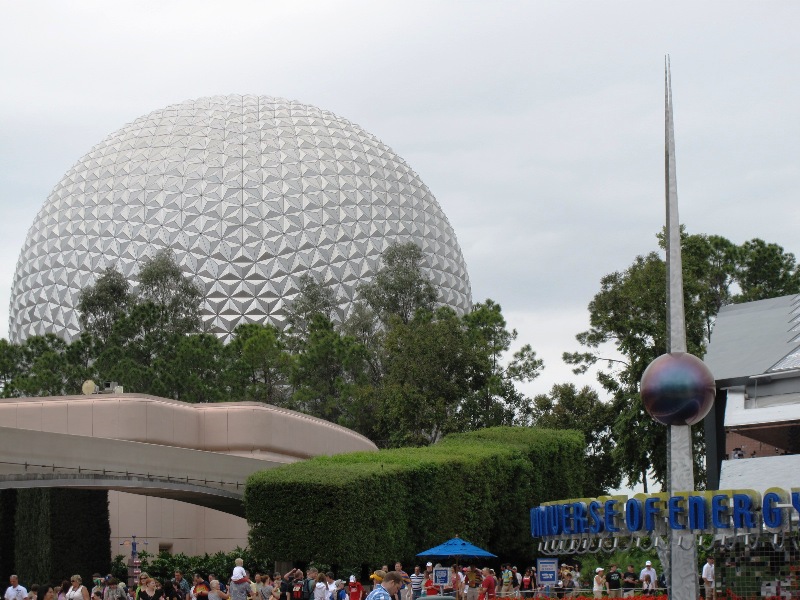
Iconic architecture - the dome and spire at Epcot
Here was my typical schedule – at least for the three days when I was on duty as a festival speaker.
Wake up and walk to the breakfast bar or bakery. One morning, we enjoyed a huge spread at Iron Chef celeb Kat Cora’s signature restaurant Kauzzina.
Next: The boys figured out which theme park to visit that day. Thankfully, Disney’s intricate shuttle bus system took them anywhere they wanted to go.
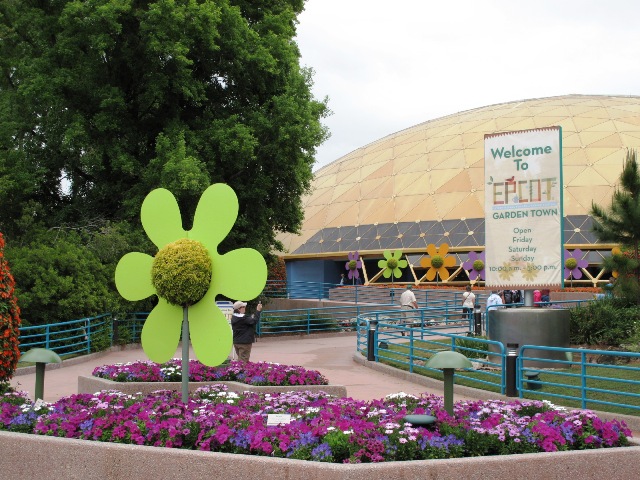
Then: Time for me to get ready for my first talk, at Noon. On my first day, I felt so special because John, one of the Resort’s longtime landscaping managers, greeted me as my personal escort. He picked me up at the hotel and drove me to the Epcot festival site, called “Garden Town.”
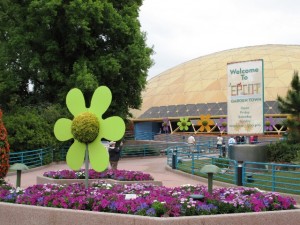
Garden Town at Epcot
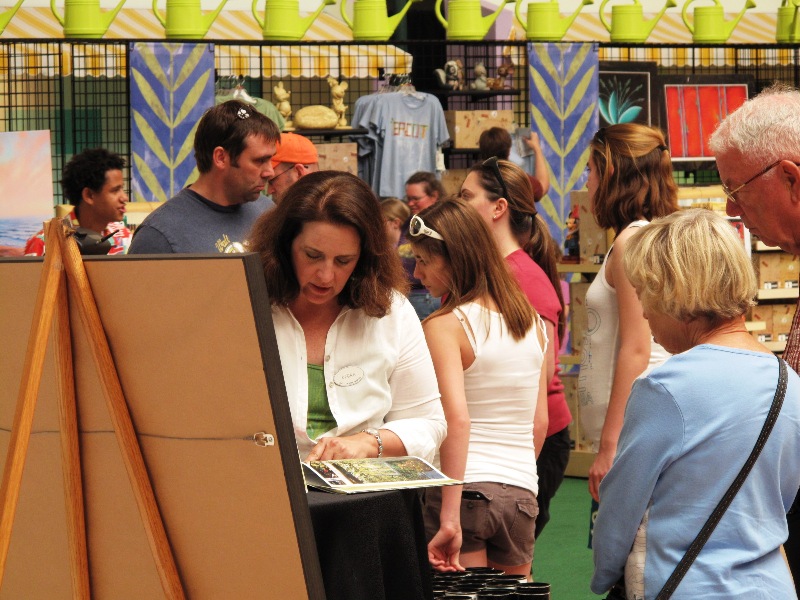
Inside the lecture hall, several demonstration stages were set up to accommodate a rotating schedule of speakers. During the day, in addition to the main stage talks, Disney’s gardening experts shared tips and involved participants in hands-on planting projects; University of Florida gardening experts presented local horticultural information, and Florida Master Gardener volunteers answered gardening questions.
After my noon lecture, I went to the garden gift shop to sign books and meet members of the audience. Then, I was free for lunch, when I took time to walk around the grounds and drink in various sights. I loved the butterfly house, the fairy garden displays, and – of course – the topiary Disney characters.
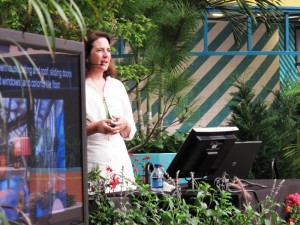
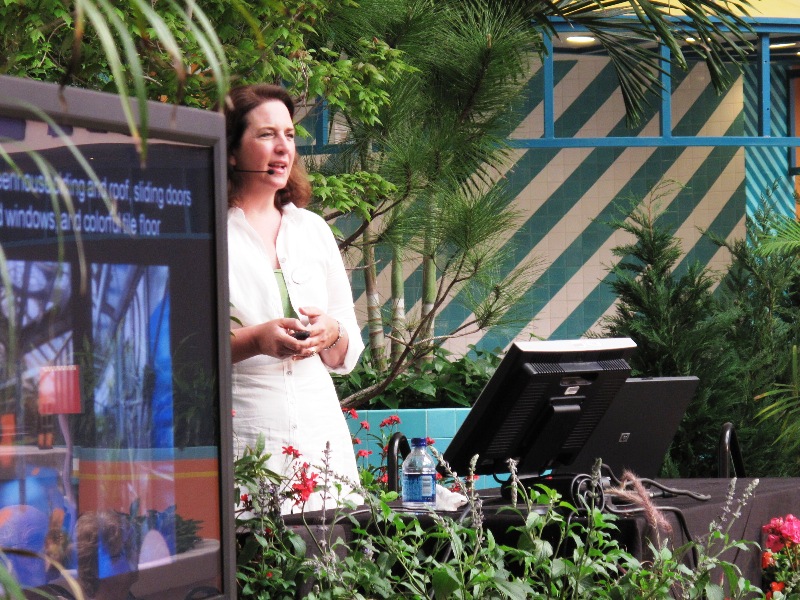
Speaking about creating the "shed of your dreams"
On Thursday evening, my friend Lindy came to meet me for dinner – what a treat to spend time with a very special friend from many moons ago. We always pick up right where we left off. I hadn’t seen Lindy since I was in Orlando in 2005 for the Garden Writers Association winter board meeting. But it felt like that was only a few months ago. I adore her. What a smart, savvy, strong woman. She always inspires me and makes me feel ready to take on the world.
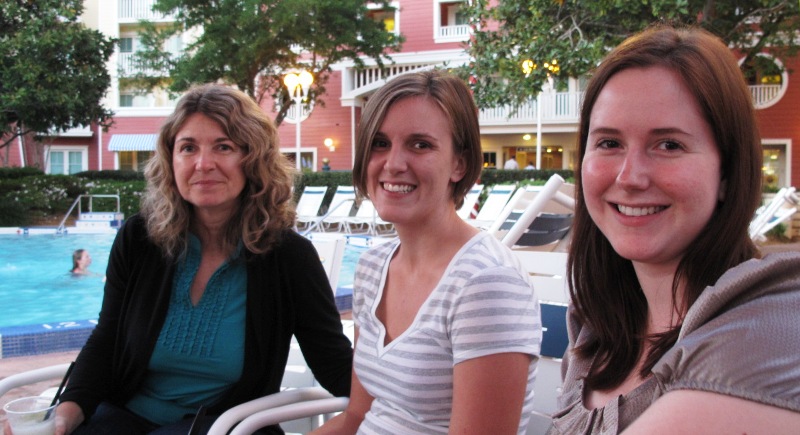
On Friday evening, the team from Garden Design magazine came to meet me for cocktails at the resort. We had a blast just socializing, while Donna’s daughter Kate jumped and splashed in the pool (my own son and his friend, both 13, were off on their own adventure, but we met up with them later. Going to Disney as a 13-year-old is a lot like going camping. Somehow the grownups worry less and you suddenly have quite a bit of autonomy and freedom).

Garden Design's team: Donna Reiss, art director; Chelsea Stickel, photo editor; Debra Prinzing, contributing editor; Megan Padilla, senior editor (with the adorable Aileigh)
On Saturday night, Bruce, my husband, had finally arrived from Pittsburgh. He was a trooper because he took Alex and Philip to Universal Studios for the day. But we reunited that evening and enjoyed a very unique dinner at Disney’s Animal Kingdom Lodge. If I ever go back to spend a vacation in Orlando, this is where I’m going to stay. You can only imagine how Disney interprets Kenya.
Bruce and I thought about our visit in 1990 to Amboseli National Park in Kenya when we went on a photo safari. Let’s just say that the real thing is a lot more rugged than the Disney version. But we had a blast and it was our last night with the boys before they flew home on Sunday morning, all by themselves to LA.
Bruce had to leave on Sunday evening and I stayed one more night in Orlando before flying to Dallas the following day. The rest of the week was a bit of a blur, since I had to teach a container design class in Dallas Tuesday night; fly home to Burbank on Wednesday; and then drive to Orange County to teach another class on Thursday. But I won’t let fatigue lessen the fun. Disney was unforgettable. And I’m so grateful for the experience.
Here are some of the horticultural sights that wowed me:
-
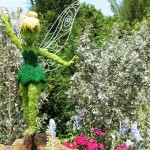
-
Tinkerbell, created from green moss
-
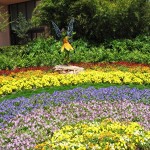
-
A rainbow of bedding plants
-
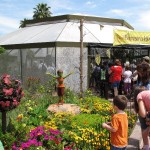
-
Disney’s Butterfly House
-
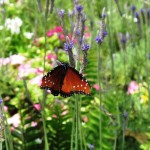
-
The butterfly display was a charmer
-
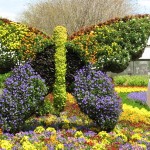
-
I loved this larger-than-life butterfly, planted with annuals
-
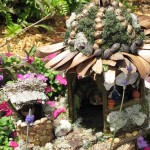
-
A tiny fairyhouse included in the Pixie Holly Fairy Garden
-
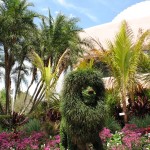
-
One of the Lion King characters with a full, planted “mane”
-
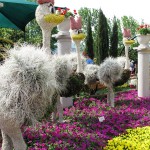
-
Topiary ostriches. What movie are they from? I can’t remember!
-

-
A topiary “Lilo” from the animated movie Lilo & Stitch
A few other pics and people to share:

Garden Design's Jenny Andrews, Leigh Ann Ledford and Shelley Easter

Fellow Garden Writer Association member, Kim Taylor from the University of Florida horticulture program (aka "The Sassy Crafter") met me on Sunday. She was at the festival to volunteer in the "Ask an Expert" booth
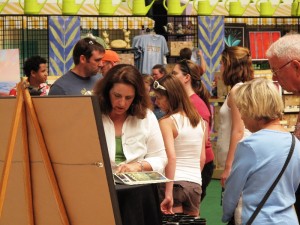
My book-signings after each talk gave me a chance to meet other stylish shed enthusiasts
Posted in Creativity, Entertainment, floral design, Gardening, General, Plants, Playfulness, Sheds & Havens | 3 Comments »
April 18th, 2010

I joined Jamie Durie, of HGTV's "The Outdoor Room," for brunch and an interview in LA
When I take on the tough job of interviewing celebrities, I always hold my breath, wondering whether we’ll move past the PR-speak and begin to discover more about the person behind the famous face and name.
So when HGTV’s publicity department arranged for me to meet Australian media celebrity Jamie Durie, I was ready for the spin. And the good news is that he surprised me with his abundant knowledge and heartfelt passion for his landscape design projects. It was a very fun assignment.
Earlier this year I spoke by telephone with Jamie for an mini-profile that appears in the April 2010 issue of Garden Design magazine. Now that he is Los Angeles-based, we decided to try and meet in person so I could interview him for a Q&A to appear in the Los Angeles Times HOME section.
An edited version of my full interview with Jamie appears in today’s paper, but I wanted to share our extended conversation here.
A big THANK YOU goes to Eddie Ward of DRC Public Relations in New York. He did all of the legwork to set up my lunch appointment with Jamie on March 28th. Read on for the full transcript of my interview with Jamie:
READ MORE…
Posted in Creativity, Entertainment, Gardening, General, Landscape Design, Plants, Writing | 3 Comments »
April 15th, 2010

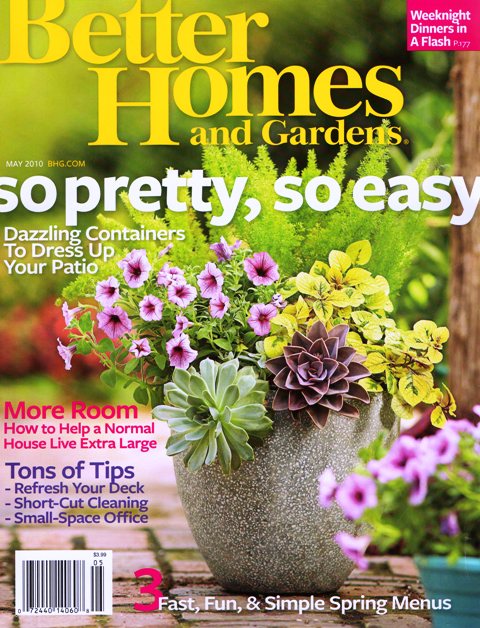
Check out pages 126-131 in the May 2010 issue
Today, while waiting to board my flight from Dallas to Burbank, I stopped by a newsstand and spied the May 2010 edition of Better Homes & Gardens.
I have been anticipating this issue because it features an article that I wrote about a very cool shed in Gig Harbor, Washington. The shed is owned by Cindy and Dave Storrar. They built their shed from plans they saw in the pages of BH&G, so they have traveled full circle from the inspiration to the reality — now reflected in their charming, 7-by-9 foot cedar-shingle garden hideaway.
How’s this for even more exciting news? My editor Eric Liskey made sure to include a sizable (half-page) sidebar featuring me as a “Shed Expert,” along with the cover of Stylish Sheds & Elegant Hideaways.
He also asked me to share tips on how to “design your dream shed.” These are excerpted from the book:
MISSION: Identify the activities that draw you outdoors (art, music, poetry, growing plants, play, entertaining, or meditating). Most personal passions can find a home in a small garden shed.
MUST-HAVES: List the design ingredients most important to you. Combine functional with frivolous. It’s OK to add a vintage cut-glass chandelier or a day bed. Make it your personal “nest.”
INSPIRATION: Draw inspiration from that single idea you can’t stop imagining – a historic property, a specific color, a recent beach vacation.
CREATIVE SOLUTIONS: Treat the exterior as a garden focal point and give it some of the visual upgrades you would give your own home. Decorate the interior with collections and cherished objects.

Stylish Sheds in the pages of Better Homes & Gardens
If this wasn’t awesome enough, I turned to the masthead and discovered that my new title as Contributing Garden Editor has landed me a place with all of BH&G’s editors and art directors. It feels good to be in such talented company.
It’s been a long day and already past midnight, but I had to post my news.
You see, I promised my new writer-friend Monica, my companion in Row 13 on that American Airlines flight from Dallas to Burbank, that I would make a big deal out of the magazine article.
Monica is the first person with whom I shared the magazine item, and she made me feel so pleased with the accomplishment.
We writers work so hard sometimes, often for less money than we deserve and little acknowledgement of our talent.
And it was nice to have an “atta-girl” from a fellow writer who was until today a complete stranger to me. Now, of course, we will probably become lifelong friends. And that makes today even more memorable.
Posted in Book reviews, Creativity, Gardening, General, Landscape Design, Sheds & Havens, Writing | 6 Comments »
March 27th, 2010
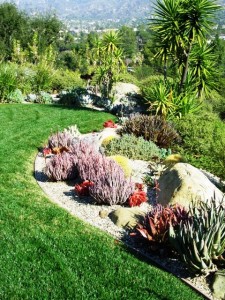
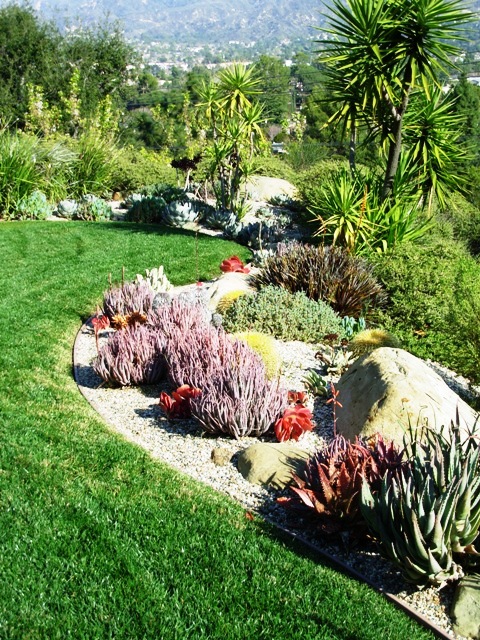
The renovated succulent and cactus border arcs along the lawn's edge. I love the salt-and-pepper gravel mulch, which echoes the dark-light elements of the home's Palos Verde stone cladding
The cover story of today’s Los Angeles Times HOME section features “Finally back in its prime,” my profile of the Daily House, a beautifully restored, circa 1954 “mod pad” in the LA suburbs of Glendale. Straight out of “Mad Men,” the house has been a decade-long project of its young owner, Christophe Burusco. Check out the Times’ web gallery here, with images by staff photographer Al Seib.
I had hoped to include a sidebar on the garden, but space limitations got in the way. My interview with Kathleen Ferguson of Los Angeles-based Kathleen Ferguson Landscapes reveals her excellent ideas and tips for approaching the exterior design of a retro home.
Here it is, along with my photographs from visiting Chris and touring his home and garden.
As I write in the Times’ story:
“The house – designed by Glendale architect Clair Earl, thoughtfully renovated by Burusco and since added to the Glendale Register of Historic Resources – sits on a 14,000-square-foot lot that feels like a rustic retreat, far from the city. Not a single neighbor is visible from the living room or master bedroom. Rather, Burusco’s eyes are drawn to the vibrant new succulent and cactus garden designed by Kathleen Ferguson, who incorporated mature specimens raised by the late Jean Daily Russom.”
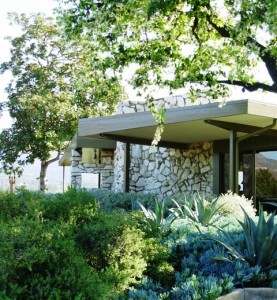
The low-slung, horizontal lines of the Daily House are visually appealing
According to Ferguson, as with all her projects, “I really look to the architecture and what my clients’ interests are.” With Chris Burusco’s project, she didn’t want the landscape to take away from the marvelous period architecture; rather, “I wanted to enhance it.”
Ferguson set out to mimic the architecture’s clean lines with “bold plantings in the landscape.”
Three major trees were saved, including a huge magnolia beyond the home’s glass-walled corner (which serves to enhance and frame the views of the San Gabriels).
Near the front entry, Ferguson was able to save an evergreen pear (Prunus caroliniana) and a Japanese maple. The beautiful forms of these two trees had been difficult to appreciate, due to a greenhouse that was plunked down between them by the original owner of the home.
Chris removed the greenhouse and its concrete foundation, giving the scene much-needed negative space.
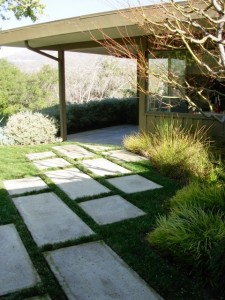
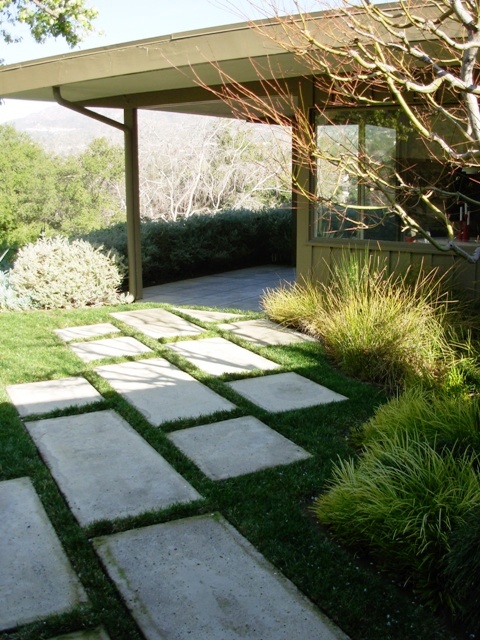
The new pathway cuts diagonally across the entry, using horizontal and square poured-in-place concrete
In its place, Ferguson added geometric poured-in-place concrete pavers that echo the lines of the home and lead visitors to the garden’s side entrance. “We really wanted the pavers to look like something that had been there already, which is why we did a random pattern,” she says.
The level front yard slopes down to the street, creating a dramatic perspective as you approach the house.
There, Ferguson staggered agaves on the low hillside. Mass planted, the scale and form of the agaves is ideally suited to the rugged texture of the Palos Verde stone-clad house. Between the agaves, ornamental grasses appear as a softening device.
“Together, the native succulents and ornamental grasses mimic the native surrounding plant palette,” Ferguson says.
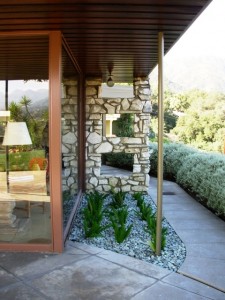
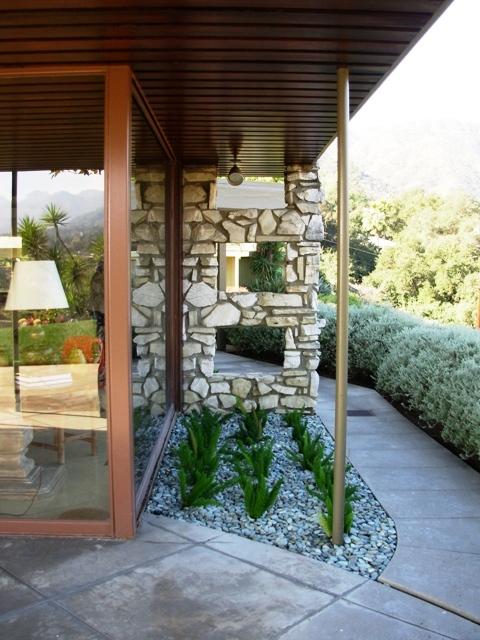
Smooth turquoise rocks cover the ground next to the accent wall with three cool cut-outs
As you walk along the side towards the home’s back garden, you can’t help but appreciate architect Clair Earl’s artisitic detailing. He punched a trio of “windows” in a stone accent wall, which invites you to view the San Gabriels through these carefully framed scenes.
On the ground at the foot of the accent wall, Ferguson planted softer forms of asparagus ferns, which can handle that constant shade. She “mulched” the plants with a layer of smooth, light turquoise stones “for a little bit of contrast.” (This stone echoes dark blue-green flagstone on the home’s entry hallway.)
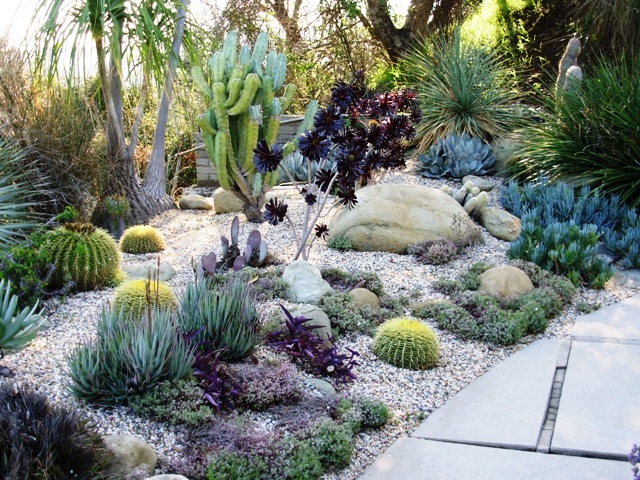
The garden’s piece de resistance is a cactus-and-succulent border that arcs around the edge of the small lawn and patio area. Here, Ferguson worked with some of the mature plants installed by Mrs. Daily Russom, who Chris says was involved with the cactus garden at the Huntington.
“Jean (Daily) loved succulents — she had a lot of amazing specimens that we wanted to keep,” he says.
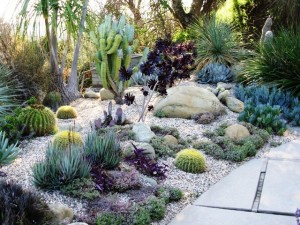
Mature cactuses are now interplanted with new hybrid succulents, creating a tonal cool-to-warm palette
By blending new succulent hybrids with the established, mature varieties, the expansive border is now a spectrum of cool-to-warm tones and contrasting shapes.
The design starts with clumps of striking, blue-gray Agave parryi, moves into purple-black rosettes of Aeonium arboreum ‘Zwartkop’ paired with sculptural paddle plants (Kalanchoe luciae) and leads to eye-pleasing multiples of golden barrel cactus (Echinocactus grusonii).
Chris loves the way the succulent palette “moves from the cool blue-grays to the reds, yellows, oranges, and then into cool again.”
The border, which runs the length of the house and can be seen from most of its rooms, is now mulched with a warm salt-and-pepper gravel (which replaced what Chris called “big ugly rocks”).
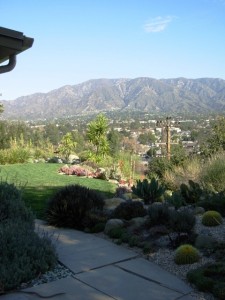
The cultivated landscape in the foreground blends with the San Gabriel Mtns. in the distance.
Ferguson is most inspired by the tension created between the landscape and the house; between the architecture and the wild setting beyond its domestic borders.
“Chris’s landscape has a lot of push-and-pull,” she says.
There’s the smooth against the rough; grey-greens against the rich greens. And there’s the contrast between the garden and the arid, native chaparal around the perimeter.
As you approach the house, it becomes more lush and more ornamental.”
I think it’s a pretty stunning treatment, worthy of this historic, but thoroughly modern, abode.
Posted in Architecture, Creativity, Gardening, Landscape Design, Plants, Writing | 5 Comments »
March 20th, 2010
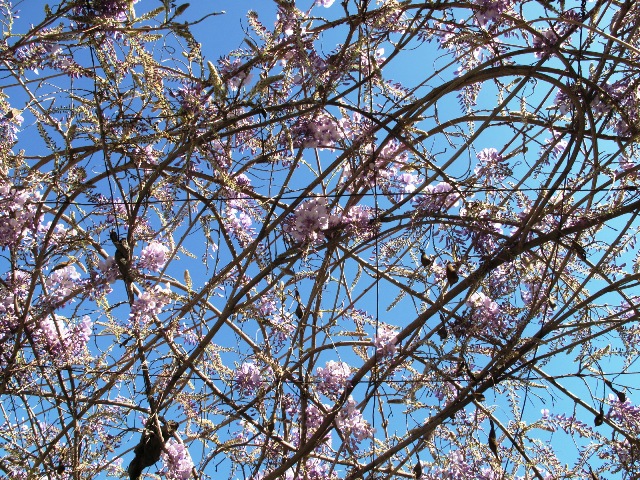
1. Wisteria sinensis

Wistaria, known as Wisteria chinensis
My week began with a very special botanical field trip to Sierra Madre, a hamlet near Pasadena that each year celebrates its hometown hero on the second Sunday of March.
That hero is a 116-year-old plant. Isn’t that cool?
Invited by Paula Panich, who enticed me with promises that I would see “one of the seven horticultural wonders of the world” (seriously, who could resist that offer!?), I drove 60 miles east to Sierra Madre and joined Paula’s entourage.
The Sierra Madre Wistaria Festival, a full-blown, main-street celebration, was under way to celebrate what the Guinness Book of World Records has named the world’s largest blooming plant – a Chinese wisteria (Wisteria sinensis).
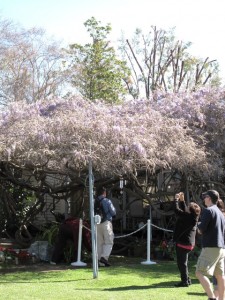
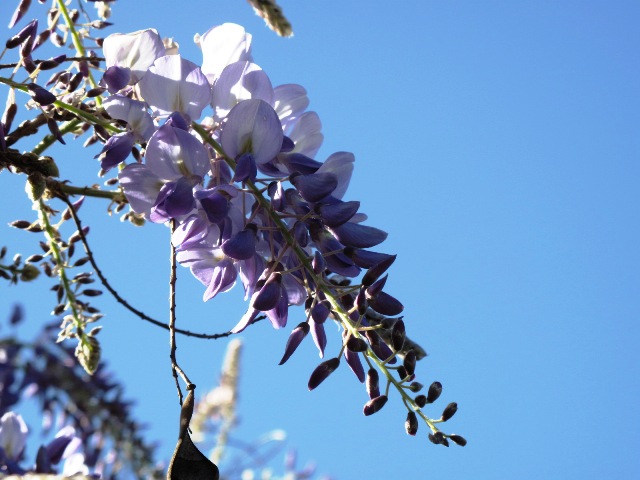
A cloud of pale, purple blooms create a one-acre floral canopy
Said wisteria, which the locals more accurately call Wistaria*, was planted in 1894 by Alice Brugman. She rode by horse and buggy to the R.H. Wilson Pioneer Nursery in nearby Monrovia to purchase the vine in a one gallon pot, spending 75-cents.
It now covers nearly one acre, weighs over 250 tons, and produces more than 1.5 million blossoms during a glorious, five-week run each spring. The festival occurs for one day only, when the property’s owners (aka the “flower stewards”) open up their gardens for thousands of visitors.
We were in attendance a little early in the vine’s bloom cycle, as you can see. But still, it was a sight to behold!
The vine covers two private residential gardens and is supported by a sturdy matrix of metal arbors. We walked underneath the canopy formed by lightly-scented, pale purple clusters that looked gorgeous against the intense-blue sky.
A festive day indeed!
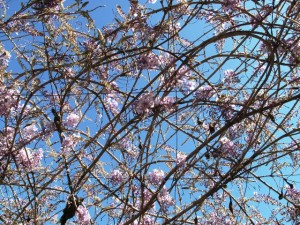
As pretty as Victorian wallpaper, the vines and blossoms trace the sky
*Wisteria or Wistaria?
According to a brochure distributed at the festival, experts at the Los Angeles County Arboretum and Botanic Garden have always used the correct spelling with “a” rather than “e.”
“The plant was named to honor Caspar Wistar (1761-1818), an American physician and University of Pennsylvania teacher. Among his accomplishments, he wrote the first text book on anatomy. When the name of the genus Wisteria was recorded, it was incorrectly spelled. So, one could say that all along, Sierra Madre has correctly spelled Wistaria.”
Now you know.
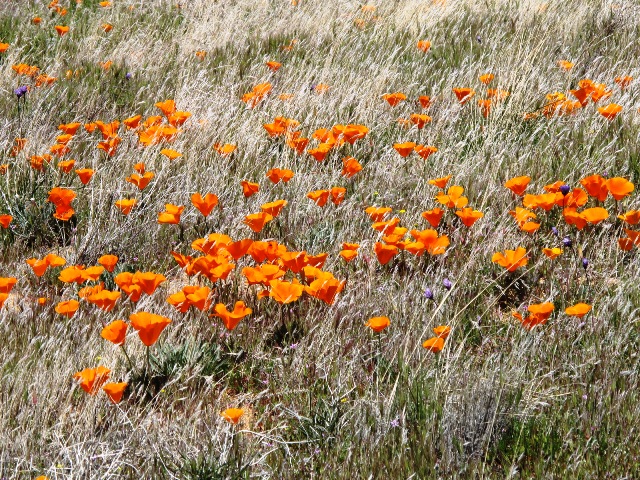
2. Eschscholtzia californica
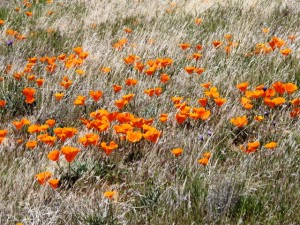
Spring is here! The poppies are in bloom!
This being perhaps my last spring as a full-time resident of Southern California, I was eager to squeeze in a visit to the Antelope Valley Poppy Reserve. My goal was to see the valley’s meadows and rolling hills awash in vibrant orange – a celebration of the California Poppy, the State Flower since 1903.
While poppies grow in many areas, along the edges of highways and in surprising pockets both urban and rural, the only remaining large fields are in the western Antelope Valley. This area is part of northern Los Angeles Co., about 90 minutes northeast of my home in Thousand Oaks.
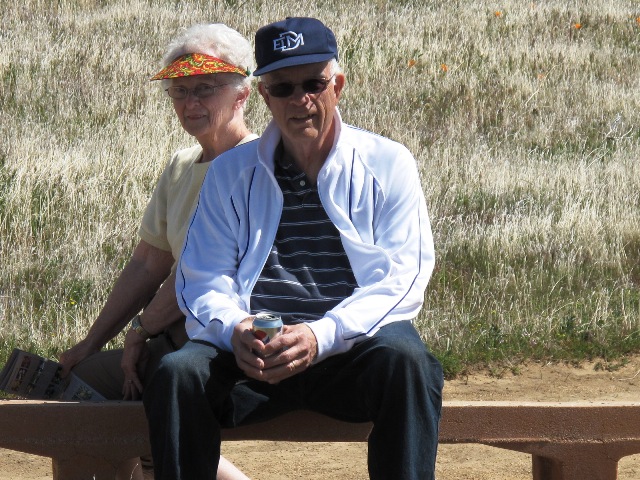
My parents were en route to visit this weekend (from the Phoenix area) and so I convinced them to take the detour north off of Hwy. 14 to meet me for a Friday morning Poppy Adventure.
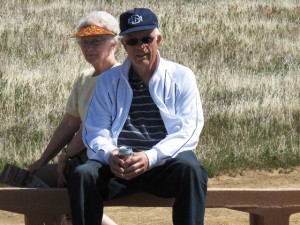
Anita and Fred Prinzing, my wildflower-hunting companions (Mom and Dad)
We arrived at the 1,800-acre reserve located about 15 miles west of the town of Lancaster. As with my wisteria visit, we were definitely too early for the peak poppy bloom.
Despite plenty of spring precipitation, the temperatures here had not warmed up enough to prompt massive blooms. There were beautiful patches of orange poppies, intermixed with other lovely wildflowers – including blue lupines. We took joy in what we saw and promised ourselves to return in the future.
I wish I could go back in two week’s time – that’s when the display will be the showiest!
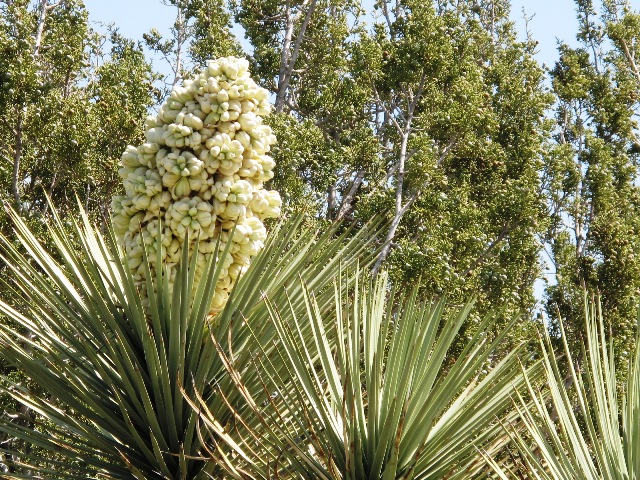
3. Yucca brevifolia
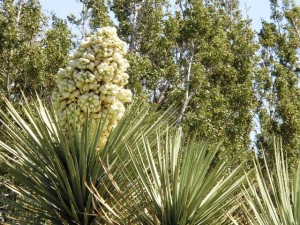
Magnificent Joshua Tree - in bloom
On our way out of the Antelope Valley, we discovered an obscure state park called the Ripley Desert Woodland. This 560-acre “virgin forest” is populated with Joshua Trees (Yucca brevifolia) and California junipers (Juniperus californica). According to the brochure we picked up:
“This is how the western part of the Mojave Desert must have appeared to early explorers as they came through the area” in the late 18th and early 19th century. . . .”
The park is named for Arthur Ripley, a farmer who willed the acreage to California when he died in 1988. He farmed a large amount of land in Antelope Valley, but he also was concerned enough about the Joshua/juniper woodlands to preserve a pristine area.
I was quite moved by this wild place. Walking through this desert woodland was pretty awe-inspiring. To find it, drive on Lancaster Road, heading west, about 5 miles beyond the Poppy Reserve.
Posted in Gardening, General, Plants | 2 Comments »
March 14th, 2010

Celebrating my birthday with Paula Panich at Girasole in Los Angeles, a sweet French bistro
Dear friends,
Where did February go? And for that matter, where did the first half of March disappear to?
I’m so sorry! I’ve been racing around like a crazy woman. Like my fellow *Gamma-Sisters everywhere, the world is asking more of us at every turn. Eternally curious, we’re inspired by exciting, interesting and compelling people, places, projects and opportunities. As one of my friends pointed out, I am easily drawn to “bright, shiny objects.” It’s irresistible. There are literally not enough hours in a day to “do it all.”
One of my excuses is that I have been traveling more than usual. Another is that my little family is currently in its bicoastal phase, with Mom and sons in Southern California and Dad (for the most part) in Pittsburgh. His occasional trips home are a highlight for us and exhausting for him. In between, I’m solo-parenting, burning the candle at both ends and juggling everything (while also letting some important things slack off, such as keeping in touch with friends, answering 500 emails in my in-box, and blogging!). I had to put the pause on the blog for a while. No promises, but as of this weekend, I sincerely hope my “blogger’s block” has been broken – and that I can return to regular correspondence.
By July, we will be reunited as a family, but I am well aware that July is still several months away. In the meantime, we have to ready this 1980 Spanish-style ranch house for sale; get packed and relocated; get our oldest son ready for his freshman year in college and move me, younger son and our family pet to Pittsburgh. Oh, and find a place to live! Crazy, life is just crazy.
I don’t want to leave Southern California, especially with its glorious natural beauty, amazing gardening and garden design community, and (for me) wonderful opportunities to gather and tell stories. So, I guess I’m going to try and become a working writer with two home bases: Los Angeles and Pittsburgh. We’ll see how that goes. I don’t want to lose these ties I’ve been so fortunate to develop since moving here in 2006. Imagine: I didn’t want to come to L.A. and now I don’t want to leave!
Just to bring you up to date, dear readers, here are a few highlights of the past month. If we’re connected on Facebook, you may already have seen some of these items. If not, then click on my Facebook icon (see right) and join in.
READ MORE…
Posted in Creativity, Entertainment, Gardening, General, Plants, Writing | 5 Comments »
© Debra Prinzing, all written and photographic content. Website design/development by Willo Bellwood/Metric Media