The Slow Flowers Podcast is the award-winning show known as the “Voice of the Slow Flowers Movement.” Launched in 2013 as the original flower podcast, we’ve devoted more than 10 years to covering the business of flower farming, floral design, and the Slow Flowers sustainability ethos. Listen to a new episode each Wednesday, available for free download here at slowflowerspodcast.com or on iTunes, Spotify, and other podcast platforms.
January 7th, 2012
Metallic, pewter, and snowy white - the non-floral arrangement
Choosing the appropriate vase for an arrangement is like finding the right pair of shoes to compliment your cocktail dress, right? There’s good, better and best. A critical eye is required to make the right choice!
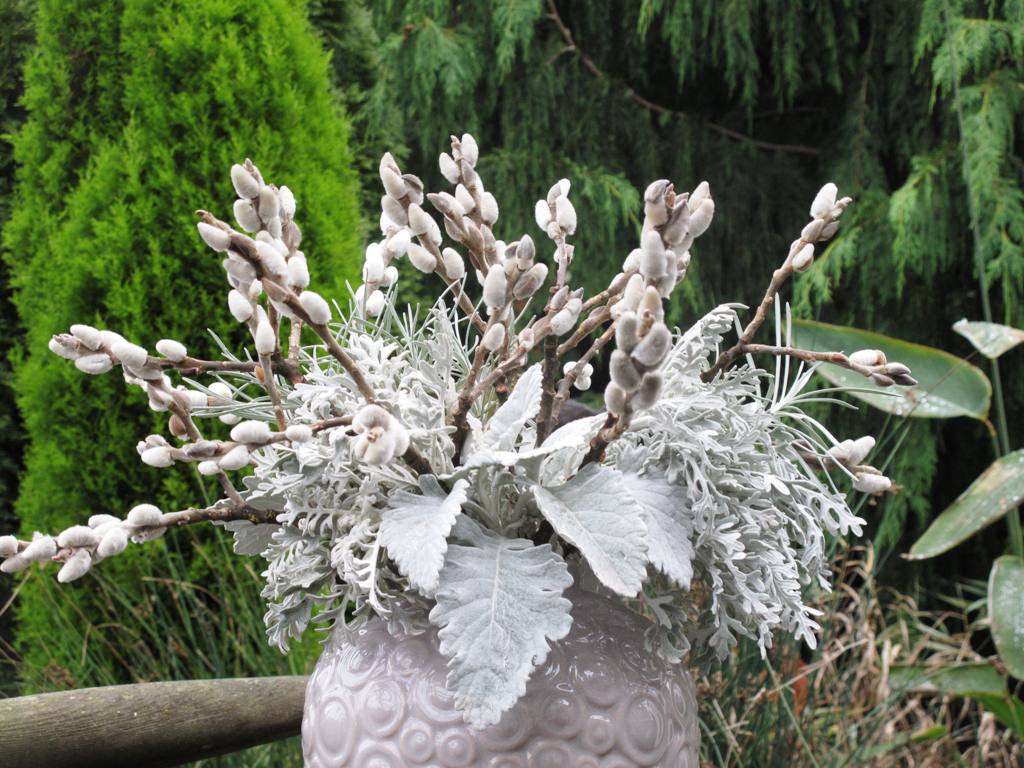
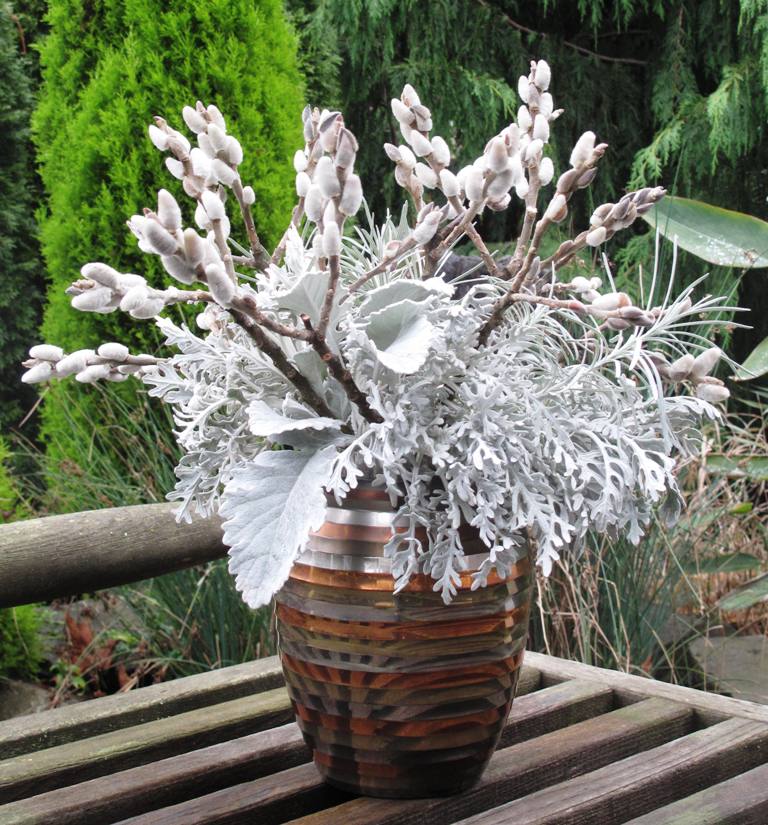
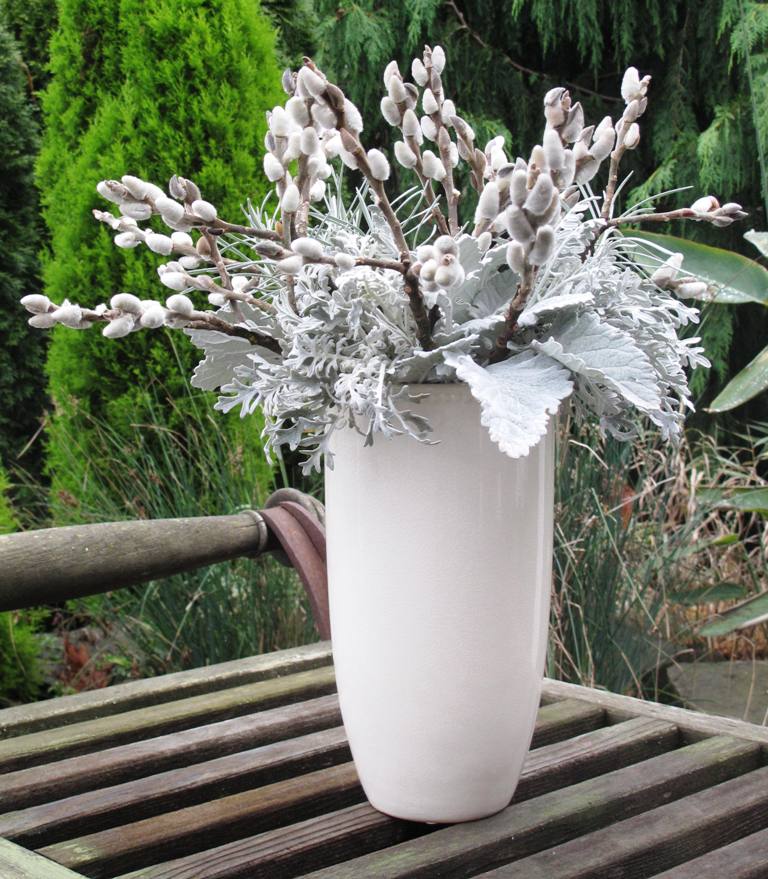
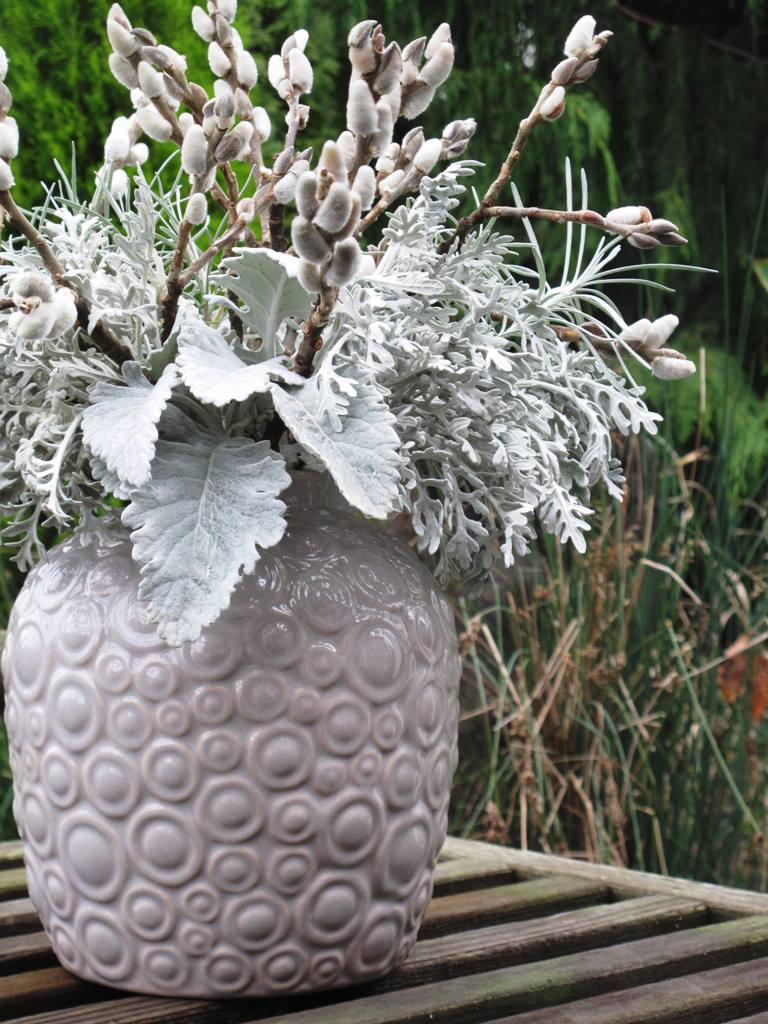
Today, not able to decide which vase to use for my New Year’s arrangement, I photographed my silvery-winter ingredients in three different vases. Please vote for your fav!
The ingredients:
- Pussy willow from J. Foss Garden Flowers in Chehalis, Washington (grower Janet Foss tells me the cultivar of her unique, multi-branched form of pussy willow is unknown; she took cuttings from a customer’s garden and began propagating them). The stems are truly stunning and way more interesting that your typical ramrod-straight pussy willow branch
- Two forms of Dusty Miller (Centaurea cineraria) — lacy and broad, grown by Charles Little & Co. of Eugene, Oregon
- Plus, a few sprigs of feathery Artemisia arborescens from my garden.
We’re all a little tired of evergreens and red berries, right? That was my thinking when I came up with a metallic, pewtery vibe, which seems fitting for the New Year.
Option 1: Stripes of bronze, brass and pewter embellish this substantial urn, inherited from my father-in-law. It’s the only shiny-metallic vessel I own.
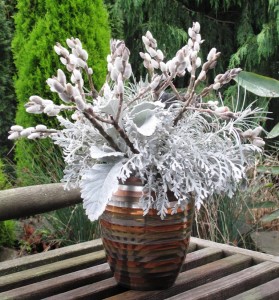
Option One
Option 2: Basic white. Going for the simple statement. The foliage definitely looks snowier against this glazed vase.
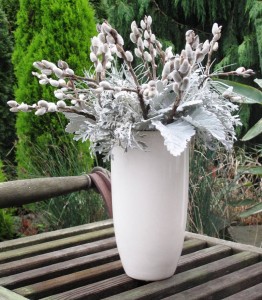
Option Two
Option 3: More textures, this time in a ginger jar with a raised, circular pattern. Its color is arguably mauve or pale lilac. Or maybe gray with a tinge of purple.
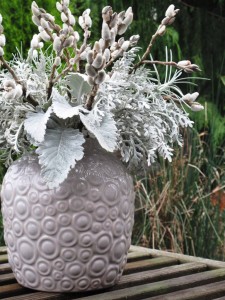
Option Three
Please vote in the comment section – and tell me WHY you prefer a particular vase for this combination!
Posted in Creativity, floral design, Gardening, General, Plants | 26 Comments »
December 11th, 2011
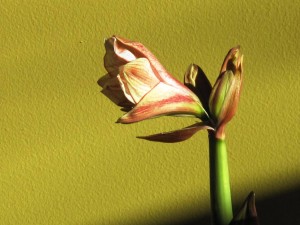
- Poetry in a bloom
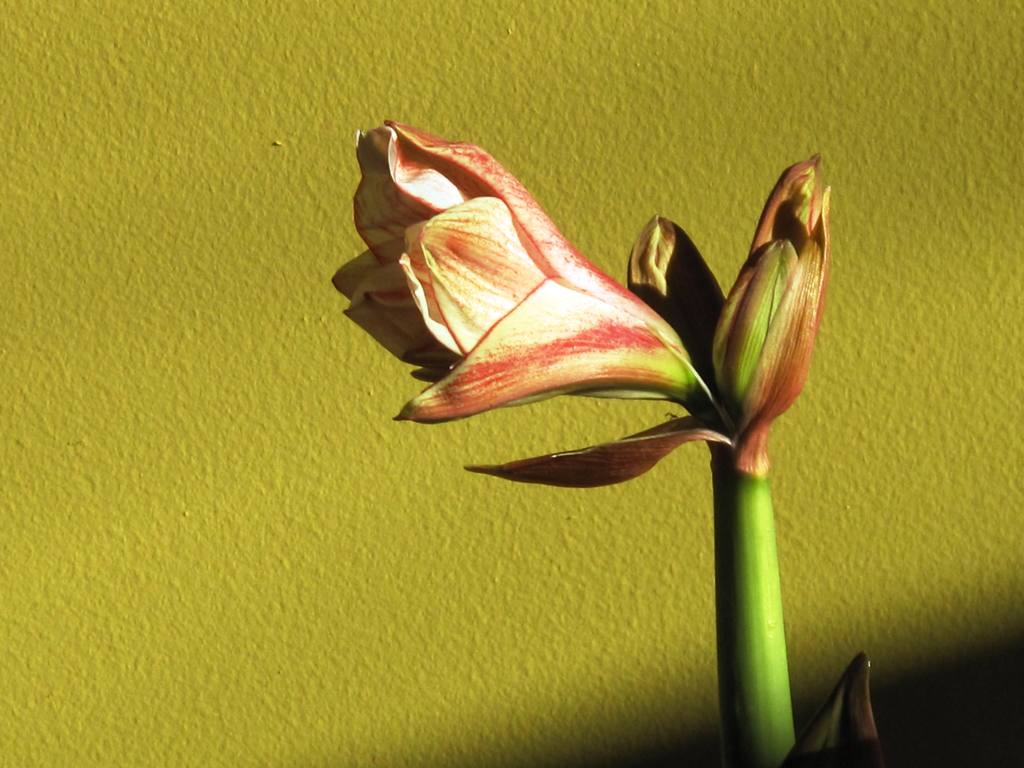
Here’s a lovely amaryllis that I potted up to enjoy in our dining room this month. I can’t say enough about the beauty of every Hippeastrum hybrid I see this time of year. There have been many holiday seasons when I am super organized, and have planned ahead to purchase the bulbs, plant them in decorated pots and nurture them to bud-stage for hostess gift-giving.
This was not one of those years. Instead, I purchased two amaryllis already in bud stage from Cascade Cuts, a wonderful grower who is now selling herbs and potted plants at the
Seattle Wholesale Growers Market. You can see how I planted the ‘Joker’ hybrids here.
The flowers I chose are mostly white with red streaks. In
Starr Ockenga’s marvlous, photo-filled book called
Amaryllis (Clarkson Potter, 2002), there are several varieties of these candy-cane style blooms. Not ‘Joker’ but enough alternate varieties to wow you for holiday decorating or gifting.
As I said, I purchased 2 potted amaryllis about a week ago, but I didn’t know how I was going to display them until yesterday. I attended
2nd Saturdayz, the monthly indoor vintage flea market, with my friend and design muse
Jean Zaputil.
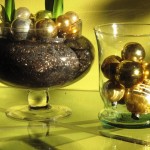
We found all sorts of fun stuff, from a 1950s plastic light-up Santa (Jean) to red and green-handled wood rolling pins (me – for my culinary essayist-friend’s surprise Christmas gift). And then I found a pretty piece of glass for $15. It has a nice footed base and graceful lines. I guess you could serve a trifle in it, or perhaps display it filled with vintage glass ornaments, as I found it.
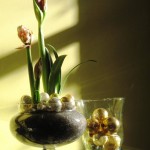
But once I came home yesterday, I started thinking: “Why not plant my 2 amaryllis flowers in this beautiful vessel?” Who says you can’t put pottting soil in glass anyway? The trick was to first pour a layer of gravel in the base, then add some potting soil and the two amaryllis. I topped off the design with the vintage silver-and-gold ornaments that came with my $15 vase. A new sort of mulch! When I water the bulbs, it will be carefully, so as not to flood this glass vase (since it has no drainage).
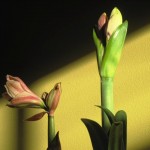
They are gracing our dining room and looking quite lovely. When December and amaryllis season arrive, I always find myself wishing for more of these yummy blooms. So here are some more pics. Please enjoy!
Posted in Creativity, floral design, Plants | 4 Comments »
November 13th, 2011
Last year I blogged about finding a set of half-circle shutters at a vintage sale. I wanted to emulate my friend Baylor Chapman’s succulent-planted shutters that grace her outdoor terrace in San Francisco. Since then, a few folks have emailed to ask if I EVER finished that project? Much to my embarrassment, those dusty shutters sat in the garage, untouched for nearly a year!
But finally, now that we’ve settled into a permanent residence, I’ve been able to work on this project. The shutters have been cleaned and given three coats of exterior paint. To turn them into vertical succulent planters I mounted both pieces with wood screws outside my office windows and then stuffed the openings betweeen each slat with sedums and sempervivums. Let’s see how they look:
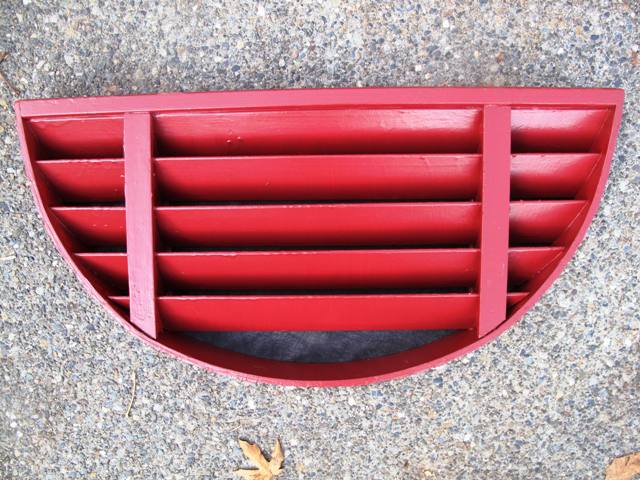
Step one: Paint the shutters. I used semigloss acrylic berry-red, the paint used for my home's exterior trim
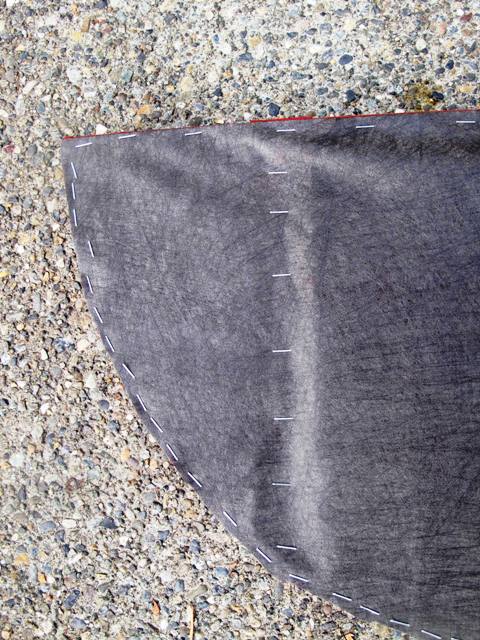
Step Two: Staple landscaping cloth to the back of both shutters.
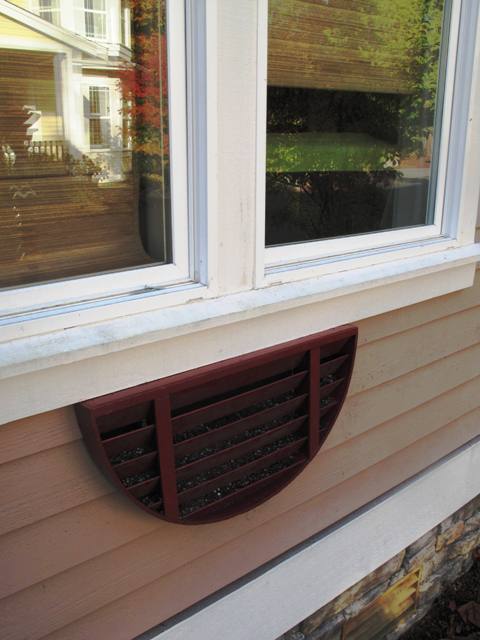
Step Three: Mount shutter and fill the "slots" with potting soil.
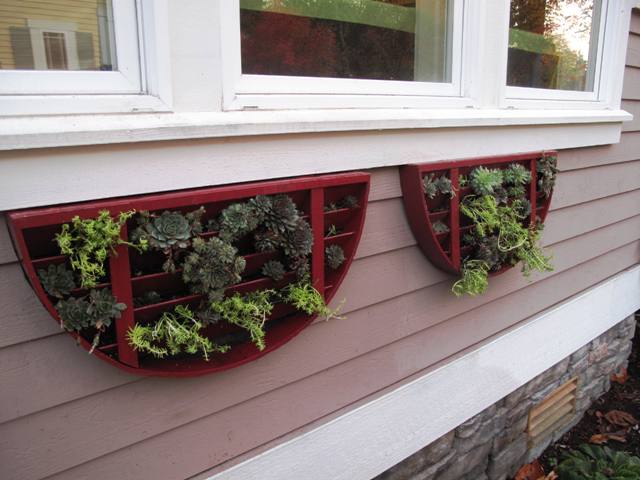
Step Four: Plant with hardy sedums and other succulents.
Posted in Architecture, Creativity, Gardening, General, Plants, Playfulness | 14 Comments »
November 8th, 2011
Here’s a photo of my dining room wall, where I’ve organized a medley of rounded objects, mostly plates and one vintage mirror that I inherited as a girl in the 1960s:
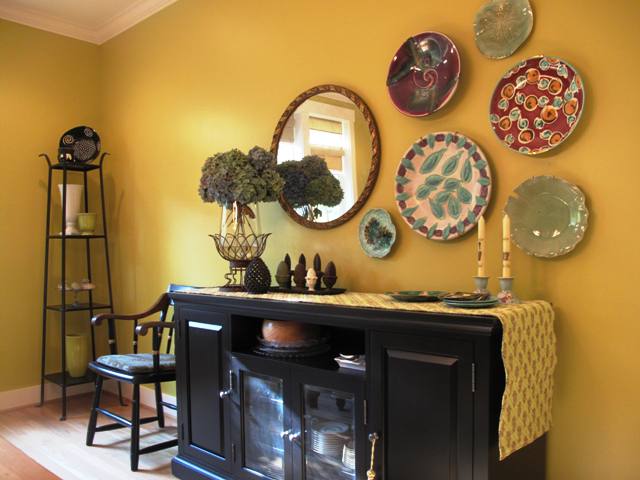
- Debra’s dining room wall. The paint color is aptly named “Pod,” chosen by my design guru, Jean Zaputil.
This is what you do when a large wall needs to be filled and one does not own large artwork! Each of the pieces has a back-story. Clockwise, from left:
-
Round gold-framed mirror, given to my parents and migrated to my possession since the 1960s.
-
Dark purple pottery plate, a gift from my college roommate and her former girlfriend.
-
Celadon plate, imprinted with a real lotus leaf, gift from same college roommate, who purchased it for me when we visited Lotusland.
-
Red-and-teal platter, a gift from the owner of Fireworks Gallery, years ago, as a thank you after I wrote a story about her Pioneer Square shop.
-
Another wonderful celadon plate, a gift from my friends Kathleen Brown and Sara Anderson when they visited us from DC years ago.
-
Teal, white and purple platter, hand-formed and painted by the Berkeley artist Keeyla Meadows. I purchased it from her on a visit to her garden in 2008.
-
Tiny vintage Majolica plate, purchased from an antique shop in Madison Park.
Let’s just say the men in my household were less than excited to see this installation. The day after I created my plate-platter vignette, my spouse left for work, saying: Please do NOT hammer any more nails into the wall today!
So the following weekend, we were in Chicago visiting our college-aged son for family weekend. We had breakfast at a cool neighborhood spot and what do you think I noticed on the wall there?! Check it out:
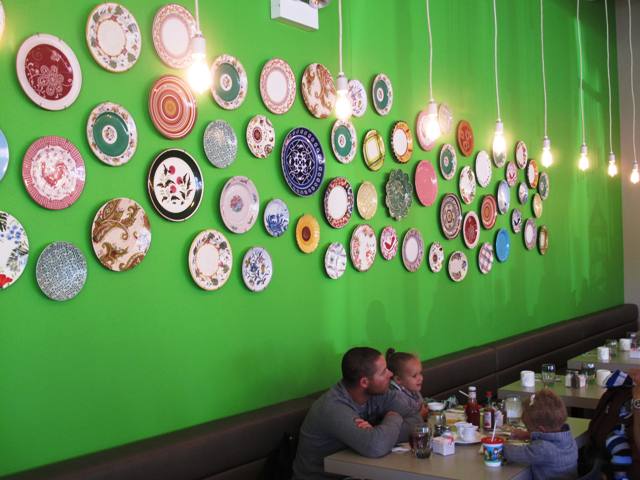
- Nice plates!
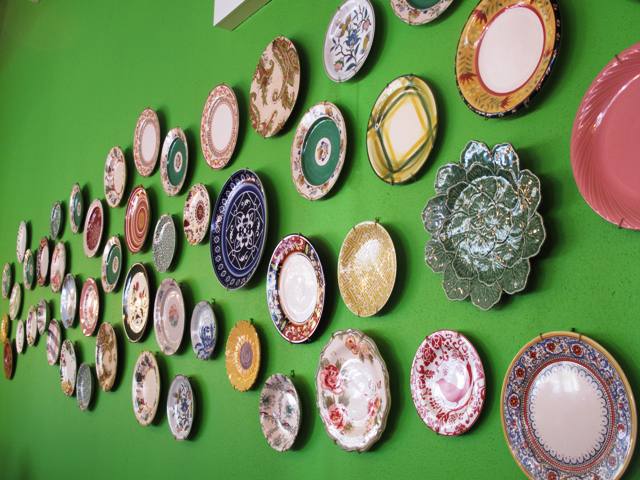
- Many small plates add up to one large work of art!
I am definitely onto something. You can be, too. Plates or dishes, inexpensive plate hangers & a few nails. Voila!
Posted in Creativity, General, interior design | 4 Comments »
November 1st, 2011
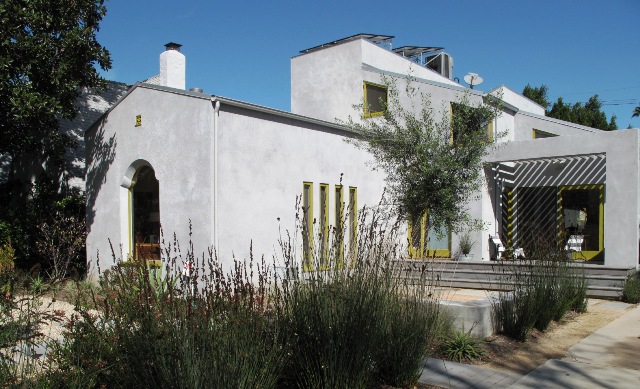
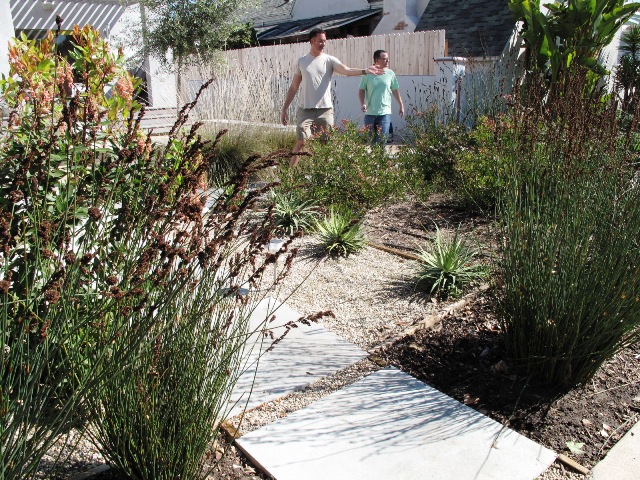
A stand of cape rush adds a semitransparent layer of privacy between sidewalk and front garden.
Joel Lichtenwalter and Ryan Gates of Grow Outdoor Design, based in Los Angeles, have introduced me to some really creative gardens they have designed. And what strikes me when seeing these mostly small, urban landscapes, is how well plants are used as architectural elements within the spaces they reside.
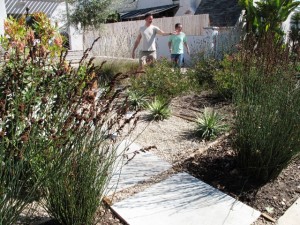
Designers Joel and his client Scott can be seen in the distance, conferring on some of the planting designs.
You won’t see fluffy cottage gardens with English-inspired perennial choices in Ryan and Joel’s gardens. Yet even when they design for bungalow-scaled residences, some of the same intimate, cottage garden experience occurs for the humans who occupy them. That emotional sense of being surrounded by plants, layers of textures — and even color in a tonal, modern sense –happens in their gardens.
I wrote about one such place recently and you can follow the links to the Los Angeles Times story here, including an extensive web gallery.
For those who ask: What plants are appropriate for a lush, low-water landscape? I think you’ll appreciate Ryan and Joel’s plant list for their clients’ lawn-free front yard now filled with native and Mediterranean grasses, shrubs, ground covers and trees, many of which display multi-season beauty:
A shopping list of California native plants and their Mediterranean companions
Natives:
Ceanothus griseus horizontalis Yankee Point
Cercis occidentalis
Arctostaphylos ‘Howard McMinn’
Arctostaphylos ‘Emerald Carpet’
Leymus condensatus ‘Canyon Prince’
Muhlenbergia rigens
Platanus racemosa
Carpenteria californica
Eschscholzia californica
Juncus patens
Sisyrinchium montanum (Blue Eyed Grass)
Non-Natives:
Arbutus ‘Marina’
Agave bracteosa
Leucadendron ‘Safari Sunset’
Agave vilmroniana
Olea europaea
Chondropetalum tectorum
Materials:
Composite decking (raised deck and boardwalk)
Square pre-cast concrete pavers
Poured-in-place concrete bench
‘Del Rio’ gravel
Decomposed granite (DG)
Shredded tree mulch
Posted in Architecture, Creativity, Gardening, General, Landscape Design, Plants, Writing | 2 Comments »
October 26th, 2011
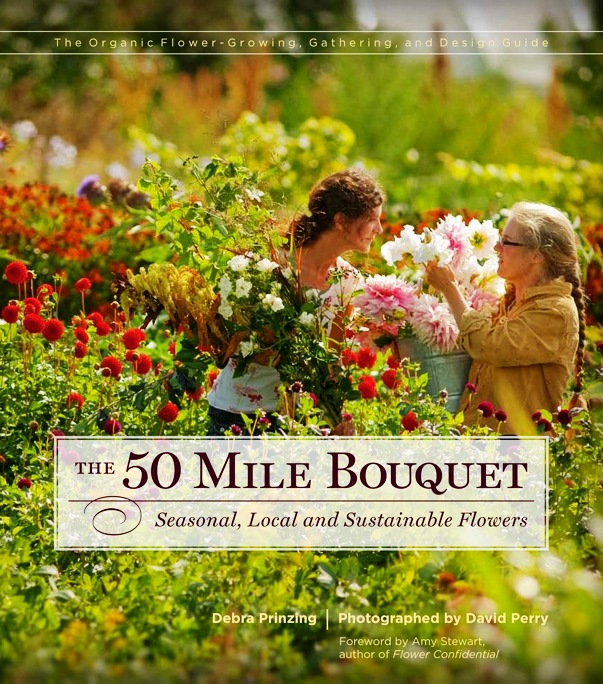
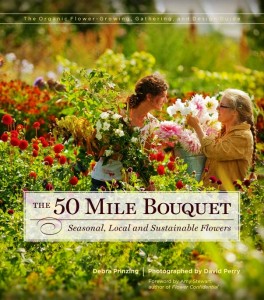 As some of you may know, I’ve been working on a book about local and seasonal floral design for several years, since 2007 to be precise. My collaborator, photographer David Perry, and I have been using the working title, A Fresh Bouquet.
But that’s all changing now, with a new title from our new publisher, St. Lynn’s Press. The words evoke just the right idea we want to communicate: The 50 Mile Bouquet: Discovering the World of Local, Seasonal, Sustainable Flowers.
Nice, huh? Our publication date is April 2012 and I’ll be writing lots more news about it soon.
Since all I’m doing these days is interviewing flower farmers, eco-couture floral designers and gardeners who grow their own cut flowers, my head is swimming with beautiful blooms.
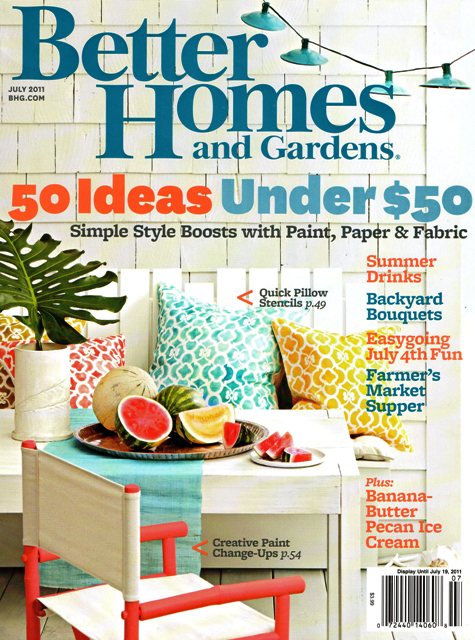
And somehow in all this flurry of work, I’ve failed to post the out-takes from my floral design story that ran a few months ago in Better Homes & Gardens. So today, I’m taking a moment to get to it.
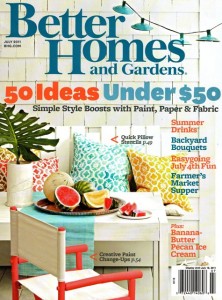
Backyard Bouquets - in BH&G's July 2011 issue
How great that 7.3 million readers of the July 2011 issue were introduced to the timeless notion of gathering flowers from the garden, a local farmer or a market stand – IN SEASON – and creating a simple, yet sumptuous arrangement that’s of the moment!
I have my editors Eric, Doug and Gayle to thank, because they believed in the idea and created the perfect opportunity for me to fly to Iowa and design a series of bouquets literally out in the field at Howell’s Family Farm.
I shared some of my on-the-scenes location photos last year, but here, finally, are my photos and recipes of the actual arrangements.
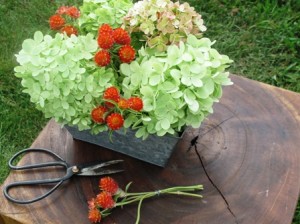
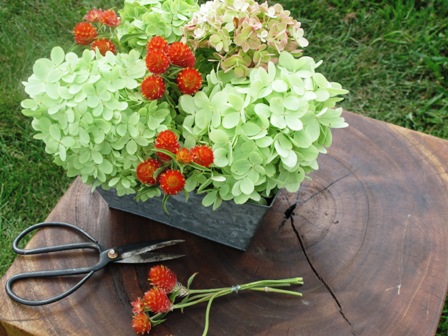
Project One
Project One features a rectangular galvanized container, measuring about 5-by-8 inches and about 5 inches tall. This small vessel was perfect for a compact bouquet with two simple ingredients. First, I filled the opening with four or five luscious heads of ‘Limelight’ hydrangea, the stems cut fairly short, say 3 inches long. To fill the spaces between the hydrangea heads and to add contrasting color and texture, I made miniature bunches of ‘Strawberry Fields’ gomphrena by wiring five slender stems with wire so that each bunch could be inserted as if it were a single flower. This is the perfect arrangement to enjoy while it’s fresh and then let it slowly air dry as an everlasting bouquet.
Project Two
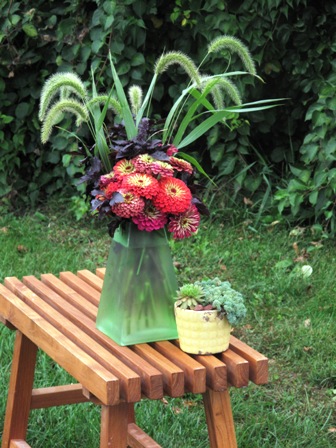
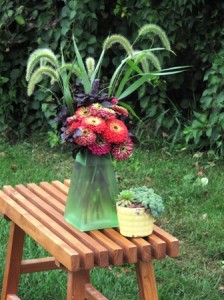
Project Two features a tall, square, modern green glass vase with a neck opening that’s smaller than the base. So of course, to make it look abundant and full, I had to create volume and height. The starting flowers here are sultry-looking zinnias from a new seed mix called ‘Queen Red Lime’ – I love the terra cotta, mauve, and reddish blooms with a lime-green center. Once I had those in place, I thought: We need dark foliage. And lucky for me, the folks at Howell’s, like many cut flower growers, have discovered how well basil performs as a cut ingredient – especially purple basil! Think about it: when you harvest basil from your garden and bring it indoors to keep in a jar on your windowsill, have you ever noticed how long those cut stems last? Of course basil is a great cut floral ingredient! The third element here is one of those happy coincidences – common foxtail grass, which some consider a ditch weed, that perfectly echoes the green vase, and catches the late summer sunlight just beautifully. Three simple ingredients in perfect harmony.
Project Three
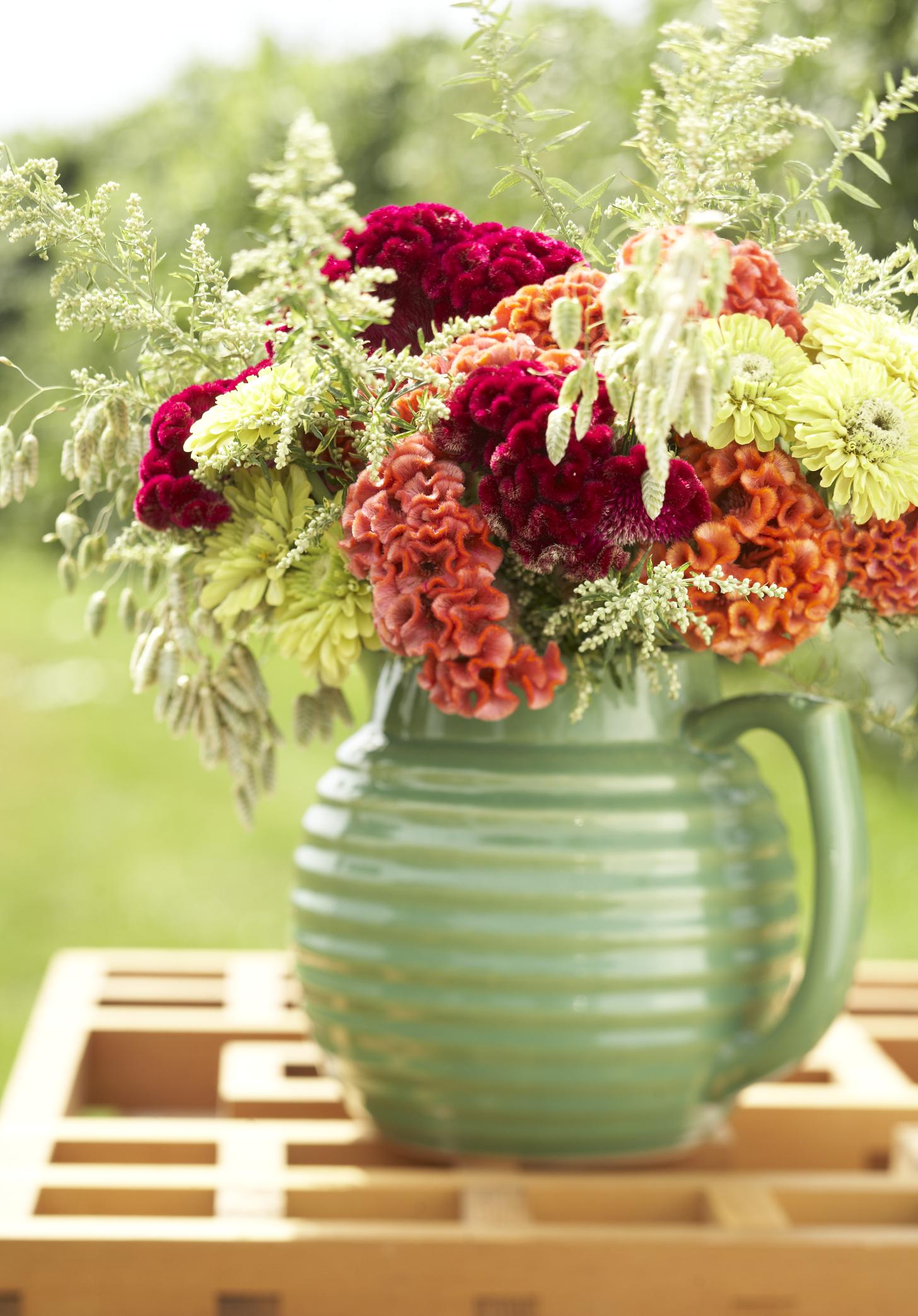
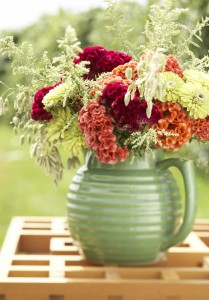
Project Three is one of my very favorites, because of the mix of colors and textures. Contained in a vintage pitcher, I absolutely love the playful combo of velvety cockscomb (the crested form of Celosia ) with all the lime green contrasting forms. Here’s how I made this bouquet. First, I filled the pitcher with soft greenery, a white mugwort (Artemisia lactiflora) that fills the opening and becomes the supporting structure for all the subsequent stems. Second, I stripped foliage off of 10 maroon and coral-hued cockscomb flowers; then I cut the stems pretty short and inserted each into the fluffy base, making sure that you can’t see the stems showing at all. Third, I added some ‘Green Envy’ zinnias, which echo the pitcher’s green quite nicely. For a sense of movement, as a final touch, I inserted taller stems of quaking grass (Brizia maxima), so they seem to hover above the bouquet. Casual and the epitome of summer!
Two other projects fell on the cutting room floor, so to speak, so you get to see them here! Actually Project Four showed up in the iPad edition, along with a video interview filled with my eco-savvy design tips. You actually have to download the July edition to see the entire interview (filmed by David Perry) on an iPad.
Here’s a rough-cut edit of the video:
httpv://www.youtube.com/watch?v=ZLKacMtjJUY
Project Four
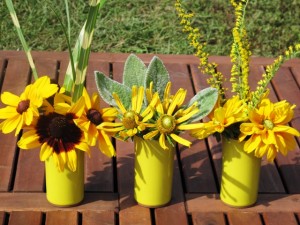
Anyone can replicate Project Four, a fun trio of mini-arrangements, which are displayed in a row or grouped together on the table as a centerpiece. We used three yellow tumblers that art director Scott Johnson brought from his kitchen cupboard. The simple idea was to showcase several varieties of black-eyed Susan flowers (Rudbeckia sp.) with a mix-and-match of foliage choices. The daisy-like Rudbeckia varieties include, from left: ‘Indian Summer’ and ‘Denver Daisy’ with zebra grass (Miscanthus sinensis ‘Zebrinus’); ‘Irish Spring’ with lamb’s ears; and ‘Prairie Sun’ with goldenrod (Solidago). This type of design works well when you only have one or two of anything in bloom at a given time – voila!
Project Five
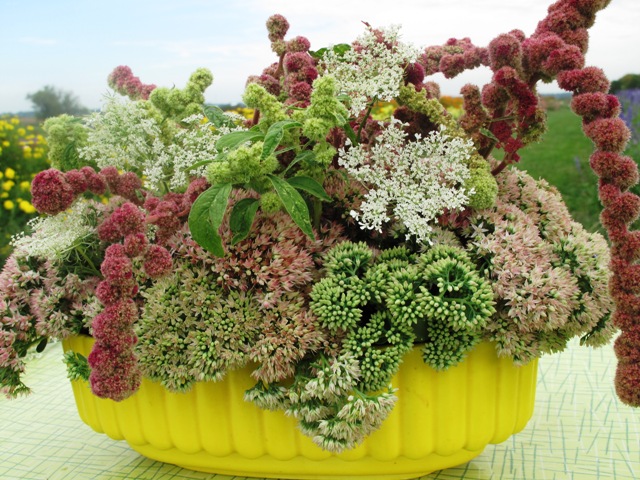
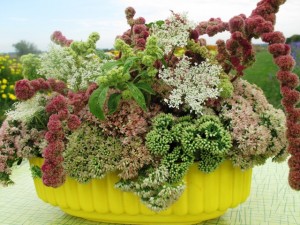
For Project Five, the last arrangement, I had to rise to the challenge of creating flowers that wouldn’t fall out of the wide, saucer-like bowl. Similar to cutting the hydrangea stems short in the first design, I cut lots of Sedum ‘Autumn Joy’ in their unopened stage. A this point, they still look pretty green because the buds are tight. When you cut the stems short, say at 2-3 inches, you can really cram a lot inside an opening. To me, they almost look like heads of broccoli! But the tightly-packed sedums create a foundation through which other stems can be inserted. And in this case, I inserted old-fashioned love-lies-bleeding (Amaranthus caudatus) and Queen Anne’s lace. The tassels cascade over the edge of the shallow bowl, and while it’s kind of quirky, I really love the effect of textures and colors.
Together, these five designs demonstrate the diversity of the cut flower world – and ways to arrange blooms without using florist foam to stabilize the stems. Have fun playing around with these ideas using your own vases and garden flowers.
Posted in Creativity, floral design, Gardening, General, Plants, Playfulness, Writing | 6 Comments »
© Debra Prinzing, all written and photographic content. Website design/development by Willo Bellwood/Metric Media