The Slow Flowers Podcast is the award-winning show known as the “Voice of the Slow Flowers Movement.” Launched in 2013 as the original flower podcast, we’ve devoted more than 10 years to covering the business of flower farming, floral design, and the Slow Flowers sustainability ethos. Listen to a new episode each Wednesday, available for free download here at slowflowerspodcast.com or on iTunes, Spotify, and other podcast platforms.
March 28th, 2012
My friend Bill called me yesterday to tell me that Seattle Met magazine included me in their “Perfect Party” feature for April.
“WHAT????” I asked. Clearly, this happened without my knowledge – but it’s quite exciting. And amusing! I’ve never before been illustrated! I wonder who put them up to this?
Here’s the story:

Posted in Book reviews, Creativity, floral design, Gardening, General, Landscape Design, Writing | 2 Comments »
March 17th, 2012
March 20th is just around the corner – thankfully! And blooms are everywhere – under our noses, poking through the soil, erupting from branches, and filling our vases. Hurrah!
Here are some of the hints of spring that have come my way:
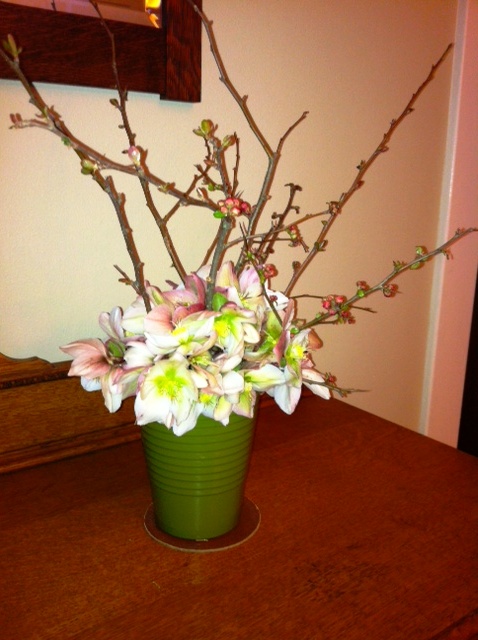
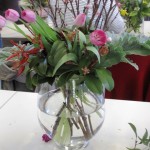
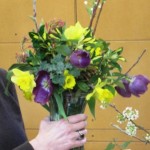
Kay's flowering quince branches and the delicate hellebores make for a stunning, early spring bouquet!
1. A DIY designer gets inspired by her own garden’s bounty. Earlier this week, an email with this charming photo appeared in my in-box from Kay Christie, who attended one of my demonstrations at the Northwest Flower & Garden Show last month. Thanks so much for sharing, Kay! And for the kind words. Keep designing!
I wanted to show you an arrangement I just made with cuttings from my garden. I really loved your demo at the flower and garden show. It gave me the idea for this. I also used chicken wire inside to hold the stems. Thanks do much for the inspirational talk.
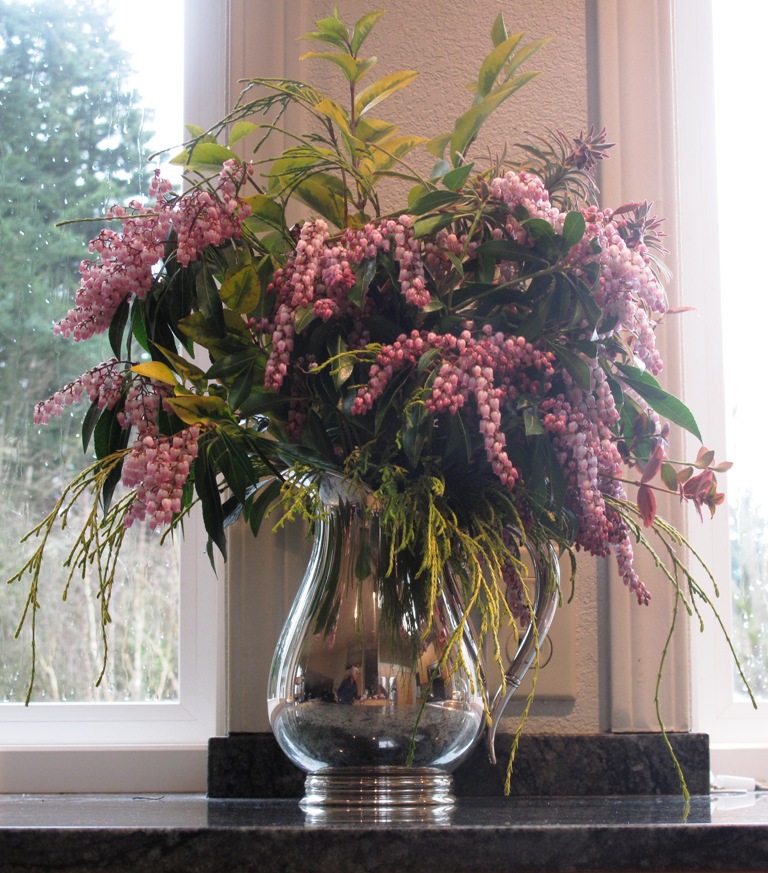
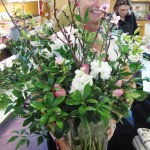
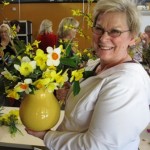
A silver pitcher contains a sublime bouquet in a pink-and-gold palette, by Peggy Shelley.
2. A talented gardener clips goodies from her backyard for a special arrangement. Like Kay, Woodinville, Wash., gardener Peggy Shelley harvests beautiful floral ingredients from her landscape. I visited Peggy and her husband Al Shelley (also a gifted gardener) earlier this month to interview them for an upcoming Better Homes & Gardens article about their garden (the feature will appear in the August 2012 edition). There was a gorgeous bouquet on the kitchen counter and of course, I couldn’t take my eyes off of it. It included pink-flowering Japanese pieris, bi-colored pink-and-green euphorbia stems, golden thread branch cypress sprigs and lemon-yellow privet foliage. Peggy told me something quite inspiring – and I’m going to remind myself of her passion every time I head into my own garden:
The biggest satisfaction of my garden comes from making a bouquet and giving it to a friend.
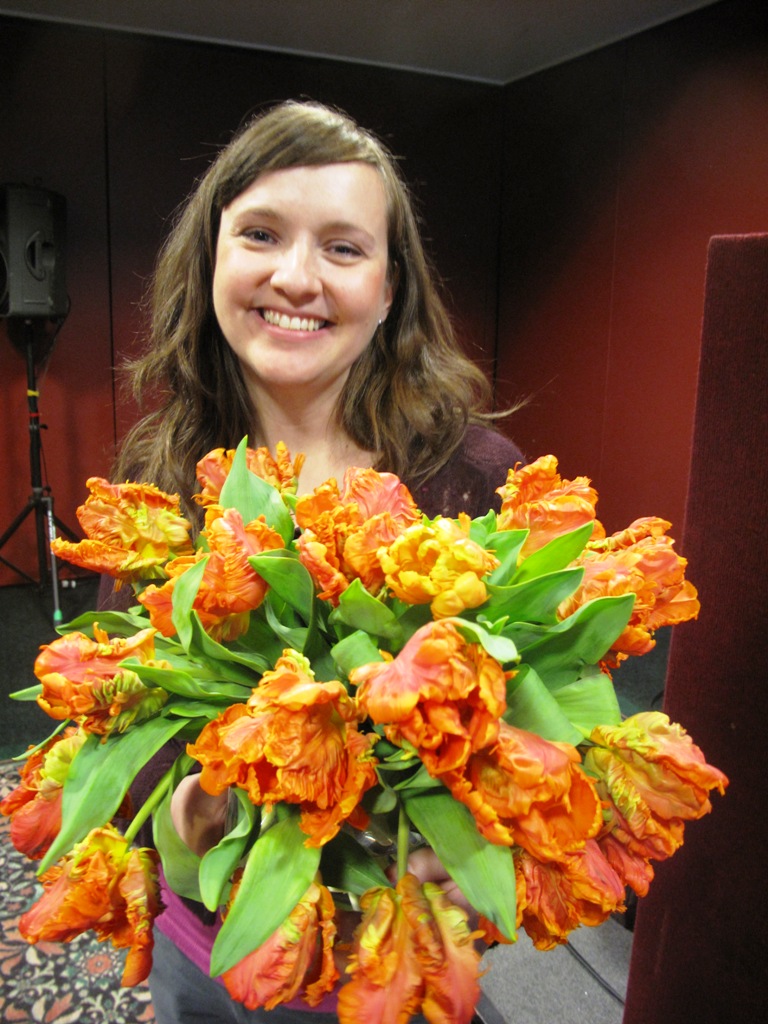
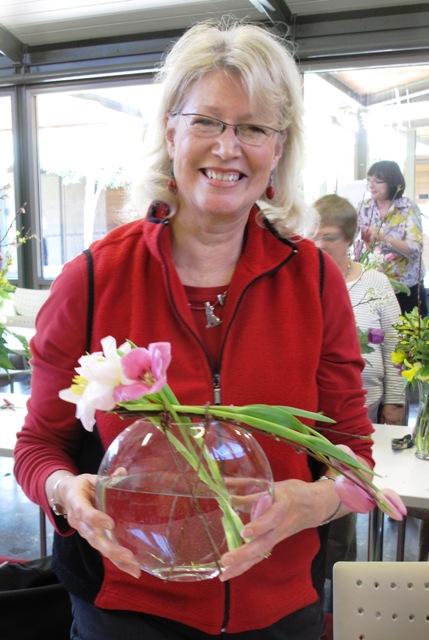
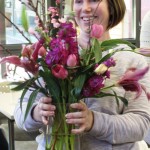
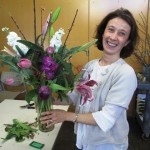
Lynn Fosbender of Pollen, an eco-friendly floral designer in Chicago, with her beautiful bouquet of local spring tulips.
3. Local flowers arrive just in time for a Chicago designer. Last Sunday, I was in Chicago to speak at the Chicago Flower & Garden Show (thanks, Bill Aldrich, for inviting me!). I called Lynn Fosbender, who owns Pollen, a sweet, ec0-conscious floral studio, and asked if she could bring a bouquet to my talk and also pass out her business cards. I wanted to showcase Lynn as a home-town resource for Chicago area floral customers, and let them know about her intentional design philosophy of using local flowers whenever possible. “I’d love to come,” she said. “But March 11th is still pretty early. I probably won’t be able to find local flowers from my sources.”
Then, to my delight, Lynn showed up with a vase of the most stunning vibrant orange-and-green parrot tulips I’d ever seen! “Spring has been mild here – and one of my local growers called me on Friday to let me know his tulips were ready to harvest,” Lynn said. What a wonderful treat. I wrote a post about Lynn when I first met her in 2012. Here’s a link to that story. I was so impressed with her vision for her business:
For several years I thought I would like to own a full-service flower shop that was eco-friendly. I knew if anyone should do it, it should be me.
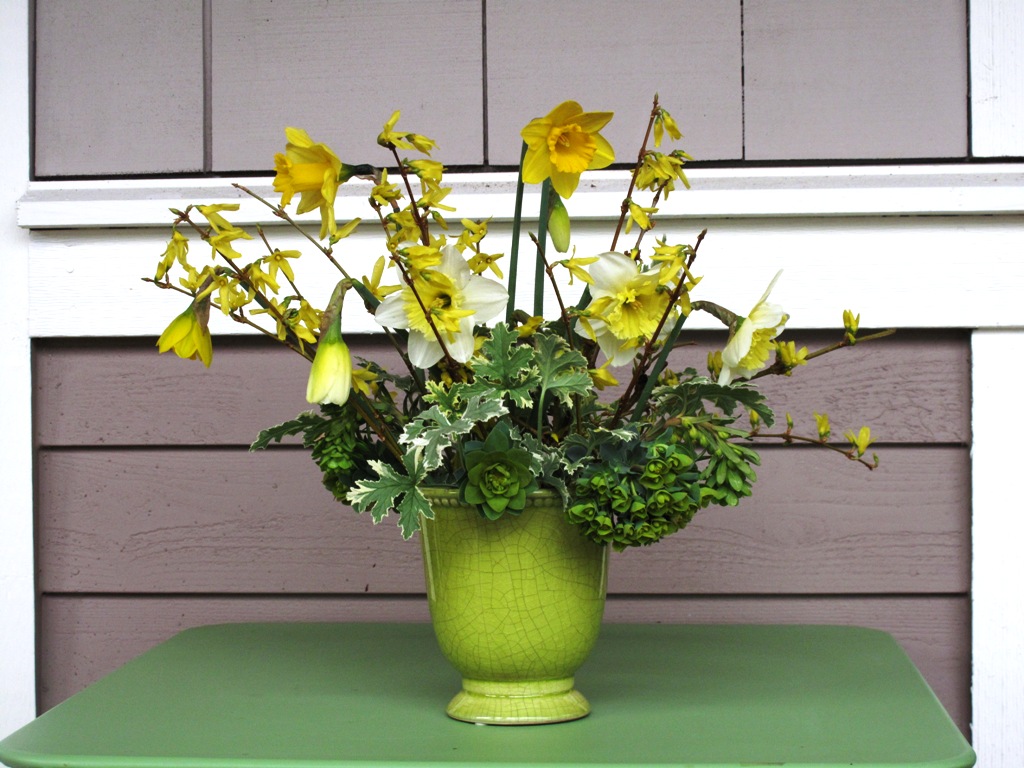
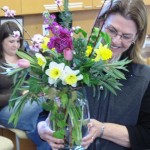
Spring's yellow and lime floral gifts collected in a green vase.
4. See what my own garden yielded this week. I’ve been making a local and seasonally-inspired floral arrangement every single week for the past 20 weeks (since the first week of November). It’s part of my plan to create a book or blog called 52-Weeks-of-Local-Flowers. It’s been fun, creative, and very educational to discover what I can source from local growers, local farmers’ markets, and of course, my own backyard.
Yellow and green are the theme of this week! I used two types of euphorbia (dipping the cut stems in boiling water helped “seal” the ends so the milky white sap didn’t drain into the vase); two types of daffodils that the prior owners of our home planted on the parking strip along the street; lots of bright-yellow-flowering forsythia; and some lovely variegated foliage from the scented geranium plant I’ve been babysitting in my garage under the shop lights. Everything came together nicely in a small green-glazed vase and a vintage flower frog held the stems in place.
Today, strangely, it’s snowing in Seattle. I soaked my sweet pea seeds in water last night and I plan to plant them in flats in the garage today. I had wanted to weed and prep the beds, but really? I think I’ll wait and see if it warms up a bit! Happy Almost-Spring!
Posted in Creativity, floral design, Gardening, General, Plants | 4 Comments »
March 13th, 2012
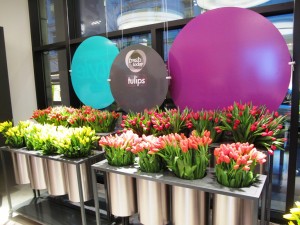
Tulips as Fashion at the new Seattle Nordstrom Rack Store
Right after the first of the year, an e-mail arrived in our in-box via The 50 Mile Bouquet blog.
“Hi – I am the Home Buyer for Nordstrom Rack. I am looking for a local floral resource to put together a floral program for our downtown Seattle Rack, which we are relocating to Westlake in March. We want this store to be special! We will have a lobby space where we’d like to sell fresh, local bouquets daily, a la Pike Place Market. Would you be able to meet with me to discuss this?”
The correspondent was Kelly Smith, Nordstrom Rack’s home and gift buyer who later told me that things like the new floral program defaulted to her because she’s a “Jill of all trades” and besides, someone there decided that the woman responsible for buying vases for the Rack is more likely to know about flowers than someone who buys handbags or cosmetics.
I was intrigued and agreed to meet with Kelly and some of her colleagues back in January. To be honest, there was an idea brewing in the back of my mind that I could get a little floral business going and drag one of my creative girlfriends into the adventure.
But Kelly and her team were very ambitious and exact in their vision. It soon became clear to me that while they might need my advice to come up with the right flower calendar, week-by-week, they would need someone with a larger-scale wholesale operation than I would ever have (or want to have, for that matter).
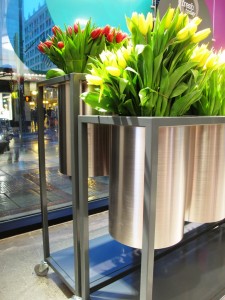
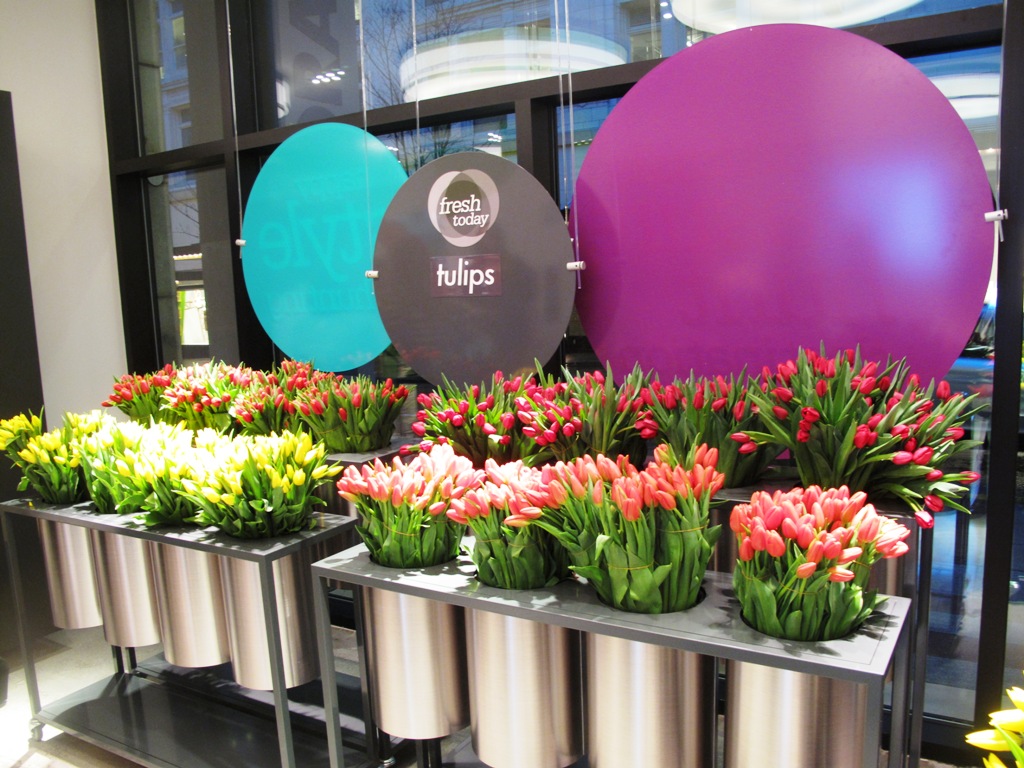
Nordstrom designed its own mod flower buckets with racks on wheels ~ cool!
Eventually, I helped Kelly find a local wholesaler who is now sourcing flowers from local farms, sorting and bunching the stems, and making daily deliveries to the new Nordstrom Rack on the corner of 5th and Pine (in the former Talbot’s location at Westlake Mall). How did Nordstrom come up with this idea of selling locally-grown cut flowers along with designer shoes and bargain-priced fashions for women and men?
“We knew we had this really great lobby space, right off of Westlake, but it’s not a selling space,” Kelly points out. “We started brainstorming about what we could do to create the Pike Place Market feeling near Westlake.” [Locals and tourist alike know that the Rack was located for years at 2nd and Pine, just across the street from the Pike Place Market.] “Selling flowers ties us back to the community and supports the local floral industry.”
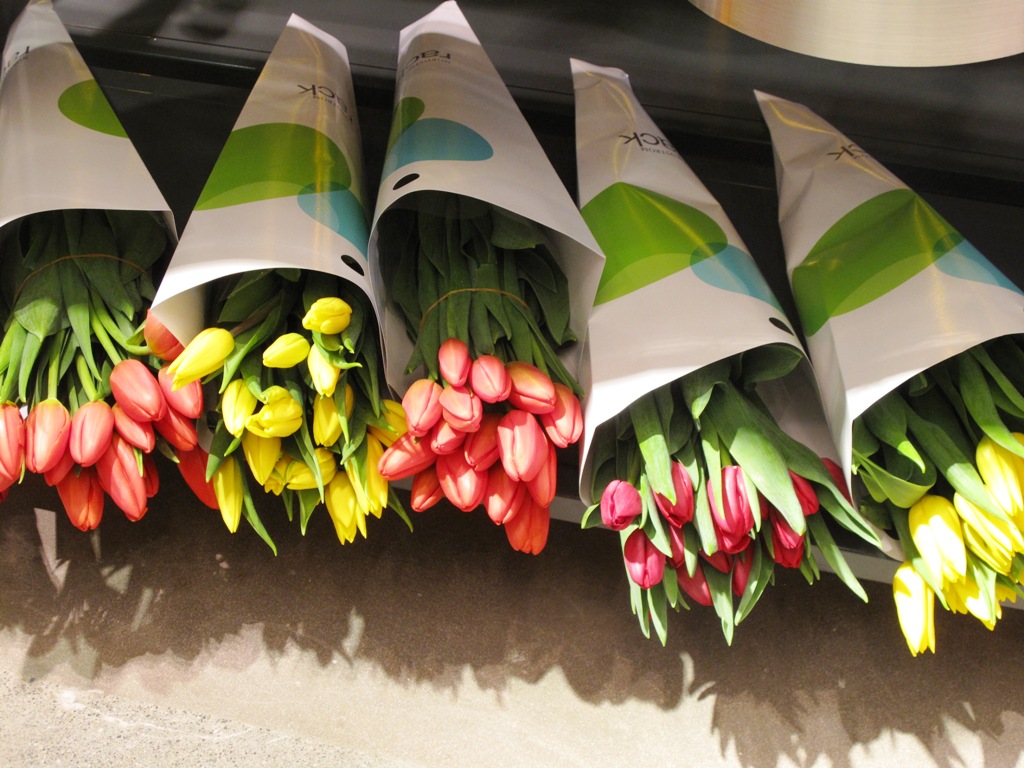
When the Rack opens on Thursday, March 15th, shoppers will be able to buy a bunch of 15 gorgeous local tulips for $10. This week, the palette includes yellow, orange and red tulips. Next week, according to Kelly, the palette will include white, purple, light pink and dark pink. “They are so vibrant and beautiful,” she enthused. In future weeks, you’ll see a wide range of flowers, depending on the seasonal crops being harvested from local fields. Just like the fashion discoveries at the Rack, the floral offerings will be ever-changing.
It will be fascinating to watch how bargain-oriented Rack customers respond to the $10/bunch floral program. The overall vision is to make cash-and-carry cut flowers so accessible that everyone who walks through that lobby will want to grab a bunch on their way out of the store.
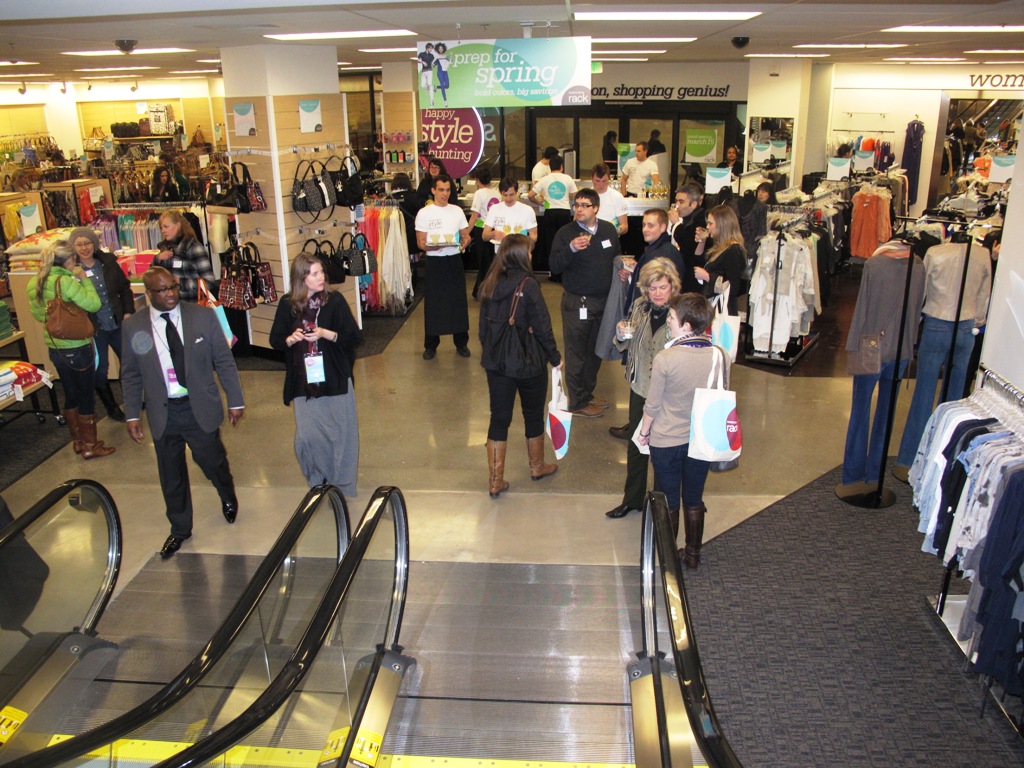
With that plan on my mind, I was thrilled to be invited to tonight’s “Tweet Up” pre-opening gala for (mostly) fashion bloggers. I was probably the only non-fashion blogger or Tweeter in attendance, but don’t worry – I found lots to grab my attention. Enjoy the photos here.
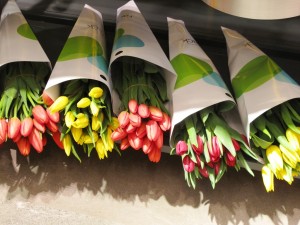
LOCAL Flowers-to-Go at Nordstrom Rack

Purple, Green, and Teal desserts to match the Rack Logo - yum!

Tonight's preview party drew 150 fashion bloggers (and me!)

Style Hunter offering up cocktails at tonight's pre-opening soiree
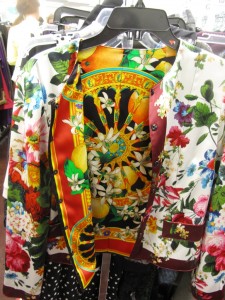
Flowers also appear on a Dolce and Gabanna silk jacket. Originally $2,945, the new Rack price is $939.97. Tempting. . .
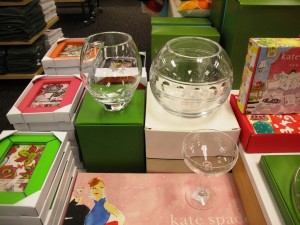
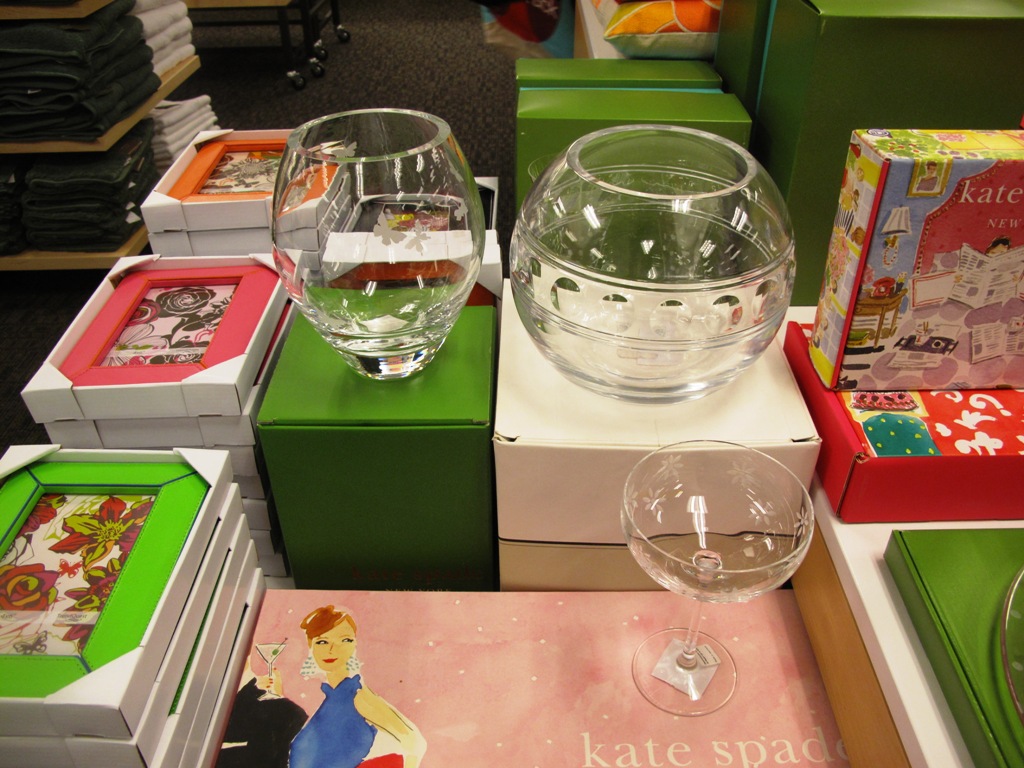
On the left, a $75 cut glass Kate Spade vase, now selling for $59. Thanks, Kelly - a great find and I brought it home with me!
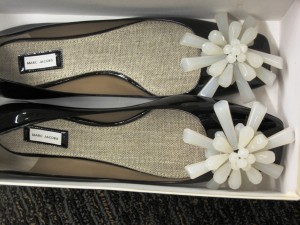
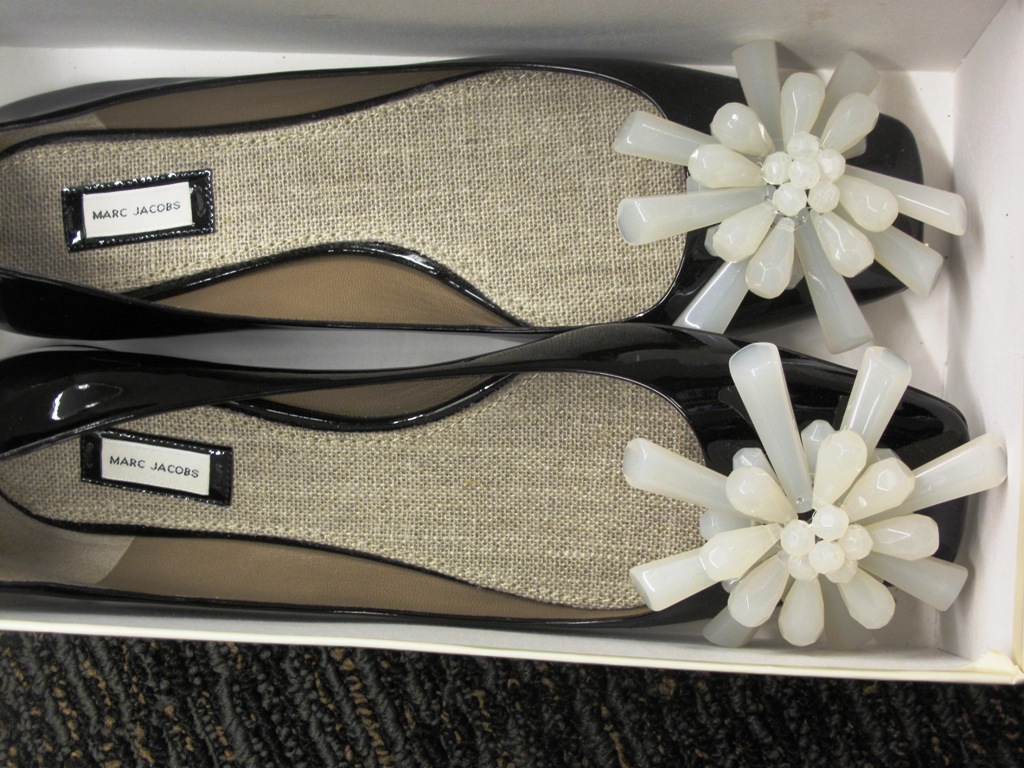
More flowers on the toes of Marc Jacobs' shoes, marked down to $299 from $695. Too bad they were 1/2-sizes too small for moi!
Posted in Creativity, Entertainment, floral design, General, Plants | No Comments »
March 7th, 2012
SUNSET GIVEAWAY
I’ve drawn names of all those who answered my question below and here are the five “winners” of a FREE copy of The New Sunset Western Garden Book, courtesy of Sunset. The question: What is your favorite ornamental landscaping plant (shrub, grass, perennial, etc.) to harvest for a cut bouquet? yielded these winners/answers:
Jen Y: peonies
Paula: bunnytails grass blossoms or pilotus joey
Carol: Peonies, nandina branches and berry clusters
Nicole: hellebores
Kim: dahlias
CONGRATULATIONS! You will soon be hearing from Dana Smith of Sunset Publishing, who needs your mailing address.
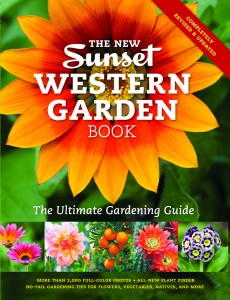 I recently had a chance to interview Kathleen Brenzel, garden editor for Sunset magazine – and editor of Sunset’s new, 2012 edition of The New Sunset Western Garden Book, (Sunset Books, $34.95 for flexible binding, $44.95 for hardcover), a “bible” for western gardeners.
Whether you’re new to gardening or have logged many planting seasons with your hands in soil, it’s the single best go-to reference for garden-makers in our region. As chunky as the Yellow Pages, this essential guide to the West’s ornamental and edible landscape has been around for 80 years. I’ve owned every version since the early 1990s, including the most recent 2007 edition, which is dog-eared from much use.
When I got my hands on the just-released ninth edition last month, I thought: How different can this really be? I asked Kathy to walk us through the book’s 768 pages:
How did you go about updating this edition? Before we did anything else, we assembled a panel with landscape architects, horticulture educators from UC Berkeley and Cal Poly San Luis Obispo, nursery people and new graduates who had used our last edition as a textbook. The recent grads told us that in order to make “The New Sunset Western Garden Book” relevant, it had to have a digital component. They said: “We go everywhere with our smartphones, so we want to be able to take a photo of a plant we see on the hiking trail and look it up instantly.”
How did you go digital? Now you can take the best of Sunset with you to the garden center, nursery and your yard. You can get the free mobile edition of this book’s Plant Finder on your smartphone. (Search for Sunset Plant Finder.) With it, you can access more than 2,000 plants — and search by plant name, ZIP Code, climate zone, sun and water requirements, and type. There’s a companion online Plant Finder that lets you browse by color, height, spread and special needs.
How else is the book interactive? The last section of “The New Sunset Western Garden Book” is a practical guide. We’ve added a camera icon on the bottom of the pages, pointing you to corresponding videos on our website. It’s nice to read directions on planting a tomato in a pot and then watch a video of one of our editors showing you exactly how to do that.
What are the other major updates? This is the first edition to feature plant photos exclusively, rather than illustrations. There are more than 2,000 plant photos. We also updated the entire plant encyclopedia. That was the biggest job in the whole book. Every plant was reappraised, and we added many new varieties now available in nurseries. We went to growers all over the west and compared our existing plant database with what they are now offering; we asked what they thought we should include and why.
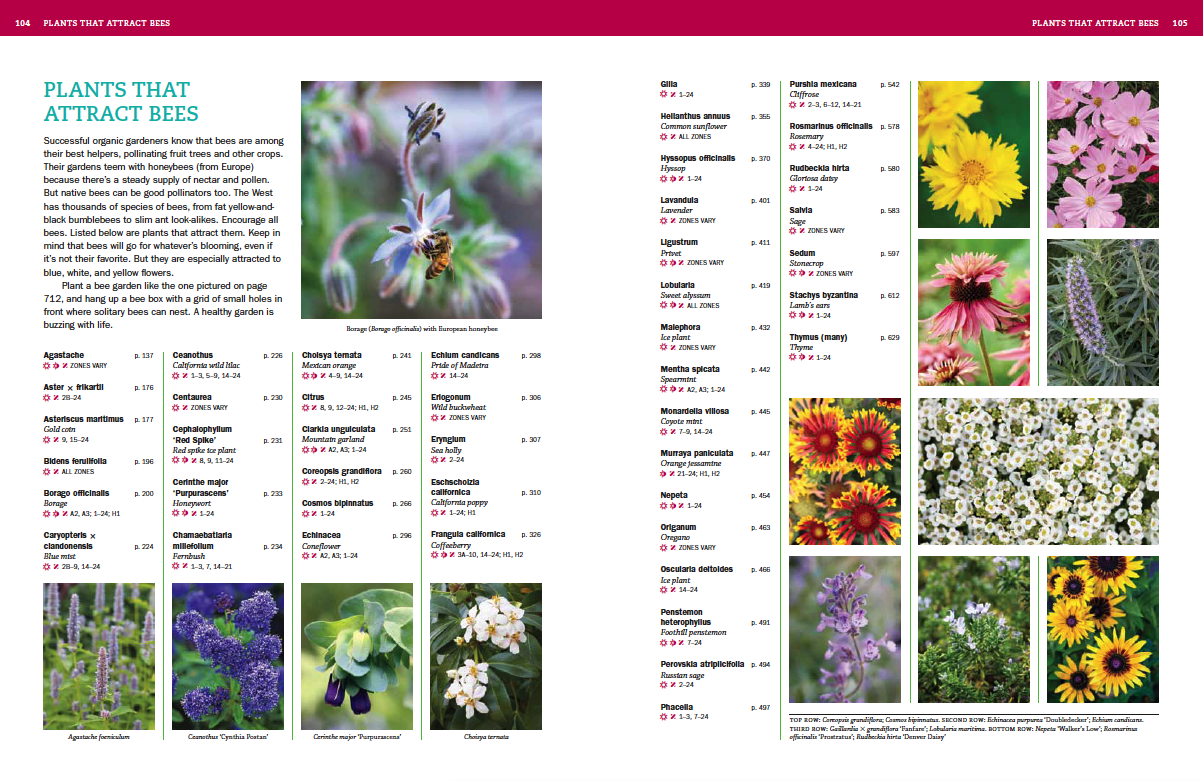 How many new plants did you add? The new book has 9,000 plants, up from 8,000 in the last edition. We also had to check the botany of every plant because botanists are constantly reclassifying plants.
What can new gardeners gain from the book? The section “Gardening Start to Finish” is more instinctive for the beginner. We walk them through the whole growing process from A to Z. We also have practical sections on gardening for wildlife and native plants, growing herbs and water-wise plants.
What can more experienced gardeners gain from the new book? The plant encyclopedia is filled with tip boxes of additional information – like how to propagate a sweet potato vine or when to cut ornamental grasses for the vase.
You have more edibles, don’t you? We asked ourselves: “What do people want most from ‘The New Sunset Western Garden Book’ right now? You’d have to be totally checked out not to notice a huge wave of edible gardening, so we wanted to amp up our coverage. I’m really happy with the “what edibles to plant when” charts for warm-season and cool-season veggies.
What’s your favorite take-away from the book? There’s an underlying theme that acknowledges how we garden now – with an interest in natural gardening and sustainability. Our gardens are smaller, but they’re stylish and sustainable.
Note: A version of this Q&A appeared in the LA Times HOME blog on February 17th.
Posted in Book reviews, floral design, Gardening, General, Landscape Design, Plants, Writing | 15 Comments »
March 1st, 2012
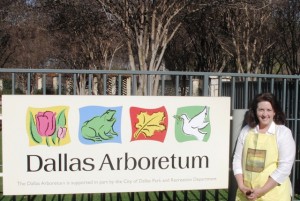
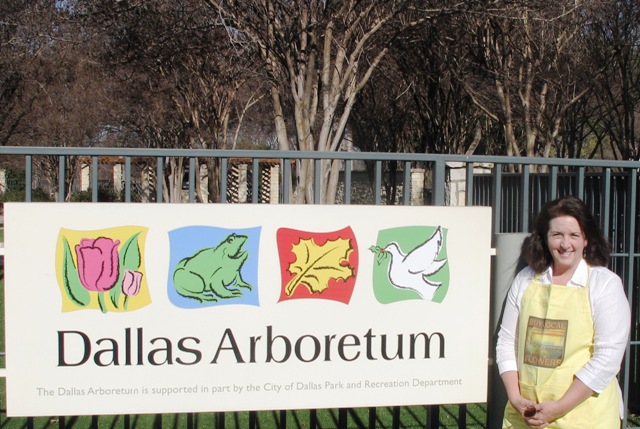
- I spent a wonderful day with floral design students at the Dallas Arboretum.
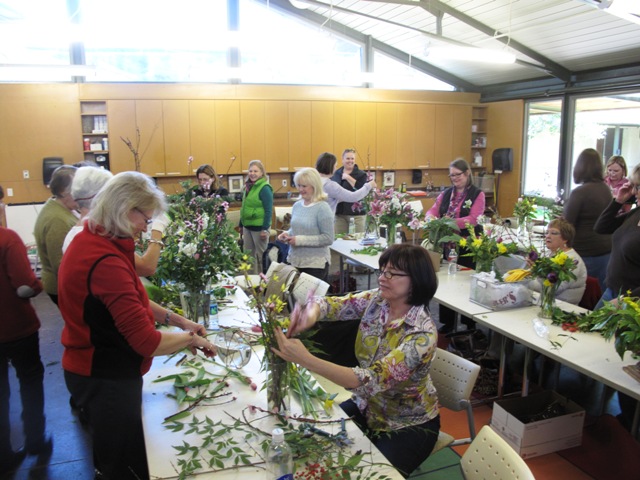
First-time floral designers and experienced arrangers converged at the Dallas Arboretum and Botanical Gardens last Saturday for a few hours of inspiring floral creativity.
In planning the hands-on workshop with education director Joy Ijams, I worried that late February in Dallas could present some challenges. That is, when it came to procuring local and seasonal design ingredients. Fortunately for the 20 folks who participated in our sold-out class, my fears were allayed.
For the success of our event, I have several awesome people to acknowledge. First of all, thanks goes to Joy – the ever-upbeat program planner who invited me to speak about The 50 Mile Bouquet in a morning lecture and then to teach what she called a “make and take” workshop after our lunch break.
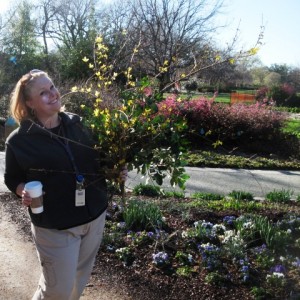
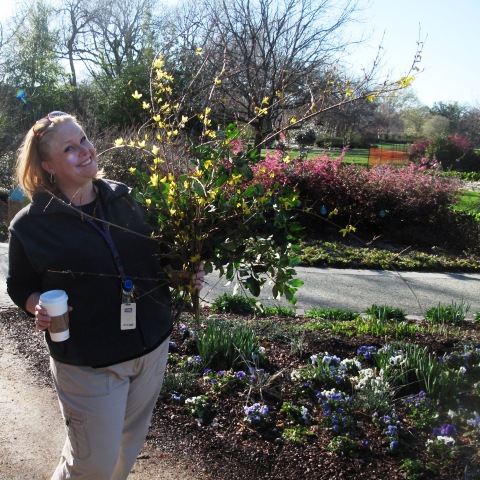
- Education director Joy Ijams and I did a little “pruning” the morning of my class…to harvest branches and foliage for our student-designers to use.
It was Joy who creatively conjured up the format and got the word out to the Arboretum audience. It also was Joy who picked me up at the airport on Friday night and took me to Central Market so we could shop the flower department to augment our menu of botanical ingredients with domestic tulips and fragrant stock (she also suggested we undertake some ‘moonlight pruning’ at the Arboretum, but we were both exhausted and decided to wait until the following morning).
Joy, along with her education department colleagues and volunteers, made everything run smoothly. Our students were happy and engaged – and all the AV systems worked to perfection.
The following morning, prior to the arrival of those attending the 10 AM lecture, Joy and I headed out to the Arboretum’s display gardens with Felcos in hand. We were motivated by a concern that we wouldn’t have enough greenery otherwise. Sorry, Jimmy, but we harvested from the fringes of your borders, including clipping from the back sides of Indian hawthorn, just-blooming forsythia, phlomis, and rosemary. Oh, and a few minor branches from a saucer magnolia.
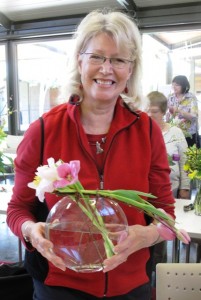
- Texas cut flower grower Cynthia Alexander is not only a great farmer, she’s a talented floral designer!
We were in pretty good shape with our supermarket flowers and the just-cut foliage. That’s because we knew Cynthia Alexander of Quarry Flower Farm was soon to arrive with goodies from her fields and orchards. In anticipation of this class, I had reached out to several of the Dallas area members of the Association of Specialty Cut Flower Growers (ASCFG) and connected with Cynthia, whose farm is located in Celina, Texas. She did not disappoint!
Cynthia agreed to harvest everything she had on hand and bring it to our class. Yes, it’s still early spring on Cynthia’s rather young flower farm, but you’d never know it by the fabulous, overflowing galvanized French flower buckets she delivered.
They contained an awesome mix of spring bulbs (several daffodil varieties); uncommon foliage (cardoons, hoar hound, and other green boughs); and lots of flowering fruit-tree branches. I’m so pleased that Cynthia joined us.
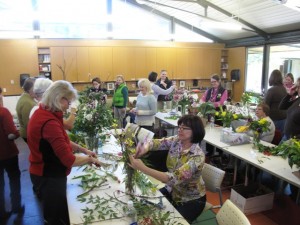
- Floral design – en masse – in a classroom filled with passionate and creative women.
It allowed me to introduce her farm to students in both the morning and afternoon class. Plus, she participated in the floral design workshop – and inspired all of us with her avant-garde creation! As soon as Cynthia walked into the classroom, I recognized her; we realized that we must have met or at least spoken with one another at the 2010 Tulsa ASCFG conference. This time, we’ve become more than passing strangers and I can’t wait to return to Dallas to see Cynthia’s farm first-hand.
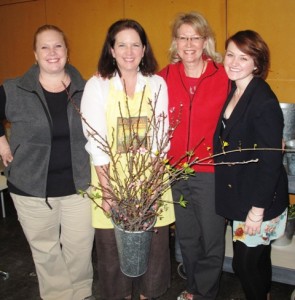
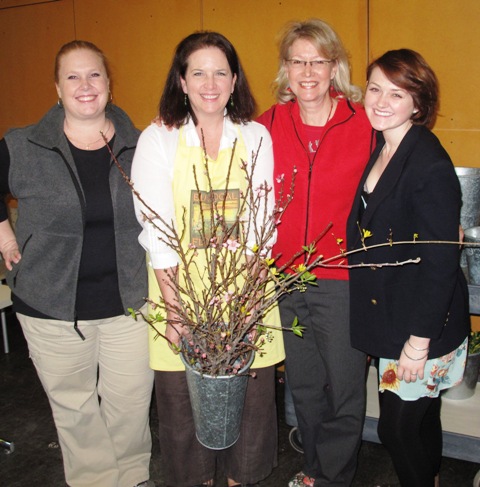
- My “dream team:, from left: Joy Ijams of The Dallas Arboretum; Debra Prinzing (me); Cynthia Alexander of Quarry Flower Farm; and Whitney White, new-generation floral designer.
A few other secret ingredients enhanced the Saturday afternoon workshop — more fresh-from-the-garden floral elements and a talented florist (read on to discover to whom I’m referring). First, Joy and I had asked those who wished to do so to bring cuttings from their own gardens – and wow, what a great selection of foliage arrived! Second, I was sent an “angel” in the form of Whitney White, a twenty-something floral designer whose father Jay White is a fellow member of Garden Writers Association and an email pal of mine. Whitney arrived like a dream….Jay encouraged her to attend the morning workshop and as soon as we met I recruited Whitney to help with the afternoon class. It was nice to have her talent and that of a few other pro’s in the class to share tips about composition, line, form and color. I can’t wait to see where her career takes her. Currently, Whitney is working for a hot Dallas design firm called Bows and Arrows. They are very lucky to have her!
Once all our ingredients were assembled, I started out the class by discussing my favorite “green” floral design techniques:
- Use a recycled or repurposed vase
- Stabilize stems with organic or re-usable material, such as an armature of branches or twigs, wood aspen (Excelsior), old-fashioned flower frogs, chicken wire and a foliage nest.
- Strip all foliage from the portion of the stem that will be under water; fresh-cut ever stem and plan on refreshing the water every day or two.
The students exceeded their own expectations with a beautiful lineup of designs. You can see some of their examples here.
Bottom line: Gardeners are ideal floral designers. We know the form, habit, bloom time and character of the ingredients in our gardens. And so we know how and when to harvest those ingredients — and arrange them in companionable displays in a vase. Perhaps this is an unscientific, alternative approach to floral design. But it makes sense to me! When you use seasonal ingredients, then they will naturally look like they belong together in a vase.
Here’s a lovely gallery of the local-seasonal-sustainable designs that filled our vases:
Posted in Creativity, floral design, Gardening, General, Plants | 4 Comments »
February 5th, 2012
Bess Wyrick, Celadon & Celery
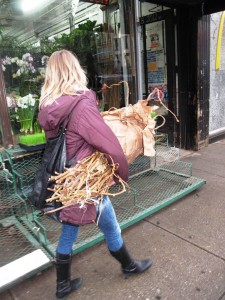
- Bess, on an early-morning visit to the NYC floral district, carrying an armload of kiwi vines for her next arrangement.
I planned on being in New York for a few days last month so I called Bess Wyrick of Celadon & Celery to see if we could get together. David Perry and I met Bess in person last November when we flew to Los Angeles to produce a story about Bess’s DIY floral design workshops. I had previously interviewed her by telephone – for a piece in the Los Angeles Times. In April, when The 50 Mile Bouquet comes out, you will be able to read all about Bess and her eco-couture floral design tips and techniques.
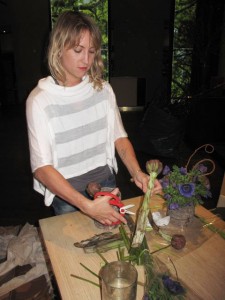
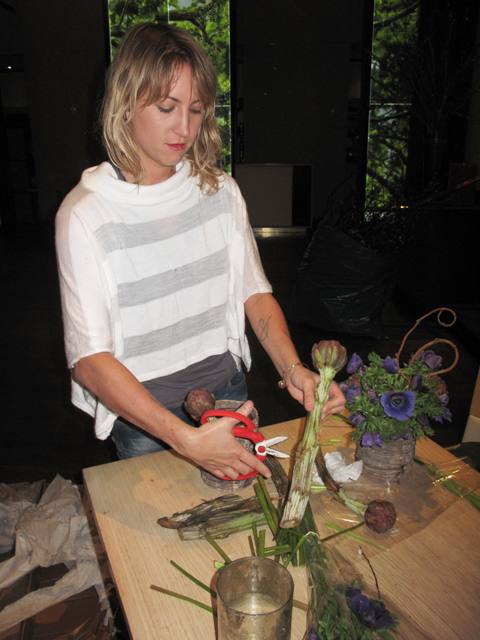
- A designer attending to her craft
“Why don’t you come with me to one of my client’s?” Bess suggested. I met her in New York’s Chelsea Flower District at 7:30 a.m. one morning and we headed to her regular source for flowering branches.
Ironically, I had visited the same vendor on a trip to NYC two years ago. On this shopping trip, Bess picked out a huge bunch of kiwi vine, with nutmeg-colored bark and attractive curls. The kiwi is locally harvested and cut to 4- and 5-foot lengths.
We headed up to midtown to a restaurant called Rouge Tomate, a 2-star Michelin establishment known for its modern, organic fare. Celadon & Celery is responsible for designing weekly arrangements for the hostess station, the main dining room and the downstairs private dining room. Because of the restaurant’s organic menu and reputation for serving local ingredients, it makes sense that the owners of Rouge Tomate want their flowers to echo similar values.
The restaurant’s credo: “At Rouge Tomate, we give preference to local and seasonal products, including fruit and vegetables grown on farms that respect the environment; choose fish depending on their stock and impact on ecosystems; select meat and poultry from farmers that feed their animals with local plants; highlight quality wines grown by viticulturists who follow organic or biodynamic principles.”
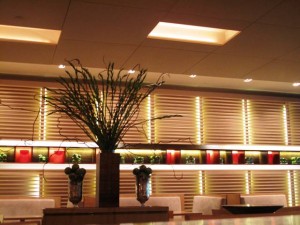
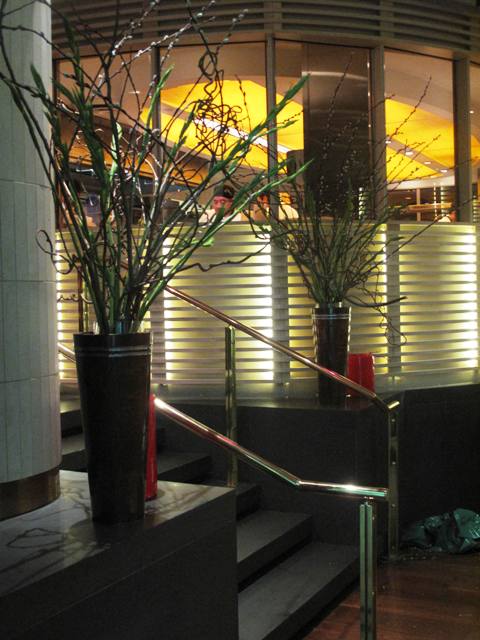
- Kiwi vines and young spring gladiolas – silhouetted against the uplit wall of Rouge Tomate
From a floral designer’s point of view, it’s easy to adhere to these principles when summer’s abundance offers more choices than you can ask for. Come January, though, Bess gets creative. And I was eager to see how her commitment to seasonal and local played out first hand.
Before I arrived, Bess’s driver had delivered the other flowers she needed. Those ingredients included the longest and most slender gladiolas I had ever seen. In pale green, the blooms were clearly hothouse grown, but they weren’t imported. Along with the glads, Bess had requested yummy bunches of winter anemones in the deepest plum hue, with dark black centers. She also sourced quirky purple artichokes on stems. All of these ingredients came from greenhouses in Florida, whereas the kiwi and pussy willow branches came from local farms on Long Island.
Bess’s arrangement for the main dining room was simple yet completely sophisticated. She first filled a tall, square container with the kiwi branches, using them to create a tree-like structure that soared above dining tables. Bess arranged the glads in and among the kiwi, using that fresh promise of spring green against the earthy kiwi bark to make a thoroughly organic statement.
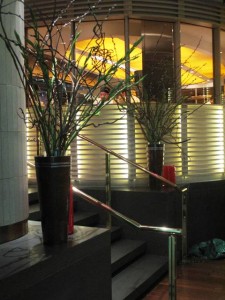
- Twin bouquets – local and seasonal, of course
Downstairs, Bess filled two matching vases with a similar version of the upstairs combo. The pair of vases flanks either side of a staircase that descends to the private dining room. These containers were large enough to accommodate an addition of pussy willow branches in and among the kiwi vines and green glads.
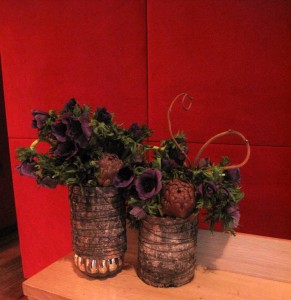
- A perfect floral and culinary pairing: Artichokes & Anemones
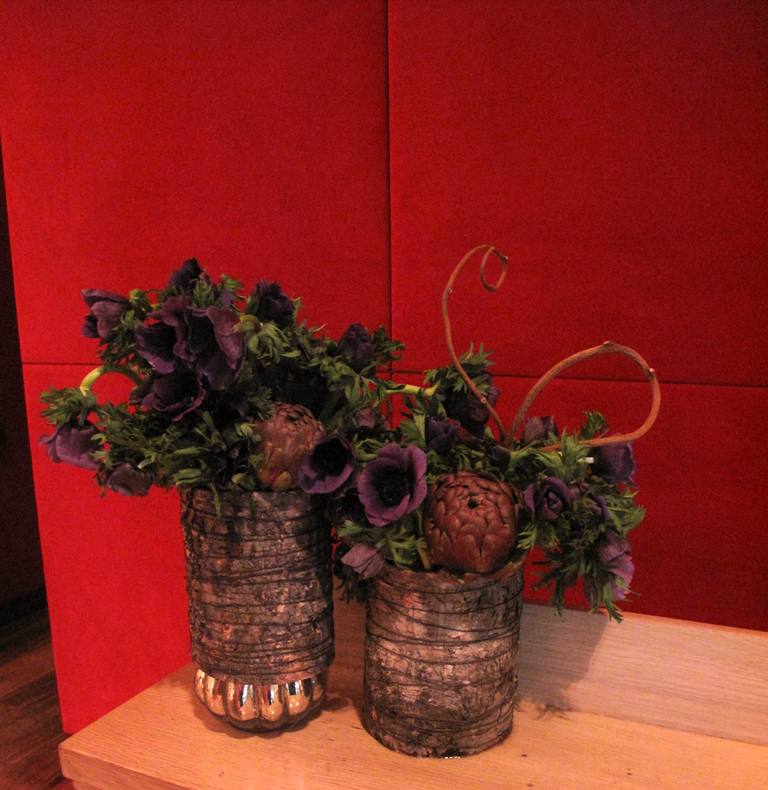
Finally, the hostess stand called for an impactful, smaller-scale design. Bess filled two bark-wrapped cylinder vases with what, to me, is a dazzling duo in purple: Artichokes and Anemones. I love the vegetable-and-flower pairing. It’s especially fitting for a restaurant venue, and it works nicely because of the purple palette. A few curly kiwi vines emerge from this design, helping to connect the smaller vases with the ingredients of the larger ones.
After finishing her design work, Bess still had cleanup duties. She brings biodegradable garbage bags with her when she designs on location. All the cuttings and trimmings get tossed in the giant bags, which are then placed with the restaurant’s kitchen compost. Any cardboard goes into the recycling, leaving zero waste on site.
This weekly ritual is one that keeps Bess in close contact with the restaurant management and kitchen staff. As a result, when weddings and private events are booked into Rouge Tomate, it’s a given that Celadon & Celery is called in to design eco-friendly flowers for the clients.
Posted in floral design, General | 4 Comments »
© Debra Prinzing, all written and photographic content. Website design/development by Willo Bellwood/Metric Media