The Slow Flowers Podcast is the award-winning show known as the “Voice of the Slow Flowers Movement.” Launched in 2013 as the original flower podcast, we’ve devoted more than 10 years to covering the business of flower farming, floral design, and the Slow Flowers sustainability ethos. Listen to a new episode each Wednesday, available for free download here at slowflowerspodcast.com or on iTunes, Spotify, and other podcast platforms.
May 26th, 2012
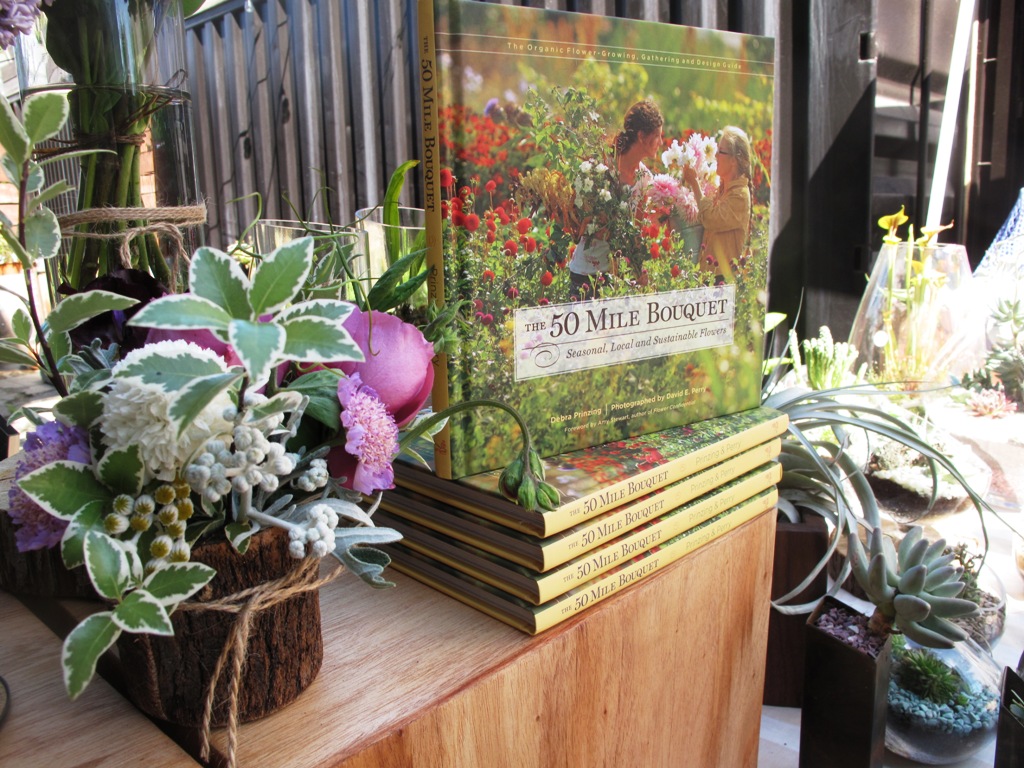
The 50 Mile Bouquet shares the stage with Lila B.'s charming mini-floral arrangements.
Promoting the Slow Flower movement means one may have to travel. I realize that’s a huge contradiction, but that’s life – a series of choices, right? I rationalize my airplane journeys by trying to cram as many events into one destination as possible. Not exactly logical, but it makes me feel more efficient and keeps me away from home for a shorter period of time.
Earlier this month, I headed to San Francisco for Mother’s Day weekend. It started when Flora Grubb and Susie Nadler, two of the superstars of The 50 Mile Bouquet, invited me to be part of the Mother’s Day events at Flora Grubb Gardens. It was the perfect excuse to combine a visit to meet my own mom (and dad) in San Francisco. And then Baylor Chapman of Lila B. Flowers, another superstar of our book, invited me to be part of her activities as part of the SF Made Week. We filled those 48 hours to the brim with flowers, friends and family. A special thanks to Sophia Markoulakis, food and garden writer, for featuring The 50 Mile Bouquet and the Mother’s Day book-signings in her article for the San Francisco Chronicle, ‘Slow-flower’ movement’s power sprouts with new book.
Here are some of the photos from the trip:
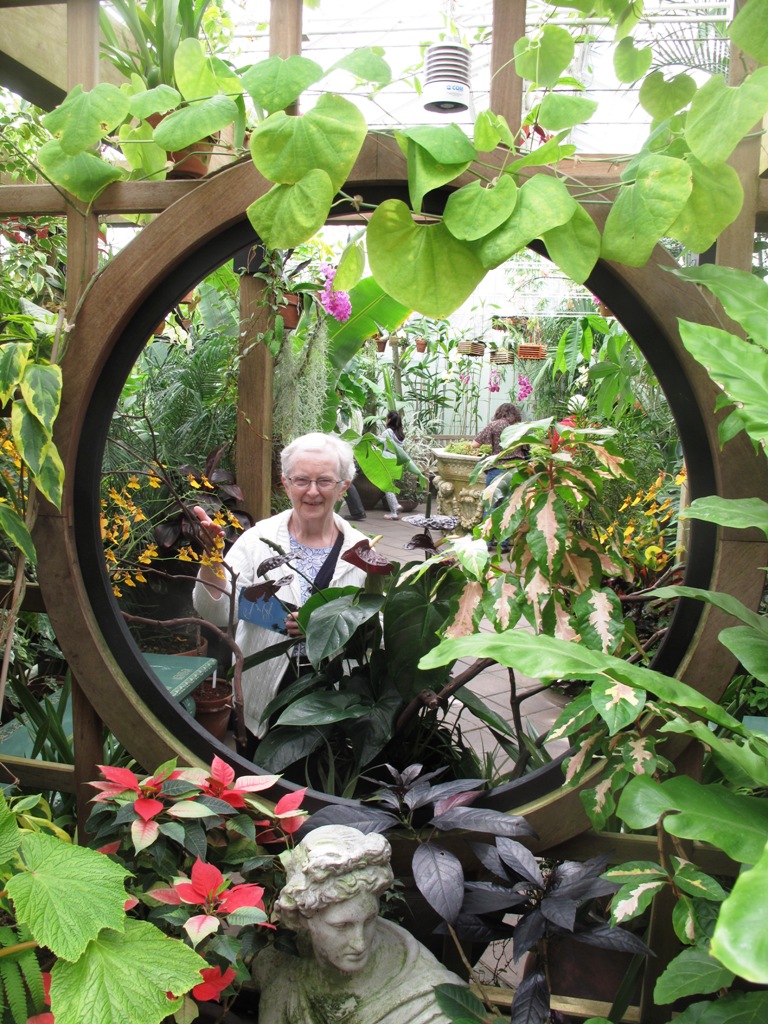
Hi Mom! Having fun with my own mom, Anita Prinzing, at the SF Conservatory of Flowers.
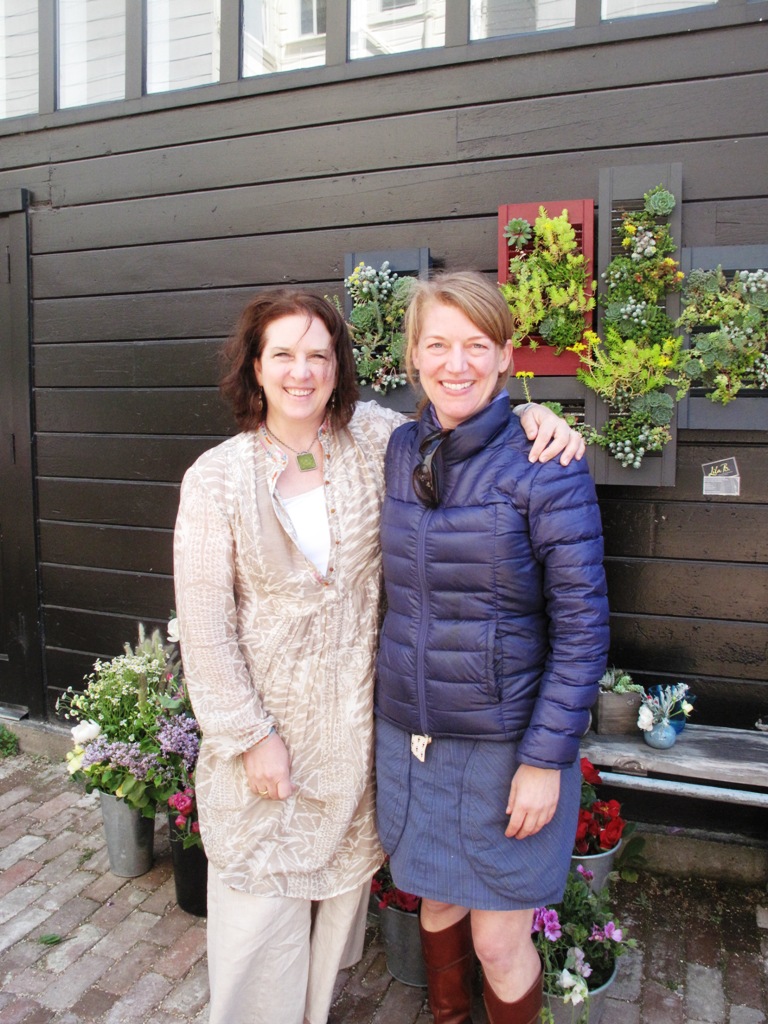
Spending time with floral artist Baylor Chapman is always a treat. We're at the Lila B. Flowers pop-up shop at the Stable Cafe on Folsom Street.
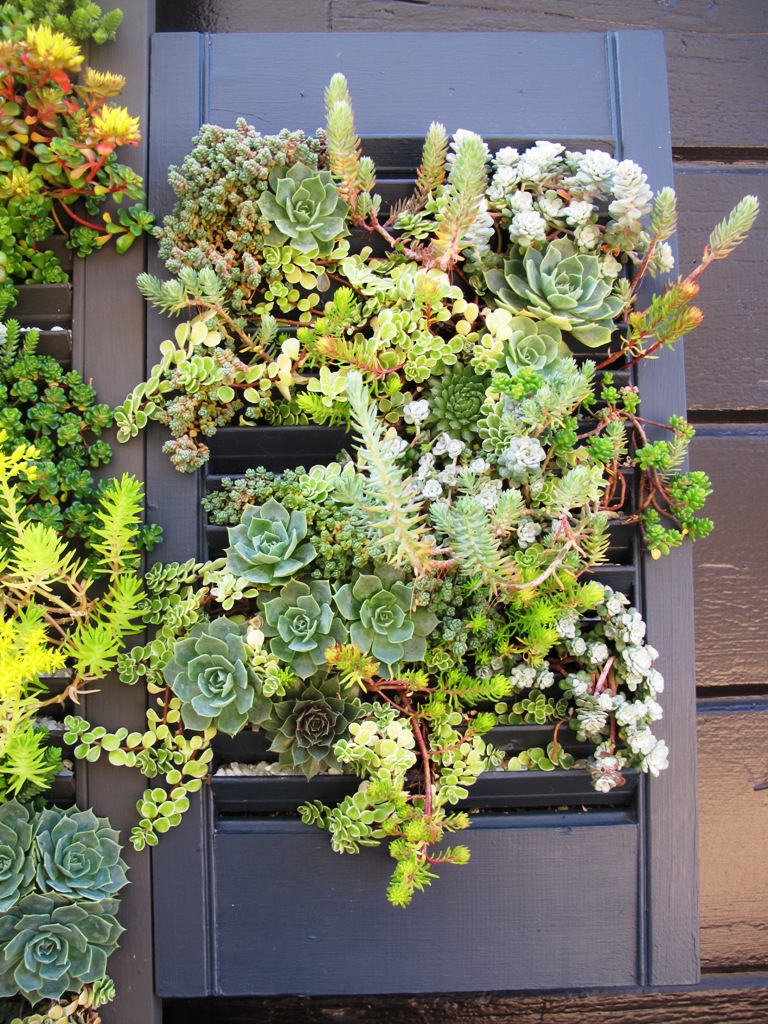
Sigh. Baylor's famous succulent-planted shutters. So beautiful!
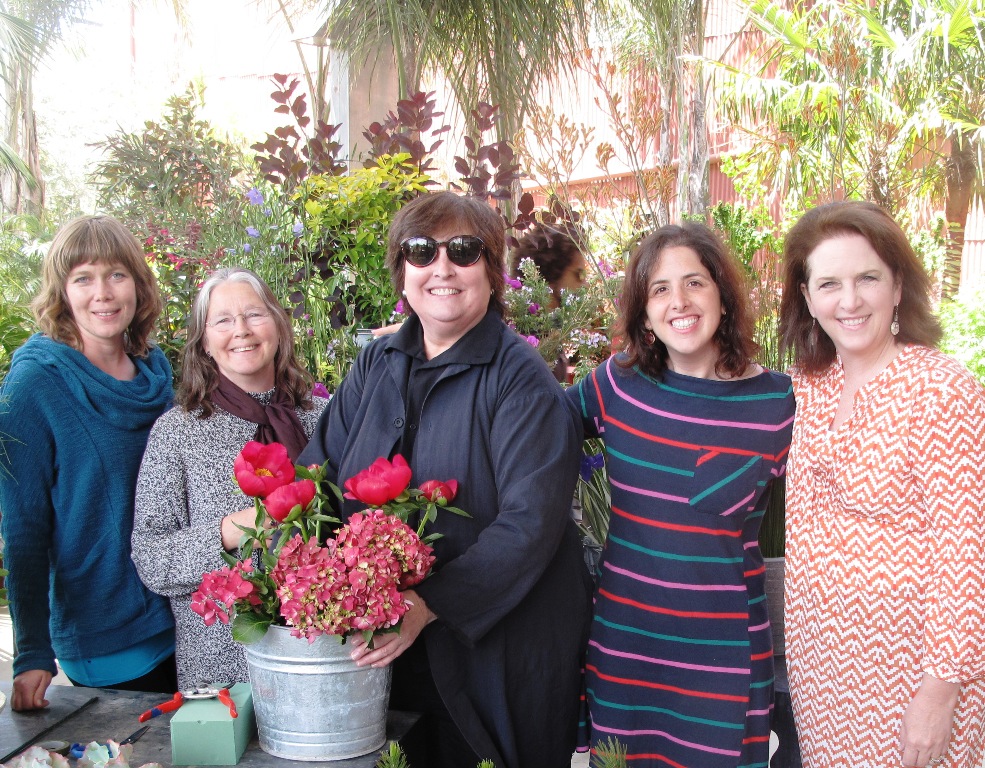
At Flora Grubb's on Mother's Day, including (from left) Flora and her mom, Susie's mom, Susie, and me.
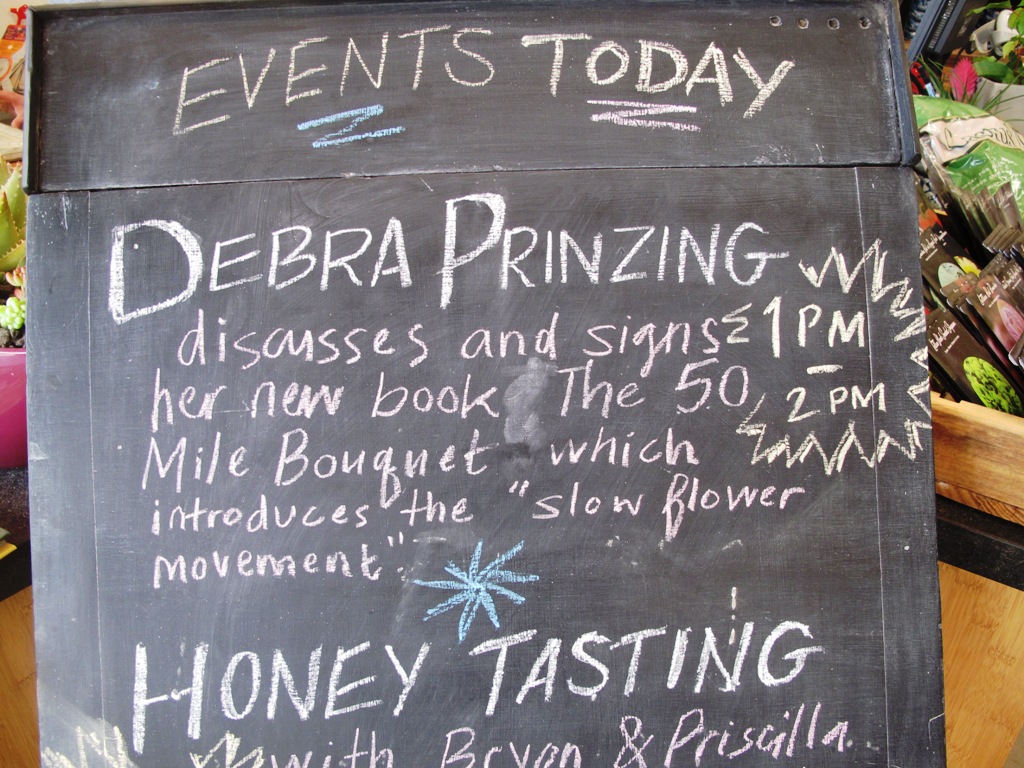
A chalkboard notice welcomes me.
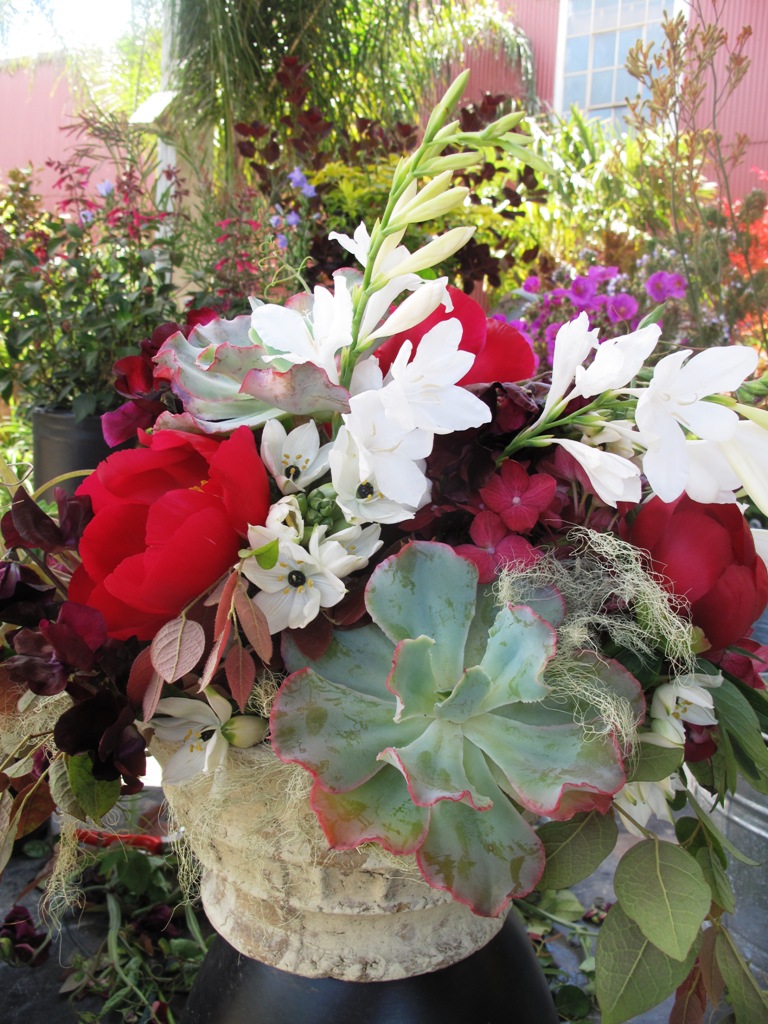
Susie create a scrumptious local bouquet using ingredients from her own backyard, from local flower growers and - of course - from succulents at Flora Grubb Gardens.
Posted in Book reviews, Creativity, floral design, Gardening, General, Writing | 5 Comments »
April 30th, 2012
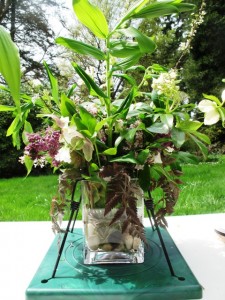
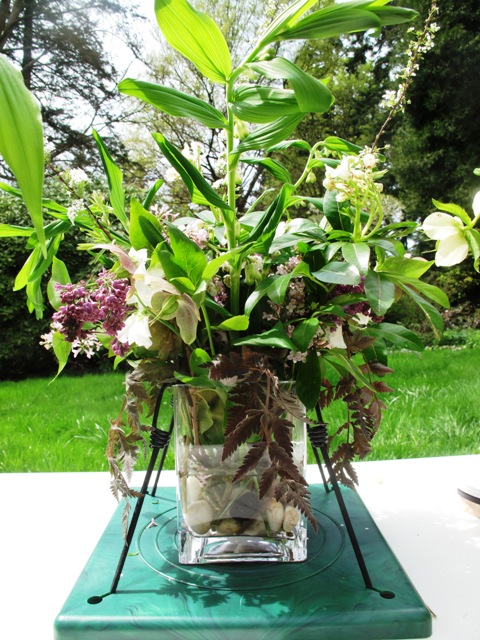
- Here’s a clever new way to transport a vase of flowers in the car!
I’ve tried all sorts of tricks to stabilize and transport a gift bouquet in my car. It usually means holding my breath while driving to the party.
Sometimes I place the vase inside a 5-gallon bucket or a large file box and stuff crumpled up newspaper around it. Occasionally, these ideas work out great. Then there are those times when I turn the corner and – oops – everything spills out.
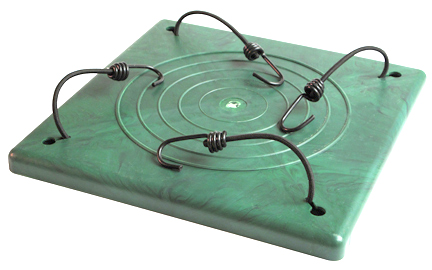
I’m not saying the Vase Brace is perfect, but I sure think it’s a clever idea for transporting a vase, especially on the floor of the passenger’s side or behind the back seat. Liz Griffin, a budding cut flower farmer from Auburn, brought along this nifty product to the workshop I taught at Seattle’s Dunn Garden on Saturday.
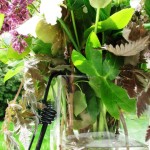
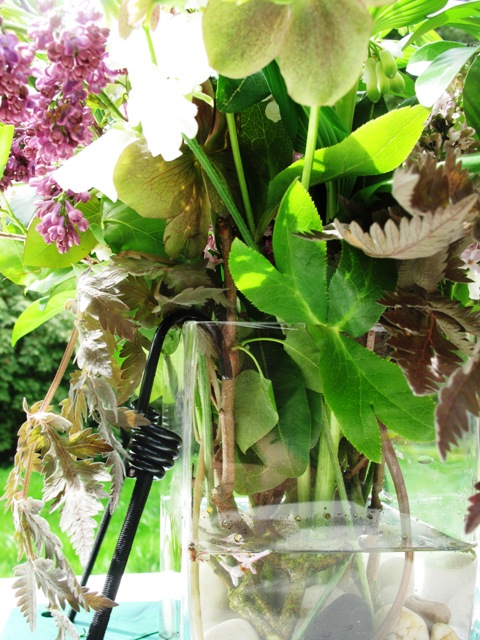
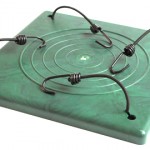 When the class was over, Liz simply placed the sturdy square base on the table and centered her vase on the top. Then she pulled on four bungee cords and snapped their hooks over the rim of her vase. The tension of the cords hold everything in place. No tipping allowed!
I was not the only person to ooh and aah at this clever product. In fact, I snapped a few photos of Liz’s beautiful arrangement secured for transport home in her car.
Today, she sent me the link to an online source called Arranged for you. Check it out – for just under $17, this simple product may make driving to a dinner party nearly stress-free! Thanks Liz!
Posted in Creativity, floral design, General | 12 Comments »
April 26th, 2012
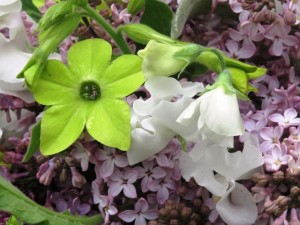
- Gotta love these yummy colors together!
Yes, a full month AFTER our spring equinox, the garden is popping! Here’s my happy spring bouquet, made just for me. But I wanted to share it, too:
Ingredients:
Vintage green fluted vase (flea market find)
Aromatic lilacs from Oregon Coastal Flowers (Tillamook, Oregon)
Very fragrant white sweet peas, velvety lamb’s ears and acid-green nicotiana – all from Janet Foss at J. Foss Garden Flowers.
The setting: my garden. I perched the arrangement on my wonderful weathered garden chair.
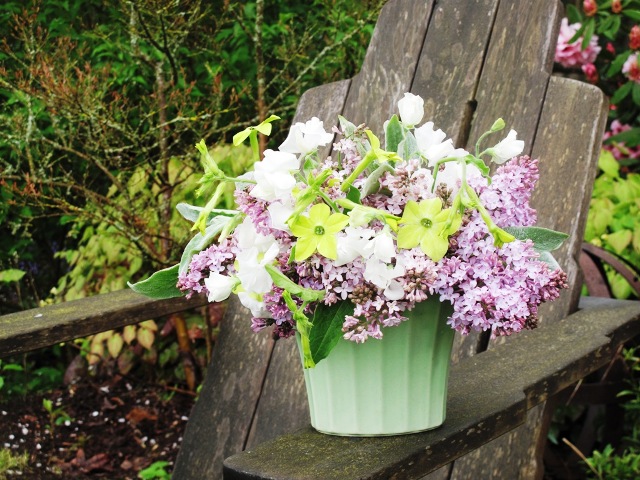
A sensory, springtime bouquet in a gentle palette of white, green and lilac.
Posted in Creativity, floral design, Gardening, General, Plants | 5 Comments »
April 17th, 2012
Eco-conscious flower farmer and floral designer Kelly Sullivan of Seattle’s Botanique Flowers arrived with this gorgeous bouquet at a lunch I hosted last week. I had to share it!
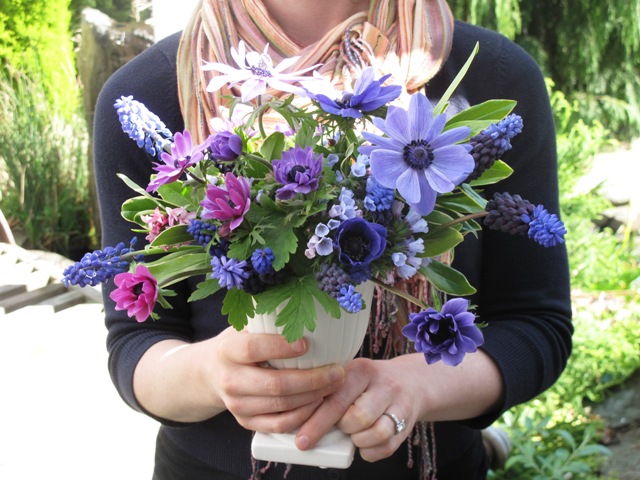
Kelly Sullivan's evocative spring bouquet
Here’s what she included in the diminutive urn:
From her own garden: purple-blue grape hyacinths (Muscari); pale pink and purple flowers from a groundcover called Pulmonaria; geranium foliage; and variegated foliage/scented pale-pink flowers from a shrub called Daphne odora.
From the garden center: It was too early to harvest these from her own backyard, so Kelly bought potted anemone plants and clipped several of their romantic black-centered flowers in indigo and dark pink to add to the bouquet.
Everything is stablized with a small piece of chicken wire inside the vase, which allowed the designer to get the full, cascading effect she wanted. I was smitten!
So, when we had a talk and book-signing at Ravenna Gardens on Sunday, I brought along her vase to add to the book display. It’s simply sublime!
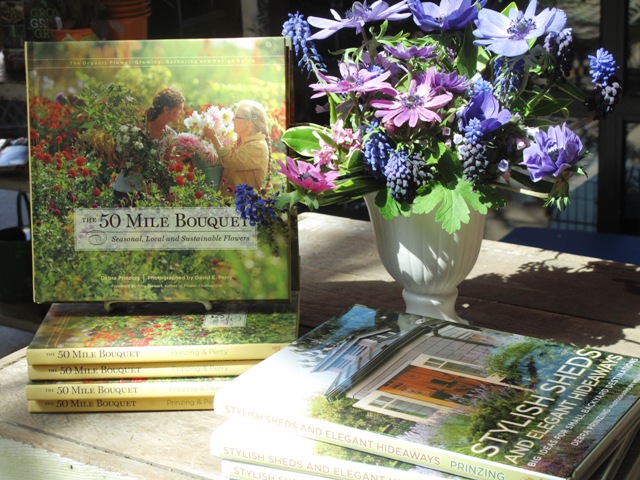
Kelly's bouquet looks pretty dazzling with our book display.
THANK YOU, Kelly!!!
Posted in Creativity, floral design, Gardening, General, Writing | 4 Comments »
April 13th, 2012
Read about the 10-year journey of a garden memoir – from the seed of an idea to its release by a top New York publisher
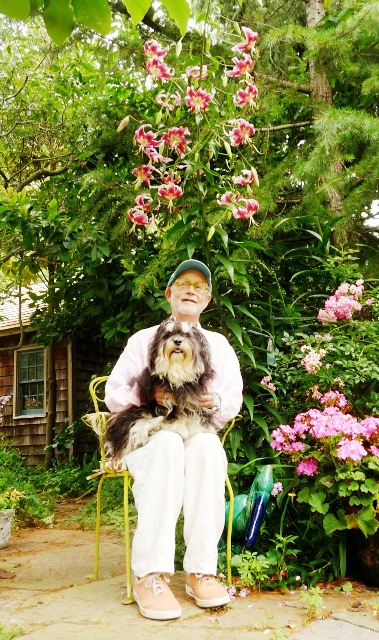
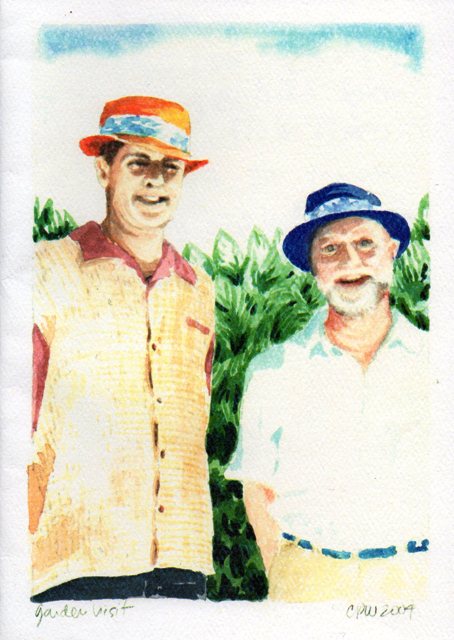
Skip in his garden in Orient, New York. Rover is seated on his lap.
Many garden writers whose work I greatly admire have privately shared their disappointment that our genre isn’t seriously viewed as a literary subject when compared to, say, sports or food. Every twelve months we witness the publication of an anthology titled something like “The Best American Sports Writing, 2011” or “The Best Food Writing, 2010.” There are books of “bests” for Science and Travel writing. Yes, even Nature and Environment writing has been compiled by publishers, but those topics aren’t the same as the subject of the garden. Sadly, garden writing rarely receives credit for its importance as an art form.
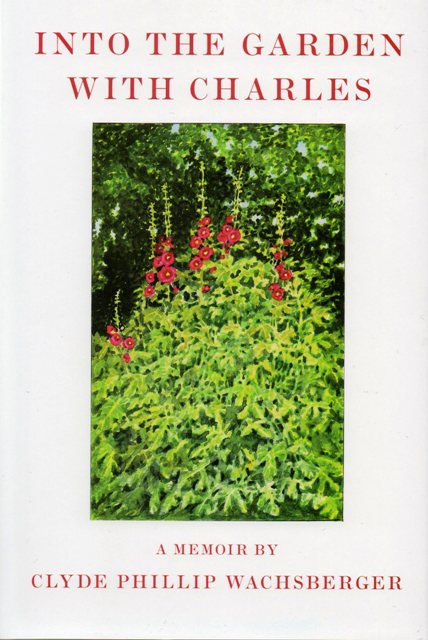
And yet, there is wonderful work in our circles. And one of the very best pieces of literary garden writing I’ve ever read was just published this week and released by the venerable imprint Farrar, Straus and Giroux. It’s a memoir called “Into the Garden with Charles,” by the late Clyde Phillip “Skip” Wachsberger, an award-winning artist twice honored by Garden Writers Association.
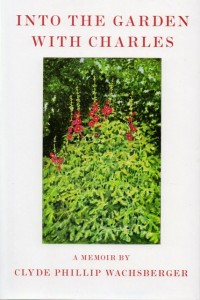 Skip’s book is beautiful both for its language and for the 14 full-color watercolor illustrations interspersed through its 224 pages. FSG’s press material describes this work as a “sweet and inspiring story about art, love, and gardening set against the backdrop of New York City and the author’s noteworthy garden outside a three-hundred-year-old house in the tiny village of Orient, Long Island.”
For those of us who knew and admired Skip, his book can be viewed as one man’s life work. It’s a highly personal and yet universal story of love, friendship, and the way the garden can nurture a lonely soul.
When I spoke by telephone with Jonathan Galassi, FSG’s president and publisher, and asked what prompted him to acquire Skip’s memoir, he said: “I thought it was a very genuine and beautiful piece of work; very touching and real and unlike anything else I’d read.”
As I listened to those words, tears welled up in my eyes. I thought: How pleased Skip would have been to hear them. We lost Skip last November, when cancer took his life. That his writings, paintings and garden survive is to be cherished by those who loved him and by anyone who reads this memoir.
For fellow garden writers, Skip’s creative story is an inspiring one, much of it documented in the pages of his memoir. His manuscript took a decade to be cultivated – from an original garden book idea to its release by one of the publishing world’s very best imprints.
Skip and I had many conversations over the years about how he reshaped his writing — from descriptions of plants and place into an intimate narrative of his own life. To better describe the story of this special book, I turned to the people closely involved with “Into the Garden With Charles.” In addition to interviewing Mr. Galassi, I spoke by phone with Charles Dean, Skip’s surviving husband, and Karen Braziller, his friend, neighbor and longtime writing coach/editor. They graciously shared details of Skip’s writing journey with me.
GARDENING, WRITING AND PAINTING
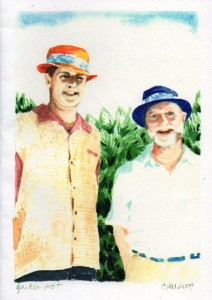
Charles and Skip in their pork pie hats. Skip printed note cards from the original watercolor.
In theatre, someone who sings, dances and acts is called a “triple threat,” so I guess you could say that as a creative individual, especially in garden writing circles, Skip had his own remarkable set of triple talents — gardening, writing and painting.
His gifts converge in and enliven the pages of “Into the Garden with Charles.” From the opening lines when he wonders if all that makes him happy is just a dream – his beloved but antiquated home and garden, his always-cheerful dog Rover, and his charming, Southern-born partner Charles – Skip draws the reader into his magical world in which the impossible is always possible, if you only believe.
“Into the Garden with Charles” tells of a wonderful life filled with a love for opera, art, plants and friends. That Skip yearned for a companion with whom to share all of it is a familiar narrative. And just when it seems like he’ll never find the love of his life, living as he does in a remote Long Island village populated with couples and having just passed his half-century birthday, Skip meets Charles.
“Every garden tells a story. Ours tells a love story,” he wrote. And you will fall in love with both Skip and Charles, as well as Rover, their loyal Havanese, and all of their plant-obsessed garden adventures. Gardeners will especially relate to the ends to which these two men go to develop an otherworldly backyard where every tree, vine or flower has its own back-story!
For those who love to read lush (but not flowery) language, you will find the narrative delightful. And like a child’s storybook from days gone by, this one is adorned with beautiful watercolor illustrations, painted by the author. Allow yourself to be drawn into Skip’s dream world. You will be touched by his wisdom, kind spirit and optimism — all of it a gift from him to the reader!
READ MORE…
Posted in Book reviews, Creativity, Gardening, General, Writing | 13 Comments »
March 29th, 2012
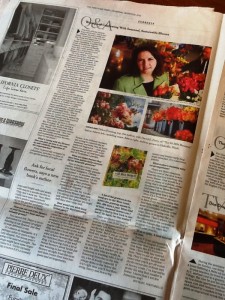
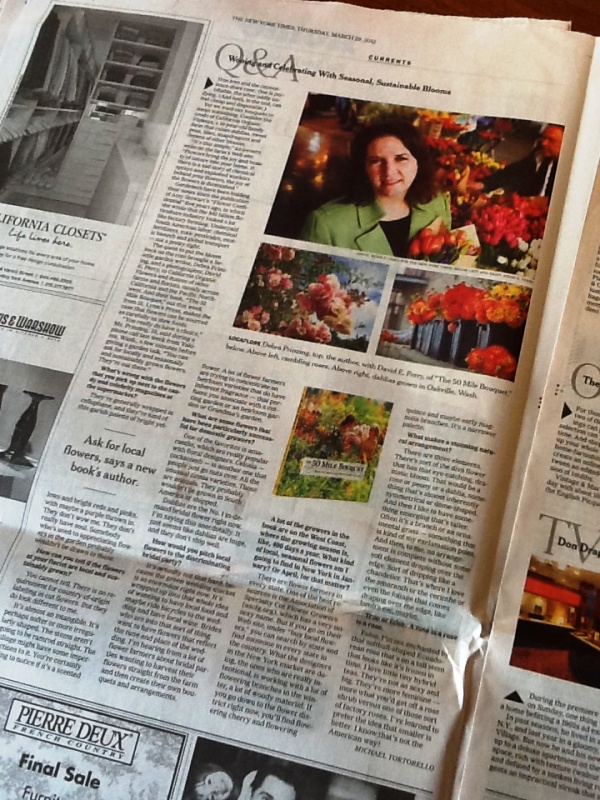
- A friend emailed me the photo he took of today’s paper and wrote: “Look who I ran into”
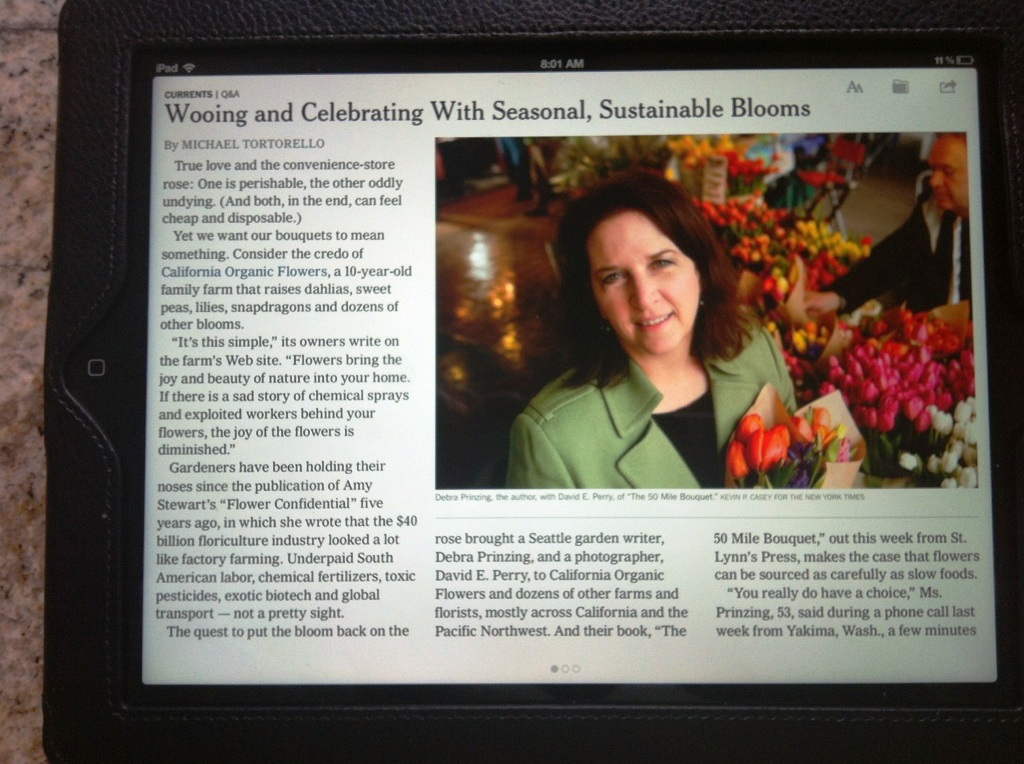
Today’s New York Times featured a piece about The 50 Mile Bouquet, complete with our book’s cover, two luscious flower photographs by David Perry, and a portrait of me. Everyone in the St. Lynn’s Press family is ecstatic, to say the least. This sort of thing doesn’t come around often, if ever, in the life of an author. Here is the full text of the Q&A.
Michael Tortorello, a gifted writer whose work regularly appears in the NYT Home section, set up a phone interview with me last week. Due to time zone differences, his travel and my own travel schedule, it turned out that between the two of us, we could only find one hour that worked for a phoner! I was literally seated in Stephanie Clevenger’s SUV, which was parked in front of The Red Barn – the gathering place for Yakima Master Gardeners. The minute Michael and I finished up the Q&A, which he recorded, I dashed into the barn and gave a Container Design presentation to about 75 MGs . Whew.
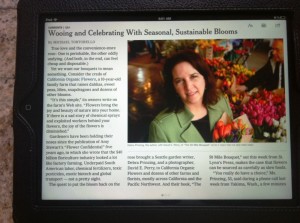
- Another friend sent me a photo of her Ipad edition of the NYT.
There was a similar crunch when it came to getting a photograph, which took place earlier this week with just a few hour’s notice. Lola Honeybone of MediaWorks Nashville, a friend whose book PR skills are unparalleled, and whose help I enlisted for our book’s publicity efforts, emailed to ask: Where would be a good spot for a portrait?
I immediately thought of the brilliantly beautiful Pike Place Market stall operated by Alm Hill Gardens (Gretchen Hoyt and Ben Craft, owners). This is the single best place in Seattle for organic tulips, daffodils, hyacinths, lilies, and other amazing crops that come later in the year – like lilacs and peonies. Their farm is located in Everson, Wash., close to the Canadian border, and Alm Hill is a gold-standard flower fixture at the Market. My go-to source! Plus, since we have a 2-page spread on Gretchen and Alm Hill in The 50 Mile Bouquet, it seemed fitting to take the photo there.
I met freelance photographer Kevin Casey at the stall on Monday afternoon. My flower-seller pal Max Clement was working, as he does most Mondays, and he indulged us by stashing Kevin’s gear and my stuff while we did the photography. It was certainly less painful that I thought it would be, thanks to Kevin’s easygoing style and also the way he let me know what “worked” and what didn’t. Do I smile? Do I look serious? Ugh!
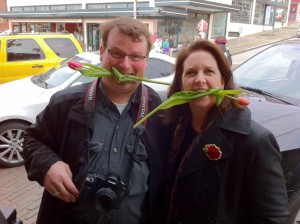
- Here I am with a “taste of tulips,” posing with Kevin Casey, a NYT freelance photographer.
In the end, I’m pleased with the photo used in the story – especially because Max and the tulips appear in the frame!
But I had a chance to turn the tables on Kevin, too. I asked him to pose with me for a photo that Max shot with my Iphone. We look goofy, but who cares? It was way fun and an unforgettable experience. Turns out, Kevin is an old newspaper staffer like me, so we compared notes about editors and writers with whom we’ve both worked in the past. It really is a small world.
Last evening, I received an email from Mary Robson telling me that she’d seen the story on the NYT’s web site. It’s also fitting that I first heard from Mary, a dear friend to so many gardeners and readers from her days as a popular columnist with The Seattle Times, and as King Co.’s Extension Agent who trained hundreds of Master Gardeners over the years. Mary and I co-authored The Washington-Oregon Gardener’s Guide in 2004 (and Lola was our publicist then – see what a small world it is?). What a treat to hear it first from her – the best co-author a girl could ever have.
This morning, the “real” print edition arrived in our driveway. Bruce went out to get it first and used the edge of the Home section to tickle my face and wake me up at about 6:30 a.m. Later in the day, friends texted and emailed their own photos taken of the story in the print edition and Ipad version.
I know that the 24-hour high is about to wind down, but then again, maybe not. There is something called an after-life for stories. I know because when my own articles are posted online I’m always surprised to see that they have an extended shelf life, sometimes for years.
For now, I’m just grateful and happy to have been part of the experience. Something great is coming from the combined creative efforts of two people who adore and admire flower farmers and floral designers. So as my friend, the late Linda Plato, would have said: “It’s all good.”
Posted in Book reviews, Creativity, floral design, General, Plants, Playfulness, Writing | 11 Comments »
© Debra Prinzing, all written and photographic content. Website design/development by Willo Bellwood/Metric Media