The Slow Flowers Podcast is the award-winning show known as the “Voice of the Slow Flowers Movement.” Launched in 2013 as the original flower podcast, we’ve devoted more than 10 years to covering the business of flower farming, floral design, and the Slow Flowers sustainability ethos. Listen to a new episode each Wednesday, available for free download here at slowflowerspodcast.com or on iTunes, Spotify, and other podcast platforms.
After the crazy week of Valentine’s Day, I’m shifting my thoughts to springtime, aren’t you? That’s a little easier for me to say here in Seattle, where the thermometers climbed above 60 degrees last week and flowers are popping up everywhere. But someone reminded me today that spring is only 30 days away. Hold on, everyone!
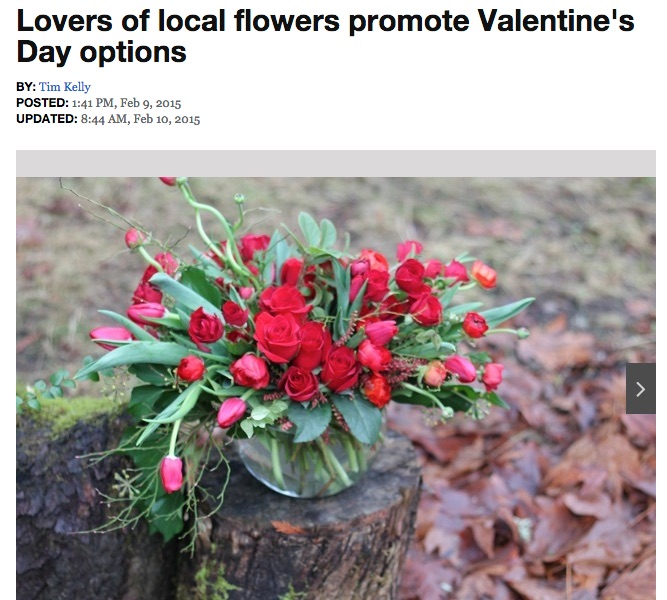
The Slow Flowers Movement and Slowflowers.com attracted major media attention last week – on wire services, television, radio, print and blogs. I am so grateful for the attention that is turning to American flowers, the passionate farmers who grow our favorite varieties and the talented designers who create magic with each local and seasonal stem they choose. Here is a sampling of some of the headlines we saw last week:
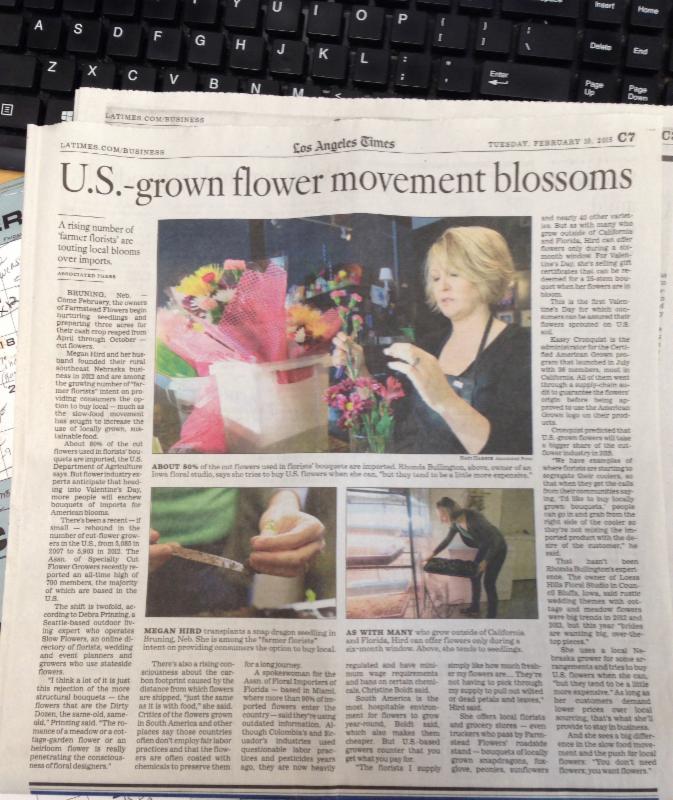
“Slow Flowers Movement Pushes Local, U.S.-Grown Cut Flowers” (that story was written by Associated Press agriculture reporter Margery Beck and it literally went viral — appearing in media outlets large and small – from the Los Angeles Times and Chicago Tribune to ABCNews.com). Slowflowers.com member Megan Hird of Farmstead Flowers in Bruning, Nebraska was also featured in this piece.
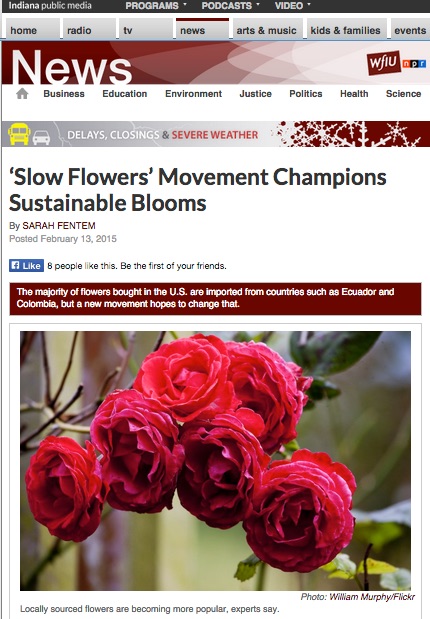
“Slow Flowers’ Movement Champions Sustainable Blooms,” by Indiana Public Radio’s Sarah Fentem. Slowflowers.com member Harvest Moon Flower Farm of Spencer, Indiana was also featured in this piece.
“Just in Time for Valentine’s Day: Introducing Farm-to-Table’s Pretty, Flowery Cousin,” by Sarah McColl on the sustainability blog TakePark.com which also featured Molly Culver of Molly Oliver Flowers in Brooklyn, a Slowflowers.com member.
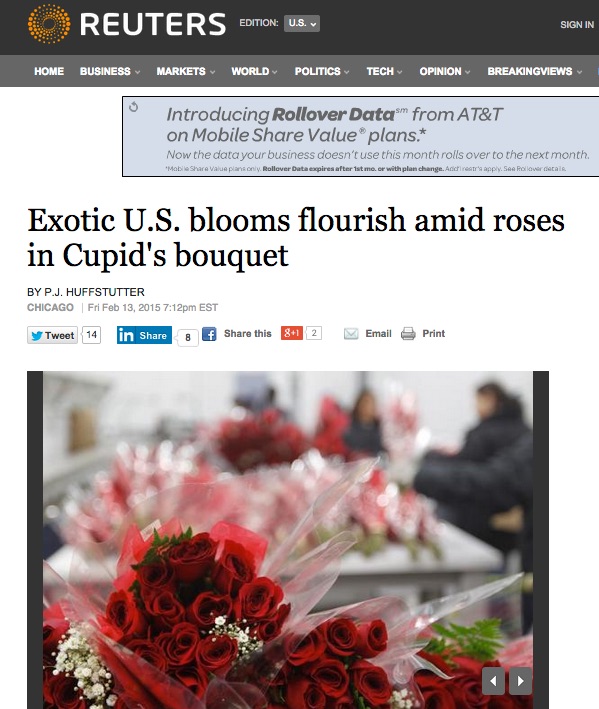
And Reuters writer P.J. Huffstutter’s piece “Exotic US Blooms Flourish amid roses in Cupid’s bouquet,” featuring the “slow flower” movement, as well as the CCFC and ASCFG.
We can’t even tally the tens of thousands of impressions that came from this great media coverage – but suffice it to say that, according to Kasey Cronquist, CEO/Ambassador of the CCFC, “In my tenure at the Commission, I can confidently say that this past week of media attention and interest was greater than all of the my other years of doing interviews and monitoring Valentine’s Day coverage.”
He went on to say: “I can also quickly point to the three things that made the difference this year.
Debra Prinzing’s SlowFlowers.com
Launch of Certified American Grown
Increasing Awareness of Caring Consumers, Designers and Buyers”
Slowflowers.com is growing with our 500th member!
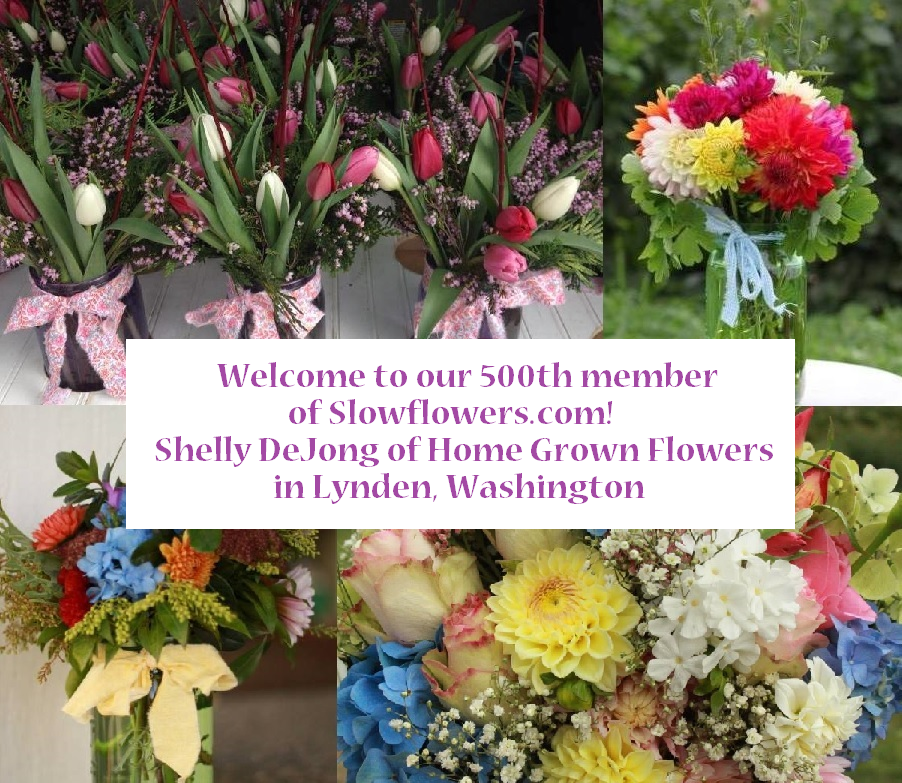
On top of all of that excitement, I want to celebrate a major milestone! This week marks the addition of the 500th member to the Slowflowers.com web site. Please welcome Shelly DeJong of Home Grown Flowers in Lynden, Washington. Shelly’s tagline is “Flowers as fresh and local as possible,” and she specializes in ball-jar bouquets delivered to customers in her community, throughout the year and for special occasions. Welcome to Slowflowers.com, Shelly!
We can already feel that 2015 might be THE year when the story of American grown flowers hits an important inflection point. As we witness a critical shift in consumer mindset at the cash register, I believe we’ll also see a change — in a good way — in the behavior of wholesalers and retailers who make those important flower sourcing decisions.
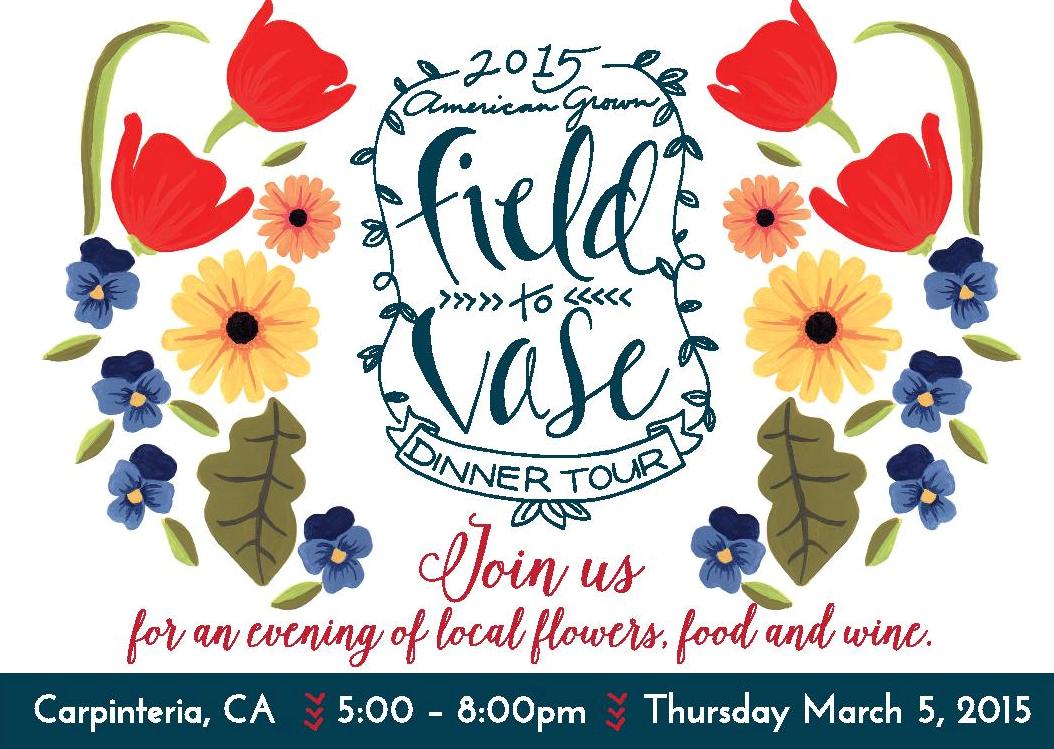
One of the things I’m most excited about this year is a series of flower farm dinners that celebrate American grown flowers, as well as the farms and florists who bring them to life. To hear more about this cool project, called the Field to Vase Dinner Tour, I’ve asked special events manager Kathleen Williford to share details.
As I mentioned, you are invited to take part as a guest at one or more of the flower farm venues. The promo code for a $25 discount is DREAM, so be sure to use it when you order your seat at the flower-laden table.
The Flower House logo, designed by Lily Stotz
Speaking of being flower-laden, our featured guest today has flowers on her brain in a big way. I am so pleased to introduce you to Lisa Waud of Pot and Box, a flower shop and floral and event studio with two Michigan locations – in Detroit and Ann Arbor. Lisa is a member of Slowflowers.com, but I think we originally met when Jill Rizzo of SF’s Studio Choo suggested to Lisa to reach out and tell me about her ambitious project called The Flower House.
Here’s the scoop:
Beginning over the first weekend of MAY, Lisa will host a preview event for an innovative art installation in Detroit.
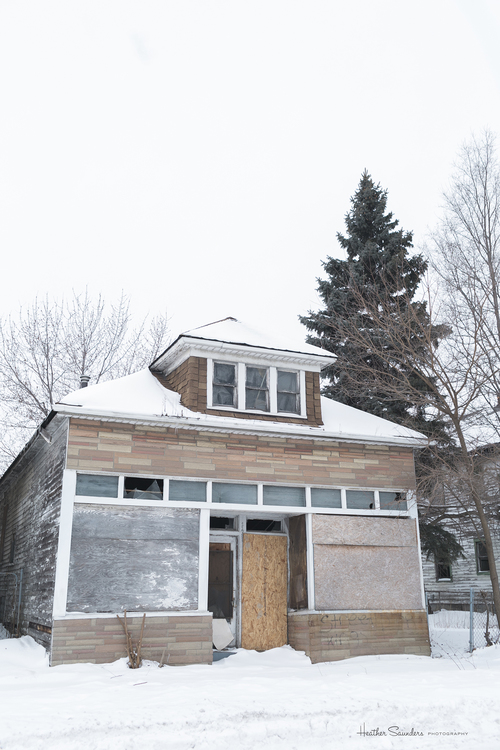
Imagine this abandoned storefront – filled with Lisa’s floral dreams. (c) Heather Saunders Photography
There, potential sponsors, partners, friends and volunteers will get a whiff of the “big project” on a smaller scale. In a tiny storefront, they will install a breathtaking floral display, just next door to a once-abandoned urban property where Lisa and fellow designers ultimately hope to transform an aging, 11-room duplex into The Flower House.
“We’ll generally work our future audience into a flower frenzy,” Lisa says of the kickoff event.
When October 16th-18th rolls around, cutting-edge florists from Michigan and across the country will fill the walls and ceilings of an abandoned Detroit house with American-grown fresh flowers and living plants for a weekend installation.
The project will be featured in local, national, and worldwide media for innovation in floral design and repurposing forgotten structures in the city of Detroit.
Visitors will be welcomed to an opening reception and a weekend of exploration, and a few reserved times will be offered to couples to hold their wedding ceremonies in The Flower House.
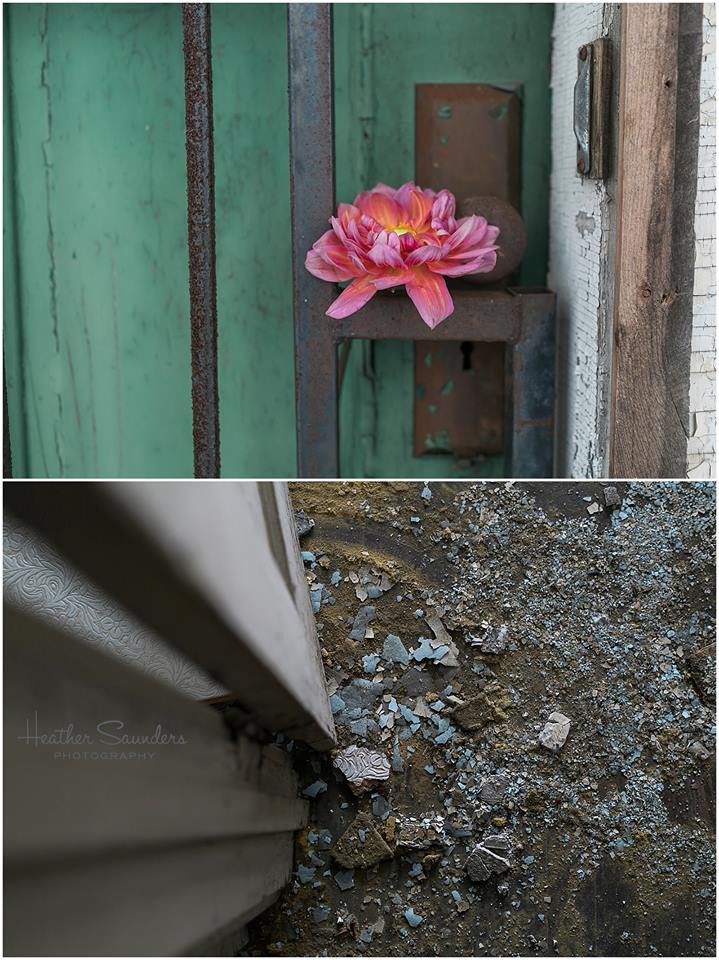
Re-flowering an abandoned home in Detroit – a glimpse of Lisa Waud’s grand idea (c) Heather Saunders Photography.
When the installation weekend has passed, the structures on The Flower House property will be responsibly deconstructed and their materials repurposed. The land will be converted into a flower farm and design education center on a formerly neglected property.
For more details on The Flower House, follow these links:
I feel like I’m saying this week after week, but today’s conversations, with Kathleen and Lisa, are so truly encouraging.
This IS the Year of the American Grown Flower. Please join efforts like the Field to Vase Dinner Tour and Detroit’s The Flower House to get in on the excitement. Both projects are community focused, with the potential for engaging huge numbers of people.
By exposing lovers of local food and floral design to the immense creativity that comes from sourcing our flowers locally, in season and from American farms, we are deepening the conversation, connecting people with their flowers in a visceral way. All the senses are stimulated, as well as our imaginations.
Thank you for downloading and listening to the Slow Flowers Podcast! Each week I share with you our “download” count and we have hit 35,000 downloads to date. I’m encouraged to know more people are learning about the farmers and florists who keeping American-grown flowers flourishing.
The NWFGS opened today and runs through February 15th at the Washington State Convention Center. Follow the links in the sidebar to the right and you’ll find details about “One Bouquet; Three Ways,” design presentations I’m giving on Friday 2/13 and Sunday 2/15. Please join me if you’re in the area! All seminars are free with show admission.
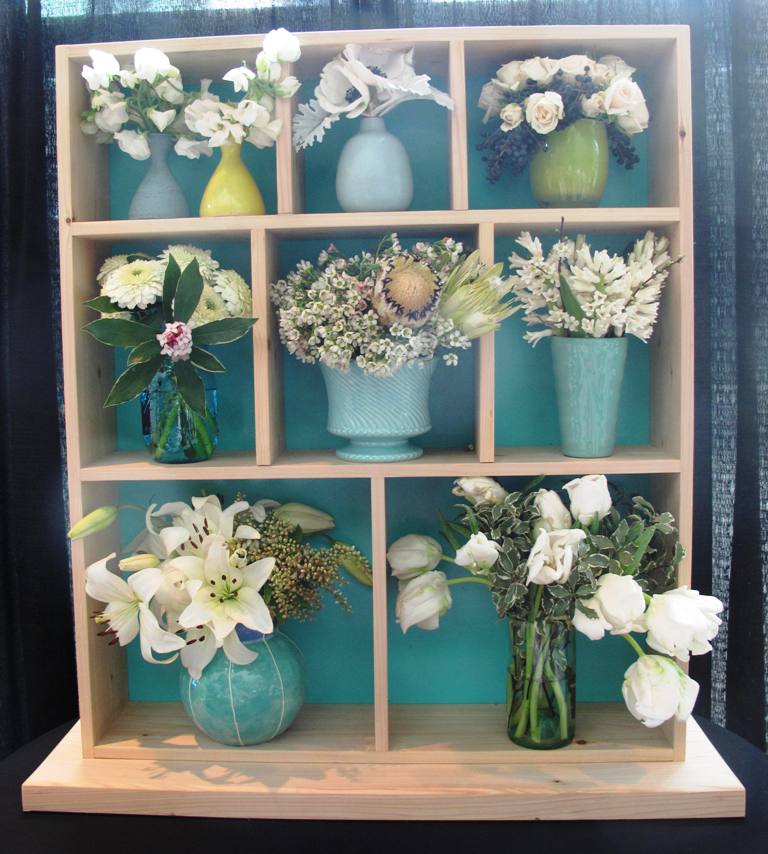
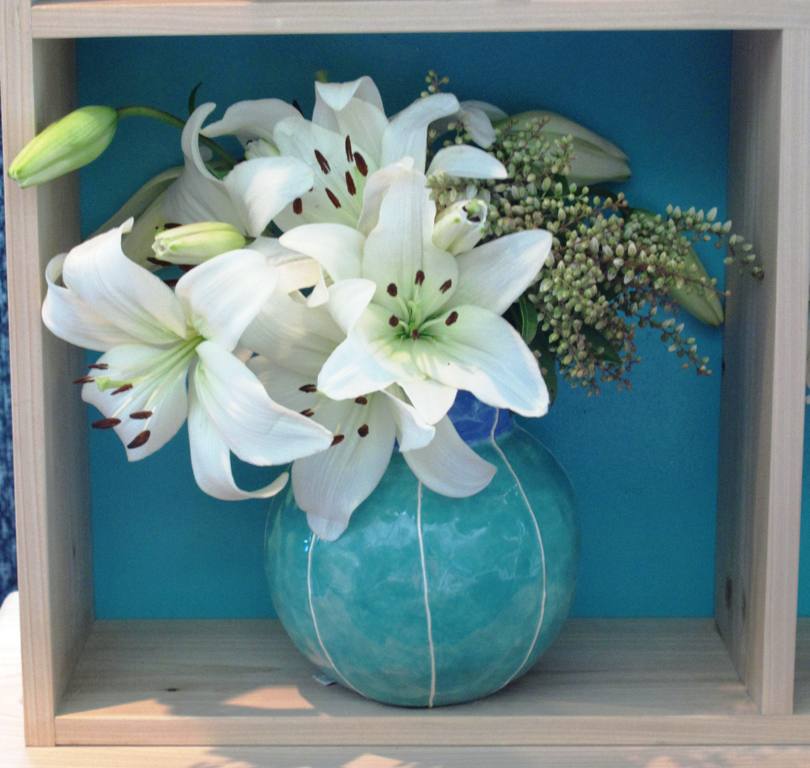
I titled my floral entry “Show Your Love With Local (Flowers),” which is fitting with the show’s theme of “Romance Blossoms.” I knew I wanted to display American-grown flowers in American-made vases, so I’ve spent the past several months thinking about how to best portray that idea. The end result is above.
The idea germinated when I gathered together all the American-made vases I wanted to use, both in my own collection and those I wanted to add. Mostly in the teal-aqua-lime green spectrum, I looked at them and thought: “Each is beautiful on its own, but together they will look like a jumble unless I figure out how to organize them.” And that’s when the idea of a curio cabinet came to mind.
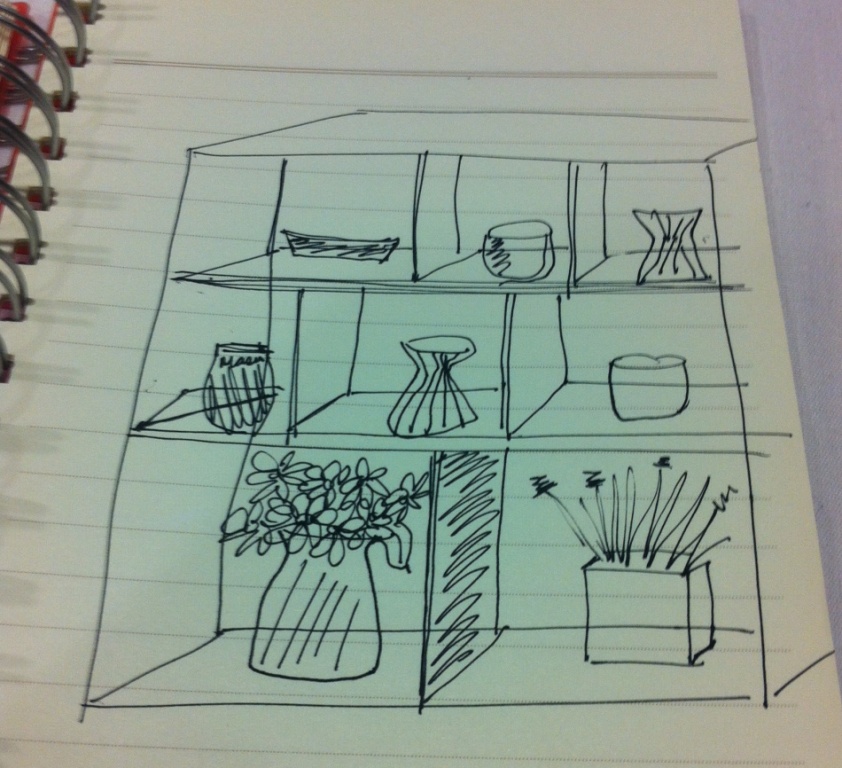
Here’s my original sketch I sent to Andy Chapman of Stumpdust, a talented woodworker and artist who I persuaded to construct what I envisioned in my mind’s eye.
It’s pretty amazing that my sketch is pretty close to the final product (discounting my poor perspective drawing skills!)
The teal and white “bubble vase” by Kristin Nelson of Vit Ceramics inspired the painted “back” of each nook of the curio cupboard.
We met to figure out the dimensions, making sure the “nooks” would have enough negative space to accommodate my flowers, while being balanced proportionately.
Andy took some measurements and we agreed to a cupboard that was about 24-inches wide by about 30-inches tall, with 6-inch deep shelves. The bottom two spaces are 12-inches square; the center ones are 9-1/2-inches tall x 7 to 9 inches wide; the top row has 6-1/2-inch cubbies by the same width as those on the center row.
I really love how Andy staggered the uprights on the top and center rows to make the spaces more visually interesting.
He used scrap lumber and suggested I purchase a thin board at the home center that I could pre-paint before he attached to the back, like the back of a bookcase. That worked out swell and I chose a high-gloss turquoise hue called ‘Seafarer’ from Lowe’s. I think it looks great in contrast to the natural boards.
This sketch is a little more refined!
The paint color makes all the glazes and glass colors pop, and unifies the display. White flowers and just a small amount of foliage keeps everything fresh-looking. Plus, I suspected that there would be a lot of red and pink this week (there is!) and I wanted to show an alternative to the predictable Valentine’s week floral palette.
It all came together beautifully and after I picked up the finished piece from Andy last weekend, I had fun arranging and rearranging the vases for maximum impact.
And thanks to the amazing selection of white flowers from Washington, Oregon and California flower farms, I was able to showcase the diversity of American-grown floral options for Valentine’s Day.
Here is the Slowflowers.com flier I created, a takeaway for showgoers who might be interested in finding their own American-made vases or changing the way they purchase flowers – selecting domestic, local and seasonal options.
SHOW YOUR LOVE WITH LOCAL: AMERICAN-GROWN FLOWERS in AMERICAN-MADE VASES
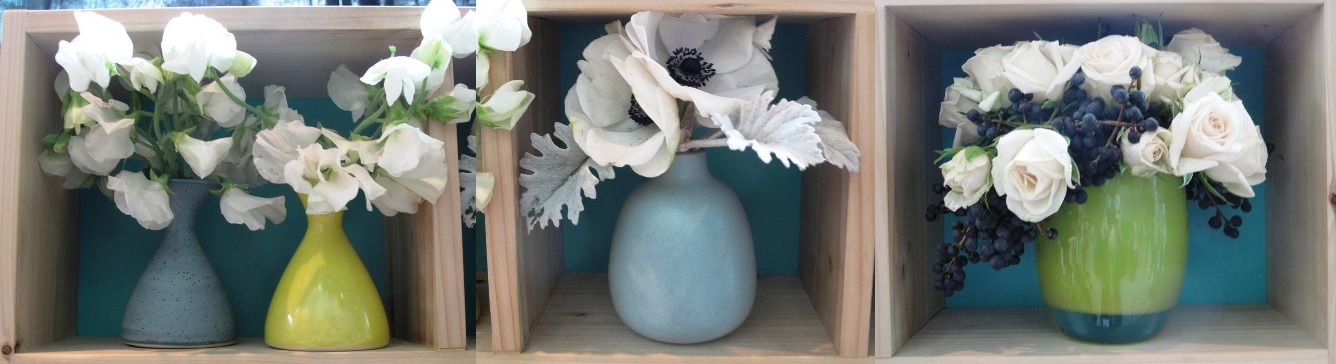
Top Row, from Left:
Little Shirley vases by Material Good / material-good.com (Seattle) with California sweet peas
Aqua bud vase by Heath Ceramics / heathceramics.com (San Francisco) with California anemones and Dusty Miller foliage from my Seattle garden.
‘Imagine’ lime green votive by Glassy Baby / glassybaby.com (Seattle) with California-grown privet berries and cream spray roses (Green Valley Floral)
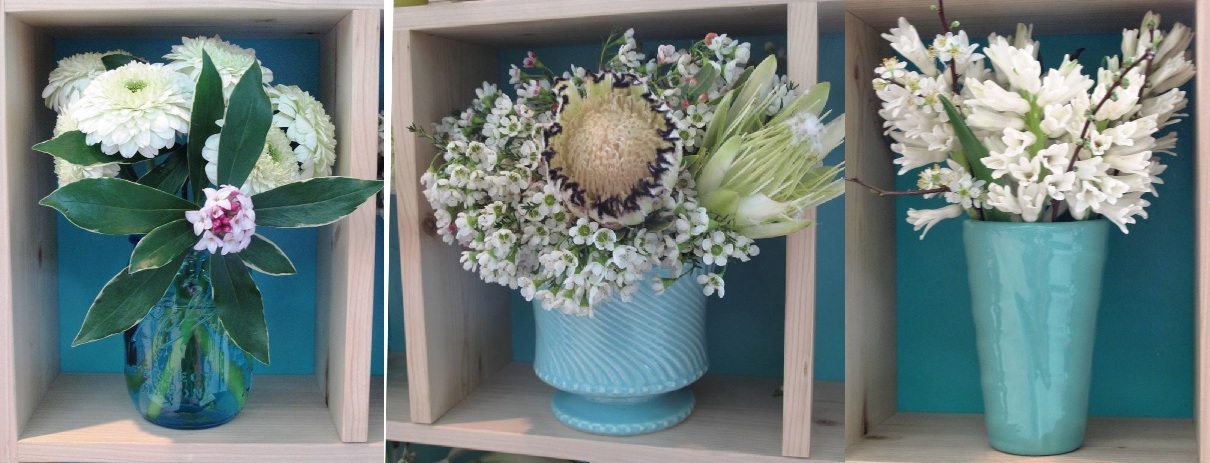
Middle Row, from Left:
Teal glass Ball Jars (USA made) with California grown ‘Gerrondo’ gerberas and Daphne odora foliage from my Seattle garden.
Vintage aqua flower-pot by McCoy Pottery (USA made) with California wax flowers and proteas.
Aqua Madagascar bud vase by Bauer Pottery / bauerpottery.com (Los Angeles) with Washington hyacinths and flowering plum branches
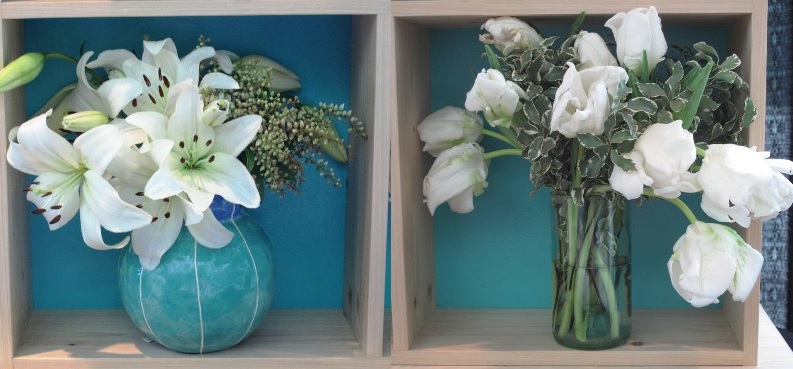
Bottom Row, from Left:
Blue/teal Bubble Vase by Vit Ceramics / vitceramics.com (Seattle) with Asiatic lilies from Oregon Flowers and Pieris japonica from my Seattle garden.
Aqua recycled wine bottle vase by Wine Punts / winepunts.com (Colorado) with California variegated pittosporum foliage and parrot tulips from Alm Hill Gardens in Everson, Washington.
Flower Shadowbox designed by Debra Prinzing of Slowflowers.com and Custom fabricated by Andy Chapman of Stumpdust.com.
Today’s episode invites you to explore one city’s efforts to grow flowers, a tiny parcel at a time.
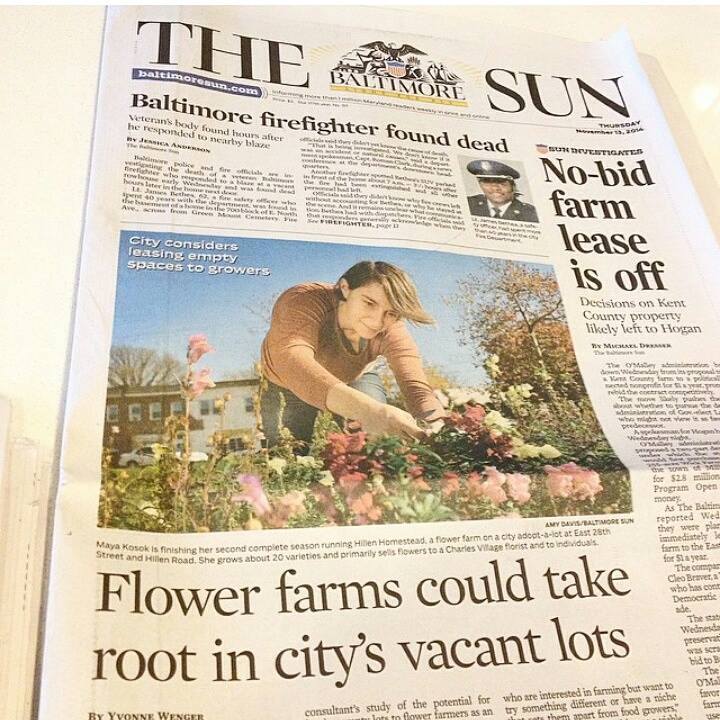
Many of you may have seen links to an article that ran in The Baltimore Sun newspaper last November called “Advocates hope flower farms will take root in Baltimore.”
Past podcast guest Ellen Frost of Local Color Flowerswas quoted in the article as saying “flowers are a good option for people who are interested in farming but want to try something different or have a niche that sets them apart from food growers.”
Cool idea, right?
So when Kristin Dawson reached out to talk with me about the research she was undertaking on behalf of Baltimore mayor Stephanie Rawlings-Blake, I was eager to learn more. Kristin opened my eyes to the fact that there are more than 10,000 vacant lots in the city, which is perhaps more prevalent across the country that you would think.
Kristin formerly worked for the City of Baltimore on vacant property issues (co-authoring a Land Banking plan), as well as food policy/urban agriculture, and other projects.
Her research on behalf of Baltimore had three goals: (a) blight elimination; (b) green jobs and (c) a way to support entrepreneurship in the city. She pointed out: “We’ve learned that cut flowers are one of the most lucrative things to grow.”
After I answered her questions, I turned my microphone to Kristin. I am thrilled to share our conversation with you. UPDATE:Kristin’s research is complete, and now the City’s staff is reviewing the findings and recommendations. The good news is that there will be more flower farming in the future for Baltimore. I’ll share more news as I receive it!
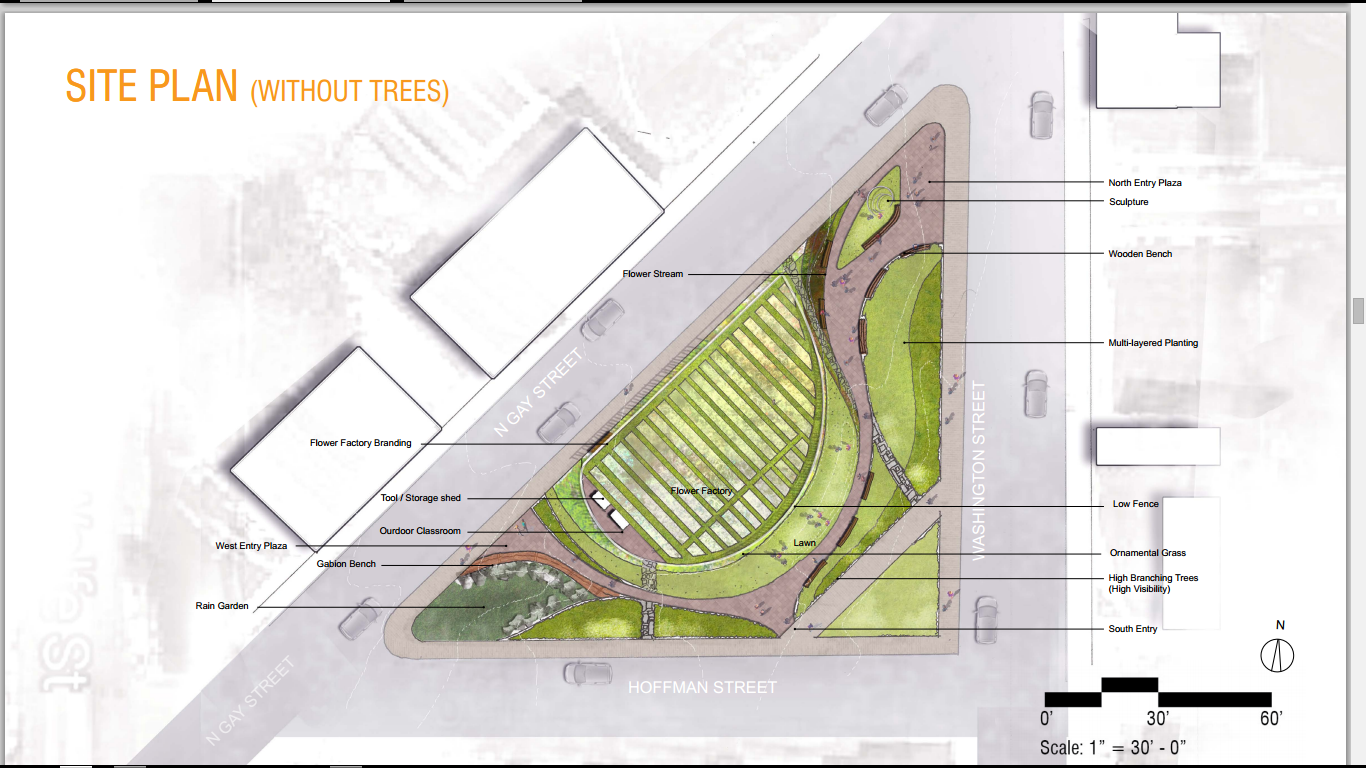
Here’s the award-winning site plan for The Flower Factory.
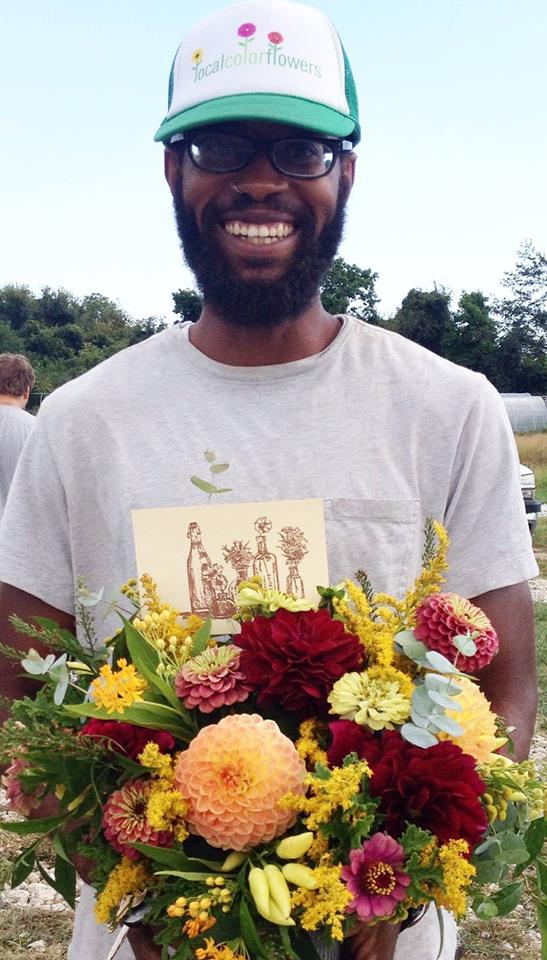
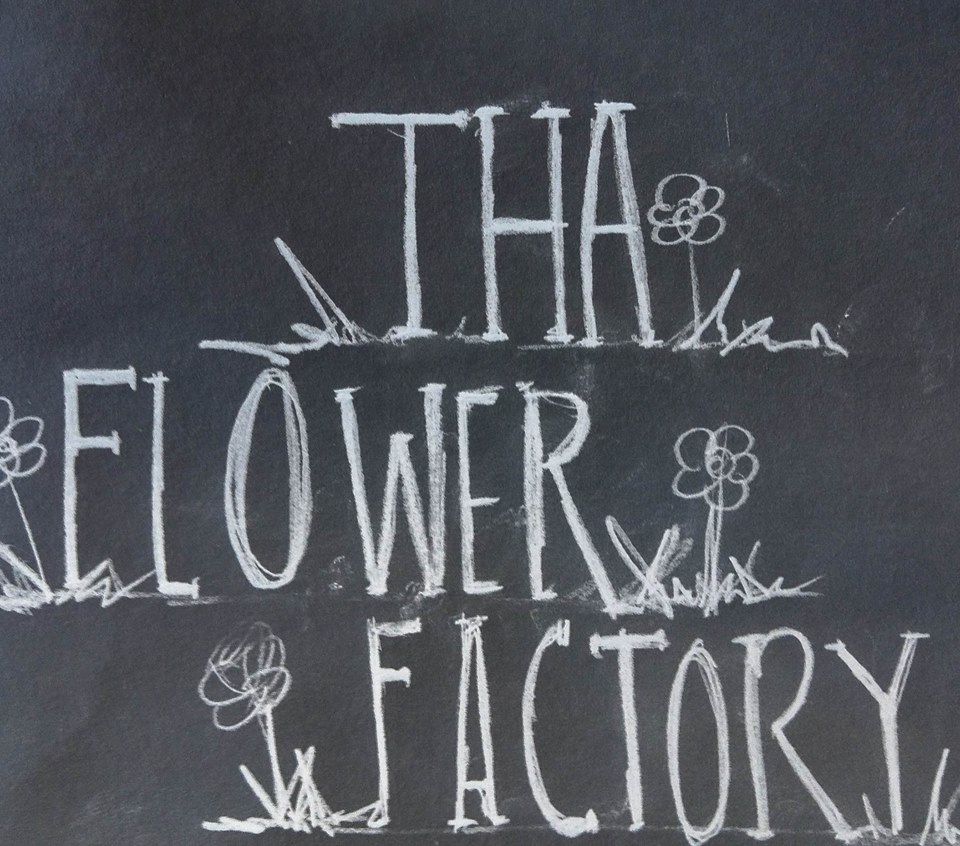
At Kristin’s suggestion, I have a bonus interview to share. She urged me to reach out to Walker Marsh of Tha Flower Factory.
He’s the first flower farmer who will raise cut flowers on a Baltimore-owned parcel land this year, facilitated by winning the Growing Green Design Competition. Walker’s background is as a field manager for Baltimore’s Real Food Farm.
In The Baltimore Sun article, he describes how he got involved with flower farming: “It is deeper than flowers for me. Once I was into it, I found I could calm myself. You have to have patience and be gentle, all the things that come with farming and gardening.”
Such truth! I know you’ll enjoy hearing his story and meeting this engaging new face of flower farming in the U.S.
If you have any doubt about the rising excitement for growing domestic flowers, I sure hope that you’re as encouraged as I am by today’s guests.
We’ll have more stories about what’s happening on the Urban, Suburban and Rural landscape for American grown flowers in the coming months. Please send me your suggestions for future episodes.
ANNOUNCEMENTS
There are so many worthy crowd-funding projects going on right now and I urge you to check them out. This week I want to highlight two:
First, BLOOMTOWN.TV is a new reality web series about the mud, sweat and tears of the U.S. horticulture industry. The show’s creators, Eric Light and Stephanie Winslow, are based in St. Louis, Missouri, and have close ties to the floral and horticultural worlds there.
“Not only is there an abundance of rich, entertaining content, but we firmly believe that Bloomtown will encourage more people to buy plants and flowers, which means better sales across the industry!,” they say.
Bloomtown is in the midst of an ambitious Kickstarter campaign that runs through February 28th so there’s still time to check it out and contribute. And whether you can contribute or not, you’ll want to watch Bloomtown.tv’s fun trailer.
Slowflowers.com members Miranda Duschack and “Mimo” Davis of Urban Buds: City Grown Flowers are featured in the clip and the flowers grown by Slowflowers.com members Steve and Cheryl DuBois of Mossy Creek Farm appear, as Steve puts it: “in non speaking parts of the trailer.” Love the energy of this creative endeavor – so please check it out.
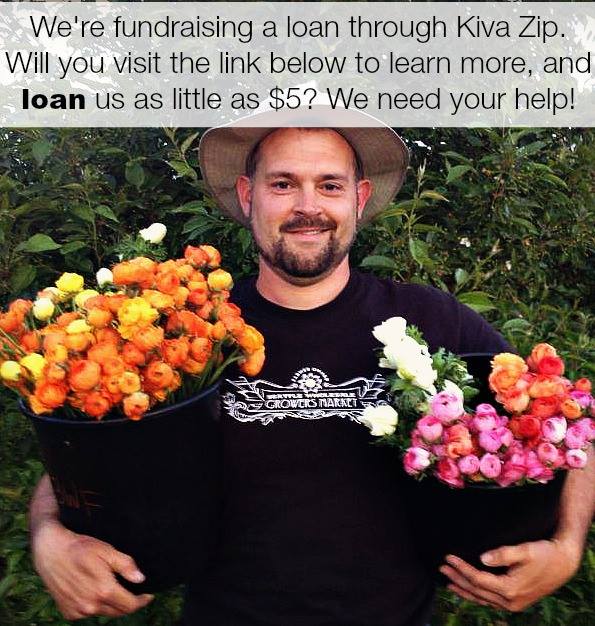
Next, not so long ago I featured Sid Anna Sherwood of Annie’s Flower Farm in Sequim, Washington, who had applied for a KIVA loan to purchase the assets of a farm she had been leasing.
Prior to interviewing her, I had not know about KIVA, an innovative “crowd-lending” program. All the funds donated are paid back by the recipient.
Yay! Triple Wren Farms hit the goal of $4,800 funding to expand their flower farm.
Other friends of Slowflowers.com, and past guests of this podcast, Steve and Sarah Pabody of Triple Wren Farms in the Bellingham, Washington, area, recently applied for a KIVA loan to help get their small flower farm to the next level this coming season.
They’ve raised three-quarters of their $4800 goal with more than a month to go – so it’s easy to help get Triple Wren to their ultimate loan amount, with a long as small as $5.
NOTE: Between the time this episode was recorded and its broadcast on February 11th, Triple Wren Farms achieved 100% funding of its KIVA loan! Whooo Hoo! Congrats Steve and Sarah!
Oh, and one follow-up. Several weeks ago we heard from Jonathan Webber who with his partner Jimmy Lohr own Pittsburgh’s greenSinner, an urban flower farm and floral design studio.
I asked Jonathan to share details of green Sinner’s Indiegogo campaign for infrastructure funds needed to prepare new land they had just purchased in the city limits of Pittsburgh.
And I guess I’m going to get on my soapbox right now. You see, greenSinner didn’t meet their original goal of $10k, but they’re more than happy that the funds that were pledged, nearly one half of that goal, will support their project.
However, if they had launched that campaign on Kickstarter and missed the ultimate goal by even $1, they would not have access to any of those funds.
If you’re considering a crowdfunding campaign for your own floral project, please choose Indiegogo. I’m a huge fan of this platform for reasons too numerous to list here. Contact me offline if you wish to discuss further. And congratulations Jimmy and Jonathan! I know you didn’t reach your goal, but I also know how incredibly resourceful you will be with the funds you did raise! Now go get those seeds in the ground!
Thank you for downloading and listening to the Slow Flowers Podcast!
Each week I share with you our “download” count and we have hit 34,000 downloads to date. I’m encouraged to know more people are learning about the farmers and florists who keeping American-grown flowers flourishing.
As we approach Valentine’s Day, I urge you to Show your Love with a gesture of Local flowers. We have such a great community and people really seem to want each other to succeed. I take encouragement from the stories I hear – and from the stories I’m able to share with you.
It’s been a busy week as we watched January transition into February.
A few days of unseasonably warm 50-degree temperatures combined with plenty of rainfall has jolted awake many of the bulbs in my garden and in my Seattle neighborhood.
I have been eyeing a beautiful shrub in my neighbor Kim’s garden that I pass by each day, realizing the rare moment each year when its inherent beauty peaks.
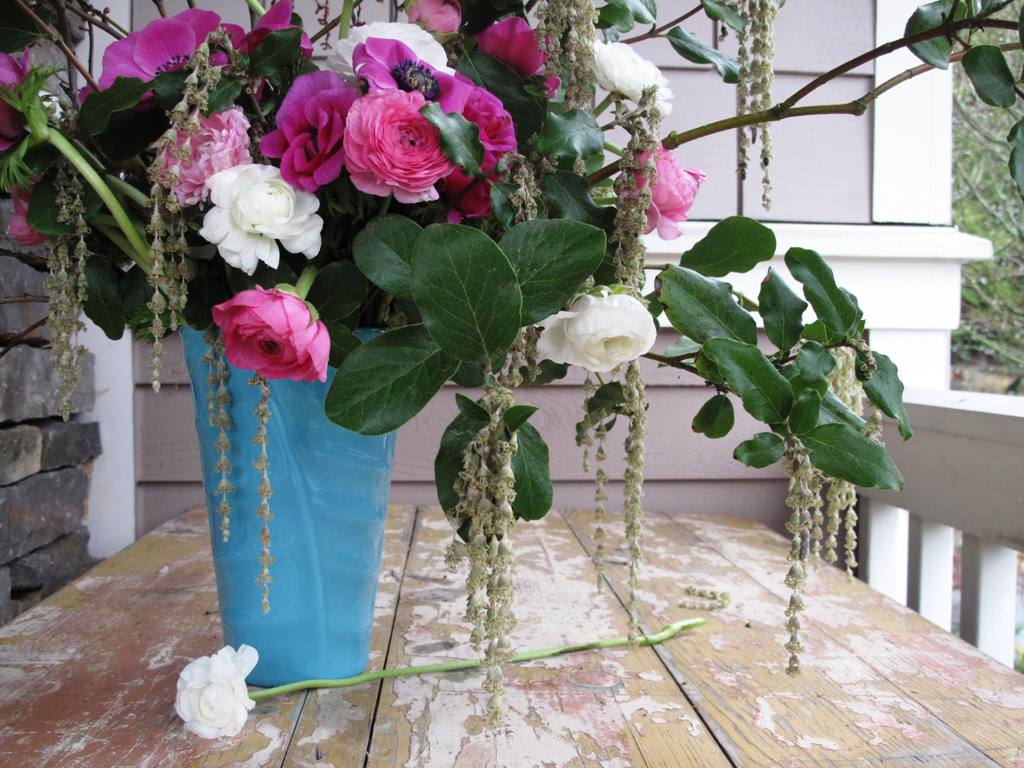
In the photo above, you can’t miss the lovely “dangles” of what is commonly called the silktassel tree (Garrya elliptica), a coastal NW native shrub with silvery flower chains that appear in winter. I wasn’t sure how it would perform as a cut flower, but here we are, three days after I snipped some of Kim’s branches, and boy does it hold up. Gorgeous and so evocative, right?
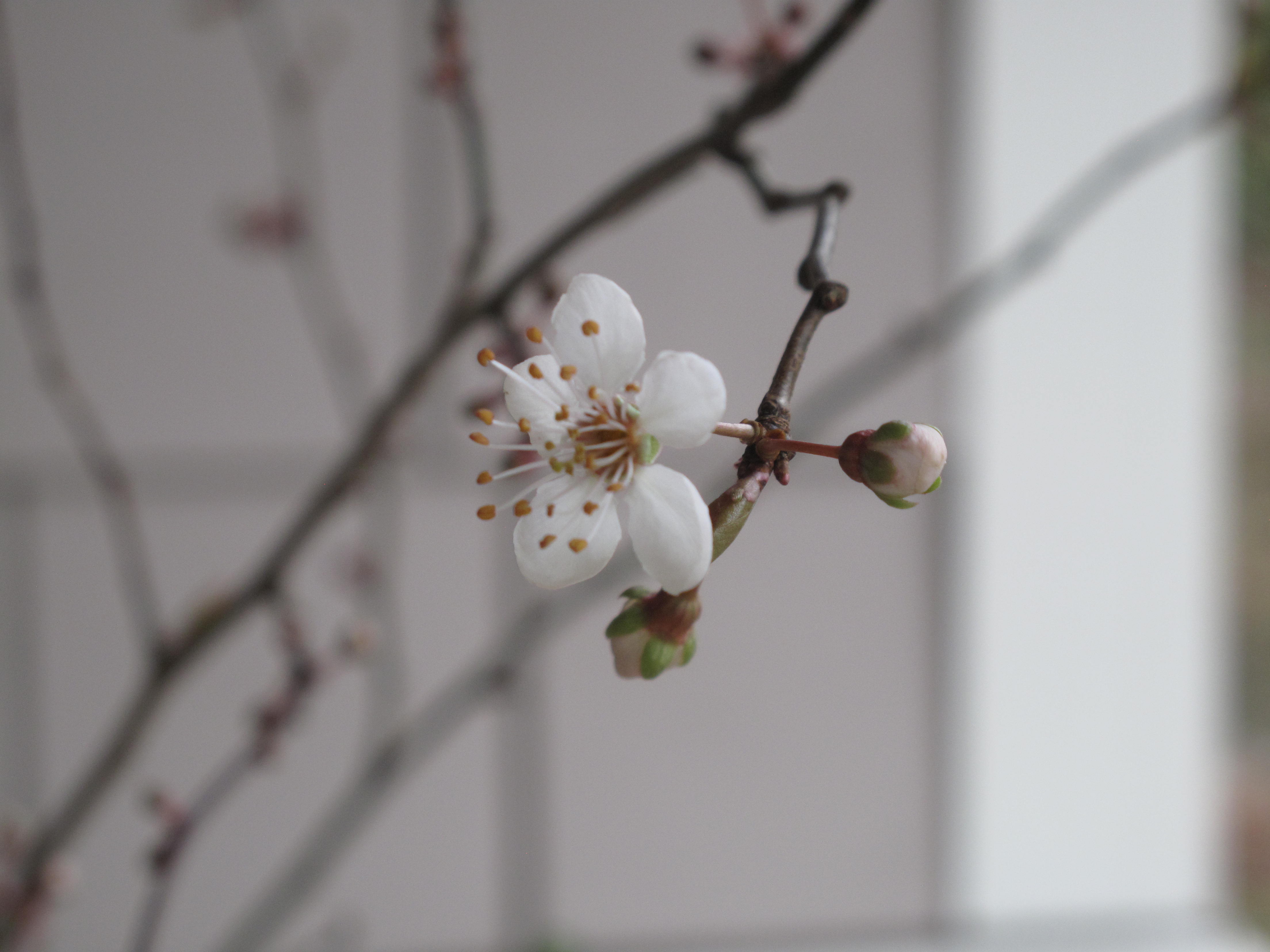
Flowering plum blossom (Prunus sp.)
For Week 5 of 2015, I combined branches of the purloined-with-permission silktassel tree with the just-about-to-flower plum branches. Then I added some of the California-grown flowers brought in by my favorite go-to flower outlet, the Seattle Wholesale Growers Market.
If you spent any time reading the Slow Flowers book, you’ll already know that I regularly turned to the flower farmers involved in this innovative cooperative to procure ingredients for my bouquets and arrangements, month after month.
In the Pacific Northwest, as in so many of the areas where members of the Slow Flowers Tribe live, winter is our quiet season.
Our gardens are relatively (or seriously!) dormant. I have to ration what is in bloom in order to have weekly diversity for my own Challenge designs.
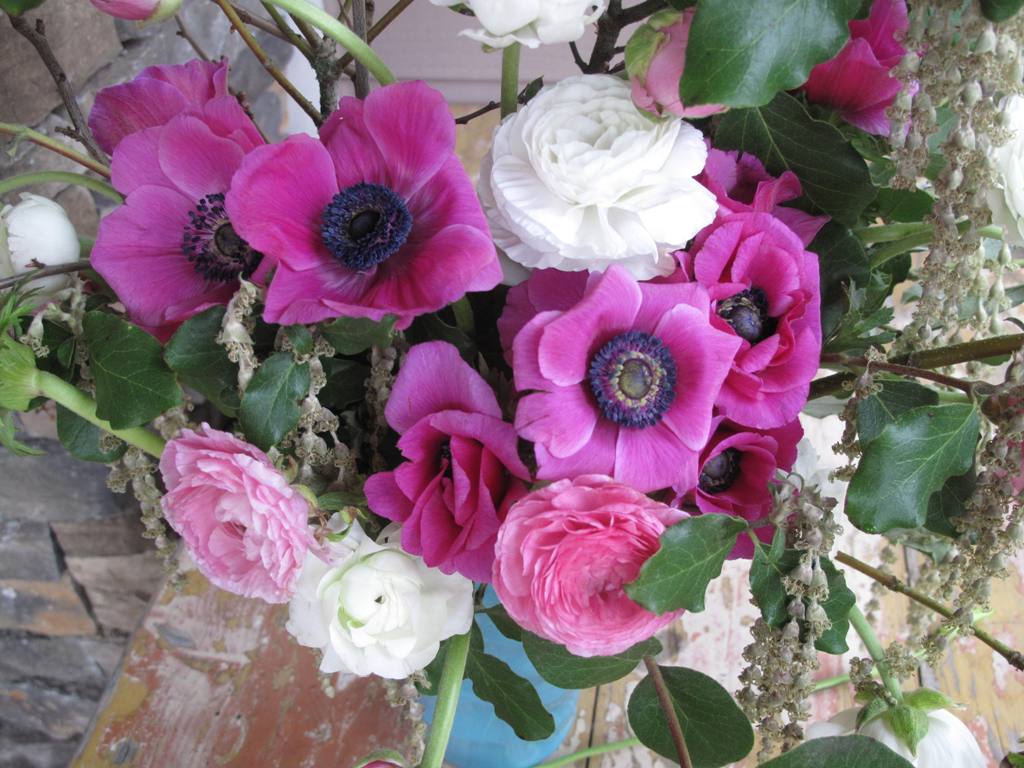
Gorgeous anemones with dark centers. Lush ranunculus in romantic shades.
So this week, please enjoy the beautiful fuchsia-petaled anemones from California, along with pale pink and creamy white ranunculus, also from California.
Molly Sadowsky of the SWGMC orders in California florals in a very thoughtful and conscious way. She endeavors to work with farms that use sustainable or Veriflora practices.
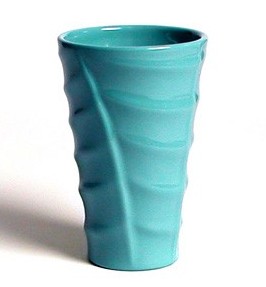
Oh, and are you wondering about this beautiful aqua-glazed vase that holds my bouquet? It is – of course – American made!
The Madagascar vase, made in California by Bauer Pottery.
Called the Madagascar vase, it comes from Bauer Pottery California, and you can read more about how Janek Boniecki saved the vintage molds for this early and iconic California ceramics factory here.
I love this vase shape so much, I used it in a photo shoot a few years ago for Better Homes & Gardens.
It was our holiday centerpiece story featuring nature-inspired cuttings from various regions around the country. I used all those yummy proteas, banksias, eucalyptus, leucodendron and leucospermum. Thought you’d enjoy seeing how appropriate these Australian natives look with the Cali vase. Here’s what I wrote:
California Cool
The turquoise glaze of a made-in-California Bauer Pottery vase enhances a blue-green and yellow bouquet. The floral ingredients, all native to Australia and South African but grown in California, are thoroughly adapted to Southwest gardens and bloom from October through May. Seeded eucalyptus and velvety sprays of silver tree (Leucadendron argenteum) serve as foliage, while the arrangement’s drama comes from Banksia and pincushion flowers (Leucospermum sp.).
Here are a few designs that others have created recently – they are so inspiring!
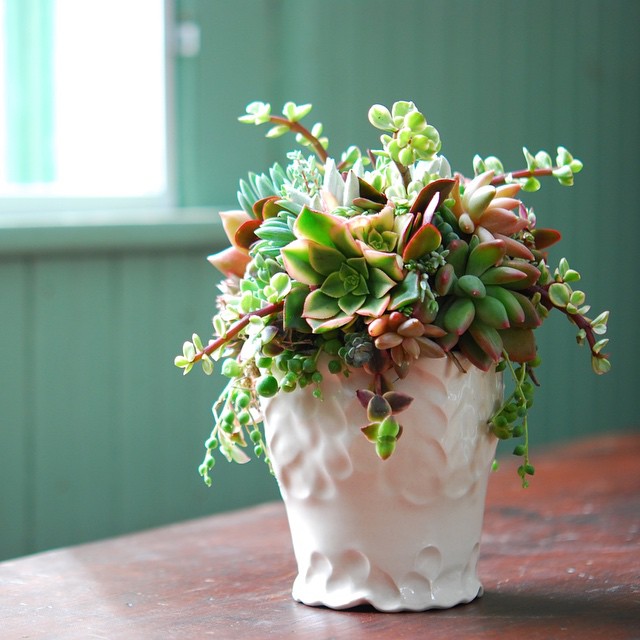
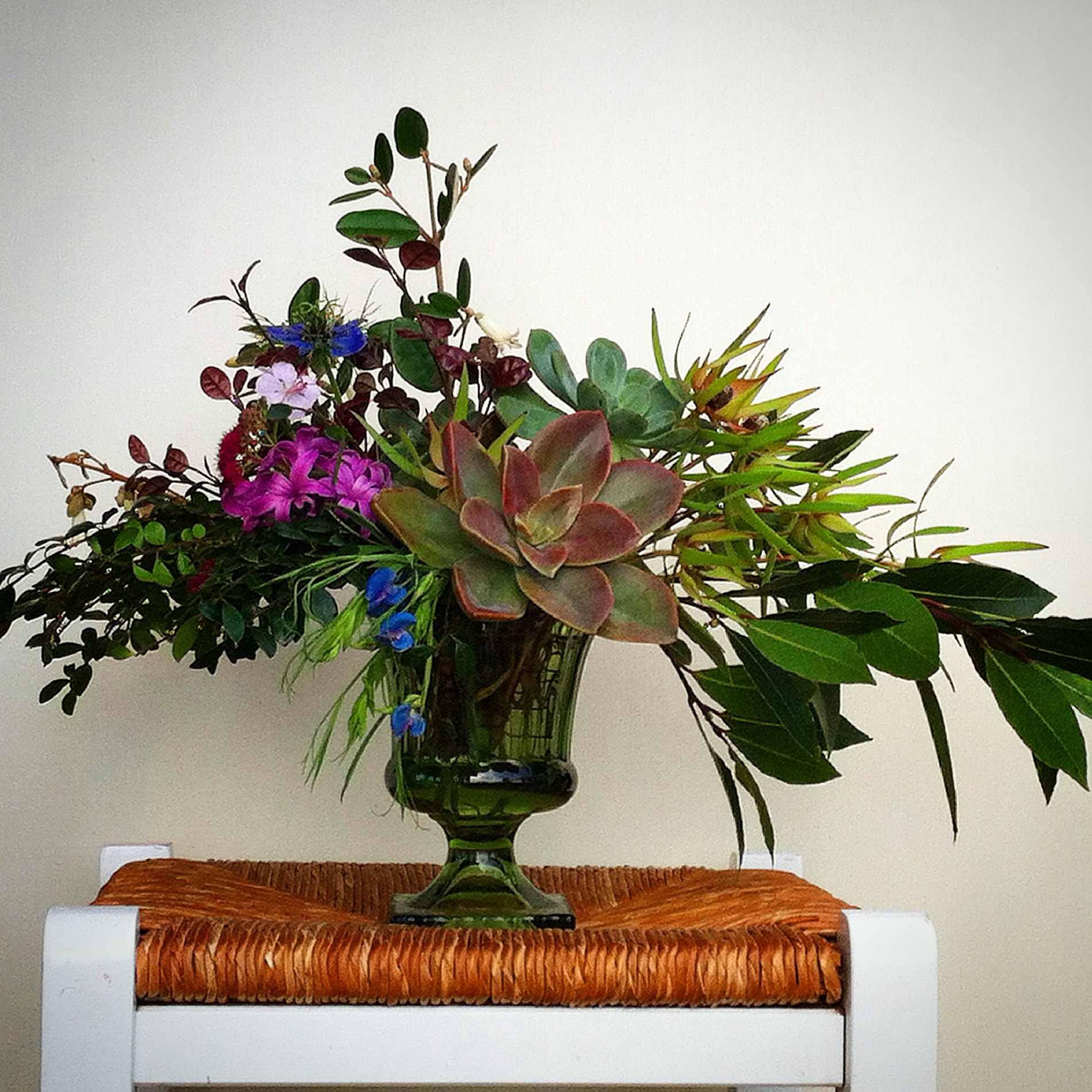
Winter Slow Flowers Challenge from Katherine Tracey of Avant Gardens: a Succulent Cutting Arrangement.
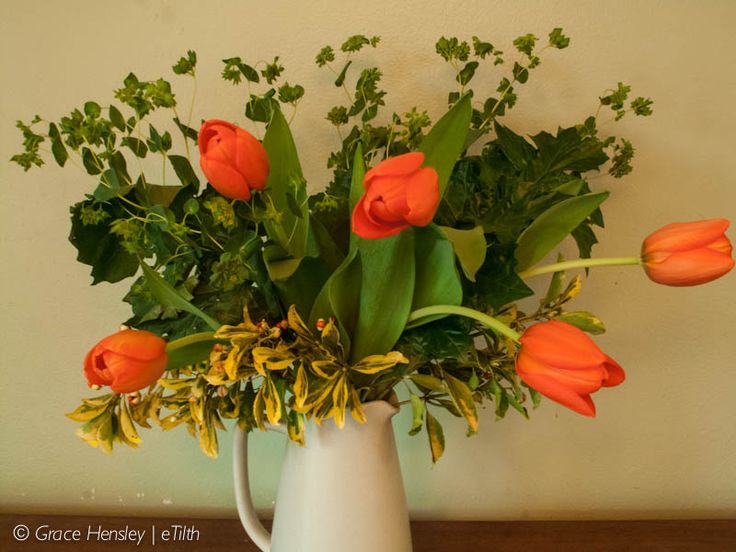
From Grace Hensley of eTilth, local tulips, euonymous and acanthus foliage (plus some bupleurum).
TIP: Design 101
Jewel Tones for springtime.
Color wheel lesson: The flowers and vase combination illustrate an analogous color palette. Analogous colors are adjacent to one another on the color wheel. Fuchsia, purple and indigo are pleasing when viewed together because they each share varying quantities of the primary color blue.
White floral accents offset the black centers of the anemones, adding a graphic punch to this composition.
This arrangement, from later in the spring (April), features:
Stephanie Hughes and Anna Campbell of The FloraCultural Society in Oakland, CA.
Today I am delighted to introduce the women behind an innovative flower farm/floral design business in Oakland, California called The FloraCultural Society.
Anna Campbell, who owns the venture with her mother Linda Davis, has an extensive career in horticulture, agriculture, floral design, editorial and retail.
She freely admits during our conversation how no matter what she pursued professionally, flowers have continued to draw her like a bee to nectar. Many of you will understand this “flower fever,” which makes Anna’s story so compelling.
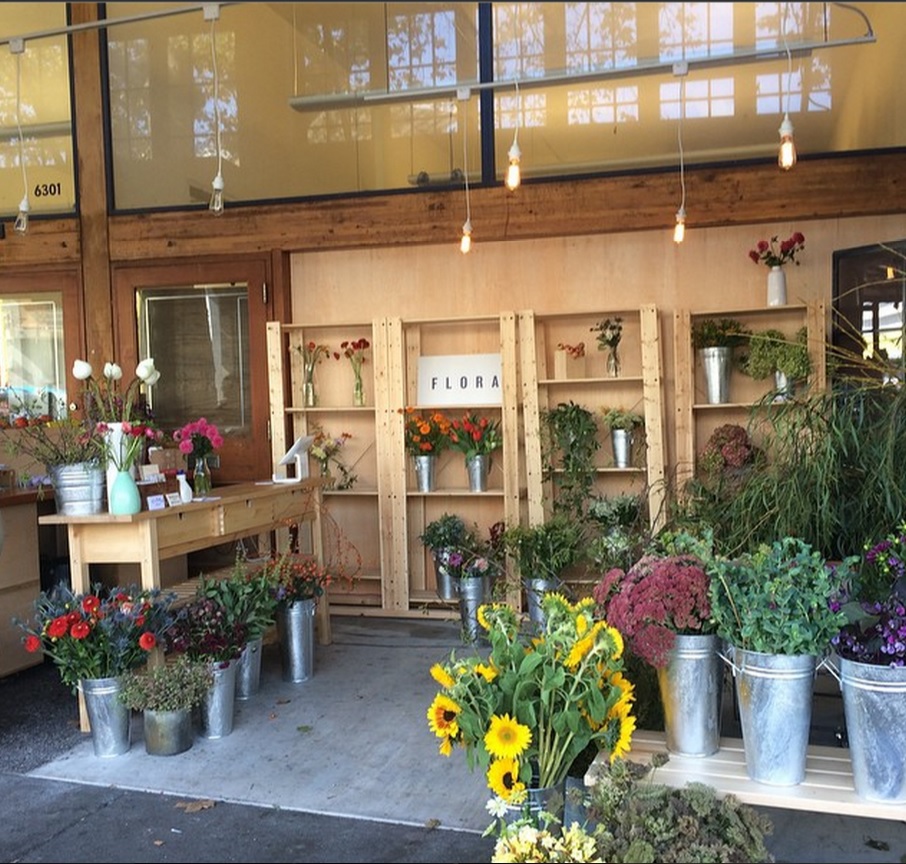
After previous forays into floral retail, Anna developed and launched the current format for The FloraCultural Society — part micro urban flower farm / part flower shop and studio space. She describes the business as “a cut flower farm and retail shop providing plant-based goods, classes and events.”
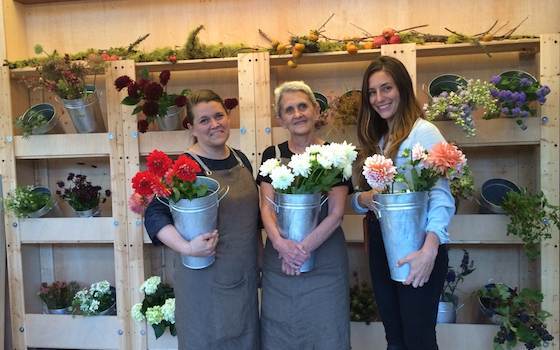
Anna, Linda and Stephanie in the new retail shop on College Ave. in Oakland’s Rockridge Neighborhood.
Anna connected with Stephanie Hughes through the local flower farming community in the Bay Area and last year Stephanie joined The FloraCultural Society as Director of Flora and Farm Operations.
I’m so pleased that Stephanie’s voice is included in the interview because she’s the one who introduced Anna and me last October, when I was invited to visit the new FloraCultural Society shop in downtown Oakland’s Rockridge neighborhood on College Ave., a stone’s throw from Berkeley.
Stephanie and I originally met last May when we were both part of a bearded iris design workshop taught by Sarah Ryhanen and Nicolette Owen of The Little Flower School.
At the time, Stephanie was still shadowing and apprenticing with flower farmers and floral designers, hoping to find a new career in the Bay Area after escaping from a corporate retail job. And now, she’s working closely with Anna to bring locally-grown flowers to their community!
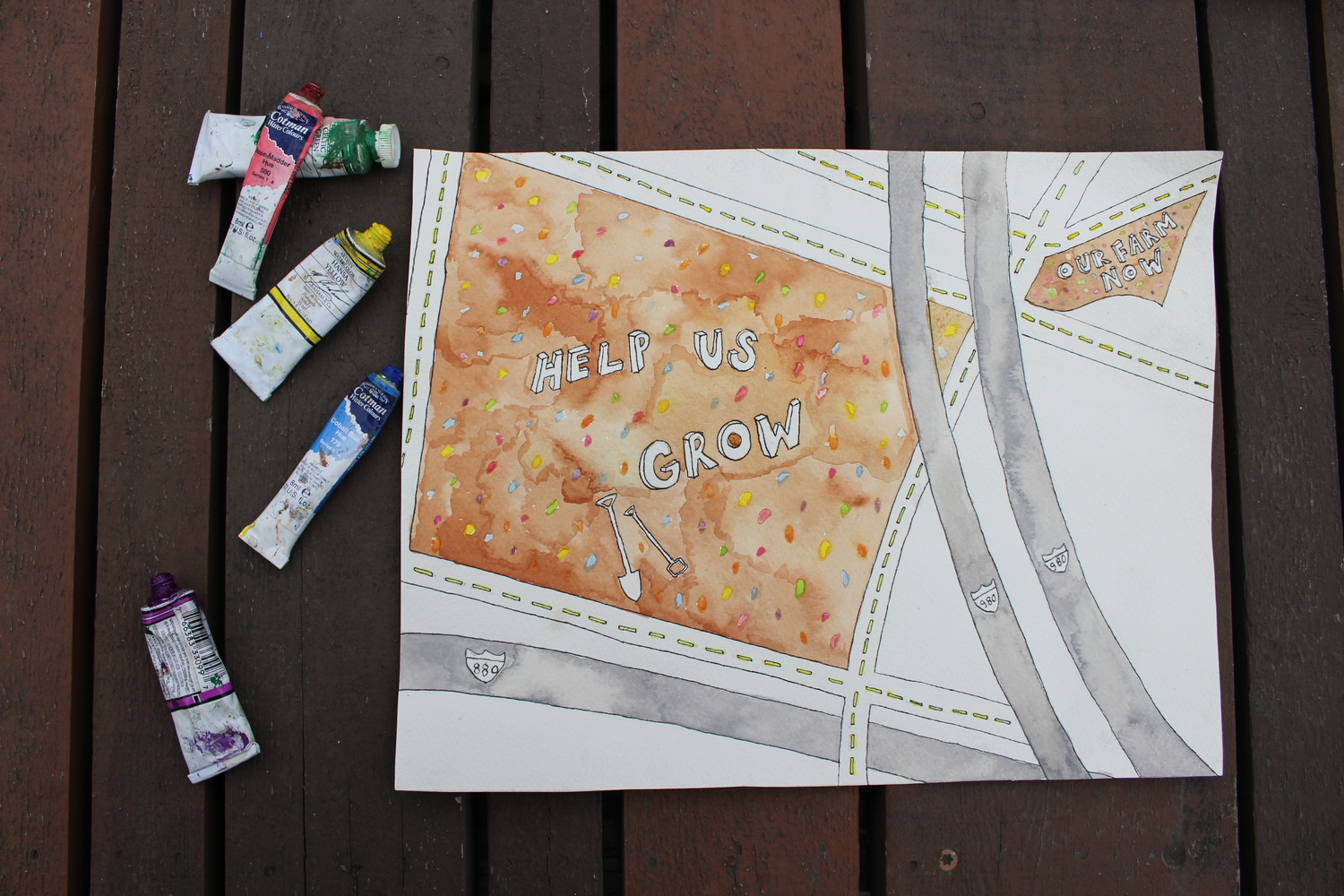
Here’s the artwork for The FloraCultural Society’s upcoming Kickstarter Campaign, a watercolor that depicts the parcel of land they plan to farm that’s super close to a freeway overpass.
I know you’ll enjoy the conversation, so click on the PLAY BUTTON above to listen or download this episode. And I do want to encourage you to check out the new Kickstarter Campaign that Anna and Stephanie and their team will launch on February 7th.
The campaign seeks to raise funds to so the new 2-acre flower farm is off to a good start. If you’re in the neighborhood, stop by between 11 and 3 for light refreshments, sneak previews of the campaign’s rewards and view a screening of the new “Help us Grow” video.
A peek inside the new flower shop in Oakland.
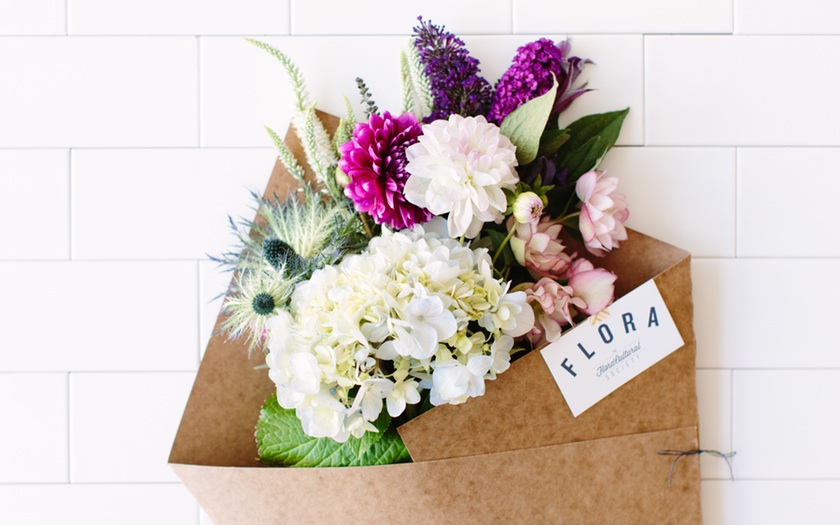
A bouquet called “Flowers to Dye For,” which includes flowers and floral dye. After you purchase the $95 bouquet, you are invited to return to The FloraCultural Society to participate in a post-Valentine’s Day workshop with Sasha Duerr, author of “The Handbook of Natural Plant Dyes.
A medium sized bouquet of beautiful floral cuttings in the signature quiver. Twenty percent of the proceeds of this bouquet purchase go towards seed, soil, and supplies for the petite urban farm.
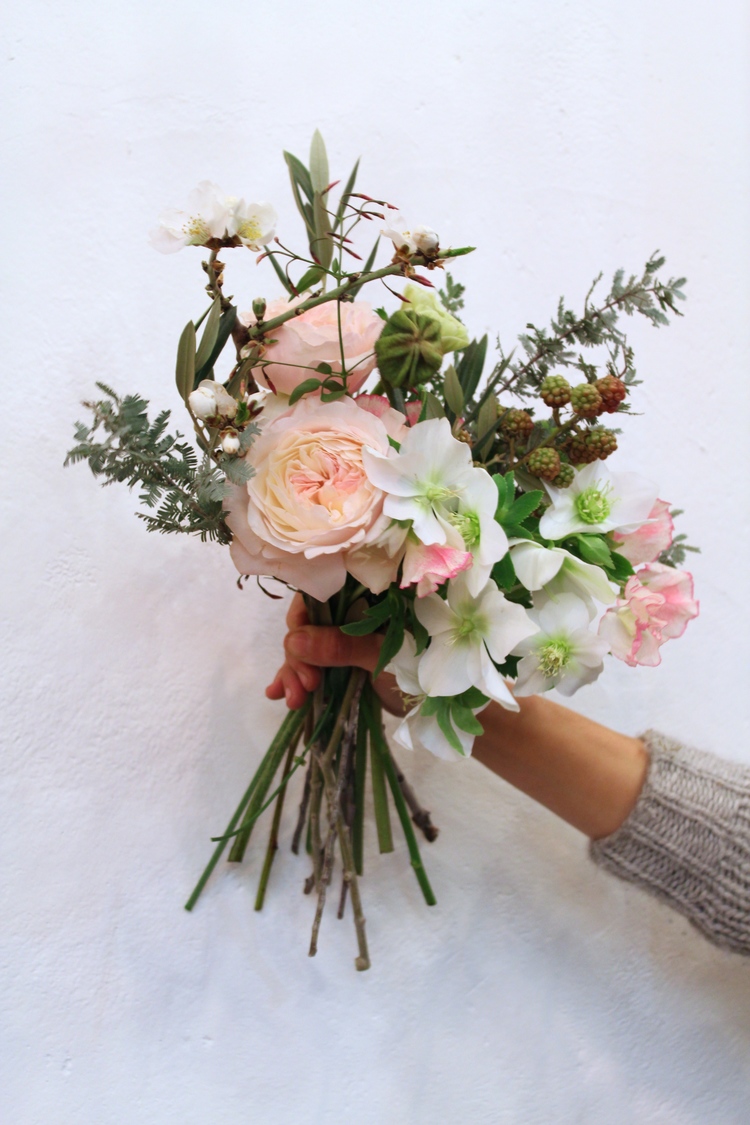
For a brief engagement this Valentine’s Day – A medium sized bouquet of blush garden roses and beautiful, fragrant winter blooms in our signature quiver.
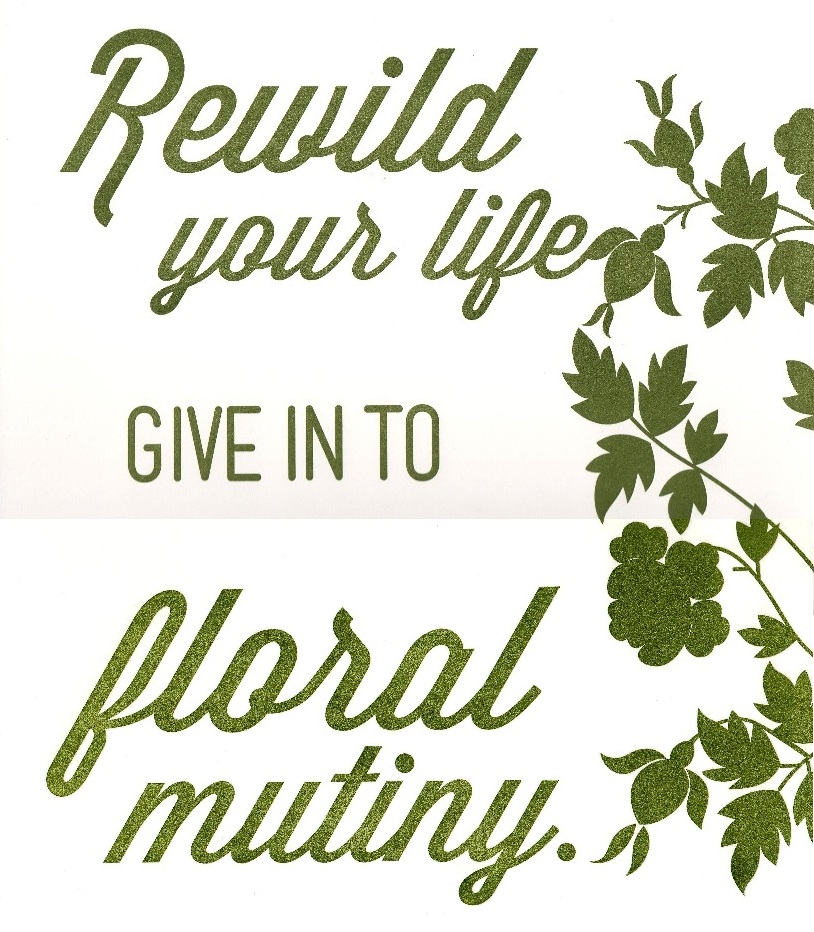
As I mentioned in the talk, Anna wowed me with a gift of a letterpress print that she commissioned for the opening of the new shop on College Avenue. It reads “Rewild Your Life . . . Give in to Floral Mutiny.”
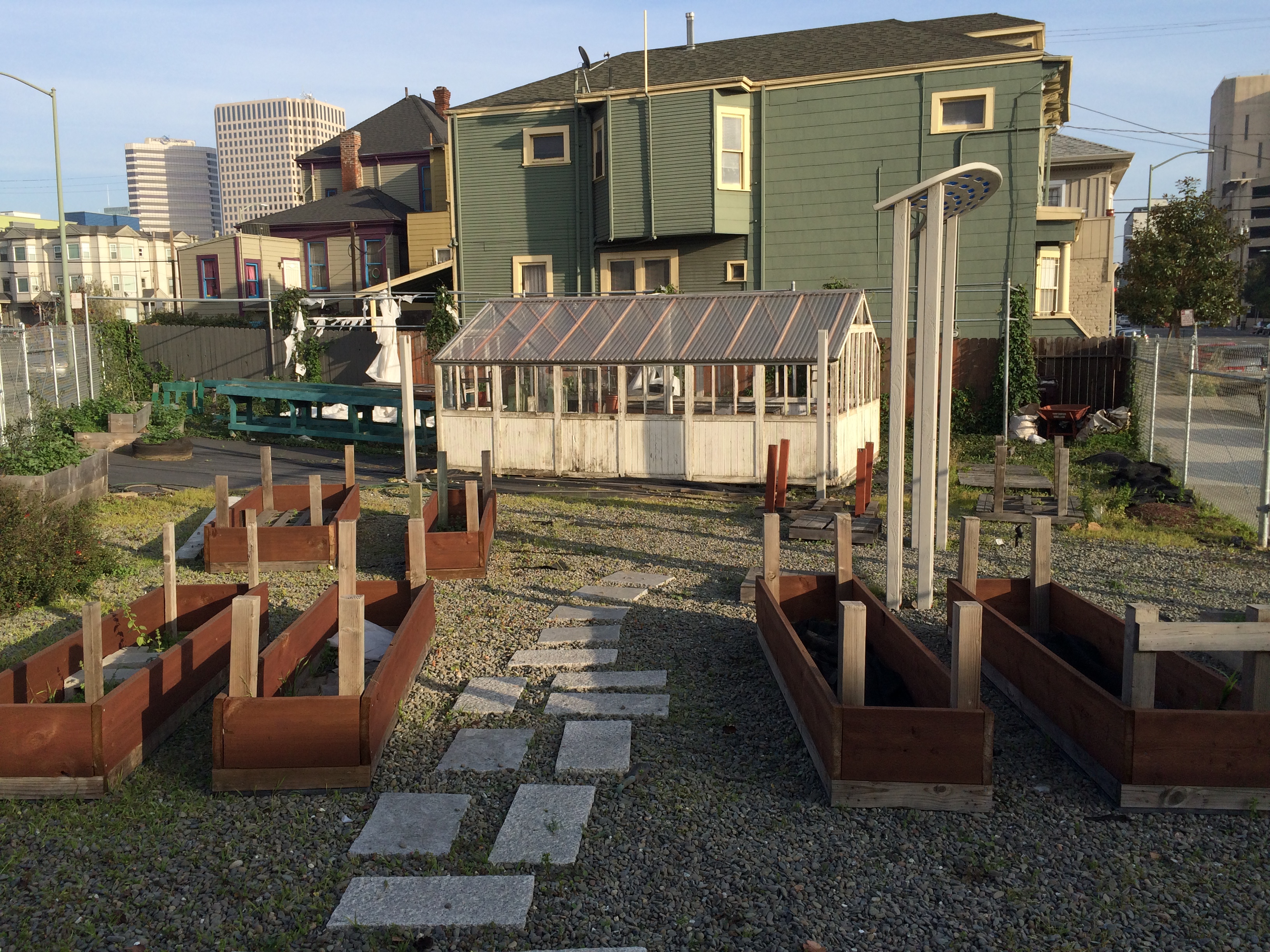
The mini flower farm, located in Oakland on less than 2,500 square feet. It’s ready to be joined by a new 2-acre parcel nearby.
Here’s a little more about the company, from The FloraCultural Society’s web site:
The FloraCultural Society was established in hopes of uniting a network of people interested in the beauty of sustainably grown flowers and plant-based goods. In 2012, we dug into a 2,600 foot plot of land in Old Oakland and began to grow heirloom varieties in the midst of the city. The contrast between the wild organic flowers and the industrialized structure of the city inspired the FloraCultural Society’s tagline… ReWild Your Life.
We are now sourcing from local farms in the Bay Area and have plans of expanding our own farm to 2 acres, giving us the ability to provide you with distinct, heirloom varieties.
In joining our society, it is our hope that you may become connected with your wild side, simplifying the way you indulge. We invite you to take a class with us, Join our CSF (our Community Supported Flowers), try out our plant based skin care lines, and rewild your home with a locally grown arrangement.
The idea of ReWilding is a lovely sentiment that we can all embrace!
ANNOUNCEMENTS:
If you want to get started in or further your knowledge of specialty cut flower farming, or if you’re a designer who wants to strengthen your connections with local flowers, I want to share details of two opportunities coming up. The Association of Specialty Cut Flower Growersis hosting two regional Growers’ Intensives in March.
On March 2nd and 3rd, in Athens, Georgia, attendees will meet and learn from experienced flower farmers including Rita Anders from Cuts of Color in Weimar, Texas whose topic is: “From Seed to Market: A Few of My Most Profitable Flowers.”
Arrive early and attend the informal meet-and-greet on Sunday evening March 1st, hosted by Tanis Clifton of Happy Trails Flower Farm in Dennis, Mississippi, and Mimo Davis of Urban Budsin St. Louis, Missouri.
You’ll also get a chance to visit Three Porch Farm, owned by Steve and Mandy O’Shea in Comer, Georgia, and participate in a bouquet-making session co-led by Mandy (known for her beautiful Moonflower design studio) and Jennie Love of Love ‘n’ Fresh Flowers in Philadelphia — both of whom have been featured in the New York Times. And not to miss, also at Three Porch, a demonstration of veggie oil-powered vehicles and other equipment.
There are a few upcoming deadlines to take note of, including the Georgia hotel room block and the San Jose bus tour of local flower farms, both of which expires this Friday, February 6th, so register soon.
Thanks for joining me today. My personal goal is to put more American grown flowers on the table, one vase at a time.
Increasingly, there are passionate people like you who are joining the Slow Flowers movement, the Floral Mutiny as Anna Campbell calls it. You are downloading and listening to the Slow Flowers Podcast more than ever before!
We have exceeded 33,000 downloads to date and every time that figure climbs, I’m encouraged to know more people are learning about the farmers and florists who keeping American-grown flowers flourishing.
I don’t know exactly how to credit our growth, but get this: The Slow Flowers Podcast ended the month of January with more than 4,000 downloads, nearly 1500 individual downloads more than any month prior.
There’s something very good going. More people are entering the flower farming profession in the U.S.; more florists are seeking fresh, seasonal and sustainable sources of American grown flowers with which to create their beautiful designs; and more flower lovers are asking: “where are my flowers grown” and expect transparent labeling of those blooms. Origin does matter when it comes to your flowers.
So I thank you!!! If you like what you hear, please consider logging onto Itunes and posting a listener review.
The Slow Flowers Podcast is engineered and edited by Andrew Wheatley and Hannah Holtgeerts.
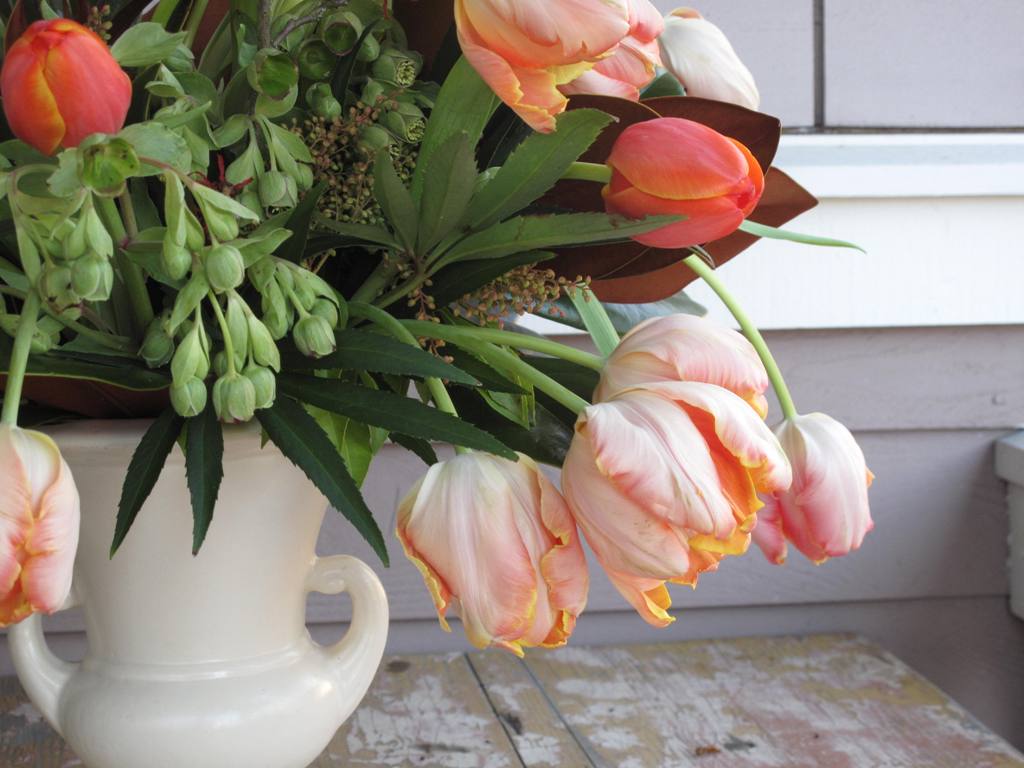
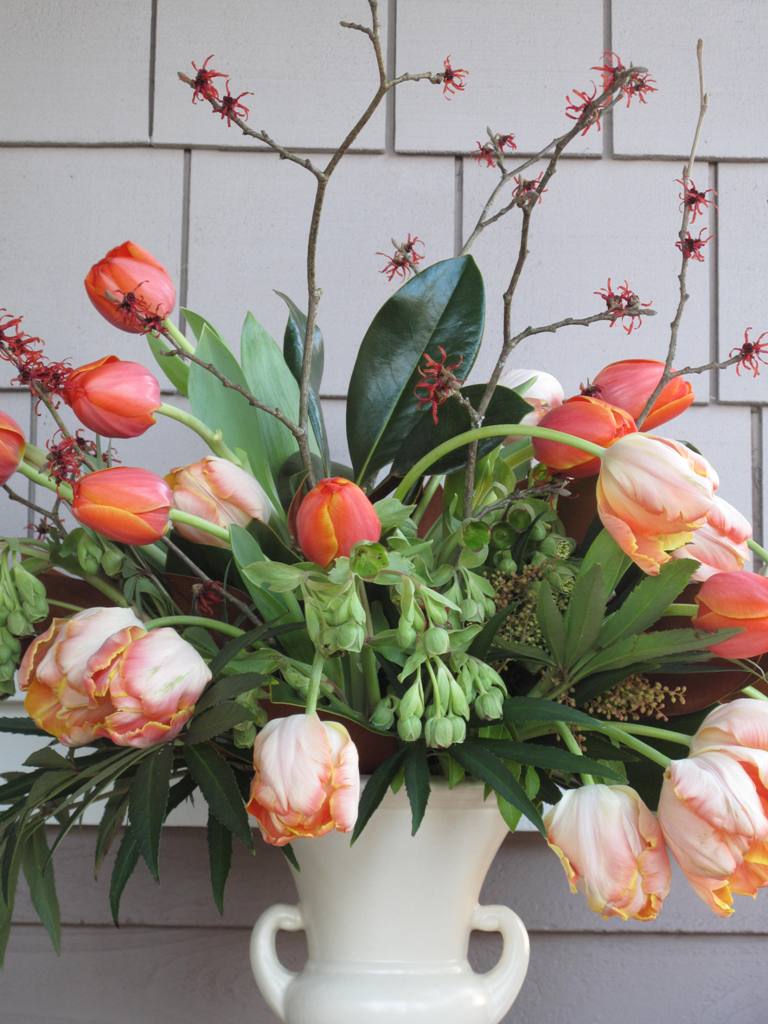
Created on Jan. 30th, Seattle, Washington. I clipped all the botanical elements from my garden and used beautiful tulips from Alm Hill Gardens (Pike Place Market vendor of WA-grown tulips)
The year is off to a great start, and I thank you for joining me in this celebration of locally-grown flowers, from our gardens, meadows and farms. Seattleites are of course wrapped up in Super Bowl preparations, but I’ve been anticipating the return of homegrown tulips from Alm Hill Gardens, an organic food and flower farm in Everson, Washington, just two miles from the Washington-British Columbia border.
Owned by Gretchen Hoyt and Ben Craft, Alm Hill is known for raising luscious cut tulips. At Seattle’s Pike Place Market, the sign in their stall reads, “Alm Hill Gardens: A Small Sustainable Family Farm Since 1974.”
I greeted flower-seller Max Clement, who I’m always happy to see, and selected 20 apricot-hued and melon-orange tulip for $20. He wrapped them up in white paper and sent me off to play with the floral gifts that my own backyard offered as companion elements to the first tulips of 2015.
Here’s what I arranged yesterday:
My vintage cream McCoy vase is filled with magnolia foliage, pieris, hellebore flowers and foliage, witch hazel and local tulips.
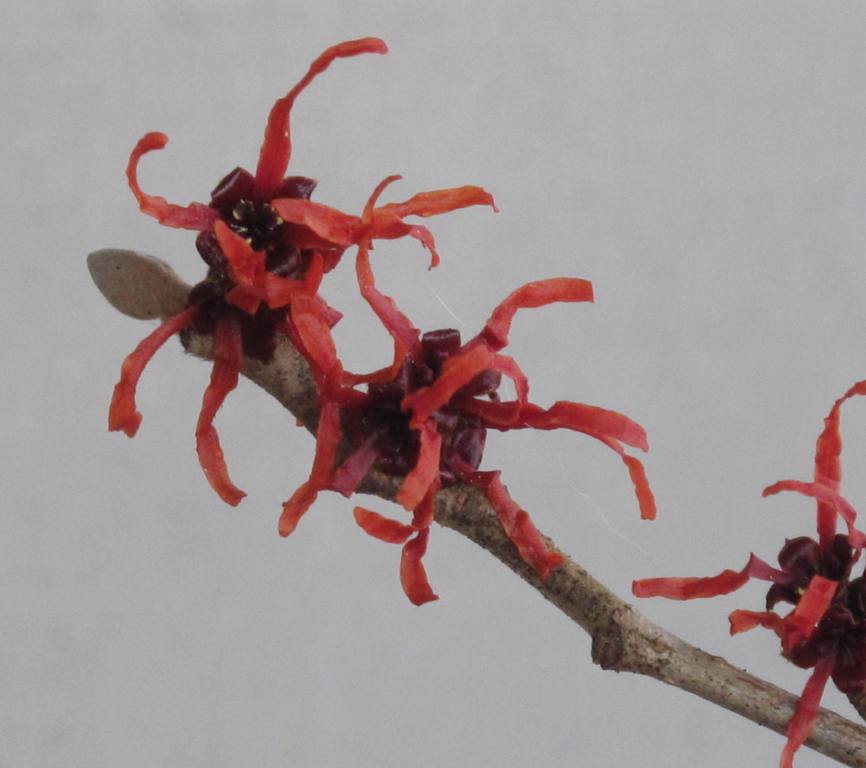
Witch hazel (Hamamelis x intermedia ‘Jelena’). This otherworldly flower excites the winter garden – and one must cut judiciously to preserve the shrub’s beauty in the landscape. I used 5 stems with copper-orange flowers for my arrangement.
TIP: Magnolia grandiflora foliage
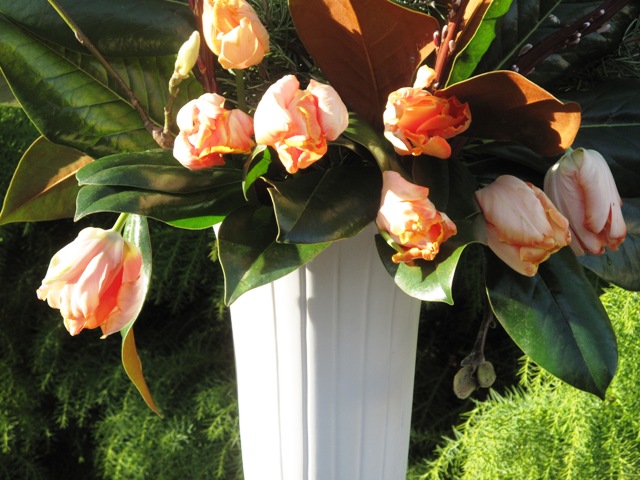
Magnolia foliage with spring tulips
The arrangement I created above took its inspiration from a winter bouquet that I included in my book Slow Flowers: Four Seasons of Locally Grown Flowers.
With this design, I raved about the fact that my neighbors Kim and Jake have a stunning Magnolia grandiflora that I view from my sitting room.
They are always so generous to allow me to walk across our shared driveway and clip a few glossy evergreen stems for my arrangements. The leaves measure up to 9 inches and the underside of each is slightly fuzzy and rusty-brown, which looks especially enticing with orange and apricot companion flowers like early spring tulips.
Anyone who thinks the winter garden is limited need only to consider broadleaf evergreen shrubs and trees – they are long-lasting and reflect the light when we desperately need it!
GET INVOLVED AND SHARE YOUR SLOW FLOWERS ARRANGEMENTS!
A beautiful January bouquet submitted by Winnie Pitrone, a flower grower and arranger in Mendocino, Ca who uses only seasonal, local flora from her garden or nearby gardens.
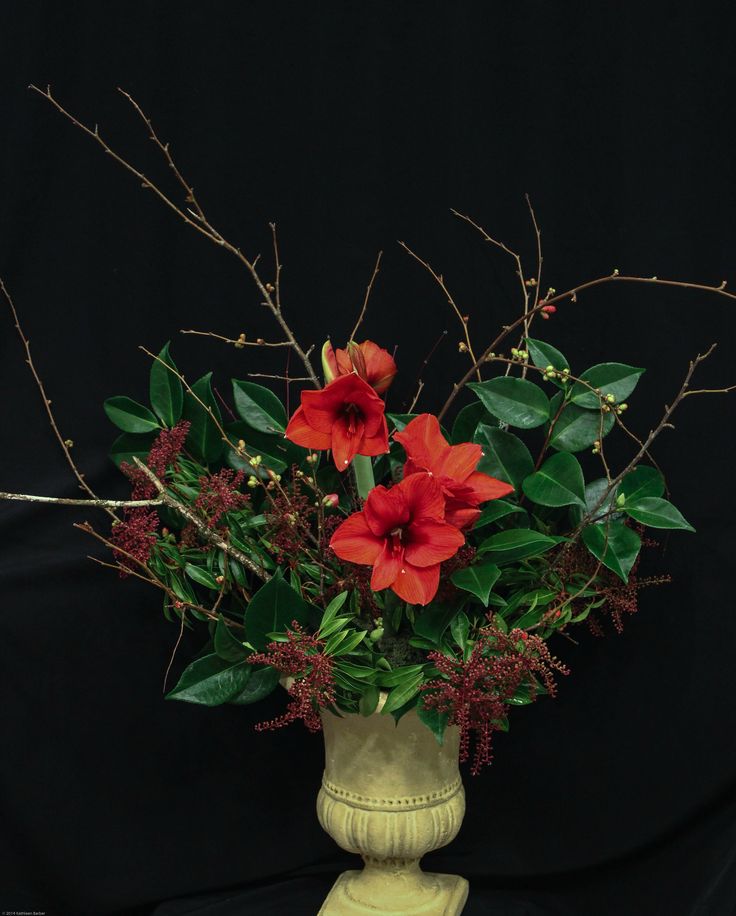
Amaryllis, camellia, quince, peiris in urn from Erika’s Fresh Flowers, a locally owned flower farm and design studio in Warrenton, Or., with a garden style that’s inspired by the wild, unique botanicals nearby.
Here’s a link to our January 2015 Slow Flowers Pinterest Board. Please share your arrangements with me and I’ll add them – or, like many of you, create your own Slow Flowers Pinterest board and invite me to join. I’ll be starting our February 2015 board this coming week!