June 21st, 2015
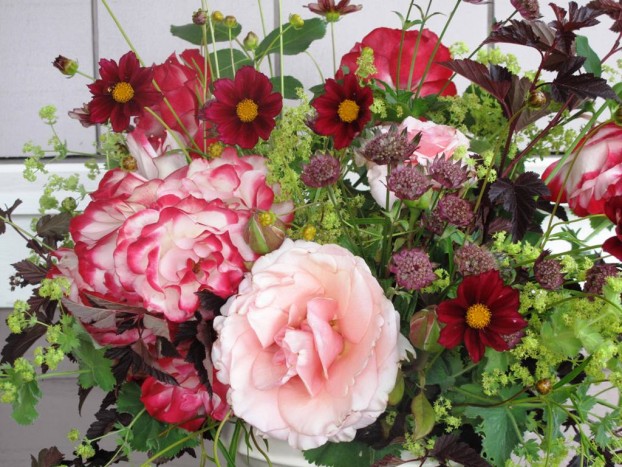
A garden-sourced Father’s Day bouquet for my husband, Bruce
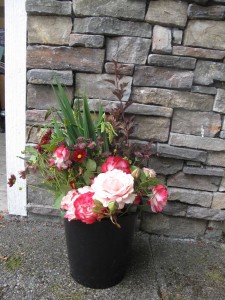
A bucket filled with lovelies from my garden.
Greetings and here’s to SUMMER’S arrival today, June 21st! I couldn’t be more inspired to celebrate the Solstice than to take a walk in the garden. I clipped each stem for today’s Slow Flowers Challenge from my Seattle yard this morning and spent a glorious (and blissfully meditative) hour or so arranging.
And since it’s Father’s Day, I’m using the arrangement for tonight’s dinner we’re preparing for Bruce, my husband and the father of our two boys.
I’ve always loved pairing lime and wine colors together, in garden borders and beds, as well as in container gardens. No surprise that the deep burgundy Ninebark (Physocarpus opulifolius ‘Diabolo’) looks terrific with the acid green Lady’s Mantle ( Alchemilla mollis). Stems from those two create the textural and high-contrast foundation for this design.
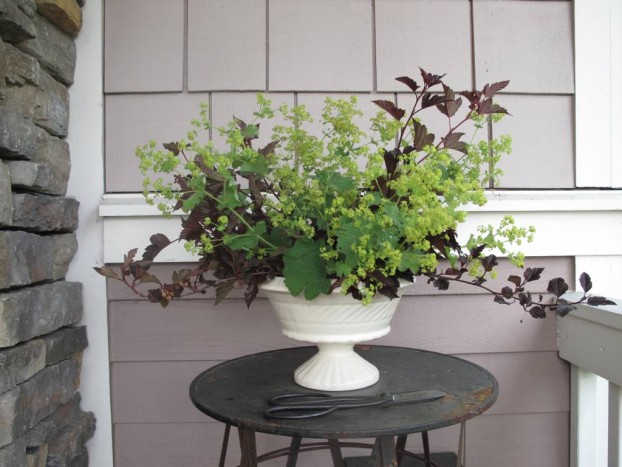
Steps one and two: Insert foliage to create the foundation.
By the way, this is a vintage Haeger American-made vessel, a creamy ivory piece that I brought home with me from a trip to Iowa a few years ago. I love the proportions – perfect for a centerpiece. (Here’s a similar one on Etsy – they’re not too difficult to find.)
To create this design, I placed a large cage-style metal flower frog (also vintage) in the bottom of the bowl. The grid has 5/8-inch openings, ideal for a combination of woody and herbaceous stems as I’m using here.
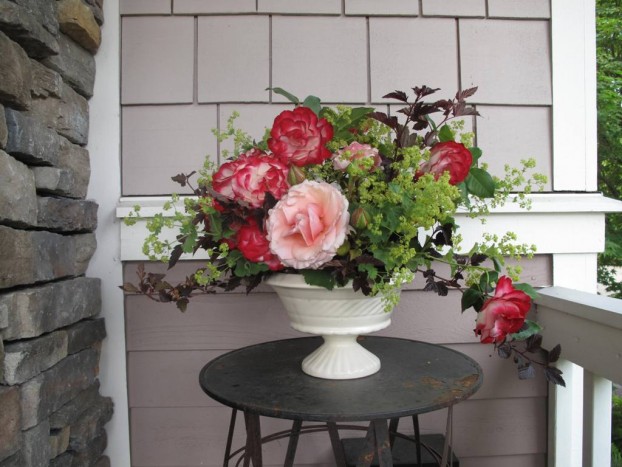
Steps three and four: Adding garden roses, a sweet pairing of a peachy-pink rose with a bicolored white-ruby rose. I inherited these two unknown roses when we moved to this garden four years ago.
After I added the roses, I wanted to take advantage of some wispy pieces to bring a playful dimension to the design. I incorporated a beautiful, mauve-colored Astrantia and several stems of a burgundy-petaled tickseed with great yellow centers ( Coreopsis sp.).
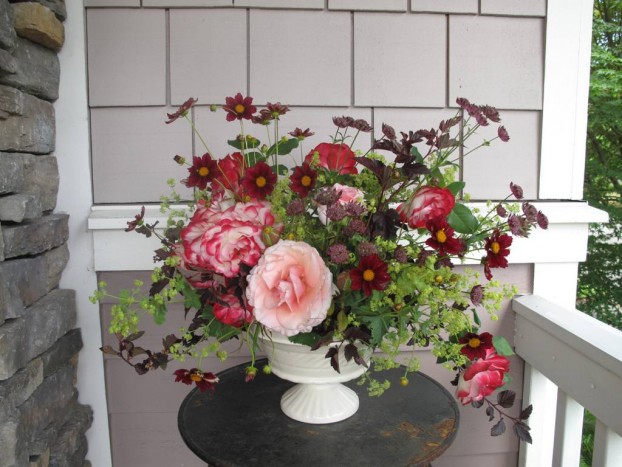
Steps five and six: Astrantia and Coreopsis for their wispy textures.
Two final and rather unexpected touches utilize other garden stalwarts: Crocosmia in bud – love the strong lines of it at this stage; and bronze fennel. Now some may argue that bronze fennel is a garden thug, and it is. But the flouncy, lacy texture is pretty fantastic in an arrangement, so I always allow a few stems of it to remain after weeding out the volunteers.
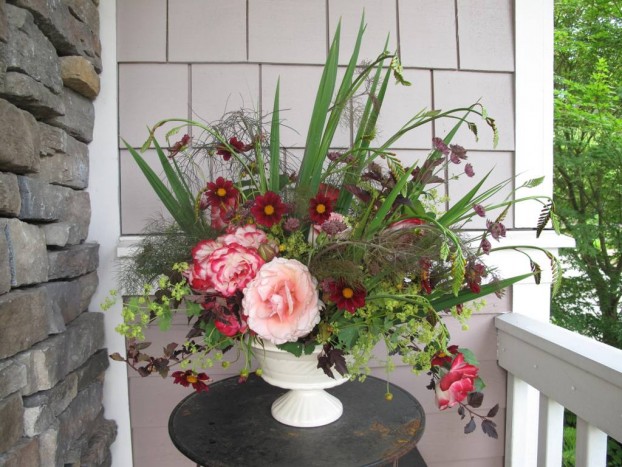
Steps seven and eight: Crocosmia buds and bronze fennel stems.
Posted in American Grown, Creativity, floral design, Gardening, General, Plants, Playfulness, Slow Flowers Challenge | No Comments »
June 18th, 2015
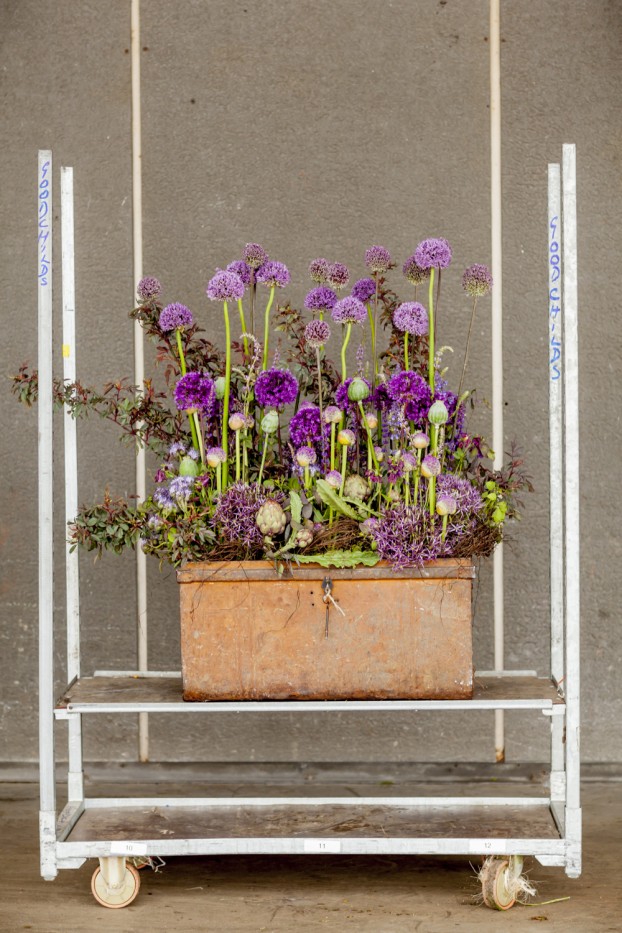
A Trunkful of Alliums by Bloomsbury Flowers (c) Julian Winslow
It’s a busy week and I wanted to devote yesterday’s blog post to our podcast interview with Sarah Statham of Simply by Arrangement.
So here, for Thursday, June 18th, are beautiful British-grown flowers in the hands of top floral designers! The New Covent Garden Flower Market commissioned these stars of British floral design to interpret and create designs using the best domestic crops available.
Thanks to the team behind British Flowers Week for sharing these gorgeous (and inspiring) creations:
DAY THREE June 17th
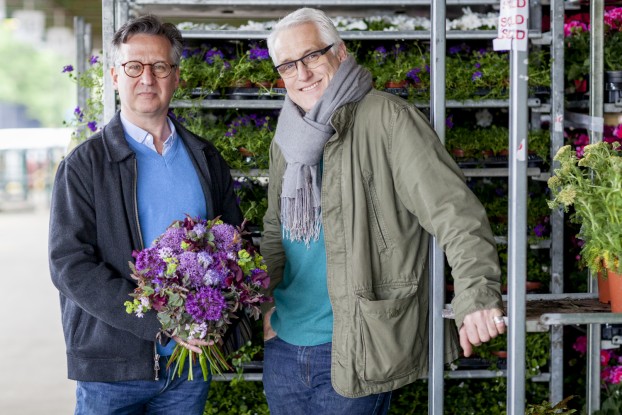
Mark Welford and Stephen Wicks of Bloomsbury Flowers (c) Julian Winslow
Welcome to Day Three of British Flowers Week 2015, the third year of the industry-wide, nationwide campaign in support of British cut flowers, founded and organised by New Covent Garden Flower Market.
Please enjoy the work of Stephen Wicks and Mark Welford of Bloomsbury Flowers, using British alliums.
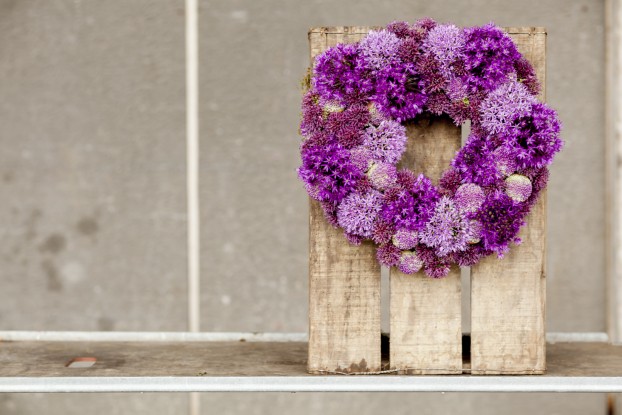
Clouds of Alliums by Bloomsbury Flowers (c) Julian Winslow
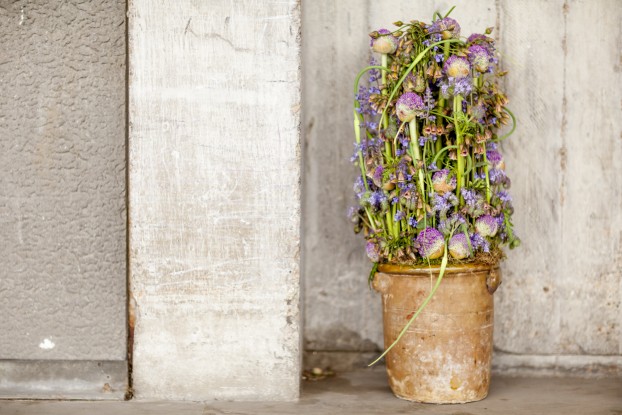
There is a distinct sense of the theatrical in the work of Stephen Wicks and Mark Welford of Bloomsbury Flowers. They celebrate the natural, organic beauty of flowers with their unpretentious design style with masculine twist. (c) Julian Winslow
DAY FOUR June 18th
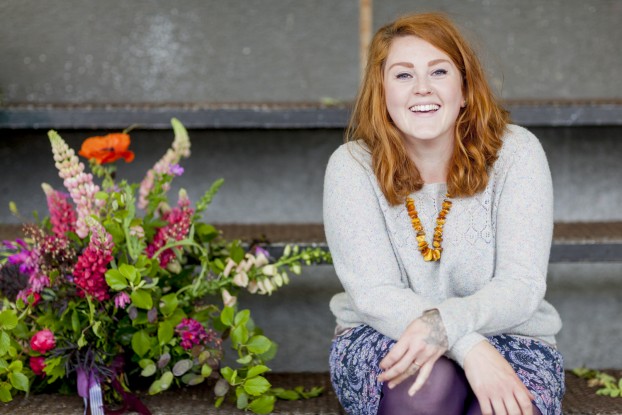
Portrait of Jay Archer (c) Julian Winslow
Jay Archer of Jay Archer Floral Design and the British Lupin are the fourth sweethearts of British Flowers Week. Jay has created three wonderful designs exclusively for this pro-British Flowers campaign:
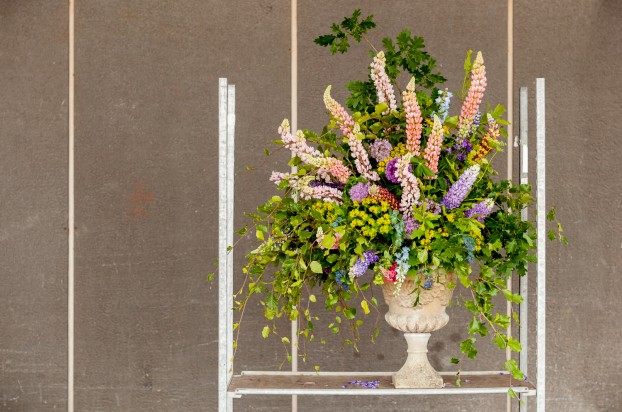
Rockin’ the Lupin (c) Julian Winslow
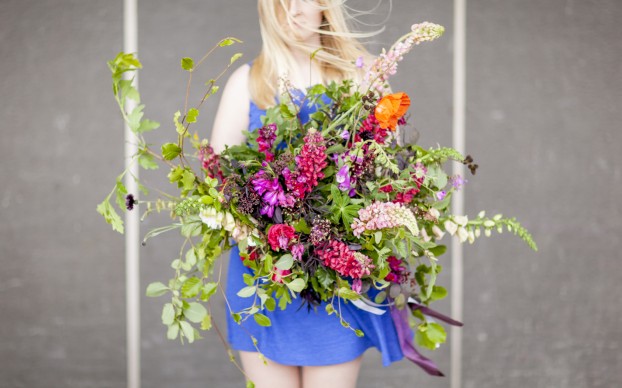
The Wedding Bouquet by Jay Archer (c) Julian Winslow
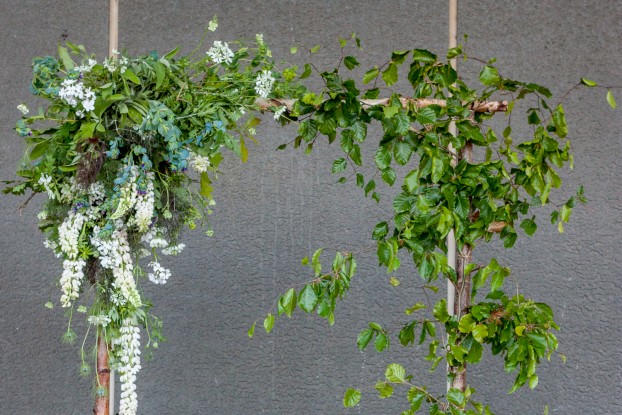
Ceremonial Arch (c) Julian Winslow
Posted in Blog Posts, Creativity, floral design, Gardening, General | 1 Comment »
June 16th, 2015
Podcast: Play in new window | Download
Subscribe: Apple Podcasts | Podcast Index | | More
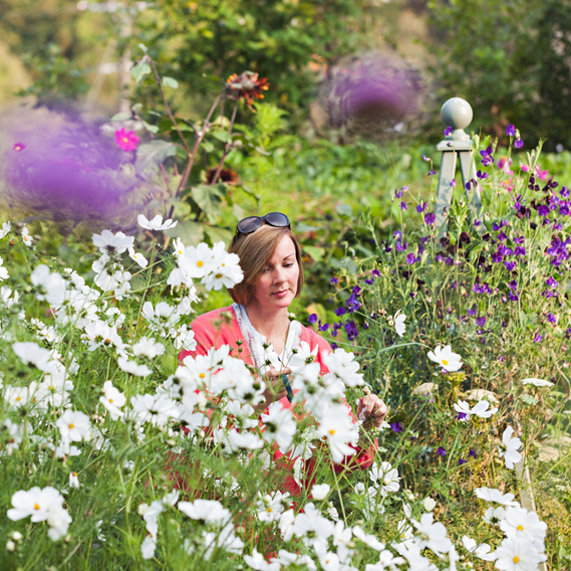
Sarah Statham of Simply by Arrangement, based in Hebden Bridge, Yorkshire, U.K.
Welcome to our second episode celebrating British Grown Flowers. It’s timely because this is British Flowers Week in the UK, where flower farmers, florists, retailers and wholesalers across the country join forces to raise awareness among consumers and the media about the renaissance of their domestic floral industry. Take note, because we’ve got big plans here at Slow Flowers to launch American Flowers Week very soon.
My guest today is more than just a professional contact. I’ve gotten to know her and spend time in her home and community and I’m so happy to call Sarah Statham a personal friend.
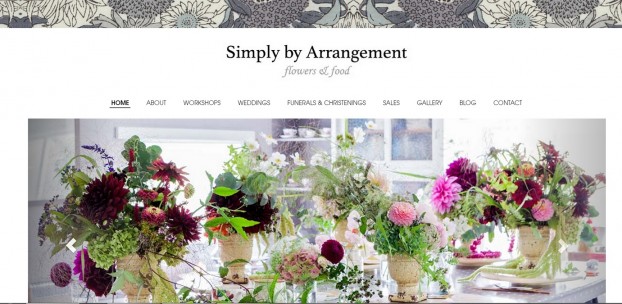
Here’s the web site for “Simply by Arrangement,” the flowers-and-food workshop business that Sarah and Christie launched after careers as criminal prosecutors.
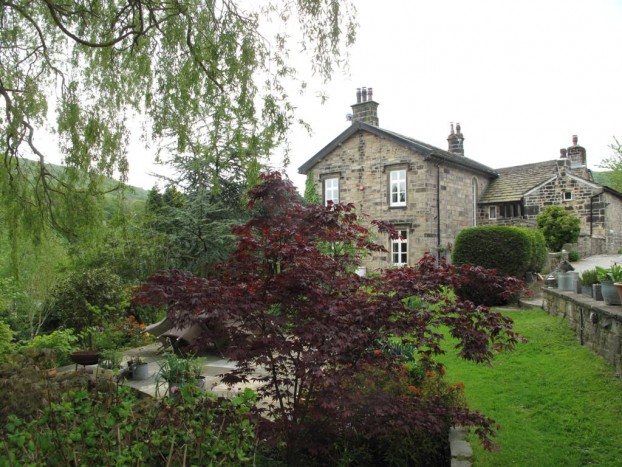
Hoo Hole House in Hebden Bridge, a centuries-old restored stone manor and HQ for Sarah’s flower-filled world.
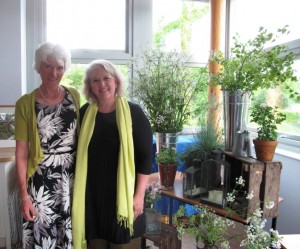
It was lovely to meet Gill Hodgson face-to-face after our long-distance friendship! She is as committed to putting British flowers on the map as I am about doing the same with American grown flowers.
Sarah and I were introduced virtually by British flower farmer Gill Hodgson of Flowers from the Farm, a UK-based organization of flower farmers and florists promoting British flowers. You may have listened to my podcast interview with Gill last year.
When I knew I would be traveling to England last month, I reached out to Gill and suggested that I schedule a visit to Yorkshire, where her farm is based.
As it turned out, Gill and Sarah teamed up to create an entire itinerary for me and my mother Anita, my traveling companion.
Sarah and her husband James Reader opened the doors to their home to invite us to stay for three amazing, flower-filled days.
Their generosity blew us away, and beyond that, Sarah made sure that we met many others in the local floral community.
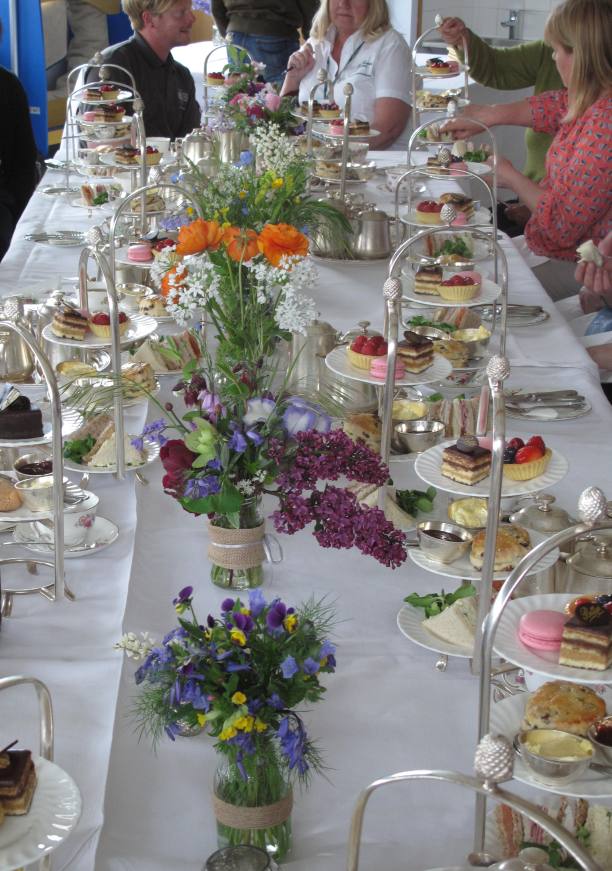
Tea at Harlow Carr, hosted by the flower famers and florists of Yorkshire.
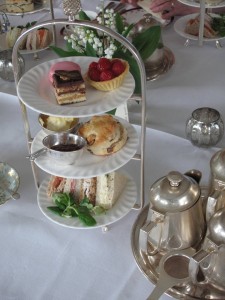
Unforgettable – the best English afternoon tea I’ve ever enjoyed!
A highlight was a gathering and full-on British afternoon tea at the RHS Harlow-Carr Botanical Garden in Harrowgate. Forty kindred spirits gathered to listen to my short presentation about Slow Flowers and the American Grown flower movement, but I have to say that what I learned from them in return was so valuable.
That afternoon we tagged along for one of the photo shoots of the Yorkshire community of growers and designers, all part of the PR campaign to coincide with British Flowers Week.
The Yorkshire flower farmers commissioned the very talented Sarah Mason whose images of Yorkshire-grown flowers, flower farmers and florists have been showcased on this blog all week.
On our last morning together, I turned on the recorder to interview Sarah about her own business, as well as about her British Flowers Week activities.
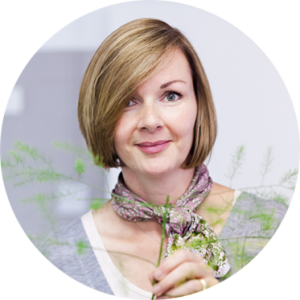
Sarah, the flower maven.
You’ll hear me refer to the fact that we are seated in a cottage in the Cotswolds and just to explain, Sarah and James brought my mom and me with them for the first day of their week-long vacation in a charming village called Snowshill. Yet another amazing bonus of this visit and of their hospitality.
The co-creator of Simply by Arrangement, which she started two years ago with Christie Buchanan, Sarah Statham is a floral designer and educator based in Hebden Bridge, in Yorkshire.
Christie calls herself a cook, but having eaten her delicious food, I’d say she’s a chef extraordinaire.
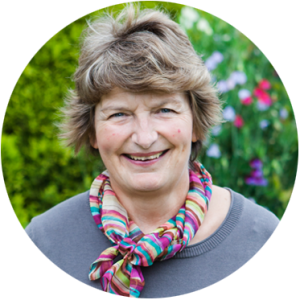
Christie, the food goddess.
Their artisan flower and food business. pairs floral workshops with delicious food, which easily turns the educational aspect of a day playing with flowers into an entire luxury experience.
Simply by Arrangement also provide flowers and food for private clients as well as flowers for larger events and weddings.
Sarah grows many of our flowers used in her own beautiful cutting garden (which, by the way, the bedroom in which I slept conveniently overlooked).
Christie sources her menu ingredients locally from farms in Lancashire, where she is based.
I know you’ll enjoy my conversation with Sarah and please follow Simply by Arrangement at these social places.
Simply by Arrangement on Facebook
Simply by Arrangement on Twitter
Simply by Arrangement on Instagram
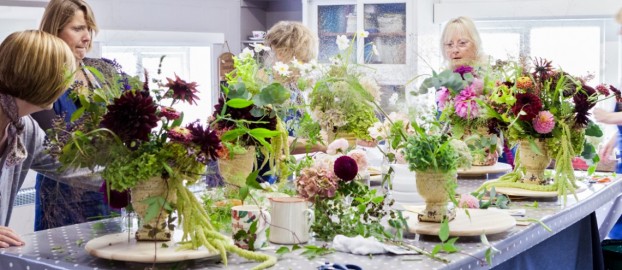
A Simply by Arrangement floral design workshop in full swing.
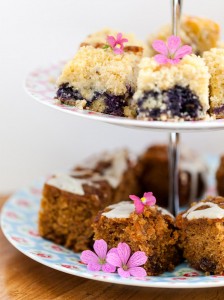
Sweet treats from Mrs. B.
And if you find yourself in the UK, a Simply by Arrangement Workshop that feeds your creativity and tempts your palate is certainly in order.
Sarah and Christie would love to include you at the table.
After wrapping up our interview Sarah and I continued to chat about the similarities in our philosophies.
I asked her to write something for me to use at the close of this podcast relating to how she uses British flowers in her work, and here is an excerpt:
We would dearly love to use British flowers for all of our work. Sadly, maybe because British flower growers have yet to be able to match supply with demand there aren’t always the quantities available and also the British climate does mean that in winter months supplies of cut flowers are relatively limited as are the varieties available especially in our more Northern parts.
Our philosophy is this: locally grown flowers are our first choice always. We grow some unusual varieties ourselves but don’t yet grow as many as we need. We are lucky to have some amazing Yorkshire growers relatively nearby and they are the ones who we go to first.
Next will be a grower in Cheshire ( but that demands a 3 hour journey which is well worth it as her flowers are of such high quality ).
We also have a supplier in Cornwall called Flowers by Clowance, who is reliable and sends supplies by Fed Ex. During winter months we do have to obtain more flowers from the flower market although we still have some supplies from Cornwall. We look forward to the day when the British flower growing market is back to full strength and can meet our needs and hope that the ‘quiet revolution’ in British flowers will give the growers confidence to produce more quantities. Our workshops through spring and summer to around October are British flower based.
What I have tried to do at workshops is to show our attendees the real difference between locally grown flowers which haven’t been ‘traumatised’ by transportation from abroad and haven’t been grown in ‘battery farm like’ conditions and so I will have a small selection of non British flowers available for comparison. I can say without doubt that everyone always goes for the locally grown varieties. I think I mentioned the lady a couple of weeks ago who has vowed never to buy supermarket flowers again and who I have put in touch with a local grower in her area and who is already buying from her.
I have to be completely honest though, there are times when a bride might have her heart set on roses and they are not available here. Whilst I will always try and steer our brides towards seasonally grown ( and thus British) flowers, sometimes it just isn’t possible.
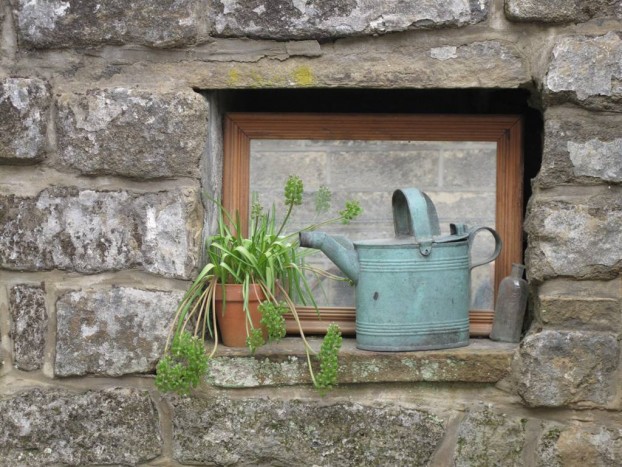
A quiet vignetter at Hoo Hole House caught my eye. Even the utilitarian is treated as a thing of beauty through Sarah’s eyes.
This description sounds so familiar to what I hear from florists and designers here in the U.S. I applaud transparency but I also want to respect that people have to make tough choices as small business owners.
At Slow Flowers I want to support anyone who engages with American grown flowers at any level, while also encouraging them to strive toward 100% American grown flowers as the ultimate goal. And I hope to be a resource to help equip those who make such choices.
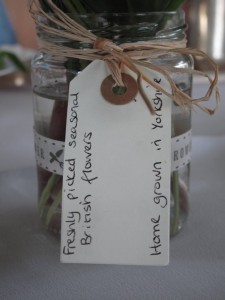
A jam jar filled with Yorkshire-grown flowers, part of the decor at the Tea.
Thanks again for joining me today for another wonderful conversation.
Yes, I am devoted to celebrating American flowers and the designers and farmers who are changing this entire industry for the better.
But as I said last week, I’m also thrilled to introduce you to ways we can borrow ideas and inspiration from places like the U.K., where many parallels occur between our two marketplaces.
Next week is our 100th podcast and you will hear from an established American flower farmer with a long history and deep Midwest roots, and where one doesn’t always expect to find year-round blooms.
Listeners like you have downloaded this podcast more than 52,000 times. THANK YOU to each and every one of you for downloading, listening, commenting and sharing. It means so much.
Until next week please join me in putting more American grown flowers on the table, one vase at a time. And If you like what you hear, please consider logging onto Itunes and posting a listener review.
The content and opinions expressed here are either mine alone or those of my guests alone, independent of any podcast sponsor or other person, company or organization.
The Slow Flowers Podcast is engineered and edited by Andrew Wheatley and Hannah Holtgeerts. Learn more about their work at shellandtree.com.
Music credits:
Tryad – “Lovely”
Thorntree – “A Night at O’Malley’s”
Zoe – “Mourning Skies”
http://zoe3.bandcamp.com/album/zoe
Chris Zabriskie – “Oxygen Garden”
Additional music from:
audionautix.com
Posted in Blog Posts, Creativity, Entertainment, floral design, Flower Farming, General, Podcast Episodes, SLOW FLOWERS Podcast | 3 Comments »
June 16th, 2015
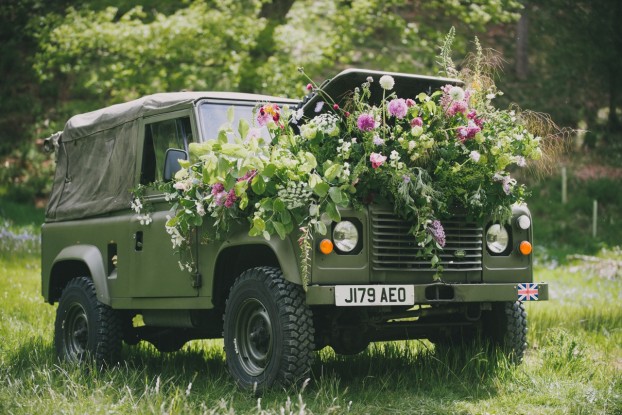
A classic Land Rover embellished in British-grown flowers in the countryside of Yorkshire! (c) Sarah Mason of Sarah Mason Photography
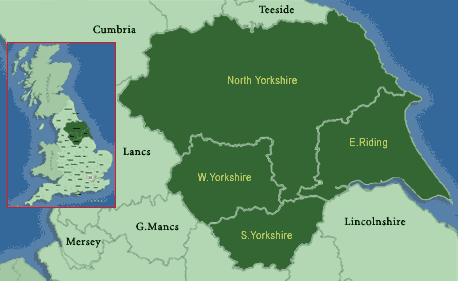
To help you find the Yorkshire region of the UK, check out this map
Day Two of British Flowers Week begins with photos taken by the very talented Sarah Mason, a photographer I met when visiting the U.K. last month and whose work simply captures the wild and beautiful character of the region I visited: Yorkshire/Northeast U.K.
These are just part of the evocative images created to promote the variety of British-grown flowers cultivated and grown by Flowers from the Farm members in that region. Many of the wonderful Yorkshire/Northeast flower farmers and florists I met and spent time with contributed behind the scenes to bring the Land Rover Defender setting to life.
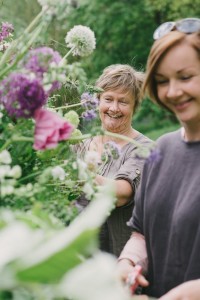
Fiona (left) and Sarah (right), look pretty happy as they decorated and designed a classic Land Rover Defender. (c) Sarah Mason
They include Sarah Statham of Simply by Arrangement (she’s also tomorrow’s Slow Flowers Podcast guest – stay tuned), and Fiona Pickles of Firenza Floral Design.
The idea of using a Land Rover Defender, says Sarah, “is really just because I have been daydreaming for some time about stuffing a Land Rover full of flowers in a more aesthetic way than I usually do day to day.”
I’m laughing as I transcribe this comment from her last email because, of course, like most florists, the “stuffing” part means loading buckets and buckets of flowers into the back of a car – NOT under the hood, right?!
Sarah drove us around in a Land Rover, which seems to be the official vehicle of UK flower farmers and florists. And she adds: “The Land Rover Defender is quintissentially British. Sadly it has no connections with Yorkshire other than the fact a lot of the growers drive them.We need them here in winter.”
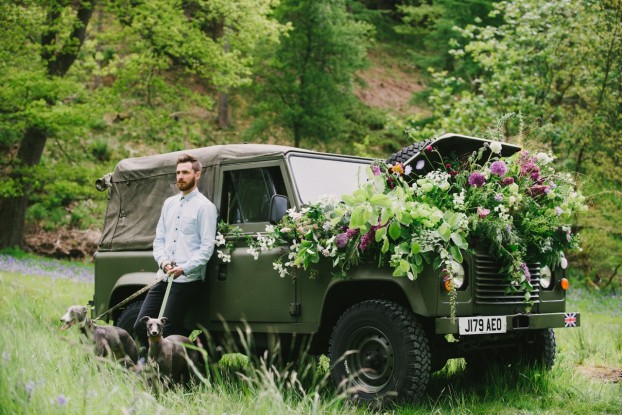
Is this dreamy or what? (c) Sarah Mason
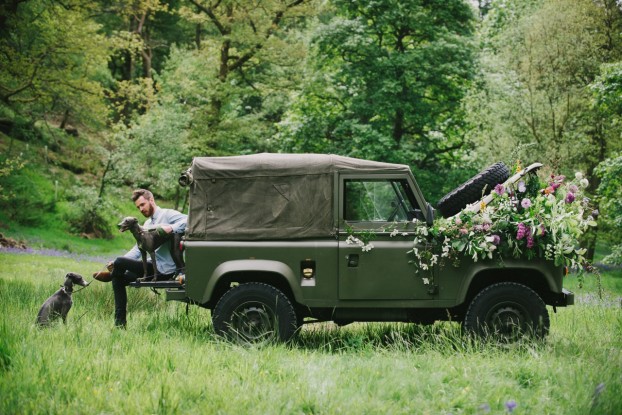
A man, his dogs and his Land Rover (oh, and a field’s-worth of Yorkshire-grown flowers) (c) Sarah Mason
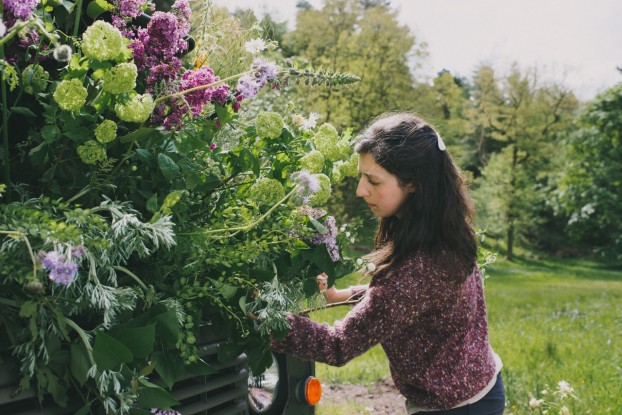
The design process was in itself a beautiful exercise, right? Here’s Holly Marsden, a design intern who volunteered on the project. (c) Sarah Mason
The setting: Hardcastle Crags, a National Trust area located just north of Hebden Bridge, the village where Sarah hosted my mother Anita and me for several delightful days.
The model: James (who I’m told doubles as a web designer)
The whippets: Flo and Ruby
The designers: Sarah, Fiona and design apprentice Holly Marsden
The photographer: Sarah Mason, Sarah Mason Photography

And this is what our friends at British Flowers Week, aka London’s New Covent Garden Flower Market, have created for Day Two of the campaign. Thanks to Liz Anderson and Helen Evans for sharing!
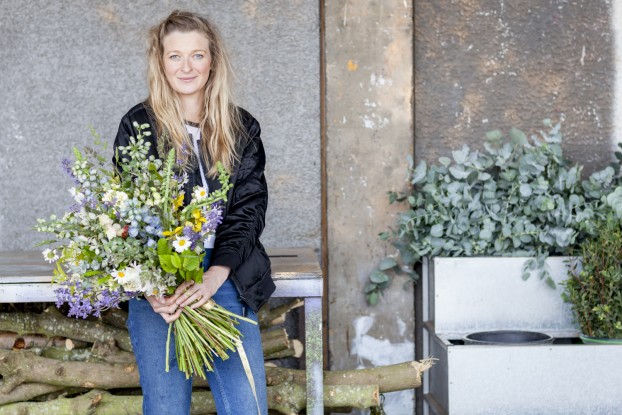
Hattie Fox of That Flower Shop (c) Julian Winslow
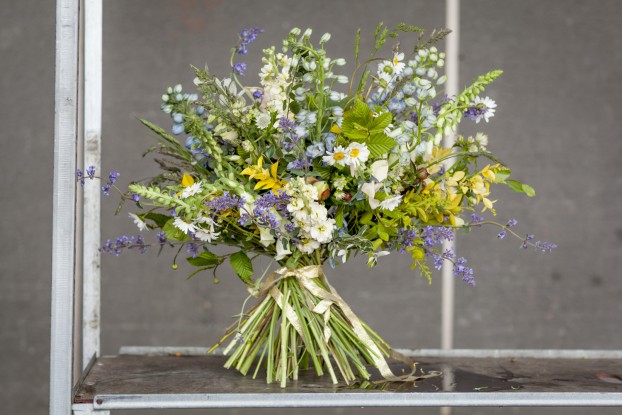
A wild bouquet by Hattie Fox of That Flower Shop (c) Julian Winslow
Please enjoy the work of the fabulous young florist Hattie Fox of That Flower Shop in Shoreditch, in which she plays with British foliage, the unsung hero of floristry. Hattie has created three gloriously free and wild floral designs exclusively for British Flowers Week.
Her style lends itself naturally to British flowers and foliages, where no two stems are the same and where seasonality is everything. Hattie has an extraordinary feel for color and texture and passion for British foliage.
Hattie’s design above is wild and loose and overflowing with locally-grown nepeta, delphinium, astrantia, ox-eye daisies, foxgloves, stocks and peonies, offset by the green tones of hornbeam, cotoneaster, a hint of silver eucalyptus, and the yellow pop of euonymous and golden privet.
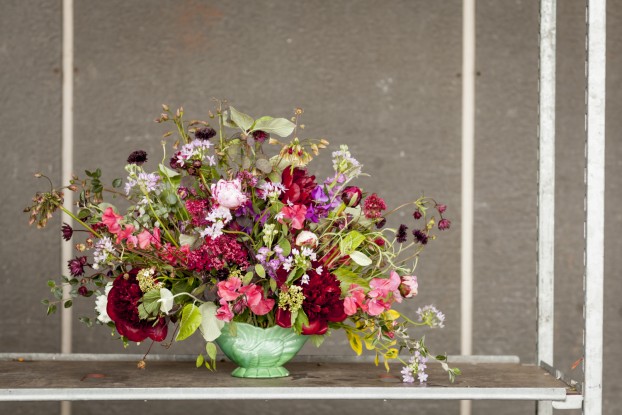
“Warming up a Riot” a vase of British Blooms (c) Julian Winslow
Above: White leaf (sorbus), eucalyptus, variegated euonymous, cotoneaster and rosemary frame this low retro ceramic vase. The warm tones of deep ruby red peonies, cornflowers, astrantia, sweet William, valerian and allium bulgaricum lift to coral sweet peas and soft lilac allium.
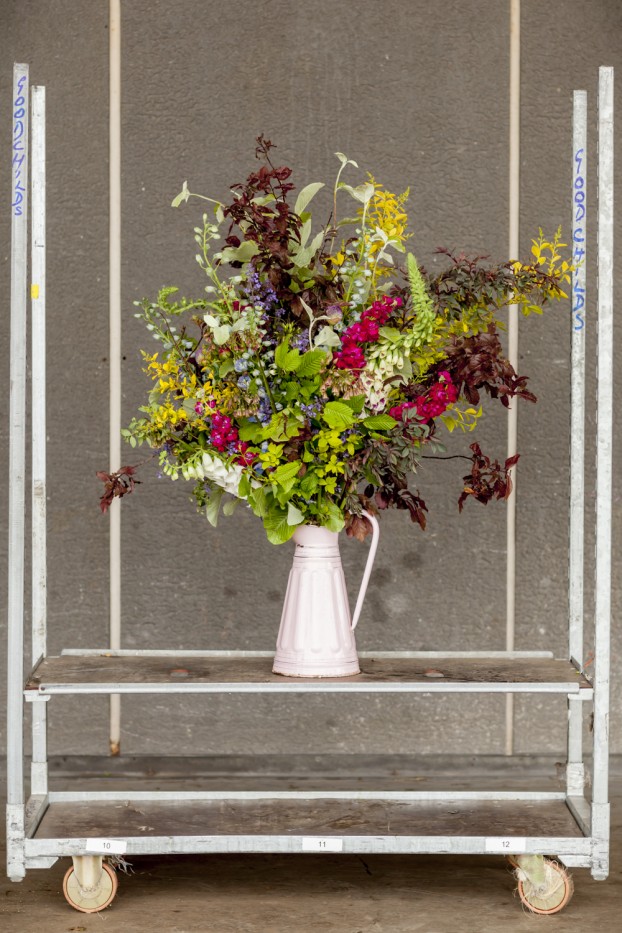
A tall jug of foliage – and more (c) Julian Winslow
Above: A tall blush-pink enamelware jug struggles to contain a profusion of lush foliage and vibrant flower stems. Arching branches of hornbeam, prunus, golden privet, and purple beech share the billing with delphiniums, foxgloves, stocks, alliums, peonies, and nepeta.
Read more about That Flower Shop here.
Read more about British Foliage here.
Posted in Blog Posts, Creativity, floral design, Flower Farming, General, Playfulness | No Comments »
June 15th, 2015
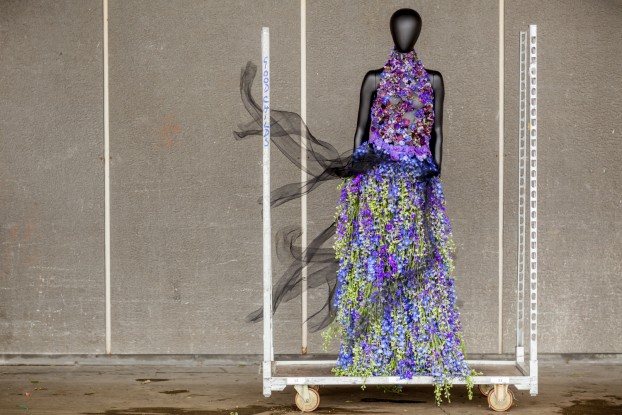
“Shadows” – a haute couture gown (c) Photo by Julian Winslow for New Covent Garden Flower Market
Enjoy this excerpt from an article that ran on June 12th in The Telegraph, by Liz Anderson:
So why do we need a British Flowers Week?
Well, British flower growers have been struggling in the face of global cut flower production. Three decades ago, when florists such as Paul Thomas, Paula Pryke and Shane Connolly were embarking on their careers, British flowers dominated the markets. Shane says of his first trip to London’s Covent Garden Flower Market with the Royal florist, Michael Goulding: “There were boxes of flowers everywhere. The first thing that hit me was the scent. It was mainly English and seasonal. Back then, Dutch flowers were rare – I think Michael called them exotics!”
In the years that followed, growers – first in Holland then in Kenya, Ecuador, Colombia and now Ethiopia – swamped the UK market with competitively priced, standardised, all-year-round cut flowers to such an extent that today British seasonal flowers have become the new “exotics”.
Slowly but surely the British cut flower industry has been mounting a comeback. The remaining large-scale growers have continued sending into the country’s wholesale markets and increasingly into supermarkets by the millions of stems. New smaller flower farms have started springing up around the country, growing and selling flowers at farmers markets, at the farm gate, to local florists and online.
Zita Elze and The British Larkspur
 Welcome to Day One of British Flowers Week 2015, the third year of the industry-wide, nationwide campaign in support of British cut flowers, founded and organised by New Covent Garden Flower Market.
Today, Monday, June 15th, New Covent Garden Flower Market presents the work of the brilliant florist Zita Elze of Kew using British larkspur.
 Brazilian-born Elze is an award-winning floral artist, teacher, design consultant and creator of the Living Embroidery design technique, whose detailed work has appeared in countless magazines across the world. Her exquisite flower shop and Design Academy in Kew are quite simply inspiring.
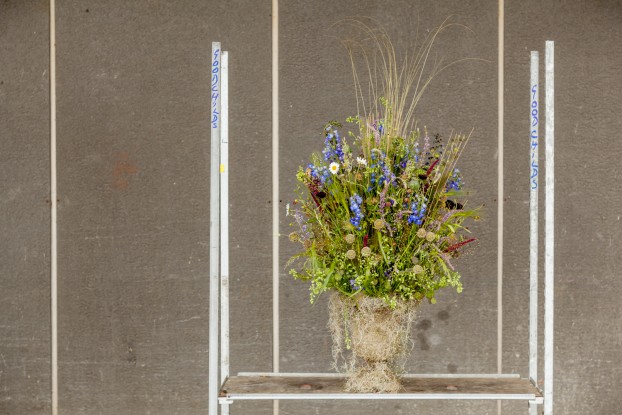
Painting with Flowers – an artist’s garden in a vase (c) Photo by Julian Winslow for New Covent Garden Flower Market
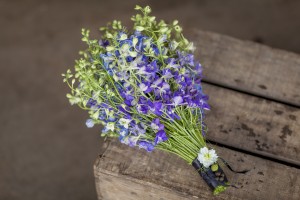
Simply Larkspur bouquet – (c) Photo by Julian Winslow for British Flowers Week
Zita has created three exquisite floral designs exclusively for British Flowers Week:
- “Shadows” – a haute couture gown
- Painting with Flowers – an artist’s garden in a vase
- Simply Larkspur – an elegant bouquet
About British Flowers Week:
British Flowers Week is the annual campaign in support of the British cut flower industry founded by New Covent Garden Flower Market in 2013.
It brings together florists, growers, wholesalers and the public in a celebration of British cut flowers. The campaign now has a dedicated website www.britishflowersweek.com, which features a programme of flower farm open days, workshops, talks, demonstrations, pop-up stalls, window displays and limited edition British flower bouquets.
About New Covent Garden Flower Market:
Located in Vauxhall, London, New Covent Garden Flower Market is the largest Flower Market in the U.K., with 26 wholesalers specializing in flowers, foliage, plants and floristry & event sundries from Britain and around the world.
Seventy-five percent of London’s florists choose to buy here, including the top names in the flower industry, and the market’s flowers dress the finest hotels, event venues, palaces, offices, restaurants and flower shops in the capital.
Help the cause! Please re-post this blog and/or the photos on Twitter, Facebook or other social sites and use the hash-tag #britishflowersweek and #originmatters. Twitter tags: @ZITA_ELZE and @MarketFlowers
Posted in Blog Posts, Creativity, floral design, General | No Comments »
June 13th, 2015
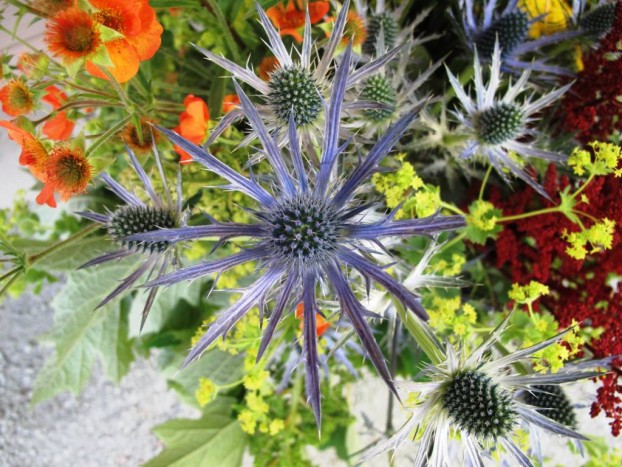
Sea holly (Eryngium sp.) looking dazzling!
This week’s arrangement comes to you courtesy of a special event in which I participated to benefit the King County Library Foundation.
Called an “Author Salon,” the private gathering was one of several offered at the Library Foundation’s recent annual Literary Lions Auction. Library supporters Elaine & John Hogle and Felicia Dixon & Lucas Hoban hosted the Author Salon last weekend at theBellevue Botanical Garden – one of my very favorite public gardens in the Seattle area. Landscape architect Liz Browning of Swift Company also participated by leading a tour of the newest garden BBG installations area designed by her firm.
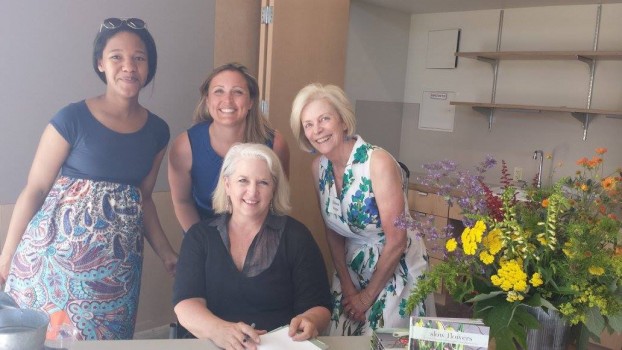
The Author Salon team, standing, from left: Felicia, Liz and Elaine; I’m seated in front.
What a beautiful venue! I was asked to talk about Slow Flowers, the book, as well as the slow flowers movement to source domestic and local flowers rather than rely on imports.
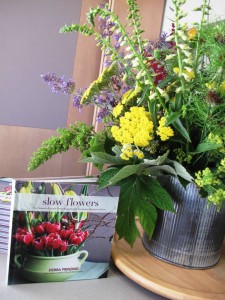
Local flowers and the Slow Flowers book go together well!
My publisher, St. Lynn’s Press, generously donated copies of Slow Flowers so that everyone in attendance took home a signed copy. And all the proceeds of the afternoon benefit the King County Library Foundation. Cindy Sharek and Andrea Quigley of the Foundation ensured that we had a lovely reception to hear the message of supporting literacy education!
And about the flowers you see here. I asked – and received special permission – to cut from the famed Perennial Border at the Bellevue Botanical Garden for my demonstration.
While you might think I focused on which blooms to choose first, it was the oak leaf hydrangea that caught my attention before anything else.
My vase had a fairly wide opening of about 7 inches, so I needed larger, structural branches and leaves as my design’s starting point. Plus, I absolutely love the hydrangea’s stage right now. The leaves are large and supple and the flowers are still in bud so they’re the same color green and the foliage.
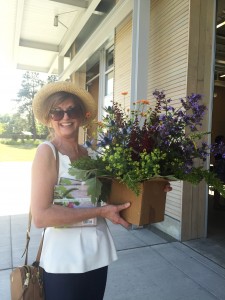
Susy Hutchison took home the Slow Flowers bouquet.
See my entire plant list below. As I was basically designing on the fly, (I only clipped the blooms 30 minutes before the event!), it occurred to me that I had three primary hues and three secondary hues of blooms — and naturally, that gave me an organizing structure to discuss a bit of color theory.
I had a few longtime friends in the audience who surprised me by attending, people I hadn’t seen for years!
How cool that my friend Susy Hutchison, former news anchor for KIRO-TV (CBS affiliate) won the doorprize to take home my arrangement. Seriously, it was not a fix!
Susy reported to me that the bouquet was “still going strong,” one week after she brought it home. Yes, folks, that’s another great reason for sourcing locally – your arrangement’s vase life will be extended!
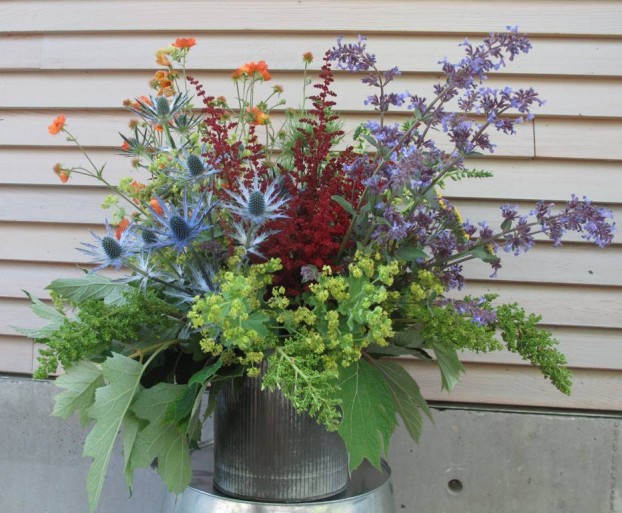
The finished “color wheel” bouquet – clipped just steps away from our event.
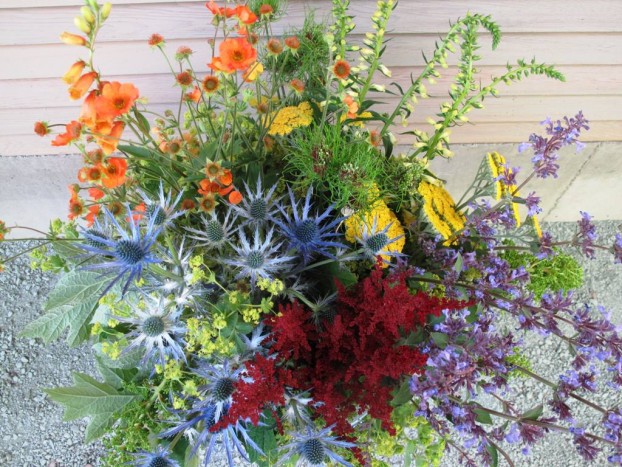
Three sets of complements: Blue & Orange; Purple & Yellow; Red & Blue (with lots of green thrown in for good measure)
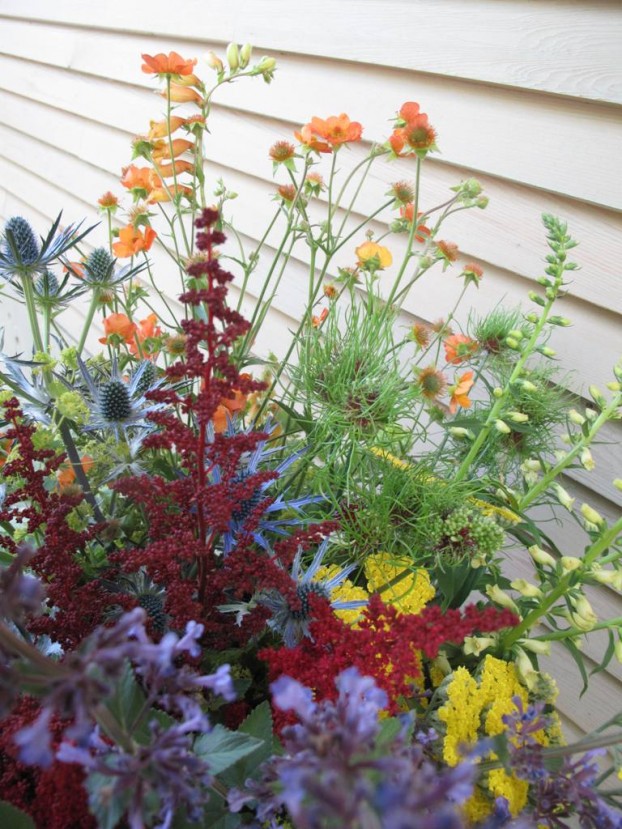
Three sets of complements: Blue & Orange; Purple & Yellow; Red & Blue (with lots of green thrown in for good measure)
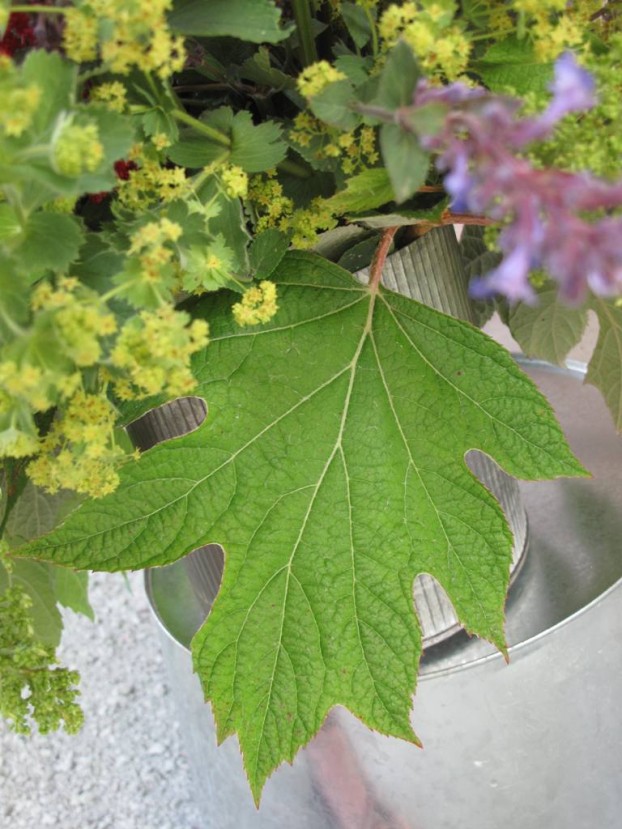
Here’s that essential oak leaf foliage
Here is the recipe, with all ingredients from the Perennial Border at Bellevue Botanic Garden:
- Oak leaf hydrangea foliage & flowers (Hydrangea quercifolia)
- Lady’s mantle (Alchemilla mollis)
- Red/Maroon: Astilbe
- Green: Allium ‘Hair’ (a mutation of A. sphaerocephalon)
- Orange: Geum (Geum chiloense) possibly ‘Totally Tangerine’
- Purple: Catmint (Nepeta sp.)
- Yellow: Yarrow (Achillea millefolium)
- Blue: Sea holly (Eryngium amethystinum)
- Bonus stems: I added a few beautiful stems of pale orange and yellow foxglove
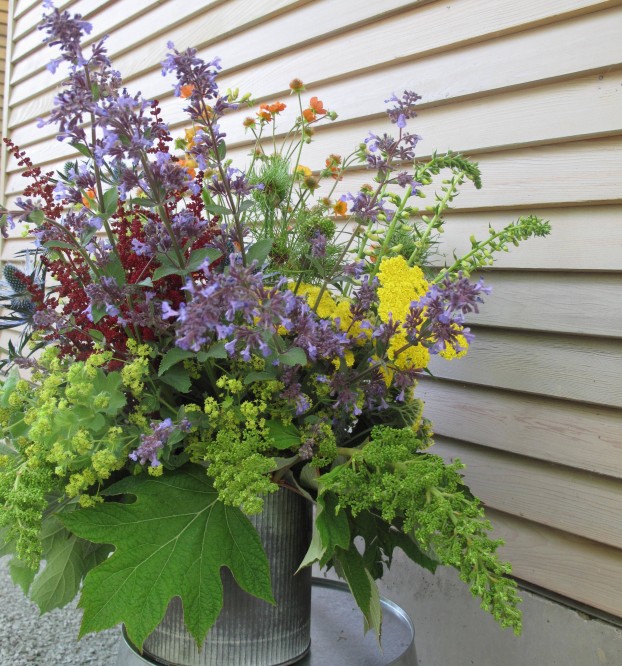
The lady’s mantle and oak leaf hydrangea blooms add a touch of lime.
Posted in American Grown, Blog Posts, Creativity, floral design, Gardening, General, Landscape Design, Plants, Slow Flowers Challenge | No Comments »