“A Blue Bowl of Blooms”
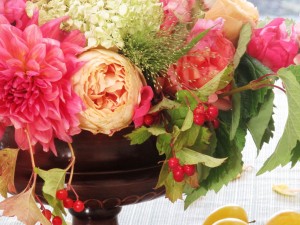
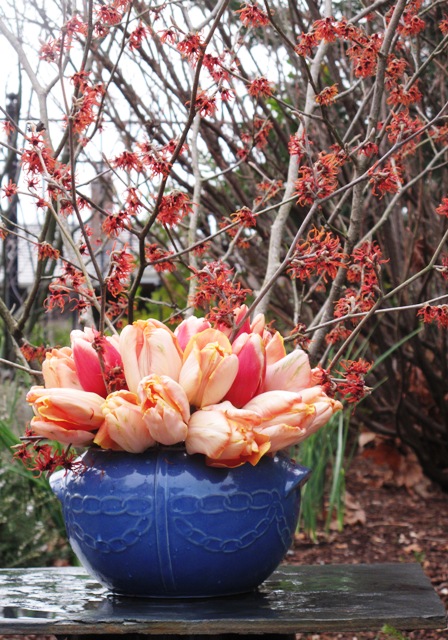
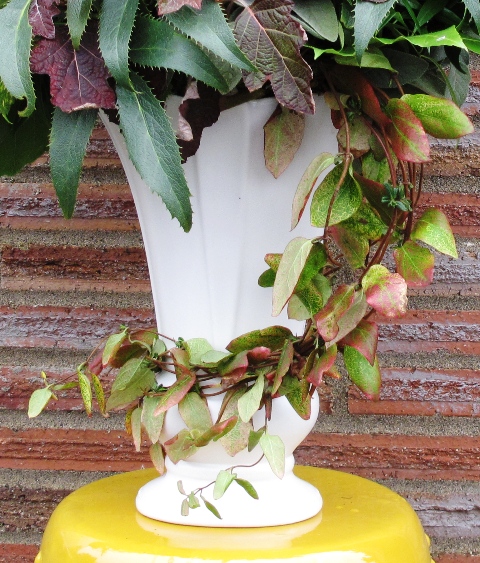
Vase: 5-inch tall x 9-inch wide cobalt blue vintage bowl with 6½-inch opening

Vase: 5-inch tall x 9-inch wide cobalt blue vintage bowl with 6½-inch opening
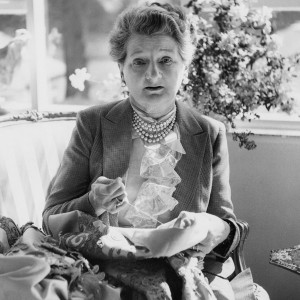
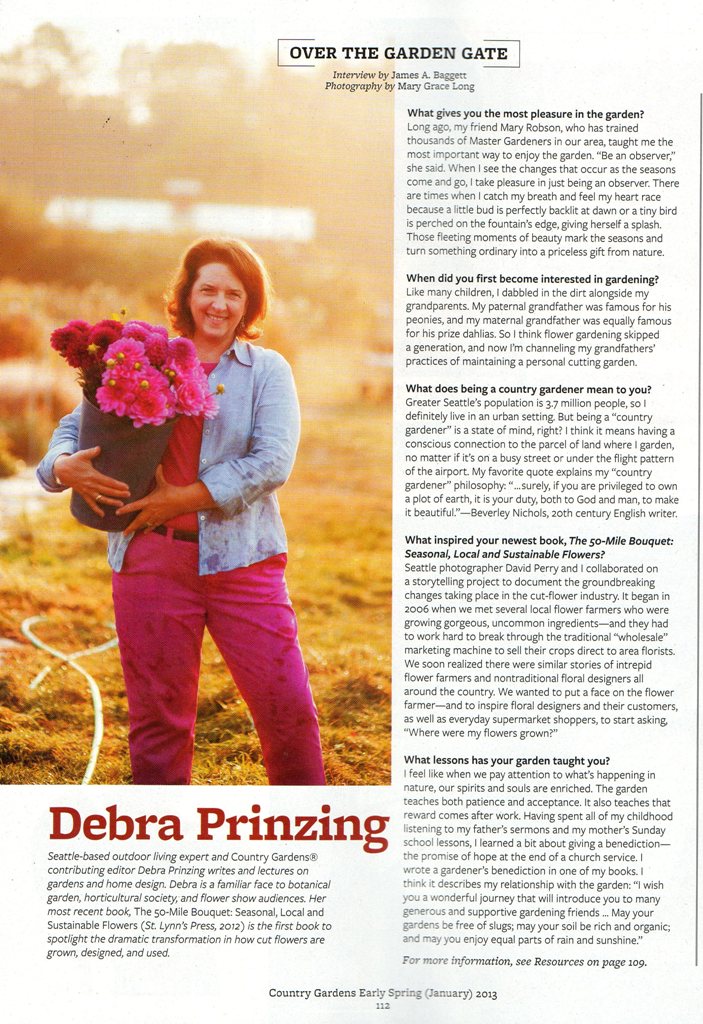
I’m used to being the one asking the questions, but recently, James Baggett, editor-in-chief of Country Gardens magazine, turned the tables on me. He asked me to participate in a Q&A for the “Over the Garden Gate” feature in Country Gardens. Here is the full interview below. A shortened version appears in the “Early Spring 2013” issue, out this week on newsstands. THANK YOU Mr. Baggett~
And a few more thank-you’s: Thank you designer Nick Crow, for making the page look so perfect; thank you to Diane Szukovathy and Dennis Westphall of Jello Mold Farm, for sharing your location (and great dahlias!) for the fun day of portrait work — and especially: thank you, talented photographer Mary Grace Long, for the nice image. No one likes to have their photo taken and you made it a blast!
Full Q&A:
1. What gives you the most pleasure in the garden (keep it clean)?
Long ago, my friend Mary Robson, who has trained thousands of Master Gardeners in our area, taught me the most important way to enjoy the garden. “Be an observer,” she said. When I see the large and small changes that occur as the seasons come and go, I take pleasure in just being an observer. There are instances when I catch my breath and feel my heart race because a little bud is perfectly backlit at dawn or a tiny bird is perched on the fountain’s edge, giving herself a splash. Those fleeting moments of beauty mark the seasons and turn something ordinary in to a priceless gift from nature.
2. When did you first become interested in gardening?
Like many children, I dabbled in the dirt alongside my grandparents. My own parents weren’t gardeners, but my paternal grandfather was famous in our family for his peonies and my maternal grandfather was equally famous for his prize dahlias. So I think flower gardening skipped a generation and now I’m channeling my grandfathers’ practice of maintaining a personal cutting garden. In my twenties, my interest in growing and gardening expanded into unbridled passion – thanks to two close friends who are both landscape designers (Karen Page, my college roommate, and Jean Zaputil, who I worked with at a textile design firm in the 1980s). I learned a lot from them. I call them my garden muses. Lucky for me, I’m a writer, so I’ve been educated while also interviewing famous gardeners and writing about incredible landscape designs.
3. What’s the best garden advice anyone’s ever given you?
Van Bobbitt, who taught many of the horticulture classes I took at South Seattle Community College, was one of the first people to talk to me about natural gardening practices. He introduced his students to the idea that if a plant is failing or under stress you should evaluate its cultural conditions rather than just dosing it with a pesticide or fungicide. That excellent advice has empowered me to stop blaming the plant and start looking at the larger environment. More often than not, it’s the “right plant” in the “wrong place.” And there’s an easy solution to that problem.
4. What—if anything—do you enjoy listening to while in the garden? (Me? Dusty Springfield, Terry Gross, and birdsong.) Do you have a playlist?
My playlist is in my head, James. As a writer forced to operate in the world of social media, I have far too many external stimuli – nearly all digital and electronic in nature. The restful quiet of being outdoors is simply too rare – I cherish it. I find that while I am tending to my garden, I reflect, imagine and dream. Whatever inner conversation I have, it’s always a rewarding one.
5. What does being a country gardener mean to you?
Greater Seattle’s population is 3.7 million people, so I definitely live in an urban setting. But being a “country gardener” is a state of mind, right? I think it means having a conscious connection to the parcel of land where I garden, no matter if it’s on a busy street or under the flight pattern of the airport. My favorite quote explains my “country gardener” philosophy: “…surely, if you are privileged to own a plot of earth, it is your duty, both to God and man, to make it beautiful.” — Beverley Nichols, 20th century English writer.
6. What inspired your newest book, The 50-Mile Bouquet: Seasonal, Local, and Sustainable Flowers?
Seattle photographer David Perry and I collaborated on a storytelling project to document the groundbreaking changes taking place in the cut flower industry. It began in 2006 when we met several local flower farmers who were growing gorgeous, uncommon ingredients — and they had to work hard to break through the traditional “wholesale” marketing machine to sell their crops direct to area florists. We soon realized there were similar stories of intrepid flower farmers and nontraditional floral designers all around the country. We wanted to put a face on the flower farmer – and to inspire floral designers and their customers, as well as everyday supermarket shoppers, to start asking “where were my flowers grown?” and “who grew them?” It turns out that the field-to-vase movement is as exciting as the culinary world’s farm-to-table movement.
7. How are you enjoying gardening in the Pacific Northwest as opposed to Southern California? What are the differences?
I gardened in Seattle for more than 20 years and then, all of a sudden, in 2006, we moved to Southern California for my husband’s work. It was a huge shock to my system and yet, from a gardener’s perspective, it was exhilarating because I learned an entire new plant palette. My garden in Thousand Oaks, California, had all sorts of cool California native perennials, grasses, and shrubs; succulents, aloes and cactuses; and plants from other Mediterranean regions like South Africa and Australia. It was like taking a crash course in low-water gardening.
And just when I started to figure things out, we returned to Seattle in 2010. So I’m back to shade gardening and zonal denial. Every single time I fly back to Seattle from my frequent SoCal trips, I have a little pot of something wonderful in my carryon. That’s the benefit of having a spot in my garage to shelter everything that’s not winter-hardy during Seattle’s cold, wet season. So far, my California succulents have made it through two Seattle winters, so I think my method is working. There’s a benefit to having lived both in the Northwest and the Southwest: I now feel like I’m a true gardener of the West. And that feeling is enhanced by the wonderful community of fellow gardeners I’ve found wherever I live.
8. Describe your dream garden for us.
I have my dream garden. It’s a beautiful series of mixed borders and flower beds with a fish pond (which I inherited and am learning to care for), a white pergola and a covered porch with vintage white wicker furniture and an outdoor fireplace. I even have a peek-a-boo view of Lake Washington that greets me every morning. My husband, Bruce Brooks, is great with the lawnmower, too. My only other “dream” would be to have a full-time gardener to keep up with the weeding, dead-heading and other chores.
9. What lessons has your garden taught you?
Back to the idea of being an observer, I feel like when we pay attention to what’s happening in nature, our spirits and souls are enriched. The garden teaches both patience and acceptance. It also teaches that reward comes after work. Having spent all of my childhood listening to my father’s sermons and my mother’s Sunday school lessons, I learned a bit about giving a benediction –– the promise of hope at the end of a church service. I wrote a gardener’s benediction in one of my books. I didn’t realize that’s what it was until I saw it in print. But I think it describes my relationship with the garden: “I wish you a wonderful journey that will introduce you to many generous and supportive gardening friends … May your gardens be free of slugs; may your soil be rich and organic; and may you enjoy equal parts of rain and sunshine.”
10. What’s next on your green-hearted agenda?
I’m wrapping up a solo project, which is a sequel of sorts to “The 50 Mile Bouquet.” Called “Slow Flowers: Four Seasons of Locally Grown Bouquets from the Garden, Meadow and Farm,” it will be published February 2013 by St. Lynn’s Press. I challenged myself to design and photograph one bouquet every week for an entire year. I only used ingredients from my garden or those grown and harvested by local flower farmers, even in the coldest months when most people assume there’s nothing available. In the process, I discovered that gardeners are ideally suited for floral design. We know the habit, form, peak of bloom and best qualities of the plants we grow – and we know how to combine them with in the landscape, so why not in a vase?
11. Anything else you would like to add that I’ve neglected to ask?
For the past five or six years, the grow-it-yourself trend has dominated the gardening world. And that has resulted in the pendulum swinging far towards the edible side of things. While many think it’s frivolous to grow flowers or care about how/where they were grown (i.e., the carbon footprint of imported flowers), I think the conversation is changing. Even though we don’t eat flowers, we do need their presence in our gardens – if only as a nectar source for pollinators or a seed source for birds. There is an important equilibrium that takes place when flowers – annuals, perennials and biennials – are cultivated, especially in the vegetable garden. You might be motivated to grow flowers for economic reasons, or to preserve heirloom varieties, or to attract beneficial insects. Whatever your reason, we need flowers in our lives, and in our gardens.
Welcome to 2013! Each Sunday of this year, I will post my photographs, “recipe” and tip for that week’s floral arrangement, created for my new book, Slow Flowers. Enjoy the floral journey through 52 weeks of the year~
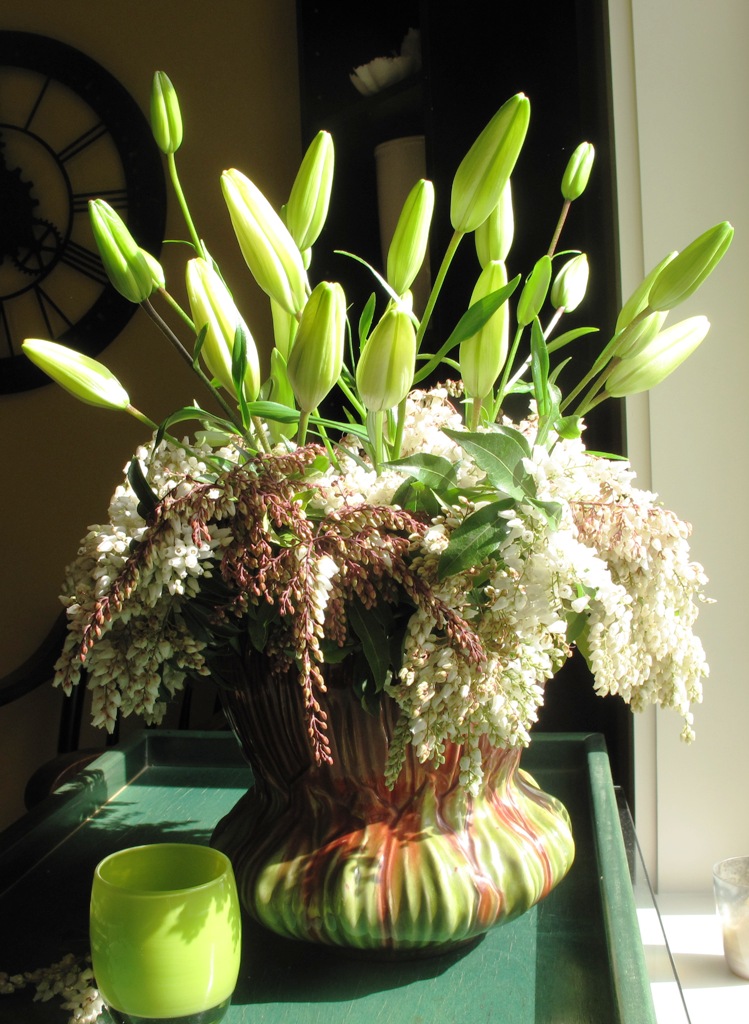
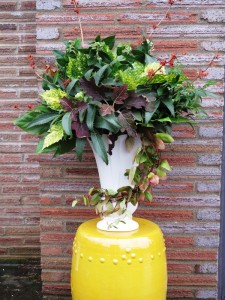
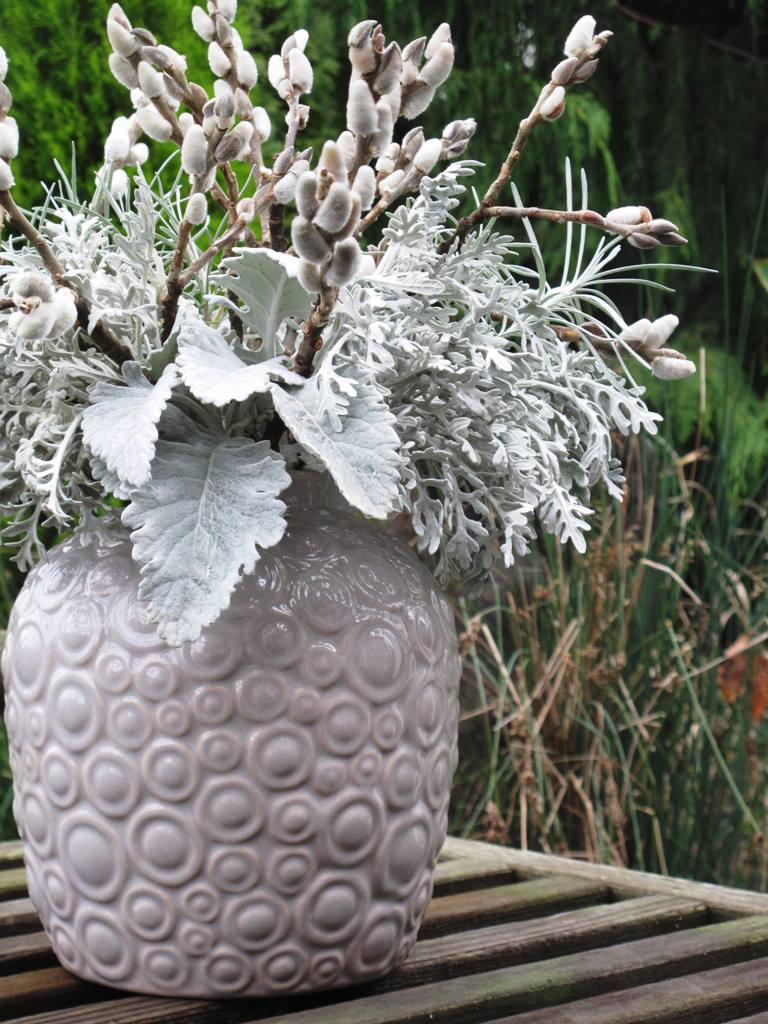
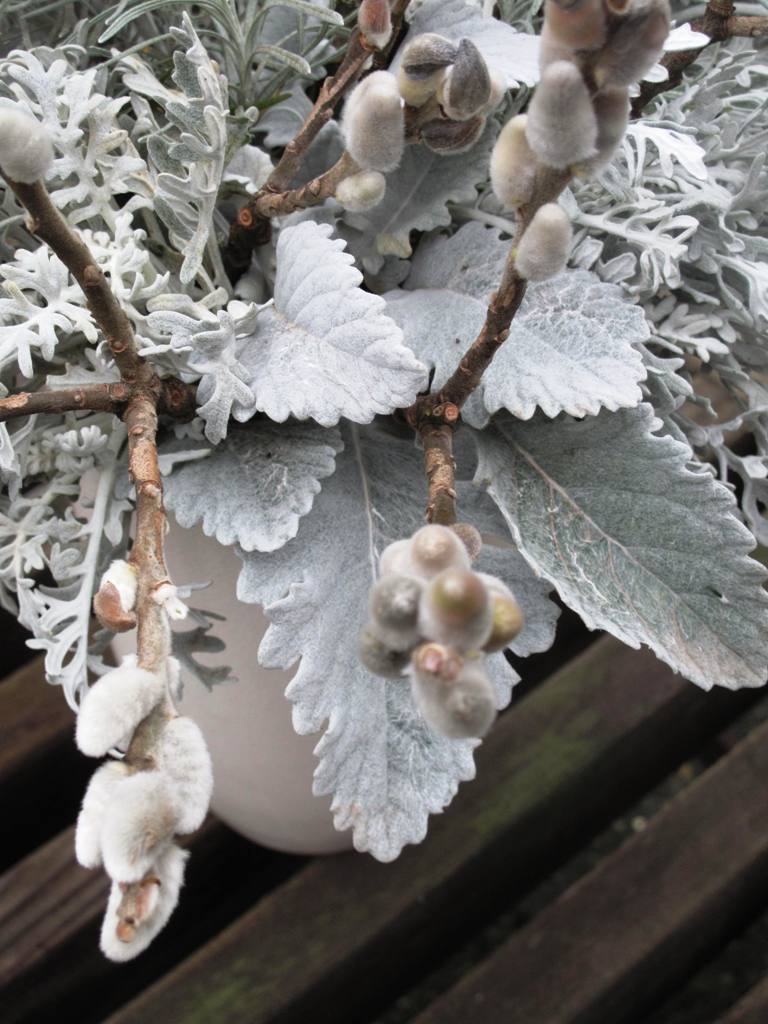
“Frosty White”
Ingredients:
Vase:
Excerpted from Debra Prinzing’s Slow Flowers: Four Seasons of Locally Grow Bouquets from the Garden, Meadow and Farm (St. Lynn’s Press, February 2013 publication date)
[Author’s note: This is the introduction of my forthcoming book, “Slow Flowers,” which will be published February 1, 2013. You can pre-order it here.]
One of the joys of gardening is to step out my back door and clip a few sprigs to bring inside. The day’s prettiest blooms and just-unfurled leaves – assembled simply into a bunch and displayed in a jar of water – provide everything I need to start the day. The tiny arrangement graces my kitchen counter or brightens a spot by the keyboard, connecting me with the natural world even when I’m “stuck” indoors, away from my beloved garden.
IS THIS FLORAL DESIGN?
I guess it is, but like avid gardeners everywhere, I certainly never considered myself a florist. After all, despite hundreds of hours of horticulture training, I never once studied the art of flowers, other than one weekend class on liturgical arrangements that I took with my Episcopal priest friend Britt Olson. Floral design was an entirely different sort of activity for which I wasn’t qualified (I thought). I’m a writer and a lover of plants, but not an artist.
I have written about floral design for years, interviewing top florists around the country for articles in magazines like Seattle Bride, Romantic Homes and Sunset. I loved reporting those stories, and I have to admit feeling a twinge of jealousy as I listened to flower artists answer questions about their style and technique, their use of botanicals and vessels – and especially, their inspiration.
I have spent my life observing and writing about creative people. But I didn’t really believe that I was one of them! I was the classic journalist: a detached outsider documenting what she heard and saw.
Yet writers are sponges and driven by an insatiable, need-to-know curiosity. In pursuit of our stories, we can’t help but absorb knowledge about myriad topics, taught to us by generous subjects whose own passion is infectious. That’s exactly what happened to me while story-gathering for my most recent project, The 50 Mile Bouquet. I loved shaping the narrative about the many talented individuals who are part of the local flower movement.
During the creation of that book with photographer David Perry, my own bouquet-making activity was on the rise. I was beginning to see the gardens around me in a new way: in all four seasons, rather than only during July when the perennials peaked. The palette of possibilities expanded greatly, thanks to my interviews with the gifted flower farmers and designers profiled in The 50 Mile Bouquet.
My previously-spontaneous bouquet-making gestures soon became a weekly ritual. I discovered that just like designing a container garden or a display border, there is great satisfaction in choosing flowers and companion elements – and then assembling them into a beautiful composition in just the right vase.
I often photographed my design process. Documenting each step seemed like a good idea, either for my own reference, for a blog post or to illustrate a future lecture.
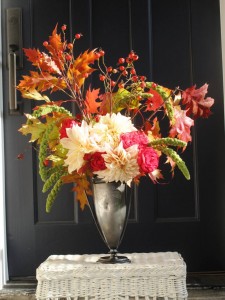
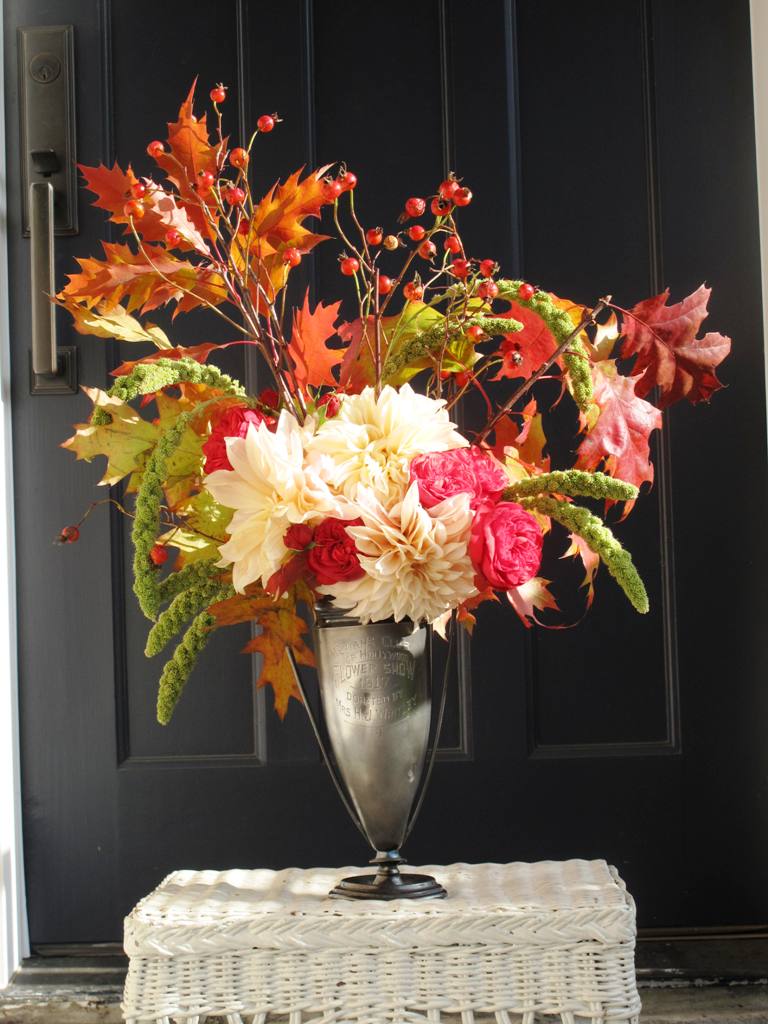
And then, one September day as I was making a bouquet out of burnished autumn leaves, green millet seed heads and the last dahlias of the fading summer, I had a brainstorm that led to the birth of my new book, Slow Flowers. I jotted down some ideas, including this one:
There’s a common misconception that it’s impossible, or at least tricky, to find enough beautiful ingredients in one’s own garden or region during certain times of the year for creating interesting seasonal floral arrangements. Taking the Do-it-Yourself designer’s point of view, I want to disprove that notion by making bouquet-a-week – all year long. My goal is to inspire others to create personal bouquets with what’s at hand, if only they begin to see what’s around them with new eyes.
I launched the project then and there, and continued it for 52 weeks. As each season unfolded, so too did my passion for floral design. My experiment turned into a season-by-season, week-by-week book of ideas and inspiration for gardeners and DIY floral designers.
WHY SLOW FLOWERS?
The idea for the title of this book emerged organically. We had used the term “slow flowers” as part of the marketing for The 50 Mile Bouquet – and to our surprise, nearly every major newspaper and magazine that reviewed the book picked up on it as a reference to a cultural shift in consumer attitudes toward local, seasonal and sustainably-grown flowers.
So when editor Cathy Dees and publisher Paul Kelly and I got serious about finding a book title, Slow Flowers seemed like the “just-right” description of my one-year floral design experiment. Thanks to the culinary pioneers who popularized the Slow Food movement, it now seems like you can put “slow” in front of any term to convey a different philosophy or approach to that subject. When I say the phrase “slow flowers,” there are those who immediately understand it to mean: I have made a conscious choice.
My blooms, buds, leaves and vines are definitely in season; not, for example, grown and brought in from elsewhere around the world during the wet, cold winter months in my hometown of Seattle. So come December and January, my commitment to sourcing locally-grown floral materials sends me to the conifer boughs, colored twigs, berry-producing evergreens – and the occasional greenhouse-grown rose, lily or tulip, just to satisfy my hunger for a bloom.
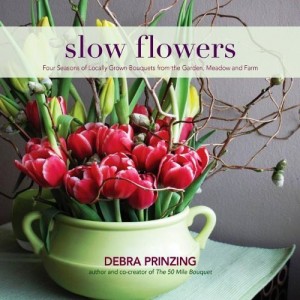
I made my book's cover bouquet using locally-grown tulips and curly willow; the camellia stems (with buds) came from my garden.
Slow Flowers (the concept and the book) is also about the artisanal, anti-mass-market approach to celebrations, festivities and floral gifts of love. I value my local sources. If not clipped from my own shrubs or cutting garden, I want to know where the flowers and greenery were grown, and who grew them. Having a relationship with the grower who planted and nurtured each flower is nothing short of magical. I call so many flower farmers around the country my friends. They are the unsung heroes – the faces behind the flowers we love.
Finally, Slow Flowers reflects life lived in the slower lane. My family, friends and professional colleagues know that it’s almost impossible for me to do anything slowly. I’m the queen of multitasking; I just can’t help myself. There are too many exciting opportunities (or bright, shiny objects) that command my interest. But this “year in flowers” was altogether different. I can only compare it to the practice of praying or meditating. I didn’t realize that those few hours I spent each week, gathering and choosing petals and stems, arranging them in a special vessel, and then figuring out where and how to capture the finished design through my camera lens, would be so personally enriching.
I used all my senses. Unplugged, away from electronic distractions, I studied the form, line, texture, subtle color and utter uniqueness of each stem. What a gift to slow down and experience the moment. I don’t know much about ikebana, the Japanese art of arranging flowers, but I understand that silence and contemplation of nature are part of its practice. I experienced something similar. Slow Flowers forced me to work at a decidedly different pace as I embraced creativity, fearlessly.
I learned about my own preferences, design style and ability to look at the world of floral ingredients in an unconventional way. I learned that I really am a floral designer. Like me, you don’t have to earn a certificate from the London School of Floral Design to create seasonally-inspired bouquets. You can find local blooms in your or your friend’s garden, or from the fields, meadows and farm stands of local flower growers. Each bouquet tells a story about one moment in time, about Grandmother’s cherished flower vase or the fleeting memory that returns with a whiff of lavender or lilac. That’s one of the intangible gifts of bringing flowers into our lives.
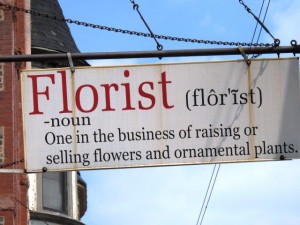
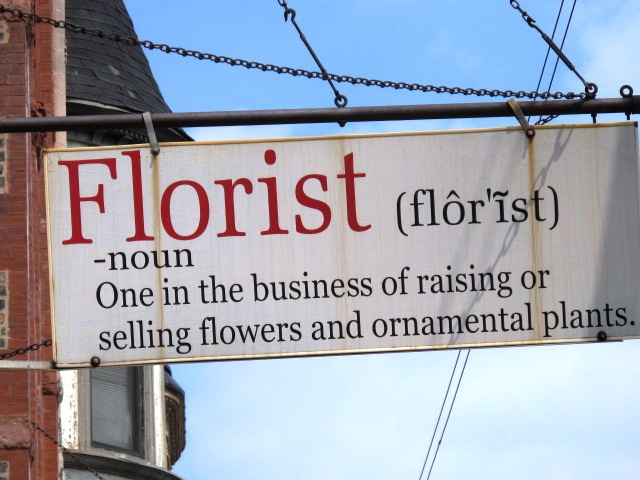
I love the old-fashioned definition of a Florist, appropriately portrayed in a flower shop sign I noticed on a visit to Chicago: “One in the business of raising or selling flowers and ornamental plants.” It underscores my belief that if you grow flowers and ornamental plants, you can also arrange them.
Gardeners are especially qualified in the art of floral design. After all, we have an intimate relationship with our plants, their bloom cycle, their natural form and character – and their seasonality. We also know what colors and textures we like when combined in the landscape. A vase can be a little garden, its contents gathered and arranged to please the eye.
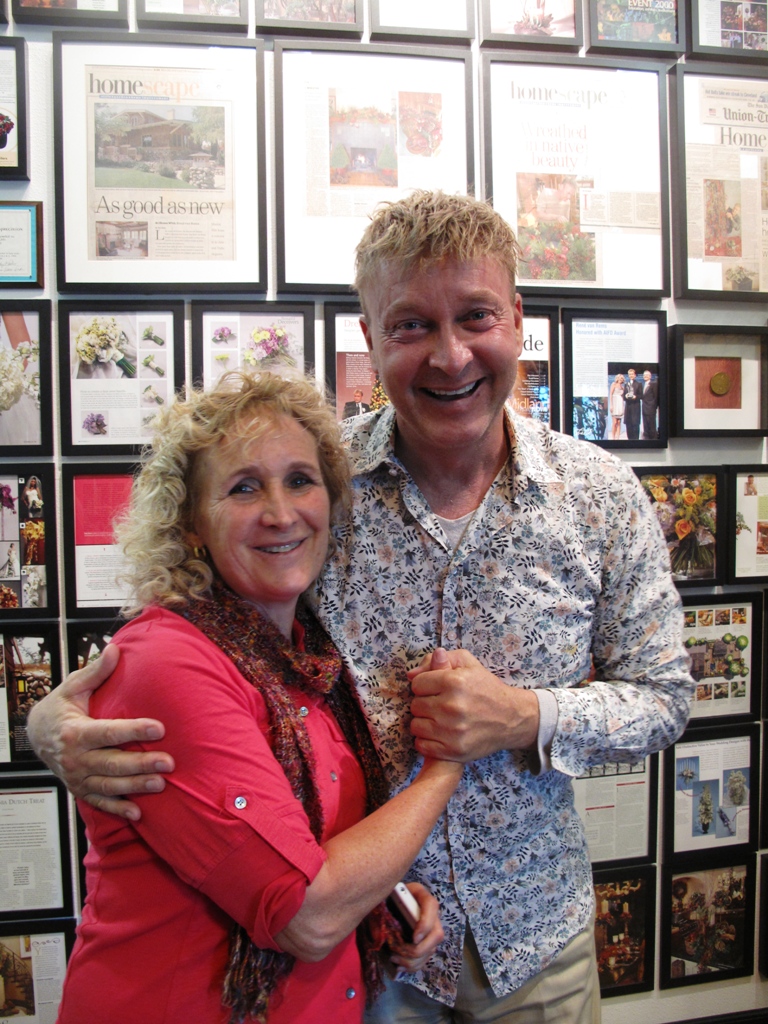
So give it a try. Design a bouquet. Channel your inner floral designer and begin your own year with slow flowers.

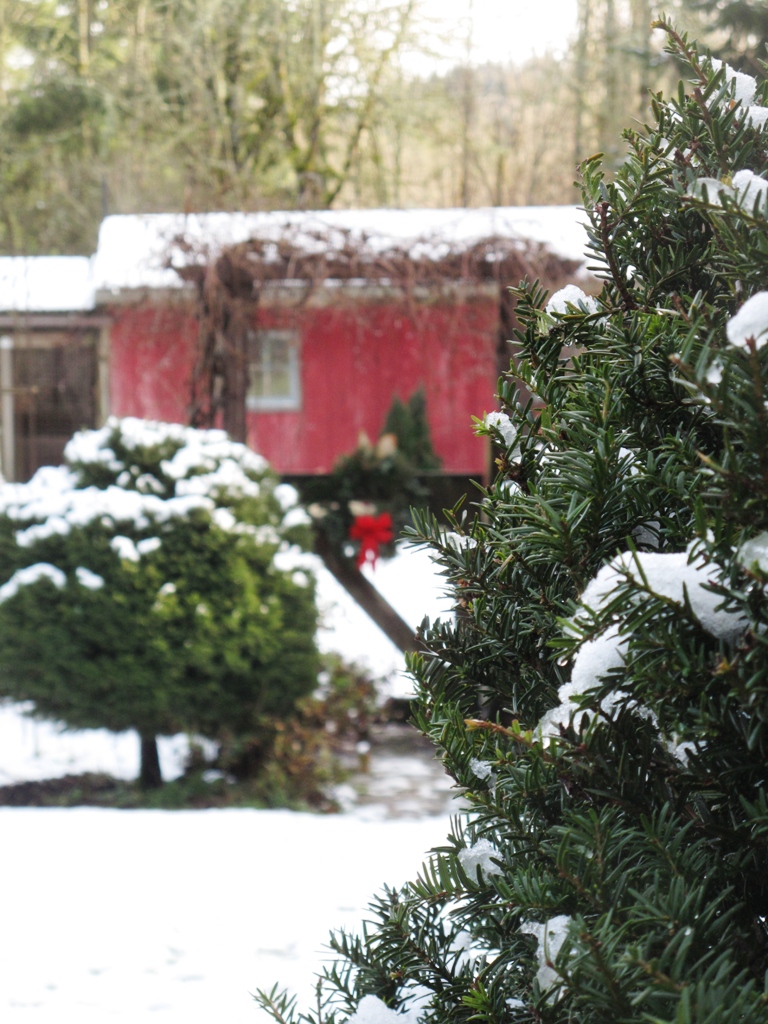
An evergreen yew and topiary forms are frosted with just a little snow on a December afternoon at Old Goat Farm.
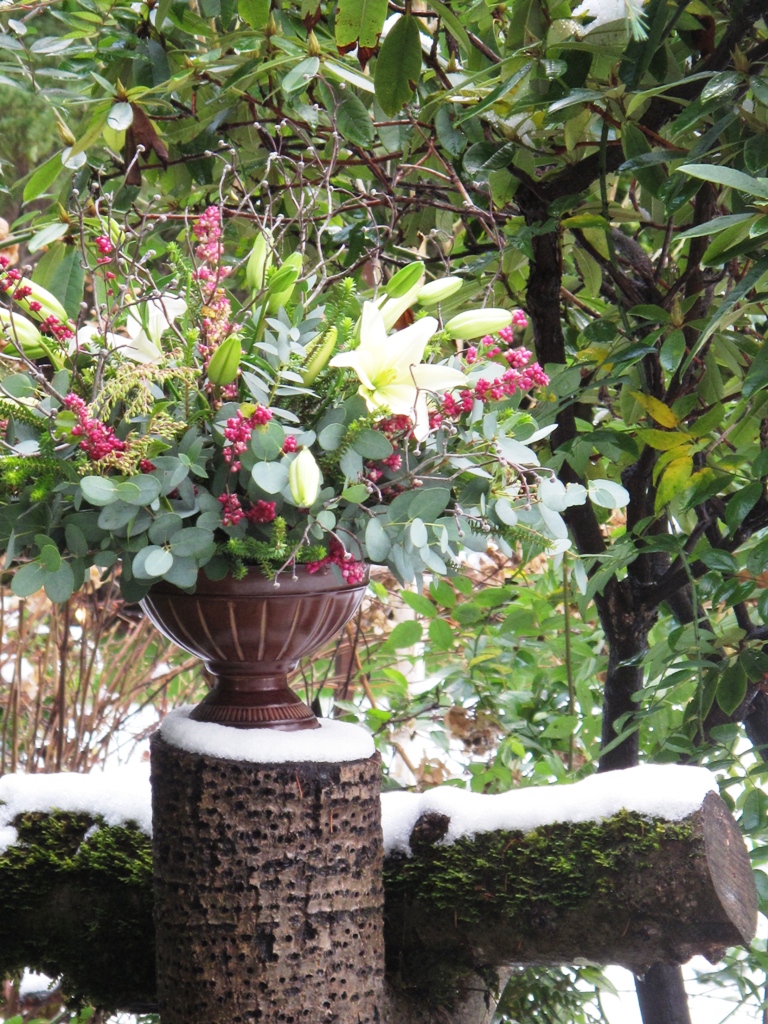
Lorene asked me to donate a seasonal floral arrangement and a copy of The 50 Mile Bouquet to the event’s silent auction. How fun to step out of our car and look across Greg and Gary’s wonderful garden at the sparkling white-and-green scene. There was an old log stump and it seemed like the perfect “pedestal” for placing my bouquet for a last-minute portrait before the party.

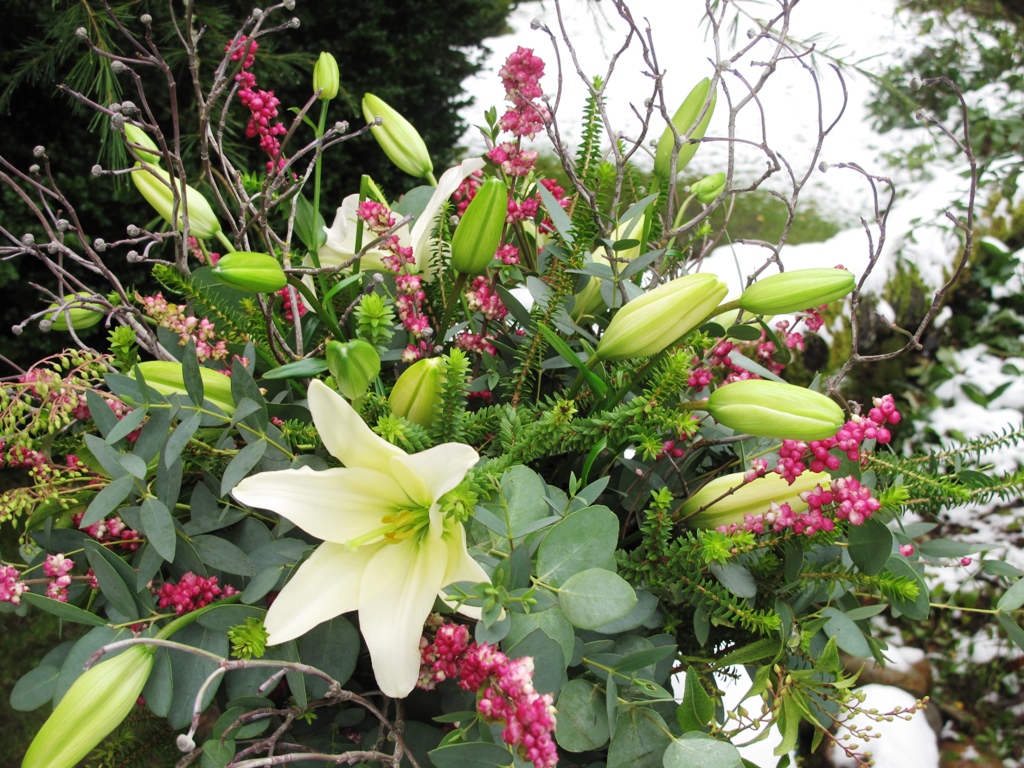
The locally-grown lilies, snowberry, eucalyptus and dogwood branches create a special holiday arrangement. There are a few stems of melaleuca tucked in. I brought them home from San Diego last week!
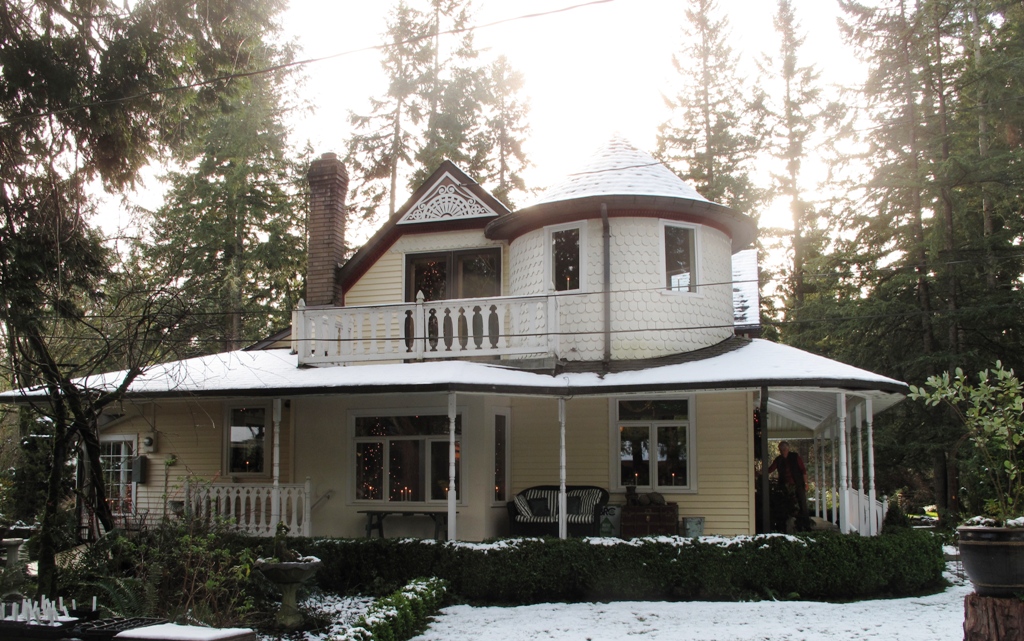
Everything else here sparkled, too. Enjoy the glimpses captured by my lens. And if you want to read more, follow this link to a post from an Old Goat Farm holiday tea from 2010. Visiting at Christmas, seeing the century-old Victorian farmhouse, hearing the clucking chickens and (of course) eating delicious food . . . what a chance to while away an afternoon.

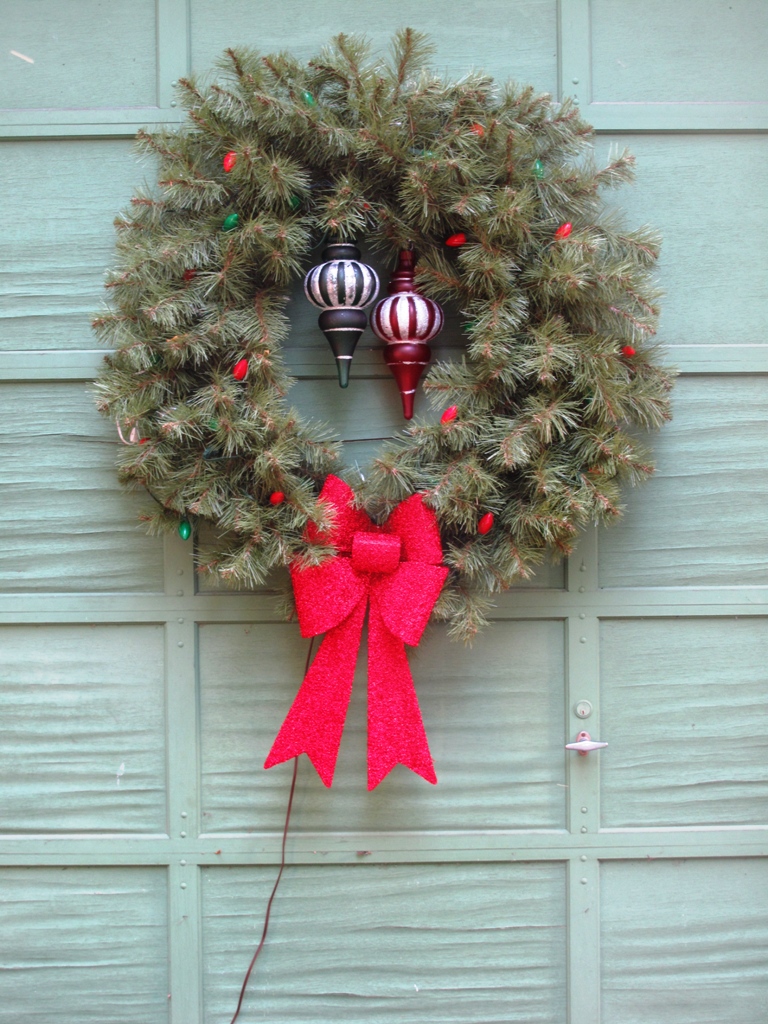
Gary, a talented floral designer and retail display wizard, decorated the barn door with a lovely wreath.

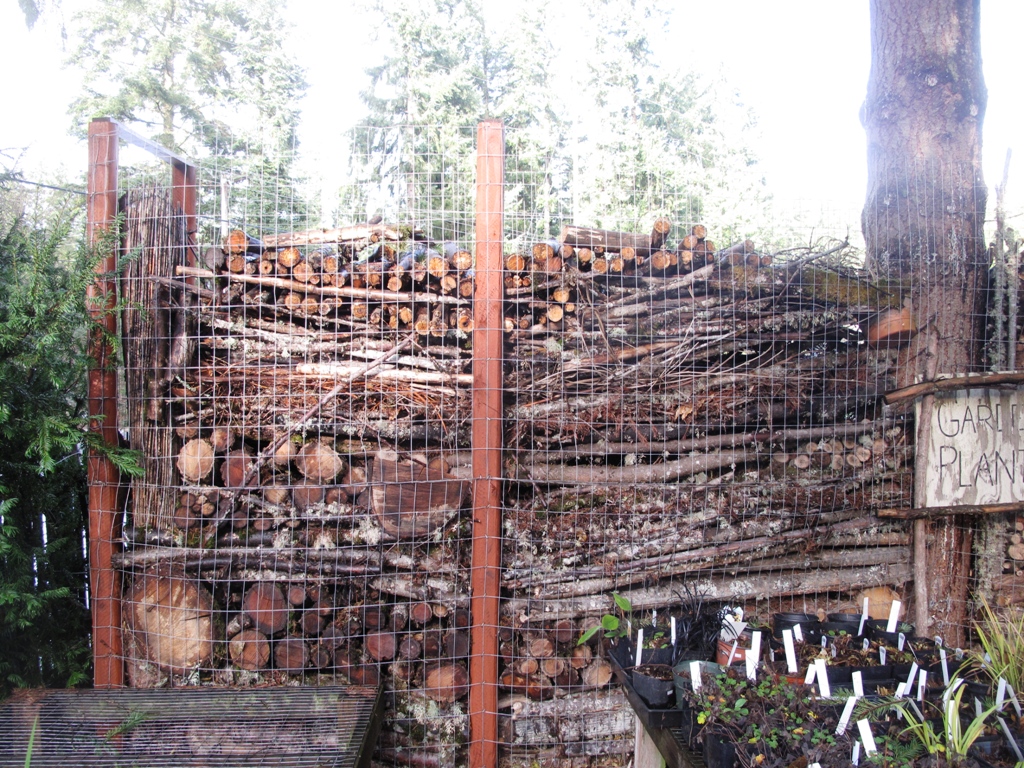
Gary and Greg's famous compost fence. It even made the cover of Pacific Horticulture magazine's fall 2012 issue~
Here’s to a wonderful holiday season! And a New Year to come~
Earlier this week I was hosted by my dear friend and fellow Garden Writer board member Nan Sterman when I flew to San Diego to give a talk to the San Diego Horticultural Society. I love the title that Mary James of SDHS gave my talk: “Bring me Slow Flowers” – a fun play of words on the title of my next book. Using images I’ve shot over the past several years, my lecture incorporated concepts from The 50 Mile Bouquet and Slow Flowers.
Here are the highlights of my (almost) 72 hours in San Diego:
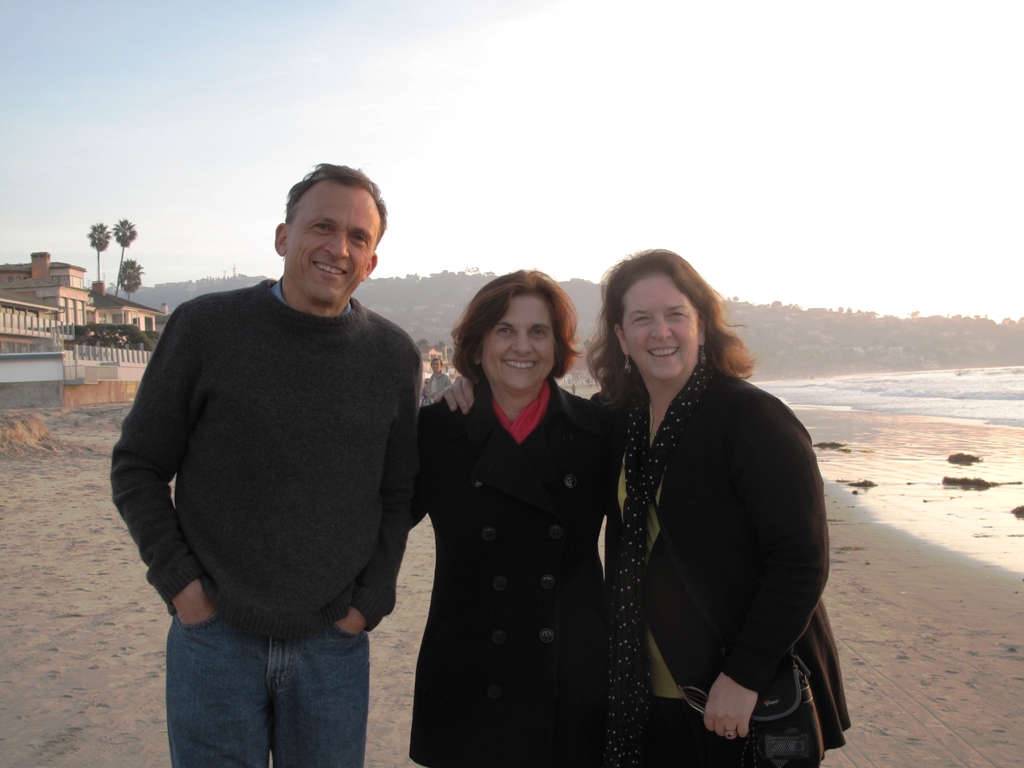
First, I visited Hasan and Ayse Kayali, some of our oldest friends from college days. My husband Bruce and Hasan were jumpers (long/triple) for Harvard’s Track Team back in the day and we never, ever get to spend enough time together. However, all of us were together in Tuscany in 2009, for a week at Villa Maddalena in the town of Montisi. That was pretty special. After a late, but delicious, lunch, we took a walk on the beach at La Jolla Shores.
After I said good-bye to the Kayalis, I headed to Encinitas, just a few miles north. Nan Sterman and Curt Wittenberg welcomed me with a flavorful Moroccan chicken dinner prepared by Curt, and we stayed up way too late just talking. Nan and I figured out that after this month (December), we will see one another in January (GWA Winter Board Meeting – Austin, TX); February (Northwest Flower & Garden Show – Seattle, WA); March (SF Flower & Garden Show – San Mateo, CA); April (when I’m back in San Diego to speak) . . . and of course, in August, when our GWA annual symposium heads to Quebec City. Nice to anticipate!
On Monday morning, I headed over to Carlsbad, Calif., to visit the very famous René van Rems, a world-class floral designer and friend of Nan’s.
I’ve known of René because of his books (including René’s Bouquets: A guide to Euro-Style Hand-Tied Bouquets) and others. He is an internationally recognized designer, consultant and instructor, born in Holland, but based in San Diego for the past 30 years.
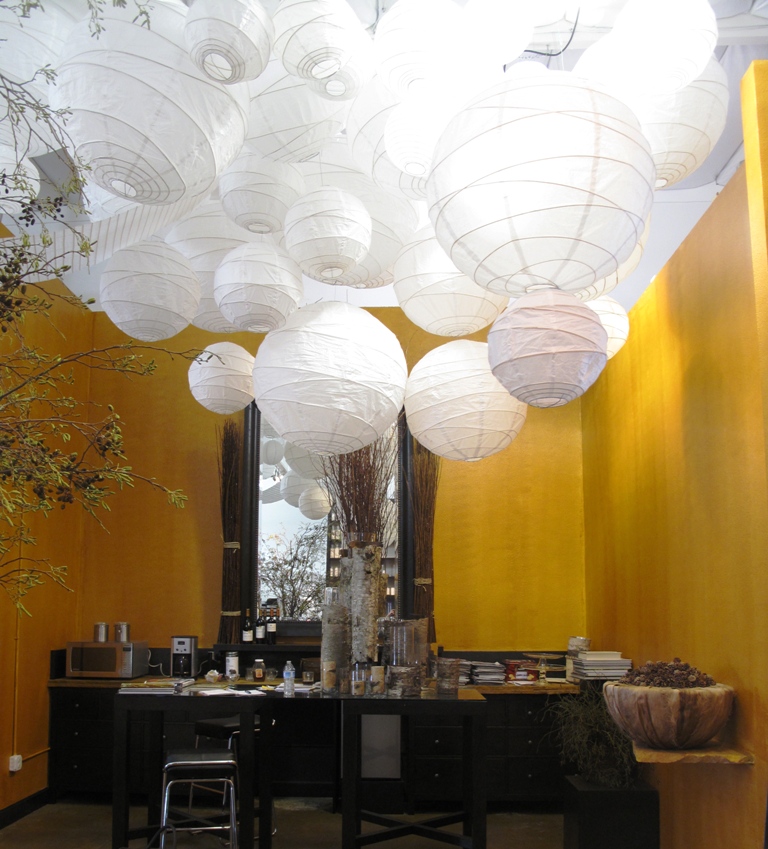
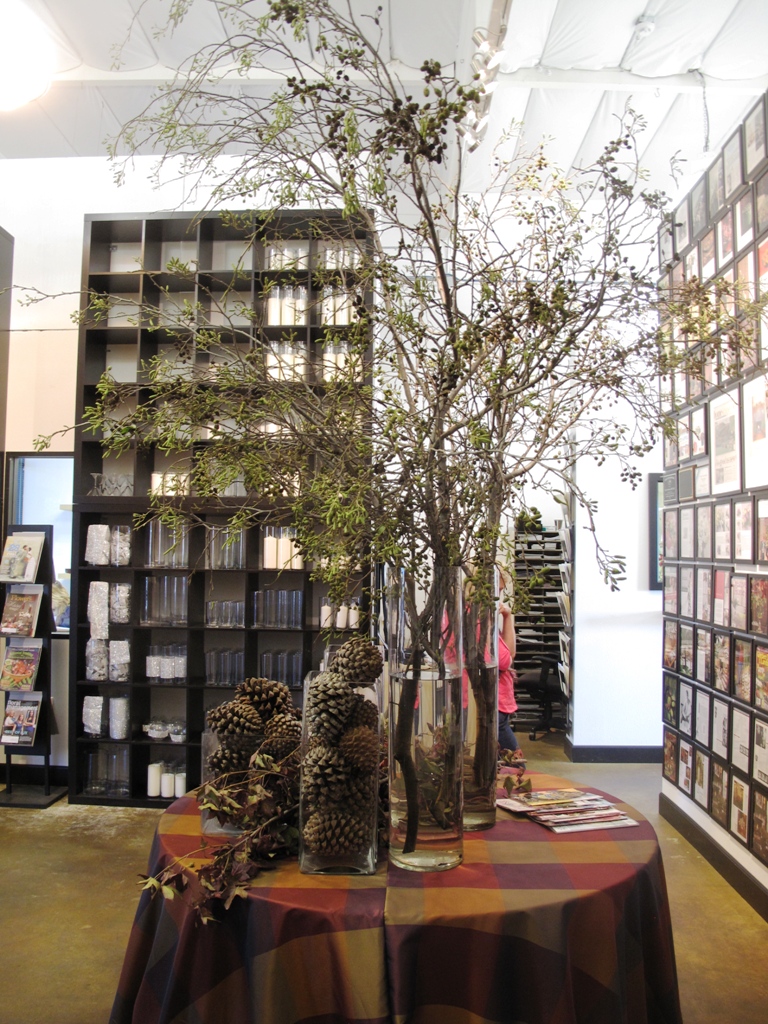
Last year, René established a new studio in Carlsbad, north of San Diego. I was so impressed with the interior space – as you can see here. It’s suitable for large-scale production for big events, for René’s many floral design workshops, and for private events. René considers himself to be in the “business of creativity,” and he loves to teach everyone – from the DIY flower-lover to the professional who participates in his advanced Master Classes.
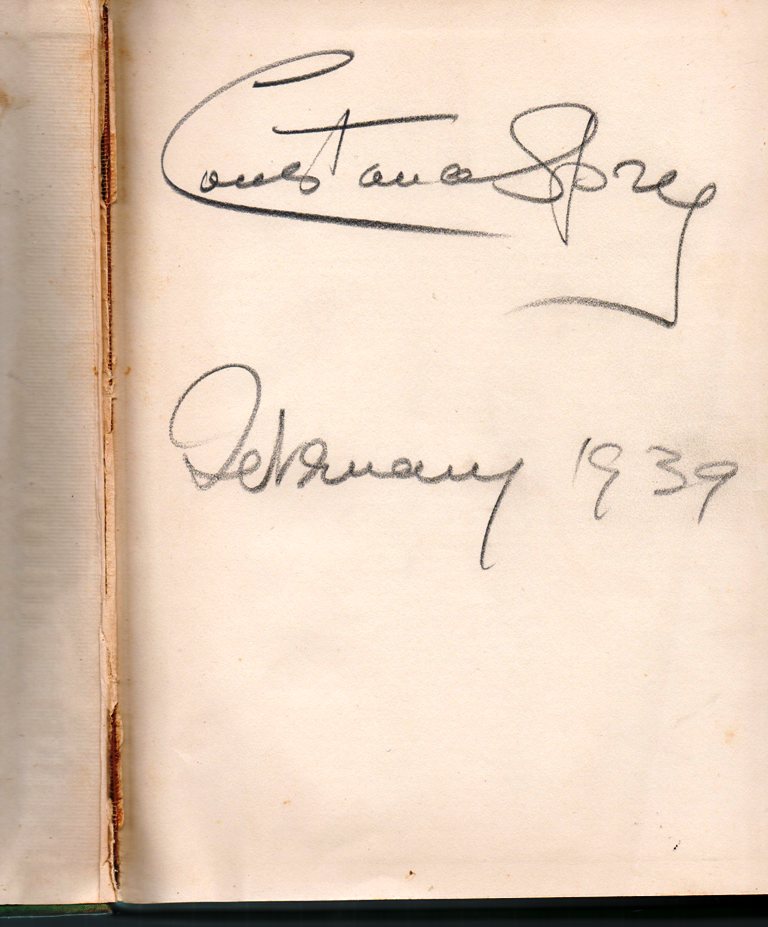
René signed and gifted me two of his recent books — the hardback version of René’s Bouquets and his way-cool new book: Rene’s Bouquets for Brides. I felt a little inadequate giving him a signed copy of The 50 Mile Bouquet, but he was quite gracious about it. And, he was very kind to come and attend my lecture that evening. Please check out René’s beautiful work at his website, here.
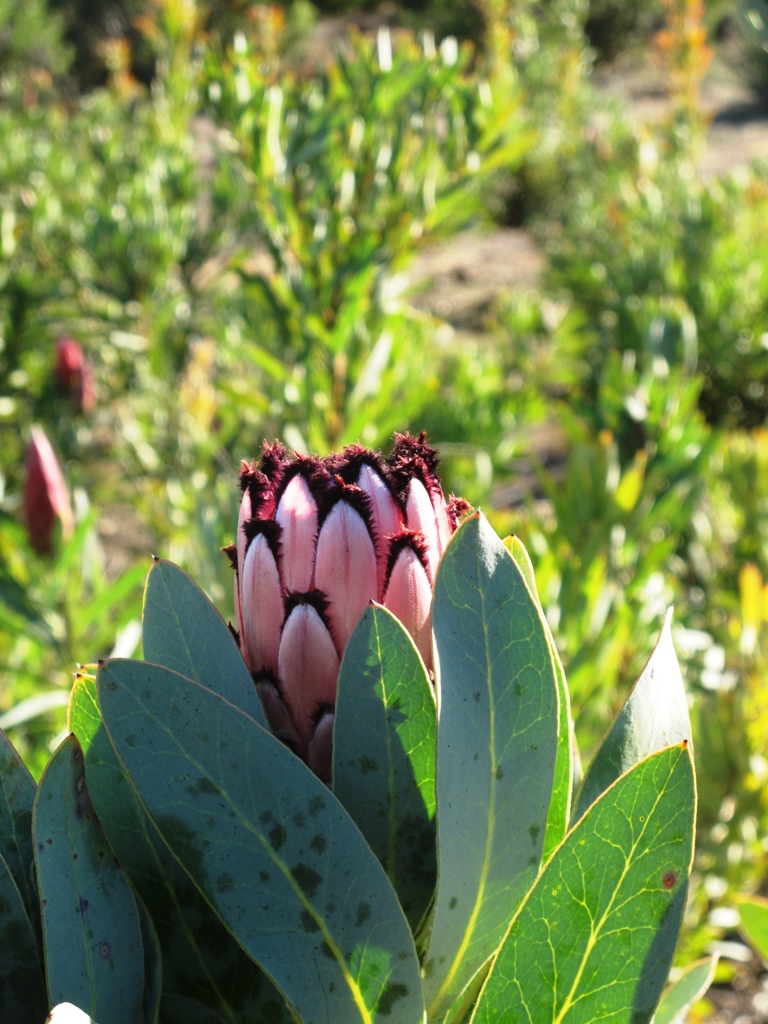
Nan picked me up around lunchtime and we headed out to Fallbrook, Calif., about 45 minutes east of Carlsbad. We were on a floral mission: To visit Rainbow Protea, an exotic cut flower farm that grows South African and Australian flowers in the Proteaceae family.
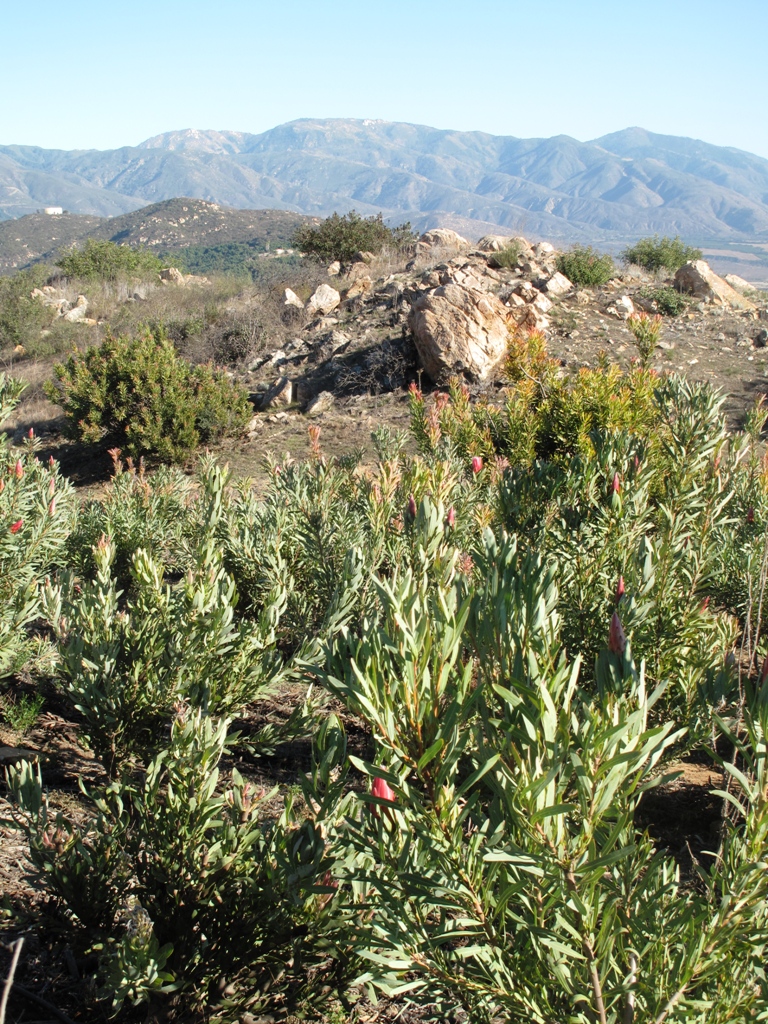
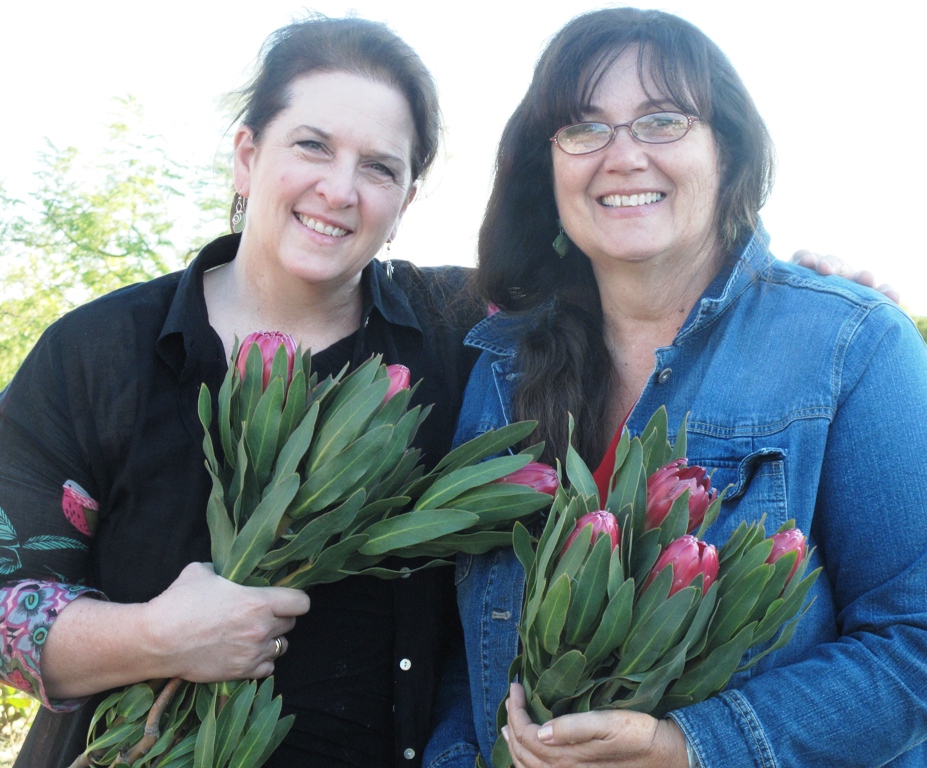
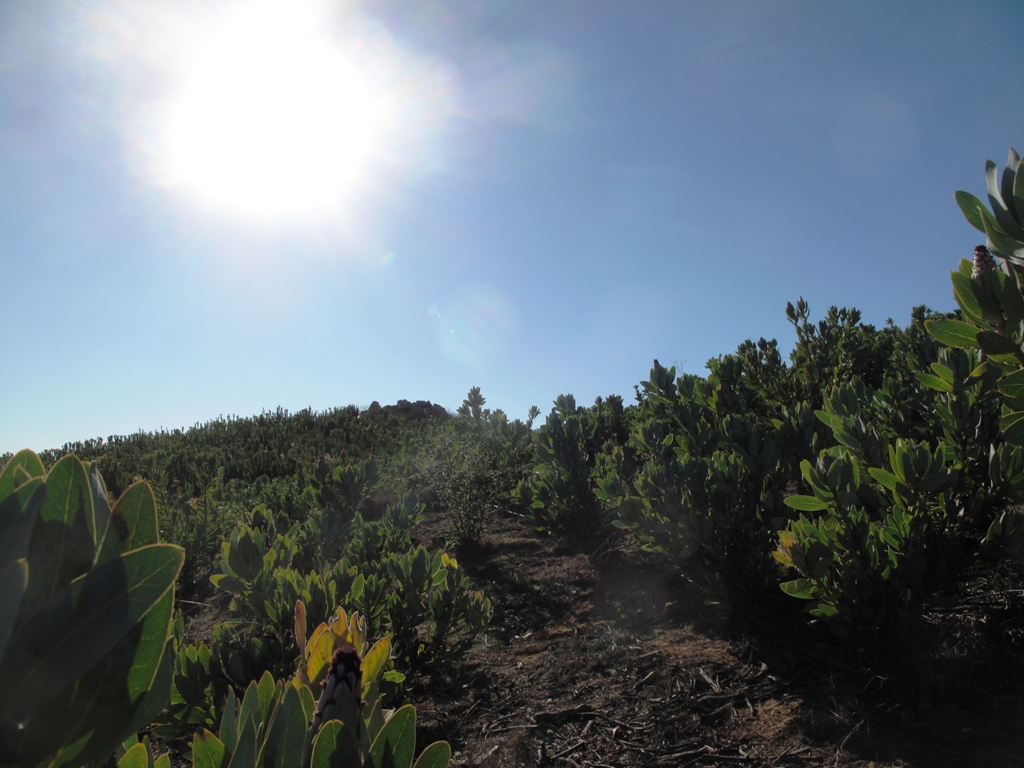
A special thanks to Dawn Bonner, whose family owns Rainbow Protea, and to sales & marketing whiz, Kim Jernegan, who hosted us. Kim loaded Nan and me into a pickup truck and we traversed the bloom-filled hills of the 198-acre farm on a brilliant December afternoon.
Rainbow Protea began operations in 1985. While some may liken the hilly terrain approximately 20 miles inland from the Pacific Ocean and 60 miles north of San Diego as “similar” to South Africa, Kim begs to differ.
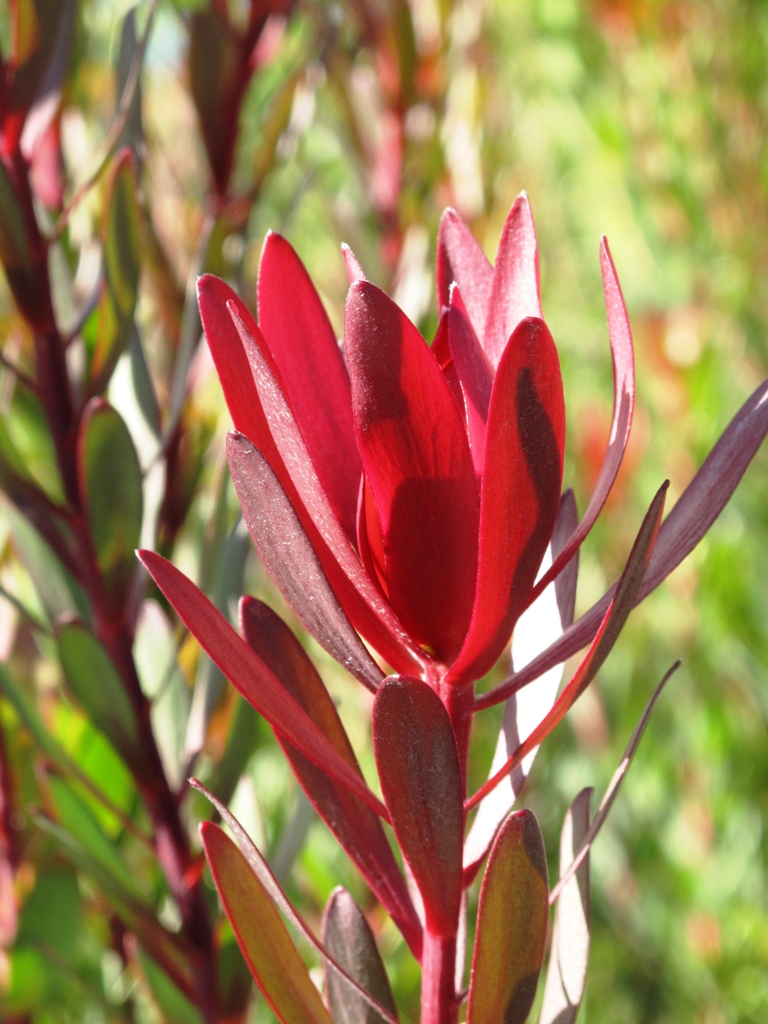
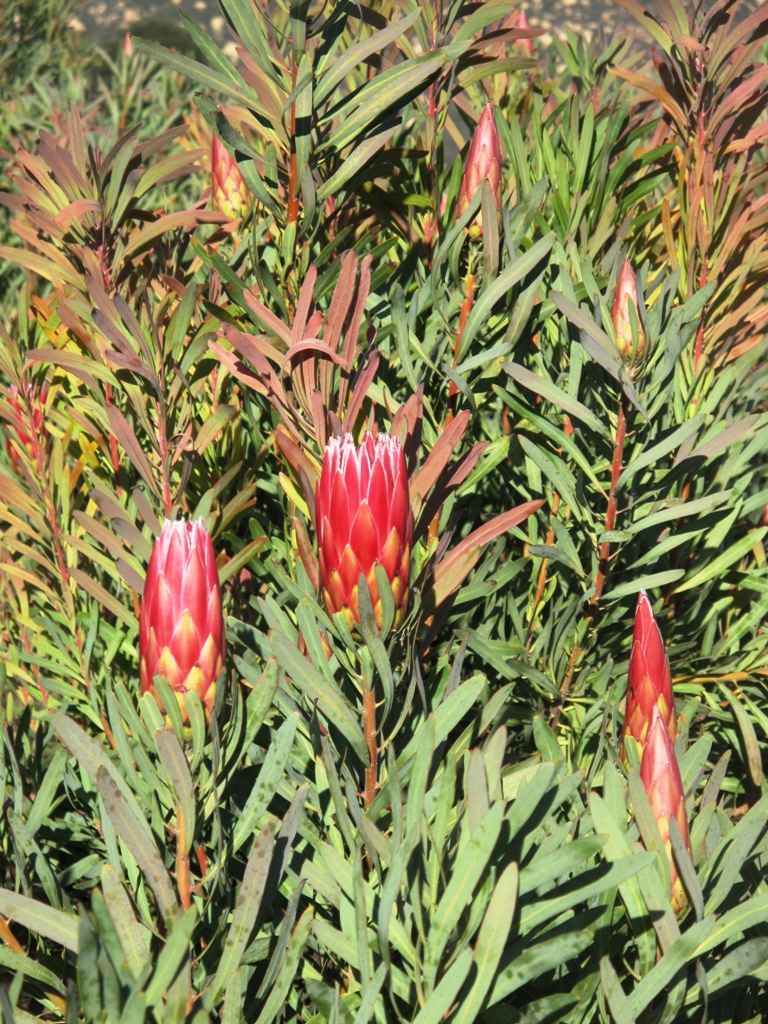
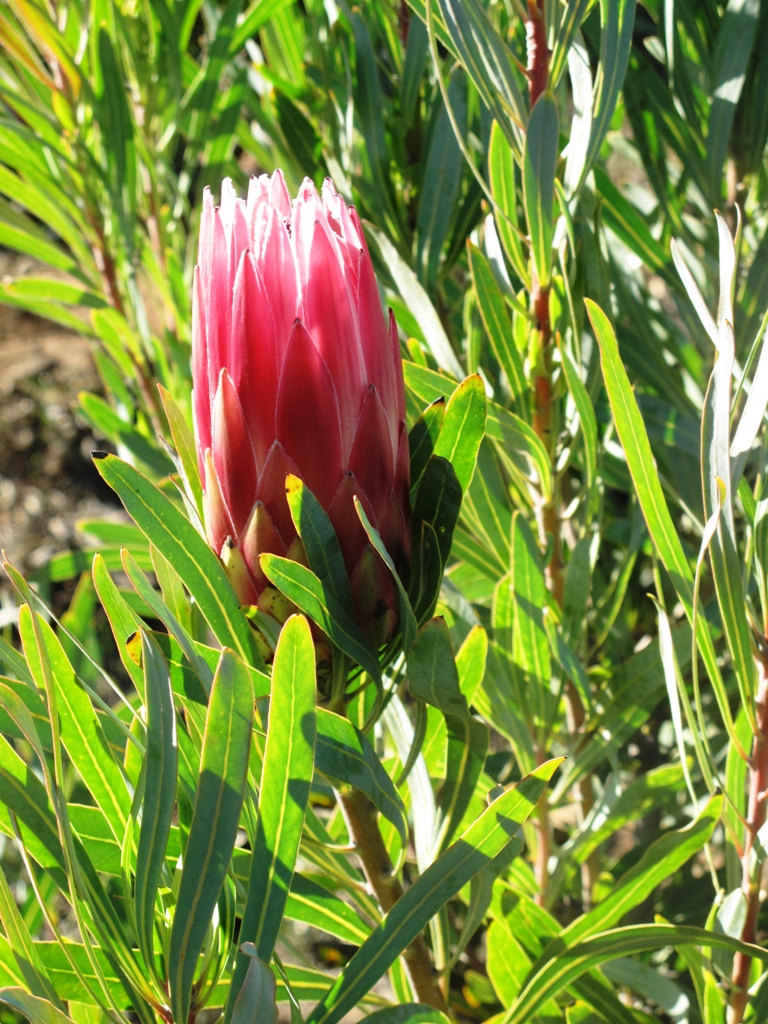
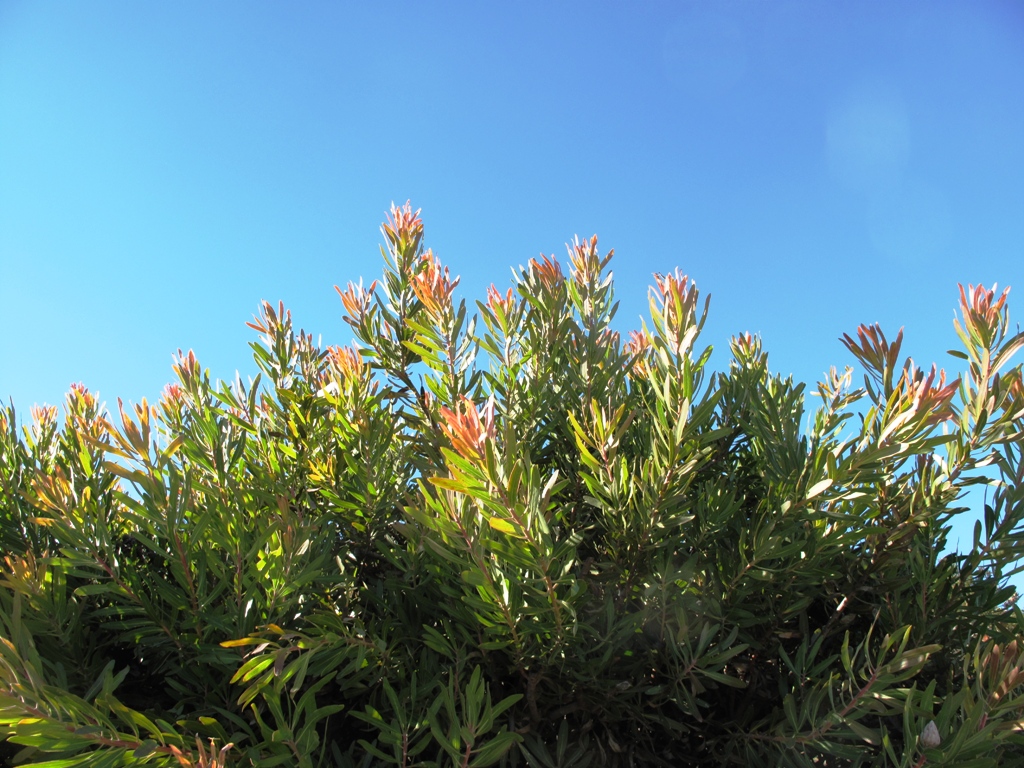
She points out that to grow thousands of flowering sub-tropical shrubs — Protea, Leucadendron, Leucospermum, Banksia, Leptospermum, Chamelaucium (Wax flowers), Anigozanthos (Kangaroo Paws) and other Mediterranean specimens — the farm’s crew has to use an auger-style drill and major amendments.
Those include primarily organic addititives such as fish fertilizers, worm compost, compost tea and kelp products.
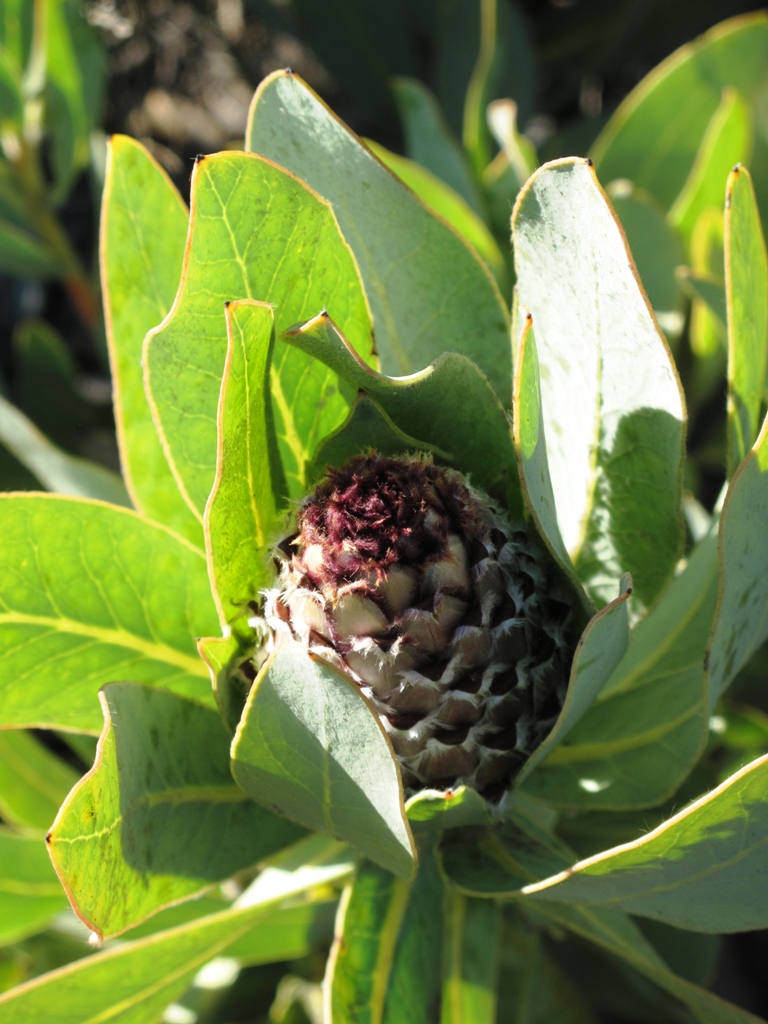
Enjoy my photographs of the plants that earned my affection.
Kim sent me home with a bountiful box of blooms, which I have been enjoying all week.
The wonderful thing about these exotic members of the Proteaceae family is that they are VERY long-lasting in the vase.
You need to re-cut the stems and refresh the H20 every two to three days; but then you can plan on having an exotic, modern-looking arrangement for weeks and weeks.
Finally, I was welcomed by the members of the San Diego Horticultural Society. I felt like the room was filled with kindred spirits – gardeners who want to learn more about the plants they grow; people who are eager to try new things, including floral design. A great visit – and one that I will always cherish. Nan, Curt, Karen Bussolini (a writer/photographer friend who was in town, visiting from Connecticut), Bonnie Manion and I closed down the night with a late dinner at Il Forniao. Very satisfying!
Before I left the following morning, I squeezed in a visit to fellow garden blogger Bonnie Manion of vintagegardengal.com. I first met Bonnie in 2009 when Country Gardens magazine asked me to write about her vintage container designs for spring bulbs. The story was called “Tour de Forced Bulbs.”
Later, after we moved from Seattle to Southern California, Bonnie and I finally met in person – and we had several fun adventures, including our day-trip to the Long Beach Flea Market with Lorene Edwards Forkner and Kathy LaFleur. Bonnie is an amazing designer, writer and winemaker (with her husband John Manion). While our time was short, I was tickled to spend a little time with her, touring their newly renovated home, barn, barrel room and more…and talking about the book-biz, blogging and gardening.
Look for exciting things coming from Bonnie in the near future, including a new book on keeping chickens!
Okay, enough for now. Please enjoy these photos and check out all the people I’ve highlighted in this blog post.

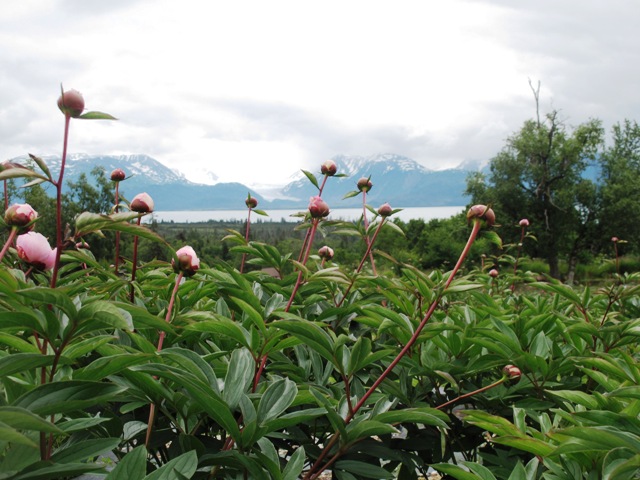
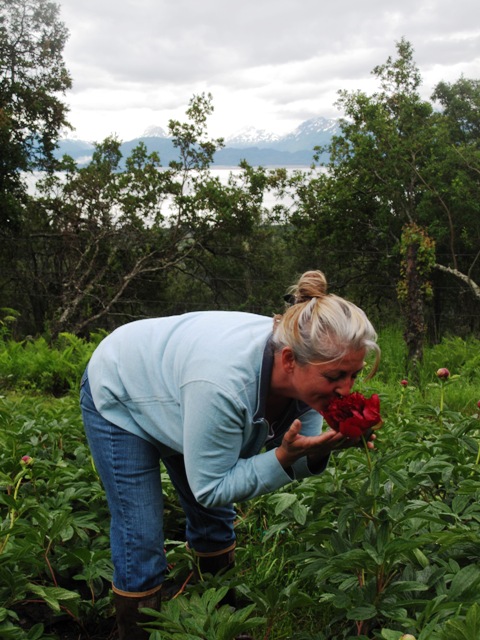
Seriously the most spectacular sight I've ever witnessed: Peony fields in the foreground. . . Glaciers in the distance! Taken at Shelley Rainwater's GLACIER PEONIES in Homer, Alaska
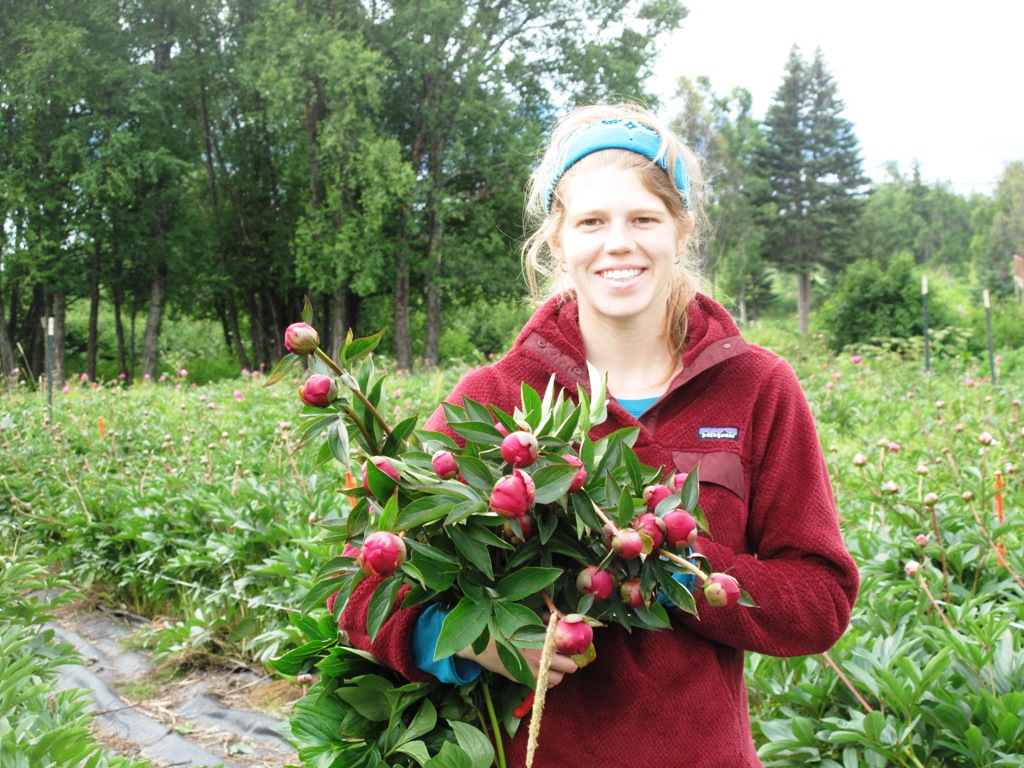
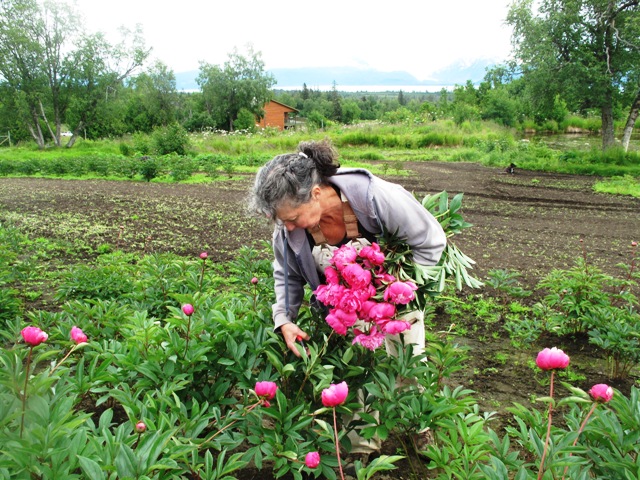
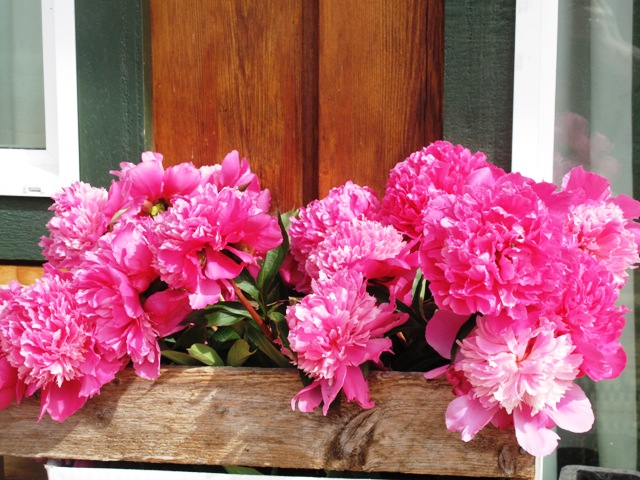
You probably didn’t think it was possible to use the words Peonies and Alaska in the same sentence, but guess what? There are acres and acres of peony fields, flourishing in June and July as far north as Fairbanks (Latitude 64). A little further south, peonies bloom in Homer until August and even early September. The cool thing about this chilly state is that an intrepid group of farmers is making a cut flower industry possible. These flower lovers have seized the opportunity and created a market for their lovely crops at the exact same time when a huge percentage of weddings takes place in the Lower 48.
It’s a sweet spot you rarely see these days. After learning about Alaska’s emerging peony scene in 2011, I set my sights on a first-person trip. In late July, I spent one week there, logging more than 1,500 miles on Alaska’s highways and byways (and a few dirt roads to nowhere!), visiting 15 peony farms and meeting with dozens of wonderful people behind the blooms. I came home totally enthralled with the can-do mindset of flower farmers everywhere, especially in Alaska where no one expects you to grow anything except those oversize cabbages that win blue ribbons at the state fair.
Peonies are one of the top bridal flowers in the country, according to The Knot and other industry sources. Yet here in the lower 48 states, peonies peak in late May and early June. If you are a bride yearning to hold a bodacious bouquet of peonies on your special day in July, August or September. . . you are simply out of luck. The next chance for peonies comes in the fall, around October, when they bloom on Australia and New Zealand flower farms – and have to be shipped to you at outrageous expense and a serious carbon foot print.

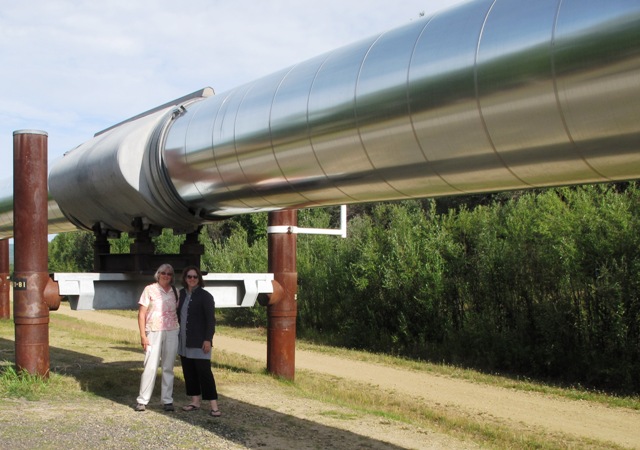
Pat Holloway, left, and me - standing underneath the Alaska Pipeline in Fairbanks. Kinda scary, but I couldn't resist the photo!
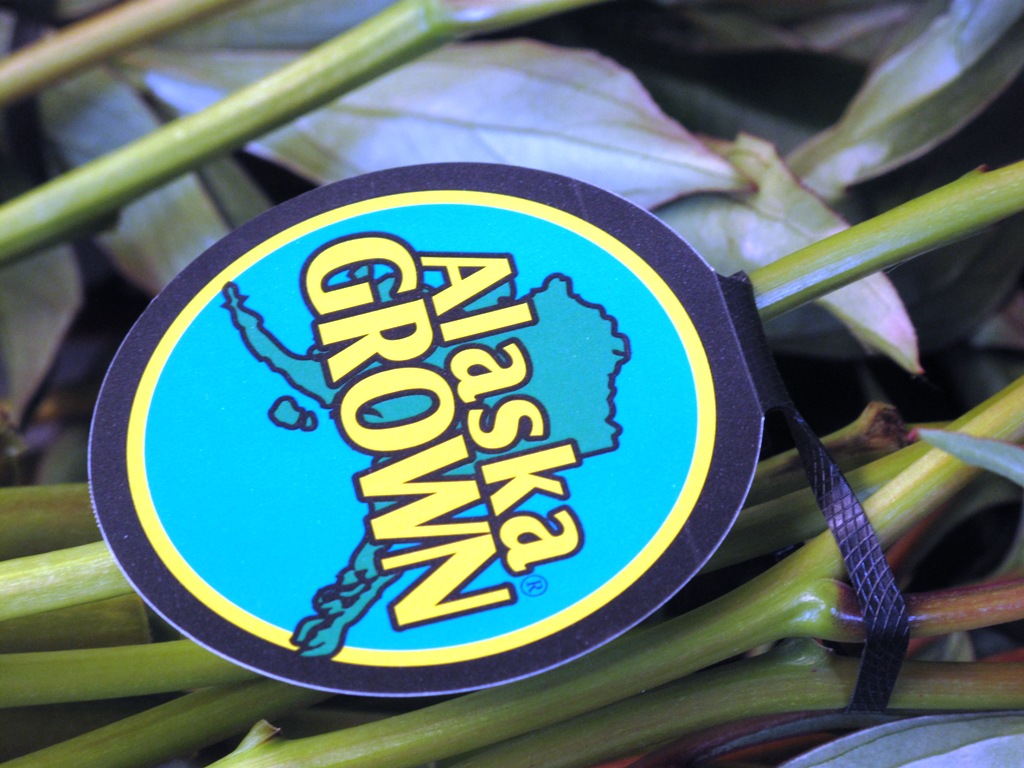
So when the folks in Alaska, inspired by the research of Pat Holloway, a professor in the department of high altitude agriculture at U of A/Fairbanks and the Georgeson Botanic Garden, discovered they could grow peonies and harvest them in July and August, well, they literally created a brand-new seasonal flower crop. The marketplace has responded with a voracious appetite for the pale pink, coral, cream, wine and hot pink blooms. Brides and their floral designers are jumping for joy – and Alaska has its first agricultural export crop. Not fish. Not oil. But PEONIES!
This micro-flower story has taken place in less than a decade, gradually at first, as a few folks planted a few hundred peonies on an acre or two. Then, armed with Pat’s research and information gleaned from her workshops on growing and harvesting, more growers joined the movement. Like many perennials, peonies take at least three years to become productive, so it has only been in the last year or two that significant quantities of blooms have been cut and shipped out of state.
The numbers are exploding, though – and an informal statewide survey suggests that about 100,000 stems were shipped this summer. There are about 150 members of the young Alaska Peony Growers Association, with about one-third of them actively growing and marketing their flowers. The rest are just getting started, ordering peony roots by the thousands and patiently tending to the plants until they explode in beauty (and quantity) over the next several seasons.
If you are wondering “what’s so special?” about these flowers, I can only tell you that there’s some kind of fairy dust in the soil, air, sunlight and altitude of Alaska that adds up to robust, healthy and vivid flowers. Some have stems like you’ve never seen before – 30-inches long or more. The foliage is healthy and true green; the petal colors are intense when you want them to be and subtly quiet when that’s preferred (in other words, better than the catalog photos!). These plants are extraordinarily responsive to the 22-hours-of-sunshine in the land of the midnight sun – and the sunlight seems to be that secret ingredient for the flowers’ success.
There are many ways that these luscious blooms make their way from North Pole, Palmer, Soldotna or Homer to the designers and florists in New York City or Los Angeles (and many places in between). Yes, there is a carbon footprint to shipping peonies on an airplane from Anchorage to the rest of the United States.
But as Pat Holloway pointed out to me: “For years, I had been saying, Isn’t there something we can stick in a box and ship to someone on all those (empty) planes?” You see, when combined, the international airports in Anchorage and Fairbanks are ranked as the third-largest air cargo transport stop on the globe. The combination of superior cut flowers — available nowhere else on the planet for nearly 10 weeks — and the necessary transportation infrastructure to deliver those flowers to the world adds up to floral magic of a different sort.
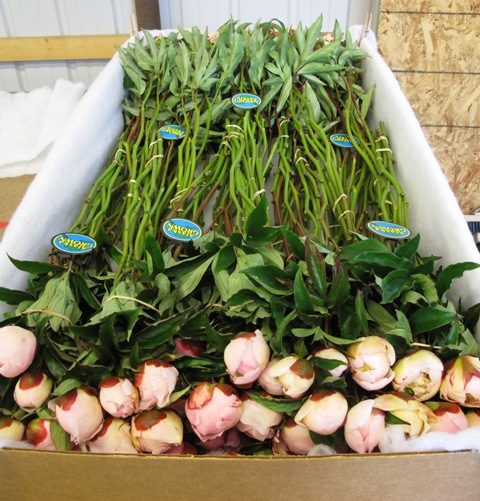
The growers typically harvest to order, fulfilling online requests, phone calls from anxious DIY brides, faxes from desperate floral designers — all who have joined the peony gold rush. Alaska has what they need. The flowers are harvested in the cool mornings or late in the day, stored in buckets of water and placed inside coolers large or small. The packaging is thoughtfully done. Stems of peonies “in bud” are swathed in soft quilt batting and arranged carefully in long boxes where there’s space for an ice pack or two. Then off they go, sent overnight so the recipient can enjoy his or her flowers as quickly as 24 hours after they were cut.
Peonies are pretty remarkable flowers. They can be “dry-stored” after having been cut when in bud (some growers call this the marshmallow stage; others, the cotton ball stage).
Pat’s research has evaluated the relationship between time stored at this stage and the vase life of the blooms once they’re placed in water. You can read some of her research here. One study found that “under optimum conditions, ‘Sarah Bernhardt’ peonies lasted up to 15 days in a vase, 8-9 days from bud break to full bloom, and an additional 5-6 days in full bloom. Chilling is the most important attribute to long vase life.”
Yes, there is an acknowledged carbon footprint associated with shipping Alaska’s peonies to other states. But the energy and expense to do so is significantly lower than the alternative (such as importing from New Zealand or Holland). And to me, here’s the bottom line: It’s exciting to support a new, viable domestic flower industry that’s meeting demand, filling a need, and bringing beauty to the rest of us.
When I was visiting Fairbanks, Pat hosted a barbecue for me to meet several peony farmers in the Fairbanks area. A few local officials came, as well, intrigued to learn about the economic development story under their noses. Later, Pat shared an email one of them had sent to his constituents:
“Two things make Alaska uniquely situated to become the single seasonal source for peonies. First, nowhere else but Alaska can farmers grow crops of peonies that bloom through the summer, especially for late summer weddings. Traditionally, there have been no peonies available for sale between July and September. Second, Anchorage provides critical shipping as the world’s largest handler of international air cargo. These two aspects give Alaska 100% exclusive access to this worldwide market. . . .
“This is just the beginning for growers in Alaska. There is a demand for tens of thousands of stems worldwide and we are in (an) excellent position to develop this outstanding and diversifying product.”
The Alaska Peony Growers Association has a one-stop web site in which you can connect with dozens of growers. Of course, the season is pretty much over, but it’s worth contacting the peony farms to get on their mailing list and ask about pre-ordering peonies for the 2013 season. These farmers are so happy to help you – so excited to know that their flowers are bringing floral beauty to the rest of the country. I encourage designers to make those important contacts now so that next year, when wedding season rolls around, you’ll have access to superior American-grown peonies during the busiest wedding months.

Bess Wyrick of NYC-based Celadon & Celery created this gorgeous bouquet and delivered it as a gift from me to Lara Spencer of Good Morning America.
My publisher actually asked me if I could get Martha Stewart to write an endorsement “blurb” for my new book, slow flowers.
I know he thinks I’m superwoman, but really? That’s a tall order!
So then I started thinking…who can I ask for a word of endorsement?
And Lara Spencer came to mind. Lara is the gorgeous, talented and funny “lifestyle anchor” for ABC’s Good Morning America.
Even as Lara is dressed in designer gowns covering red carpet events and interviewing celebrities, she is at heart a passionate design maven, a bargain-hunting thrift-store gal.
When I met Lara in 2009, I was working for the LA Times. I visited her mid-century-era Beverly Hills home to report on the incredibly beautiful makeover she had conjured up. It was a la Hollywood regency, but the best part of our story included Lara’s secret sources. Ebay, Craig’s List, Pasadena Rose Bowl – she has the nose for the bargain to be sure!
Now Lara has left her LA gig as host of “The Insider” to join Good Morning America. Oh, and did I mention? She’s also the host of the “Good Afternoon America,” ABC’s new daily show?
In order to let Lara know about my new book project, I knew I needed to make a big splash. So here’s what I did:
1. I put together a package that included a copy of The 50 Mile Bouquet, as well as all the great press stories we’ve received from major newspapers like the New York Times, San Francisco Chronicle, Dallas Morning News, Better Homes & Gardens, Garden Design and more.
2. I shipped it to my floral designer friend Bess Wyrick, of Celadon & Celery. “Bess,” I wrote. “Can you make a LOCAL floral arrangement and deliver it to ABC Studios with my package?”
3. Bess did not disappoint. She created this yummy bouquet of locally-grown hydrangeas and delivered it to Lara Spencer a few weeks ago with my package of clips and the book. Since then, Lara and I exchanged messages on Twitter – she LOVED Bess’s flowers – and The 50 Mile Bouquet.
4. That was followed by a series of calls and emails to Lara’s talented producers -Sabrina and Kelly. These women did the legwork to make sure ABC’s legal department could “sign off” on Lara contributing a blurb to support my new book. Today, I got the YES! the Green Light!
Here’s Lara’s blurb:
And so, I owe a HUGE thanks, not just to Lara, whose kindness and friendship is incredibly sweet, but also to Bess, floral designer extraordinaire, for all her legwork! And to Lara’s producers, Sabrina and Kelly.
See? It really does take a village of women – supportive, encouraging friends – to make things happen.
There’s a sequel to The 50 Mile Bouquet and you will be able to hold it in your hands come February 1, 2013!
Above, you see the cover mock-up featuring my photo of a simple arrangement I created for a 2011 Northwest Flower & Garden Show demonstration. My green urn holds two types of locally grown tulips from Alm Hill Gardens in Whatcom County, as well as curly willow branches and camellia branches from my former garden. Simple and graphic. Gorgeous cover art designed by Holly Rosborough, St. Lynn Press’s art director.
Yes, the good news is that St. Lynn’s Press will publish SLOW FLOWERS: Four Seasons of Locally Grown Bouquets from the Garden, Meadow and Farm. The book features 52 weeks of seasonal floral arrangements created and photographed by Moi!
Here’s the book’s description:
The slow food movement (with its hundreds of thousands of members and supporters) has changed our relationship with the foods in our lives. Now the slow flower movement is changing the way we think about cut flowers: Yes, we’d all prefer fresh, fragrant flowers in our bouquets, not the chemical-laden “undead” blooms flown in from afar – but what to do in those seasons when not much is growing locally? Debra Prinzing challenged herself to create a beautiful, locally grown bouquet for each of 52 weeks of one year (going beyond flowers to include ornamental twigs, foliage, greenhouse plants, dried pods, and more), to demonstrate that all four seasons have their own botanical character to be celebrated. She provides extensive design tips, bouquet “recipes” and region-by-region floral ingredient lists that can be found in all climate zones through the year. Slow Flowers is written from a DIY floral designer’s point of view, to inspire anyone to go green and make a beautiful bouquet with what’s at hand, no matter the season.
More details to come, but you can help me out by pre-ordering a copy on Amazon. Yeah!!!
© Debra Prinzing, all written and photographic content. Website design/development by Willo Bellwood/Metric Media