Debra Prinzing

Get the Email Newsletter!

Archive for the ‘Playfulness’ Category

The Venice Garden Tour Vibe

Saturday, May 2nd, 2009

venice001

Today – May 2nd – is the 16th annual Venice Garden and Home Tour, which is a hip, happenin’ kind of tour serving up no fewer than 30 properties. For $70-per-ticket, that averages about $2.50 per garden, so when you look at it that way, it’s well priced. Plus, who can argue with the deserving beneficiaries? Children! The tour raises funds for the Neighborhood Youth Association of Venice, which operates Las Doradas Children’s Center, a licensed childcare facility that serves working families.

Along with tour producer Barbara Baumann and co-chair Adri Butler, I previewed several of the properties a few weeks ago and wrote about four of them for today’s Los Angeles Times.  Due to s-p-a-c-e limitations (surprise!), there is only room for one mini-feature in the print edition. You have to go to the online gallery to get a peek at how the staff photographers captured the three other gardens.

Here are the four gardens we profiled, complete with my original story about each. Take a virtual tour and enjoy a slice of one of the most eclectic spots in Los Angeles.

Get the Venice vibe and borrow these easy design ideas for your interior and exterior spaces

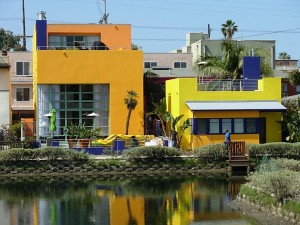
A colorful compound on one of Venice's unusual canal streets

A colorful compound on one of Venice's unusual canal streets

By Debra Prinzing

For all the glossy magazine articles and garden-makeover shows we consume, there’s nothing like a day of garden sight-seeing to inspire the inner-landscaper in all of us.

Featuring nearly 30 properties, today’s legendary Venice Garden & Home Tour is sure to ignite your imagination – and dish up dozens of adaptable ideas for your own yard.

Don’t go empty-handed, though. Bring a camera to capture a cool architectural detail or alluring bloom, a notebook and pencil for jotting down plant names or design resources, and plenty of curiosity. In many of the gardens, owners and designers will be on hand to answer questions and share tips. Consider it affordable design research. Plus, nothing’s more fun than cruising along the canals, walks and side streets of one of L.A.’s most iconic neighborhoods.

We previewed several of the tour’s vintage cottages and sleek cubes (and the gardens, decks and balconies that surround them). Here’s a look at four favorites, including design tips from each.

 Accessorize your garden with salvaged signage

A generous and genial host, Orson Bean

A generous and genial host, Orson Bean

Orson Bean, a veteran actor and longtime resident of Venice’s canal district, has a thing for Americana, especially signage “folk art.” “It’s really just pop culture,” he says. “Advertising has always been part show biz.”

Oversized and retro, Bean’s restaurant and retail signs are well suited for the endless scale of blue sky and sunshine overhead. Their very presence in his garden brings out the storyteller in Bean.

There’s the tale of the neon billboard that’s mounted against a ficus-covered fence in the garden he shares with his wife, actress Alley Mills.

“It’s from the ‘Simple Simon’ rhyme, but it was also the logo for Howard Johnson’s restaurants,” Bean points out. “That sign was as identified as the McDonald’s arches.” Rendered in carnival-colored neon tubes, the once-ubiquitous image of a baker, a boy and his dog promised coffee and a slice of pie to drivers along the Jersey Turnpike.

Orson and Alley's vintage Howard Johnson's sign embellishes a corner of their Venice garden

Orson and Alley's vintage Howard Johnson's sign embellishes a corner of their Venice garden

The neon Ho-Jo is one of several pieces Bean has collected as garden art. He likes the way they personalize the shallow-but-wide landscape, which was created by combining three adjacent cottages and their yards over the years, beginning when he spent $113,000 for the first one in the early 1970s.

Another sign promises “Cash for Cars” and it, too lights up at night. Tucked next to a camellia shrub, a third, its faded paint beginning to chip, advertises a sheet metal shop in the hands of a cartoonish man.

There is a down side to having neon tubes so close to the lawn, where Bean’s seven grandchildren often play ball. Fortunately, he has been able to replace or repair occasional damage. “Only the chef’s hat is original,” Bean says.

Infuse the sound of bubbling water in a few square feet

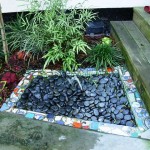
Barbara Balaban's tiny fountain with broken pottery mosaic trim

Barbara Balaban's tiny fountain with broken pottery mosaic trim

There’s not a lot of room in her 20-by-20 foot front yard but Barbara Balaban has maximized every square inch. Instead of a space-gobbling fountain, she created a tiny one, wedged between the walkway and the front steps. The 18-inch water feature uses a re-circulating pump bought at a home center. “I filled the top with river rocks and surrounded the fountain with a border of broken pottery,” says the interior designer and contractor. “I just wanted the sound of water here.”

Balaban moved to her canal cottage after fleeing a traditional Sherman Oaks house destroyed by the 1994 earthquake. Her Venice garden incorporates mosaics of broken pottery salvaged from that disaster: the fountain, a freestanding barbecue-cooking counter and a “welcome mat” at the front gate. “I reconstituted my grandmothers’ and mother’s dishes – and it gives me a big smile to see each piece,” Balaban says.

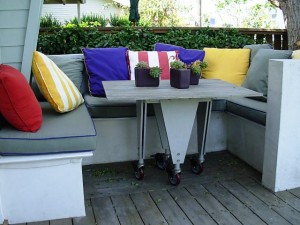
Tiny and efficient, Barbara's U-shaped eating nook seats six

Tiny and efficient, Barbara's U-shaped eating nook seats six

During a home renovation, she retained the original footprint rather than expanding. “I kept the depth of the property the same because I wanted the garden,” she says. Studio City designers Carol Plotkin and Janet Hoskins helped Balaban rethink the miniscule landscape and incorporate a slim border filled with succulents, Mediterranean plants and whimsical art.

There’s a large glass table (on wheels) that accommodates the parties Balaban and her partner, artist Yaacov Aloni frequently throw. But when they want a quiet Sunday morning brunch, the couple lounges in a U-shaped eating nook installed in a corner of the front porch. “It’s like having a little sofa outdoors,” Balaban says. “We can sit here and be a little secluded from passersby.”

Pave the indoor and outdoor spaces with the same flooring material

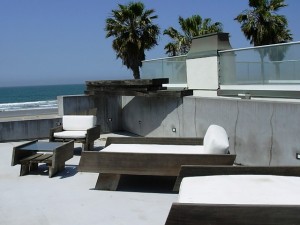
Lenny Steinberg's tiled, open-air terrace overlooks the Pacific Ocean

Lenny Steinberg's tiled, open-air terrace overlooks the Pacific Ocean

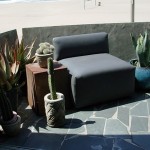
A floor covered in sultry blue-green stone leads your eyes through the soaring, loft-like space, through a 17-foot opening in a retractable glass wall and beyond the outdoor terrace, until they rest on the endless seascape.

“The stones reflect the constant color of the ocean,” say owner Lenny Steinberg of her North Carolina bluestone floor. “Although that seems to change according to the light.”

When Steinberg, a furniture and architectural designer, renovated the former duplex into a single, über-contemporary home on Ocean Front Walk, she wanted to bring the ocean indoors. She inherited a palette of irregular-shaped bluestone after a friend’s patio project fell through.

Lenny designed her chaises with distressed wood and modern lines - perfect for the rooftop garden

Lenny designed her chaises with distressed wood and modern lines - perfect for the rooftop garden

“It was the perfect solution for my floor, although I ended up calling all over North Carolina to get more of it,” Steinberg says. Even though the material, a hard slate, is usually installed randomly, the designer spent hours choosing the position of each stone to create a subtle pattern. “I like to think of it as a river running out to the sea,” she says.

The sea metaphor (and the bluestone) continues on the floor of the small, angled terrace that Steinberg designed to cantilever beyond the glass wall. The space serves as the intimate outdoor living room, with views of the palm trees, walkway and pier. The dark teal stone has endured intense sun and saltwater beautifully, says its owner. “If it has any nicks, I just take a little steel wool to it,” Steinberg says. “I wish everything else was as durable.”

 Practice sustainable design by recycling found objects and allowing the garden to evolve over time (rushing is not allowed here)

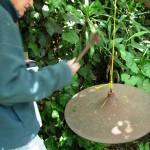
Tim Rudnick rings his hanging cymbal-as-doorbell

Tim Rudnick rings his hanging cymbal-as-doorbell

Stepping through the opening in the ivy-clad fence surrounding Tim and Robin Rudnick’s home and garden, it’s possible to lose all track of time. In fact, it seems as if Tim Rudnick, an architectural designer and artist, has turned back the clock to an earlier Venice. “I like the old, tattered hippy cottage that we lived in and raised our kids – where everyone hung out on the old porch,” he says.

Circa 1913, the summer bungalow originally faced Venice’s Aldebaran Canal (now Market Street). The Rudnicks purchased it in 1984, subsequently modernizing the interior and adding an L-shaped Arts-and-Crafts style addition. The old and new portions of the family compound now embrace an intentionally tangled and untamed landscape, also of Rudnick’s design.

“I had this beautiful photograph of a Buddhist garden in Japan and I imagined our yard by looking at it,” Rudnick says. “I loved the idea that like a Japanese garden, you feel like you’re entering another world when you go through the gate.”

Lush and semi-wild, the Venice garden of Tim and Robin Rudnick

Lush and semi-wild, the Venice garden of Tim and Robin Rudnick

A naturalistic pond, measuring about 25-feet across, occupies the center of the garden. Rudnick used the excavated dirt to build a mounded knoll between the pond and a wraparound deck. He landscaped the water’s edge with heirloom irises once grown by his mother, native Pacific coast irises and ferns.

Several mature trees, planted as seedlings nearly 40 years ago, now tower above the rooftops: a coral tree, an olive, and four eucalyptuses. “The leafy trees give us the feeling of real separation,” he says.

Visitors announce their arrival by striking a mallet on two bronze disks, suspended from the twining branches of the coral tree. Rudnick made one from the base of a salvaged clothing store fixture; the other is a recycled cymbal. He prefers their music to a regular doorbell: “One has a very resonant sound and it goes on for 15 minutes; the other makes a beautiful, contrasting sound.”


Los Angeles Garden Show Highlights

Friday, May 1st, 2009
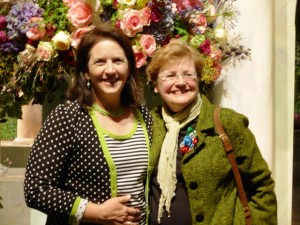
Garden celebrity Shirley Bovshow and I posed on a bench in Nick Williams's garden

Garden celebrity Shirley Bovshow and I posed on a bench in Nick Williams's garden

The theme of this year’s LA Garden Show, “A Festival of Flavors,” is timely and delectable. The show is produced by the Los Angeles County Arboretum and Botanical Garden in Arcadia (just east of Pasadena), a 127-acre destination with a diverse plant collection, inspiring display gardens and natural habitat-inspired landscapes. The three-day flower show runs through Sunday, May 3rd. The event’s honorary chairs are Clara and Jacob Maarse of the famous Pasadena rose nursery and florist, and Rosalind Creasy, garden writer and pioneer in edible landscaping.

Edible gardening expert Rosalind Creasy

Edible gardening expert Rosalind Creasy

Most of the flower shows I’ve participated in have been indoor shows, so when I arrived last night to attend the preview gala, I was reminded of how alluring an open-air flower show can be. There’s nothing like the sky overhead, the sounds of screeching peacocks that wander the Arboretum grounds, the fragrances and textures of plants from every continent — and the conviviality of friendships — to put me in a perfect festive mood.

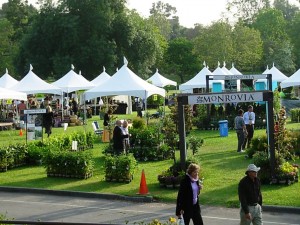
Upon entering the Arboretum, we first stopped off at the “marketplace” of plant vendors, garden artists and purveyors of cool stuff, which occupies the lower lawn adjacent to Baldwin Lake. The collection of white tents, topped with jaunty flags, put a smile on my face. I felt as if I was in Europe rather than Los Angeles. The two hours allotted to previewing the sales area was barely enough – but no worry, because I’ll be back there on Sunday to do some more damage to the checkbook (That’s after my 11 a.m. “Garden Chat” ).

Plant vendors, garden artists and more

Plant vendors, garden artists and more

As I strolled along the grassy pathways between each tent, poked my head inside several to check out the offerings, and chatted with fellow party-goers, I said to myself: These are my people!

I was surrounded by kindred spirits who love gardens, plants, ornamentation, vintage finds, and more.

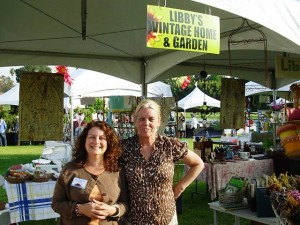
Vintage gals, Libby and Nancie

Vintage gals, Libby and Nancie

A couple of highlights included visiting with Libby Simon of Libby’s Vintage Home & Garden and her friend Nancie Piser, fellow collectors of salvage, old linens, elderly gardening books, retro dishes and glassware, anything tin, rusted or galvanized, and more!

Oh, and Libby also specializes in unusual cactuses – I came home with a nifty specimen (Euphorbia handiensis) that I quickly re-potted in a turquoise-glazed pot for my garden.

My friend Paula Panich and I had a few acquisitive moments, inspired by all the unique finds these two women featured in their tent. I came home with an old garden spray-nozzle and some awesome vintage books, including an almost-mint 1932 edition of The Fragrant Path: A book about sweet scented flowers and leaves, By Louise Beebe Wilder (perfect for a friend’s upcoming birthday). Here’s what Miss Beebe Wilder writes in her opening lines:

A garden full of sweet odours is a garden full of charm, a most precious kind of charm not to be implanted by mere skill in horticulture or power of purse, and which is beyond explaining. It is born of sensitive and very personal preferences yet its appeal is almost universal.

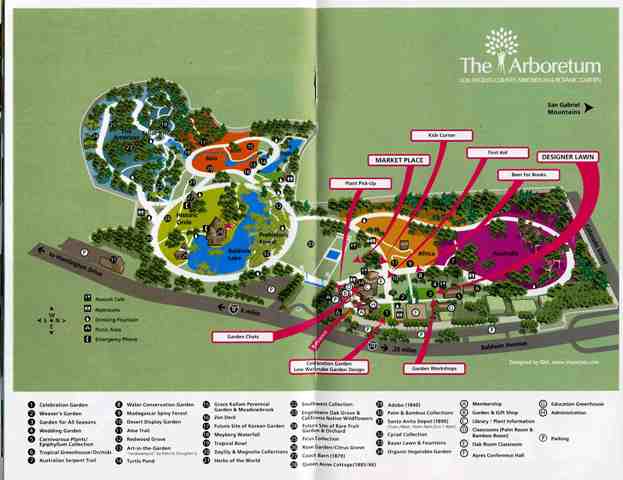
Here is a map of The Arboretum and the Garden Show features:

lagardenshowmap001

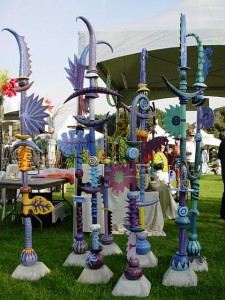
Leslie Codina's art: A joyful explosion of color and form

Leslie Codina's art: A joyful explosion of color and form

Playful, fanciful, nature-inspired sculpture

Playful, fanciful, nature-inspired sculpture

Inspired, my eyes drifted over to the next tent over, which was filled with lively ceramic spires pleasing to the visual senses. Leslie Codina, a local Los Angeles area artist, creates whimsical stacked towers of color, pattern and form. The 5- to 7-foot-tall sculptural creations are formed first in Leslie’s imagination as she “interprets the shapes and colors of nature into her garden sculpture.”

Leslie renders individual elements in clay, then shapes, curves, twists, carves and rolls the medium into fantastical armitures, balls, finials and wing-like shapes.

Firing and glazing steps follow, featuring a mix-and-match palette of lime, plum, apricot, red, orange, blue, aqua and lavender.

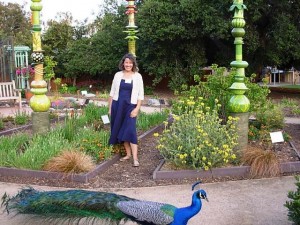
Artist and sculptor Leslie Codina, with peacock strolling by

Artist and sculptor Leslie Codina, with peacock strolling by

I first learned of Leslie from photographer pal Gene Sasse, who has done much of the photography that appears on her web site. He urged me to seek Leslie out – and boy am I glad I finally did.

Leslie has just donated a grouping of four 8- to 12-foot tall sculptures as a permanent installation at the Arboretum. The collection appears in the “Garden for All Seasons” display, which represents each phase of the year.

After shopping and browsing, several of us moved to the “Designer Lawn” area of the Arboretum, where the cocktail reception was underway.

The displays, created by talented area landscape firms and individuals, brings together the idea of “edible” and “ornamental” worlds co-existing in the garden. Here are a few of the innovative ideas showcased:

“Punctuation in the Garden: A Gallery of Edible Container Gardens,” created by the local members of the Association of Professional Landscape Designers (APLD):

I’ve admired and been privileged to write about the design work of several APLD members, both in the Washington State chapter and now in the California chapter. The group of a dozen folks who created eye-catching edible focal points has come up with some pretty fun interpretations of an “edible container.”

READ MORE…

The prettiest outhouse-turned-stylish shed I’ve ever seen

Tuesday, April 21st, 2009
The Cozy Shack, Designed by Scotty Thompson and Suzanne St. Pierre of "Living in the Garden," a cool Pullman (Wash.) garden emporium

The Cozy Shack, Designed by Scotty Thompson and Suzanne St. Pierre of "Living in the Garden," a cool Pullman (Wash.) garden emporium

I love it when I receive surprise “Shed-Mail” from Shedistas like Suzanne St. Pierre. Suzanne and her husband Scotty Thompson own Living in the Garden, a cool nursery/emporium in Pullman, Washington. We’ve swapped a few emails, originally prompted by Suzanne’s note saying she loves Stylish Sheds as much as I do.

Recently, while planning their own version of a spring flower show, Suzanne and Scotty recycled an old cedar outhouse from their 2-acre property and tricked it out to be a too-cute cottage for their nursery. She sent me a sweet note and some photos and gave me permission to share them with you.

Hello, inspired by your Stylish Shed book, my husband and I jazzed up an old outhouse we had on the property (to use) for a focal point in our Sweet on Spring event at Living in the Garden. It was a hit!! I wanted to thank you for the inspiration and tell you that I enjoy your blog.

I just caught up with Suzanne by phone and we had a good ol’ gab. It felt like I was talking with a long-lost friend. She described how this little structure found its way from humble to haute:

Originally, the cedar “box” was an outhouse over a pit toilet. The couple actually used it while living in their tiny “sugar shack” when they moved to the two-acre property about six years ago. After they built their residence and started running the nursery, they had a “real” indoor bathroom, so the 3-by-3 foot outhouse was no longer needed. “We filled in the pit and just moved the building around,” she says.

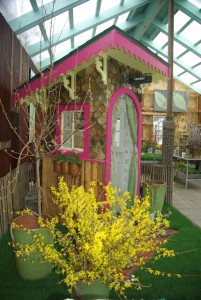
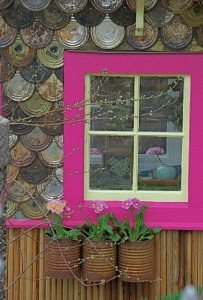
With shingles made from flattened tin can lids and hot pink trim, this is an outrageous outhouse!

With shingles made from flattened tin can lids and hot pink trim, this is an outrageous outhouse!

When preparing for Living in the Garden’s “Sweet on Spring” event last month, they decided to create several indoor garden displays (it’s still pretty chilly out there on the Palouse in March). As Suzanne explains, “We wanted to create our homage to the Northwest Flower & Garden Show.”

Once she and Scotty decided to dress up the rustic outhouse, the creativity exploded. Suzanne told Scotty: “We have to use everything we already have on hand.”

Like most artist-builders (Scotty is “incredibly handy and artistic”), the couple has all sorts of project piles and cool materials had saved for future endeavors. Clearly, they love to re-purpose what others might toss into the landfill.

This detailed photo illustrates how they used flattened tin cans, layered like gingerbread shingles, to clad the upper portion of the structure. Scotty added a window and the arched doorway, plus the cool corbel-style brackets and scallop-trim fascia board around the shed roof.  It even has a skylight! I’m dying to see an indoor shot (maybe Suzanne will send it to add here!) because apparently she decoupaged the interior walls with pages from old gardening books someone had given them. I guess Suzanne broke her own rule about using on-hand materials when it came to paint. She confesses that she did actually buy the hot pink paint as a finishing detail. Fancy!

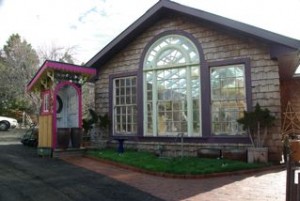
Cute Outhouse (left) outside the gorgeous conservatory, built by Scotty Thompson of Living in the Garden

Cute Outhouse (left) outside the gorgeous conservatory, built by Scotty Thompson of Living in the Garden

I love this couple’s philosophy of truly LIVING IN THE GARDEN. Suzanne grew up in a family nursery and purchased and ran her parents’ former nursery for 12 years after graduating from college with a horticulture degree.

“But I burned out. I was never getting my hands dirty,” she confides. Several years (and a career in the wholesale plant trade) later, Suzanne realized how much she missed retail. “I just wrote on a piece of paper what the perfect job would be: Work from home. Work with Scotty. Work 4 months of the year for 4 days a week.”

Wow. How seldom do any of us have such an honest conversation with ourselves? Guess what? For the past six years, Suzanne and Scotty have been doing exactly what she wrote down on that page. “My commute to work is just 113 steps,” she jokes. “We’re working on our farm and making people come to us. It’s really wonderful.”

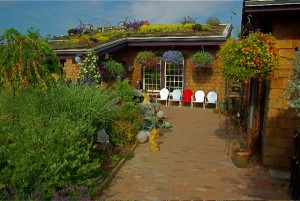
Living in the Garden's green roof

Living in the Garden's green roof

Living in the Garden is open from March through June (Thursdays through Sundays). Earlier in the season, beginning in February, Suzanne starts work in their production greenhouse, growing geraniums and plants for their own hanging baskets. By summer, the couple is off on trips in their camping van (complete with solar panels on the roof!) and touring around the Northwest and beyond to see other nurseries and commercial greenhouses.

They believe in “marketing with a cause,” so during the summer months Suzanne and Scotty encourage local charities to use their extensive and beautiful display gardens for fund-raisers or donor-appreciation events.

By September, just about the time Suzanne is “missing” her customers, Living in the Garden opens for one spectacular autumn weekend.

When you arrive, don’t be surprised to hear the mellow sounds of Gregorian chants drifting through the garden and conservatory. “Gardening is my religion,” Suzanne concludes.

Check out the nursery in person or read more at Suzanne’s blog, Living in the Gardens.

Peace by Design: a preview

Monday, April 6th, 2009

peacebydesign0002

The filming and editing are finished and we’ve posted a short excerpt from “Peace by Design,” my new outdoor lifestyle television show produced by Robert Schauf and Tisha Fein of Branch BR3.  

We developed “Peace by Design” to bring a new level of inspiring and informative garden and home stories to the consumer. With the theme of “creating your own peaceful place – indoors and outdoors,” the show will feature my visits to and interviews with top celebrities in film, television, music and sports. We will single out stars who are passionate about their own environmental activities, sustainable practices and related themes such as living in harmony with the natural world. Each program will be supported by ideas, tips and other takeaways for the viewer who yearns to turn their own backyard into a harmonious and serene environment.

Click here for Peace by Design’s web site and to view an excerpt of the show. Now the fun begins, as we share the show with potential presenting sponsors who view Peace by Design as a multi-platform marketing opportunity. I think the visuals, the celebrity component and the varied topics come together to create an exciting new show. I welcome your response and reaction to this project. I hope you love it as much as I do!

Ides of March . . . April Fools Day . . . and more!

Sunday, April 5th, 2009

March 30 to April 3, 2009 

Los Angeles to Seattle to Yakima. Back to Los Angeles, via Seattle. Two snowstorms and lots of rain. Heavy doses of friendship.

“]The perky roofline of Michelle and Rob Wyles's hedge-enclosed gardenhouse is seen in relief against an expansive eastern Washington sky [photo by William Wright]

The perky roofline of Michelle and Rob Wyles's hedge-enclosed gardenhouse is seen in relief against an expansive eastern Washington sky, photographed by William Wright

Spring may have arrived on March 20th, but it still feels like winter in the Pacific Northwest and there I was, loving it! But to the person, my gardening pals on both sides of the (Washington State) Cascades are sick of this unfriendly weather (unfriendly, at least, to gardens, plants and gardeners).

I flew out of LAX on Monday, arriving in Seattle around 3 p.m. Not wanting to bug any of my hardworking friends, I hopped an express Metro bus from the airport to downtown’s new transit center. That $2.50 bus pass, which even included a transfer to the Number 14 city bus, got me all the way to Mt. Baker neighborhood, where I walked a few short blocks to my friend Jan’s.

She graciously lent me a bed and use of a car – not for the first time – and it felt like coming home to a place I know so well. I walked these sidewalks with my newborn son Benjamin during the summer of 1992. I feel like I have every front yard, every border, memorized. I love the perspective of the often cloud-streaked sky looming above Lake Washington. I love the tall Douglas firs and the western red cedars, the old, overgrown rhododendrons, the Craftsman architecture. This place holds good remembrances.

But it is cold here this week, colder than when my sons and I visited for the Northwest Flower & Garden Show in February. That week – Presidents’ Week – was sunny and blue-skied, with temperature in the mid 40s. Picture perfect and perfect for one’s mood.

httpv://www.youtube.com/watch?v=OSy75jcIgFA

On Tuesday morning, Lorene Edwards Forkner arrived in her trusty All-Wheel Drive Subaru and we began our 3-hour drive east to Yakima – over the Snoqualmie Pass and into Eastern Washington.

It was raining lightly; the air was cold and damp, for what is supposed to be springtime already. As we passed through North Bend and started climbing up toward the summit, the scene on either side of the freeway was cloaked in white. Beautiful, if you like a Christmas card image of dark blue-green conifers frosted with dollops of snow. But brutal for the driver. We slowed down to a snail’s pace at the peak- where truckers literally stopped in the middle of a lane to put on their chains and the little people (the cars, and their drivers, that is), skulked over to a single lane and crept through the pass at single-digit speeds.

 A DIFFERENT LANDSCAPE ALTOGETHER
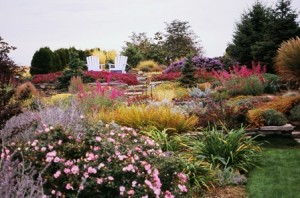
Linda Knutson and Ron Sell's magnificent Yakima landscape, photographed on our October 2005 tour

Linda Knutson and Ron Sell's magnificent Yakima landscape, photographed on our October 2005 tour

With the snow behind us, our arrival in Yakima was cause for celebration. We stopped at Linda Knutson’s and Ron Sell’s, fellow Northwest Horticultural Society members who have always generously shared their four-acre, arboretum-like landscape with visitors. They participate each year in the Northwest Perennial Alliance Open Garden schedule (if you really want a treat, plan a day’s trip to Yakima to see it!)

Linda and Ron focus on texture, color, form using mostly conifers, ornamental grasses, woody ornamental shrubs, stone and artwork. Lorene and I remember with fondness our visit there in October 2005 when I led the NHS weekend tour to Yakima.
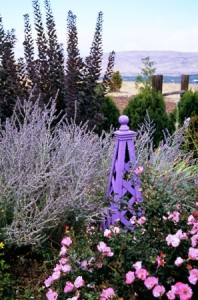
A perfect autumn scene at Linda and Ron's, which to me perfectly illustrates an analagous color scheme in plants and art

A delicious autumn scene at Linda and Ron's, which to me perfectly illustrates an analagous color scheme in plants and art

The weather was pretty unforgiving (brisk and very windy), but after a delicious spanakopita lunch, we bundled up and took a spin around the place. We stayed mostly on the pathways, but we stooped down to observe new crocuses, species tulips, galanthus, chionodoxa and (possibly) pushkinia bulbs poking their heads out of the soil. “These plants are a month behind my Seattle garden,” Lorene observed. “And my Seattle garden is a month behind its usual bloom time.” That tells you a lot about the vagaries of the Pacific Northwest winter of 2008-2009, but Linda and Ron insist that Yakima has been spared much of the snow-dump that hit Spokane and other parts of Eastern Washington (even still, we woke up to snowfall Wednesday morning, April 1st!).

Later, we met up with shedista Michelle Wyles at Garden Dance, her adorable “fashion and frou-frou” clothing emporium in downtown Yakima. She has one of the best pair of eyes for spotting innovative apparel and interior styling I’ve ever seen.

All you have to do is see how Michelle has created and adorned her charming “shed,” photographed by William Wright for our book, Stylish Sheds and Elegant Hideaways, to know what I mean.

Michelle has had a wide and varied career, including raising alpacas (Right now, the attention-getting creatures at Michelle and Rob’s home/farm are the Guinea hens. What funny poultry!)

Bill Wright's photo of Rob and Michelle Wyles, with Chester (July 2006)

Bill Wright's photo of Rob and Michelle Wyles, with Chester (July 2006)

Her garden antiques and retail business has morphed into fashion: Garden Dance is housed in Yakima’s turn-of-the-last-century train station. For about an hour, Lorene and I browsed and oohed and aahed to our heart’s content, while Michelle and her girlfriend/sales associate Stephanie helped guests and handled customers. For some delicious (virtual) retail therapy, read Michelle’s lighthearted blog, linked to her web site.

After they closed shop, we walked across the street to Gilbert Cellars, a cool wine-and-cheese bar that you might expect to find in Seattle’s Belltown district or in Santa Monica. A sampling of artisan cheeses and a sip of wine fortified us for delaying dinner until after my 7 p.m. lecture finished!

My lecture, “the Ultimate Garden Hideaway,” was the final of a four-part lecture series hosted by the Yakima Co. Master Gardeners. Held at the beautiful Yakima Area Arboretum, the lecture series was the brainchild of several incredible volunteers and MG staff, including our fellow GWA member Jim Black. The “Outdoor Room”-themed lecture series included Michelle Wyles and Linda Knutson as prior speakers.

We had a great, sell-out gathering of enthusiastic folks, from shed owners who treated me to stories of their own backyard hideaways, to shed wanna-be’s who had big dreams for their future PODs (Personal Outdoor Dwelling).

As always, I feel so at home with these “peeps,” the Master Gardeners of the world who are truly citizen-volunteers, generous, pay-it-forward folks concerned with educating and inspiring everyone to embrace the traditions and skills of growing edible and ornamental plants.
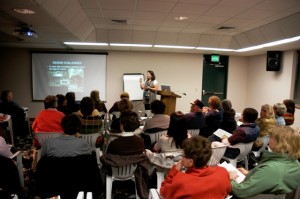
Mastern Gardener Bill Woolman, snapped this photo during my talk, "The Ultimate Garden Hideaway."

Mastern Gardener Bill Woolman snapped this photo during my talk, "The Ultimate Garden Hideaway."

Thank you to the Yakima Master Gardeners and the Yakima Area Arboretum for hosting me, and to Michelle and Rob Wyles for housing (and feeding) Lorene and me on Tuesday night. By the way, we woke up to more snow and had fun watching the Wyles poultry population racing around in the cold weather. What a hoot! (Sorry, Lorene, about locking you out of the guesthouse while I was showering away to my heart’s content. I’m glad you’ve thawed out!)

Lorene and I made it back to Seattle pretty quickly. Well, that is AFTER we spent close to an hour searching for a hard-to-find address of a Yakima trailer park (North Acres) to track down the good Samaritan (?) who called me on my cell phone with news that he had found my camera in the parking lot of Gasperetti’s Restaurant in the wee hours of April 1st. I will let Lorene have the honor of blogging about THAT experience. I just checked her terrific blog, Plantedathome.com, and I’m surprised (and a bit relieved) that to date, the photos of that “doo dad” decorated residential trailer have not been posted. Given the blackmail potential, that may be good news. I’ll await Lorene’s decision!

Debra, pontificating about Stylish Sheds (photographed by Bill Woolman)

Debra, pontificating about Stylish Sheds (photographed by Bill Woolman)

All in all, this was a good trip. I felt like the Energizer Bunny, squeezing in more friends and networking encounters than anyone could imagine. I had a wonderful evening with the Woodinville Garden Club (thank you to Susan Latter for the invitation to speak), and several excellent encounters with creative people (the subject of future blog posts).

I’ve been home in Southern California for about 36 hours and I can’t wait to stay here for a while. I can’t imagine leaving my family or my garden for one more moment. It’s hard to believe, but I have traveled on seven adventures since I went to Orlando in mid-January. As inspiring and exciting and stimulating as these lecture venues, flower shows, press junkets and garden tours can be, I know they just delay me from sinking my roots deeper in the patch of earth for which I’m responsible. So it’s time to stay put for a while.

It’s Palm Sunday and time to celebrate the gift of life, the gift of love and the gift of nature.

Peace by Design: My TV show

Friday, March 27th, 2009
Filming the pilot episode of "Peace by Design"

Filming the pilot episode of "Peace by Design"

My friends know I am a PRINT person – I love magazines, newspapers and books. I’m kind of okay with the Internet, because blog posts and web sites still involve using letters to compose words and words to create sentences . . . all of which are ultimately read as the printed word.

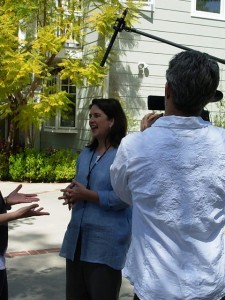
So this week has been one of those out-of-the-comfort-zone experiences as I “played” at being a television host. Robert Schauf, my amazing and intuitive producer, keeps telling me that talking to the camera is just like talking to a friend (a conversation!). . . and I’m starting to believe him. I just have to imagine all my friends hiding behind the HUGE black lens held by the cute camera guy, John. And then, just talk. Naturally.

Okay, I need to back up. I met Robert Schauf in 2006. It was one of those Kismet moments. It will sound so cliche, but we met on an airplane flying on business class from Burbank to Newark (a Jet Blue flight). I’m pretty unfamiliar with business class, but somehow I was bumped up to that rarefied section because it was the last seat on an overbooked flight. I was on my way to speak to a garden club in New Jersey and absolutely had to make that flight or I would miss the lecture entirely.

Robert, who hops comfortably back and forth between NYC and LA, was returning from a business trip. How do I describe him? He’s tall and slender, he wears the kind of clothing that my teenage son might wear (hip jeans, long-sleeved t-shirts, lace-up Keds) and his shocking white-platinum hair kind of sticks out all over his head. Robert has that Rocker-dude look and frankly I didn’t know what to think of him at first. But we talked nonstop for something like 5-1/2 hours. I was so fascinated with his stories of producing television specials and working on the Grammys. I told him about my new project – about garden sheds! – and described my plans to scout sheds in the Hamptons and NYC after I finished my New Jersey lecture. We exchanged business cards and subsequently swapped a few emails. That was it.

READ MORE…

Botanical fantasy? Or Shoe Fetish?

Monday, March 9th, 2009
Shoes for a flower fairy with twigs, moss and petals

Shoes for a flower fairy with twigs, moss and petals

I spent a few days last week at the spectacular Philadelphia Flower Show. It was my second time traveling to this Grand Dame of indoor flower shows to give a garden talk. When I first presented there in 2006, I was blown away by the over-the-top displays and ambitious floral designs. This year’s theme, “Bella Italia,” inspired show designers to highlight Italian- and Mediterranean-themed gardens.

Debra (left) and Mary-Kate Mackey (right). We posed in front of a lavish rose-filled urn at the entrance to the Philadelphia Flower Show.

Debra (left) and Mary-Kate Mackey (right). We posed in front of a lavish rose-filled urn at the entrance to the Philadelphia Flower Show.

With my roommate, Mary-Kate Mackey, I managed to squeeze in lots of adventures in my 36 hours on Pennsylvania soil (I spent more time trying to fly there and back than I was actually on the ground, due to a doozy of an East Coast snow storm that stranded me in Dallas overnight and then marooned me for five hours in Milwaukee). Unfortunately, I missed seeing all of my fellow Garden Writer members because I was sitting in the Milwaukee Airport at the exact time the regional meeting took place. Oh well.

But – finally – when down to my last option of continuing eastward or returning home to LA, I grabbed a seat on the only flight to Philly that day. I arrived late last Monday and met up with Mary-Kate, who was in town to teach a one-day writing class for Garden Writers, and to see the show.

After my lecture on Tuesday afternoon, we strolled out to the show. With M-K as my tour guide (all-knowing, she had been there for several days, including hours spent behind-the-scenes during show set-up). We meandered through “Bella Italia” – kind of like taking a cross-country floral tour – all in a single day.

With gardens devoted to Italy’s major tourist regions, there was lots to admire. But the most surprising and artistic of them all celebrated Milan. Milan is the fashion capital of Italy. The American Institute of Floral Designers (AFID) created a floral fashion show of sorts. Spectacular stuff!

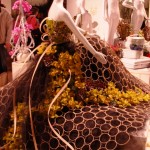
Foliage as soft as velvet creates the bodice of this nature-inspired creation

Foliage as soft as velvet creates the bodice of this nature-inspired creation

Against a stark white backdrop of mannequins and props, the designers displyaed imaginative shoes, handbags, hats, jewelry and garments . . . made out of petals, leaves, pods, buds, stems, needles and more. In every hue and texture of flower and foliage. Oh, so beautiful. M-K likened the technique of layering and gluing individual petals and plant parts (to create fields of color) to a small-scale version of Pasadena Rose Bowl Parade’s float production. It is a good explanation of the way these inventive designers rendered fashion “in bloom.”

Bows, buds and pods adorn this pair of stylish heels

Bows, buds and pods adorn this pair of stylish heels

More inspiring than the dresses, though, was the footwear. People were standing three- and four-bodies deep to gaze at and try to capture photographs of these dainty delicacies for the toes.

What is it about shoes? We asked each other this question as we, too, tried to get close and peer at the high heels, strappy sandals, little ballet flats, avant-garde boots, and more.

Are shoes magical, like Cinderella’s glass slippers? Or do they just seduce us with those sensual shapes? I know from experience that a gorgeous pair of shoes (comfortable ones would be nice, too) gives many women a feeling of power and confidence.

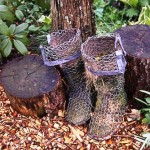
A whimsical pair of boots (made from chicken wire and moss), spotted in Holland in 2005

A whimsical pair of boots (made from chicken wire and moss), spotted in Holland in 2005

Shoes in the garden never fail to charm and delight. Think of those people who love to plant hen-and-chicks in old work boots.

A steel "spring" adorns the toe of this shoe-planter

A steel "spring" adorns the toe of this shoe-planter

I love my wacky garden shoes, also known as “Steel Heels.” I discovered them when I lectured at the Boise Flower Show in 2006.

Cut from steel and welded with fanciful heels and swirly toes, these artful shoes were made by Micki Shampang-Voorhies and her husband Gary Voorhies. I love that these perfect Size 8’s are weathered over time to reveal a rusty patina.

These shoes make me smile every time I see them in the garden.

The artists, whose Blue River, Oregon, studio is called Custom Copper & Iron, turn everyday scrap metal and rusted tools into fashionista-worthy shoes.

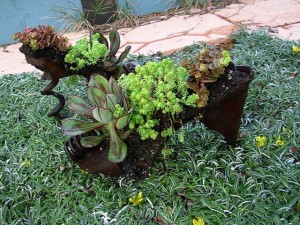
Castoff springs, drill bits, bolts and even a handle of a garden faucet create the heels of each artistic stiletto. Tuck a few sedums into the toe or heel and I’ve started my own shoe wardrobe in the garden:

"Steel Heels," planted with succulents

"Steel Heels," planted with succulents

 Enjoy this garden gallery of shoes and other fashions for your visual delight:

The New Terrarium: Small world, Big influence

Saturday, March 7th, 2009
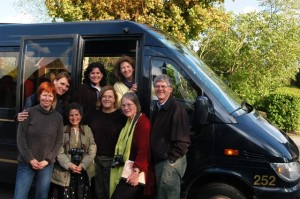
Our Holland gang, with Tovah front and center (she is the short, grinning gal with a huge camera around her neck). Clockwise, from left: Kathy Renwald, Bianca Helderman, Anne Nieland, Debra Prinzing, Walter Reeves, Mary Robson, Nellie Neal and Tovah Martin

Our Holland gang, with Tovah front and center (she is the short, grinning gal with a huge camera around her neck). Clockwise, from left: Kathy Renwald, Bianca Helderman, Anne Nieland, Debra Prinzing, Walter Reeves, Mary Robson, Nellie Neal and Tovah Martin

I met Tovah Martin in 2005 when we both participated in a media tour to Holland during spring bulb season. Since I had for years enjoyed and admired Tovah’s garden writing in the original Victoria magazine, you can only imagine how exciting it was to actually meet her.

I think we were both surprised at how quickly our little group of seven (including our wonderful guide Bianca Helderman from the Netherlands Board of Tourism & Conventions) bonded as accidental fellow travelers. I have vivid memories of Tovah wearing her knee-high rubber boots to tramp around the bulb fields at Hortus Bulborum  (I actually envied her pragmatism: I mean, who else would pack a pair of waterproof gardening boots to bring on a trip to Europe!?)

Tovah gave me a very important gift that week. I still remember sitting across from each other at an ancient trestle table. We ate lunch and swapped stories about book publishing. Known and loved around the globe for her beautiful Tasha Tudor’s Garden and Tasha Tudor’s Heirloom Crafts and many other books, Tovah graciously shared her advice and guidance as I struggled with how to develop my “garden shed” book (it was just an idea back then). Her suggestions about photography really influenced my decision to partner with Bill Wright on Stylish Sheds and Elegant Hideaways, rather than working with a variety of photographers in every market. She gave me a lot of clarity and I cherish her advice.

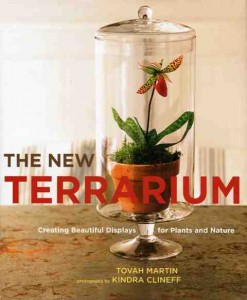
newterrariumcover001So now, I’m the lucky recipient of newest Tovah Martin book, by all counts, her 13th title. The New Terrarium: Creating Beautiful Displays for Plants and Nature, was published on March 3rd by Clarkson Potter/Publishers. [Full disclosure: Clarkson Potter also published our book – we love everything they produce!]

Captured on film by photographer Kindra Clineff, The New Terrarium is a magical tome filled with small, planted scenes, landscapes, still-life’s and collections under glass.

Tovah brings a perfect combination of talent to this dreamy book. She is a gifted storyteller, both visually and with words (Tovah art-directs and produces many of her magazine articles for Country Gardens and other publications); she has a long history as an expert with indoor and greenhouse plants from her past career at Logee’s Greenhouses; and she is a visionary who understands how to get others excited about her passion.

The idea of creating a book about gardening under glass (on a small scale) struck a chord with this avid plants woman. Here is an excerpt of my recent conversation with Tovah:

Q. How did The New Terrarium come about?

A. Kindra and I started working on magazine projects together, and when Clarkson Potter came to me with this idea, I thought of Kindra. She is a cross between a garden photographer and an interior photographer.

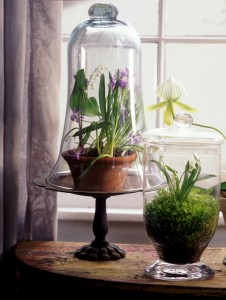
This ode to spring under glass includes white wood hyacinth (right) and lily-of-the-valley with glory-of-the-snow (left). Kindra Clineff photograph

This ode to spring under glass includes white wood hyacinth (right) and lily-of-the-valley with glory-of-the-snow (left). Kindra Clineff photograph

Q. What enchants you about gardens under glass?

A. Way back when I was at Logee’s, I originally lived in the upstairs of the house that overlooked all the greenhouses. Why I find (terrariums) so quaint, and why I can really get into them, is that I’ve never lost that feeling of loving things encased in glass. I loved looking down on the glass greenhouses. I even used to produce little booklets on how to plant terrariums for people who wanted to make or sell them.

Q. Terrariums are a tradition that dates back more than a century. What makes this technique, this idea, suddenly “new”?

A. I can’t think of a modern terrarium book. What I’m hoping is that people in office buildings, people with no access to gardening for a major part of their day, will think of this as a low-maintenance way to bring nature into their lives.

Q. You really believe that plants can be transformative?

A. I kept calling up Kindra and saying, “This is really big. We’re going to change the world.” I saw that this whole mode of gardening has the potential to rescue people from terminal office life.

Q. Tell me about the glass containers you used to create your projects. There is such an incredible variety – many surprised me.

A. Almost anything can be used. You can just start looking at glass this new way.

[Debra’s note: The New Terrarium is packed with inspiring ideas of the types of containers suitable for planting – from traditional cloches, Wardian cases and lantern cloches to more contemporary vessels, including recycled aquariums, hurricane lanterns, vases and repurposed glass domes used to cover cakes or cheese platters.]

“]A Wardian case with a deep base simplifies planting directly in the case. Kindra Clineff photograph]

A Wardian case with a deep base simplifies planting directly in the case. Kindra Clineff photograph

Q. What do you hope to teach gardeners and non-gardeners about growing plants under glass?

A. It’s an easy way for people to enjoy plants. Basically you don’t need to water very often. You don’t even need to fertilize.

[Debra’s note: Tovah has included a comprehensive plant encyclopedia that recommends a surprising array of plants for glass gardens, including: orchids, ferns, heucheras, begonias, mosses, African violets, bromeliads, ivies, ornamental grasses and more.]

Q. I love the photos! How did you and Kindra produce the shots?

A. This book was the challenge of the century because everything reflects in glass. We now understand why no one’s done this book before. Kindra had to surround herself in a black piece of velvet (so she wouldn’t be reflected in the shot). We kept joking that we should do the author and photographer’s portraits reflected in glass.

Q. Did you photograph at your Connecticut farmhouse?

A. We shot at four different houses, one of them being mine. I have a converted barn with big, huge windows and a little cobbler shop from 1790. A greenhouse connects these two buildings. We used the windows of these houses (for a backdrop). But most terrariums should be displayed away from the sun or windows.

Q. Tovah, how do you describe your writing philosophy?

A. This has been a lifelong mission for me: To write for (publications) that aren’t necessarily reaching gardening audiences in order to expand the whole realm.

Thank you! What a great conversation and a spectacular book.

Happy birthday to me

Saturday, February 28th, 2009
Celebrating my first birthday, February 28, 1960, with my mother, Anita

Celebrating my first birthday, February 28, 1960, with my mother, Anita

It pains me to admit it, but I was born 50 years ago today.

But one of my hip, young friends told me she thought I was 41, so I totally love her for that.

The hardest thing about turning 50 is that my mother can’t quite believe she has a 50-year-old child.

My mother is the youngest person I know. She is an artist and a writer and she has more curiosity about life than I will ever have. She also has patience, kindness, empathy and incredible courage.

I think today is more about celebrating Anita Louise Ford Prinzing than anything else. Thank you, Mom. You are the best. (Thank you, Dad, too. You are also the best!)

My husband has turned the five-year birthday mark into an art form. When I turned 40, our boys were 2 and 7. Bruce surprised me by flying my mother to Seattle to take care of them so we could go to Palm Springs for the weekend.

When I turned 45, he flew me on Business Class to London and arranged for me to spend 5 days visiting the Chelsea Flower Show and other awesome gardens (including Wisley, Great Dixter, and Sissinghurst). A magical, unforgettable trip. The pressure was on for turning 50.

But I decided to take matters into my own hands to plan my 50th b-day and also Bruce’s and my 25th wedding anniversary (which is in August). So I booked two weeks at Villa Maddalena, a magical and ancient villa that our friend Marcia has renovated. It is situated in a small Tuscan village called Montisi. At the end of October, I will get to spend one week there with many of my girlfriends. And then, the following week, Bruce and my sons will come for a family vacation – to celebrate our 25th anniversary.

When I invited my girlfriends to make the trip, I wrote something a little carefree (careless?).

Live large, people. The economy is in the toilet; the publishing world is spiraling into a ghost of its former self. Oh well. What’s left to do but eat pasta and drink Chianti?  

This kind of cavalier attitude might be what gets us through the current malaise of life. Many of us are in a waiting pattern. . . waiting for life to get back on track, waiting for things in Washington to sort themselves out, waiting for a job, waiting for the housing market to rebound. We have to find the joy, the surprise, the spontaneity. Birthdays allow us to do just that. We have one day every year to be self-indulgent and frivolous. Oh, but there’s one problem. I have two story deadlines today. UGH.

Even so. . . it will be a day of laughter, family, friends, and celebration – as I think about that Tuscany trip in October.

A Malibu garden party worth writing about

Thursday, February 26th, 2009

gardendesign0309001Designers Scott Shrader and Julie Millgan are friends who teamed up to produce a fantastic garden party for GARDEN DESIGN Magazine’s March 2009 issue (on newsstands now). I am the fortunate scribe who was asked to tell the story of their “Sunset Soiree” (which is what I titled the 10-page article). A great shot of Scott Shrader’s custom fire table appears on the cover of the magazine.

Here’s the background: Scott designed the outdoor living spaces of a modified A-frame midcentury beach house owned by Rea Laccone and Paul Perla, a style-savvy couple who run the casual fashion line called Vince USA.

When the project was completed, Rea and Paul suggested that Scott invite a few friends and clients to “show off” the project and celebrate. He took them up on it and recruited Julie Milligan, herself a fave Garden Design landscape designer, to produce and co-host the party.

Garden Design sent along Jack Coyier, a great photographer (this is my third article illustrated by Jack’s photographs – his images also accompany a piece Metropolitan Home’s March issue and last September’s Garden Design cover story about Ron Radziner’s garden in Venice). Through his lens, Coyier captures the playful, carefree nature of the space, the event, the people and the food — with gorgeous shots.

Scott Shrader and Julie Milligan - on location in Malibu

Scott Shrader and Julie Milligan - on location in Malibu

Even though this is an outdoor entertaining piece, the story naturally centers around its designed environment and the oceanside setting. Buy the magazine in order to really feast your eyes on the photos. Or read it here, on my web site: Sunset Soiree.


For the student of landscape design, this project offers several important take-aways. This is not a plant-centric space, so some hort-heads may scoff that Garden Design actually describes it as a “garden.”

But by designing with stone, textiles, elements like fire and water – and plants – Scott has created a magnetic reason for his clients to spend time outdoors.

And isn’t that the point, the mission of everyone in the garden-making world? To advocate for the role of exterior design and put it on par (or even elevate it!) with architecture and interior design? Scott has hit a home run with this project.

A stucco half-wall encloses the U-shaped banquette that Scott Shrader designed for his Malibu clients

A stucco half-wall encloses the U-shaped banquette that Scott Shrader designed for his Malibu clients

Even though you’d think it would be awesome to live by the beach (who wouldn’t?), there are some pretty harsh conditions here to challenge a homeowner and designer alike. The extremes range from intense sunlight and heat to intense wind and chilly temperatures. So the design thoughtfully accommodates the elements and helps protects those who spend time in the outdoor spaces.

To begin with, the home’s entry area (the non-ocean side) was really just a jumble of grass and an aging deck. Scott reconfigured these “negative” volumes to form a spacious outdoor living room. It doubles as the entry courtyard, enclosed on four sides. Two sides are created by the “L” of the home; new walls form the other two sides (one wall has a rustic wood entry gate; the other is the backdrop to a linear pool of water level with the “floor” of the space). The courtyard is by no means dark because sunlight flows through the beach house. Glass walls on the home’s west and east sides give the home a see-through quality.

On the western side of Rea and Paul’s house is a serene sunset-viewing terrace. When the winds die down, the couple adjourns to this partially-covered outdoor room. Sinking into comfy armchairs, they can prop their feet up on the versatile basalt table-bench-firepit and watch the orange-red orb disappear beyond the Pacific’s horizon. A lone palm tree – part of the borrowed scenery – adds a bit of perspective to the scene.

The new basalt patio faces the ocean; new furnishings from Janus et Cie are placed around a cool basalt fire feature.

The new basalt patio faces the ocean; new furnishings from Janus et Cie are placed around a cool basalt fire feature.

Here are some of Scott’s the smart design ideas:

  • Palette: Inspired by the fashion colors in the Vince clothing line, Scott worked with a range of gray hues (this means a monochromatic use of pewter-colored basalt, aluminum planter boxes and smoke-gray cushion/pillow fabric choices). Shrader translated Vince’s spectrum of warm-toned neutrals – ranging from dove-gray to dark gunmetal – into a tranquil and unified garden environment.  “If you look at the Vince clothing line, you see warm grays. I wanted to use that palette and keep things minimal and clean to reflect Rea and Paul’s  life,” he says.
  • Function: This is not just a pretty space to observe from an indoor vantage point. The courtyard has multiple functions, with a U-shaped chaise providing incredibly generous seating (what do I mean by the term “generous”? I can easily imagine several intimate clusters of two or three friends in intense conversation OR 20 hipsters for pre-dinner drinks). But what I like most, as I said in the article, is that Scott created a cozy, curl-up-your-feet kind of space. When there are gusts of wind at the shore, this space is protected; blocked mostly by the home’s architecture.
  • More Function comes by way of the 6-by-6 foot coffee-table cum buffet-counter. It is the most utilitarian element of this setting. Hidden castor wheels enable its movement, rolling in-and-out of the “U” seating area. Custom designed by Scott Shrader and fabricated of weathered teak (very beachy), the chunk of wood is earthy and durable. Piled with beverages and hors d’oeuvres during the photo shoot, it earned its weight in gold.
  • Even More Function is revealed in the basalt-wrapped fire feature, pictured on Garden Design’s cover. The heat source doubles as a cocktail table and bench. Its flames are mesmerizing; you can get even closer to the warmth by perching on the ledge. “This part of the garden is fairly limited in size, so I wanted to give it a warm element and make it a generous gathering space,” Scott says.

Cliipped Carolina laurel cherry hedges form a transitional corridor between the two gardens

Clipped Carolina laurel cherry hedges form a transitional corridor between the two gardens

Where plants are used in this landscape, they serve as architectural and sculptural purposes. The opening shot of the magazine spread depicts one of Scott’s guests as she walks through a hallway of green (which creates a maze-like journey from entry courtyard to oceanside terrace). The hedge-walls are formed by clipped Carolina laurel cherry (Prunus caroliniana). Simple and dramatic. So much more exciting than a few stepping stones that could serve a similar, but ordinary purpose.

Just inside the front gate is another beautiful and functional feature – a basalt counter that acts as a foyer table. On it, Scott placed a potted bonsai of boxwood. It has just as much presence as if he put a small ornament or sculpted object instead. Phormiums and agaves also lend sculptural form; they are mulched with Japanese black river rock, which looks sleek, modern, and works with the overall slate-gray palette.

Finally, there are two private miniature gardens outside the guest bedrooms. Scott treated these spaces as still-lifes; he called them “planted beach” scenes. Grasses and phormiums emerge from a salt-and-pepper mixed gravel carpet. A stone bench, planted with a moss “seat” is quiet and meditative in feeling. I can understand the sense of calm that settles over Rea and Paul when they escape here after an intense week in the city. This is another world altogether.

I ended the article with this paragraph:

To Rea and Paul, the Malibu getaway is one of the only places they can relax and unwind. Rea loves the “boundary-less environment” that encourages her to easily move from indoor spaces to the open-air ones. “Sometimes we quietly sneak out here by ourselves,” Rea says. Yet she’s happy to welcome friends, even during sweater weather. “How lucky am I? “Paul and I are both from New England, so we couldn’t be more excited to live near the ocean and where we need our sweaters.”

So, you can tell that I loved this garden and I certainly loved writing about it!