Debra Prinzing

Get the Email Newsletter!

Archive for the ‘Playfulness’ Category

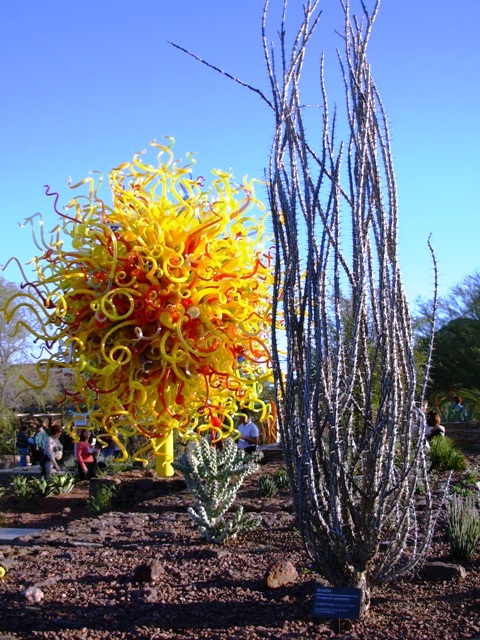
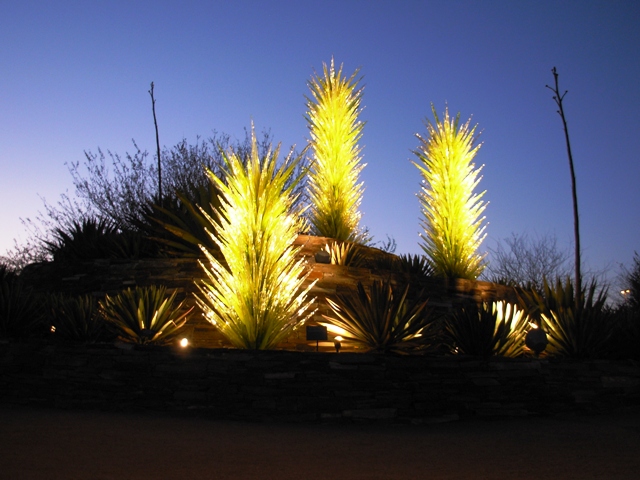
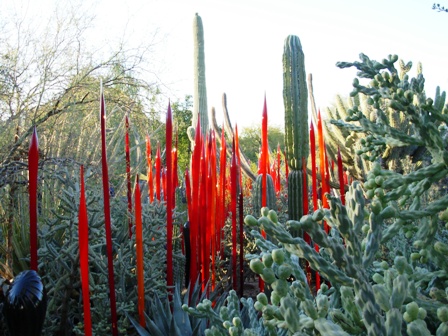
Check out the Chihuly Glass sculptures at Phoenix’s Desert Botanical Garden

Friday, February 6th, 2009

If you’re lucky enough to travel anywhere in the world, there’s no excuse not to try and visit the local botanical garden or arboretum. My family has become used to this mission of mine and they often accommodate me.

Last weekend, though, I was with my fellow hort geeks, and no one tried to stop me from a garden side trip! I traveled to Phoenix for the Garden Writers Association winter board meeting. After sitting indoors in a board room all day, we rewarded ourselves by racing over to the Desert Botanical Garden, a magnificent place in the heart of Phoenix.

I first visited DBG about five years ago while staying with my parents (they have spent their winters in Mesa, AZ, a suburb of Phoenix for the past five or six years). At the time, I was a Seattle gardener. I was not interested in cactuses or other thorny desert plants. But the visit changed my mindset. The garden dates back to the late 1930s and it is designed beautifully. Who knew then that I would eventually live in Southern California where all these alien plants thrive with little or no water, heat, sun and (practically) neglect!?

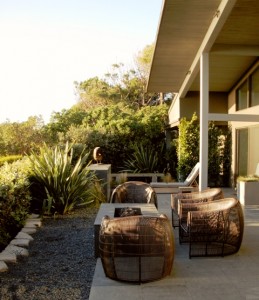
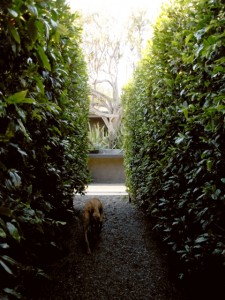
Here are a few shots I took on that first visit:

The January 31, 2009 visit had an agenda.

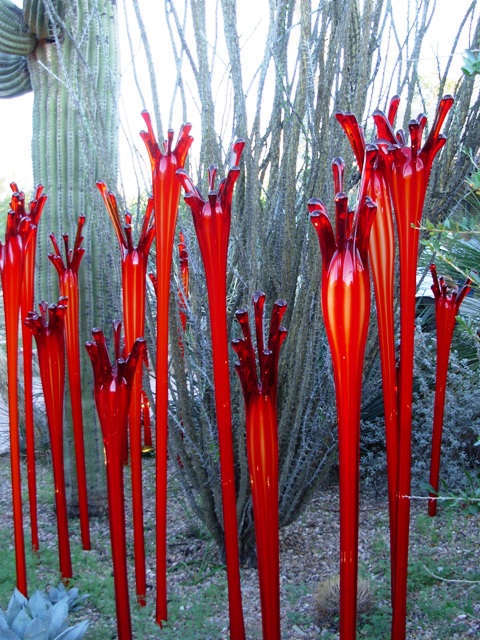
Number one: Tour “Chihuly: The Nature of Glass” show, the Seattle artist’s first installation entirely within a desert garden environment.  Number two: Meet Ken Schutz, the garden’s executive director, who led the GWA board on guided tour of the show (plus, he graciously joined us for dinner following our hour-long walk through the plants-and-glass extravaganza).

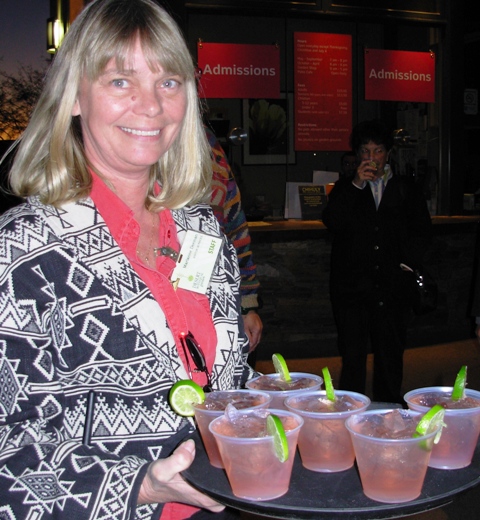
We gathered at the DBG entrance and were welcomed with a refreshing drink, straight from the desert: Prickly Pear Margaritas topped with a wedge of lime! You can purchase the Prickly Pear syrup in the garden’s wonderful gift shop.


Enjoy my narrated introduction, followed by my favorite images:

httpv://www.youtube.com/watch?v=k_F6-J8AOwo

A virtual tour of the gorgeous glass sculpture display:

“Sun,” the opening sculpture

Agaves in glass: the new entry piece

READ MORE…

Another great garden shed – with a new slant

Monday, January 19th, 2009

Literary agent Charlotte Gusay has a delicious secret. She recently shared it with me and gave me permission to write about it here.

Charlotte contacted me after reading about my shed expertise (also known as an “obsession”) in Dwell magazine:

“[I] saw the recent issue of Dwell (Feb. 09) with your article on ‘backyard’ sheds. So disappointed we did not find each other before this article and/or your book . . . .

“I have a swell little ‘postmodern shed’ that my husband Bobby Milder and I built about 5 years ago. . . .”

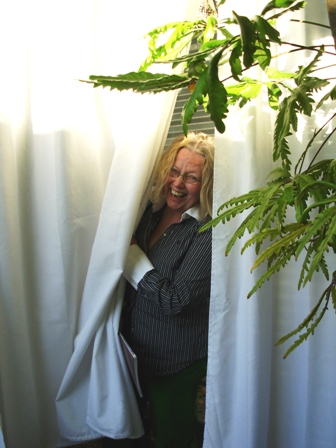
She sent along a few photographs to tempt me. What else would a nosy reporter such as me do next? I called Charlotte and invited myself over for a visit. Paula Panich, my writing mentor and friend, came along last week when we drove over to Charlotte’s after lunch.

Her house sits quietly on a tree-lined city street, just a block or so away from a major thoroughfare. It is nice to know these inviting residential pockets exist here in LA, right in the city. I love it!

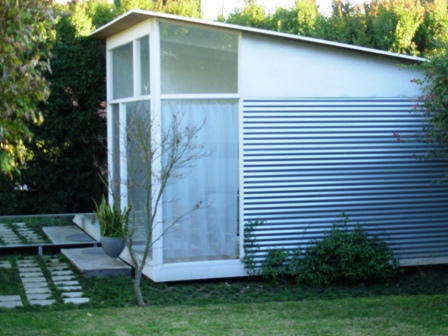
This irresistible 10-by-14 foot haven is tucked comfortably into a far corner of Charlotte’s urban lot, hidden from everyone’s view but hers. Because of the way it has been sited, the shelter is first seen “in profile,” its longer side and angled shed roof-line emphasized. When glimpsed by newcomers (such as Paula and me) the shed reveals its see-through quality, thanks to a wraparound glass “corner” that connects two outer walls. The white-painted framework around the windows and door outlines and emphasizes vertical and horizontal lines of the design (almost Mondrianesque in its geometry).

I like how Charlotte described the shed to me in her first email note: “It floats elegantly in the backyard, just beyond our 1944 mid-century house in West Los Angeles.”

READ MORE…

It’s time to think about spring in the garden

Tuesday, January 13th, 2009

Yes, it may only be the second week of January, but our Noble firs and cedar boughs are now past their prime (and in my case, at least) cut up and ready for recycling in the yard-waste bin.
Onward to spring!

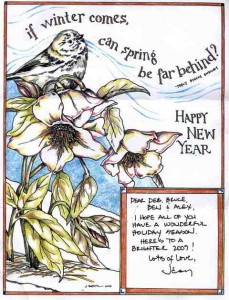
To get me in the mood, I have this inspiring drawing pinned next to my desk.

My friend Jean Zaputil, an artist and garden designer, illustrated and hand-colored it as a most charming New Year greeting.

The scene depicts a songbird perched on top of a hellebore, with the wistful and compelling lines, which read:

“If winter comes, can spring be far behind?” 

[attributed to Percy Byssne Shelley]

Perhaps this saying will give you something to hold onto in the dormant months of winter! Spring is coming soon!

Also getting me in the mood for spring: Country Gardens’ early spring 2009 edition, which just arrived in my mailbox. 

I opened it up to find my story about friend and designer Bonnie Manion, owner of Mon Petit Chou, a vintage design business based in Encinitas, California. Bonnie blogs at VintageGardenGal – a cheery and charming spot to visit – you’ll want to do so frequently!

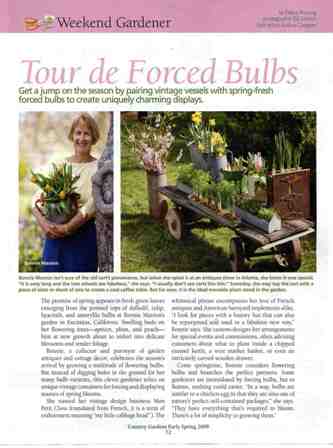
The story, commissioned by James A. Baggett, editor of Country Gardens, is called “Tour de Forced Bulbs,” and it features Bonnie’s designs pairing forced spring bulbs with forced flowering branches – arranged in vintage containers.

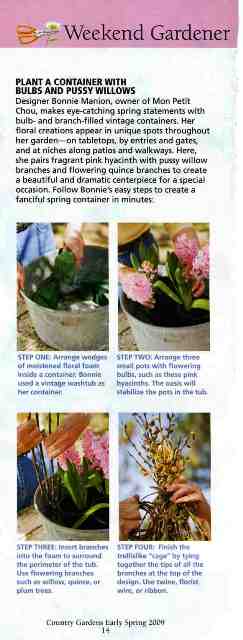
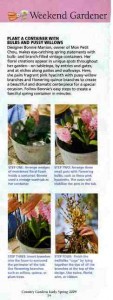
Here is the story in its entirety. A shorter version appears in the magazine, along with the step-by-step instructions for planting a container with hyacinth bulbs and pussywillow branches. The story was photographed by Ed Gohlich and produced by field editor Andrea Caughey.

TOUR de FORCED BULBS: Get a jump on the season by pairing vintage vessels with spring-fresh forced bulbs to create uniquely charming displays.

The promise of spring appears in fresh-green leaves emerging from the pointed tops of daffodil, tulip, hyacinth and amaryllis bulbs at Bonnie Manion’s garden in Encinitas, California. Swelling buds on her flowering trees – apricot, plum and peach – hint at new growth about to unfurl into delicate blossoms and tender foliage.
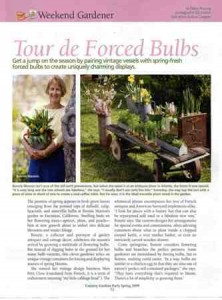
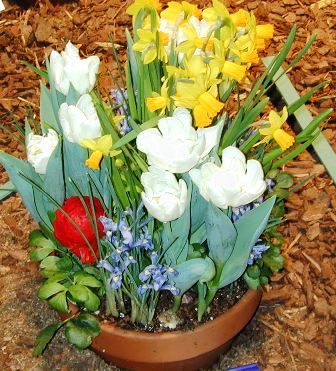
Bonnie, a collector and purveyor of garden antiques and cottage décor, celebrates the season’s arrival by growing a multitude of flowering bulbs. But instead of digging holes in the ground for her many bulb varieties, this clever gardener relies on unique vintage containers for forcing and displaying masses of spring blooms.

She named her vintage design business Mon Petit Chou (translated from French, it is a term of endearment meaning “my little cabbage head”). The whimsical phrase encompasses her love of French antiques and American barnyard implements alike.

“I look for pieces with a history but that can also be repurposed and used in a fabulous new way,” Bonnie explains. She custom-designs her arrangements for special events and commissions, often advising customers about what to plant inside a chipped enamel kettle, a wire market basket or even an intricately-carved wooden drawer.

Come springtime, Bonnie considers flowering bulbs and branches as the perfect partners.
Some gardeners are intimidated by forcing bulbs, but to Bonnie, nothing could easier. “In a way, bulbs are similar to a chicken egg in that they are also one of nature’s perfect self-contained packages,” she says. “They have everything that’s required to bloom into a flower. There’s a lot of simplicity to growing them.”

Using fresh-cut branches, the flower and leaf buds of which have yet to open, requires little effort, Bonnie adds. Whether brought indoors for flower arranging, or used as accents to planted containers, the tiny buds slowly open until flowers gracefully unfurl. “They last quite a while, especially if you keep the branches in water,” she advises.

With a spring palette ranging from soft pastels to bright primary colors, bulbs and branches pair companionably with timeworn artifacts of the past. “I like the yin-and-yang of it. To me, the weathered patina of old containers goes well with the colors of my spring bulbs.”
To grow bulbs in containers, Bonnie begins with the right vessel, selecting an eye-catching piece with a generously-sized opening at the top. Bulbs don’t require much root space, meaning that even a four-inch-deep wooden box is adequate as a planter. Deeper containers can be used as well. “You can keep the soil level low around the bulbs, and use the height of the container to support bulbs such as paper whites or amaryllis, as they grow tall and reach for sunlight,” Bonnie says.

Interesting vintage containers include chicken feeders, tool carriers, old boxes or pails, hay racks, sugar tins, large and small funnels, oil cans, children’s wagons or carts, old urns, kitchen strainers – “virtually any container with a wonderful vintage character,” she says.

Bonnie’s finished designs look spontaneously fresh. “I get a lot of my plant and container ideas from my travels,” explains this vintage garden gal.

She frequents large and small flea markets and other off-beat vintage garden antique sources around the country and occasionally visits Europe for inspiration. “I might see a single potted rose in a Paris flower shop. Or, I’ll discover a dramatic floral arrangement in a London hotel lobby and try to recreate it at home.”

Bulb-filled vintage containers never fail to make a statement. “Put them in a setting in your garden where you need some ornamentation,” Bonnie suggests. “You can have fun bringing old pieces back to life and making them functional again. Get as creative as you like, and your pieces will be uniquely you!”
Forcing Bulbs

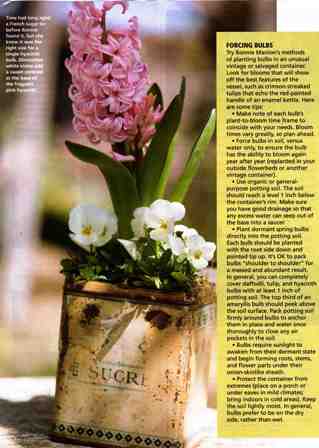
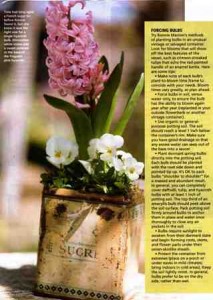
Try Bonnie Manion’s methods of planting spring-flowering bulbs in an unusual vintage or salvaged container. Look for blooms that will show off the best features of the vessel, such as crimson-streaked tulips that echo the red painted handle of an enamel kettle. Here are some tips:

  • Make note of each bulb’s “Plant-to-Bloom” timeframe to coincide with your needs. Bloom times vary greatly and you will need to plan ahead when planting.
  • Forcing bulbs in soil, versus water only, will ensure the bulb has the ability to bloom again year after year (replanted in your outside flower beds or another vintage container).
  • Use organic or general-purpose potting soil. The soil should reach a level one-inch below the container’s rim. Make sure you have good drainage so that any excess water is able to drip out of the base (you may need to use a saucer to protect furniture or windowsills from water damage).
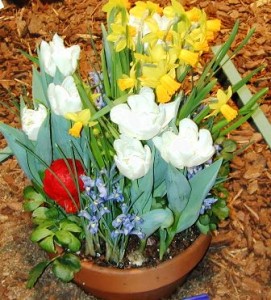
  • Plant dormant spring bulbs directly into the potting soil. Bulbs should be root-side down and pointed-tips upward. It’s okay to pack bulbs “shoulder to shoulder” for a massed and abundant result. In general, you can completely cover daffodil, tulip and hyacinth bulbs with at least one inch of potting soil. The top third of an amaryllis bulb should peek out above the soil surface. Pack potting soil firmly around bulbs to anchor them in place and water once thoroughly to close any air pockets in the soil.
  • Bulbs require sunlight to awaken from their dormant state, and begin forming roots, stems, and flower parts under their onion-skin-like sheath.
  • Protect the container from extremes (place on a porch or under eaves in milder climates; bring indoors in colder ones). Do not let the soil dry out, but keep it lightly moist. In general, bulbs prefer to be on the drier side, rather than wet.
  • If you want maximum versatility with your designs, plant bulbs in small plastic nursery pots. One or two bulbs will fit inside a six-inch, soil-filled pot. You can plant up dozens of bulbs and care for them using directions above. Once they begin to bloom, arrange the bulbs inside larger containers and layer Spanish moss on top to cover your secret.

Check out one of Bonnie’s favorite bulb sources: Easy-to-Grow Bulbs.

Forcing Branches

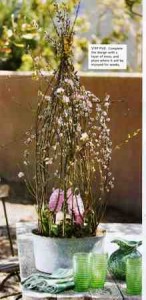
Young branches of woody trees and shrubs are supple and pliable in the spring. This makes them easy to weave into trellis-like designs as Bonnie has done. If you cut the branches before their flower or leaf buds open, you can bring them indoors for long-lasting vase arrangements. Better yet, add cut branches to outdoor containers as a complement to spring bulbs. Here are some general guidelines:

  • Look around your landscape for inspiration. Do you have a golden forsythia, coral-bark maple, or flowering plum? As many of these woody plants are in need of early spring thinning or pruning, save the cut branches for container or vase designs. A neighbor might also allow you to lightly prune a few branches. In late winter or early spring, local markets or florists are good sources for cut branches, such as curly willow, quince, or witch hazel.
  • Use a pair of clean, sharp garden shears, secateurs or loppers to branches at a 45-degree angle. Make the cut at the bottom of a stem where it joins a larger branch.
  • You can stick the pointed base of each cut branch directly into the planting soil, at least three inches deep. As you water your bulbs, the branches will soak up needed moisture to keep the buds plump until they bloom.
  • You can also arrange cut branches in a water-filled vase. Flower preservatives can keep the water muck-free, but nothing’s better than replacing water daily.

Recycled column debuts in LA Times

Saturday, January 3rd, 2009

You spy a weathered castoff, a tarnished this or a timeworn that. What is the first thing that comes to mind? “Don’t throw that away! I can find a good use for it.”

The designer’s mind will recycle, reinvent or re-imagine the piece of “junk,” giving it a new purpose as an object of style. Read on for the first installment of a new column that features local designers and resources for transforming otherwise unusable objects into home décor.

Today’s HOME section of the Los Angeles Times introduces a new feature about recycling old objects for home and garden decor. It’s the brainchild of editor Craig Nakano and we hope this is just the beginning of the “hunt” for cool ideas that give new life to elderly castoffs.

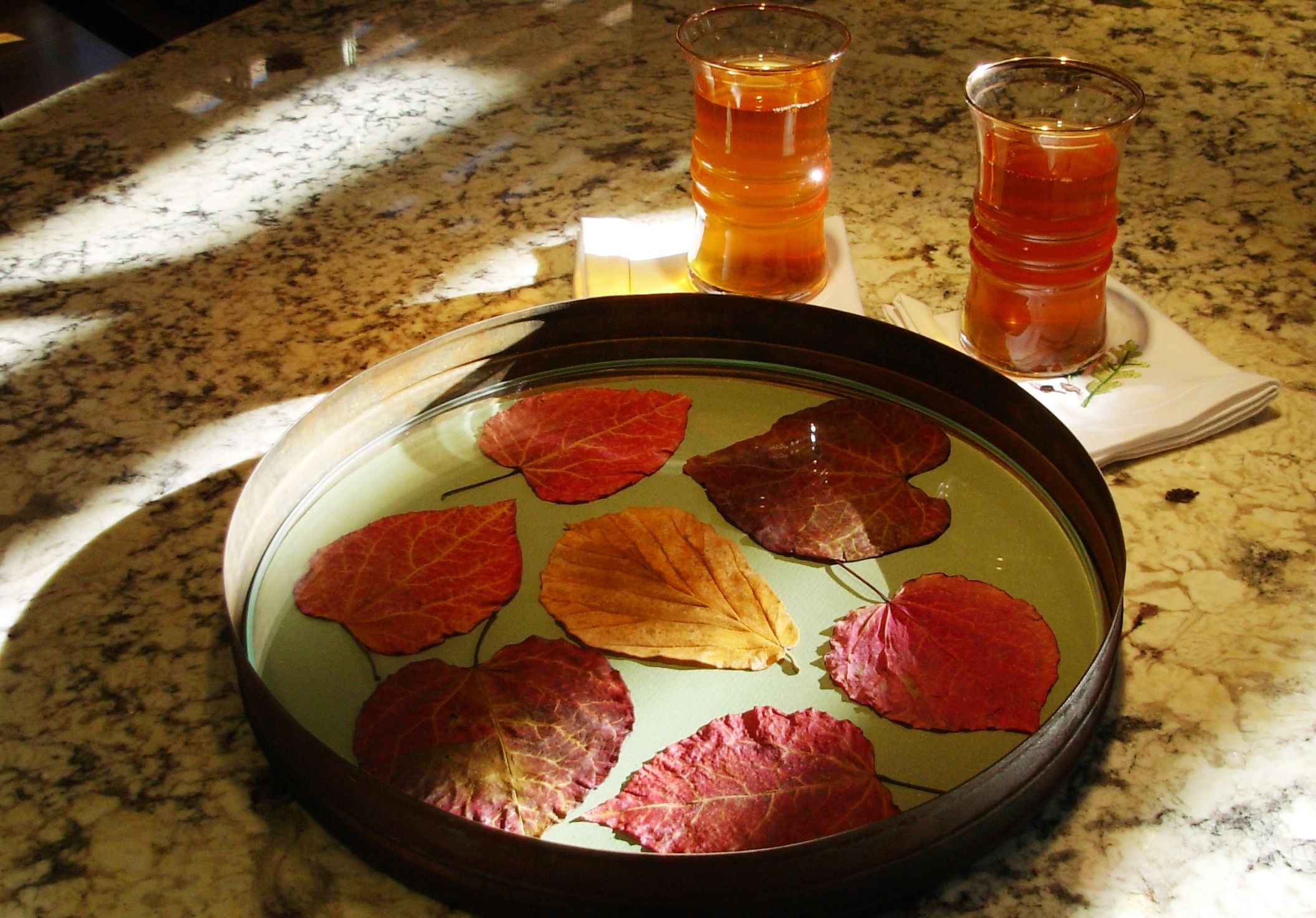
To get things going, I created the first product – a cocktail tray made from a vintage feature-film canister. I found the 14-inch diameter tins at Pasadena Architectural Salvage, a store filled with carefully salvaged columns, doors, windows, corbels, gates, hardware and more. Most everything there is pricey (we’re not talking junk-shop rates) but worth it if you want to factor in the “value added” of someone else seeking, securing, and transporting rare or hard-to-find objects.

When I visited Pasadena Architectural Salvage, I got lucky. The tins (bottom and lid as a set) were $5 each. I found similar ones for $15 to $25 each on eBay, so I know I got a steal.  My Recycled story, “A second serving,” gives readers the background of these vintage 35 mm film tins and step-by-step instructions for making their own. My finished photo appears above, with two heirloom ridged and gold-rimmed juice glasses that were my grandmother Helen Winslow Ford’s (thanks, mom!).

P.S., I used “a lust for rust” in my lede sentence. Credit must be given here to my friends Beth, Lisa and Amy of the Salvage Studio. It’s one of their favorites and I’m sure they coined the phrase!

Gardener’s Resolutions

Tuesday, December 30th, 2008

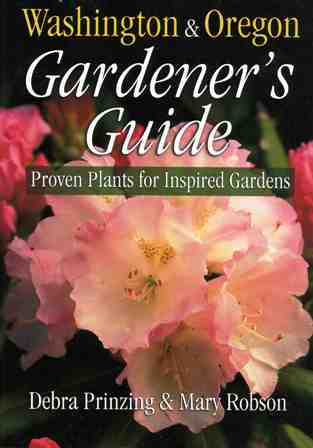
In early 2005, Cool Springs Press published the Washington & Oregon Gardener’s Guide, a book I co-authored with the wise and gifted garden writer Mary Robson. We combined our talents to share years of garden experience to help readers plan, plant, and maintain a beautiful and healthy garden.

The book is filled with our personal recommendations of plants that thrive in the Northwest, presented in a concise, helpful format. The major challenge of writing WOGG, as we called it, was to limit ourselves to 186 individual plant selections, from annuals to vines. No gardener wants to be told she has to “choose” a finite plant list!

Our fabulous publicist, Lola Honeybone, who now runs Media Workshop, a Nashville-based book PR shop, suggested that Mary (shown at left) and I develop a lecture to accompany our book-signings and appearances. She dreamed up the title “Seven Habits of a Highly Successful Gardener.” Lola’s clever angle brought Mary and me together for a 2005 lecture at the Northwest Flower & Garden Show in Seattle. It was so much fun to plan this talk knowing Mary and I would have a friendly give-and-take as we walked the audience through our Seven Tips.

Later, our friend Richard Turner, editor of Pacific Horticulture, asked us to turn the lecture into an article. Here is the article, from the journal’s Winter 2006 issue. It seems appropriate to share this as we approach 2009 – and I encourage you to adapt these tips for your own New Year in the Garden:

Seven Habits of a Highly Successful Gardener

Gardeners in the west enjoy the unique luxury of living with few rules about what’s right or wrong in the way we grow our plants. We appreciate and adapt to our garden’s cultural conditions. We are overwhelmed with a seemingly endless selection of excellent, healthy and suitable trees, shrubs, perennials, annuals, vines, bulbs and ground covers from which to choose for our landscapes.

In the Pacific Northwest [my former home], we’re particularly lucky to have temperate conditions where it’s not too hot – and not too cold. This welcoming, plant-friendly climate bestows added blessings. Imagine how hard it was for us to compile a regional gardening book and limit ourselves to only 186 great plants!

Perhaps the horticultural excesses in our lives call for a little discipline. Certainly, we want to be good stewards of our gardens, both to ensure our immediate enjoyment and the long-term health of the plants and places we tend.

So, with apologies to the original “7 Habits” author Steven R. Covey, we offer the following Seven Habits of a Highly Successful Gardener:

READ MORE…

a word about tiny Christmas trees

Wednesday, December 17th, 2008

Those of us who attended the September 2008 Garden Writers Association annual symposium in Portland were in for a big treat when we boarded the coach buses (seven or eight in all) and took a ride to Boring, Oregon, home of Iseli Nursery.

We were introduced to a world of ornamental conifers, in every shape and size. Even though Washington is called the “Evergreen State,” in the nursery trade, it seems, the folks in Oregon claim the title. 

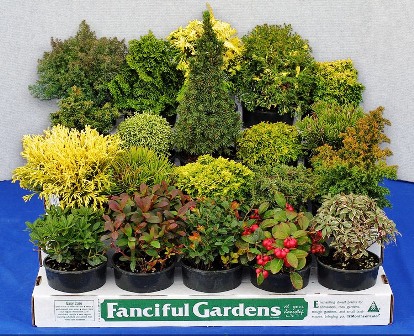
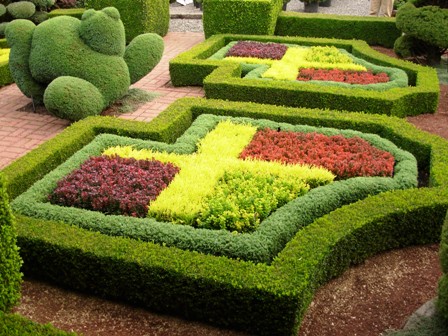
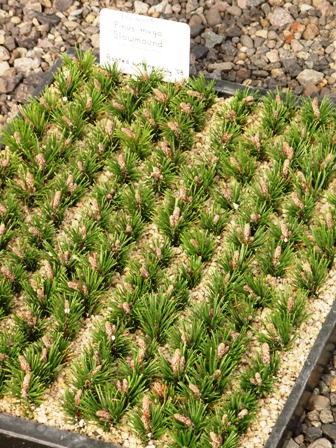
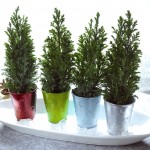
Iseli Nursery grows all sorts of amazing woody plant specimens – trees, shrubs and more. They sent us home with a gift bag packed with five delightful little conifer specimens – perfect for a container planting, rock garden or tablescape. You can see the incredible variety in Iseli’s “Fanciful Gardens” collection depicted above (including some dwarf broadleaf evergreens in the front row). My photos, from left: A colorful “knot garden” of mostly dwarf conifers mixed with barberry, Iseli entrance; tiny, just-propagated woody cuttings of mugo pine.

The next day, I found myself sitting on yet another the bus ride/garden tour with with Sandy Dittmar, a horticulturist at Iseli. We talked about how many gardeners are only now discovering conifers, and how dwarf conifers are so versatile for smaller landscapes. She planted a seed of insight and got me thinking.

So when I saw my local Trader Joe’s stocked with miniature Leyland cypress and Lawson cypress (we’re talking 4-inch pots for $4.29 or so), I called Sandy and said: Remember when we talked about dwarf conifers? Are those Trader Joe’s mini-trees yours?

It turns out, the tiny live trees in shiny pots are supplied by BloomRite Nursery, a wholesale grower in Half Moon Bay, California. But Iseli’s tiny Alberta spruces, mugo pines, and blue-star junipers, and countless other dwarf conifers are showing up in specialty nurseries and retail florists around the country. Cute, they are. Versatile, too. And perfect for a scaled-back Christmas!

In this cost-conscious holiday season, it was a fitting “tiny tree story” for the Los Angeles Times’  Home section, page F2 (December 13th).

Here is the piece I wrote under the “Seen” heading, in its entirety:

A pint-sized forest at home

Looking for evergreen decor – something that can last long past Christmas? Turn tiny potted conifers into a miniature forest across a fireplace mantle, or create a tabletop landscape with dwarf pines. Tiny trees are “a cheap luxury,” says Lisa Tsui, a product manager at BloomRite, a wholesale grower in Half Moon Bay, Calif., that supplies potted pines and Leyland cypress to Trader Joe’s. “In this economic environment, people are using them to supplement decorations they already have,” she says.

Iseli Nursery in Boring, Ore., ships tens of thousands of dwarf conifers to garden centers during the holidays. Even though some customers treat the evergreens as throwaway décor, they can be transplanted in the garden or an outdoor container, Iseli sales manager Jock Demme says. The challenge is to keep the plants alive indoors. “The home setting has drier and warmer air than these plants require,” he says. “I suggest submerging the pot in a larger container of water and soaking the roots every day.” The trees at Trader Joe’s sell for $4.29 to $5.99 each; you’ll find variations for $9.95 at the Empty Vase in West Hollywood, (310) 278-1988, www.emptyvase.com. Also try Red Envelope, (877) 733-3683, www.redenvelope.com.

Here’s a little gallery of dwarf and miniature tree photographs, shared by Iseli and Nurserymen’s Exchange (which is the company behind BloomRite).

December has arrived!

Monday, December 1st, 2008

It was 74 degrees and sunny here today in Southern California, but I have wintry visions dancing in my head.

To get into the holiday spirit (even though the leftover turkey and stuffing is still packed in the fridge), I picked up the December issue of Better Homes & Gardens magazine, out on newsstands now. That’s where my pal Susan Appleget Hurst serves as the talented senior associate editor for gardens and outdoor living. She blogs as The Everyday Gardener (with colleague Eric Liskey).

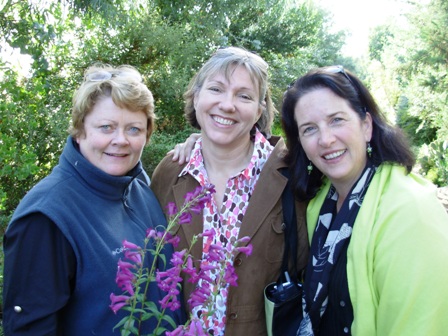
When we were last together in September, Susan mentioned that she had worked on a wintry design for iced botanical containers to hold votive candles. (Photo at right: Mary Ann Newcomer aka Idahogardener.com; Susan, and me, taken while gallivanting around Portland in September).

The idea Susan described sounded gorgeous and sparkly, a creative new way to use favorite ingredients from the garden — leaves, berries, colorful branches and conifer sprays — for holiday decorations. Her twist on the traditional luminaria even found a new use for poinsettias, which are rarely successful as cut flowers.

I spoke with Susan today and congratulated her on the alluring designs, which are splashed across five pages of the magazine. She sent me a web link to a BH&G video demonstration, which makes the project easy-to-understand and replicate.

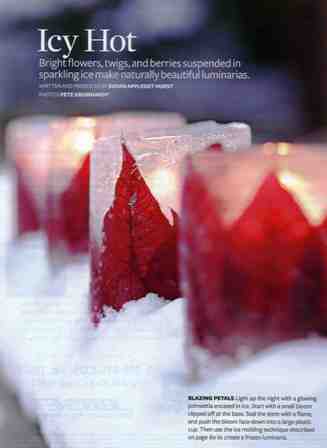
All you need are a few ingredients and space in the freezer to transform a watery concoction into frozen floral luminarias. Susan’s article begins on page 58 of BH&G. It’s titled “Icy Hot: Bright flowers, twigs, and berries suspended in sparkling ice make naturally beautiful luminarias.”

Susan has a culinary and herb-gardening background, so it didn’t come as a surprise to learn that she has used a similar technique to freeze blooms and herbs into ice rings to float in punch bowls. That handy trick, combined with the editorial challenge of showing readers new ideas for using their garden during the depths of winter, added up to the holiday-on-ice project. The frozen floral ring, best employed for a summery brunch, also taught her that distilled (rather than tap) water is preferred because it freezes clear rather than cloudy.

Susan first captured ruby red poinsettia bracts in a flexible plastic container, arranging each leaf so it’s evenly spaced (see finished project, above). Pour in a little bit of water, say 1/2-way to the top. Then insert a smaller plastic cup, sinking it with a few stones. Pop the entire vessel into the freezer until it’s frozen solid. There are tips in Susan’s article for choosing the right containers and for slightly thawing your creation in order to remove the finished product from the plastic molds.

The poinsettia votive holder was so successful that Susan experimented with colorful cut branches, arranged to stick out around the top of a luminaria like a beautiful nest for an exotic winged creature.

“How on earth did you fit that into the freezer?” I asked.

She laughed and pointed out that the water-and-branch-filled mold (actually a big plastic cake carrier) froze in the outdoor environment of her Des Moines, Iowa, backyard.

“I just needed sustained, freezing temperatures,” she added (assuring me that these conditions do not occur every winter in Des Moines, but they did last year when Susan played around with this project).

Um, okay. Well, since we don’t have an open-air freezer here in my SoCal yard, perhaps I’ll stick to Susan’s smaller projects. Like the ones that use 1-litre and 2-litre pop bottles with the tops cut off.

The Icy Hot story illustrates Susan’s gifted floral design skills. She’s got more tricks up her sleeve and you can find them in future editions of Better Homes & Gardens. Here’s what I managed to get out of her: The February 2009 issue will feature Susan’s inspired new way to design with forced branches and fresh flowers. In April 2009, look for her egg story. I don’t want to give away the details, but suffice it to say she is NOT cooking an omelet or quiche with her eggs!

Happy December. I hope it’s filled with joy and peace for everyone.

A shed that walks

Saturday, November 22nd, 2008

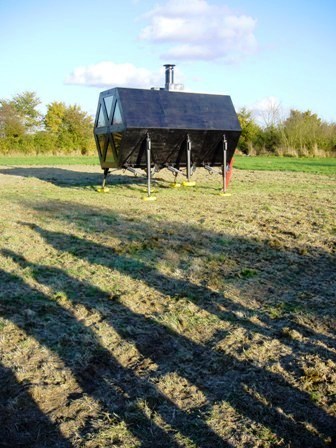
Couldn’t resist sharing this wacky invention called The Walking House, which appeared in the New York Times’ House & Home section two days ago.

Apparently, the design of this jet-black structure, which looks like a giant, six-sided building-block with “windows” on each end, was inspired by 18th and 19th century Gypsy carriages.

A Danish art collective called N55 created it during a residency at the Wysing Arts Center in Cambridge, England (The Walking House photo is from this web site).

Envisioned as a “high-tech form of nomadic living,” The Walking House measures 60-square-feet. Inside: a bed, a kitchen, a toilet, a shower, and a wood burning stove.

The computer-controlled legs were created by a M.I.T. engineer. You can watch a little video of The Walking House’s snail-like movements here:

httpv://uk.youtube.com/watch?v=CvxIB83Y0PA

There are some pretty funny comments – hundreds of them, actually – on the YouTube post. I’ll paraphrase three that caught my attention:

What happened to using good, old-fashioned wheels?

What about just walking – you could move a lot faster!

This looks like it was designed for obese people to transport themselves to McDonald’s for a Big Mac

Uh-huh. I dunno, it seems like a lot of work to get this behemoth on six legs to s-l-o-w-l-y meander at the speed of 196 feet per hour.

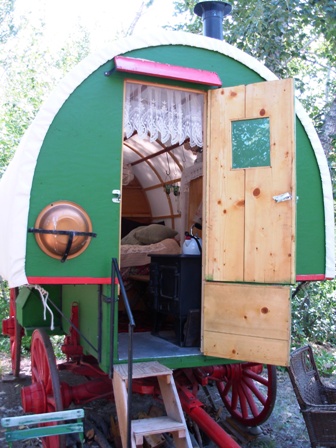
All I know is that the real Gypsy carriage I visited in Sun Valley this past summer seemed quite a bit more sensible – and it has four old-fashioned wheels.

Inside, there is a full-sized bed, a little cooking area, charming lace curtains, and lots of appeal! Imagine sleeping here, with the canvas roof overhead like a big canopy.

Throw open the door and watch nature’s display; or, perch on the steps with a mug o’ coffee and admire the sunrise. Glorious!

This green-and-red Basque sheep wagon was restored by a craftsman named Cotton Riley (how’s that for authentic?) for Cindy Hamlin, a passionate garden designer and friend of Mary Ann Newcomer’s. I felt very lucky that Cindy shared her hideaway-on-wheels with me!

Cindy’s abode may not be high tech, but it’s got a whole lotta character – and I bet it’s more comfy than The Walking House, too. Vive le difference!

Here’s what I’m reading – a blogging “meme” (or is it a “tag”?)

Thursday, November 20th, 2008

I’m the kind of person who may be vaguely aware of a trend but I don’t have a clue what it’s actually called.

Case in point: the hip blogging term “MEME.” I kept hearing about this word, but didn’t know its meaning. I thought perhaps it was an acronym (as in multi-electronic-marketing-expression – huh?).

When I moderated the “Blogging Success Stories” panel at the Garden Writers Association annual symposium in September, Dee Nash of Red Dirt Ramblings made a comment about “meme” this and “meme” that. I just smiled and nodded, as if to say: Oh, I am in the know. I really get what you’re talking about.

Except I didn’t. That’s how non-technical I am.

Then last week, my friend Lorene Edwards Forkner sent me a “tag” challenge, one that she received from another Internet girlfriend, “Flowergardengirl” (aka Anna). I received Lorene’s nudge, but I’ve been so swamped that my follow-through has been belated for seven days.

I looked up the word MEME, which I thought might apply to Lorene’s “what are you reading right now?” tag, and discovered the following:

Meme: (Noun) A unit of cultural information, such as a cultural practice or idea, that is transmitted verbally or by repeated action from one mind to another.

Okay, tonight is the night. I’m down to one kid (the other kid is performing in a play and has informed me he is going to the midnight opening of teen-vampire flick “Twilight” after his show – who cares about first period choir tomorrow anyway? And husband Bruce is conveniently away at a 2-day graduate school commitment), so I can finally sit down and “play” with Lorene. She understands the delay and distractions. I know she does!

The challenge is as follows: Grab the nearest book at hand (no fair looking for something intellectual, just what’s within arm’s reach of your keyboard). Turn to page 56, go to the 5th sentence and post your results – include the 2-3 sentences that follow to provide some sort of context. Then turn around and “tag” 5 or more blogging friends to do the same.

READ MORE…

Tree Houses (Huts? Sheds?) in Manhattan

Monday, November 17th, 2008

Alerted by my British shed-pal Alex Johnson, of www.shedworking.co.uk,  to news that a village of tree houses had sprung up in Manhattan’s Madison Square Park, I was determined to see the spectacle with my own eyes. While in NYC for a brief 48 hour visit last weekend, I added a stop at this midtown Manhattan public exhibit of sheds-in-trees.

My son, Ben, and I spent 2 days in New York, en route home from a not-so-happy occasion (my mother-in-law’s funeral). The exposure to theater and art was a welcome respite. Last Sunday, before departing to take the train out to JFK Airport, we squeezed in a subway ride on the Downtown R train to 23rd Street & Fifth Avenue.

Emerging from underground into the beautiful autumn weather, we crossed the street and entered a verdant, 6.2-acre patch in the heart of urban hustle. Looking up, built around the trunks and suspended amid branches of six or seven tall shade trees, we spied the underneath sides of the Tree Huts. While quite humble, constructed with an apparent lack of precision from 2-by-4s and nails, each little hut seems perfect in its imperfection. The mere essentials of shelter are provided: roof overhead; floor beneath; walls to protect; window or doorway for access and light. All that is missing is a rope ladder or steps made by pieces of lumber nailed up the tree trunks. I was eager to scramble the heights and enter one of these engaging structures!

READ MORE…