Debra Prinzing

Get the Email Newsletter!

Archive for the ‘Playfulness’ Category

A filmmaker, his designer and me

Saturday, September 5th, 2009

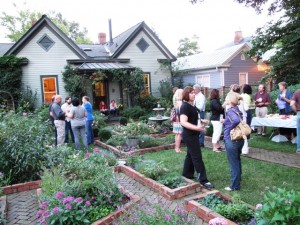
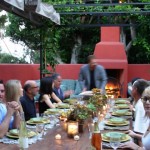
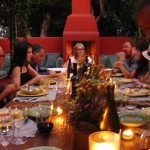
. . . in an intimate, domestic setting illuminated by flames, candles and carnival lights.
The September Issue

The September Issue

Thanks to ample layout space and the 4-color gods, today’s Los Angeles Times HOME section devotes a whole lotta real estate to my feature story about the indoor and outdoor kitchens of hot documentary filmmaker R.J. Cutler.  If his name doesn’t ring a bell, I refer you to the The September Issue, the documentary feature film that opened last weekend in New York and opens in Los Angeles and the rest of the world on Friday. The film follows the legendary Vogue editor Anna Wintour and her creative team as they put together the fashion magazine’s most important issue of the year – in this case, the September 2007 issue. The expanded online photo gallery is here.

Debra and R.J. on location in his outdoor dining room

Debra and R.J. on location in his outdoor dining room

Every good thing that has happened to me since moving to Los Angeles comes through meeting interesting and talented people who, in turn, lead me to more fascinating and gifted ones. I met R.J. through interior designer Lory Johansson, whose studio is called Just Joh. I met Lory indirectly while profiling a Malibu garden designed by Scott Shrader for Garden Design magazine. Lory designed the interiors for Scott’s clients and I mentioned their collaboration on choosing materials for the indoor-outdoor elements in my text (that piece appeared in January, called “Sunset Soiree.”).

During the editing process, I received a message from the Garden Design fact-checker saying that Lory would love to show me one of her outdoor projects. We connected by phone and arranged to meet at R.J.’s Hollywood Hills property this past February. It takes a lot of time to scout gardens. It’s kind of like buying futures on the commodities market. You have to spend a few hours on the freeway, usually in crummy traffic, on the off-chance that the architecture, interiors or landscape you’re scheduled to visit will be a worthy candidate for publication. For some reason, after speaking with Lory, I had a hunch the trip to R.J.’s wouldn’t be a waste of my time.

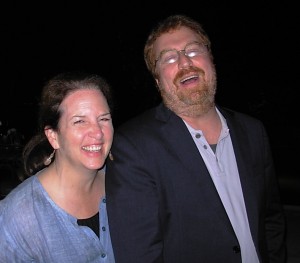
Designer Lory Johansson and me. The photo is a little blurry because it was taken without a flash by candlelight. We're happy that the shoot is over!

Designer Lory Johansson and me. The photo is a little blurry because it was taken without a flash by candlelight. We're happy that the shoot is over!

The property is just stunning, high in the hills above Beachwood Canyon and literally under the HOLLYWOOD sign we’ve all seen in a million movies and TV shows. It’s a circa 1924 Spanish Colonial Revival home, which R.J. acquired in 2005 and has subsequently restored with Lory’s brilliant design skills. Big but not imposing, the house sits on three-quarters of an acre. There is a beautiful garden with a swimming pool, strolling paths, a lawn for croquet and square-dancing, a secret garden and other intimate spaces. You can’t see that now, though, because photographs of the garden are under wraps until Garden Design’s March 2010 issue (photographed by the very talented Jack Coyier). That’s right. First the Los Angeles Times. Then Garden Design. See how lucky I was connecting with Lory?

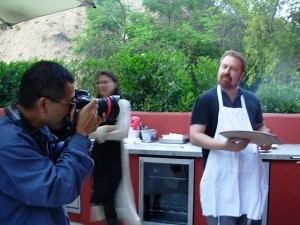
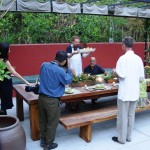
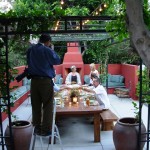
At the outdoor pizza party featured in today’s LA Times, freelance photographer Ringo Chiu, who shoots frequently for the newspaper, captured the festivities through his lens. I tried to stay out of the way while also surreptitiously “art directing.” Anyone who has worked with a newspaper photographer over the years (this comment is for you Melanie Munk) knows how impossible it is to get them to do what you want. And even more impossible to style a shot as you would for a magazine or book. However tough that “dance” can be, Ringo at least humored my few suggestions (ie, shouldn’t we light the fireplace? how about the candles? let’s move that dead potted rosemary!). He did a great job and it was fun for me to snap a few shots of him at work, shown here.

Photographer and Filmmaker

Photographer and Filmmaker

You can draw a lot of inspiration from this story for your own garden. The best tip from Lory is to go bold with color. She designed the entire outdoor kitchen, benches, fireplace and privacy wall with a white stucco finish, like R.J.’s house. But when it was finished, Lory says she stood at the opposite end of the garden and looked across the pool to the too-white scene. “It looked like Greece instead of Los Angeles,” she lamented. Lory knew color would lend heightened drama, especially in the outdoor setting.

The day before R.J. was planning to host his first big al fresco pizza party, she couldn’t stand it. Lory went out and ordered gallons of paint – rich, deep, paprika-terra cotta red – and got the crew started painting. When R.J. came home and saw what was going on, she promised him that if he didn’t like the result, she would pay to repaint everything white again. (Can you imagine how many coats of white paint it would take to cover dark red?).

Let’s just say Lory’s gamble paid off. You have to read my story to see what R.J. says of the decision to keep it.

After researching and reporting this story, I have two new items on my own garden wish list. Number one: I need to buy a 100-foot string of carnival lights to suspend around my own garden. Number two: I desperately want my own wood-burning pizza oven. But only if I can have Chef Alberto come over to cook for me!

Here are more of my candid party photographs:

A Gazebo in the Garden

Sunday, August 23rd, 2009
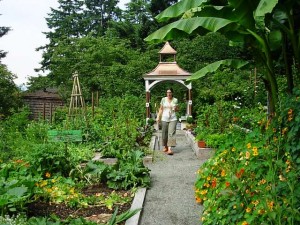
Kathy Fries, framed by her new gazebo

Kathy Fries, framed by her new gazebo

Most gazebos are a little twee for my liking. If you think of a traditional white latticework structure, the kind that looks as if a gust of wind or a swiftly-kicked soccer ball might knock it over, you probably don’t love gazebos either.

Ever since I started scouting great garden architecture for Stylish Sheds and Elegant Hideaways several years ago, I have changed my tune.

Case in point: When I was in Seattle earlier this summer, my friend Kathy Fries invited me to see her new copper-roofed gazebo. Situated in the heart of Kathy’s prolific vegetable garden, the structure was built by John Akers. I’ve written about Kathy and John’s collaboration before, both in this blog and in the pages of Stylish Sheds. He is a salvage-artist-carpenter who knows how to take Kathy’s grand ideas and construct them into fanciful garden buildings.

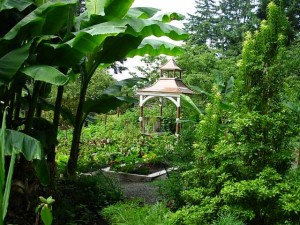
It's a lovely addition that enhances the vegetable garden

It's a lovely addition that enhances the vegetable garden

What I love about Kathy’s new gazebo is that it is both beautiful and functional (not to mention sturdy!). In it, you can gain shelter from rain or sunshine; you can pause while picking raspberries and sit on one of two facing interior benches. You can “gaze out” over the garden, looking through openings on either end or the side walls.

The gazebo’s charming rooftop joins several other turrets, cupolas and domes that populate the skyline of Kathy’s garden. Plus, it gives the vegetable garden a new point of view. When John erected the gazebo, it allowed Kathy to realign some of her paths and planting beds on a main axis. It’s beautiful and I know everyone who sees it will start dreaming about a new sort of garden gazebo.

And did you know that Gazebo is believed to come from the Latin for “Gaze About”? I’ve added definitions from several sources to my Shed Glossary, here.

If you have a Gazebo you want to share, please send me the photo and I’ll post it in the future. Here are a few more photos from Kathy’s garden:

Stylish Chicken Coop in Santa Barbara

Sunday, August 16th, 2009
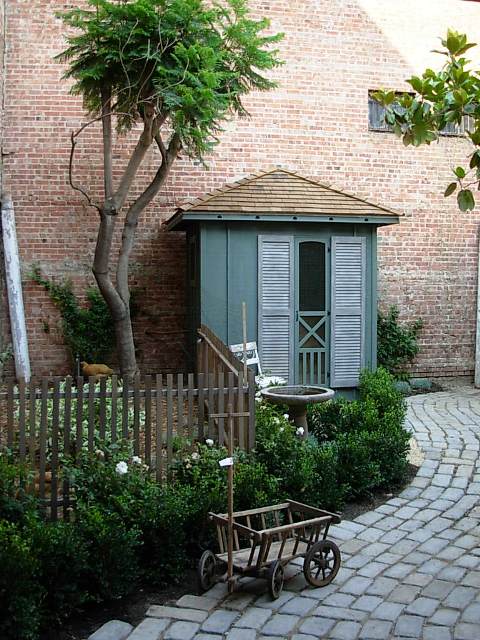
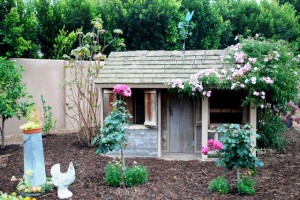
A tiny chicken coop with loads of style

A tiny chicken coop with loads of style

Last week’s visit to Santa Barbara included a stop at “Rooms & Gardens,” a wonderful home furnishings, antiques, accessories and interior design emporium on State Street.

I needed to check out the store’s new backyard chicken coop and garden.

Owners Eric and Jami Voulgaris recently created the sweet coop and romantic garden, where four Buff Orpington hens reside.

When I met Eric a few weeks ago, at the Santa Monica “Rooms & Gardens” store (they own this location with a partner, actress Mary Steenbergen), he told me about the chicken coop project.

The little building measures about 6-by-6 feet in size, with a charming shingled roof, board-and-batten siding, a country-style screen door and shutters. Stained that dreamy grey-blue shade, it looks both elegant and timeless.

A curved cobblestone path leads from the store’s back door out into the postage-stamp-sized garden. Picket fencing contains the four gals in their little yard.

The Voulgaris children named the Buff Orpington chicks, born on Easter morning: “Henny Penny,” “Rosy,” “Cornflake,” and “Scramble.”

The 800-square-foot garden’s renovation came about because it had to be ripped up when the neighboring Apple store was moving in. When that construction came to an end, Eric and Jami saw it as a chance to dress up the space, which really hadn’t changed much since Rooms & Gardens opened 16 years ago.

Happy chickens living in a happy garden

Happy chickens living in a happy garden

Pretty and inviting, a corner garden

Pretty and inviting, a corner garden

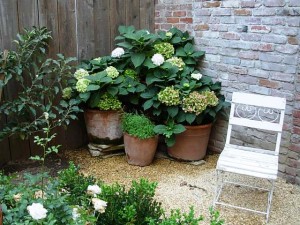
Fully organic, the Martha’s Vineyard-inspired garden is landscaped with espaliered apple trees, Meyer lemon trees, ‘Iceburg’ roses and clumps of lavender. One corner holds a display of potted hydrangeas and an iron chair.

The garden and hens complement the carefree lifestyle settings inside Rooms & Gardens. Eric describes the store’s look and feel as “a fusion of British Colonial, ethnic accents, Chinoiserie and a relaxed coastal theme.”

I love the happy vibe that you feel upon entering. It’s a store where sink-into furniture is paired with uncommon accessories, all of which suggests well-loved and well-lived-in environments.

The garden is open to visitors during store hours. If you want to taste the yummy brown eggs produced here, check with the staff. Eric mentioned that a plan is in the works to supply Tuttini’s, a cafe around the corner, with their daily source of eggs!

Fun at the Ventura County Fair

Tuesday, August 11th, 2009

My lifeblood is comprised of words, sentences, paragraphs, stories. I am definitely NOT a writer of “short” blog posts. But sometimes, I do have to defer to the photographs to tell a story. So today, you will be treated to mostly photos of our afternoon at the Ventura County Fair in Ventura, California. After years fighting the crowds, strollers and sticky run-ins with cotton candy at the King County Fair in Puyallup (Washington), I have to say how nice it is to take in a smaller fair with fewer bells and whistles. With the charming theme, “Homegrown and Pure-Bred,” Ventura’s is the perfectly-sized county fair. Of course, when you go on a Monday afternoon, you’re not going to encounter the weekend crowds. So we did.

What follows are my favorite images of the day. The fair continues through Sunday, August 16th. For details, click here:

RIDES TO THRILL

What a beautiful whirligig. The figures against the blue sky are flying around. The machine's carnival-colored design is beautiful.
What a beautiful whirligig. The figures against the blue sky are flying around. The machine’s carnival-colored design is beautiful.
The giant slide. A ride down the track on a burlap sack couldn't be more fun. My son Alex is nearly prostrate, on the green slide; his friend Philip is racing down the orange one.

The giant slide. A ride down the track on a burlap sack couldn't be more fun. My son Alex is nearly prostrate, on the green slide; his friend Philip is racing down the orange one.

 JUST FOR LOCAVORES

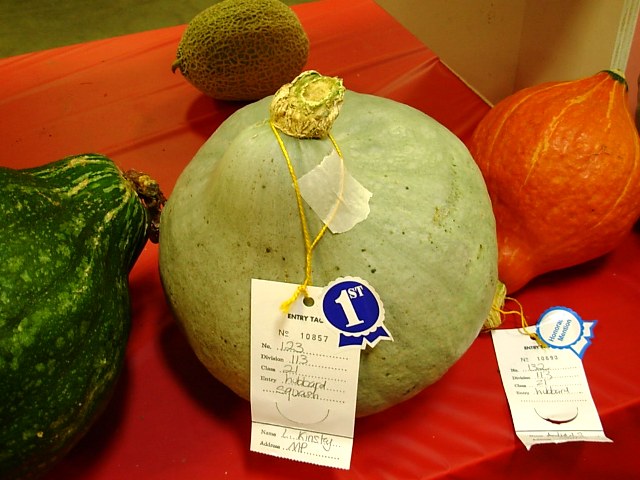
A prizewinning Hubbard squash in the Agricultural Building caught my eye. I'm growing one in the garden, but she won't be this big for a while yet.

A prizewinning Hubbard squash in the Agricultural Building caught my eye. I'm growing one in the garden, but she won't be this big for a while yet.

CRAZY FARM ANIMALS
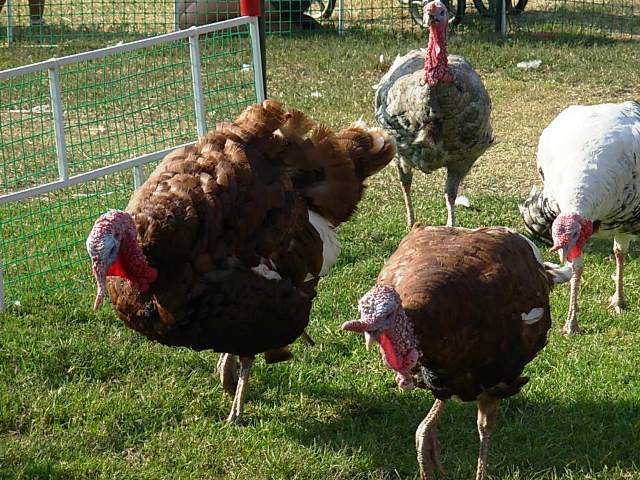
Turkey racing. Words cannot describe this silly event, but we loved it!

Turkey racing. Words cannot describe this silly event, but we loved it!

More turkeys, including the brown ones.

More turkeys, including the brown ones.

FLOWER POWER
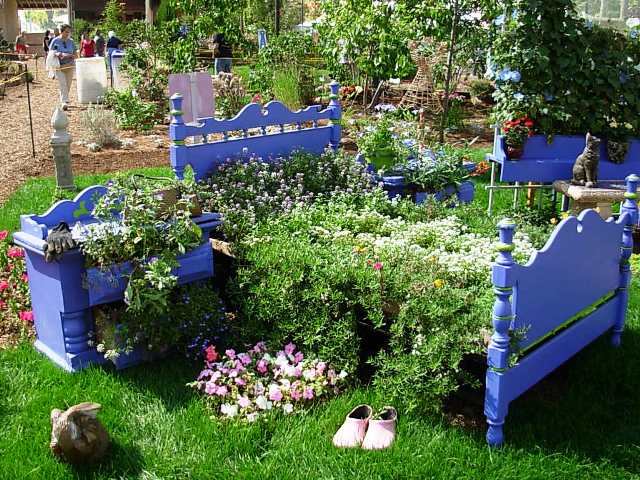
The "Floriculture" displays featured some outdoor gardens. Here's my very favorite: The "Flower Bedroom." I've seen planted beds before, but none as fanciful and well-executed as this one. Note the succulents spilling out of the dresser drawers, too!

The "Floriculture" displays featured some outdoor gardens. Here's my very favorite: The "Flower Bedroom." I've seen planted beds before, but none as fanciful and well-executed as this one. Note the succulents spilling out of the dresser drawers, too!

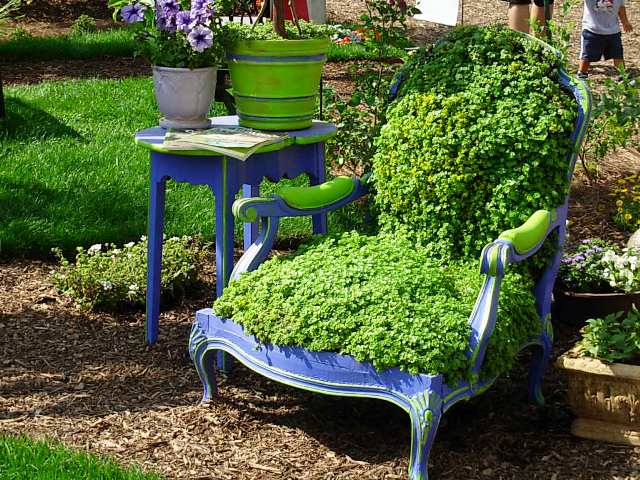
A sedum armchair. Lush and fluffy. Makes you want to sink right in. I love that the lime green arms have been painted to pick up the bright foliage.

A sedum armchair. Lush and fluffy. Makes you want to sink right in. I love that the lime green arms have been painted to pick up the bright foliage.

BACK TO WORK
 
Today I’m back at the desk, doing interviews for an article for a garden trends story that will run in a future issue of Alaska Airlines magazine. Alex and his friend are back to Junior Lifeguard training. We had a great day at the fair! After all that frivolity, we ended up only eating two roasted corn-on-the-cobs and one powder-sugar-flocked funnel cake between the three of us. Even still, by the time we came home at 8 p.m., both guys had headaches and stomachaches. That’s what going on all those spinning rides will do to you. Me, I’d rather look at produce, pigs, and pretty plants.

Chicken Coop Sightings . . .

Thursday, August 6th, 2009
A vintage EGGS sign hangs in Kathy Fries's fanciful coop

A vintage EGGS sign hangs in Kathy Fries's fanciful coop

Fresh eggs, how can you argue with that idea? I love cooking with fresh, organically-grown eggs produced by free-range hens. Thank goodness that I can buy them at my local, Thousand Oaks Farmers Market every Thursday! 

I wonder how long it will take before I graduate from growing backyard herbs, fruits and vegetables to raising chickens? Let’s see. . . maybe after my children leave for college, and perhaps after my beloved Lab, Zanny, has passed on.

Poultry fever has smitten many of my friends, though. I love the way they’ve integrated chicken culture into horticulture (get it?). And I really love the chicken coop architecture created by inspired hen owners.

Bonnie Manion's hens live in a renovated children's playhouse!

Bonnie Manion's hens live in a renovated children's playhouse!

My blogger friend Bonnie Manion, who writes at Vintage Garden Gal, often shares stories of her hens, advice on raising chickens and even the care an maintenance of coops. She has just inherited a couple of charming gals – Buff Wheaten Marans. You’ll want to read more of Bonnie’s chicken adventures (and see more photos of her charming coop, which is a re-purposed children’s playhouse, shown here ).

Recently, a writer friend of mine paid me what I think was a lovely compliment. She said, “Debra, I want to create a book just like Stylish Sheds and Elegant Hideaways – but about chicken coops!”

And my response: Go for it!

Bill Wright, my fearless collaborator, would love to photograph a chicken coop book. I call him “fearless,” because how else could you describe a guy willing to get inside a coop with half-a-dozen chickens, two youngsters and a lot of feed flying around . . . just to capture the perfect shot!!!?

Here is that photograph, of our dear friend and shedista Kathy Fries, along with her sons Xander and Jasper. We documented a moment in their daily routine, when mom and boys feed and water the chickens, gather eggs, and generally putter around the coop. That coop, by the way, is no ordinary henhouse. You’ll see what I mean about “poultry fever.”

”]Kathy, Jasper (left) and Xander feeding their chickens [William Wright photo]Kathy’s chicken edifice is called the Palais de Poulet. She worked with Seattle artist-builder John Akers to create the magnificent chicken abode, complete with a jaunty turret and a brick entry path lined with boxwood clipped into a fleur de lis pattern.

READ MORE…

Leslie Codina’s Garden Sculpture at LA County Arboretum

Thursday, August 6th, 2009
Leslie's Autumn-inspired piece is topped by a fabulous flame

Leslie's Autumn-inspired piece is topped by a fabulous flame

There’s new artwork at the Los Angeles County Arboretum & Botanic Garden  and it’s as colorful as the peacocks strolling around the grounds.

Four sculptural “towers,” designed, crafted and donated by artist Leslie Codina, celebrate winter, spring, summer and fall. The installation complements a 10,000-square-foot display of ornamental and edible plants called “Garden for All Seasons.”

Codina, who lives and works in Ontario, creates whimsical stacked towers of color, pattern and form. Her hand-built earthenware “beads” are fired in vibrant glazes, eye-catching patterns, and exaggerated organic shapes that suggest thorns, leaves, flowers, tendrils and bugs. Each piece has a hole at its center so it can be slid over a metal rod in whimsical, mix-and-match designs.

“They are my crazy interpretation of what’s already in the garden,” she says.

The artist sells her $400-$650 garden sculptures at local fairs, including the Arboretum’s L.A. Garden Show each spring. She proposed donating a permanent, site-specific sculpture several years ago, but it wasn’t until after renovations on “Garden for All Seasons” started in 2007 that Tim Phillips, the Arboretum’s acting CEO, agreed and suggested the site. Codina worked with garden curator Darlene Kelly to come up with the four-season theme and determine where the pieces would be installed.

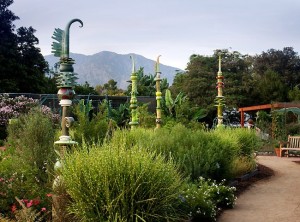
The four spires represent the garden's beauty in all four seasons

The four spires represent the garden's beauty in all four seasons

At 9 to 15 feet high, the quartet of spires has more than 50 individual “beads” and is larger than Codina’s typical work.  “The scale is huge – the base shapes are the size of a beach ball,” she says. “When we put them all together, they look hugely impressive. They complement the garden and the garden complements the sculpture.”

The sculptures follow the seasons, both in size and color. “They gain height as they ‘grow’ from winter through the rest of the year,” Codina says. Purple-and-sage designs symbolize winter; spring is a full spectrum of green colors; summer has hot pinks, oranges and greens; and fall is depicted with mustard yellow, olive green and red hues.

Unlike Codina’s smaller pieces, which often have branch-like armatures, the sculptures at the Arboretum are made of mostly cylindrical shapes. “I made them very peacock-safe,” says the artist. “I didn’t want to give the peacocks any place to perch.”

PHOTOS: courtesy Gene Sasse Photography

I’m now a “Garden Pundit”

Wednesday, July 8th, 2009

Just received this hand-addressed mailing from famous landscape architect Richard Haag of Seattle. I really like the title he gave me – GARDEN PUNDIT! I would now like to be addressed as “Ms. Debra Prinzing, Garden Pundit.”

gardenpundit001

Sneak a Peek at Summer: Outdoor Accessory Review

Monday, June 8th, 2009
Pier 1 imports in-house stylist, Aimee Beatty in her fav Papasan chair

Pier 1 imports in-house stylist, Aimee Beatty in her fav Papasan chair

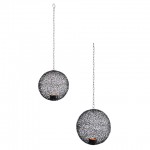
"Crazy Weave" hanging lanterns in 2 sizes, 6-inch high and 7-inch high; ($10-$15)

"Crazy Weave" hanging lanterns in 2 sizes, 6-inch high and 7-inch high; ($10-$15)

Summer’s almost here and since you may not have the budget for a big vacation, why not spend just a little to turn your backyard into a spa-at-home?

Pier 1 imports, my fav post-college source for home decor and furniture, is all grown up. I recently reviewed the retailer’s playful summer collection. I’m especially drawn to their lineup of  creative ideas for decorating outdoor spaces.

To learn more about the colors, patterns and materials that inspired the season, I called Aimee Beatty, Pier 1’s in-house stylist and design maven. She works for the Ft. Worth, Texas-based home furnishings chain to coordinate photo studio vignettes, visual displays and settings for advertisements and catalogues. 

One of the things I noticed about the Summer 2009 collection is that it’s very “interiors-looking.” I wanted to ask Aimee all about it. Here’s part of our conversation:

Q. I have enjoyed many great decorating moments from Pier 1, especially when I was in my budget-conscious, recent grad phase. But now Pier 1’s mix seems more edited and less like a world market. Has this change been conscious?

A. We envision ourselves as having something for everyone. There is an element of our products all working together (mixing-and-matching). Even today, we want shopping at Pier 1 to be a treasure hunt of sorts.

Q. I’m interested in the outdoor furnishings and accessories. What is the palette of the moment?

 A. We’re using punches of lime, yellows, corals and different shades of blue, including turquoise.

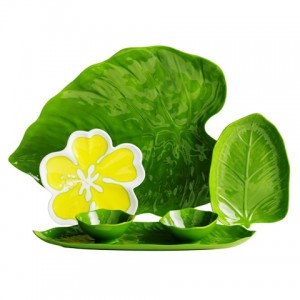
Reusable tropical-themed Melamine serving plates, $2-$19

Reusable tropical-themed Melamine serving plates, $2-$19

 Q. How about materials – what’s new there?

 A. One of the materials I’m most excited about is a plastic rattan.

 Q. It looks like Pier 1’s distinct design themes have an exotic flavor this summer:

 A. I would describe the overall theme as “eclectic” – a look of mixing and matching and layering furniture with different finishes. Themes include:

  • Bohemian:  It’s comfy, eclectic and a little romantic. Our design team has combined patchwork, embroidery and relaxed pieces for a vibe that’s in tune with today even though it might recall a hippy, happy era.
  • Tropical: Oversized floral patterns. Bold color. Natural touches. Easy ideas. This collection is as budget-friendly as it is cheery.
  • Global: This is the look that Pier 1 is known for. We travel the world and pick up treasures along the way.  You’ll see this in festive dinnerware, ceramic vases with an Old World look, carved mirrors – anything with rich, jeweled tones. This season, it’s the mix that makes traditional creations look bold and fresh.
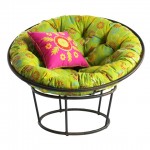
Outdoor Papasan chair, approx. 46-inches in diameter, $99.95 for 2-piece frame; Scatter daisy cushion, $100; 18-inch pillow, $16.95

Outdoor Papasan chair, approx. 46-inches in diameter, $99.95 for 2-piece frame; Scatter daisy cushion, $100; 18-inch pillow, $16.95

Q. Can you share any fun tips on making an outdoor space more personal?

A. People tend to overlook the fact that their outdoor patio can be just as important as their indoor rooms. I suggest you clear the clutter. Don’t use that space for storage! Instead, view the patio (or deck or terrace) as a useful place. No matter how small or big, have fun.

Q. Do you have an example of a favorite deck or patio design?

 A. I like to mix a sitting area with the dining area. You can have a bistro table for two but also incorporate a wicker chair or love seat. Blend the two uses rather than separate them.

 Q. Let’s talk about some of the hot styles and products for al fresco summer settings. What are some of your favorites?

Hot pink with Electric orange, an exotic, 4-by-6 foot outdoor rug, $24.95

Hot pink with Electric orange, an exotic, 4-by-6 foot outdoor rug, $24.95

A. First, the Papasan – for outdoors. I remember when I went off to college and that was the first thing we bought for the dorm room. It’s an iconic Pier 1 piece. This Papasan is great because it can stay outside. It’s bold and bright and has a lot of personality. It’s made out of iron and plastic rattan. The cushions are 100% polyester and water repellent. I love these (once) indoor chairs used outdoors because they offer a new and fun patio feature for you and your guests. Use them to create a cozy, casual environment.

Q. What about the outdoor rugs – they are awesome!

A. Rugs are often the last thing people think about when decorating their patio. These are bold and bright and have a lot of personality. They really warm up a space and make it room-like.

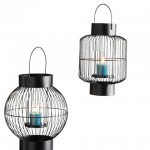
Iron wire cage lanterns 9-3/4-inch high and 10-1/2-inch high ($18 each style)

Iron wire cage lanterns 9-3/4-inch high and 10-1/2-inch high ($18 each style)

Q. And I love all the lanterns — the ones that accommodate votives and the battery-operated options. They would look great hanging from the pergola over my patio or from the trees in my garden.


A. Rather than just using one, you can have groupings of lanterns. Experiment with a little cluster. Or, hang a row of them above a table.

Q. Any final advice for accessorizing our summertime spaces?

A. These trends can be taken and shown by themselves or, for even more fun, mix them all up for an eclectic look that is totally your own.

Thanks, Aimee. I look forward to talking with you again.

Another amazing reason I’m starting to groove on Southern California

Monday, May 18th, 2009


For those of you who have known me for a l-o-n-g time, or even for ones who only occasionally stumble upon Shedstyle.com, it may be evident that I am torn between desperately missing Seattle, my home for most of the past 30 years, and embracing life in Southern California, where I’ve been living nearly 3 years now.

I’m learning that there is incredible beauty here in SoCal, especially if one gets off of the freeways and out into the raw, rugged nature. The same attributes that make me love the Pacific Northwest – the mountains, the ocean, the amazing plant life – are some of the ones that have made me begin to appreciate, value and (possibly) love my new home.

Yesterday was no exception. I slogged through 70 miles of freeway traffic on a mid-Sunday (which took 1 hour and 45 minutes, thank goodness for Prairie Home Companion or it would have been a lot worse!) to a place high above the ocean called Rancho Palos Verdes. When it comes to offering endless views of the Pacific shoreline, coastal beaches and blue ocean, it’s as breathtakingly gorgeous of a place as the more popular Malibu. Except, it seemed to me yesterday, with way less traffic and commercial development.

I met up with architect Ron Radziner of Marmol-Radziner, a Venice, Calif.-based architectural firm (which also has landscape architecture, interior design, furniture design and prefabricated design in its portfolio) to tour one of his projects. The property is called Altamira Ranch and the American Society of Landscape Architects recognized it with a residential design honor award in 2008.  My interview with Ron about the project will appear in a future issue of Landscape Architecture magazine. Suffice it to say that the approximately three sweeping acres of California native plants, surrounding a contemporary residence (also designed by Marmol-Radziner) is a study in excellent design. It is lesson that Bud Merrill, my former garden design instructor, would have so loved. He preached the gospel of “environmentally responsive design” – and I tell you, this project – home and landscape – makes huge strides in that practice of only “lightly touching” the earth.  Stay tuned for the full story.

The alluring labyrinth patterns are visible from high above the beach

The alluring labyrinth patterns are visible from high above the beach

The stone design, made by unknown hands

The stone design, made by unknown hands

After Ron and I finished the interview, Julie, the owners’ personal assistant, offered to walk the property with me.

She is a wealth of knowledge about native plants and how they perform in a residential setting – especially this tricky coastal site that is exposed to high winds, intense sun, frequent blankets of fog, and saltwater.

We paused at the edge of the bluff and looked down at the beach, which was probably 200 feet below us.

Julie pointed out the stone labyrinths that beachcombers have placed on the shore and she told me where to park so I could walk down to see them (she also suggested where I could grab some lunch; ironically, it was at the grill where golfers eat when they’re finished playing the greens at the Trump International Golf Club).

I hiked down to the beach and made my way across the uneven, rocky surface. It isn’t one of those “take off your shoes and stroll barefoot” kind of beaches. My shoes kept filling up with pebbles, but I couldn’t imagine going bare. The wind was brisk, which you’ll notice in the poor sound of the two short movies I shot. How else do you show the experience of a labyrinth without a moving picture?

At the Beach with Deb:

httpv://www.youtube.com/watch?v=BKYt9OW2iQE

Walking the Heart-shaped Labyrinth:

httpv://www.youtube.com/watch?v=HSxQm4iv_GA

Here’s my takeaway from yesterday’s unexpected hour on the beach: I was given yet another gift of California’s natural beauty. It was a vivid reminder that I am here for a reason. I am still discovering the reason(s), but isn’t having a chance to drink in this beach, collect a few of these stones and witness the creative way artistic humans have responded to them reason enough?

Growing Your Own Vegetables with Lorene Edwards Forkner

Tuesday, May 12th, 2009
Lorene, visiting a waterwise garden in San Diego, 2007

Lorene, visiting a waterwise garden in San Diego, 2007

I am so proud of my gal-pal Lorene Edwards Forkner and her latest book, Growing Your Own Vegetables (Sasquatch Books, 2009, $17.95).

An inspiring and essential compendium of vegetables and herbs to grow in your own backyard, GYOV is the first in Sasquatch’s series of single-topic references inspired by the late Carla Emery’s The Encyclopedia of Country Living.

If you came of age in the 1970s, you’ll remember this huge Yellow Pages-like tome. More than 600,000 copies have (and continue to be) sold over the years, even though Carla passed away in 2005.

growingyourownvegetables001It’s a good thing that Lorene was a back-to-the-earth gal long before modern-day foodies who are just discovering the joys and benefits of tending to their own edible plants.

She writes confidently and lovingly about all the great veggie and herb crops that have grown in her potager over the years. In GYOV‘s 180 pages, Lorene’s lively, conversational tone makes the idea of planting and tending one’s own food sources sound easy and achievable. There’s no right or wrong here, just an enthusiasm that says, “Come on, you can do it, just try!”

Lorene hints at an early obsession with urban farming in her introduction to GYOV, in which she thanks her parents “who allowed me to dig up our backyard, plant corn, and walk away.”

That curious opening prompted me to request the “back story” when Lorene and I spoke by telephone last week. Here’s her true confession:

“It was the mid 1970s, I think I was in junior high school. One day, I tore up about one-third of our backyard and planted it with corn. Then I lost interest and walked away. Oh my goodness, it turned into the biggest mess! I was in so much trouble because what I created was everything that ran against my father’s neat-and-tidy instincts. It was total chaos. And that was truly my first garden.”

Lorene and me, visiting the famed Lotusland in Santa Barbara (2007)

Lorene and me, visiting the famed Lotusland in Santa Barbara (2007)

Not much later Lorene went to college and married her high school sweetheart James (that’s where I met up with them in the late 70s-early 80s in Seattle). 

After a successful career in art, garden design and nursery ownership, Lorene joined the writing profession in earnest several years ago. One day last spring, Lorene met with Gary Luke, Sasquatch’s editorial director. He showed up carrying the latest edition of ECL (which was about to celebrate its 35th anniversary of the first printing).

That’s when Lorene proclaimed: “I know this book. I bought it in college. I knew who Carla was and what she was about.”

With one Sasquatch title under her belt, the hilarious and irreverent Hortus Miscellaneous, Lorene agreed to tackle editing and rewriting the first two single-subject adaptations of ECL.

She’s an amazing writer, but this project called for more than good composition skills. It required a dose of literary anthropology and journalistic archaeology to dissect the 900-page, 3.5 pound title (yes, she weighed ECL’s 10th edition to verify this fact) and turn out a very readable, user-friendly Veggie Manual.

READ MORE…