Debra Prinzing

Get the Email Newsletter!

Archive for the ‘Playfulness’ Category

My Mother’s Day gardening project

Sunday, May 9th, 2010

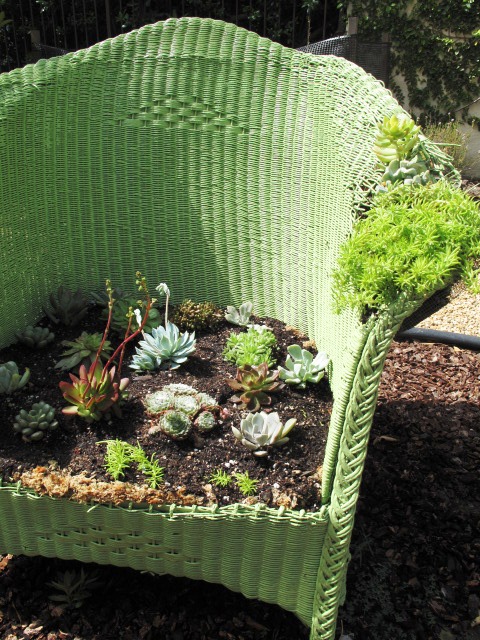
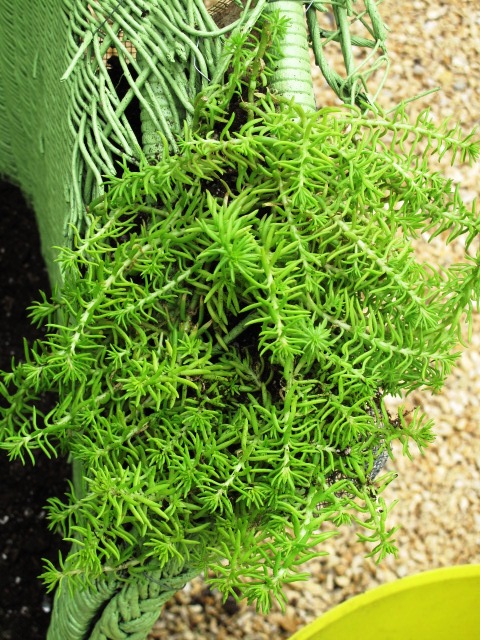
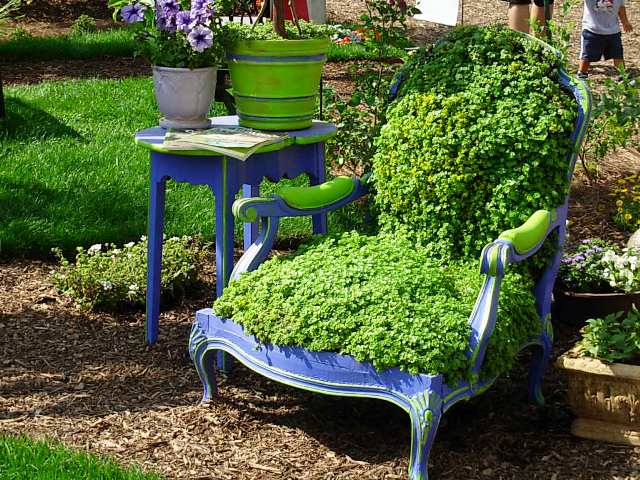
A sedum armchair. Lush and fluffy. Makes you want to sink right in. I love that the lime green arms have been painted to pick up the bright foliage.

Ever since I can remember, I was in love with a 3-piece set of wicker furniture that stood inside the enclosed porch of my grandmother Helen Winslow Ford’s home in Hammond, Indiana. 

After I wrote the above paragraph, I started asking myself “what was it about the wicker porch furniture that tugged at my heart?” Vintage wicker somehow symbolizes all the feelings of comfort, care and love that I always felt at Grandma’s house. Those emotions continued with my own mother and the home she created and kept for her family. And now, maybe I can emulate those traits here in my grownup life, for the husband and sons I care for.

That timeworn wicker – a love seat, arm chair and rocking chair – made its way from Grandma’s home on Florence Street to my mother Anita Ford Prinzing. I first remember seeing the pieces in our Portland, Ore., house (perhaps Mom inherited the furniture after Grandma passed away – I’ll have to ask her).

Mom updated the 1940s seafoam green wicker with a coat of 1970s chocolate brown paint. She replaced the aging seat covers with cushions of a quilted rust-orange-sunflower yellow patchwork print. 

Soon after Bruce and I married in 1984, Mom gave me the rocking chair. I took off the curved “rocker” sections and converted the piece into an armchair. I painted the woven wicker a soft blue-gray. The new cushion was covered in a tiny blue-and-raspberry polished cotton print. I also gathered and piped a cover to hide one of the chewed up arms.    

The shredded weft and warp of the wicker was the fault of mom and her brother’s childhood dog. Consequentially, the chair was always considered a bit junky because you couldn’t sit in it without your sweater sleeve snagging on the bits of wire sticking in every direction.    

Later, my parents shipped me the wicker love seat. I am not sure how I got so lucky because I know my brother Scott and his wife Kris used it for a while. But somehow my teenage “request” to inherit the piece lodged in my mom’s memory and she sent me the brownish wicker love seat in 1997, after she had owned it for more than two decades.

That was the year we lived in a 2-bedroom apartment with a newborn (Alex) and a 5-yr-old (Benjamin) in Seattle’s Madison Park while building our dream house in nearby Seward Park. I remember the enormous box arriving from UPS or some other shipping service. I had to open it in the courtyard outside, because there simply was no space in our apartment to do so.    

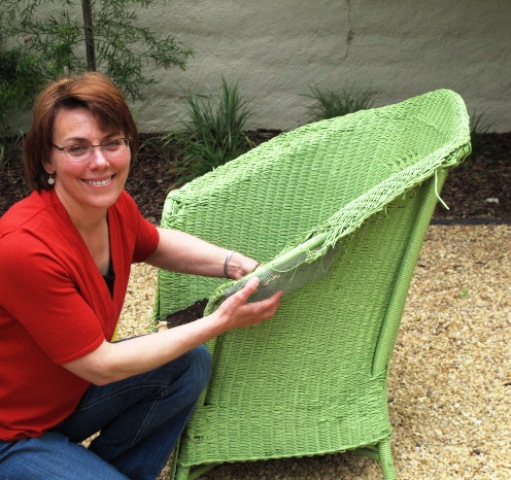
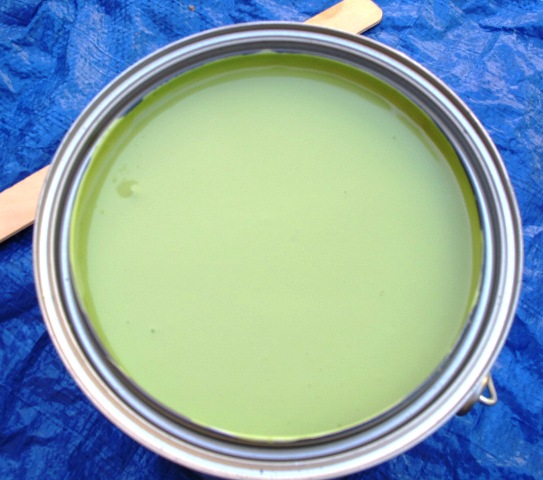
My yummy green paint choice - a perfect garden color!

Recently, after downsizing, my parents arrived to see us in Southern California while en route to their place in Mesa. The “good” wicker armchair (the one the dog didn’t eat!) was wedged into the back seat of their car. Personally delivered by my folks, the chair has joined its love seat companion on our back patio. Both pieces now need a face lift but they are in good shape considering they are at least 70 years old. I’m thinking of painting them glossy black and adding lime green cushions with black piping. Won’t that look modern?!   

Mom told me, “I’m going to give you the nice chair but only if you promise to get rid of the one that’s unraveling.”    

I said, “Okay, I’ll stop using it to entertain garden guests. But is it okay if I find a spot for it as a piece of art in the garden?”    

She couldn’t say no!    

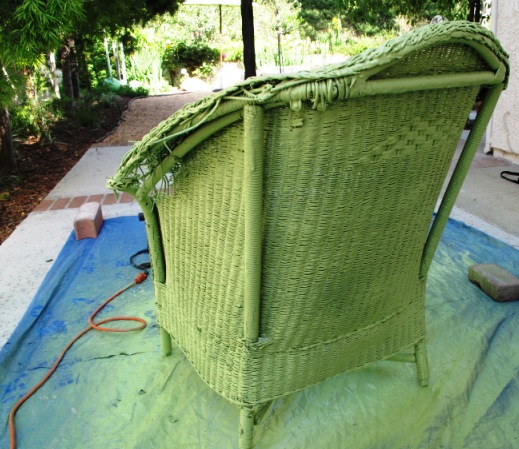
Today I started the makeover of my Grandmother’s wicker chair

Last fall, I removed the disintegrating cushion and seat, and placed the bottomless chair out in the garden. Yup, it’s in the right place. For months, I’ve wanted to paint it lime green and “plant” the seat and torn-up arm section with sedums and other succulents.   

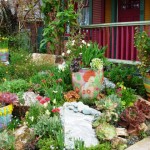
I have admired planted chairs before. Last summer I saw a peacock blue chair in a garden display at the Ventura Co. Fair. Its seat and back were planted with succulents. Luscious! [see my photo – above]    

So today, my Mother’s Day gift to myself was to dig out the electric paint sprayer, clean off the chair’s wicker framework, and head to the hardware store for paint. I came home with an outdoor-ready semigloss in a color I can only think to call guacamole green.    

The painting is finished. Doesn’t it look great? Perhaps it needs a second coat after this one dries. I’ll do that tomorrow, before the demands and deadlines of the coming week take over my calendar.    

The new-leaf green, aka “guacamole green” will transform the old wicker

Next: I want to fill the empty seat area with a panel of 1/4-inch mesh sheeting. I have a piece lying around from a planting project a few summers ago. I  used it to anchor some succulents into a path and stop some critters (rabbits? possums?) from digging up the plants each night.    

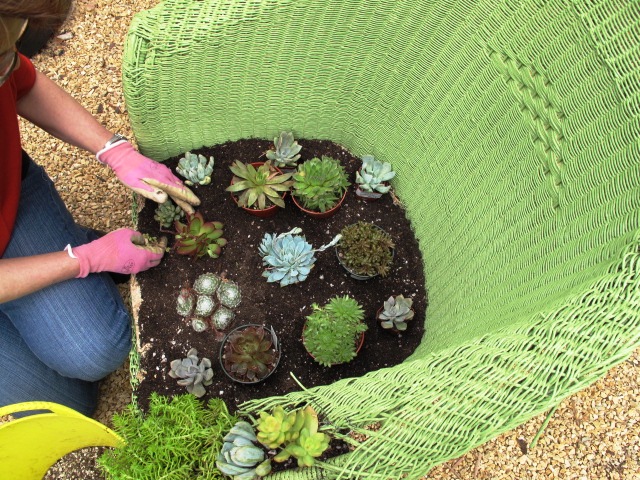
The mesh will create a supporting base for moss, which will be covered with a shallow layer of potting soil-cactus mix as my planting medium. Into that, I’ll plant a new “cushion” of all sorts of sedums. Voila! My long-awaited planted chair.    

I’ll post photos as I go along. I’m also thinking of using the mesh to contain soil behind the gaps created by Mom’s hungry dog so I can plant a few more succulents there.

I don’t remember much about her family pet other than that the dog’s name was Sue-Sue. According to Mom, my grandfather used to open the front door and call out to the dog: “Oh, Susanna!”    

That’s a silly story, but I remember it made me laugh as a girl.

LA in BLOOM

Thursday, May 6th, 2010

Gregg Fleishman's "Puzzle Prefab Shelter" and Laura Morton's dog shelter with a planted roof were two features of the New California Garden, designed by members of the Association of Professional Landscape Designers/Greater LA Chapter

During the weekend of April 30-May 2, the 127-acre Los Angeles Arboretum & Botanical Garden presented “Living Green: Essentials for the Home Gardener,” an outdoor flower and garden show that was an essential place to welcome the spring growing season.

The LA Garden Show seems to expand in size and style each year, adding exciting and informative speakers on topics ranging from sustainable design (“Green Architecture: Volume and Shape in the Mediterranean Garden,” by Gary Jones) to edible gardening (“Ten Trees in One: Grafting Citrus and Avocados,” with Darren Butler).

There are al fresco-style gardens, planted in or on top of real soil, just like Chelsea and other outdoor garden shows, which I think is a vast improvement over those dark, fluorescent-lit caverns that house indoor displays.

And of course, while the somewhat aggressive male peacocks are strolling and squawking, the two-legged garden show-goers are chatting with designers, snapping pics, waiting in line for lunch (I loved my chicken tacos, served with fresh cilantro), and, of course, doing some plant- and art-related retail therapy!

One of the Arboretum's resident peacocks strolling the greens

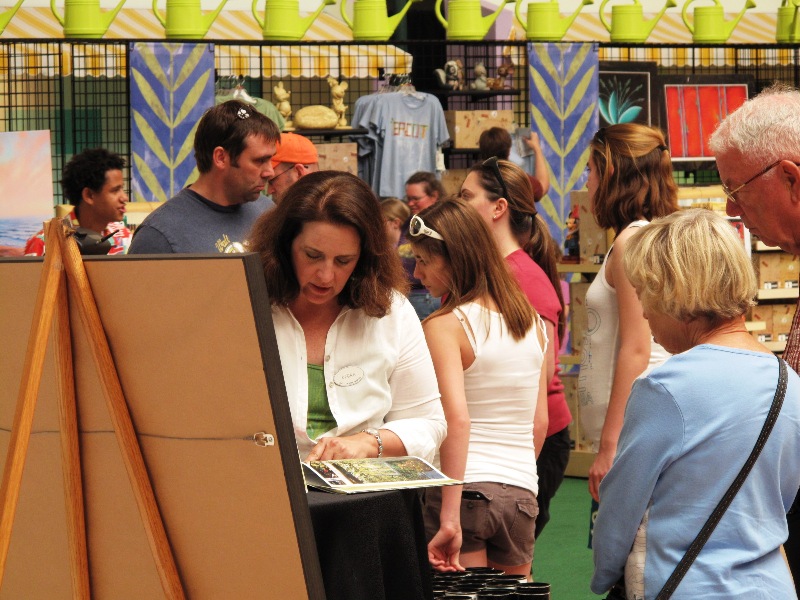
I mention shopping because as far as I’ve been able to discern, the marketplace at the LA Garden Show is one of the very best stops for plants, garden art, accessories and other must-have items for the horticulturally-inclined.
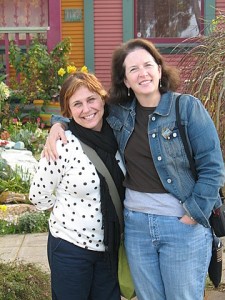
 I only wish it lasted longer than 3 days because I didn’t get around to all the plant-sellers, horticultural societies, garden accessory purveyors and other vendors. I learned that efforts by the Arboretum’s volunteer marketplace managers resulted in nearly twice the number of exhibitors this year over last. It was a well-curated lineup of offerings (thankfully, no schlocky stuff).

The festive and enticing Garden Markeplace - where we all engaged in a little horticultural retail therapy

I checked in with a few of my favorite folks including Pacific Horticulture Magazine, Southern California Horticultural Society, Leslie Codina Ceramics and TerraSculpture.

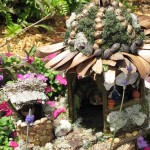
A tiny tabletop landscape by Smallweeds

 A new discovery: Smallweeds, which designs miniature tablescapes and also sells miniature accessories for making your own tabletop and fairy gardens.

I did a lot of browsing and gabbing with old and new friends, a little shopping, and a lot of note-taking while spotting new products, themes and trends. One of my very favorite picks of the weekend is the powder-coated obelisk series, created by Annette Gutierrez and Mary Gray. The women own Pot-ted, an eclectic, must-visit garden shop on Los Feliz in Los Angeles.

Yowzer! Shiny and bold, the powdercoated metal orbs are the hot, new "objet" for your garden.

As experienced and artistic film industry veterans, the women sure know how to create high style on a shoestring. They also know that it’s often easier to design something themselves rather than wait around for the marketplace to catch up with a need or opportunity.

Thus, the colorful objets for the garden, seen at left. Can’t you just imagine how elegant and artful these spherical shapes would look, grouped one, two, or three on a lawn, a gravel patio, or even tucked into a perennial border with stems and petals weaving in and out of the openings?

Annette and Mary aren’t claiming to have invented the ringed orbs (some of the earliest ones were made from leftover steel straps used to hold wine caskets together). But they do love the way the steel shapes take to easily to the powdercoated color. And since aqua and orange are the Pot-ted purveyors’ two favorite garden colors, they started with this palette. You can visit the shop or call to inquire about shipping. There are three sizes and boy do they look awesome: 30-inch ($169); 24-inch ($139) and 18-inch ($98).

READ MORE…

Disney’s Glorious Garden Festival

Thursday, April 29th, 2010

I posed with the larger-than-lifesized Mickey and Minnie topiaries who stand amid Epcot's bodacious vegetable patch

Mickey-Minnie-‘n’-Me

For the past couple of years, whenever I learned that a garden-communicator-pal was invited to speak at Epcot’s International Flower & Garden Festival in Orlando, I would think: How do I get in on that great gig?

And so it seems: good things come to those who wait.

Last fall, Debbie Mola Mickler, the horticultural program planner for Epcot’s nearly three-month-long spring gardening festival, contacted me with an invitation to participate in the 2010 “Great American Gardeners” lecture series.

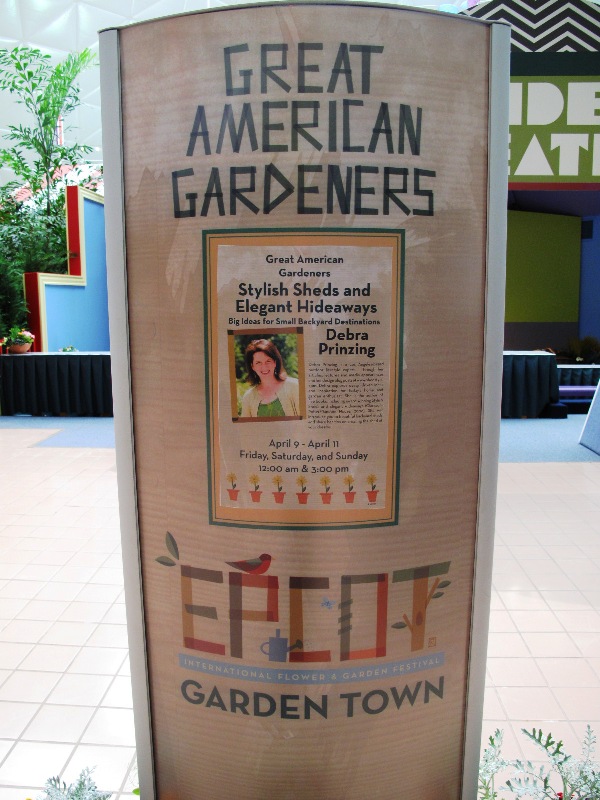
She and her colleagues wanted me to come and talk about Stylish Sheds and Elegant Hideaways. It was a pretty awesome invitation to speak six times over a three-day period.

And how cool that it coincided with spring break, which allowed my husband Bruce, and our youngest son, Alex (and his pal Philip) could come along and take advantage of the myriad adventures: water parks, animal kingdoms, magic kingdoms, fireworks, and lots more! We also got to see some good friends who’ve lived in Orlando for many years. And I was able to connect with most of the staff at Garden Design magazine, who are headquartered at nearby Winter Park, Florida. Lots of great reasons to come to Orlando… the fact that it was still “spring” here was a huge one. Warm and a little humid, but certainly better than summer here.

Great American Gardeners at Epcot

We stayed at Disney’s BoardWalk Resort, just across a “lake” from Epcot’s “Future World” and its iconic sphere. Our hotel’s Atlantic-City-inspired setting was gorgeous. My friend Lanny Wood, an architect, told me that famed American architect Robert A.M. Stern designed the boardwalk-style resort, with its white clapboard siding, striped awnings, and pristine lawns. There really is a fantasy world here and it’s so easy to be drawn into the playfulness, forgetting that there’s reality beyond the perimeter of Disney.

The plant displays, topiaries, and tropical landscaping are superb.  When I first met Debbie by phone, I asked her why the flower festival had never come to Disneyland here in Southern California. She explained to me that it is merely a matter of real estate. Anaheim is land-locked by freeways and over-development. There seems to be little room to grow gardens at a Southern California amusement park.

Whereas in Orlando, there’s plenty of acreage! Over the past three decades or so, the talented horticultural staff at Disneyworld has created a beautiful, arboretum-like setting as a backdrop to no fewer than six theme parks and countless resorts.

Iconic architecture - the dome and spire at Epcot

Here was my typical schedule – at least for the three days when I was on duty as a festival speaker.

Wake up and walk to the breakfast bar or bakery. One morning, we enjoyed a huge spread at Iron Chef celeb Kat Cora’s signature restaurant Kauzzina.

Next: The boys figured out which theme park to visit that day. Thankfully, Disney’s intricate shuttle bus system took them anywhere they wanted to go.

Then: Time for me to get ready for my first talk, at Noon. On my first day, I felt so special because John, one of the Resort’s longtime landscaping managers, greeted me as my personal escort. He picked me up at the hotel and drove me to the Epcot festival site, called “Garden Town.”

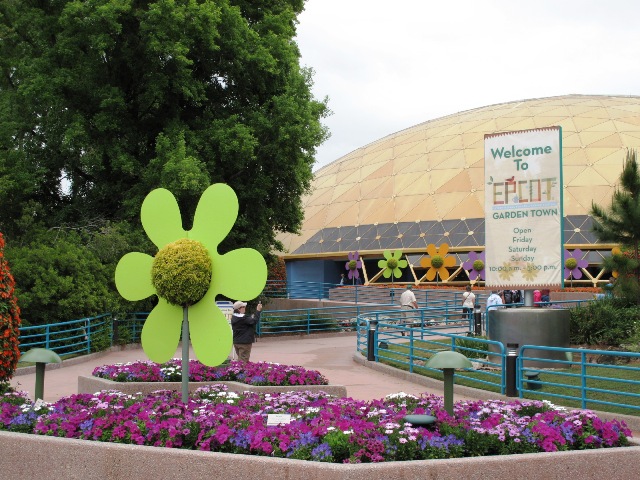
Garden Town at Epcot

Inside the lecture hall, several demonstration stages were set up to accommodate a rotating schedule of speakers. During the day, in addition to the main stage talks, Disney’s gardening experts shared tips and involved participants in hands-on planting projects; University of Florida gardening experts presented local horticultural information, and Florida Master Gardener volunteers answered gardening questions.

After my noon lecture, I went to the garden gift shop to sign books and meet members of the audience. Then, I was free for lunch, when I took time to walk around the grounds and drink in various sights. I loved the butterfly house, the fairy garden displays, and – of course – the topiary Disney characters.

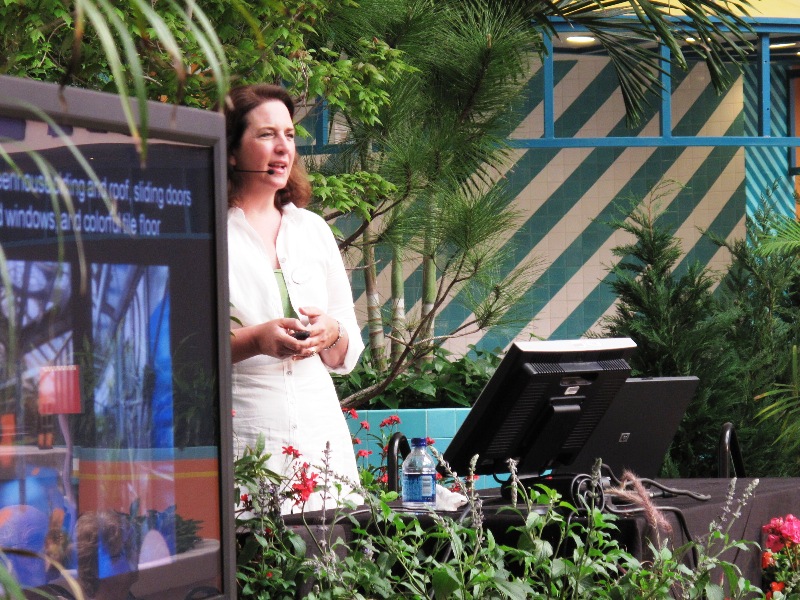
Speaking about creating the "shed of your dreams"

On Thursday evening, my friend Lindy came to meet me for dinner – what a treat to spend time with a very special friend from many moons ago. We always pick up right where we left off. I hadn’t seen Lindy since I was in Orlando in 2005 for the Garden Writers Association winter board meeting. But it felt like that was only a few months ago. I adore her. What a smart, savvy, strong woman. She always inspires me and makes me feel ready to take on the world.  

On Friday evening, the team from Garden Design magazine came to meet me for cocktails at the resort. We had a blast just socializing, while Donna’s daughter Kate jumped and splashed in the pool (my own son and his friend, both 13, were off on their own adventure, but we met up with them later. Going to Disney as a 13-year-old is a lot like going camping. Somehow the grownups worry less and you suddenly have quite a bit of autonomy and freedom).

Garden Design's team: Donna Reiss, art director; Chelsea Stickel, photo editor; Debra Prinzing, contributing editor; Megan Padilla, senior editor (with the adorable Aileigh)

On Saturday night, Bruce, my husband, had finally arrived from Pittsburgh. He was a trooper because he took Alex and Philip to Universal Studios for the day. But we reunited that evening and enjoyed a very unique dinner at Disney’s Animal Kingdom Lodge. If I ever go back to spend a vacation in Orlando, this is where I’m going to stay. You can only imagine how Disney interprets Kenya.

Bruce and I thought about our visit in 1990 to Amboseli National Park in Kenya when we went on a photo safari. Let’s just say that the real thing is a lot more rugged than the Disney version. But we had a blast and it was our last night with the boys before they flew home on Sunday morning, all by themselves to LA.

Bruce had to leave on Sunday evening and I stayed one more night in Orlando before flying to Dallas the following day. The rest of the week was a bit of a blur, since I had to teach a container design class in Dallas Tuesday night; fly home to Burbank on Wednesday; and then drive to Orange County to teach another class on Thursday. But I won’t let fatigue lessen the fun. Disney was unforgettable. And I’m so grateful for the experience.

Here are some of the horticultural sights that wowed me:

 A few other pics and people to share:

Garden Design's Jenny Andrews, Leigh Ann Ledford and Shelley Easter

Fellow Garden Writer Association member, Kim Taylor from the University of Florida horticulture program (aka "The Sassy Crafter") met me on Sunday. She was at the festival to volunteer in the "Ask an Expert" booth

My book-signings after each talk gave me a chance to meet other stylish shed enthusiasts

These green walls will blow your mind

Thursday, January 28th, 2010
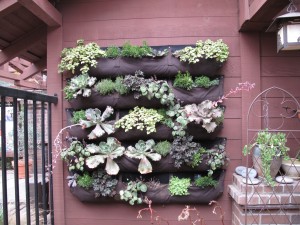
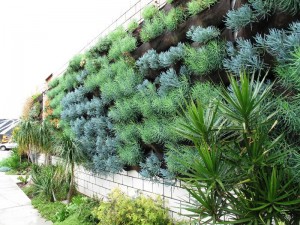
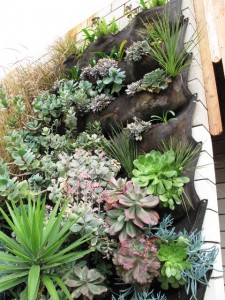
A Woolly Pocket wall of succulents adorns the retail shop at Descanso Gardens near Pasadena

A Woolly Pocket wall of succulents adorns the retail shop at Descanso Gardens near Pasadena

Designed in Los Angeles, fabricated in Kansas, and soon to hang on a wall near you, the Woolly Pocket is a soft-sided planting envelope that makes it possible to have a lush wall of vegetation without having to hire a structural engineer.

Vertical gardening is all the rage, so here’s a way to bring plants into your home (indoors or out) with a breathable fabric container that is easy to hang and maintain.

Fill the 15 x 24 inch pocket with a little potting soil, plant it with lush greenery and allow the vines or foliage to spill over the top edge. Combine multiple pockets to create a living wall as is shown in these photographs.

WHAT IS THE WOOLLY POCKET?

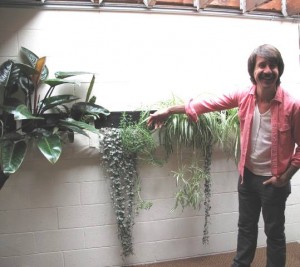
Miguel shows off a 5-pocket Woolly planter

Miguel shows off a 5-pocket Woolly planter

I met designer Miguel Nelson at his studio in Culver City earlier this week and took a tour of Smog Shoppe, his event space where the Woolly Pocket was created.
Miguel was trained as a sculptor, but he obviously thinks about sculpture in a completely different way than artists whose work stands on a pedestal in the garden or in the foyer of a home.

The type of sculpture Miguel conjures is an entire building and outdoor courtyard that contains green events. He and Sherry Walsh, his wife, retrofitted an unsightly garage used to do emissions tests on cars (thus, the clever Smog Shoppe name).

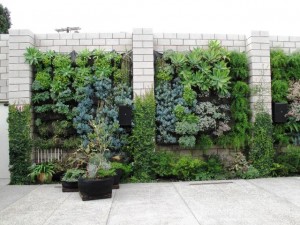
The analagous blue-green plant palette nearly covers the exterior of Nelson's Smog Shoppe event space in Los Angeles

The analagous blue-green plant palette nearly covers the exterior of Nelson's Smog Shoppe event space in Los Angeles

Used for private and corporate events, the warehouse-y space needed to be softened up. And so Miguel and his brother Rodney created huge wall-hangings with pockets and stuffed them with succulents, tropicals and other plants that cascade and drape. The hangings look like those large shoe-organizer pocket panels, but are oh-so-much more elegant.

Over two year’s time, the plants have thrived, nearly obscuring the concrete block walls and the black wool pockets. Once partygoers started asking if they could buy the planting system for their own homes and gardens, Woolly Pockets was born.

A detail shot reveals how happy these plants look

A detail shot reveals how happy these plants look

Instead of wool felt like the original system, Miguel and Rodney now use an industrial-strength USA-made felt from recycled plastic bottles (it is available in chocolate brown, black and cream – with a promise for more colors in the future). The pockets have a built-in moisture barrier that allows the plants to breathe while keeping moisture off your walls or floors.

The blogosphere and a few design magazines have discovered Woolly Pockets, which are priced at $49 for a single. Multiples range from $125 (3-pocket, 68 inches) to $188 (5-pocket, 112 inches).

Miguel’s eco-publicist, Corey Scholibo, is convinced that this green gardening solution will capture the imaginations of non-gardeners. It is a cool interior design application that is at the same time retro (think indoor plants of the 1970s) and futuristic (plants will save the planet!).

“You can now garden any time, anywhere, with little or no skill,” Corey says.

Interior walls of the courtyard are planted top-to-bottom

Interior walls of the courtyard are planted top-to-bottom

The team is inventing all sorts of new iterations of the Woolly Pocket. There is a Vagabond, which I wrote about last month for LA At Home (think “Garden Container meets Handbag”) and at this weekend’s Accent on Design in New York, Miguel will introduce a 5-sided wee-woolly tabletop planter and a gorgeous, free-standing 6-, 8- or 10-sided planter that has zippered sides so you can unzip sections to accommodate sculptural tree branches poking out. Those items appear to be ideal for the interior space and are a lot more attractive than some of the plastic, clay or faux planters I see hanging around garden centers.

You can mostly find Woolly Pockets online, but Miguel expects to sell through several retail channels by later this year.

“I see all these amazing living wall installations in public spaces,” he points out. “But you never read about a vertical garden you could have yourself. Now, even with just one Woolly Pocket, you can grow plants on your wall.”
With a cluster of them, arranged like a giant patchwork quilt, pretty soon you can have your own living, green wall.

I have four dark-brown Woolly Pockets to try out and I’ll report back soon on how they are doing. I’m going to hang them outside to try and mask some of that ho-hum tan stucco we’re so lucky to have here in SoCal.

Keeyla Meadows colors her garden world

Sunday, December 20th, 2009

Note: A version of this Q&A appeared earlier this week in “LA At Home,” the Los Angeles Times’ daily home and garden blog.

Mary Ann caught one glimpse of the awesome coat and matching socks . . . and said - Hey, that's Keeyla Meadows!

Mary Ann caught one glimpse of the awesome coat and matching socks . . . and said - Hey, that's Keeyla Meadows!

Los Angeles native Keeyla Meadows lives in Berkeley where she makes art and designs gardens. Her cheerful, 50-by-100 foot city lot is a living canvas packed with life-sized female figures and not-so-perfect vessels, hand-built in clay and glazed in a palette of turquoise, apricot and lavender.

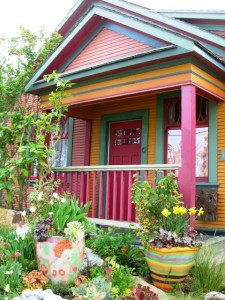
An exuberant color palette that few would dare to use - here's Keeyla's Berkeley bungalow and street-side "sunset" garden

An exuberant color palette that few would dare to use - here's Keeyla's Berkeley bungalow and street-side "sunset" garden

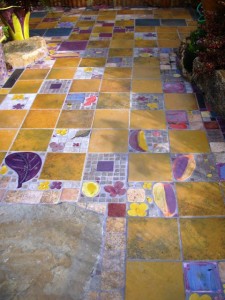
No surface here is left unadorned. Whether it’s her swirly ceramic paving, custom metal benches or sculpted walls, Keeyla artistically places favorite objects and plants with a carefree confidence that few of us can master.

Fans of Keeyla have long admired her award-winning gardens, including a ‘Best in Show’ at the San Francisco Flower & Garden Show a few years back. Her beautiful first book, Making Gardens a Work of Art, was published in 2004 by Sasquatch Books, a Seattle imprint that also published my first book, The Northwest Gardener’s Resource Directory.

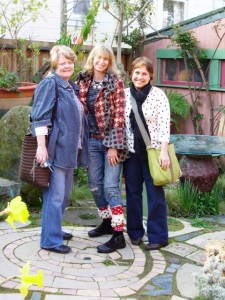
Lorene and me ~ gal pals in Keeyla's garden

Lorene and me ~ gal pals in Keeyla's garden

In 2008, I lucked into an impromptu visit to Keeyla’s personal wonderland when my girlfriend Mary Ann Newcomer boldly followed her into Café Fanny’s in Berkeley, an Alice Waters bistro, and snagged an invite for our group of breakfasting garden writers.

Lorene Edwards Forkner, Mary Ann and I hopped in the car and followed Keeyla to her bungalow, a few blocks away. It is fair to say we were hyperventilating!

“You can take photos, but don’t publish them until my book is out,” Keeyla requested. It was the least we could do, having feasted our eyes on her botanical paint box, imagining how we might try her playful ideas in our own backyards.

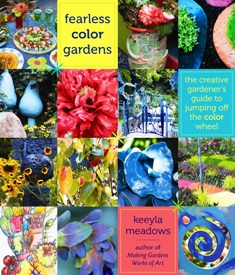
9780881929409_CMYKHer new book, Fearless Color Gardens: The creative gardener’s guide to jumping off the color wheel (Timber Press, $27.95), has just been published. Filled with Keeyla’s photography of design projects, as well as her doodles and sketches, it reads like a colorist’s memoir, complete with a muse named Emerald.
Strong on fantasy, it’s also a useful workbook for garden owners who need a nudge toward the more vibrant end of the color spectrum. I recently asked Keeyla about the book.

Q: How do you teach students to feel confident as garden designers?

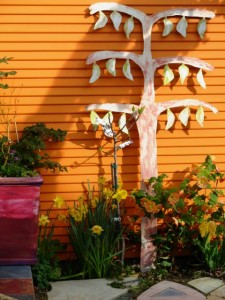
Keeyla's color sensibility is in her DNA as evidenced by the orange side of her house punctuated by a tree-inspird sculpture

Keeyla's color sensibility is in her DNA as evidenced by the orange side of her house punctuated by a tree-inspird sculpture

A: A lot of people have this mantra that says, “I’m not a creative person. I’m not an artist.” Our lives are built around the practicality of what we have to do everyday so many people shut those doors to creativity a long time ago. I suggest you treat garden design like something you do all the time. The physical activity of placing plants in a space can be as easy as folding laundry and putting it away, or setting the table, or baking a cake.

Q. How can I make a landscape project feel less overwhelming?

Mary Anne Newcomer, Keeyla Meadows and Lorene Edwards Forkner

Mary Anne Newcomer, Keeyla Meadows and Lorene Edwards Forkner

A. I suggest you divide your space up like a series of photographs or like windows.

Decide what “picture” you’re working with, where it starts and ends. Start with looking out the kitchen window and use plants and art to fill the frame.

Q. Where does your color inspiration come from?

A. A lot of my color sense comes from growing up in Los Angeles and living with its “colorfulness” – the light, tile work and Catalina Island all inspired me. Right now, I’m designing a new garden for the San Francisco Flower & Garden Show in March. It’s a habitat garden and the colors I’m using come from the red-headed garter snake, an endangered snake from the San Mateo coastline. It has a read head with a turquoise and red stripe down the back, so it’s providing my design motif, my imagery and my color combination.

Jump off the conventional Color Wheel and play with Keeyla's Color Triangle

Jump off the conventional Color Wheel and play with Keeyla's Color Triangle

Q. How do you suggest people “jump off” the color wheel?

A. The traditional color wheel makes my head spin. I use a color triangle, which is so stabilizing. I put blue at the top of the pyramid – it represents the sky. The other two points are red and yellow. Between the three primary colors are the secondary colors. On either side of any point is a harmonic chord of color. You’ll never go wrong if you take one of the points – red, yellow or blue – and use one of those chords of color on either side of it.

 Q. How do you balance artwork with the plants in your garden? 

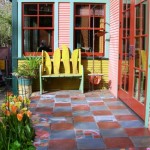
A checkerboard of color in a patio installation

A checkerboard of color in a patio installation

A. Art gives me a constant relationship to plant against, a very stable feature to move through the seasons with.

Art creates so much focus and orients the whole space so one is not always reinventing. It is like a stage setting.

The artwork and hardscape set the stage for your plants to really become the stars.

Here’s a quote from Keeyla’s book that seems apropos:

“In my gardens, color refers to everything – absolutely everything. I don’t just make a bland holder, a neutral vase, for colorful plants. Color includes the rocks, the pavings, and the artwork. It also connects up with the color of the house and the sky above. So it’s really like bringing the camera to your eye. When you take a photo, you are looking at everything in the frame. In creating color gardens we will look at everything that is part of the garden picture. . . “

More photos to share from our visit to Keeyla’s magical garden:

Rolling Greens nursery and garden emporium comes to Hollywood

Wednesday, December 16th, 2009
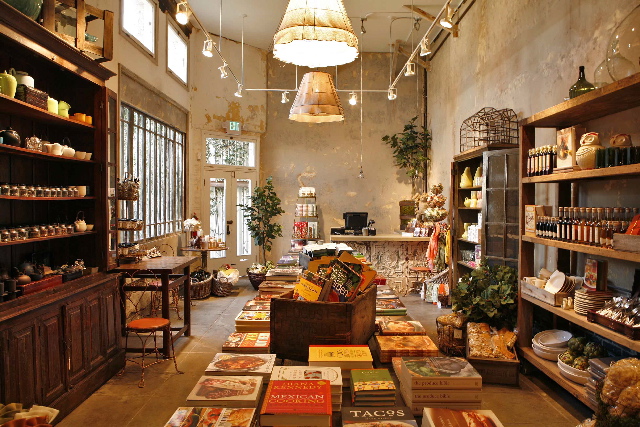
Gourmet food, exotic tea blends and a library of design books fill the new Rolling Greens in Hollywood

Gourmet food, exotic tea blends and a library of design books fill the new Rolling Greens in Hollywood

rolling greensLast Thursday, a vintage tire shop in the heart of Hollywood was the setting for a festive pre-opening bash thrown by Rolling Greens, its new tenant.

Designers, landscapers and horticulture fans gathered to sip, graze, explore (and shop!) at the hottest new garden emporium in Los Angeles. My editors at Garden Design magazine asked me to attend and check out the happenin’s.

Rolling Greens’ second location is the brainchild of owner Greg Salmeri and his colleague and creative director Angela Hicks. The original store in L.A.’s Culver City is a distinctive nursery, home and garden destination, formerly only for the trade, that opened to the public in 2004.

Tire dealer-turned-garden emporium, in a historic, weathered building that's full of character

Tire dealer-turned-garden emporium, in a historic, weathered building that's full of character

For his new outlet, Salmeri snagged the lease on Town Tire Company, a weathered brick building that has been a Hollywood landmark at the corner of Beverly Blvd. and Gardner Ave. Built in 1930, the iconic structure was originally a food market and then in 1963 became a tire store.

“I’ve had my eye on the Town Tire Co. building for years and dreamed of opening Rolling Greens in this incredible space,” Salmeri says. “In this new location, we’ve expanded our offerings into home categories beyond what we offer at our Culver City location.”

Greg Salmeri

Greg Salmeri

Salmeri and Hicks turned the tire shop’s unpolished attributes into appealing design elements for Rolling Greens. There are big metal garage doors that roll up to connect the indoor spaces with the fresh-air ones. The original concrete floor has been cleaned up and the exposed brick walls sandblasted. Once covered over, several huge glass doorways topped with half-circle transom windows have been exposed to invite sunshine into the 1,000-square-foot bed and bath department. The cash-wrap counters are clad in 19th century pressed-tin ceiling tiles. The “color greenhouse” is a glass-and-steel dividing wall that encloses an area for indoor plants, including orchids and ferns. Panes of amethyst and bottle green glass replaced broken sections, creating a vintage greenhouse backdrop at the center of the store.

READ MORE…

A visit to Sharon Lovejoy’s garden shed

Wednesday, November 25th, 2009
Sharon Lovejoy and me

Sharon Lovejoy and me

In the middle of last week, when I really didn’t have the time to do it, I drove northbound, to central California, where I spent 24 hours with talented writer-illustrator-naturalist Sharon Lovejoy and her smart and kind husband Jeff Prostovich. I met Sharon a little over two years ago when Nan Sterman and I drove to the San Francisco Flower & Garden Show with our friend Joan Bolton of Santa Barbara Garden Design. It was our Garden Writer Caravan and Road Trip. First, Nan took the train/bus from San Diego to my neck of the woods (Ventura Co.); then, the next morning, we drove to Santa Barbara to pick up Joan. Another 90 minutes north of Joan, up Hwy. 101, and we arrived to visit Sharon and Jeff. They fed us, feted us, and hopped in their car to follow the caravan.

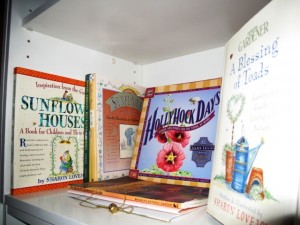
A collection of Sharon's charming and inspiring books

A collection of Sharon's charming and inspiring books

Sharon is a total rock star in the Garden Writing Galaxy and I was so excited to have a chance to spend time with her and Jeff.

She has had a huge following ever since she started writing “Heart’s Ease,” a monthly naturalist’s column for the former Country Living Gardener magazine. Sharon’s blog is fun and highly personal – it’s read by friends and fans around the globe.

Her illustrated books about gardening, gardening with children, gardening for wildlife, gardening with food — oh, there are so many and they are like little love letters — have sold hundreds of thousands of copies over the years. In our world, that is unparalleled, I tell you.

61rTYy4K-jL__SL500_AA240_If, like me, you love the way Sharon involves children and their grownups with the natural world, be on the lookout for her next book – out in January 2010! It’s called Toad Cottages & Shooting Stars (and it features her sweet artist-granddaughter, Sara, on the cover).
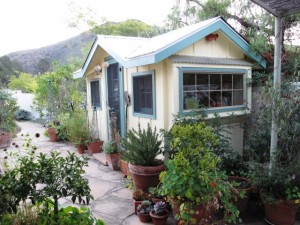
Sharon and Jeff and I had a magical 24 hours in which we basically talked, ate, drank, cooked, went to see the Lone Pine Arboretum and the plant nursery at Cal Poly San Luis Obispo, admired nature, and compared notes about our industry (?) and the “new media” platforms we’re all learning to navigate.

We had to force ourselves to go to bed last Tuesday night . . . the fire was burning in the fireplace and we had so much to say to one another. But we drifted off to sleep and rose on Wednesday morning in time for me to join Sharon at her writers’ group, during which yet another sparkling facet of this talented writer was revealed to me (hint: she is writing a wonderful young adult novel and I can’t wait for it to be completed AND published!).

A sweet retreat in the heart of Sharon's garden

A sweet retreat in the heart of Sharon's garden

It was nice to do something very spontaneous (and very nice that my own husband Bruce held down the fort at home so I could take the trip). I’ve been anxious to see Sharon’s new garden shed.

I had a sneaking suspicion I would be able to persuade Sharon to let me interview her on camera, so I asked – and lucky for you – she said yes. (And there was Jeff, the smart marketer, egging us on and actually directing us at one point.)

We made this totally rough-and-rugged video with my little Flip camera and gave the footage to Shirley Bovshow of Garden World Report. Shirley cleaned it up and used a portion of my tour with Sharon on today’s show. You can watch it here, along with contributions from Ken Druse and Ellen Zachos, two of my favorite garden writer-designers on the east coast.

Sharon promised me a personal tour, and here it is:

httpv://www.youtube.com/watch?v=cv4OT8NukZ8

This entire experience reminded me of why I love what I do and the people with whom I share this journey.

Since this is Thanksgiving week, I’m thinking about gratitude:

1. I’m thankful that Nan introduced me to Sharon. Nan’s heart is big enough to share her blessings with her friends. I love that about Nan. It’s not the first time she’s opened a door for me, and I hope I can reciprocate.

2. I’m thankful that Sharon and Jeff have adopted me as a friend, and for their generous gift of time, ideas, support, encouragement, shelter (hey, I didn’t mention getting to sleep in the cozy loft at the top of a spiral staircase in Sharon’s art studio!!!) and food (oh, time around the table in their farmhouse kitchen was delicious – in more ways than one).

3. I’m thankful that there are so many kindred spirits in the gardening world, especially for innovators like Shirley Bovshow who just make things happen in new ways, pioneering the path that we all wish to follow (but when we don’t have a road map….she’s bound to!)

4. I’m thankful for my long-suffering spouse and partner, Bruce. He always encourages me to take these trips and excursions, even though it usually means more work for him. I can’t wait for the time when he’ll be freer to join me (and vice-versa).

That’s it for now.

Shed-of-the-Year . . . you can enter!

Tuesday, November 17th, 2009
Uncle Wilco, as he is depicted on his web site, We *Heart* Sheds (well, this was a holiday version from 2007)

Uncle Wilco, as he is depicted on his web site, We *Heart* Sheds (well, this was a holiday version from 2007)

Here’s some background about SHED OF THE YEAR and its creator Uncle Wilco, a cyber friend who lives in the UK in South Wales, and is the creator of We (Heart) Sheds and several other projects.  I was thrilled to discover that I was not alone on this quest for finding and documenting awesome backyard structures, that many kindred spirits existed on this globe to share my journey. Here is the original story I wrote about Uncle Wilco nearly two years ago. A memorable quote about his Shed of the Year contest:

. . . the British have a love affair with the shed, so really it’s just snowballed. I was lucky to do a few radio interviews. I got the impression they thought I was a nutter . . . ! But at least people realise that I have a passion for sheds, so that’s all that matters.

Imagine my surprise when Wilco asked me to join his illustrious team of judges to represent as the International Judge for the 2010 Shed of the Year competition! The event culminates with an announcement in early July, during National Shed Week, and I’m eager to participate. I’m hoping to get over to the UK to join the others, but at the very least, I will do my part on this end. I encourage any of my readers to submit photos and enter. That is all it takes!

Thought I’d kick things off by telling you a little more about the competition. In the words of Mr. Wilco himself:

Q. You started Shed of the Year in 2007, right? So you’ve had 3 winners!
What has surprised you most about the scope and diversity of sheds
around the globe?

Tony's Roman Temple took honors in the 2007 Shed of the Year contest

Tony's Roman Temple took honors in the 2007 Shed of the Year contest

A. I have run readersheds since 2001  and thought it was time I should celebrate all these great sheds. So I started Shed of the Year. The last three winners have been very different: 1) A Roman Temple,  2) A Pub Shed, and 3) a Cabin. I look forward to shed of the year 2010 — it could be a workshop or studio or even a hut. That’s the thing — we don’t know until the public have voted and the judges have made their decisions for Shed Week 2010.

Q. Who does Sheds better, the UK shed aficionados or the North American ones?

A. Well, I am biased. UK sheds Rock- or should I say UK Sheddies rock. But you US sheddies have a different view on sheds. The UK history with sheds as mainly a man thing is very long and it’s the sheddies that make readersheds.co.uk

Q. Can you please describe “wossname” and how I can explain it to US readers?

A. I am not great with words , so I tend to fill in things I can’t think about with “wossname.” So it’s a term in the UK, like a thing or a “wotsit,” when you can’t think of the real word!

Here's where Uncle Wilco hangs out and enjoys his home brew

Here's where Uncle Wilco hangs out and enjoys his home brew

Q. If you had to spend your final days inside your own shed, what three essential items would you need to bring with you?

A. That’s very difficult. I would say family and friends and  my dog, but as for items it would have to be some home brew (beer).

Q. What kind of swag can I expect for being a Shed of the Year judge?

A. What, the glory of being a judge in the World’s most favourite Shed competition is not enough?

Q. How many entries have you had from North American shed owners (in past years)?

A. Well, it’s not just North American sheds. It’s International, too. We love sheddies from the Americas, Canada, Europe and Australia and New Zealand. You can view all the international sheds entries (199 of them to join the 1200 UK ones) here.

Q. What else do you want my readers to know?

A. That we are welcoming entries to Shed of the Year 2010 now and would love to have some more  Stylish Sheds added. All I ask is that the sheddies add a few good images — including external/internal shots. The more images the better, so the public can get a  good look.

Thanks so much Uncle Wilco – I will do my best to pump up the entries from the International contingent. See you soon.

Here’s how her garden influences one textile designer

Thursday, November 12th, 2009
Sina Pearson relies on regular visits to her island garden in Washington state to inspire her teextile designs.

Sina Pearson relies on regular visits to her island garden in Washington state to inspire her teextile designs.

I met Sina Pearson in 2006 when her publicist Susan Harkavy arranged a visit to the textile designer’s aerie (aka studio, atelier, loft) in SoHo.

I was in New York City with Bill Wright to photograph an amazing glass-and-steel West Village “shed” for Stylish Sheds and Elegant Hideaways, but I took a side trip for an hour to meet Sina and see her work.

She grew up in Washington State and studied art and textiles at the University of Washington. Our common Pacific Northwest roots gave us an easy, mutual language, designer-to-writer, as we talked about her interests, influences and passions.

Recently, Garden Design magazine invited me to profile Sina as “One to Watch,” with a short Q-and-A that appears in the November-December 2009 issue. Due to space, a portion of my interview did not make it into the print edition. So here it is in full, along with some photos that Sina shared from her garden in Washington’s Fidalgo Island (Skagit Valley).

Garden Design NovDec001ONE TO WATCH:

Textile designer Sina Pearson may live and work in SoHo but trips outside the city inspire her saturated stripes and vibrant abstracts.

She spends one week each month at a remote island cabin in Washington State, surrounded by a semi-wild garden, just steps away from the 1950s A-frame where she played each summer as a child. Sojourns abroad include idea-gathering places like Scandinavia, France, Mexico and the Caribbean. Collectively, these design “threads” are woven into finished cloth: confident, evocative – and high performance – textiles for residences, hotels, restaurants, offices and outdoor settings.

sina-pearsonThe designer, manufacturer and entrepreneur trained in fine arts and textiles at the University of Washington before earning a MFA in textiles from Cranbrook and studying at the Royal Academy of Arts, Crafts and Design in Stockholm. She launched Sina Pearson Textiles in 1990.

Pearson reinterprets outdoor fabric that looks as if it belongs inside, including terrycloth, chenille and boucle cloth made with Sunbrella® yarns for sunfast, stain-, rain- and mildew resistance. Her newest collection, out next spring, is called Colores de Mexico. Her influence? The orange-striped, hand-woven Mexican curtains that Pearson’s mother hung in the family’s beach cabin. “It has an ethnic, modernist vibe with a serape-like texture,” she says.

 Q. Tell me about your Fidalgo Island garden and how it informs your textiles:

 A. I could not be doing what I’m doing if I didn’t have my garden. It frees my soul and lets me experiment with weaving colors and textures together. The way I work in my garden is very much how I work in textiles. I’ve always maintained that you have to listen to what the fabric wants to be – it’s a wonderfully slow process. Similarly, I have to let my garden design itself. I observe how each plant color works together, how each season is revealed in flower, foliage and blade.  

Q. What influences you as a designer?

A. I can’t separate how I’ve grown up from what I am now. My parents were so visual – my mother was a landscape designer and my father was a photographer. We had Jack Lenor Larson’s textiles in our house. I cannot remember a time when I was not playing with fabric. Family legend recalls me cutting textiles into small pieces and arranging them on the sofa when I was two. At 12, I learned weaving from a Swedish woman and batik design from Ruth Pennington, a very fine metal artist. I created a huge, abstract piece of batik silk with fuchsia pink, bright orange and red colors. We hung it up in the sun and it looked like a stained glass window. Ruth turned to my mom and said: “Sina has a career in textiles.”

Q. How is your Scandinavian heritage reflected in your work?

A. I grew up with Danish modern furniture and I double-majored in Swedish language and literature in college. I also lived and studied in Sweden. When I design, I am looking for “emotion” – the feeling conveyed by yarns, colors and textures in my fabrics. After my last trip to Scandinavia, I created a collection evocative of what my ancestors would have woven to wrap themselves in for warmth: soft, heathery “comfort” fabrics that are hand-crafted, quiet, simple and dignified.

cote d azur_03Q. How have you re-imagined outdoor fabric as something more than utilitarian?

A. When I first started in the contract fabric industry in the late 70s and 1980s, everything was rather plain. That all changed when I went to Unika Vaev as president and design director. We introduced the first tapestry for contract interiors. Herman Miller put our tapestries on its new paneling system and broke open the whole concept of patterned fabrics.

The same thing has happened now that I’m designing outdoor fabric with Sunbrella® yarns. I wanted to invigorate outdoor fabrics with modern designs. I’m a big proponent of mixing cool and warm colors together. I also like to use neutrals – sage, taupe, mid-tone brown – with brighter colors to give a reference to nature.

Q. What is the ideal exterior setting for Sina Pearson’s textiles?

IMG_3265A. A space where the interiors blend with nature as occupants move from indoors through a covered area to the outdoors. I love to see complementary fabrics and colors in all three environments. I don’t design my outdoor fabrics separate from my interiors collection. My outdoor fabrics look and feel just like indoor textiles, yet they are made with high-performance fibers for resistance to sun, mold and mildew.

Q. What is on your drafting table right now?

A. I have little piles of yarn sitting on my desk. I’m playing with brighter palettes to create fabrics with clean, crisp colors of summer. I’m also playing with simple shapes, hand-cutting paper into geometric forms – stripes and flowers. I find it very satisfying. I look like a second-grader, sitting on the floor cutting out bits and pieces.

–Debra Prinzing

Garden products and Twitter friends

Thursday, October 1st, 2009
  Garden Writers Association annual symposium, Part II: 
A charming Southern garden, Raleigh's Rose Cottage

A charming Southern garden, Raleigh's Rose Cottage

Tuesday/Wednesday:  

Raleigh here I come.  

Greensboro gardener Lynda Waldrep drove me to Raleigh on Tuesday morning where I checked into the Garden Writers Association conference hotel, dropped off my gear and joined the GWA board meeting.

Nice to get Tuesday afternoon’s and Wednesday morning’s business out of the way so I could enjoy the rest of the conference once it began on Wednesday afternoon after lunch.

Wow, I got to meet heirloom seed wunderkind Jere Gettle of Baker Creek Heirloom Seeds

Wow, I got to meet heirloom seed wunderkind Jere Gettle of Baker Creek Heirloom Seeds

After some regional meetings and receptions for first-time attendees, the Garden Products Information Exhibit opened – four hours of checking out the new trends in plants, products and programs for the horticultural industry. The exhibit continued on Wednesday for another four hours.

Next, I joined 50 or more very new (and a few old) friends at a private garden cocktail party for garden Twitter participants. Sharon and Jim Bright, our gracious garden hosts, opened the gates to Rose Cottage, their charming place in a historic downtown neighborhood.

The GWA Tweet-up is in full swing

The GWA Tweet-up is in full swing

Raleigh hometown gal Helen Yoest of Gardening With Confidence and Elizabeth Licata of Gardening While Intoxicated/Garden Rant, planned the evening with several other volunteer Twitter friends. Proven Winners (thanks Danielle!) was our sponsor, so we had lots to nibble and sip while admiring the garden’s exuberant cottage plantings, semi-formal vegetable beds (outlined in brick) and more.

Laura Schaub, Amy Stewart and Helen Yoest, real-time Twittering

Laura Schaub, Amy Stewart and Helen Yoest, real-time Twittering

All those women and men with whom I “tweet” came together for an evening where putting a face to a name was part of the fun. Our nametags had our real names and our Twitter names (I’m “@dkprinzing”).

What amused me more than anything was watching people post comments on Twitter during the party.  I call it real-time garden tour commentary at its best.

My gal pal Mary Ann, busy with thumbs and I-phone

My gal pal Mary Ann, busy with thumbs and I-phone

Later that night, I walked all the way across town with a friend to an authentic Carolina ribs BBQ dinner hosted by the Garden Media Group. A chance to catch up with some editor and writer friends, meet several of GMG’s clients, shake the hand of famed BBQ chef Ed Mitchell and eat some of his great Southern food.

Long day, but good conversations all around!

This annual gathering of gardeners is something I look forward to from year to year. Raleigh was my 8th Garden Writer Association event and I’m hooked.