Debra Prinzing

Get the Email Newsletter!

Archive for the ‘Landscape Design’ Category

Building raised beds for the vegetable garden

Sunday, December 7th, 2008

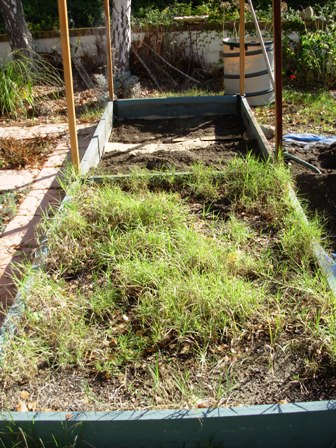
The subtitle to this post should be “Haste makes waste.”

But before I tell you my woeful tale of rushing a gardening project and living to regret it, I will tip you off to a wonderful product that helps non-carpenter types like me build raised beds for backyard vegetable gardening.

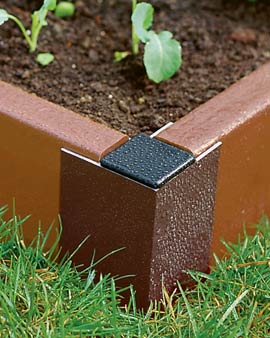
Gardener’s Supply has designed and fabricated a very cool piece of hardware – a corner bracket – that allows you to build a raised bed rather simply, with sections of lumber. Having previously built wobbly raised beds with L-shaped brackets screwed inside two 2-by-10s at a 90-degree angle, I think this Gardener’s Supply solution is far superior (see corner bracket, left).

All you need are four powder-coated, aluminum corner brackets. Slip the boards into the fitted sections of each bracket and secure them with Philips screws inserted in the pre-drilled holes.

There are also side brackets that allow you to extend the raised bed from 4-feet to 8-feet long.  And not to sound too Xenophobic, but – hurrah! – these brackets are made in Vermont by Gardener’s Supply. It really is nice to know that something is still manufactured in the U.S. of A. these days.

So, to create one 4-by-8 foot raised bed, you need the following:

  • 4 pieces of 2-by-10 lumber measuring 8 feet long
  • 3 pieces of 2-by-10 lumber measuring 4 feet long
  • 4 corner brackets from Gardener’s Supply
  • 2 side brackets from Gardener’s Supply

READ MORE…

What’s a Ramada?

Monday, November 24th, 2008

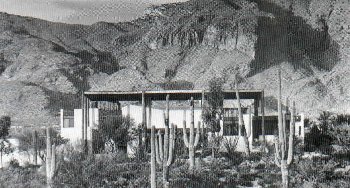
If you’re following my ongoing Glossary of Garden Architecture, check out this just-added “definition” of a Ramada. [photo source: Arid Lands Newsletter, 1989]

Part arbor-trellis, part pavilion, the open-air structure protects and shelters its occupants from the high-noon sun and also invites breezes to cool and comfort.

According to Allwords.com, the word ramada appears in at least two citations of American literature – in 1909 (Vanished Arizona, by Martha Summerhayes) and 1992 (All the Pretty Horses, by Cormac McCarthy).

1992: “They sat in the shade of the pole and brush ramada in front of the place and sipped their drinks and looked out at the desolate stillness of the little crossroads at noon. ” Cormac McCarthy, All the Pretty Horses

1909: (footnote) “A sort of rude awning made of brush and supported by cottonwood poles.” Martha Summerhayes, Vanished Arizona

Read further to discover why it’s important to learn and understand regional influences and cultural origins of architectural terms like ramada.

Autumn Gardens in Oregon

Monday, October 27th, 2008

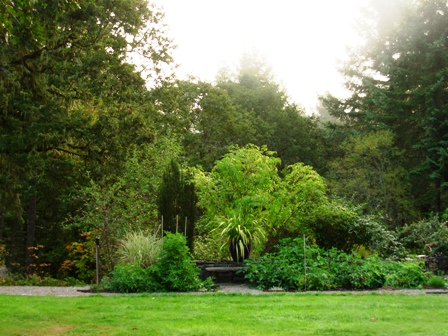
An early morning scene outside the guest room window at Mary-Kate Mackey’s in Eugene

October in Oregon – you can’t beat it. Earlier this month, I traveled there to lecture to the Hardy Plant Group of Willamette Valley.

Returning to my beloved roots, in the Pacific Northwest, was such a treat, especially since it is still wickedly hot down here in LA and I am desperate for some moist, cool autumnal weather.

And oh, the gardens!

Mary-Kate Mackey, fellow garden writer and a gifted journalism educator, met me at the airport. It was fun to fly into this sleek, modern, small airport and arrive via Horizon Airlines (they serve complimentary Pacific Northwest ale on board and, oh, by the way, one of my articles appears in the October issue of Horizon/Alaska’s in-flight magazine, so I was able to grab lots of extra copies from the seat-pocket in front of me, etc.!).

Upon disembarking in Eugene, I was impressed by the changing autumn light and saturated foliage palette. Oh, it’s autumn in Oregon! It took away my breath and captured my heart.

The evening began with drinks at a nifty bistro with Mary-Kate, followed by dinner with my dear friend Jennifer (we were editors together at “Seattle Woman” magazine in the 80s).

On Tuesday, after a restful overnight in Jenny and her husband Tim’s comfortable home, I met up again with Mary-Kate.

Since I missed out on the one-day garden tour in Eugene that followed last month’s Garden Writers Association’s annual symposium, I had a special request for Mary-Kate: Can I have my own mini-tour of the best of the best Eugene has to offer? [Above: Mary-Kate inspects the craftsmanship of a stunning stone wall hand-built by Allen Bosworth (right) of Bosworth Landscaping.]

READ MORE…

What’s a Grotto?

Tuesday, October 21st, 2008

Dare we call it a “Stone Shed”?

Does the idea of hanging moss, dripping water and a dark, quiet enclosure come to mind? Call it a cave, cavern or hollow and you’re getting close to both the ancient and modern-day descriptions of this sheltered stone destination in the cultivated or wild landscape.

If you’re following my ongoing Glossary of Garden Architecture, check out this just-added “definition” of a Grotto.

Arts and Crafts architecture, then and now

Thursday, October 16th, 2008

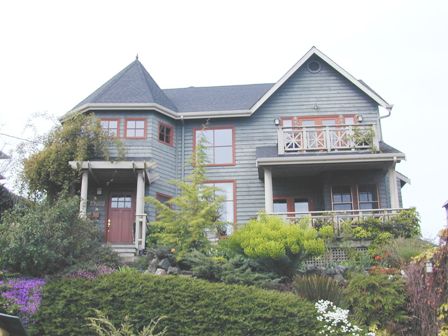
Our beloved Seattle bungalow, updated from its 1924 origins

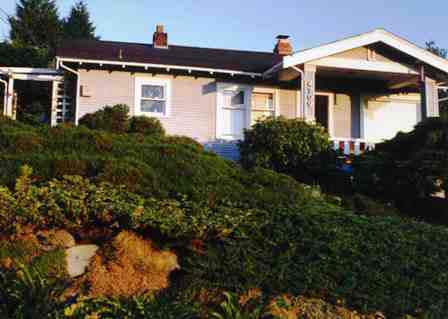
My interest in garden design from the American Arts and Crafts era is connected with the affection we have for a 1924 Seattle Craftsman bungalow, which my husband and I bought in 1996.

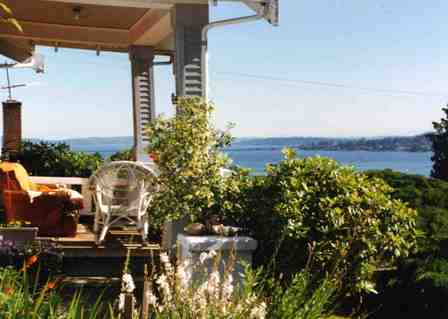
The one-story house, about 1,100-square-feet in size, was painted light gray. With faded white trim, it was not much to look at, as it had been a rental house for so many years (seen at right). On our first visit, we ignored the sofa on the front porch (below, left) and instead gazed at the breathtaking views of Lake Washington, the Cascade Mountains, Seward Park and Mount Baker.

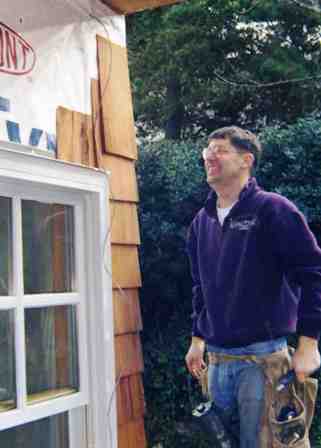
Thus began our love affair with Craftsman architecture. We wanted to expand the house while also preserving its character. My husband Bruce met Toby Taylor of Caledonia Bay Builders after previously seeing his work and tracking him down through a real estate agent

Toby (seen below, right) and Bruce hit it off immediately, an almost unheard of phenomenon between a builder and a potential client who is also a lawyer. Toby introduced us to Robin Abrahams, a Seattle architect who he described admiringly. We were impressed when Toby told us that Robin was “way cool.”

Miraculously, we went with our “gut” feelings and hired them both (this was highly rare for my lawyer-husband, who typically would have insisted on competitive bids from three candidates). We’d heard all the horror stories. Nearly everyone we knew who had restored, renovated or built a home was unenthusiastic about the process, or about their contractor, or about their architect.

But our little project was blessed. We adored Robin and her colleagues at Abrahams Architects. She is a bundle of creative energy, a thoughtful, very smart, incredibly gifted designer. We also loved Toby’s verve, his hard-working, can-do attitude, and his often amusing ski-bum vocabulary.

READ MORE…

Shed Style Glossary: Exedra

Thursday, October 2nd, 2008

A FURTHER INSTALLMENT OF THE SHED STYLE GLOSSARY. . .

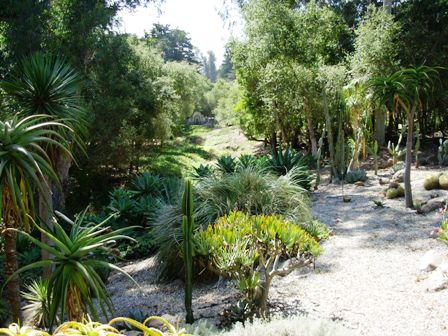
Look far in the distance. What do you see? Is there a destination at the terminus of this path?

In September 2006, after living in Southern California for only three weeks, I had the fortunate experience of joining many of my Seattle friends on a Northwest Horticultural Society tour led by Gillian Mathews. It was an introduction to the awesome plants and landscape beauty of my new environs . . . an inspiring and encouraging few days, spent in the company of kindred (Seattle) spirits who kept telling me how fortunate I was to be living here amidst “paradise.”

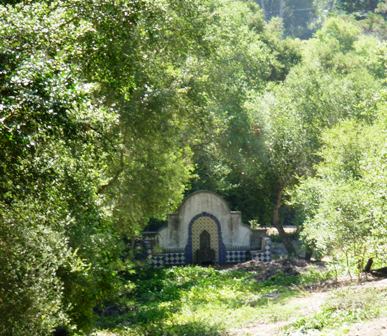
One of our stops was to visit Casa del Herrero, a fantastic Spanish Hacienda-style estate, built in the 1920s in nearby Montecito. After touring the magnificent home, completely restored down to the furniture and artwork, we moved on to the garden. At a particular stop on the tour the vantage point shown above appeared. The decorative stucco-and-tile wall, at least 10-feet tall and 18-feet wide, stood nestled at the base of a gently-sloping ravine. Built-in benches on each side face the center.

“Oh, look,” said one of my friends, a landscape designer. “It’s an Exedra!”

A Spanish-inspired Exedra: Standing apart from the dwelling and lying widely open

To learn more about the classic “Exedra” as a landscape design element, visit my glossary, where I’m compiling photos and definitions of unique garden architcture.

More cool gardens, garden art, and sheds

Sunday, September 28th, 2008

Visting Bellingham and the Whatcom Horticultural Society

Bright and early on September 17th, I flew from Burbank, CA to Bellingham, WA (by way of Seattle and a 2-hour layover). I was pretty tired, having only four hours of sleep the night before, so I dozed a bit on the small Horizon Air jet that transported me from Seattle to B’ham in barely 25 minutes.

As the plane began to descend, I perked up and looked out the window to see – oh glory – Puget Sound, and several of its islands including Lummi Island. I was so happy (exhilarated, actually) to gaze upon the gray-blue palette of the water and islands, the scenery dotted witha few boats; the islands populated with cabins and summer cottages. What a “welcome home”!

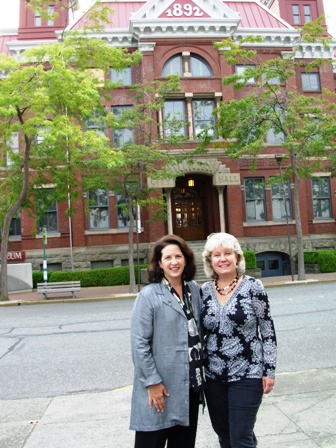
My friend, Dawn Chaplin, garden designer and nurserywoman (seen with me above, in front of the Whatcom Museum), invited me to speak at the September meeting for the Whatcom Horticultural Society. I have a special place in my heart for this group, thanks to my friendship with the late Stephanie Feeney, who was one of the founding mothers of WHS. Stephanie, creator of the Northwest Gardener”s Resource Directory, originally started her garden touring “reference” (as a few photocopied pages stapled together at the corner), for her use and for her WHS friends. Upon her death in 2000, I inherited the editorship of her book and produced the 9th edition, still in print.

Dawn and her husband David met me at the airport and whisked me off on a whirlwind tour of Bellingham’s fantastic gardens and even a few magical “sheds” and shelters in the garden. In this misty, foggy maritime place on the map, people in Bellingham use color and art in very exciting ways. Here is a travelogue of our garden-filled afternoon:
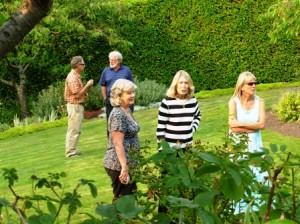
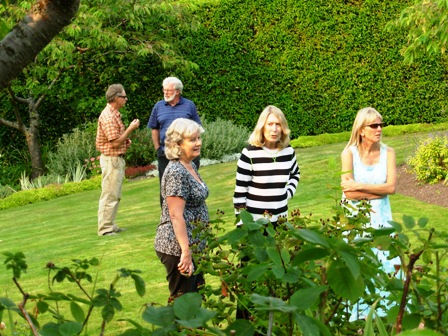
Our tour kept gathering up friends and bringing them along. In front, from left: Dawn Chaplin, landscape designer Susann Schwiesow, and Laurie Satushek discussing plants in Susann’s glorious front border; In the back, Steve Satushek and David Chaplin.

SATUSHEK GARDEN
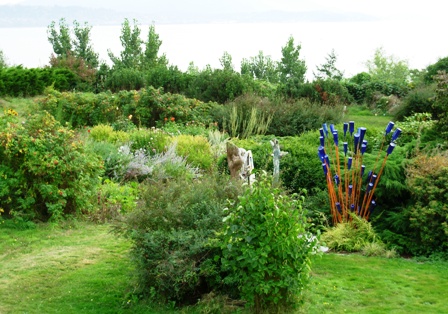

The wild and crazy landscape owned by Steve and Laurie Satushek
Photographer Steve Satushek and artist/teacher Laurie Satushek live and garden on about 8 acres overlooking the Nooksack River Delta and Bellingham Bay. They have transformed a nondescript ranch house and unkempt field into a colorful residence and equally brilliant landscape. Every surface of their residence is embellished with mosaics, mirrors, three-dimensional objects, and Steve’s oversize “outdoor” photographs — all rendered in a crayon box-inspired palette.

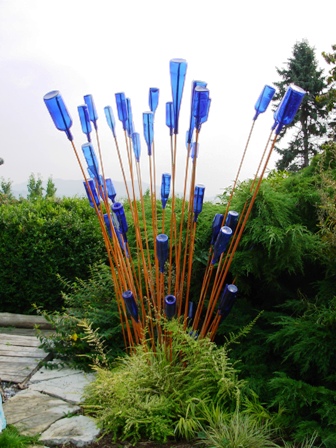
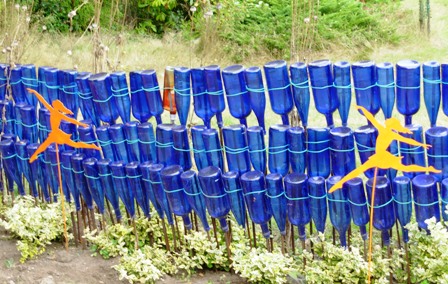
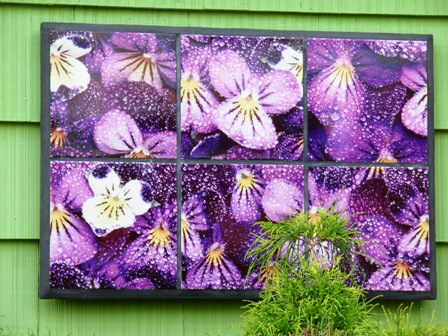
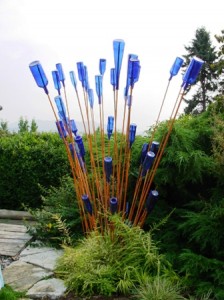
The informal but exuberant garden makes creative use of cobalt glass wine and water bottles (seen above, at left and below) and Steve’s cleverly-engineered and equally beautiful photography (he combines nature and botanical photographs with several innovative processes for weatherproofing oversize canvases). Together, the gallery-house and gallery-garden lure visitors to explore, observe, and fill their eyes with a surprising interpretation of art infused into every aspect of life.
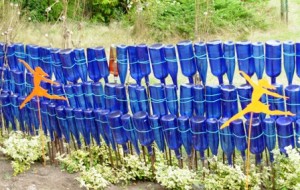
More blue bottles: Here, they are mounted upside down on rebar posts. Staggered “rows” create a waist-high blue wall that lines the driveway. Citrus-cutouts of dancers add whimsical contrast.

READ MORE…

In Praise of the Modern Shed

Monday, September 15th, 2008

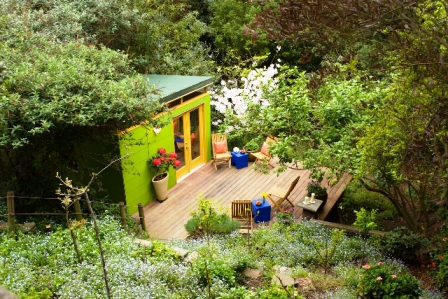
Irv and Shira Cramer created a backyard destination in an otherwise unused section of their hillside property. They bought and personalized a prefabricated shed-studio from Seattle-based Modern Shed.

[All photographs by William Wright]

There’s a huge media spotlight on prefabricated sheds these days, and much of it is shining on Ryan Grey Smith and Modern Shed of Seattle. While I would prefer to have a bit of those bright rays focus on Shed Style and our book, Stylish Sheds and Elegant Hideaways, I can’t help but be pleased to have media outlets participate in the conversation we began. As more stories rave about Modern Shed’s innovative and affordable design solutions for people in search of stylish space, I think everyone in the shed world will benefit. “The Shed,” an online magazine published by Alex Johnson in the UK, ran my story about Ryan earlier this year, called “Shedquarters.”

One of Ryan’s projects is featured in our book, a chapter called “Rec Room” that profiles a young Los Angeles artist and designer named Lin Su (seen at left, in front of her Modern Shed). But originally, a second Modern Shed structure was also slated for Stylish Sheds. It’s the sad reality that books have space limitations. Ours did, and in the end, that meant we had to cut seven chapters out of the final version of Stylish Sheds. It was P-A-I-N-F-U-L to say the least!


So many sheds, so few pages. Now it’s time to share one of those “lost” chapters. It includes the story and photographs of a bright green structure perched on a Berkeley hillside. Designed and built by Modern Shed, the haven is owned and used by a warm, artistic and fascinating couple named Irv and Shira Cramer.

Here’s their story, illustrated by a gallery of Bill Wright’s wonderful photographs:

Hillside Hideaway

A couple descends twenty-five steps to a garden far below their home to enjoy this separate and soulful place for music, books, and conversation. 

Irv Cramer doesn’t take the gift of sanctuary lightly. While some might consider the 13-by-14 foot shed installed at the foot of their garden to be a modest, humble structure, to Irv and his wife Shira, it is an oasis, for both body and mind.

READ MORE…

“Sustainable Spaces. Beautiful Places”

Friday, September 5th, 2008

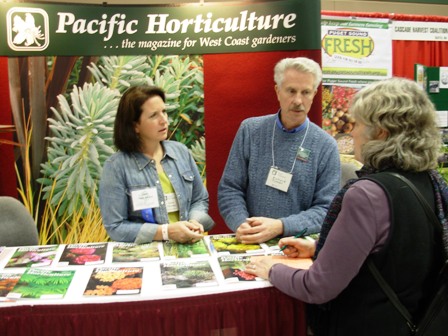
 I’m standing with Richard Turner, editor-in-chief of Pacific Horticulture magazine. We’re volunteering at the 2008 NWFGS in Seattle, visiting with Dawn Chaplin, formerly a fellow board member of Northwest Horticultural Society and a great garden-touring pal (she’s now a Whatcom Co. Hort. Society board member).

The press release just arrived in my in-box, and it announced the 2009 Northwest Flower & Garden Show’s theme. It’s only six months away – and I’m already excited! The theme: SUSTAINABLE SPACES. BEAUTIFUL PLACES. I like it! A lot!

The Northwest Flower & Garden Show, created by my pal, the talented and visionary Duane Kelly, today announced its 2009 theme:

“. . . (the) show will place a major focus on gardening materials and techniques that are good for the environment,” said Duane Kelly, chairman and founder of the annual event, now in its twenty-first year. “Show goers can expect to come away with a number of great ideas that conserve resources such as water and soil while, at the same time, making their gardens more self-sustaining and easier to care for.

“During the past year, organic gardening and vegetable gardening have grown in popularity thanks to the public’s keen interest in doing what’s best for the environment.  The movement has also gained traction with consumers seeking homegrown fruits and vegetables that not only taste better but reduce ever increasing grocery bills.”

READ MORE…

My first Garden Design piece – and it makes the cover!

Friday, September 5th, 2008

Okay, this is to be filed under “self promotion 101,” but, after all, what is the point of blogging if I can’t do that?

I am sending a huge bouquet of thanks to Jenny Andrews, Sarah Kinbar and the talented team of editors and designers at GARDEN DESIGN. Earlier this year, they asked me to profile the Venice, Calif., garden of uber-architect Ron Radziner and his wife Robin Cottle.

“Simple Geometry,” my story, appears in the September-October issue of Garden Design. You can see one of photographer Jack Coyier’s gorgeous shots appearing on the cover, depicting the family’s outdoor dining room. There’s lots more to read and see inside, as GD gave us a 10-page spread for the article.

I still haven’t seen the real issue or paged through it, but thanks to my Seattle pal, Stace Crooks, for calling this morning to tell me a copy arrived in her mailbox. I guess I better race out to get my own. I’ll post the entire story on my web site soon.

And another huge thanks goes to Paula Panich, my wonderful friend and writing coach. Paula helped me unsnag some tricky elements of the story, and in the process, made it lighter and more graceful. She is awesome.