Debra Prinzing

Get the Email Newsletter!

Author Archive

Creating and capturing movement in the landscape

Monday, November 16th, 2009

AGnucov1AA version of this piece originally appeared in my 2005 book, The Abundant Garden (Cool Springs Press), photographed by Barbara J. Denk, a gifted Bainbridge Island-based photographer. 

I recently updated the text as an article that appears in the current Southern California Horticultural Society newsletter.

RHYTHM AND MOTION

In landscape design, you can create a visual flow through the garden with the dynamic element of rhythm.

As a beat is to music, as choreographed steps are to a dance, rhythm animates a garden. Even if the wind doesn’t blow, your garden can look and feel infused with energy.

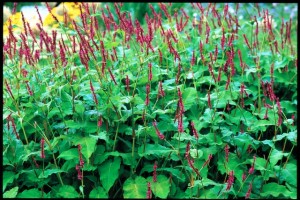
Raspberry-red spikes of aptly named Persicaria amplexicaulis 'Firetail' erupt in this singular performance of color and form. (Barbara J. Denk photograph)

Raspberry-red spikes of aptly named Persicaria amplexicaulis 'Firetail' erupt in this singular performance of color and form. (Barbara J. Denk photograph)

MOTION:  We experience a physical sensation when something rustles or sways in the garden. We pause to appreciate movements, subtle or dramatic – flowing water, rippling leaves, a billowing banner, or clanging chimes – because they signal life’s evanescent qualities. Such movements resonate as the garden responds to the earth’s vital elements.

By the very act of creating a garden, we embrace the external forces of nature, most of which are out of our control. In addition to rays of sunlight and rain showers, the kinetic presence of wind and breeze in our landscapes is important to channel – as movement – in a planting scheme.

The ball-shaped seed heads of Allium 'Globemaster' are showcased against a rhythmic display of Calamagrostis x acutiflora 'Karl Foerster', velvety Russian sage (Perovskia atriplicifolia) and Sedum 'Autumn Joy' (Barbara J. Denk photograph)

The ball-shaped seed heads of Allium 'Globemaster' are showcased against a rhythmic display of Calamagrostis x acutiflora 'Karl Foerster', velvety Russian sage (Perovskia atriplicifolia) and Sedum 'Autumn Joy' (Barbara J. Denk photograph)

It’s rewarding to see how climatic changes affect the garden, something we can’t help but notice, whether there are extreme gusts or light flurries flowing through branches and stems. When we intentionally design the garden to capture these movements, we infuse an otherwise commonplace landscape with vitality.

The choices of plants that can catch the airflow, gently dance, or furiously shake are endless. Perennials with tall, slender stems ripple like the fringe on a canopy (think of a vibrant stand of daylilies or a swath of lavender).

Fluffy inflorescences of maiden grass undulate above its finely-textured blades – and the overall effect is a seductive rhythm. The leaves of a California pepper tree shimmer like sequins on an evening gown. Agapanthus seedpods rattle and whisper as autumn arrives. The natural symphony energizes any landscape.

RHYTHM:  Beyond individual plants, the visual suggestion of animation or motion can also be incorporated into the overall template of a garden. The repetition of organic forms, the course of a sinuous path, or the sensual outlines of beds and borders suggest movement. Alternating shapes – the gradual widening or narrowing of a space, the regular spacing of trees – do as well.

Calm white and intense blue join for a duet of gentle movement. A border of creamy white Lysimachia clethroides relates well with a stand of blue-flowering Caryopteris x clandonensis.

Calm white and intense blue join for a duet of gentle movement. A border of creamy white Lysimachia clethroides relates well with a stand of blue-flowering Caryopteris x clandonensis (Barbara J. Denk photograph)

When the tiny stones in a Zen garden are raked into concentric circles, movement appears. When a “stream” of large, smooth, river rocks fills a gully or trench, the sense of running water is implied. The sequence of stepping stones spaced through a cushioned ground cover of fragrant thyme invigorates the scene and helps direct the viewer’s eye through the garden. The scene is emotionally alive and visually pleasing.

Movement in a garden is essential. It’s the organic rhythm, the fluid characteristic that every garden needs in order to come to life for those who enjoy it.

Here are some tips for “animating” your garden:

  • Develop a repertoire of plants:
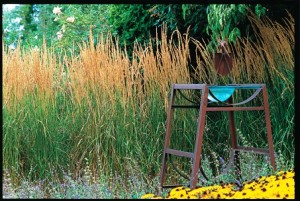
A glass bowl - a modern birdbath - is showcased against a coppery stand of Karl Foerster grass - an exquisite choice for "motion" in the garden (Barbara J. Denk photograph)

A glass bowl - a modern birdbath - is showcased against a coppery stand of Karl Foerster grass - an exquisite choice for "motion" in the garden (Barbara J. Denk photograph)

Base your plant selection on the scale of your house and the natural setting around it. Once you’ve selected the primary plants – those that provide structure and have multiseason interest, such as ornamental grasses – you can choose a second wave of plants to “star” in specific seasons.

  • Create a basic framework for design:

Choose a template and follow it consistently throughout the garden. One method is to mirror dominant lines of your house, such as repeating key architectural shapes in the landscape. Use these as a guide for shaping pathways and planting beds. For example, a home’s arched windows and doorways might be echoed in the contour of a border or patio. Alternately, you can borrow a framework for design from nature, such as the irregular rhythm of distant hills. 

  • Consider the vertical dimension:
Hardscape, such as this fabulous pebble "river" running through a flagstone patio, can animate and energize the landscape. This was designed and installed by my Yakima friends Linda Knutson and Ron Sell (Debra Prinzing photograph)

Hardscape, such as this fabulous pebble "river" running through a flagstone patio, can animate and energize the landscape. This was designed and installed by my Yakima friends Linda Knutson and Ron Sell (Debra Prinzing photograph)

Backlighting is magical, even in my own backyard. I love the morning sun as it illuminates and highlights the various blades, stems and leaves (Debra Prinzing photo).

Backlighting is magical, even in my own backyard. I love the morning sun as it illuminates and highlights the various blades, stems and leaves (Debra Prinzing photo).

Select plants that bring height, energy, and motion into the garden, and vary their placement for impact.

Even if surrounded by buildings on every side, your garden will respond to daily and seasonal climate changes. Watch how breezes move through the garden, and capture that energy by placing fluid plants where currents flow. Notice where the sun rises and sets in relation to your landscape, and choose trees, shrubs, grasses, and other perennials that will reflect the morning light or absorb sunset’s glow. Red and purple foliage turns flame-like when backlit. As the sun’s rays shine through fringed tassels of fountain grass or pampas grass, the garden will shimmer in response.

Gray concrete goes “green”

Saturday, November 14th, 2009

Here’s a story that ran in the Los Angeles Times last month. It’s about a few of Stephanie Bartron’s projects to remake her clients’ ugly concrete patios into more attractive – and sustainable – backyard features. The best part of the story is learning how easy it is to turn this technique into a DIY project of your own. The LA Times also features an awesome in this photo gallery. Read on . . .
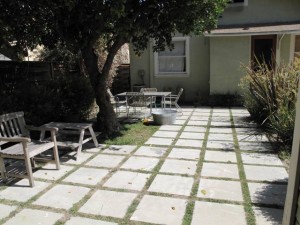
The basketball-court like patio has been repurposed by scoring and slicing 4-inch bands to create a grid pattern

The basketball-court like patio has been repurposed by scoring and slicing 4-inch bands to create a grid pattern

If landscape designer Stephanie Bartron has her way, California’s sea of patio concrete is going to start shrinking.

When the Los Angeles landscape designer eyed her clients’ slab behind a 1940s Atwater Village bungalow, she knew the concrete had to go. New hardscape and plants would have done the trick, sure, but digging out all that paving was costly and, the the waste would just end up in the landfill.

So, Bartron took a different approach. She hired a professional industrial saw operator to slice up the 20-by-20 foot patio into a grid of 18-inch squares.

The result is a new focal point for the garden, resembling evenly-spaced pavers divided by 4-inch bands of grass. When it rains, the storm water percolates into the ground rather than streaming down the driveway and into the street. Little material was thrown away. But the biggest effect was aesthetic. The repurposed patio no longer resembles a basketball court, nor does it dominate the tiny lot.

A power saw with a diamond blade slices up a sea of concrete

A power saw with a diamond blade slices up a sea of concrete

“By cutting it up, I changed the scale of the concrete from a big slab into an attractive backyard feature,” the designer says.

While his two children play nearby, owner Caleb Dewart, a television producer, likes to lounge beneath the mature orange tree that Bartron saved.

“We’re really happy we didn’t have to tear this up and start over,” he says of the patio. “And we like using what we have rather than being wasteful.”

Bartron’s approach solves myriad design challenges, and the designer has artfully sliced up several ugly patios and driveways for clients. Environmentally conscious homeowners like reducing the waste associated with redesigning a landscape. Budget-conscious clients like getting a lot of bang for their buck.
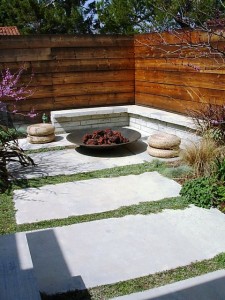
The once-ugly carport slab is reinterpreted as a lovely courtyard and seating area designed by Stephanie Bartron

The once-ugly carport slab is reinterpreted as a lovely courtyard and seating area designed by Stephanie Bartron

According to Kenny Grimm, sales manager for Oxnard-based Independent Concrete Cutting Inc., this kind of project requires an experienced operator to cut concrete with a diamond blade, 37-horsepower saw. Cost: $140 per hour, plus travel charges.

“We’re seeing more people re-use their existing material because recycling your paving is an affordable alternative to hauling it away,” he says. “You can get a lot of cutting done for around $1,000.”

For yoga instructor Lucy Bivins and cinematographer Eric Schmidt, Bartron recycled front-yard concrete into useful elements, including garden benches and a prominent water feature.

The couple inherited a gray slab when they purchased a Mt. Washington house designed by architect Barbara Bestor. The concrete had been installed by a previous owner as part of a carport, Bivins says. “It was very bleak and unattractive,” she says. “A real eyesore.”

At Bestor’s suggestion, she and Schmidt contacted Bartron for design help.
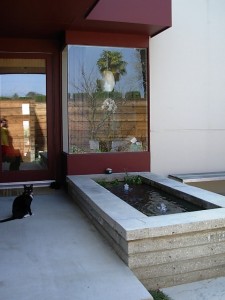
Narrow bands of concrete now form the edges of a modern koi pond and fountain

Narrow bands of concrete now form the edges of a modern koi pond and fountain

“We asked for shade trees, an outdoor gas fireplace and some type of fountain,” Schmidt says. “Stephanie turned the unused space into our outdoor living room, which in just a few years has been filled by a canopy of shade trees. It’s a favorite place to sit with our newborn son, Hugo, listen to the fountain and watch the trees move in the wind. It calms him down every night before bedtime.”

Used to working with old, cracked paving, Bartron was fascinated with the newer concrete. Four-inches thick and embedded with rebar, it covered 400 square feet between the street and her clients’ front door.

Coming up with a savvy design that created little waste was “like solving a big jigsaw puzzle,” the designer says. “This material was in great shape, but we wanted to turn one giant slab into many smaller elements for a bold and inviting garden space.”

Bartron chose a rectilinear motif to echo the architecture’s lines, slicing the patio into 1-1/2-by-4-foot sections. She layered the cut-out concrete in the form of an L-shaped seating area, the bench backed by a new, horizontal-plank fence. Narrower slices of concrete stacked four levels high form the edges of a contemporary fountain and koi pond. Cross sections reveal aggregate-like detailing when sanded smooth.
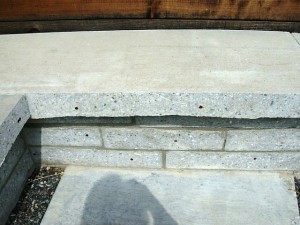
You can see the interesting texture in the cross-sections of cut concrete

You can see the interesting texture in the cross-sections of cut concrete

Bartron left some of the concrete in place but carved away planting strips to accommodate low-growing, drought-tolerant dymondia, a silver groundcover. She also removed enough patio to create two large beds for Eastern redbud trees (Cercis canadensis), carex and fescue grasses, and New Zealand flax. Evenly-spaced concrete bands serve as a walkway from the front door and adjacent bubbling fountain to the L-shaped seating, which has a gas-piped steel fire bowl designed by New York artist Elena Colombo .

“It’s a very sexy entertaining space,” Bivins says. “Whenever we have people over, we end up around the fire bowl. There can be 10 of us here and it still feels intimate.”

She praises Bartron for coming up with a money-saving design that also enhances the architecture.

“It was very crafty of her,” she says. “She took our lemon and made lemonade.”

Cutting up the patio
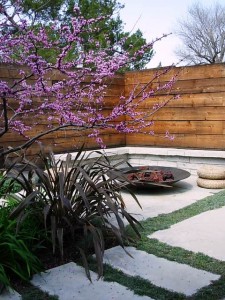
Another view of the lush transformation of this garden

Another view of the lush transformation of this garden

Want to slice up your patio? Landscape designer Stephanie Bartron says it’s not for the faint of heart. It’s possible to make small cuts using a power hand saw with a diamond blade, but you should take safety precautions such as wearing safety goggles and heavy gloves. Large-scale projects, such as the ones shown here, are best left to professional contractors.

Draw a map of your patio and think about where you want to place furniture. Table and chair legs need to be placed on an even surface, not in the spaces between concrete.

Dig along your patio to determine the concrete’s depth and the edge type (uniform or jagged). Newer concrete may be even, but old patios tend to be rough-edged. The type of edge may determine if or how the cut pieces may be repurposed.

While marking your pattern with chalk, note of any cracks, chips or score lines. If possible, tweak your design to eliminate these blemishes.

If the concrete is prone to cracking, Bartron suggests cutting it so the remaining pads are standard paver sizes (18- or 20-inch squares). “That way you can pull out a cracked section and install a replacement paver,” she says.

A gentle plea for an excellent cup of tea

Friday, November 13th, 2009

Author’s note. You know those “contributor pages” that many magazines include at the front of their books? I recently received a request from one of my 805 Living editors to write about “the little things that make life grand” to be included in the November issue’s “Behind the Scenes” section.

I wrote the following tea-drinker’s manifesto (about 500 words) before I re-read Anthony’s email in which he asked for only 50 words! Yikes! Anyway, he used one entire sentence and the rest would have been filed away or deleted had I not decided to go public here, with my personal confession. I don’t think I’m alone, either. While staying our our villa in Italy a few weeks ago, I woke up every morning with a chubby packet — a bag of Peet’s English Breakfast tea — slid under the door of my room (thanks, Paula!). Someone was looking out for me.

iStock_000009079416SmallI am a tea drinker.

In the world of double-tall lattes and cappuccinos, I realize I am a minority.

So I am grateful for a decent, HOT mug of English Breakfast tea (or two). Honestly, I wake up each morning excited to start my day. But mostly I wake up excited to fill the electric kettle with water and hit the “on” button so I can brew a pot of tea, pour myself a mug and add a splash of milk (not half-and-half or cream). I always drink from my French Apilco porcelain mugs from Williams Sonoma.

I’ve taken to carrying around spare tea bags with me, just in case. Places like Starbucks stock Tazo’s “Awake” and the Tully’s at the Burbank Airport has canisters of “British Breakfast.” I love these teas, too.

Unfortunately, though, at least one time out of 10, these coffee joints are “out” of my tea. You would never, ever find these places running out of coffee. That would be unthinkable. At least I can order a Grande cup of piping hot water and make my own on the fly.

The problem with restaurants and hotels (as well as airplanes) is that you often have to beg for real milk. I’ll take it any way you have it – whole, two percent or non-fat (I especially love steamed milk, which doesn’t cool down my tea). Just please give me milk instead of cream or half-and-half. I am one-quarter English, and I always tell the waitress that the English people use milk with their tea.

And don’t get me started about the stupid carafes of hot water you get at conferences. I’m talking about the vessels previously used to dispense the dreaded coffee beverage. As a result, the entire pot of hot water is infused with that bad coffee flavor. It really shouldn’t be difficult to segregate your carafes so a few are dedicated to only hot water for tea drinkers.

I realize this little meditation on the merits of a good cup of tea sounds more like a rant than a rave. So I will end on a positive, thankful note.

I could not function with out my delicious, satisfying mug of morning tea. It really is the fuel that runs my engine. I love that there are places in the world where tea is grown, processed and packaged for export to the U.S. I love that a few retailers still exist where I can purchase excellent, loose tea in bulk. And I love the moment of calm that drinking tea gives me in the midst of my chaotic, deadline-driven life.

To many more sips!

P.S., A great tea resource is the Teacup in Seattle. You can go online and order loose tea (Malty Assam is my favorite), OR if you are ever visiting Seattle, be sure to go in person for their very excellent tea latte. My friend Jean introduced me to this beverage more than a decade ago. It is a big secret how they make it, but Jean’s theory is that the brewers make a “shot” of a very dense, strong Indian tea and then infuse steamed milk, just like the coffee lattes are made. It is heavenly.

Here’s how her garden influences one textile designer

Thursday, November 12th, 2009
Sina Pearson relies on regular visits to her island garden in Washington state to inspire her teextile designs.

Sina Pearson relies on regular visits to her island garden in Washington state to inspire her teextile designs.

I met Sina Pearson in 2006 when her publicist Susan Harkavy arranged a visit to the textile designer’s aerie (aka studio, atelier, loft) in SoHo.

I was in New York City with Bill Wright to photograph an amazing glass-and-steel West Village “shed” for Stylish Sheds and Elegant Hideaways, but I took a side trip for an hour to meet Sina and see her work.

She grew up in Washington State and studied art and textiles at the University of Washington. Our common Pacific Northwest roots gave us an easy, mutual language, designer-to-writer, as we talked about her interests, influences and passions.

Recently, Garden Design magazine invited me to profile Sina as “One to Watch,” with a short Q-and-A that appears in the November-December 2009 issue. Due to space, a portion of my interview did not make it into the print edition. So here it is in full, along with some photos that Sina shared from her garden in Washington’s Fidalgo Island (Skagit Valley).

Garden Design NovDec001ONE TO WATCH:

Textile designer Sina Pearson may live and work in SoHo but trips outside the city inspire her saturated stripes and vibrant abstracts.

She spends one week each month at a remote island cabin in Washington State, surrounded by a semi-wild garden, just steps away from the 1950s A-frame where she played each summer as a child. Sojourns abroad include idea-gathering places like Scandinavia, France, Mexico and the Caribbean. Collectively, these design “threads” are woven into finished cloth: confident, evocative – and high performance – textiles for residences, hotels, restaurants, offices and outdoor settings.

sina-pearsonThe designer, manufacturer and entrepreneur trained in fine arts and textiles at the University of Washington before earning a MFA in textiles from Cranbrook and studying at the Royal Academy of Arts, Crafts and Design in Stockholm. She launched Sina Pearson Textiles in 1990.

Pearson reinterprets outdoor fabric that looks as if it belongs inside, including terrycloth, chenille and boucle cloth made with Sunbrella® yarns for sunfast, stain-, rain- and mildew resistance. Her newest collection, out next spring, is called Colores de Mexico. Her influence? The orange-striped, hand-woven Mexican curtains that Pearson’s mother hung in the family’s beach cabin. “It has an ethnic, modernist vibe with a serape-like texture,” she says.

 Q. Tell me about your Fidalgo Island garden and how it informs your textiles:

 A. I could not be doing what I’m doing if I didn’t have my garden. It frees my soul and lets me experiment with weaving colors and textures together. The way I work in my garden is very much how I work in textiles. I’ve always maintained that you have to listen to what the fabric wants to be – it’s a wonderfully slow process. Similarly, I have to let my garden design itself. I observe how each plant color works together, how each season is revealed in flower, foliage and blade.  

Q. What influences you as a designer?

A. I can’t separate how I’ve grown up from what I am now. My parents were so visual – my mother was a landscape designer and my father was a photographer. We had Jack Lenor Larson’s textiles in our house. I cannot remember a time when I was not playing with fabric. Family legend recalls me cutting textiles into small pieces and arranging them on the sofa when I was two. At 12, I learned weaving from a Swedish woman and batik design from Ruth Pennington, a very fine metal artist. I created a huge, abstract piece of batik silk with fuchsia pink, bright orange and red colors. We hung it up in the sun and it looked like a stained glass window. Ruth turned to my mom and said: “Sina has a career in textiles.”

Q. How is your Scandinavian heritage reflected in your work?

A. I grew up with Danish modern furniture and I double-majored in Swedish language and literature in college. I also lived and studied in Sweden. When I design, I am looking for “emotion” – the feeling conveyed by yarns, colors and textures in my fabrics. After my last trip to Scandinavia, I created a collection evocative of what my ancestors would have woven to wrap themselves in for warmth: soft, heathery “comfort” fabrics that are hand-crafted, quiet, simple and dignified.

cote d azur_03Q. How have you re-imagined outdoor fabric as something more than utilitarian?

A. When I first started in the contract fabric industry in the late 70s and 1980s, everything was rather plain. That all changed when I went to Unika Vaev as president and design director. We introduced the first tapestry for contract interiors. Herman Miller put our tapestries on its new paneling system and broke open the whole concept of patterned fabrics.

The same thing has happened now that I’m designing outdoor fabric with Sunbrella® yarns. I wanted to invigorate outdoor fabrics with modern designs. I’m a big proponent of mixing cool and warm colors together. I also like to use neutrals – sage, taupe, mid-tone brown – with brighter colors to give a reference to nature.

Q. What is the ideal exterior setting for Sina Pearson’s textiles?

IMG_3265A. A space where the interiors blend with nature as occupants move from indoors through a covered area to the outdoors. I love to see complementary fabrics and colors in all three environments. I don’t design my outdoor fabrics separate from my interiors collection. My outdoor fabrics look and feel just like indoor textiles, yet they are made with high-performance fibers for resistance to sun, mold and mildew.

Q. What is on your drafting table right now?

A. I have little piles of yarn sitting on my desk. I’m playing with brighter palettes to create fabrics with clean, crisp colors of summer. I’m also playing with simple shapes, hand-cutting paper into geometric forms – stripes and flowers. I find it very satisfying. I look like a second-grader, sitting on the floor cutting out bits and pieces.

–Debra Prinzing

Recession entertaining with Martha

Wednesday, November 11th, 2009

Appr'dPRShotbyScottDuncan8-20-2008While it may seem as if über-hostess Martha Stewart produces a new cookbook every few months, the October release of Dinner at Home: 52 Quick Meals to Cook for Family & Friends felt especially timely.

The 272-page cookbook follows one of her favorite formats: Meals you can prepare in one hour or less including a salad, entrée, side dish and dessert. 

A few weeks ago, I had the chance to do a phone interview with Martha for the Los Angeles Times, just before she came to Southern California for two book-signing appearances.

How does one prepare for such a momentous event? I called my longtime Seattle writer-friend Tracy Schneider, a regular contributor to Amazon’s Al Dente foodie blog, to ask her advice.  A few years ago, after I left Seattle and a design-writing gig at the (now departed) Seattle Post-Intelligencer, Tracy started writing for the newspaper’s home section with a clever shopping column called “Hot Finds, Cool Prices.” She, too, was given a chance to interview Martha by phone, which totally impressed me.

Tracy’s tip? Buy a tape recorder to make sure you capture a perfectly accurate, verbatim interview. Well, I couldn’t pull that off with such a short lead time. Luckily, years of newsroom experience and very fast typing skills prepared me to just take notes. Wearing my headset, fingers poised on the keyboard, and my questions already inserted into a Word document, I did just that.

America’s domestic goddess couldn’t have been nicer. Brisk and businesslike during a 14-minute interview, she answered my questions and shared her advice on entertaining at home during a recession. An edited version of this Q&A appeared in the October 17th edition of the Los Angeles Times Home section and on our LA At Home blog.

Q: Is home entertaining more important than ever?

A: Many people are entertaining at home and cooking delicious food. But they are looking for simple, time-saving recipes they can actually do themselves that are as tasty as restaurant food. I just love the whole idea of using a few ingredients that taste so extraordinary.

Q. What’s an easy way to throw a party at home?

A. I often do breakfasts and lunches. It gets it out of the way so I can do other things later in the day. Last Sunday I had nine people over for brunch for a delicious, homemade meal. It wasn’t expensive food: cheese popovers, beautiful poached eggs with country smoked bacon, two platters of smoked fish, homemade biscuits and fresh-squeezed grapefruit juice.

Q. What is the ideal number of guests for a dinner party?

A. I would suggest inviting what you can handle. I’m an experienced caterer so I can have 12 or 14; my dining room comfortably fits 16.

Q. What do you do when your guests outnumber your set of dishes?

A. I suggest you serve a buffet and use stacks of plates from different sets.

Q. How do you feel about potluck meals?

A. When friends get together, it should be a little more orchestrated so you know there is a salad, a vegetable, a main course, and a dessert. The host can provide the main course. You could use my duck breast with fig sauce menu from “Dinner at Home.” One person can bring the braised red cabbage and someone else can prepare the potato pancake or the hazelnut brittle for the ice cream.

Q. If you could only splurge on a few key pantry ingredients, what would you buy?

A. You should have coarse salt, fine salt, peppercorns and a grinder, vanilla beans, saffron threads, unbleached flour, natural sugar and an assortment of pasta. I’m always looking for the imported, rough Italian pasta. (Note: Martha actually used “really good” in describing each one of these ingredients).

DinneratHomeCoverBOOK DETAILS:

Dinner at Home: 52 Quick Meals to Cook for Family & Friends

By Martha Stewart

Clarkson Potter/Publishers

$35, hardcover

Here is the recipe Martha mentions. It really sounds delish! I’m going to try it soon and will report back.

DUCK BREAST WITH FIG SAUCE (serves 4)

Duck breasts area available at butcher shops and specialty food shops, as well as many supermarkets. They render quite a lot of fat as they cook. If you like, strain the fat and refrigerate up to a month. Use it for roasting or frying potatoes or making duck confit.

Ingredients:

2 duck breasts (1 lb. ea)

Coarse salt and freshly ground pepper

1 T olive oil

1 large shallot, thinly sliced

1/3 cup dry sherry

1/3 cup fig jam

1/2 cup chicken stock, home made or low-sodium store-bought

2 t. unsalted butter

1 t. fresh lemon juice

Preheat oven to 400-degrees F

Using the tip of a sharp knife, score the duck breast at 1/4-inch intervals in a crosshatch pattern, cutting deeply into the fat but not the meat. Season duck all over with 1 tsp. salt and a generous pinch of pepper. Let stand at room temperature 20-30 min.

Heat oil in a 10-inch cast iron skillet oer medium low until hot but not smoking. Add duck breasts, skin sides down; cook until browned and crisp, about 5 minutes. Turn breasts, and transfer to oven; roast until an instant-read thermometer inserted in the thickest part (avoiding bone) registers 130-degrees F for medium-rare, 10-12 minutes. Remove pan from oven, and transfer duck to a cutting board; let rest.

Meanwhile, pour off rendered duck fat into a heatproof container. Return 2 T duck fat to the pan (reserve the rest for another use, or discard). Add shallot; cook over medium heat until beginning to brown, stirring occasionally, about 2 minutes. Carefully add the sherry (it will splatter), and cook 1 minute, then stir in fig jam and cook 1 minute more. Pour in stock; cook, stirring, until sauce is thick and emulsified. Add butter; cook, stirring, until combined, 1 minute. Remove from heat; stir in lemon juice.

To serve, thinly slice duck diagonally against the grain; divide among four plates. Spoon fig sauce over duck.

Yum.

What can we learn from a classic Tuscan garden?

Tuesday, November 10th, 2009
The stone steps of La Foce's terraced garden draw the eye upward, towards two large Italian cypresses

The stone steps of La Foce's terraced garden draw the eye upward, towards two large Italian cypresses

I’ve barely been home from Italy for 24 hours and despite jet lag, I am still alert enough to post my first report about the two week trip to Tuscany.

One of the most memorable days was our tour of La Foce, a Tuscan estate and garden with influences dating to the 15th century when the property was built as an Inn (“Osteria”) by the Hospital of S. Maria della Scala.  It is located in the town of Chianciano, about 30 minutes southeast of where we stayed in Montisi.

“Foce” (pronounced Foe-CHAY) means “opening” or “meeting place,” and its origins are traced to the Etruscans. The name refers to the osteria’s location as a stopping place where two prominent roads intersect. The roads were traveled by pilgrims, merchants and travelers who sought rest from their journeys at La Foce.

READ MORE…

Off to Italy for my Tuscan Adventure

Thursday, October 22nd, 2009

”]The garden terrace at Villa Maddalena [BillWright photo]Two years in the planning, I’m leaving tonight to fly to Rome (via Munich) for a two-week Italy getaway. Ten of my dearest friends are joining me in a little village called Montisi, which is (happily) in the middle of nowhere. We are ostensibly celebrating my belated 50th birthday, but I also think we’re just celebrating life. Each other’s and the beautiful friends who, sadly, couldn’t be with us this time around.

Hey – there’s always my 55th, right?

After my girlfriend week, I will have a family week. My husband and 2 sons arrive as the girls leave. Plus, some dear college friends of Bruce’s and my folks. Celebrating our 25th wedding anniversary, too. Lots to be grateful for. And I hope this trip slows me down long enough to ponder that.
Slide show of Villa Maddalena, our home away from home for 2 weeks. Photographs by Bill Wright. Yes, THE Bill Wright!

Here’s one more shot of the Villa, taken from a hot air balloon:

Here it is, our stone villa

Here it is, our stone villa

More gardens, even more plants

Wednesday, October 7th, 2009
Shopping and playing at Plant Delights Nursery

Shopping and playing at Plant Delights Nursery

“All the world’s a nursery. And all the men and women merely gardeners.”

— William Shakeshovel (aka Tony Avent)

Garden Writers Annual symposium, Part IV

On Friday, Sept. 26th, the climate started cooling off, but with that came some lightish showers. Luckily, the rain held off until later in the morning, but we started out boarding buses at 7 a.m. (!) to visit to the famous Juniper Level Botanic Gardens at Plant Delights Nursery – a gardener’s mecca, nursery and botanical garden all in one.
 
Consider: A five-acre display garden that contains 17,000 different plant specimens. The nursery has 1,600 different plants available at any given time. Talk about over-stim!  
Wow - a chance to meet Tony Avent, genius plantsman

Wow - a chance to meet Tony Avent, genius plantsman

I have been a fan of plantsman Tony Avent ever since I inherited the late Stephanie Feeney’s working files from her book, The Northwest Gardener’s Resource Directory. I picked up where Stephanie left off to edit the 9th edition in 2002. That was when Internet plant-ordering was in its infancy and thousands of plant fanatics on both coasts looked forward to receiving the entertaining Plant Delights catalog from this Raleigh nursery. I got a kick out of the “price” that Tony printed on the front cover. It hasn’t changed in the ensuing years: “10 stamps or a box of chocolates.”  

Here’s what I wrote about Plant Delights Nursery in 2002 (of course, never having been there, this was based on the catalog and web site):

 Among the Plant Delights here is an engagingly humorous catalog, its gentle joshing bordering occasionally on the sarcastic. Earlier issues have been subtitled along the lines of “Raiders of the Lost Park” and “It’s not easy being variegated,” as this nursery boldly announces its mission to sell unusual perennials. You’ll find an online catalog of 1,000-plus offerings, including arisaema, asarum, cannas, crinum lilies, epimediums, ferns, hardy palms, hardy ginger lilies, hellebores, heuchera, hosta, lobelia, ornamental grasses, pulmonaria, Solomon’s seal, tiarella, verbena . . . and more.

When we arrived Friday morning, Plant Delights was everything I hoped it would be – and more. The crew at Plant Delights were all-hands-on-deck. Hundreds of garden writers wandered (raced?) around the property, little red or green wagons in tow, seeking unusual must-have plants in the hoop houses and absorbing design ideas in the display gardens that surround Tony and Michelle Avent’s home. The mood was at first festive, followed by a quiet sense of awe.

READ MORE…

Inspiration for the mind, heart and spirit

Saturday, October 3rd, 2009

Garden Writers Association Annual Symposium, Part III:

Lotuses thrive in the sultry Southern heat at the Sarah P. Duke Gardens in Raleigh

Lotuses thrive in the sultry Southern heat at the Sarah P. Duke Gardens in Raleigh

 Thursday morning kicked off with our keynote speaker Dr. Lowell Catlett, a fascinating economic futurist who really put things into perspective in his talk, “The Greening of America.” Dr. Catlett tailored his remarks to our profession and totally blew the audience away. We were inspired and challenged (in a good way) to rethink our definition of “green” and “sustainable” lifestyle choices.

You can find several clips of Dr. Catlett’s lectures on YouTube, so check him out. He ended the lecture with this charge: “Do not sell people products and services. Sell them dreams.” It resonated, because we know that seeking and creating beauty in our surroundings is a basic human desire. If you didn’t make it to the symposium, Dr. Catlett’s lecture is one CD to purchase and listen to.

Love the gothic gates at the entry to Duke Gardens; made of metal but inspired by stained glass

Love the gothic gates at the entry to Duke Gardens; made of metal but inspired by stained glass

After the morning workshop sessions and a working lunch at the trade show, we hopped on buses for the first of three days of garden touring.

Thursday was the hottest, most humid day during the conference, so I have mixed memories from our late afternoon tour of the Sarah P. Duke Gardens.

Canna tropicana and a cluster of coleus, backlit in the afternoon sun

Canna tropicana and a cluster of coleus, backlit in the afternoon sun

The 55-acre public garden graces the campus of Duke University and features several special areas, including a formal Italianate-style terrace garden planted with an explosion of colorful tropicals, annuals and woody plants. I spent a lot of time here and was drawn to the twin historic stone structures. Not quite sheds, but shed-like for sure.

I love the placement of these round millstones providing transit across the pond

I love the placement of these round millstones providing transit across the pond

I then escaped to the shade with a few friends walking through the understory of the H.L. Blomquist Garden of Native Plants. Filled with more than 900 varieties of regional natives, it was a beautiful and serene enclave. It was especially fun to hang out here with Nan Sterman, aka PlantSoup, my symposium roommate and Duke University alum. She spent a lot of time studying plants as a biology undergrad, so I had a personal narrative to connect to this amazing place.

We experienced that languishing, Southern state of mind, what with the heat, the humidity, the sun and the sleep deprivation from staying awake late the night before and getting up early in the morning.

Dreamy, visually restful: the Virtue Peace Pond

Dreamy, visually restful: the Virtue Peace Pond

A buffet dinner led to some fabulous conversations with new friends, despite the climatic challenges (it was all I could do NOT to throw myself into the “Virtue Peace Pond” to cool off – seriously). Those water lilies, lotuses and other water-loving plants looked so much happier than the humans seated around the pond’s perimeter.

Most memorable that evening were two conversations my good friend (and collaborator) David Perry of A Photographer’s Garden Blog and I had with Susan Reimer, garden and op-ed (!) columnist and “Garden Variety” blogger for the Baltimore Sun, and later with Rizaniño “Riz” Reyes , an up-and-coming plantsman, horticulturist and designer from Seattle. I recall sharing a table (and prior conversation) with Riz at a Northwest Perennial Association event several years ago. Inspiring to know him – and new friend, to be sure.

READ MORE…

Garden products and Twitter friends

Thursday, October 1st, 2009
  Garden Writers Association annual symposium, Part II: 
A charming Southern garden, Raleigh's Rose Cottage

A charming Southern garden, Raleigh's Rose Cottage

Tuesday/Wednesday:  

Raleigh here I come.  

Greensboro gardener Lynda Waldrep drove me to Raleigh on Tuesday morning where I checked into the Garden Writers Association conference hotel, dropped off my gear and joined the GWA board meeting.

Nice to get Tuesday afternoon’s and Wednesday morning’s business out of the way so I could enjoy the rest of the conference once it began on Wednesday afternoon after lunch.

Wow, I got to meet heirloom seed wunderkind Jere Gettle of Baker Creek Heirloom Seeds

Wow, I got to meet heirloom seed wunderkind Jere Gettle of Baker Creek Heirloom Seeds

After some regional meetings and receptions for first-time attendees, the Garden Products Information Exhibit opened – four hours of checking out the new trends in plants, products and programs for the horticultural industry. The exhibit continued on Wednesday for another four hours.

Next, I joined 50 or more very new (and a few old) friends at a private garden cocktail party for garden Twitter participants. Sharon and Jim Bright, our gracious garden hosts, opened the gates to Rose Cottage, their charming place in a historic downtown neighborhood.

The GWA Tweet-up is in full swing

The GWA Tweet-up is in full swing

Raleigh hometown gal Helen Yoest of Gardening With Confidence and Elizabeth Licata of Gardening While Intoxicated/Garden Rant, planned the evening with several other volunteer Twitter friends. Proven Winners (thanks Danielle!) was our sponsor, so we had lots to nibble and sip while admiring the garden’s exuberant cottage plantings, semi-formal vegetable beds (outlined in brick) and more.

Laura Schaub, Amy Stewart and Helen Yoest, real-time Twittering

Laura Schaub, Amy Stewart and Helen Yoest, real-time Twittering

All those women and men with whom I “tweet” came together for an evening where putting a face to a name was part of the fun. Our nametags had our real names and our Twitter names (I’m “@dkprinzing”).

What amused me more than anything was watching people post comments on Twitter during the party.  I call it real-time garden tour commentary at its best.

My gal pal Mary Ann, busy with thumbs and I-phone

My gal pal Mary Ann, busy with thumbs and I-phone

Later that night, I walked all the way across town with a friend to an authentic Carolina ribs BBQ dinner hosted by the Garden Media Group. A chance to catch up with some editor and writer friends, meet several of GMG’s clients, shake the hand of famed BBQ chef Ed Mitchell and eat some of his great Southern food.

Long day, but good conversations all around!

This annual gathering of gardeners is something I look forward to from year to year. Raleigh was my 8th Garden Writer Association event and I’m hooked.