Debra Prinzing

Get the Email Newsletter!

What does Slow Flowers mean, anyway?

Friday, June 21st, 2013
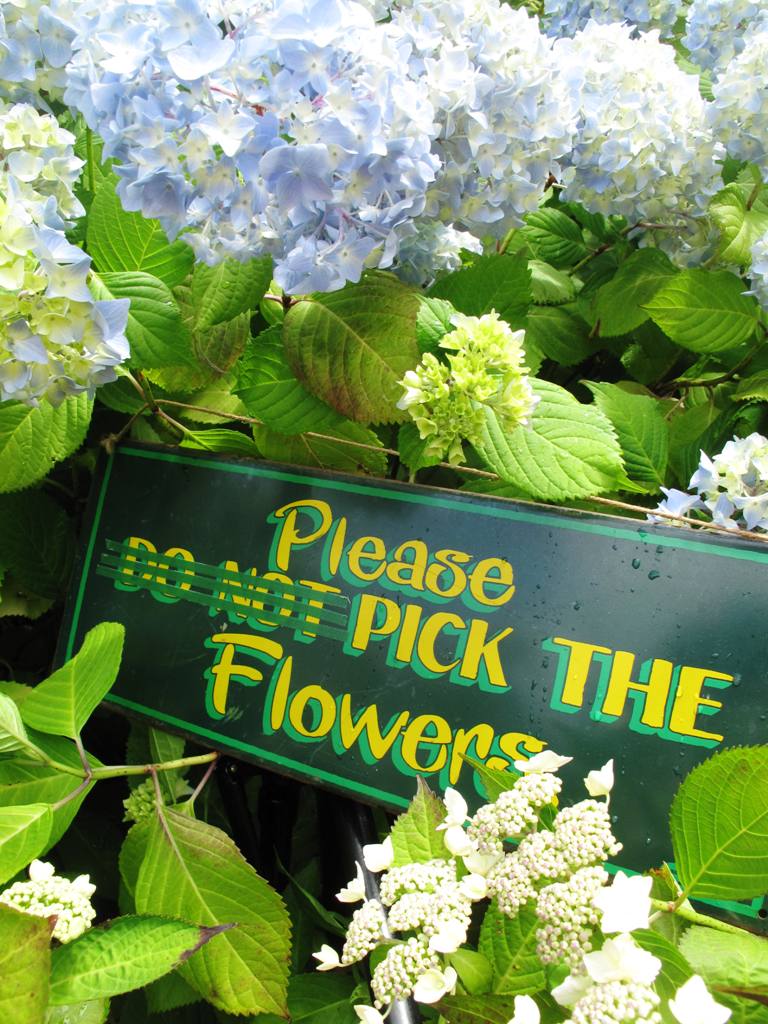
Please Pick sign

After I found this sign in a garden shop, I took the liberty to cross out the words “DO NOT” so the message better fits my philosophy of floral design!

I’ve been eating, sleeping, breathing, writing and speaking about SLOW FLOWERS for so long that it’s good to sometimes be reminded that not everyone understands what that phrase means. Recently, one of my flower farmer friends emailed to ask: Tell me again what Slow Flowers mean. I know it’s USA flowers but SLOW?

Fair enough. With all due respect to my fellow garden writer Felder Rushing, who coined the phrase “Slow Gardening,” let me outline my personal definition of SLOW FLOWERS. This is excerpted from my introduction to the book, Slow Flowers: Four Seasons of Locally Grown Bouquets from the Garden, Meadow and Farm (St. Lynn’s Press, 2013).

Thanks to the culinary pioneers who popularized the Slow Food movement, it now seems like you can put “slow” in front of any term to convey a different philosophy or approach to that subject. When I say the  phrase “slow flowers,” there are those who immediately understand it to mean: I have made a conscious choice. 

My blooms, buds, leaves and vines are definitely in season; not, for example, grown and brought in from elsewhere in the world during the wet, cold winter months in my hometown of Seattle. So, come December and January, my commitment to sourcing locally-grown floral materials sends me to the conifer boughs, colored twigs and berry-producing evergreens – and the occasional greenhouse-grown rose, lily or tulip, just to satisfy my hunger for a bloom. 

Slow Flowers (the concept and the book) is also about the artisanal, anti-mass-market approach to celebrations, festivities and floral gifts of love. I value my local sources. If not clipped from my own shrubs or cutting garden, I want to know where the flowers and greenery were grown, and who grew them. Having a relationship with the grower who planted and nurtured each flower is nothing short of magical. I call so many flower farmers around the country my friends. They are the unsung heroes – the faces behind the flowers we love. 

Finally, Slow Flowers reflects life lived in the slower lane. My family, friends and professional colleagues know that it’s almost impossible for me to do anything slowly. I’m the queen of multitasking; I just can’t help myself. There are too many exciting opportunities (or bright, shiny objects) that command my interest. But this “year in flowers” was altogether different. I can only compare it to the practice of praying or meditating. I didn’t realize that those few hours I spent each week, gathering and choosing petals and stems, arranging them in a special vessel, and then figuring out where and how to capture the finished design  through my camera lens, would be so personally enriching.
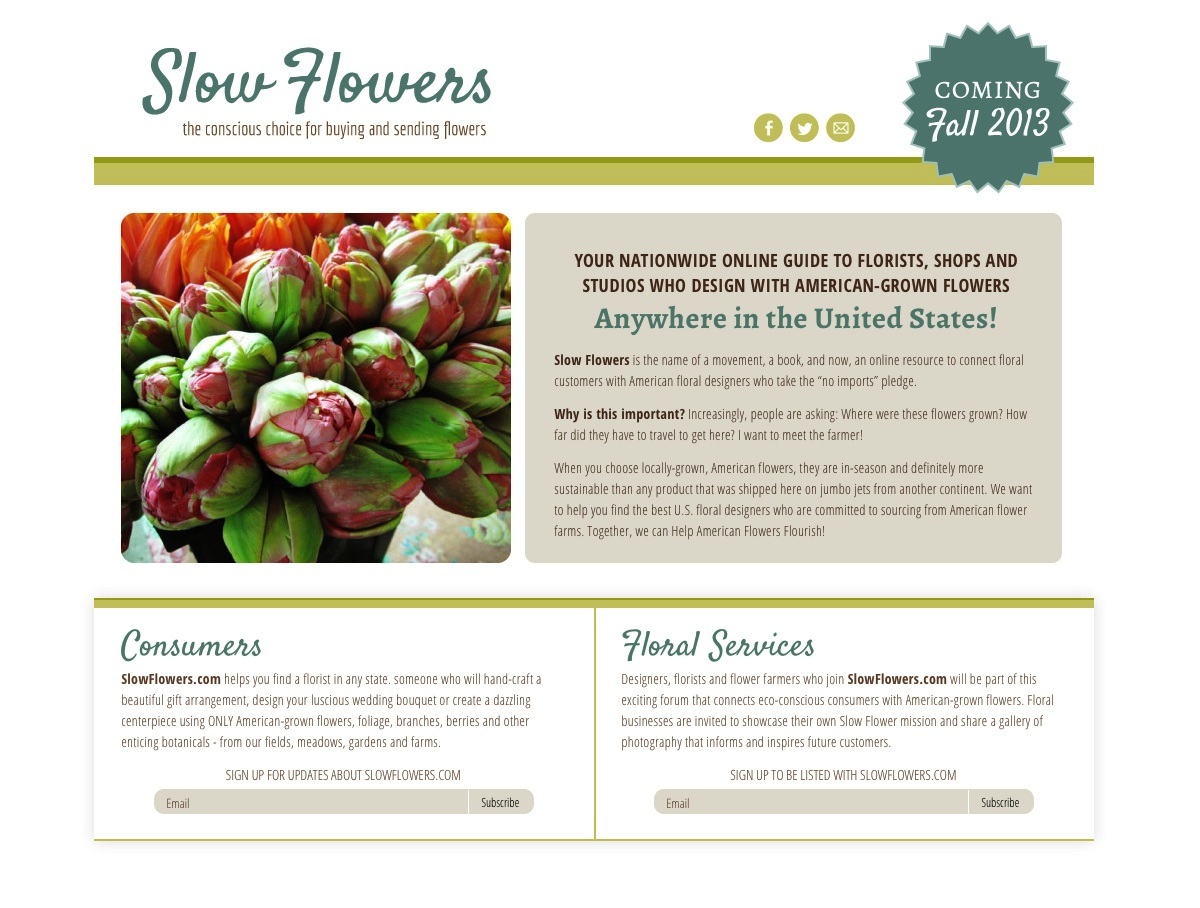
And speaking of the phrase, Slowflowers.com is also the name of my newest project, announced this past week. With a scheduled Fall 2013 launch, this will be a free, online database that helps connect consumers with floral designers, studio florists, florists and supermarket floral departments who are committed to designing with American-grown flowers. Please sign up – either for consumer updates on our official launch, or to be listed as as SlowFlowers.com designer.
SlowFlowersScreenShotSo I guess you can also say that the idea of “Slow Flowers” is also a resource that I hope many will find useful. Here is the description of this project:

Join the Slow Flowers Movement, an All-American philosophy that supports grown-in-the-USA flower farms as well as floral designers, florists and retailers committed to using American-grown ingredients.

Origin matters! Slowflowers.com is a free, searchable database that makes it easy for customers to find designers who share their values and ethos. Log onto our home page to add your listing. Let’s tell consumers that there is a better way to beautiful – and they can find it at Slowflowers.com.

Slowflowers.com enables users to:

* Search by state or city and by keyword for the type of florist they seek.

* Find studios and retailers who specialize in green weddings, weekly subscriptions and eco-florals.

* Discover local flower farms that sell direct to the DIY consumer.

* Access coupons and promotions from individual studios, shops and farms.

* Provide reviews and raves about great American flower sources and comment on

experiences.

* Map the location of a desired destination.

I hope this helps! I invite you to add your own thoughts about “Slow Flowers” and what it means to you.
SLOW FLOWERS: Week 24

Monday, June 17th, 2013

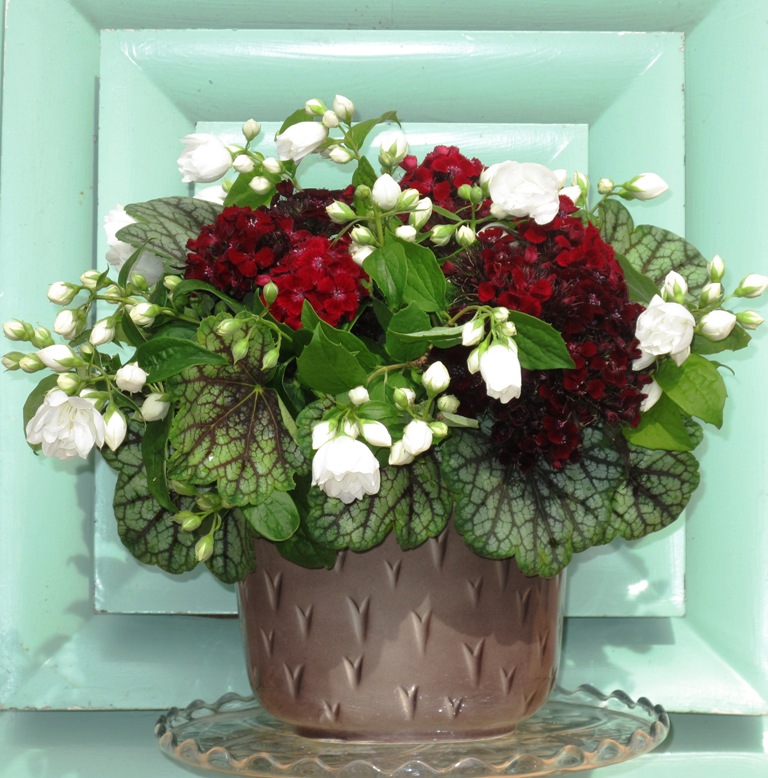
A Certain Vintage

A Certain Vintage

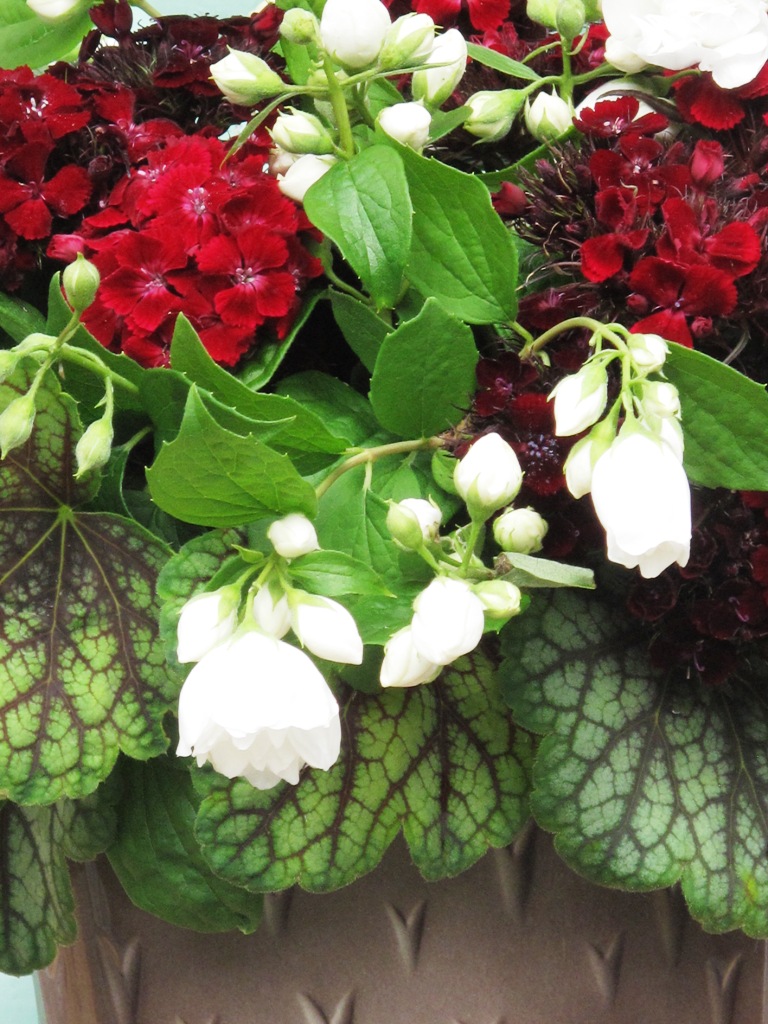
Ruffly ‘Green Spice’ heuchera foliage pulls together the mocha-colored vintage vase and the deep burgundy sweet William flowers

detailIngredients:
25 stems heuchera foliage (Heuchera ‘Green Spice’), harvested from my garden
7 stems sweet William (Dianthus barbatus var. nigrescens ‘Sooty’), grown by J. Foss Garden Flowers
5 stems mock orange (Philadelphus coronarius), harvested from my garden
Vase:
6-inch tall 1940s vase with a 7-inch x 3-inch oval opening
Eco-technique
Just add foliage: Thanks to the eco-conscious designers I’ve met and interviewed, I am quite wary of using florist’s foam, a formaldehyde-based product, to stabilize arrangements. Designing around a base of foliage offers a greener way to keep flower stems upright in a vase. Choose leaves that are large, fluffy or textured. Then, insert your other floral ingredients through this vegetation. For example, in this bouquet I placed the heuchera leaves first; then I added the sweet William and mock orange stems. Everything stays just where I want it.

SLOW FLOWERS: Week 23

Sunday, June 9th, 2013

A Bit of Purple Heaven

All shades of purple

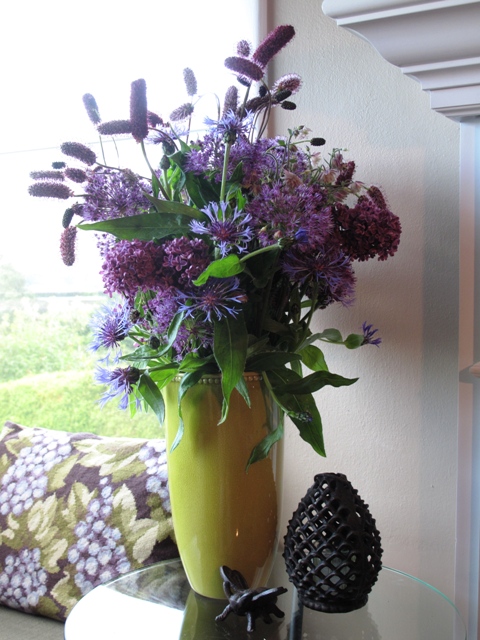
A wistful arrangement of blue, purple and plum flowers looks awesome in a chartreuse vase.

Ingredients:

flower detail

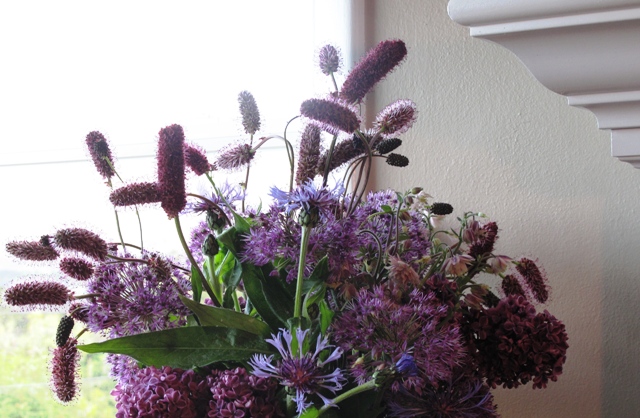
The little “dancing” bottlebrushes are called burnet, or Sanguisorba menziesii.

5 stems dark purple lilacs (Syringa vulgaris), grown by Sunshine Crafts and Flowers

7 stems blue perennial bachelor buttons (Centaurea cyanus), grown by Sunshine Crafts and Flowers
7 stems reddish-pink ‘Nora Barlow’ columbine (Aquilegia hybrid), grown by Sunshine Crafts and Flowers
5 stems purple ornamental alliums, grown by Jello Mold Farm
20 stems burnet (Sanguisorba menziesii), grown by Jello Mold Farm
Vase:
11-inch tall x 5½-inch citron-green crackle glaze vase
Eco-technique
Traveling with flowers: I can’t resist taking flowers with me or bringing them home. If it’s a car trip, place flowers in a stable bucket with just a few inches of water to hydrate the stems (but avoid splashing). Store on the shady side of the car. If you’re traveling by air, wrap the stems in wet paper, cover with a plastic bag and then wrap the entire bunch in kraft paper that extends above the blooms. As soon as you arrive at your destination, re-cut all the
stems, place in fresh water and possibly a refrigerator. I’ve been known to use a hotel wastebasket and mini-bar fridge for this step!

SLOW FLOWERS: Week 21

Sunday, May 26th, 2013

Pitchers of Poppies

Poppy One

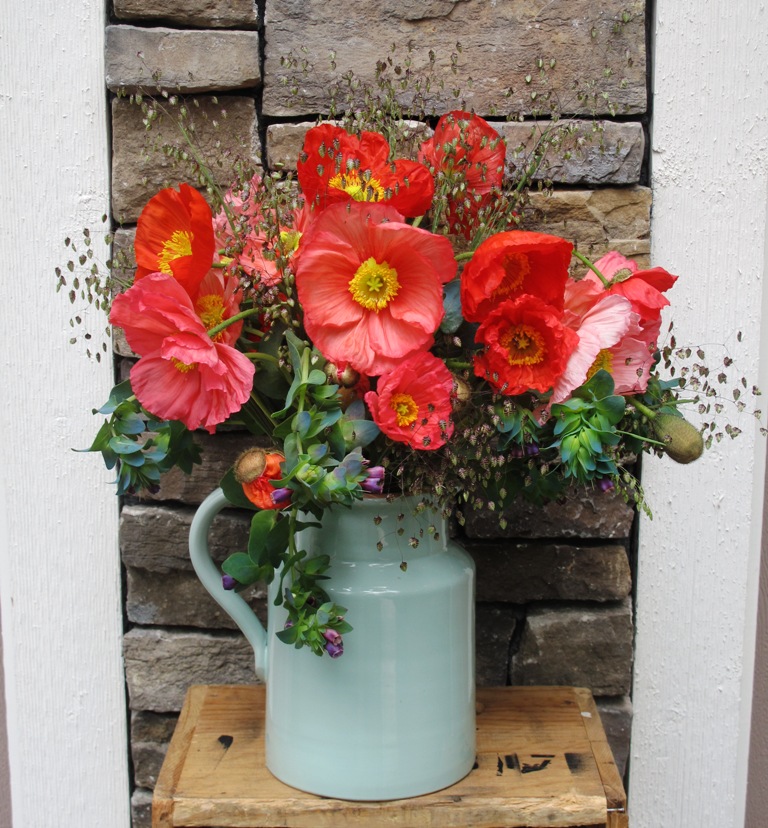
Why do we love poppies so much? Perhaps it’s because of their pure, vibrant petal colors with the charming button-like centers.

Ingredients:
(Green pitcher)
10 stems coral-red Icelandic poppies (Papaver nudicaule), grown by Jello Mold Farm
6 stems Cerinthe major ‘Purpurascens’, grown by Jello Mold Farm
7 stems rattlesnake grass (Briza media), grown by Jello Mold Farm
(Glass pitcher)
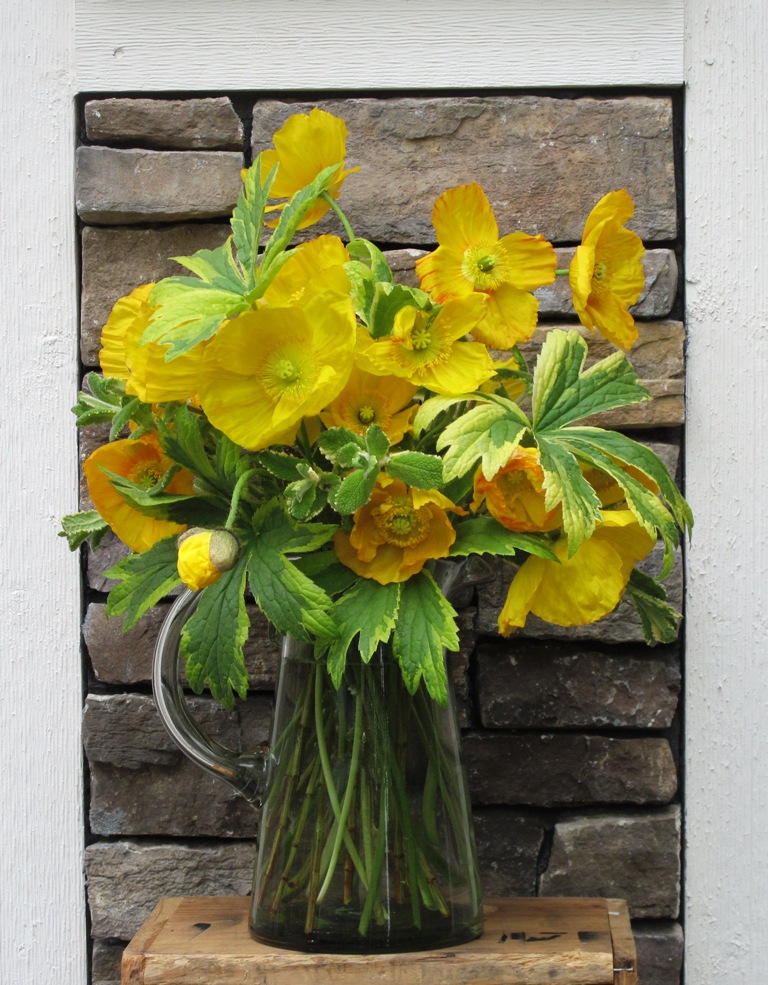
10 stems bright yellow Icelandic poppies (Papaver nudicaule), grown by Jello Mold Farm
10 stems Astrantia major ‘Sunningdale Variegated’ foliage, harvested from my garden
7 stems golden apple mint (Mentha x gracilis), grown by Charles Little & Co.
Vase:
8-inch tall x 5½-inch wide glazed ceramic pitcher
9-inch tall x 5½-inch wide Mexican glass pitcher
Poppy Two

This arrangement, in a clear glass vase, showcases yellow Icelandic poppies, paired with variegated Astrantia and apple mint foliage.

From the Farmer
Poppy care: Many garden books recommend that you sear the cut tips of these poppies in a flame or submerge them in a beaker of boiling water in order to extend their vase life. It has been thought that the extreme heat
will soften the tougher outer stem and increase the surface area for absorbing moisture in the vase. But in fact, according to Diane Szukovathy of Jello Mold Farm, the poppy’s hairy stem collects more foreign matter that
contributes to bacterial build-up in the vase than with smoother-stemmed flowers. Because of this, she says, “heating the stems ‘cooks’ them, making the flower more susceptible to colonization by bacteria.” Diane’s best
tip: “Every few days, re-cut the stems and change the water.”


FedEx Flowers: How to ship a wedding or gift bouquet

Friday, May 24th, 2013
The bridal bouquet

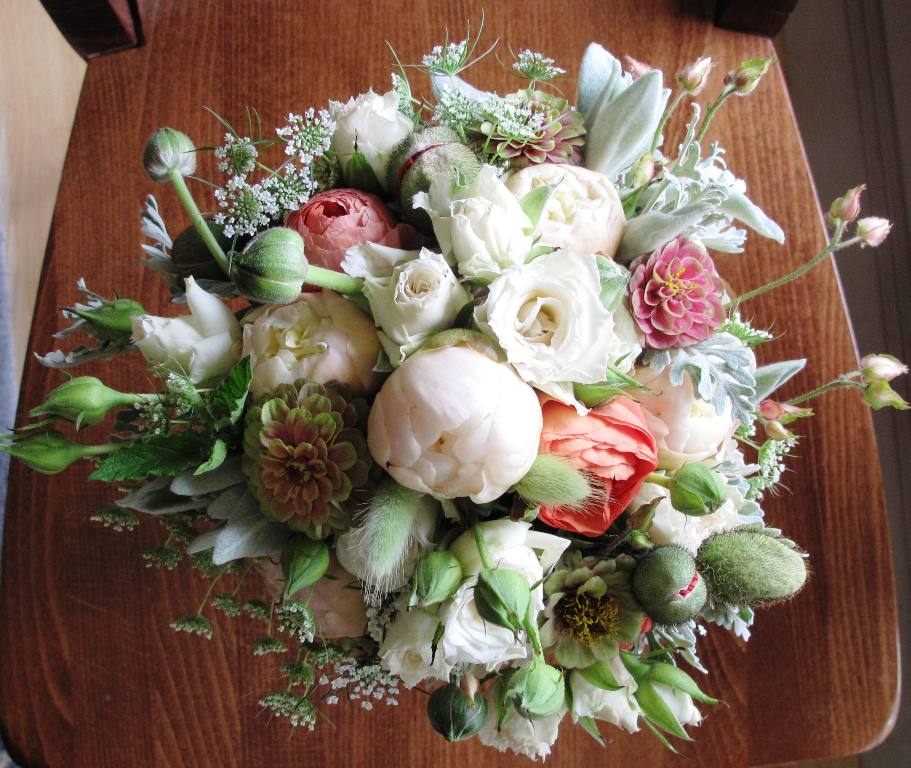
Tight flower heads, soft foliage that doesn’t bruise easily, and interesting textural elements – add up to a wedding bouquet for a friend far away.

A dear friend of mine is getting married today, in a state halfway across the country. None of her close friends are there to support her, mostly because she only recently moved away from Seattle to be close to her sweetheart. But at least she’s going to hold a bouquet of flowers I made Wednesday and sent via FedEx overnight delivery service. Her new husband will be wearing a sweet little boutonniere I sent along.

Here’s how to successfully make and send a long-distance gift of flowers:

1. Select durable flowers with fairly tight buds. I chose all Northwest-grown flowers in a cream-to-peach-to-coral palette:

  • Spray roses have tiny heads and are long-lasting. ‘Moonstruck’ is a creamy white variety grown by Peterkort Roses.
  • Peonies are super-durable, especially when you start at the “marshmallow” stage when just a small amount of color is showing at the top of the bud. The blush peonies I used are sublime, grown by Ojeda Farms.
  • Ranunculus are a more fragile than the spray roses or tighter peonies, but the petal colors are so delicious that I took a risk. I chose mostly-closed flower heads and tried to nestle them between other, sturdier flowers to sort of shelter them in the bouquet. These were grown by Vivian Larson of Everyday Flowers. She literally saved the last ranunculus stems of the season for me.
  • Poppies, especially in bud with those fuzzy green cases, are the epitome of springtime. The petals on these are more like a persimmon-orange color, which made them a little too dark for the bouquet palette. So I used only the tightest buds and lifted them up above the main bouquet. A sliver of the dark orange peeked out, but that only added to its charm. These were grown by Jello Mold Farm.

    READ MORE…

SLOW FLOWERS: Week 20

Sunday, May 19th, 2013

A Softer Side of Green

Pastel bouquet

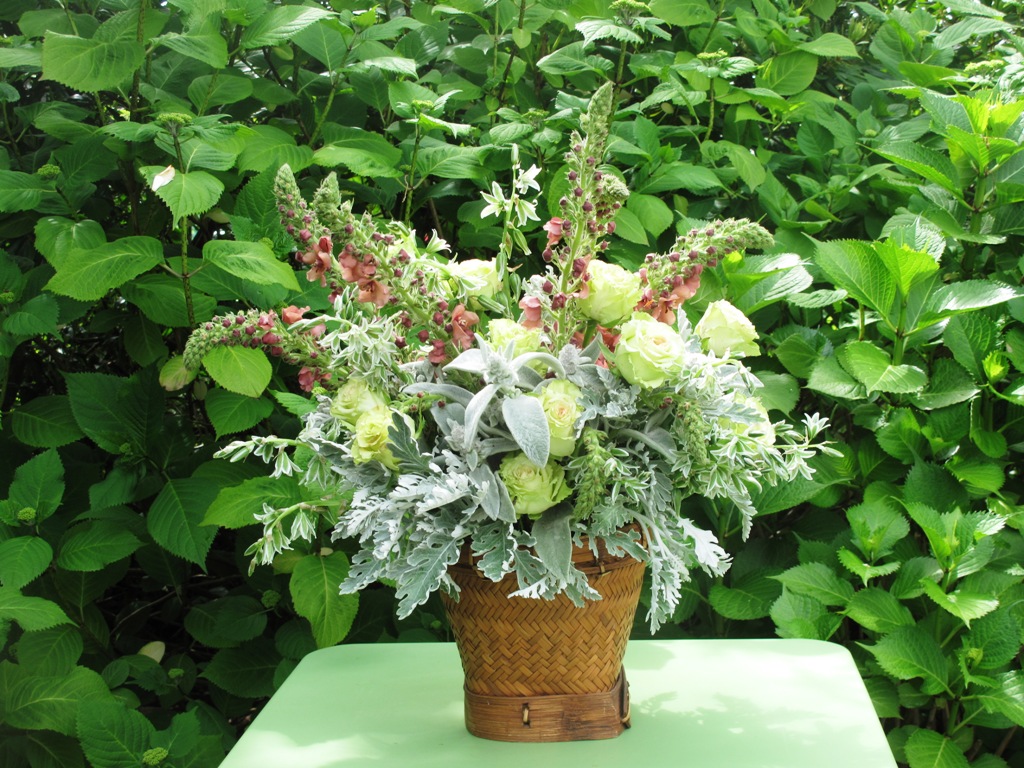
An unexpected combination, inspired by the pale ‘Supergreen’ hybrid tea roses given to me by the grower


Pastel flowers in detail

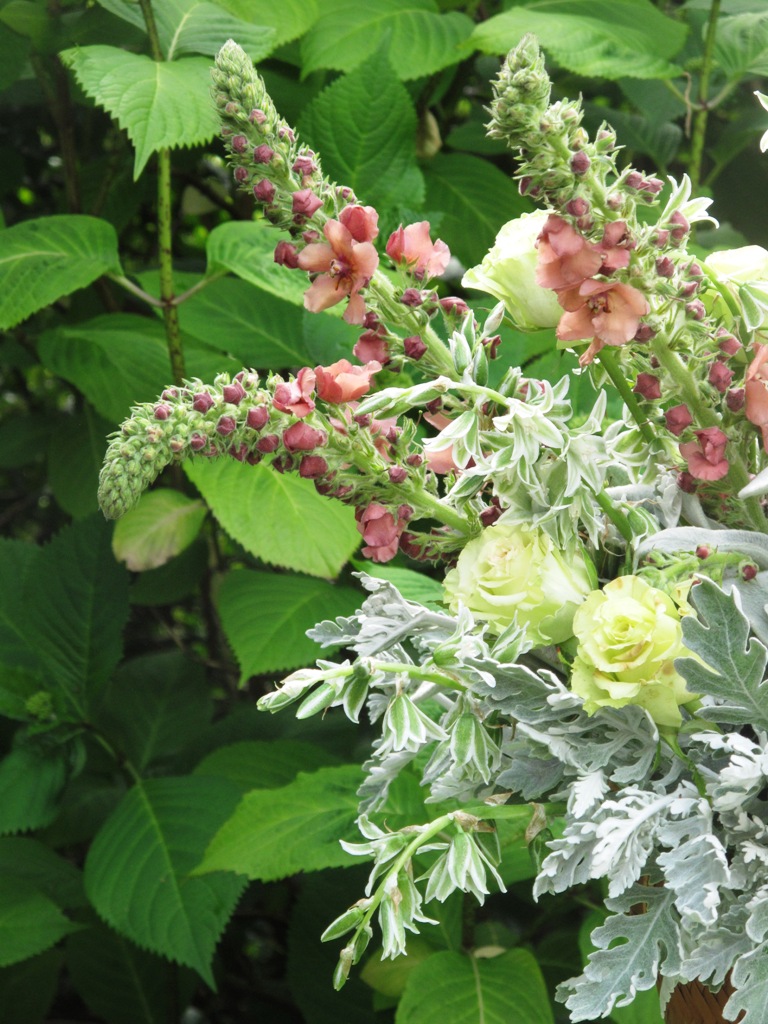
This sweet detail shows the delicate features of the apricot verbascum and the varietgated Star of Bethlehem

Ingredients:

15 stems Dusty Miller foliage (Centaurea cineraria), grown by Charles Little & Co.
5 stems lamb’s ears (Stachys byzantina), grown by Charles Little & Co.
15 stems ‘Supergreen’ hybrid tea roses, grown by Peterkort Roses
9 stems Star of Bethlehem (Ornithogalum nutans), grown by Choice Bulb Farms
6 stems Verbascum ‘Caribbean Crush’, grown by Jello Mold Farm
Vase:
7½-inch tall x 7-inch diameter woven basket with a 6-inch tall x 6½ inch wide glass insert
Eco-technique
Vase in an instant: Any container can double as a flower vase as long as you can hide a watertight vessel inside of it. This simple, budget-conscious technique instantly expands your design choices. I frequently pick up glass vases for 50-cents to a few dollars at the thrift store, which means I always have extras on hand to tuck inside boxes, baskets, tins – and even leaky watering cans .


SLOW FLOWERS: Week 19

Sunday, May 12th, 2013

FIRST PEONIES OF THE SEASON

Peonies from Ojeda Farms

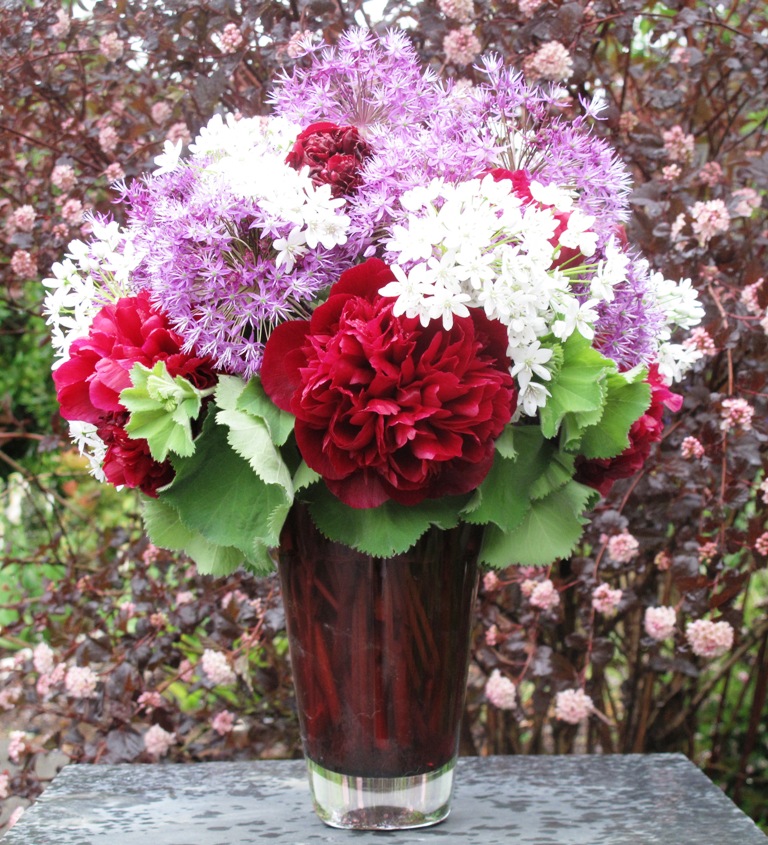
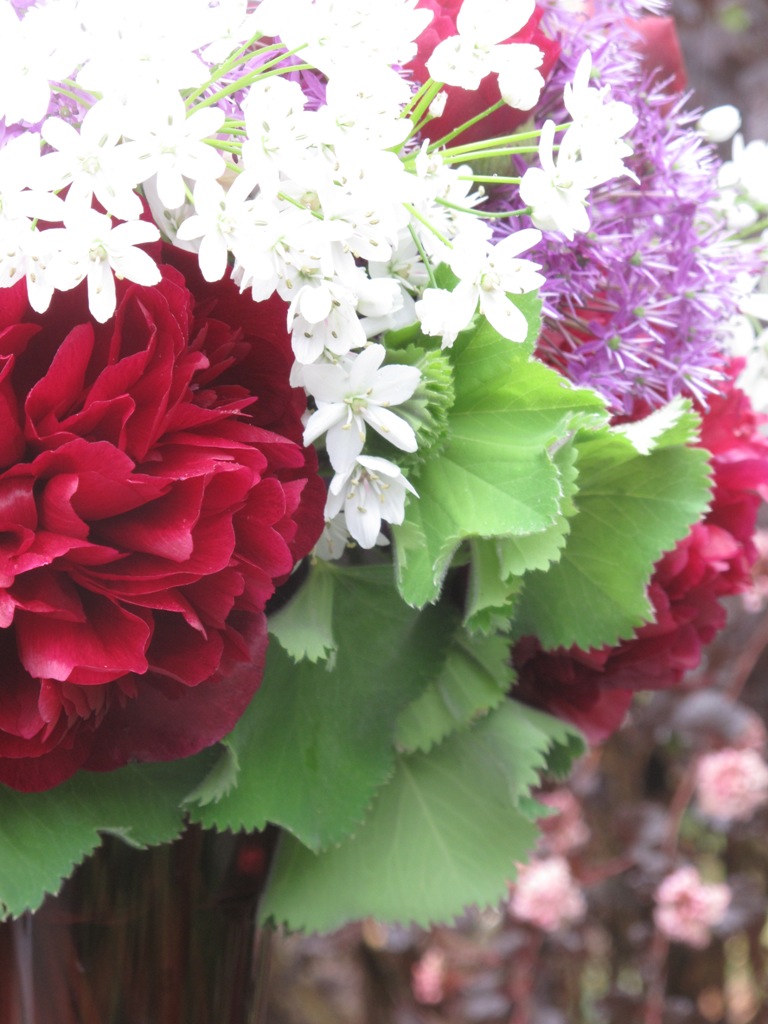
These luscious red peonies from a local grower reflect the garnet-colored art glass and complement two forms of ornamental allium.

Foliage detail

The lady’s mantle foliage is absolutely the BEST for spring bouquets. And if your garden is like mine, it’s super abundant right now!

Ingredients:
10 stems red peonies, grown by Ojeda Farms
7 stems each ‘Purple Sensation’ and ‘Cowanii’ ornamental alliums, grown by Choice Bulb Farms
12 stems lady’s mantle foliage (Alchemilla mollis), harvested from my garden

Vase:
9-inch tall x 5-inch diameter hand-blown glass vase

Design 101
Create a collar: You can use flowers or foliage to ring the base of a bouquet or arrangement as a finishing detail. This technique is usually done as the bouquet’s last step. For this arrangement, I pre-cut the greenery and then added it beneath the peonies, slightly overlapping each stem as I worked around the circumference of the bouquet. Here, the lady’s mantle visually separates the dark red peonies from the wine-red vase.


SLOW FLOWERS: Week 18

Sunday, May 5th, 2013

Still Life With Flowers

Shadow box

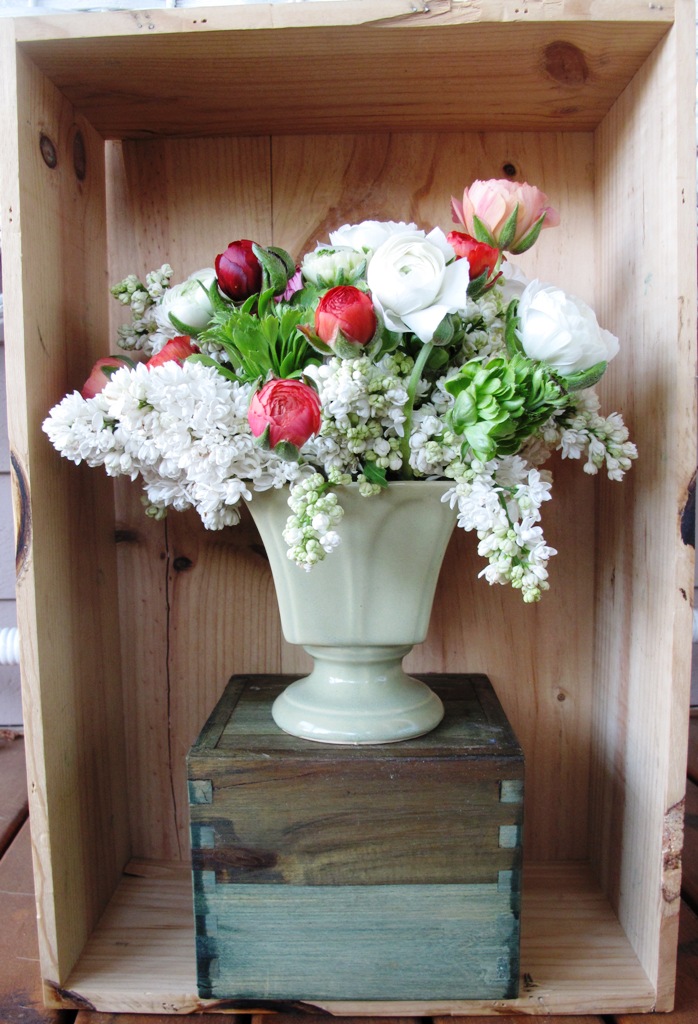
A wine crate serves as a shadowbox for this sweet spring bouquet of white lilacs and ranunculus in a bright pastel palette.

Ranunculus detail

Grower Vivian Larson’s delectable spring ranunculus are in big demand by floral designers.

Ingredients:

10 stems lilac (Syringa vulgaris), grown by Oregon Coastal Flowers

12 stems Ranunculus asiaticus, including ‘La Belle’ and ‘Super Green’ varieties, grown by Everyday Flowers

Vase:

5-inch tall x 5-inch wide x 3-inch deep vase (overall height is 5½ inches)

From the Farmer

Extending the vase life: For decades, it’s been the conventional wisdom of florists that woody shrubs, such as lilacs and hydrangeas, benefit from a second cut, a vertical slice up the center of the stem, to increase the surface area that can absorb water. But according to professors Lane Greer and John M. Dole, authors of Woody Cut Stems for Growers and Florists, a research-based reference, the practice “has never been proven to extend vase life.” The best thing you can do is to use clean, sharp pruners and refresh the vase water every day or so.


SLOW FLOWERS: Week 17

Sunday, April 28th, 2013

Jewel Tones

Jewel tones in a blue vase

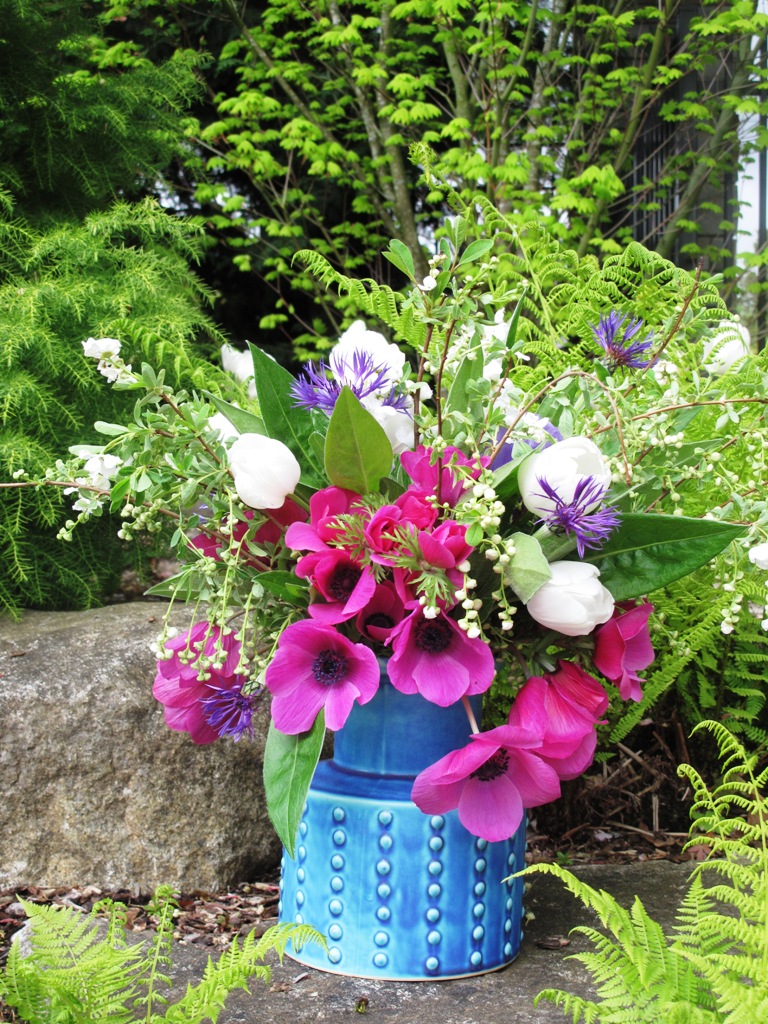
This indigo-blue vase is a favorite of mine. Love it with fucshia anemones, bachelor’s buttons and white tulips.

Ingredients:

12 stems fuchsia anemones (Anemone coronaria ‘Galilee Pink), grown by Everyday Flowers

8 stems pearl bush (Exochorda x macrantha), grown by J. Foss Garden Flowers

6 stems bachelor’s buttons (Centaurea cyanus), harvested from my garden

7 stems white tulips, grown by Alm Hill Gardens

Vase:

8-inch tall x 6-inch diameter round vase with 5-inch opening

Stunning detail

Stunning detail shows those velvety black button-like centers of the anemones.

Design 101

Color wheel lesson: The flowers and vase combination illustrate an analogous color palette. Analogous colors are adjacent to one another on the color wheel. Fuchsia, purple and indigo are pleasing when viewed together because they each share varying quantities of the primary color blue. White floral accents offset the black centers of the anemones, adding a graphic punch to this composition.

SLOW FLOWERS: Week 15

Sunday, April 14th, 2013

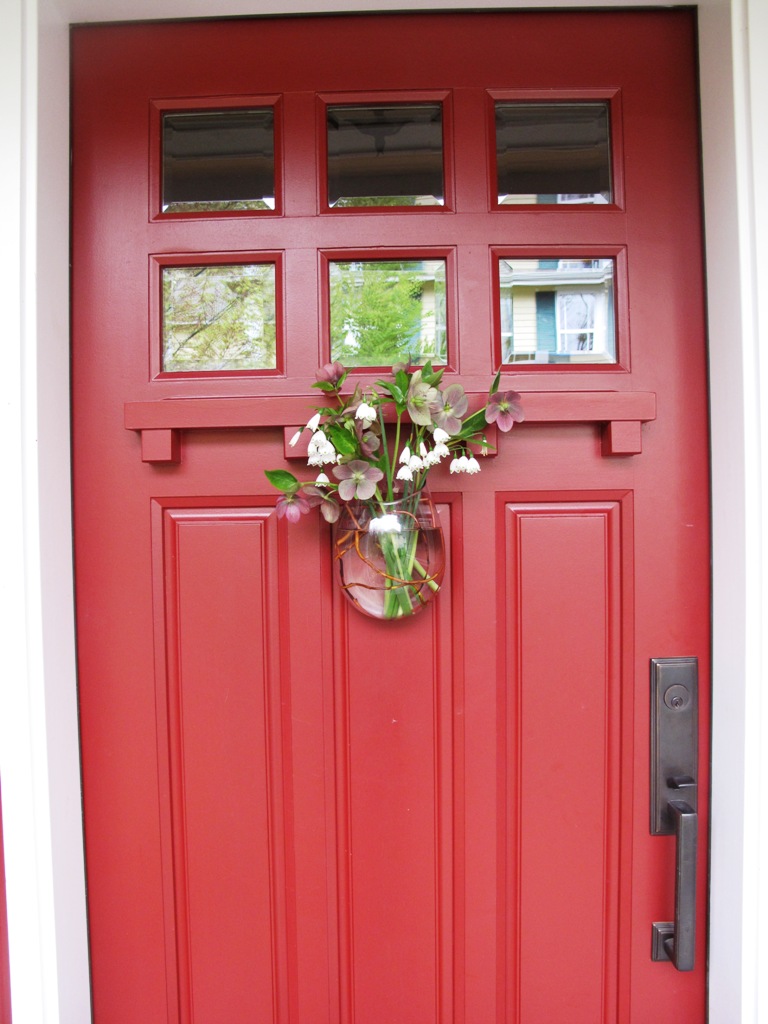
A Floral Welcome

A Floral Welcome

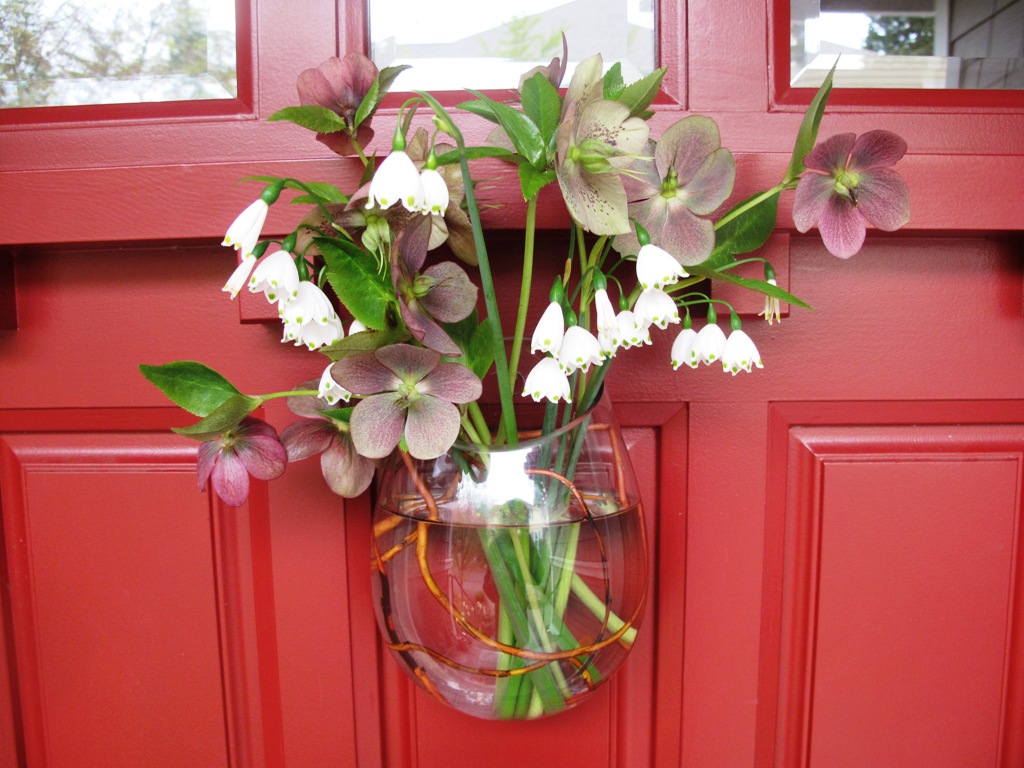
This wonderful pocket vase adorns my front door, containing curly willow, garden hellebores and pretty white summer snowflakes.

Front door bouquet

A fresh and inspiring way to adorn your front door: a floral vase filled with spring blooms!

Ingredients:

10 stems garden hellebores (Helleborus orientalis), grown by Jello Mold Farm

12 stems summer snowflake (Leucojum aestivum), harvested from my garden

1 stem curly willow (Salix matsudana ‘Tortuosa’), harvested by Oregon Coastal Flowers

Vase:

9-inch tall x 6-inch wide, teardrop-shaped wall vase (4-inch diameter opening)

Design 101

Just add white: There are some floral designers who abide by the “rule of white,” which calls for adding white flowers to every design. Take a look at this arrangement and you’ll notice that a few white blooms go a long way. The bell-shaped snowflakes are smaller than the plum-colored hellebores, but they add a lot of cheer to the design. Especially when viewed from a distance, white flowers are impactful, making any arrangement young and fresh-looking.