The Slow Flowers Podcast is the award-winning show known as the “Voice of the Slow Flowers Movement.” Launched in 2013 as the original flower podcast, we’ve devoted more than 10 years to covering the business of flower farming, floral design, and the Slow Flowers sustainability ethos. Listen to a new episode each Wednesday, available for free download here at slowflowerspodcast.com or on iTunes, Spotify, and other podcast platforms.
Karen Marshall and Tina Barkley of Fleurs de Villes
In Seattle, we have a rite of springtime called the Northwest Flower & Garden Festival, which always takes place in February when everyone craves the fragrance of flowers (not to mention the scent of potting soil), and the unfurling of foliage, fronds and petals as seen in the excellent garden displays that cover the floor of the Washington State Convention Center.
I’ve been involved in one way or another with this amazing experience for more than two decades. In fact, in 1989 when it was launched by founder Duane Kelly, I covered the story for the local business newspaper where I was a staff reporter. I recall then thinking that I so wanted to join Duane’s world. For years, I covered the Flower and Garden show as a journalist and editor; then, when I made the leap to home and garden writing, I actually spoke at the show in 2002, beginning a recurring gig every year since.
In the past few years, though, instead of speaking, I’ve produced and hosted the Flower Stage at the NWFGF. This role has allowed me to invite Slow Flowers members to participate and engage flower show audiences in the conversation about floral design, local and seasonal botanicals, and more.
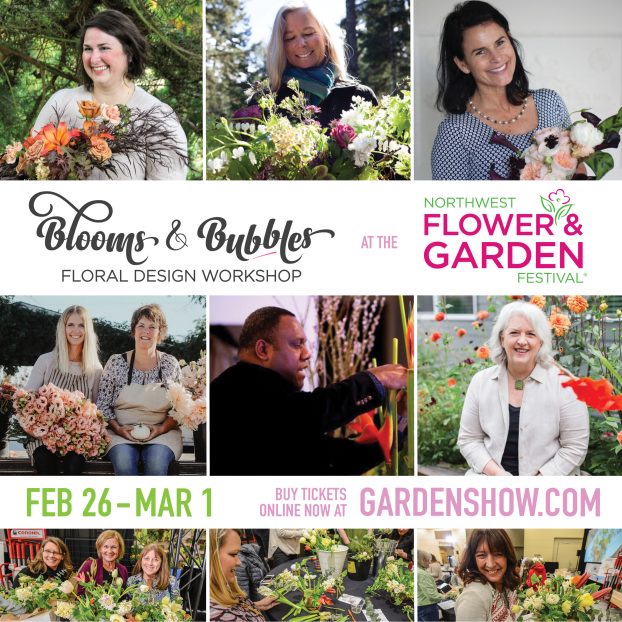
Blooms & Bubbles instructors will appear at the Northwest Flowr & Garden Festival’s DIY Floral Stage
This year, we’re again producing Blooms & Bubbles, a daily DIY workshop series with American-grown and locally-grown “blooms” and a glass of champagne aka “bubbles.” Five Slow Flowers members are teaching and I want to give them a shout-out right now so you can follow along on social as we post workshop images of their classes and students.
They include Thomasi Boselawa, CFD, Tiare Floral DesignStudio; Erin Shackelford, Camas Designs; Maura Whalen, Casablanca Floral; Carolyn Kulb, Folk Art Flowers; and Teresa Engbretson and Katie Elliott of My Garden Overfloweth. Tickets are going fast but you might be able to snag a seat to join us! And PS, even if you aren’t able to sign up for the DIY workshop each day at 2 p.m., there is public seating and you’re invited to watch along! The dates: February 26-March 1.
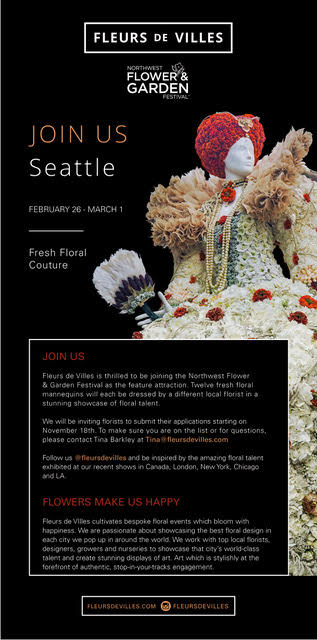
Because I’ve been able to work closely with the management at Marketplace Events, the current owners of the Northwest Flower & Garden Festival, I learned last fall that FLOWERS were taking center stage at the 2020 show. Operations manager Courtney Goetz and I met for lunch and she pulled out a few images to share the secret with me. It’s no secret anymore — and today’s guests will tell you all about the phenomenom called Fleurs de Villes. That’s Fleurs with an “S” and Villes with an “S” – as in “Flowers of the Cities.”
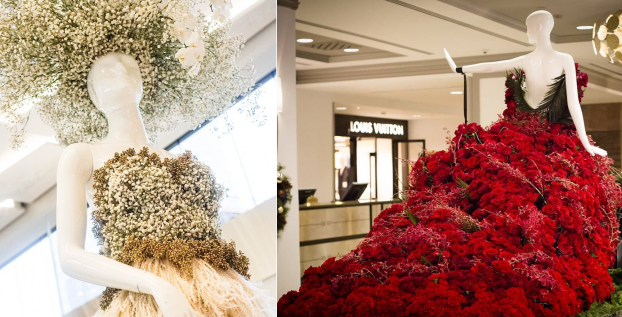
As soon as Courtney showed me photos of flower-clad female mannequins, I knew I had seen the images on my Instagram feed. I soon learned from Courtney that this woman-owned company was based just a few hours to the north of us – in Vancouver, B.C., and that the Northwest Flower & Garden Festival had invited Karen Marshall and Tina Barkley to bring Fleurs de Villes here to Seattle.
I’m so exited to bring you today’s
conversation with two event and marketing experts. Karen and Tina are elevating
flowers in a way that feels fresh, fashion-forward, and inventive.
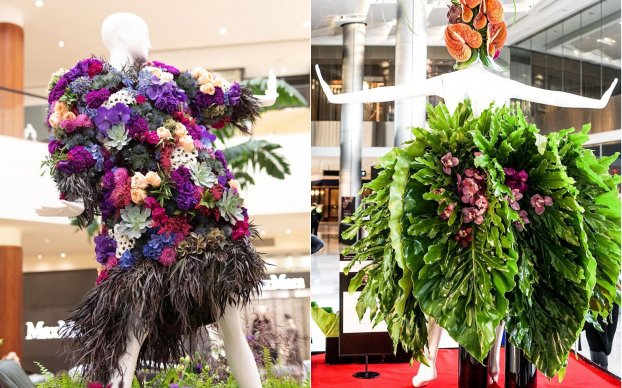
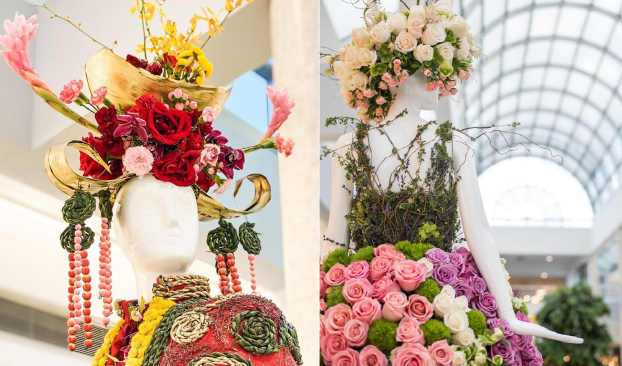
Much like the response people have when they see the photo shoots of real models wearing botanical couture for our American Flowers Week campaigns that Slow Flowers began commissioning in 2016, the botanical couture on Fleurs de Villes’ three-dimensional mannequins takes floral fashion to a new level. That level is different in one key way from what I’ve been doing with American Flowers Week. And it is a feat to pull off, I can tell you. That’s because Tina and Karen are gathering more than a dozen mannequins, each designed and created by an area florist, and each on display for the full run of the Northwest Flower & Garden Festival. I am in awe of the theatrical levels achieved by Fleurs de Villes.
I want to jump right into this
conversation, but first, a bit more about Fleurs de Villes and its founders:
FLEURS DE VILLES combines the love of flowers, local design talent, and bespoke, utterly unique displays, for experiential events like none other. The name speaks to that – Fleurs de Villes – flowers of the cities. Connecting with each city we launch in, we work with top local florists, designers, growers and nurseries, to showcase that city’s world-class talent and create stunning displays of art. Fleurs de Villes not only showcases artful flower displays, we create engagement – with audiences viewing our events, and with the partners who support us, from leading sponsor brands to local and national media, as well as community-based groups. We believe in the power of partnerships and the amplification of messaging that comes when audiences have an experience of the senses. Our team of highly professional individuals is dedicated to ensuring every touch-point is on brand to deliver an event experience people will be talking about – and sharing – for a long time to come.
Floral mannequins from past Fleurs de Villes events
TINA BARKLEY is one of Vancouver’s best known lifestyle experts regularly working with Chatelaine Magazine, Today’s Parent and appearing on TV cooking, styling, decorating. Tina has also been a serial entrepreneur for over 25 years, researching, structuring and building businesses. Creating a brand and building a solid product, strategic partnerships, operational structure, marketing and sales are all areas Tina thrives in. As an effective event builder and planner, Tina has a ‘knack’ for making it happen, and empowering everyone around her.
KAREN MARSHALL has a long term international career in publishing and the digital space. She is a strategic thinker with a laser focus on partnership cultivation. With a belief that no brand is an island she has put together countless programs bringing key organizations and media together to create outstanding promotions. Working for some of the largest media brands in the world and in Canada and within the luxury space with numerous consumer brands across a broad spectrum, her focus is on quality engagement and experiential offerings for all partners.
Thanks so much for joining me today. Find and follow Fleurs de Villes at these links below:
You can find details about the Seattle Fleurs de Villes display — February 26-March 1st at the Northwest Flower & Garden Festival
Future schedule to see Fleurs de Villes around North America and beyond.
As promised, here are the local florists and designers participating as Fleurs de Villes artists. Each will create a floral garment to adorn the lifesize mannequin. It’s no surprise, but a number of them are Slow Flowers members!
First of all, I am thrilled that Melissa Feveyear of Terra Bella Flowers & Mercantile is designing the Slow Flowers-sponsored mannequin featuring all local and domestic botanicals. We are so grateful for Melissa’s longtime membership and support and I can’t wait to see what she creates!
Of course, as anyone who is committed to sourcing domestic and local flowers in the Pacific Northwest in February, which faces a dormant growing season that many of you also experience, I want to just acknowledge what a feat it will be to bring a Slow Flowers sentiment and values to an undertaking like a botanical garment made entirely from fresh and natural materials. I’ve heard anecdotally from several Slow Flowers members as they’ve planned their creations and I know they are committed to sourcing a good percentage of their looks with domestic crops. Let’s cheer them on and see what they create. Including Melissa of Terra Bella, nine Slow Flowers members are participating as Fleurs de Villes designers — more than half of all the dresses you’ll see! They include:
Other Fleurs de Villes florists include: a Natural Design; Fena Flowers; Seattle Floral Design; Zupan’s Markets; Leah Erickson; Ondine; and you’ll see supporting floral installations by Apotheca Design and Soren Events.
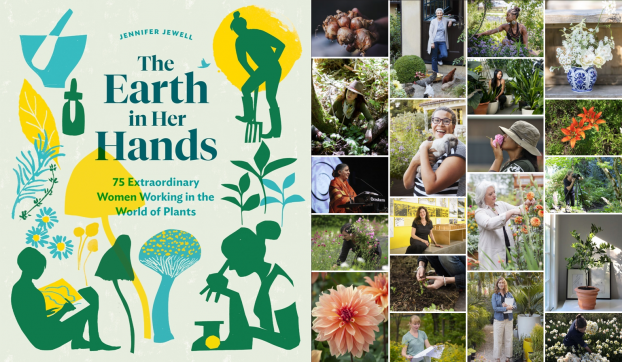
Jennifer Jewell is the author of The Earth in Her Hands, which includes a profile of Lorene Edwards Forkner, Christin Geall and Debra Prinzing, among many others.
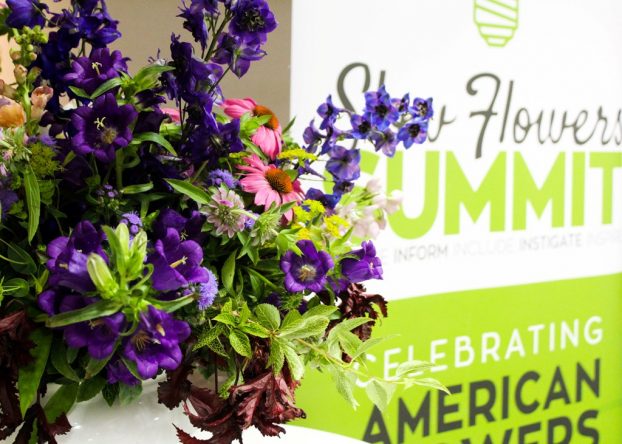
Jumping ahead to future events . . . the clock is ticking along as we continue to finalize details for the 4th Annual Slow Flowers Summit – June 26-28, 2020 in San Francisco Bay Area at Filoli.
We only have 50 seats
left so I urge you to follow the links in today’s show notes and reserve your
space with the Slow Flowers tribe! Your Ticket Includes: All-Day Sunday, June 28 + Monday, June
29 with 5 Presentations + 7 Fabulous Speakers, all meals,
refreshments and evening cocktail receptions;
Floral Design Demonstrations; an Interactive Floral Installation; Author Book-Signings; Cool Take-Home Gifts . . . and then, on Tuesday Morning, June 30th, a behind the scenes tour at Farmgirl Flowers HQ where you’ll enjoy a Light Breakfast + Coffee, and meet our good friend Christina Stembel of Farmgirl Flowers.
I can’t wait to see you
there!
(c) Mary Grace Long photography
The Slow Flowers Podcast
has been downloaded more than 578,000 times by listeners
like you. Thank you for listening, commenting and sharing – it means so much.
As our movement gains more supporters and more passionate participants who believe in the importance of the American cut flower industry, the momentum is contagious. I know you feel it, too. I value your support and invite you to show your thanks and with a donation to support my ongoing advocacy, education and outreach activities. You can find the donate button in the column to the right.
Thank you to our Sponsors
Florists’ Review magazine. I’m delighted to serve as Contributing Editor for Slow Flowers Journal, found in the pages of Florists’ Review. Our partnership with Florists’ Review is such a valuable one, providing a forum for beautiful and inspiring editorial content in the #slowflowersjournal section – month after month. Take advantage of the special subscription offer for members of the Slow Flowers Community.
Mayesh Wholesale Florist. Family-owned since 1978, Mayesh is the premier wedding and event supplier in the U.S. and we’re thrilled to partner with Mayesh to promote local and domestic flowers, which they source from farms large and small around the U.S. Learn more at mayesh.com.
FarmersWeb. FarmersWeb software makes it simple for flower farms to streamline working with their buyers. By lessening the administrative load and increasing efficiency, FarmersWeb helps your farm save time, reduce errors, and work with more buyers overall. Learn more at www.farmersweb.com.
Our next sponsor thanks goes to Association of Specialty Cut Flower Growers. Formed in 1988, ASCFG was created to educate, unite, and support commercial cut flower growers. It mission is to help growers produce high-quality floral material, and to foster and promote the local availability of that product. Learn more at ascfg.org.
The content and opinions expressed here are either mine alone or those of my guests alone, independent of any podcast sponsor or other person, company or organization.
The Slow Flowers Podcast is engineered and edited by Andrew Brenlan. Learn more about his work at soundbodymovement.com
Music Credits:
Le Marais; Symphony 40 in G Minor; Via Verre; Gaena; Glass Beads by Blue Dot Sessions http://www.sessions.blue
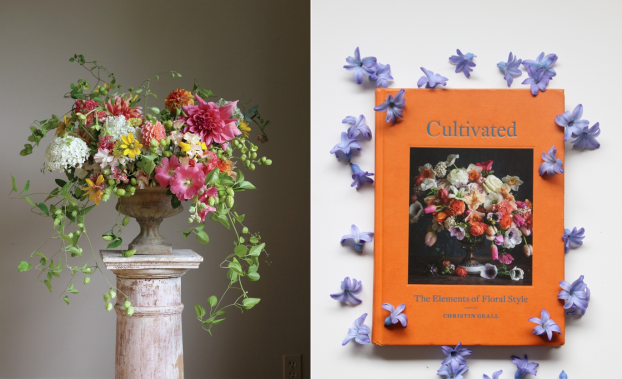
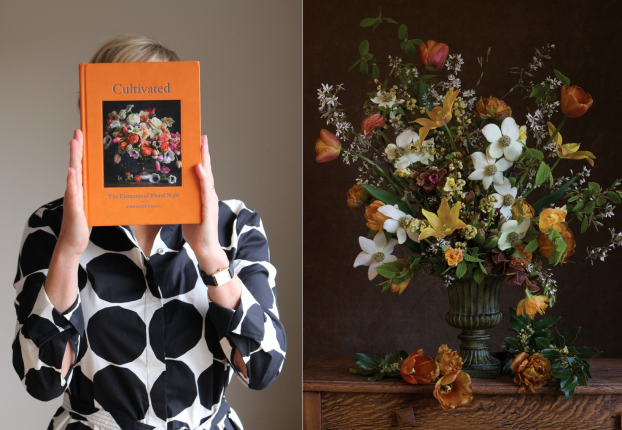
The author shows off her new book (left) and a Baroque-styled arrangement from Cultivated
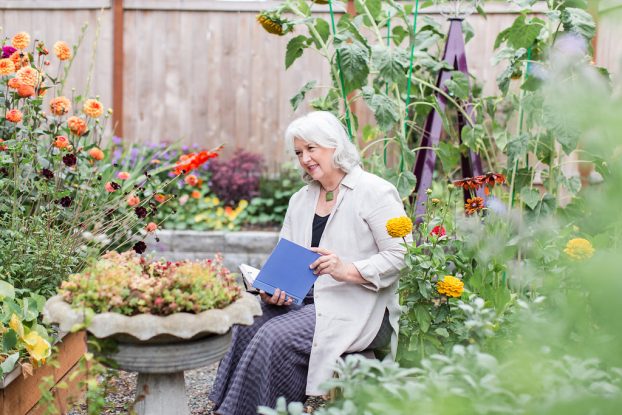
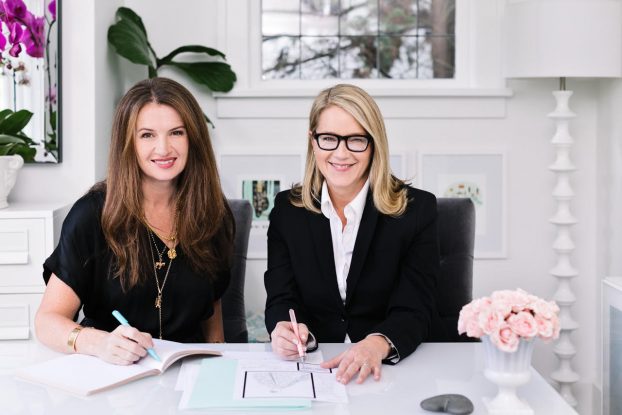
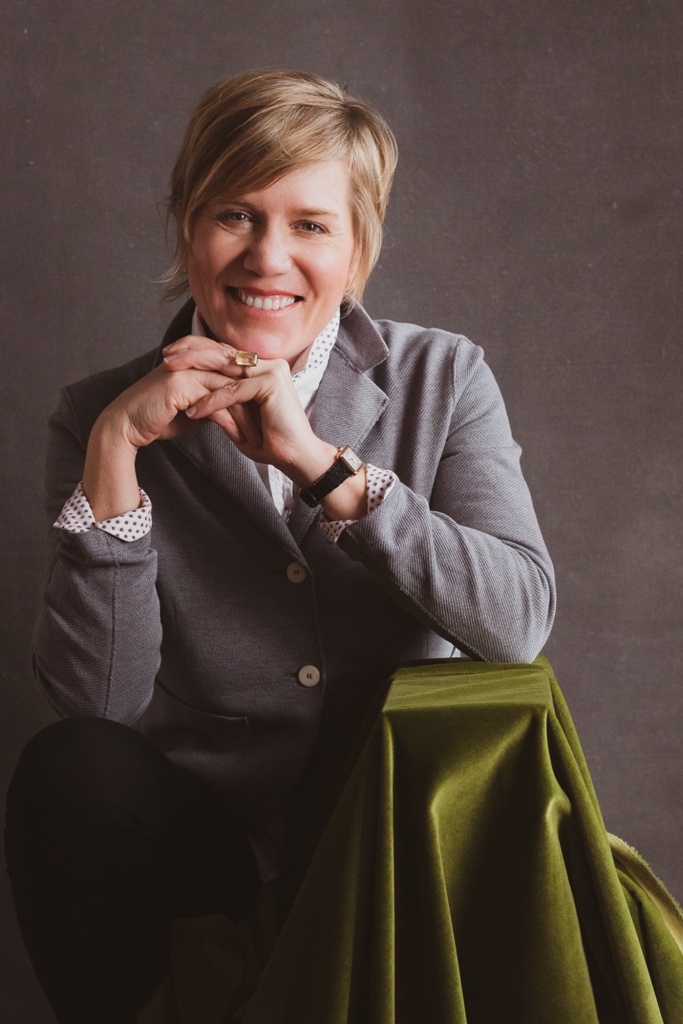
On Vancouver Island, along the western edge of Canada, gardener, designer, writer and teacher Christin Geall grows flowers and shares her designs through Cultivated by Christin, a creative studio launched in 2015.
Christin’s eclectic background includes pursuits that are equal parts physical and intellectual. She apprenticed on a Martha’s Vineyard herb farm, interned at the Royal Botanic Gardens, Kew, and homesteaded on a remote island in British Columbia. Academic studies in ethnobotany, environmental science and a creative writing MFA led to editorships, university-level teaching and a regular gardening column for local newspapers.
Today, Christin’s artistic focus centers around her urban flower farm-design studio in USDA Zone 8, the tiny hub of a multifaceted floral business.
A few years ago, I interviewed Christin for an August 2018 Florists’ Review profile, which we titled “Creative Fulfillment — Growing a floral-centric life on your own terms.” I loved that chance to speak with Christin about her art, writing, floristry and teaching.
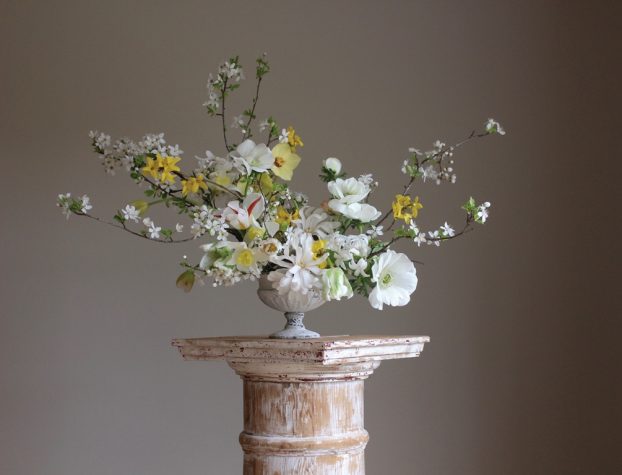
An arrangement to illustrate the concept of “torque.”
Many of you may already be following @CultivatedbyChristin on Instagram, where she posts luscious, seasonal arrangements that originate in her Vancouver Island garden, located just 10 minutes from downtown Victoria, the provincial capital. There, Christin maintains six 32-foot-long beds where she rotates flowers using West coast-style succession planting. As well, there are perennial borders, and a wild meadow in the front, which means pretty much all of the grass is gone, she says. Meals and workshops take place beneath a 32-foot-long arbor and there is a very useful greenhouse. “It leads to a wild style, but I’m truly trying to maximize production on a small piece of land,” Christin told me.
Gesture, line, mass – all expressed in Christin’s arrangement (left).
Teaching writing concides with Christin’s writing of essays and garden columns. Growing unique and uncommon flowers supports floral design and the photography of those arrangements. And naturally, teaching floral workshops brings it all together for this gifted creative. And it only makes sense that all of these passions found their way into a book called Cultivated: The Elements of Floral Style, to be published this spring by Princeton Architectural Press.
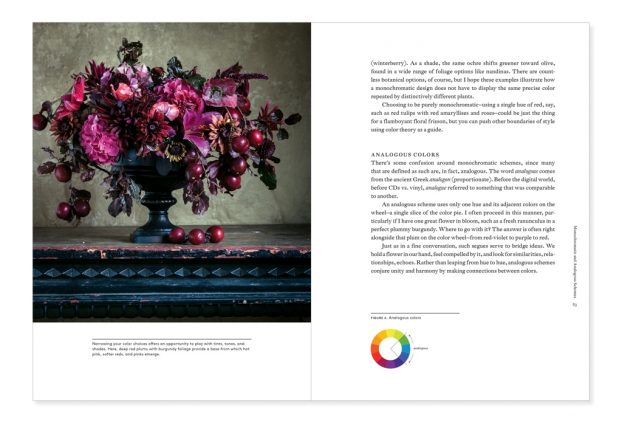
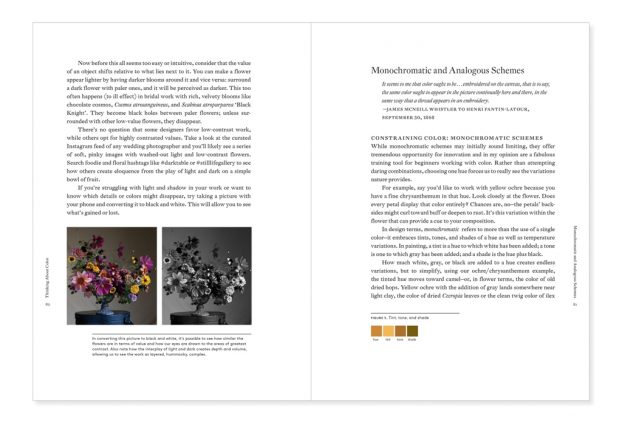
A peek inside Cultivated . . . this from the study of tints, tones and shades.
Cultivated elevates floral design to
fine art in this richly informative work on the principles of floral style.
Christin emboldens designers, gardeners, and floral entrepreneurs to think
differently and deeply about their work with flowers as she draws upon the fine
arts and historical sources – whether exploring Baroque music, the paintings of
the Impressionists, or the work of floral innovators like Gertrude Jekyll and
Constance Spry.
Seeing color
Thanks so much for joining me today. What an inspiring conversation. If you’re interested in meeting and hearing Christin speak in person, you can find her upcoming book tour schedule here.
Registration continues for Slow Flowers Summit and if you’re listening on our release date of this episode, February 12th, you can find details about our Galentine’s/Palentine’s/Valentine’s flash-sale. I can’t wait to see you at the Slow Flowers Summit June 28-30, 2020, at Filoli in San Francisco!
(c) Mary Grace Long photography
The Slow Flowers Podcast
has been downloaded more than 575,000 times by listeners
like you. Thank you for listening, commenting and sharing – it means so much.
As our movement gains more supporters and more passionate participants
who believe in the importance of the American cut flower industry, the momentum
is contagious. I know you feel it, too. I value your support and invite you to
show your thanks and with a donation to support my ongoing advocacy, education
and outreach activities. You can find the donate button in the column to the right.
Thank you to our Sponsors
Florists’ Review magazine. I’m delighted to serve as Contributing Editor for Slow Flowers Journal, found in the pages of Florists’ Review. Our partnership with Florists’ Review is such a valuable one, providing a forum for beautiful and inspiring editorial content in the #slowflowersjournal section – month after month. Take advantage of the special subscription offer for members of the Slow Flowers Community.
Johnny’s Selected Seeds, an employee-owned company that provides our industry the best flower, herb and vegetable seeds — supplied to farms large and small and even backyard cutting gardens like mine. Find the full catalog of flower seeds and bulbs at johnnysseeds.com.
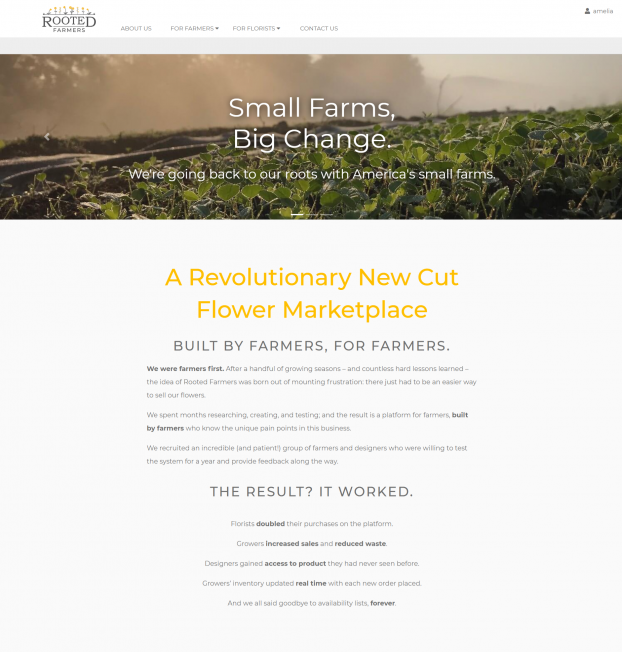
Rooted Farmers. Rooted Farmers works exclusively with local growers to put the highest-quality specialty cut flowers in floral customers’ hands. When you partner with Rooted Farmers, you are investing in your community, and you can expect a commitment to excellence in return. Learn more at RootedFarmers.com.
Syndicate Sales, an American manufacturer of vases and accessories for the professional florist. Look for the American Flag Icon to find Syndicate’s USA-made products and join the Syndicate Stars loyalty program at syndicatesales.com.
The content and opinions expressed here are either mine alone or those of my guests alone, independent of any podcast sponsor or other person, company or organization.
The Slow Flowers Podcast is engineered and edited by Andrew Brenlan. Learn more about his work at soundbodymovement.com
Fresh and beautiful – an all-Wisconsin-grown bouquet, with flowers and design from Sunborn Gardens
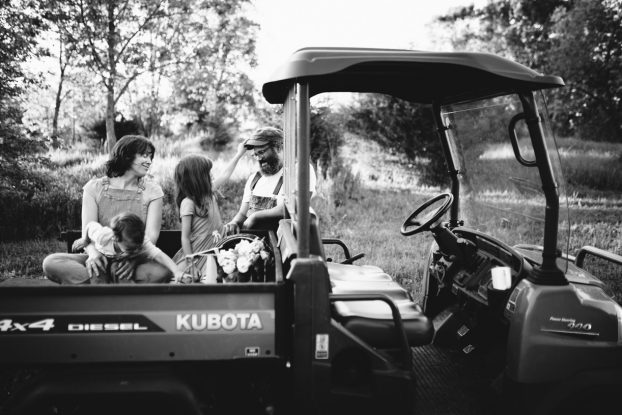
I’m so delighted today to welcome Hans Larsen and Lisa Larsen, partners in Sunborn Gardens, a Wisconsin flower farm and design studio with a long history in cut flower growing.
Hans Larsen and Lisa Larsen, partners in Sunborn Gardens, 2.0!
Tucked in a little valley near downtown Mount Horeb, Sunborn has been growing beautiful cut flowers for over 40 years. Owners Hans and Lisa Larsen run the flower farm and design studio, working closely together to create unique and artful floral. The farmer and florist relationship is what makes their floral designs one-of-a-kind, as they constantly trial new varieties and color palettes to showcase the best Wisconsin has to offer. All farming is done using organic practices in order to properly care for their family land. Sunborn’s modern designs are inspired by the garden, full of specialty blooms, heirloom varieties and rich with texture.
Inside one of the Sunborn Gardens’ high tunnels, with Farmer Hans.
Sunborn Gardens’ founder Carol Larsen is Hans’ mother. She originally began to sell at the Dane County Farmer’s Market in Madison, Wisconsin, 44 years ago. Her love affair with flowers began with a bucket of orange marigolds and she and Sunborn have grown cut flowers ever since. Many of you will recall that Carol is a pioneering cut flower farmer who co-founded Fair Field Flowers, a marketing cooperative of Wisconsin and Illinois specialty cut flower growers.
Hans and Lisa with two of their three young children.
Fair Field Flowers permanently closed as of January 1, 2019, but the roots of this legendary and innovative regional model remain deep in Madison, Milwaukee and other markets formely served by the cooperative. These are talented people who really made a mark on the Wisconsin floral scene and whose reach went far beyond their region through education, workshops and sharing their knowledge generously.
This is posted on the Fair Field Gardens FB Page: Fair Field Flowers has ceased operation as of 1/1/19. Should you wish to contact any of the former partners please check out the info below:
FAIR FIELD FLOWERS PO Box 2071 Madison WI 53701
Mary Jo Borchardt fivegreenacres@gmail.com Five Green Acres
Catherine Cooper katesfreshflowers@gmail.com Kate’s Fresh Flowers
Cheryl Burton and Gina Graham oldstonehousefarm.wisc@gmail.com Old Stone House Farm, LLC
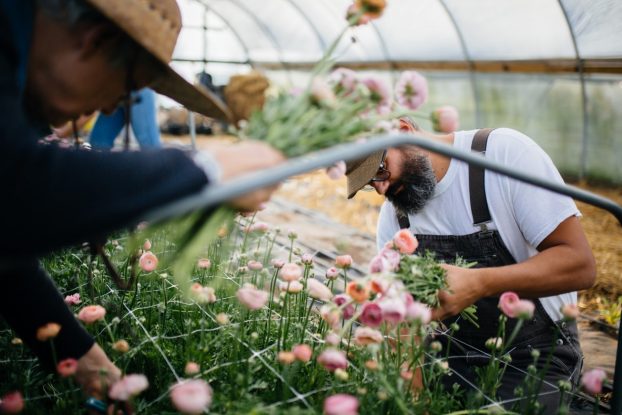
At harvest with Hans Larsen
Here’s more about Flower Farmer Hans Larsen:
“When the opportunity to take over the family farm business came up I had just had my first child. It was in that moment that I knew I had to do it. I wanted my daughter to live the magical, nature-filled life I had as a kid. I wanted her to play in those woods and talk to the flowers. This is by far the hardest thing I have ever done. Learning greenhouse production, bookkeeping, seed starting and more is no walk in the park. I keep showing up for the flowers. The entrepreneurship journey is a interesting one, full of ups and downs, but unlike the jobs I had before, this gig feeds the soul. Working so closely with my designer wife, we are cultivating something really special.”
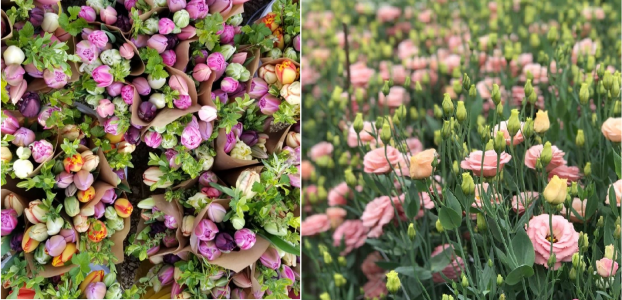
Spring market bouquets (left) and summer lisianthus harvest (right)
And a bit from
farmer-florist Lisa Larsen:
I married into this wonderful flower family of mine. When Hans first had the idea to take over his Mother’s flower farm I was skeptical. I was about to move my entire life to a new city and become a farmer? I eventually found myself helping out in the design studio and it was there I found my calling. I had studied fine arts in college and was set on becoming a teacher, but through long days at the workbench creating art by using flowers as my medium, I was hooked. All the elements and principles of design I once studied were being applied on a daily basis and I wanted more more more! I apprenticed with my mother-in-law for a few years learning all I could. I now run the design studio with a small, very talented staff to produce weddings almost every weekend. I am constantly inspired by what is growing all around me. There really is nothing better than a fresh cut local stem.
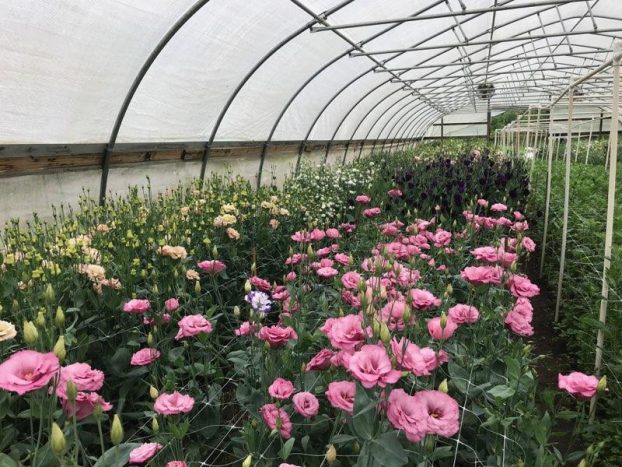
Lisianthus season at Sunborn Gardens.
I can’t wait for you to hear the next chapter of Sunborn Gardens and be inspired by the changes that Lisa and Hans have brought, changes that work with their lifestyle of living off farm and juggling farming and studio responsibilities while parenting three young children. As Lisa and Hans like to joke, it takes two of them to match the skills of Carol Larsen. They are all quite fortunate to have one another along this journey, with Carol continuing to share her “heirloom body of knowledge” (a phrase my friend Diane Szukovathy once coined) with the next generation.
Thanks so much for joining me today — what a wonderful visit with two passionate flower lovers. Sunborn Gardens is part of the upcoming Wisconsin Cut Flower Growers School, scheduled for next weekend, February 15-16, 2020, and presented by University of Wisconsin/Madison’s Center for Integrated Agricultural Systems. You can find more details here.
Love this image created by our friends at Johnny’s Selected Seeds
Well, we’ve made it through the first month of a new year and a new decade. If you missed the February Slow Flowers newsletter check it out here.
We’ve got lots of goodness going on and you won’t want to miss out on opportunities to get involved with campaigns, content and events that will benefit you and your brand. Among other things, the newsletter celebrates one of our top highlights for the New Year. January witnessed our largest burst of growth ever — with 23 new members joining and 61 renewing members last month. Welcome all!
Registration continues forSlow Flowers Summit and we’re more than 50% sold out!
Please join me on June 28-30th and connect with our fabulous speakers, enjoy the incredibly beautiful venue at Filoli Historic House & Garden, and experience the many features that will immerse you in the people, principles and practices of Slow Flowers.
Check out all the details by following the link in
today’s show notes or head to slowflowerssummit.com where you can register at
an incredibly affordable rate of $599 for 2-1/2 days inclusive of programming
and meals. Slow Flowers Members enjoy a discount at $549.
The Slow Flowers Podcast
has been downloaded more than 573,000 times by listeners
like you. Thank you for listening, commenting and sharing – it means so much.
As our movement gains more supporters and more passionate
participants who believe in the importance of the American cut flower industry,
the momentum is contagious. I know you feel it, too. I value your support and
invite you to show your thanks and with a donation to support my ongoing
advocacy, education and outreach activities. You can find the donate button in the column to the right.
Thank you to our sponsors
Florists’ Review magazine. I’m delighted to serve as Contributing Editor for Slow Flowers Journal, found in the pages of Florists’ Review. Our partnership with Florists’ Review is such a valuable one, providing a forum for beautiful and inspiring editorial content in the #slowflowersjournal section – month after month. Take advantage of the special subscription offer for members of the Slow Flowers Community.
FarmersWeb software makes it simple for flower farms to streamline working with their buyers. By lessening the administrative load and increasing efficiency, FarmersWeb helps your farm save time, reduce errors, and work with more buyers overall. Learn more at www.farmersweb.com.
Association of Specialty Cut Flower Growers. Formed in 1988, ASCFG was created to educate, unite, and support commercial cut flower growers. It mission is to help growers produce high-quality floral material, and to foster and promote the local availability of that product. Learn more at ascfg.org. Thanks to ASCFG for returning as a Slow Flowers Sponsor for 2020. We’re launching a fun podcast series this year, in which I will catch up with all of the regional directors across North America — so listen for news about what’s happening in your area.
Longfield Gardens, which provides home gardeners with high quality flower bulbs and perennials. Their online store offers plants for every region and every season, from tulips and daffodils to dahlias, caladiums and amaryllis. Check out the full catalog at Longfield Gardens at longfield-gardens.com.
The content and opinions expressed here are either mine alone or those of my guests alone, independent of any podcast sponsor or other person, company or organization.
The Slow Flowers Podcast is engineered and edited by Andrew Brenlan. Learn more about his work at soundbodymovement.com.
Today we have a very cool segment with Amelia Ihlo and Althea Smith, partners in a brand new farmer-to-florist sales platform called Rooted Farmers.
You’ll be hearing much more about Rooted Farmers in the future because we’ve partnered for 2020 to bring this resource to the Slow Flowers Community. As you know, Slowflowers.com is an online directory to help connect U.S. and Canadian consumers with domestic flower sources AND to help farmers and florists find one another and do business with one another. However, as I frequently admit, I think like a journalist, not like a business person. I always had a desire for Slowflowers.com to include a sales mechanism, but the skills required to do that are way beyond me.
Amelia Ihlo, flower farmer and co-founder of Rooted Farmers
Then last fall, a Slow Flowers member named Amelia Ihlo of Reverie Flowers in Etna, N.H., reached out to tell me what she was doing. She wrote this:
“I am a Slow Flowers member based in New Hampshire and a huge supporter (and beneficiary!) of your work. I spent this past year testing a business model that works exclusively with local flower growers, and had a tremendous response from both our grower network and all of our floral buyers. My partner are at a point to begin discussions
with other folks within the industry, and as such, I am reaching out to see if
you might have some time to connect on the phone.”
It was the beginning of a
conversation that led to in-person meetings and eventually Rooted Farmers
joining Slow Flowers as a major sponsor for 2020 and Slow Flowers endorsing the
Rooted Farmers platform for flower farmers.
I alluded to the launch of Rooted Farmers in my 2020 Slow Flowers Floral Insights and Industry Forecast, in the section on “Agriculture-driven Design.” I wrote this: “The next chapter in this shift is being authored by designers who weave the agricultural narrative through their aesthetic and branding. From creative collaborations between flower farmers and floral designers to new apps and online resources that help florists learn who is growing what and when that’s available, the direction connections between the field and the studio are more important than ever.”
That paragraph was a direct
reference to Rooted Farmers and the exciting way Amelia and Althea are solving
problems and addressing pain points in the sales and buying process.
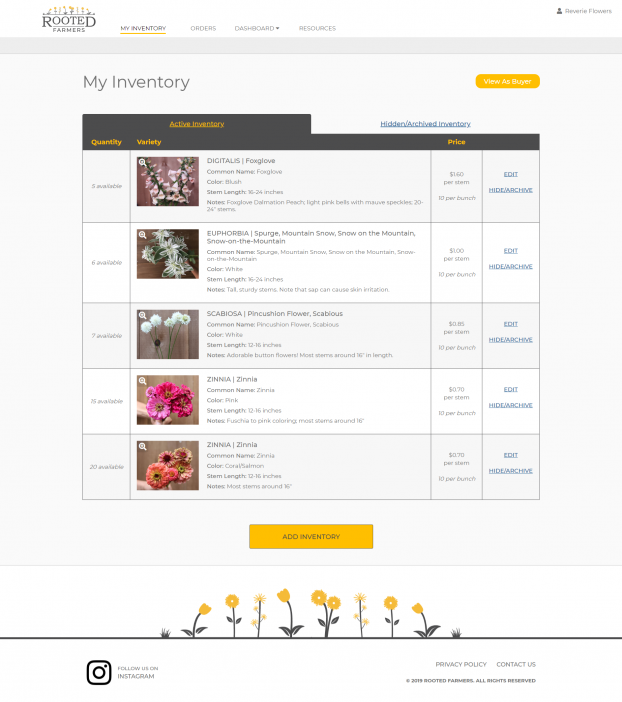
This is a screen capture of how you can present your INVENTORY to buyers
Having worked with developers on Slowflowers.com since 2013, basically using an off-the-shelf directory software designed for a “one-size-fits-all” marketplace, I have had multiple conversations with myself where I’ve thought, “if women were designing this product, it would be so much more intuitive.”
I’ve since considered that all young women should go into UX Design because our world would be a better place. It is so refreshing that Althea and Amelia are bringing a different sensibility to Rooted Farmers’ design. Yes, they have all the technical skills that are needed to create a highly-functional platform, but they bring with that a different intuition that I’m so grateful for. The lack of common-sense thinking I’ve run into in my own efforts to build a user-friendly platform, even though there isn’t an e-commerce component, have been frustrating, to say the least. Amelia IS the customer, which helps tremendously in translating to Althea what and how Rooted Farmers needs to work.
If you are a Slow Flowers member flower farmer, you are invited to join Rooted Farmers for a free, one-year registration to participate and market you flowers. Of course, there is an application procedure, which we’ve just discussed. Feel free to reach out to me or to Amelia with any questions!
If you are a Slow Flowers Florist, by all means, sign up and participate as a buyer. This is a farmer-to-florist platform, specifically designed to help you source domestic and seasonal flowers. It represents the best of modern technology and the values of the Slow Flowers Movement.
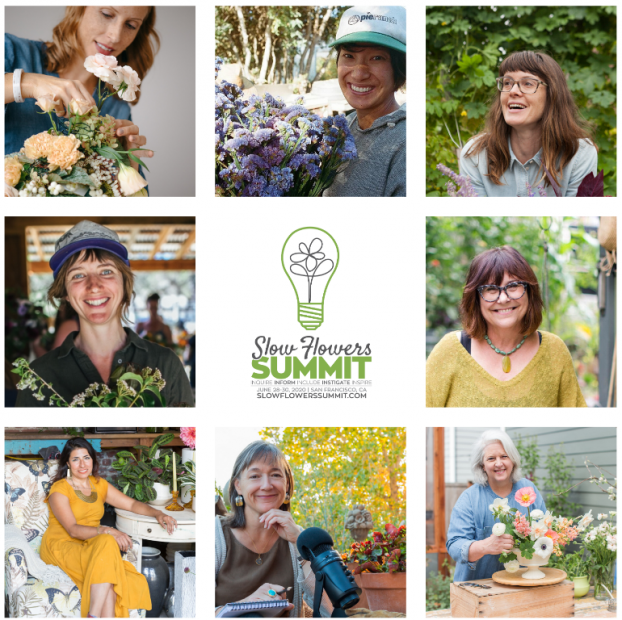
Clockwise from top, left: Susan Mcleary, Kellee Matsushita-Tseng, Molly Culver, Lorene Edwards Forkner, Debra Prinzing, Jennifer Jewell, Pilar Zuniga and Emily Saeger
Registration continues for Slow Flowers Summit and we’re more than 50% sold out, which is amazing to me! Please join me on June 28-30th and connect with our fabulous speakers, enjoy the incredibly beautiful venue at Filoli Historic House & Garden, and experience the many features that will immerse you in the people, principles and practices of Slow Flowers.
As I mentioned earlier in the episode, Amelia Ihlo and Althea Smith of Rooted Farmers are supporting the Summit as our Premier Sponsor. They will be in attendance at the Summit and they will be sharing a demonstration of their new platform – and more!
We also want to welcome Mayesh and say thank you for joining the 2020 Slow Flowers Summit as a Supporting Sponsor. It will be wonderful to partner with Mayesh to help connect attendees with more U.S.-grown flowers and expose flower lovers to the amazing resource of Mayesh, now at the San Francisco Flower Market through its Brannon Street branch. Thank you again.
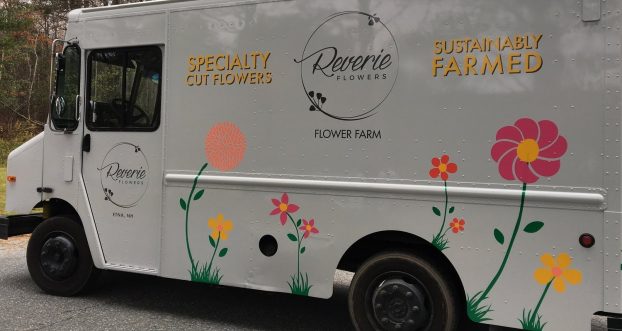
Reverie Flowers’ repurposed U.S. Postal Delivery Truck — where it all began!
The Slow Flowers Podcast
has been downloaded more than 570,000 times by listeners
like you. Thank you for listening, commenting and sharing – it means so much.
As our movement gains more supporters and more passionate
participants who believe in the importance of the American cut flower industry,
the momentum is contagious. I know you feel it, too. I value your support and
invite you to show your thanks and with a donation to support my ongoing
advocacy, education and outreach activities. You can find the donate button in the column to the right.
Thank you to our Sponsors!
Florists’ Review magazine. I’m delighted to serve as Contributing Editor for Slow Flowers Journal, found in the pages of Florists’ Review. Our partnership with Florists’ Review is such a valuable one, providing a forum for beautiful and inspiring editorial content in the #slowflowersjournal section – month after month. Take advantage of the special subscription offer for members of the Slow Flowers Community.
Syndicate Sales, an American manufacturer of vases and accessories for the professional florist. Look for the American Flag Icon to find Syndicate’s USA-made products and join the Syndicate Stars loyalty program at syndicatesales.com.
Mayesh Wholesale Florist. Family-owned since 1978, Mayesh is the premier wedding and event supplier in the U.S. and we’re thrilled to partner with Mayesh to promote local and domestic flowers, which they source from farms large and small around the U.S. Learn more at mayesh.com.
Rooted Farmers works exclusively with local growers to put the highest-quality specialty cut flowers in floral customers’ hands. When you partner with Rooted Farmers, you are investing in your community, and you can expect a commitment to excellence in return. Learn more at RootedFarmers.com.
The content and opinions expressed here are either mine alone or those of my guests alone, independent of any podcast sponsor or other person, company or organization.
The Slow Flowers Podcast is engineered and edited by Andrew Brenlan. Learn more about his work at soundbodymovement.com
Music Credits:
Lupi (uptempo); Lupi (cozybeat lead); Gaena; Glass Beads by Blue Dot Sessions http://www.sessions.blue
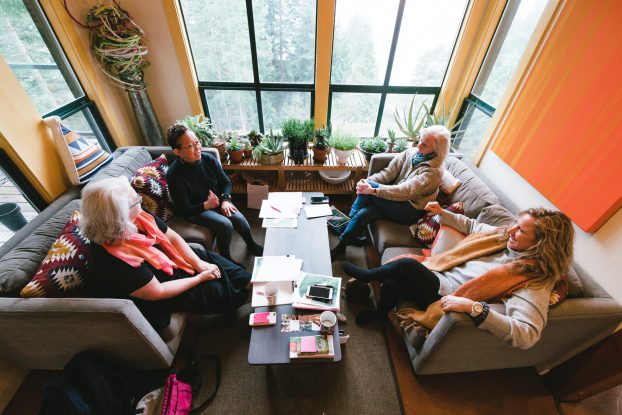
A late December 2019 planning session for Trend Summit — held at Hitomi Gilliam’s home. Clockwise from top left: Hitomi Gilliam, Francoise Weeks, Rebecca Raymond and Debra Prinzing. (c) Colin Gilliam
Hitomi Gilliam, AIFD, is a Vancouver, B.C.-based floral design educator and innovator, as well as a fellow contributor to Florists’ Review. In 2011, she launched a collaborative, inclusive conference called Trend Summit, designed as an immersive trend discussion led by a team of influencers, covering a variety of topics including wedding flower trends.
Trend Summit has taken place every two or three years since, mostly in Vancouver (with one year being held in Dallas). The Summit has grown and evolved to the point where it’s almost a full week with numerous floral design workshops and demonstrations — all sorts of ways to draw you in, engage you and connect you. This year it takes place March 12-17, 2020, at United Floral, where the famed Vancouver Flower Auction is based outside Vancouver.
Listen to Hitomi Gilliam as she discusses Trend Summit and how trends take shape.
Hitomi is one of those rare individuals who shares the spotlight and platform with her peers, her students, and her contemporaries. In 2018, she invited me to present the Slow Flowers Floral Insights and Industry Forecast for 2019 during the Trend Summit Symposium a one-day session open to the larger floral community in B.C. and beyond. It was such a great experience and truly an honor to be given a place at the podium in what some might consider the mainstream floral community. I was so touched that Hitomi shined a light on my work with Slow Flowers, adding sustainability, floral sourcing and eco practices to the conversation!
For 2020, there are so many events and activities planned. To kick it off on March 12th and 13th, the Trend Roundtables focus on a variety of themes important to the future of floristry. This is an opportunity to be introduced to some of the newest product from participating vendors and growers, who will also be in the discussion. In addition to Hitomi, I will join Gregor Lersch, Holly Chapple, Susan McLeary, Françoise Weeks, Rebecca Raymondand Colin Gilliam for this riveting event.
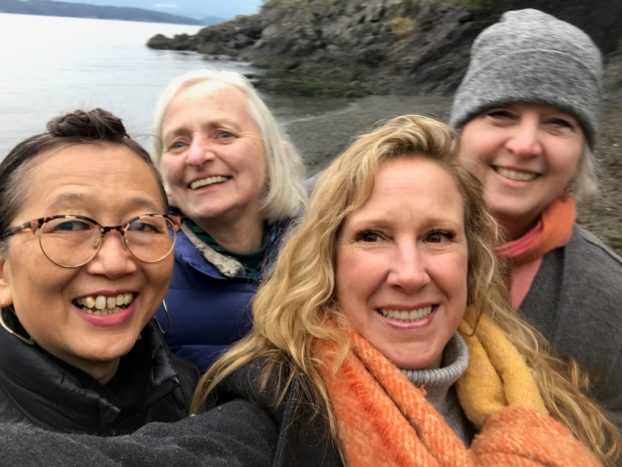
We took in the inspiring natural beauty on a Bowen Island hike one afternoon, too!!
With Hitomi, Colin, Rebecca and
Francois in early December, we spent two full days brainstorming the roundtable
format. We sat in the cozy living room of Hitomi’s delightful home on Bowen
Island, which is located a short ferry ride across Horseshoe Bay north of
Vancouver. With a view of water, mountains, trees and nature, it was a working
session that doubled as an unforgettable retreat.
We cooked up
some of the key topics that will seed the conversations at the Conference:
botanicals, hardgoods and accessories, lifestyle shifts, wedding styles, as
well as emerging floral design styles.
I think you’ll love hearing our dialogue and perhaps you will be
tempted to join us in March.
You might want to attend Thursday Night, March 12th, when Leatrice Eiseman of the Pantone Color Institute will present her insights on color, or on Sunday when all these fabulous design innovators will present during the Symposium.
Quickly, here’s a bit more about the guests you’ll hear in my
conversation today:
Teacher, mentor, floral industry leader Hitomi Gilliam (c) Colin Gilliam
Hitomi Gilliam AIFD is a Japanese-Canadian floral artist, keynote lecturer, demonstrator, educator and a consultant in all aspects of the Art and Business of Floral Design. She is the Creative Director for DESIGN358. She has guest-designed extensively throughout North America, England, Japan, Mexico, Taiwan, Bermuda, Singapore, Hong Kong, Australia, New Zealand, Colombia, Belgium, Korea and India.
She
owned and operated Satsuki’s Florist in Mission, British Columbia for 28 years.
She currently works with her son, Colin Gilliam in an Event & Education
business, DESIGN358 which was established 10 years ago.
Hitomi
has lectured at major art museums and floral shows around North America and
beyond, and she is the founding organizer of the Annual ‘Survival of the
Creative Minds’ Conference in Taos, New Mexico.
Françoise Weeks, born in Belgium, has infused her work with a quintessential European reverence for flowers and nature. Combined with creativity and mechanical ingenuity, she has crystalized her singular style of Textural Woodlands and Botanical Haute Couture pieces, garnering a global following.
Francoise Weeks discusses ‘Plants are Trending’ in the run-up to Trend Summit 2020
Françoise’s
studio is located in Portland, Oregon. Her innovation and love of teaching have
brought her to the Flower School Cohim in China, the Academy of Floral Art in
Exeter, England, studios in Australia and Mexico, workshops at Mayesh and
Florabundance and to the La Jolla and Memphis garden clubs. Her dynamic work
has been published in Nacre, Fusion Flowers, Modern Wedding Flowers, Huffington
Post, Flutter and Millieu.
Her
generosity of knowledge and perspective in use of floral materials, structure
and mechanics, in addition to the business of being a florist, unite to create
rigorous and exciting learning opportunities for her students to explore all
that nature has to offer.
Rebecca Raymond, EMC, floral artist and educator
Rebecca Raymond, EMC, is owner of Rebecca Raymond Floral. She is one of the most respected and sought-after floral designers in the Pacific Northwest.
Rebecca
collaborates closely with each of her clients, gets to know their hopes and
dreams, and then works with color, texture, and architecture to bring their
vision to life. Whether it’s a bridal bouquet or a floral installation, she
sources both seasonal and curated fresh flowers to design beautiful, eclectic
arrangements that reflect the moment and create memories to last a lifetime. As
a member of organizations at the cutting edge of floral design, including
Chapel Designers, she has access to a network of leading designers and ongoing
professional development – and Rebecca is always looking for the latest and
best techniques and design ideas for my clients.
Colin Gilliam
Colin Gilliam, partner with Hitomi Gilliam in Design358 and owner of Colin Gilliam Photo + Design, has been photographing flowers for more than a decade. His work has been published in numerous books, as well as in Florists’ Review and Fleur Creatif Magazine.
I had a chance to discuss my thoughts about Trends during a recent conversation with Hitomi
Clarity in 2020 is knowing where we are at and where we want to go.
Hitomi Gilliam, AIFD, founder of Trend Summit 2020
Hitomi, Francoise and Rebecca have all been guests on the Slow Flowers Podcast. Here are links to those episodes:
Registration continues for Slow Flowers Summit and we’re nearly 50% sold out, which is amazing to me! Please join me on June 28-30th and connect with our fabulous speakers, enjoy the incredibly beautiful venue at Filoli Historic House & Garden, and experience the many features that will immerse you in the people, principles and practices of Slow Flowers.
The Slow Flowers Podcast
has been downloaded more than 568,000 times by listeners
like you. Thank you for listening, commenting and sharing – it means so much.
As our movement gains more supporters and more passionate
participants who believe in the importance of the American cut flower industry,
the momentum is contagious. I know you feel it, too. I value your support and
invite you to show your thanks and with a donation to support my ongoing
advocacy, education and outreach activities. You can find the donate button in the column to the right.
Thank you to our Sponsors
Florists’ Review magazine. I’m delighted to serve as Contributing Editor for Slow Flowers Journal, found in the pages of Florists’ Review. Our partnership with Florists’ Review is such a valuable one, providing a forum for beautiful and inspiring editorial content in the #slowflowersjournal section – month after month. Take advantage of the special subscription offer for members of the Slow Flowers Community.
Association of Specialty Cut Flower Growers. Formed in 1988, ASCFG was created to educate, unite, and support commercial cut flower growers. It mission is to help growers produce high-quality floral material, and to foster and promote the local availability of that product. Learn more at ascfg.org.
Johnny’s Selected Seeds, an employee-owned company that provides our industry the best flower, herb and vegetable seeds — supplied to farms large and small and even backyard cutting gardens like mine. Find the full catalog of flower seeds and bulbs at johnnysseeds.com.
Longfield Gardens, which provides home gardeners with high quality flower bulbs and perennials. Their online store offers plants for every region and every season, from tulips and daffodils to dahlias, caladiums and amaryllis. Check out the full catalog at Longfield Gardens at longfield-gardens.com.
The content and opinions expressed here are either mine alone or those of my guests alone, independent of any podcast sponsor or other person, company or organization.
The Slow Flowers Podcast is engineered and edited by Andrew Brenlan. Learn more about his work at soundbodymovement.com
As many of you know, my path to flowers began as a home and garden features writer for magazines and newspapers. And one of my favorite gigs twenty years ago, when I first shifted from business journalism to design writing, was as garden editor for Seattle Homes & Lifestyles.
I love shelter magazines of all kinds, a dying breed, some would say, including that magazine, which took a hit along with so many during the 2008 downtown in real estate. But we had a very good run and I scouted gardens, produce photo shoots and wrote about landscape design in the Seattle area for years.
Pine Creek Farms & Nursery in Monroe, WA. (c) B. Jones Photography
One of the very first stories I produced for Seattle Homes & Lifestyles was about a young couple named Gwen and Paul Sayers, who had a company called Paul Sayers Landscaping and who lived in Monroe, Wash., about 30 miles northeast of Seattle. Paul had designed and installed an amazing pond surrounded by a strolling path and landscaped with hundreds of beautiful trees and shrubs. It was a plant-lovers paradise and I visited Paul and Gwen on a few occasions for that article and another one for The Herald, the local daily newspaper in Everett, for which I also wrote.
Scattered Seeds . . . a flower farm at Pine Creek Farms & Nursery, (c) B. Jones Photography
Fast forward more than 15 years later and I reconnected with Paul and Gwen at the Northwest Flower & Garden Festival in 2017 where they had a retail booth selling items from the retail shop at their new nursery, renamed Pine Creek Farms & Nursery. Gwen has a great eye for combining plants with vintage objects and that, combined with Paul’s ability to build anything out of salvaged lumber, added up to a charming display. At the time, Gwen told me that she had started growing cut flowers for wedding clients, including ceremonies being held at Pine Creek Nursery. It was a bit of a shift from running a landscaping company, but in a logical way, their sister businesses — Pine Creek Nursery and Scattered Seeds — made a lot of sense to me.
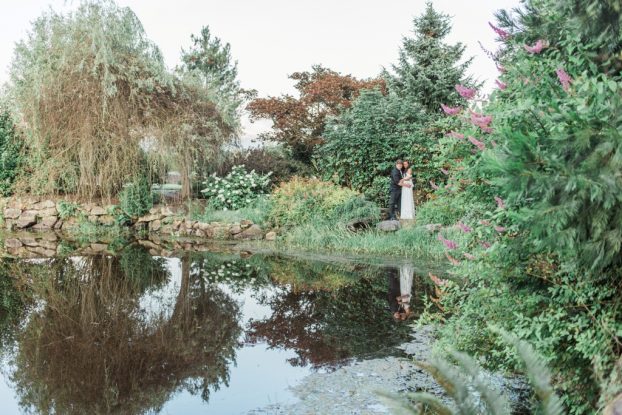
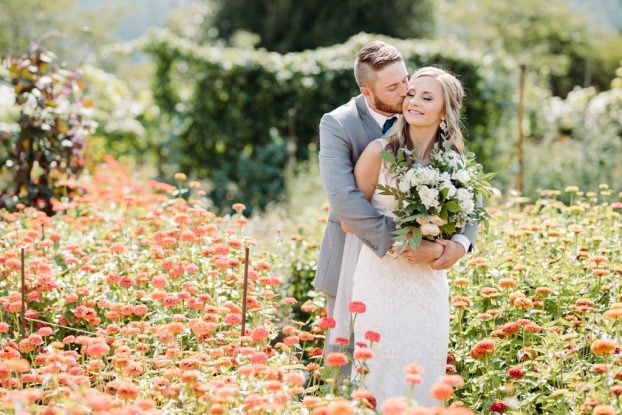
The stunning landscape grounds and pond at Pine Creek Farms & Nursery. The couple: my young friends Claire & Cody, whose wedding flowers I designed in July 2019 (c) B. Jones Photography
Last summer, I was immersed in the full wedding experience at Pine Creek Nursery when I designed the florals for my friend’s daughter’s wedding — on July 6th no less — just a few days after returning to Seattle from the 3rd annual Slow Flowers Summit in the Twin Cities.
The bride, Claire, grew up with my boys, and since I don’t have a daughter, I guess I was feeling quite sentimental when I offered to help her with her wedding flowers. You can see a few photos of that ceremony, captured through the lens of talented wedding photographer B. Jones Photography.
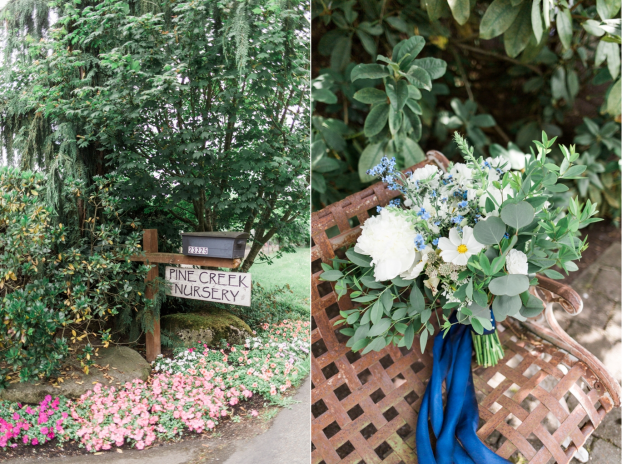
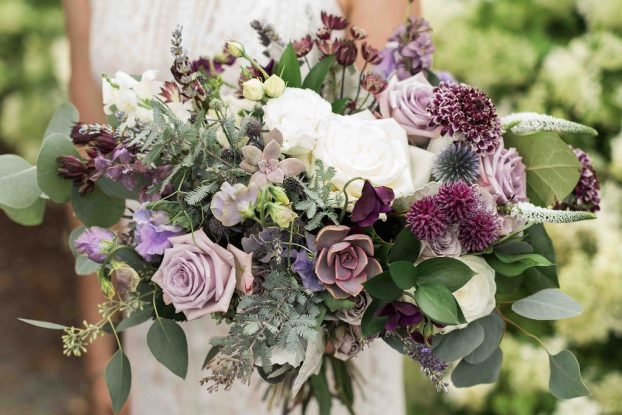
These images from B. Jones Photography were captured at Claire & Cody’s wedding, including the bridal bouquet and a Pine Creek Nursery sign
I mention this experience to help underscore how impressed I was
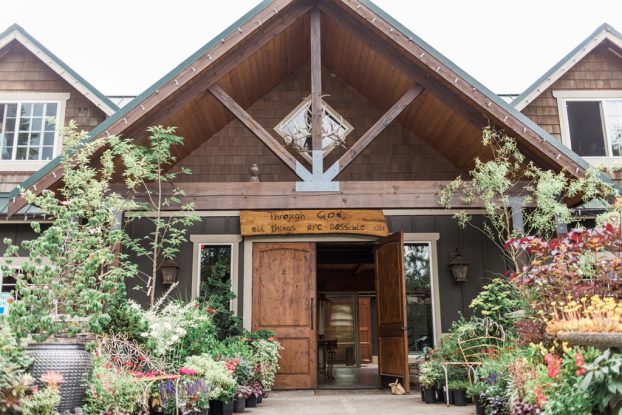
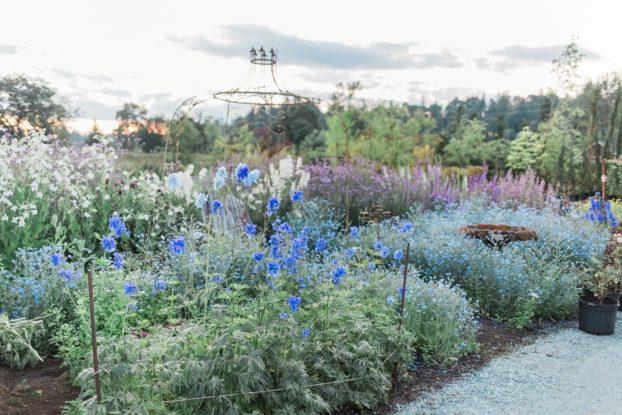
with the venue, the amenities, the incredibly beautiful landscape and cutting
gardens that create Pine Creek Nursery.
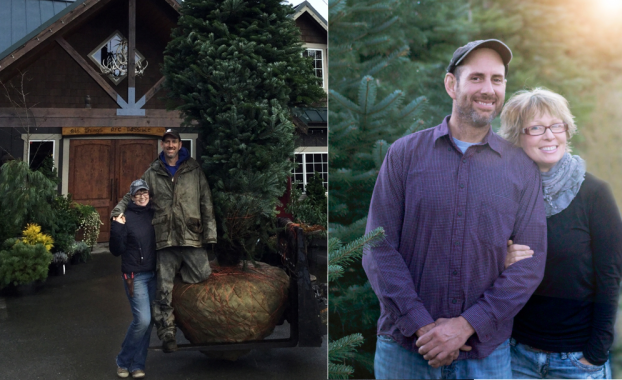
Paul and Gwen and I recorded this episode right before the holidays and I’m so happy to share it with you here. You will learn how these retail nursery owners turned some of their tree production fields into destination wedding venue and cut flower farm. It’s a story of innovation and love for their land. And as we continue the conversation of sustainability in 2020, today’s them is how to sustain a livelihood from your land.
Floral design by Gwen Sayers of Scattered Seeds for a wedding ceremony at Pine Creek Nursery (c) Joanna Monger Photography
Here’s a bit more about Paul and Gwen:
Paul, the visionary of Pine Creek, began landscaping in 1989. Taking the leap to build a full service nursery in 2002, he and Gwen bought 20 acres of land on the outskirts of Monroe, Wa. Nestled in the foothills of the beautiful Cascade Mountains, they have developed what was once a raw piece of ground into a stunning destination nursery and event venue. Paul is an all around talented man who not only envisioned Pine Creek, but built every facet along the way. He is a man who not only dreams up BIG ideas, but actually tackles them and makes them real! From growing nursery stock out in the field, or repairing heavy equipment or irrigation, Paul has made it happen with full on hard work and a ‘get er done’ work ethic! His passion is building, creating and working with rock which is seen throughout the nursery, including a grand granite rock fireplace that is a centerpiece to the event venue at Pine Creek!
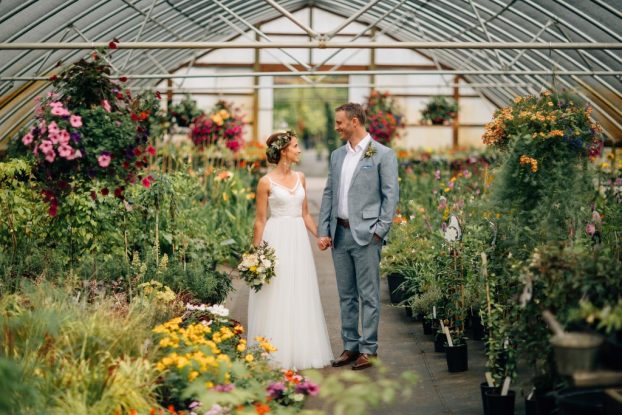
The greenhouse at Pine Creek Farms & Nursery is a top photography setting for couples who wed there.
Gwen who loves everything green, growing and flowers, has been alongside Paul through the whole process of developing Pine Creek. She has had a love for gardening ever since she was a young girl, & now some of her favorite things to do are propagating plants as well as developing a new addition to the nursery… ‘Scattered Seeds…a Flower Farm’ where fresh, locally-grown flowers are lovingly tended for weddings and local floral shops. Gwen wears many hats at Pine Creek – from the office, greenhouse, loading materials, to arranging flowers — but you can always find her with clippers in hand, foraging for unique & beautiful elements to add to a vase or to propagate for future nursery stock.
I’m so grateful that they are part of the Slow Flowers community! We’ve come full circle together and that’s a priceless gift.
Gwen’s flower fields for Scattered Seeds is another favorite of couples (c) Cameron Zeger Photography
As they mentioned, by creating a dedicated brand called Events at Pine CreekNursery, and hiring an a dedicated wedding coordinator, they have been able to build a following for that brand and business channel. It’s a smart move and as you heard, 2020 wedding bookings are already higher than last year. A flourishing year, for sure.
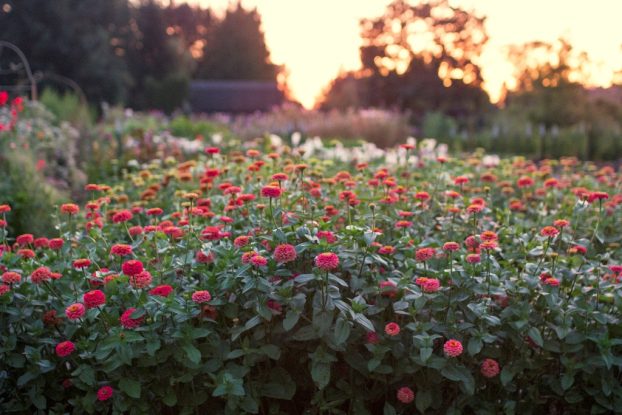
The zinnia patch at sunset
Find and Follow Gwen & Paul at these social places:
We are continuing to build the program for the Slow Flowers Summit, including some special surprises that we’ll be announcing in the weeks and months ahead.
Please join me on June 28-30th and connect with our fabulous speakers, enjoy the incredibly beautiful venue at Filoli Historic House & Garden, and experience the many features that will immerse you in the people, principles and practices of Slow Flowers.
Sarah Hinton and BloomTrac software for event florists, is again sponsoring our name tag layards — and we hope she will be on site to share more about BloomTrac with you.
And thanks to our friends at Red Twig Farms, Lindsey and Josh McCullough, just joined as one of our evening meal/reception sponsors! Check out links to these two great floral partners at today’s show notes at debraprinzing.com. We’ll have more sponsors to announce soon.
The Slow Flowers Podcast
has been downloaded more than 566,000 times by listeners
like you. Thank you for listening, commenting and sharing – it means so much.
As our movement gains more supporters and more passionate
participants who believe in the importance of the American cut flower industry,
the momentum is contagious. I know you feel it, too. I value your support and
invite you to show your thanks and with a donation to support my ongoing
advocacy, education and outreach activities. You can find the donate button in the column to the right.
Florists’ Review magazine. I’m delighted to serve as Contributing Editor for Slow Flowers Journal, found in the pages of Florists’ Review. Our partnership with Florists’ Review is such a valuable one, providing a forum for beautiful and inspiring editorial content in the #slowflowersjournal section – month after month. Take advantage of the special subscription offer for members of the Slow Flowers Community.
Mayesh Wholesale Florist. Family-owned since 1978, Mayesh is the premier wedding and event supplier in the U.S. and we’re thrilled to partner with Mayesh to promote local and domestic flowers, which they source from farms large and small around the U.S. Learn more at mayesh.com.
FarmersWeb. FarmersWeb software makes it simple for flower farms to streamline working with their buyers. By lessening the administrative load and increasing efficiency, FarmersWeb helps your farm save time, reduce errors, and work with more buyers overall. Learn more at www.farmersweb.com.
Syndicate Sales, an American manufacturer of vases and accessories for the professional florist. Look for the American Flag Icon to find Syndicate’s USA-made products and join the Syndicate Stars loyalty program at syndicatesales.com.
The content and opinions expressed here are either mine alone or those of my guests alone, independent of any podcast sponsor or other person, company or organization.
The Slow Flowers Podcast is engineered and edited by Andrew Brenlan. Learn more about his work at soundbodymovement.com




 On Vancouver Island, along the western edge of Canada, gardener, designer, writer and teacher Christin Geall grows flowers and shares her designs through