The Slow Flowers Podcast is the award-winning show known as the “Voice of the Slow Flowers Movement.” Launched in 2013 as the original flower podcast, we’ve devoted more than 10 years to covering the business of flower farming, floral design, and the Slow Flowers sustainability ethos. Listen to a new episode each Wednesday, available for free download here at slowflowerspodcast.com or on iTunes, Spotify, and other podcast platforms.
October 3rd, 2010
BEHIND THE SCENES WITH JON TOGO
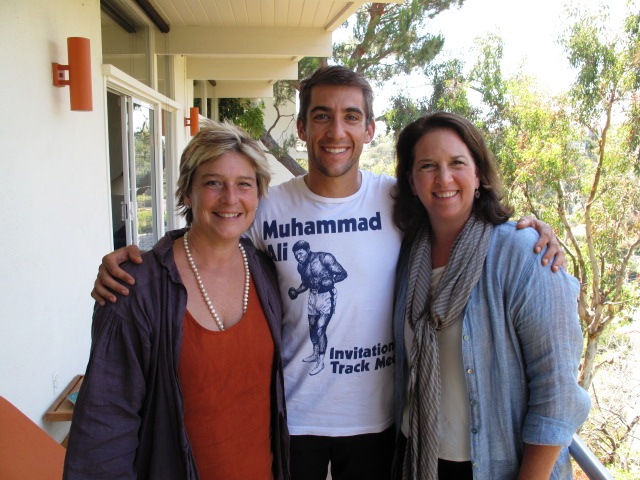
Actor Jon Togo (center), with designer Lory Johansson and me
If you’re a fan of the “CSI” television franchise, you probably know this handsome young actor I’m standing with in the photo at left. He’s Jonathan Togo, aka investigator Ryan Wolfe of “CSI: Miami.”
The show enters its 9th season with tonight’s premiere (10 p.m. on CBS). In anticipation of the show, I’ve posted my recent interview with Jon and his interior designer Lory Johansson.
Lory, an inventive and gifted designer whose firm is called Just Joh, introduced me to Jon’s 1958 Midcentury modern “guy pad” in the Hollywood Hills earlier this year. I love that Jon describes her as “the best design Sherpa” because it’s true. She has a gift for helping each client express his or her unique personality through furniture, art, and the home.
The Los Angeles Times photographed the interiors in July, the day of this photo, which Lory’s husband Mats Johansson took with my camera. My interview with Jon and Lory (and featuring a fun commentary by Jon’s mother, Sheila Togo) appeared in the Sept. 18 issue of the HOME section. You can read the story and see a gallery of photos here.
Posted in Architecture, Creativity, Furniture design, General, interior design, Writing | No Comments »
October 2nd, 2010
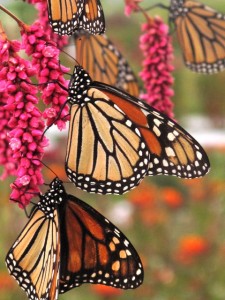
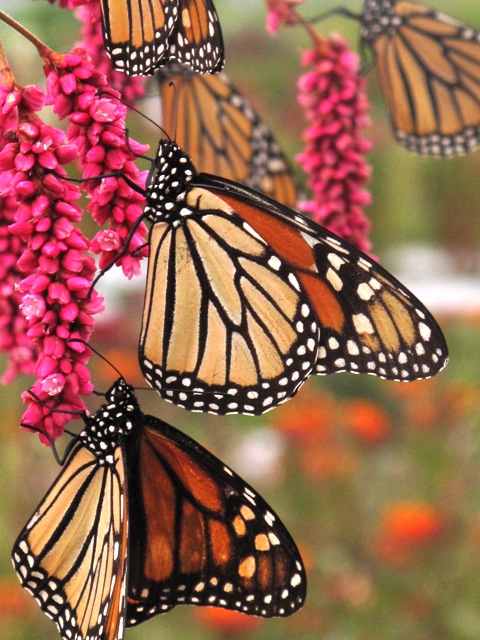
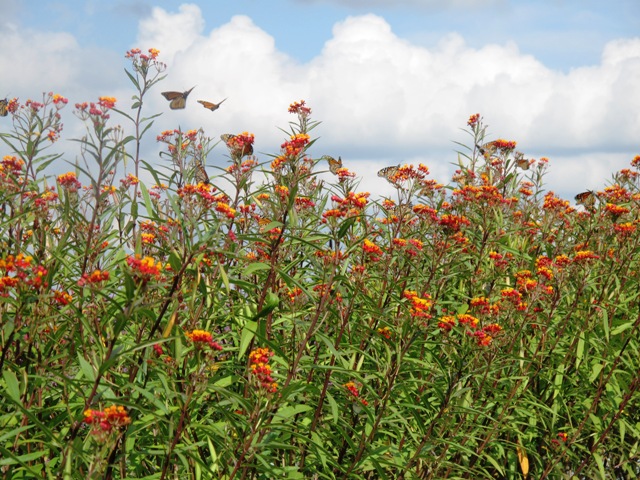
Even the Monarchs were willing to be photographed at the flower farm.
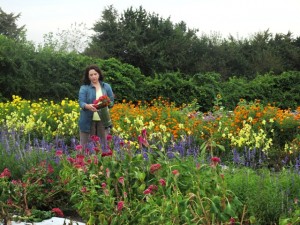
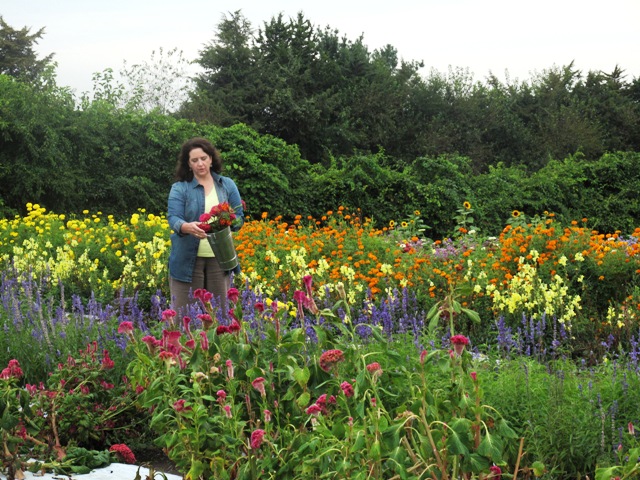
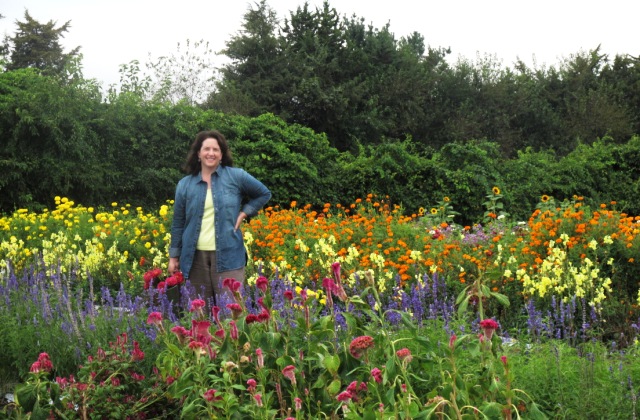
In a glorious Iowa field, I gathered flowers for my bouquets.
One knows she’s in relationship trouble when her own mother and dear friend Susan, who was her maid-of-honor in 1984, call to say, “I haven’t heard from you for a while, so I checked your blog to see what you have been up to.”
Umm. I’ve been on the road a lot lately. Way too much on the road for my liking. Being away from home and traveling for 15 of the 30 days in the month of September was ridiculous, but (I guess) necessary. Anyway, for the first time in three years, I went for a full month without posting an entry on this blog. Yikes!
There were many blog posts composed in my mind as an idea or notion would occur to me. “I should write that down,” I thought. But then, the droning lull of the airplane engine would convince me a quick “up in the air” nap was in order. Or I didn’t have access to the Internet. Or something like a deadline for a volunteer project or even – wow – a paying project . . or someone else’s needs that were way more pressing came along.
So here we are in October – how apropos. The new leaf is turned. I don’t have to travel again until Oct. 12th and that is a single overnight jaunt for a photo shoot in Bellingham, 100 miles to the north.
Seriously, I should be able to squeeze in some news, insights, ideas, GARDENS, cool FLOWERS, and more between now and then.
The story I want to share here is from September 14-16. After six full and intense days for the annual Garden Writers Association Symposium in Dallas, I jumped on a tiny airplane and flew to Des Moines. I met up with the team I collaborate with at Better Homes & Gardens magazine. Eric Liskey (deputy garden editor), Jane McKeon (associate garden editor) and Scott Johnson (deputy art director) and I were up to our knees in flowers.
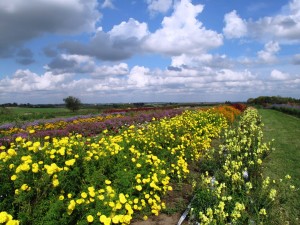
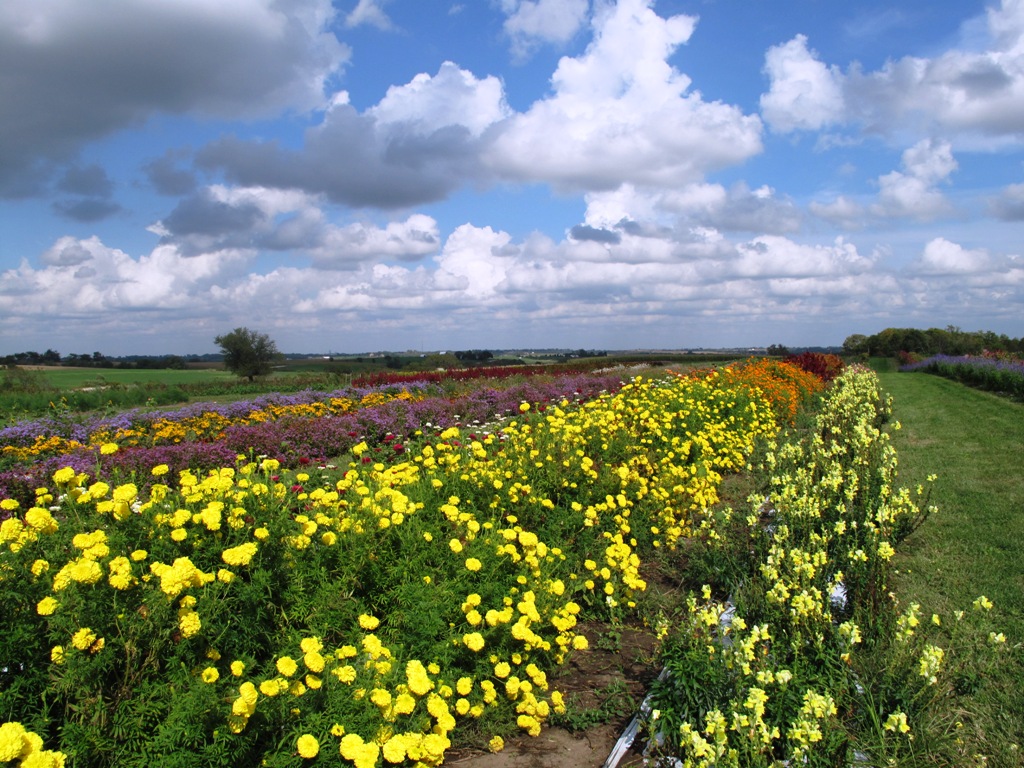
A view across the flower fields at Howell's Farm in Iowa. Isn't this just the most perfect cloud-filled sky you've ever seen?
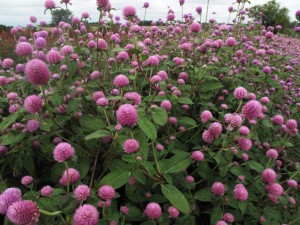
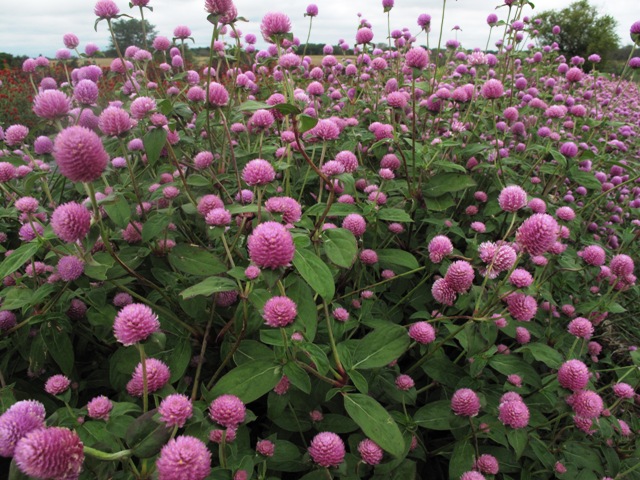
Globe amaranth (Gomphrena sp.)
The flowers – ingredients for a how-to story on creating bouquets from field-grown arrangements – were in all their glory at Howell’s Farm.
Based in Cumming, Iowa (in Madison County – yes, where the bridges are!), Howell’s is a sixth-generation family farm. After decades of raising corn and other agricultural crops, current owners Fred Howell and family began in 1985 to grow everlasting flowers.
Today, the farm is an 800-acre destination for people in search of the best varieties of decorative and seasonal crops. In the spring, summer and fall that means people come for the huge variety of annual and perennial flowers, herbs and grasses for cutting and drying. In the fall, they enjoy the amazing pumpkin patch and a cool corn maze. By the end of the year, in the winter, it’s the Christmas trees as main attraction.
After I landed in Des Moines, Eric and I drove out to Howell’s, about 25 miles outside of Des Moines, on a breezy, but gorgeous afternoon. Scott met us there and the three of us followed Erin Howell, Fred’s daughter, on a walk through the five-acre flower fields. As is my typical reaction whenever I visit a flower-growing operation, I was practically hyperventilating with excitement.
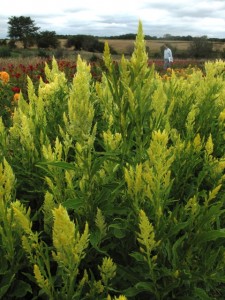
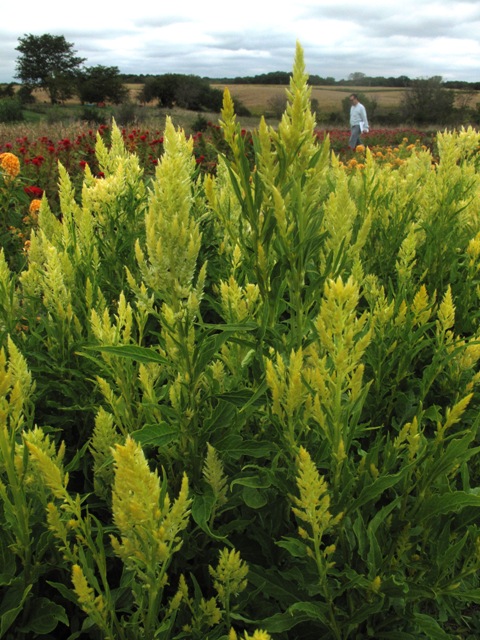
Celosia, plume type - what a great color!
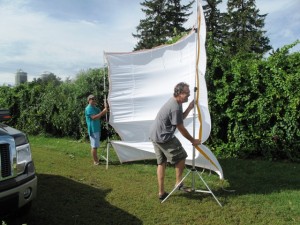
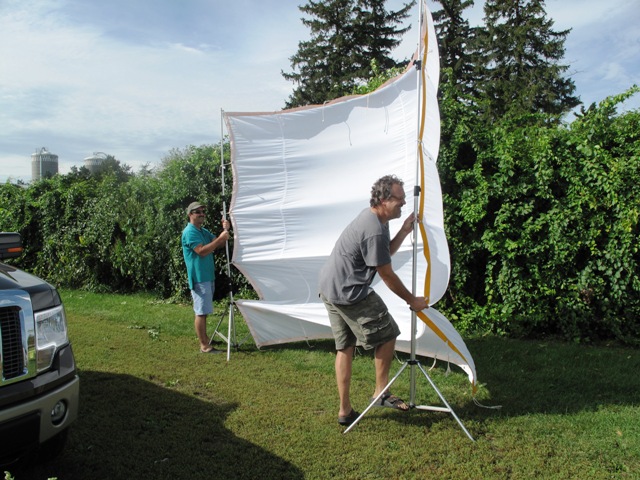
This shows how windy it was as Eric (left) and Scott (right) held the oversized "silk" to cast a shadow for one of the bouquet vignettes.
The variety of flower form, color and vigor in Howell’s crops was dazzling. The setting itself was breathtaking. We talked through our options of ingredients, including what “design lessons” we wanted to illustrate in the story, what sizes and shapes of vases we needed to use, and how to CHOOSE among all the great flowers that seemed to say “pick me, pick me!”
Back at the editorial offices, the three of us huddled with Jane to talk about the floral design projects we wanted to assemble and photograph the following day. This was no small task. Everything has to be mapped out so we could envision how things will look on the pages of Better Homes & Gardens.
The sheets on Scott’s clip-board featured his sketches of mini-magazine pages, complete with thumbnails of vases, blooms and notes to show how a four-page flower arranging story might look. We had to think about a color palette for the vases, taking into consideration the textures and hues of each flower lesson. Then Scott raced out to pick up props from all his secret sources (including tables, stands, vases, pitchers, etc.) and Eric and I took a drive over to his personal garden. We needed a few extra plant ingredients to enhance the designs we had in mind, so Eric obligingly let me cut some lambs’ ears and goldenrod from his borders. What else? Oh! a visit to the mall to pick up a denim shirt for me to wear in the photo shoot.
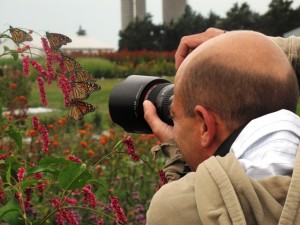
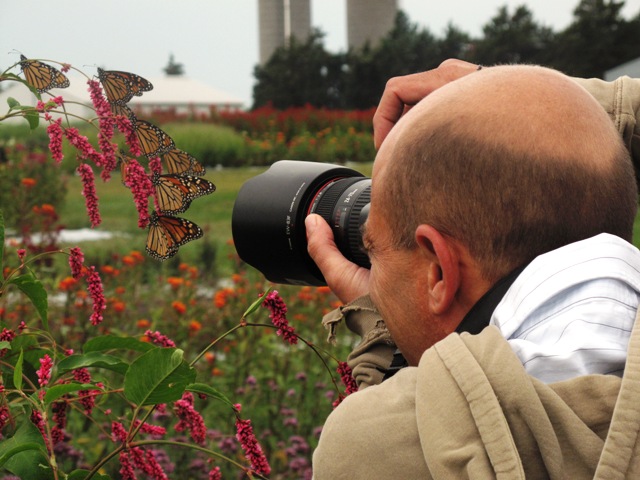
BH&G staff photographer Blaine Moats wanted the perfect Monarch shot. He actually got dozens of perfect shots because the butterflies were amazingly cooperative.
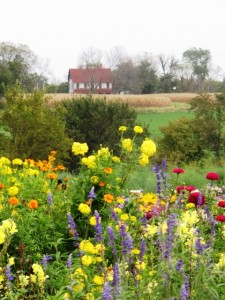
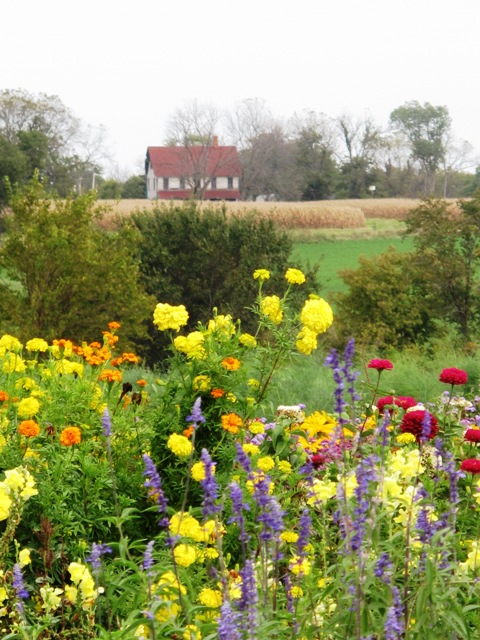
Yes, there it is: Francesca's House
The next morning arrived bright and early and we met out at Howell’s around 7 a.m. Since Jane and I had designed the first two looks the afternoon before, we had a jump start for the photography. But then, the light seemed pretty good for a portrait, so Scott sent me out to cut flowers while our photographer Blaine Moats shot away. As I walked between the rows of marigolds, zinnias, sunflowers and milkweed, filling my galvanized French flower buckets with stems, I thought: How lucky can a gal get? It was a joyous experience to just be there, to know that I was getting to create bouquets and arrangements that will be featured in the magazine sometime next summer, and to work with such talented, artistic colleagues.
We were soon distracted by a sight so compelling and awe-inspiring that we simply had to stop working. Well, except for Blaine, who just turned his lens on the scene and began to document it. A harmonic convergence of Monarch butterflies was waking up as the day began to warm. They seemed to want to pose for photos, since even I was able to capture some really sweet butterfly portraits as the winged creatures breakfasted on the nectar of hot pink “Kiss-me-over-the-garden-gate” flowers (aka Polygonum orientale).
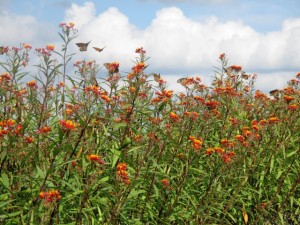
Milkweed with Monarchs (Asclepias sp.)
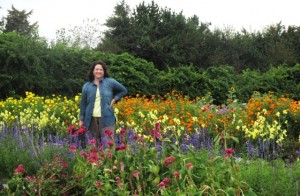
Me again - can't stay away from those blooms!
If that wasn’t thrilling enough, by the time Jane McKeon arrived in the afternoon, I had another amazing sight.
“Look over there,” Jane said, gesturing to a distant and lonely farmhouse. “Do you know that it’s Francesca’s house?” Yes, this was the actual Iowa farmhouse used by Meryl Streep’s character Francesca Johnson in the famous film “Bridges of Madison County.”
Another reason to visit Howell’s Farm is to gaze across rows of flowers and see that setting. I may have to rent the film just to see that house on the screen, and to appreciate Meryl’s Oscar-nominated performance from 1995.
There’s lots more to share but my bouquet designs are embargoed until they show up in the magazine. I can’t wait to show them off to you.
Posted in Creativity, floral design, Gardening, General, Plants, Writing | 11 Comments »
August 25th, 2010

This was my first visit to the IGC Show in Chicago - the 4th Annual Show was impressive
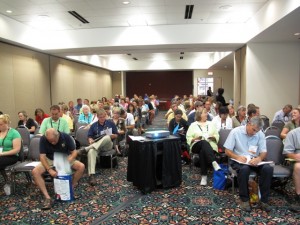
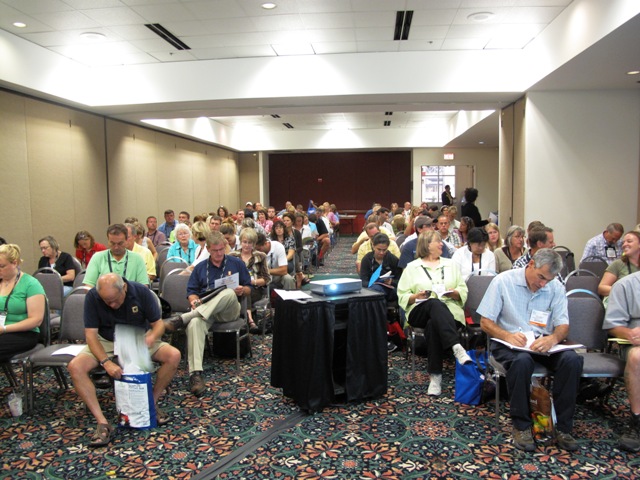
I had a great gathering of "indie" retailers for this presentation.
After presenting to a welcoming audience at last week’s Independent Garden Center Show in Chicago, I’m more convinced than ever that there is a huge passion and vitality among the “indies” of horticulture.
These are the women and men who adore plants, love to share their knowledge about growing things, don’t mind getting dirt under their nails, and who understand that connecting with other gardeners is what it’s all about.
If you can run a business like that, well, then you are blessed. I’m not saying it’s easy. These are hard-working plantswomen and men; some of them are from longtime nursery families who grew up growing and selling plants. Others come to garden center life through different paths. But people find their way. And in the face of competition from big box retailers, the “indies” are almost as threatened as small-town booksellers (Although I just read an article in New York magazine about the return of independent book stores.) From what I saw last week, with the aisles of Chicago’s Navy Pier teeming with thousands of trade showgoers, I’m convinced the “indie” garden center and outdoor living retailer is a force to be reckoned with.
My talk highlighted some of the successful participants in this movement. I promised to post an excerpt of this talk and some highlights here for my audience members to read. I”m also interested in comments and suggestions for other “indies” who are doing things right in their own community. Please let me know where you gain inspiration and make a “connection” with the local garden center in your community. I really do want to know!
INSPIRING GARDEN CENTERS AND OUTDOOR LIVING RETAILERS are . . .
READ MORE…
Posted in Creativity, Gardening, General, Plants | 6 Comments »
August 21st, 2010
 The September issue of Better Homes & Gardens features my “Debra’s Garden” column encouraging readers to add ornamental grasses to their seasonal flower arrangements.

"Meadow in a vase" is the theme of my September column for BH&G
The photo that accompanies the piece depicts a gorgeous autumn bouquet bursting with asters, fall foliage and miscanthus blades.
Its sultry palette includes dark purple, russet-red, gold and green elements in a clear, glass vase. As a footnote, I promised to show off my favorite grasses for cutting and flower arranging here on this blog.
As it turns out, I’ve been seeing a lot of wonderful ornamental grasses and grass-like design ingredients lately. These days, I have dreamy plumes of fountain, feather, and silver grasses on my mind.
There’s something both completely romantic and purely modern about grasses in floral arrangements (or in the landscape, for that matter). Here’s a peek at what’s caught my eye this year, including my favorite grasses for cutting:
FROM THE FLOWER FARM
Owned by Diane Szukovathy and Dennis Westphall, Jello Mold Farm is one of my favorite local flower sources here in the Pacific Northwest. Diane and Dennis use sustainable practices and recently they’ve delighted floral design customers with gorgeous late-summer grasses. You can find Jello Mold Farm at the Queen Anne Farmers’ Market every Thursday – be sure to check out the incredible selection of downy and fluid grasses.
Here are a few show-stoppers included on Diane’s “fresh list” that she emails to customers every Monday. The four images you see here were taken by Diane:
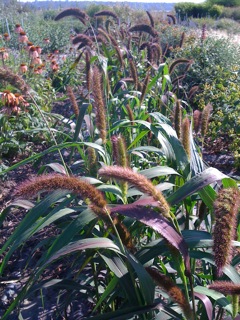
Jello Mold's RED JEWEL MILLET, with large, elegant, arching, red-toned seed-heads approximately 5 inches long
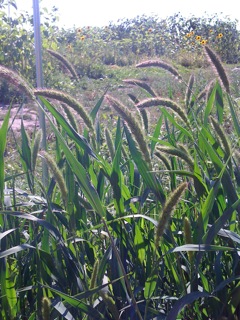
Jello Mold's GREEN MILLET, with 3-inch-long, fuzzy green seedheads and a wonderful texture
These awesome examples are ornamental millets, not edible ones.
While actually cultivars of Pennisetum glaucum, you can almost convince yourself that they are relatives of the corn family if you squint.
When cut for bouquets, the plants yield both the sweet, furry seed-heads, as well as the strapping, wide leaf blades. Both plant elements are useful in an arrangement as beautiful counterpoints to blooms.
Like many good things, “more is better.” For example, I like to gather several seed-heads together in a clump and inset them into the arrangement.
It’s a pretty picture to have three to five seed-heads cascading out of a bountiful grouping of seasonal flowers and foliage.
READ MORE…
Posted in Creativity, floral design, Gardening, Plants, Writing | 2 Comments »
August 8th, 2010
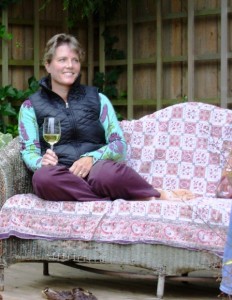
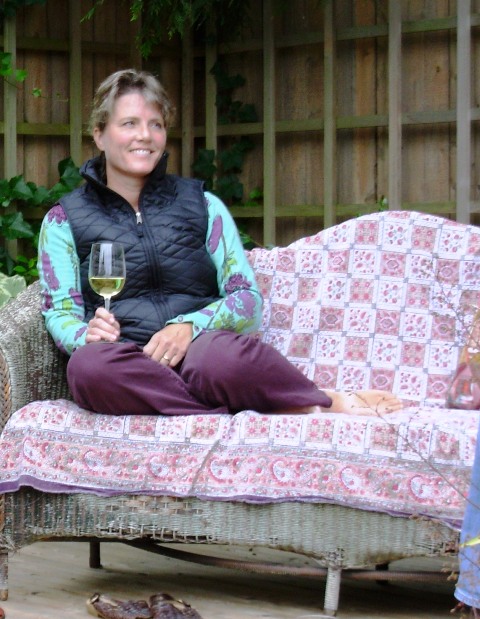
Tina sure knows how to enjoy herself in the garden! Here she is, resting on my vintage wicker in my former Seattle garden, 2006.
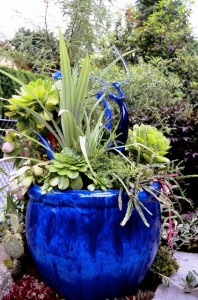
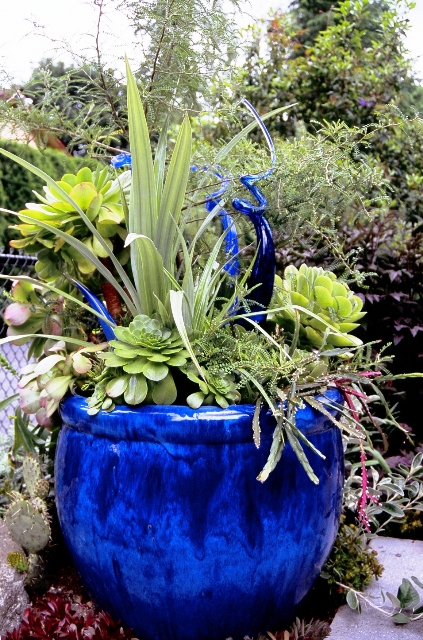
Great container design paired with whimsical glass art makes this pot a stunning focal point in Tina and Paul's garden.
I first met Tina Dixon in the early 2000’s when I was asked to join her as a judge for the Washington State Nursery & Landscape Association design awards.
Her bubbly personality and welcoming nature included me in the circle of other judges, most of whom had previously served together. Our judging session took place at her home in Bothell, just north of Seattle, allowing me to gain a better sense of just who Tina is. In short, Tina is a connector. She connects colleagues, clients and friends, helping everyone feel part of the Seattle horticultural community. You can’t help but have fun when she’s in the room (or on the tour bus or in the garden).
Through Plants a la Cart, her container design business, Tina creates breathtakingly gorgeous planted pots for some of the Seattle area’s poshest addresses.
Several years ago, she turned her attention to the property she owns with her husband Paul Stredwick. Their hand-crafted garden is a vibrant, color-infused, texture-layered, art-filled spot on the map. And garden tour-goers, if they are lucky, can occasionally get beyond the denim blue-stained gate to see the surprising horticultural world inside.
The photographs shared here are ones I took in 2006 when Tina and Paul opened their Golden Trowel Award-winning garden to the Hardy Plant Study Weekend participants. I served on the event’s planning committee that year, so I knew what a treat was in store for the several hundred participants who flocked there during the Open Garden schedule.
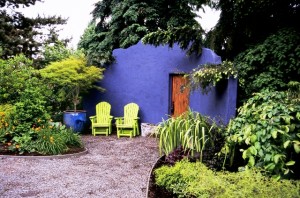
In 2007, Garden Design magazine awarded Tina and landscape designer Mike Jeppesen the Golden Trowel Award for this gorgeous Blue-Themed landscape
Since then, I know that Tina and Paul have received numerous requests to add their garden to area tours. They recently decided to open the property to benefit a cause that they personally support, Hopelink. Hopelink is an United Way agency that offers an array of programs that enable families in crisis to make progress toward and achieve self-sufficiency.
You can see the garden next Sunday, August 15th, at two different events. An evening Garden Party (6-8 p.m.) includes wine, hors d’oeuvres and music by The Chromatics. Knowledgeable docents will be on hand to answer questions during the festivities. Tickets to the private garden gala are $150 with a portion tax-deductible. Register online or call 425-897-3703.
The Dixon-Stredwick garden is also open earlier in the day, Noon-5 p.m. for a $50 donation to Hopelink. You can pre-order tickets for the tour here. Or call the number above.
For some background on this garden, here is the story I wrote in April 2007, which appeared in Seattle Homes & Lifestyles magazine. Subsequently, their garden has been featured by other publications, so I feel pleased that Tina said “yes” to me first!
True Blue: Designed with a harmonious blue-hued palette, a Bothell garden shows off art, architecture and plants
Written by Debra Prinzing
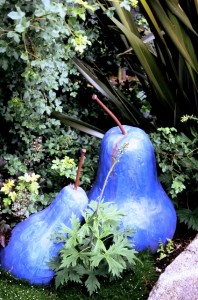
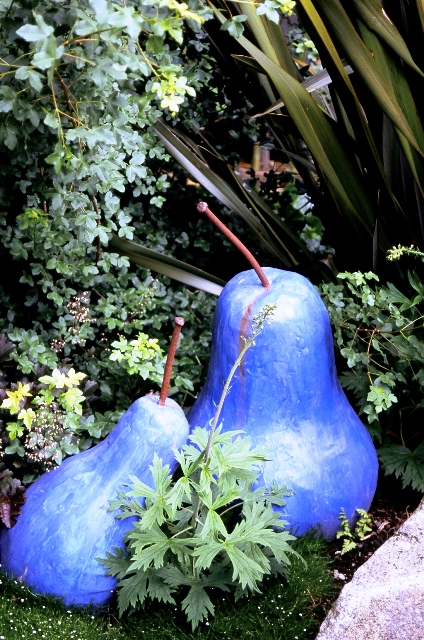
Painted periwinkle, two concrete pears by Woodinville artist Judy Thomas continue the color story.
If, as color theorists say, blue has therapeutic qualities, then Tina Dixon is a very healthy woman. Whether it’s a bright or subdued blue, Tina thrives on the hue.
Owner of Plants a la Cart, a successful container-garden design service, Tina considers the serene hue her signature color. Although she doesn’t limit clients to her preferred palette, Tina is well known for filling azure- and cobalt-glazed urns with dazzling combinations of leaf shapes, textures and colors.
Her penchant for blue infuses her own landscape, giving it a cohesive theme. “Blue is my favorite color,” she proclaims.
When they bought a one-third-acre Bothell pasture in 1983 (previously inhabited by a lone calf), Tina and her husband, Paul Stredwick, were in their late 20s and intent on building their first home, a gray, barn-shaped Dutch colonial, trimmed in blue. Landscaping was not on their minds or in their budget.
By 1987, Tina abandoned an office job for a horticultural career. She studied landscape design at Lake Washington Technical College and launched Plants a la Cart. The pasture was by then home to two rambunctious golden retrievers.
Occasionally, Tina and Paul had time to tackle their own backyard. They renovated a deck and planted an 80-foot-long mixed perennial border against the south fence. “Paul and I were trying to pick away at the landscape,” she recalls. “Wherever we stopped one year, we started there the next. It wasn’t quite flowing.”
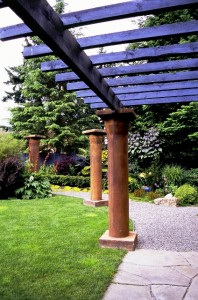
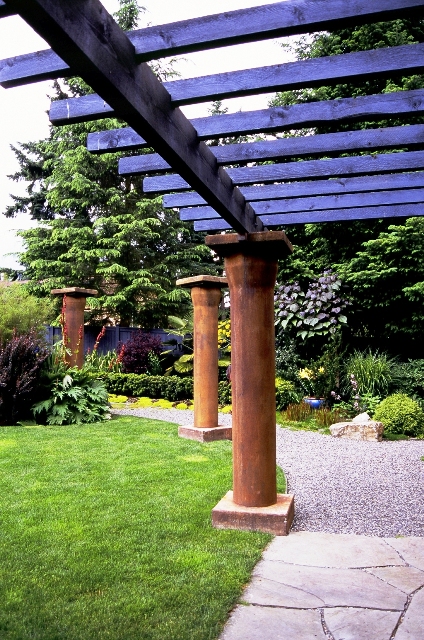
The blue-stained arbor is supported by DIY columns.
In 2002, knowing they wanted lighting, irrigation and hardscaping in the garden, Tina and Paul agreed to ask a landscape designer for an overall plan.
It was almost inevitable that Mike Jeppesen of Sammamish Landscape would help the couple create their blue-themed dream garden, since he and Tina had collaborated earlier that year on a gold-medal “Blue Garden” for the Northwest Flower & Garden Show. With a blue-stained gate and arbor, Pennsylvania bluestone pavers, blue Asian pots and collections of blue-tinged conifers, the designers made a rare statement with this cool palette. The design also earned them the Pacific Horticulture Award.
“Like Tina, I prefer to deal with foliage—this garden is virtually a tapestry of texture and leaf color,” Jeppesen says. “I also knew that even though Tina and Paul and the dogs needed to enjoy the garden, it also had to be a space for her to show off what she does best—it’s a garden that people will visit.”
Tina and Paul’s garden invites visitors to enter along a charming walkway, pass through an oversize blue gate and pause at a dramatic “foyer” where one of eight ochre-stained concrete columns appears as a focal point.
From here, a 4-foot-wide strolling path meanders clockwise around the garden’s perimeter. An irregular section of lawn is reserved at the center for playing ball with the dogs. More free-standing columns punctuate the heavily planted borders, drawing the eye through the landscape to a four-column pergola in the distance.
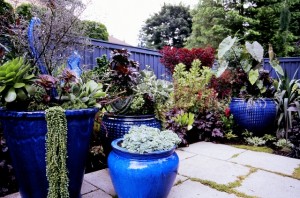
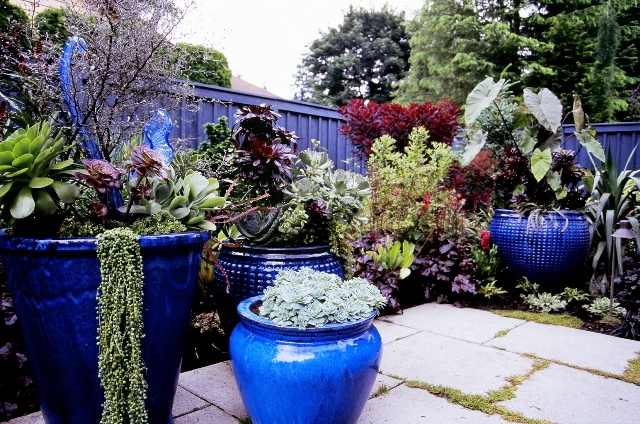
A grouping of blue Asian pots presents Tina’s favorite container designs, incorporating bear’s breech (Acanthus mollis), golden smoke bush (Cotinus coggygria ‘Golden Spirit’) and Canna ‘Tropicanna’.
“Columns were on my wish list but were killing the budget,” Tina admits. Jeppesen suggested using concrete waste-water pipes, set on end, to serve as columns. At $80 each, the 8-foot-long pipes were a perfect solution. Tina asked artist Johnny Ward to transform the ordinary concrete with a rich gold-brown patina. Blue-stained lattice boards and rafters form the pergola, complementing a Pennsylvania bluestone terrace beneath.
To give the landscape the feeling of maturity, Jeppesen and his crew placed boulders, large rocks and stone steps throughout the landscape. He also encouraged Tina and Paul to incorporate large trees and shrubs into the design. “Even though Tina deals more with perennial-style plants, I wanted her to use trees and shrubs to provide interest when there are no flowers in bloom,” he says. “They give substance to this landscape.”
Tina and Paul agreed and headed to Oregon, where they used Tina’s wholesale connections with a tree farm. They selected trees to complement the scale of their house, including several hinoki false cypress (Chamaecyparis obtusa>‘Gracilis’), plume cryptomeria (Cryptomeria japonica ‘Elegans’), weeping copper European beech (Fagus sylvatica ‘Purpurea Pendula’) and a flowering dogwood (Cornus x rutgersensis ‘Constellation’).
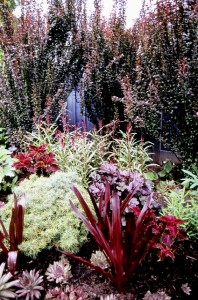
Wine, burgundy and maroon foliage are great complements to blue tones.
One-color gardens are appealing because of their simplicity, allowing plants and constructed elements to speak a common design language. Tina recognized that gold, lime, wine and silver foliage plants gain a visual boost when placed near blue pots and architecture.
She adapted container design techniques when planting the landscape. “Because I work on such a small scale, it was an overwhelming thought at first,” she says, “but you just have to take the principles of putting the right leaf shapes and textures together and use them in the larger context.”
Blue-glazed Vietnamese pots hold everything from gold-leafed ornamental trees and striped tropical plants to exuberant vines and silvery succulents. Tina’s adventurous designs rely on attention-grabbing plants that look even better when paired with blue. “I’ve been really tempted to use other container colors,” she says. “But that would feel like a mixed jar of jelly beans. Instead, I decided to be bold and consistent. The blue pots make sense and tell a story.”
Landscape designer-contractor: Mike Jeppesen, Sammamish Landscape, (360) 435-3769 or amjeppesen@earthlink.net
Container designer: Tina Dixon, Plants a la Cart, (425) 481-2194 or stredson@aol.com
Carpenter (pergola, entry arbor and fence): Cliff Chatel, Woodmark Construction, (425) 827-5242
More photos to delight – and tempt you to attend next Sunday’s tour and garden party:
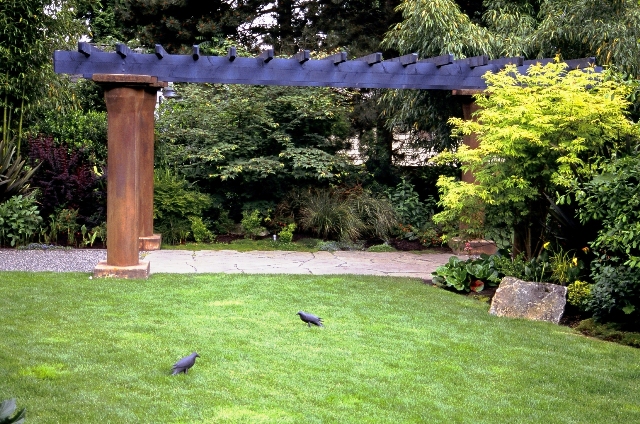
There is a small patch of dog-friendly lawn in this garden, yet Tina can't resist placing sculptural black crows on its surface.
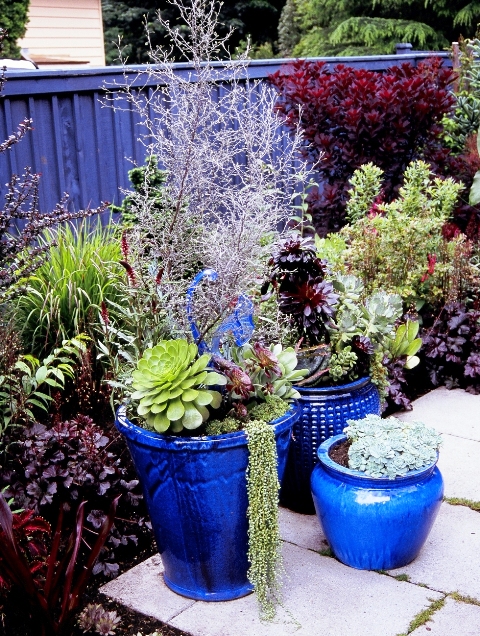
Another detail shot revealing Tina's incredible container design talent and her color sensibility.
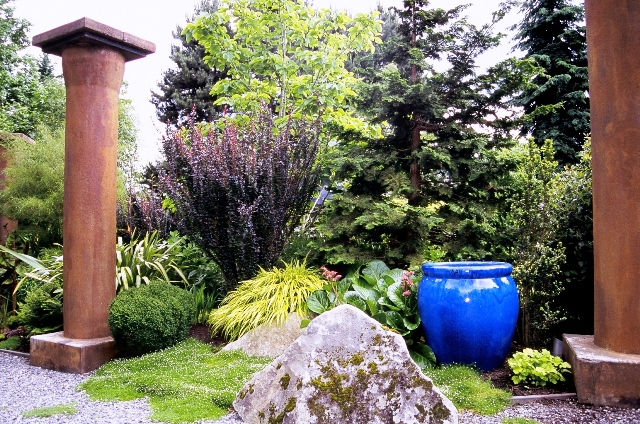
A brilliant, blue-glazed urn is a delightful counterpoint to trees, shrubs and rock.
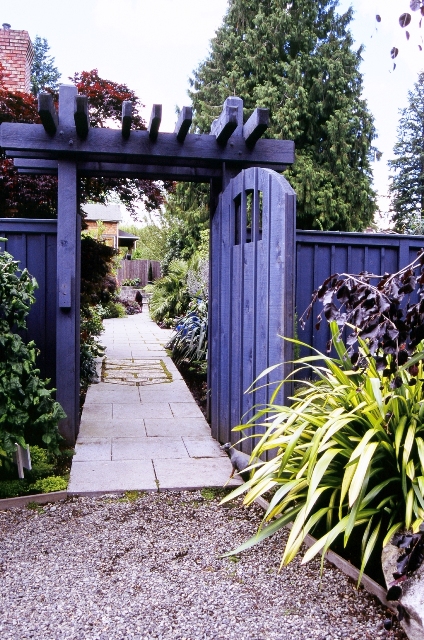
Playful “hopscotch” pavers guide visitors to the blue-stained entry gate (a hand-painted sign nearby reads “All who enter must hop” and another, inside the garden, asks “Did you hop?”).
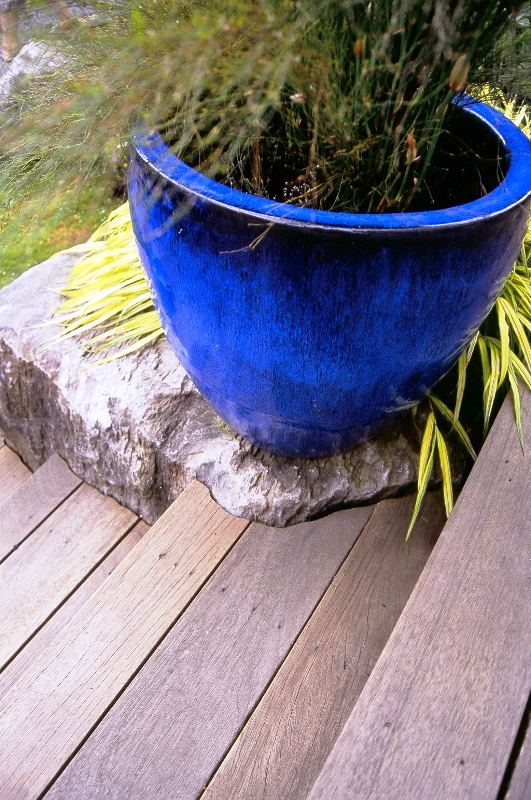
Here's a cool detail showing how Tina and her landscape cohort Mike Jeppesen carved the decking around a piece of basalt - just like a puzzle piece.
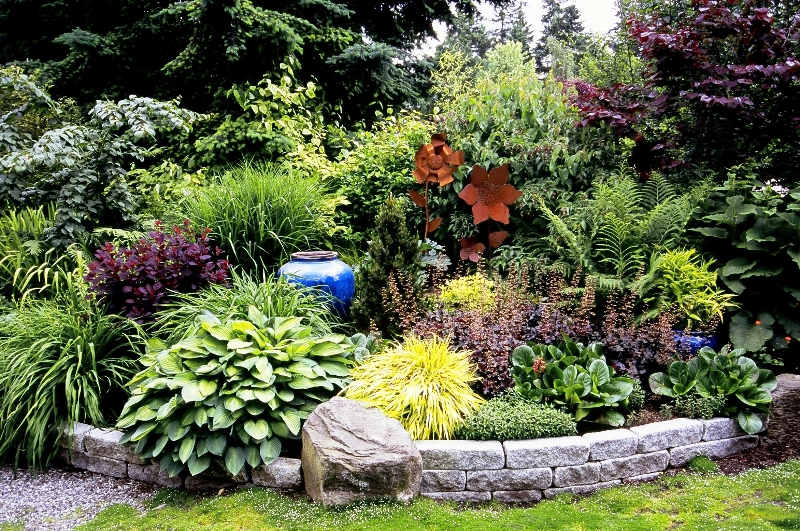
Not much to say but: "Feast your eyes on this tapestry of texture and color"
Posted in Creativity, Gardening, General, Landscape Design, Plants, Playfulness, Writing | 5 Comments »
August 7th, 2010
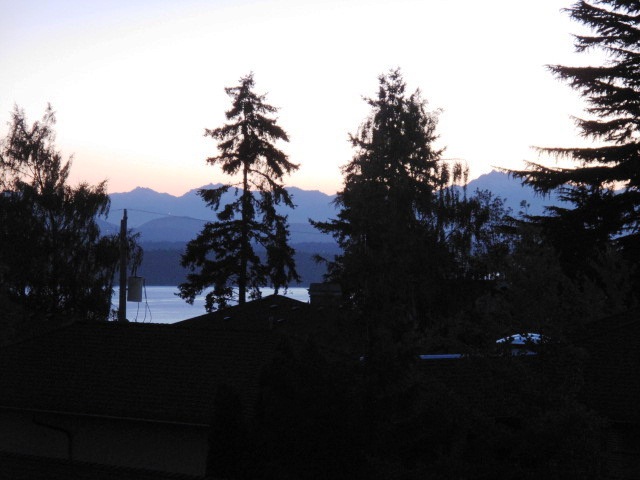
The view from our rental house in West Seattle at sunset. It reveals the purplish silhouette of the Olympic Mountains and a peek of Puget Sound.
I drove into Seattle on Monday, July 19th after spending three days on the road from Ventura County. My husband and two sons were already settling into our new rental home in West Seattle while I hung out with the (not fun) packers and movers in Southern California.
FINALLY – the house was emptied, cleaned and ready to wow potential buyers. And it was time for my return to Seattle. With the Volvo station wagon crammed to the brim with breakable garden sculpture and pottery, the many plants I couldn’t say good-bye to, a few pieces of clothing and my faithful Lab, Zanny, I left for my Pacific Northwest destination. I hit the road Friday evening with four books on tape and a tank full of gas. One night bunking at the borrowed home of Palo Alto friends who left me a key, followed by one night in an artist’s rental apartment that Amy Stewart found for me in Eureka, Calif., and a third overnight at a dog-friendly hotel in Portland . . . and we got here by noon on Monday.
I was happy to unload the car, although with 20-plus steps from sidewalk to house, I burned quite a few calories doing so. It took nearly 2 hours to unload properly and check that my mostly succulent menagerie was unbruised and that nothing was damaged due to my occasional need to slam on the brakes!
But there really wasn’t time to dawdle because I had to get cleaned up and dressed for my friend Stacie’s garden gal’s soiree, the second annual event. While vacationing in Seattle last summer, I was able to attend Stacie’s delightful summer garden party in her highly-published North Seattle landscape. Earlier this year, way back in February, Stacie asked me to let her know when I might be back in Seattle so she could work around my travel schedule for her 2010 soiree plans.
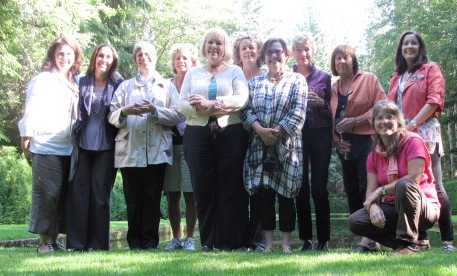
The garden gals, from left: Me, Kathy Fries, Deborah Cheadle, Stacie Crooks, Marty Wingate, Wendy Welch, Lorene Edwards Forkner, Nita-Jo Rountree, Gillian Mathews, Janet Endsley and Tina Dixon (kneeling)
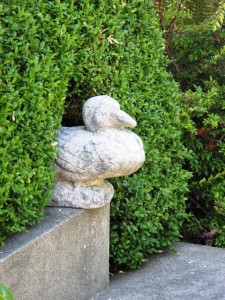
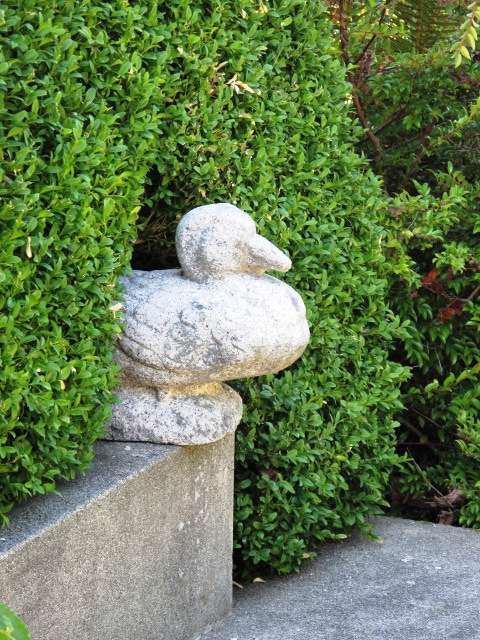
I was greeted by a charming stone duck - peeking from a hedge at the Bloedel Reserve.
As it turns out, I anticipated being at a family wedding in mid-July so I assured her that something around July 19th would be ideal. Little did I know that (a) the bride and groom would skip the formal wedding for a simple civil ceremony (and three-week honeymoon in Mexico) and (b) that I would not be vacationing here in July but MOVING HERE!! Life occasionally throws us some very wonderful surprises and this one came courtesy of the company my husband works for deciding quite recently to relocate its corporate headquarters from Pittsburgh to Seattle.
Back to Stacie’s party. This one was scheduled for late afternoon-early evening when the light is quite delicious and the day’s temperatures begin to cool. A gifted landscape designer and sustainable gardening educator, Stacie recently joined the board of trustees for the Bloedel Reserve on Bainbridge Island.
For some magical reason, she obtained permission to host a private gathering on a day when the garden isn’t normally open.
Let me tell you, the prospect of joining Stacie and some of my very favorite Seattle women friends kept my eyes on the road and my foot on the pedal while I drove from LA to Seattle over that long weekend.
Here’s some background on Bloedel Reserve, excerpted from the 9th edition of the Northwest Gardener’s Resource Directory(Sasquatch Books, 2002), my very first book project that I inherited from the wonderful, late Stephanie Feeney:
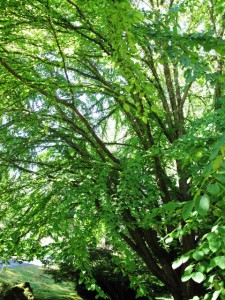
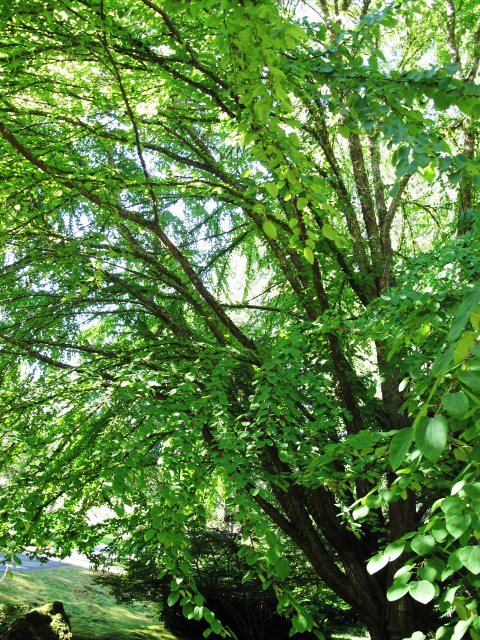
The most massive Katsura tree I've ever seen.
From the time Prentice and Virginia Bloedel acquired this 150-acre property in 1951, they began a sensitive courtship aimed at marrying the designing hand of man with the natural attributes of the woodland setting. Over a period of 30 years, and with the commissioned partnerships of wisely selected professionals (Fujitaro Kubota, for help with the Japanese Garden, and landscape architects Thomas Church, Richard Haag, and the firm Environmental Planning and Design), Prentice Bloedel orchestrated the development of many garden rooms set in the varied landscape of second-growth hardwood and conifers, meadow and wetlands, glens and gullies.
While incorporating influences from the Japanese and the European gardening traditions, a respect for the natural attributes of the land prevailed and pervaded. There are now 84 acres of second-growth forest and 66 acres of altered landscapes. The result: a native woodland crisscrossed with shady paths, meadows, and a broad selection of formal and informal gardens.
So here is a selection of photos taken that lovely day, including a group shot that we staged by placing self-timing cameras on the bench perfectly aligned with the reflection pool (above). At the bottom of this post, I have included details on visiting Bloedel. The garden is more accessible to the public than ever and offers some delightful summer concerts, guided tours, classes and other events. It is worth a visit and you’ll want to set aside a full day to do so.
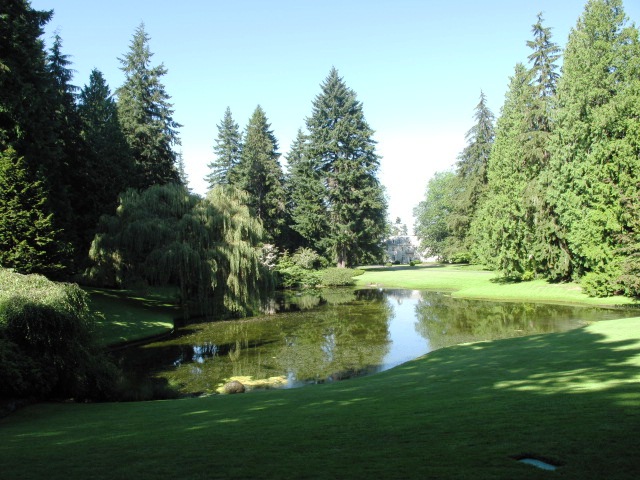
This is the quintessential photograph often captured by amateurs and professionals alike. The perspective is elegant and inviting, with the Bird Refuge and pond in the foreground; the original estate framed by native northwest conifers, in the distance.
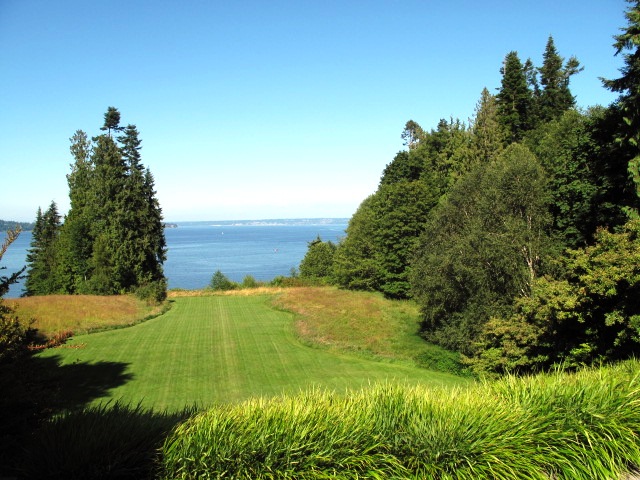
On the east side of the estate, there are brilliant views of Puget Sound facing Seattle. The massive planting of Hakonechloa macra in the foreground emulates soft ripples of the water.
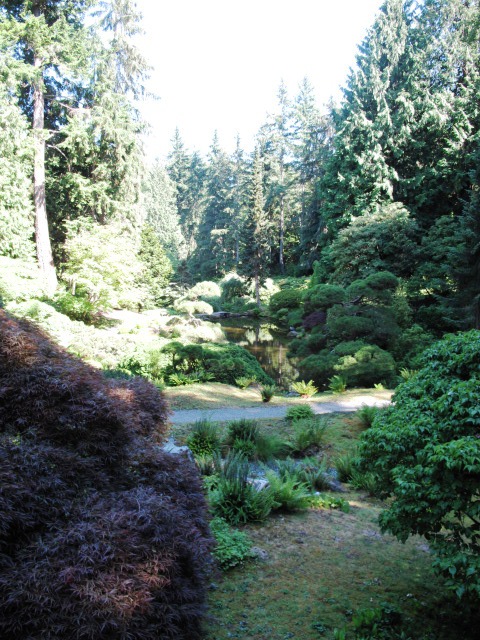
A view through the towering trees and sun-dappled understory, taken from the deck outside the Japanese-inspired tea house where we gathered
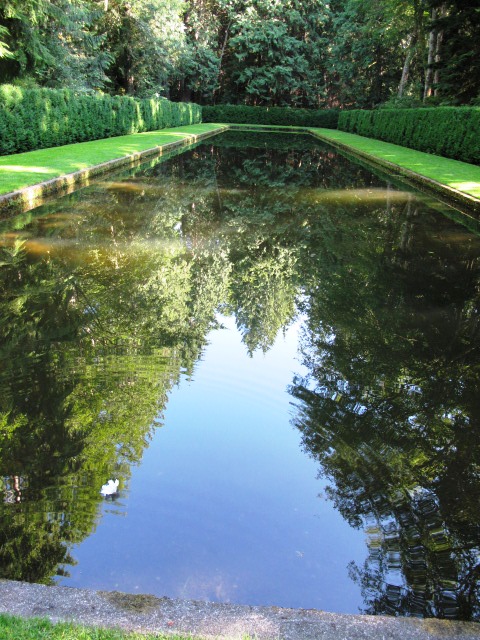
The Reflecting Pool mirrors the sky and treetops.
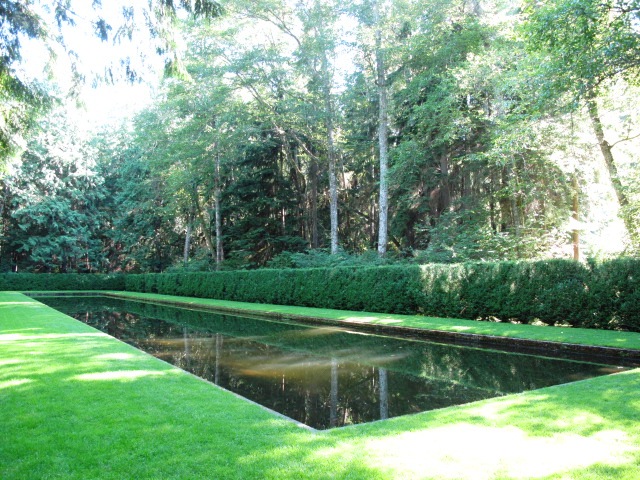
The Reflecting Pool is contained by a wall of green hedging, making it separate from the semiwild woodland.
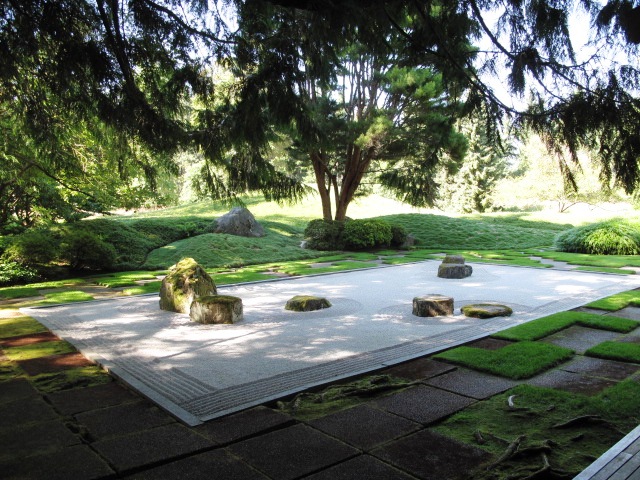
Fujitaro Kubota's Japanese garden, a quiet, contemplative space.
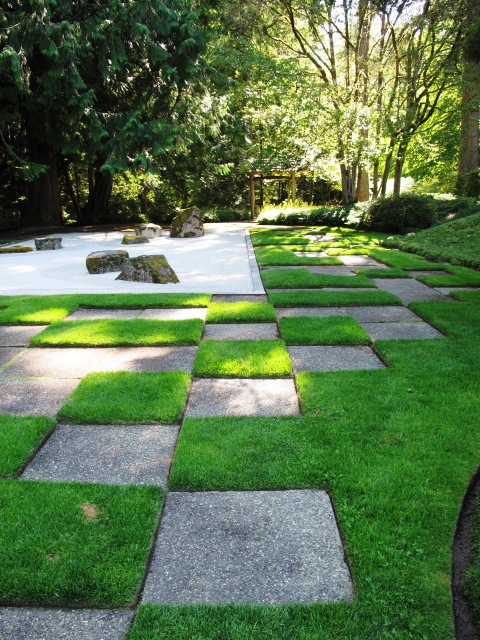
One of my favorite design details at Bloedel is this alternating turf-and-stone pattern next to the Japanese gravel garden.
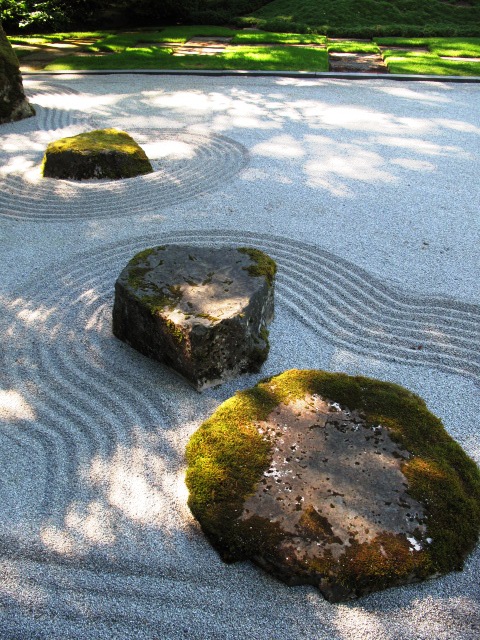
Observe and appreciate the hand-raked lines in the gravel.
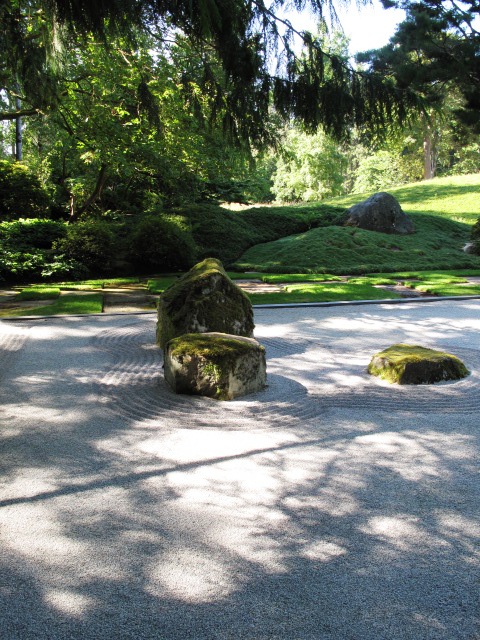
Dapple light plays on stone, gravel and moss of the Japanese garden.
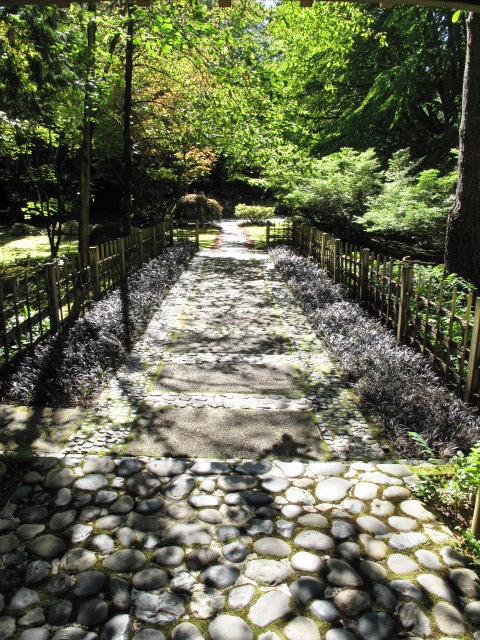
The cobbled walkway leads toward the Japanese teahouse. Note the attractive low fencing on either side, made from lashed bamboo poles.
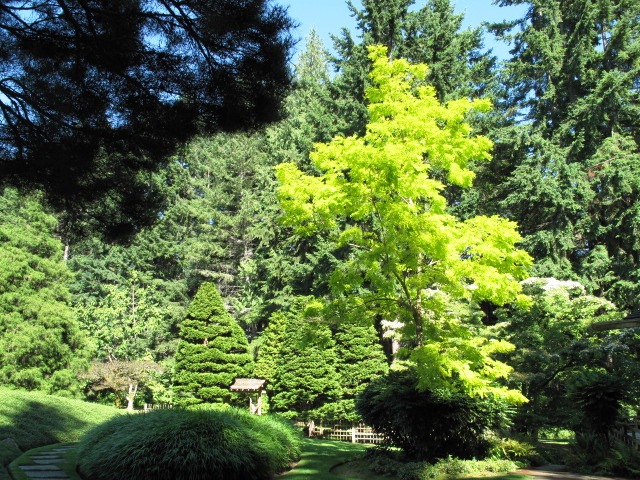
I think this is a golden form of black locust (Robinia pseudoacacia), glowing against the darker evergreens.
Bloedel Reserve, 7571 NE Dolphin Drive., Bainbridge Island, WA 98110-1097
phone: 206-842-7631
Open: 10 a.m.-4 p.m. Wednesday-Saturday (summer hours – open 10 a.m.-7 p.m., Wednesday-Friday); Sunday 10 a.m-4 p.m. (open Memorial Day, July 4th and Labor Day).
Admission: $12 (discounts for seniors, military and children 5-12; children under 5 are free).
Membership info: At $55, the basic annual membership is a great bargain because a single membership entitles you to bring a total of 4 people each visit.
Posted in Entertainment, General, Landscape Design, Plants, Writing | 3 Comments »
© Debra Prinzing, all written and photographic content. Website design/development by Willo Bellwood/Metric Media