Debra Prinzing

Get the Email Newsletter!

Archive for the ‘Writing’ Category

Growing Your Own Vegetables with Lorene Edwards Forkner

Tuesday, May 12th, 2009
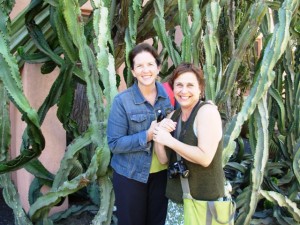
Lorene, visiting a waterwise garden in San Diego, 2007

Lorene, visiting a waterwise garden in San Diego, 2007

I am so proud of my gal-pal Lorene Edwards Forkner and her latest book, Growing Your Own Vegetables (Sasquatch Books, 2009, $17.95).

An inspiring and essential compendium of vegetables and herbs to grow in your own backyard, GYOV is the first in Sasquatch’s series of single-topic references inspired by the late Carla Emery’s The Encyclopedia of Country Living.

If you came of age in the 1970s, you’ll remember this huge Yellow Pages-like tome. More than 600,000 copies have (and continue to be) sold over the years, even though Carla passed away in 2005.

growingyourownvegetables001It’s a good thing that Lorene was a back-to-the-earth gal long before modern-day foodies who are just discovering the joys and benefits of tending to their own edible plants.

She writes confidently and lovingly about all the great veggie and herb crops that have grown in her potager over the years. In GYOV‘s 180 pages, Lorene’s lively, conversational tone makes the idea of planting and tending one’s own food sources sound easy and achievable. There’s no right or wrong here, just an enthusiasm that says, “Come on, you can do it, just try!”

Lorene hints at an early obsession with urban farming in her introduction to GYOV, in which she thanks her parents “who allowed me to dig up our backyard, plant corn, and walk away.”

That curious opening prompted me to request the “back story” when Lorene and I spoke by telephone last week. Here’s her true confession:

“It was the mid 1970s, I think I was in junior high school. One day, I tore up about one-third of our backyard and planted it with corn. Then I lost interest and walked away. Oh my goodness, it turned into the biggest mess! I was in so much trouble because what I created was everything that ran against my father’s neat-and-tidy instincts. It was total chaos. And that was truly my first garden.”

Lorene and me, visiting the famed Lotusland in Santa Barbara (2007)

Lorene and me, visiting the famed Lotusland in Santa Barbara (2007)

Not much later Lorene went to college and married her high school sweetheart James (that’s where I met up with them in the late 70s-early 80s in Seattle). 

After a successful career in art, garden design and nursery ownership, Lorene joined the writing profession in earnest several years ago. One day last spring, Lorene met with Gary Luke, Sasquatch’s editorial director. He showed up carrying the latest edition of ECL (which was about to celebrate its 35th anniversary of the first printing).

That’s when Lorene proclaimed: “I know this book. I bought it in college. I knew who Carla was and what she was about.”

With one Sasquatch title under her belt, the hilarious and irreverent Hortus Miscellaneous, Lorene agreed to tackle editing and rewriting the first two single-subject adaptations of ECL.

She’s an amazing writer, but this project called for more than good composition skills. It required a dose of literary anthropology and journalistic archaeology to dissect the 900-page, 3.5 pound title (yes, she weighed ECL’s 10th edition to verify this fact) and turn out a very readable, user-friendly Veggie Manual.

READ MORE…

Spring Garden Books for Mother’s Day gift-giving

Monday, May 4th, 2009

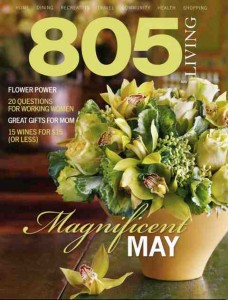
805-may-09001My “In the Garden” column for 805 Living’s May issue is all about great gardening books to give Mom (or keep for your own shelves).

Grow your garden library: Just like plants, you can never have too many books that inspire and intrigue

By Debra Prinzing

I was on the East Coast recently to lecture at the Philadelphia Flower Show. While sharing gossip and a glass of chardonnay with my NYC-based literary agent, Sarah Jane Freymann, conversation turned to the sorry state of book publishing.

“When I give a gift,” she proclaimed in her always-alluring British accent, “I only buy books.” Her singular gesture of thoughtfully choosing, buying and giving a book (rather than an impersonal gift card) might be an important element of the reading person’s economic stimulus package.

In early March, I visited Philadelphia and met up with book-lover and awesome agent, Sarah Jane Freymann

In early March, I visited Philadelphia and met up with book-lover and awesome agent, Sarah Jane Freymann

Books, especially when they are hand-picked for the reader, convey as much about the giver as the recipient.

For my birthday, my writing mentor, Paula Panich, recently gave me American Writers at Home, by J.D. McClatchy, a fitting tome for a journalist who covers architecture, interiors and the garden – all aspects of the home. When Britt Olson, my best friend from high school, recently wed, she spent hours at the book store, choosing just the right hard-bound volume for each of her attendants. For me, she selected Barbara Kingsolver’s lovely memoir of a year growing her own food, Animal, Vegetable, Miracle, which fed my spirit and mind alike.

If you’re like me, you can “read” a person by observing the titles that fill her bookcase. So here’s a peek at what’s on my bedside table (a new crop of gardening books). Whether for Mother’s Day, a friend’s birthday, or just for your own pleasure, give the gift of a book. As the author of five books, I thank you.

A Rose by Any Name

By Douglas Brenner and Stephen Scanniello [Algonquin Books of Chapel Hill, 2009, 320 pp., $19.95]
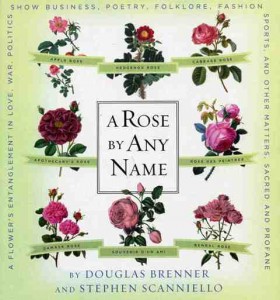
805-may-09002I met Stephen Scanniello, president of the Heritage Rose Foundation, in a Chicago radio studio several years ago. We enjoyed our banter with the host of a garden show, but the conversation continued well after the gig was over. His favorite subject? Roses. Scanniello lives, breathes, and designs gardens with roses. Not those scentless, thornless pageant variety roses, but ones with  storied pasts and interesting pedigrees. He teamed up with co-author Douglas Brenner, a former Martha Stewart Living garden editor, to document the origins, history, and lore of more than 1,200 rose names.

Their enchanting narrative follows the trials and tribulations of this beloved flower through the centuries to modern time. The rose has been entangled in love, war, politics, show business, fashion, sports and even automobiles (yes, the ruby-red ‘Chrysler Imperial’ rose was bred in the 1950s, right here in California).

A Rose by Any Name features all sorts of facts and anecdotes about the world’s most popular flower. There is even a chapter devoted to celebrity-named roses, including ‘Barbra Streisand’, a glamorous purple-blushed lavender rose that the star selected from a field of potential candidates. Even we nobodies can have a personalized flower. “As with vanity license plates, anybody can have his or her name officially conferred upon a rose,” the authors write. “All it takes is a phone call and a big check.”

Designer Plant Combinations

By Scott Calhoun [Storey Publishing, 2008, 240 pp., $18.95]

805-may-09003I’m a sucker for artful color combos,and I can often be found playing with paint-chip samples at the hardware store or mixing and matching blooming plants at the nursery. But here’s a guide that color-dreams for me. Designer Plant Combinations features inspiring techniques the pros use to pair color, texture, scale and form in the garden.

Tucson-based garden designer and book author Scott Calhoun is easy to envy for his writing and photography talents. Except that since he’s so likeable and engaging, I end up hungrily waiting for the next installment of his thoughts and images that appear in book form. And this vibrant guide doesn’t disappoint. Calhoun crisscrossed the country visiting the best residential and public landscapes to study and photograph stunning plant vignettes. Each of the 105 design schemes include six plants or less, which will inspire both designers and non-designers in their garden-making efforts. Detailed plant lists and photographs show you how to replicate the ideas in your own garden.

The book’s oh-so-alluring imagery is more than just eye candy, though. Calhoun explains why these perennials, ornamental grasses, annuals, ground covers, woody plants and dramatic accent plants are hardworking ingredients of successful garden design (look for useful designer tips, such as “when using one color, use different textures”).

A consummate plantsman, Calhoun is convinced that non-plant elements are crowding his beloved specimens out of the landscape. He writes, ” . . . good plant combinations are a little like the stanzas of a poem. That is, like the stanza, they are not trying to be a whole garden but a self-contained little part of one.” Whether bold or subdued, the groupings you’ll find here will give your garden personality and elevate it to something more than ordinary.

The New Terrarium

By Tovah Martin (photography by Kindra Clineff) [Clarkson Potter/Publishers, 2009, 176 pp., $25.00]
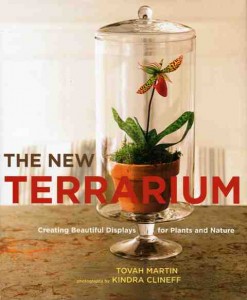
newterrariumcover001Devoted subscribers of the original Victoria magazine know the work of garden writer Tovah Martin. In her stories, Tovah brings a sense of wonderment to each of her subjects, be they gardens, gardeners or the plants they love.

Likewise, her latest project, The New Terrarium, is a magical tome filled with small, planted scenes, diminutive landscapes, twee still-lifes and dwarf collections – all under glass. This dreamy book is captured on film by photographer Kindra Clineff.

The New Terrarium pays homage to the conservatory gardens of the Victorian era, as they were the first to perfect the art of gardening under glass. According to Martin, in today’s go-go, hard-to-find-time to garden world, the terrarium may be the best way to bring something from nature into your life. “A terrarium is any transparent confine that allows you to nurture the elements of the green world,” Martin writes. “[It] is truly a small world . . . a mini-environment that provides an atmosphere of elevated humidity for all the botanical contents it embraces.”

This idea is appealing – and relatively simple to do yourself. Martin presents an array of cool glass containers suitable for planting: Traditional cloches, “Wardian” cases (miniature glass greenhouses), hurricane lamps, recycled aquariums, vases and repurposed glass domes typically used to cover cakes or cheese platters. What to grow under these unique vessels? Martin provides a comprehensive plant encyclopedia, including orchids, ferns, heucheras, begonias, mosses, African violets, bromeliads, ivies, ornamental grasses, and more.

This writer’s enthusiasm for gardening under glass inspired me to buy a small potted fern and contain it under a cloche (also called a bell jar). Living in its charming covered world, the fern, I think, will be happy. And I know I will be, too.

Home Outside: Creating the Landscape You Love

By Julie Moir Messervy [The Taunton Press, 2009, 240 pp., $30]
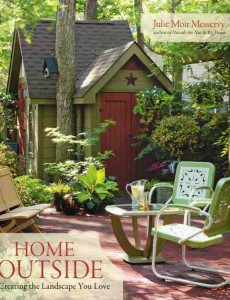
805-may-09005Julie Moir Messervy is an amazing landscape designer, author and teacher who teamed up with the likes of Yo-Yo Ma to create the Toronto Music Garden, and with architect Sarah Susanka to co-write Outside the Not So Big House.

In her new book, Messervy asks, “Why do we spend the bulk of our resources on the inside of our house, while settling for so little on the outside?” In response, she walks readers through the process of turning any property into the “home outside” they’ve always dreamed of. If, like her, you believe that the nurturing nest, the place called home, begins at the edge of your property and encompasses everything within its boundaries (the porch, the patio, the lawn where your children play – even the pathways, edges and corners), then Messervy’s book is the ideal reference to inform and inspire your design decisions. If you haven’t thought of the landscape in this way, her design approach is the perfect starting point. It will equip you with both basics and intricacies necessary to create a personal outdoor space that feeds the eyes and the spirit.

Bursting with instructive illustrations and before-and-after photographs of do-it-yourself gardens, Home Outside helps you see a property the way a landscape designer views it. Messervy breaks down the design process into manageable pieces. Take her “Designer’s Personality Test” and learn more about your style of garden-making. After completing the quiz, I discovered that I’m more expressive (versus reserved) and more relaxed (instead of orderly).

Our Life in Gardens

By Joe Eck and Wayne Winterrowd [Farrar Straus Giroux, 2009, 322 pp., $30]
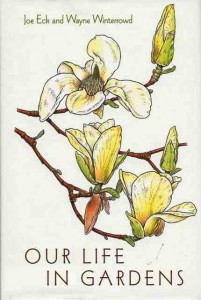
805-may-09004My aforementioned agent, Sarah Jane, has a saying about what makes a good cookbook. “It must transcend the recipes,” she posits. In other words, we can now find recipes anywhere – in magazines, on the web, in grandmother’s dog-eared “Joy of Cooking.” But what makes a great cookbook resonate is the way it touches our universal relationship with food.

Similarly, Joe Eck and Wayne Winterrowd, Vermont-based garden designers and authors, transcend the typical gardening book in Our Life in Gardens. Their collection of nearly 50 essays (arranged logically from Agapanthus to Xanthorrhoea quadrangulata) is so engaging, so gratifying to read, that you truly forget it came from the section of a bookstore otherwise filled with “how-to” titles. There is a lot to learn from these celebrated designers, but I think the lesson is more about observing and cherishing everyday life in the garden than about how to grow delicious peas.

For example, in “Pea Season,” a chapter illustrated with one of Bobbi Angell’s charming plant drawings, Eck and Winterrowd philosophize on the rewards a gardener receives outside of the vegetable plot. The chapter opens with these lines: “No one can say that a gardening life is rich in leisured holidays, but a gardener’s rewards are festivals, big and small, though we make little distinction there, for they are all wonderful. There are other activities in which effort and labor are so certainly followed by achievement and celebration, and anyone who takes an active hand in shaping life must know equal causes for joy. We know only our life, which is largely one of gardening.”

Written with passion and honesty, this book is a keeper. Buy two copies. One to delight in yourself and the other to share with someone who needs to be lured outdoors.

Santa Barbara Style – indoors and outdoors

Sunday, April 26th, 2009
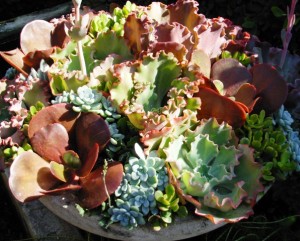
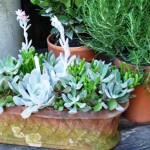
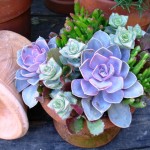
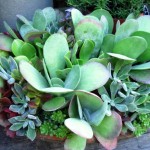
A tapestry of showy succulents, designed by Botanik

A tapestry of showy succulents, designed by Botanik

Erin (Keosian) Taylor’s  cool plant and design emporium called Botanik was one of my very first garden discoveries when I moved to Southern California in late summer of 2006.

I have Gillian Mathews, another awesome garden retailer who created Ravenna Gardens in Seattle, to thank for the introduction.

In September 2006, Gillian and Theresa Malmanger created and led the “Los Angeles-Santa Barbara Garden Tour” for the Northwest Horticultural Society. So I piggybacked on that trip and joined all my Seattle pals only 3 weeks after I moved here. I was in for a treat!

It turns out that I needed Gillian and Theresa to be my “guides” to begin to understand my new backyard.

It was the best gift they could have shared. The three-day garden extravaganza gave me a front seat tour to some amazing private gardens, public gardens and retail outlets. It fed my spirit and soul as I got to pal around with several very special, dear friends.It made me begin to realize that I was going to be “okay” living here because I started viewing SoCal’s horticultural and garden design world through the eyes of these savvy Seattle folks. That began my long education as to just how cool my new environs are.

One of our stops was the coastal village of Summerland, where Botanik occupies two cute cottages. Created by Erin Taylor, a fresh, young talent who has an amazing eye for design and a solid footing in horticulture, Botanik captured my imagination for gardening with succulents in a whole new way.

Since then, over the past few years, I’ve visited Summerland whenever I could (it’s only a few miles south of Santa Barbara off of Hwy. 101). Erin is inspiring, creative, and refreshingly casual in her design approach. She and staff designer, Molly Hutto create succulent displays like I’ve never before seen. Their creations are oft-copied but never surpassed in composition – with delicious succulent textures, colors, forms and patterns.

Botanik's entry porch converted into a potted plant display

Botanik's entry porch converted into a potted plant display

botanik7In 2007, Kate Karam and I produced a story about Botanik’s luscious succulent designs for a future Cottage Living story. We had such a great time working with Erin and Molly that day. The designs they came up with were to die for! Sadly, as you all know, Cottage Living ceased publication after the December 2008 issue and we all miss it (we miss garden editor Kate, too!) Who knows where that film will surface or whether it will at all (I’m hoping Sunset picks it up, since it’s a sister magazine).

Not one to sit around and wait, I was recently fortunate to interest another editor in Botanik. Well, that’s not fair to say because I haven’t met an editor or publication yet NOT isn’t interested in Erin and Botanik!

But, earlier this spring, Erin graciously agreed to let 805 Living create a story around her natural design philosophy for interior and exterior spaces.

My story appears in the April issue of 805 Living, with photographs by Gary Moss. Here it is for you to read and enjoy. And for those of you planning a Garden Pilgrimage to Santa Barbara (Lotusland, Santa Barbara Botanic Gardens, etc.) don’t leave town without stopping in Summerland to visit Botanik.

READ MORE…

Peace by Design: a preview

Monday, April 6th, 2009

peacebydesign0002

The filming and editing are finished and we’ve posted a short excerpt from “Peace by Design,” my new outdoor lifestyle television show produced by Robert Schauf and Tisha Fein of Branch BR3.  

We developed “Peace by Design” to bring a new level of inspiring and informative garden and home stories to the consumer. With the theme of “creating your own peaceful place – indoors and outdoors,” the show will feature my visits to and interviews with top celebrities in film, television, music and sports. We will single out stars who are passionate about their own environmental activities, sustainable practices and related themes such as living in harmony with the natural world. Each program will be supported by ideas, tips and other takeaways for the viewer who yearns to turn their own backyard into a harmonious and serene environment.

Click here for Peace by Design’s web site and to view an excerpt of the show. Now the fun begins, as we share the show with potential presenting sponsors who view Peace by Design as a multi-platform marketing opportunity. I think the visuals, the celebrity component and the varied topics come together to create an exciting new show. I welcome your response and reaction to this project. I hope you love it as much as I do!

Ides of March . . . April Fools Day . . . and more!

Sunday, April 5th, 2009

March 30 to April 3, 2009 

Los Angeles to Seattle to Yakima. Back to Los Angeles, via Seattle. Two snowstorms and lots of rain. Heavy doses of friendship.

“]The perky roofline of Michelle and Rob Wyles's hedge-enclosed gardenhouse is seen in relief against an expansive eastern Washington sky [photo by William Wright]

The perky roofline of Michelle and Rob Wyles's hedge-enclosed gardenhouse is seen in relief against an expansive eastern Washington sky, photographed by William Wright

Spring may have arrived on March 20th, but it still feels like winter in the Pacific Northwest and there I was, loving it! But to the person, my gardening pals on both sides of the (Washington State) Cascades are sick of this unfriendly weather (unfriendly, at least, to gardens, plants and gardeners).

I flew out of LAX on Monday, arriving in Seattle around 3 p.m. Not wanting to bug any of my hardworking friends, I hopped an express Metro bus from the airport to downtown’s new transit center. That $2.50 bus pass, which even included a transfer to the Number 14 city bus, got me all the way to Mt. Baker neighborhood, where I walked a few short blocks to my friend Jan’s.

She graciously lent me a bed and use of a car – not for the first time – and it felt like coming home to a place I know so well. I walked these sidewalks with my newborn son Benjamin during the summer of 1992. I feel like I have every front yard, every border, memorized. I love the perspective of the often cloud-streaked sky looming above Lake Washington. I love the tall Douglas firs and the western red cedars, the old, overgrown rhododendrons, the Craftsman architecture. This place holds good remembrances.

But it is cold here this week, colder than when my sons and I visited for the Northwest Flower & Garden Show in February. That week – Presidents’ Week – was sunny and blue-skied, with temperature in the mid 40s. Picture perfect and perfect for one’s mood.

httpv://www.youtube.com/watch?v=OSy75jcIgFA

On Tuesday morning, Lorene Edwards Forkner arrived in her trusty All-Wheel Drive Subaru and we began our 3-hour drive east to Yakima – over the Snoqualmie Pass and into Eastern Washington.

It was raining lightly; the air was cold and damp, for what is supposed to be springtime already. As we passed through North Bend and started climbing up toward the summit, the scene on either side of the freeway was cloaked in white. Beautiful, if you like a Christmas card image of dark blue-green conifers frosted with dollops of snow. But brutal for the driver. We slowed down to a snail’s pace at the peak- where truckers literally stopped in the middle of a lane to put on their chains and the little people (the cars, and their drivers, that is), skulked over to a single lane and crept through the pass at single-digit speeds.

 A DIFFERENT LANDSCAPE ALTOGETHER

Linda Knutson and Ron Sell's magnificent Yakima landscape, photographed on our October 2005 tour

Linda Knutson and Ron Sell's magnificent Yakima landscape, photographed on our October 2005 tour

With the snow behind us, our arrival in Yakima was cause for celebration. We stopped at Linda Knutson’s and Ron Sell’s, fellow Northwest Horticultural Society members who have always generously shared their four-acre, arboretum-like landscape with visitors. They participate each year in the Northwest Perennial Alliance Open Garden schedule (if you really want a treat, plan a day’s trip to Yakima to see it!)

Linda and Ron focus on texture, color, form using mostly conifers, ornamental grasses, woody ornamental shrubs, stone and artwork. Lorene and I remember with fondness our visit there in October 2005 when I led the NHS weekend tour to Yakima.

A perfect autumn scene at Linda and Ron's, which to me perfectly illustrates an analagous color scheme in plants and art

A delicious autumn scene at Linda and Ron's, which to me perfectly illustrates an analagous color scheme in plants and art

The weather was pretty unforgiving (brisk and very windy), but after a delicious spanakopita lunch, we bundled up and took a spin around the place. We stayed mostly on the pathways, but we stooped down to observe new crocuses, species tulips, galanthus, chionodoxa and (possibly) pushkinia bulbs poking their heads out of the soil. “These plants are a month behind my Seattle garden,” Lorene observed. “And my Seattle garden is a month behind its usual bloom time.” That tells you a lot about the vagaries of the Pacific Northwest winter of 2008-2009, but Linda and Ron insist that Yakima has been spared much of the snow-dump that hit Spokane and other parts of Eastern Washington (even still, we woke up to snowfall Wednesday morning, April 1st!).

Later, we met up with shedista Michelle Wyles at Garden Dance, her adorable “fashion and frou-frou” clothing emporium in downtown Yakima. She has one of the best pair of eyes for spotting innovative apparel and interior styling I’ve ever seen.

All you have to do is see how Michelle has created and adorned her charming “shed,” photographed by William Wright for our book, Stylish Sheds and Elegant Hideaways, to know what I mean.

Michelle has had a wide and varied career, including raising alpacas (Right now, the attention-getting creatures at Michelle and Rob’s home/farm are the Guinea hens. What funny poultry!)

Bill Wright's photo of Rob and Michelle Wyles, with Chester (July 2006)

Bill Wright's photo of Rob and Michelle Wyles, with Chester (July 2006)

Her garden antiques and retail business has morphed into fashion: Garden Dance is housed in Yakima’s turn-of-the-last-century train station. For about an hour, Lorene and I browsed and oohed and aahed to our heart’s content, while Michelle and her girlfriend/sales associate Stephanie helped guests and handled customers. For some delicious (virtual) retail therapy, read Michelle’s lighthearted blog, linked to her web site.

After they closed shop, we walked across the street to Gilbert Cellars, a cool wine-and-cheese bar that you might expect to find in Seattle’s Belltown district or in Santa Monica. A sampling of artisan cheeses and a sip of wine fortified us for delaying dinner until after my 7 p.m. lecture finished!

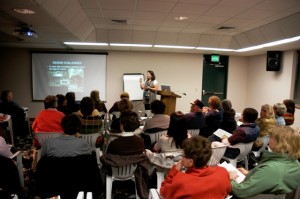
My lecture, “the Ultimate Garden Hideaway,” was the final of a four-part lecture series hosted by the Yakima Co. Master Gardeners. Held at the beautiful Yakima Area Arboretum, the lecture series was the brainchild of several incredible volunteers and MG staff, including our fellow GWA member Jim Black. The “Outdoor Room”-themed lecture series included Michelle Wyles and Linda Knutson as prior speakers.

We had a great, sell-out gathering of enthusiastic folks, from shed owners who treated me to stories of their own backyard hideaways, to shed wanna-be’s who had big dreams for their future PODs (Personal Outdoor Dwelling).

As always, I feel so at home with these “peeps,” the Master Gardeners of the world who are truly citizen-volunteers, generous, pay-it-forward folks concerned with educating and inspiring everyone to embrace the traditions and skills of growing edible and ornamental plants.

Mastern Gardener Bill Woolman, snapped this photo during my talk, "The Ultimate Garden Hideaway."

Mastern Gardener Bill Woolman snapped this photo during my talk, "The Ultimate Garden Hideaway."

Thank you to the Yakima Master Gardeners and the Yakima Area Arboretum for hosting me, and to Michelle and Rob Wyles for housing (and feeding) Lorene and me on Tuesday night. By the way, we woke up to more snow and had fun watching the Wyles poultry population racing around in the cold weather. What a hoot! (Sorry, Lorene, about locking you out of the guesthouse while I was showering away to my heart’s content. I’m glad you’ve thawed out!)

Lorene and I made it back to Seattle pretty quickly. Well, that is AFTER we spent close to an hour searching for a hard-to-find address of a Yakima trailer park (North Acres) to track down the good Samaritan (?) who called me on my cell phone with news that he had found my camera in the parking lot of Gasperetti’s Restaurant in the wee hours of April 1st. I will let Lorene have the honor of blogging about THAT experience. I just checked her terrific blog, Plantedathome.com, and I’m surprised (and a bit relieved) that to date, the photos of that “doo dad” decorated residential trailer have not been posted. Given the blackmail potential, that may be good news. I’ll await Lorene’s decision!

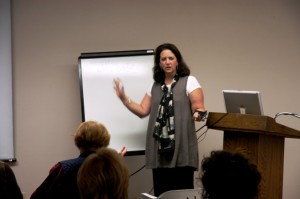
Debra, pontificating about Stylish Sheds (photographed by Bill Woolman)

Debra, pontificating about Stylish Sheds (photographed by Bill Woolman)

All in all, this was a good trip. I felt like the Energizer Bunny, squeezing in more friends and networking encounters than anyone could imagine. I had a wonderful evening with the Woodinville Garden Club (thank you to Susan Latter for the invitation to speak), and several excellent encounters with creative people (the subject of future blog posts).

I’ve been home in Southern California for about 36 hours and I can’t wait to stay here for a while. I can’t imagine leaving my family or my garden for one more moment. It’s hard to believe, but I have traveled on seven adventures since I went to Orlando in mid-January. As inspiring and exciting and stimulating as these lecture venues, flower shows, press junkets and garden tours can be, I know they just delay me from sinking my roots deeper in the patch of earth for which I’m responsible. So it’s time to stay put for a while.

It’s Palm Sunday and time to celebrate the gift of life, the gift of love and the gift of nature.

Peace by Design: My TV show

Friday, March 27th, 2009
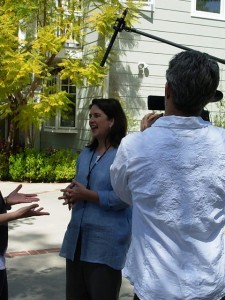
Filming the pilot episode of "Peace by Design"

Filming the pilot episode of "Peace by Design"

My friends know I am a PRINT person – I love magazines, newspapers and books. I’m kind of okay with the Internet, because blog posts and web sites still involve using letters to compose words and words to create sentences . . . all of which are ultimately read as the printed word.

So this week has been one of those out-of-the-comfort-zone experiences as I “played” at being a television host. Robert Schauf, my amazing and intuitive producer, keeps telling me that talking to the camera is just like talking to a friend (a conversation!). . . and I’m starting to believe him. I just have to imagine all my friends hiding behind the HUGE black lens held by the cute camera guy, John. And then, just talk. Naturally.

Okay, I need to back up. I met Robert Schauf in 2006. It was one of those Kismet moments. It will sound so cliche, but we met on an airplane flying on business class from Burbank to Newark (a Jet Blue flight). I’m pretty unfamiliar with business class, but somehow I was bumped up to that rarefied section because it was the last seat on an overbooked flight. I was on my way to speak to a garden club in New Jersey and absolutely had to make that flight or I would miss the lecture entirely.

Robert, who hops comfortably back and forth between NYC and LA, was returning from a business trip. How do I describe him? He’s tall and slender, he wears the kind of clothing that my teenage son might wear (hip jeans, long-sleeved t-shirts, lace-up Keds) and his shocking white-platinum hair kind of sticks out all over his head. Robert has that Rocker-dude look and frankly I didn’t know what to think of him at first. But we talked nonstop for something like 5-1/2 hours. I was so fascinated with his stories of producing television specials and working on the Grammys. I told him about my new project – about garden sheds! – and described my plans to scout sheds in the Hamptons and NYC after I finished my New Jersey lecture. We exchanged business cards and subsequently swapped a few emails. That was it.

READ MORE…

It’s official: Stylish Sheds and Elegant Hideaways is “Award-Winning”

Monday, March 23rd, 2009

09-awards-logoThe tan envelope arrives in today’s mail. I open it up, hardly able to focus on the letter from Denise Cowie, chair of the 2009 Garden Writers Association Media Awards program.
But, yes, it seems I read this right. “Your entry has received a Silver Award of Achievement,” the letter explains.

The work: Stylish Sheds and Elegant Hideaways

The category: Writing, book

new-book-cover-webAfter whooping it up with my husband, Bruce, I call Jennifer Gilbert at the GWA headquarters to ask whether a letter was sent to Clarkson Potter regarding the “Overall Product” category (which encompasses writing, photography, design and production).
Yes, she assures me, Stylish Sheds has also won a Silver Award for Overall Product. The letter went to our editor, Doris Cooper.

Then I call Bill Wright in Seattle. “Did you open your mail yet?” I ask. “Do you mean my e-mail?” he replies.

“No, your regular mail.”

“It hasn’t come yet today.”

“Oh, well, guess what? We won a Silver Award from Garden Writers for Overall Book Product and I won a Silver for Writing.”

His reply? “Yeah, I got the letter on Saturday saying I won a Silver for Photography.”

What? How could he not be as excited as I am?! He’s known for two days and he didn’t call to tell me!!!

Maybe I’m putting too much emphasis on this, but I love to win – and I love accolades. (Sorry, I know that statement reveals my desire for human affirmation. It often puts me in a bad position because sometimes my motivation to write is more for the accolades than a paycheck!)

Stylish Sheds and Elegant Hideaways, this labor of love, has been positively recognized by many reviewers, purchased by book buyers, and supported by our patient family and friends. That should be reward enough.

But just this once, it’s nice to win something. Even if it’s merely a “certificate” that you can take home and frame.

P.S. We’re eligible in all three categories (Writing, Photography and Overall Product) to be judged for a Gold Award. But we have to wait until the 2009 annual symposium in Raleigh, North Carolina (in September) to know the results.

Erin Benzakein’s seasonal and sustainable flowers

Saturday, March 21st, 2009
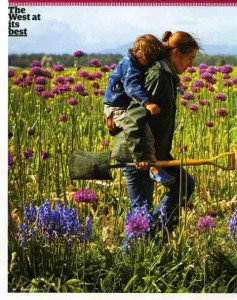
Read "The West at its Best," pages 20-21

Read "The West at its Best," pages 20-21

The April 2009 issue of Sunset magazine features my friend Erin Benzakein of floret flowers. Erin is a young organic flower farmer and talented floral designer who values seasonal ingredients for her bouquets and uses sustainable practices to raise a wide array of flowers, blooming shrubs and attractive foliage.

I met Erin in the spring of 2006 through her father David Perry, a gifted photographer (that was the first day I met Dave, too, when we teamed up on a garden scouting excursion after being introduced by a mutual colleague). That meeting, at Waverly Jaegel’s antique rose-filled garden in Skagit Valley (Washington State), was the beginning of two inspiring and invigorating friendships for me.

The three of us talked about our mutual passion for locally-grown blooms. Erin and I discovered our love of floral design that’s “in the moment,” depending on what’s in bloom in one’s own garden, or what you can find at the farmer’s market, from a friend’s flowering shrubs, or even foraged in the wild. That’s the essence of seasonal and sustainable floral design. It begins with the farmer who raises those blooms with care for the land and agricultural workers alike.

Over time, Erin, David and I realized we all hold a dream of some day creating a book about this topic. We hope it will be filled with stories that I write, photographs that David captures through his lens, and – of course – flowers that Erin grows and arranges. Whether it happens and in what form, time will tell. In the meantime, we are beginning to document the best stories of growers and designers with organic values. You can see some pretty exciting photographs on A Photographer’s Garden Blog, David’s visually alluring online journal.

David and I shared Erin’s story with our editors at Sunset who agree that she has an unique and compelling passion and philosophy – one worthy of a feature in the magazine. The piece appearing in Sunset’s April issue, out now on newsstands, is spread across two pages with David’s evocative photo of Erin, carrying her son Jasper on her back, as she walks through rows of giant alliums. My Q-and-A with Erin has been reduced to just a few lines, but you can read my full interview with her here: 
Erin and Jasper, mother-and-son organic farmers

Erin and Jasper, mother-and-son organic farmers

The Western pioneer: Budding ambition

Erin Benzakein has turned her two Washington acres into a sustainable flower farm

By Debra Prinzing | Photography by David Perry

Erin Benzakein became captivated with fresh-from-the-border flowers while working on a Seattle estate’s garden crew. “I never before thought you could go into your yard and cut so many flowers. They looked like the Dutch paintings – perennials, berries, vines, floppy roses – all spilling out of a huge vase.”

Inspired, Benzakein planted two rows of sweet peas to create a fragrant “tunnel” (“I wanted to walk down it, just for the experience,” she confides). Suddenly, the 29-year-old mother-of-two became a flower farmer. “It was a done deal. All the vegetables got ripped out and were replaced with flowers.”  Since 2007, with her husband Chris Benzakein and their “bunch runners” (9-year-old daughter Elora and 6-year-old son Jasper), Benzakein has operated Floret, a 2-acre certified organic flower farm in Mt. Vernon, about 90 minutes north of Seattle.

Why are sustainable flowers important?

Eighty percent of the cut flowers we buy in the U.S. are imported from countries that do not have worker safety or pesticide regulations. I don’t think we should sacrifice the health of our earth, or that of the farmers, their children and animals, just to have a bunch of pretty blooms on our kitchen tables. If you buy your flowers locally – at a farmer’s market, from a roadside stand, or a grocery store that sources bouquets from local growers – they’re probably sustainably grown. You’ll help eliminate the use of jet fuel that flies flowers to America, keep money in your local economy and enjoy healthier and fresher blooms.

READ MORE…

Home Wizards Radio, gotta love it!

Friday, March 20th, 2009

Cindy Dole is LA’s home improvement and design go-to gal on the AM dial. You can hear her “Home Wizards” show each Saturday morning for a full hour on KRLA 870-AM. Cindy chooses all of her music openers and transitions – each number is whimsical and creative. The morning I appeared, she opened the show with the Crosby, Stills, Nash & Young song “Our house is a very, very, very fine house . . . .” – A perfect segue into a conversation about home, haven, design and interiors.

I appeared on the March 14, 2009 edition of "Home Wizards" radio in LA

I appeared on the March 14, 2009 edition of "Home Wizards" radio in LA

Cindy invited me to be a guest on last Saturday’s show to talk all about my favorite subject: personal backyard escapes (aka SHEDS).  We’d been waiting several weeks to do the program, mainly because at this time of year I have too many Saturday lectures or trips. What a treat to finally arrive at her studio in Glendale early last week and meet Cindy in person. She is vivacious and knowledgeable, serving as both executive producer and host of her long-running show.

We found an instant rapport, along with my fellow studio guest, a Los Angeles floral and garden designer George Woods. George and his partner and wife Evonne Woods own The Woods Exquisite Flowers in Culver City.

When Cindy introduced my segment, she promised that we’d talk about “Man Caves” and “Gal Palaces.” I’ve heard lots about the man-cave movement, both here in the U.S. and also in the U.K. But I really love the gal-palace correlary. Looking forward to using those distinctions in my upcoming talks – it’s often not too hard to tell the difference between the styles.

If you want to listen to the interview, Cindy has it posted on her web site in two parts, about 15 minutes total. Enjoy and let me know what you think! Part One and Part Two.

When I saw George Woods’ beautiful floral arrangement that he and Evonne brought to the studio, I knew they were kindred spirits – people who appreciate flowers in season and who are far from traditional in their design approach.

Cindy Dole with George and Evonne Woods - and their gorgeous arrangement of spring blooms

Cindy Dole with George and Evonne Woods - and their gorgeous arrangement of spring blooms

Displayed in a low, square glass vase, combining a palette of greens and vibrant oranges, reds, and purples, George’s design drew from a wonderful mix of flowers and foliage. 

His fresh, new “happy” spring green came mostly from a surprise ingredient: ephemeral Maidenhair Ferns; plus, Algerian variegated ivy, pale green viburnums and hydrangea blooms. Parrot tulips, ranunculus, roses, anemones and some pretty awesome dark purple and fuchsia-colored sweet peas comprised the brighter hues. So breathtaking. Plus, all the stems of these cut flowers and foliage were hidden in a woven “nest” of just-sprouting willow that George used to line the vase.

A lucky listener won the arrangement, but I certainly lusted after it, too. I can’t wait to see what else George has designed (he promised to take me to a certain garden on a Malibu hillside very soon!).

A POD in the Garden (POD=Personal Outdoor Dwelling)

Saturday, March 14th, 2009
San Francisco's hottest garden and plant emporium, Flora Grubb

San Francisco's hottest garden and plant emporium, Flora Grubb

A great gathering of Shed-Fanatics joined me at Flora's

A great gathering of Shed-Fanatics joined me at Flora's

After my exhausting trip to the wintry Philadelphia Flower Show, I returned to LA for a quick overnight to recharge my batteries with my family.

Then, last Thursday, I returned to Burbank to fly north to Oakland.

My friends at the Garden Conservancy invited me to share my fascination with sheds and hideaways at an evening benefit lecture.

Hosted by horticultural celebrity Flora Grubb at her eponymous urban emporium, the after-hours event included cocktails and hors d’oeuvres among Flora’s awesome collection of palms, succulents, Mediterranean and drought-tolerant plants – and more.

Flora and Debra, smiling in this great garden setting

Flora and Debra, smiling in this great garden setting

She curates this environment with an eye for design, style and presentation. Furniture selections, displayed among plant groupings really “pop” – from avant-garde concrete chaises to retro-salvaged circle lawn chairs (see below for specifics).

The playfulness with which Flora and her staff have created this plant-centric lifestyle just puts a smile on my face. I’ve heard and read about this cool SF destination nursery for a few years and am thrilled to have been given a great excuse to travel and speak there.

Thanks for the experience begins with my friend Margo Sheffner, who is Flora Grubb’s book buyer extraordinaire. Margo, who is also the business manager for the Pacific Horticultural Foundation (a nonprofit of which I am board member), was an early fan and supporter of Stylish Sheds and Elegant Hideaways. She brought it to Flora Grubb’s and continues to update me about how Flora’s customers “get” the notion of backyard sanctuary, habitat and haven. And that translates into book sales (which is so reassuring in this non-print phase we’re in). Yeah! It makes me happy to see our book in this cool environment.

Here’s a little gallery of Flora Grubb’s Garden. You will love every image:

Credit for my lecture title, “A POD in the Garden,” goes to Garden Conservancy west coast program manager and all-around horticultural go-to gal, Betsy Flack. She came up with the idea of using the acronym P-O-D (as a personal-outdoor-dwelling). I love it! This is my new buzzword. Stylish Sheds includes a chapter about Loretta Fisher’s “Mod Pod” in Austin, so Betsy’s title is apropos. Betsy and her assistant Maria Martinez (along with several Garden Conservancy staff, friends and volunteers) put on a lovely evening. I felt welcomed among so many kindred spirits.

The following morning, I stopped by Dwell's editorial offices to say hello to Miyoko

The following morning, I stopped by Dwell's editorial offices to say hello to Miyoko

Before I started my talk, Betsy invited Miyoko Ohtake, associate editor at Dwell magazine, to share a few words. Miyoko is a talented young architect-journalist who joined Dwell last summer after impressive gigs at Wired and Business Week.

She contacted me in August to ask if I could serve as Dwell’s guest expert for a review of prefabricated sheds (February 2009 issue). It was great to finally meet her in person and to also have the audience meet Miyoko and hear her enthusiasm for modern outdoor design. Dwell supported the event and Miyoko blogged about my talk in advance of the evening.

Then, Flora invited her architect-friend Seth Boor, AIA, of SF’s Boor Bridges Architecture, to comment on the city’s zoning issues relating to shed construction.

It was a stroke of brilliance to include Seth on the program. He and Flora (and her partner Kevin Smith) recently collaborated on a very cool planted-wall installation at a hip, new Napa Valley hotel called Bardessono. The project was recently documented by Stephen Orr in the New York Times. So we were in excellent company (oh, and how cool is this? Stephen was in the audience – what a sweet guy to come hear my talk).

Among other remarks, Seth touched on the permit and installation parameters for anyone wanting to add a backyard shed in San Francisco:

  • No permit is required if you build an outdoor structure under 100 square feet in size and no taller than 8 feet high.
  • The configurations can vary. For example, the structure can be 10-by-10 feet or 8-by-12 feet in size.
  • As for height, as Seth pointed out, “Eight-feet-tall is a little short” but you can work with it.
  • Working without a permit “frees you up to do anything within that size,” he says
  • Also, if the structure isn’t permitted, the typical setback rules do not apply. However, there is the “good neighbor” rule and Seth recommended that shed-builders think about how a 100-sf structure will appear to a neighboring property.

Debra’s note: Creative shed-owners are already aware of this issue. I’ve seen shedistas carefully paint, embellish and artfully adorn the side of their structure that faces a neighbor’s lot. Good shed policy!