Debra Prinzing

Get the Email Newsletter!

Archive for the ‘Plants’ Category

It’s time to think about spring in the garden

Tuesday, January 13th, 2009

Yes, it may only be the second week of January, but our Noble firs and cedar boughs are now past their prime (and in my case, at least) cut up and ready for recycling in the yard-waste bin.

Onward to spring!

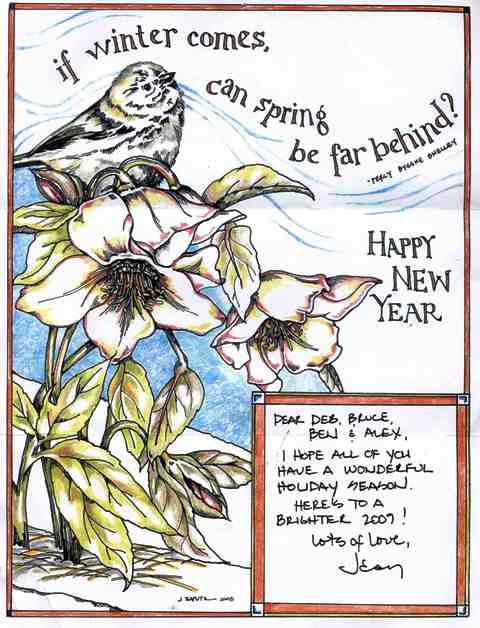
To get me in the mood, I have this inspiring drawing pinned next to my desk.

My friend Jean Zaputil, an artist and garden designer, illustrated and hand-colored it as a most charming New Year greeting.

The scene depicts a songbird perched on top of a hellebore, with the wistful and compelling lines, which read:

“If winter comes, can spring be far behind?” 

[attributed to Percy Byssne Shelley]

Perhaps this saying will give you something to hold onto in the dormant months of winter! Spring is coming soon!

Also getting me in the mood for spring: Country Gardens’ early spring 2009 edition, which just arrived in my mailbox. 

I opened it up to find my story about friend and designer Bonnie Manion, owner of Mon Petit Chou, a vintage design business based in Encinitas, California. Bonnie blogs at VintageGardenGal – a cheery and charming spot to visit – you’ll want to do so frequently!
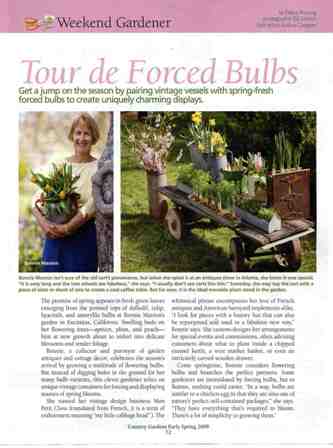
The story, commissioned by James A. Baggett, editor of Country Gardens, is called “Tour de Forced Bulbs,” and it features Bonnie’s designs pairing forced spring bulbs with forced flowering branches – arranged in vintage containers.
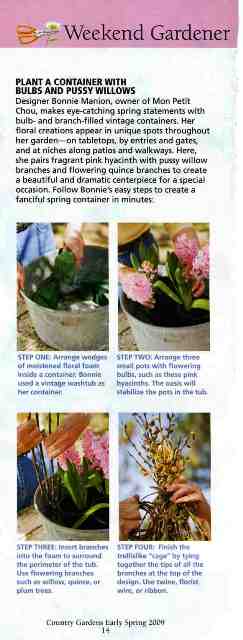
Here is the story in its entirety. A shorter version appears in the magazine, along with the step-by-step instructions for planting a container with hyacinth bulbs and pussywillow branches. The story was photographed by Ed Gohlich and produced by field editor Andrea Caughey.

TOUR de FORCED BULBS: Get a jump on the season by pairing vintage vessels with spring-fresh forced bulbs to create uniquely charming displays.

The promise of spring appears in fresh-green leaves emerging from the pointed tops of daffodil, tulip, hyacinth and amaryllis bulbs at Bonnie Manion’s garden in Encinitas, California. Swelling buds on her flowering trees – apricot, plum and peach – hint at new growth about to unfurl into delicate blossoms and tender foliage.

Bonnie, a collector and purveyor of garden antiques and cottage décor, celebrates the season’s arrival by growing a multitude of flowering bulbs. But instead of digging holes in the ground for her many bulb varieties, this clever gardener relies on unique vintage containers for forcing and displaying masses of spring blooms.

She named her vintage design business Mon Petit Chou (translated from French, it is a term of endearment meaning “my little cabbage head”). The whimsical phrase encompasses her love of French antiques and American barnyard implements alike.

“I look for pieces with a history but that can also be repurposed and used in a fabulous new way,” Bonnie explains. She custom-designs her arrangements for special events and commissions, often advising customers about what to plant inside a chipped enamel kettle, a wire market basket or even an intricately-carved wooden drawer.

Come springtime, Bonnie considers flowering bulbs and branches as the perfect partners.

Some gardeners are intimidated by forcing bulbs, but to Bonnie, nothing could easier. “In a way, bulbs are similar to a chicken egg in that they are also one of nature’s perfect self-contained packages,” she says. “They have everything that’s required to bloom into a flower. There’s a lot of simplicity to growing them.”

Using fresh-cut branches, the flower and leaf buds of which have yet to open, requires little effort, Bonnie adds. Whether brought indoors for flower arranging, or used as accents to planted containers, the tiny buds slowly open until flowers gracefully unfurl. “They last quite a while, especially if you keep the branches in water,” she advises.

With a spring palette ranging from soft pastels to bright primary colors, bulbs and branches pair companionably with timeworn artifacts of the past. “I like the yin-and-yang of it. To me, the weathered patina of old containers goes well with the colors of my spring bulbs.”

To grow bulbs in containers, Bonnie begins with the right vessel, selecting an eye-catching piece with a generously-sized opening at the top. Bulbs don’t require much root space, meaning that even a four-inch-deep wooden box is adequate as a planter. Deeper containers can be used as well. “You can keep the soil level low around the bulbs, and use the height of the container to support bulbs such as paper whites or amaryllis, as they grow tall and reach for sunlight,” Bonnie says.

Interesting vintage containers include chicken feeders, tool carriers, old boxes or pails, hay racks, sugar tins, large and small funnels, oil cans, children’s wagons or carts, old urns, kitchen strainers – “virtually any container with a wonderful vintage character,” she says.

Bonnie’s finished designs look spontaneously fresh. “I get a lot of my plant and container ideas from my travels,” explains this vintage garden gal.

She frequents large and small flea markets and other off-beat vintage garden antique sources around the country and occasionally visits Europe for inspiration. “I might see a single potted rose in a Paris flower shop. Or, I’ll discover a dramatic floral arrangement in a London hotel lobby and try to recreate it at home.”

Bulb-filled vintage containers never fail to make a statement. “Put them in a setting in your garden where you need some ornamentation,” Bonnie suggests. “You can have fun bringing old pieces back to life and making them functional again. Get as creative as you like, and your pieces will be uniquely you!”

Forcing Bulbs

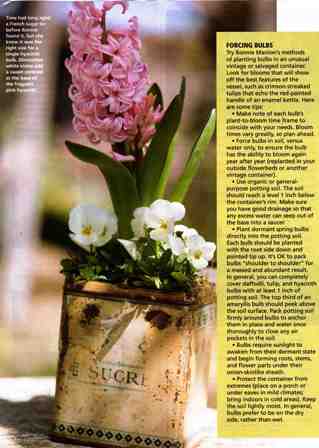
Try Bonnie Manion’s methods of planting spring-flowering bulbs in an unusual vintage or salvaged container. Look for blooms that will show off the best features of the vessel, such as crimson-streaked tulips that echo the red painted handle of an enamel kettle. Here are some tips:

  • Make note of each bulb’s “Plant-to-Bloom” timeframe to coincide with your needs. Bloom times vary greatly and you will need to plan ahead when planting.
  • Forcing bulbs in soil, versus water only, will ensure the bulb has the ability to bloom again year after year (replanted in your outside flower beds or another vintage container).
  • Use organic or general-purpose potting soil. The soil should reach a level one-inch below the container’s rim. Make sure you have good drainage so that any excess water is able to drip out of the base (you may need to use a saucer to protect furniture or windowsills from water damage).
  • Plant dormant spring bulbs directly into the potting soil. Bulbs should be root-side down and pointed-tips upward. It’s okay to pack bulbs “shoulder to shoulder” for a massed and abundant result. In general, you can completely cover daffodil, tulip and hyacinth bulbs with at least one inch of potting soil. The top third of an amaryllis bulb should peek out above the soil surface. Pack potting soil firmly around bulbs to anchor them in place and water once thoroughly to close any air pockets in the soil.
  • Bulbs require sunlight to awaken from their dormant state, and begin forming roots, stems, and flower parts under their onion-skin-like sheath.
  • Protect the container from extremes (place on a porch or under eaves in milder climates; bring indoors in colder ones). Do not let the soil dry out, but keep it lightly moist. In general, bulbs prefer to be on the drier side, rather than wet.
  • If you want maximum versatility with your designs, plant bulbs in small plastic nursery pots. One or two bulbs will fit inside a six-inch, soil-filled pot. You can plant up dozens of bulbs and care for them using directions above. Once they begin to bloom, arrange the bulbs inside larger containers and layer Spanish moss on top to cover your secret.

Check out one of Bonnie’s favorite bulb sources: Easy-to-Grow Bulbs.

Forcing Branches

Young branches of woody trees and shrubs are supple and pliable in the spring. This makes them easy to weave into trellis-like designs as Bonnie has done. If you cut the branches before their flower or leaf buds open, you can bring them indoors for long-lasting vase arrangements. Better yet, add cut branches to outdoor containers as a complement to spring bulbs. Here are some general guidelines:

  • Look around your landscape for inspiration. Do you have a golden forsythia, coral-bark maple, or flowering plum? As many of these woody plants are in need of early spring thinning or pruning, save the cut branches for container or vase designs. A neighbor might also allow you to lightly prune a few branches. In late winter or early spring, local markets or florists are good sources for cut branches, such as curly willow, quince, or witch hazel.
  • Use a pair of clean, sharp garden shears, secateurs or loppers to branches at a 45-degree angle. Make the cut at the bottom of a stem where it joins a larger branch.
  • You can stick the pointed base of each cut branch directly into the planting soil, at least three inches deep. As you water your bulbs, the branches will soak up needed moisture to keep the buds plump until they bloom.
  • You can also arrange cut branches in a water-filled vase. Flower preservatives can keep the water muck-free, but nothing’s better than replacing water daily.

Great plants, great friends

Friday, January 9th, 2009

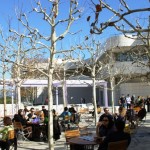
This post aspires to nothing more than sharing with you my garden-gal outing two days ago to the Getty Center in LA. I had a lovely “New Year’s” lunch with garden designers Linda McKendry (of Linda McKendry Design) and Laura Morton (of Laura Morton Garden Design).

We toasted the New Year and talked about our goals, our wishes, our dreams, our *resolutions* and a bit of reality. After lunch, the three of us took an afternoon stroll through the Getty’s Robert Irwin-designed garden.

The light was beautiful. The plantings were surreal. Enjoy!

January 1st – a day to garden

Thursday, January 1st, 2009

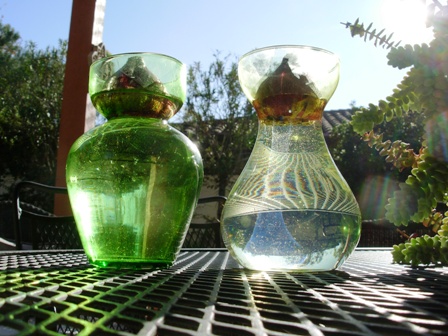
Enjoy this photo gallery of some of my New Year’s gardening projects, accomplished today. I’ll add a few comments with each image to explain what I did. Above: Two hyacinth bulbs from Brent and Becky Heath’s care package – I saved them to grow in these glass bulb vases in my kitchen windowsill.

The blogosphere and Twitter world have been busy today, with my friends and those whose work I admire/read writing about resolutions, garden mission statements, and more. I have really tried to tear myself away from the keyboard and screen. It’s ironic that I spend more time here at my desk – looking through the open shutters to the backyard – than I do actually touching, breathing and engaging with said yard.

So today I decided to spend time on gardening projects. I am stiff and tired. Six hours straight – pruning and deadheading, digging up, wheeling the barrow to and fro – is not my typical schedule these days. And I am determined to return to this routine (or an edited version of it) in 2009.

Because you know what? I’m feeling very happy.

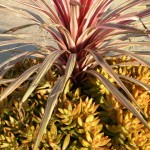
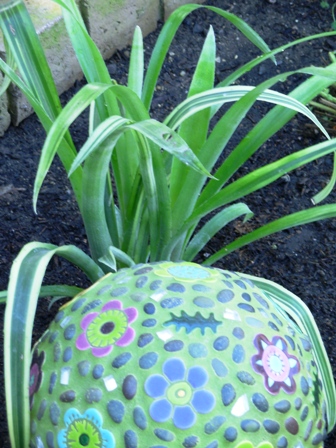
At left: I finally planted this beautiful Billbergia nutans ‘Variegata’, which I am embarrassed to say I purchased in March 2008 at Western Hills Nursery in Occidental, Calif., during our post-SF Flower & Garden Show garden-gals’ field trip. Miraculously, this plant has not only endured, but seemingly thrived in a 6-inch pot all these months. It is a beautiful, strappy, striped plant and doesn’t it look nice with the Clare Dohna mosaic orb?

What’s been holding me back anyway?
Since leaving behind my cherished garden in Seattle in August 2006, and moving to what many people think is heaven on earth – Southern California – I have been fairly disengaged with my new yard. As I’ve said before, I can’t really call it a garden. It’s really just a yard filled with plants I don’t understand or particularly like. I’ve had bursts of energy now and then to try and tackle things, including hiring someone a year ago to dig up and haul to a landscaping dumpster a yard’s worth of big red lava-rock mulch that covered every surface of soil.

But my heart hasn’t been in it. My heart is so torn between my past life and my present life. Surely, I am a lucky woman. I have my family who I cherish. I have so many wonderful friendships that continue, regardless of whether I’m in Washington State, California or other places around the globe. I manage to keep writing articles about gardens and design topics that really get published by tangible publications (that’s a shocker) and so what’s the problem?

At right: Senecio cristobalensis is another survivor from the Western Hills plant-shopping excursion in March, now given a special place in my front border. What pretty leaves! It’s supposed to reach 6-ft x 6-ft so I will eventually have to relocate this fuzzy-leafed beauty. This is one of those plants I once purchased from Heronswood (I just found the original plant tag from 2001!) that never wintered over in Seattle. See? I already have a new reason to be grateful for living in Zone 10~

I don’t have all the answers, but I’ve been pondering on how to get out of my rut. And the answer is staring me right in the eye. I need to return to the garden. The one that I see if I lift my eyes away from the computer screen and look through the slats of the shutters. Sometimes we have to start moving forward even before we know the path. “Putting wheels on it,” is how my friend Stephanie would describe it. Moving anywhere is better than staying put. There’s a lot of safety at this keyboard. But I don’t want to be just an observer of other people’s gardens, homes, plants and collections. I need to have my own relationship with the land, the plants, and the wildlife that occupy my suburban backyard.  I’ll say it again:  I need to return to the garden.

Today, I did just that. And while I’m in no position to write a garden mission statement, I do have a simple goal (dare I say Resolution?) for myself. And that is to spend 1 hour a day, at least 5 days a week, in the garden. Lord knows, I waste that much time reading emails each day. I think there’s a much better use of my physical and mental energy – and that’s to get outdoors and garden.

I don’t have money to hire a landscaper to do all the things I dream of accomplishing here, but my investment of time and attention is bound to improve my environment. It’s bound to improve my emotional attitude about this place. I’ll try and use this blog to document my progress.

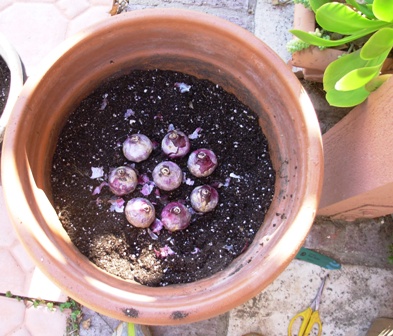
Above: I guess any month of the year is bulb-season here in LA. It’s just that my bulbs will have to be annuals. That’s something I will have to get used to, after investing in and planting hundreds of spring flowering bulbs back in Seattle. The hyacinths, narcissus, tulips and muscari I planted today were a surprise gift from Brent and Becky Heath. The box filled with 70 bulbs arrived a few weeks ago ~ what a treat! I planted layers of bulbs in 2 terracotta pots this afternoon. Then I sprinkled annual seeds on top of each (dwarf cosmos on one; nigella on the other). Who knows if you can pair annuals with bulbs? It’s worth a try! This is my chance to experiment, so stay tuned!

And Happy New Year to all of you. Let’s cherish what we have!

Gardener’s Resolutions

Tuesday, December 30th, 2008

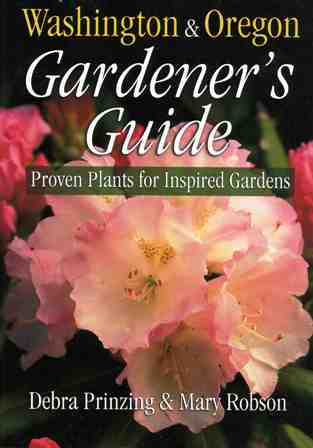
In early 2005, Cool Springs Press published the Washington & Oregon Gardener’s Guide, a book I co-authored with the wise and gifted garden writer Mary Robson. We combined our talents to share years of garden experience to help readers plan, plant, and maintain a beautiful and healthy garden.

The book is filled with our personal recommendations of plants that thrive in the Northwest, presented in a concise, helpful format. The major challenge of writing WOGG, as we called it, was to limit ourselves to 186 individual plant selections, from annuals to vines. No gardener wants to be told she has to “choose” a finite plant list!

Our fabulous publicist, Lola Honeybone, who now runs Media Workshop, a Nashville-based book PR shop, suggested that Mary (shown at left) and I develop a lecture to accompany our book-signings and appearances. She dreamed up the title “Seven Habits of a Highly Successful Gardener.” Lola’s clever angle brought Mary and me together for a 2005 lecture at the Northwest Flower & Garden Show in Seattle. It was so much fun to plan this talk knowing Mary and I would have a friendly give-and-take as we walked the audience through our Seven Tips.

Later, our friend Richard Turner, editor of Pacific Horticulture, asked us to turn the lecture into an article. Here is the article, from the journal’s Winter 2006 issue. It seems appropriate to share this as we approach 2009 – and I encourage you to adapt these tips for your own New Year in the Garden:

Seven Habits of a Highly Successful Gardener

Gardeners in the west enjoy the unique luxury of living with few rules about what’s right or wrong in the way we grow our plants. We appreciate and adapt to our garden’s cultural conditions. We are overwhelmed with a seemingly endless selection of excellent, healthy and suitable trees, shrubs, perennials, annuals, vines, bulbs and ground covers from which to choose for our landscapes.

In the Pacific Northwest [my former home], we’re particularly lucky to have temperate conditions where it’s not too hot – and not too cold. This welcoming, plant-friendly climate bestows added blessings. Imagine how hard it was for us to compile a regional gardening book and limit ourselves to only 186 great plants!

Perhaps the horticultural excesses in our lives call for a little discipline. Certainly, we want to be good stewards of our gardens, both to ensure our immediate enjoyment and the long-term health of the plants and places we tend.

So, with apologies to the original “7 Habits” author Steven R. Covey, we offer the following Seven Habits of a Highly Successful Gardener:

READ MORE…

a word about tiny Christmas trees

Wednesday, December 17th, 2008

Those of us who attended the September 2008 Garden Writers Association annual symposium in Portland were in for a big treat when we boarded the coach buses (seven or eight in all) and took a ride to Boring, Oregon, home of Iseli Nursery.

We were introduced to a world of ornamental conifers, in every shape and size. Even though Washington is called the “Evergreen State,” in the nursery trade, it seems, the folks in Oregon claim the title. 

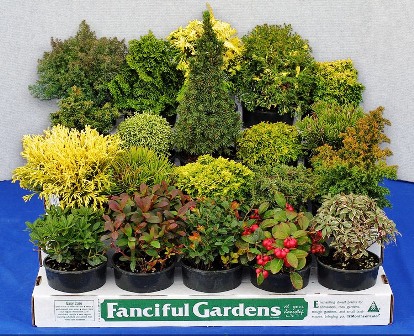
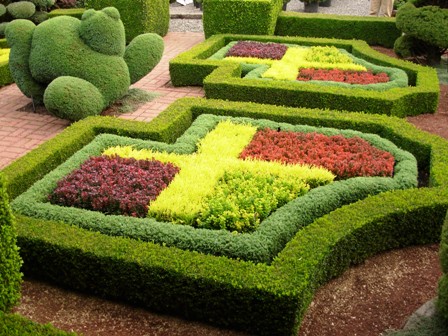
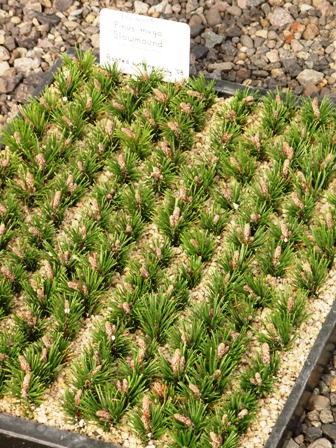
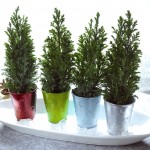
Iseli Nursery grows all sorts of amazing woody plant specimens – trees, shrubs and more. They sent us home with a gift bag packed with five delightful little conifer specimens – perfect for a container planting, rock garden or tablescape. You can see the incredible variety in Iseli’s “Fanciful Gardens” collection depicted above (including some dwarf broadleaf evergreens in the front row). My photos, from left: A colorful “knot garden” of mostly dwarf conifers mixed with barberry, Iseli entrance; tiny, just-propagated woody cuttings of mugo pine.

The next day, I found myself sitting on yet another the bus ride/garden tour with with Sandy Dittmar, a horticulturist at Iseli. We talked about how many gardeners are only now discovering conifers, and how dwarf conifers are so versatile for smaller landscapes. She planted a seed of insight and got me thinking.

So when I saw my local Trader Joe’s stocked with miniature Leyland cypress and Lawson cypress (we’re talking 4-inch pots for $4.29 or so), I called Sandy and said: Remember when we talked about dwarf conifers? Are those Trader Joe’s mini-trees yours?

It turns out, the tiny live trees in shiny pots are supplied by BloomRite Nursery, a wholesale grower in Half Moon Bay, California. But Iseli’s tiny Alberta spruces, mugo pines, and blue-star junipers, and countless other dwarf conifers are showing up in specialty nurseries and retail florists around the country. Cute, they are. Versatile, too. And perfect for a scaled-back Christmas!

In this cost-conscious holiday season, it was a fitting “tiny tree story” for the Los Angeles Times’  Home section, page F2 (December 13th).

Here is the piece I wrote under the “Seen” heading, in its entirety:

A pint-sized forest at home

Looking for evergreen decor – something that can last long past Christmas? Turn tiny potted conifers into a miniature forest across a fireplace mantle, or create a tabletop landscape with dwarf pines. Tiny trees are “a cheap luxury,” says Lisa Tsui, a product manager at BloomRite, a wholesale grower in Half Moon Bay, Calif., that supplies potted pines and Leyland cypress to Trader Joe’s. “In this economic environment, people are using them to supplement decorations they already have,” she says.

Iseli Nursery in Boring, Ore., ships tens of thousands of dwarf conifers to garden centers during the holidays. Even though some customers treat the evergreens as throwaway décor, they can be transplanted in the garden or an outdoor container, Iseli sales manager Jock Demme says. The challenge is to keep the plants alive indoors. “The home setting has drier and warmer air than these plants require,” he says. “I suggest submerging the pot in a larger container of water and soaking the roots every day.” The trees at Trader Joe’s sell for $4.29 to $5.99 each; you’ll find variations for $9.95 at the Empty Vase in West Hollywood, (310) 278-1988, www.emptyvase.com. Also try Red Envelope, (877) 733-3683, www.redenvelope.com.

Here’s a little gallery of dwarf and miniature tree photographs, shared by Iseli and Nurserymen’s Exchange (which is the company behind BloomRite).

December: Garden Bloggers’ Bloom Day – My First Installment!

Monday, December 15th, 2008

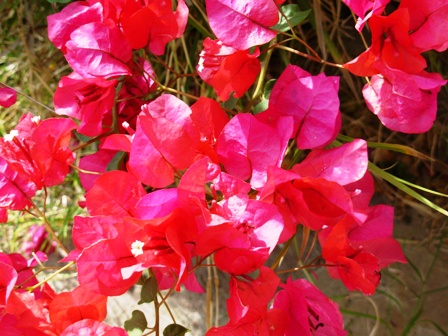
My bougainvillea’s lipstick-pink bracts look almost iridescent in Southern California’s December sunshine

Dateline: Thousand Oaks, California

USDA Zone: 10

The journalist-observer in me couldn’t help but notice that when the 15th of each month rolled around, many of my favorite fellow bloggers wrote about this phenom called “Garden Bloggers Bloom Day.” They even included images of that day’s blooms in their own garden.

The instigator behind this movement is Carol of May Dreams Gardens, and somehow I thought I had to be invited by that select inner circle of garden bloggers to participate. Kathy Purdy of Cold Climate Gardening recently set me straight on that assumption and assured me that all I have to do is post photos of my flowers. She sent me an email with “No Rules for Bloom Day” in the subject line and a link to May Dreams Gardens with the “rules,” of which there really are none:

All you need to do to participate in Garden Bloggers’ Bloom Day is post about what is blooming in your garden on the 15th of the month, or thereabouts, depending on your personal schedule. Then leave a comment on my bloom day post so we can find your blog and check out what is blooming in your garden.

I sort of cheated because I took these photos yesterday, Dec. 14th. I’m glad I did, though because today, Dec. 15th, we experienced a rare occurrence: RAINFALL. Don’t worry – I managed to spend plenty of time outside soaking up the raindrops while letting my dog, Zanny, run around and play catch with her favorite (now muddy) yellow tennis ball. It was a glorious day and everything is refreshed – in the garden and in our spirits. All the air pollution and dust has been washed off of the foliage and the soil looks wet and dark brown. We’ll see how long that lasts!

Here’s what I have to contribute:

Bougainvillea, seen here and above. It was inherited from the previous owner when we moved here in 2006. The first time I really noticed a bougainvillea was in 1999, when my sweet husband took me to Palm Springs for a surprise 40th birthday weekend. We were staying at the former Merv Griffin Resort and Givenchy Spa (how mid-century!) and there was an entire wall covered with the raspberry-colored display of bougainvillea. Little did I know then that I’d live in Southern California some day and actually have one in my garden. I’m trying to train it up to the the patio-covering arbor.

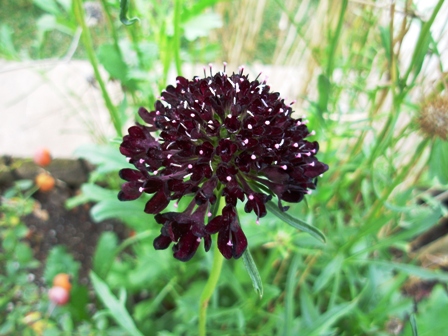
Scabiosa atropurpurea ‘Black’, also called pincushion flower – and also called ‘Ace of Spades’. This perennial (for me) has a delicious, dark-plum bloom. It’s a favorite of butterflies because they can use it as a landing pad while doing their thing. I purchased this plant in 2007 on a “garden gals’ field trip” to Annie’s Annuals (we actually took a road trip from SoCal to the Bay Area for the San Francisco Flower & Garden Show and Annie’s was a side trip). The scabiosa thrives and re-blooms so often I can’t keep up with the job of cutting back the old growth. So pretty as a cut flower, especially when combined with anything chartreuse.

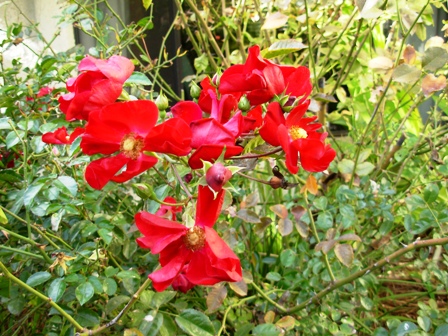
Mystery rose, another “gift” from the former owner of our property.

I really like the delicate form of its single flowers, the crimson petals and the yellow centers. This rose, which is taller than me, has thrived despite little or no water in the area outside my dining room window. I have plans to renovate this bed, but first I have to hand-dig and remove the red lava rock “mulch” out of the bed, which may explain why this to-do remains on my list!

Echeveria hybrid in bloom. This is a close-up of the beautiful, costume-jewelry-like flowers, the stem of which emerges from the center of an echeveria. I have a wonderful display of echeverias, crassulas, sedums and other succulents in my kids’ old red wagon. It was once planted with spring bulbs or summer annuals (back in Seattle), but here, it is a perfect, low-maintenance container for a wagon-full of succulents. According to Lorraine Schulz and Attila Kapitany in “Echeveria Cultivars” (Schulz Publishing, Australia) the cut blooms of echeverias alway outlast more conventional flowers when brought indoors for an arrangement.

Well, that was fun! I’m happy I could join the Bloom Day party!

Building raised beds for the vegetable garden

Sunday, December 7th, 2008

The subtitle to this post should be “Haste makes waste.”

But before I tell you my woeful tale of rushing a gardening project and living to regret it, I will tip you off to a wonderful product that helps non-carpenter types like me build raised beds for backyard vegetable gardening.

Gardener’s Supply has designed and fabricated a very cool piece of hardware – a corner bracket – that allows you to build a raised bed rather simply, with sections of lumber. Having previously built wobbly raised beds with L-shaped brackets screwed inside two 2-by-10s at a 90-degree angle, I think this Gardener’s Supply solution is far superior (see corner bracket, left).

All you need are four powder-coated, aluminum corner brackets. Slip the boards into the fitted sections of each bracket and secure them with Philips screws inserted in the pre-drilled holes.

There are also side brackets that allow you to extend the raised bed from 4-feet to 8-feet long.  And not to sound too Xenophobic, but – hurrah! – these brackets are made in Vermont by Gardener’s Supply. It really is nice to know that something is still manufactured in the U.S. of A. these days.

So, to create one 4-by-8 foot raised bed, you need the following:

  • 4 pieces of 2-by-10 lumber measuring 8 feet long
  • 3 pieces of 2-by-10 lumber measuring 4 feet long
  • 4 corner brackets from Gardener’s Supply
  • 2 side brackets from Gardener’s Supply

READ MORE…

Gifts from the Gardener

Thursday, November 20th, 2008

The month of November seems to generate an abundance of magazine articles about being “thankful.” For many of us, the notion of giving thanks is top of mind this season. Not only am I hugely grateful for my family, friends, home, garden and writing career, I’m so often reminded how rare these gifts truly are.

When it was time to write my “In the Garden” column for the November issue of my local magazine, 805 Living, my editor Lynne Andujar mentioned choosing Volunteerism as the month’s theme. You can see how nicely this idea is communicated on the cover, which reads: “Give Thanks, Give Back.”

The assignment made me think of Master Gardeners, some of the most volunteer-minded souls in the gardening world. I first learned about the MG program in the early 1990s, when my friend Jean Zaputil trained as a Master Gardener in King County, the local Seattle area program. I was always so impressed that Jean did this, especially when she managed the herb department for the local MG plant sales. That experience, combined with her BFA in Interior Design, soon led Jean to start her successful landscape design business.

Wanting to expand my own horticultural knowledge about the time I was trying to switch from business writing to home and garden feature writing, I applied to enroll in the 1998 Master Gardener class (also in King County). I spent many enjoyable years actively involved with the organization, including three years as PR chair for our annual plant sale.

When I moved to Southern California, I thought I’d re-apply and get in on the excellent training that comes directly from local horticultural experts. That’s when I discovered the Ventura County MGs require trainees to volunteer (“give back”) 80 hours of community service in their first year. The math just didn’t add up for me, at least at this time in my life. But the application and interview process introduced me to my local MG group, and piqued my interest in learning more.

What better way to get to know the Master Gardeners in my own back yard than by writing about them? (I always say that “I write in order to learn,” so it makes sense!).

READ MORE…

Autumn Gardens in Oregon

Monday, October 27th, 2008

An early morning scene outside the guest room window at Mary-Kate Mackey’s in Eugene

October in Oregon – you can’t beat it. Earlier this month, I traveled there to lecture to the Hardy Plant Group of Willamette Valley.

Returning to my beloved roots, in the Pacific Northwest, was such a treat, especially since it is still wickedly hot down here in LA and I am desperate for some moist, cool autumnal weather.

And oh, the gardens!

Mary-Kate Mackey, fellow garden writer and a gifted journalism educator, met me at the airport. It was fun to fly into this sleek, modern, small airport and arrive via Horizon Airlines (they serve complimentary Pacific Northwest ale on board and, oh, by the way, one of my articles appears in the October issue of Horizon/Alaska’s in-flight magazine, so I was able to grab lots of extra copies from the seat-pocket in front of me, etc.!).

Upon disembarking in Eugene, I was impressed by the changing autumn light and saturated foliage palette. Oh, it’s autumn in Oregon! It took away my breath and captured my heart.

The evening began with drinks at a nifty bistro with Mary-Kate, followed by dinner with my dear friend Jennifer (we were editors together at “Seattle Woman” magazine in the 80s).

On Tuesday, after a restful overnight in Jenny and her husband Tim’s comfortable home, I met up again with Mary-Kate.

Since I missed out on the one-day garden tour in Eugene that followed last month’s Garden Writers Association’s annual symposium, I had a special request for Mary-Kate: Can I have my own mini-tour of the best of the best Eugene has to offer? [Above: Mary-Kate inspects the craftsmanship of a stunning stone wall hand-built by Allen Bosworth (right) of Bosworth Landscaping.]

READ MORE…

Modesto Garden Club and Lavender Hollow Farm

Saturday, October 11th, 2008

I have my father to thank for my two-day trip to Modesto earlier this week. That’s because a year ago, as my folks were driving from Seattle to Phoenix, they stayed overnight at the home of Sue and Jerry Houser in Modesto, California. Like my parents, the Housers belonged to an informal bed-and-breakfast club. You pay some kind of nominal fee to join and receive a directory of hosts who will give you a room for the night, plus breakfast. My affable dad was seated in Sue Houser’s family room and he noticed all her gardening books and magazines. “My daughter writes about gardens,” he offered.

Turns out, Sue is the program chair for the Modesto Garden Club, one of the largest clubs I’ve ever encountered (it was founded 81 years ago and has more than 600 members)! How’s that for serendipity?

The next thing I know, Dad’s on the phone to me, introducing me to Sue. Several phone calls and emails later, she invited me to come speak to her club. That’s the two of us pictured above, standing in the foyer of the garden club’s beautiful office in a renovated cottage (seen at right).

I began my trip on Tuesday, driving to Bakersfield, which is 120 miles northbound on Interstate 5. I parked my car at the Amtrak station there and hopped the San Joaquin line (which begins in Bakersfield and continues to Sacramento or Oakland). I passed the 3-1/2 hour train trip quite pleasantly, looking out the window at the changing scenery, much of it agricultural (mostly corn fields and pecan orchards), napping, reading, and relaxing. My cell phone was turned off, ensuring that I really could “unplug” for a little while.

READ MORE…