Debra Prinzing

Get the Email Newsletter!

Archive for the ‘Plants’ Category

More cool gardens, garden art, and sheds

Sunday, September 28th, 2008

Visting Bellingham and the Whatcom Horticultural Society

Bright and early on September 17th, I flew from Burbank, CA to Bellingham, WA (by way of Seattle and a 2-hour layover). I was pretty tired, having only four hours of sleep the night before, so I dozed a bit on the small Horizon Air jet that transported me from Seattle to B’ham in barely 25 minutes.

As the plane began to descend, I perked up and looked out the window to see – oh glory – Puget Sound, and several of its islands including Lummi Island. I was so happy (exhilarated, actually) to gaze upon the gray-blue palette of the water and islands, the scenery dotted witha few boats; the islands populated with cabins and summer cottages. What a “welcome home”!

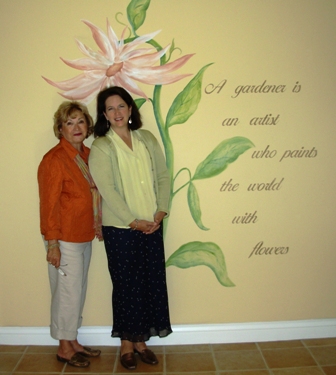
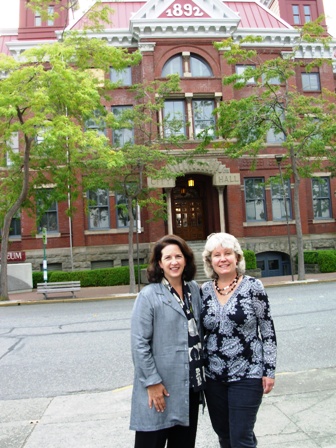
My friend, Dawn Chaplin, garden designer and nurserywoman (seen with me above, in front of the Whatcom Museum), invited me to speak at the September meeting for the Whatcom Horticultural Society. I have a special place in my heart for this group, thanks to my friendship with the late Stephanie Feeney, who was one of the founding mothers of WHS. Stephanie, creator of the Northwest Gardener”s Resource Directory, originally started her garden touring “reference” (as a few photocopied pages stapled together at the corner), for her use and for her WHS friends. Upon her death in 2000, I inherited the editorship of her book and produced the 9th edition, still in print.

Dawn and her husband David met me at the airport and whisked me off on a whirlwind tour of Bellingham’s fantastic gardens and even a few magical “sheds” and shelters in the garden. In this misty, foggy maritime place on the map, people in Bellingham use color and art in very exciting ways. Here is a travelogue of our garden-filled afternoon:
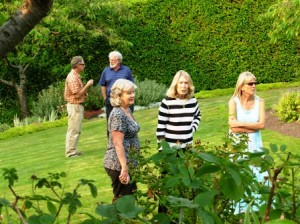
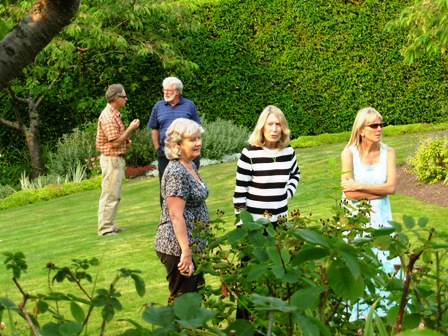
Our tour kept gathering up friends and bringing them along. In front, from left: Dawn Chaplin, landscape designer Susann Schwiesow, and Laurie Satushek discussing plants in Susann’s glorious front border; In the back, Steve Satushek and David Chaplin.

SATUSHEK GARDEN
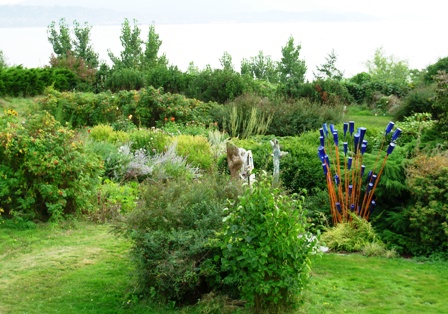

The wild and crazy landscape owned by Steve and Laurie Satushek
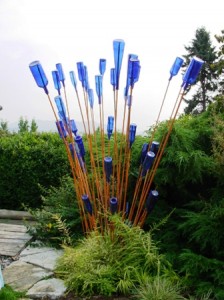
Photographer Steve Satushek and artist/teacher Laurie Satushek live and garden on about 8 acres overlooking the Nooksack River Delta and Bellingham Bay. They have transformed a nondescript ranch house and unkempt field into a colorful residence and equally brilliant landscape. Every surface of their residence is embellished with mosaics, mirrors, three-dimensional objects, and Steve’s oversize “outdoor” photographs — all rendered in a crayon box-inspired palette.

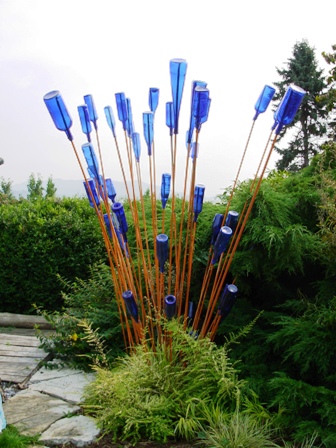
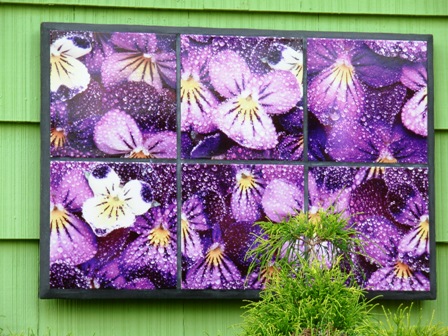
The informal but exuberant garden makes creative use of cobalt glass wine and water bottles (seen above, at left and below) and Steve’s cleverly-engineered and equally beautiful photography (he combines nature and botanical photographs with several innovative processes for weatherproofing oversize canvases). Together, the gallery-house and gallery-garden lure visitors to explore, observe, and fill their eyes with a surprising interpretation of art infused into every aspect of life.
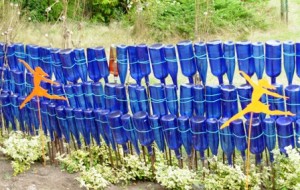
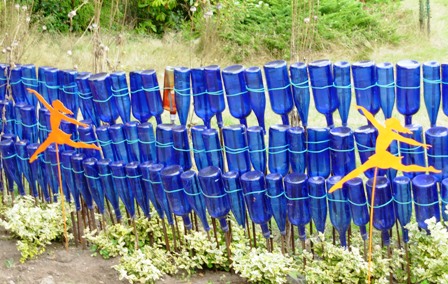
More blue bottles: Here, they are mounted upside down on rebar posts. Staggered “rows” create a waist-high blue wall that lines the driveway. Citrus-cutouts of dancers add whimsical contrast.

READ MORE…

“Sustainable Spaces. Beautiful Places”

Friday, September 5th, 2008

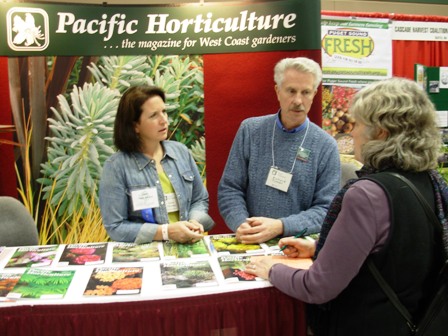
 I’m standing with Richard Turner, editor-in-chief of Pacific Horticulture magazine. We’re volunteering at the 2008 NWFGS in Seattle, visiting with Dawn Chaplin, formerly a fellow board member of Northwest Horticultural Society and a great garden-touring pal (she’s now a Whatcom Co. Hort. Society board member).

The press release just arrived in my in-box, and it announced the 2009 Northwest Flower & Garden Show’s theme. It’s only six months away – and I’m already excited! The theme: SUSTAINABLE SPACES. BEAUTIFUL PLACES. I like it! A lot!

The Northwest Flower & Garden Show, created by my pal, the talented and visionary Duane Kelly, today announced its 2009 theme:

“. . . (the) show will place a major focus on gardening materials and techniques that are good for the environment,” said Duane Kelly, chairman and founder of the annual event, now in its twenty-first year. “Show goers can expect to come away with a number of great ideas that conserve resources such as water and soil while, at the same time, making their gardens more self-sustaining and easier to care for.

“During the past year, organic gardening and vegetable gardening have grown in popularity thanks to the public’s keen interest in doing what’s best for the environment.  The movement has also gained traction with consumers seeking homegrown fruits and vegetables that not only taste better but reduce ever increasing grocery bills.”

READ MORE…

My first Garden Design piece – and it makes the cover!

Friday, September 5th, 2008

Okay, this is to be filed under “self promotion 101,” but, after all, what is the point of blogging if I can’t do that?

I am sending a huge bouquet of thanks to Jenny Andrews, Sarah Kinbar and the talented team of editors and designers at GARDEN DESIGN. Earlier this year, they asked me to profile the Venice, Calif., garden of uber-architect Ron Radziner and his wife Robin Cottle.

“Simple Geometry,” my story, appears in the September-October issue of Garden Design. You can see one of photographer Jack Coyier’s gorgeous shots appearing on the cover, depicting the family’s outdoor dining room. There’s lots more to read and see inside, as GD gave us a 10-page spread for the article.

I still haven’t seen the real issue or paged through it, but thanks to my Seattle pal, Stace Crooks, for calling this morning to tell me a copy arrived in her mailbox. I guess I better race out to get my own. I’ll post the entire story on my web site soon.

And another huge thanks goes to Paula Panich, my wonderful friend and writing coach. Paula helped me unsnag some tricky elements of the story, and in the process, made it lighter and more graceful. She is awesome.

Garden-in-a-pot

Monday, August 4th, 2008

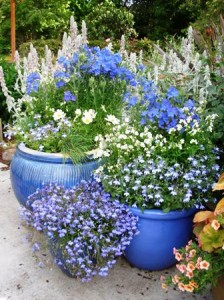
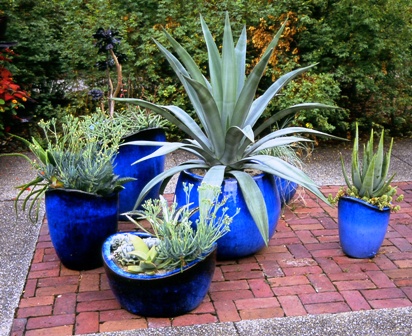
A true-blue grouping (left) in Sunset Magazine’s test gardens; Silvery succulents (right) thrive in ice-blue containers for a satisfying grouping at Longwood Gardens, 2006

Ever since I relocated from Seattle to Los Angeles, nearly 2 years ago now, I have relied more than ever on container gardening. With a confounding, on-again, off-again irrigation system that will cost the equivalent of a year’s grad-school tuition to completely repair, and with rock-hard soil that endured years smothered by the previous owner’s idea of weed control (black plastic sheeting covered with red lava rock “mulch”), I’m desperate to grow plants in spite of unwelcome conditions.

But where? And how to keep them alive when it’s too hot and dry for anything but succulents to look good?

The answer is a container garden. Gardening in a container is like one-stop shopping. Maybe we should call it “one-stop gardening.” Here are some of the best reasons for gardening in pots:

Why grow a container garden?         

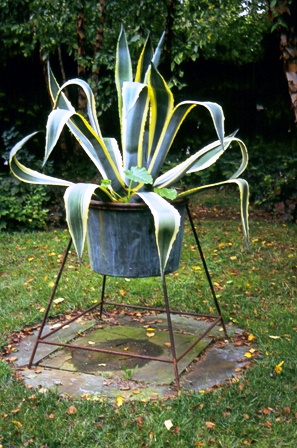
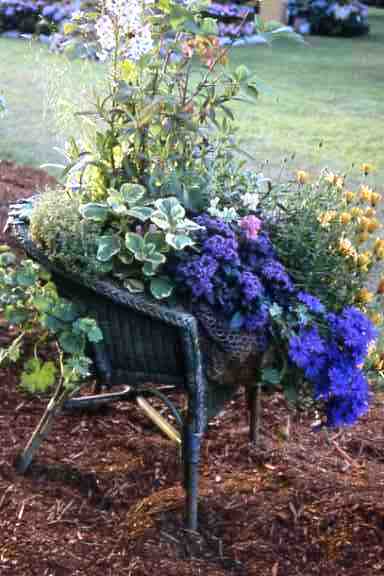
  •  Move plants and architectural interest above the ground’s surface:  You’ll enjoy beauty closer to eye level, as in this cool vintage vessel that caught my eye at Chanticleer Gardens in Pennsylvania (2006).


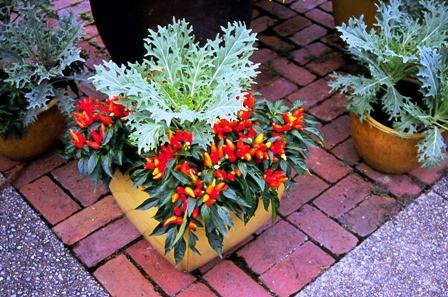
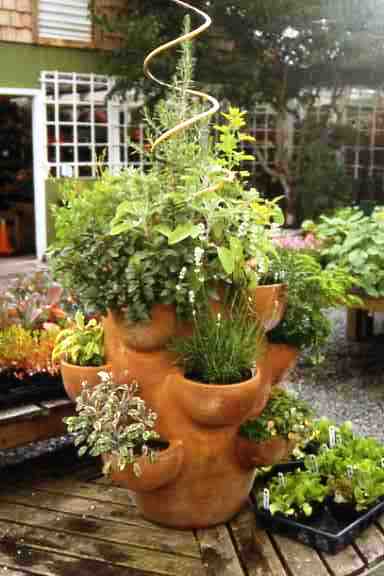
Edible and Accessible: Lettuces and herbs thrive in pots, like this over-sized terracotta “strawberry” pot at right – measuring 48 inches tall, created several years ago by the designers at Emery’s Garden in Lynnwood, Wash.! At left, ornamental peppers and kale in a pot at Longwood Gardens are food for the eyes.


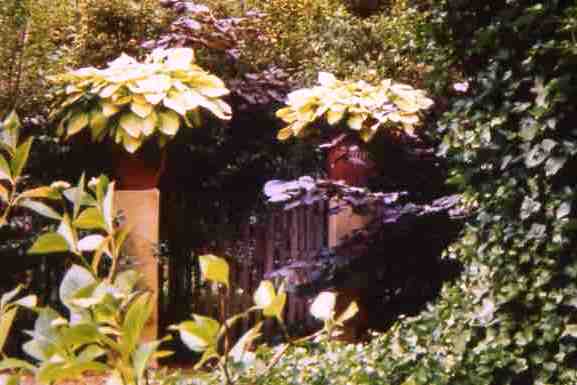
Define a focal point: Signal the entrance to the garden, such as with these two glossy Asian pots that contain lush golden hostas. Mounted on pillars, they announce: “Come this way,” a way that’s made more enjoyable because this portal leads to the gardens of David Lewis and George Little, Bainbridge Island artists.


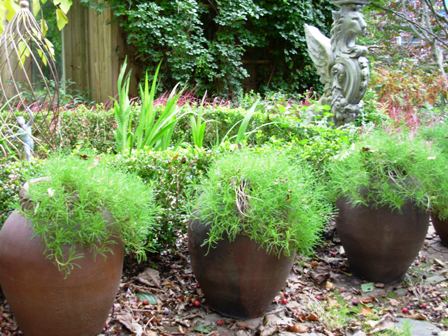
Provide a natural perimeter: Anywhere in the garden, such as at the edge of a deck or patio, pots can act as a verdant “wall” to contain, deter, protect or enclose. I particularly enjoy seeing three identical pots, lined up as a formal barrier – it’s plant-filled architectural interest. Here, at the edge of Peter Norris Home & Garden’s parking lot, these giant iron urns hold gold-streaked phormiums (left). A trio of fern-filled pots defines the edge of a formal planting scheme at Robert Dash’s Madoo Garden (right).


READ MORE…

Pretty in purple

Sunday, July 13th, 2008

July in Southern California dishes up a haze of purple in every hue. I recently snapped a few photos to capture the floral bounty around us.

It’s the weekend; time to be lazy and enjoy a little eye candy. So here we go:

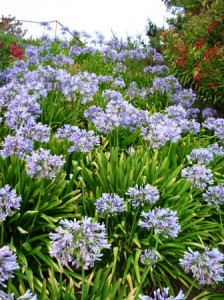
Lavender-blue agapanthus cascades down the hillside in my neighborhood

This time of year, AGAPANTHUS takes over our “East Hills” neighborhood. Seattle gardening friends, eat your eyes and hearts out! When I first visited this neck of the woods, in spring 2006, I was blown away by the appearance — shall I say ‘explosions’? — of lavender-blue agapanthus blooms on every corner of town.

“Okay, I guess I can live here after all,” I thought. I mentioned loving this plethora of agapanthus to my friend Nan Sterman, a California native and author of California Gardener’s Guide, Vol. 2.

“Oh, Debra, they’re gas station plants!” she exclaimed.

As I’ve said before. . . one woman’s gas station plant is another woman’s rare collector plant. Imagine describing it as a commonplace “filler” for the corner convenience store! I know of a few passionate souls in Seattle who willingly forked over $15 for a 2-inch Agapanthus ‘Blue Heaven’ cultivar from Heronswood (or, elsewhere spent $20 to $40 for larger pots of this pretty purple South African native). And then. And then. Well, if my efforts were at all representative, there was the breath-holding that occurred through the wet, chilly winter months, as we pretty much realized the true-blue agapanthus wasn’t going to emerge in great shape the following spring. Like many tender perennials, well, they were pricey annuals. Or, they were in need of massive amounts of pampering, such as potting up the fleshy rhizomes and moving them indoors for the winter.

READ MORE…

A hydrangea grows in Zone 10

Friday, July 4th, 2008

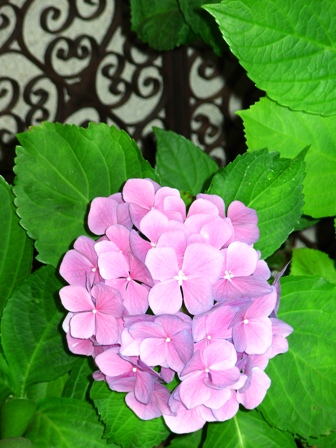
Today, all I have to share are these photographs of my sole hydrangea plant. This pinky charmer lives on our covered porch, surviving the heat, I guess, because of its deeply shaded existence.

It is 90 degrees outside as I write at 7:30 p.m. With adequate water, this hydrangea seems to cope with close-to-the-century-mark temperatures. But if it wasn’t protected by the overhanging roof, it would be miserable.

In contrast, hydrangeas in Seattle can handle a few days of excessive heat, here and there. But their blooms and leaves get crispy when subjected to sustained hot-and-sunny summer conditions. All the more reason why I cherish owning at least one non-crispy specimen here in Zone 10!

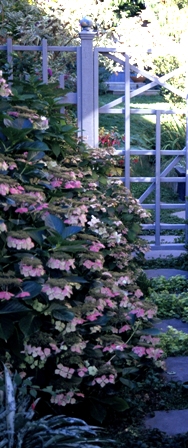
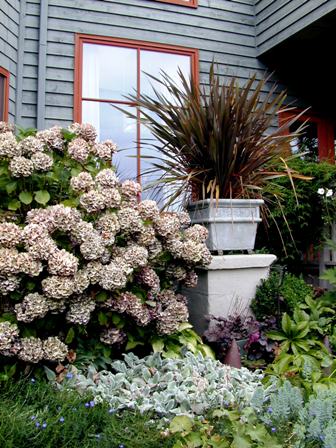
This hydrangea was a “housewarming” gift nearly 2 years ago, given by my husband’s boss on the occasion of our move to SoCal. To me, “Miss Hydrangea,” it seemed ironic to receive a no-name, hothouse variety in a 1-gallon pot, cloaked in that crinkly-metallic florist paper. It nearly toppled over because the few enormous mop-head blooms were wildly out of proportion to the size of the plant itself. In my former garden (seen at left and right), I was lucky to grow several cool Japanese hydrangeas that were gifted to me by friend Richie Steffen of the Miller Garden. These babies seemed to think they were still growing in their native soil because they exploded in size over the period of a few years – only to crowd out the nearby path. (Although, I must confess that the huge mophead hydrangea shown here was also a housewarming gift that arrived in a 1-gallon florist’s pot: It was given by our then-new neighbor David when we completed construction and threw ourselves a move-in party in 1998!).

Back to this pink hothouse hydrangea, which sat on my kitchen counter and seemed to be mocking me. If she could have spoken, she would have said: “You think you’re such a great gardener? Well, guess what? No one here cares that you grew a dozen stunning hydrangea shrubs, not to mention two climbing hydrangeas, in your old Seattle garden. Try keeping me alive here in Zone 10!”

READ MORE…