Debra Prinzing

Get the Email Newsletter!

Archive for the ‘Plants’ Category

Seattle Gardens extraordinaire

Wednesday, July 1st, 2009

Seattle in June.

Blue skies, expansive views of water and mountains, blooming gardens, great friends.

Here are some photographs of two days in Seattle: Saturday and Sunday, June 27th and 28th:

The view from Ivar's on Lake Union: Seattle's skyline and the iconic Seattle Space Needle

The view from Ivar's on Lake Union: Seattle's skyline and the iconic Seattle Space Needle

My dear friend Lorene Edwards-Forkner was my dining companion, along with fellow Pacific Horticultural Foundation board members

My dear friend Lorene Edwards-Forkner was my dining companion, along with fellow Pacific Horticultural Foundation board members


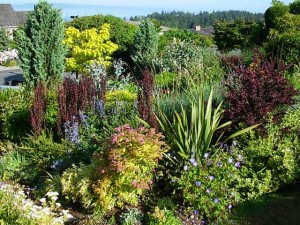
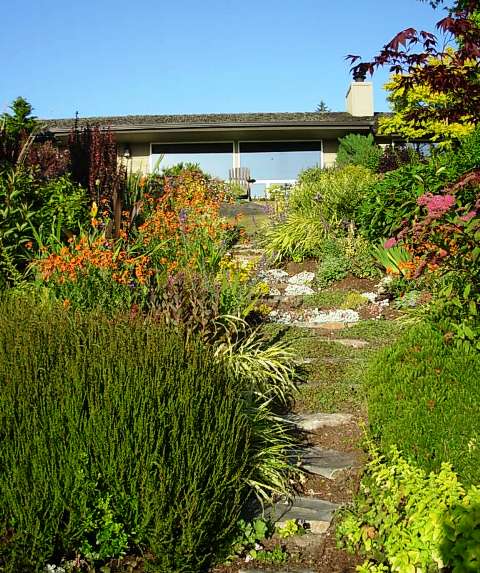
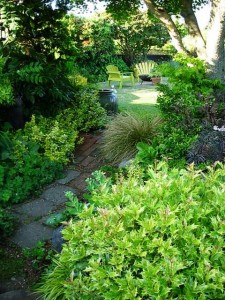
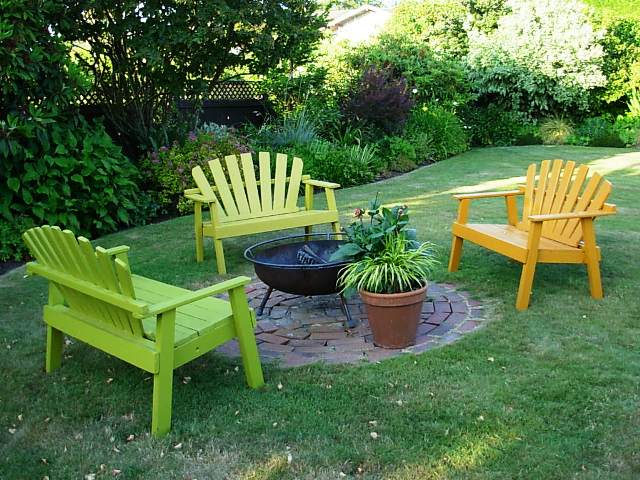
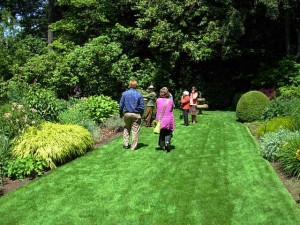
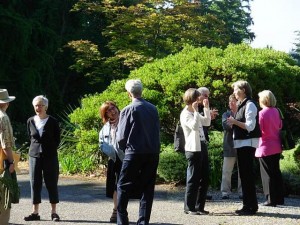
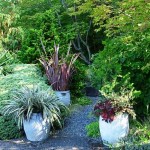
Garden touring in the Seattle garden of Mrs. Alison Andrews

Garden touring in the Seattle garden of Mrs. Alison Andrews

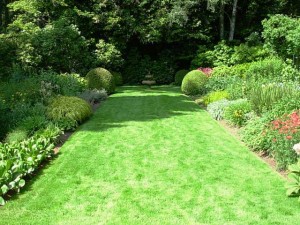
Here's that garden without people

Here's that garden without people


My friend garden designer and writer Robyn Cannon joined me at the Andrews garden

My friend garden designer and writer Robyn Cannon joined me at the Andrews garden

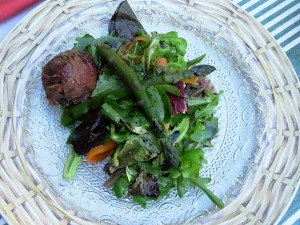
Robyn's delicious salad with asparagus and a yummy fig wrapped in prosciutto - unforgettable!

Robyn's delicious salad with asparagus and a yummy fig wrapped in prosciutto - unforgettable!


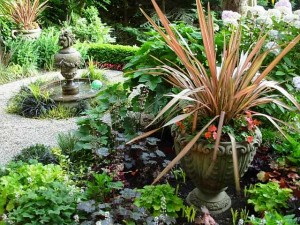
Robyn and Don Cannon's oft-photographed Seattle hillside garden - inspiring and lavish

Robyn and Don Cannon's oft-photographed Seattle hillside garden - inspiring and lavish

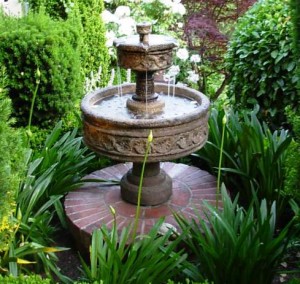
Elegant and cool, a splashing fountain in the heart of Robyn's garden

Elegant and cool, a splashing fountain in the heart of Robyn's garden

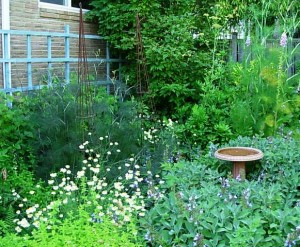
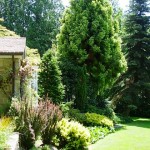
Stopped by my friend and garden muse Jean Zaputil's for a view of her beautiful herb garden

Stopped by my friend and garden muse Jean Zaputil's for a view of her beautiful herb garden

Seattle’s Miller Garden: a photo gallery

Sunday, June 28th, 2009
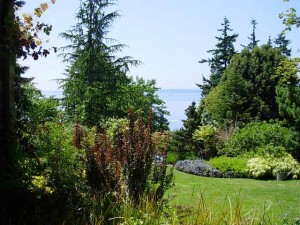
Here's the view from Betty Miller's house on a picture-perfect Saturday in June

Here's the view from Betty Miller's house on a picture-perfect Saturday in June

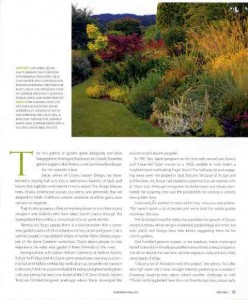
Looking out the windows of the house that Betty Miller lived in until her death, I admired a perfectly-framed view of The Elisabeth C. Miller Botanic Garden, located in Seattle’s elite gated community, The Highlands.

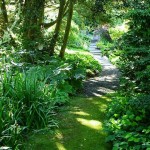
Her garden, now a private, nonprofit botanical garden, is a sparkling palette of green-gold, lime, dark green and silvery-blue. Impressions: Touches of burgundy Japanese Maples appear, peeking through the multilayered branches of a mostly green woodland understory. Lichens and moss create irregular patterns on grey bark. Gentle mounds. Draping foliage. A shadowplay of bright and dark. Alluring. Inviting.

I spent all day indoors, at a Pacific Horticultural Foundation board meeting (thank goodness for “lunch break”) and I will be back tomorrow morning for yet another half-day of meetings. It’s a good group and we are excited about some of our new projects and plans for the essential publication for gardeners in the West.

If you want to take advantage of a special Pacific Horticulture magazine 5-for-the-price-of-4 issues subscription rate, let me know and I’ll send you a coupon ($28/year).

Work. It's "work," people. My fellow board members gathered outdoors before being dragged to the conference table

Work. It's "work," people. My fellow board members gathered outdoors before being dragged to the conference table

If you like the photos you see here, you can actually see this garden for yourself. There are two ways to tour the Miller Garden. First of all, call for a tour appointment. Tours are limited, due to the fact that the property is in a residential community. They also fill up fast (check the web site for details about early-in-the-year-registrations).

You also have the opportunity to take a class at the Miller Garden, offered through the Northwest Horticultural Society, ongoing education series. Check out their web site for details.

In preparation, enjoy this visual tour of Seattle in June. I’ll be posting photos of my travels here in the PNW (at the Miller Garden and in other awesome gardens) all week.

The Miller Garden is the quintessential Seattle garden. It is cared for by some very talented horticulturists, including my friends Greg Graves and Richie Steffen, along with many regular volunteers. I have wonderful memories of coming here to work on Northwest Horticultural Society projects with former director Richard Hartlage (who was president of NHS when I was editor of Garden Notes) and with his successor Carolyn Jones, who is a good friend and garden gal-pal. The Miller Garden is at the heart of the plant-obsessed Seattle gardening community. You’ll see why below.

Enjoy these awesome photos from today’s tour:

Growing Vegetables Organically: an old technique for new gardeners

Saturday, June 20th, 2009
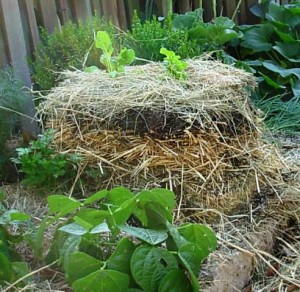
The layered, above ground, "no-dig," organic vegetable bed

The layered, above ground, "no-dig," organic vegetable bed

Here’s a sneak peek at a story that I’ll be reporting for an upcoming issue of Organic Gardening magazine.

I stopped by Pat Marfisi’s house in the Hollywood Hills last evening to tour his unusual “no-dig” veggie patch and to say hello to Pat and my colleague Jack Coyier, who’s photographing Pat’s prolific garden for my piece.

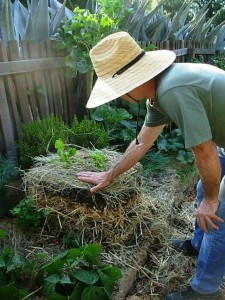
I arrived around 5:30 p.m. The late afternoon light was beautiful and warm. Pat’s dog “VaBene” (Italian for “it’s going well”) came down the street to greet me, followed by his owner: A grinning face under a broad-brimmed straw hat; strong gardener’s arms, emerging from a soft green T-shirt; functional jeans and black sneakers. He was in his element with vegetables, soil, and a harmonic convergence of pollinating native bees darting around to their heart’s content.


With apologies to Jack, who with his camera was preoccupied with artistic portraits of young squashes and pole beans, I launched into “interview mode” with Pat. Every word that emerged from his mouth was inspiring – practically prophetic. This was just a meet-and-greet visit. It wasn’t supposed to be an interview. I grabbed my notebook and pen and started scribbling furiously to capture our conversation. 


His face hidden under a brim, Pat demonstrates the layering method

His face hidden under a brim, Pat demonstrates the layering method

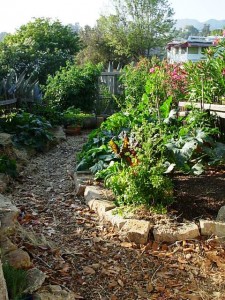
A central pathway cuts through the narrow garden with no-dig beds lining each side

A central pathway cuts through the narrow garden with no-dig beds lining each side

Pat was profiled last summer in an article by Lisa Boone for the Los Angeles Times Home section. Willi Galloway, west coast editor for Organic Gardening, saw the piece and tracked Pat down to learn more about his unusual method of layering newspapers, alfalfa, straw and compost – with a bit of blood meal and bone meal stirred in – to grow edibles above ground. He plants straight into this towering medium, which is a good alternative to tilling up poor soil or back-breaking “double-dig” methods. As I was trying to understand the process, I jotted this explanation down on the page: He creates rich soil while at the same time grows food in it.  


When Willi asked me to interview Pat and write the article for Organic Gardening, I was thrilled! I remember reading Lisa’s piece when it came out and learning that this practice of sandwiching organic materials (some also call this the “lasagna” technique) was decades old. Pat picked it up during an early retirement trip to Australia and New Zealand, where he volunteered on organic farms. He’s refined the scheme in his own LA garden and now teaches it to schools and community groups. He’s a modern day vegetable gardening Pied Piper.

kalesquashetcAs I’ve mentioned here before, some people learn by reading or doing, but I tend to learn by writing about something. I fall in love with each tree or flower I find myself writing about. I become fascinated with a style, a material, a project as I craft the narrative piece that will be published and read by others. 

I suspect it will be the same when I learn more about Pat’s process of growing food with abundance – in a very small area with few resources, natural or physical. I can’t wait to actually write this story (after returning to spend more time with Pat), and to see how it turns out in print with Jack’s photos.


Until then, the photos you see here are some of my snapshots to illustrate what Pat’s up to in his few hundred square feet of level land on an otherwise very steep 1/5th-acre urban lot.

More Stylish Sheds: Old House Interiors story + review

Saturday, June 13th, 2009

STYLISH SHEDS AND ELEGANT HIDEAWAYS: “A charming, happy, very pretty book full of ideas for building, furnishing, and enjoying your backyard shed or writing den.” — Old House Interiors review, July 2009.

ohijuly09001My Stylish Shed partner, the very talented Bill Wright, is a frequent contributor to Old House Interiors magazine. His photographs of luscious historic interiors and architecture are always a treat for the eyes. So when we learned recently that editor Patricia Poore planned to feature Stylish Sheds and Elegant Hideaways in the magazine’s July 2009 issue, Bill and I were thrilled.

Patty decided to excerpt a chapter from Stylish Sheds, one about Michelle and Rob Wyles’s dreamy garden shed in Eastern Washington.

We called our chapter “Sun Catcher,” which aptly describes the shed’s design that utilizes ample antique windows to draw sunlight into the 20-by-20 foot cedar-shingle-clad structure. OHI titled the chapter “Garden Hideaway” and I’ve included the edited story here, along with Bill’s images:

ohijuly09002

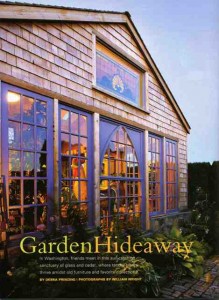
GARDEN HIDEAWAY: In Washington, friends meet in this sun-catching sanctuary of glass and cedar, where tended plants thrive amidst old furniture and favorite collections.

By Debra Prinzing | Photographs by William Wright

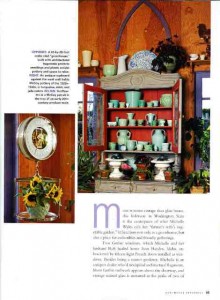
More summer cottage than glass house, this hideaway in Washington State is the centerpiece of what Michelle Wyles calls her “farmer’s wife’s vegetable garden.” It functions not only as a greenhouse, but also a place for collectibles and friendly gatherings.

Two Gothic windows, which Michelle and her husband Rob hauled home from Hayden, Idaho, are bracketed by fifteen-light French doors installed as windows. Besides being a master gardener, Michelle is an antiques dealer who’d stockpiled architectural fragments. More Gothic millwork appears above a doorway, and vintage stained glass is mounted at the peaks of two of the building’s four gables.

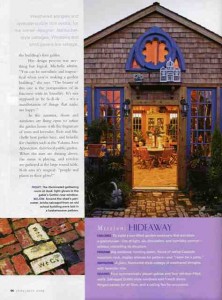
ohijuly09003Her design process was anything but logical, Michelle admits. “You can be unrealistic and impractical when you’re making a garden building,” she says.
“The beauty of this one is the juxtaposition of its fanciness with its humility. It’s not supposed to be la-di-da . . . it’s a manifestation of things that make me happy.”

In the summer, doors and windows are flung open to infuse the garden house with the fragrance of roses and lavender.

Rob and Michelle host parties here, and benefits for charities such as the Yakima Area Arboretum, their local public garden.

When the stars are shining above, the music is playing, and revelers are gathered at the large round table, Rob says it’s magical: “people and plants in their glory!”

Mission: Hideaway

ohijuly09004Challenge: To build a sun-filled garden sanctuary that emulates a greenhouse – lots of light, air, circulation, and humidity control – without mimicking its structure.

Program [Must-haves]: Big windows, running water, floors of native Cascade mountain rock, display shelves for pottery – and “room for a party.”

Inspiration: A plain, Nantucket-style cottage of weathered shingles with lavender trim.

Design features: Four symmetrically placed gables and four window-filled walls. Salvaged Gothic-style windows and French doors. Hinged panels for air flow, and a ceiling fan for circulation.

The story ends with this sidebar, featuring three other of our favorite Stylish Sheds:

“A room of one’s own” doesn’t have to be in the house. Backyard structures sometimes bear no resemblance to the cobwebby garden sheds of suburbs past; today people are using them as studios, writing rooms, playhouses, dining pavilions – hideaways of all sorts. Look for lace curtains and window boxes, and cedar shingles instead of corrugated walls. Even toolsheds, of course, can be artistic.

Rooftop Crop: Edible Gardens Overhead

Thursday, June 11th, 2009
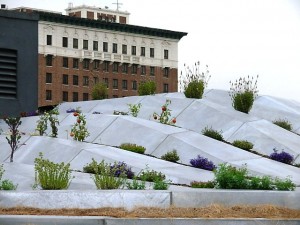
A sculptural vegetable garden grows on a downtown Los Angeles rooftop

A sculptural vegetable garden grows on a downtown Los Angeles rooftop

I wrote about Los Angeles’s gardens-in-the-sky in 2007, so when my chef-photographer friend Rico Mandel told me about a rooftop vegetable and herb garden that fellow chef Jonathan McDowell had been cultivating, I was excited to learn more. And to see it!

We grabbed a Starbucks and hopped on the freeway a few days ago to drive to downtown Los Angeles. On the way, I told Rico about an article I had just read in the January 2009 issue of Growing for Market, a journal for local food and flower producers. It was written by Marc Boucher-Colbert, a Portland sustainable farmer who created Rocket Restaurant’s rooftop garden with table-high steel planting troughs and 39 lightweight “kiddie” wading pools.

“Kiddie pools – how do you like that?” I asked Rico. “That’s cheap, lightweight and clever, isn’t it?” He silently chuckled to himself. Later, I understood why. Because what Jonathan had to show us was as far from a plastic wading pool as you could get.

bluevelvetBlue Velvet restaurant occupies the ground floor of a 10-story, 1960s-looking (but new) apartment building – all horizontal lines and clean facade. Jonathan met us in the parking lot and took us up the elevator to the top floor; we climbed a flight of stairs and emerged onto the roof.

Rico hinted about the totally unusual, sculptural design that contains Blue Velvet’s edible crop, but there was no way I could have envisioned the fluid, galvanized metal, Frank Gehryesque installation in front of me. What the . . . ?

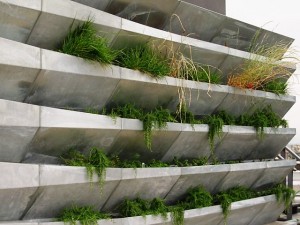
"Gutters" hold trailing rosemary in a vertical wall system.

"Gutters" hold trailing rosemary in a vertical wall system.

Turns out, this creation was fabricated on site to mold up and across a bleacher-like frame that hides HVAC units and other commercial rooftop paraphernalia.

It begins as a 10-foot vertical installation of long, horizontal channels – stacked almost like a wall of roof gutters. Many of the sections are planted with trailing rosemary. We marveled at the metal material. Even though Rico and I visited on a dreary, cool day in June, there’s no denying Southern California’s heat and sun effect. “Oh, well, this wall is north-facing, so at least it’s away from the most intense heat,” I commented.

“Wait until you see the rest of the roof,” Jonathan promised.

We walked a few yards across the roof, following that vertical wall of herbs, and I noticed how this “metal farm” took on kinetic qualities, wrapping over and around the “stuff” on the roof (and in the process, facing due south!).

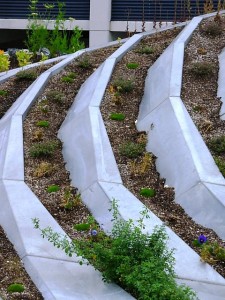
Fluid, shaped metal planting channels hold veggies and herbs

Fluid, shaped metal planting channels hold veggies and herbs

plantedroof3To get an idea of how this scheme looks in person, take a sheet of paper from your printer and fold it back and forth every 1/2-inch or so. This is how we made paper “fans” when we were kids. Open up the paper slightly so there are V-shaped pleats. Now, imagine translating that texture to sheet metal. The V-shapes create long planting channels, about 4- to 8-inches at the deepest point. Sections of the metal, welded together every 18-20 inches or so, take form, twisting, bending and turning as a beautiful sculpture.
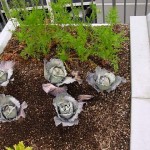
veggiesBut for all practicality, in responding to this design as a gardener, I have to admit that a million questions flooded my mind. How can tender herbs, greens and vegetables handle this sun-baked, roots-against-metal, rooftop condition, especially in July and August when it is ugly-hot? Moreover, where was the irrigation?

Jonathan, who just completed a four-year stint at Blue Velvet (two years as sous-chef and two years as head chef), looked at me and shrugged. Although he wasn’t involved in the design of the “garden,” Jonathan was tasked with figuring out how to grow plants in it. That has meant filling those pockets and grooves with soil and planting veggies in an artful way. There’s no denying this is an evocative design. “It pleases the eye,” Chef Jonathan acknowledges. “It has attracted a lot of attention.”

But – duh. Every square inch of this garden has to be hand-watered.

“In L.A.’s restaurant gardens, freshness is grown to order,” a May 20th Los Angeles Times Food article, Betty Hallock featured Blue Velvet’s rooftop garden, quoting its designer, architect Alexis Rochas: “The point was to experiment with how to turn infertile ground into a fertile one,” he said.

Chef Jonathan McDowell and Chef-photographer Rico Mandel

Chef Jonathan McDowell and Chef-photographer Rico Mandel

That’s an admirable goal. But the experiment has revealed that plants here don’t thrive against metal, and the absence of drip irrigation – that could direct moisture straight to root zones – is a negative. I’m worried that those hand-watering duties will likely be neglected when the guys in the kitchen get super busy!

Metromix Los Angeles recently featured “rooftop gardens” in a trend report by Krista Simmons. She included Blue Velvet’s in-the-sky garden, calling it “a sweeping silver flatbed . . . strikingly similar to the Walt Disney Concert Hall.” Simmons points out that the garden doesn’t generate enough to sustain the restaurant, but adds: “. . . McDowell does use the produce for tasting menus, amuse bouches and specialty holiday events.”

I applaud the rooftop restaurant garden. It’s a great vehicle to bring the “seasonal, sustainable and local” concept from garden to plate. To succeed, however, Blue Velvet needs a retrofit. Maybe getting an irrigation specialist up to that rooftop will help. Ask a professional market farmer or gardener to consult on how to better grow and sustain these poor little plants – they looked pretty stressed out! After all, part of the sustainable equation is to work with nature and create a supportive growing environment so that plants are productive and bountiful.

More reading: INHABIT, a design blog

Everyone wants a “green” planted wall

Tuesday, June 2nd, 2009
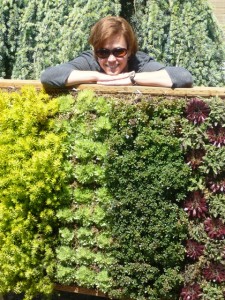
Carina Langstraat's delicious planted wall

Carina Langstraat's delicious planted wall

Green walls are the hot, new, must-have landscape design element. The Europeans were the first to figure out how to engineer large-scale planted walls, inspiring some innovative American designers to follow with their own twist. From my research, most are here on the West Coast, natch.

My friend Flora Grubb in San Francisco has received quite a bit of press for her avant-garde planted wall tapestries that incorporate everything from succulents to air plants (Tillandsias). 

And recently, the Los Angeles Times featured green wall designs using edibles (by Go Green Gardeners’ Anne Phillips) and California native plants + succulents embedded with LED lighting (by L.A. artist Michel Horvat).

HOW DID THIS TREND GET STARTED?

Garden writers have been describing “vertical elements” in the landscape for years. Traditionally, this idea involved arbors, trellises, fences and other structures upon which vines and climbing plants are trained. An explosion of interest in “green” planted roofs – including here in Los Angeles – followed. Pamela Berstler and Marliee Kuhlmann, two cool LA designers, create planted succulent “sky-scapes” for their clients’ garden roofs. I’ve seen, touched, and admired their work – and I can tell you, a lush, foliage-strewn roof is a lot more snazzy (and eco-smart) than tile, composite or tar!

But privately, some designers have confided to me their concern about liability issues involved in engineering green roofs. Even when I wrote on this topic for the Los Angeles Times in 2007, the experts I quoted cautioned that roof structures should be designed with load-bearing supports to manage soil/planting medium, handling moisture, and just the sheer weight of plants.

So, it’s only natural that the planted wall is the next installment of “plants-as-architecture” – a trend that seems more achievable than a green roof. I love seeing how designers are “going vertical” with a planted foliage palette.

THE WALL AS A PLANTING CANVAS

One of my favorite designers, Seattle-based Carina Langstraat (who runs Langstraat-Wood Landscape Architecture & Design with her landscape architect partner Erik Wood), has recently engineered a 4-foot by 5-foot green wall prototype at her Ballard studio. She shared with me photos and tips on how she created the system. It’s exciting to think about the possibilities, whether you’re willing to play around with this concept on your own or if you want to hire a professional.

READ MORE…

In my own backyard: California’s Channel Islands

Sunday, May 24th, 2009
A view down the rocky coast of Santa Cruz Island

A view down the rocky coast of Santa Cruz Island

This won’t be a long post because it has been a long day. But I have some images to share from today’s field trip to Santa Cruz Island, which is part of a string of eight small islands forming the Channel Islands off the California coast (between Santa Barbara and Long Beach). Perhaps the most famous is the glamorous Catalina Island. But since I wanted to see nature and take a break from the freeways and noise, the remoteness of Santa Cruz was appealing.

My companion Paula Panich has ventured to Santa Cruz twice before by herself. She suggested a day trip over the holiday weekend and we both arranged to be away from our families for a good part of the day. It started by booking our passage through a commercial boating company called Island Packers. We each spent $48 for the round-trip journey. The boat left the Oxnard Harbor at 9 a.m. We boarded and sat up on the top deck, along with other pleasure-seekers, cameras and small video recorders around their necks. No one was disappointed by the 90-minute crossing, thanks to a playful performance from dolphins, including several that seemed to want to “surf” in the boat’s wake.

With my friend Paula, on the trail

With my friend Paula, on the trail

Paula had prepped me for this trip, helping dictate a list of what I should bring: 2 bottles of water; 2 bottles of Gatorade; a fanny pack and a backpack; nuts and dried fruit; a hat and sunscreen; polar fleece and a rain jacket; hiking shoes. I added my fav hiking food – hard cheddar cheese and salami, along with crackers.

The thing is, Santa Cruz is one of four northern islands that make up the Channel Islands National Park. The only amenities on this rocky, isolated destination are a few port-a-potties and potable water. You can plan ahead to camp or kayak here but everything you bring in . . . you must pack out.

We got off the boat at 10:30 a.m. and checked our watches: Four Hours. Before hiking, we wandered through the historic displays that covered Santa Cruz’s background dating to the first indication of human life there 2,000 years ago. Those humans were probably the ancestors of our local Chumash Indian tribe. European settlers had their moment in time here, too, unfortunately. This island was home to sheep, cattle and pig ranching over the years. Paula and I kept asking ourselves: Who would transport livestock to this island to “farm” when there was still a ton of good, undeveloped property on the mainland a century ago? Ridiculous.

The restored black smith shed

The restored black smith shed

A relic of undetermined provenance

A relic of undetermined provenance

But, of course, we were tickled to see the remains of a few “sheds.”

There you go. Sheds are everywhere.

The natural beauty of Santa Cruz, though, made everything man made look uninspired. The terrain blew our minds. I kept saying: “It’s otherworldly.” Finally, Paula said it reminded her of Iceland, an otherworldly place she visited last October. When we hiked up to a bluff overlooking the Pacific Ocean to the southwest and the Santa Barbara Channel to the northeast, I was struck by how varied the geography is here.

This blooming pinkish succulent carpeted the earth

This blooming pinkish succulent carpeted the earth

On land, it’s desolate, dry and hilly (the livestock ate most of the native vegetation, but there are efforts to reintroduce native plant species). On the perimeter, it’s rugged, weather beaten and dramatic, where the sheer face of the island exposes itself to the sea.

Here’s a paragraph from the National Parks brochure we picked up:

Santa Cruz Island: Here are pristine beaches, rugged mountains, lonely canyons, grass-covered hills, and some animals and plants that you have never seen before. This paradise is Santa Cruz Island, a miniature of what southern California looked like more than 100 years ago. The largest island in the national park, with 61,972 acres, Santa Cruz is 22 miles long and from two to six miles wide. A central valley splits the island along the Santa Cruz Island fault, with volcanic rock on the north and older sedimentary rock on the south. Today, the Nature Conservancy and National Park Service preserve and protect the island.

Rocky outcroppings, perhaps formed in an earlier millenia

Rocky outcroppings, perhaps formed in an earlier millennia

We spent most of our time just staring at the rock formations and speculating about what force of nature had shaped them in which millennium. The trails were narrow, single-file style, and perilously close to the edge of cliffs and bluffs. But we felt more exhilarated than frightened.

Our clock wound down to 2:30 p.m. and we had to make our way back to the pier to re-board the return boat. This morning, I worried about what on earth we would do to fill 4 hours on an island, one with no tree cover, few places to sit but on the ground, and lonely views of water and rock all around us. But breathtaking scenery, good conversation with a close friend, a zip-lock bag filled with nuts and dried fruit, a few cheese-and-salami bites and – wow – time flies.

I can’t wait to schedule a return visit. Just think, only 30 minutes away from home is the boat that will bring me back to the wild place called Santa Cruz.

A tale of a Wicked Plant (aka “The Case of the Poisonous Monkshood”)

Saturday, May 23rd, 2009

In preparing for a phone interview with prolific, bestselling author Amy Stewart to discuss her new book, Wicked Plants: The Weed that Killed Lincoln’s Mother & Other Botanical Atrocities, I came across a dog-eared manila folder in my office file drawer. Its label read “Emery’s Garden Monkshood.”

”]Autumn Monkshood - beautiful and poisonous [photo from Valleybrook Gardens Ltd.]And immediately, I recalled my own brush with a “Wicked Plant.” Before sharing my Q&A with Amy, I will indulge in the tale of Autumn Monkshood, aka Aconitum carmichaelii ‘Arendsii’.

In the late 1990s, I worked for a wonderful specialty nursery in Lynnwood, Washington, called Emery’s Garden. I had recently left business writing and a nonprofit communications gig to embark on my “garden writer” journey. Lucky for me, the people at Emery’s took me in and our relationship there flourished. I wrote and edited “The Weedy Reader,” our quarterly newsletter. I planned and produced our educational program and special events. I basically learned the horticulture business, thanks to Emery Rhodes, Marlis Korber and Amy Tullis.

After I left Emery’s in 2000 (that’s when I joined the team of The Herald’s “Home & Garden” section in nearby Everett), I stayed in close touch with my Emery’s pals. One day, in April 2001, I received a panicked phone call from Marlis, the nursery’s general manager.

Turns out, a customer purchasing perennials pointed out some odd tags on the 6-inch containers of Monkshood (Aconitum). The tag read: “All parts of this plant are tasty in soup.” The shopper had filled one of Emery’s carts with her two toddlers and three pots of the mislabeled (and wicked) perennial. “I thought this stuff was poisonous,” she said to our sales associate. “But this label says it’s edible.”

aconitum-story2aconitum010Needless to say, a check in Sunset Western Garden Book revealed the exact opposite to be true. Under “Aconitum,” Sunset warns: “All parts are poisonous if ingested.”

What resulted was a mini-international scandal and media frenzy. The common Monkshood, which is a beautiful, tall violet-blue ingredient in the cottage border, is NOT a tasty ingredient for soup or stews. Instead, it’s lethal.

The ensuing drama played out as you might expect. I got to play the role of Crisis-PR consultant while Emery’s pulled all the mislabeled plants, contacted the grower (a Canadian nursery), and soon discovered that the label mishap had been a stupid prank pulled by one of the grower’s employees! Within 48 hours, we were visited by the FDA; the Canadian authorities got involved; the plant recall went out over the wires; television, radio and print outlets picked up on the story and came to report on the scare.

In the end, it was a bit of a wake up call for Emery’s (and possibly other local nurseries) about the importance of using proper signage and labeling of toxic ornamental and landscaping plants. But I wonder, did anything really change? It certainly elevated consciousness at one nursery, at least for one season.

wicked012Now, however, with the advent of Wicked Plants, the evils of ingesting the flowers, stems or leaves of Aconitum are coming back to haunt me. The perennial is, in fact, the very first entry of Amy Stewart’s charming and horrifying new effort, published earlier this month. Amy writes:

In 1856 a dinner party in the Scottish village of Dingwall came to a horrible end. A servant had been sent outside to dig up horseradish, but instead he uprooted aconinte, also called monkshood. The cook, failing to recognize that she had been handed the wrong ingredient, grated it into a sauce for the roast and promptly killed two priests who were guests at the dinner. Other guests were sickened but survived.

Her scary narrative explains where the perennial grows and what to look out for (gardeners should wear gloves anytime they go near aconitum, Amy advises). The page is labeled “Deadly.”

Wicked Plants, is a compendium of horrifying stories and historical facts of the botanical world. If you have any question as to the deadly, illegal, intoxicating, dangerous, destructive, painful and offensive traits of the trees, shrubs, perennials and herbs growing on our planet, you’ll want to peruse this powerful little volume.

Between the pages of Amy’s 5-3/4 x 7-1/4 inch, 235-page book, which is bound in the same sickly green worn on the face of the witch Elphaba in the musical “Wicked,” are tales of death, destruction, war and more. I recently had a chance to chat by phone with Amy, and here is part of our conversation:

READ MORE…

Country Gardens: A Lavender Life

Friday, May 15th, 2009
Look inside for Debra's feature about Oregon lavender farmer Sarah Bader

Look inside for Debra's feature about Oregon lavender farmer Sarah Bader

I’m sending a huge *virtual* bouquet of aromatic lavender to the lovely and wise Oregon grower Sarah Bader. Sarah is the subject of a story I wrote for the Summer 2009 issue of COUNTRY GARDENS magazine — out on newsstands now.

Another big bouquet goes to James Baggett, the awesome editor at Country Gardens who asked me to interview Sarah and write the piece. He has an uncanny knack for finding just the right story subjects for moi. And Sarah was a perfectly wonderful plantswoman to profile.

She is the purveyor of Lavender at Stonegate in West Linn, a village about 20 minutes outside Portland. As you’re planning summertime excursions, think about a thoroughly enjoyable detour to Stonegate. Sarah, her children, small staff, neighbors and friends – not to mention lavender enthusiasts from around the country – celebrate the season with several fun events, plant sales and u-pick opportunities. Just think, an aromatic escape that feeds your eyes, fills your head, and and nurtures your spirit. One step onto this farm and you’ll be cramming your hatchback full of dozens of lavender varieties. [UPDATE: Lavender at Stonegate’s “opening day” for the summer season is May 22nd. The Summer Lavender Festival weekend is set for July 11-12. You can check the web site for other events and open hours.]

Just to give you a whiff of Sarah’s lavender life, I want to share the opening lines of my story, “Purple Haze.” Laurie Black photographed the story. I’ve had the chance to collaborate with Laurie on a past article and I do love her work! Here it is:

countrygardenslavender002She lives and breathes all things lavender. When gentlewoman-farmer Sarah Bader isn’t working side by side with a few employees to propagate lavender cuttings and harvest armloads of the aromatic herb, she’s walking along hazy purple rows to evaluate her best-performing lavender cultivars. She gardens with lavender, cooks with lavender, perfumes her home with lavender, and is even writing a book about lavender.

Sarah calls her West Linn, Oregon, farm Lavender at Stonegate. About 20 minutes from Portland, the venture takes its name from a hand-carved stone pillar near the entry of her 5-acre parcel. Sarah began growing lavender as a hobby – a way to make her agricultural property productive after its original hazelnut orchard suffered from blight. Inspired by a visit in 2002 to the Sequim (Washington) Lavender Festival, Sarah started with 380 Lavandula sp. plants. She laughs at her beginner’s ambition: “I wanted to try growing 10 to 15 kinds of lavender. I jokingly called that first effort ‘my learning curve field’ because I couldn’t plant in straight rows.”

countrygardenslavender005I called Sarah this morning to see how she thought the final story and photography turned out. She was so pleased.

Pleased, too, that Country Gardens readers from all around the country, coast to coast, have already begun to contact Lavender at Stonegate with inquiries about special events this summer, about buying and growing lavender – and to tell Sarah what an inspiration she is to them.

That’s exactly how I feel every time I talk with Sarah. She is an inspiration.

The final lines of my story capture this woman’s strength, passion and engaging spirit:

Sarah’s philosophy is summed up by a hand-lettered sign that hangs in her greenhouse: “We have the honor of assisting the creator in making little miracles every day.”

Amen.


Growing Your Own Vegetables with Lorene Edwards Forkner

Tuesday, May 12th, 2009
Lorene, visiting a waterwise garden in San Diego, 2007

Lorene, visiting a waterwise garden in San Diego, 2007

I am so proud of my gal-pal Lorene Edwards Forkner and her latest book, Growing Your Own Vegetables (Sasquatch Books, 2009, $17.95).

An inspiring and essential compendium of vegetables and herbs to grow in your own backyard, GYOV is the first in Sasquatch’s series of single-topic references inspired by the late Carla Emery’s The Encyclopedia of Country Living.

If you came of age in the 1970s, you’ll remember this huge Yellow Pages-like tome. More than 600,000 copies have (and continue to be) sold over the years, even though Carla passed away in 2005.

growingyourownvegetables001It’s a good thing that Lorene was a back-to-the-earth gal long before modern-day foodies who are just discovering the joys and benefits of tending to their own edible plants.

She writes confidently and lovingly about all the great veggie and herb crops that have grown in her potager over the years. In GYOV‘s 180 pages, Lorene’s lively, conversational tone makes the idea of planting and tending one’s own food sources sound easy and achievable. There’s no right or wrong here, just an enthusiasm that says, “Come on, you can do it, just try!”

Lorene hints at an early obsession with urban farming in her introduction to GYOV, in which she thanks her parents “who allowed me to dig up our backyard, plant corn, and walk away.”

That curious opening prompted me to request the “back story” when Lorene and I spoke by telephone last week. Here’s her true confession:

“It was the mid 1970s, I think I was in junior high school. One day, I tore up about one-third of our backyard and planted it with corn. Then I lost interest and walked away. Oh my goodness, it turned into the biggest mess! I was in so much trouble because what I created was everything that ran against my father’s neat-and-tidy instincts. It was total chaos. And that was truly my first garden.”

Lorene and me, visiting the famed Lotusland in Santa Barbara (2007)

Lorene and me, visiting the famed Lotusland in Santa Barbara (2007)

Not much later Lorene went to college and married her high school sweetheart James (that’s where I met up with them in the late 70s-early 80s in Seattle). 

After a successful career in art, garden design and nursery ownership, Lorene joined the writing profession in earnest several years ago. One day last spring, Lorene met with Gary Luke, Sasquatch’s editorial director. He showed up carrying the latest edition of ECL (which was about to celebrate its 35th anniversary of the first printing).

That’s when Lorene proclaimed: “I know this book. I bought it in college. I knew who Carla was and what she was about.”

With one Sasquatch title under her belt, the hilarious and irreverent Hortus Miscellaneous, Lorene agreed to tackle editing and rewriting the first two single-subject adaptations of ECL.

She’s an amazing writer, but this project called for more than good composition skills. It required a dose of literary anthropology and journalistic archaeology to dissect the 900-page, 3.5 pound title (yes, she weighed ECL’s 10th edition to verify this fact) and turn out a very readable, user-friendly Veggie Manual.

READ MORE…