Debra Prinzing

Get the Email Newsletter!

Archive for the ‘General’ Category

When an interior designer transforms her garage. . .

Thursday, June 5th, 2008

Frette’s luxurious Bohemian pillows, featured in a Betty Wasserman-designed living room

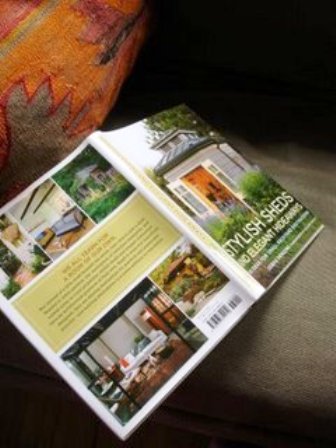
New York-based interior designer Betty Wasserman, whose redesign of a one-car garage and potting shed into a gorgeous guest cottage is featured in Stylish Sheds and Elegant Hideaways, has been named JUNE Designer of the Month by the luxury linen firm Frette.

Profiled on Frette’s web site (photo above and at left by Frette), Betty is described as “a rising designer who has made her mark by fusing original art, interior design and home furnishings into a complete and modern approach to lifestyles.” The article continues: “She takes a warm, minimalist approach to design to create an environment reflective of modern themes while concurrently expressing the lifestyle and needs of the client.”

In “Second Act,” our chapter about her inviting backyard destination, Betty plays the role of designer and client. Bill Wright’s photos capture the spirit and flair of Betty’s creative work. In my text, I tried to sum up her acumen as an artist and designer:

Where others saw “potting shed” Betty Wasserman saw “guesthouse. She renovated the barn-shaped structure with her signature “country modern” style, using furniture and art to create a cozy backyard getaway.

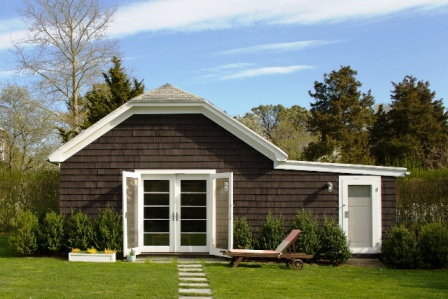
There is a pleasing asymmetry to the gambrel-roof garage with the small attached potting shed [William Wright photo]

This talented young woman breathed new life into a 1930s Hamptons garage and created a serene guest cottage for weekend visitors. Bill and I still talk about the day we arrived at Betty and her daughter Milly’s  Southampton backyard in May 2007. Situated behind her 1930s farmhouse, which Betty also renovated with a refreshing face-lift, the 600-square-foot garage revealed undeniable charm. A gambrel-style roof hinted at the building’s history. The original barn-style sliding door was mounted along the outside, as one would expect. But there was a promise of something new and exciting on the face of this little brown building.

A pair of horizontally-divided French doors enliven the front of the building.  Square, cottage-style windows give it a welcoming, wide-eyed personality. Tidy evergreen shrubs anchor the foundation into the ground. Square paving stones punctuate the lawn with a checkered pattern. Everything is crisp and confident. And that is just the exterior.

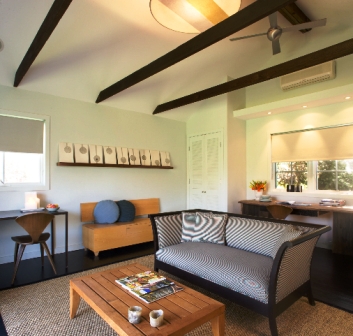
The original beams look rugged beneath an open ceiling [William Wright photo]

The interior is, as Bill likes to say, “magazine picture-perfect.” When we walked inside, it was so understated and classy that we honestly just stood there and pointed the lens. That’s not to say it was easy to photograph because like anything done well, we had to light the interior and compose our shots. We also had some kind of insanely short deadline, since weekend guests were expected to arrive in less than three hours. The picture-perfect room would soon be filled with their luggage and tennis equipment.

Somehow, thanks to a year of mentally communicating with one another on our locations, Bill and I whipped into high gear, angling furniture, and running into Betty’s house to borrow accessories like pillows, vases and candles. Her daughter Milly, who reminded us of the storybook character, Eloise, alternated between hanging around to watch, posing on the sofa in her party dress, and racing around the garden in “superhero” mode. We could have used a superhero to make time stand still and allow us to work at our leisure.

Miraculously, we shot something like 11 images in that three-hour window. Serious record, folks. Bill likes to say, “we did our best work in the shortest period of time!”

We have to give much of the credit for our awesome photos to Betty herself. After she was through with it, as small as it was, the serene guesthouse gave no hint that it once held a truck or tractor. This woman has incredible vision. To Betty, what once was a 200-square-foot lean-to style potting shed appeared just the right size for an apartment-efficient kitchen and even a postage-stamp-sized bathroom.  The garage ceiling was stripped away to make room for earthy beams overhead. A Murphy bed, hidden behind a custom door that Betty created by “weaving” walnut veneer strips over and under steel rods, was just one of her innovations. Betty designed much of the guesthouse’s custom furniture, similar to pieces in her line called bettyhome.

The garage-turned-guesthouse is popular with visiting families and their small children, usually playmates of Milly. It’s also a private retreat for mother and daughter, Betty says. “Sometimes, Milly will say, ‘Oh, Mommy, can we sleep out here tonight? She loves that whole feeling of it being our separate getaway.”

If you click over to the Frette web site, you will read a Q&A interview with Betty. Her answers to two of the questions struck a chord with me:

Q: What advice would you give to other young, up and coming designers?

A: Determine what your tastes are early in your career and focus on what you love doing. Only do what you love doing. Specialize and do not try to be everything to everyone; then you are no good to anyone!

Q: What do you look forward to accomplishing in the next 10 years?

A: Besides raising my 5-year-old daughter Milly to be a confident, happy child who is proud of her mom, I also look forward to seeing the business grow to another level in terms of project type and scale. I enjoy having our projects published, and I would like to consider producing a book about my work some day. We appear in a new book just released called “Stylish Sheds and Elegant Hideaways,” by Debra Prinzing. Milly and I are featured in our Southampton guest house and that has inspired me to want a book published about my work soon!

Congratulations, Betty! Thank you for sharing your talent with us and here’s to your future success!

Chronicling the life of a book

Wednesday, June 4th, 2008

“Shelf Life,” by Adrian Tomine, from the February 25, 2008 cover of  The New Yorker


Only a writer (or possibly an editor or book-seller) could appreciate the ironic narrative played out across the nine frames of cartoonist and illustrator Adrian Tomine’s spot-on perfect cover for The New Yorker earlier this year.


Yup. It starts with an author, toiling away at her laptop, alone in her little office. Nothing but a cup of coffee (tea, in my case) and a bare window to stare out of when she is searching for the correct word or phrase. Next, we follow the further adventure of a book’s life: When the agent presents the wonderful, finally-completed manuscript to the editor; when the editor gives it a thumb’s up; when the book is printed and bound (probably in Taiwan); when the bookseller displays a stack of crisp, fresh-smelling, just-published books; when the beloved customer first buys, and then actually sits down to READ it.


But then, as is depicted in frame number 7, we arrive at the waning years of a book’s life. The period of time from a book’s conception through gestation to its birth may seem to drag on forever, folks. Yet the final days of a book’s life can occur at lightening speed, as is witnessed here. Perhaps its owner needs to “simplify” or “clean up the clutter,” thus: the tome is set out on the curb in a cardboard box filled with other household discards. But someone reaches for it. Has the book gained new meaning? A new purpose? Yes, indeed. That hard-back cover and high-quality paper makes for great kindling on a cold night. As it burns away in a metal drum, in a desolate urban alleyway or corner, perhaps this frame can be described as “book cremation.” Its ashes live on. Somewhere.


My friends Robyn and Don framed the cover, entitled “Shelf Life,” as a gift commemorating the publication of Stylish Sheds and Elegant Hideaways. Along with other dear friends, they signed the huge white mat-board that surrounds the artwork, wishing success with sentiments like:

“While you have always impressed me as a ‘can-do’ girl and accomplished your goals, this tops the cake – Stylish Sheds is a Big Deal!” (Robyn)


“Cheers to your biggest, best and brightest, with many more to come. Can’t wait!” (Braiden and Spencer)


“You’ve always been the ‘bright’ light in our neighborhood, but baby, you’re on ‘fire'” (Don)


The print is now hanging in my office, a tribute to the highs and lows of this rare creative process, one that’s still steeped in something more tangible than letters appearing on a flat-screen monitor.


But how do others see the product of the heartfelt efforts to which Bill Wright and I devoted several years of our lives? It’s a useful tool, all 224 pages of it, according to my blogging friends. Here are two observations. It’s pretty funny when you think about it. The life of a book. I’m happy mine gets around, even in nontraditional ways:


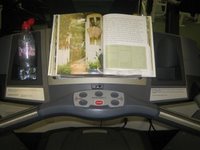
Lydia Plunk, whose blog A Very Good Life is all about living, gardening and loving her Southern California backyard and home, used Stylish Sheds as a distraction during her exercise routine (see her photo above). She posted a shot of the book, resting on the handles of her treadmill. In her May 17th blog-entry, entitled “Perspiration and Inspiration,” Lydia had this to say:


By slowing the pace, the layers of visual pleasure are better appreciated for their individual flavor components. That is why Stylish Sheds became my companion on the treadmill the past few weeks. It was a delightful companion, helping make the road back to my pre-accident self enjoyable. . . . Perspiration mixing with inspiration, I began to re-imagine my own shed. Using the matrix Debra used as an executive summary for each project, this is how I plan to make the highest and best use of my own shed.
Mission: My shed is the playhouse I always wanted, but growing -up never had. Think denim and lace for style. The shed serves as a big treasure chest of the parts for the hobbies integral to my lifestyle (doesn’t that sound so much better than “storage”)? Started with great intentions, it is in need of tlc. . .


Daniel Mount, a gardening and writing pal in Seattle, confessed to NAPPING with my book (see his photo above). In his May 26th blog-journal entry, entitled “A Nap in a Shed,” Daniel had this to say:

I decided to treat Memorial Day as at least a half-holiday and left Michael out in the garden planting and came in to the house, on a sunny day no less, and napped and read. I read Debra Prinzing’s Stylish Sheds and Elegant Hideaways. I had already wandered through the pictures several times, envious and awed at what passes for a shed these days. Many were better than our house. But it was Debra’s writing on the subject and the inspiration she found when visiting these sheds, that caught me on fire.
I always though of my suitcase as my home away from home. But as I get older and travel gets more expensive, I realize the necessity of retreat space in my own back yard. Well now I have a back yard. Of course living in a flood plane makes siting such a space complicated, but Michael had the idea for a tree house high above the floods grasp, where we could monkishly retreat together or separately and leave the messy kitchen, the paper work and the shovels behind, without getting into the truck. . . Maybe you will start to dream about a shed of your own, too.


I have to admit, reading as a prelude to napping is one of my very favorite activities. Just ask the males in my family. “Mom’s napping,” is an oft-uttered Sunday afternoon phrase around here. So of course, I love the image of Daniel, sprawled out on his sofa, with this book propped up on his chest, alternating between snoozing and dreaming about the future incarnation of his backyard treehouse-shed! I also love the image of a slim, trim, healthy Lydia, jogging away on her treadmill, her imagination miles away from that grind as she mentally redesigns the storage shed for a more personal expression of her design style. The creative mind doesn’t stop working, even when the body is sweating!


I’m so curious to see what other activities this book inspires. What other “chapters” it lives, all before landing in someone’s bonfire as a source of heat. For now, one of the best uses seems to be stashing Stylish Sheds inside a one-gallon zip-lock bag (to keep the soil off the cover) and taking it with me to the garden! That’s what I’ll be doing this summer.


Toasting and celebrating

Monday, April 28th, 2008

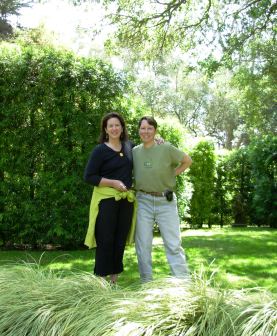
debra and bill

Debra and Bill – all that hard work has finally paid off!

Bill Wright and I are blessed with friends and family who rallied together to celebrate the publication of Stylish Sheds and Elegant Hideaways!

bhparty042708.JPG

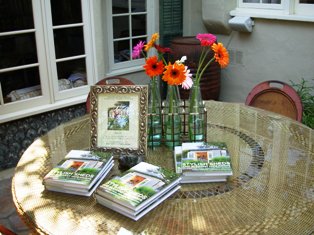
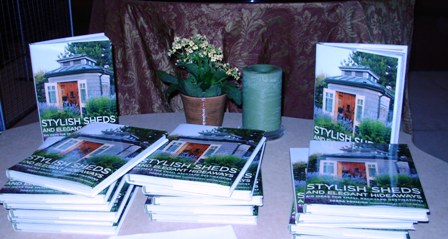
Sandy set up a comfy wicker table for our book-signing

Whereas tomorrow, Tuesday, April 29th, is the book’s “official” publication date, we jumped the gun and decided to pop the cork yesterday, April 27th.

sandysparty042708.jpg

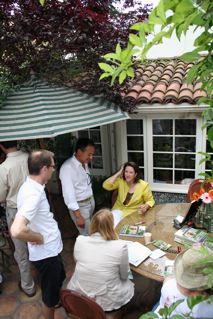
Gathering in Sandy Koepke’s Beverly Hills courtyard with friends; Debra catches up with “shedistas” Joseph Marek and John Bernatz, whose Santa Monica backyard studio is pictured in Stylish Sheds.

booksigning

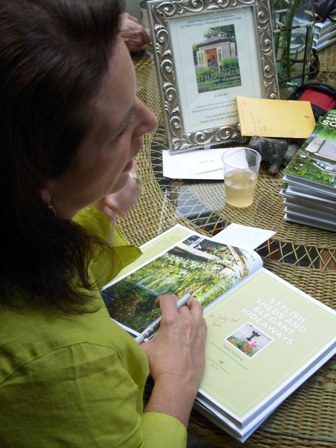
We signed lots of copies!

The setting: Sandy Koepke’s awesome, romantic, Beverly Hills farmhouse and courtyard. This talented designer’s much-published and welcoming home and garden lured no fewer than 80 guests to the Stylish Sheds book launch.

debandsandydebandpaulacristi walden and jack stevenson, her dad

The hostesses: Sandy (left, with Debra), Paula Panich (right, with Debra) and Cristi Walden (seen above with her dad, plantsman Jack Stevenson).

shed cookies

The menu: Tea party fare, including delicious sandwiches, scones, and breads made by my three dear and generous friends. Plus: Shed-shaped cookies (shown above), decorated by my mom, Anita Prinzing.

The temperature: nearly 100-degrees at 4 p.m.! Yes, in April!!!

The guest of honor: Bill Wright, photographer and collaborator extraordinaire, who flew down from Seattle for the occasion. His fellow photographer-friend Winston Hughes was a great addition to the party.

My special guests: Husband Bruce and sons Alex and Benjamin Brooks, my family; plus, my college roommate, Karen Page, who flew down from Seattle for the party.  

 .deb and karen

Deb and Karen – visiting Lotusland on Friday

Thank you to all who attended and purchased a copy of Stylish Sheds. Proceeds from the book sales benefit the new patio at Phoenix House, a project that will be completed during Big Sunday, next weekend. Sandy Koepke has redesigned a livable and nurturing space for Phoenix House residents in Venice Beach.

We’re off to Austin in 2 days to continue the party!

Escape to your own backyard

Friday, April 25th, 2008

Stylish Sheds on display

This posting is intended to THANK the wonderful members of Piedmont and Orinda Garden Clubs for hosting me on Thursday morning. These two groups in SF’s East Bay invited me to fly up to Oakland and visit their beautiful communities. The opportunity to talk about Stylish Sheds and Elegant Hideaways was particularly “sweet,” because even though the event was scheduled five days before the April 29th publication of our book, I was able to show a slide preview of our book and sign advanced copies, shipped especially for this event.

deb at book signing

One of the things I noticed immediately was the sense of connection between gardeners and the idea of seeking out a separate, private getaway in the landscape. After the lecture many people in the audience mentioned their own desire for a backyard “shed” or “shelter,” including ideas sparked by seeing Bill’s photographs of some of the best shed designs around.

gingerbread playhouse

Joyce Nelson, past president of the Orinda Garden Club, invited us to stop by her place after lunch to see her Hansel-and-Gretel-inspired playhouse. Her grandchildren are growing up and Joyce confided to me that during my talk she looked at Bill Wright’s wonderful photographs and thought of all the new ways she could use and enjoy the gingerbread-style structure. I am waiting to see if Joyce adds an adult-sized door, tosses away the toys and replaces them with a wicker armchair and footstool. Here, she can enjoy quiet afternoons reading mystery novels or perusing seed catalogs!

I flew home last night to Burbank feeling gratified that my “launch” was warmly welcomed by wonderful new friends, including Lani Schulte, my hostess for the 24-hour visit. Thank you, Lani! I know we’ll see one another again.

Bill and I have a big week ahead. Our first big book publication event is scheduled for this Sunday, April 27th, in Sandy Koepke’s Beverly Hills garden. Sandy, Cristi Walden and Paula Panich are hosting the debut of Stylish Sheds. These talented women are baking up a storm – tea party sandwiches and more! But my contribution to the party is a batch of shed-shaped cookies. Yes, the idea took hold and I couldn’t ignore it! I found cookie-cutter choices in the shapes of a cottage, dog house, gingerbread house and barn. I baked dozens of cookies and my mom, Anita, helped decorate them last weekend.

On Wednesday, we fly to Austin for 2 “Shedista” parties, a TV show and a special book-signing at Big Red Sun, a hot Austin garden center. This is going to be a blast….

Living large in 50 words or less

Friday, March 14th, 2008

I thought my big foray into the glossy, over-sized, luxury magazine market here in LA would be exciting. Instead, it kind of left me underwhelmed.

The assignment, by way of a referral from an editor friend whose work I really admire and who handed me off to write for his design deputy, was to report and write three 150-word pieces for Angeleno magazine’s “Living Large” section in its March 08 issue. Measuring 10-by-12 inches, the 300-page issue arrived in my mailbox today. Wow, Ryan Philippe is on the cover looking broodingly handsome.

Angeleno magazine

Quickly, I flipped through the first two hundred or so pages, past full-page ads featuring the beautiful people wearing clothing by Armani, Banana Republic, Dolce & Gabbana and Chanel. Where was my big story?

FINALLY. I found the six-page article, chock-full of mini-stories (and I mean mini – you really could call them “sentence stories”) about everything big in architecture, furnishings, interiors, oh, and even plants. Yes, my dazzling prose was boiled down to a caption-length block of text. Only two of the three items I wrote made the “cut,” so to speak. They really don’t resemble anything I composed.

Living Large, the story

if you look veeeerry closely, you can see my byline, circled above

But the good news is that I can publish my original pieces here, thanks to the freedom of blogging. I think you’ll like reading them. One is about super-sized cactuses and succulents; the next one is about how to grow an instant-gratification hedge; and the final one – my favorite – is about Berylwood Tree Farm, a magical nursery owned by Rolla Wilhite, a man who has been growing trees for 40 years. This is the one short story that Angeleno cut. And you know, I’m actually relieved, because Mr. Wilhite is a visionary – and he deserves a HUGE story of his own in a publication that will give him his due. And I intend to write it myself.

Read on for a revealing comparison between how the stories began and how they ended up in print:

STORY ONE (the original):

Looking Sharp: Emulate Lotusland’s exotic century plants and tree-sized aloes or recreate Huntington Botanical Garden’s otherworldly desert displays for your own enjoyment. Stunning as a piece of living sculpture, a prickly tower calls for special care in transporting and planting, says cactus-grower Molly Thongthiraj of California Cactus Center in Pasadena.

“It usually involves some kind of big equipment like a forklift or a crane,” she deadpans. “We sold a saguaro cactus that had to be delivered by helicopter.”

The scale and size of estate gardens call for big impact, which you can achieve with a pair of 4-by-4-foot variegated century plants (Agave americana ‘Variegata’) displayed in large urns. With cream-and-blue-green streaked blades forming a perfectly symmetrical (but wicked-to-the-touch) rosette, you can expect to spend $300 to $600 per plant.

Wish for something even rarer? Thongthiraj suggests a South African giant tree aloe (Aloe bainesii), with a price tag of $30,000 (12-foot) to $60,000 (20-foot). Location: 216 South Rosemead Blvd., Pasadena, CA; 626-795-2788 or www.cactuscenter.com.

How STORY ONE looks in print:

tiny story on big cactuses

STORY TWO (the original):

Fortress mentality: When Suzanne Rheinstein, interior designer and owner of Hollyhock, the West Hollywood design and antique store, wanted to double the size of her Hancock Park backyard for her daughter’s wedding, she removed a wood fence and ripped out an old eugenia hedge in order to “borrow” her neighbor’s yard for the event (that’s a nice neighbor!).

“When (the wedding) was over, we knew we had to put a hedge back, but I didn’t want to use eugenia again,” Rheinstein explains. “Instead, I found espaliered podocarpus trees that were eight feet high and wide, with wonderful dark green foliage.”

If you plant it in a straight line, just about anything – from tree ferns and ficus to holly and bamboo – can be considered a hedge. People want hedges for privacy, enclosure, and to screen objectionable views. Euphemistically called a “living fence,” there’s something kinder about erecting a green hedge rather than a solid wall between you and the neighbors.

“A green hedge benefits the environment more than a block wall,” notes Los Alamitos-based landscape architect Graham Stanley. (It’s also more economical: hedging costs about $20-per-linear-foot versus $100-per-linear-foot for a constructed wall, Stanley estimates.)

Evergreen shrubs with dark-green leaves make for the best hedges. “They set off the garden as a backdrop to the lime and bronze foliage of other plants,” Stanley says. Good choices: Waxleaf privet (Ligustrum japonica ‘Texanum’, 8-10 ft.); myrtle (Myrtus communis ‘Compacta’, 8 ft.); and fern pine (Podocarpus gracilior, 20-40 ft.). Stanley’s current favorite is Japanese blueberry tree (Elaeocarpus decipiens, to 10-15 ft.), “a nice hedging plant with dark green leaves.”

Source: Valley Crest Tree Co., 818-223-8500 or www.vctree.com (to the trade).

How STORY TWO looks in print:

hedging “story”

STORY THREE (the original piece which was dropped from Angeleno’s roundup of all things big):

Trees are the answer:There’s nothing like a 20-foot-tall (or larger) shade tree to give the impression of largess. Use one as a focal point or group several trees to form a bosque or grove – and your landscape will feel instantly established. For mega-specimens, landscape architects and designers here and beyond call Rolla Wilhite, tree purveyor extraordinaire and owner of Somis-based Berylwood Tree Farm.

Rolla Wilhite

A UCLA-trained landscape architect and horticultural pioneer who 40 years ago began planting saplings at his 25-acre nursery, Wilhite supplied trees for the Bellagio, Getty Center, Getty Villa and the Smithsonian. While he won’t reveal his most-famous clients, Wilhite slyly hints at the marquee names who have shopped among his verdant rows of stately redwoods, graceful magnolias and tufted blue atlas cedars trained into espaliered forms (Hint: just last month he helped a certain pregnant Oscar-winner choose mature live oaks for “one of her houses.”)

Known as the Rodeo Drive of trees, Berylwood is open only to architects and contractors. Wholesale trees have three- to five-figure price tags. You can’t access an online list of his 8,000 trees (Wilhite keeps that inventory in his head), but staff will email photos of specific varieties upon request.

Then there’s the waiting: After you select a mature, field-grown tree, it may take six months to two years for it to be pruned, dug and boxed for delivery so as to avoid transplant shock. “These trees are my children,” Wilhite confides.

Berylwood Tree FarmSource: Berylwood Tree Farm, 805-485-7601 or btfnurs@aol.com (to the trade).

It’s back to the world of full-length stories for me. I think my Hollywood journalism days are over.

Growing resolutions

Wednesday, January 2nd, 2008

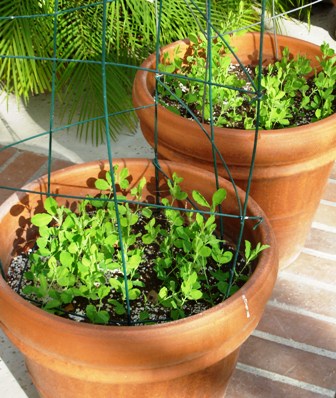
sweet pea young plantsYesterday, on the first day of the year, my 10-year-old son, Alexander, asked me to tell him my New Year’s resolution. That he posed this question at about 8 a.m. while I was trying to grab a few more moments of a midwinter’s nap after a festive “eve” the night before was only slightly bothersome. His innocence and optimism in the power of a simple turn of the calendar’s page to a new month (and year) was endearing nonetheless.

I didn’t hesitate, but immediately told Alex: my resolution this year is to grow a garden.

It has been 16 months since we’ve been uprooted from our beloved Seattle garden (and home) and suddenly transplanted to Zone 10, Ventura County. We’re living not far off of a freeway exit, half-way between Los Angeles and Santa Barbara. Like the results of a 4-inch perennial that’s been quickly planted in unprepped soil, we’ve experienced some “transplant shock,” so to speak.

Now is the time to begin transitioning from newcomers to neighbors. The change has begun, from discovering the local farmer’s market (thanks to my kind and generous neighbor, Alisa), to attending monthly Southern California Horticultural Society meetings where fellow plant-lovers welcome and include me, to hitting the road touring gardens, nurseries and other horticultural destinations with my Garden Writer pals like Nan, Joan and Paula. There is much here to admire, learn, embrace and even emulate in our suburban backyard.

So the process is underway. It requires a resolution of faith and optimism in order to put aside the “cherished familiar” and begin to look intentionally at the unfamiliar as my own new canvas. It begins with learning how plants grow and survive here in Southern California. Already our yard has begun its return to health because we cancelled the mow-and-blow-and-fertilize service the day we moved in. New layers of organic compost are continuing the process.

sweet peas in pots

Lathyrus odoratus, Early Multiflora Blend and Bouquet Blend

I’m waiting for sweet peas that I planted six weeks ago to bloom and share their perfume (the seedlings are about 8-inches tall and promise to perform once the temperatures warm up).  I’ve ordered way too many seeds and started to lay out the planting beds. 

New Year, New Garden. It’s a hopeful time.

Intrinsic beauty

Tuesday, December 25th, 2007

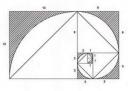
Anyone who has taken an art theory course or studied design will be familiar with the “golden mean” or the “golden ratio.” These terms describe a magical, eye-pleasing proportion that appears time after time in nature’s own handiwork. The mathematical formula is 1-to-0.618.

fibonacci spiralLook at a nautilus shell or the face of a perfectly-formed dahlia and you’ll see evidence of that unmistakable perfection. Artists, architects and designers have tried to attain (emulate?) this natural phenomenon. The logarithmic formula was studied by a 13th Century mathematician, Leonardo da Pisa (Leonardo Fibonacci). He developed what is known as the “Fibonacci Series,” a progression of numbers that explains nature’s structural design, especially seen in botany. Beginning with 1+1=2, and then adding the sum of the first two numbers with the second, you begin to see an endless series of numbers: 1, 1, 2, 3, 5, 8, 13, 21, 34, 55, 89, 144, etc. (Each number is the sum of the two numbers preceding it.) Count the seeds on a pine cone, daisy or sunflower. You will begin to see this beautiful, perfect, equation.

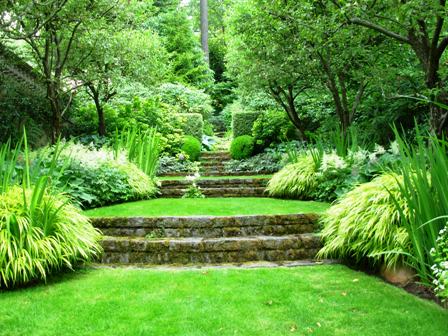
Another related, and also timeless, design notion is called the “French Third.” It is the approximate ratio of 1/3-to-2/3, which also appears in classical paintings, sculpture, architecture and design.

Now I read that scientists think even our brains intuitively respond to evidence of great beauty.

Researchers in Italy recently showed great works of art to volunteers with no artistic training (some of whom had never before been to a museum). According to a report in The Week (12-7-2007), neuroscientists showed their subjects images of Classical and Renaissance sculptures by Michelangelo and da Vinci. Some of the images had been altered, slightly modifying the original proportions. When subjects viewed pictures of the original sculptures, scans of their brains showed a strong emotional response.

There was less response to the sculptures with changed proportions. “We were very surprised that very small modifications to images of the sculptures led to very strong modifications in brain activity,” researcher Giacomo Rizzolatti was quoted as saying. The brain, he surmised, may have a special attraction to images that demonstrate the golden ratio, which shows up in nature, and is emulated in great art. And our brains interpret these proportions, responding to them positively.

It is quite humbling to realize that for all our lofty notions of “beauty,” “art” and “good design,” our very body (brain and soul) recognizes intrinsic beauty. Portland garden

The gracefully-proportioned steps in the Israelit garden (Portland, OR) demonstrate the idea of “French Thirds”

More British shed news

Monday, December 10th, 2007

In an earlier post, I mentioned that TWO “shed guys” from the U.K. have been in touch with Shedstyle.com. If Uncle Wilco of readersheds.co.uk is the “bad boy” of sheds, then Alex Johnson is the shed-dweller’s “boy-next-door.” I’m happy to have them both on my team!

When I first discovered Alex’s site — Shedworking — I was thrilled to learn he was the online voice of a community of people who have shunned the office cubicle for their backyard studios and ateliers. He has successfully identified and tapped into a groundswell of shed users – across Britain and (increasingly) on U.S. soil. I’m glad to join this international conversation and want to introduce my Shedstyle readers to Alex.

Q. Please provide us with a brief bio:

Alex JohnsonA. I’m a 38-year-old journalist, living in St. Albans, England (just outside London) and have worked on national newspapers and magazines in the U.K. and Spain for the last 15 years, as well as being an editorial consultant for several major charities. I’ve focused particularly on over-50s issues, Spanish culture (I lived in Madrid for several years) and over the last two years, the world of ‘homeworking,’ with an emphasis on shedworking, using a garden office as an alternative to the traditional office workplace.

Q. How/when did you get the idea to start shedworking.co.uk?

A. When I bought my own garden office four years ago, there seemed to be growing interest in the U.K. (and also to some extent the U.S.) in not only working from home, but particularly from a shed-like atmosphere at the bottom of the garden. I felt that this group wasn’t being catered to by the traditional mainstream media — indeed often patronised by it — and so decide to launch “The Shed” as a free PDF magazine to try and bring this dispersed community together. The magazine has recently celebrated its second birthday and now has 1,500 readers in countries around the globe (U.K., U.S., Spain, Italy, France, Brazil, Canada, Australia and New Zealand). I launched the Shedworking blog site just over a year ago and that has also taken off nicely – I blog daily, sometimes posting three or four times.

 Q. To what do you attribute the explosion of interest in backyard office-sheds?

A. The increasing belief that the current way we work is simply not applicable any more to 21st century living and that ‘presenteeism’ is largely unnecessary. Offices as factories is a fairly recent phenomenon, largely the result of the industrial revolution, and working from home is superior in many ways – it cuts out the commute, it improves life/work balance, it can be a lot more eco-friendly, it’s more productive . . . the list is endless. And there’s a really impressive range of garden offices available on the market, too, so whatever your wallet size or architectural interest, it’s likely there’s something for the proto-shedworker out there.

Q. Who are your ‘readers’?

A. A large number work in creative industries, particularly the media, with a roughly 50-50 split between men and women. The beauty of shedworking is that while the traditional allotment shed is still something of a male domain, the trend towards shedworking has enfranchised women to own their own sheds and work from them. Many readers are particularly interested in green issues.

Q. Are you working from a backyard shed? Describe it, please.

Alex’s shed-office

Alex’s “shedquarters” in St. Albans, England

A. I am indeed. It’s a green Homestead Timber Building’s garden office, a Marlow model, rather traditionally shedlike architecturally. It’s perfect since I don’t need a vast amount of space and our back garden is fairly modestly sized. It has full insulation, a heater, electrics, wi-fi and as an office it also handles my overflow for books from the house and minor bits of gardening (I keep my home-brewed cider in here).

Q. Please tell me about your online magazine, “The Shed,” and how people can subscribe to it.

A. It’s a lifestyle magazine for people who work in garden offices, sheds and other shedlike atmospheres. It covers homeworking issues such as what to wear to homework, interesting garden office structures, poetry (we have a poet in residence called Shedman, John Davies, who has just released a new collection of poems, largely about sheds), humor and the latest news about garden offices and accessories. To subscribe, just email me at alex@splashmedia.co.uk.

Q. Can you share details about your forthcoming book?

A. “Shedworking: the alternative workplace revolution,” will be published by The Friday Project in the U.K. in July 2008 during the second “National Shed Week.” It will look, in more depth, at the issues and structures touched on in the magazine and on the site, from historic sheds and shedworkers to examples of how people run businesses from their garden offices in the 21st century to dealing with issues such as isolation and the future of shedworking as microarchitecture starts to really take off. There’ll be plenty of examples to enjoy but it will also be a good read. I’m just finishing writing at the moment.

Q. What do you plan to do next?

A. I’d like to put together a book about shepherd’s huts – these sheds on wheels are becoming increasingly popular in the U.K. as garden offices and backyard structures (both original and reconstructed) but there are also more concrete examples around the world from Romney Marsh in eastern England (where they are called ‘Lookers Huts’) to New Zealand.

Thank you, Alex! It will be great fun to follow your progress and keep up with you!

As always, they do it better across the Atlantic

Sunday, December 9th, 2007

Last week’s posting on Shed design tips yielded response from two of the U.K.’s shed experts who have their own awesome blogs. I first discovered Readersheds last spring, while working on “Stylish Sheds and Elegant Hideaways,” my book project.

So it is with great delight that I can share the first of two Q&As with my British Shed Pals. Appearing here is my email conversation with the “Prince of Sheds,” aka Uncle Wilco. Uncle Wilco runs a popular web site: www.readersheds.co.uk (he blogs at shedblog.co.uk).

Q. Please share your bio with us:

uncle wilcoA. I am Uncle Wilco and I am a sheddie. I’m 36 and I live near Pontypridd (where singer superstar Tom Jones comes from ) in South Wales in the U.K. I’m not sure if Tom has a shed; I’ve never had a reply from him. But I love sheds!

Q. When/how did you launch readersheds.co.uk?

A. Readersheds started as an idea in early 2000. I was looking for information about building a garden shed, but could not find much online, so I thought I might as well start a website, where people “shared their sheds” and told us how they went about it.

Ironically, the shed I went with in the end was ordered online and I just erected it instead of building from scratch. But the idea for “readersheds” had started and it just took on a life of its own! The shedblog.co.uk came later, but has been great in promoting Shed Week (details on this below)! And my general musings on shed-related matters.

Q. What was your first introduction to a shed? Did you grow up with a tool shed or potting shed in your backyard?

A. My grandfather (who turned 90 in November) used to have a big allotment garden in the Welsh Valleys. There he used to grow vegetables – and of course (it) was a place the men used to go to escape the wife!

All the allotmenters had sheds they built from scrap wood and anything else they could find. They were recycling before it was fashionable. I used to spend a lot of time there when I was younger. I don’t recall my parents having a shed, but my dad had a garage converted into a wood-shop, so the idea was there!

Q. Please describe your own shed.

uncle wilcos shedA. I have two. Technically, one is a normal garden shed, but it is the hub of my ‘shed empire.’  The other one is a summerhouse, which is Mrs. Uncle Wilco’s domain, so is not on the site yet, but very soon.

Q. Tell me about the response you’ve had, both in the U.K. and around the globe.

A. It was slow to start with, but I never did any advertising or Search Engine Optimisation really for the site. Over the past three years the site has gone from strength to strength in terms of global visitors. And of course sheddies from most continents have shared their sheds, from your basic off-the-shelf to unique cabins and buildings of beauty.

Q. How many readers have posted photos of their sheds on your site?

A. We have around 730 sheds on the site currently, with around 100 that have been added since “Shed of the Year 2007,” but we are looking for many more and your readers can share their sheds here.

Q. When did you start the Shed of the Year competition?

Tony’s Roman Temple ShedA. 2007 was the first year, but I had a small shed competition a few years ago. I can’t wait for Shed of the Year 2008. Not sure if we can top last year’s winner: Tony’s Roman Temple Shed. We have a good selection so far, but we have six months to go, so hopefully we will have some unique sheds.

Q. Tell me about the National Shed Week – it seems like it has been wildly popular with great press coverage.

A. I decided that here in the U.K., we should have a week that celebrates all things sheds. I tried to petition the U.K. government, but to no avail, as they said the idea “was intended to be humorous, or have no point about government policy.”

So I thought, well I have a shed site so I will run it myself. National Shed Week was born with the aim of getting sheds recognized. [Editor’s note: National Shed Week is scheduled to begin July 7, 2008.]

I think having U.K. property guru and sheddies favourite Sarah Beeny signed up as a judge may have helped with the press coverage, but of course the British have a love affair with the shed, so really it’s just snowballed. I was lucky to do a few radio interviews. I got the impression they thought I was a nutter . . . ! But at least people realise that I have a passion for sheds, so that’s all that matters.

Q. What do you plan next?

A. Well, Shed of the Year 2008 is my next big thing. I hope to be more organised than this year – in fact I have already signed up four judges including TV property guru Sarah Beeny, the famous wind-up radio inventor Trevor Baylis, Alex from shedworking.co.uk and renowned beach hut expert Dr. Kathryn Ferry.

I hope we get lots more unique sheds on the site, as they are the lifeblood of Shed Week! I am talking to sponsors at the moment, so we should have some great shed prizes to give away as well.

After 2008, well, not sure. Hopefully, 2009! And then, Shed World Domination.

Shed design tips

Monday, December 3rd, 2007

Atlanta shedA nice surprise arrived in my email in-box last week. It was a note from someone who has discovered shedstyle.com: 

Dear Debra, My husband and I are building a potting shed. We have a footprint and general design concept.  What we haven’t been able to find are ideas or samples of interior space allocation.  I’ve preordered Stylish Sheds and Elegant Hideways from Random House but now is the time I most need some of your knowledge/experience.  Is there another source (I’ve also read your internet magazine) that you can direct me?  Is there any information you can provide? I’ve literally been hoping for this building ever since my husband and I bought our home – 27 years ago.  I’d really appreciate your help. Thank you! (signed, MARY) 

book coverWow, thank you, Mary! She actually pre-ordered Stylish Sheds and Elegant Hideaways! Very exciting news, especially since it won’t be on bookstore shelves until April 29, 2008. Mary’s note prompted me to think about what kind of Shed Design Checklist I would give a nascent shed-builder.  

shelf and stained glassHere are some general tips: First, of all, remember that there are infinite ideas to play around with. Think carefully about the interiors. So many people build gorgeous pieces of architectural wonder but then leave the shed’s inside ordinary-looking, dusty and filled with cobwebs. Even a functioning potting shed should be beautiful and reflect your own style. 

interior with pegboard

Pegboard walls and exposed rafters give this shed a barn-like feeling, while a cozy area rug and rocking chair ensure comfort

Treat the interior space allocation as you would design any room of your house. What will you do with the wall? It’s fine to leave the rafters and studs exposed, but can you paint them or mount shelves or hooks for displaying collections? One woman I know lined the walls of her potting shed with pegboard and hung from it all her antique gardening tools.  

kathy’s potting bench

Kathy’s potting counter

If you want a work counter or potting bench, consider the dimensions and proportions of the interior counters that feel best to you. Is your kitchen counter the correct height and depth? Do you like it deep enough to allow room for stacks of flowerpots or rows of gardening books to be displayed across the back? Is there storage room underneath?

Some of the most attractive countertops I’ve seen are covered in a sheath of copper or zinc. Kathy Fries, a Seattle gardener who has no fewer than four “shed” structures on her property, bought a salvaged section of classroom cabinets (probably used in a high school wood-shop or science class), complete with countertop and storage bins — voila! The perfect potting bench for her garden house.

window1Windows: Can you add a valance or lace panels? Can you make sure there’s a nice deep ledge for potted herbs or anything else that makes you happy? Windows should definitely be operable so you can adjust temperatures, create ventilation and — most important — hear the sounds of your garden while inside the shed. Swishing grasses, the whir of a hummingbird, bird-songs and a fountain’s trickling water are essential sounds you wouldn’t want to miss.

doorwayDoors: Just as with your home, you want the threshold and portal that lead from the “external world” to your “inner sanctum” to be symbolic of powerful and nurturing emotions: shelter, safety and haven. Don’t settle for an ordinary door from the big-box home center when you can do a little hunting to find something special. A salvaged door, especially one with glass, is a nice choice. You can add color or (as we did in our Seattle garden) allow the elements to continue the peeling process that reveals decades of life.

roman paversterra cotta paversFloor: Remember this is an outdoor structure. It’s okay if you have a cement floor, but perhaps you should paint it and put a drain in the center so any gardening projects can be easily cleaned up. I’ve visited numerous sheds with wood plank flooring, vinyl tile, terracotta tile, flagstone, wall-to-wall carpeting and the aforementioned concrete. It really depends on the function of the room. 

Space-planning: Even if this is going to be a space for working on gardening projects, designate one wall or corner for R&R; A bench with cushions, a wicker chair and good reading lamp (of course, this means electricity), a desk for your reference books, correspondence or even a small tea party. Again, look to the room-like proportions of your home. One couple we interviewed/photographed for the book built their tea-house on the exact proportions of their dining room because to them, it was a comfortable space. 

debra’s Seattle shed

On the potting shed in my former Seattle garden, designer Jean Zaputil used salvaged French doors donated by a contractor-neighbor. The weathered mailbox became the perfect planter-box for daffodils and a rose hip wreath hangs on one door

Here are some other questions to ask yourself:

  • What activity draw us outdoors? Are you creating art, making music, writing, gardening, arranging flowers, playing with children, stargazing, entertaining friends, seeking solitude or meditating?
  • What role will the structure play in the landscape? Is it a design focal point or is it intentionally hidden from view? Will it be a surface or “wall” in the garden for climbing vines or roses? Will you use it as a gallery for hanging objects, mirrors, artifacts? Will it hide or disguise an unsightly view (such as the back of a neighbor’s garage)? Is it for pure function or pure folly…or a little bit of both?
  • detail1To create an appropriate shelter or structure to house your activity, take time to address these functional choices: placement (where will you site the structure? how will it be oriented?); size and scale (check your local building codes to determine the maximum size allowed without a construction permit; it is often around 100 square feet); what materials will complement your home’s architecture? what utilities do you need (electricity, water, heat?); and, of course, the fun part: how will you decorate, embellish and adorn the structure?

In her book Hideaways: Cabins, Huts, and Tree House Escapes, French author Sonya Faure explores some of the emotions that the word “hideaway” can conjure. I’d like to share them here:

“The dictionary defines a hideaway as ‘a secluded spot.’. . . There are plenty of synonyms for the word, most of which emphasize its protective function: cover, den, haven, hideout, refuge, retreat, sanctuary, shelter. . . . The noun ‘hut’ and the verb ‘to hide’ share the same Indo-European root – skeu – meaning: to cover or to conceal.”

In the end, your shed should be designed for your private and personal delight. It is the place where you will feel safe, feel free to create and contemplate, and take refuge from the everyday demands of life. “Shed” also is a verb that has several meanings, most of which hint at “letting go” (as in shedding tears, sending forth, losing by a natural process). There’s something very symbolic in that notion as well. We “shed” our burdens, our cares, our sadness or pain, when we can escape into our secret backyard place.