Debra Prinzing

Get the Email Newsletter!

Archive for the ‘Gardening’ Category

Botanical fantasy? Or Shoe Fetish?

Monday, March 9th, 2009
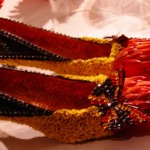
Shoes for a flower fairy with twigs, moss and petals

Shoes for a flower fairy with twigs, moss and petals

I spent a few days last week at the spectacular Philadelphia Flower Show. It was my second time traveling to this Grand Dame of indoor flower shows to give a garden talk. When I first presented there in 2006, I was blown away by the over-the-top displays and ambitious floral designs. This year’s theme, “Bella Italia,” inspired show designers to highlight Italian- and Mediterranean-themed gardens.

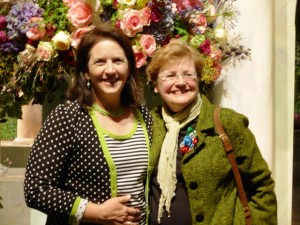
Debra (left) and Mary-Kate Mackey (right). We posed in front of a lavish rose-filled urn at the entrance to the Philadelphia Flower Show.

Debra (left) and Mary-Kate Mackey (right). We posed in front of a lavish rose-filled urn at the entrance to the Philadelphia Flower Show.

With my roommate, Mary-Kate Mackey, I managed to squeeze in lots of adventures in my 36 hours on Pennsylvania soil (I spent more time trying to fly there and back than I was actually on the ground, due to a doozy of an East Coast snow storm that stranded me in Dallas overnight and then marooned me for five hours in Milwaukee). Unfortunately, I missed seeing all of my fellow Garden Writer members because I was sitting in the Milwaukee Airport at the exact time the regional meeting took place. Oh well.

But – finally – when down to my last option of continuing eastward or returning home to LA, I grabbed a seat on the only flight to Philly that day. I arrived late last Monday and met up with Mary-Kate, who was in town to teach a one-day writing class for Garden Writers, and to see the show.

After my lecture on Tuesday afternoon, we strolled out to the show. With M-K as my tour guide (all-knowing, she had been there for several days, including hours spent behind-the-scenes during show set-up). We meandered through “Bella Italia” – kind of like taking a cross-country floral tour – all in a single day.

With gardens devoted to Italy’s major tourist regions, there was lots to admire. But the most surprising and artistic of them all celebrated Milan. Milan is the fashion capital of Italy. The American Institute of Floral Designers (AFID) created a floral fashion show of sorts. Spectacular stuff!

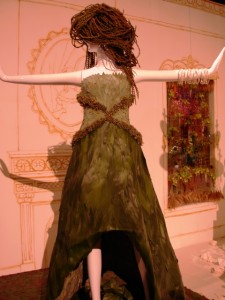
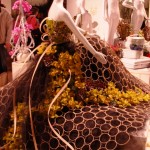
Foliage as soft as velvet creates the bodice of this nature-inspired creation

Foliage as soft as velvet creates the bodice of this nature-inspired creation

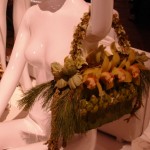
Against a stark white backdrop of mannequins and props, the designers displyaed imaginative shoes, handbags, hats, jewelry and garments . . . made out of petals, leaves, pods, buds, stems, needles and more. In every hue and texture of flower and foliage. Oh, so beautiful. M-K likened the technique of layering and gluing individual petals and plant parts (to create fields of color) to a small-scale version of Pasadena Rose Bowl Parade’s float production. It is a good explanation of the way these inventive designers rendered fashion “in bloom.”

Bows, buds and pods adorn this pair of stylish heels

Bows, buds and pods adorn this pair of stylish heels

More inspiring than the dresses, though, was the footwear. People were standing three- and four-bodies deep to gaze at and try to capture photographs of these dainty delicacies for the toes.

What is it about shoes? We asked each other this question as we, too, tried to get close and peer at the high heels, strappy sandals, little ballet flats, avant-garde boots, and more.

Are shoes magical, like Cinderella’s glass slippers? Or do they just seduce us with those sensual shapes? I know from experience that a gorgeous pair of shoes (comfortable ones would be nice, too) gives many women a feeling of power and confidence.

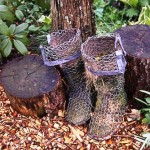
A whimsical pair of boots (made from chicken wire and moss), spotted in Holland in 2005

A whimsical pair of boots (made from chicken wire and moss), spotted in Holland in 2005

Shoes in the garden never fail to charm and delight. Think of those people who love to plant hen-and-chicks in old work boots.

A steel "spring" adorns the toe of this shoe-planter

A steel "spring" adorns the toe of this shoe-planter

I love my wacky garden shoes, also known as “Steel Heels.” I discovered them when I lectured at the Boise Flower Show in 2006.

Cut from steel and welded with fanciful heels and swirly toes, these artful shoes were made by Micki Shampang-Voorhies and her husband Gary Voorhies. I love that these perfect Size 8’s are weathered over time to reveal a rusty patina.

These shoes make me smile every time I see them in the garden.

The artists, whose Blue River, Oregon, studio is called Custom Copper & Iron, turn everyday scrap metal and rusted tools into fashionista-worthy shoes.

Castoff springs, drill bits, bolts and even a handle of a garden faucet create the heels of each artistic stiletto. Tuck a few sedums into the toe or heel and I’ve started my own shoe wardrobe in the garden:

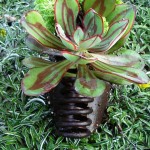
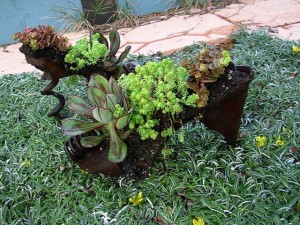
"Steel Heels," planted with succulents

"Steel Heels," planted with succulents

 Enjoy this garden gallery of shoes and other fashions for your visual delight:

The New Terrarium: Small world, Big influence

Saturday, March 7th, 2009
Our Holland gang, with Tovah front and center (she is the short, grinning gal with a huge camera around her neck). Clockwise, from left: Kathy Renwald, Bianca Helderman, Anne Nieland, Debra Prinzing, Walter Reeves, Mary Robson, Nellie Neal and Tovah Martin

Our Holland gang, with Tovah front and center (she is the short, grinning gal with a huge camera around her neck). Clockwise, from left: Kathy Renwald, Bianca Helderman, Anne Nieland, Debra Prinzing, Walter Reeves, Mary Robson, Nellie Neal and Tovah Martin

I met Tovah Martin in 2005 when we both participated in a media tour to Holland during spring bulb season. Since I had for years enjoyed and admired Tovah’s garden writing in the original Victoria magazine, you can only imagine how exciting it was to actually meet her.

I think we were both surprised at how quickly our little group of seven (including our wonderful guide Bianca Helderman from the Netherlands Board of Tourism & Conventions) bonded as accidental fellow travelers. I have vivid memories of Tovah wearing her knee-high rubber boots to tramp around the bulb fields at Hortus Bulborum  (I actually envied her pragmatism: I mean, who else would pack a pair of waterproof gardening boots to bring on a trip to Europe!?)

Tovah gave me a very important gift that week. I still remember sitting across from each other at an ancient trestle table. We ate lunch and swapped stories about book publishing. Known and loved around the globe for her beautiful Tasha Tudor’s Garden and Tasha Tudor’s Heirloom Crafts and many other books, Tovah graciously shared her advice and guidance as I struggled with how to develop my “garden shed” book (it was just an idea back then). Her suggestions about photography really influenced my decision to partner with Bill Wright on Stylish Sheds and Elegant Hideaways, rather than working with a variety of photographers in every market. She gave me a lot of clarity and I cherish her advice.

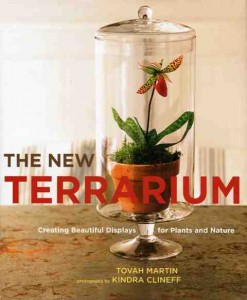
newterrariumcover001So now, I’m the lucky recipient of newest Tovah Martin book, by all counts, her 13th title. The New Terrarium: Creating Beautiful Displays for Plants and Nature, was published on March 3rd by Clarkson Potter/Publishers. [Full disclosure: Clarkson Potter also published our book – we love everything they produce!]

Captured on film by photographer Kindra Clineff, The New Terrarium is a magical tome filled with small, planted scenes, landscapes, still-life’s and collections under glass.

Tovah brings a perfect combination of talent to this dreamy book. She is a gifted storyteller, both visually and with words (Tovah art-directs and produces many of her magazine articles for Country Gardens and other publications); she has a long history as an expert with indoor and greenhouse plants from her past career at Logee’s Greenhouses; and she is a visionary who understands how to get others excited about her passion.

The idea of creating a book about gardening under glass (on a small scale) struck a chord with this avid plants woman. Here is an excerpt of my recent conversation with Tovah:

Q. How did The New Terrarium come about?

A. Kindra and I started working on magazine projects together, and when Clarkson Potter came to me with this idea, I thought of Kindra. She is a cross between a garden photographer and an interior photographer.

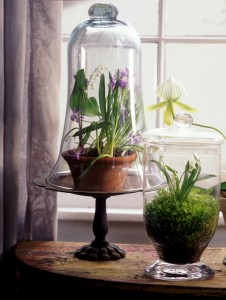
This ode to spring under glass includes white wood hyacinth (right) and lily-of-the-valley with glory-of-the-snow (left). Kindra Clineff photograph

This ode to spring under glass includes white wood hyacinth (right) and lily-of-the-valley with glory-of-the-snow (left). Kindra Clineff photograph

Q. What enchants you about gardens under glass?

A. Way back when I was at Logee’s, I originally lived in the upstairs of the house that overlooked all the greenhouses. Why I find (terrariums) so quaint, and why I can really get into them, is that I’ve never lost that feeling of loving things encased in glass. I loved looking down on the glass greenhouses. I even used to produce little booklets on how to plant terrariums for people who wanted to make or sell them.

Q. Terrariums are a tradition that dates back more than a century. What makes this technique, this idea, suddenly “new”?

A. I can’t think of a modern terrarium book. What I’m hoping is that people in office buildings, people with no access to gardening for a major part of their day, will think of this as a low-maintenance way to bring nature into their lives.

Q. You really believe that plants can be transformative?

A. I kept calling up Kindra and saying, “This is really big. We’re going to change the world.” I saw that this whole mode of gardening has the potential to rescue people from terminal office life.

Q. Tell me about the glass containers you used to create your projects. There is such an incredible variety – many surprised me.

A. Almost anything can be used. You can just start looking at glass this new way.

[Debra’s note: The New Terrarium is packed with inspiring ideas of the types of containers suitable for planting – from traditional cloches, Wardian cases and lantern cloches to more contemporary vessels, including recycled aquariums, hurricane lanterns, vases and repurposed glass domes used to cover cakes or cheese platters.]

“]A Wardian case with a deep base simplifies planting directly in the case. Kindra Clineff photograph]

A Wardian case with a deep base simplifies planting directly in the case. Kindra Clineff photograph

Q. What do you hope to teach gardeners and non-gardeners about growing plants under glass?

A. It’s an easy way for people to enjoy plants. Basically you don’t need to water very often. You don’t even need to fertilize.

[Debra’s note: Tovah has included a comprehensive plant encyclopedia that recommends a surprising array of plants for glass gardens, including: orchids, ferns, heucheras, begonias, mosses, African violets, bromeliads, ivies, ornamental grasses and more.]

Q. I love the photos! How did you and Kindra produce the shots?

A. This book was the challenge of the century because everything reflects in glass. We now understand why no one’s done this book before. Kindra had to surround herself in a black piece of velvet (so she wouldn’t be reflected in the shot). We kept joking that we should do the author and photographer’s portraits reflected in glass.

Q. Did you photograph at your Connecticut farmhouse?

A. We shot at four different houses, one of them being mine. I have a converted barn with big, huge windows and a little cobbler shop from 1790. A greenhouse connects these two buildings. We used the windows of these houses (for a backdrop). But most terrariums should be displayed away from the sun or windows.

Q. Tovah, how do you describe your writing philosophy?

A. This has been a lifelong mission for me: To write for (publications) that aren’t necessarily reaching gardening audiences in order to expand the whole realm.

Thank you! What a great conversation and a spectacular book.

Alluring aloes in a January garden

Saturday, January 24th, 2009

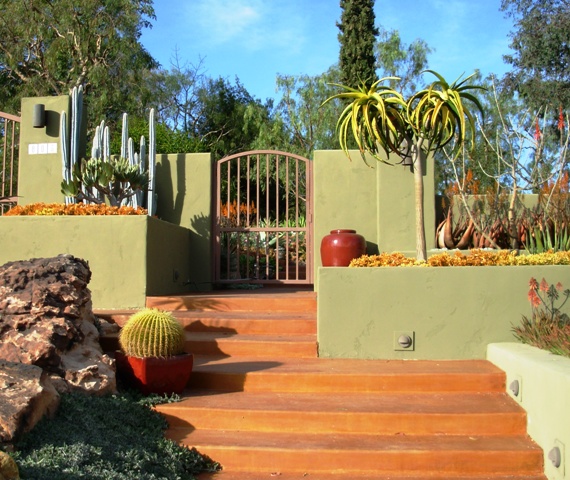
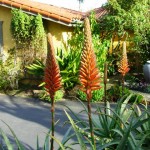
The sage and pumpkin-colored entry garden hints at the glories inside the gate!

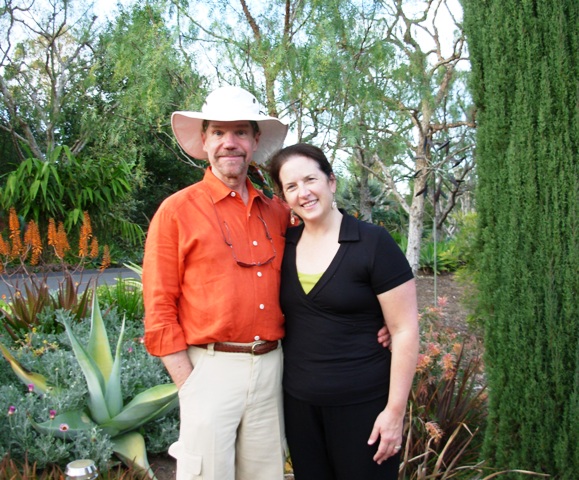
Patrick donned his “Aloe Orange” linen shirt so he could match his garden!  

I think I’ve established my willingness to drive, fly, walk, hike, take a train or ride a bicycle to get to a garden destination that summons me.

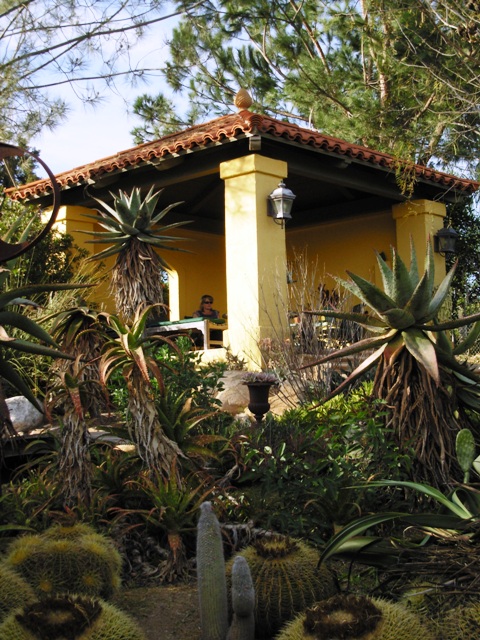
Last Sunday is a good example. I was staring at an invitation from Patrick Anderson and Les Olson, owners of a cactus and succulent garden extraordinaire (not to mention the most majestic dining pavilion in the universe – you can find it on page 126 of Stylish Sheds and Elegant Hideaways, in my chapter entitled “Extravagant Gestures”).

“Sweets, Savories & Succulents,” read the invite. “Please join us to celebrate the New Year, and the glory of the garden in midwinter.”

This was the third time Patrick and Les extended an invitation to their winter party. And it was the first year I wasn’t traveling out of state. I first met the men in 2005 when they hosted a Pacific Horticulture Open Garden event for donors. I returned with Bill Wright in the fall of 2006 to photograph the dining pavilion and garden for our book. Practically hyperventilating with excitement about shooting such a cool setting, we rose before dawn and tiptoed out to the garden to get the very best early-morning shots (our task was eased, thanks to the offer of lodging in Patrick and Les’s guest bedrooms).

Last weekend, I desperately wanted to visit their exotic botanical wonderland in San Diego County. Not only did I want to say hello to my “Shedista” friends, but I knew the aloe display would be at its ever-lovin’ peak of perfection.

Who cares that going to the party meant a 300-mile round-trip drive on a Sunday afternoon? Husband and sons all fed and settled into their own activities, I hopped in the car after church and hit the freeway, heading south.

Oh what a treat I had! This is the very type of excursion that convinces a California newcomer that all her former Seattle blossoms have serious competition for her affections. It’s tough to yearn for my hydrangeas, peonies and lilacs when the intense, architectural aloe blooms are in my face.

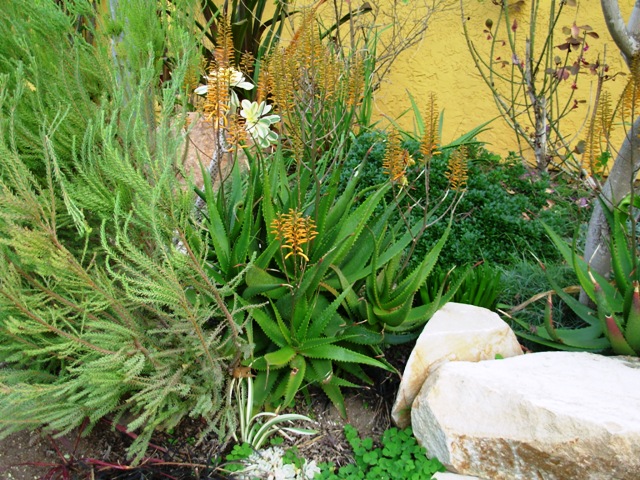
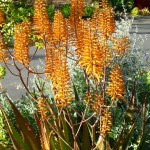
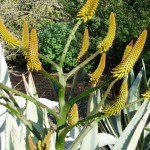
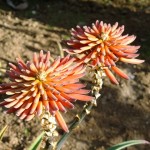
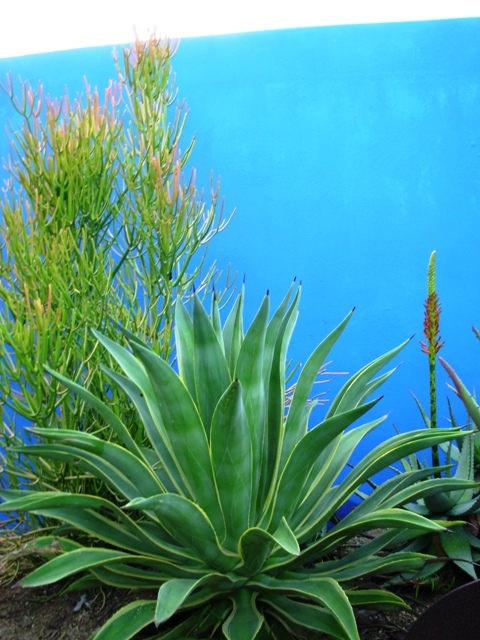
Orange, gold, salmon, yellow, apricot, terracotta pink – saturated hues of the sun – on display like colorful fireworks hovering at the tips of erect stalks. Each bloom is composed of tubular flowers tightly arranged around the stem. And what diversity! Some are shaped like a red-hot poker Kniphofia bloom; others are short and wide, in the shape of a spinning top. Some tilt upwards; others are arranged like rays of the sun. These flowers are winter’s antidote to gloom.

According to Sunset Western Garden Book, aloes are primarily South African native plants:

They range from 6-inch miniatures to trees. “Showy and easy to grow in well-drained soil in reasonably frost-free areas, (aloes) need little water but can take more. . . . Highly valued as ornamentals, in the ground, or in pots.”

That’s not all Patrick and Les have in their 2-acre garden.

They own, of course, the enviable dining pavilion (I still marvel at my luck convincing my editor Doris that we could include this architectural gem.)

It is certainly an “elegant hideaway,” although a very distant relation to a shed.

Not a wimpy latticework gazebo, but a bold, manly garden house that can accommodate a quiet dinner for two or a raucous gathering of a dozen friends.

Here are the opening lines that appear in the Stylish Sheds chapter about their dreamy garden hideaway:

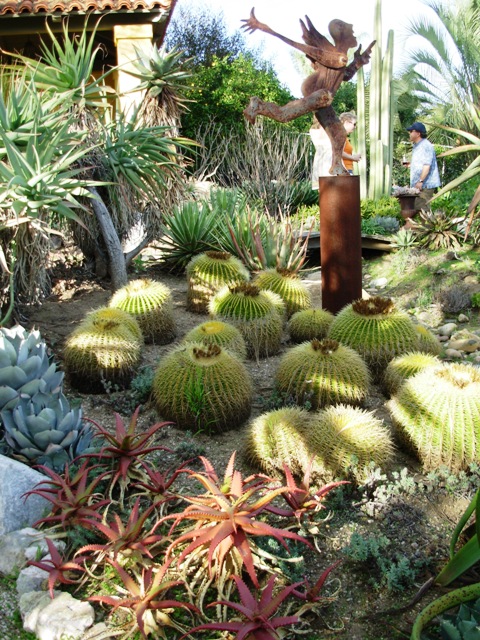
Patrick seized the chance to invent his own plant world here, spending the past fifteen years shaping the landscape with unusual spiked, whorled, spherical, and fan-shaped cactuses, along with succulents representing a color spectrum from maroon to bronze to silvery blue. “Every inch of this property is plantable if I ever get around to it,” he maintains. The garden’s finishing touch: a golden, open-air pavilion where Les and Patrick seek haven from heat and sun.

The neighbors jokingly call it the Taj Mahal, but the opulent pavilion situated at the highest point of Patrick and Les’s property has exactly the right degree of dramatic presence their flamboyant desert garden needs. Together the structure and plant collections embody Patrick’s two loves: theater and horticulture.
Patrick fell in love with aloes and other succulents and cactus forms years ago, as a volunteer at the famed Huntington Botanical Gardens near Pasadena. He learned to grow and propagate many varieties, including aloes. And I suspect his design sensibility (he studied theater and costume design in college) was also honed as he spent time in the Huntington’s desert collection.

When he began to transform the property nearly 20 years ago, Patrick wanted to plant a wide variety of desert-climate plants in a lush style that he describes as a “dry jungle.”

More than 200 varieties of aloes unify the garden. Against the pointed and thorny blue-green leaves, the brilliant aloe blooms remind visitors that there’s nothing dull about the desert floral palette.

Thank you, again, Les and Patrick, for sharing your garden with me and with so many of your admirers!

It was a long drive. But an inspiring day. And I am certain that by next January, when another invitation to “Sweets, Savories, and Succulents” arrives in my mailbox, I will clear my calendar and make the drive again!

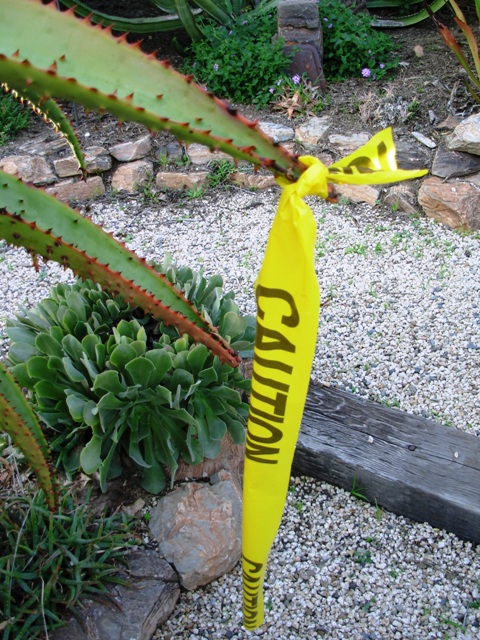
P.S., One amusing photograph I just had to add.

For anyone who has been up close and intimate with an aloe, agave, cactus or other thorny plant. . . the “Caution” tape was a reminder of how careful one must be in a desert garden!

Eco-friendly lawn and garden equipment – and more

Thursday, January 22nd, 2009

I hopped a plane last week to fly from Los Angeles to Orlando and back in less than 48 hours.

No, I’m not one of those desperate collectors of airline miles who is trying to get bumped up to the platinum level for better perks (although that would be nice).

But somehow, the invitation from a publicist for Sears-Craftsman Lawn and Garden Equipment convinced me that this trip would be worth my while. And in many ways, it was more than a good trip. Crazed, but definitely a surprisingly good one.

Sometimes it’s smart just to say “yes” to something unexpected that falls in your lap, even though you don’t really have the time. Here are 10 Reasons Why:

I’m joined by Garden Design magazine’s Jenny Andrews (Features Editor, left) and Megan Padilla (Senior Editor, center)

1. Enjoying dinner with two gifted and creative editors of Garden Design magazine. Jenny Andrews and Megan Padilla are two of the staff editors for this hip publication and I’ve worked with both of them on recent articles. They treated me to dinner at what might best be described as a quintessential Florida restaurant. The seafood was de-lish and the entertainment? We’re talking performers on stilts and a guy who swallowed flaming swords. The conversation was pretty entertaining, too!


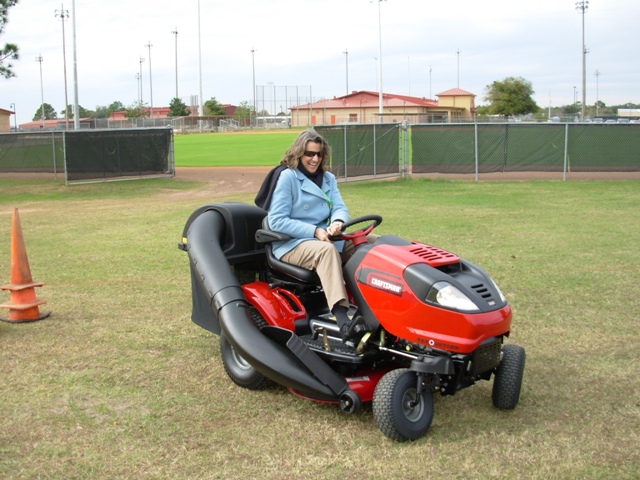
Amy Sitze, editor of Gardening How-To magazine, takes a spin in the Craftsman “Revolution” Zero-Turn Yard Tractor. Yes, she’s a good driver!

2. Walking into the press room for Continental breakfast the next morning not expecting to know anyone and then hearing “Hi Debra!” from across the room. I looked over to see the smiling face of Amy Sitze, editor-in-chief of Minneapolis-based Gardening How-To magazine and a fellow member of Garden Writers Association (and another wonderful editor for whom I’ve written).

The black-and-white Craftsman golf pullover helped take the chill off as I put the pedal to the metal on the Craftsman “Excellerator” Garden Tractor.

3. Getting to brave the brisk weather by wearing one of those cool golf pullovers with the Craftsman logo on it. And since it was a windy and wintry Orlando day (something like high 50s), I was very happy to have that extra layer to protect me.

4. Arriving at Osceola County Stadium, “Home of the Houston Astros – Spring Training,” and seeing my name on the electronic read-out that tops the scoreboard.

READ MORE…

Another great garden shed – with a new slant

Monday, January 19th, 2009

Literary agent Charlotte Gusay has a delicious secret. She recently shared it with me and gave me permission to write about it here.

Charlotte contacted me after reading about my shed expertise (also known as an “obsession”) in Dwell magazine:

“[I] saw the recent issue of Dwell (Feb. 09) with your article on ‘backyard’ sheds. So disappointed we did not find each other before this article and/or your book . . . .

“I have a swell little ‘postmodern shed’ that my husband Bobby Milder and I built about 5 years ago. . . .”

She sent along a few photographs to tempt me. What else would a nosy reporter such as me do next? I called Charlotte and invited myself over for a visit. Paula Panich, my writing mentor and friend, came along last week when we drove over to Charlotte’s after lunch.

Her house sits quietly on a tree-lined city street, just a block or so away from a major thoroughfare. It is nice to know these inviting residential pockets exist here in LA, right in the city. I love it!

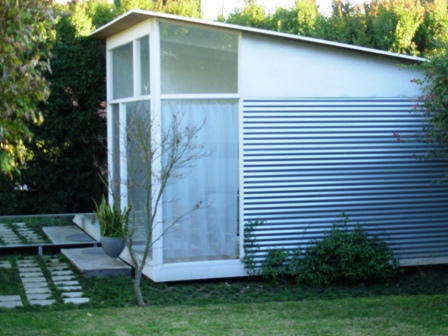
This irresistible 10-by-14 foot haven is tucked comfortably into a far corner of Charlotte’s urban lot, hidden from everyone’s view but hers. Because of the way it has been sited, the shelter is first seen “in profile,” its longer side and angled shed roof-line emphasized. When glimpsed by newcomers (such as Paula and me) the shed reveals its see-through quality, thanks to a wraparound glass “corner” that connects two outer walls. The white-painted framework around the windows and door outlines and emphasizes vertical and horizontal lines of the design (almost Mondrianesque in its geometry).

I like how Charlotte described the shed to me in her first email note: “It floats elegantly in the backyard, just beyond our 1944 mid-century house in West Los Angeles.”

READ MORE…

January: Garden Bloggers’ Bloom Day

Friday, January 16th, 2009

Dateline: Thousand Oaks, California

Zone 10

Well, I’m one-day late, but that’s because I spent most of January 15th sitting on an airplane.

So I’m back in Southern California – and hurrah! It’s supposed to be 80 degrees outdoors today. Early this morning, I snuck out to see what my garden has to share with you. Four new blooms, intentionally selected to show you something different from my December blooms. All of these came into my possession from the prior owners of our home, which we bought in August 2006.

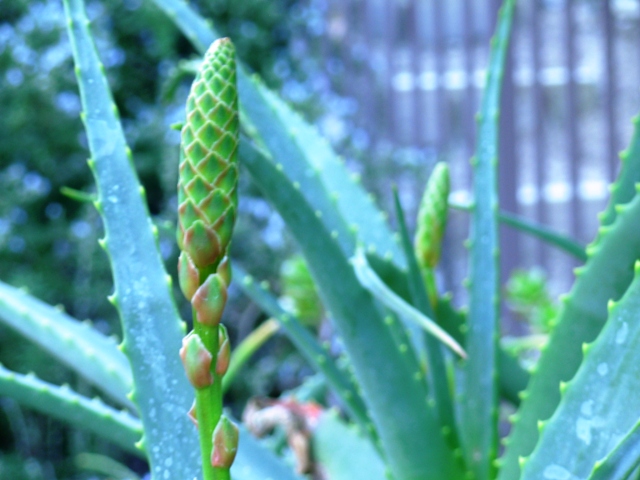
A beautiful, mature Aloe – about to bloom

A sprawling Pelargonium – planted as a ground cover

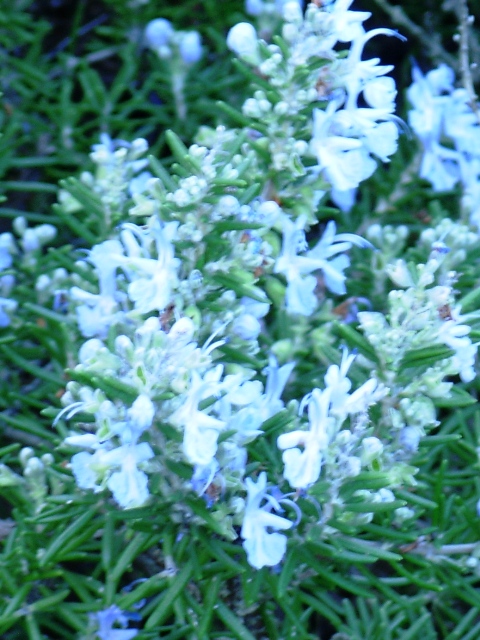
Rosemary – blue blooms to blanket my hillside

Silvery lavender foliage offsets a rare late bloom

Happy New Year to each of you, and may the garden feed your heart, health and soul!

Inspired by the words of Elizabeth Lawrence, “We can have flowers nearly every month of the year,” Carol of May Dreams Gardens started Garden Bloggers Bloom Day. On the 15th of every month, garden bloggers from all over the world publish what is currently blooming in their gardens, and leave a link in Mr. Linky and the comments of May Dreams Gardens.

It’s time to think about spring in the garden

Tuesday, January 13th, 2009

Yes, it may only be the second week of January, but our Noble firs and cedar boughs are now past their prime (and in my case, at least) cut up and ready for recycling in the yard-waste bin.

Onward to spring!

To get me in the mood, I have this inspiring drawing pinned next to my desk.

My friend Jean Zaputil, an artist and garden designer, illustrated and hand-colored it as a most charming New Year greeting.

The scene depicts a songbird perched on top of a hellebore, with the wistful and compelling lines, which read:

“If winter comes, can spring be far behind?” 

[attributed to Percy Byssne Shelley]

Perhaps this saying will give you something to hold onto in the dormant months of winter! Spring is coming soon!

Also getting me in the mood for spring: Country Gardens’ early spring 2009 edition, which just arrived in my mailbox. 

I opened it up to find my story about friend and designer Bonnie Manion, owner of Mon Petit Chou, a vintage design business based in Encinitas, California. Bonnie blogs at VintageGardenGal – a cheery and charming spot to visit – you’ll want to do so frequently!

The story, commissioned by James A. Baggett, editor of Country Gardens, is called “Tour de Forced Bulbs,” and it features Bonnie’s designs pairing forced spring bulbs with forced flowering branches – arranged in vintage containers.

Here is the story in its entirety. A shorter version appears in the magazine, along with the step-by-step instructions for planting a container with hyacinth bulbs and pussywillow branches. The story was photographed by Ed Gohlich and produced by field editor Andrea Caughey.

TOUR de FORCED BULBS: Get a jump on the season by pairing vintage vessels with spring-fresh forced bulbs to create uniquely charming displays.

The promise of spring appears in fresh-green leaves emerging from the pointed tops of daffodil, tulip, hyacinth and amaryllis bulbs at Bonnie Manion’s garden in Encinitas, California. Swelling buds on her flowering trees – apricot, plum and peach – hint at new growth about to unfurl into delicate blossoms and tender foliage.

Bonnie, a collector and purveyor of garden antiques and cottage décor, celebrates the season’s arrival by growing a multitude of flowering bulbs. But instead of digging holes in the ground for her many bulb varieties, this clever gardener relies on unique vintage containers for forcing and displaying masses of spring blooms.

She named her vintage design business Mon Petit Chou (translated from French, it is a term of endearment meaning “my little cabbage head”). The whimsical phrase encompasses her love of French antiques and American barnyard implements alike.

“I look for pieces with a history but that can also be repurposed and used in a fabulous new way,” Bonnie explains. She custom-designs her arrangements for special events and commissions, often advising customers about what to plant inside a chipped enamel kettle, a wire market basket or even an intricately-carved wooden drawer.

Come springtime, Bonnie considers flowering bulbs and branches as the perfect partners.

Some gardeners are intimidated by forcing bulbs, but to Bonnie, nothing could easier. “In a way, bulbs are similar to a chicken egg in that they are also one of nature’s perfect self-contained packages,” she says. “They have everything that’s required to bloom into a flower. There’s a lot of simplicity to growing them.”

Using fresh-cut branches, the flower and leaf buds of which have yet to open, requires little effort, Bonnie adds. Whether brought indoors for flower arranging, or used as accents to planted containers, the tiny buds slowly open until flowers gracefully unfurl. “They last quite a while, especially if you keep the branches in water,” she advises.

With a spring palette ranging from soft pastels to bright primary colors, bulbs and branches pair companionably with timeworn artifacts of the past. “I like the yin-and-yang of it. To me, the weathered patina of old containers goes well with the colors of my spring bulbs.”

To grow bulbs in containers, Bonnie begins with the right vessel, selecting an eye-catching piece with a generously-sized opening at the top. Bulbs don’t require much root space, meaning that even a four-inch-deep wooden box is adequate as a planter. Deeper containers can be used as well. “You can keep the soil level low around the bulbs, and use the height of the container to support bulbs such as paper whites or amaryllis, as they grow tall and reach for sunlight,” Bonnie says.

Interesting vintage containers include chicken feeders, tool carriers, old boxes or pails, hay racks, sugar tins, large and small funnels, oil cans, children’s wagons or carts, old urns, kitchen strainers – “virtually any container with a wonderful vintage character,” she says.

Bonnie’s finished designs look spontaneously fresh. “I get a lot of my plant and container ideas from my travels,” explains this vintage garden gal.

She frequents large and small flea markets and other off-beat vintage garden antique sources around the country and occasionally visits Europe for inspiration. “I might see a single potted rose in a Paris flower shop. Or, I’ll discover a dramatic floral arrangement in a London hotel lobby and try to recreate it at home.”

Bulb-filled vintage containers never fail to make a statement. “Put them in a setting in your garden where you need some ornamentation,” Bonnie suggests. “You can have fun bringing old pieces back to life and making them functional again. Get as creative as you like, and your pieces will be uniquely you!”

Forcing Bulbs

Try Bonnie Manion’s methods of planting spring-flowering bulbs in an unusual vintage or salvaged container. Look for blooms that will show off the best features of the vessel, such as crimson-streaked tulips that echo the red painted handle of an enamel kettle. Here are some tips:

  • Make note of each bulb’s “Plant-to-Bloom” timeframe to coincide with your needs. Bloom times vary greatly and you will need to plan ahead when planting.
  • Forcing bulbs in soil, versus water only, will ensure the bulb has the ability to bloom again year after year (replanted in your outside flower beds or another vintage container).
  • Use organic or general-purpose potting soil. The soil should reach a level one-inch below the container’s rim. Make sure you have good drainage so that any excess water is able to drip out of the base (you may need to use a saucer to protect furniture or windowsills from water damage).
  • Plant dormant spring bulbs directly into the potting soil. Bulbs should be root-side down and pointed-tips upward. It’s okay to pack bulbs “shoulder to shoulder” for a massed and abundant result. In general, you can completely cover daffodil, tulip and hyacinth bulbs with at least one inch of potting soil. The top third of an amaryllis bulb should peek out above the soil surface. Pack potting soil firmly around bulbs to anchor them in place and water once thoroughly to close any air pockets in the soil.
  • Bulbs require sunlight to awaken from their dormant state, and begin forming roots, stems, and flower parts under their onion-skin-like sheath.
  • Protect the container from extremes (place on a porch or under eaves in milder climates; bring indoors in colder ones). Do not let the soil dry out, but keep it lightly moist. In general, bulbs prefer to be on the drier side, rather than wet.
  • If you want maximum versatility with your designs, plant bulbs in small plastic nursery pots. One or two bulbs will fit inside a six-inch, soil-filled pot. You can plant up dozens of bulbs and care for them using directions above. Once they begin to bloom, arrange the bulbs inside larger containers and layer Spanish moss on top to cover your secret.

Check out one of Bonnie’s favorite bulb sources: Easy-to-Grow Bulbs.

Forcing Branches

Young branches of woody trees and shrubs are supple and pliable in the spring. This makes them easy to weave into trellis-like designs as Bonnie has done. If you cut the branches before their flower or leaf buds open, you can bring them indoors for long-lasting vase arrangements. Better yet, add cut branches to outdoor containers as a complement to spring bulbs. Here are some general guidelines:

  • Look around your landscape for inspiration. Do you have a golden forsythia, coral-bark maple, or flowering plum? As many of these woody plants are in need of early spring thinning or pruning, save the cut branches for container or vase designs. A neighbor might also allow you to lightly prune a few branches. In late winter or early spring, local markets or florists are good sources for cut branches, such as curly willow, quince, or witch hazel.
  • Use a pair of clean, sharp garden shears, secateurs or loppers to branches at a 45-degree angle. Make the cut at the bottom of a stem where it joins a larger branch.
  • You can stick the pointed base of each cut branch directly into the planting soil, at least three inches deep. As you water your bulbs, the branches will soak up needed moisture to keep the buds plump until they bloom.
  • You can also arrange cut branches in a water-filled vase. Flower preservatives can keep the water muck-free, but nothing’s better than replacing water daily.

Stylish Sheds: A video review from Jean Ann Van Krevelen

Saturday, January 10th, 2009

Technology being what it is, I am tickled to share a video review that GWA pal and Twitter goddess Jean Ann Van Krevelen just posted on Facebook and YouTube.

Of course, I love the plug about Stylish Sheds and Elegant Hideaways, but you’ll also be interested to watch Jean Ann as she reviews some of her favorite seed catalogs.

httpv://www.youtube.com/watch?v=9p_YCwDfMSc&feature=channel

You can read more at her blog Gardener to Farmer.


Thanks, Jean Ann!

Great plants, great friends

Friday, January 9th, 2009

This post aspires to nothing more than sharing with you my garden-gal outing two days ago to the Getty Center in LA. I had a lovely “New Year’s” lunch with garden designers Linda McKendry (of Linda McKendry Design) and Laura Morton (of Laura Morton Garden Design).

We toasted the New Year and talked about our goals, our wishes, our dreams, our *resolutions* and a bit of reality. After lunch, the three of us took an afternoon stroll through the Getty’s Robert Irwin-designed garden.

The light was beautiful. The plantings were surreal. Enjoy!

January 1st – a day to garden

Thursday, January 1st, 2009

Enjoy this photo gallery of some of my New Year’s gardening projects, accomplished today. I’ll add a few comments with each image to explain what I did. Above: Two hyacinth bulbs from Brent and Becky Heath’s care package – I saved them to grow in these glass bulb vases in my kitchen windowsill.

The blogosphere and Twitter world have been busy today, with my friends and those whose work I admire/read writing about resolutions, garden mission statements, and more. I have really tried to tear myself away from the keyboard and screen. It’s ironic that I spend more time here at my desk – looking through the open shutters to the backyard – than I do actually touching, breathing and engaging with said yard.

So today I decided to spend time on gardening projects. I am stiff and tired. Six hours straight – pruning and deadheading, digging up, wheeling the barrow to and fro – is not my typical schedule these days. And I am determined to return to this routine (or an edited version of it) in 2009.

Because you know what? I’m feeling very happy.

At left: I finally planted this beautiful Billbergia nutans ‘Variegata’, which I am embarrassed to say I purchased in March 2008 at Western Hills Nursery in Occidental, Calif., during our post-SF Flower & Garden Show garden-gals’ field trip. Miraculously, this plant has not only endured, but seemingly thrived in a 6-inch pot all these months. It is a beautiful, strappy, striped plant and doesn’t it look nice with the Clare Dohna mosaic orb?

What’s been holding me back anyway?
Since leaving behind my cherished garden in Seattle in August 2006, and moving to what many people think is heaven on earth – Southern California – I have been fairly disengaged with my new yard. As I’ve said before, I can’t really call it a garden. It’s really just a yard filled with plants I don’t understand or particularly like. I’ve had bursts of energy now and then to try and tackle things, including hiring someone a year ago to dig up and haul to a landscaping dumpster a yard’s worth of big red lava-rock mulch that covered every surface of soil.

But my heart hasn’t been in it. My heart is so torn between my past life and my present life. Surely, I am a lucky woman. I have my family who I cherish. I have so many wonderful friendships that continue, regardless of whether I’m in Washington State, California or other places around the globe. I manage to keep writing articles about gardens and design topics that really get published by tangible publications (that’s a shocker) and so what’s the problem?

At right: Senecio cristobalensis is another survivor from the Western Hills plant-shopping excursion in March, now given a special place in my front border. What pretty leaves! It’s supposed to reach 6-ft x 6-ft so I will eventually have to relocate this fuzzy-leafed beauty. This is one of those plants I once purchased from Heronswood (I just found the original plant tag from 2001!) that never wintered over in Seattle. See? I already have a new reason to be grateful for living in Zone 10~

I don’t have all the answers, but I’ve been pondering on how to get out of my rut. And the answer is staring me right in the eye. I need to return to the garden. The one that I see if I lift my eyes away from the computer screen and look through the slats of the shutters. Sometimes we have to start moving forward even before we know the path. “Putting wheels on it,” is how my friend Stephanie would describe it. Moving anywhere is better than staying put. There’s a lot of safety at this keyboard. But I don’t want to be just an observer of other people’s gardens, homes, plants and collections. I need to have my own relationship with the land, the plants, and the wildlife that occupy my suburban backyard.  I’ll say it again:  I need to return to the garden.

Today, I did just that. And while I’m in no position to write a garden mission statement, I do have a simple goal (dare I say Resolution?) for myself. And that is to spend 1 hour a day, at least 5 days a week, in the garden. Lord knows, I waste that much time reading emails each day. I think there’s a much better use of my physical and mental energy – and that’s to get outdoors and garden.

I don’t have money to hire a landscaper to do all the things I dream of accomplishing here, but my investment of time and attention is bound to improve my environment. It’s bound to improve my emotional attitude about this place. I’ll try and use this blog to document my progress.

Above: I guess any month of the year is bulb-season here in LA. It’s just that my bulbs will have to be annuals. That’s something I will have to get used to, after investing in and planting hundreds of spring flowering bulbs back in Seattle. The hyacinths, narcissus, tulips and muscari I planted today were a surprise gift from Brent and Becky Heath. The box filled with 70 bulbs arrived a few weeks ago ~ what a treat! I planted layers of bulbs in 2 terracotta pots this afternoon. Then I sprinkled annual seeds on top of each (dwarf cosmos on one; nigella on the other). Who knows if you can pair annuals with bulbs? It’s worth a try! This is my chance to experiment, so stay tuned!

And Happy New Year to all of you. Let’s cherish what we have!