Debra Prinzing

Get the Email Newsletter!

Archive for the ‘Gardening’ Category

Gardener’s Resolutions

Tuesday, December 30th, 2008

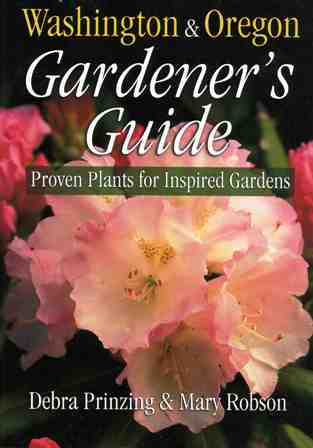
In early 2005, Cool Springs Press published the Washington & Oregon Gardener’s Guide, a book I co-authored with the wise and gifted garden writer Mary Robson. We combined our talents to share years of garden experience to help readers plan, plant, and maintain a beautiful and healthy garden.

The book is filled with our personal recommendations of plants that thrive in the Northwest, presented in a concise, helpful format. The major challenge of writing WOGG, as we called it, was to limit ourselves to 186 individual plant selections, from annuals to vines. No gardener wants to be told she has to “choose” a finite plant list!

Our fabulous publicist, Lola Honeybone, who now runs Media Workshop, a Nashville-based book PR shop, suggested that Mary (shown at left) and I develop a lecture to accompany our book-signings and appearances. She dreamed up the title “Seven Habits of a Highly Successful Gardener.” Lola’s clever angle brought Mary and me together for a 2005 lecture at the Northwest Flower & Garden Show in Seattle. It was so much fun to plan this talk knowing Mary and I would have a friendly give-and-take as we walked the audience through our Seven Tips.

Later, our friend Richard Turner, editor of Pacific Horticulture, asked us to turn the lecture into an article. Here is the article, from the journal’s Winter 2006 issue. It seems appropriate to share this as we approach 2009 – and I encourage you to adapt these tips for your own New Year in the Garden:

Seven Habits of a Highly Successful Gardener

Gardeners in the west enjoy the unique luxury of living with few rules about what’s right or wrong in the way we grow our plants. We appreciate and adapt to our garden’s cultural conditions. We are overwhelmed with a seemingly endless selection of excellent, healthy and suitable trees, shrubs, perennials, annuals, vines, bulbs and ground covers from which to choose for our landscapes.

In the Pacific Northwest [my former home], we’re particularly lucky to have temperate conditions where it’s not too hot – and not too cold. This welcoming, plant-friendly climate bestows added blessings. Imagine how hard it was for us to compile a regional gardening book and limit ourselves to only 186 great plants!

Perhaps the horticultural excesses in our lives call for a little discipline. Certainly, we want to be good stewards of our gardens, both to ensure our immediate enjoyment and the long-term health of the plants and places we tend.

So, with apologies to the original “7 Habits” author Steven R. Covey, we offer the following Seven Habits of a Highly Successful Gardener:

READ MORE…

Building raised beds for the vegetable garden

Sunday, December 7th, 2008

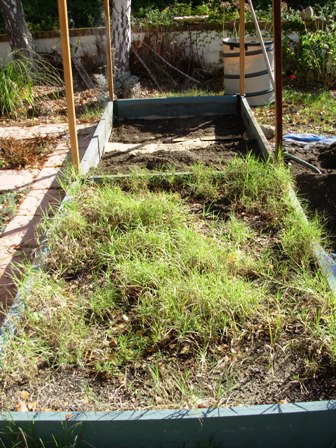
The subtitle to this post should be “Haste makes waste.”

But before I tell you my woeful tale of rushing a gardening project and living to regret it, I will tip you off to a wonderful product that helps non-carpenter types like me build raised beds for backyard vegetable gardening.

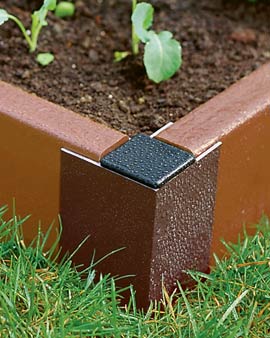
Gardener’s Supply has designed and fabricated a very cool piece of hardware – a corner bracket – that allows you to build a raised bed rather simply, with sections of lumber. Having previously built wobbly raised beds with L-shaped brackets screwed inside two 2-by-10s at a 90-degree angle, I think this Gardener’s Supply solution is far superior (see corner bracket, left).

All you need are four powder-coated, aluminum corner brackets. Slip the boards into the fitted sections of each bracket and secure them with Philips screws inserted in the pre-drilled holes.

There are also side brackets that allow you to extend the raised bed from 4-feet to 8-feet long.  And not to sound too Xenophobic, but – hurrah! – these brackets are made in Vermont by Gardener’s Supply. It really is nice to know that something is still manufactured in the U.S. of A. these days.

So, to create one 4-by-8 foot raised bed, you need the following:

  • 4 pieces of 2-by-10 lumber measuring 8 feet long
  • 3 pieces of 2-by-10 lumber measuring 4 feet long
  • 4 corner brackets from Gardener’s Supply
  • 2 side brackets from Gardener’s Supply

READ MORE…

Gifts for Gardeners: Hoe, HOE, Hoe

Wednesday, December 3rd, 2008

Garden writers often dread the perennial assignment that happens around August or early September when an editor summons us to say: “It’s time to do that round-up story on holiday gifts for gardeners.” 

For as many of these puff-pieces that I’ve written over the years, I guess people really do read them. I’ve witnessed first-hand how such stories influence the behavior of desperate gift-givers with the calendar racing toward December 25th.

One year, when I was “The Weedy Reader” newsletter editor at Emery’s Garden nursery in Lynnwood, Washington, we sent around gift ideas to local columnists. We had this rather funny non-gardening item ~ a paper-mache pig with wings. It was about the size of a piggy bank. We had them hanging from the ceiling of the cashier-checkout area and someone (probably Amy Tullis, our genius marketing manager), put up a sign that read: When Pigs Fly.
The famous and widely-followed Ann Lovejoy picked up on the pun and mentioned Emery’s pig-figures in her column for the Seattle Post-Intelligencer. We couldn’t keep those pigs in stock. They really did fly — straight out the door! There were piles of fine hand tools, lovely leather gloves, and beautiful plant books. But everyone wanted a pig. Who knew?

This year, a few really good ideas just plopped in my lap from the gift gods. I’m sending up thanks to them this very moment (I should actually call this unseen, heavenly entity “The Patron Saint of Deadlines,” because he/she has so often appeared just when I so desperately need an idea while on deadline!).

I met a few people at the Garden Writers Association annual symposium who suggested ideas; I received some other tips unsolicited by mail. Editors and their market scouts even did some of the legwork for me. Yay! Oh, I did find one great gift all by myself – an ExOfficio hat that I purchased at SeaTac Airport. It’s probably designed for people who go fly-fishing, but I think it’s an excellent gardening hat.

I wrote two December stories – one for Seattle Homes & Lifestyles and one for 805 Living Magazine. Isn’t that funny? The former periodical is published in my prior environs – Seattle; the latter is circulated here in Southern Cal’s Ventura and Santa Barbara Counties, where I now reside. Is it possible to be contributing garden editor for both? I really do have two lives!

Before I run Debra’s list of great gifts for gardeners, I want to tell you what I’m giving my gardening pals this year. The idea is part of the Alternative Christmas Market that my parish is hosting this Sunday. I’ve already perused the fine catalog of gifts with meaning for worthy causes in Haiti, Kenya, Mexico, Thailand, Turkey and our own country.

One program in the catalog really stood out to me. It’s run by FLORESTA, a non-profit Christian agency that “plants hope” in communities through environmental restoration, community development, micro lending and more. 

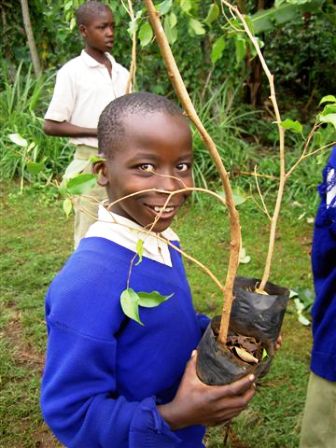
Floresta’s programs enable farmers to make the best possible use of the resources available to them. Programs teach agroforestry, reforestation, soil conservation, and a host of other sustainable techniques. One way to support Floresta includes funding the planting of trees to restore deforested areas ($10 pays for an orchard of 10 trees; $100 pays for a forest of 100 trees). You can also finance a small farm loan ($25 pays for a vegetable garden; $100 pays for an agroforestry loan). I like the idea of giving a gift on behalf of one of my gardening friends to truly help a person in need change their life for the better. Imagine: giving up lattes for a week could transform the lives of a family in need? Gardening is truly a powerful source for change around the world

Read on for OTHER HOLIDAY GIFTS GARDENERS WILL LOVE:

READ MORE…

December has arrived!

Monday, December 1st, 2008

It was 74 degrees and sunny here today in Southern California, but I have wintry visions dancing in my head.

To get into the holiday spirit (even though the leftover turkey and stuffing is still packed in the fridge), I picked up the December issue of Better Homes & Gardens magazine, out on newsstands now. That’s where my pal Susan Appleget Hurst serves as the talented senior associate editor for gardens and outdoor living. She blogs as The Everyday Gardener (with colleague Eric Liskey).

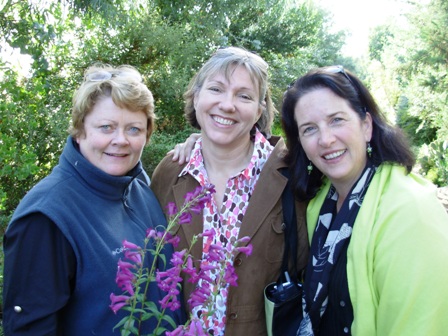
When we were last together in September, Susan mentioned that she had worked on a wintry design for iced botanical containers to hold votive candles. (Photo at right: Mary Ann Newcomer aka Idahogardener.com; Susan, and me, taken while gallivanting around Portland in September).

The idea Susan described sounded gorgeous and sparkly, a creative new way to use favorite ingredients from the garden — leaves, berries, colorful branches and conifer sprays — for holiday decorations. Her twist on the traditional luminaria even found a new use for poinsettias, which are rarely successful as cut flowers.

I spoke with Susan today and congratulated her on the alluring designs, which are splashed across five pages of the magazine. She sent me a web link to a BH&G video demonstration, which makes the project easy-to-understand and replicate.

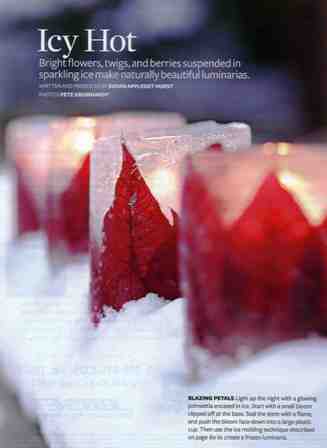
All you need are a few ingredients and space in the freezer to transform a watery concoction into frozen floral luminarias. Susan’s article begins on page 58 of BH&G. It’s titled “Icy Hot: Bright flowers, twigs, and berries suspended in sparkling ice make naturally beautiful luminarias.”

Susan has a culinary and herb-gardening background, so it didn’t come as a surprise to learn that she has used a similar technique to freeze blooms and herbs into ice rings to float in punch bowls. That handy trick, combined with the editorial challenge of showing readers new ideas for using their garden during the depths of winter, added up to the holiday-on-ice project. The frozen floral ring, best employed for a summery brunch, also taught her that distilled (rather than tap) water is preferred because it freezes clear rather than cloudy.

Susan first captured ruby red poinsettia bracts in a flexible plastic container, arranging each leaf so it’s evenly spaced (see finished project, above). Pour in a little bit of water, say 1/2-way to the top. Then insert a smaller plastic cup, sinking it with a few stones. Pop the entire vessel into the freezer until it’s frozen solid. There are tips in Susan’s article for choosing the right containers and for slightly thawing your creation in order to remove the finished product from the plastic molds.

The poinsettia votive holder was so successful that Susan experimented with colorful cut branches, arranged to stick out around the top of a luminaria like a beautiful nest for an exotic winged creature.

“How on earth did you fit that into the freezer?” I asked.

She laughed and pointed out that the water-and-branch-filled mold (actually a big plastic cake carrier) froze in the outdoor environment of her Des Moines, Iowa, backyard.

“I just needed sustained, freezing temperatures,” she added (assuring me that these conditions do not occur every winter in Des Moines, but they did last year when Susan played around with this project).

Um, okay. Well, since we don’t have an open-air freezer here in my SoCal yard, perhaps I’ll stick to Susan’s smaller projects. Like the ones that use 1-litre and 2-litre pop bottles with the tops cut off.

The Icy Hot story illustrates Susan’s gifted floral design skills. She’s got more tricks up her sleeve and you can find them in future editions of Better Homes & Gardens. Here’s what I managed to get out of her: The February 2009 issue will feature Susan’s inspired new way to design with forced branches and fresh flowers. In April 2009, look for her egg story. I don’t want to give away the details, but suffice it to say she is NOT cooking an omelet or quiche with her eggs!

Happy December. I hope it’s filled with joy and peace for everyone.

Gifts from the Gardener

Thursday, November 20th, 2008

The month of November seems to generate an abundance of magazine articles about being “thankful.” For many of us, the notion of giving thanks is top of mind this season. Not only am I hugely grateful for my family, friends, home, garden and writing career, I’m so often reminded how rare these gifts truly are.

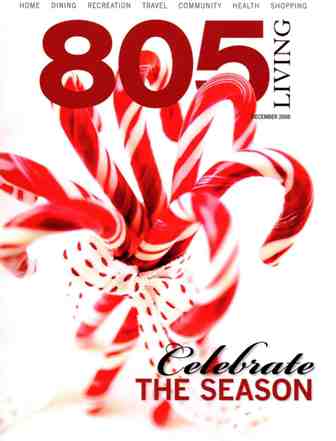
When it was time to write my “In the Garden” column for the November issue of my local magazine, 805 Living, my editor Lynne Andujar mentioned choosing Volunteerism as the month’s theme. You can see how nicely this idea is communicated on the cover, which reads: “Give Thanks, Give Back.”

The assignment made me think of Master Gardeners, some of the most volunteer-minded souls in the gardening world. I first learned about the MG program in the early 1990s, when my friend Jean Zaputil trained as a Master Gardener in King County, the local Seattle area program. I was always so impressed that Jean did this, especially when she managed the herb department for the local MG plant sales. That experience, combined with her BFA in Interior Design, soon led Jean to start her successful landscape design business.

Wanting to expand my own horticultural knowledge about the time I was trying to switch from business writing to home and garden feature writing, I applied to enroll in the 1998 Master Gardener class (also in King County). I spent many enjoyable years actively involved with the organization, including three years as PR chair for our annual plant sale.

When I moved to Southern California, I thought I’d re-apply and get in on the excellent training that comes directly from local horticultural experts. That’s when I discovered the Ventura County MGs require trainees to volunteer (“give back”) 80 hours of community service in their first year. The math just didn’t add up for me, at least at this time in my life. But the application and interview process introduced me to my local MG group, and piqued my interest in learning more.

What better way to get to know the Master Gardeners in my own back yard than by writing about them? (I always say that “I write in order to learn,” so it makes sense!).

READ MORE…

Autumn Gardens in Oregon

Monday, October 27th, 2008

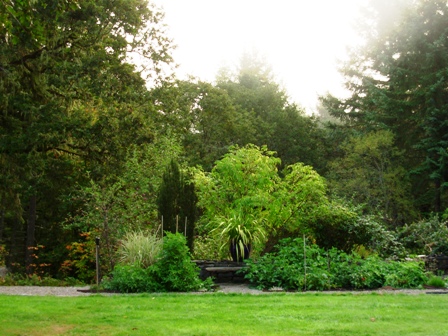
An early morning scene outside the guest room window at Mary-Kate Mackey’s in Eugene

October in Oregon – you can’t beat it. Earlier this month, I traveled there to lecture to the Hardy Plant Group of Willamette Valley.

Returning to my beloved roots, in the Pacific Northwest, was such a treat, especially since it is still wickedly hot down here in LA and I am desperate for some moist, cool autumnal weather.

And oh, the gardens!

Mary-Kate Mackey, fellow garden writer and a gifted journalism educator, met me at the airport. It was fun to fly into this sleek, modern, small airport and arrive via Horizon Airlines (they serve complimentary Pacific Northwest ale on board and, oh, by the way, one of my articles appears in the October issue of Horizon/Alaska’s in-flight magazine, so I was able to grab lots of extra copies from the seat-pocket in front of me, etc.!).

Upon disembarking in Eugene, I was impressed by the changing autumn light and saturated foliage palette. Oh, it’s autumn in Oregon! It took away my breath and captured my heart.

The evening began with drinks at a nifty bistro with Mary-Kate, followed by dinner with my dear friend Jennifer (we were editors together at “Seattle Woman” magazine in the 80s).

On Tuesday, after a restful overnight in Jenny and her husband Tim’s comfortable home, I met up again with Mary-Kate.

Since I missed out on the one-day garden tour in Eugene that followed last month’s Garden Writers Association’s annual symposium, I had a special request for Mary-Kate: Can I have my own mini-tour of the best of the best Eugene has to offer? [Above: Mary-Kate inspects the craftsmanship of a stunning stone wall hand-built by Allen Bosworth (right) of Bosworth Landscaping.]

READ MORE…

Ornamental pumpkins, squashes and gourds:

Friday, October 3rd, 2008

Here it is, already October 3rd and Halloween is upon us. Thanksgiving will soon follow.

I’m the type of mom who has always been grateful (relieved?) when the college-aged nanny offered to take my boys costume-shopping. That’s because I subscribe to the “use what’s available; look for stuff in the garage, sewing room, or attic,” school of Halloween costume-making. None of this molded rubber mask or fire-hazard printed-on-acetate superman kind of stuff. But my boys, on the other hand think a brand-new costume is de rigeur.

The organic, agricultural Halloween appeals to me. You know, the old-fashioned fall celebration that gets its thrills from a full moon rather than a mountain of Mars bars. Oh, for those cellophane-wrapped caramel apples of our youth (remember the ones we were warned might have razor blades in them, back in the 1970s?). Yup, those very ones.

In search of awesome produce for the fall holidays, I drove over the hill this afternoon into Simi Valley to visit Underwood Family Farms. An organic, U-pick farm, Underwood is a refreshing haven just a mile beyond fast-food row (What can I say? We do live in the suburbs).

I wanted to scout out cool, fashionable vegetables, worthy of centerpieces and front porches, for an upcoming November story called “Thanksgiving, A to Z.”

READ MORE…

A tiny garden house of your own

Tuesday, September 16th, 2008

Judy Lowe, of the Christian Science Monitor, posted a review of Stylish Sheds and Elegant Hideaways yesterday entitled “A tiny garden house of your own.” You can read it here:

An excerpt:

“Debra Prinzing’s book, “Stylish Sheds and Elegant Hideaways” (Clarkson Potter, $30), showcases 28 little retreats that anyone with space and money can construct in the backyard.

As William Wright’s photos show, these aren’t prefab repositories of old shovels and mildewed garden gloves, but stuff of dreams – stylish shelters and studios, even pavilions for garden entertaining.

Because it’s so well-written and beautifully photographed, this book has earned a permanent place on my bookshelves. I’ll be leafing through over and over, dreaming of the possibilities.

Debra’s blog, Shed Style, has become must reading for me, too, to keep up on this trend.

This is the second time this month I’ve had the pleasure of saying, Thank you, Judy!

What’s filling my in-box

Saturday, September 6th, 2008

Like many freelance journalists, I receive a lot of “goodies” in the mail. I love it when garden, design, and plant books arrive for me to review. And of course, I appreciate “plant booty” — those boxes sent by growers who want me to trial their new introductions (although it’s uncanny: the boxes of tiny annuals, perennials and the like inevitably arrive on the hottest day of the week when I’m away from home, making it very hard to quickly rehydrate and revive the contents once I return!).

Press kits abound (although many are now sent electronically), and since I belong to countless horticultural societies, I also receive colorful monthly newsletters. Hand-written notes from friends are highly valued, as are checks from publishers (yeah!).

Today, as I was trying to organize the piles in my office, I pulled out a few of the items in my In-Box that caught my attention. Here’s a list:

Personal notes come first:

My friend and former co-author Mary Robson, a faithful letter-writer, jotter of quick notes, and all-around dear friend, dropped me a note with a nice little story: “. . . an incident you will appreciate,” (she wrote). “I stayed over at a friend’s home, in their garden-shed turned guest house. And what should be on the bedside table – of course, your book. She bought it to show guests! Warm thoughts, Mary.” [Oh, I love it. . . Stylish Sheds as bedside table reading! Thanks for the imagery, Mary]

With a SUNFLOWER STAMP, no less, Julie Schoenfeld, she of my auction-planning days, sent me a lovely hand-written note on letterpress stationary from Snow & Graham. We recently enjoyed a Malibu breakfast catch-up/gab when Julie brought her son from Seattle to Cali so he could attend the same summer camp of her childhood. As a memento of our sunflower obsession (see my “Stamps for the Gardener” post on August 21st), Julie tucked a book of the current sunflower postage stamps inside her note. She knows I’ll use them! And her sweet sentiment cheered me up with wonderful memories.

READ MORE…

“Sustainable Spaces. Beautiful Places”

Friday, September 5th, 2008

 I’m standing with Richard Turner, editor-in-chief of Pacific Horticulture magazine. We’re volunteering at the 2008 NWFGS in Seattle, visiting with Dawn Chaplin, formerly a fellow board member of Northwest Horticultural Society and a great garden-touring pal (she’s now a Whatcom Co. Hort. Society board member).

The press release just arrived in my in-box, and it announced the 2009 Northwest Flower & Garden Show’s theme. It’s only six months away – and I’m already excited! The theme: SUSTAINABLE SPACES. BEAUTIFUL PLACES. I like it! A lot!

The Northwest Flower & Garden Show, created by my pal, the talented and visionary Duane Kelly, today announced its 2009 theme:

“. . . (the) show will place a major focus on gardening materials and techniques that are good for the environment,” said Duane Kelly, chairman and founder of the annual event, now in its twenty-first year. “Show goers can expect to come away with a number of great ideas that conserve resources such as water and soil while, at the same time, making their gardens more self-sustaining and easier to care for.

“During the past year, organic gardening and vegetable gardening have grown in popularity thanks to the public’s keen interest in doing what’s best for the environment.  The movement has also gained traction with consumers seeking homegrown fruits and vegetables that not only taste better but reduce ever increasing grocery bills.”

READ MORE…