Debra Prinzing

Get the Email Newsletter!

Archive for the ‘Gardening’ Category

Garden Conservancy’s Altadena Tour

Saturday, April 25th, 2009
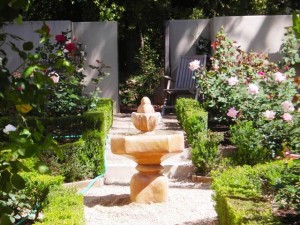
A small fountain bubbles at the intersection of the rose garden's central walkway and side paths

A small fountain bubbles at the intersection of the rose garden's central walkway and side paths

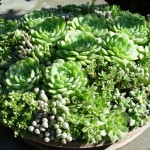
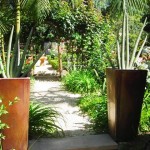
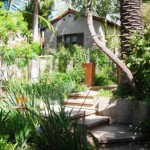
Last week, I toured the 3/4-acre landscape owned by Cheryl Bode and Robin Colman, a lavish garden developed over the past 10 years in the foothills of the San Gabriel Mountains.

Tomorrow, April 26th, they are generously sharing their lush and serene property as one of six private, residential landscapes on the Altadena Garden Conservancy Tour.

My story, “Botanical bounty in Altadena,” about Cheryl and Robin’s abundant landscape, appears in today’s edition of the Los Angeles Times.

Since we had to cut the original piece due to space, I have included the full story below.


Take a virtual tour through this web gallery of photos from my visit:

Here is my original story. Enjoy a peek into the lives of two who are passionate about the place they possess:

By Debra Prinzing

Ten years ago, Cheryl Bode and Robin Colman discovered the house and garden they soon called Casa dos Mujeres (House of Two Women).

Prompted by the desire for more space as they combined their individual households, the two Pasadena residents considered buying in nearby Altadena, a village in unincorporated Los Angeles County wedged between Pasadena and the foothills of the San Gabriel Mountains.

“Cheryl went to Altadena on a lark with our real estate agent,” Robin recalls. “This house was in terrible shape, but part of it really captivated her.” Later, when Cheryl returned with her partner in tow, she couldn’t help jumping up and down with happiness when Robin pronounced: “I could live here.”

READ MORE…

California lilacs (Syringa, not ceanothus)

Thursday, April 23rd, 2009
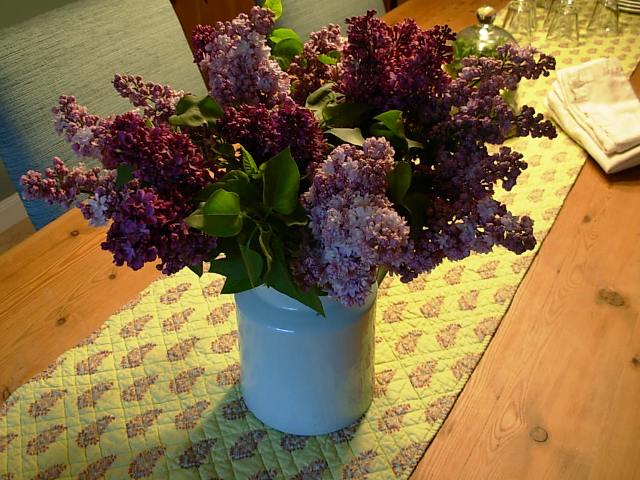
My lovely bouquet of California-grown lilacs from Kilcoyne Lilac Farm

My lovely bouquet of California-grown lilacs from Kilcoyne Lilac Farm

A few weeks ago, I interviewed a hot Santa Barbara floral designer for a story that will run in the May issue of 805 Living, our local shelter glossy.

While telling me about the fresh-from-the-garden arrangement he created, the designer mentioned that the lilacs came from a farm in Antelope Valley.

I know of Antelope Valley because it is the famous home of the California Poppy Reserve (which I am kicking myself for NOT getting to see last month when the ubiquitous yellow-orange flowers were in bloom). That flower fact is filed away for future reference . . . but suddenly, the idea of LOCAL lilacs is tickling my fancy in a big way. Some of my best childhood moments were experienced with my face buried in wild, unkempt but intoxicatingly fragrant lilac shrubs: first in the backyard of a Connecticut rental house in the mid-1960s and later in a historic Massachusetts town square where lilacs grew with abandon in the mid-1970s.

In the late 1990s, we planted a Syringa ‘Sensation’ in our Seattle garden. My dear friend and former college roommate (and longtime garden muse) Karen Page selected the plant for us while helping with several landscaping projects. It grew tall and robust and blessed me and my garden alike each June, producing voluptuous trusses of darkest-purple florets edged in pure white. Too beautiful! It now lives in my memories.

So today, while racing through the Thousand Oaks Farmers Market near closing time (to pick up a half-dozen hand-made tamales for dinner), I stopped dead in my tracks at this little scene: a row of white plastic 5-gallon buckets FILLED with pale and deep lavender clusters of lilacs. Two women were working out of the back of a pickup truck, clipping and bundling lilacs: gorgeous, fresh-cut, real lilacs. I overheard one of them telling a customer that she grows the lilacs in Antelope Valley.

The connection was made! I introduced myself to Elizabeth Kilcoyne of Kilcoyne Lilac Farm and her neighbor-assistant Marie. I asked: “Do you sell lilacs to S. R. Hogue in Santa Barbara?” Her face broke into a lovely, warm smile: “Yes.”

I told Elizabeth and Marie about the 805 Living article and they already knew about it – my editor Lynne Andujar and her photographer Gary Moss had shot scenes of Thousand Oaks Farmers Market flower vendors a few weeks ago – for our upcoming flower story.

Without thinking, I switched into Debra-as-Reporter and started quizzing the women about these awesome, California-grown lilacs. Wait!!! I raced to my car and grabbed my little Flip video camera and returned to see whether Elizabeth would let me tape a short interview with her. She agreed and here is the interview:

httpv://www.youtube.com/watch?v=-oOdGqEm-xQ

I came home with a lovely bunch of Elizabeth’s lilacs and have promised myself that come next spring, I will visit her farm and display gardens filled with 150 lilacs. Plus, I need to find an outlet to produce a magazine story about Kilcoyne Lilac Farm.

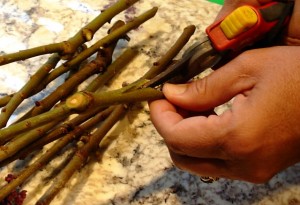
The varieties seen here are: ‘Charles Jolie’ (or ‘Charles Joly’) and ‘Ludwig Spaeth’ – two dark reddish-purple lilacs (‘Charles’ has a tiny white spot – Elizabeth calls it a ‘B’ – in the center of the floret); and ‘Michael Buchner’, the pale lavender French hybrid. Before I filled a jug with the blooms, I made sure to clip the bottom of each woody stem and then slice the stem in half, with a 1-inch cut. This technique helps the stems drink more water and stay fresh.

My fresh lilacs, home from the market

My fresh lilacs, home from the market

making a "slice" in the stem base

making a "slice" in the stem base

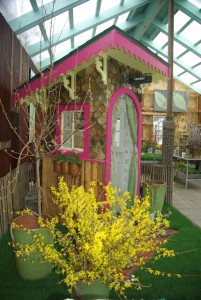
The prettiest outhouse-turned-stylish shed I’ve ever seen

Tuesday, April 21st, 2009
The Cozy Shack, Designed by Scotty Thompson and Suzanne St. Pierre of "Living in the Garden," a cool Pullman (Wash.) garden emporium

The Cozy Shack, Designed by Scotty Thompson and Suzanne St. Pierre of "Living in the Garden," a cool Pullman (Wash.) garden emporium

I love it when I receive surprise “Shed-Mail” from Shedistas like Suzanne St. Pierre. Suzanne and her husband Scotty Thompson own Living in the Garden, a cool nursery/emporium in Pullman, Washington. We’ve swapped a few emails, originally prompted by Suzanne’s note saying she loves Stylish Sheds as much as I do.

Recently, while planning their own version of a spring flower show, Suzanne and Scotty recycled an old cedar outhouse from their 2-acre property and tricked it out to be a too-cute cottage for their nursery. She sent me a sweet note and some photos and gave me permission to share them with you.

Hello, inspired by your Stylish Shed book, my husband and I jazzed up an old outhouse we had on the property (to use) for a focal point in our Sweet on Spring event at Living in the Garden. It was a hit!! I wanted to thank you for the inspiration and tell you that I enjoy your blog.

I just caught up with Suzanne by phone and we had a good ol’ gab. It felt like I was talking with a long-lost friend. She described how this little structure found its way from humble to haute:

Originally, the cedar “box” was an outhouse over a pit toilet. The couple actually used it while living in their tiny “sugar shack” when they moved to the two-acre property about six years ago. After they built their residence and started running the nursery, they had a “real” indoor bathroom, so the 3-by-3 foot outhouse was no longer needed. “We filled in the pit and just moved the building around,” she says.

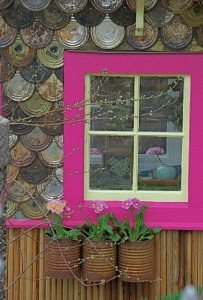
With shingles made from flattened tin can lids and hot pink trim, this is an outrageous outhouse!

With shingles made from flattened tin can lids and hot pink trim, this is an outrageous outhouse!

When preparing for Living in the Garden’s “Sweet on Spring” event last month, they decided to create several indoor garden displays (it’s still pretty chilly out there on the Palouse in March). As Suzanne explains, “We wanted to create our homage to the Northwest Flower & Garden Show.”

Once she and Scotty decided to dress up the rustic outhouse, the creativity exploded. Suzanne told Scotty: “We have to use everything we already have on hand.”

Like most artist-builders (Scotty is “incredibly handy and artistic”), the couple has all sorts of project piles and cool materials had saved for future endeavors. Clearly, they love to re-purpose what others might toss into the landfill.

This detailed photo illustrates how they used flattened tin cans, layered like gingerbread shingles, to clad the upper portion of the structure. Scotty added a window and the arched doorway, plus the cool corbel-style brackets and scallop-trim fascia board around the shed roof.  It even has a skylight! I’m dying to see an indoor shot (maybe Suzanne will send it to add here!) because apparently she decoupaged the interior walls with pages from old gardening books someone had given them. I guess Suzanne broke her own rule about using on-hand materials when it came to paint. She confesses that she did actually buy the hot pink paint as a finishing detail. Fancy!

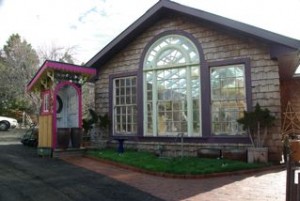
Cute Outhouse (left) outside the gorgeous conservatory, built by Scotty Thompson of Living in the Garden

Cute Outhouse (left) outside the gorgeous conservatory, built by Scotty Thompson of Living in the Garden

I love this couple’s philosophy of truly LIVING IN THE GARDEN. Suzanne grew up in a family nursery and purchased and ran her parents’ former nursery for 12 years after graduating from college with a horticulture degree.

“But I burned out. I was never getting my hands dirty,” she confides. Several years (and a career in the wholesale plant trade) later, Suzanne realized how much she missed retail. “I just wrote on a piece of paper what the perfect job would be: Work from home. Work with Scotty. Work 4 months of the year for 4 days a week.”

Wow. How seldom do any of us have such an honest conversation with ourselves? Guess what? For the past six years, Suzanne and Scotty have been doing exactly what she wrote down on that page. “My commute to work is just 113 steps,” she jokes. “We’re working on our farm and making people come to us. It’s really wonderful.”

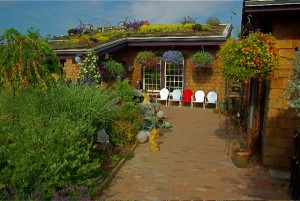
Living in the Garden's green roof

Living in the Garden's green roof

Living in the Garden is open from March through June (Thursdays through Sundays). Earlier in the season, beginning in February, Suzanne starts work in their production greenhouse, growing geraniums and plants for their own hanging baskets. By summer, the couple is off on trips in their camping van (complete with solar panels on the roof!) and touring around the Northwest and beyond to see other nurseries and commercial greenhouses.

They believe in “marketing with a cause,” so during the summer months Suzanne and Scotty encourage local charities to use their extensive and beautiful display gardens for fund-raisers or donor-appreciation events.

By September, just about the time Suzanne is “missing” her customers, Living in the Garden opens for one spectacular autumn weekend.

When you arrive, don’t be surprised to hear the mellow sounds of Gregorian chants drifting through the garden and conservatory. “Gardening is my religion,” Suzanne concludes.

Check out the nursery in person or read more at Suzanne’s blog, Living in the Gardens.

Garden field trip: Terrain at Styer’s

Sunday, April 19th, 2009
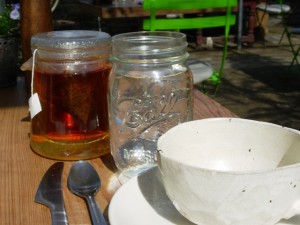
a morning. a mug of tea. breakfast inside a greenhouse. perfection.

a morning. a mug of tea. breakfast inside a greenhouse. perfection.

I have a backlog of cool ideas and discoveries that I want to write about. Too many inspiring thoughts and insights swirling around my head. Too little time.

Since returning from my crazy Jan-Feb-March travel (seven out-of-town lecture trips in something like 10 weeks) I have been trying to carve out time to return to Shedstyle.com. It is the writing forum I love the most, but family demands, and the need to actually make some money, have distracted me. But I’m back on track, friends. I promise.

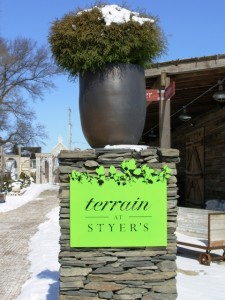
terrain14One of the places I visited on my many journeys is Terrain at Styer’s.
I recently wrote about my early March trip to lecture on stylish sheds and other small abodes in a talk called “Your Personal Escape” at the Philadelphia Flower Show. But my side trip to Terrain was great fun and I don’t want any more time to pass before writing about it.

Terrain is the darling of the home and garden media. As a hot, design-oriented gardening emporium outside Philadelphia, Terrain appears in shelter magazines as often as its west coast “kindred spirit,” Flora Grubb’s. How cool that I visited both plant- and style-savvy destinations within a few weeks of one another.

You all probably know the back-story about Terrain. If not, I’ll give you the short version here, beginning with Terrain’s own words:

“Lifestyle merchandising is our business and our passion. The goal for our brands is to build a strong emotional bond with the customer. To do this we must build lifestyle environments that appeal emotionally, and offer fashion correct products on a timely basis. Our customers are the reason and the inspiration for everything we do.”

Founded in 2008, Terrain transforms the local garden center into a celebration of nature. Our flagship location . . . was inspired by the idea of merging house and garden to create an experience for the senses, catering to our customer with a curated assortment of plants for all seasons, as well as inspired items for the home and garden. Situated in a luxurious indoor-outdoor environment, our on-site nursery is flanked by a cafe and garden terrace, providing the ideal environment to host events and workshops. [from the Urban Outfitters corporate web site]

READ MORE…

You say Toe-MAY-toe; I say Toe-MAH-Toe

Thursday, April 9th, 2009
A cause for celebration: Hundreds of Heirloom Tomato Starts

A cause for celebration: Hundreds of Heirloom Tomato Starts

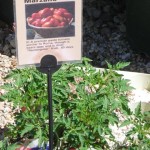
Does anyone really NEED 21 tomato plants? The answer is: OF COURSE!

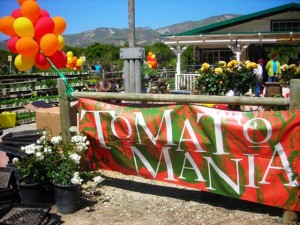
If you are obsessed with having dee-lish heirloom tomatoes at your fingertips, you will want to track down Tomatomania, the largest spring sale of tomato seedlings around. It is a grassroots endeavor; the brainchild of landscape designer and Tomato addict Scott Daigre.

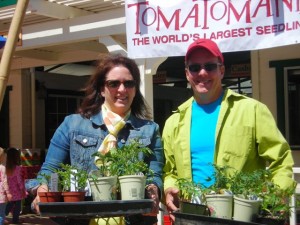
Shopping for the very best of heirloom tomato starts with Tomatomania founder Scott Daigre

Shopping for the very best of heirloom tomato starts with Tomatomania founder Scott Daigre

I remember meeting Scott in 2006 at the Northwest Flower & Garden Showin Seattle. I’m not really sure why a California boy was up in Seattle, but it was certainly a treat to meet him at one of my book signings. Little did I know ( I find I am saying that a lot these days ) that I would soon be Scott’s neighbor in Ventura Co., and moreover, a customer of one of his Tomatomania events.

A couple of folks, fellow Garden Writers, have kept Tomatomania on my radar. Kate Karem, formerly Cottage Living’s gardening editor and also a former LA resident, told me she used to be involved in Scott’s annual plant sales. While reading Orange Co.-based garden writer Cindy McNatt’s new “Dirt du Jour” blog, I was recently reminded to check out Scott’s event. In fact, it was a link on Cindy’s blog that pointed me to the very first Ventura County “Tomatomania” event at Otto & Sons’ nursery in the agricultural town of Fillmore, about 20 miles north of my place.

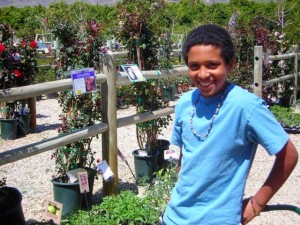
My buddy Alex, tomato fan extraordinaire

My buddy Alex, tomato fan extraordinaire

Since ours is a household of foodies, including children who have very definite opinions on all things culinary, I was psyched to again grow heirloom tomatoes (I haven’t planted any since leaving Seattle – and that’s a pretty tough tomato-growing climate). Whether someone needs as many as Alex and I acquired last Saturday is a matter of opinion.

We have room in our raised beds, so we’re going to go for it. Scott advises that backyard gardeners space tomato plants at 2-foot intervals. We can make it work, I’m sure.

The nursery sale was organized with a logical A to Z display. The only problem is that every single tomato looked healthy and vigorous; the fruit photos and descriptions made our mouths water (or at least piqued our curiosity).

Pick it, Slice it, Salt it, Eat it - Simple!

Pick it, Slice it, Salt it, Eat it - Simple!

The wagon Alex pulled for me up quickly. We loved running into Scott, he of the bright red hat, lime green shirt, and turquoise Tomatomania T-shirt. The ambassador of tomatoes is on a roll. His sales now crisscross the US and he has plans to add a few more states in 2010 (even in Texas, he says).

Here is a list of the plants we brought home in 4-inch pots. For $4 each, ours was a good investment. The neighbors are already putting in their requests for our “extras” come harvest-time:

  • Cherokee Chocolate: Mahogany-colored variety; excellent flavor, large fruit
  • Black Krim: Originally from Krim on the Black Sea of Russia; slightly flattened shape, dark-reddish mahogany color
  • Aunt Ruby’s German Green: Pink-blushed interior; green pleated exterior; handed down from Aunt Ruby Arnold, Greenville, Tennessee
  • Copia: Named in honor of the American Center for Food, Wine and Arts in Napa, California; a stabilized cross of ‘Green Zebra’ and ‘Mauve Stripe’; fine-lined golden yellow and red striped fruit
  • Beam’s Yellow Pear; Pomodoro; La Roma; Sungold Cherry
  • Sugary: Sweet, cherry-sized, oval-shaped
  • Berkeley Tie-Die: no description necessary! The name alone demanded that we plant this one
  • Black Zebra: Perfectly round, 1-1/2-2 inch fruits with deep, dark red to caramel-colored skin beneath dark green-mahogany streaks; smoky-sweet flavor
  • dscn0374Pink Accordian
  • Kellogg’s Breakfast: Round, yellow-orange fruit
  • Hillbilly Potato-Leaf: From West Virginia (natch); mild flavored beefsteak fruit that weights up to 2 lbs; orange-yellow streaked and mottled shades
  • Omar’s Lebanese: 1-2 pound pink beefsteak
  • Banana Legs: 4-inch mini banana-shaped, brilliant yellow fruit; fun for kids

Peace by Design: a preview

Monday, April 6th, 2009

peacebydesign0002

The filming and editing are finished and we’ve posted a short excerpt from “Peace by Design,” my new outdoor lifestyle television show produced by Robert Schauf and Tisha Fein of Branch BR3.  

We developed “Peace by Design” to bring a new level of inspiring and informative garden and home stories to the consumer. With the theme of “creating your own peaceful place – indoors and outdoors,” the show will feature my visits to and interviews with top celebrities in film, television, music and sports. We will single out stars who are passionate about their own environmental activities, sustainable practices and related themes such as living in harmony with the natural world. Each program will be supported by ideas, tips and other takeaways for the viewer who yearns to turn their own backyard into a harmonious and serene environment.

Click here for Peace by Design’s web site and to view an excerpt of the show. Now the fun begins, as we share the show with potential presenting sponsors who view Peace by Design as a multi-platform marketing opportunity. I think the visuals, the celebrity component and the varied topics come together to create an exciting new show. I welcome your response and reaction to this project. I hope you love it as much as I do!

Ides of March . . . April Fools Day . . . and more!

Sunday, April 5th, 2009

March 30 to April 3, 2009 

Los Angeles to Seattle to Yakima. Back to Los Angeles, via Seattle. Two snowstorms and lots of rain. Heavy doses of friendship.

“]The perky roofline of Michelle and Rob Wyles's hedge-enclosed gardenhouse is seen in relief against an expansive eastern Washington sky [photo by William Wright]

The perky roofline of Michelle and Rob Wyles's hedge-enclosed gardenhouse is seen in relief against an expansive eastern Washington sky, photographed by William Wright

Spring may have arrived on March 20th, but it still feels like winter in the Pacific Northwest and there I was, loving it! But to the person, my gardening pals on both sides of the (Washington State) Cascades are sick of this unfriendly weather (unfriendly, at least, to gardens, plants and gardeners).

I flew out of LAX on Monday, arriving in Seattle around 3 p.m. Not wanting to bug any of my hardworking friends, I hopped an express Metro bus from the airport to downtown’s new transit center. That $2.50 bus pass, which even included a transfer to the Number 14 city bus, got me all the way to Mt. Baker neighborhood, where I walked a few short blocks to my friend Jan’s.

She graciously lent me a bed and use of a car – not for the first time – and it felt like coming home to a place I know so well. I walked these sidewalks with my newborn son Benjamin during the summer of 1992. I feel like I have every front yard, every border, memorized. I love the perspective of the often cloud-streaked sky looming above Lake Washington. I love the tall Douglas firs and the western red cedars, the old, overgrown rhododendrons, the Craftsman architecture. This place holds good remembrances.

But it is cold here this week, colder than when my sons and I visited for the Northwest Flower & Garden Show in February. That week – Presidents’ Week – was sunny and blue-skied, with temperature in the mid 40s. Picture perfect and perfect for one’s mood.

httpv://www.youtube.com/watch?v=OSy75jcIgFA

On Tuesday morning, Lorene Edwards Forkner arrived in her trusty All-Wheel Drive Subaru and we began our 3-hour drive east to Yakima – over the Snoqualmie Pass and into Eastern Washington.

It was raining lightly; the air was cold and damp, for what is supposed to be springtime already. As we passed through North Bend and started climbing up toward the summit, the scene on either side of the freeway was cloaked in white. Beautiful, if you like a Christmas card image of dark blue-green conifers frosted with dollops of snow. But brutal for the driver. We slowed down to a snail’s pace at the peak- where truckers literally stopped in the middle of a lane to put on their chains and the little people (the cars, and their drivers, that is), skulked over to a single lane and crept through the pass at single-digit speeds.

 A DIFFERENT LANDSCAPE ALTOGETHER

Linda Knutson and Ron Sell's magnificent Yakima landscape, photographed on our October 2005 tour

Linda Knutson and Ron Sell's magnificent Yakima landscape, photographed on our October 2005 tour

With the snow behind us, our arrival in Yakima was cause for celebration. We stopped at Linda Knutson’s and Ron Sell’s, fellow Northwest Horticultural Society members who have always generously shared their four-acre, arboretum-like landscape with visitors. They participate each year in the Northwest Perennial Alliance Open Garden schedule (if you really want a treat, plan a day’s trip to Yakima to see it!)

Linda and Ron focus on texture, color, form using mostly conifers, ornamental grasses, woody ornamental shrubs, stone and artwork. Lorene and I remember with fondness our visit there in October 2005 when I led the NHS weekend tour to Yakima.

A perfect autumn scene at Linda and Ron's, which to me perfectly illustrates an analagous color scheme in plants and art

A delicious autumn scene at Linda and Ron's, which to me perfectly illustrates an analagous color scheme in plants and art

The weather was pretty unforgiving (brisk and very windy), but after a delicious spanakopita lunch, we bundled up and took a spin around the place. We stayed mostly on the pathways, but we stooped down to observe new crocuses, species tulips, galanthus, chionodoxa and (possibly) pushkinia bulbs poking their heads out of the soil. “These plants are a month behind my Seattle garden,” Lorene observed. “And my Seattle garden is a month behind its usual bloom time.” That tells you a lot about the vagaries of the Pacific Northwest winter of 2008-2009, but Linda and Ron insist that Yakima has been spared much of the snow-dump that hit Spokane and other parts of Eastern Washington (even still, we woke up to snowfall Wednesday morning, April 1st!).

Later, we met up with shedista Michelle Wyles at Garden Dance, her adorable “fashion and frou-frou” clothing emporium in downtown Yakima. She has one of the best pair of eyes for spotting innovative apparel and interior styling I’ve ever seen.

All you have to do is see how Michelle has created and adorned her charming “shed,” photographed by William Wright for our book, Stylish Sheds and Elegant Hideaways, to know what I mean.

Michelle has had a wide and varied career, including raising alpacas (Right now, the attention-getting creatures at Michelle and Rob’s home/farm are the Guinea hens. What funny poultry!)

Bill Wright's photo of Rob and Michelle Wyles, with Chester (July 2006)

Bill Wright's photo of Rob and Michelle Wyles, with Chester (July 2006)

Her garden antiques and retail business has morphed into fashion: Garden Dance is housed in Yakima’s turn-of-the-last-century train station. For about an hour, Lorene and I browsed and oohed and aahed to our heart’s content, while Michelle and her girlfriend/sales associate Stephanie helped guests and handled customers. For some delicious (virtual) retail therapy, read Michelle’s lighthearted blog, linked to her web site.

After they closed shop, we walked across the street to Gilbert Cellars, a cool wine-and-cheese bar that you might expect to find in Seattle’s Belltown district or in Santa Monica. A sampling of artisan cheeses and a sip of wine fortified us for delaying dinner until after my 7 p.m. lecture finished!

My lecture, “the Ultimate Garden Hideaway,” was the final of a four-part lecture series hosted by the Yakima Co. Master Gardeners. Held at the beautiful Yakima Area Arboretum, the lecture series was the brainchild of several incredible volunteers and MG staff, including our fellow GWA member Jim Black. The “Outdoor Room”-themed lecture series included Michelle Wyles and Linda Knutson as prior speakers.

We had a great, sell-out gathering of enthusiastic folks, from shed owners who treated me to stories of their own backyard hideaways, to shed wanna-be’s who had big dreams for their future PODs (Personal Outdoor Dwelling).

As always, I feel so at home with these “peeps,” the Master Gardeners of the world who are truly citizen-volunteers, generous, pay-it-forward folks concerned with educating and inspiring everyone to embrace the traditions and skills of growing edible and ornamental plants.

Mastern Gardener Bill Woolman, snapped this photo during my talk, "The Ultimate Garden Hideaway."

Mastern Gardener Bill Woolman snapped this photo during my talk, "The Ultimate Garden Hideaway."

Thank you to the Yakima Master Gardeners and the Yakima Area Arboretum for hosting me, and to Michelle and Rob Wyles for housing (and feeding) Lorene and me on Tuesday night. By the way, we woke up to more snow and had fun watching the Wyles poultry population racing around in the cold weather. What a hoot! (Sorry, Lorene, about locking you out of the guesthouse while I was showering away to my heart’s content. I’m glad you’ve thawed out!)

Lorene and I made it back to Seattle pretty quickly. Well, that is AFTER we spent close to an hour searching for a hard-to-find address of a Yakima trailer park (North Acres) to track down the good Samaritan (?) who called me on my cell phone with news that he had found my camera in the parking lot of Gasperetti’s Restaurant in the wee hours of April 1st. I will let Lorene have the honor of blogging about THAT experience. I just checked her terrific blog, Plantedathome.com, and I’m surprised (and a bit relieved) that to date, the photos of that “doo dad” decorated residential trailer have not been posted. Given the blackmail potential, that may be good news. I’ll await Lorene’s decision!

Debra, pontificating about Stylish Sheds (photographed by Bill Woolman)

Debra, pontificating about Stylish Sheds (photographed by Bill Woolman)

All in all, this was a good trip. I felt like the Energizer Bunny, squeezing in more friends and networking encounters than anyone could imagine. I had a wonderful evening with the Woodinville Garden Club (thank you to Susan Latter for the invitation to speak), and several excellent encounters with creative people (the subject of future blog posts).

I’ve been home in Southern California for about 36 hours and I can’t wait to stay here for a while. I can’t imagine leaving my family or my garden for one more moment. It’s hard to believe, but I have traveled on seven adventures since I went to Orlando in mid-January. As inspiring and exciting and stimulating as these lecture venues, flower shows, press junkets and garden tours can be, I know they just delay me from sinking my roots deeper in the patch of earth for which I’m responsible. So it’s time to stay put for a while.

It’s Palm Sunday and time to celebrate the gift of life, the gift of love and the gift of nature.

Erin Benzakein’s seasonal and sustainable flowers

Saturday, March 21st, 2009
Read "The West at its Best," pages 20-21

Read "The West at its Best," pages 20-21

The April 2009 issue of Sunset magazine features my friend Erin Benzakein of floret flowers. Erin is a young organic flower farmer and talented floral designer who values seasonal ingredients for her bouquets and uses sustainable practices to raise a wide array of flowers, blooming shrubs and attractive foliage.

I met Erin in the spring of 2006 through her father David Perry, a gifted photographer (that was the first day I met Dave, too, when we teamed up on a garden scouting excursion after being introduced by a mutual colleague). That meeting, at Waverly Jaegel’s antique rose-filled garden in Skagit Valley (Washington State), was the beginning of two inspiring and invigorating friendships for me.

The three of us talked about our mutual passion for locally-grown blooms. Erin and I discovered our love of floral design that’s “in the moment,” depending on what’s in bloom in one’s own garden, or what you can find at the farmer’s market, from a friend’s flowering shrubs, or even foraged in the wild. That’s the essence of seasonal and sustainable floral design. It begins with the farmer who raises those blooms with care for the land and agricultural workers alike.

Over time, Erin, David and I realized we all hold a dream of some day creating a book about this topic. We hope it will be filled with stories that I write, photographs that David captures through his lens, and – of course – flowers that Erin grows and arranges. Whether it happens and in what form, time will tell. In the meantime, we are beginning to document the best stories of growers and designers with organic values. You can see some pretty exciting photographs on A Photographer’s Garden Blog, David’s visually alluring online journal.

David and I shared Erin’s story with our editors at Sunset who agree that she has an unique and compelling passion and philosophy – one worthy of a feature in the magazine. The piece appearing in Sunset’s April issue, out now on newsstands, is spread across two pages with David’s evocative photo of Erin, carrying her son Jasper on her back, as she walks through rows of giant alliums. My Q-and-A with Erin has been reduced to just a few lines, but you can read my full interview with her here: 
Erin and Jasper, mother-and-son organic farmers

Erin and Jasper, mother-and-son organic farmers

The Western pioneer: Budding ambition

Erin Benzakein has turned her two Washington acres into a sustainable flower farm

By Debra Prinzing | Photography by David Perry

Erin Benzakein became captivated with fresh-from-the-border flowers while working on a Seattle estate’s garden crew. “I never before thought you could go into your yard and cut so many flowers. They looked like the Dutch paintings – perennials, berries, vines, floppy roses – all spilling out of a huge vase.”

Inspired, Benzakein planted two rows of sweet peas to create a fragrant “tunnel” (“I wanted to walk down it, just for the experience,” she confides). Suddenly, the 29-year-old mother-of-two became a flower farmer. “It was a done deal. All the vegetables got ripped out and were replaced with flowers.”  Since 2007, with her husband Chris Benzakein and their “bunch runners” (9-year-old daughter Elora and 6-year-old son Jasper), Benzakein has operated Floret, a 2-acre certified organic flower farm in Mt. Vernon, about 90 minutes north of Seattle.

Why are sustainable flowers important?

Eighty percent of the cut flowers we buy in the U.S. are imported from countries that do not have worker safety or pesticide regulations. I don’t think we should sacrifice the health of our earth, or that of the farmers, their children and animals, just to have a bunch of pretty blooms on our kitchen tables. If you buy your flowers locally – at a farmer’s market, from a roadside stand, or a grocery store that sources bouquets from local growers – they’re probably sustainably grown. You’ll help eliminate the use of jet fuel that flies flowers to America, keep money in your local economy and enjoy healthier and fresher blooms.

READ MORE…

Breaking News: Buyers step up for San Francisco Flower & Garden Show

Thursday, March 19th, 2009

Duane Kelly, owner of the popular Northwest Flower & Garden Show and the San Francisco Flower & Garden Show, dropped a big surprise gift into our laps last night at the SF Flower Show’s garden media reception in San Mateo, Calif.

While making remarks about the show’s history he announced that a deal was reached on Tuesday, March 17th with an investor group that will purchase the San Francisco Flower & Garden Show.

That means the show will go on! At least here in Northern California.

The 2010 San Francisco Flower & Garden Show will be staged by the new owners, a group of horticultural enthusiasts who recently joined forces to acquire and continue the wonderful spring event.  SF Garden Show LLC will be led by a new steering committee comprised of well-known landscape gardeners and growers including Davis Dalbok of Living Green, Mike Boss of Rock & Rose Landscapes, Robin Stockwell of Succulent Gardens, and led by Chairman Tim O’Shea of Greenworks Design.

The new team wants to ensure that the show will celebrate its 25th anniversary next year.

Congratulations to Duane Kelly and his awesome team of garden creators – the magical people who bring springtime to our gray, wet, cold days. Their legacy will continue in an exciting new way!

More details to follow. I filmed videotaped the announcement and remarks made by two of the new owners but I won’t be able to post my video clip until this weekend.

A POD in the Garden (POD=Personal Outdoor Dwelling)

Saturday, March 14th, 2009
San Francisco's hottest garden and plant emporium, Flora Grubb

San Francisco's hottest garden and plant emporium, Flora Grubb

A great gathering of Shed-Fanatics joined me at Flora's

A great gathering of Shed-Fanatics joined me at Flora's

After my exhausting trip to the wintry Philadelphia Flower Show, I returned to LA for a quick overnight to recharge my batteries with my family.

Then, last Thursday, I returned to Burbank to fly north to Oakland.

My friends at the Garden Conservancy invited me to share my fascination with sheds and hideaways at an evening benefit lecture.

Hosted by horticultural celebrity Flora Grubb at her eponymous urban emporium, the after-hours event included cocktails and hors d’oeuvres among Flora’s awesome collection of palms, succulents, Mediterranean and drought-tolerant plants – and more.

Flora and Debra, smiling in this great garden setting

Flora and Debra, smiling in this great garden setting

She curates this environment with an eye for design, style and presentation. Furniture selections, displayed among plant groupings really “pop” – from avant-garde concrete chaises to retro-salvaged circle lawn chairs (see below for specifics).

The playfulness with which Flora and her staff have created this plant-centric lifestyle just puts a smile on my face. I’ve heard and read about this cool SF destination nursery for a few years and am thrilled to have been given a great excuse to travel and speak there.

Thanks for the experience begins with my friend Margo Sheffner, who is Flora Grubb’s book buyer extraordinaire. Margo, who is also the business manager for the Pacific Horticultural Foundation (a nonprofit of which I am board member), was an early fan and supporter of Stylish Sheds and Elegant Hideaways. She brought it to Flora Grubb’s and continues to update me about how Flora’s customers “get” the notion of backyard sanctuary, habitat and haven. And that translates into book sales (which is so reassuring in this non-print phase we’re in). Yeah! It makes me happy to see our book in this cool environment.

Here’s a little gallery of Flora Grubb’s Garden. You will love every image:

Credit for my lecture title, “A POD in the Garden,” goes to Garden Conservancy west coast program manager and all-around horticultural go-to gal, Betsy Flack. She came up with the idea of using the acronym P-O-D (as a personal-outdoor-dwelling). I love it! This is my new buzzword. Stylish Sheds includes a chapter about Loretta Fisher’s “Mod Pod” in Austin, so Betsy’s title is apropos. Betsy and her assistant Maria Martinez (along with several Garden Conservancy staff, friends and volunteers) put on a lovely evening. I felt welcomed among so many kindred spirits.

The following morning, I stopped by Dwell's editorial offices to say hello to Miyoko

The following morning, I stopped by Dwell's editorial offices to say hello to Miyoko

Before I started my talk, Betsy invited Miyoko Ohtake, associate editor at Dwell magazine, to share a few words. Miyoko is a talented young architect-journalist who joined Dwell last summer after impressive gigs at Wired and Business Week.

She contacted me in August to ask if I could serve as Dwell’s guest expert for a review of prefabricated sheds (February 2009 issue). It was great to finally meet her in person and to also have the audience meet Miyoko and hear her enthusiasm for modern outdoor design. Dwell supported the event and Miyoko blogged about my talk in advance of the evening.

Then, Flora invited her architect-friend Seth Boor, AIA, of SF’s Boor Bridges Architecture, to comment on the city’s zoning issues relating to shed construction.

It was a stroke of brilliance to include Seth on the program. He and Flora (and her partner Kevin Smith) recently collaborated on a very cool planted-wall installation at a hip, new Napa Valley hotel called Bardessono. The project was recently documented by Stephen Orr in the New York Times. So we were in excellent company (oh, and how cool is this? Stephen was in the audience – what a sweet guy to come hear my talk).

Among other remarks, Seth touched on the permit and installation parameters for anyone wanting to add a backyard shed in San Francisco:

  • No permit is required if you build an outdoor structure under 100 square feet in size and no taller than 8 feet high.
  • The configurations can vary. For example, the structure can be 10-by-10 feet or 8-by-12 feet in size.
  • As for height, as Seth pointed out, “Eight-feet-tall is a little short” but you can work with it.
  • Working without a permit “frees you up to do anything within that size,” he says
  • Also, if the structure isn’t permitted, the typical setback rules do not apply. However, there is the “good neighbor” rule and Seth recommended that shed-builders think about how a 100-sf structure will appear to a neighboring property.

Debra’s note: Creative shed-owners are already aware of this issue. I’ve seen shedistas carefully paint, embellish and artfully adorn the side of their structure that faces a neighbor’s lot. Good shed policy!