Debra Prinzing

Get the Email Newsletter!

Archive for the ‘Gardening’ Category

Seasonal eye candy

Tuesday, April 17th, 2012

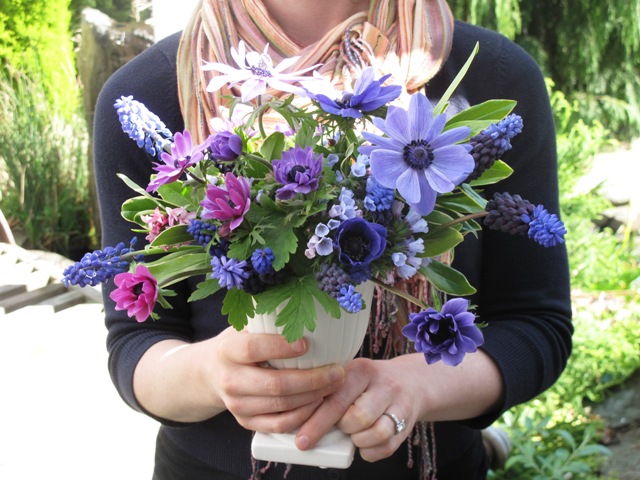
Eco-conscious flower farmer and floral designer Kelly Sullivan of Seattle’s Botanique Flowers arrived with this gorgeous bouquet at a lunch I hosted last week. I had to share it!

Kelly Sullivan's evocative spring bouquet

Here’s what she included in the diminutive urn:

From her own garden: purple-blue grape hyacinths (Muscari); pale pink and purple flowers from a groundcover called Pulmonaria; geranium foliage; and variegated foliage/scented pale-pink flowers from a shrub called Daphne odora.

From the garden center: It was too early to harvest these from her own backyard, so Kelly bought potted anemone plants and clipped several of their romantic black-centered flowers in indigo and dark pink to add to the bouquet.

Everything is stablized with a small piece of chicken wire inside the vase, which allowed the designer to get the full, cascading effect she wanted. I was smitten!

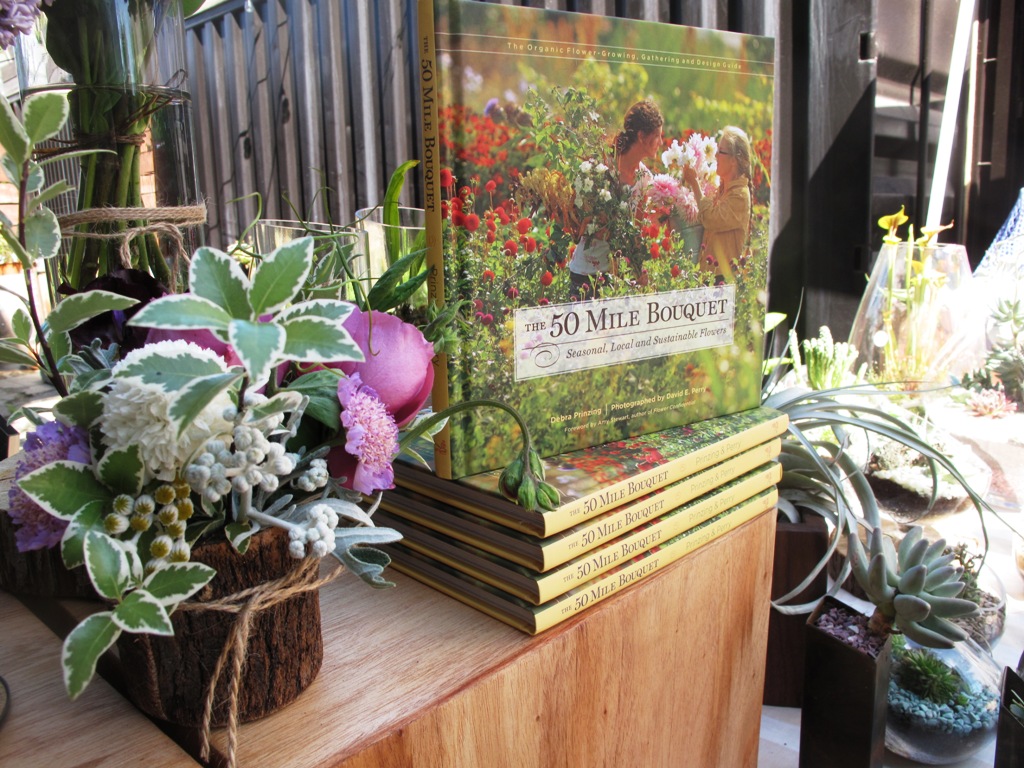
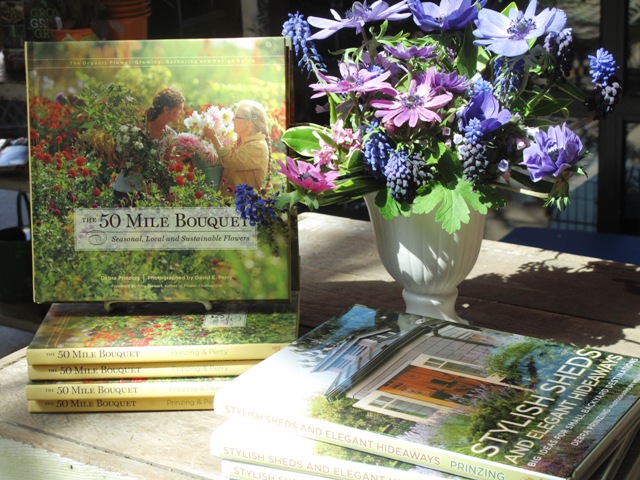
So, when we had a talk and book-signing at Ravenna Gardens on Sunday, I brought along her vase to add to the book display. It’s simply sublime!

Kelly's bouquet looks pretty dazzling with our book display.

THANK YOU, Kelly!!!


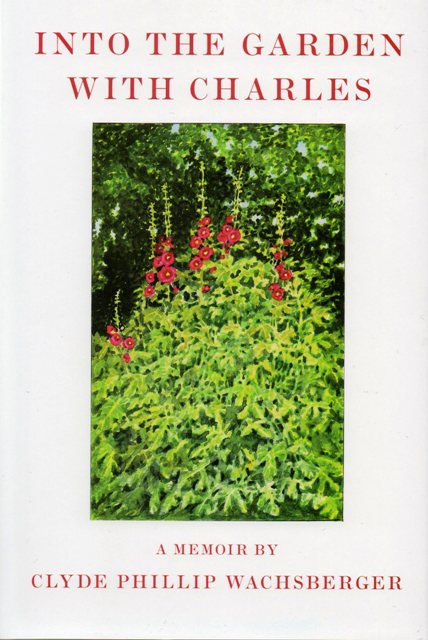
Into the Garden with Charles

Friday, April 13th, 2012

Read about the 10-year journey of a garden memoir – from the seed of an idea to its release by a top New York publisher

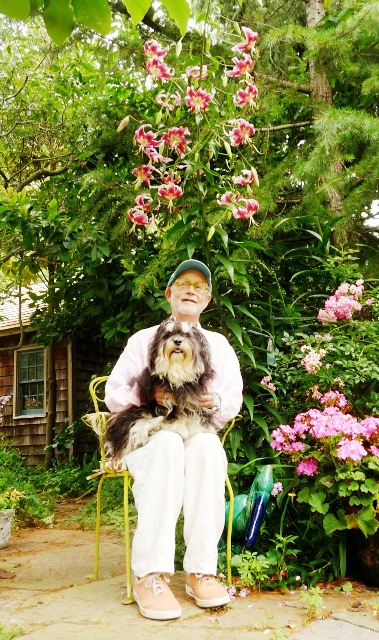
Skip in his garden in Orient, New York. Rover is seated on his lap.

Many garden writers whose work I greatly admire have privately shared their disappointment that our genre isn’t seriously viewed as a literary subject when compared to, say, sports or food. Every twelve months we witness the publication of an anthology titled something like “The Best American Sports Writing, 2011” or “The Best Food Writing, 2010.” There are books of “bests” for Science and Travel writing. Yes, even Nature and Environment writing has been compiled by publishers, but those topics aren’t the same as the subject of the garden. Sadly, garden writing rarely receives credit for its importance as an art form.

And yet, there is wonderful work in our circles. And one of the very best pieces of literary garden writing I’ve ever read was just published this week and released by the venerable imprint Farrar, Straus and Giroux. It’s a memoir called “Into the Garden with Charles,” by the late Clyde Phillip “Skip” Wachsberger, an award-winning artist twice honored by Garden Writers Association.
Skip’s book is beautiful both for its language and for the 14 full-color watercolor illustrations interspersed through its 224 pages. FSG’s press material describes this work as a “sweet and inspiring story about art, love, and gardening set against the backdrop of New York City and the author’s noteworthy garden outside a three-hundred-year-old house in the tiny village of Orient, Long Island.”

For those of us who knew and admired Skip, his book can be viewed as one man’s life work. It’s a highly personal and yet universal story of love, friendship, and the way the garden can nurture a lonely soul.

When I spoke by telephone with Jonathan Galassi, FSG’s president and publisher, and asked what prompted him to acquire Skip’s memoir, he said: “I thought it was a very genuine and beautiful piece of work; very touching and real and unlike anything else I’d read.”

As I listened to those words, tears welled up in my eyes. I thought: How pleased Skip would have been to hear them. We lost Skip last November, when cancer took his life. That his writings, paintings and garden survive is to be cherished by those who loved him and by anyone who reads this memoir.

For fellow garden writers, Skip’s creative story is an inspiring one, much of it documented in the pages of his memoir. His manuscript took a decade to be cultivated – from an original garden book idea to its release by one of the publishing world’s very best imprints.

Skip and I had many conversations over the years about how he reshaped his writing — from descriptions of plants and place into an intimate narrative of his own life. To better describe the story of this special book, I turned to the people closely involved with “Into the Garden With Charles.” In addition to interviewing Mr. Galassi, I spoke by phone with Charles Dean, Skip’s surviving husband, and Karen Braziller, his friend, neighbor and longtime writing coach/editor. They graciously shared details of Skip’s writing journey with me.

GARDENING, WRITING AND PAINTING

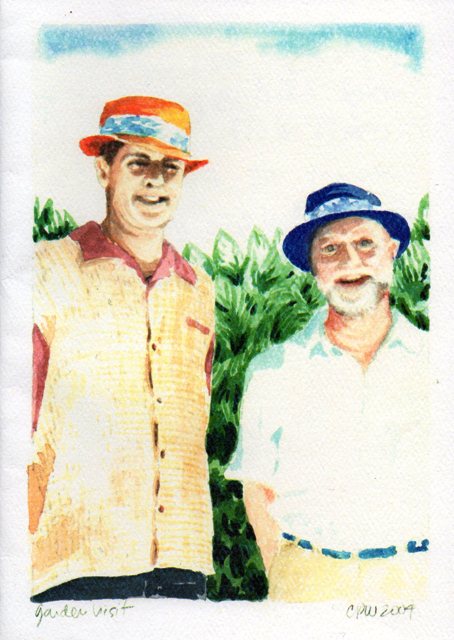
Charles and Skip in their pork pie hats. Skip printed note cards from the original watercolor.


In theatre, someone who sings, dances and acts is called a “triple threat,” so I guess you could say that as a creative individual, especially in garden writing circles, Skip had his own remarkable set of triple talents — gardening, writing and painting.

His gifts converge in and enliven the pages of “Into the Garden with Charles.” From the opening lines when he wonders if all that makes him happy is just a dream – his beloved but antiquated home and garden, his always-cheerful dog Rover, and his charming, Southern-born partner Charles – Skip draws the reader into his magical world in which the impossible is always possible, if you only believe.

“Into the Garden with Charles” tells of a wonderful life filled with a love for opera, art, plants and friends. That Skip yearned for a companion with whom to share all of it is a familiar narrative. And just when it seems like he’ll never find the love of his life, living as he does in a remote Long Island village populated with couples and having just passed his half-century birthday, Skip meets Charles.

“Every garden tells a story. Ours tells a love story,” he wrote. And you will fall in love with both Skip and Charles, as well as Rover, their loyal Havanese, and all of their plant-obsessed garden adventures. Gardeners will especially relate to the ends to which these two men go to develop an otherworldly backyard where every tree, vine or flower has its own back-story!

For those who love to read lush (but not flowery) language, you will find the narrative delightful. And like a child’s storybook from days gone by, this one is adorned with beautiful watercolor illustrations, painted by the author. Allow yourself to be drawn into Skip’s dream world. You will be touched by his wisdom, kind spirit and optimism — all of it a gift from him to the reader!

READ MORE…

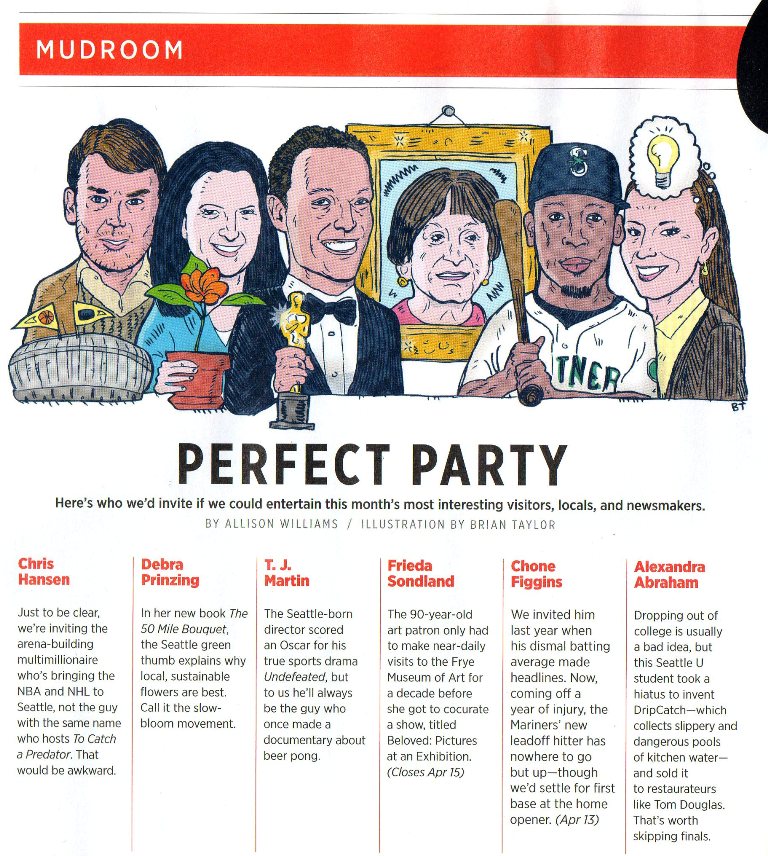
Perfect Party

Wednesday, March 28th, 2012

My friend Bill called me yesterday to tell me that Seattle Met magazine included me in their “Perfect Party” feature for April.

“WHAT????” I asked. Clearly, this happened without my knowledge – but it’s quite exciting. And amusing! I’ve never before been illustrated! I wonder who put them up to this?

Here’s the story:

Spring is blooming!

Saturday, March 17th, 2012

March 20th is just around the corner – thankfully! And blooms are everywhere – under our noses, poking through the soil, erupting from branches, and filling our vases. Hurrah!

Here are some of the hints of spring that have come my way:

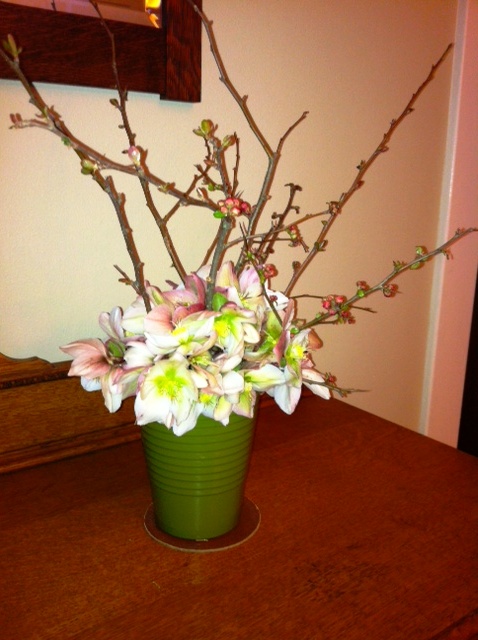
Kay's flowering quince branches and the delicate hellebores make for a stunning, early spring bouquet!

1. A DIY designer gets inspired by her own garden’s bounty. Earlier this week, an email with this charming photo appeared in my in-box from Kay Christie, who attended one of my demonstrations at the Northwest Flower & Garden Show last month. Thanks so much for sharing, Kay! And for the kind words. Keep designing!

I wanted to show you an arrangement I just made with cuttings from my garden. I really loved your demo at the flower and garden show. It gave me the idea for this. I also used chicken wire inside to hold the stems. Thanks do much for the inspirational talk.

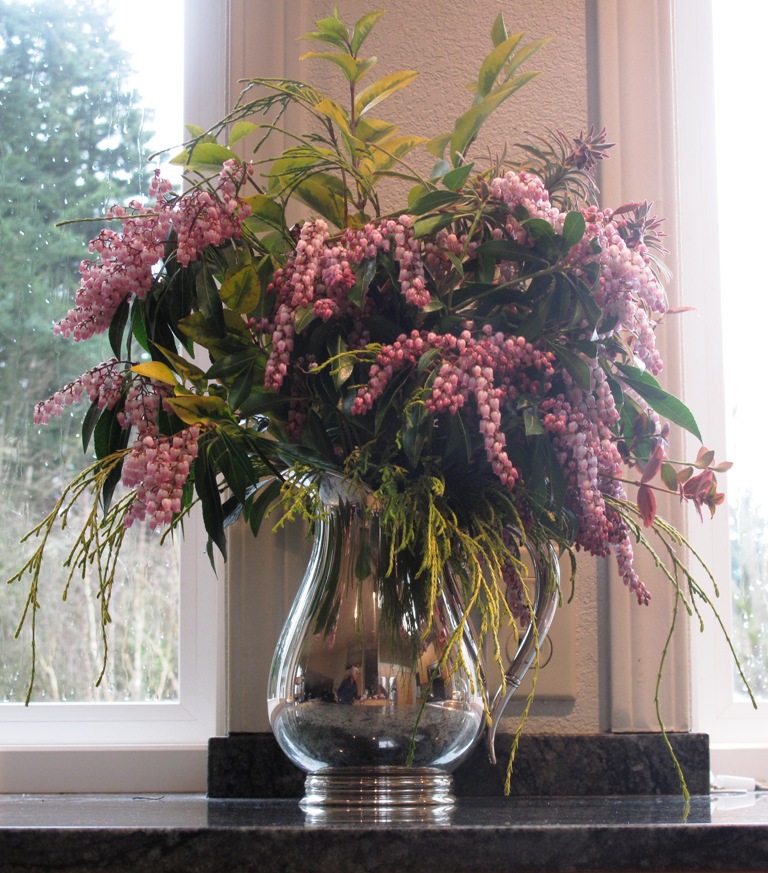
A silver pitcher contains a sublime bouquet in a pink-and-gold palette, by Peggy Shelley.

2. A talented gardener clips goodies from her backyard for a special arrangement. Like Kay, Woodinville, Wash., gardener Peggy Shelley harvests beautiful floral ingredients from her landscape. I visited Peggy and her husband Al Shelley (also a gifted gardener) earlier this month to interview them for an upcoming Better Homes & Gardens article about their garden (the feature will appear in the August 2012 edition). There was a gorgeous bouquet on the kitchen counter and of course, I couldn’t take my eyes off of it. It included pink-flowering Japanese pieris, bi-colored pink-and-green euphorbia stems, golden thread branch cypress sprigs and lemon-yellow privet foliage. Peggy told me something quite inspiring – and I’m going to remind myself of her passion every time I head into my own garden:

The biggest satisfaction of my garden comes from making a bouquet and giving it to a friend.

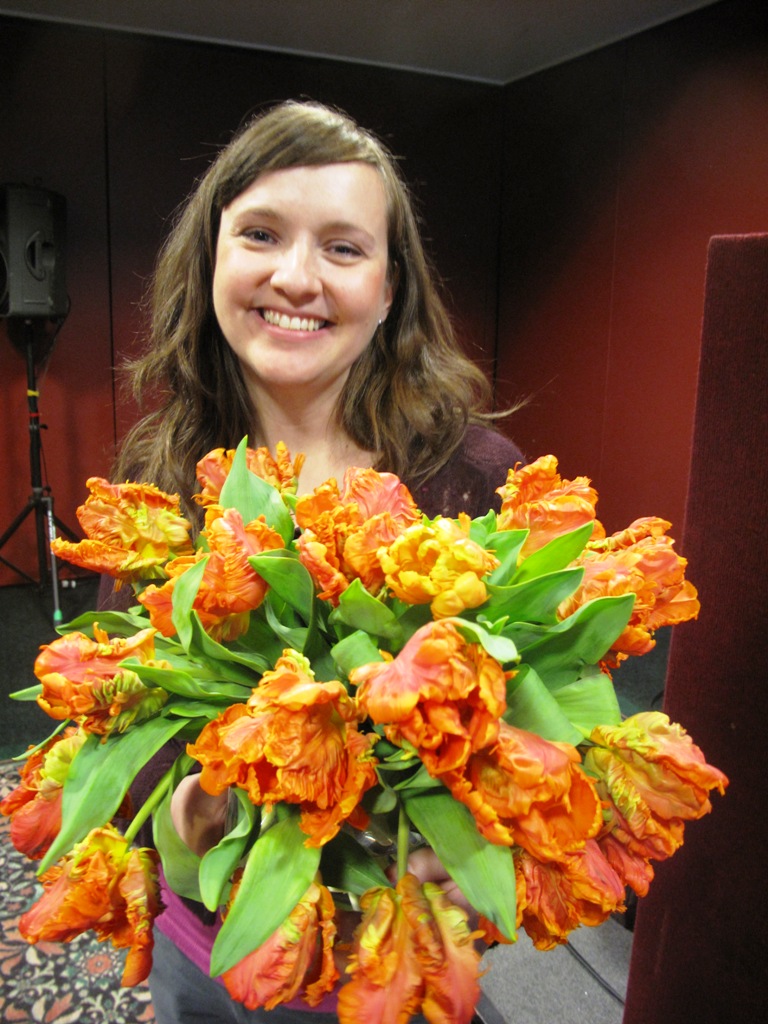
Lynn Fosbender of Pollen, an eco-friendly floral designer in Chicago, with her beautiful bouquet of local spring tulips.

3. Local flowers arrive just in time for a Chicago designer. Last Sunday, I was in Chicago to speak at the Chicago Flower & Garden Show (thanks, Bill Aldrich, for inviting me!). I called Lynn Fosbender, who owns Pollen, a sweet, ec0-conscious floral studio, and asked if she could bring a bouquet to my talk and also pass out her business cards. I wanted to showcase Lynn as a home-town resource for Chicago area floral customers, and let them know about her intentional design philosophy of using local flowers whenever possible. “I’d love to come,” she said. “But March 11th is still pretty early. I probably won’t be able to find local flowers from my sources.”

Then, to my delight, Lynn showed up with a vase of the most stunning vibrant orange-and-green parrot tulips I’d ever seen! “Spring has been mild here – and one of my local growers called me on Friday to let me know his tulips were ready to harvest,” Lynn said. What a wonderful treat. I wrote a post about Lynn when I first met her in 2012. Here’s a link to that story. I was so impressed with her vision for her business:

For several years I thought I would like to own a full-service flower shop that was eco-friendly. I knew if anyone should do it, it should be me.

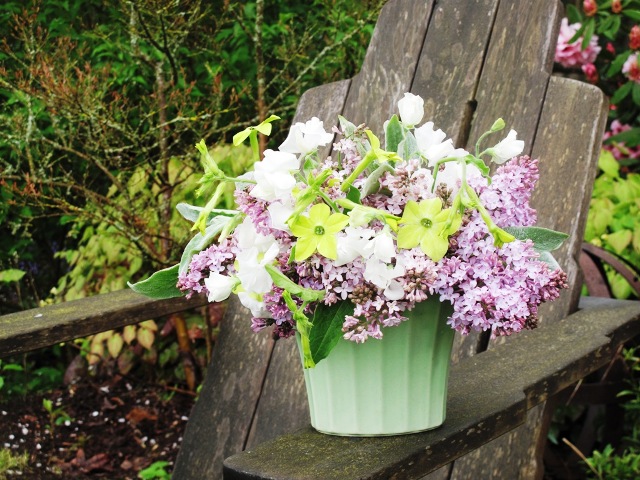
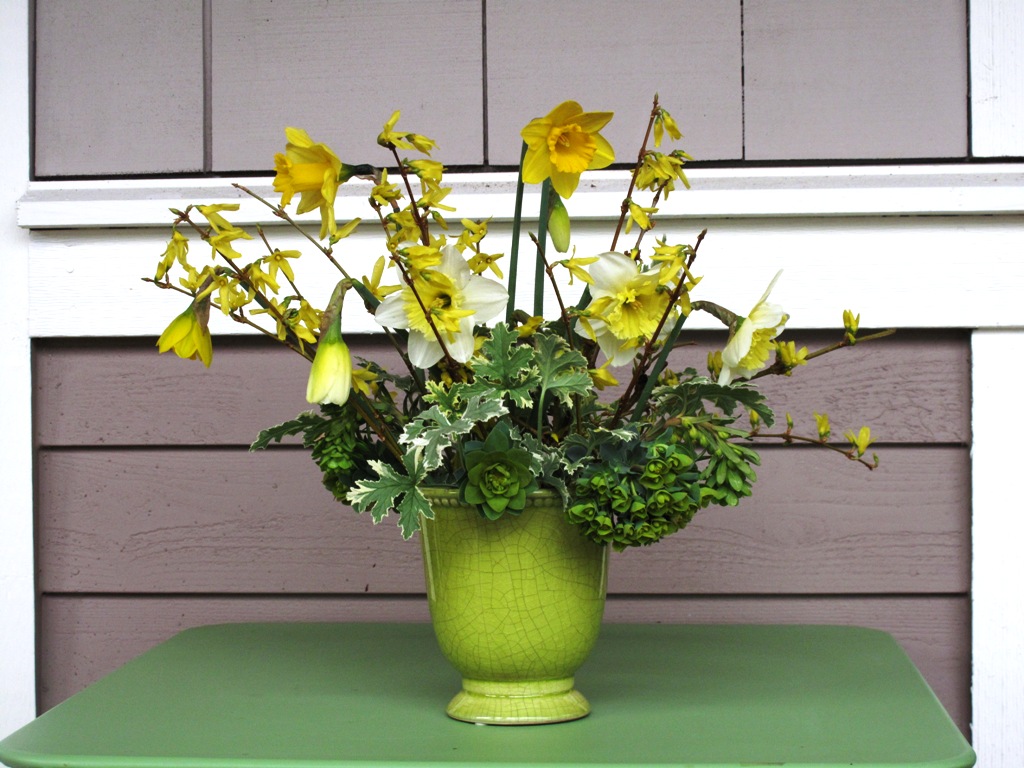
Spring's yellow and lime floral gifts collected in a green vase.

4. See what my own garden yielded this week. I’ve been making a local and seasonally-inspired floral arrangement every single week for the past 20 weeks (since the first week of November). It’s part of my plan to create a book or blog called 52-Weeks-of-Local-Flowers. It’s been fun, creative, and very educational to discover what I can source from local growers, local farmers’ markets, and of course, my own backyard.

Yellow and green are the theme of this week! I used two types of euphorbia (dipping the cut stems in boiling water helped “seal” the ends so the milky white sap didn’t drain into the vase); two types of daffodils that the prior owners of our home planted on the parking strip along the street; lots of bright-yellow-flowering forsythia; and some lovely variegated foliage from the scented geranium plant I’ve been babysitting in my garage under the shop lights. Everything came together nicely in a small green-glazed vase and a vintage flower frog held the stems in place.

Today, strangely, it’s snowing in Seattle. I soaked my sweet pea seeds in water last night and I plan to plant them in flats in the garage today. I had wanted to weed and prep the beds, but really? I think I’ll wait and see if it warms up a bit! Happy Almost-Spring!

Meet the NEW Sunset Western Garden Book

Wednesday, March 7th, 2012

SUNSET GIVEAWAY

I’ve drawn names of all those who answered my question below and here are the five “winners” of a FREE copy of The New Sunset Western Garden Book, courtesy of Sunset. The question: What is your favorite ornamental landscaping plant (shrub, grass, perennial, etc.) to harvest for a cut bouquet? yielded these winners/answers:

Jen Y: peonies

Paula: bunnytails grass blossoms or pilotus joey

Carol: Peonies, nandina branches and berry clusters

Nicole: hellebores

Kim: dahlias

CONGRATULATIONS! You will soon be hearing from Dana Smith of Sunset Publishing, who needs your mailing address.

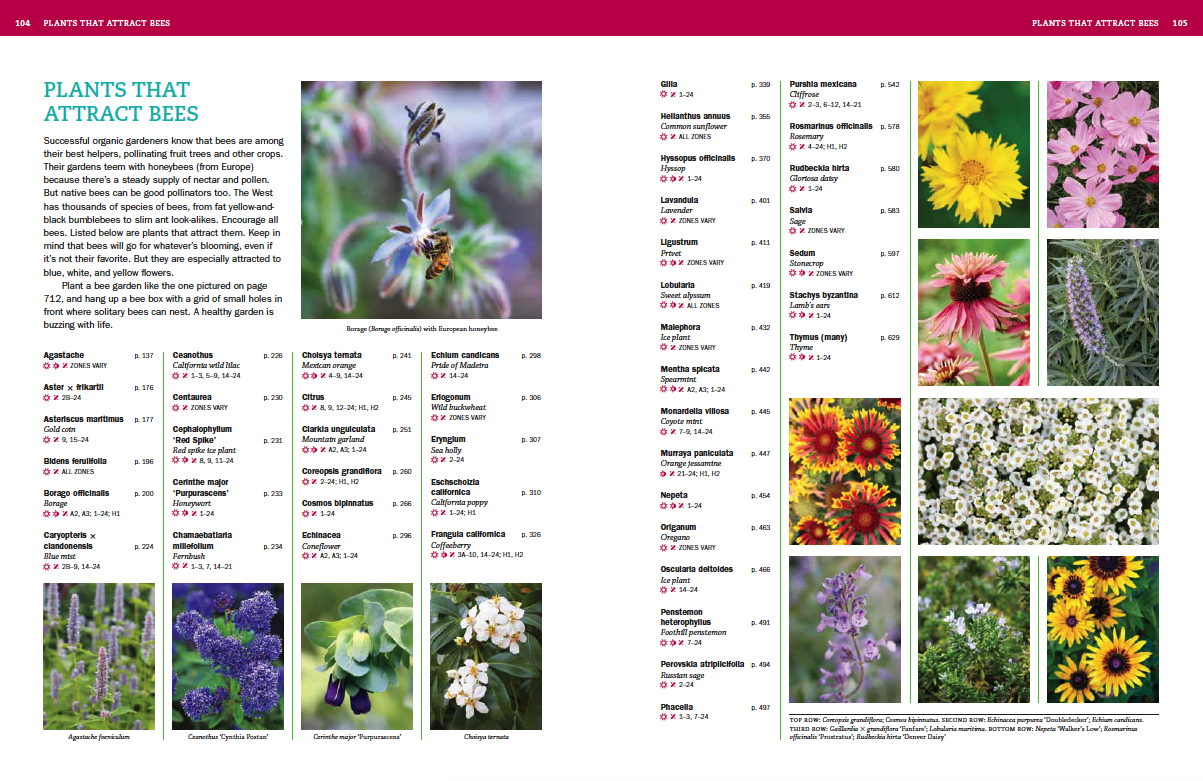
I recently had a chance to interview Kathleen Brenzel, garden editor for Sunset magazine – and editor of Sunset’s new, 2012 edition of The New Sunset Western Garden Book,  (Sunset Books, $34.95 for flexible binding, $44.95 for hardcover), a “bible” for western gardeners.

Whether you’re new to gardening or have logged many planting seasons with your hands in soil, it’s the single best go-to reference for garden-makers in our region. As chunky as the Yellow Pages, this essential guide to the West’s ornamental and edible landscape has been around for 80 years. I’ve owned every version since the early 1990s, including the most recent 2007 edition, which is dog-eared from much use.

When I got my hands on the just-released ninth edition last month, I thought: How different can this really be? I asked Kathy to walk us through the book’s 768 pages:

How did you go about updating this edition? Before we did anything else, we assembled a panel with landscape architects, horticulture educators from UC Berkeley and Cal Poly San Luis Obispo, nursery people and new graduates who had used our last edition as a textbook. The recent grads told us that in order to make “The New Sunset Western Garden Book” relevant, it had to have a digital component. They said: “We go everywhere with our smartphones, so we want to be able to take a photo of a plant we see on the hiking trail and look it up instantly.”

How did you go digital? Now you can take the best of Sunset with you to the garden center, nursery and your yard. You can get the free mobile edition of this book’s Plant Finder on your smartphone. (Search for Sunset Plant Finder.) With it, you can access more than 2,000 plants — and search by plant name, ZIP Code, climate zone, sun and water requirements, and type. There’s a companion online Plant Finder that lets you browse by color, height, spread and special needs.

How else is the book interactive? The last section of “The New Sunset Western Garden Book” is a practical guide. We’ve added a camera icon on the bottom of the pages, pointing you to corresponding videos on our website. It’s nice to read directions on planting a tomato in a pot and then watch a video of one of our editors showing you exactly how to do that.

What are the other major updates? This is the first edition to feature plant photos exclusively, rather than illustrations. There are more than 2,000 plant photos. We also updated the entire plant encyclopedia. That was the biggest job in the whole book. Every plant was reappraised, and we added many new varieties now available in nurseries. We went to growers all over the west and compared our existing plant database with what they are now offering; we asked what they thought we should include and why.

How many new plants did you add? The new book has 9,000 plants, up from 8,000 in the last edition. We also had to check the botany of every plant because botanists are constantly reclassifying plants.

What can new gardeners gain from the book? The section “Gardening Start to Finish” is more instinctive for the beginner. We walk them through the whole growing process from A to Z. We also have practical sections on gardening for wildlife and native plants, growing herbs and water-wise plants.

What can more experienced gardeners gain from the new book? The plant encyclopedia is filled with tip boxes of additional information – like how to propagate a sweet potato vine or when to cut ornamental grasses for the vase.

You have more edibles, don’t you? We asked ourselves: “What do people want most from ‘The New Sunset Western Garden Book’ right now? You’d have to be totally checked out not to notice a huge wave of edible gardening, so we wanted to amp up our coverage. I’m really happy with the “what edibles to plant when” charts for warm-season and cool-season veggies.

What’s your favorite take-away from the book? There’s an underlying theme that acknowledges how we garden now – with an interest in natural gardening and sustainability. Our gardens are smaller, but they’re stylish and sustainable.

Note: A version of this Q&A appeared in the LA Times HOME blog on February 17th.


DIY Bouquets in Dallas

Thursday, March 1st, 2012


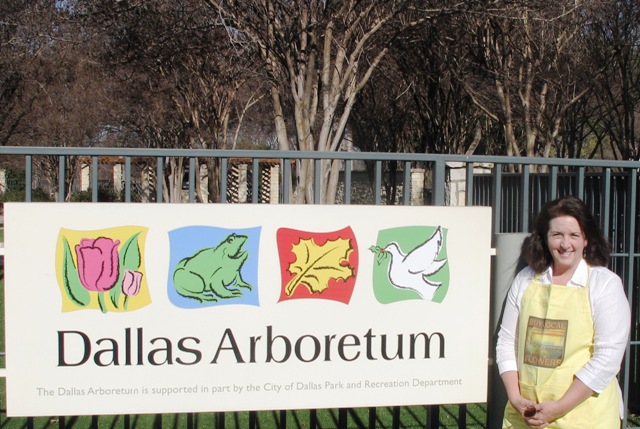
I spent a wonderful day with floral design students at the Dallas Arboretum.

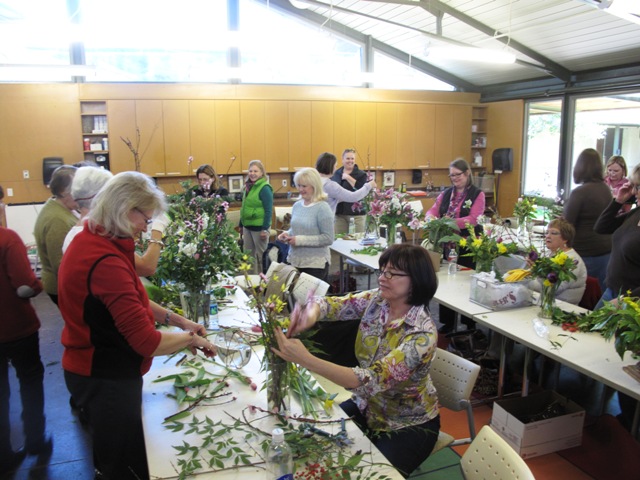
First-time floral designers and experienced arrangers converged at the Dallas Arboretum and Botanical Gardens last Saturday for a few hours of inspiring floral creativity.

In planning the hands-on workshop with education director Joy Ijams, I worried that late February in Dallas could present some challenges. That is, when it came to procuring local and seasonal design ingredients. Fortunately for the 20 folks who participated in our sold-out class, my fears were allayed.

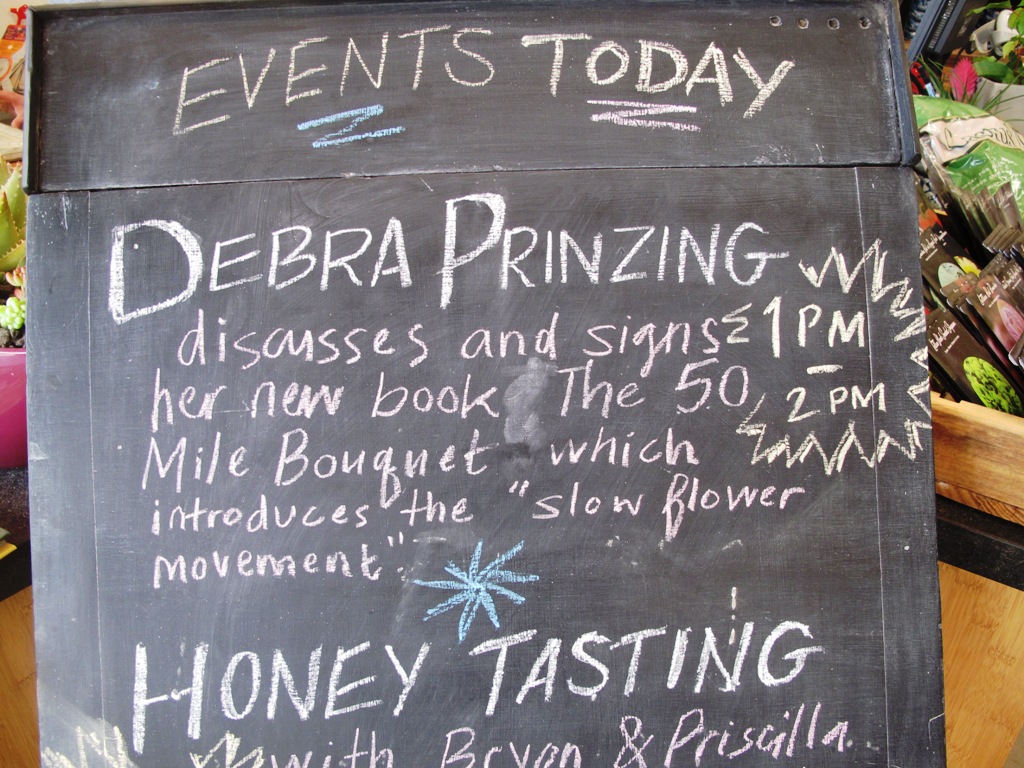
For the success of our event, I have several awesome people to acknowledge. First of all, thanks goes to Joy – the ever-upbeat program planner who invited me to speak about The 50 Mile Bouquet in a morning lecture and then to teach what she called a “make and take” workshop after our lunch break.

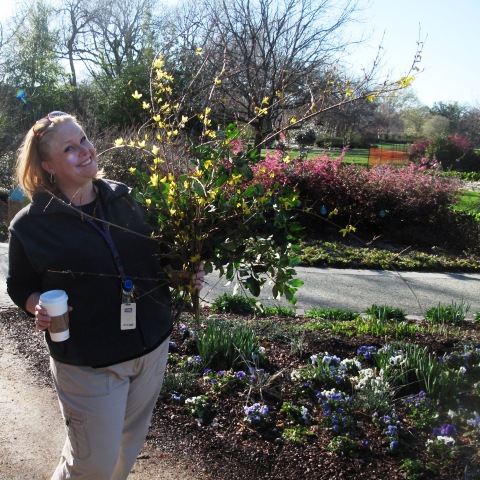
Education director Joy Ijams and I did a little “pruning” the morning of my class…to harvest branches and foliage for our student-designers to use.

It was Joy who creatively conjured up the format and got the word out to the Arboretum audience. It also was Joy who picked me up at the airport on Friday night and took me to Central Market so we could shop the flower department to augment our menu of botanical ingredients with domestic tulips and fragrant stock (she also suggested we undertake some ‘moonlight pruning’ at the Arboretum, but we were both exhausted and decided to wait until the following morning).

Joy, along with her education department colleagues and volunteers, made everything run smoothly. Our students were happy and engaged – and all the AV systems worked to perfection.

The following morning, prior to the arrival of those attending the 10 AM lecture, Joy and I headed out to the Arboretum’s display gardens with Felcos in hand. We were motivated by a concern that we wouldn’t have enough greenery otherwise. Sorry, Jimmy, but we harvested from the fringes of your borders, including clipping from the back sides of Indian hawthorn, just-blooming forsythia, phlomis, and rosemary. Oh, and a few minor branches from a saucer magnolia. 

Texas cut flower grower Cynthia Alexander is not only a great farmer, she’s a talented floral designer!

We were in pretty good shape with our supermarket flowers and the just-cut foliage. That’s because we knew Cynthia Alexander of Quarry Flower Farm was soon to arrive with goodies from her fields and orchards. In anticipation of this class, I had reached out to several of the Dallas area members of the Association of Specialty Cut Flower Growers (ASCFG) and connected with Cynthia, whose farm is located in Celina, Texas. She did not disappoint!

Cynthia agreed to harvest everything she had on hand and bring it to our class. Yes, it’s still early spring on Cynthia’s rather young flower farm, but you’d never know it by the fabulous, overflowing galvanized French flower buckets she delivered.

They contained an awesome mix of spring bulbs (several daffodil varieties); uncommon foliage (cardoons, hoar hound, and other green boughs); and lots of flowering fruit-tree branches. I’m so pleased that Cynthia joined us.

Floral design – en masse – in a classroom filled with passionate and creative women.

It allowed me to introduce her farm to students in both the morning and afternoon class. Plus, she participated in the floral design workshop – and inspired all of us with her avant-garde creation! As soon as Cynthia walked into the classroom, I recognized her; we realized that we must have met or at least spoken with one another at the 2010 Tulsa ASCFG conference. This time, we’ve become more than passing strangers and I can’t wait to return to Dallas to see Cynthia’s farm first-hand.

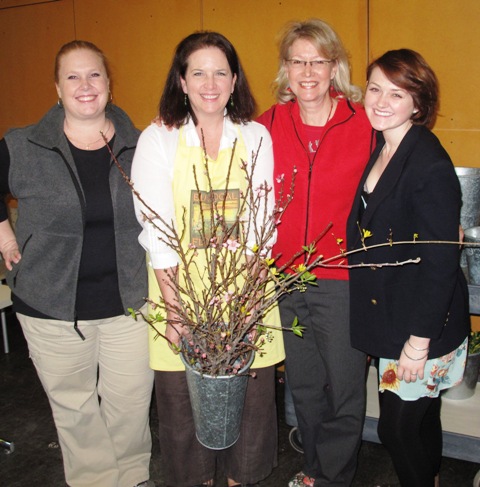
My “dream team:, from left: Joy Ijams of The Dallas Arboretum; Debra Prinzing (me); Cynthia Alexander of Quarry Flower Farm; and Whitney White, new-generation floral designer.

A few other secret ingredients enhanced the Saturday afternoon workshop — more fresh-from-the-garden floral elements and a talented florist (read on to discover to whom I’m referring). First, Joy and I had asked those who wished to do so to bring cuttings from their own gardens – and wow, what a great selection of foliage arrived! Second, I was sent an “angel” in the form of Whitney White, a twenty-something floral designer whose father Jay White is a fellow member of Garden Writers Association and an email pal of mine. Whitney arrived like a dream….Jay encouraged her to attend the morning workshop and as soon as we met I recruited Whitney to help with the afternoon class. It was nice to have her talent and that of a few other pro’s in the class to share tips about composition, line, form and color. I can’t wait to see where her career takes her. Currently, Whitney is working for a hot Dallas design firm called Bows and Arrows. They are very lucky to have her!

Once all our ingredients were assembled, I started out the class by discussing my favorite “green” floral design techniques:

  • Use a recycled or repurposed vase
  • Stabilize stems with organic or re-usable material, such as an armature of branches or twigs, wood aspen (Excelsior), old-fashioned flower frogs, chicken wire and a foliage nest.
  • Strip all foliage from the portion of the stem that will be under water; fresh-cut ever stem and plan on refreshing the water every day or two.

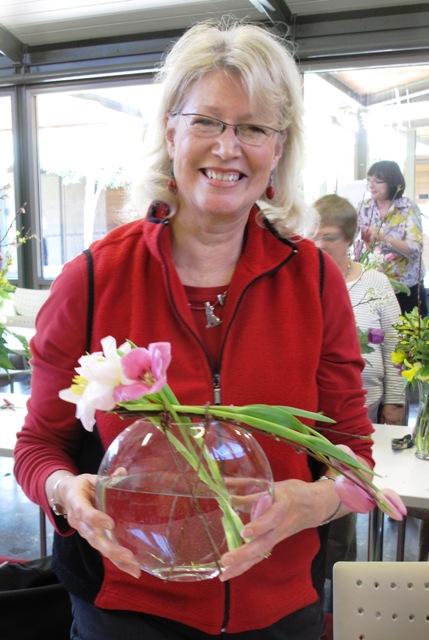
The students exceeded their own expectations with a beautiful lineup of designs. You can see some of their examples here.

Bottom line: Gardeners are ideal floral designers. We know the form, habit, bloom time and character of the ingredients in our gardens. And so we know how and when to harvest those ingredients — and arrange them in companionable displays in a vase. Perhaps this is an unscientific, alternative approach to floral design. But it makes sense to me! When you use seasonal ingredients, then they will naturally look like they belong together in a vase.

Here’s a lovely gallery of the local-seasonal-sustainable designs that filled our vases:


Decisions, Decisions . . . right flowers, right vase?

Saturday, January 7th, 2012

Metallic, pewter, and snowy white - the non-floral arrangement

Choosing the appropriate vase for an arrangement is like finding the right pair of shoes to compliment your cocktail dress, right? There’s good, better and best. A critical eye is required to make the right choice!

Today, not able to decide which vase to use for my New Year’s arrangement, I photographed my silvery-winter ingredients in three different vases. Please vote for your fav!

The ingredients:

  • Pussy willow from J. Foss Garden Flowers in Chehalis, Washington (grower Janet Foss tells me the cultivar of her unique, multi-branched form of pussy willow is unknown; she took cuttings from a customer’s garden and began propagating them). The stems are truly stunning and way more interesting that your typical ramrod-straight pussy willow branch
  • Two forms of Dusty Miller (Centaurea cineraria) — lacy and broad, grown by Charles Little & Co. of Eugene, Oregon
  • Plus, a few sprigs of feathery Artemisia arborescens from my garden.

We’re all a little tired of evergreens and red berries, right? That was my thinking when I came up with a metallic, pewtery vibe, which seems fitting for the New Year.

Option 1: Stripes of bronze, brass and pewter embellish this substantial urn, inherited from my father-in-law. It’s the only shiny-metallic vessel I own.

Option One

 Option 2: Basic white. Going for the simple statement. The foliage definitely looks snowier against this glazed vase.

Option Two

 Option 3: More textures, this time in a ginger jar with a raised, circular pattern. Its color is arguably mauve or pale lilac. Or maybe gray with a tinge of purple.

Option Three

Please vote in the comment section – and tell me WHY you prefer a particular vase for this combination!

Shutters, stylish and succulent-filled

Sunday, November 13th, 2011

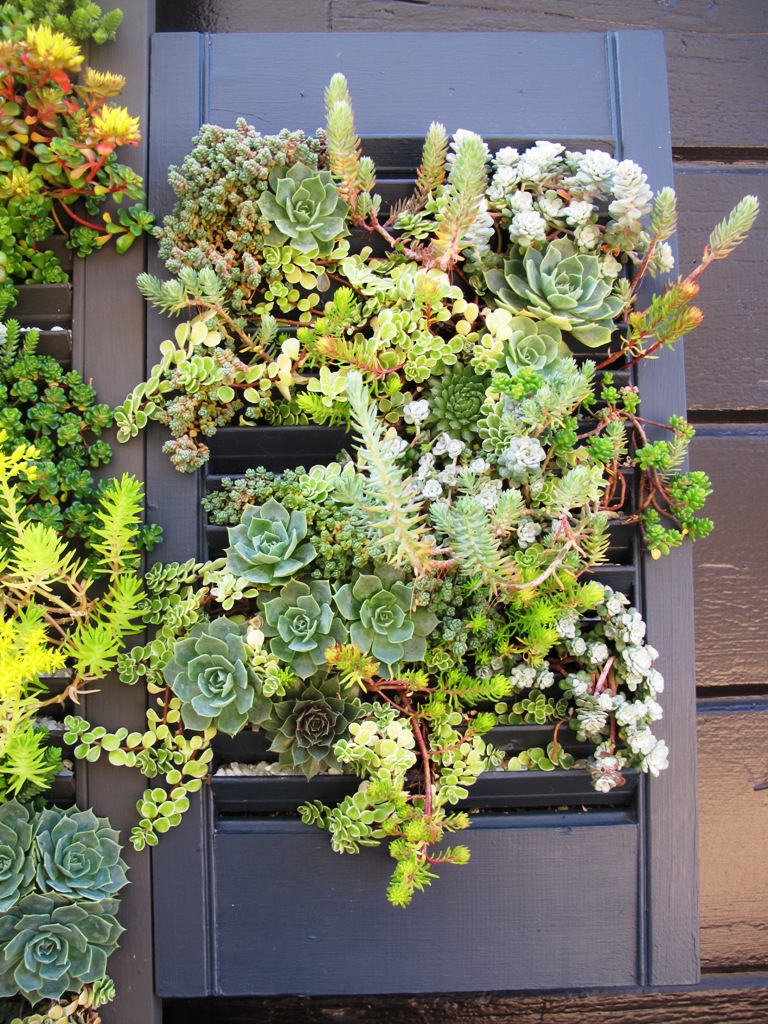
Last year I blogged about finding a set of half-circle shutters at a vintage sale. I wanted to emulate my friend Baylor Chapman’s succulent-planted shutters that grace her outdoor terrace in San Francisco. Since then, a few folks have emailed to ask if I EVER finished that project? Much to my embarrassment, those dusty shutters sat in the garage, untouched for nearly a year!

But finally, now that we’ve settled into a permanent residence, I’ve been able to work on this project. The shutters have been cleaned and given three coats of exterior paint. To turn them into vertical succulent planters I mounted both pieces with wood screws outside my office windows and then stuffed the openings betweeen each slat with sedums and sempervivums. Let’s see how they look:

Step one: Paint the shutters. I used semigloss acrylic berry-red, the paint used for my home's exterior trim

Step Two: Staple landscaping cloth to the back of both shutters.

Step Three: Mount shutter and fill the "slots" with potting soil.

Step Four: Plant with hardy sedums and other succulents.


Mostly native plant list for a modern California garden

Tuesday, November 1st, 2011

A stand of cape rush adds a semitransparent layer of privacy between sidewalk and front garden.

Joel Lichtenwalter and Ryan Gates of Grow Outdoor Design, based in Los Angeles, have introduced me to some really creative gardens they have designed. And what strikes me when seeing these mostly small, urban landscapes, is how well plants are used as architectural elements within the spaces they reside.

Designers Joel and his client Scott can be seen in the distance, conferring on some of the planting designs.

You won’t see fluffy cottage gardens with English-inspired perennial choices in Ryan and Joel’s gardens. Yet even when they design for bungalow-scaled residences, some of the same intimate, cottage garden experience occurs for the humans who occupy them. That emotional sense of being surrounded by plants, layers of textures — and even color in a tonal, modern sense –happens in their gardens.

I wrote about one such place recently and you can follow the links to the Los Angeles Times story here, including an extensive web gallery.

For those who ask: What plants are appropriate for a lush, low-water landscape? I think you’ll appreciate Ryan and Joel’s plant list for their clients’ lawn-free front yard now filled with native and Mediterranean grasses, shrubs, ground covers and trees, many of which display multi-season beauty:

A shopping list of California native plants and their Mediterranean companions
Natives:
Ceanothus griseus horizontalis
Yankee Point
Cercis occidentalis
Arctostaphylos ‘Howard McMinn’

Arctostaphylos ‘Emerald Carpet’
Leymus condensatus ‘Canyon Prince’

Muhlenbergia rigens
Platanus racemosa
Carpenteria californica
Eschscholzia californica
Juncus patens

Sisyrinchium montanum (Blue Eyed Grass)

Non-Natives:
Arbutus ‘Marina’
Agave bracteosa
Leucadendron ‘Safari Sunset’

Agave vilmroniana
Olea europaea
Chondropetalum tectorum

Materials:
Composite decking (raised deck and boardwalk)
Square pre-cast concrete pavers
Poured-in-place concrete bench
‘Del Rio’ gravel
Decomposed granite (DG)
Shredded tree mulch

Backyard Bouquets

Wednesday, October 26th, 2011

As some of you may know, I’ve been working on a book about local and seasonal floral design for several years, since 2007 to be precise. My collaborator, photographer David Perry, and I have been using the working title, A Fresh Bouquet.

But that’s all changing now, with a new title from our new publisher, St. Lynn’s Press. The words evoke just the right idea we want to communicate: The 50 Mile Bouquet: Discovering the World of Local, Seasonal, Sustainable Flowers.

Nice, huh? Our publication date is April 2012 and I’ll be writing lots more news about it soon.

Since all I’m doing these days is interviewing flower farmers, eco-couture floral designers and gardeners who grow their own cut flowers, my head is swimming with beautiful blooms.

And somehow in all this flurry of work, I’ve failed to post the out-takes from my floral design story that ran a few months ago in Better Homes & Gardens. So today, I’m taking a moment to get to it.

Backyard Bouquets - in BH&G's July 2011 issue

How great that 7.3 million readers of the July 2011 issue were introduced to the timeless notion of gathering flowers from the garden, a local farmer or a market stand – IN SEASON – and creating a simple, yet sumptuous arrangement that’s of the moment!

I have my editors Eric, Doug and Gayle to thank, because they believed in the idea and created the perfect opportunity for me to fly to Iowa and design a series of bouquets literally out in the field at Howell’s Family Farm.

I shared some of my on-the-scenes location photos last year, but here, finally, are my photos and recipes of the actual arrangements.

Project One

Project One features a rectangular galvanized container, measuring about 5-by-8 inches and about 5 inches tall. This small vessel was perfect for a compact bouquet with two simple ingredients. First, I filled the opening with four or five luscious heads of ‘Limelight’ hydrangea, the stems cut fairly short, say 3 inches long. To fill the spaces between the hydrangea heads and to add contrasting color and texture, I made miniature bunches of ‘Strawberry Fields’ gomphrena by wiring five slender stems with wire so that each bunch could be inserted as if it were a single flower. This is the perfect arrangement to enjoy while it’s fresh and then let it slowly air dry as an everlasting bouquet.

Project Two

Project Two features a tall, square, modern green glass vase with a neck opening that’s smaller than the base. So of course, to make it look abundant and full, I had to create volume and height. The starting flowers here are sultry-looking zinnias from a new seed mix called ‘Queen Red Lime’ – I love the terra cotta, mauve, and reddish blooms with a lime-green center. Once I had those in place, I thought: We need dark foliage. And lucky for me, the folks at Howell’s, like many cut flower growers, have discovered how well basil performs as a cut ingredient – especially purple basil! Think about it: when you harvest basil from your garden and bring it indoors to keep in a jar on your windowsill, have you ever noticed how long those cut stems last? Of course basil is a great cut floral ingredient! The third element here is one of those happy coincidences – common foxtail grass, which some consider a ditch weed, that perfectly echoes the green vase, and catches the late summer sunlight just beautifully. Three simple ingredients in perfect harmony.

Project Three

Project Three is one of my very favorites, because of the mix of colors and textures. Contained in a vintage pitcher, I absolutely love the playful combo of velvety cockscomb (the crested form of Celosia ) with all the lime green contrasting forms. Here’s how I made this bouquet. First, I filled the pitcher with soft greenery, a white mugwort (Artemisia lactiflora) that fills the opening and becomes the supporting structure for all the subsequent stems. Second, I stripped foliage off of 10 maroon and coral-hued cockscomb flowers; then I cut the stems pretty short and inserted each into the fluffy base, making sure that you can’t see the stems showing at all. Third, I added some ‘Green Envy’ zinnias, which echo the pitcher’s green quite nicely. For a sense of movement, as a final touch, I inserted taller stems of quaking grass (Brizia maxima), so they seem to hover above the bouquet. Casual and the epitome of summer!

Two other projects fell on the cutting room floor, so to speak, so you get to see them here! Actually Project Four showed up in the iPad edition, along with a video interview filled with my eco-savvy design tips. You actually have to download the July edition to see the entire interview (filmed by David Perry) on an iPad.

Here’s a rough-cut edit of the video:

httpv://www.youtube.com/watch?v=ZLKacMtjJUY

Project Four

Anyone can replicate Project Four, a fun trio of mini-arrangements, which are displayed in a row or grouped together on the table as a centerpiece. We used three yellow tumblers that art director Scott Johnson brought from his kitchen cupboard. The simple idea was to showcase several varieties of black-eyed Susan flowers (Rudbeckia sp.) with a mix-and-match of foliage choices. The daisy-like Rudbeckia varieties include, from left: ‘Indian Summer’ and ‘Denver Daisy’ with zebra grass (Miscanthus sinensis ‘Zebrinus’); ‘Irish Spring’ with lamb’s ears; and ‘Prairie Sun’ with goldenrod (Solidago). This type of design works well when you only have one or two of anything in bloom at a given time – voila!

Project Five

For Project Five, the last arrangement, I had to rise to the challenge of creating flowers that wouldn’t fall out of the wide, saucer-like bowl. Similar to cutting the hydrangea stems short in the first design, I cut lots of Sedum ‘Autumn Joy’ in their unopened stage. A this point, they still look pretty green because the buds are tight. When you cut the stems short, say at 2-3 inches, you can really cram a lot inside an opening. To me, they almost look like heads of broccoli! But the tightly-packed sedums create a foundation through which other stems can be inserted. And in this case, I inserted old-fashioned love-lies-bleeding (Amaranthus caudatus) and Queen Anne’s lace. The tassels cascade over the edge of the shallow bowl, and while it’s kind of quirky, I really love the effect of textures and colors.

Together, these five designs demonstrate the diversity of the cut flower world – and ways to arrange blooms without using florist foam to stabilize the stems. Have fun playing around with these ideas using your own vases and garden flowers.