Debra Prinzing

Get the Email Newsletter!

Archive for the ‘Creativity’ Category

“Leafing Through” – autumn book reviews

Sunday, September 13th, 2009

flowermagazine008A big thanks to Amy Stewart for referring me to flower magazine, a publication I was unfamiliar with until now, for a book-review gig.

A quarterly publication, flower magazine is edited by founder Margot Shaw and managing editor Melissa Brown, who produce a gorgeous, informative, 4-color glossy for flower enthusiasts, floral designs and gardeners. They are based in Birmingham, Alabama.

The fall 2009 issue is just out and because I thoroughly enjoyed the four books I reviewed, I thought I’d share them here. I like the opening text, which helps describe my credentials:

“As a much-published chronicler of home and garden design and a Master Gardener to boot, Debra Prinzing dove into these informative selections on a variety of “green” themes:

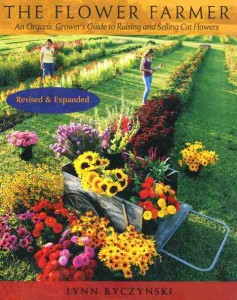
theflowerfarmer009The Flower Farmer: An Organic Grower’s Guide to Raising and Selling Cut Flowers (Revised & Expanded) by Lynn Byczynski (Chelsea Green Publishing, 2008), $35.
Lynn Byczynski is the godmother of the organic flower movement. Little more than a decade after she wrote The Flower Farmer, the rest of the flower world is finally catching up with her visionary ideas and practices. This updated version brims with photographs, planting plans and profiles of innovative cut flower growers, making it the definitive resource for anyone who raises and markets flowers as a commercial venture.

If you’re like me and you want to grow simply for your own enjoyment, this book is equally important. Professional floral designers will find Byczynski’s ideas illuminating, as they advocate establishing relationships with organic farmers and growers to expand a florist’s repertoire.

Writing from Wild Onion Farm, her Lawrence, Kansas-based homestead, Byczynski says she discovered flower farming serendipitously (she planted zinnias among her tomatoes and soon discovered how well they sold at the local farmer’s market). This eco-entrepreneur outlines a gentle manifesto for sustainable practices, asking “Why Organic Flowers?” The answers are revealed in every useful chapter of her 266-page guide. Even if you aren’t persuaded that organic growing practices improve soil fertility and ensure the health of farm workers and their customers alike, the argument for organic is won by the sheer bounty and beauty of the flowers themselves.

Byczynski outlines the most reliable varieties and specific cultivation and handling advice for more than 100 kinds of specialty cut flowers (from Achillea to Zinnia). These blooms are called “specialty,” she explains, “Because they transcend the standard floral fare of roses, carnations, and chrysanthemums. They are considered good cut flowers because they have long stems and a vase life of at least five days.”  Once you’ve grown a collection of fresh, seasonal and local varieties, try Byczynski’s easy-to-follow design ideas. 

“If you really do love flowers, and you find joy in growing and selling them, you will succeed,” she promises. Change the word “sharing” to “selling” and her words are equally appropriate for anyone who plants a row of zinnias.

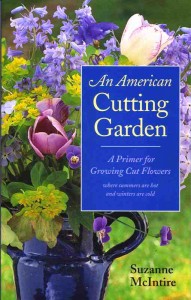
AmericanCuttingGarden001An American Cutting Garden: A Primer for Growing Cut Flowers, by Suzanne McIntire (University of Virginia Press, 2002), $16.95.
The extended subtitle of Suzanne McIntire’s highly personal volume of flower-growing advice is “. . . where summers are hot and winters are cold.”

Though I live in Los Angeles, McIntire’s guide is still informative and useful, since many of the 200 flowers she profiles will grow in my garden, as well as in her northern Virginia one.

 After addressing important infrastructure decisions, the author gets down to the toughest choice you’ll face – choosing which flowers to grow. “. . . it’s not long before you realize there are many more plants out there than you can grow in a lifetime,” she acknowledges.

McIntire’s writing hints at years getting soil under her nails and dirt on her knees. I like the useful advice, such as: “The gardener who has no yellow is missing something important” or “Red is the surprise that a bouquet often needs.”

Her planting, harvesting, and arranging advice is geared toward the gardener-floral designer. It’s okay to space plants in a cutting garden closer together than you would in a display garden to increase their yields, she says.

She is anything but a perfectionist, a breath of fresh air to those tired of floral designs that seem unrelated to nature. “I prefer to spend only a few minutes to help flowers look their best, and often it comes down to selecting the right vase, choosing good vase companions for a given flower, and adjusting stem lengths by shortening where necessary,” McIntire confides.

If you need inspiration for how to start a cutting garden, the book offers four design concepts, including ones for beginners, small spaces, shady sites and autumn interest. Each of McIntire’s detailed flower narratives is worth losing yourself in. I only wish there were more than the rather limited 28 color images as illustrations. You’ll need a photo-rich plant encyclopedia on hand for her lesser-known suggestions, such as Anchusa azurea (Italian bugloss, a forget-me-not relative) or Kalimeris pinnatifida (Japanese aster). But that’s just a small complaint. Without McIntire’s book, I wouldn’t have found them in the first place.

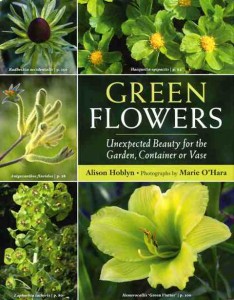
greenflowers010Green Flowers: Unexpected Beauty for the Garden, Container or Vase, by Alison Hoblyn with photographs by Marie O’Hara (Timber Press, 2009), $24.95.
The full spectrum of green is the backbone of any garden scheme. Green is also the essential ingredient in any floral arrangement. But often these verdant elements are taken for granted, or, worse, not thoughtfully incorporated. Think about the prosaic green shrub practically ignored in a landscape. Or, consider the generic “filler” foliage that might be shiny or fluffy in a bouquet, but quickly forgotten in contrast to a Stargazer lily or the classic red rose emerging from all that green.

Green Flowers offers a lovely alternative and a reminder that green is, indeed, a color! Both writer Alison Hoblyn and photographer Marie O’Hara live in England, but many of the flowers they profile are available in North America (although none are commonplace).

I like that Hoblyn – who has worked as a designer, illustrator and painter – offers an artistic explanation for green’s usefulness. Not only does green have neutral and restful qualities, but it also unifies any palette. “On the colour wheel, it occupies that middle land between the hot hues of red and the colder climes of blue,” she explains.

Gardeners and florists usually cast green as supporting player in their designs, as foliage. But there are plenty of extraordinary plants with green flowers or flower-like bracts and modified leaves. Each plant profiled in the book is paired with an attractive, full-page photograph (although sometimes the images are so tightly focused on the bloom it is impossible to envision the size or form of a mature plant). I appreciate the inclusion of other recommended cultivars, as well as sidebars including little-known traits about each plant.

For example, the seeds of Amaranthus caudatus ‘Viridis’ (love-lies-bleeding), an exotic, tassel-like flower that looks beautiful in a container garden or as a cut flower, are a good source of iron, magnesium and fiber. Moluccella laevis (Bells of Ireland), has been cultivated since the 16th century, is in the mint family, and has its origins in Turkey, not Ireland.

After falling in love with Green Flowers, you’ll want to grow and design with Mother Nature’s favorite color as revealed in her blooms, blades, and leaves. Whether the star of your bouquet (or border) or a harmonizing design element, green will never again seem ordinary. 

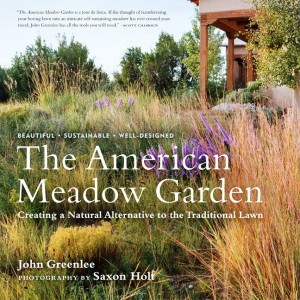
theamericanmeadowgardenThe American Meadow Garden: Creating a Natural Alternative to the Traditional Lawn, by John Greenlee with photography by Saxon Holt (Timber Press, 2009), $39.95.


“Meadows are far more satisfying than either a lawn or traditional border, combining the best attributes of both: like a lawn, a calming place for the eye to rest, yet with the richness and complexity of a border.” John Greenlee’s opening lines are so compelling to read, because they open up the imagination to the practical and eye-pleasing alternatives to a monochromatic (and water-hogging) sea of turf.

“Unlike lawns, meadows are better for the environment, a safe habitat for beneficial insects and pollinators, a place where native ecology can thrive,” he continues. Yet meadows aren’t like a roll of sod that can be unfurled across a patch of soil. They need to be properly designed, installed and maintained, which is reason enough to read and emulate the ideas in Greenlee’s book, available in November.

Owner of Greenlee Nursery, the oldest grass nursery in California, the author has created grass ecologies in gardens since 1984. Greenlee (the “Grass Guru”) pioneered the use of native grasses in ornamental landscapes and advocates for a redefinition of American yards. The American Meadow Garden offers homeowners a new model – a mini ecosystem friendly to children, pets and wildlife. That it requires minimal resources and zero mowing is yet another argument in favor of this anti-lawn.

Saxon Holt’s evocative photography is equally persuasive, for when you see the way sunlight plays off the seed heads and wildflowers that compose Greenlee’s meadows, “dream-like” is the only word that comes to mind.

“A meadow can be quiet and green, or filled with riotous displays of flowers and color,” Greenlee expounds. Non-green grass varieties are listed, such as those with silver, blue, yellow, gold and white hues. Flowers, too, play a large role in the meadow tapestry. The diversity of flowering bulbs, daisies, penstemons, salvias, poppies and ferns that Greenlee likes to sprinkle through his meadows will amaze you.

I love the detailed lists of grasses for fragrance, groundcovers, great flower heads, seasonal effects, background and “fillers.” Then there’s “grasses for billowy or cloudlike flowers,” which plays right into my dreamlike notion of growing a meadow of my very own.


A garden pottery field trip

Saturday, September 12th, 2009
Bauer Pottery Company, Los Angeles

Bauer Pottery Company, Los Angeles

Thanks to my friend Cristi Walden and her “Merry Band of L.A. Archivists,” Wednesday added up to a very big Design Adventure. It meant putting a few hundred miles on the Volvo, but that’s part of life here. And anyway, I have NPR and my catch-up calls to friends in Seattle (with a head-set – I’m safe) to keep me company.

We arrived at 11 a.m. in a dusty town waaaaay east of me. Down a vintage lane called Main Street, where stood an ancient wood-and-galvanized metal warehouse. I later learned it was once a citrus fruit-packing plant when communities like Redlands and Highland grew oranges for the rest of the U.S. (we’re talking late 19th century).

This is the worldwide headquarters of Bauer Pottery, the colorful, joy-inducing collection of dishes, bowls, platters and all kinds of awesome outdoor pottery pieces for the landscape (flowerpots, urns, orbs, bowls and much, much more). It was very hard not to hyperventilate.

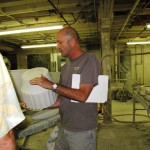
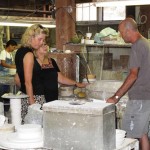
Janek Boniecki, president of Bauer Pottery California, greeted us. He was incredibly gracious and spent two hours showing our group of five all that he has accomplished since purchasing the factory and reissueing hundreds of Bauer pieces for grateful folks like me.  Manufactured in California since 1910, the highly-collectible vintage Bauer pieces are hard to find and all but the most serious aficionados are starting to feel priced out of the market. Unless you’re a seasoned collector, it’s really hard to discern the difference between an original Bauer piece and one of Janek’s reissues unless you flip it over and look on the back. The words “Bauer California 2000” are stencilled on the bottom of each new piece.

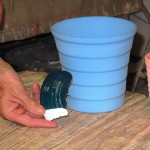
Janek shows us the reissued Rebekah vase in Bauer crimson

Janek shows us the reissued Rebekah vase in Bauer crimson

Here’s a bit of history that Janek shared with us:

The Bauer Pottery Company of Los Angeles (1882-1962) started in Louisville, Kentucky, and then moved to LA, where it flourished. J.A. Bauer created simple, yet beautiful stoneware from the late 1880s to the early 1960s, with lines ranging from redware flowerpots to brilliantly colored dinnerware. Bauer Pottery was a staple in American homes for many decades.

Inspired by the weather and the lifestylesof Southern California, Bauer Pottery created many different lines for the home and garden. These new styles and rich colors were introduced soon after the Depression, and it wasn’t long before all the major pottery companies in the United States began to follow with their own interpretation of Bauer’s vision.

Today the work of J.A. Bauer has been reintroduced to the home by a ceramics studio based again in Los Angeles. Just minutes away from the site of the original plant, the new Bauer line is being reproduced using some of the original pieces and models, with an emphasis on items that were manufactured by Bauer during the 1930s and ’40s.

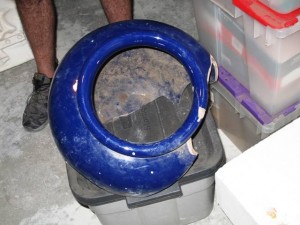
The broken rim and top portion of an original Bauer urn

The broken rim and top portion of an original Bauer urn

"Ali Baba" jar, in satin white, inspired by Terry's broken urn

"Ali Baba" jar, in satin white, inspired by Terry's broken urn

The story of how Janek saved Bauer begins in 1996 when he had a candle-making business. He was working in the film industry and wanted to start a business of his own.

“I started making candles in my basement – in a tiny, little 200-square-foot space,” he explains. Janek used colorful, inexpensive flowerpots to contain his candles. He ordered the pots from California Design Works in Highland, housed in the 36,000-square-foot fruit factory on historic Main Street, where Bauer now resides. 

According to Cristi’s friend Terry Freed (who was part of our group), he urged Janek to stop making pottery in Bauer colors and instead reissue the original designs. Terry used to own an L.A. shop called Fiesta Specialties. “Janek brought me a ceramic planter with a candle in it and I said, ‘forget the candle,’ make the pottery,” Terry says.

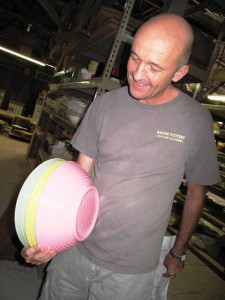
Janek shows how the stackable bowls can mix-and-match

Janek shows how the stackable bowls can mix-and-match

Two years ago, the owners, Debbie and Marty, sold their factory – building, machines, kiln and operations – to Janek. They worked with him for several years to develop the Bauer reissues and stills show up three days a week at the factory, which is a pretty cool business transition model. 

Cristi and Terry have befriended and supported Janek by lending him some of their original Bauer pieces as the basis for reissues. We saw the broken shard from a once-gorgeous Bauer oil jar that inspired a wonderful new pot (Terry’s partner Michael broke it accidentally, so they made lemonade out of that lemon and let Janek study and copy it).  The original pots might sell for $800-$1,000, but the reissued ones are $300-$600, depending on the size. Similarly, collector Linda Roberts, another one of our Merry Band, lent Janek a tall, slender Rebekah vase as the model for his new ones. The 22-inch reissued vase is $250.

It’s pretty mind-boggling what this tiny company is doing. Janek says there are 110 styles made in 15 different colors (classic Bauer colors, including Bauer Orange, Bauer Yellow, Turquoise, Federal Blue, Lime Green, Midnight Blue, Mango, Crimson, Teal Blue and Chocolate Brown – and all content to mingle, mix, and match with one another, plus a few new ones that I’m sure I’ve forgotten to list here).

We followed Janek downstairs to see where much of the ceramic casting and molding takes place. To get there, he led us into a freight elevator original to the century-old building. The lift is powered by water, making it the oldest water-operated elevator in California. It wasn’t fast, but it was a smooth ride.

The bottom of every piece has Bauer 2000 on it

The bottom of every piece has Bauer 2000 on it

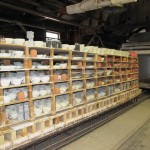
Downstairs, we saw shelves and tables and stacked with the unfired pieces. When you observe the “blanks,” without color added, you really can appreciate the graceful shapes and lines of Bauer’s original designs.

Terry showed me one large planter that he remembers seeing in Desi Arnaz’s nightclub on old “I Love Lucy” television programs. Actually, there were two of them because on the set, one planter was turned upside down as a base for the one containing a plant. That reference to “I Love Lucy” gives me a perfect mental picture of the Bauer pottery vibe – then, and now.

My little Bauer-and-Mosaic installation

My little Bauer-and-Mosaic installation

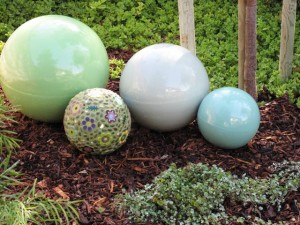
For those of you in the Los Angeles area, here is the best news. Janek holds occasional sales of factory seconds and samples. He started them last year and when news got out, there were 500 people lined up to buy the cheerful pottery. If you’re wondering whether I got my Bauer fix, the answer is YES. I didn’t leave empty-handed. In fact, I came home with a trio of garden orbs in Bauer colors. These orbs are new from Janek. They were never part of the original Bauer line, but are fired in several colors from the Bauer palette. So the large, 15-inch orb is lime green; the medium, 12-inch is pale blue; and the small, 8-inch is turquoise. I have them grouped in the garden with my lovely mosaic orb by Vashon Island, Wash.-based artist Clare Dohna. The effect is quite pleasing to my eyes!

And finally, a gallery of our visit:

A filmmaker, his designer and me

Saturday, September 5th, 2009

. . . in an intimate, domestic setting illuminated by flames, candles and carnival lights.

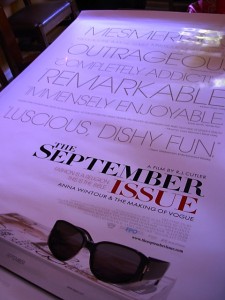
The September Issue

The September Issue

Thanks to ample layout space and the 4-color gods, today’s Los Angeles Times HOME section devotes a whole lotta real estate to my feature story about the indoor and outdoor kitchens of hot documentary filmmaker R.J. Cutler.  If his name doesn’t ring a bell, I refer you to the The September Issue, the documentary feature film that opened last weekend in New York and opens in Los Angeles and the rest of the world on Friday. The film follows the legendary Vogue editor Anna Wintour and her creative team as they put together the fashion magazine’s most important issue of the year – in this case, the September 2007 issue. The expanded online photo gallery is here.

Debra and R.J. on location in his outdoor dining room

Debra and R.J. on location in his outdoor dining room

Every good thing that has happened to me since moving to Los Angeles comes through meeting interesting and talented people who, in turn, lead me to more fascinating and gifted ones. I met R.J. through interior designer Lory Johansson, whose studio is called Just Joh. I met Lory indirectly while profiling a Malibu garden designed by Scott Shrader for Garden Design magazine. Lory designed the interiors for Scott’s clients and I mentioned their collaboration on choosing materials for the indoor-outdoor elements in my text (that piece appeared in January, called “Sunset Soiree.”).

During the editing process, I received a message from the Garden Design fact-checker saying that Lory would love to show me one of her outdoor projects. We connected by phone and arranged to meet at R.J.’s Hollywood Hills property this past February. It takes a lot of time to scout gardens. It’s kind of like buying futures on the commodities market. You have to spend a few hours on the freeway, usually in crummy traffic, on the off-chance that the architecture, interiors or landscape you’re scheduled to visit will be a worthy candidate for publication. For some reason, after speaking with Lory, I had a hunch the trip to R.J.’s wouldn’t be a waste of my time.

Designer Lory Johansson and me. The photo is a little blurry because it was taken without a flash by candlelight. We're happy that the shoot is over!

Designer Lory Johansson and me. The photo is a little blurry because it was taken without a flash by candlelight. We're happy that the shoot is over!

The property is just stunning, high in the hills above Beachwood Canyon and literally under the HOLLYWOOD sign we’ve all seen in a million movies and TV shows. It’s a circa 1924 Spanish Colonial Revival home, which R.J. acquired in 2005 and has subsequently restored with Lory’s brilliant design skills. Big but not imposing, the house sits on three-quarters of an acre. There is a beautiful garden with a swimming pool, strolling paths, a lawn for croquet and square-dancing, a secret garden and other intimate spaces. You can’t see that now, though, because photographs of the garden are under wraps until Garden Design’s March 2010 issue (photographed by the very talented Jack Coyier). That’s right. First the Los Angeles Times. Then Garden Design. See how lucky I was connecting with Lory?

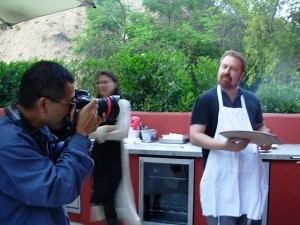
At the outdoor pizza party featured in today’s LA Times, freelance photographer Ringo Chiu, who shoots frequently for the newspaper, captured the festivities through his lens. I tried to stay out of the way while also surreptitiously “art directing.” Anyone who has worked with a newspaper photographer over the years (this comment is for you Melanie Munk) knows how impossible it is to get them to do what you want. And even more impossible to style a shot as you would for a magazine or book. However tough that “dance” can be, Ringo at least humored my few suggestions (ie, shouldn’t we light the fireplace? how about the candles? let’s move that dead potted rosemary!). He did a great job and it was fun for me to snap a few shots of him at work, shown here.

Photographer and Filmmaker

Photographer and Filmmaker

You can draw a lot of inspiration from this story for your own garden. The best tip from Lory is to go bold with color. She designed the entire outdoor kitchen, benches, fireplace and privacy wall with a white stucco finish, like R.J.’s house. But when it was finished, Lory says she stood at the opposite end of the garden and looked across the pool to the too-white scene. “It looked like Greece instead of Los Angeles,” she lamented. Lory knew color would lend heightened drama, especially in the outdoor setting.

The day before R.J. was planning to host his first big al fresco pizza party, she couldn’t stand it. Lory went out and ordered gallons of paint – rich, deep, paprika-terra cotta red – and got the crew started painting. When R.J. came home and saw what was going on, she promised him that if he didn’t like the result, she would pay to repaint everything white again. (Can you imagine how many coats of white paint it would take to cover dark red?).

Let’s just say Lory’s gamble paid off. You have to read my story to see what R.J. says of the decision to keep it.

After researching and reporting this story, I have two new items on my own garden wish list. Number one: I need to buy a 100-foot string of carnival lights to suspend around my own garden. Number two: I desperately want my own wood-burning pizza oven. But only if I can have Chef Alberto come over to cook for me!

Here are more of my candid party photographs:

New scenes of my lawn-free backyard

Wednesday, September 2nd, 2009
My killer backlit shot of the central path

My killer backlit shot of the central path

We now have a backyard that is grass-free. The space has undergone a huge transformation since earlier this summer when a crew removed the last patches of dying turf. With irrigation repaired and new planting beds+borders outlined and populated, we received a delivery of California Gold crushed gravel to carpet the walking areas. I’ve since decided on the very best way to describe this color of gravel. To me, it will forever be called “Golden Lab.” When our dog Zanny lays on the gravel in the warm Cali sunshine, we notice that her fur blends beautifully – practically the same color.

Our 25th anniversary was last week, and Bruce surprised me with a brand new digital camera, a Canon PowerShot G10. This is a “big girl” camera. No point-and-shoot idiot stuff for me anymore. OK, basically, I have no idea how to do anything BUT point and shoot, but I hope to learn.

The partner-in-crime in this Canon choice is none other than Bill Wright. Bill and I have worked together for years and together created Stylish Sheds and Elegant Hideaways. He knows his stuff. I’m sure he rolled his eyes (privately) about my wimpy camera shenanigans while we were on location together. Lucky for me, Bill advised Bruce on this camera purchase. Oh, and one sweet note. Bruce gave me a 35mm manual camera for a wedding gift on August 24, 1984. It was a beautiful Pentax. I used it for years, but eventually, it broke (OK, it “was dropped,” which is my passive way of saying I broke it) and couldn’t be repaired. That he remembered the wedding gift 25 years ago and wanted to do a reprise was both thoughtful and romantic.  I’m going to get major mileage out of this Canon. That is, when I learn all of its bells and whistles.

Until then, here is my maiden voyage. Photos of the “new” backyard:

Meet a beautiful – and sustainable – landscape

Friday, August 28th, 2009
Mike Mcdonald, a Green Builder and Visionary

Mike Mcdonald, a Green Builder and Visionary

gardendesign004Garden Design magazine asked me to profile one of its “Green Awards” winners for the September-October issue, which is out on newsstands this week.

The story is about a lovely, sustainable landscape designed to complement the cutting-edge, eco-architecture of Margarido House in Oakland.

Margarido House is the creation of builder-owner Mike McDonald of McDonald Construction & Development, and his architect-brother Tim McDonald of Philadelphia-based Plumbob.  The brothers and their multiple collaborators have created a stunning residence that earned the highest (Platinum) rating from the U.S. Green Building Council. It is the first home in Northern California to obtain the LEED-H Platinum Award (Leadership in Energy and Environmental Design).

gardendesign005What makes this garden and its home sustainable?
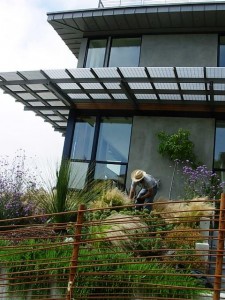

1. It’s Permeable : The patio, roof and driveway surfaces are designed to capture all of the property’s storm water runoff. The driveway’s decorative design uses recycled and perforated Pavestone concrete tiles. Water percolates into a 4,000-gallon cistern hidden under the driveway and, when needed, circulates through the property for irrigation and flowing through the Zen garden’s piped fountain. “We’ve created a self-contained water loop,” Mike points out.

 2. It’s Durable: Garden designer Lauren Schneider of  Wonderland Garden and Landscape in Oakland, chose a diverse, drought-tolerant plant palette. She worked closely with local growers to specify California native varieties, as well as plants from many Mediterranean regions, including South Africa, Australia and New Zealand, South America and Mexico. She closely observed the garden during its first year to evaluate whether each plant was durable enough to survive Oakland’s dry summer conditions with infrequent water.

 3. It’s Reusable: Recycled concrete is the basis for Margarido House’s über-modern S-curve chaises, tabletops and sleek urns, which contain succulents, bamboo, and New Zealand flax. Created by Bay Area Concreteworks Studio, which also fabricated interior concrete counters, the products satisfy LEED’s “local” and “reusable” criteria. Other outdoor furniture also has recycled content, including Room & Board’s  “Emmet” Adirondack-inspired chairs, by Loll Designs, made with 100 percent recycled high density polyethylene (plastic).

Margarido House, enhanced by a soft, sustainable garden

Margarido House, enhanced by a soft, sustainable garden

One of the key scoring factors in earning this ranking is Lauren’s sustainable landscape design.

Dreamy and naturalistic, the garden is an organic counterpoint to the geometric architecture.

Lauren actually created three distinct gardens – one on the ground; one in the air; and one that climbs an incredible vertical retaining wall and has multiple sections for planting (not to mention a melodic water feature to attract birds).

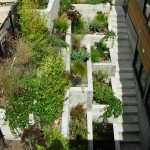
Photographs of the Margarido’s rooftop garden weren’t included in the Garden Design layout, due to space constraints. I wanted to make sure and show some here. The rooftop is pretty stunning, and not just because it has killer views of San Francisco Bay. It is installed on top of a capillary mat and layer of geo-textile material; over this base are “three inches of horticultural pumice as a drainage medium and five inches of lightweight planting mix,” Lauren explains.

Garden designer Lauren Schneider gave me a personal tour of Margarido House's exterior spaces

Garden designer Lauren Schneider gave me a personal tour of Margarido House's exterior spaces

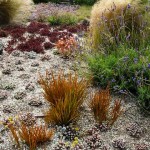
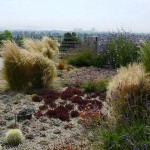
The dramatic design includes sedums and sempervivums, golden barrel cactus, lewisia, Cleveland sage, lavender, deer grass, and Libertia peregrinans, a New Zealand iris relative valued for its bronzy-orange blades.

This garden provides top-down insular qualities that cool or warm the home, depending on the season. Flowers and stems of Cleveland sage, silhouetted against the sky, can even be seen through the skylight that illuminates the master bath. The roof garden invites its viewers to look close and study the interplay of plant colors and forms. In an abstract way, they echo the distant scenery where treetops and buildings form an irregular city skyline.

You can read the full story here. And enjoy this gallery of photos that I shot when visiting this past May. You’ll see details that caught my eye and get a fuller sense of this amazing landscape and home.

A Gazebo in the Garden

Sunday, August 23rd, 2009
Kathy Fries, framed by her new gazebo

Kathy Fries, framed by her new gazebo

Most gazebos are a little twee for my liking. If you think of a traditional white latticework structure, the kind that looks as if a gust of wind or a swiftly-kicked soccer ball might knock it over, you probably don’t love gazebos either.

Ever since I started scouting great garden architecture for Stylish Sheds and Elegant Hideaways several years ago, I have changed my tune.

Case in point: When I was in Seattle earlier this summer, my friend Kathy Fries invited me to see her new copper-roofed gazebo. Situated in the heart of Kathy’s prolific vegetable garden, the structure was built by John Akers. I’ve written about Kathy and John’s collaboration before, both in this blog and in the pages of Stylish Sheds. He is a salvage-artist-carpenter who knows how to take Kathy’s grand ideas and construct them into fanciful garden buildings.

It's a lovely addition that enhances the vegetable garden

It's a lovely addition that enhances the vegetable garden

What I love about Kathy’s new gazebo is that it is both beautiful and functional (not to mention sturdy!). In it, you can gain shelter from rain or sunshine; you can pause while picking raspberries and sit on one of two facing interior benches. You can “gaze out” over the garden, looking through openings on either end or the side walls.

The gazebo’s charming rooftop joins several other turrets, cupolas and domes that populate the skyline of Kathy’s garden. Plus, it gives the vegetable garden a new point of view. When John erected the gazebo, it allowed Kathy to realign some of her paths and planting beds on a main axis. It’s beautiful and I know everyone who sees it will start dreaming about a new sort of garden gazebo.

And did you know that Gazebo is believed to come from the Latin for “Gaze About”? I’ve added definitions from several sources to my Shed Glossary, here.

If you have a Gazebo you want to share, please send me the photo and I’ll post it in the future. Here are a few more photos from Kathy’s garden:

The Oregonian book review

Tuesday, August 18th, 2009
Today’s Oregonian newspaper features an online 3-Star “Excellent” review of Stylish Sheds and Elegant Hideaways by staff garden writer Kym Pokorny. I love how she started out the review:

It’s tempting to describe all 28 sheds in Debra Prinzing’s “Stylish Sheds and Elegant Hideaways,” but that would take the fun out of discovery. Here’s a tease: A tiny, rustic cabin in the woods; an astonishing, asymmetrical, steel-framed structure over a pool; a grass-roofed, Norwegian stabbur; a stucco-and-tile pavilion surrounded by desert plantings. OK, that’s enough.

For those of you who read Kym’s Q&A interview with me and then moseyed over here, I thought I’d share the photos of each of the stylish structures she highlighted in her tease. These photographs reveal the incredible talent of my collaborator William Wright.

Enjoy!

A Tiny, Rustic Cabin in the Woods


Separate from the main residence but as comfortable as a little cottage, the 14-by-14 foot writing shed is nestled in the Connecticut woods

Separate from the main residence but as comfortable as a little cottage, the 14-by-14 foot writing shed is nestled in the Connecticut woods


 A Stucco-and-Tile Pavilion Surrounded by Desert Plantings

The grand pavilion sets the stage for entertaining in a gorgeous cactus-and-succulent landscape outside San Diego


Grass-Roofed, Norwegian Stabbur

The 9-by-12 foot redwood dining pavilion was inspired by traditional Norwegian farm buildings, called stabburs. Complete with a sod roof, it's a magical destination for outdoor gatherings
The 9-by-12 foot redwood dining pavilion was inspired by traditional Norwegian farm buildings, called stabburs. Complete with a sod roof, it’s a magical destination for outdoor gatherings


An Astonishing, Asymmetrical, Steel-Framed Structure Over a Pool

Made from ordinary greenhouse material, the 430-square-foot shed is a winter greenhouse for potted tropical plants. But during summers in Austin, Texas, it's a play pavilion
Made from ordinary greenhouse material, the 430-square-foot shed is a winter greenhouse for potted tropical plants. But during summers in Austin, Texas, it’s a play pavilion

 I hope you find inspiration from these incredibly diverse garden destinations!

Stylish Chicken Coop in Santa Barbara

Sunday, August 16th, 2009
A tiny chicken coop with loads of style

A tiny chicken coop with loads of style

Last week’s visit to Santa Barbara included a stop at “Rooms & Gardens,” a wonderful home furnishings, antiques, accessories and interior design emporium on State Street.

I needed to check out the store’s new backyard chicken coop and garden.

Owners Eric and Jami Voulgaris recently created the sweet coop and romantic garden, where four Buff Orpington hens reside.

When I met Eric a few weeks ago, at the Santa Monica “Rooms & Gardens” store (they own this location with a partner, actress Mary Steenbergen), he told me about the chicken coop project.

The little building measures about 6-by-6 feet in size, with a charming shingled roof, board-and-batten siding, a country-style screen door and shutters. Stained that dreamy grey-blue shade, it looks both elegant and timeless.

A curved cobblestone path leads from the store’s back door out into the postage-stamp-sized garden. Picket fencing contains the four gals in their little yard.

The Voulgaris children named the Buff Orpington chicks, born on Easter morning: “Henny Penny,” “Rosy,” “Cornflake,” and “Scramble.”

The 800-square-foot garden’s renovation came about because it had to be ripped up when the neighboring Apple store was moving in. When that construction came to an end, Eric and Jami saw it as a chance to dress up the space, which really hadn’t changed much since Rooms & Gardens opened 16 years ago.

Happy chickens living in a happy garden

Happy chickens living in a happy garden

Pretty and inviting, a corner garden

Pretty and inviting, a corner garden

Fully organic, the Martha’s Vineyard-inspired garden is landscaped with espaliered apple trees, Meyer lemon trees, ‘Iceburg’ roses and clumps of lavender. One corner holds a display of potted hydrangeas and an iron chair.

The garden and hens complement the carefree lifestyle settings inside Rooms & Gardens. Eric describes the store’s look and feel as “a fusion of British Colonial, ethnic accents, Chinoiserie and a relaxed coastal theme.”

I love the happy vibe that you feel upon entering. It’s a store where sink-into furniture is paired with uncommon accessories, all of which suggests well-loved and well-lived-in environments.

The garden is open to visitors during store hours. If you want to taste the yummy brown eggs produced here, check with the staff. Eric mentioned that a plan is in the works to supply Tuttini’s, a cafe around the corner, with their daily source of eggs!

Fun at the Ventura County Fair

Tuesday, August 11th, 2009

My lifeblood is comprised of words, sentences, paragraphs, stories. I am definitely NOT a writer of “short” blog posts. But sometimes, I do have to defer to the photographs to tell a story. So today, you will be treated to mostly photos of our afternoon at the Ventura County Fair in Ventura, California. After years fighting the crowds, strollers and sticky run-ins with cotton candy at the King County Fair in Puyallup (Washington), I have to say how nice it is to take in a smaller fair with fewer bells and whistles. With the charming theme, “Homegrown and Pure-Bred,” Ventura’s is the perfectly-sized county fair. Of course, when you go on a Monday afternoon, you’re not going to encounter the weekend crowds. So we did.

What follows are my favorite images of the day. The fair continues through Sunday, August 16th. For details, click here:

RIDES TO THRILL

What a beautiful whirligig. The figures against the blue sky are flying around. The machine's carnival-colored design is beautiful.
What a beautiful whirligig. The figures against the blue sky are flying around. The machine’s carnival-colored design is beautiful.
The giant slide. A ride down the track on a burlap sack couldn't be more fun. My son Alex is nearly prostrate, on the green slide; his friend Philip is racing down the orange one.

The giant slide. A ride down the track on a burlap sack couldn't be more fun. My son Alex is nearly prostrate, on the green slide; his friend Philip is racing down the orange one.

 JUST FOR LOCAVORES

A prizewinning Hubbard squash in the Agricultural Building caught my eye. I'm growing one in the garden, but she won't be this big for a while yet.

A prizewinning Hubbard squash in the Agricultural Building caught my eye. I'm growing one in the garden, but she won't be this big for a while yet.

CRAZY FARM ANIMALS
Turkey racing. Words cannot describe this silly event, but we loved it!

Turkey racing. Words cannot describe this silly event, but we loved it!

More turkeys, including the brown ones.

More turkeys, including the brown ones.

FLOWER POWER
The "Floriculture" displays featured some outdoor gardens. Here's my very favorite: The "Flower Bedroom." I've seen planted beds before, but none as fanciful and well-executed as this one. Note the succulents spilling out of the dresser drawers, too!

The "Floriculture" displays featured some outdoor gardens. Here's my very favorite: The "Flower Bedroom." I've seen planted beds before, but none as fanciful and well-executed as this one. Note the succulents spilling out of the dresser drawers, too!

A sedum armchair. Lush and fluffy. Makes you want to sink right in. I love that the lime green arms have been painted to pick up the bright foliage.

A sedum armchair. Lush and fluffy. Makes you want to sink right in. I love that the lime green arms have been painted to pick up the bright foliage.

BACK TO WORK
 
Today I’m back at the desk, doing interviews for an article for a garden trends story that will run in a future issue of Alaska Airlines magazine. Alex and his friend are back to Junior Lifeguard training. We had a great day at the fair! After all that frivolity, we ended up only eating two roasted corn-on-the-cobs and one powder-sugar-flocked funnel cake between the three of us. Even still, by the time we came home at 8 p.m., both guys had headaches and stomachaches. That’s what going on all those spinning rides will do to you. Me, I’d rather look at produce, pigs, and pretty plants.

Hurrah for Julie and Julia

Saturday, August 8th, 2009

51ezORAwNJL__SL500_AA240_Two years ago, I read Julie Powell’s wonderful debut memoir, “Julie & Julia.” Her story of spending 365 days cooking every recipe in Julia Child’s “Mastering the Art of French Cooking” was electrifying and compelling.

I couldn’t decide what was more inspiring – Julie Powell’s innocent ambition and subsequent bravado or the between-the-lines story of the power of blogging as a voice for authors.

Either way, I ended up buying 5 copies of Powell’s book for my favorite writer girlfriends. I told them: You must read this book. It will open up your eyes to the potential of blogging.

At the time, I had just bit the bullet and decided to really try serial blogging. My best intentions prior to the fall of 2007 hadn’t gotten me very far. I originally “started” this blog in March 2007, when I foolishly thought Shedstyle.com would be a book-in-progress blog while Bill Wright and I created “Stylish Sheds and Elegant Hideaways.”  Constant travel, photo shoots, intense deadlines and a generally crazy schedule conspired to keep that from occurring (I think I wrote 2 posts between March and October 2007).

In September 2007, I moderated a “Garden Blogging” panel at the annual Garden Writers Association symposium with blogger-friends Kathy Purdy, Mary Ann Newcomer and David Perry (you will find each of them and their blogs the LINKS section of my home page).  I felt like a fraud. Sure, I created the panel and served as its moderator. But I was a pretender “talking” about blogging, not actually doing it.

I came home from Oklahoma City and, wholly inspired, I just started writing. I am eternally grateful to Mary Ann, David and Kathy for their honest and heartfelt support as fellow bloggers.

Like many tough things, repetition and frequency make it easier to learn new skills and habits. In less than 2 years I have written nearly 200 posts and met many awesome fellow bloggers, readers, friends.

Back to Julie and Julia.

That book really did change my life, thanks to the courageous Julie Powell and the inimitable Julia Child. I came home tonight from watching the movie “Julie & Julia” equally inspired.

As director and screenwriter, Norah Ephron is amazing. What a talent. Her screenplay is delightful. Her cast – Meryl Streep and Amy Adams – are delicious. Totally delicious in their roles as Julia Child and Julie Powell.

A woman seated near me (friend of a friend) told me a great story after the movie. As you may know, Julia Child lived in Santa Barbara in her retirement. The woman remembered working as a waitress in Santa Barbara in 1989. She waited on Julia and her husband Paul, who by then was in a wheelchair.

“Julia ordered a grilled-cheese sandwich and a banana for lunch,” this former waitress recalled. Hmm. I love hearing that our culinary icon, Julia Child, liked basic comfort food. It puts a smile on my face.

Not sure where this post is going, except to say that the writer in me LOVED the book and the film. I felt like I was watching all of our stories, our efforts, our hopes and dreams, up there on the screen. When the film portrayed Julia Child’s manuscript finally getting published after 8 years of work, I felt so victorious for her. When Julia Powell was interviewed for a story in the New York Times food section, I felt the excitement at hearing her answering machine buzz (well, that hasn’t exactly happened to me, but I can kind of relate).

Anyway, if you’re into food you should see “Julie & Julia.” If you’re a writer, you’ll definitely want to.

This post is dedicated to Nan, Paula, Mary Ann and Lorene, my friends who received copies of Julie & Julie from me in 2007.