Debra Prinzing

Get the Email Newsletter!

Author Archive

Flower Show season…

Friday, January 18th, 2008

eat your veggies

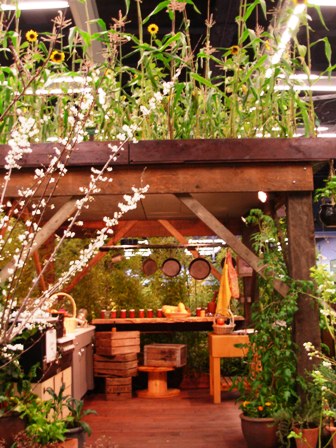
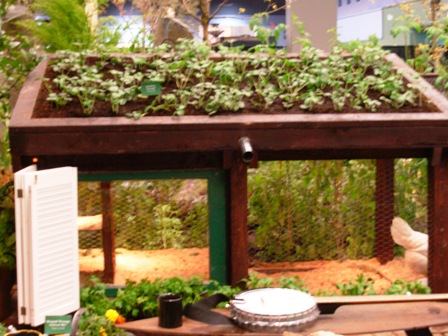
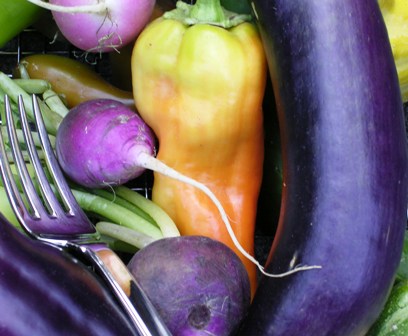
Eat Your Vegetables: Garden to Table [Cindy Combs photograph]

The minute the calendar page turns to the New Year gardeners don’t read: “January.” They read: “Spring.” It’s silly when so many places are still buried in snow, have sub-freezing temperatures, or even worry (as I am) about occasional frost. But we are busy planning our planting schedules.

Until the soil warms up, however, we can take solace in the piles of seed catalogs that fill our mailboxes. To speed up spring’s arrival, we buy tickets to the pre-season extravaganzas: Flower and garden shows. I liken these green celebrations to the “annual meeting” for plant lovers — especially plant lovers who push the envelope when it comes to defining our gardening season.

I’m deep into planning my February and March travel itineraries for taking in the Northwest Flower & Garden Show (February 20-24) and San Francisco Flower & Garden Show (March 12-16), respectively. I’m excited to gain new inspiration for hot plants, cool designs and inspiring lessons from the show gardens. Here’s where I can revel in horticultural happiness with like-minded souls, because seeing friends, of course, is a huge part of the fun.

For months I’ve been hearing from my Seattle garden friends about the flurry of activity surrounding the Northwest Horticultural Society’s display that will (I think) be the educational organization’s largest ever at the Northwest Flower & Garden Show. As a former NHS board member and past editor of the organization’s newsletter, “Garden Notes,” I have a special place in my heart for its people and programs. Through NHS and its members and speakers, I have gained so much knowledge and inspiration over the years.

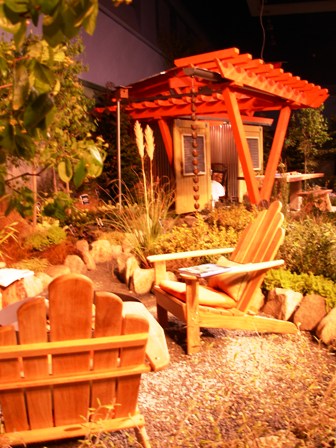
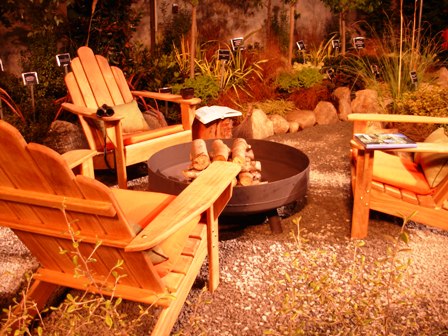
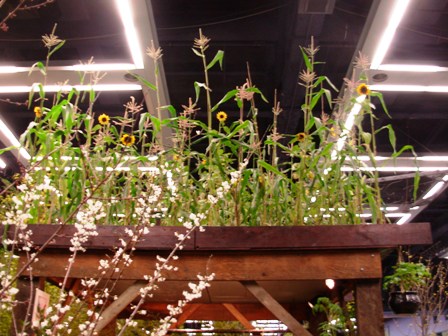
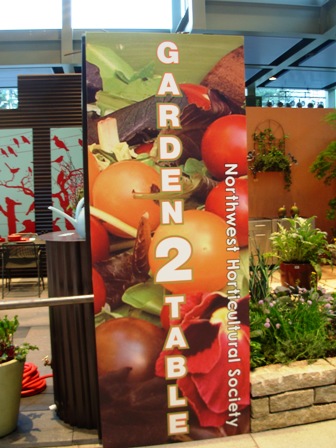
NHS has sponsored inspiring art- and plant-filled displays in past years. For 2008, NHS president Nita-Jo Rountree tells me the focus will be on edibles. “Eat Your Vegetables! Garden to Table,” promises to be centered around a tasty and inspiring display garden. Actually, THREE edible gardens. When it opens on February 20th, the installation will be a centerpiece of the Washington State Convention Center’s south lobby entrance.  The goal is to demonstrate to showgoers that edible plants are easy to raise, attractive when mixed with ornamentals in the landscape and, with a few simple preparations, ready to go from the garden to the dinner table.

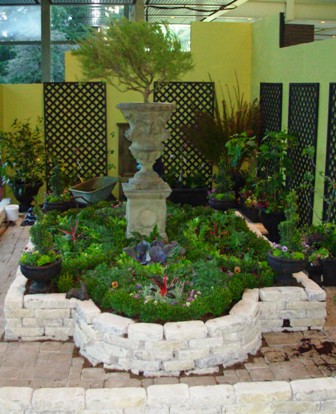
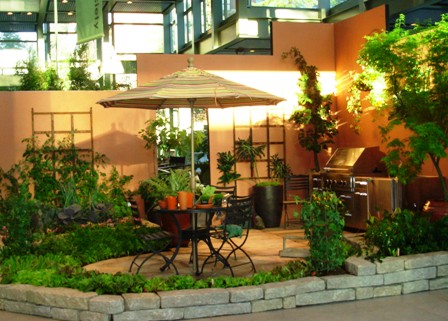
The 1,200-square-foot display will highlight two huge lifestyle trends — growing vegetables and cooking “fresh,” says Nita-Jo. I called her recently to get the inside scoop on how the garden plans are coming together. The design will feature an chef demonstration stage, plus a trio of edible landscapes: A formal French potager, designed by Robyn Cannon (featuring material and ideas from Lucca Statuary and Lakeview Stone); a contemporary container garden, suitable for balcony and rooftop, created by award-winning designer Wendy Welch; and the ideal patio kitchen garden with a “to-die-for” Aqua Quip kitchen and furnishings supplied by Gillian Mathews and Ravenna Gardens.

“Vegetables, fruits and herbs are the rage in gardening right now,” Nita-Jo says. Interest in growing one’s own food is a response to healthy lifestyle trends — a philosophy that excites and inspires novice and experienced gardeners alike, she points out.

“We’ll have organic cooking demonstrations surrounded by ideas for vegetable gardening and seed starting,” Nita-Jo adds. From Ciscoe Morris’s favorite Brussels sprouts to the recipeses of famed chef Jerry Traunfeld, formerly of The Herb Farm, cooking with seasonal and local ingredients will be presented.

Good design is an important element of appealing edible gardens. “We’re going to have a very cool circular stone patio that Lakeview Stone is installing,” Nita-Jo explains. “It will be surrounded by a tapestry of lettuces and strawberries.” Robyn recently shared with me her exploits in procuring 150 “perfect” dwarf boxwoods, which will knit together the intricate parterre for her potager design. All around, this is an ambitious – and delicious – undertaking.

To think that hundreds of tiny plants are needed to create the perfect edible garden is mind-boggling. A review of the list of vegetable seeds started and forced indoors weeks ago reveals the ambitious scale of this endeavor: Lettuces with names like ‘Outredgeous’, ‘Merlot’, ‘Oak Leaf’, ‘Italian Misticanza’, ‘Yugoslavian red butterhead’ and ‘Black Seeded Simpson’; ‘Bright Lights’ and ‘Golden Sunrise’ chard; ‘Grafitti’ cauliflower; ‘Russian Red’ kale; and ‘Ruby’ cabbage. The bounty of the greenhouse also includes aforementioned Brussels Sprouts, plus onions, leeks, rhubarb, chives, parsley, cilantro, sugar pod snap peas, strawberries, rosemary, a bay tree, fig trees, tomatoes, peppers, beets, spinach, and 10 espaliered apple trees!

Creating a Flower Show display garden is nothing short of a labor of love – one that is created to share with thousands of fellow garden-aficionados. For those of us who desire an edible garden, one that feeds and nourishes our bodies and souls, the NHS display will be even more meaningful. Best of luck building your gardens, NHS!

Wonderful willow

Friday, January 4th, 2008

woven willowThere’s something magical about a plant that keeps growing even after you think it’s a goner. I love seeing new leaves sprout from my just-pruned apple tree branches (I used to stick both ends of the saplings into the soil around the perimeter of my vegetable beds to create low scalloped fencing each spring).

If harvested while its branches are bare, willow (Salix sp.) performs its magic, too. My textile background and my love for any material that can be woven like fabric, combined with my penchant for gardening, has drawn me to supple ingredients like willow. So it’s no surprise that I enjoyed building my own “willow goose” in 2002.

Jacky Barber teaching willow weaving

Jacky Barber teaching willow techniques

On a pleasant June evening, I was invited to join members of the Woodinville Garden Club to gather for a willow workshop in Carol Ager’s garden in Woodinville, Wash. This special class was led by two British willow-weavers, Pat Hutchinson and Jacky Barber. Known as “The Willow Weavers,” the duo’s artistic efforts in 2001 won them the coveted Gold Medal at the famed Chelsea Flower Show. The women were in town to teach at the annual Hardy Plant Study Weekend, hosted by the Northwest Perennial Alliance. It was a rare opportunity for about 20 Seattle area gardeners to play with willow, learning Jacky and Pat’s techniques for creating willow animals. Since I wasn’t a garden club member, I considered myself lucky to participate.

it takes two

Using a “Twisler” tool to tie and secure bent willow

We used fresh willow twigs from Judy Zugish of Marysville’s Bouquet Banque nursery (which also operates a basketry school called FishSticks). Cut in the dormant season, the 5-foot and 7-foot lengths of Salix alba ‘Polish Purple’ branches were soaked in water for five days to make them workable. Jacky and Pat recommended wrapping the branches in damp cloths or plastic sheets to keep them moist while working with them (especially in hot weather).

A partially-made willow gooseAs we worked in teams to create a larger-than-lifesized goose, heron or swan, the women showed us how to manipulate the willow branches and form animal shapes using tools and wire fasteners. The nifty trick is to use 4-6 inch “wire ties” with a loop at each end. The wire is used in the UK to seal sacks of potatoes and in the US for securing rebar. You can find them at home improvement centers. To join pieces of willow, we used a hand-held tool called the “Twisler” or “Twister.” It hooks into the two loops that have been wrapped around willow bundles. When the tool is pulled, it twists and secures the wire (this tool is available from Stanley Tools). The other useful willow-working tools include pruners for cutting and trimming branches, wire cutters for removing excess wire, string to hold willow sections in shape before they are wired, and measuring tape.

willow creationsAfter making the various animal parts — head, neck, body and legs — we used more wire ties to connect them. Playful and perfect for the flowerbed, my completed willow goose stood around 5 feet tall. I stuck the twig “legs” a few inches into the soil and enjoyed watching how the garden began to grow in and around its body.

Inevitably, willow creations are short-lived. Subject to exposure, elemental extremes and the vagaries of time, there is a temporal nature to anything fabricated from twigs and stems. That’s why I was blown away when I saw Patrick Dougherty’s woven twig sculptures.

Toad Hall at Santa Barbara Botanical Garden

“Toad Hall,” by Patrick Dougherty

Resembling a whimsical, storybook abode (perhaps an ambitious version of the first Little Pig’s house of sticks?) the large-scale, temporary sculpture Dougherty created for Santa Barbara Botanic Garden in 2005 was a joy to behold. Named “Toad Hall,” it stood in a distant field, beckoning us to come. We were able to touch the twisted branches that formed walls more than 4-inches thick. We walked inside the rounded structures, peered out of the windows to notice the landscape beyond, gazed at the fanciful turret-shaped roof-line against the blue September sky. That I visited the garden and Toad Hall more than a year after Dougherty had created it was a testament to the durability of his creations. That the willow had begun to sprout leaves added a spontaneous twist to the installation.

willow turret in leaf

The building began to “grow” in place, long after the original branches were cut from willow trees

Patrick Dougherty is based in Chapel Hill, North Carolina, but he has a worldwide reputation for creating on-site twig sculptures. Commissions have taken him to Japan, England, Denmark, and countless American cities. Some of his projects look like pieces of tornado-blown tumbleweed, slightly askew, slightly tilted as if they survived the “big one.” Others take advantage of permanent architecture, climbing up the face of a building or weaving in and out of columns. In a book titled “Where there’s a Willow, there’s a Way,” which I picked up at the Santa Barbara Botanic Garden, there are construction process photographs depicting two-story high scaffolding on which he must stand to work at this scale.

childhood dreams

“Childhood Dreams,” by Patrick Dougherty – made from willow and creosote, measuring 47-feet high x 12-feet wide x 29-feet deep

Just before Christmas I had an unexpected surprise when I stopped by the Desert Botanical Garden in Phoenix. I was on a two-day visit to see my folks and sneaked away for a sunny Sunday afternoon visit to the garden, a favorite place of mine. As I walked the loop through the grounds, I could see a willow creation emerge at the edge of my periphery. WOW! Of course, it was another Patrick Dougherty installation, created last year. Called “Childhood Dreams,” the playful project is a series of interconnecting spherical rooms.

golden barrel cactusesYou can see a slide show of the 17-day design and installation process featuring Patrick Dougherty on the garden’s web site. It was fascinating to learn that the design was inspired by the rounded forms of golden barrel cactus that grow throughout the botanical garden. Circular “windows” in the rooms are aligned to capture important desert views.

a window on the cactus garden

One curator had this to say about Dougherty’s willow sculptures:

“Dougherty’s works allude to nests, cocoons, hives, and lairs built by animals, as well as the man-made forms of huts, haystacks, and baskets, created by interweaving branches and twigs together. Many of his works look ‘found’ rather than made, as if they were created by the natural force of a tornado sweeping across the landscape. He intentionally tries for this effortless effect, as if his creations just fell or grew up naturally in their settings.”

It’s so easy to be drawn into a Patrick Dougherty sculpture because it is, in so many ways, a living, organic expression. Quite humbling, in fact, to see how something so simple, so ordinary (otherwise destined for the compost heap) can be reinterpreted as architecture.

Growing resolutions

Wednesday, January 2nd, 2008

sweet pea young plantsYesterday, on the first day of the year, my 10-year-old son, Alexander, asked me to tell him my New Year’s resolution. That he posed this question at about 8 a.m. while I was trying to grab a few more moments of a midwinter’s nap after a festive “eve” the night before was only slightly bothersome. His innocence and optimism in the power of a simple turn of the calendar’s page to a new month (and year) was endearing nonetheless.

I didn’t hesitate, but immediately told Alex: my resolution this year is to grow a garden.

It has been 16 months since we’ve been uprooted from our beloved Seattle garden (and home) and suddenly transplanted to Zone 10, Ventura County. We’re living not far off of a freeway exit, half-way between Los Angeles and Santa Barbara. Like the results of a 4-inch perennial that’s been quickly planted in unprepped soil, we’ve experienced some “transplant shock,” so to speak.

Now is the time to begin transitioning from newcomers to neighbors. The change has begun, from discovering the local farmer’s market (thanks to my kind and generous neighbor, Alisa), to attending monthly Southern California Horticultural Society meetings where fellow plant-lovers welcome and include me, to hitting the road touring gardens, nurseries and other horticultural destinations with my Garden Writer pals like Nan, Joan and Paula. There is much here to admire, learn, embrace and even emulate in our suburban backyard.

So the process is underway. It requires a resolution of faith and optimism in order to put aside the “cherished familiar” and begin to look intentionally at the unfamiliar as my own new canvas. It begins with learning how plants grow and survive here in Southern California. Already our yard has begun its return to health because we cancelled the mow-and-blow-and-fertilize service the day we moved in. New layers of organic compost are continuing the process.

sweet peas in pots

Lathyrus odoratus, Early Multiflora Blend and Bouquet Blend

I’m waiting for sweet peas that I planted six weeks ago to bloom and share their perfume (the seedlings are about 8-inches tall and promise to perform once the temperatures warm up).  I’ve ordered way too many seeds and started to lay out the planting beds. 

New Year, New Garden. It’s a hopeful time.

Essential reading: a gardener’s library

Tuesday, January 1st, 2008

Northwest Gardeners’ Resource DirectoryWow, I’m honored to report that Arthur Lee Jacobson, the tree guru himself, has paid a very high compliment to the late Stephanie Feeney and me for the Northwest Gardeners’ Resource Directory (9th ed.). This book is the “yellow pages” for gardeners in Oregon, Washington and British Columbia that Stephanie started in the 1990s and grew as a self-published reference through eight wonderful editions. We lost Stephanie in 2000, a premature death due to cancer at age 52. Before she died, Stephanie and her husband Larry Feeney sold NWGRD to Seattle-based Sasquatch Books. And thanks to some gentle nudging from Stephanie, Sasquatch editorial director Gary Luke asked me to revised and edit the ninth edition. This was my “first” chance at writing and editing a garden book, published in 2002. I am eternally grateful to my friend Stephanie for believing in me.

Arthur Lee’s periodic newsletters are always filled with useful information about his many writing and consulting projects, including his books, Trees of Seattle 2nd edition (2006) and Wild Plants of Greater Seattle (2001), two amazing references for anyone wishing to learn more about the Emerald City’s flora, native and exotic alike. His latest newsletter, out in late November 2007, included this wonderful entry:

“The top dozen from my library of some 325 PLANT book titles, that I would keep if forced to reduce from 30 feet of shelf space to about 2 feet 8 inches . . . assuming copies of books written by myself could be kept” —

Listed among venerable titles like Hortus Third, American Horticultural Society A-Z Encyclopedia of Garden Plants, Sunset Western Garden Book  and Hillier Manual of Trees and Shrubs, Arthur Lee has included our directory as a must-have book on his library shelf:

“Northwest Gardeners’ Resource Directory: All Northwest gardeners will find this helpful, though a new edition would be better.”

I agree! It would be ideal to update the reference book that Stephanie spent more than a decade developing and I spent the better part of a year working on, as I updated tens of thousands of entries. But lots has happened since 2002.

First of all, the Internet has made it easier to find nursery and plant sources, public gardens, horticultural organizations, garden tours, retail emporiums and more. Second, because of the Internet, it seems like a directory like ours would be ideally suited for an online database. So how will that happen? I’m open to ideas. For now, Sasquatch Books isn’t particularly inclined to publish an online directory, as it is still rooted in the world of printed books. My thought is to find someone (or a group of someones) interested in creating a new model – and find a way for that group to run the directory as a nonprofit or for-profit web site.

In the meantime, people wishing to send me updates about changes in the Northwest gardening world are invited to fill out a form on my web site. I try to post these changes, including the opening of new nurseries or other changes, on that section of www.debraprinzing.com.

Stephanie Feeney and Debra Prinzing, 2000

Stephanie Feeney and Debra in Stephanie’s garden on Lake Whatcom, Bellingham, Wash. [Gary Luke photograph]

It puts a smile on my face (and I know Stephanie is smiling up there, too) to know that our friend Arthur Lee still uses his five-year-old version of the Northwest Gardener’s Resource Directory. If his copy is anything like the one on my desk, it is a bit dog-eared, with post-it notes sticking every which way from important pages, and my notations in the margins about special discoveries while traveling the Northwest’s horticultural highways.

Now that I am trying to learn and discover new sources for plants, gardens and tours, I sure could use a directory like ours in Southern California!

P.S. It isn’t fair to end this post without giving you the complete list of Arthur Lee’s “essential” books. His encyclopedic mind is unparalleled. This list will explain in part why I’m so tickled to see our little local directory included:

  1. The Standard Cyclopedia of Horticulture,  6 vol. (1914-1917); New York: MacMillan, by Liberty Hyde Bailey.  “The greatest horticultural title ever produced in America. It utterly shames modern works such as the RHS Dictionary of Gardening. Its completeness, erudition, illustration and layout are all superb.
  2. Hortus Third (1976); New York: MacMillan, by Liberty Hyde Bailey, revised by L.H. Hortorium Staff. “A scholarly, concise, enumeration of horticultural plants grown in North America, and their myriad names.”
  3. Trees and Shrubs Hardy in the British Isles,  8th ed. (1970-1980), 4 vols; London: John Murray; D. L. Clarke, chief ed. “Comprehensive, learned account of cultivated temperate-zone woody plants. Weak in U.S. cultivars.”
  4. American Horticultural Society A-Z Encyclopedia of Garden Plants (1997); New York: DK Publishing, by Christopher Brickell and Judith D. Zuk. “Of the clumsily stout and heavy modern encyclopedic books packed with color photos, I prefer this.”
  5. Landscape Plant Problems: A Pictorial Diagnostic Manual,  3rd ed. (2006); Puyallup, WA: Washington State University Cooperative Extension, by Ralph Byther et al. “Color photos of Western Washington common garden plant bugs and diseases. When consulting, I use the photos to show clients. Once one learns the problem’s name, then other sources suggest actions. (You can buy this at South Seattle Community College’s bookstore).”
  6. Cornucopia II: A Source Book of Edible Plants,  2nd ed. (1998); Vista, CA: Kampong Publications, by Stephen Facciola. “The most practical and handy book to learn about edibility of plants, and their availability.”
  7. Northwest Gardener’s Resource Directory,  9th ed. (2002); Seattle, WA: Sasquatch Press, by Stephanie Feeney (ed. Debra Prinzing). “All Northwest gardeners will find this helpful, though a new edition would be better.”
  8. The Plant Locator(R) Western Region (2004); Portland, OR: Black-Eyed Susan Press and Timber Press, by Susan Hill and Susan Narizny. “The quickest way to learn about commercial availability of garden plants. More than 60,000 plants included.”
  9. Hillier Manual of Trees and Shrubs,  7th ed. (2002); Newton Abbot, England: David & Charles, John Hillier and Allen Coombes. “Useful one-volume, compact and comprehensive list of cultivated temperate-zone woody plants. Weak in U.S. cultivars.”
  10. The Plant Book: A Portable Dictionary of the Vascular Plants,  2nd ed. (1997); Cambridge, England: Cambridge University Press, by D. J. Mabberley. “By far the best one-volume source to look up any plant family of genus. Small, dense and invaluable.”
  11. New Flora of the British Isles,  2nd ed. (1997); New York: Cambridge University Press, by Clive Stace. “The best botany book to identify non-native plants growing wild in the Seattle area. Richly complete; over 1,000 pages.”
  12. Sunset Western Garden Book,  8th ed. (2007); Menlo Park, CA: Sunset Publishing Corp., Kathy Brenzel, editor. “All western North American gardeners should own this. Every edition gets better.”

Intrinsic beauty

Tuesday, December 25th, 2007

Anyone who has taken an art theory course or studied design will be familiar with the “golden mean” or the “golden ratio.” These terms describe a magical, eye-pleasing proportion that appears time after time in nature’s own handiwork. The mathematical formula is 1-to-0.618.

fibonacci spiralLook at a nautilus shell or the face of a perfectly-formed dahlia and you’ll see evidence of that unmistakable perfection. Artists, architects and designers have tried to attain (emulate?) this natural phenomenon. The logarithmic formula was studied by a 13th Century mathematician, Leonardo da Pisa (Leonardo Fibonacci). He developed what is known as the “Fibonacci Series,” a progression of numbers that explains nature’s structural design, especially seen in botany. Beginning with 1+1=2, and then adding the sum of the first two numbers with the second, you begin to see an endless series of numbers: 1, 1, 2, 3, 5, 8, 13, 21, 34, 55, 89, 144, etc. (Each number is the sum of the two numbers preceding it.) Count the seeds on a pine cone, daisy or sunflower. You will begin to see this beautiful, perfect, equation.

Another related, and also timeless, design notion is called the “French Third.” It is the approximate ratio of 1/3-to-2/3, which also appears in classical paintings, sculpture, architecture and design.

Now I read that scientists think even our brains intuitively respond to evidence of great beauty.

Researchers in Italy recently showed great works of art to volunteers with no artistic training (some of whom had never before been to a museum). According to a report in The Week (12-7-2007), neuroscientists showed their subjects images of Classical and Renaissance sculptures by Michelangelo and da Vinci. Some of the images had been altered, slightly modifying the original proportions. When subjects viewed pictures of the original sculptures, scans of their brains showed a strong emotional response.

There was less response to the sculptures with changed proportions. “We were very surprised that very small modifications to images of the sculptures led to very strong modifications in brain activity,” researcher Giacomo Rizzolatti was quoted as saying. The brain, he surmised, may have a special attraction to images that demonstrate the golden ratio, which shows up in nature, and is emulated in great art. And our brains interpret these proportions, responding to them positively.

It is quite humbling to realize that for all our lofty notions of “beauty,” “art” and “good design,” our very body (brain and soul) recognizes intrinsic beauty. Portland garden

The gracefully-proportioned steps in the Israelit garden (Portland, OR) demonstrate the idea of “French Thirds”

Word of the year: “Locavore”

Thursday, December 13th, 2007

Editors at the New Oxford American Dictionary recently announced that “locavore” is their word of the year.

Locavore: someone who eats locally grown food.

Watching this wonderful word move into the mainstream is both gratifying and a little worrisome. Will locavore become a politicized label, like recent research reports concluding that owners of hybrid cars are active, educated and Democrat? Will locavore suffer from overuse, watered down for marketers’ convenience, as “organic” and “all-natural” have been? I hope neither. I hope, like the Slow Food movement, that this word will remain a cherished symbol of grassroots passion about the character (and food) of a specific place on earth. Namely: your own backyard. And for this reason, I maintain that gardeners at their very hearts, are also locavores.

Animal-Vegetable-MiracleAnimal, Vegetable, Miracle, a wonderful new book by Barbara Kingsolver, Stephen L. Hopp and Camille Kingsolver, is the authentic locavore manifesto. In it, megastar novelist Kingsolver and her family document “a year of food life,” in which they attempted to grow and produce as much of their own food as possible. And when the food doesn’t come from their own small farm in the southern Appalacians, it is supplied by local farmers who use sustainable practices. I received this book as a gift from my dear friend Britt Olson. Reading it this autumn has given me renewed hope in the power of one’s own small patch of soil — and what can be grown there.

As I’m trying to renovate a sterile, suburban backyard so that it can be planted next March, I’m thinking about all the delicious, nourishing vegetables and herbs that it will produce (not to mention seasonal flowers that I can enjoy and use in arrangements). I’ll never reach the status of a 100-percent locavore, but if I can at least grow some of my own food supply, it will be a start. It is a gardener’s obligation, I think, to grow edible as well as ornamental crops.

cauliflowers

Cauliflowers from Underwood Family Farms in Somis, CA

The farmer’s market is open this afternoon, and I’m off to buy organic eggs (although one has to arrive at 2 p.m. on the spot in order to get the lovely blue-green Araucana eggs), fingerling potatoes, colorful cauliflowers, and autumn fruit. Perhaps I’m a locavore-wannabe, but it’s sure better than the alternative.

Texas wildflowers: My first movie effort

Wednesday, December 12th, 2007

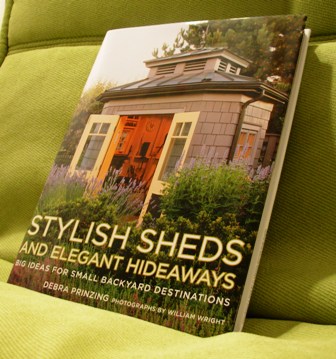
During our many road trips to produce Stylish Sheds and Elegant Hideaways, I

More British shed news

Monday, December 10th, 2007

In an earlier post, I mentioned that TWO “shed guys” from the U.K. have been in touch with Shedstyle.com. If Uncle Wilco of readersheds.co.uk is the “bad boy” of sheds, then Alex Johnson is the shed-dweller’s “boy-next-door.” I’m happy to have them both on my team!

When I first discovered Alex’s site — Shedworking — I was thrilled to learn he was the online voice of a community of people who have shunned the office cubicle for their backyard studios and ateliers. He has successfully identified and tapped into a groundswell of shed users – across Britain and (increasingly) on U.S. soil. I’m glad to join this international conversation and want to introduce my Shedstyle readers to Alex.

Q. Please provide us with a brief bio:

Alex JohnsonA. I’m a 38-year-old journalist, living in St. Albans, England (just outside London) and have worked on national newspapers and magazines in the U.K. and Spain for the last 15 years, as well as being an editorial consultant for several major charities. I’ve focused particularly on over-50s issues, Spanish culture (I lived in Madrid for several years) and over the last two years, the world of ‘homeworking,’ with an emphasis on shedworking, using a garden office as an alternative to the traditional office workplace.

Q. How/when did you get the idea to start shedworking.co.uk?

A. When I bought my own garden office four years ago, there seemed to be growing interest in the U.K. (and also to some extent the U.S.) in not only working from home, but particularly from a shed-like atmosphere at the bottom of the garden. I felt that this group wasn’t being catered to by the traditional mainstream media — indeed often patronised by it — and so decide to launch “The Shed” as a free PDF magazine to try and bring this dispersed community together. The magazine has recently celebrated its second birthday and now has 1,500 readers in countries around the globe (U.K., U.S., Spain, Italy, France, Brazil, Canada, Australia and New Zealand). I launched the Shedworking blog site just over a year ago and that has also taken off nicely – I blog daily, sometimes posting three or four times.

 Q. To what do you attribute the explosion of interest in backyard office-sheds?

A. The increasing belief that the current way we work is simply not applicable any more to 21st century living and that ‘presenteeism’ is largely unnecessary. Offices as factories is a fairly recent phenomenon, largely the result of the industrial revolution, and working from home is superior in many ways – it cuts out the commute, it improves life/work balance, it can be a lot more eco-friendly, it’s more productive . . . the list is endless. And there’s a really impressive range of garden offices available on the market, too, so whatever your wallet size or architectural interest, it’s likely there’s something for the proto-shedworker out there.

Q. Who are your ‘readers’?

A. A large number work in creative industries, particularly the media, with a roughly 50-50 split between men and women. The beauty of shedworking is that while the traditional allotment shed is still something of a male domain, the trend towards shedworking has enfranchised women to own their own sheds and work from them. Many readers are particularly interested in green issues.

Q. Are you working from a backyard shed? Describe it, please.

Alex’s shed-office

Alex’s “shedquarters” in St. Albans, England

A. I am indeed. It’s a green Homestead Timber Building’s garden office, a Marlow model, rather traditionally shedlike architecturally. It’s perfect since I don’t need a vast amount of space and our back garden is fairly modestly sized. It has full insulation, a heater, electrics, wi-fi and as an office it also handles my overflow for books from the house and minor bits of gardening (I keep my home-brewed cider in here).

Q. Please tell me about your online magazine, “The Shed,” and how people can subscribe to it.

A. It’s a lifestyle magazine for people who work in garden offices, sheds and other shedlike atmospheres. It covers homeworking issues such as what to wear to homework, interesting garden office structures, poetry (we have a poet in residence called Shedman, John Davies, who has just released a new collection of poems, largely about sheds), humor and the latest news about garden offices and accessories. To subscribe, just email me at alex@splashmedia.co.uk.

Q. Can you share details about your forthcoming book?

A. “Shedworking: the alternative workplace revolution,” will be published by The Friday Project in the U.K. in July 2008 during the second “National Shed Week.” It will look, in more depth, at the issues and structures touched on in the magazine and on the site, from historic sheds and shedworkers to examples of how people run businesses from their garden offices in the 21st century to dealing with issues such as isolation and the future of shedworking as microarchitecture starts to really take off. There’ll be plenty of examples to enjoy but it will also be a good read. I’m just finishing writing at the moment.

Q. What do you plan to do next?

A. I’d like to put together a book about shepherd’s huts – these sheds on wheels are becoming increasingly popular in the U.K. as garden offices and backyard structures (both original and reconstructed) but there are also more concrete examples around the world from Romney Marsh in eastern England (where they are called ‘Lookers Huts’) to New Zealand.

Thank you, Alex! It will be great fun to follow your progress and keep up with you!

As always, they do it better across the Atlantic

Sunday, December 9th, 2007

Last week’s posting on Shed design tips yielded response from two of the U.K.’s shed experts who have their own awesome blogs. I first discovered Readersheds last spring, while working on “Stylish Sheds and Elegant Hideaways,” my book project.

So it is with great delight that I can share the first of two Q&As with my British Shed Pals. Appearing here is my email conversation with the “Prince of Sheds,” aka Uncle Wilco. Uncle Wilco runs a popular web site: www.readersheds.co.uk (he blogs at shedblog.co.uk).

Q. Please share your bio with us:

uncle wilcoA. I am Uncle Wilco and I am a sheddie. I’m 36 and I live near Pontypridd (where singer superstar Tom Jones comes from ) in South Wales in the U.K. I’m not sure if Tom has a shed; I’ve never had a reply from him. But I love sheds!

Q. When/how did you launch readersheds.co.uk?

A. Readersheds started as an idea in early 2000. I was looking for information about building a garden shed, but could not find much online, so I thought I might as well start a website, where people “shared their sheds” and told us how they went about it.

Ironically, the shed I went with in the end was ordered online and I just erected it instead of building from scratch. But the idea for “readersheds” had started and it just took on a life of its own! The shedblog.co.uk came later, but has been great in promoting Shed Week (details on this below)! And my general musings on shed-related matters.

Q. What was your first introduction to a shed? Did you grow up with a tool shed or potting shed in your backyard?

A. My grandfather (who turned 90 in November) used to have a big allotment garden in the Welsh Valleys. There he used to grow vegetables – and of course (it) was a place the men used to go to escape the wife!

All the allotmenters had sheds they built from scrap wood and anything else they could find. They were recycling before it was fashionable. I used to spend a lot of time there when I was younger. I don’t recall my parents having a shed, but my dad had a garage converted into a wood-shop, so the idea was there!

Q. Please describe your own shed.

uncle wilcos shedA. I have two. Technically, one is a normal garden shed, but it is the hub of my ‘shed empire.’  The other one is a summerhouse, which is Mrs. Uncle Wilco’s domain, so is not on the site yet, but very soon.

Q. Tell me about the response you’ve had, both in the U.K. and around the globe.

A. It was slow to start with, but I never did any advertising or Search Engine Optimisation really for the site. Over the past three years the site has gone from strength to strength in terms of global visitors. And of course sheddies from most continents have shared their sheds, from your basic off-the-shelf to unique cabins and buildings of beauty.

Q. How many readers have posted photos of their sheds on your site?

A. We have around 730 sheds on the site currently, with around 100 that have been added since “Shed of the Year 2007,” but we are looking for many more and your readers can share their sheds here.

Q. When did you start the Shed of the Year competition?

Tony’s Roman Temple ShedA. 2007 was the first year, but I had a small shed competition a few years ago. I can’t wait for Shed of the Year 2008. Not sure if we can top last year’s winner: Tony’s Roman Temple Shed. We have a good selection so far, but we have six months to go, so hopefully we will have some unique sheds.

Q. Tell me about the National Shed Week – it seems like it has been wildly popular with great press coverage.

A. I decided that here in the U.K., we should have a week that celebrates all things sheds. I tried to petition the U.K. government, but to no avail, as they said the idea “was intended to be humorous, or have no point about government policy.”

So I thought, well I have a shed site so I will run it myself. National Shed Week was born with the aim of getting sheds recognized. [Editor’s note: National Shed Week is scheduled to begin July 7, 2008.]

I think having U.K. property guru and sheddies favourite Sarah Beeny signed up as a judge may have helped with the press coverage, but of course the British have a love affair with the shed, so really it’s just snowballed. I was lucky to do a few radio interviews. I got the impression they thought I was a nutter . . . ! But at least people realise that I have a passion for sheds, so that’s all that matters.

Q. What do you plan next?

A. Well, Shed of the Year 2008 is my next big thing. I hope to be more organised than this year – in fact I have already signed up four judges including TV property guru Sarah Beeny, the famous wind-up radio inventor Trevor Baylis, Alex from shedworking.co.uk and renowned beach hut expert Dr. Kathryn Ferry.

I hope we get lots more unique sheds on the site, as they are the lifeblood of Shed Week! I am talking to sponsors at the moment, so we should have some great shed prizes to give away as well.

After 2008, well, not sure. Hopefully, 2009! And then, Shed World Domination.

December, Pacific-style

Wednesday, December 5th, 2007

alex at beach

Alex, barefoot at the beach

“We have snow in Seattle!” my friend Robyn exclaimed, her voice coming through my cellphone headset.

It was in the low-70s. I was driving home, south on Highway 101 with the Pacific Ocean and the afternoon sun over my right shoulder. It was December first.

Life is certainly a study in contrasts. While my heart is constantly in the Pacific Northwest, and while I can just picture the beautiful fluffy snow landing ever so gently on the railings surrounding Robyn’s decks, the reality is: I’m here. And this week, I’m enjoying the beginnings of winter, Southern California style.

seaside gardensOn Saturday, a road trip was called for. We hopped in the Subaru and headed north, up the Ventura Freeway in the sunshine…(yes, like the song), to Seaside Gardens in Carpinteria.

This is a very cool place. Not only is there an amazing selection of not-so-common landscaping plants here, there is an abundance of design ideas presented in the display gardens. Located just a stone’s throw from Santa Claus Beach, where my son Alex and I stopped on the way home to dip our toes in the sand and saltwater, and watch the kite-surfers, Seaside Gardens is arranged like a small botanical garden.

deb plant shoppingalex at seaside gardensWe were lured by the colorful postcard that arrived in the mail box, inviting us to a holiday open house (complete with hot cider and hors d’oeuvres). Weather report: Intense sun, powerful wind. No potted plant over 2-feet-tall was immune from the swift breezes coming inland from the ocean.

But we had fun nonetheless. Shopped for succulents: we brought home lots of 2-inch pots of echeverias for $2.49 each, plus we snagged four really enticing 4-inch pots of Sedum hispanicum‘Purpureum’ (delicate 1- to 2-inch high groundcover stonecrop that spreads up to 18-inches…unfortunately, I’m afraid the rabbits might like this one, time will tell).

seaside gardens map

Map depicts the wonderful display areas at Seaside Gardens

We took a breezy tour through the display gardens, spotting plants that caught our eyes and snapping photos to capture the moment. No thoughts of buying a Christmas tree, yet. But planting a sedum wreath, maybe!

Alex with Abyssinian banana

Abyssinian banana-tree-hugger!

encircled by cycads

Surrounded by Cycads

toes and sand

20 Toes…can’t resist!