Debra Prinzing

Get the Email Newsletter!

Author Archive

Architecture and photography

Friday, November 14th, 2008

Welcome to my 101st post on Shed Style. I guess it’s a bit of a milestone, and I have been wanting to do something special to mark the accomplishment. For bloggers who post constantly, finally passing the one hundredth installment may not be that significant (some of my pals could do that in a month or two!). But for me, a relative newbie to blogging, reaching Number 101 is an exciting benchmark.

By moving into the triple digits as I document my little corner of the blogosphere, I realize how much I enjoy this writing venue. There’s a lot of freedom when a writer can sit down and compose her thoughts unhindered by another’s deadlines, tone, or style. No editor, no word-count restrictions. Sure, there’s no pay, and the circulation (readership) is certainly a lot smaller than the traditional print media that usually publishes my words. But even still, the presence of this blog in my life fills a personal and creative need that my other outlets don’t always satisfy.

A BIT OF BACKGROUND
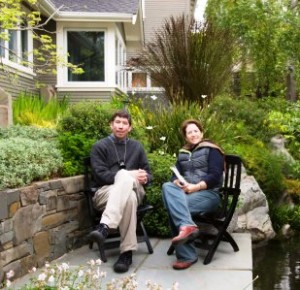
I originally started this blog in March 2007 to document the creation of Stylish Sheds and Elegant Hideaways, the book that photographer Bill Wright and I produced and published this past April. The early morning, “on-location” photo at right is from our year-long odyssey to discover and document the stories of the most creative and inspiring shed designs around the country (not to mention their inspiring owners).

[As an aside, the idea of writing a book-in-progress blog didn’t really take off until AFTER the photography and manuscript finished in the fall of 2007 . . . best-laid plans, and all that!]

Bill and I talked about this book for a long time (we’ve worked together since 2000). But by the summer of 2005, we got serious. Bill had just started to taste the sweet and satisfying flavors of the book world by collaborating with interior design writer Brian Coleman on a book called “Window Dressings” (Gibbs-Smith Publishers). I had worked on four previous books and in June 2005 I traveled to NYC to meet Sarah Jane Freymann, with whom we signed on to represent us as agent.

We began with a fairly decent catalog of shed photography, images Bill and I produced earlier for my articles in Seattle Homes & Lifestyles and Romantic Homes magazines. We created a book outline, gathering up bits and pieces of ideas, including some concepts I played around with in 2002 when Gary Luke at Sasquatch Books and I briefly toyed with ideas for a shed book.

Bill and I sat at the island in the kitchen of our (former) Seattle home, joined by our friend Marcy Stamper. A talented writer, editor, and photographer in her own right, Marcy introduced the two of us when she was art director at Seattle Homes and assigned Bill to photograph my first shed design piece for the magazine in 2001. Now freelancing and living in eastern Washington, Marcy was back in Seattle for a few days. We asked her to meet with us and come up with a design concept that we could use to “sell” our book to a publisher. We called our project “Shed Style.” The resulting 12-page mini-book she designed was called a BLAD (which stands for: book-layout-and-design).

Our meeting took place mid-day in early August. The conversation was punctuated (interrupted) with the screaming, ear-splitting, sounds of the Blue Angels flying overhead. It was a few days before Seattle’s popular Seafair Festival and the Navy jets were in town to perform. Their practice runs and actual performances occur over Lake Washington in Seattle.

Um, yes, right over the rooftops of my former neighborhood in Seward Park. We could barely hear ourselves speak and eventually, we gave up and went out front to witness the spectacle. (Well, Bill and I did. I think Marcy was hiding under the table, reminding herself that it was noise like this that drove her over the Cascades to the solitude of the town of Twisp.) Bill took a great photo of the jets flying by (seen at left).

ON THE ROAD WITH BILL AND DEBRA
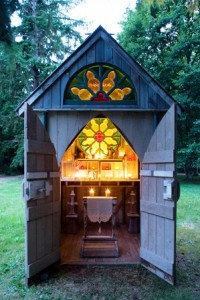
With the book successfully sold to Clarkson Potter/Random House, we began this journey. Although we had a few sheds “in the can” when we started this project a summer later, in July 2006, Bill and I had no idea what kind of momentum we’d soon experience. That same month, even before the contract was actually signed, we photographed five chapters (five shed locations) all around Washington state.

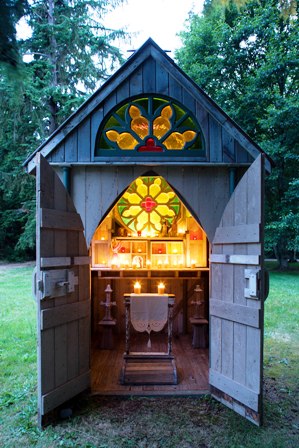
I still remember the euphoria I felt on July 5, 2006 when we came back to Seattle on the last ferry from Vashon Island where we’d photographed Edgar Lee’s magical little chapel-shed, fully lit with votive candles from his former business Votivo (see Bill’s photo, right).

I laid awake half the night replaying the thrill of the setting and the joy I felt looking through the lens of Bill’s camera as it framed the scene we’d created.

The following month, in August 2006, I moved with my children and dog to join my husband in Southern California (he preceded us by a few months). A week or so later, Bill and his wife Pauline welcomed their brand new baby Ella into the world. How many more life-altering things could we manage in such a short period of time?

We got back on the road by November ’06 when Bill flew down to Burbank to spend a few days before Thanksgiving photographing San Diego area locations with me. After the holidays, we started on an intense marathon of travel to scout and photograph sheds, sheds and more sheds.

FAST FORWARD

Stylish Sheds and Elegant Hideaways was published in late April. Since then, Bill and I have pursued our own projects, but we continued to scheme about how/when we could again collaborate.

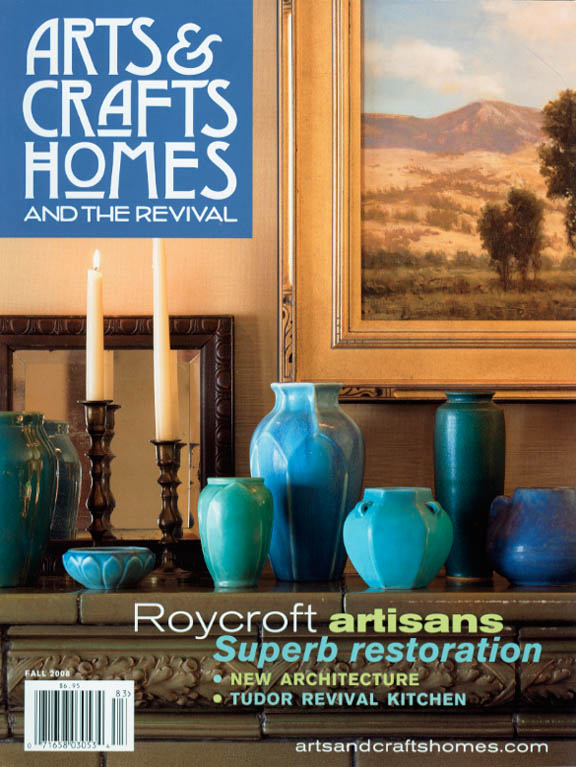
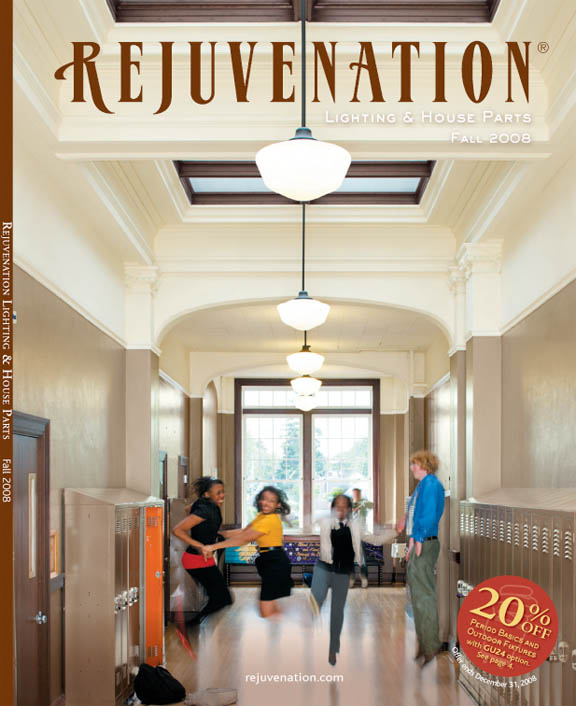
In the six months since our book’s release, we’ve had some great adventures – together and individually. Bill continues to photograph GREAT projects and I continue to write design pieces for national and regional magazines and Southern California newspapers, including the Los Angeles Times and the San Diego Union-Tribune. Recently, Bill nailed two great covers, which I want to share here:
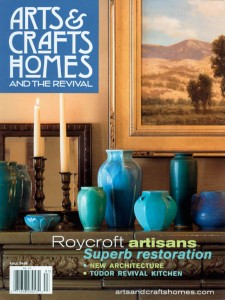
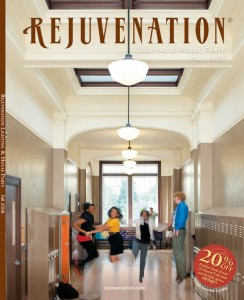
Left: Fall 2008 cover of Arts & Crafts Homes (for a Brian Coleman story); Right: Cover of Rejuvenation Lighting’s Fall catalogue. [William Wright photography]

LAST WEEK
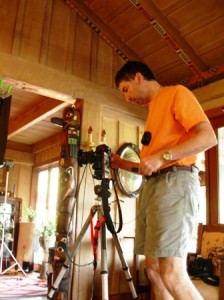
Our work has appeared together in several recent magazines, including stories for the October 08 issue of Alaska Airlines/Horizon Air magazines, the November 08 issue of Seattle Homes & Lifestyles, and others, but since completing the G-R-I-N-D of our “year of the book,” Bill and I had not been able to find the time to create any new stories together.

That opportunity finally came last week, when Bill flew from Seattle to Southern California. We drove up to Ojai, the historically famous town located east of Santa Barbara near the Topatopa Bluff, to photograph a 1908 bungalow, its grounds and interiors, for Arts & Crafts Homes. See Bill at work, right.

We enjoyed two days of hard but gratifying work, thanks to owner Kathy Couterie (an ace stylist in her own right!).

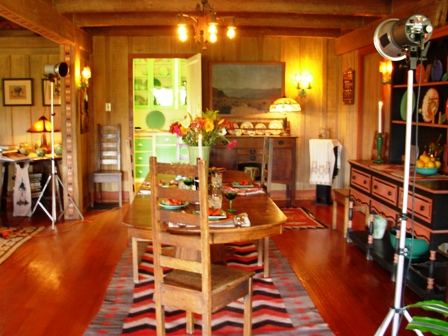
The article about the home she owns with her husband, Emmy-winning director and Oscar-winning documentary filmmaker Bill Couterie, will appear in 2009, but until then, here is a preview of our photo shoot:
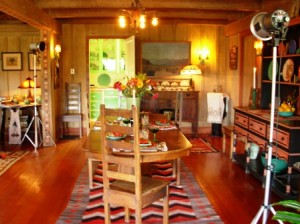
 Lights, camera, action….the Couterie dining room, styled, lit, and ready to photograph.
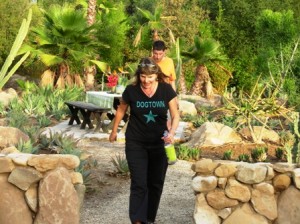
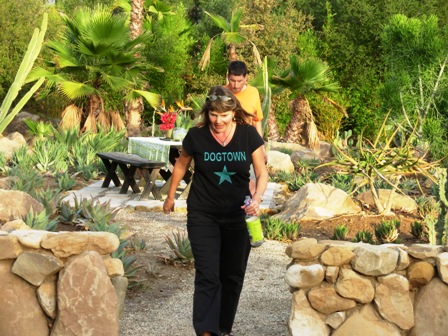
 Kathy Couterie (foreground), followed by Bill Wright, as we finalize the garden shot for Arts & Crafts Homes.
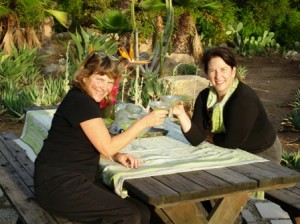
 The sun is about to set, we’ve photographed the garden, and we’re ready to call it a day.

Watch Stylish Sheds on TV

Thursday, October 30th, 2008

Our friend Linda Lehmusvirta, producer of the very popular Central Texas Gardener, has begun to post her segments on You Tube. Bill Wright and I appeared on the show a few months ago with host Tom Spencer and we had a lively conversation about our favorite subject: Stylish Sheds and Elegant Hideaways.

Here is the segment:

httpv://www.youtube.com/watch?v=cMpbg8Cg2dg

Autumn Gardens in Oregon

Monday, October 27th, 2008

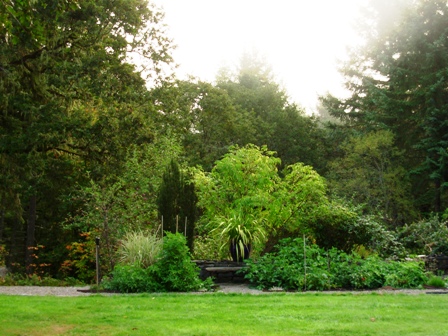
An early morning scene outside the guest room window at Mary-Kate Mackey’s in Eugene

October in Oregon – you can’t beat it. Earlier this month, I traveled there to lecture to the Hardy Plant Group of Willamette Valley.

Returning to my beloved roots, in the Pacific Northwest, was such a treat, especially since it is still wickedly hot down here in LA and I am desperate for some moist, cool autumnal weather.

And oh, the gardens!

Mary-Kate Mackey, fellow garden writer and a gifted journalism educator, met me at the airport. It was fun to fly into this sleek, modern, small airport and arrive via Horizon Airlines (they serve complimentary Pacific Northwest ale on board and, oh, by the way, one of my articles appears in the October issue of Horizon/Alaska’s in-flight magazine, so I was able to grab lots of extra copies from the seat-pocket in front of me, etc.!).

Upon disembarking in Eugene, I was impressed by the changing autumn light and saturated foliage palette. Oh, it’s autumn in Oregon! It took away my breath and captured my heart.

The evening began with drinks at a nifty bistro with Mary-Kate, followed by dinner with my dear friend Jennifer (we were editors together at “Seattle Woman” magazine in the 80s).

On Tuesday, after a restful overnight in Jenny and her husband Tim’s comfortable home, I met up again with Mary-Kate.

Since I missed out on the one-day garden tour in Eugene that followed last month’s Garden Writers Association’s annual symposium, I had a special request for Mary-Kate: Can I have my own mini-tour of the best of the best Eugene has to offer? [Above: Mary-Kate inspects the craftsmanship of a stunning stone wall hand-built by Allen Bosworth (right) of Bosworth Landscaping.]

READ MORE…

What’s a Grotto?

Tuesday, October 21st, 2008

Dare we call it a “Stone Shed”?

Does the idea of hanging moss, dripping water and a dark, quiet enclosure come to mind? Call it a cave, cavern or hollow and you’re getting close to both the ancient and modern-day descriptions of this sheltered stone destination in the cultivated or wild landscape.

If you’re following my ongoing Glossary of Garden Architecture, check out this just-added “definition” of a Grotto.

Home of the (Los Angeles) Times

Saturday, October 18th, 2008

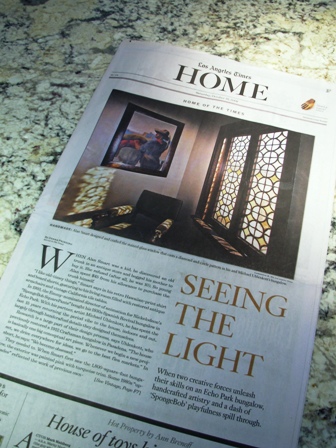
Here’s how “Seeing the Light,” my story in today’s Los Angeles Times’  HOME section begins:

When Alan Smart was a kid, he discovered an old trunk in an antique store and begged his mother to buy it. She refused (after all, he was 10). So young Alan spent $45 from his allowance to purchase the trunk himself.

“I like old-timey things,” Smart says in his retro Hawaiian-print shirt and board shorts, gesturing to his living room filled with restored antique armchairs and vintage California tile tables.

This is a story that underscores my belief that we can both possess a home and be possessed by it. It’s about how Alan and his partner Michael Uhlenkott transformed a nondescript 1930s Spanish Revival bungalow in an aging Los Angeles neighborhood into a showpiece for decorative arts and their amazing collection of early California pottery, tile, furniture, paintings, figures, and lighting. It’s about how their personalities and preferences are revealed through their choices of color, textiles and artwork.

Alan and Michael are artists of the highest order. If there is a surface to embellish, they will find a way, even if it means spending endless hours standing on ladders to hand-stencil the stucco ceiling with a Moorish pattern or antiquing the walls with layers of glazing, rag-application and dry brush painting techniques.

They design with a respect for the past, an appreciation for craftsmanship and materials, and a lighthearted sense of irony. There is no halfway effort here. Everything relating to a genre, period or style is explored, honed, refined and reinterpreted. There’s such an honesty and authenticity to each decision to adorn and decorate. I love every detail! 

READ MORE…

Arts and Crafts architecture, then and now

Thursday, October 16th, 2008

Our beloved Seattle bungalow, updated from its 1924 origins

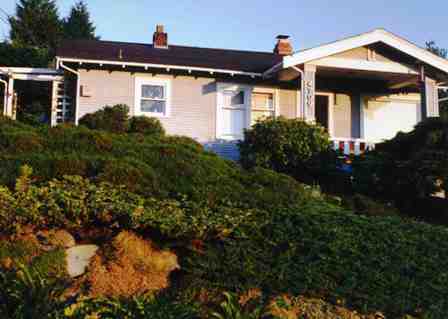
My interest in garden design from the American Arts and Crafts era is connected with the affection we have for a 1924 Seattle Craftsman bungalow, which my husband and I bought in 1996.

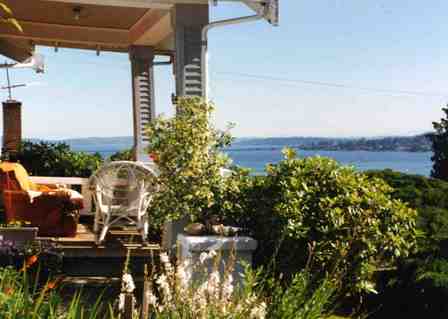
The one-story house, about 1,100-square-feet in size, was painted light gray. With faded white trim, it was not much to look at, as it had been a rental house for so many years (seen at right). On our first visit, we ignored the sofa on the front porch (below, left) and instead gazed at the breathtaking views of Lake Washington, the Cascade Mountains, Seward Park and Mount Baker.

Thus began our love affair with Craftsman architecture. We wanted to expand the house while also preserving its character. My husband Bruce met Toby Taylor of Caledonia Bay Builders after previously seeing his work and tracking him down through a real estate agent

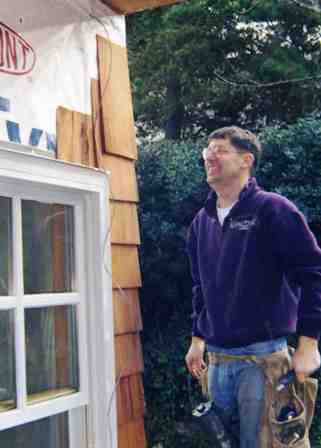
Toby (seen below, right) and Bruce hit it off immediately, an almost unheard of phenomenon between a builder and a potential client who is also a lawyer. Toby introduced us to Robin Abrahams, a Seattle architect who he described admiringly. We were impressed when Toby told us that Robin was “way cool.”

Miraculously, we went with our “gut” feelings and hired them both (this was highly rare for my lawyer-husband, who typically would have insisted on competitive bids from three candidates). We’d heard all the horror stories. Nearly everyone we knew who had restored, renovated or built a home was unenthusiastic about the process, or about their contractor, or about their architect.

But our little project was blessed. We adored Robin and her colleagues at Abrahams Architects. She is a bundle of creative energy, a thoughtful, very smart, incredibly gifted designer. We also loved Toby’s verve, his hard-working, can-do attitude, and his often amusing ski-bum vocabulary.

READ MORE…

Modesto Garden Club and Lavender Hollow Farm

Saturday, October 11th, 2008

I have my father to thank for my two-day trip to Modesto earlier this week. That’s because a year ago, as my folks were driving from Seattle to Phoenix, they stayed overnight at the home of Sue and Jerry Houser in Modesto, California. Like my parents, the Housers belonged to an informal bed-and-breakfast club. You pay some kind of nominal fee to join and receive a directory of hosts who will give you a room for the night, plus breakfast. My affable dad was seated in Sue Houser’s family room and he noticed all her gardening books and magazines. “My daughter writes about gardens,” he offered.

Turns out, Sue is the program chair for the Modesto Garden Club, one of the largest clubs I’ve ever encountered (it was founded 81 years ago and has more than 600 members)! How’s that for serendipity?

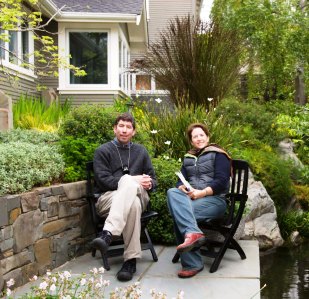
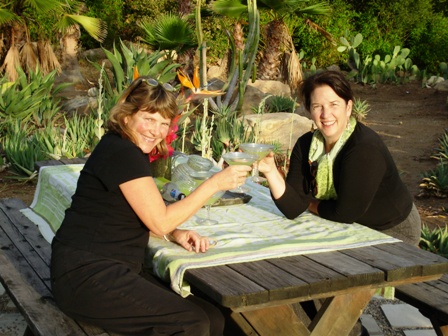
The next thing I know, Dad’s on the phone to me, introducing me to Sue. Several phone calls and emails later, she invited me to come speak to her club. That’s the two of us pictured above, standing in the foyer of the garden club’s beautiful office in a renovated cottage (seen at right).

I began my trip on Tuesday, driving to Bakersfield, which is 120 miles northbound on Interstate 5. I parked my car at the Amtrak station there and hopped the San Joaquin line (which begins in Bakersfield and continues to Sacramento or Oakland). I passed the 3-1/2 hour train trip quite pleasantly, looking out the window at the changing scenery, much of it agricultural (mostly corn fields and pecan orchards), napping, reading, and relaxing. My cell phone was turned off, ensuring that I really could “unplug” for a little while.

READ MORE…

California Garden and Landscape History Society

Friday, October 10th, 2008

A late September afternoon along Independence Creek, with the Sierras in the distance, at the Mary DeDecker Native Plant Garden, Eastern California Museum, Independence, California

I’m paraphrasing here, but that saying about how we understand the future if we learn from the past came to mind when I attended part of the California Garden and Landscape History Society’s annual meeting.

The conference was held in Lone Pine, California (about 250 miles north of my home on Ventura Co. – toward the high desert, the Eastern Sierras, and the west entrance to Death Valley). Its theme: “Spirit of Landscape: California’s Lower Owens River Valley.”

The event attracted me because dear friend and writing mentor Paula Panich was on the program to give a lecture about the writer and pioneer woman Mary Austin. She titled her talk: “Beauty and Madness and Death and God: Mary Austin’s Land of Little Rain.”

Why do we pursue such impetuous, insensible decisions as to drive 250 miles on a Saturday morning in order to get to a friend’s 1-hour lecture? It’s actually easy to explain, because the fabric of my life is woven with such spontaneous decisions. If I didn’t make these sudden journeys (to fly to Seattle for Braiden’s book-launch; to take the bus to the end of the line and visit Skip and Charles in Orient, NY; to drive to the mountains for Paula’s birthday celebration) what else would I be doing anyway? Shopping for groceries, paying bills, folding laundry?

A fellow conference participant, Liz Ames, pauses to observe the not-so-distant Sierra Nevada range

We often remember the glimmering highlights that punctuate the rough textures of everyday life; they are the peaks that even out the valleys, comforting us. Don’t get me wrong. Usually, I love my life and the choices I’ve made. I float through it observing all the blessings I have with my marriage, my children, my home, my safe existence. But sometimes . . . different seasonings need to be tasted. Gardens, friends, excursions…provide the unexpected flavors to our regular diet of normalcy.

READ MORE…

Salvage Studio and Sustainable Design

Saturday, October 4th, 2008

If you’re seeking creative inspiration, or need a gift idea for that crafty person in your life, look no further than Salvage Studio of Seattle.

My pals Beth Evans-Ramos, Lisa Hilderbrand and Amy Duncan share a “lust for rust” in their pursuit of sustainable design (to them, this means “reduce, reuse and recycle”) for the home, garden, and more. They teach classes at their studio in Edmonds, Washington, and frequently publish an idea-filled blog, also called Salvage Studio.

Just out, their new book, “The Salvage Studio: Sustainable Home Comforts to Organize, Entertain and Inspire” (Skipstone Books/Mountaineers, $21.95), is a compendium of the best salvage projects created and collected by these three gals over the past few years.

Imagine my delight when my review copy of The Salvage Studio arrived a few weeks ago. The attractive 8-1/4-inch x 9-1/4-inch book contains 200 gorgeous pages of great design ideas, tips for turning discarded items into decorative accents, step-by-step projects and more. I turned to the Acknowledgements page to find a thoroughly unexpected gift from the authors:

READ MORE…

Ornamental pumpkins, squashes and gourds:

Friday, October 3rd, 2008

Here it is, already October 3rd and Halloween is upon us. Thanksgiving will soon follow.

I’m the type of mom who has always been grateful (relieved?) when the college-aged nanny offered to take my boys costume-shopping. That’s because I subscribe to the “use what’s available; look for stuff in the garage, sewing room, or attic,” school of Halloween costume-making. None of this molded rubber mask or fire-hazard printed-on-acetate superman kind of stuff. But my boys, on the other hand think a brand-new costume is de rigeur.

The organic, agricultural Halloween appeals to me. You know, the old-fashioned fall celebration that gets its thrills from a full moon rather than a mountain of Mars bars. Oh, for those cellophane-wrapped caramel apples of our youth (remember the ones we were warned might have razor blades in them, back in the 1970s?). Yup, those very ones.

In search of awesome produce for the fall holidays, I drove over the hill this afternoon into Simi Valley to visit Underwood Family Farms. An organic, U-pick farm, Underwood is a refreshing haven just a mile beyond fast-food row (What can I say? We do live in the suburbs).

I wanted to scout out cool, fashionable vegetables, worthy of centerpieces and front porches, for an upcoming November story called “Thanksgiving, A to Z.”

READ MORE…