Debra Prinzing

Get the Email Newsletter!

A winter bouquet: arranging flowers from the January garden

Sunday, January 9th, 2011


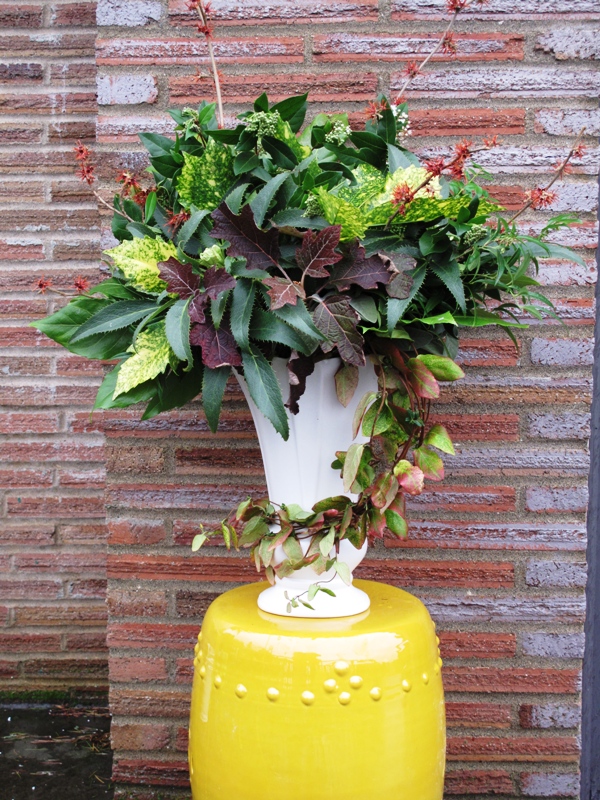
By borrowing this lovely cream urn from my friend Lorene, and by clipping ingredients from her garden and that of Jean Zaputil's, I created a dramatic winter bouquet.

Earlier this week, my collaborator David Perry and I were the “program” for Woodinville Garden Club’s first meeting of 2011. It was an auspicious beginning for what we anticipate to be a great year gathering stories both visually and with words for our book project, A Fresh Bouquet.

Frequently, the feedback to our “seasonal, local and sustainable” mantra has to do with the argument that one can only follow this practice in the peak growing seasons when annuals and perennials are in their glory (you know what we mean – roses, peonies, dahlias, even sunflowers….they don’t usually sing in January!)

That’s true, but living in the seasons means that of course you don’t want a vase filled with August bloomers in the dead of winter. That’s like eating a mealy hothouse tomato out of season. Yes, it’s red in color, but that’s about as much in common the January grocery store tomato has with the off-the-vine, warm, juicy, flavorful heirloom you grow in the garden and add to your late summer salads.

So after our illustrated lecture on “A Year in Flowers,” featuring some pretty incredible images that Dave has captured on our joint and his solo excursions, we set out to design and demonstrate some great ideas for winter bouquets. Suffice it to say, David created an uniquely “David” arrangement. Yes, it involved power tools and an unexpected combination of leaves and blooms. When he blogs about it, I’ll add the link here.
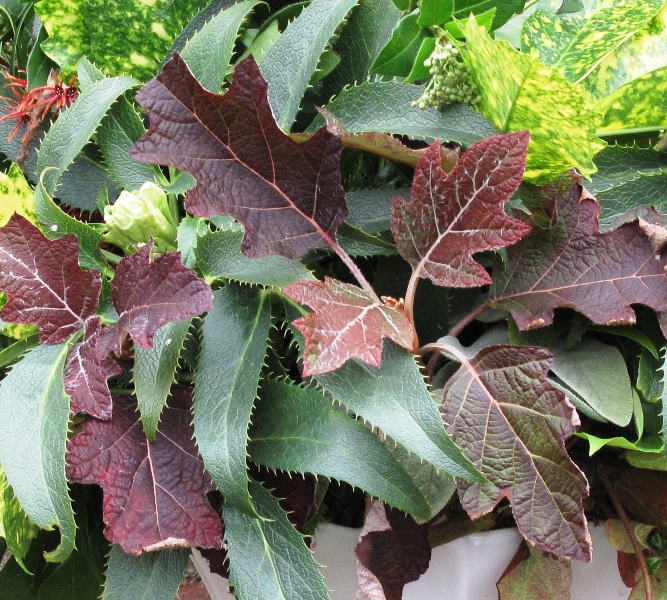
This detail shot shows how the oakleaf hydrangea adds wine to the bouquet, showcased against the hellebore foliage; a glimpse of the yellow-and-green acuba foliage is in the upper right corner.

For me, I wanted to fill a vase with winter beauty. Some of you may know that our family is in a bit of transition. We finally sold our house in Southern California, but we are still living in a rental house in Seattle, while house- and garden-hunting for a permanent residence.

I yearn for my previous Seattle garden where I could gather more than enough ingredients for any impromptu bouquet (does this come close to admitting that I’m an over-planter? YES! But I don’t own that garden anymore, sadly). I’m a bit limited with the offerings at our rental house and I don’t want to denude all the plants my landlords consider theirs!

So, on Tuesday, I went “flower shopping,” which means I visited the amazing gardens of two friends, clippers in hand. It was sunny out, and very cold. Some of the shrubs showed signs of frost damage. After all, It was January 4th! But I was not disappointed and my garden designer friend Jean Zaputil walked me around her backyard and entry garden, encouraging me to take a little of this and a little of that.

Her bounty included Fatsia, which has huge, palm-like foliage. Green and glossy, this is good stuff – perfect for adding drama to a vase. We clippped branches of green Boxwood, another hardworking shrub that is just as hardworking in an arrangement. Oh, and the Sarcococca, or sweet box – divine. If you have never grown this evergreen shrub, which has little pointed leaves and hard-to-see, super fragrant white winter flowers, think about planting it now. It’s hardy in the Pacific NW….not in the midwest, unfortunately, according to my friend Danielle.

I also left with a few stems from Jean’s Acuba shrub, which is another one of those plants you sometimes ignore in the summertime when everything else looks so swell. But even the famed Christopher Lloyd admired this plant – its bright yellow foliage is splashed with green flecks. And there’s nothing like something golden to offset all that greenery. It ended up as one of the magical ingredients that perked up my bouquet. I also talked Jean into letting me clip two branches from her about-to-bloom Helleborus argutifolia – with its leathery, serrated, olive-green foliage and the pale green flower in bud.
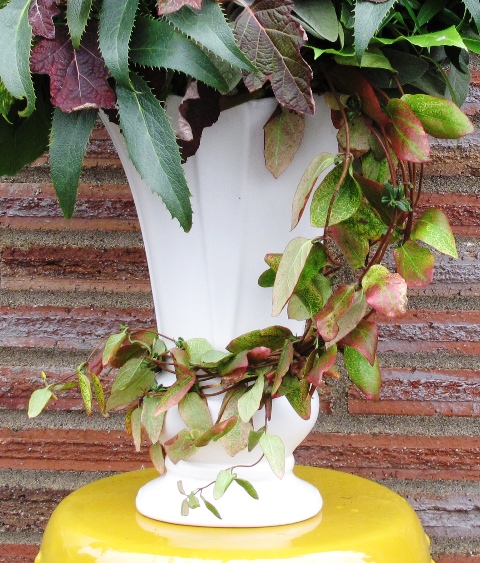
Here's how the honeysuckle vine looks, wrapping around the base of the urn.

After leaving Jean’s, I headed to Lorene Edwards Forkner, plantswoman, designer, blogger and fellow writer — another incredibly talented friend (I am blessed with many of them!). Lorene’s garden is very close to Puget Sound, which is often a bit milder than the rest of Seattle. That’s the only reason I can come up with to explain why her Oakleaf Hydrangea shrub was still hanging onto several deep burgundy leaves in pretty sets.

Like the golden Acuba, the wine-colored Hydrangea foliage added great contrast to the bouquet. Oh- and the ‘Jelena’ witch hazel – yes, this glorious, fragrant shrub is just beginning to flower in Lorene’s front yard, so she allowed me to clip a few branches. The blooms of the witch hazel are little puffs of burgundy-copper – and it doesn’t take many of them to perfume a room. I made this bouquet on Tuesday and four days later, the dining area where I set the urn was still heady with the scent.

You can look closely to see most of these ingredients in the photos here. One more thing I want to share about this abundant bouquet. Notice the draping vine? That’s a cascading and twining length of a rugged honeysuckle, also from Lorene’s property. I wanted it to spill elegantly from the mouth of the cream-colored urn, but it was a little too stiff to give me the look I envisioned. So I started wrapping it around the base of the urn and – well, that looked better. I employed a trick I learned from a Portland floral designer we recently interviewed, Jennie Greene. She uses tiny lengths of twine-wrapped wire to secure branches and stems in place. Easy t0 find at craft stores, I pulled out a roll of the wire, cut off a couple inches and secured the honeysuckle in place.

Now who says there’s nothing to put in a vase in January? This creation illustrates just one way to gather from the winter garden. Go see what you can create!

New Garden Products for 2011 – Part One

Saturday, November 27th, 2010

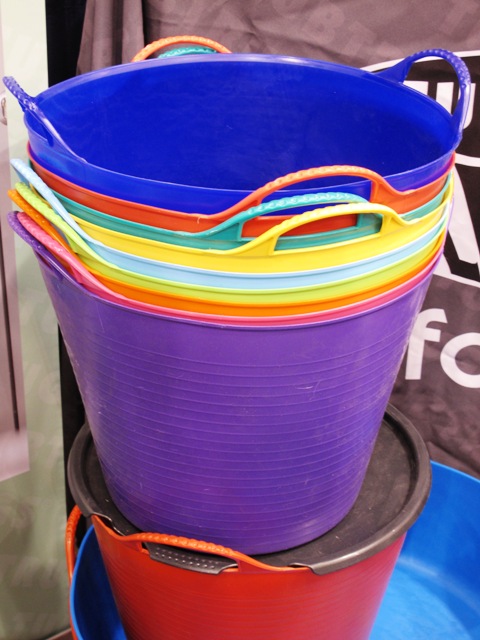
Here is an array of new 2011 Tub Trug colors

Part One of Two Consecutive Blog posts:
I was invited  by the producers of The Independent Garden Center Show, an annual trade show held in Chicago each August, to give two talks about garden and consumer trends. It was easy to say “yes,” because I had heard so much about this massive event. It’s the place to be and be seen for anyone in the gardening industry!

By experiencing the extravaganza first-hand and seeing what all the buzz was about, I got a real workout. With thousands of other attendees, I navigated the aisles and aisles of new garden products, tools, furniture, accessories and even plants. I managed to see it all over the course of three days – and here are my picks for the best new ideas that gardeners will see in 2011. 

You’ll likely discover these goods on the shelves of your local indy garden center, nursery or emporium. Follow the links to the web site for each company (some only sell wholesale, but many have store locator tabs). 

Ethel work glove

I’ve previously endorsed and written about the Ethel Glove so I wanted to stop by the booth of this cool Valencia, Calif.-based company to see what was new. The Ethel Work Glove, with an $8 price tag, is at first glance similar to the everyday rubber-dipped knit glove you’ll see at hardware stores and garden centers. But the Ethel staff explained that this glove is made from a durable knit material with a rubber palm, pads and fingertips formed by painting (rather than dipping) the gloves into a polypropylene finish. 

Ethel also has a new, slim and fashionable, black knit glove made from a bamboo-derived fine knit (protecting the cuff, back of the hands and fingers). The durable palm and pads are coated with a synthetic leather. 

A reimagined rubber tire-turned-trug

Tub trugs come in a rainbow of colors. I own several of these excellent plastic garden carriers with handles. They’re great for hauling anything around the garden and useful for pruning,  dead-heading and weeding projects. 

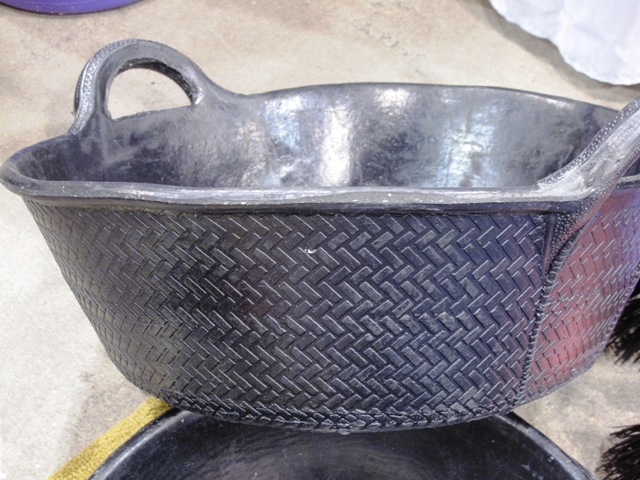
The designed-in-the-UK and made-in-Spain tubs will soon be available in 10 new colors. There are also a few fun new products, including a color-coordinating push broom ($29.99 retail) and two sizes of trugs made from recycled tires. To me, these look like a riff on the Southern tire planters – they even smell like old Goodyears! Thicker and a little less refined than the sleek, Pantone palette-trugs, the black rubber ones will be available in January for $9.99-$12.99. 

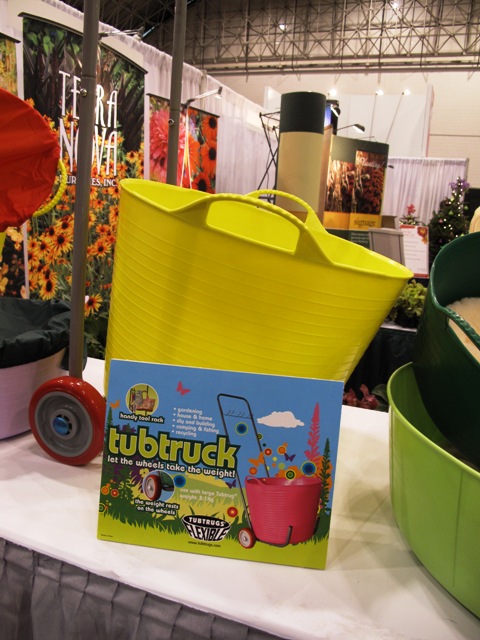
The tub truck - take it with you to the farmer's market!

For those of you who already own a medium or large trug, look for the January release of Tub Truck, a rolling carrier ($37.99). You can pop the bucket onto the frame and take it with you to a plant sale or farmer’s market. The handle has hooks for hanging additional bags. It’s a fun cart to pull behind you and a brilliant solution for gardeners. 

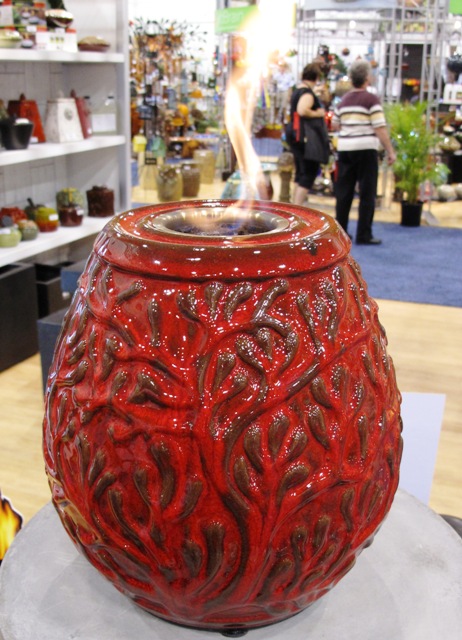
'Serenade' ~ a Napa Firelite, 12 in. tall

“Firelites” or fire bowls are all the rage. As Martyn Fernambucq of Napa Home & Garden puts it: “Fire is such a hot commodity right now.” 

I first noticed this new product category when an editor at Better Homes & Gardens sent me a photo of a small ceramic lantern with a flame (not a wick, mind you, but a 2-inch diameter flame that was flickering 2-3 inches above the round opening in the lantern). That’s when I went online to learn more and discovered that the lanterns are fueled by a long-burning smoke- and odor-free gel.

Like many things that bubble up to one’s consciousness and elbow their way onto one’s radar, it’s not really a surprise that the very next day I went to an al fresco dinner party for a friend where the hosts’ boathouse was illuminated by these flaming lanterns. Clearly they are decorative. The flame can’t  be blown out by a gust of wind (as would be the case with a candle).

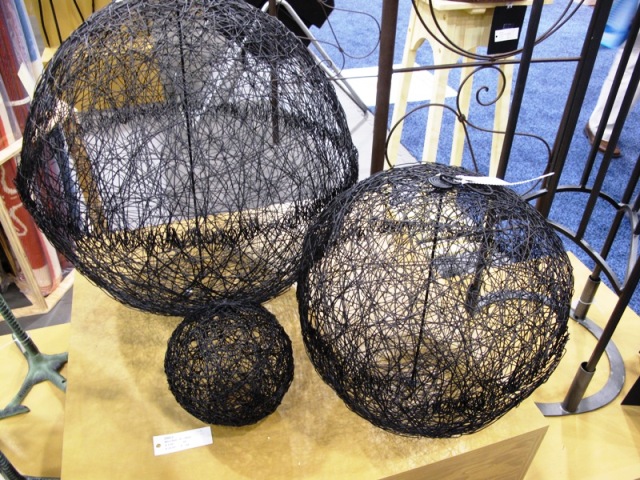
Mesh orbs by Achla Designs

I’m all about orbs, spheres, globes, and balls as sophisticated garden ornamentation. My favorite piece of sculpture features a filigree-style wire mesh ball with a random “scribble” pattern. It was designed by artist Jennifer Gilbert Asher of TerraSculpture and fabricated by Mario Lopez in his Los Angeles metal shop. 

If you like this custom-designed and fabricated look, you might like the black wire orbs that are slightly reminiscent of Jennifer’s designs. I spotted them in Achla Designs booth. Nice design in small (6-inch), medium (12-inch) and large (18-inch) sizes. 

A sunflower pillow - perfect for the patio

Outdoor textiles are more interesting than ever, moving way beyond awning striped polyester choices. 

So of course, the Liora Manne booth lured me in and I was eager to learn more about the gorgeous, patterned pillows made with a felting-like process. 

The Lamontage pillows are made of 100% antimicrobial polyester microfiber for indoor/outdoor use. They measure 20-by-20 inches or 12-by-20 inches with removable, hand-washable covers. The collection includes place mats and outdoor rugs, as well. 

According to the Liora Manne web site, Lamontage is a technique “in which acrylic fibers are intricately structured by hand and then mechanically interlocked by needle-punching to create a nonwoven textile. Lamontage is based on the idea of versatility; breaking the boundaries of traditional textiles and creating a unique textile with unlimited possibilities.” 

READ MORE…

A mini terrarium to hang from your tree boughs

Monday, November 22nd, 2010

Okay, I know that there is still one more week left in the month of November, but we had a big Seattle snowstorm today and so visions of sugarplums are dancing in my head.

One other reason I’m dreaming about my holiday decor is the just-arrived December issue of Better Homes & Gardens. It hit newsstands with a really gorgeous wreath on the cover and all sorts of design, entertaining and gift-giving ideas filling 275 beautiful pages.

A medium-sized glass "world" to gaze upon in wonder.

I was asked to pick my favorite garden gift for the holidays and you can read about it on page 153. Or you can see it here: An alluring “Forest Floor” ornament created by San Francisco designer Flora Grubb. It is a winner! Thanks to Flora for suggesting we feature one of her custom ornaments and for sharing the photograph you see here.

Living Ornaments:

It’s fun to use living elements and wild-gathered souvenirs from nature in your holiday decorating. I love this “Forest Floor” glass ornament created by San Francisco designer Flora Grubb. Lichens, moss, feathers and seeds cushion a living Tillandsia air plant inside a tiny glass ball – an enchanting, diminutive naturescape to hang from branch or bough.

An occasional spritz of water is all this tiny terrarium needs to continue looking beautiful – even after you take down the tree. Available from www.floragrubb.com; 3-inch, $19.95; 4-inch, $24.95; set of three 2-inch balls, $19.95.

Cool, huh?

Some good news for the print world:

For those of you who subscribe to the New York Times, you can’t have missed a full-page advertisement on the back of today’s Business section. It’s so huge that I couldn’t scan the entire contents of the colorful spread on my tiny printer. But here’s the gist of it:

Better Homes & Gardens, along with Meredith Corp. sister title Family Circle, are the magazine world’s #1 and #2 top books for women consumers, in terms of total advertising pages sold.

Under the leadership of editor-in-chief Gayle Goodson Butler and SVP, Group Publisher James T. Carr, Better Homes & Gardens has earned the support of 1,739 advertising pages this year. 

Just when everyone thinks magazines are a dying breed, here’s a report that “these magazines have held the top two positions in the women’s lifestyle category for 2010 and 2009.”

Just sayin’.

A tour of the Chartreuse House garden

Saturday, November 20th, 2010

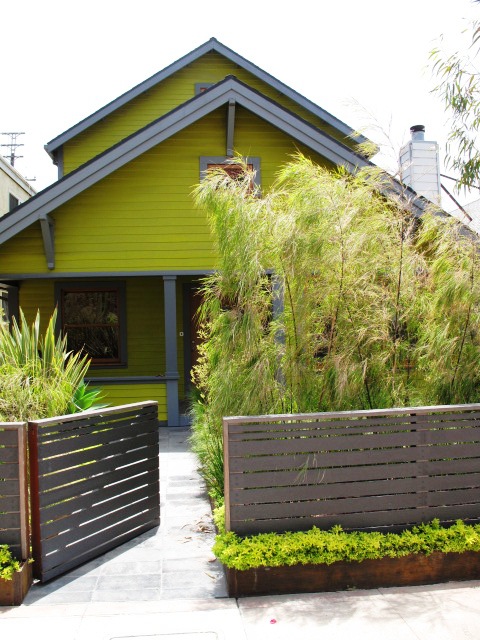
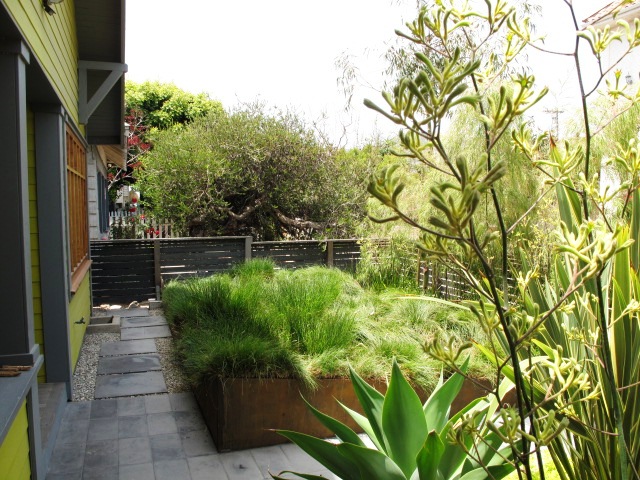
You can't miss the Chartreuse House, seen through the similarly-colored plant palette.

Today’s Los Angeles Times’ HOME section features my architecture/interiors story about Lisa Little and Phil Brennan’s makeover of a pair of tiny cottages in Venice, Calif.

The Venice-based architect and her special effects wizard husband painted the exterior an acid-chartreuse color and trimmed the house in charcoal gray.

Click on over to the story and you’ll see a fabulous web gallery of images shot by photographer Katie Falkenberg.

I also included a sidebar on Stephanie Bartron’s amazing work in the postage stamp-sized front yard, which faces a Venice walk street, which appears in LA at Home, the Home section’s daily design blog.

But you really can’t see much of the garden in the Times’ web gallery.

I promise you – it’s something to behold, featuring a dazzling palette of plants that enliven the small entry garden and play beautifully with the rugged materials Stephanie selected.

So I will share those photos here, along with the sidebar text:

A Chartreuse garden

As a color-packed accent to the renovated 1905 Craftsman bungalow, the Chartreuse House’s front yard is a example of how much great design can occur in a tiny patch of soil.

Yet before choosing a zesty palette of drought- and salt-tolerant plantings, designer Stephanie Bartron, of SB Garden Design, had to address some of the less visible challenges of the property’s postage stamp-sized entry. Prior owners had piled layers of topsoil over the sandy native soil, which created a drainage mess.

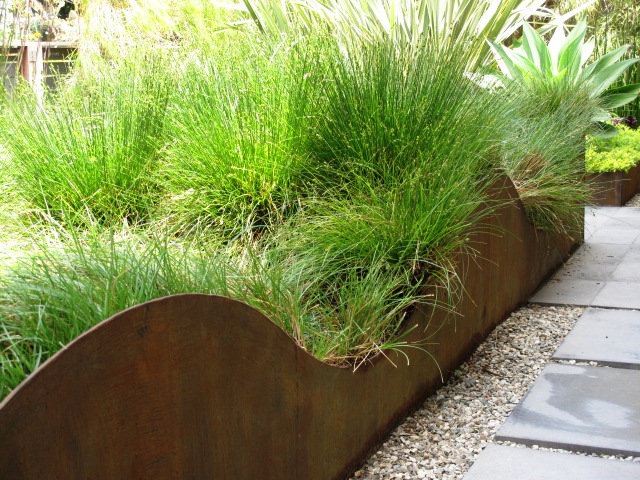
A wave-like pattern gives lots more interest to the raised bed.

“I needed to lower the grade of the front yard in order to move water away from the house,” Bartron says. “We calculated the volume of soil to excavate and used that amount to fill two raised planters. That way we didn’t have to haul away any material.”

Divided by a permeable walkway of concrete tile, the raised planters are formed by boxes of thick steel plate that have been roughly finished to encourage rusting. Now weathered, the boxed-beds replicate the Cor-Ten steel used to make the vertical planter in Little and Brennan’s courtyard.

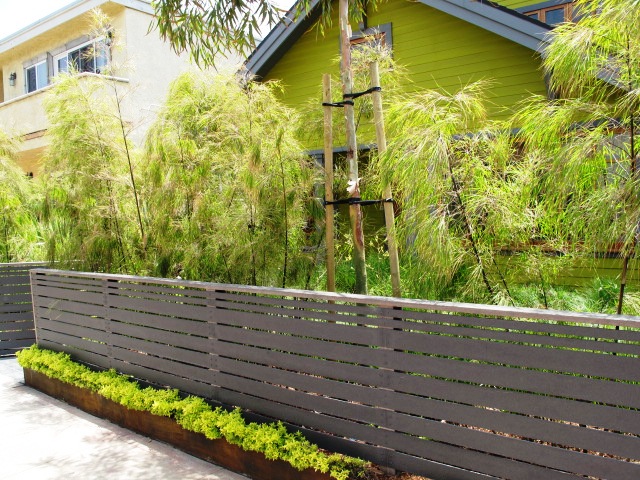
The same weathered steel forms a slender raised planter at the base of the charcoal fence facing the walk-street. It is filled with a ribbon of golden oregano and Sedum rupestre ‘Angelina’ — which dazzle against the darker fencing.

The chartreuse scheme continues outside the gray composite fence.

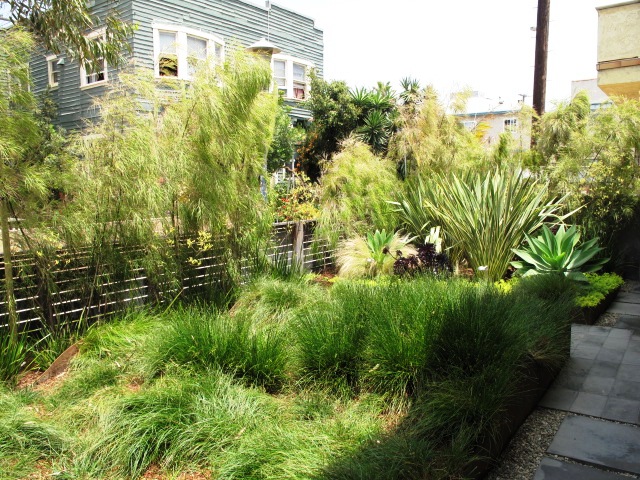
Bartron asked the metal fabricator cut a “wave” detail along the top of the larger planting box and in it she installed a sedge meadow, a nod to the nearby beach.  Privacy screening comes from a “hedge” of weeping Mexican bamboo and alternating chartreuse and yellow-flowering kangaroo paws.

“The plants create a punch of color in  such a small space,” Bartron says. The lacy bamboo fronds, the tall kangaroo paw stalks and the undulating drifts of sedge are constantly moving, thanks to the ocean breezes. Little added a eucalyptus tree to the front area, situated so that it will eventually grow high enough to screen the house’s topmost windows.

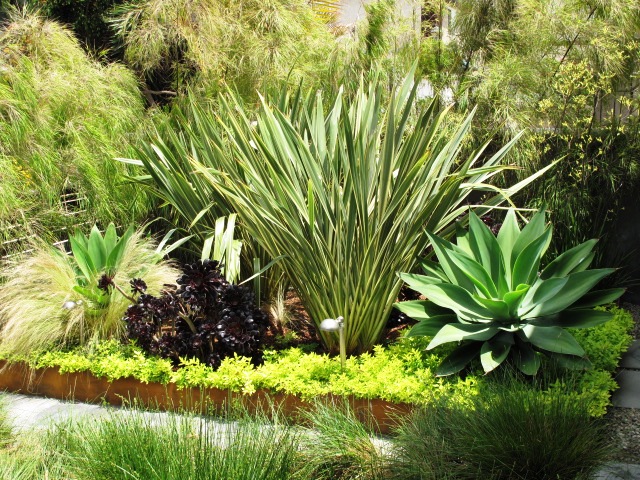
Such a simple yet sophisticated combination of plants in the smaller of two raised beds.

For the smaller of the two planter boxes, Barton paired dramatic clumps of smooth agave (Agave attenuata), known for growing well near the ocean, with Mexican feather grasses, dark purple Aeonium arboreum ‘Zwartkop’ and yellow-and-green variegated New Zealand flaxes. The entire bed is under-planted with the chartreuse Sedum rupestre ‘Angelina’. Filled with detail, it is a diminutive landscape that causes visitors to slow down and experience while approaching the front door.

The garden has many sustainable features, including low-maintenance plantings and permeable surfaces. Yet, says Bartron, its main design motivation is a response to the architecture. “This is such an artsy, whimsical place and I see the garden as a colorful jewel box for Lisa and Paul to enjoy.”

–Debra Prinzing

I’ll close with just a few more photos:

The larger of the two raised beds is planted mostly with Carex, to emulate the waves of the nearby Pacific Ocean.

This view shows how the Mexican bamboo and the kangaroo paws provide ample screening from the walk street traffic.

Playful and suitable for the setting, the lemon yellow kangaroo paw sways in the breezes.

Fall design inspiration: foliage, flowers, fruit and architecture

Monday, November 1st, 2010

“It would be worthwhile having a cultivated garden

if only to see what Autumn does to it.”

–Alfred Austin, The Garden that I Love (1894)

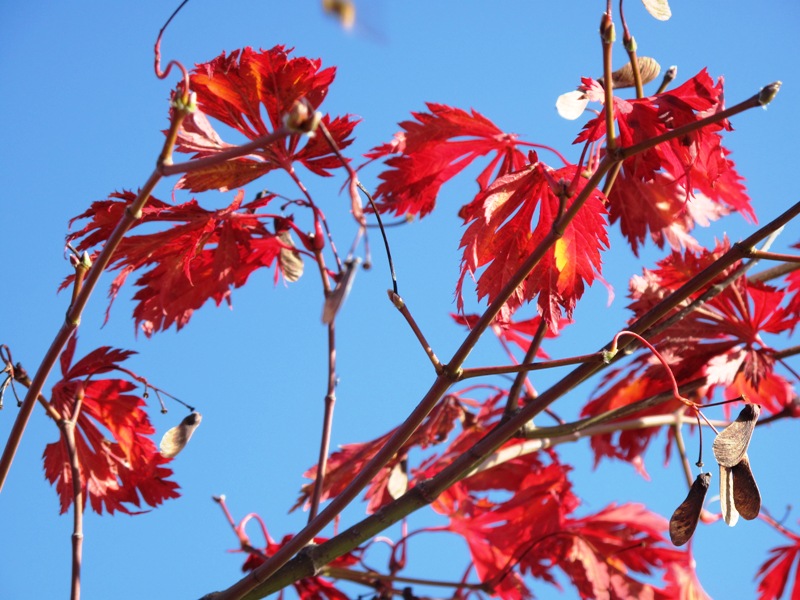
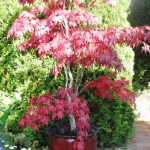
Acer japonicum 'Aconitifolium'

Whether emulating what you see in nature or combining plants to masterful heights, gardens that excel in the fall are ones that showcase the best of the season. 

There are certain trees, shrubs, perennials, ground-covers and vines that you may not notice during the rest of the year. But somehow, once the temperatures cool and the sun’s arc lowers in the sky (lighting foliage and plant forms from the side, rather than from overhead), a fall glow illuminates – and we see the garden in a new way.  

Last Friday I gave a presentation entitled “Gardens that excel in the fall: Something for everyone” at the Garden Conservancy’s one-day seminar in the San Francisco Bay Area. Called Fourth Quarter Gardens: An August to December Romance, the symposium featured several really inspiring speakers on design, horticulture and the unique gardening culture of the west. 

I was thrilled to be part of this cohort, which included Bob Perry, Katherine Greenberg, Nicholas Staddon, Elizabeth Murray, Chris Jacobson and Brian Kemble. The highlight for me was a tour of Katherine Greenberg’s all-native garden in Lafayette (an East Bay community). It was the three-dimensional, living embodiment of her lecture “Greens, Grays and Golds in a Native Garden.” 

My talk was a visual meditation of what inspires me this time of year: foliage, flowers, fruit and architecture in the landscape. 

I started by sharing the excitement I feel about the season as I design for texture in a new way; find unexpected plant pairings (not just those Halloween hues, either); tend to the harvest and see the bones, lines and structure emerge as leaves fall and flowers fade. My attention is drawn to the aging beauty of what some may call “decay.” Yet those yellowing hosta leaves and nearly-bare branches are a sign to me that the garden in every phase of growth is to be celebrated. 

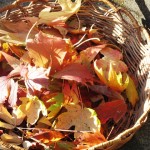
This lovely melange shows the amazing diversity of fall leaf color.

I also shared a lay-person’s explanation of why leaves change color in the fall. I quoted from Brian Capon’s book Plant Survival

“. . . the cool night temperatures and shorter days of September and October are sure to start the season’s normal color changes in leaves and . . . trigger their falling from the trees. 

“Leaves change color when the green pigment, chlorophyll, decomposes in leaf cells to reveal orange and yellow pigments, present all summer but hidden from sight by the more abundant chlorophyll. 

“In some trees, the unmasking of the yellow-orange pigments is accompanied by production of brilliant red ones, made from sugars and other substances in the leaves. The purpose of this last-minute display of added color is not known.  

“In the green leaf, both green chlorophyll and yellow-orange carotenoid pigments are contained in tiny chloroplasts. Because there is more chlorophyll than carotenoid, the leaves appear green. In fall, after the chlorophyll decomposes, only carotenoides remain to give the leaf its glowing, golden color. In some plants, the leaf cells produce red pigments, anthocyanins, that are stored in the vacuoles. As the anthocyanins collect and mask the carotenoids, the leaf turns red.” 

A lot has been written about fall gardening and much of it focuses on the importance that gardeners in the west do fall planting! 

Witch hazel is espaliered along a lattice arbor at the Center for Urban Horticulture in Seattle.

I embrace and endorse this strategy, since it accomplishes so much that one may not have energy to tackle six months hence. It gets us out into nurseries and weekend plant sales, heightening our sensory response to a plant’s autumn form and texture and its promise of spring to come. The season forces us down on our knees to plan, prepare and place those treasures, brought home with the admonition (at least in the Pacific Northwest) to “plant before frost.” California gardeners want to plant in the fall for an entirely different reason — to capture any winter precipitation for good root establishment. 

If only to think about springtime, I will plant peony crowns in the fall. But then, I pause and remember what occurs after the blowsy bloom of Mother’s Day; and the sultry autumn glory of peony foliage comes to mind. Appreciating both the youth of spring and the maturity of fall is one of those wonderful surprises that comes from having plant lust. 

If you, too, are a fall-planting advocate, then what may be second-most on your mind is the design of an autumn landscape. 

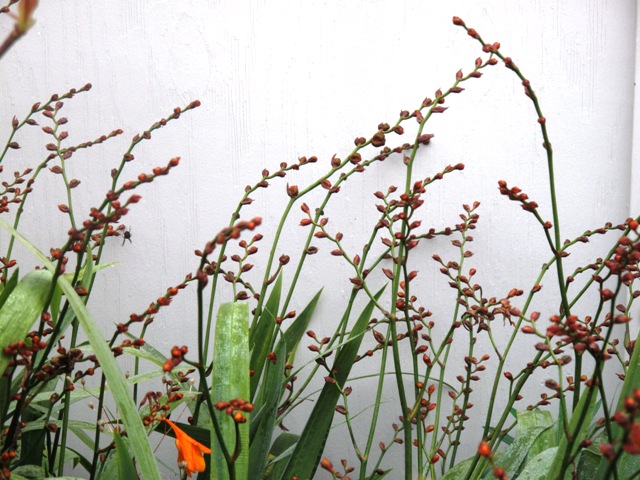
I love the architectural form of "spent" crocosmia blooms. These seed-heads are as beautiful as the flowers themselves.

Seasonal changes, at least at the beginning of the fourth quarter, work their magic here in the west. The light changes, the moisture content heightens, and the foliage reddens. The garden’s edges soften in some places (perennials go to seed; grass plumes explode; greens turn tan) and become more acute in other places (the architecture of deciduous plants is more pronounced; evergreen plants move to the foreground; anything that blooms is undoubtedly noticed as well). 

It’s almost as if the feminine personality of spring and summer steps aside for the more masculine personality of fall. Yet when I posed this theory to my friend Betsy Flack, she argued that “I’ve always thought (fall) was my own season—sort of the ample-bosomed (billowy) matron . . . after Spring’s sprite.” 

Our differing opinions reveal that the autumn garden is one we can all embrace. 

To me, there are four aspects to the 4th quarter garden that I consider when planning, touring and evaluating the well-designed landscape: 

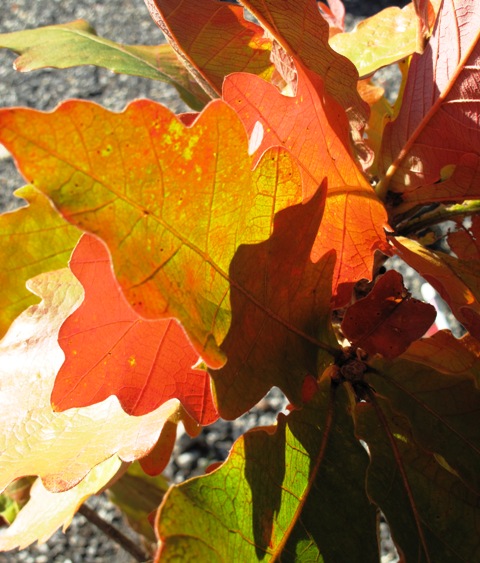
This is some kind of wild-looking oak, isn't it?

Foliage: 

Cooling temperatures and shortening days bring out the fall glow we so admire. Yet it’s not just color (golds, coppers, wine reds and dark purples) that I’m in search of. I also consider broadleaf evergreen plants with graphic foliage, as well as conifers that change with the season, taking on their own non-green hues. 

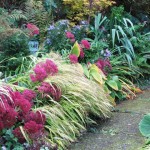
Laura Morton, a Hollywood designer, uses echinacea and asters in this yummy fall combo

Flowering plants: 

If you find a fall-blooming perennial that you like, plant it not once but thrice. 

Some of my favorites include Japanese anemone, heaths and heathers (Calluna vulgaris cultivars are especially gorgeous when the temperatures drop) and asters (A. novi-belgii; A. novae-angliae; A. lateriflorus). 

Fruit: Edibles and ornamentals unify in the autumn garden, lending a sense of “harvest” and hearkening 

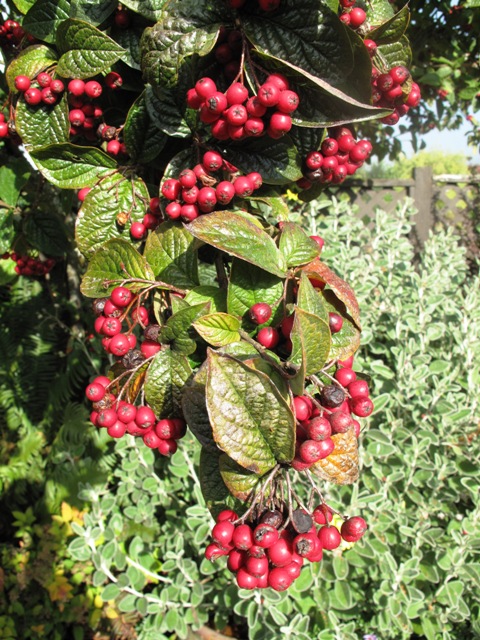
This cotoneaster will delight birds and humans alike.

back to the ritual and sustenance of gleaning fruit from the earth. Nuts, berries, pods, seeds, fruit – for eating or just eye-feasting – are essential elements of the autumn garden. Because I am a floral designer, I take particular interest in gathering rose hips, crabapple fruit, seed heads and even spent grapevines (with tendrils and curls) from the garden for use in my vases. 

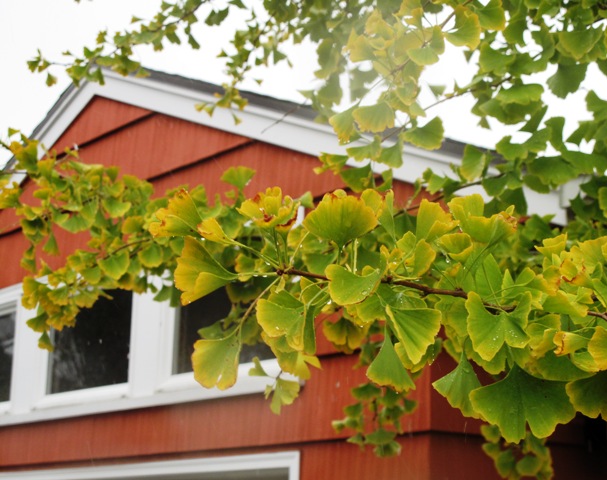
The yellowing gingko against a pumpkin-colored garage is a perfect fall scene.

Architecture: It goes without saying that structure is the backbone of 4th quarter gardens. Deciduous trees and shrubs, dormant perennials, disappearing annuals . . .they can do their thing and yet the arbors, gates, patios and pathways remain – thankfully. I take special note of the shadow-play created by light as it moves through a garden, catching shapes made by architectural elements and throwing those alluring patterns against walls and fences. 

Here are a few more seasonally-appropriate quotes to enjoy: 

” . . . asters: purple asterisks for autumn.” Conrad Aiken, Preludes for Memnon (1930) 

“Hurrah!  . . . it is a frost! — the dahlias are dead.” R.S. Surtees, Handley Cross (1843) 

A mosaic of autumn impressions: 

More from the 2010 Independent Garden Center Show

Wednesday, October 27th, 2010

Speaking at IGC was a great experience - with 2 talks in 2 days

Dateline CHICAGO: Another “first” this year was participating in the Independent Garden Center Show, which took place in Chicago, August 17-19th.

The fourth annual trade show for independent nursery owners and their staff gathers thousands under one roof for seminars, tours, a mega trade show, and serious networking.

The who’s who of the garden world comes to the IGC Show. I’ve wanted to check it out for a couple years, so when I was invited to make a presentation on the “Most Inspiring Garden Centers and Specialty Retailers,” I jumped at the chance to participate.

You can see some hightlights of that talk here. I had a wonderful audience of engaged and energized nursery owners. And I am encouraged by the response from these retailers interested in sharing my ideas and themes with their employees and staff.

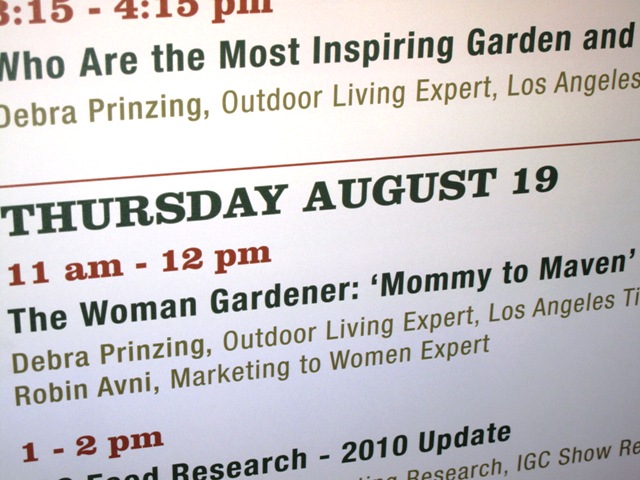
I participated in a second presentation with Robin Avni, a friend and colleague who has invited me to be an associate in her Lifestyle Insights consultancy. I’m one of a group of like-minded “real women” experts who have come together to use our talents and knowledge to help corporate clients serving the female consumer.

For the IGC Show audience, Robin and I presented “The Female Gardener: Mommy to Maven.” Our presentation shared some of the research and insights collected by Lifestyle Insights in the past 12 months. We want garden center owners and garden-related companies to think about the female consumer not just by obvious demographics of age, ethnicity or economics but by her life stages. We’ll be sharing more about our research in the coming months, but suffice it to say, Robin and I both felt that the presentation was a good way to have a conversation with the gardening industry about who “she” is (and “she” is a powerful consumer to serve).

Magnetic and inspiring - Jamie Durie

There were other fun aspects to attending the IGC Show, including hearing from keynote speaker Jamie Durie of HGTV’s Outdoor Rooms. Jamie’s electrifying talk was not long enough – in fact, it’s a bummer that he was sort of cut short due to timing, since he had so many inspiring things to share with American nursery owners and outdoor living retailers.

Here are a few of his comments that resonated with me:

Luxe-scaping is one of Jamie’s design terms. He likes to start a landscape with Shapes First, Plants Second. Once you decide on the shape (“Embrace the plant’s architecture,” he explains), you can choose site-adaptable and regionally-appropriate plants to reflect the shape.

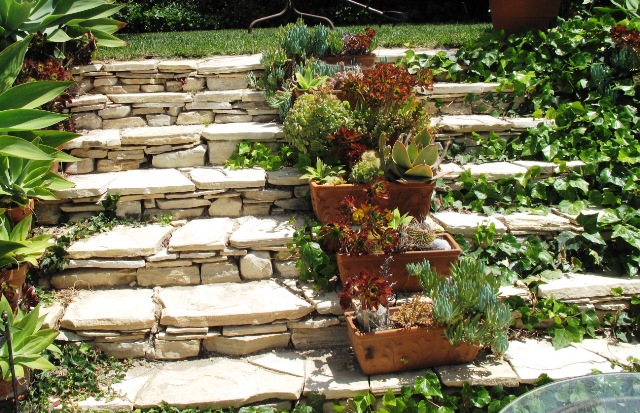
Jamie talked about “planting into the hard-scape,” an idea that helps to soften the architectural elements of a design. He showed images of one of the garden staircases designed by his firm Patio that caught my eye and nicely illustrated this concept. The wide stone-tread staircase has shallow risers that are planted to give a soft, green contrast to the hard-edged stone. This made me think of a succulent staircase at Ed and Susie Bealls’garden in Rancho Palos Verdes we saw recently (photo, below).

Here is a Southern California interpretation of "planting the steps" - from Ed and Susie Beall's garden.

It’s easy to get swept up in Jamie’s passion for enjoying the garden all year long. “Control your environment with built structures” and use new, technological and design features to do so (especially if you live in cooler climates). For example, Jamie uses overhead heaters as well as under-deck and under-patio warming systems. Outdoor fireplaces and fire pits are de rigeur for all-season garden living.

Jamie shared some of the ways he has developed and expanded DurieDesign, his overall brand. His advice could apply to anyone interested in staking out a position in the horticultural industry. I certainly found it useful. This isn’t comprehensive since I wasn’t writing notes as quickly as Jamie was speaking, but are some highlights:

Be able to state clearly your business Description, Expression, Attributes, Promise and Theme.

Study your brand personality and strategy. For Durie Design, the theme of “well-being” represents lifestyle and balance. There is a spectrum that goes from the tangible (what you do) to the intangible (why you do it). In between are the How and Who of your brand personality.

DurieDesign’s brand attributes includebeing Inspiring, a Design Authority, Accessible and having a Positive Energy. Know and communicate your brand promise. For DurieDesign, that means “connecting design and innovation wi the mind, body and spirit.” His brand theme: Let’s Go Outside. “People are intrinsically connected to plants.” Yes, that’s so true!
In the coming weeks, garden and design writers and their publications will be obsessing about “what’s hot” for the 2011 gardening season. I venture a guess that many of those must-have products, plants and ideas were introduced at IGC. I’m going to share my favorite new products — my “picks” — very soon.

My home design interview with actor Jonathan Togo of “CSI: Miami”

Sunday, October 3rd, 2010

 BEHIND THE SCENES WITH JON TOGO

Actor Jon Togo (center), with designer Lory Johansson and me

If you’re a fan of the “CSI” television franchise, you probably know this handsome young actor I’m standing with in the photo at left. He’s Jonathan Togo, aka investigator Ryan Wolfe of “CSI: Miami.” 

The show enters its 9th season with tonight’s premiere (10 p.m. on CBS). In anticipation of the show, I’ve posted my recent interview with Jon and his interior designer Lory Johansson.

Lory, an inventive and gifted designer whose firm is called Just Joh, introduced me to Jon’s 1958 Midcentury modern “guy pad” in the Hollywood Hills earlier this year. I love that Jon describes her as “the best design Sherpa” because it’s true. She has a gift for helping each client express his or her unique personality through furniture, art, and the home.

The Los Angeles Times photographed the interiors in July, the day of this photo, which Lory’s husband Mats Johansson took with my camera. My interview with Jon and Lory (and featuring a fun commentary by Jon’s mother, Sheila Togo) appeared in the Sept. 18 issue of the HOME section. You can read the story and see a gallery of photos here.

A charming necklace and a gesture of friendship

Sunday, June 20th, 2010

The back story

The cake says it all. Good-bye again.

My nearly four years in Los Angeles have been quite amazing. We arrived here in late August, 2006, not really excited about leaving our beloved Seattle, but trying hard to embrace our “new” life here in SoCal. 

The mood around our household has changed dramatically in 2010. The boy who was entering high school when we moved here has just graduated and is college-bound. The child who came here as a 4th grader is now a teenager, ready for 8th grade. The husband who came here for a pretty great job lost it during the financial meltdown. But in the interim, he earned an MBA from UCLA and joined an amazing new company NOT in financial services – one that uses his combination of legal and business talents for a compelling new business strategy.  

Happy in LA

 As for me, well, this four-year California chapter has been quite an adventure. I have grown professionally, honed my design sensibilities and in many ways gained more confidence (guess that comes with turn 50 anyway, right?). I have met and interviewed incredible people – designers of homes and gardens, artists, actors, directors, producers, animators – famous people and unusual characters alike, all of whom embody this beautiful spot on the planet. Writing about the homes and gardens they possess has been a privilege. Seeing those stories appear in some of the most well-respected publications has been quite satisfying. 

So now, we are moving again. And while I have alluded for months to our plans to relocate to Pittsburgh, the surprise ending of our California chapter is that we are actually returning to Seattle

Bruce’s company – at what feels like the eleventh hour – has shifted strategy and is moving its corporate HQ to Seattle. Manna from heaven, I say. A small part of me thought the Pittsburgh thing would be a fun adventure (actually, after what we’ve been through on the unemployment front, I would have willingly moved to Siberia). I have a few acquaintances in Pittsburgh – through Garden Writers Association – and I was interested in spending more time there getting to know them better. That optimism was combined with anxiety about having to garden in Zone 4 or 5; whatever low temperatures Pittsburgh experiences in the winter, at the very least I know it has snow – lots of it.  

So here we are, on the threshold of yet another move. But one that brings us full-circle back to the city where Bruce and I first met, lived as were newlyweds, gave birth to and raised two wonderful sons, became first-time homeowners, and even built our dream house, living a life surrounded by so many cherished family and friends.  

READ MORE…

Happy birthday to me

Saturday, February 28th, 2009
Celebrating my first birthday, February 28, 1960, with my mother, Anita

Celebrating my first birthday, February 28, 1960, with my mother, Anita

It pains me to admit it, but I was born 50 years ago today.

But one of my hip, young friends told me she thought I was 41, so I totally love her for that.

The hardest thing about turning 50 is that my mother can’t quite believe she has a 50-year-old child.

My mother is the youngest person I know. She is an artist and a writer and she has more curiosity about life than I will ever have. She also has patience, kindness, empathy and incredible courage.

I think today is more about celebrating Anita Louise Ford Prinzing than anything else. Thank you, Mom. You are the best. (Thank you, Dad, too. You are also the best!)

My husband has turned the five-year birthday mark into an art form. When I turned 40, our boys were 2 and 7. Bruce surprised me by flying my mother to Seattle to take care of them so we could go to Palm Springs for the weekend.

When I turned 45, he flew me on Business Class to London and arranged for me to spend 5 days visiting the Chelsea Flower Show and other awesome gardens (including Wisley, Great Dixter, and Sissinghurst). A magical, unforgettable trip. The pressure was on for turning 50.

But I decided to take matters into my own hands to plan my 50th b-day and also Bruce’s and my 25th wedding anniversary (which is in August). So I booked two weeks at Villa Maddalena, a magical and ancient villa that our friend Marcia has renovated. It is situated in a small Tuscan village called Montisi. At the end of October, I will get to spend one week there with many of my girlfriends. And then, the following week, Bruce and my sons will come for a family vacation – to celebrate our 25th anniversary.

When I invited my girlfriends to make the trip, I wrote something a little carefree (careless?).

Live large, people. The economy is in the toilet; the publishing world is spiraling into a ghost of its former self. Oh well. What’s left to do but eat pasta and drink Chianti?  

This kind of cavalier attitude might be what gets us through the current malaise of life. Many of us are in a waiting pattern. . . waiting for life to get back on track, waiting for things in Washington to sort themselves out, waiting for a job, waiting for the housing market to rebound. We have to find the joy, the surprise, the spontaneity. Birthdays allow us to do just that. We have one day every year to be self-indulgent and frivolous. Oh, but there’s one problem. I have two story deadlines today. UGH.

Even so. . . it will be a day of laughter, family, friends, and celebration – as I think about that Tuscany trip in October.

are you a SHEDISTA?

Thursday, December 11th, 2008

If you, like me, are enchanted with sublime and soulful backyard destinations once merely called “sheds,” consider yourself a Shedista

According to some Internet searches, the term Shedista has been appropriated (originated?) by the boutique wine industry. In France, these clever folks are called “Garagistes,” because they make incredible wine in their garages. Kind of an underground movement!
To quote Wordspy.com: “Shedista: A professional, low budget wine maker, particularly one who processes grapes in a shed-like building.”

I first discovered this term in Jay McInerney’s “Uncorked” column for (now defunct) House & Garden magazine: It was titled “The Shedistas.”

He wrote about a “warehouse gang” of Santa Barbara winemakers who “maxed out credit cards to rent a shed, buy a few tanks and a few tons of Syrah grapes, design a label, and make [their] own wine.”

Those who know me well know I have no desire to steal a moniker from winemakers. However, if you do an Internet search of the word, I bet you’ll find nearly three-quarters of the Shedista entries appearing are ones that I’ve generated. Yup, I’m out to change the meaning of this alluring term.

Here’s my definition: “Shedista: A person who creates and occupies a small-scale shelter in the garden for personal enjoyment and the pursuit of any creative passion.”

My UK shed friend, Uncle Wilco, who publishes a blog at his We [heart] Sheds site, calls himself a “Sheddie.” It’s a close cousin to “Shedista,” and we can all feel free to use both terms! Another friend coined the word Shedquarters to describe his backyard office. In other words, shedistas find shelter in their shedquarters. I like it!

If you wish to see some of the very best examples of personal escapes, aka “sheds,” check out my book: Stylish Sheds and Elegant Hideaways. Welcome to all Shedistas!

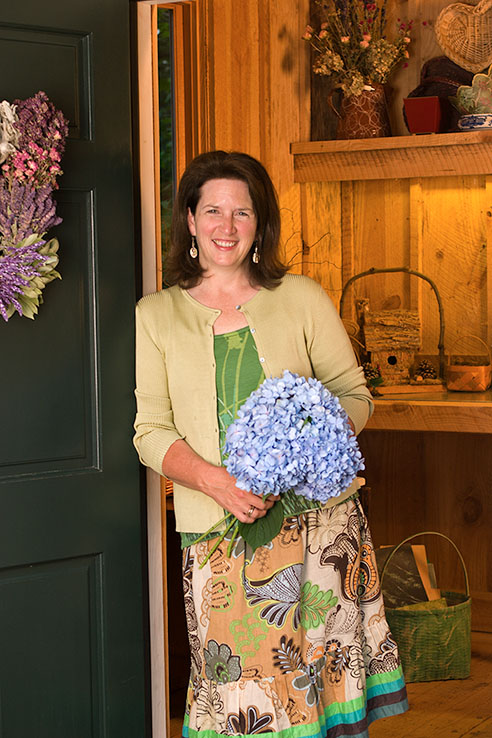
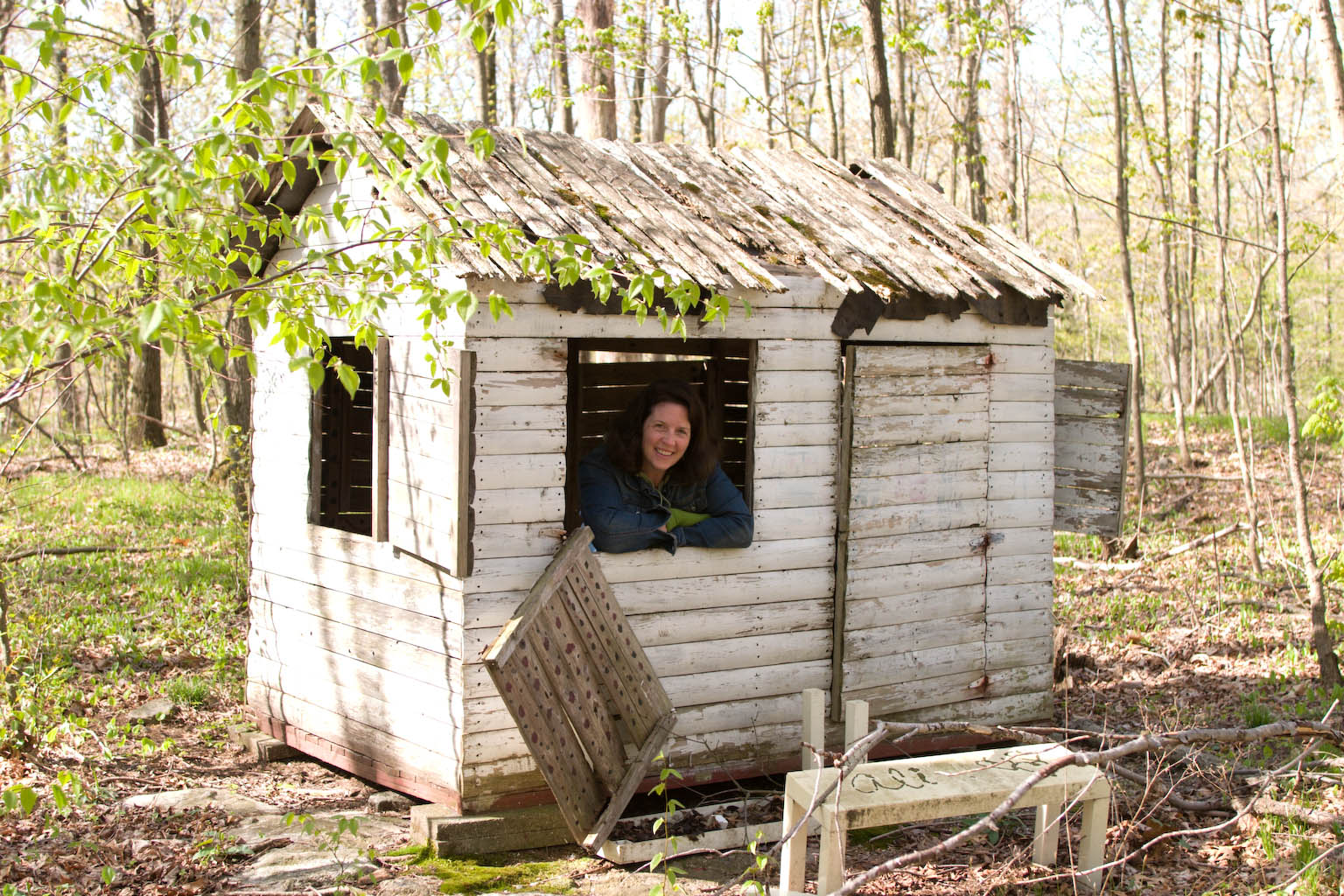
Photos: (c) William Wright; top left: taken in July 2007 in Atlanta – in the doorway of Betsy Hansen’s beautiful potting shed. Lower right: taken in May 2007 (as a joke) at an abandoned child’s playhouse in Connecticut. We were on location at author Amy Bloom’s property and noticed this “shack” on a hill near her property. We couldn’t resist!

A Post-Script, Uncle Wilco just tipped me off to his December 14, 2006 post “What is a Shedista?” in which he quoted the same Wordspy definition I’ve used. I like what he wrote after that:

sounds great, but who is someone who brew beer in their sheds, maybe a shedbrewhaha

As I wrote in a reply to him: Of course, while I was running around the country trying to find sheds to photograph and write about, there he was . . . steps ahead of me! Thanks Uncle Wilco!