The Slow Flowers Podcast is the award-winning show known as the “Voice of the Slow Flowers Movement.” Launched in 2013 as the original flower podcast, we’ve devoted more than 10 years to covering the business of flower farming, floral design, and the Slow Flowers sustainability ethos. Listen to a new episode each Wednesday, available for free download here at slowflowerspodcast.com or on iTunes, Spotify, and other podcast platforms.
January 22nd, 2008
 My friend Paula Panich recently shared this passage from Doris Lessing’s 2007 Nobel Prize for Literature speech, presented on December 7, 2007. Lessing urges writers (and, I would imagine, any creative person) to seek a distinct and personal space in which to feel surrounded and enveloped when putting pen to paper. Her admonitions gave me goosebumps. It was if this literary icon was speaking directly to me. There she was, an accomplished and celebrated author, sharing an insight about the practice, the craft, of writing. And what she says — about escaping to that separate place — feels just right. Read an excerpt below:
“Writers are often asked: “How do you write? With a [word] processor? an electric typewriter? a quill? longhand?” But the essential question is: “Have you found a space, that empty space, which should surround you when you write? Into that space, which is like a form of listening, of attention, will come the words, the words your characters will speak, ideas – inspiration.”
If this writer cannot find this space, then poems and stories may be stillborn.
When writers talk to each other, what they ask each other is always to do with this space, this other time. “Have you found it? Are you holding it fast?”
Let us now jump to an apparently very different scene. We are in London, one of the big cities. There is a new writer. We, cynically, enquire… “Is she good-looking?” If this is a man: “Charismatic? Handsome?” We joke, but it is not a joke.
This new find is acclaimed, possibly given a lot of money. The buzzing of paparazzi begins in their poor ears. They are feted, lauded, whisked about the world. Us old ones, who have seen it all, are sorry for this neophyte, who has no idea of what is really happening. He, she, is flattered, pleased. But ask in a year’s time what he or she is thinking. I’ve heard them: “This is the worst thing that could have happened to me.”
Some much-publicised new writers haven’t written again, or haven’t written what they wanted to, meant to.
And we, the old ones, want to whisper into those innocent ears: “Have you still got your space? Your soul, your own and necessary place where your own voices may speak to you, you alone, where you may dream. Oh, hold on to it, don’t let it go.”
For so long, I have had to apologize for wanting to close my office door. Yet having a door is a luxury, considering the place where I used to sit when I wrote. Before moving to my current home nearly a year-and-a-half ago (where my office is a former bedroom with a real door — hinges, knob and lock included), my writing desk resided in a corner of an open loft.
Yes, all three bedroom doors opened onto this space where desk, computer and bookcases were shoved against one wall. This space also contained a futon and a cabinet where the television was hidden. I began freelance writing in earnest when we built this home in 1998, with a one-year-old and a six-year-old nearby. As a writer, I shared this “sacred” space with the children’s play area (in those days, in the late 1990s, I would actually un-plug the phone and fax during nap-time, holding my breath that the UPS delivery guy wouldn’t ring the doorbell and destroy my perfect 90 minutes of quiet!).

My daily view, Lake Washington (1998-2006)
In one sense, I couldn’t complain, because this perch offered me the most dazzling views of second-growth Northwest forest (on a park-peninsula that jutted into Lake Washington), the lake’s ever-changing, but usually grey-blue surface, and the top peaks of the Cascade mountains to the east. How could I whine about my work space when I enjoyed the respite of lifting my eyes away from the computer screen to peer at this gift of nature anytime I needed a pause?
Yet, to use a phrase that novelist Amy Bloom shared with me about her “mom” years as a writer: I was interruptible. Can you imagine being on deadline for an article while also listening to Pokemon cartoons playing in the background? Or trying to conduct a telephone interview while whispering an answer to the daily question: Mom, what can I have to eat? Moms who are attempting to create anything — art, words, a garden — can imagine this.
So yes, I jealously guard my current office with a DOOR THAT CLOSES. I get testy whenever someone enters. There is a comfy futon in here, too, so I occasionally feel like a talk-show host who entertains a steady stream of guest stars…this is usually when one of my guys plops down on those welcoming lime green cushions and wants to talk. But sometimes . . . I just want to lock the door and relish in solitude and the creative atmosphere it produces.
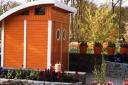
 The pursuit of personal, hidden, secluded space for one’s creative endeavors is a thread that runs through my forthcoming book, Stylish Sheds and Elegant Hideaways. While interviewing and photographing locations with my partner Bill Wright, I was so often struck with a sense of awe that the many gifted and talented individuals we profiled trusted us enough to share their “necessary place” with us. They knew we gave respectful attention to their studios, ateliers, nooks and sheds. Regardless of the artistic endeavors that may occur inside the owner’s tiny structure, often measuring just a few hundred square feet in size, we were well aware of the honor and prestige bestowed upon each space. For those whose professional pursuits seem mainstream or decidedly non-artistic, the private, personal space is somehow even more precious: a symbol of time to daydream, ponder and contemplate; to be alone with oneself.
Here are some of the comments we gathered during our interview and photography sessions:
“The real reason my shed exists is so that I can work uninterrupted. There is no phone, no Internet in here.” — Amy Bloom, novelist and creator of Lifetime Network’s ‘State of Mind’
 “In designing this studio, my motive was to make it a happy space, because I make happy art.” — Liz Lyons Friedman, printmaker
“Being in the shed makes me feel more connected – and grounded – to the creative forces that simplicity affords. It’s a very practical environment that offers a great escape from all the complexities that surround me.” — Lin Su, designer and painter
“Here’s where I keep everything I want to save and love. This is my little comfort zone, my quiet place.” — Sunni Rudd, illustrator
Another quote from Sunni: “I have a hard time slowing down, but when I come here I want the solitude of my garden shed. It keeps me on an even keel. It keeps me planted.”
“I always wanted to find a place in the country – a retreat. And for years, I had plans for this potting shed in my mind.” — Sylvia Williams, Master Gardener
“People don’t necessarily need more house as much as they need more places to be where they can have fun and utilize their outdoor spaces.” — Kathy Fries, horticulturist
“If I’m inside my shed and it’s raining outside, I feel cozy. On warm days, I pull my chair out to the shed, open the windows and doors, and enjoy the view of my garden.” —Joan Enticknap, banking executive and avid gardener
“It’s so beautiful to be in the little house. We use it in the evenings, on Sunday afternoon when the sun pours in, in the fall when we have a fire going and the doors are open. It’s heaven.” — Anne Kennedy, artists’ agent
 “The moment I enter, I’m in a different world.” — Rand Babcock, furniture designer
“It’s intimate; it’s a space that transforms your mood when you enter.” — Tony Nahra, furniture designer
“It’s a lovely place for me to get away. I like to go up there and view the garden; there’s always a nice breeze and I’m away from the phone!” — Patrick Anderson, plant collector and musician
“We’re perfectly aware that we have things to do indoors, but it’s hard to stop being there.” — Beverly Sutton, pediatrician and child psychiatrist
The “space” to which Doris Lessing refers may be a physical space, like a writing studio, sacred and separate. Or, perhaps it is an inner space, the hard-to-explain silence we seek when beginning a writing project. But it is vital and valid, and necessary.
Posted in Creativity, Spiritual Practices, Writing | 4 Comments »
January 18th, 2008
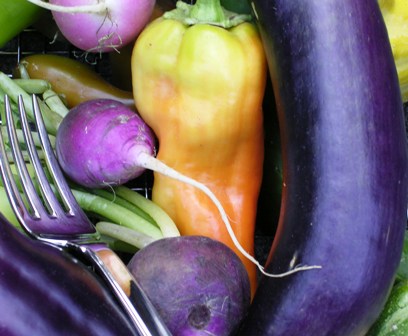
Eat Your Vegetables: Garden to Table [Cindy Combs photograph]
The minute the calendar page turns to the New Year gardeners don’t read: “January.” They read: “Spring.” It’s silly when so many places are still buried in snow, have sub-freezing temperatures, or even worry (as I am) about occasional frost. But we are busy planning our planting schedules.
Until the soil warms up, however, we can take solace in the piles of seed catalogs that fill our mailboxes. To speed up spring’s arrival, we buy tickets to the pre-season extravaganzas: Flower and garden shows. I liken these green celebrations to the “annual meeting” for plant lovers — especially plant lovers who push the envelope when it comes to defining our gardening season.
I’m deep into planning my February and March travel itineraries for taking in the Northwest Flower & Garden Show (February 20-24) and San Francisco Flower & Garden Show (March 12-16), respectively. I’m excited to gain new inspiration for hot plants, cool designs and inspiring lessons from the show gardens. Here’s where I can revel in horticultural happiness with like-minded souls, because seeing friends, of course, is a huge part of the fun.
For months I’ve been hearing from my Seattle garden friends about the flurry of activity surrounding the Northwest Horticultural Society’s display that will (I think) be the educational organization’s largest ever at the Northwest Flower & Garden Show. As a former NHS board member and past editor of the organization’s newsletter, “Garden Notes,” I have a special place in my heart for its people and programs. Through NHS and its members and speakers, I have gained so much knowledge and inspiration over the years.
NHS has sponsored inspiring art- and plant-filled displays in past years. For 2008, NHS president Nita-Jo Rountree tells me the focus will be on edibles. “Eat Your Vegetables! Garden to Table,” promises to be centered around a tasty and inspiring display garden. Actually, THREE edible gardens. When it opens on February 20th, the installation will be a centerpiece of the Washington State Convention Center’s south lobby entrance. The goal is to demonstrate to showgoers that edible plants are easy to raise, attractive when mixed with ornamentals in the landscape and, with a few simple preparations, ready to go from the garden to the dinner table.
The 1,200-square-foot display will highlight two huge lifestyle trends — growing vegetables and cooking “fresh,” says Nita-Jo. I called her recently to get the inside scoop on how the garden plans are coming together. The design will feature an chef demonstration stage, plus a trio of edible landscapes: A formal French potager, designed by Robyn Cannon (featuring material and ideas from Lucca Statuary and Lakeview Stone); a contemporary container garden, suitable for balcony and rooftop, created by award-winning designer Wendy Welch; and the ideal patio kitchen garden with a “to-die-for” Aqua Quip kitchen and furnishings supplied by Gillian Mathews and Ravenna Gardens.
“Vegetables, fruits and herbs are the rage in gardening right now,” Nita-Jo says. Interest in growing one’s own food is a response to healthy lifestyle trends — a philosophy that excites and inspires novice and experienced gardeners alike, she points out.
“We’ll have organic cooking demonstrations surrounded by ideas for vegetable gardening and seed starting,” Nita-Jo adds. From Ciscoe Morris’s favorite Brussels sprouts to the recipeses of famed chef Jerry Traunfeld, formerly of The Herb Farm, cooking with seasonal and local ingredients will be presented.
Good design is an important element of appealing edible gardens. “We’re going to have a very cool circular stone patio that Lakeview Stone is installing,” Nita-Jo explains. “It will be surrounded by a tapestry of lettuces and strawberries.” Robyn recently shared with me her exploits in procuring 150 “perfect” dwarf boxwoods, which will knit together the intricate parterre for her potager design. All around, this is an ambitious – and delicious – undertaking.
To think that hundreds of tiny plants are needed to create the perfect edible garden is mind-boggling. A review of the list of vegetable seeds started and forced indoors weeks ago reveals the ambitious scale of this endeavor: Lettuces with names like ‘Outredgeous’, ‘Merlot’, ‘Oak Leaf’, ‘Italian Misticanza’, ‘Yugoslavian red butterhead’ and ‘Black Seeded Simpson’; ‘Bright Lights’ and ‘Golden Sunrise’ chard; ‘Grafitti’ cauliflower; ‘Russian Red’ kale; and ‘Ruby’ cabbage. The bounty of the greenhouse also includes aforementioned Brussels Sprouts, plus onions, leeks, rhubarb, chives, parsley, cilantro, sugar pod snap peas, strawberries, rosemary, a bay tree, fig trees, tomatoes, peppers, beets, spinach, and 10 espaliered apple trees!
Creating a Flower Show display garden is nothing short of a labor of love – one that is created to share with thousands of fellow garden-aficionados. For those of us who desire an edible garden, one that feeds and nourishes our bodies and souls, the NHS display will be even more meaningful. Best of luck building your gardens, NHS!
Posted in Creativity, Entertainment, Gardening | 5 Comments »
January 4th, 2008
 There’s something magical about a plant that keeps growing even after you think it’s a goner. I love seeing new leaves sprout from my just-pruned apple tree branches (I used to stick both ends of the saplings into the soil around the perimeter of my vegetable beds to create low scalloped fencing each spring).
If harvested while its branches are bare, willow (Salix sp.) performs its magic, too. My textile background and my love for any material that can be woven like fabric, combined with my penchant for gardening, has drawn me to supple ingredients like willow. So it’s no surprise that I enjoyed building my own “willow goose” in 2002.
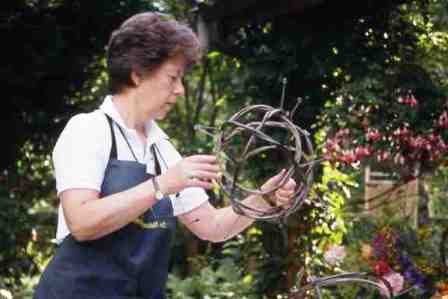
Jacky Barber teaching willow techniques
On a pleasant June evening, I was invited to join members of the Woodinville Garden Club to gather for a willow workshop in Carol Ager’s garden in Woodinville, Wash. This special class was led by two British willow-weavers, Pat Hutchinson and Jacky Barber. Known as “The Willow Weavers,” the duo’s artistic efforts in 2001 won them the coveted Gold Medal at the famed Chelsea Flower Show. The women were in town to teach at the annual Hardy Plant Study Weekend, hosted by the Northwest Perennial Alliance. It was a rare opportunity for about 20 Seattle area gardeners to play with willow, learning Jacky and Pat’s techniques for creating willow animals. Since I wasn’t a garden club member, I considered myself lucky to participate.
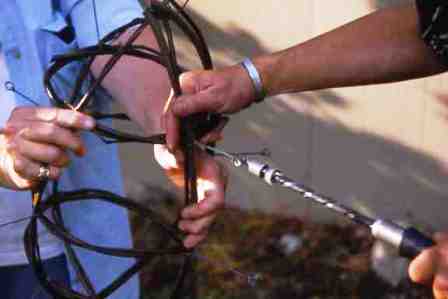
Using a “Twisler” tool to tie and secure bent willow
We used fresh willow twigs from Judy Zugish of Marysville’s Bouquet Banque nursery (which also operates a basketry school called FishSticks). Cut in the dormant season, the 5-foot and 7-foot lengths of Salix alba ‘Polish Purple’ branches were soaked in water for five days to make them workable. Jacky and Pat recommended wrapping the branches in damp cloths or plastic sheets to keep them moist while working with them (especially in hot weather).
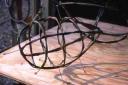 As we worked in teams to create a larger-than-lifesized goose, heron or swan, the women showed us how to manipulate the willow branches and form animal shapes using tools and wire fasteners. The nifty trick is to use 4-6 inch “wire ties” with a loop at each end. The wire is used in the UK to seal sacks of potatoes and in the US for securing rebar. You can find them at home improvement centers. To join pieces of willow, we used a hand-held tool called the “Twisler” or “Twister.” It hooks into the two loops that have been wrapped around willow bundles. When the tool is pulled, it twists and secures the wire (this tool is available from Stanley Tools). The other useful willow-working tools include pruners for cutting and trimming branches, wire cutters for removing excess wire, string to hold willow sections in shape before they are wired, and measuring tape.
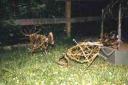 After making the various animal parts — head, neck, body and legs — we used more wire ties to connect them. Playful and perfect for the flowerbed, my completed willow goose stood around 5 feet tall. I stuck the twig “legs” a few inches into the soil and enjoyed watching how the garden began to grow in and around its body.
Inevitably, willow creations are short-lived. Subject to exposure, elemental extremes and the vagaries of time, there is a temporal nature to anything fabricated from twigs and stems. That’s why I was blown away when I saw Patrick Dougherty’s woven twig sculptures.
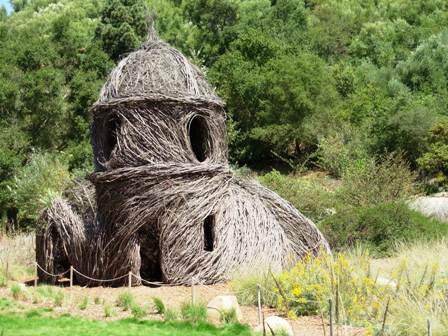
“Toad Hall,” by Patrick Dougherty
Resembling a whimsical, storybook abode (perhaps an ambitious version of the first Little Pig’s house of sticks?) the large-scale, temporary sculpture Dougherty created for Santa Barbara Botanic Garden in 2005 was a joy to behold. Named “Toad Hall,” it stood in a distant field, beckoning us to come. We were able to touch the twisted branches that formed walls more than 4-inches thick. We walked inside the rounded structures, peered out of the windows to notice the landscape beyond, gazed at the fanciful turret-shaped roof-line against the blue September sky. That I visited the garden and Toad Hall more than a year after Dougherty had created it was a testament to the durability of his creations. That the willow had begun to sprout leaves added a spontaneous twist to the installation.
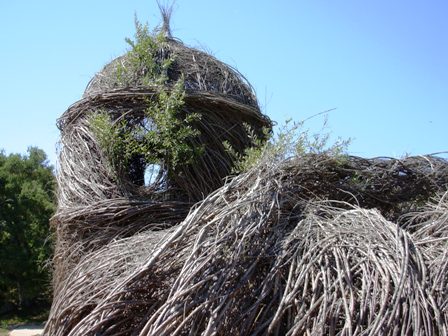
The building began to “grow” in place, long after the original branches were cut from willow trees
Patrick Dougherty is based in Chapel Hill, North Carolina, but he has a worldwide reputation for creating on-site twig sculptures. Commissions have taken him to Japan, England, Denmark, and countless American cities. Some of his projects look like pieces of tornado-blown tumbleweed, slightly askew, slightly tilted as if they survived the “big one.” Others take advantage of permanent architecture, climbing up the face of a building or weaving in and out of columns. In a book titled “Where there’s a Willow, there’s a Way,” which I picked up at the Santa Barbara Botanic Garden, there are construction process photographs depicting two-story high scaffolding on which he must stand to work at this scale.
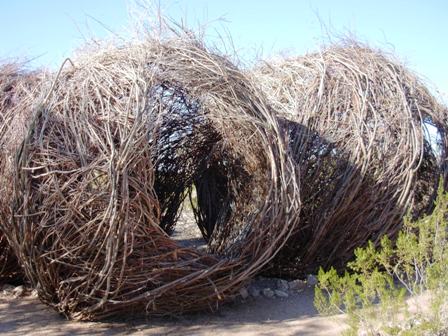
“Childhood Dreams,” by Patrick Dougherty – made from willow and creosote, measuring 47-feet high x 12-feet wide x 29-feet deep
Just before Christmas I had an unexpected surprise when I stopped by the Desert Botanical Garden in Phoenix. I was on a two-day visit to see my folks and sneaked away for a sunny Sunday afternoon visit to the garden, a favorite place of mine. As I walked the loop through the grounds, I could see a willow creation emerge at the edge of my periphery. WOW! Of course, it was another Patrick Dougherty installation, created last year. Called “Childhood Dreams,” the playful project is a series of interconnecting spherical rooms.
 You can see a slide show of the 17-day design and installation process featuring Patrick Dougherty on the garden’s web site. It was fascinating to learn that the design was inspired by the rounded forms of golden barrel cactus that grow throughout the botanical garden. Circular “windows” in the rooms are aligned to capture important desert views.
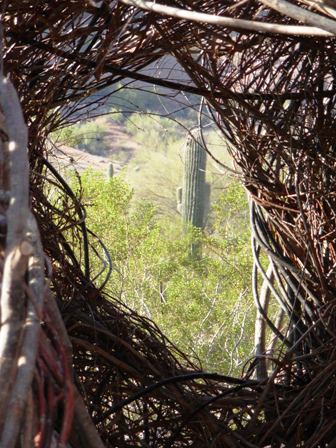
One curator had this to say about Dougherty’s willow sculptures:
“Dougherty’s works allude to nests, cocoons, hives, and lairs built by animals, as well as the man-made forms of huts, haystacks, and baskets, created by interweaving branches and twigs together. Many of his works look ‘found’ rather than made, as if they were created by the natural force of a tornado sweeping across the landscape. He intentionally tries for this effortless effect, as if his creations just fell or grew up naturally in their settings.”
It’s so easy to be drawn into a Patrick Dougherty sculpture because it is, in so many ways, a living, organic expression. Quite humbling, in fact, to see how something so simple, so ordinary (otherwise destined for the compost heap) can be reinterpreted as architecture.
Posted in Creativity, Gardening, Playfulness, Shed Glossary | 5 Comments »
January 2nd, 2008
 Yesterday, on the first day of the year, my 10-year-old son, Alexander, asked me to tell him my New Year’s resolution. That he posed this question at about 8 a.m. while I was trying to grab a few more moments of a midwinter’s nap after a festive “eve” the night before was only slightly bothersome. His innocence and optimism in the power of a simple turn of the calendar’s page to a new month (and year) was endearing nonetheless.
I didn’t hesitate, but immediately told Alex: my resolution this year is to grow a garden.
It has been 16 months since we’ve been uprooted from our beloved Seattle garden (and home) and suddenly transplanted to Zone 10, Ventura County. We’re living not far off of a freeway exit, half-way between Los Angeles and Santa Barbara. Like the results of a 4-inch perennial that’s been quickly planted in unprepped soil, we’ve experienced some “transplant shock,” so to speak.
Now is the time to begin transitioning from newcomers to neighbors. The change has begun, from discovering the local farmer’s market (thanks to my kind and generous neighbor, Alisa), to attending monthly Southern California Horticultural Society meetings where fellow plant-lovers welcome and include me, to hitting the road touring gardens, nurseries and other horticultural destinations with my Garden Writer pals like Nan, Joan and Paula. There is much here to admire, learn, embrace and even emulate in our suburban backyard.
So the process is underway. It requires a resolution of faith and optimism in order to put aside the “cherished familiar” and begin to look intentionally at the unfamiliar as my own new canvas. It begins with learning how plants grow and survive here in Southern California. Already our yard has begun its return to health because we cancelled the mow-and-blow-and-fertilize service the day we moved in. New layers of organic compost are continuing the process.
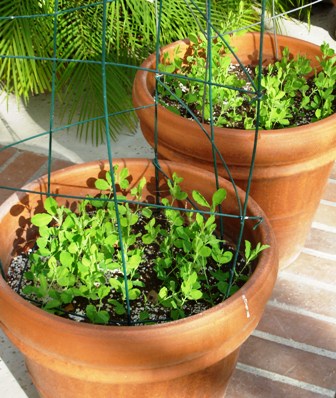
Lathyrus odoratus, Early Multiflora Blend and Bouquet Blend
I’m waiting for sweet peas that I planted six weeks ago to bloom and share their perfume (the seedlings are about 8-inches tall and promise to perform once the temperatures warm up). I’ve ordered way too many seeds and started to lay out the planting beds.
New Year, New Garden. It’s a hopeful time.
Posted in Creativity, Gardening, General | 2 Comments »
January 1st, 2008
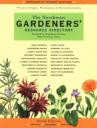 Wow, I’m honored to report that Arthur Lee Jacobson, the tree guru himself, has paid a very high compliment to the late Stephanie Feeney and me for the Northwest Gardeners’ Resource Directory (9th ed.). This book is the “yellow pages” for gardeners in Oregon, Washington and British Columbia that Stephanie started in the 1990s and grew as a self-published reference through eight wonderful editions. We lost Stephanie in 2000, a premature death due to cancer at age 52. Before she died, Stephanie and her husband Larry Feeney sold NWGRD to Seattle-based Sasquatch Books. And thanks to some gentle nudging from Stephanie, Sasquatch editorial director Gary Luke asked me to revised and edit the ninth edition. This was my “first” chance at writing and editing a garden book, published in 2002. I am eternally grateful to my friend Stephanie for believing in me.
Arthur Lee’s periodic newsletters are always filled with useful information about his many writing and consulting projects, including his books, Trees of Seattle 2nd edition (2006) and Wild Plants of Greater Seattle (2001), two amazing references for anyone wishing to learn more about the Emerald City’s flora, native and exotic alike. His latest newsletter, out in late November 2007, included this wonderful entry:
“The top dozen from my library of some 325 PLANT book titles, that I would keep if forced to reduce from 30 feet of shelf space to about 2 feet 8 inches . . . assuming copies of books written by myself could be kept” —
Listed among venerable titles like Hortus Third, American Horticultural Society A-Z Encyclopedia of Garden Plants, Sunset Western Garden Book and Hillier Manual of Trees and Shrubs, Arthur Lee has included our directory as a must-have book on his library shelf:
“Northwest Gardeners’ Resource Directory: All Northwest gardeners will find this helpful, though a new edition would be better.”
I agree! It would be ideal to update the reference book that Stephanie spent more than a decade developing and I spent the better part of a year working on, as I updated tens of thousands of entries. But lots has happened since 2002.
First of all, the Internet has made it easier to find nursery and plant sources, public gardens, horticultural organizations, garden tours, retail emporiums and more. Second, because of the Internet, it seems like a directory like ours would be ideally suited for an online database. So how will that happen? I’m open to ideas. For now, Sasquatch Books isn’t particularly inclined to publish an online directory, as it is still rooted in the world of printed books. My thought is to find someone (or a group of someones) interested in creating a new model – and find a way for that group to run the directory as a nonprofit or for-profit web site.
In the meantime, people wishing to send me updates about changes in the Northwest gardening world are invited to fill out a form on my web site. I try to post these changes, including the opening of new nurseries or other changes, on that section of www.debraprinzing.com.

Stephanie Feeney and Debra in Stephanie’s garden on Lake Whatcom, Bellingham, Wash. [Gary Luke photograph]
It puts a smile on my face (and I know Stephanie is smiling up there, too) to know that our friend Arthur Lee still uses his five-year-old version of the Northwest Gardener’s Resource Directory. If his copy is anything like the one on my desk, it is a bit dog-eared, with post-it notes sticking every which way from important pages, and my notations in the margins about special discoveries while traveling the Northwest’s horticultural highways.
Now that I am trying to learn and discover new sources for plants, gardens and tours, I sure could use a directory like ours in Southern California!
P.S. It isn’t fair to end this post without giving you the complete list of Arthur Lee’s “essential” books. His encyclopedic mind is unparalleled. This list will explain in part why I’m so tickled to see our little local directory included:
- The Standard Cyclopedia of Horticulture, 6 vol. (1914-1917); New York: MacMillan, by Liberty Hyde Bailey. “The greatest horticultural title ever produced in America. It utterly shames modern works such as the RHS Dictionary of Gardening. Its completeness, erudition, illustration and layout are all superb.
- Hortus Third (1976); New York: MacMillan, by Liberty Hyde Bailey, revised by L.H. Hortorium Staff. “A scholarly, concise, enumeration of horticultural plants grown in North America, and their myriad names.”
- Trees and Shrubs Hardy in the British Isles, 8th ed. (1970-1980), 4 vols; London: John Murray; D. L. Clarke, chief ed. “Comprehensive, learned account of cultivated temperate-zone woody plants. Weak in U.S. cultivars.”
- American Horticultural Society A-Z Encyclopedia of Garden Plants (1997); New York: DK Publishing, by Christopher Brickell and Judith D. Zuk. “Of the clumsily stout and heavy modern encyclopedic books packed with color photos, I prefer this.”
- Landscape Plant Problems: A Pictorial Diagnostic Manual, 3rd ed. (2006); Puyallup, WA: Washington State University Cooperative Extension, by Ralph Byther et al. “Color photos of Western Washington common garden plant bugs and diseases. When consulting, I use the photos to show clients. Once one learns the problem’s name, then other sources suggest actions. (You can buy this at South Seattle Community College’s bookstore).”
- Cornucopia II: A Source Book of Edible Plants, 2nd ed. (1998); Vista, CA: Kampong Publications, by Stephen Facciola. “The most practical and handy book to learn about edibility of plants, and their availability.”
- Northwest Gardener’s Resource Directory, 9th ed. (2002); Seattle, WA: Sasquatch Press, by Stephanie Feeney (ed. Debra Prinzing). “All Northwest gardeners will find this helpful, though a new edition would be better.”
- The Plant Locator(R) Western Region (2004); Portland, OR: Black-Eyed Susan Press and Timber Press, by Susan Hill and Susan Narizny. “The quickest way to learn about commercial availability of garden plants. More than 60,000 plants included.”
- Hillier Manual of Trees and Shrubs, 7th ed. (2002); Newton Abbot, England: David & Charles, John Hillier and Allen Coombes. “Useful one-volume, compact and comprehensive list of cultivated temperate-zone woody plants. Weak in U.S. cultivars.”
- The Plant Book: A Portable Dictionary of the Vascular Plants, 2nd ed. (1997); Cambridge, England: Cambridge University Press, by D. J. Mabberley. “By far the best one-volume source to look up any plant family of genus. Small, dense and invaluable.”
- New Flora of the British Isles, 2nd ed. (1997); New York: Cambridge University Press, by Clive Stace. “The best botany book to identify non-native plants growing wild in the Seattle area. Richly complete; over 1,000 pages.”
- Sunset Western Garden Book, 8th ed. (2007); Menlo Park, CA: Sunset Publishing Corp., Kathy Brenzel, editor. “All western North American gardeners should own this. Every edition gets better.”
Posted in Book reviews, Creativity, Gardening, Shed Glossary, Writing | 1 Comment »
December 25th, 2007
Anyone who has taken an art theory course or studied design will be familiar with the “golden mean” or the “golden ratio.” These terms describe a magical, eye-pleasing proportion that appears time after time in nature’s own handiwork. The mathematical formula is 1-to-0.618.
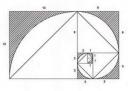 Look at a nautilus shell or the face of a perfectly-formed dahlia and you’ll see evidence of that unmistakable perfection. Artists, architects and designers have tried to attain (emulate?) this natural phenomenon. The logarithmic formula was studied by a 13th Century mathematician, Leonardo da Pisa (Leonardo Fibonacci). He developed what is known as the “Fibonacci Series,” a progression of numbers that explains nature’s structural design, especially seen in botany. Beginning with 1+1=2, and then adding the sum of the first two numbers with the second, you begin to see an endless series of numbers: 1, 1, 2, 3, 5, 8, 13, 21, 34, 55, 89, 144, etc. (Each number is the sum of the two numbers preceding it.) Count the seeds on a pine cone, daisy or sunflower. You will begin to see this beautiful, perfect, equation.
Another related, and also timeless, design notion is called the “French Third.” It is the approximate ratio of 1/3-to-2/3, which also appears in classical paintings, sculpture, architecture and design.
Now I read that scientists think even our brains intuitively respond to evidence of great beauty.
Researchers in Italy recently showed great works of art to volunteers with no artistic training (some of whom had never before been to a museum). According to a report in The Week (12-7-2007), neuroscientists showed their subjects images of Classical and Renaissance sculptures by Michelangelo and da Vinci. Some of the images had been altered, slightly modifying the original proportions. When subjects viewed pictures of the original sculptures, scans of their brains showed a strong emotional response.
There was less response to the sculptures with changed proportions. “We were very surprised that very small modifications to images of the sculptures led to very strong modifications in brain activity,” researcher Giacomo Rizzolatti was quoted as saying. The brain, he surmised, may have a special attraction to images that demonstrate the golden ratio, which shows up in nature, and is emulated in great art. And our brains interpret these proportions, responding to them positively.
It is quite humbling to realize that for all our lofty notions of “beauty,” “art” and “good design,” our very body (brain and soul) recognizes intrinsic beauty. 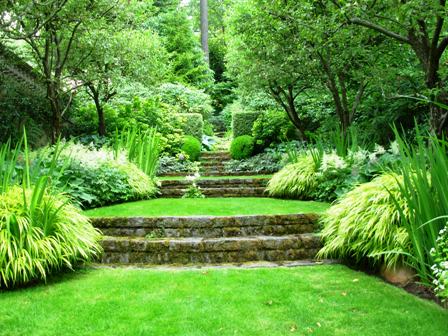
The gracefully-proportioned steps in the Israelit garden (Portland, OR) demonstrate the idea of “French Thirds”
Posted in Architecture, Creativity, General | 4 Comments »
© Debra Prinzing, all written and photographic content. Website design/development by Willo Bellwood/Metric Media