The Slow Flowers Podcast is the award-winning show known as the “Voice of the Slow Flowers Movement.” Launched in 2013 as the original flower podcast, we’ve devoted more than 10 years to covering the business of flower farming, floral design, and the Slow Flowers sustainability ethos. Listen to a new episode each Wednesday, available for free download here at slowflowerspodcast.com or on iTunes, Spotify, and other podcast platforms.
June 2nd, 2013
Joyeux Anniversaire
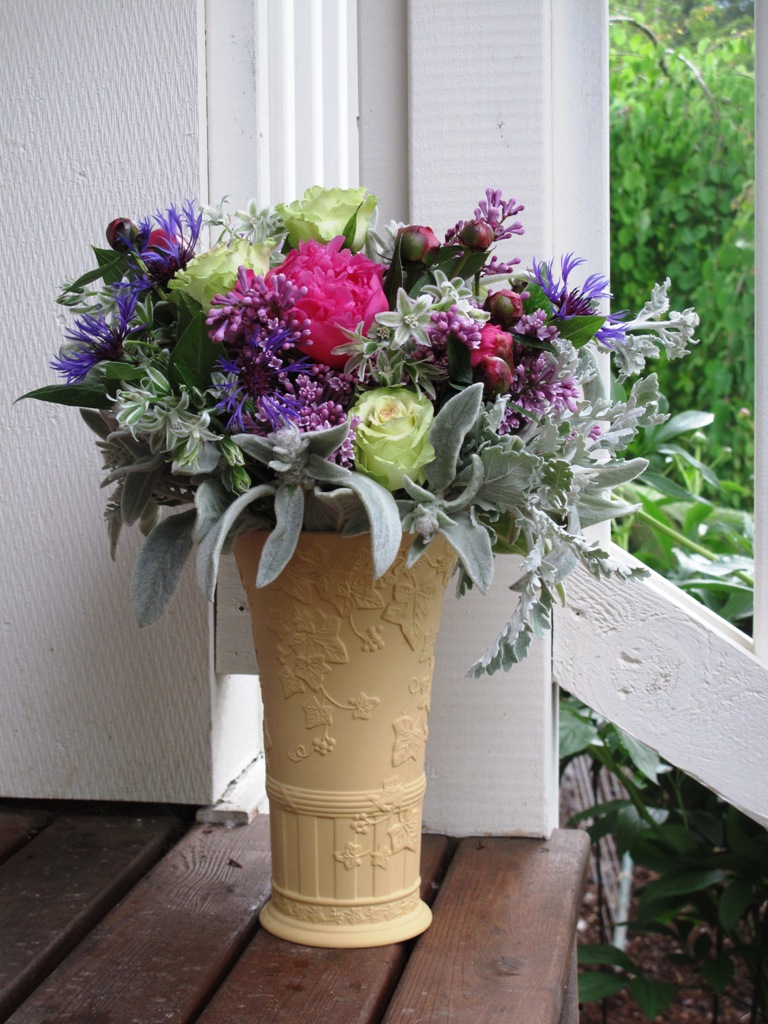
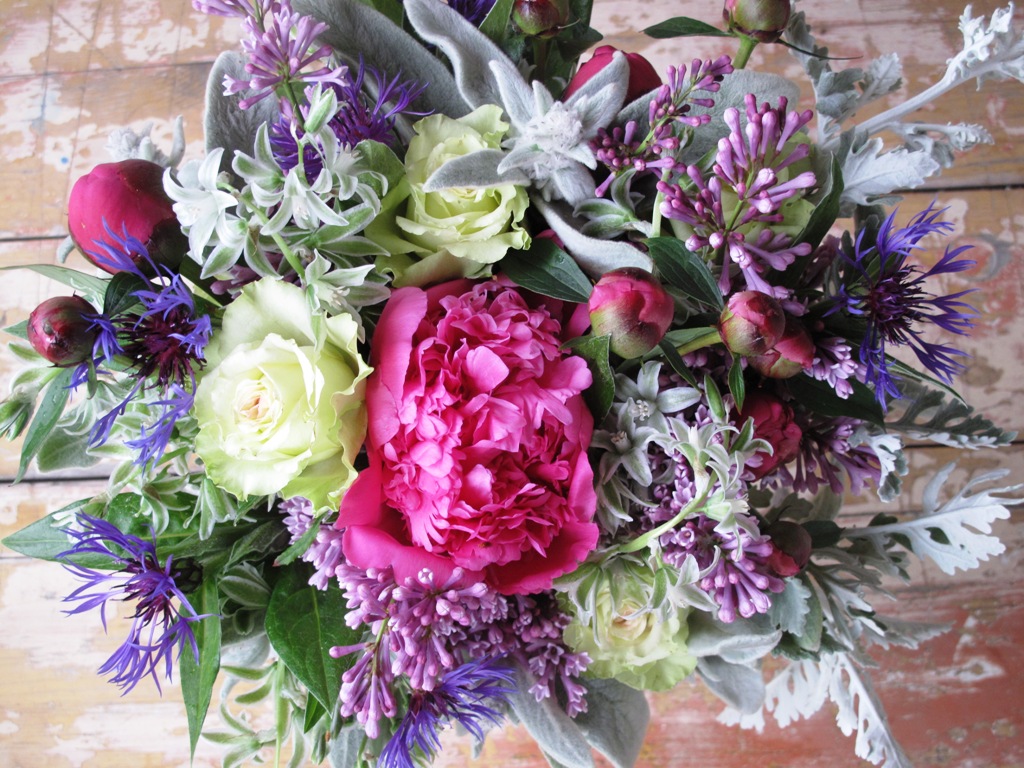
I created this bouquet as a birthday gift for my friend Carrie Krueger. The soft and feminine
gathering of blooms, paired with a vintage butter-yellow Wedgwood Jasperware trumpet vase, makes a complete package.
Ingredients:
Top view: so sweet~
5 stems hot-pink peonies (variety unknown), harvested from my garden
5 stems late-blooming lilac (Syringa x prestoniae), harvested from my garden
5 stems bachelor’s buttons (Centaurea cyanus), harvested from my garden
3 stems ‘Supergreen’ hybrid tea roses, grown by Peterkort Roses
6 stems each Dusty Miller (Centaurea cineraria) and lamb’s ears (Stachys byzantina), grown by Charles Little & Co.
6 stems variegated Star of Bethlehem (Ornithogalum nutans), grown by Choice Bulb Farms
Vase:
9½ inch tall x 57/8 inch diameter Wedgwood Jasperware trumpet vase
Design 101
Unity and variety: In design theory, “unity” and “variety” are interrelated principles. Unifying features tie a composition together; in this arrangement the silvery-green foliage suggests a sparkly embroidery thread embellishing a shawl. Variety lends interest to a design, eliminating the ordinary. Here, the pleasing mix of ingredients from the cooler side of the color wheel does the trick, with a range of floral hues from pale green and lavender to deep fuchsia and indigo.
Posted in American Grown, Creativity, floral design, General, Slow Flowers: 52 Weeks, Writing | No Comments »
May 29th, 2013
There’s a lot of wisdom to be found in the Dining pages of today’s New York Times. Mark Bittman’s “The Flexitarian” column focuses on changing our relationship with meat, learning to eat less and re-thinking our food dollar.
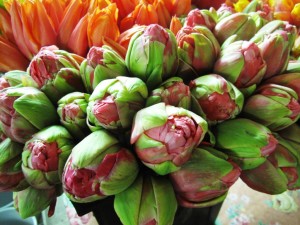
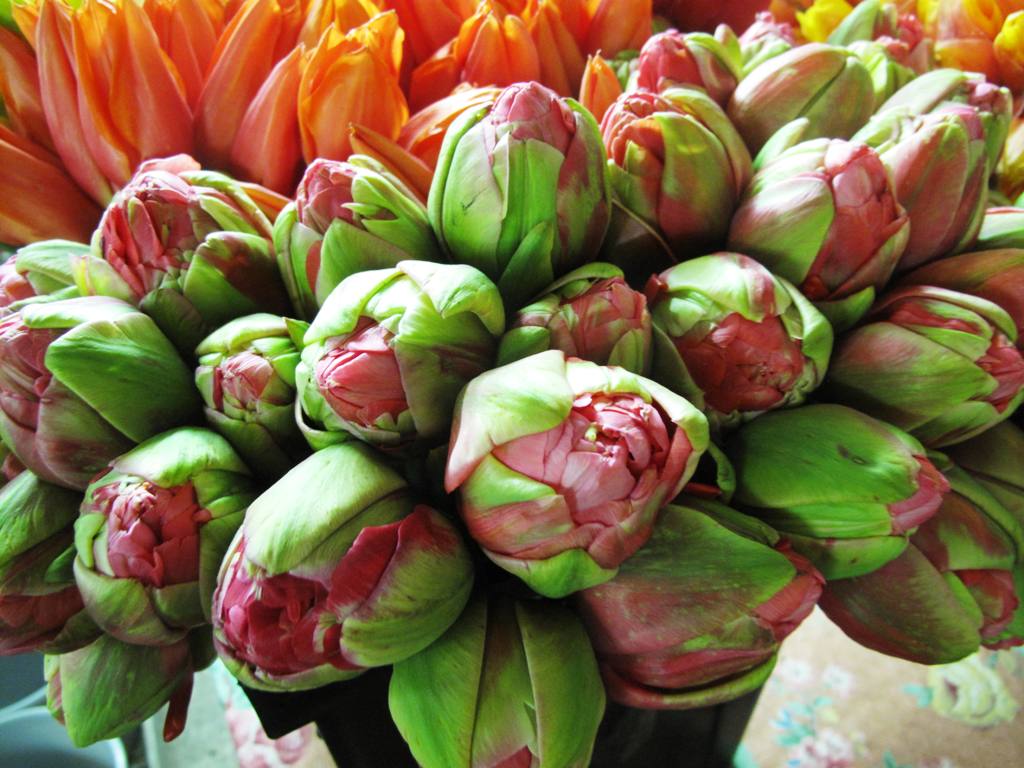
American-grown tulips grown by a farmer I know and trust.
You can basically take the term MEAT and replace it with FLOWERS to come up with a very credible explanation about what America’s flower farmers are up against. You know, that notion recently shared by none other than our nation’s Vice President Joe Biden about how cheap, imported flowers are “good for U.S. consumers.” No, Mr. Vice President, they are not. Cheap anything has a huge price. In the case of flowers, if you believe that cheap flowers are good, that means you aren’t concerned about living wage farm jobs in the U.S., about preserving farm land or about encouraging rural economic development. So there is a price to pay. For food writer Mark Bittman, the story of meat gives me a great analogy for flowers. I’ve taken the liberty of changing his story so you can see what I mean. Read on. . .
I feel best when buying from a farmer or farmer’s representative I know, or think I know. But even assuming this is possible, it has what at first appears to be a decided drawback: cost. It’s difficult to nail down averages, but if commodity meat (FLOWERS) — I’m talking about red meat (ROSES) here, but most of what follows could be argued about almost any product — costs something under $10 a pound (PER DOZEN) in most cases, and national brands from humanely treated animals like that from Niman Ranch or Coleman Natural (DOMESTICALLY PRODUCED FLOWERS) cost maybe twice as much, meat GARDEN ROSES from local farmers costs considerably more. It’s not uncommon to spend $25 or more a pound (A DOZEN) on beef (FLOWERS LIKE ROSES) from a trustworthy DOMESTIC source.
The immediate response that we as consumers have to this is “ouch.” Counterintuitive as it may seem, this is good for everyone.
Relatively large-scale sustainable and “natural” or “organic” or “humane” farmers might raise 500 pigs (UNDER 10 ACRES OF FLOWERS) in a year— they are not getting rich. We want these farmers to earn a living; they are stewarding the land in a manner we appreciate and they are providing us with the kind of food (FLOWERS) we want to eat (ENJOY, GIVE TO LOVED ONES, BRING INTO OUR HOMES); they are not using antibiotics (CHEMICALS) routinely or torturing animals (DAMAGING THE ENVIRONMENT). Nor are they likely to be receiving, directly or indirectly, federal subsidies. And they are providing us with meat (FLOWERS) that tastes better (ARE HEALTHIER, FRESHER, LOCAL AND SUSTAINABLE).
All of which may not make up for spending $30 instead of $15. But there are other reasons you can live with these higher prices.
It’s widely accepted that large quantities of red meat may be problematic, health-wise , and
We know that many people have made it a goal to eat less meat (CONSUME DOMESTIC FLOWERS) because large-scale industrial FACTORY FLOWER production is damaging to the environment. This is to a great extent what flexitarianism BEING A LOCAFLOR is about, after all.
Here’s a way to think about it: The price of food in general is what economists call “inelastic” — you’re going to eat something no matter the cost. But The price of any particular food like meat (FLOWER) is elastic — you will buy less as it becomes more expensive. Though it may at first seem paradoxical, this is a good thing from nearly every perspective.
I am saying this: Spend the same $30, or $50 or $100 or $300 on meat FLOWERS that you now spend each week or month, but buy less and buy better. You might compare this to an annual purchase of 20 $5 T-shirts made bychild labor (CHEAP, IMPORTED FLOWERS GROWN BY LOW-COST LABOR) versus one of five $20 T-shirts (BOUQUETS) made by better-paid and better-treated workers from organic cotton AMERICAN FLOWER FARMS. Expensive meat from real farms is a more extreme example of this less-is-better policy.
I hope you can follow where I’m going with this word-play. The takeaway message to me is that American Grown flowers might cost more, but they are higher quality, they will last longer, AND, they are sustaining American flower farms.
Posted in American Grown, Creativity, floral design, General | No Comments »
May 26th, 2013
Pitchers of Poppies
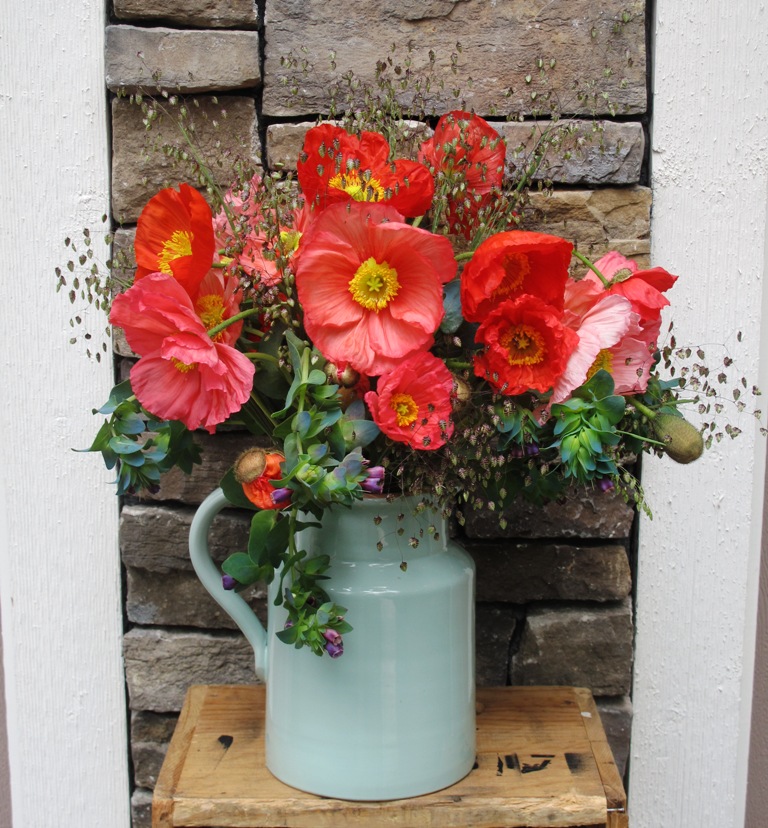
Why do we love poppies so much? Perhaps it’s because of their pure, vibrant petal colors with the charming button-like centers.
Ingredients:
(Green pitcher)
10 stems coral-red Icelandic poppies (Papaver nudicaule), grown by Jello Mold Farm
6 stems Cerinthe major ‘Purpurascens’, grown by Jello Mold Farm
7 stems rattlesnake grass (Briza media), grown by Jello Mold Farm
(Glass pitcher)
10 stems bright yellow Icelandic poppies (Papaver nudicaule), grown by Jello Mold Farm
10 stems Astrantia major ‘Sunningdale Variegated’ foliage, harvested from my garden
7 stems golden apple mint (Mentha x gracilis), grown by Charles Little & Co.
Vase:
8-inch tall x 5½-inch wide glazed ceramic pitcher
9-inch tall x 5½-inch wide Mexican glass pitcher
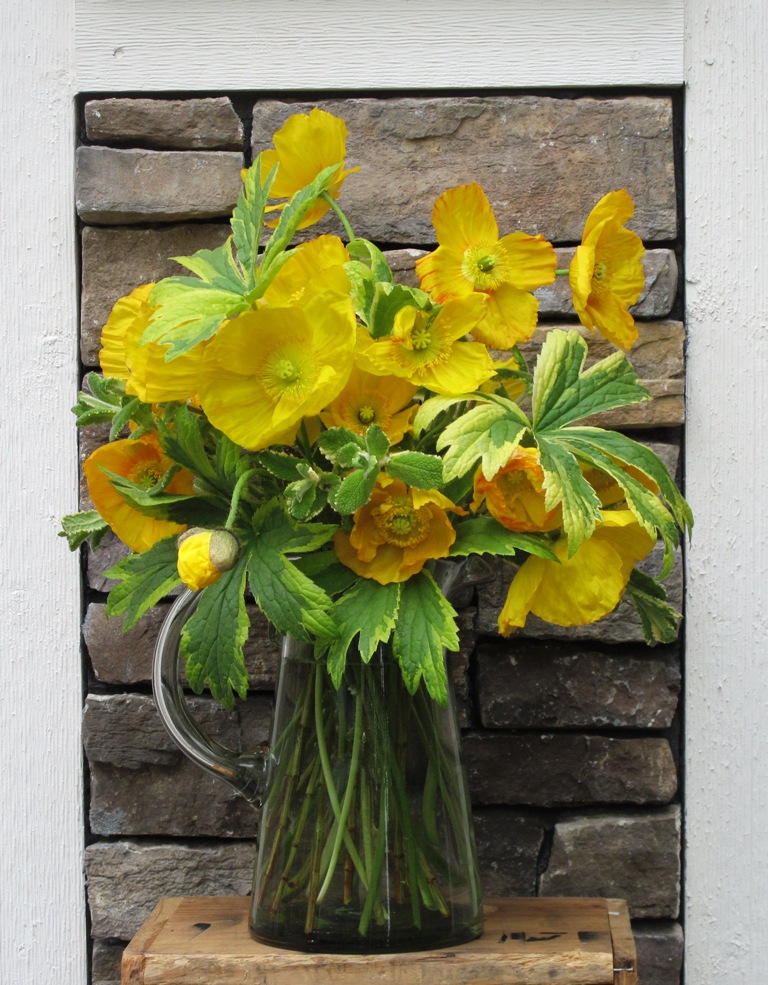
This arrangement, in a clear glass vase, showcases yellow Icelandic poppies, paired with variegated Astrantia and apple mint foliage.
From the Farmer
Poppy care: Many garden books recommend that you sear the cut tips of these poppies in a flame or submerge them in a beaker of boiling water in order to extend their vase life. It has been thought that the extreme heat
will soften the tougher outer stem and increase the surface area for absorbing moisture in the vase. But in fact, according to
Diane Szukovathy of
Jello Mold Farm, the poppy’s hairy stem collects more foreign matter that
contributes to bacterial build-up in the vase than with smoother-stemmed flowers. Because of this, she says, “heating the stems ‘cooks’ them, making the flower more susceptible to colonization by bacteria.” Diane’s best
tip: “Every few days, re-cut the stems and change the water.”
Posted in Creativity, floral design, Gardening, General, Plants, Slow Flowers: 52 Weeks, Writing | 1 Comment »
May 24th, 2013
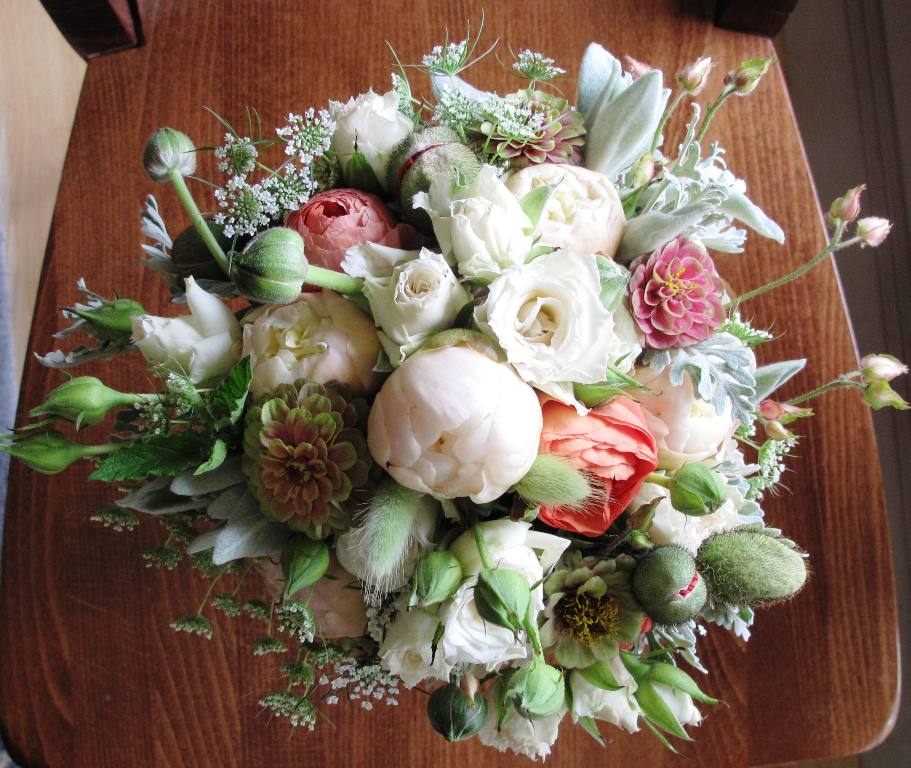
Tight flower heads, soft foliage that doesn’t bruise easily, and interesting textural elements – add up to a wedding bouquet for a friend far away.
A dear friend of mine is getting married today, in a state halfway across the country. None of her close friends are there to support her, mostly because she only recently moved away from Seattle to be close to her sweetheart. But at least she’s going to hold a bouquet of flowers I made Wednesday and sent via FedEx overnight delivery service. Her new husband will be wearing a sweet little boutonniere I sent along.
Here’s how to successfully make and send a long-distance gift of flowers:
1. Select durable flowers with fairly tight buds. I chose all Northwest-grown flowers in a cream-to-peach-to-coral palette:
- Spray roses have tiny heads and are long-lasting. ‘Moonstruck’ is a creamy white variety grown by Peterkort Roses.
- Peonies are super-durable, especially when you start at the “marshmallow” stage when just a small amount of color is showing at the top of the bud. The blush peonies I used are sublime, grown by Ojeda Farms.
- Ranunculus are a more fragile than the spray roses or tighter peonies, but the petal colors are so delicious that I took a risk. I chose mostly-closed flower heads and tried to nestle them between other, sturdier flowers to sort of shelter them in the bouquet. These were grown by Vivian Larson of Everyday Flowers. She literally saved the last ranunculus stems of the season for me.
- Poppies, especially in bud with those fuzzy green cases, are the epitome of springtime. The petals on these are more like a persimmon-orange color, which made them a little too dark for the bouquet palette. So I used only the tightest buds and lifted them up above the main bouquet. A sliver of the dark orange peeked out, but that only added to its charm. These were grown by Jello Mold Farm.
READ MORE…
Posted in Creativity, floral design, General, Slow Flowers: 52 Weeks | 2 Comments »
May 19th, 2013
A Softer Side of Green
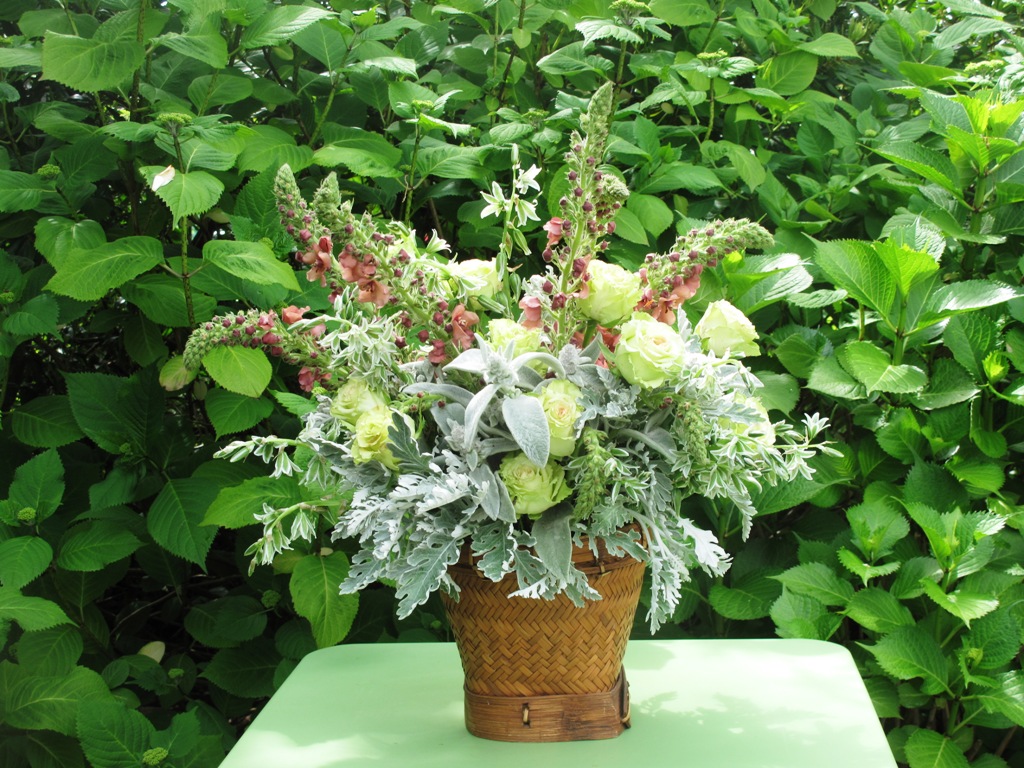
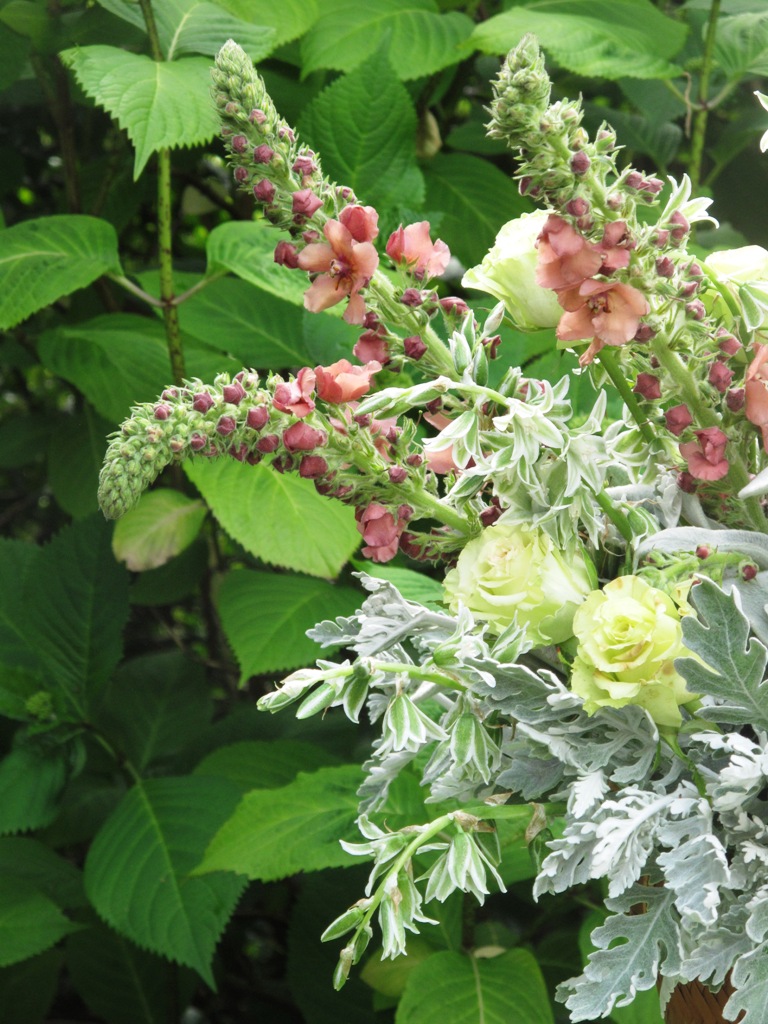
An unexpected combination, inspired by the pale ‘Supergreen’ hybrid tea roses given to me by the grower
This sweet detail shows the delicate features of the apricot verbascum and the varietgated Star of Bethlehem
Ingredients:
15 stems Dusty Miller foliage (Centaurea cineraria), grown by Charles Little & Co.
5 stems lamb’s ears (Stachys byzantina), grown by Charles Little & Co.
15 stems ‘Supergreen’ hybrid tea roses, grown by Peterkort Roses
9 stems Star of Bethlehem (Ornithogalum nutans), grown by Choice Bulb Farms
6 stems Verbascum ‘Caribbean Crush’, grown by Jello Mold Farm
Vase:
7½-inch tall x 7-inch diameter woven basket with a 6-inch tall x 6½ inch wide glass insert
Eco-technique
Vase in an instant: Any container can double as a flower vase as long as you can hide a watertight vessel inside of it. This simple, budget-conscious technique instantly expands your design choices. I frequently pick up glass vases for 50-cents to a few dollars at the thrift store, which means I always have extras on hand to tuck inside boxes, baskets, tins – and even leaky watering cans .
Posted in Creativity, floral design, Gardening, General, Landscape Design, Plants, Slow Flowers: 52 Weeks, Writing | No Comments »
May 14th, 2013
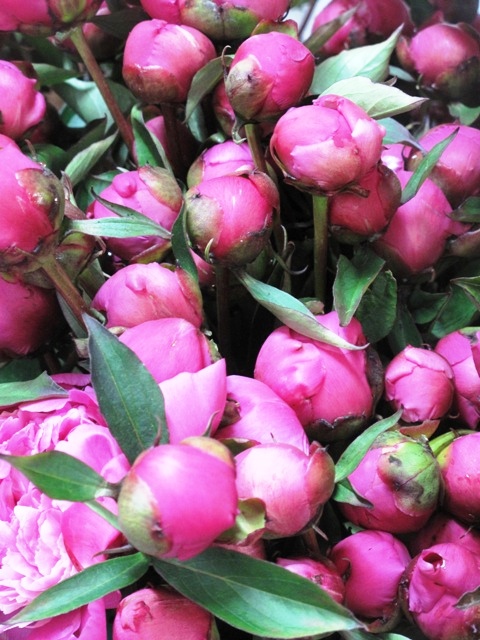
Field-grown peonies should be selected at the “marshmallow” stage, when the heads have just a little give when squeezed.
Forget flowers grown far from home. You’ll find the best blooms right in your own neighborhood – straight from a local flower farmer.
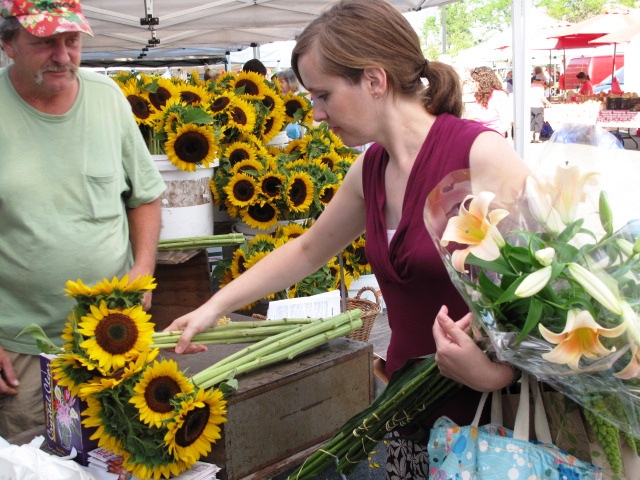
The growth of local farmers’ markets is staggering – up 17 percent nationwide in 2011, according to the USDA (USDA Farmers’ Market Data). And as more farmers’ markets establish in communities across the U.S., you can be certain to find more beautiful flower stalls, which is great news for the DIY floral designer, hostess and nature- lover.
When you shop at a weekly farmers’ market, look for fresh, seasonal and uncommon floral crops – you’ll be wowed by the selection and quality. Yes, it’s fun to meet the people who grow these blooms. But you can also learn from their experience and knowledge — ask your flower farmer for tips on how to care for their beautiful stems at home. Here are some of the best ways to enjoy farmers’ market flowers and extend their vase life:
Selection: Most farmers harvest their crops as close to market day as possible, ensuring very fresh varieties – straight from the field. Shop early in the morning for the best choice (plus, flowers are always happier when it’s cooler!). If the market is in an uncovered location, expect to see large awnings or umbrellas to keep the floral products out of direct sun. Look at the stall’s hygiene – are the buckets clean and filled with fresh water? Be sure to ask “Where is your farm?” and “Why type of growing practices do you use?” – let the vendor know you appreciate sustainable practices.
What to look for:
-
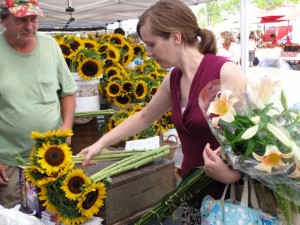
Chicago floral designer Lynn Fosbender, owner of Pollen Flowers, relies on Midwest flower farmers for her summertime vase arrangements and bouquets.
When choosing a mixed bouquet, look at all the ingredients to see that they are equally fresh. The focal flowers, softly-textured delicate elements and foliage should feel plump; not wilted or limp. When selecting a straight bunch, often called a “grower’s bunch,” check that all the stems are similar in length and all the blooms are similar size.
- Flower heads should be relatively tight on most varieties, ensuring that they will continue to open in the vase on your dining table.
- Some flowers, such as dahlias, do not open further once cut, so what you see is what you get. Others, like zinnias, can be fully open and they’ll last well over a week.
- With lilies, such as Stargazer or the Asiatic varieties, choose stems with plump, tight buds and possibly only one full bloom – you’ll have more than a week of enjoyment as those flowers open in succession.
- Sunflowers should be about half or two-thirds open and will soon look fuller as their petals unfurl in the vase.
- Tulips should have a tight head with the tips of the foliage as tall as possible (if the tulip head is far above the foliage tips, it means the flowers have been in water for several days, as the stems continue to “grow”).
- Daffodils that are tight in bud will open beautifully to a full trumpet shape indoors.
- Peonies should be in the “marshmallow” stage (squeeze the bud gently and you’ll feel a spongy quality – like a marshmallow). If you buy fully-opened peonies, they won’t last long at home.
- Garden roses should not have tight heads or fully-opened heads; look for a partially open rose head.
- Tall or spiked flowers, such as delphiniums, gladiolas and snapdragons, should have tight or closed buds along the top one-third of the stem, with the lower two-thirds in bloom; those upper-most buds will open in your vase.
- Lilacs are not known for lasting more than 5 days or so – but their intoxicating fragrance makes up for their shorter vase life. Pick lilacs with the top florets still in bud.
- Hydrangeas should be almost fully open and they will need lots of fresh water – up to their necks in a vase – to ensure that the entire stem is hydrated.
- All stems should be clean, stripped of their bottom foliage, and not slimy. Any remaining leaves should be fresh and un-bruised.
READ MORE…
Posted in Creativity, General, Slow Flowers: 52 Weeks | 3 Comments »
© Debra Prinzing, all written and photographic content. Website design/development by Willo Bellwood/Metric Media