The Slow Flowers Podcast is the award-winning show known as the “Voice of the Slow Flowers Movement.” Launched in 2013 as the original flower podcast, we’ve devoted more than 10 years to covering the business of flower farming, floral design, and the Slow Flowers sustainability ethos. Listen to a new episode each Wednesday, available for free download here at slowflowerspodcast.com or on iTunes, Spotify, and other podcast platforms.
June 23rd, 2013
SUMMER GLOW
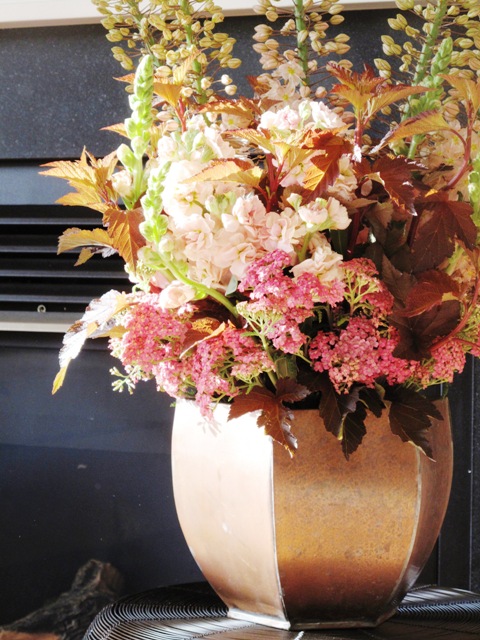
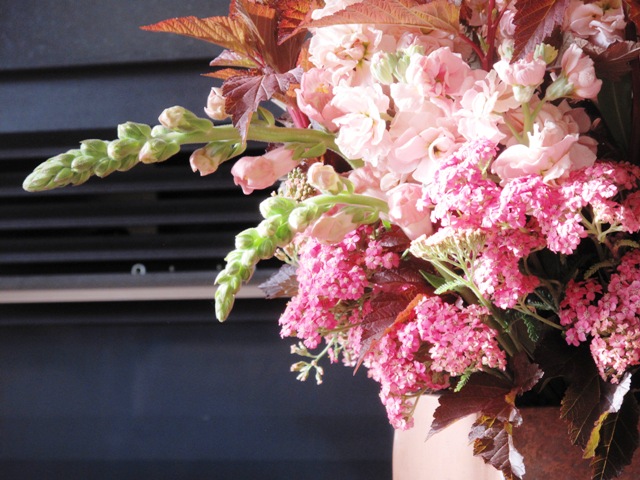
This coppery design began with the russet foliage called ‘Coppertina’, a variety of ninebark.
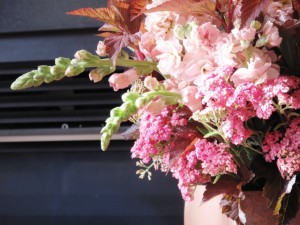
Textural details in a sultry summer color palette
Ingredients:
20 stems ninebark (Physocarpus opulifolius ‘Coppertina’), grown by Jello Mold Farm
11 stems pink yarrow (Achillea millefolium), grown by Jello Mold Farm
7 stems pale peach stock (Matthiola incana), grown by Everyday Flowers
5 stems apricot snapdragon (Antirrhinum maius ‘Tangerine Trumpet’), grown by Everyday Flowers
5 stems foxtail lily (Eremurus x issabellinus), grown by Choice Bulb Farms
Vase:
7-inch tall x 7½-inch diameter copper planter with a 5½-inch opening
Design 101
Tonal color palettes: Sometimes called “monochromatic,” a tonal theme incorporates different shades of colors in the same group. Here I used a combination of pale, medium-toned and dark floral elements in the pink-peach-copper color family. What makes the composition interesting (rather than plain) are the many uncommon shapes and textures. Try this technique with varying shades of gold, green, silver or burgundy – your bouquet will look
modern and sophisticated.
Posted in American Grown, Creativity, floral design, Gardening, General, Slow Flowers: 52 Weeks | No Comments »
June 22nd, 2013
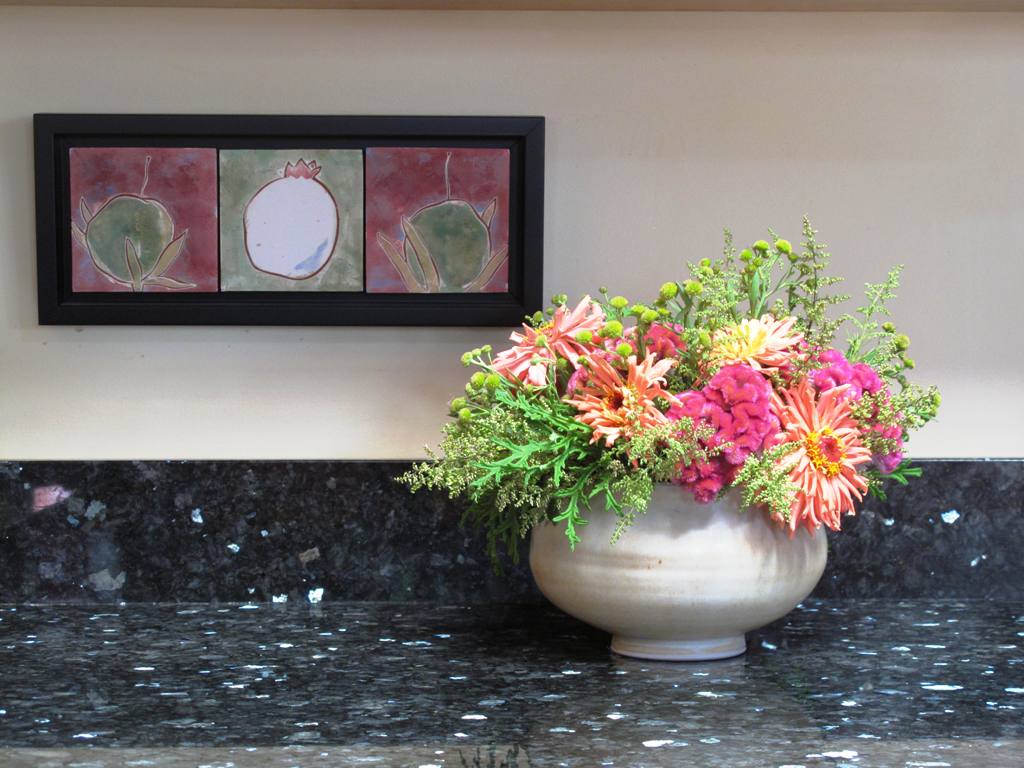
I placed my beautiful bowl of zinnias on the kitchen counter, in front of a botanically-inspired tile triptych by artist Paula Gill of Red Step Studio
This bouquet, which is featured on page 77 of Slow Flowers (Autumn|Week 3), features a framed trio of hand-carved and colored tiles that I purchased from one of my very favorite Northwest artists, Paula Gill. Paula owns Red Step Studios, and anyone who has attended the Northwest Flower & Garden Show or San Francisco Flower & Garden Show over the years has inevitably fallen in love with her beautiful tiles. I have a collection of them and I’ve given them as gifts to many friends. Check out her work here: Red Step Studio.
After the book was published, I sent Paula a copy so she could see how her artwork looked with one of my arrangements. Out of the blue, a big envelope arrived in my mailbox recently – and much to my surprise, I found inside a set of hand-printed notecards from Paual. She wrote:
“Hi Debra, Your book was so delightful that I savored it over several days after you sent it. And then you inspired me! Your arrangements ignited a creative spark. These images were made with ‘stamps’ I cut from blocks. Thank you – and I hope you’ll enjoy. All the best, Paula”
Thank YOU, Paula~! You have, as always, a whimsical touch to your artwork. I love how you reinterpreted these vases and flowers of mine with new eyes, using distinct graphic shapes and a playful style. How can something two-dimensional look so three-dimensional! It must be the way you cut the little blocks and layered them as you made the prints. Oh, and your use of color is sublime!
I’ve got to share them here. These little works of art will put a smile on your face:
The back of each card has a little hand-lettered reference to “Slow Flowers”
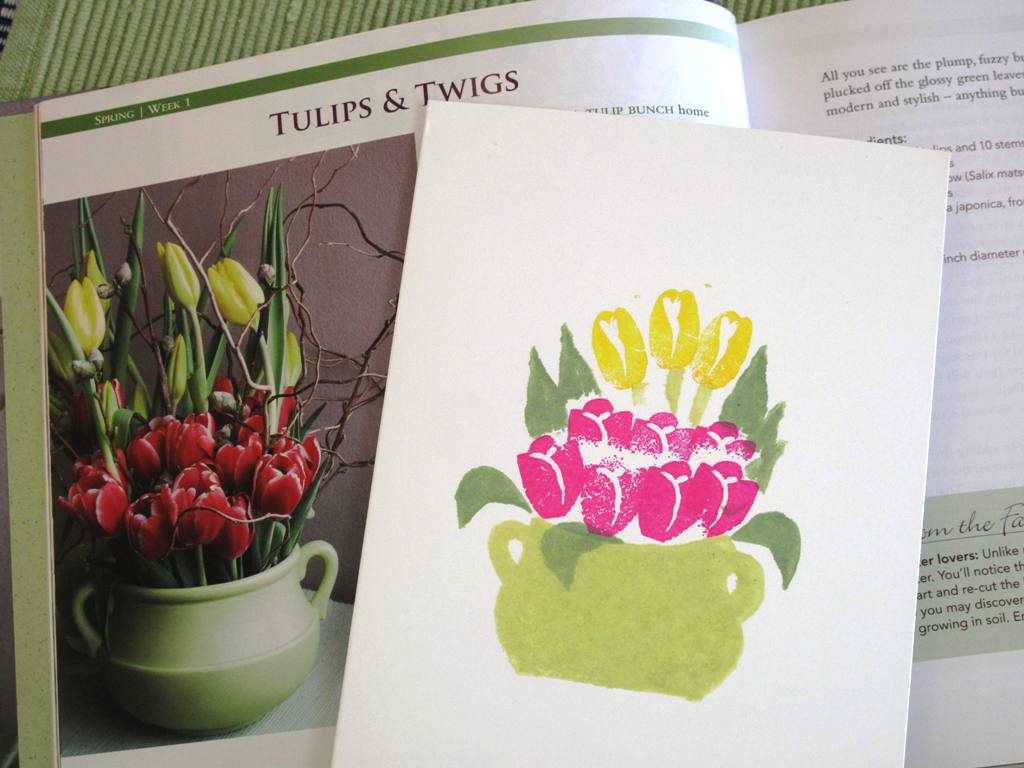
So happy that Paula chose “Tulips & Twigs,” the first bouquet of Spring – and the cover art for Slow Flowers.
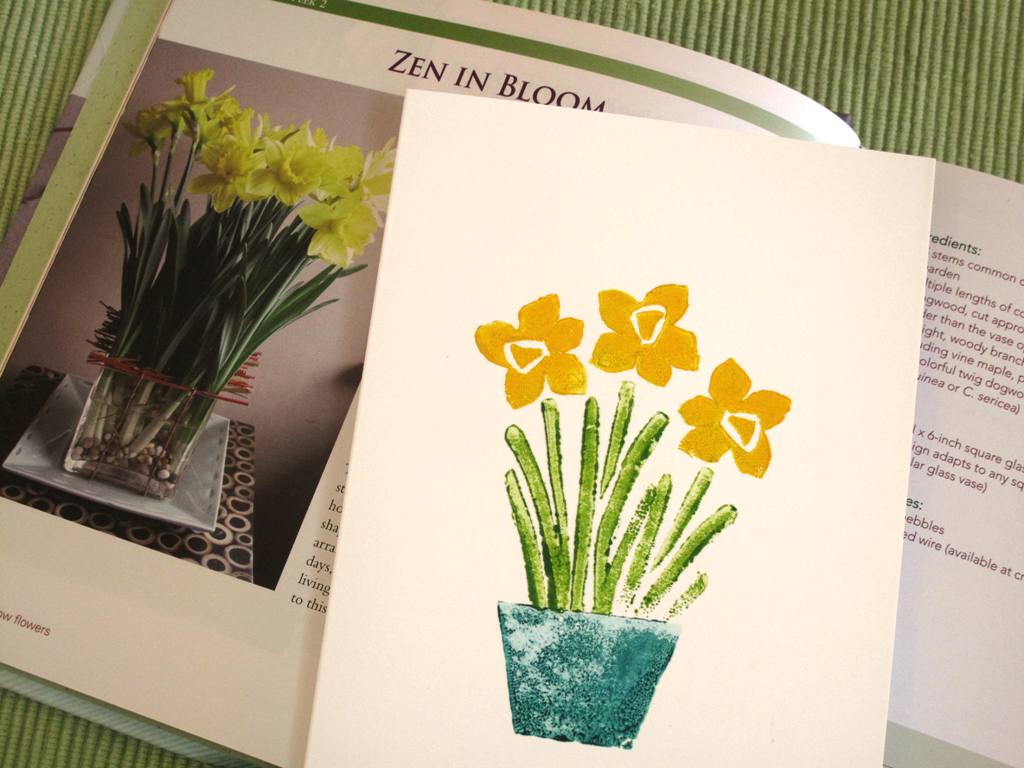
“Zen in Bloom” from Week 2, Spring, features daffodils in a charming block print.
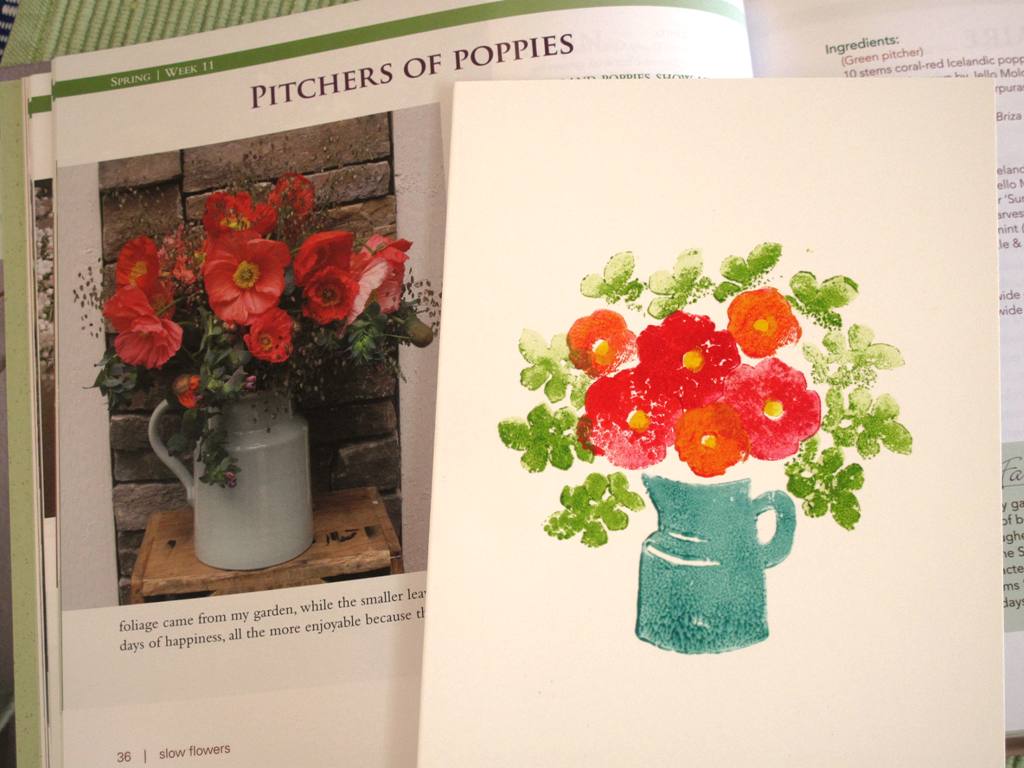
Coral-red Icelandic poppies in my celadon-green pitcher, from Slow Flowers, Week 11, Spring.
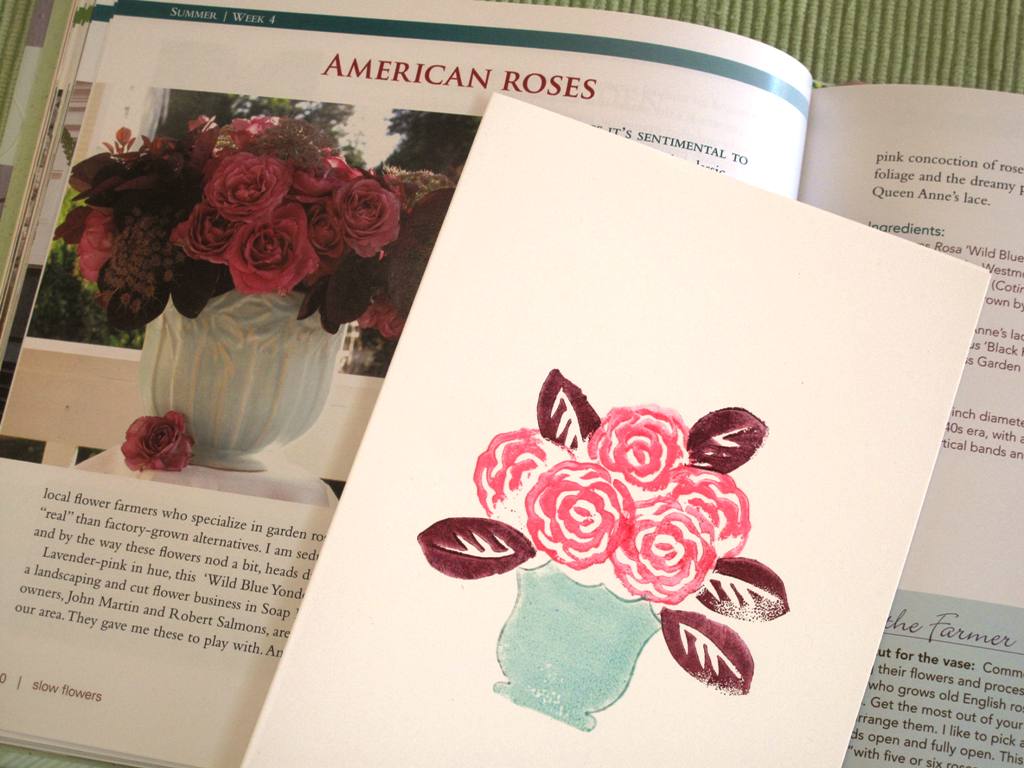
American Roses with purple smoke bush, Week 4, Summer. Love the way Paula rendered my McCoy flowerpot.
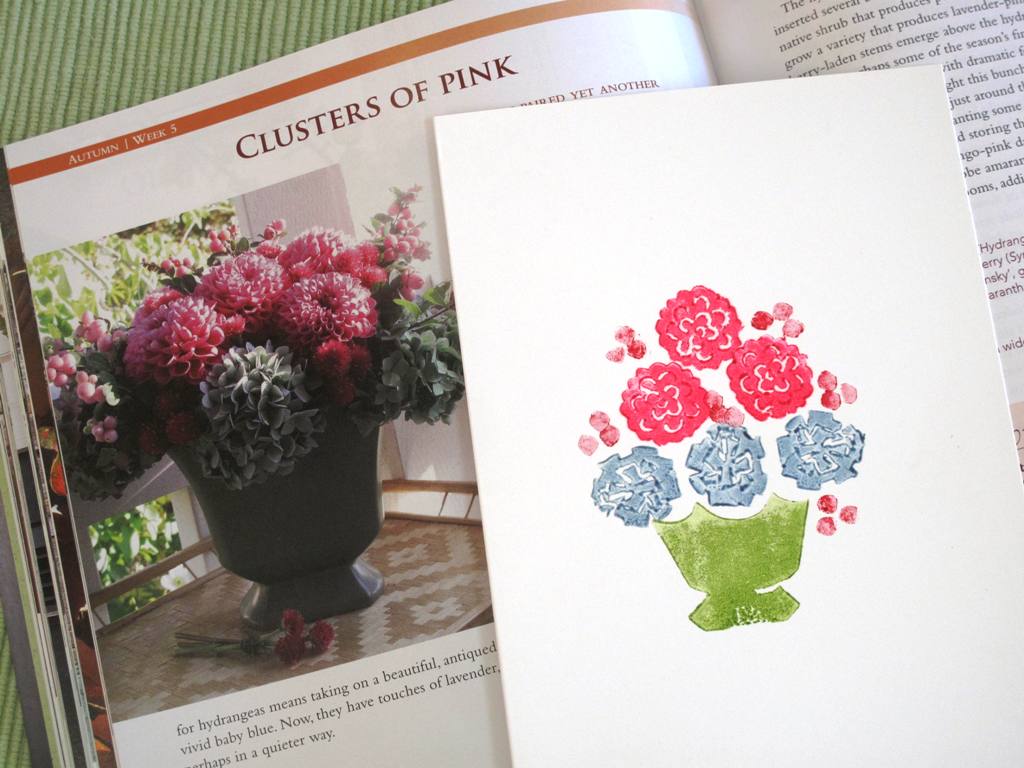
Late season dahlias and hydrangeas from Week 5, Autumn.
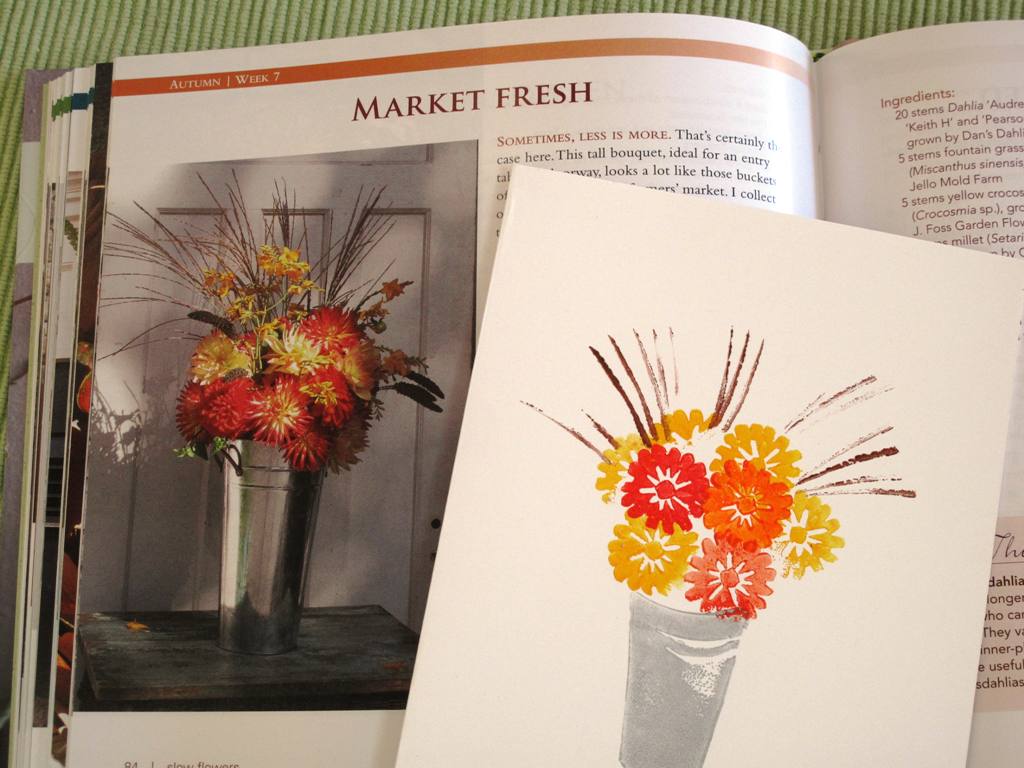
Dahlias grown by my friend Dan Pearson in “Market Fresh,” from Week 7, Autumn.
Happiness is going on here at my house today, thanks to this generous and unexpected gift from a friend. Clearly, I am having selfish thoughts about NOT sending these cards to anyone, but perhaps I will frame them for my office wall. Isn’t that a great idea?
Posted in American Grown, Creativity, floral design, General, Plants, Spiritual Practices | No Comments »
June 21st, 2013
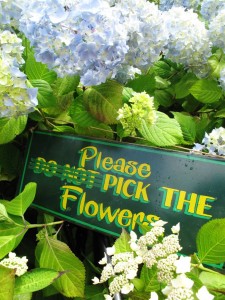
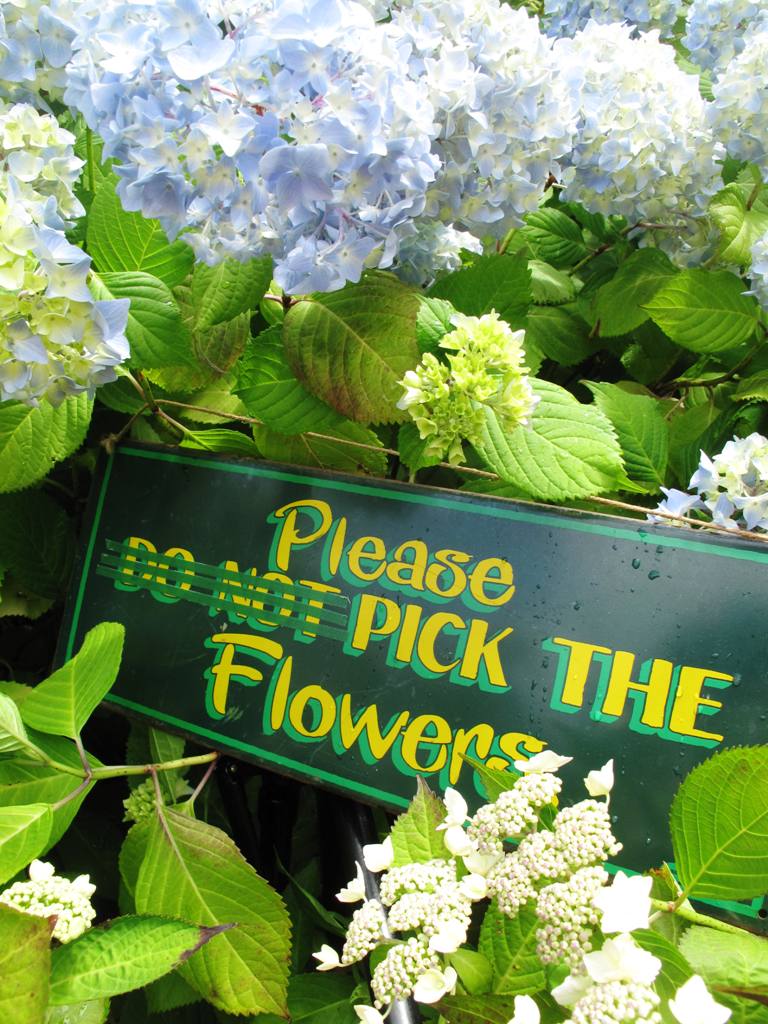
After I found this sign in a garden shop, I took the liberty to cross out the words “DO NOT” so the message better fits my philosophy of floral design!
I’ve been eating, sleeping, breathing, writing and speaking about SLOW FLOWERS for so long that it’s good to sometimes be reminded that not everyone understands what that phrase means. Recently, one of my flower farmer friends emailed to ask: Tell me again what Slow Flowers mean. I know it’s USA flowers but SLOW?
Fair enough. With all due respect to my fellow garden writer Felder Rushing, who coined the phrase “Slow Gardening,” let me outline my personal definition of SLOW FLOWERS. This is excerpted from my introduction to the book, Slow Flowers: Four Seasons of Locally Grown Bouquets from the Garden, Meadow and Farm (St. Lynn’s Press, 2013).
Thanks to the culinary pioneers who popularized the Slow Food movement, it now seems like you can put “slow” in front of any term to convey a different philosophy or approach to that subject. When I say the phrase “slow flowers,” there are those who immediately understand it to mean: I have made a conscious choice.
My blooms, buds, leaves and vines are definitely in season; not, for example, grown and brought in from elsewhere in the world during the wet, cold winter months in my hometown of Seattle. So, come December and January, my commitment to sourcing locally-grown floral materials sends me to the conifer boughs, colored twigs and berry-producing evergreens – and the occasional greenhouse-grown rose, lily or tulip, just to satisfy my hunger for a bloom.
Slow Flowers (the concept and the book) is also about the artisanal, anti-mass-market approach to celebrations, festivities and floral gifts of love. I value my local sources. If not clipped from my own shrubs or cutting garden, I want to know where the flowers and greenery were grown, and who grew them. Having a relationship with the grower who planted and nurtured each flower is nothing short of magical. I call so many flower farmers around the country my friends. They are the unsung heroes – the faces behind the flowers we love.
Finally, Slow Flowers reflects life lived in the slower lane. My family, friends and professional colleagues know that it’s almost impossible for me to do anything slowly. I’m the queen of multitasking; I just can’t help myself. There are too many exciting opportunities (or bright, shiny objects) that command my interest. But this “year in flowers” was altogether different. I can only compare it to the practice of praying or meditating. I didn’t realize that those few hours I spent each week, gathering and choosing petals and stems, arranging them in a special vessel, and then figuring out where and how to capture the finished design through my camera lens, would be so personally enriching.
And speaking of the phrase,
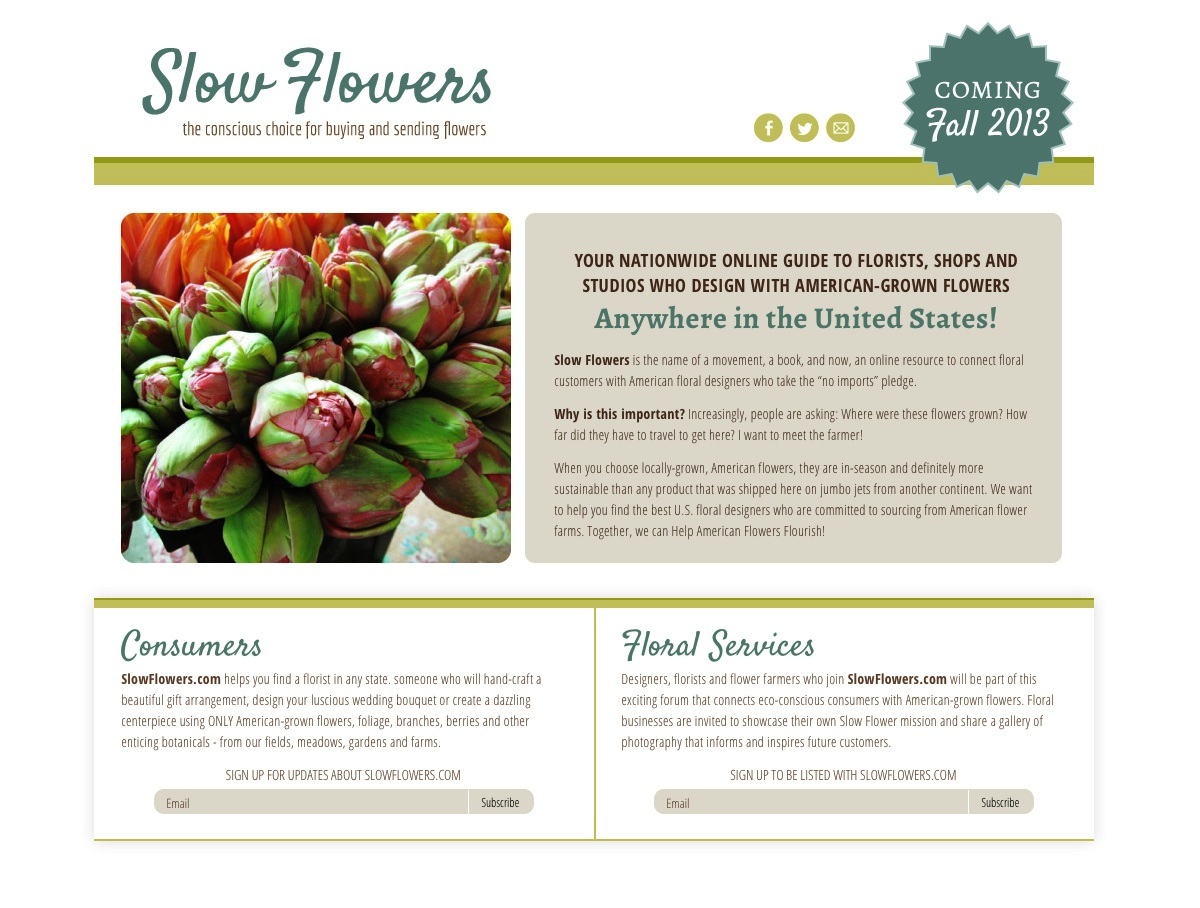
Slowflowers.com is also the name of my newest project, announced this past week. With a scheduled Fall 2013 launch, this will be a free, online database that helps connect consumers with floral designers, studio florists, florists and supermarket floral departments who are committed to designing with American-grown flowers. Please sign up – either for consumer updates on our official launch, or to be listed as as
SlowFlowers.com designer.
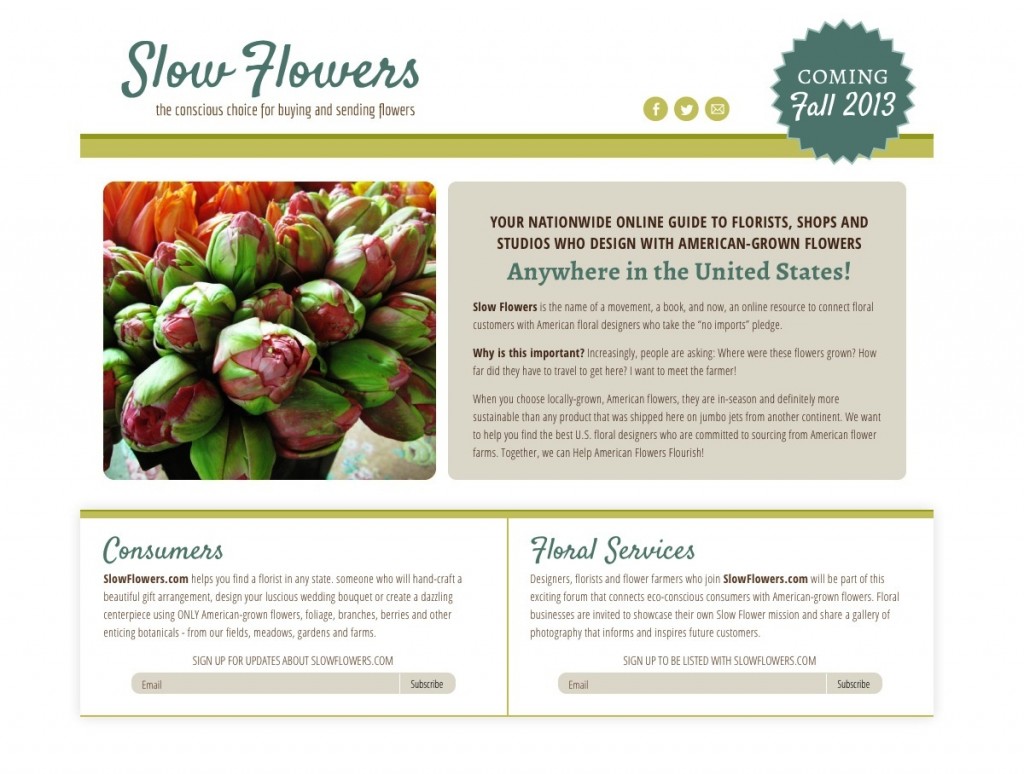
So I guess you can also say that the idea of “Slow Flowers” is also a resource that I hope many will find useful. Here is the description of this project:
Join the Slow Flowers Movement, an All-American philosophy that supports grown-in-the-USA flower farms as well as floral designers, florists and retailers committed to using American-grown ingredients.
Origin matters! Slowflowers.com is a free, searchable database that makes it easy for customers to find designers who share their values and ethos. Log onto our home page to add your listing. Let’s tell consumers that there is a better way to beautiful – and they can find it at Slowflowers.com.
Slowflowers.com enables users to:
* Search by state or city and by keyword for the type of florist they seek.
* Find studios and retailers who specialize in green weddings, weekly subscriptions and eco-florals.
* Discover local flower farms that sell direct to the DIY consumer.
* Access coupons and promotions from individual studios, shops and farms.
* Provide reviews and raves about great American flower sources and comment on
experiences.
* Map the location of a desired destination.
I hope this helps! I invite you to add your own thoughts about “Slow Flowers” and what it means to you.
Posted in American Grown, Creativity, floral design, Gardening, General, Plants, Playfulness, Slow Flowers: 52 Weeks, Writing | 10 Comments »
June 17th, 2013
A Certain Vintage
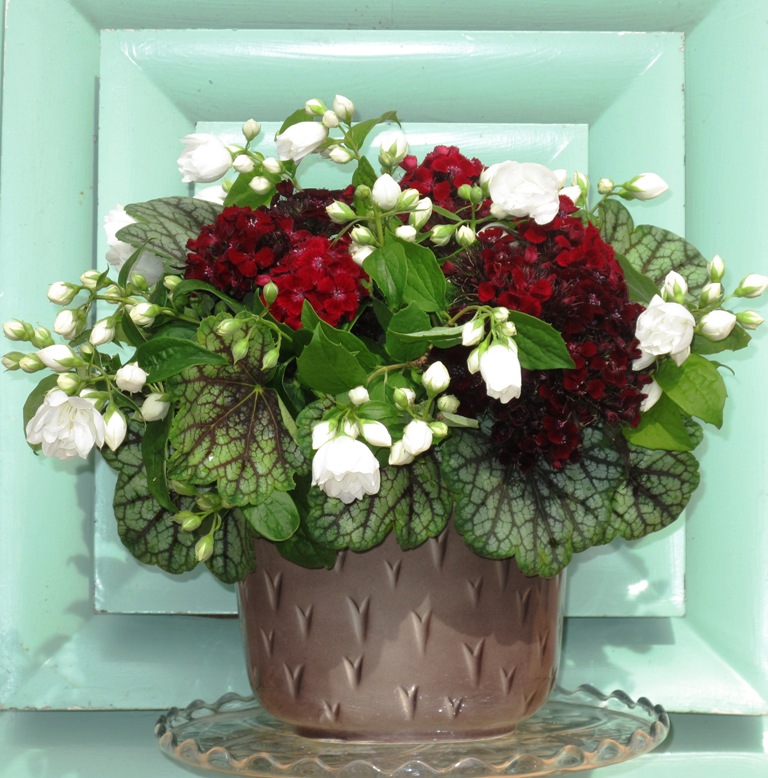
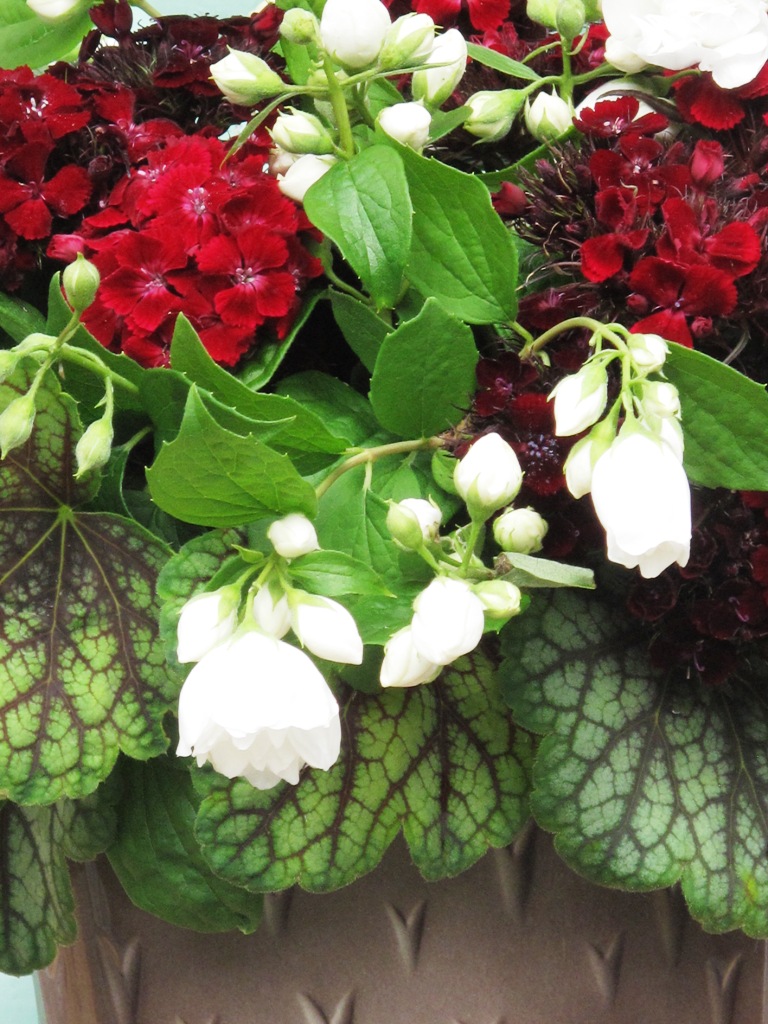
Ruffly ‘Green Spice’ heuchera foliage pulls together the mocha-colored vintage vase and the deep burgundy sweet William flowers
 Ingredients:
25 stems heuchera foliage (Heuchera ‘Green Spice’), harvested from my garden
7 stems sweet William (Dianthus barbatus var. nigrescens ‘Sooty’), grown by J. Foss Garden Flowers
5 stems mock orange (Philadelphus coronarius), harvested from my garden
Vase:
6-inch tall 1940s vase with a 7-inch x 3-inch oval opening
Eco-technique
Just add foliage: Thanks to the eco-conscious designers I’ve met and interviewed, I am quite wary of using florist’s foam, a formaldehyde-based product, to stabilize arrangements. Designing around a base of foliage offers a greener way to keep flower stems upright in a vase. Choose leaves that are large, fluffy or textured. Then, insert your other floral ingredients through this vegetation. For example, in this bouquet I placed the heuchera leaves first; then I added the sweet William and mock orange stems. Everything stays just where I want it.
Posted in American Grown, Creativity, floral design, Gardening, General, Plants, Slow Flowers: 52 Weeks, Writing | No Comments »
June 11th, 2013
 I never thought I would be such a proponent of the American Grown-American Made movement, but after writing The 50 Mile Bouquet and Slow Flowers, I have gained newfound appreciation for companies that provide jobs to American workers. We should all make an effort to both value and promote domestic farms and domestic manufacturers. Hey – even my books are printed in North American (not Asia!), on FSC certified paper with soy-based inks. I have my publisher to thank for making the choice to not print overseas.
Here, for you, I have compiled a list of my must-have floral design tools and accessories. Sadly, it has been a challenge to find all the Made-in-the-USA products I want. For example, I can’t find any women’s gardening gloves that weren’t made in Asia (yes, there are some leather glove makers still around in the US, but those products are intended for a more rugged gardening activity than floral design!)
And then there are those companies that label their packaging with phrases such as: Designed in the USA; Assembled in China. That’s not really what I’m looking for either. Nevertheless, I am here to share some glimmers of hope that American manufacturing is alive and well in the specialized world of floral design.
Here are my favorite floral design products. I recommend you check them out and make a conscious choice with your dollars! When you read a sentence like this one: “. . . carefully manufactured in Seattle by skilled craftsmen paid a living wage,” from apron designer Janna Lufkin (Raw Materials Designs), you really want to support her spirit and her faith in her company’s lifeblood, the workers who turn her ideas into tangible products!
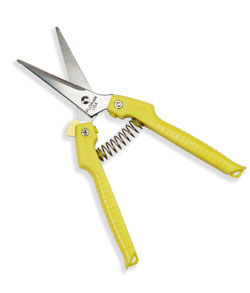
The best USA-made floral snips around! I love this tool – I have two of them!
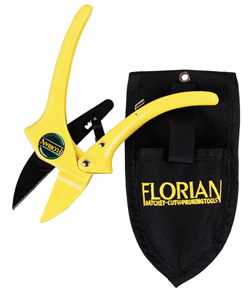
Florian’s rachet pruner, also USA-made.
Florian floral snips (for herbaceous and woody stems), $25.95 plus tax & shipping. This fine point scissor shear is made in the USA and is an excellent hand pruner. It is ideal for flower arranging, Ikebana, Bonsai and other precise hand pruning activities. This hand pruner shear features precision ground stainless blades and comfortable polypropylene ribbed grips with a brass thumb lock. Size: 7 1/4″ long. Florian also makes a fine rachet pruner, which you’ll find useful for cutting thicker branches of trees and shrubs. *Rachet Pruner is $36.95 plus tax & shipping.
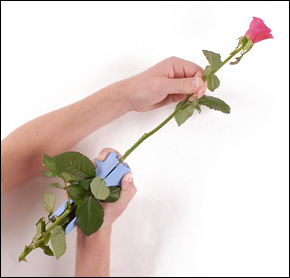
Easy to use! Made in the USA, too!
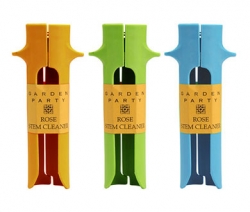
Love that this tool was designed by a woman florist with her product-designer husband – and they have it manufactured by a woman-owned company.
Garden Party’s Thorn strippers (for stripping rose stems), designed by a floral designer and made in the USA, $11.95 plus tax & shipping. This colorful and lightweight tool has a spring-action handle to protect your hands from thorns, while the finger supports ensure a non-slip grip. Durable metal blades are honed to reduce tearing or peeling of the rose stem. Size: 6 inches long.
READ MORE…
Posted in American Grown, Creativity, floral design, Gardening, General | 1 Comment »
June 9th, 2013
A Bit of Purple Heaven
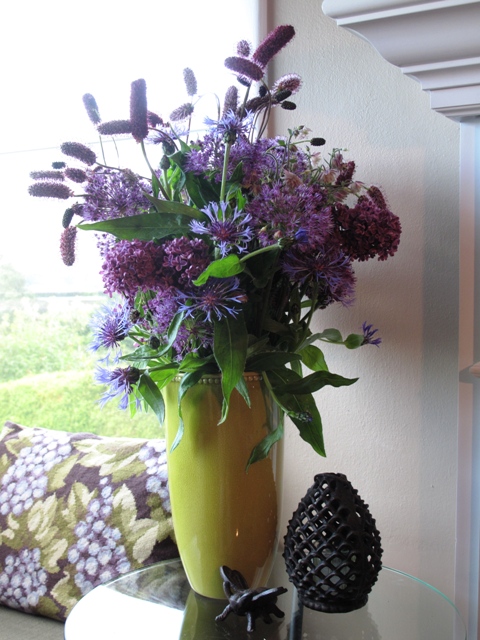
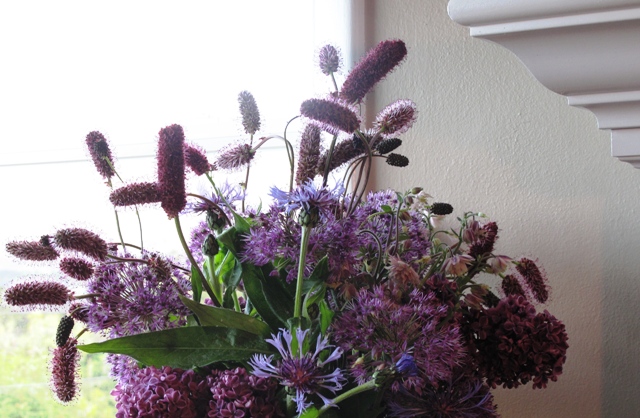
A wistful arrangement of blue, purple and plum flowers looks awesome in a chartreuse vase.
Ingredients:
The little “dancing” bottlebrushes are called burnet, or Sanguisorba menziesii.
5 stems dark purple lilacs (Syringa vulgaris), grown by Sunshine Crafts and Flowers
7 stems blue perennial bachelor buttons (Centaurea cyanus), grown by Sunshine Crafts and Flowers
7 stems reddish-pink ‘Nora Barlow’ columbine (Aquilegia hybrid), grown by Sunshine Crafts and Flowers
5 stems purple ornamental alliums, grown by Jello Mold Farm
20 stems burnet (Sanguisorba menziesii), grown by Jello Mold Farm
Vase:
11-inch tall x 5½-inch citron-green crackle glaze vase
Eco-technique
Traveling with flowers: I can’t resist taking flowers with me or bringing them home. If it’s a car trip, place flowers in a stable bucket with just a few inches of water to hydrate the stems (but avoid splashing). Store on the shady side of the car. If you’re traveling by air, wrap the stems in wet paper, cover with a plastic bag and then wrap the entire bunch in kraft paper that extends above the blooms. As soon as you arrive at your destination, re-cut all the
stems, place in fresh water and possibly a refrigerator. I’ve been known to use a hotel wastebasket and mini-bar fridge for this step!
Posted in Creativity, floral design, Gardening, General, Plants, Slow Flowers: 52 Weeks, Writing | 1 Comment »
© Debra Prinzing, all written and photographic content. Website design/development by Willo Bellwood/Metric Media