Debra Prinzing

Get the Email Newsletter!

Archive for the ‘General’ Category

Erin Benzakein’s seasonal and sustainable flowers

Saturday, March 21st, 2009
Read "The West at its Best," pages 20-21

Read "The West at its Best," pages 20-21

The April 2009 issue of Sunset magazine features my friend Erin Benzakein of floret flowers. Erin is a young organic flower farmer and talented floral designer who values seasonal ingredients for her bouquets and uses sustainable practices to raise a wide array of flowers, blooming shrubs and attractive foliage.

I met Erin in the spring of 2006 through her father David Perry, a gifted photographer (that was the first day I met Dave, too, when we teamed up on a garden scouting excursion after being introduced by a mutual colleague). That meeting, at Waverly Jaegel’s antique rose-filled garden in Skagit Valley (Washington State), was the beginning of two inspiring and invigorating friendships for me.

The three of us talked about our mutual passion for locally-grown blooms. Erin and I discovered our love of floral design that’s “in the moment,” depending on what’s in bloom in one’s own garden, or what you can find at the farmer’s market, from a friend’s flowering shrubs, or even foraged in the wild. That’s the essence of seasonal and sustainable floral design. It begins with the farmer who raises those blooms with care for the land and agricultural workers alike.

Over time, Erin, David and I realized we all hold a dream of some day creating a book about this topic. We hope it will be filled with stories that I write, photographs that David captures through his lens, and – of course – flowers that Erin grows and arranges. Whether it happens and in what form, time will tell. In the meantime, we are beginning to document the best stories of growers and designers with organic values. You can see some pretty exciting photographs on A Photographer’s Garden Blog, David’s visually alluring online journal.

David and I shared Erin’s story with our editors at Sunset who agree that she has an unique and compelling passion and philosophy – one worthy of a feature in the magazine. The piece appearing in Sunset’s April issue, out now on newsstands, is spread across two pages with David’s evocative photo of Erin, carrying her son Jasper on her back, as she walks through rows of giant alliums. My Q-and-A with Erin has been reduced to just a few lines, but you can read my full interview with her here: 
Erin and Jasper, mother-and-son organic farmers

Erin and Jasper, mother-and-son organic farmers

The Western pioneer: Budding ambition

Erin Benzakein has turned her two Washington acres into a sustainable flower farm

By Debra Prinzing | Photography by David Perry

Erin Benzakein became captivated with fresh-from-the-border flowers while working on a Seattle estate’s garden crew. “I never before thought you could go into your yard and cut so many flowers. They looked like the Dutch paintings – perennials, berries, vines, floppy roses – all spilling out of a huge vase.”

Inspired, Benzakein planted two rows of sweet peas to create a fragrant “tunnel” (“I wanted to walk down it, just for the experience,” she confides). Suddenly, the 29-year-old mother-of-two became a flower farmer. “It was a done deal. All the vegetables got ripped out and were replaced with flowers.”  Since 2007, with her husband Chris Benzakein and their “bunch runners” (9-year-old daughter Elora and 6-year-old son Jasper), Benzakein has operated Floret, a 2-acre certified organic flower farm in Mt. Vernon, about 90 minutes north of Seattle.

Why are sustainable flowers important?

Eighty percent of the cut flowers we buy in the U.S. are imported from countries that do not have worker safety or pesticide regulations. I don’t think we should sacrifice the health of our earth, or that of the farmers, their children and animals, just to have a bunch of pretty blooms on our kitchen tables. If you buy your flowers locally – at a farmer’s market, from a roadside stand, or a grocery store that sources bouquets from local growers – they’re probably sustainably grown. You’ll help eliminate the use of jet fuel that flies flowers to America, keep money in your local economy and enjoy healthier and fresher blooms.

READ MORE…

Breaking News: Buyers step up for San Francisco Flower & Garden Show

Thursday, March 19th, 2009

Duane Kelly, owner of the popular Northwest Flower & Garden Show and the San Francisco Flower & Garden Show, dropped a big surprise gift into our laps last night at the SF Flower Show’s garden media reception in San Mateo, Calif.

While making remarks about the show’s history he announced that a deal was reached on Tuesday, March 17th with an investor group that will purchase the San Francisco Flower & Garden Show.

That means the show will go on! At least here in Northern California.

The 2010 San Francisco Flower & Garden Show will be staged by the new owners, a group of horticultural enthusiasts who recently joined forces to acquire and continue the wonderful spring event.  SF Garden Show LLC will be led by a new steering committee comprised of well-known landscape gardeners and growers including Davis Dalbok of Living Green, Mike Boss of Rock & Rose Landscapes, Robin Stockwell of Succulent Gardens, and led by Chairman Tim O’Shea of Greenworks Design.

The new team wants to ensure that the show will celebrate its 25th anniversary next year.

Congratulations to Duane Kelly and his awesome team of garden creators – the magical people who bring springtime to our gray, wet, cold days. Their legacy will continue in an exciting new way!

More details to follow. I filmed videotaped the announcement and remarks made by two of the new owners but I won’t be able to post my video clip until this weekend.

A POD in the Garden (POD=Personal Outdoor Dwelling)

Saturday, March 14th, 2009
San Francisco's hottest garden and plant emporium, Flora Grubb

San Francisco's hottest garden and plant emporium, Flora Grubb

A great gathering of Shed-Fanatics joined me at Flora's

A great gathering of Shed-Fanatics joined me at Flora's

After my exhausting trip to the wintry Philadelphia Flower Show, I returned to LA for a quick overnight to recharge my batteries with my family.

Then, last Thursday, I returned to Burbank to fly north to Oakland.

My friends at the Garden Conservancy invited me to share my fascination with sheds and hideaways at an evening benefit lecture.

Hosted by horticultural celebrity Flora Grubb at her eponymous urban emporium, the after-hours event included cocktails and hors d’oeuvres among Flora’s awesome collection of palms, succulents, Mediterranean and drought-tolerant plants – and more.

Flora and Debra, smiling in this great garden setting

Flora and Debra, smiling in this great garden setting

She curates this environment with an eye for design, style and presentation. Furniture selections, displayed among plant groupings really “pop” – from avant-garde concrete chaises to retro-salvaged circle lawn chairs (see below for specifics).

The playfulness with which Flora and her staff have created this plant-centric lifestyle just puts a smile on my face. I’ve heard and read about this cool SF destination nursery for a few years and am thrilled to have been given a great excuse to travel and speak there.

Thanks for the experience begins with my friend Margo Sheffner, who is Flora Grubb’s book buyer extraordinaire. Margo, who is also the business manager for the Pacific Horticultural Foundation (a nonprofit of which I am board member), was an early fan and supporter of Stylish Sheds and Elegant Hideaways. She brought it to Flora Grubb’s and continues to update me about how Flora’s customers “get” the notion of backyard sanctuary, habitat and haven. And that translates into book sales (which is so reassuring in this non-print phase we’re in). Yeah! It makes me happy to see our book in this cool environment.

Here’s a little gallery of Flora Grubb’s Garden. You will love every image:

Credit for my lecture title, “A POD in the Garden,” goes to Garden Conservancy west coast program manager and all-around horticultural go-to gal, Betsy Flack. She came up with the idea of using the acronym P-O-D (as a personal-outdoor-dwelling). I love it! This is my new buzzword. Stylish Sheds includes a chapter about Loretta Fisher’s “Mod Pod” in Austin, so Betsy’s title is apropos. Betsy and her assistant Maria Martinez (along with several Garden Conservancy staff, friends and volunteers) put on a lovely evening. I felt welcomed among so many kindred spirits.

The following morning, I stopped by Dwell's editorial offices to say hello to Miyoko

The following morning, I stopped by Dwell's editorial offices to say hello to Miyoko

Before I started my talk, Betsy invited Miyoko Ohtake, associate editor at Dwell magazine, to share a few words. Miyoko is a talented young architect-journalist who joined Dwell last summer after impressive gigs at Wired and Business Week.

She contacted me in August to ask if I could serve as Dwell’s guest expert for a review of prefabricated sheds (February 2009 issue). It was great to finally meet her in person and to also have the audience meet Miyoko and hear her enthusiasm for modern outdoor design. Dwell supported the event and Miyoko blogged about my talk in advance of the evening.

Then, Flora invited her architect-friend Seth Boor, AIA, of SF’s Boor Bridges Architecture, to comment on the city’s zoning issues relating to shed construction.

It was a stroke of brilliance to include Seth on the program. He and Flora (and her partner Kevin Smith) recently collaborated on a very cool planted-wall installation at a hip, new Napa Valley hotel called Bardessono. The project was recently documented by Stephen Orr in the New York Times. So we were in excellent company (oh, and how cool is this? Stephen was in the audience – what a sweet guy to come hear my talk).

Among other remarks, Seth touched on the permit and installation parameters for anyone wanting to add a backyard shed in San Francisco:

  • No permit is required if you build an outdoor structure under 100 square feet in size and no taller than 8 feet high.
  • The configurations can vary. For example, the structure can be 10-by-10 feet or 8-by-12 feet in size.
  • As for height, as Seth pointed out, “Eight-feet-tall is a little short” but you can work with it.
  • Working without a permit “frees you up to do anything within that size,” he says
  • Also, if the structure isn’t permitted, the typical setback rules do not apply. However, there is the “good neighbor” rule and Seth recommended that shed-builders think about how a 100-sf structure will appear to a neighboring property.

Debra’s note: Creative shed-owners are already aware of this issue. I’ve seen shedistas carefully paint, embellish and artfully adorn the side of their structure that faces a neighbor’s lot. Good shed policy!

Botanical fantasy? Or Shoe Fetish?

Monday, March 9th, 2009
Shoes for a flower fairy with twigs, moss and petals

Shoes for a flower fairy with twigs, moss and petals

I spent a few days last week at the spectacular Philadelphia Flower Show. It was my second time traveling to this Grand Dame of indoor flower shows to give a garden talk. When I first presented there in 2006, I was blown away by the over-the-top displays and ambitious floral designs. This year’s theme, “Bella Italia,” inspired show designers to highlight Italian- and Mediterranean-themed gardens.

Debra (left) and Mary-Kate Mackey (right). We posed in front of a lavish rose-filled urn at the entrance to the Philadelphia Flower Show.

Debra (left) and Mary-Kate Mackey (right). We posed in front of a lavish rose-filled urn at the entrance to the Philadelphia Flower Show.

With my roommate, Mary-Kate Mackey, I managed to squeeze in lots of adventures in my 36 hours on Pennsylvania soil (I spent more time trying to fly there and back than I was actually on the ground, due to a doozy of an East Coast snow storm that stranded me in Dallas overnight and then marooned me for five hours in Milwaukee). Unfortunately, I missed seeing all of my fellow Garden Writer members because I was sitting in the Milwaukee Airport at the exact time the regional meeting took place. Oh well.

But – finally – when down to my last option of continuing eastward or returning home to LA, I grabbed a seat on the only flight to Philly that day. I arrived late last Monday and met up with Mary-Kate, who was in town to teach a one-day writing class for Garden Writers, and to see the show.

After my lecture on Tuesday afternoon, we strolled out to the show. With M-K as my tour guide (all-knowing, she had been there for several days, including hours spent behind-the-scenes during show set-up). We meandered through “Bella Italia” – kind of like taking a cross-country floral tour – all in a single day.

With gardens devoted to Italy’s major tourist regions, there was lots to admire. But the most surprising and artistic of them all celebrated Milan. Milan is the fashion capital of Italy. The American Institute of Floral Designers (AFID) created a floral fashion show of sorts. Spectacular stuff!

Foliage as soft as velvet creates the bodice of this nature-inspired creation

Foliage as soft as velvet creates the bodice of this nature-inspired creation

Against a stark white backdrop of mannequins and props, the designers displyaed imaginative shoes, handbags, hats, jewelry and garments . . . made out of petals, leaves, pods, buds, stems, needles and more. In every hue and texture of flower and foliage. Oh, so beautiful. M-K likened the technique of layering and gluing individual petals and plant parts (to create fields of color) to a small-scale version of Pasadena Rose Bowl Parade’s float production. It is a good explanation of the way these inventive designers rendered fashion “in bloom.”

Bows, buds and pods adorn this pair of stylish heels

Bows, buds and pods adorn this pair of stylish heels

More inspiring than the dresses, though, was the footwear. People were standing three- and four-bodies deep to gaze at and try to capture photographs of these dainty delicacies for the toes.

What is it about shoes? We asked each other this question as we, too, tried to get close and peer at the high heels, strappy sandals, little ballet flats, avant-garde boots, and more.

Are shoes magical, like Cinderella’s glass slippers? Or do they just seduce us with those sensual shapes? I know from experience that a gorgeous pair of shoes (comfortable ones would be nice, too) gives many women a feeling of power and confidence.

A whimsical pair of boots (made from chicken wire and moss), spotted in Holland in 2005

A whimsical pair of boots (made from chicken wire and moss), spotted in Holland in 2005

Shoes in the garden never fail to charm and delight. Think of those people who love to plant hen-and-chicks in old work boots.

A steel "spring" adorns the toe of this shoe-planter

A steel "spring" adorns the toe of this shoe-planter

I love my wacky garden shoes, also known as “Steel Heels.” I discovered them when I lectured at the Boise Flower Show in 2006.

Cut from steel and welded with fanciful heels and swirly toes, these artful shoes were made by Micki Shampang-Voorhies and her husband Gary Voorhies. I love that these perfect Size 8’s are weathered over time to reveal a rusty patina.

These shoes make me smile every time I see them in the garden.

The artists, whose Blue River, Oregon, studio is called Custom Copper & Iron, turn everyday scrap metal and rusted tools into fashionista-worthy shoes.

Castoff springs, drill bits, bolts and even a handle of a garden faucet create the heels of each artistic stiletto. Tuck a few sedums into the toe or heel and I’ve started my own shoe wardrobe in the garden:

"Steel Heels," planted with succulents

"Steel Heels," planted with succulents

 Enjoy this garden gallery of shoes and other fashions for your visual delight:

The New Terrarium: Small world, Big influence

Saturday, March 7th, 2009
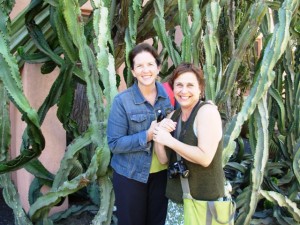
Our Holland gang, with Tovah front and center (she is the short, grinning gal with a huge camera around her neck). Clockwise, from left: Kathy Renwald, Bianca Helderman, Anne Nieland, Debra Prinzing, Walter Reeves, Mary Robson, Nellie Neal and Tovah Martin

Our Holland gang, with Tovah front and center (she is the short, grinning gal with a huge camera around her neck). Clockwise, from left: Kathy Renwald, Bianca Helderman, Anne Nieland, Debra Prinzing, Walter Reeves, Mary Robson, Nellie Neal and Tovah Martin

I met Tovah Martin in 2005 when we both participated in a media tour to Holland during spring bulb season. Since I had for years enjoyed and admired Tovah’s garden writing in the original Victoria magazine, you can only imagine how exciting it was to actually meet her.

I think we were both surprised at how quickly our little group of seven (including our wonderful guide Bianca Helderman from the Netherlands Board of Tourism & Conventions) bonded as accidental fellow travelers. I have vivid memories of Tovah wearing her knee-high rubber boots to tramp around the bulb fields at Hortus Bulborum  (I actually envied her pragmatism: I mean, who else would pack a pair of waterproof gardening boots to bring on a trip to Europe!?)

Tovah gave me a very important gift that week. I still remember sitting across from each other at an ancient trestle table. We ate lunch and swapped stories about book publishing. Known and loved around the globe for her beautiful Tasha Tudor’s Garden and Tasha Tudor’s Heirloom Crafts and many other books, Tovah graciously shared her advice and guidance as I struggled with how to develop my “garden shed” book (it was just an idea back then). Her suggestions about photography really influenced my decision to partner with Bill Wright on Stylish Sheds and Elegant Hideaways, rather than working with a variety of photographers in every market. She gave me a lot of clarity and I cherish her advice.

newterrariumcover001So now, I’m the lucky recipient of newest Tovah Martin book, by all counts, her 13th title. The New Terrarium: Creating Beautiful Displays for Plants and Nature, was published on March 3rd by Clarkson Potter/Publishers. [Full disclosure: Clarkson Potter also published our book – we love everything they produce!]

Captured on film by photographer Kindra Clineff, The New Terrarium is a magical tome filled with small, planted scenes, landscapes, still-life’s and collections under glass.

Tovah brings a perfect combination of talent to this dreamy book. She is a gifted storyteller, both visually and with words (Tovah art-directs and produces many of her magazine articles for Country Gardens and other publications); she has a long history as an expert with indoor and greenhouse plants from her past career at Logee’s Greenhouses; and she is a visionary who understands how to get others excited about her passion.

The idea of creating a book about gardening under glass (on a small scale) struck a chord with this avid plants woman. Here is an excerpt of my recent conversation with Tovah:

Q. How did The New Terrarium come about?

A. Kindra and I started working on magazine projects together, and when Clarkson Potter came to me with this idea, I thought of Kindra. She is a cross between a garden photographer and an interior photographer.

This ode to spring under glass includes white wood hyacinth (right) and lily-of-the-valley with glory-of-the-snow (left). Kindra Clineff photograph

This ode to spring under glass includes white wood hyacinth (right) and lily-of-the-valley with glory-of-the-snow (left). Kindra Clineff photograph

Q. What enchants you about gardens under glass?

A. Way back when I was at Logee’s, I originally lived in the upstairs of the house that overlooked all the greenhouses. Why I find (terrariums) so quaint, and why I can really get into them, is that I’ve never lost that feeling of loving things encased in glass. I loved looking down on the glass greenhouses. I even used to produce little booklets on how to plant terrariums for people who wanted to make or sell them.

Q. Terrariums are a tradition that dates back more than a century. What makes this technique, this idea, suddenly “new”?

A. I can’t think of a modern terrarium book. What I’m hoping is that people in office buildings, people with no access to gardening for a major part of their day, will think of this as a low-maintenance way to bring nature into their lives.

Q. You really believe that plants can be transformative?

A. I kept calling up Kindra and saying, “This is really big. We’re going to change the world.” I saw that this whole mode of gardening has the potential to rescue people from terminal office life.

Q. Tell me about the glass containers you used to create your projects. There is such an incredible variety – many surprised me.

A. Almost anything can be used. You can just start looking at glass this new way.

[Debra’s note: The New Terrarium is packed with inspiring ideas of the types of containers suitable for planting – from traditional cloches, Wardian cases and lantern cloches to more contemporary vessels, including recycled aquariums, hurricane lanterns, vases and repurposed glass domes used to cover cakes or cheese platters.]

“]A Wardian case with a deep base simplifies planting directly in the case. Kindra Clineff photograph]

A Wardian case with a deep base simplifies planting directly in the case. Kindra Clineff photograph

Q. What do you hope to teach gardeners and non-gardeners about growing plants under glass?

A. It’s an easy way for people to enjoy plants. Basically you don’t need to water very often. You don’t even need to fertilize.

[Debra’s note: Tovah has included a comprehensive plant encyclopedia that recommends a surprising array of plants for glass gardens, including: orchids, ferns, heucheras, begonias, mosses, African violets, bromeliads, ivies, ornamental grasses and more.]

Q. I love the photos! How did you and Kindra produce the shots?

A. This book was the challenge of the century because everything reflects in glass. We now understand why no one’s done this book before. Kindra had to surround herself in a black piece of velvet (so she wouldn’t be reflected in the shot). We kept joking that we should do the author and photographer’s portraits reflected in glass.

Q. Did you photograph at your Connecticut farmhouse?

A. We shot at four different houses, one of them being mine. I have a converted barn with big, huge windows and a little cobbler shop from 1790. A greenhouse connects these two buildings. We used the windows of these houses (for a backdrop). But most terrariums should be displayed away from the sun or windows.

Q. Tovah, how do you describe your writing philosophy?

A. This has been a lifelong mission for me: To write for (publications) that aren’t necessarily reaching gardening audiences in order to expand the whole realm.

Thank you! What a great conversation and a spectacular book.

Stylish Sheds and Elegant Hideaways at the Northwest Flower & Garden Show

Monday, February 23rd, 2009
Stylish Sheds, a featured book at University Bookstore's display

Stylish Sheds, a featured book at University Bookstore's display

I’ve just returned from spending three days at the fabulous-but-possibly-final Northwest Flower & Garden Show in Seattle where I saw many, many gardening friends, hung out with my Hortus Posse pals and enjoyed a week of Seattle Sunshine (Seriously, folks. It was raining in Burbank when we flew outta here on Feb. 16th and sunny when we landed in Seattle!).

Of course, I was preaching the message of Stylish Sheds, and I’m happy to say, my “Shedar” (that’s like Radar, but it’s my own version of being alert to shed-spotting all around me) zoomed in on several fantastic garden structures, sheds, arbors, pavilions, shelters and enclosures.

It seemed as if every display garden at the show featured a fanciful structure in the garden. That goes to show you how important it is to design with not just plants, but architecture in mind.

Bill Wright, my collaborator on Stylish Sheds, and I kicked off the week with a Tuesday lecture for his peers in the Seattle chapter of American Society of Media Photographers. We participated in “The Odyssey of a Book,” a panel with two other book-savvy photographers, Dick Busher, of Cosgrove Editions, and Rosanne Olson, creator of a beautiful new book called “this is who I am — our beauty in all shapes and sizes”. The audience included fellow photographers, some of whom are also members of Garden Writers Association (David Perry, Mark Turner), friends Marcia Gamble Hadley and writer Robyn Cannon, as well as my former cohort from Seattle Post-Intelligencer days, Steve Shelton (what a treat to see him in the audience!). While we writers were definitely in the minority in the crowded room at Seattle Central Community College’s photography studio, it was a great experience talking books with kindred spirits.

Rosanne Olson, Bill Wright, Debra Prinzing and Dick Busher

Rosanne Olson, Bill Wright, Debra Prinzing and Dick Busher

On Wednesday, I took a tour through the Flower Show and snapped a bevy of shots to document the veritable bevy of sheds and shed-like structures featured in the show (see below). I was particularly gratified to see two Modern Shed structures by the talented Ryan Grey Smith and his team. Ryan adapted his awesome prefabricated shed architecture for two display gardens, including Michael Hancock’s “Serene Scapes” garden and Tony Fajarillo’s “Collaborating with Nature” garden.

Bill and Debra at their book signing

Bill and Debra at their book signing

On Thursday, I was back on my soapbox, speaking about backyard architecture in “Your Personal Escape,” my lecture illustrated by many of Bill’s awesome photos from our book. Bill joined me for a booksigning afterwards and we’re pleased to say that University Bookstore sold out of copies of Stylish Sheds. Hopefully, they’ll order MORE books next time!

The week went by way too quickly, but upon reflection, it was a perfect moment in time; a perfect experience to savor for months to come.  I’ll close by sharing some of my favorite structures: A Gallery of Garden Architecture from the 2009 Northwest Flower & Garden Show’s designers.

Eco-friendly lawn and garden equipment – and more

Thursday, January 22nd, 2009

I hopped a plane last week to fly from Los Angeles to Orlando and back in less than 48 hours.

No, I’m not one of those desperate collectors of airline miles who is trying to get bumped up to the platinum level for better perks (although that would be nice).

But somehow, the invitation from a publicist for Sears-Craftsman Lawn and Garden Equipment convinced me that this trip would be worth my while. And in many ways, it was more than a good trip. Crazed, but definitely a surprisingly good one.

Sometimes it’s smart just to say “yes” to something unexpected that falls in your lap, even though you don’t really have the time. Here are 10 Reasons Why:

I’m joined by Garden Design magazine’s Jenny Andrews (Features Editor, left) and Megan Padilla (Senior Editor, center)

1. Enjoying dinner with two gifted and creative editors of Garden Design magazine. Jenny Andrews and Megan Padilla are two of the staff editors for this hip publication and I’ve worked with both of them on recent articles. They treated me to dinner at what might best be described as a quintessential Florida restaurant. The seafood was de-lish and the entertainment? We’re talking performers on stilts and a guy who swallowed flaming swords. The conversation was pretty entertaining, too!


Amy Sitze, editor of Gardening How-To magazine, takes a spin in the Craftsman “Revolution” Zero-Turn Yard Tractor. Yes, she’s a good driver!

2. Walking into the press room for Continental breakfast the next morning not expecting to know anyone and then hearing “Hi Debra!” from across the room. I looked over to see the smiling face of Amy Sitze, editor-in-chief of Minneapolis-based Gardening How-To magazine and a fellow member of Garden Writers Association (and another wonderful editor for whom I’ve written).

The black-and-white Craftsman golf pullover helped take the chill off as I put the pedal to the metal on the Craftsman “Excellerator” Garden Tractor.

3. Getting to brave the brisk weather by wearing one of those cool golf pullovers with the Craftsman logo on it. And since it was a windy and wintry Orlando day (something like high 50s), I was very happy to have that extra layer to protect me.

4. Arriving at Osceola County Stadium, “Home of the Houston Astros – Spring Training,” and seeing my name on the electronic read-out that tops the scoreboard.

READ MORE…

Great plants, great friends

Friday, January 9th, 2009

This post aspires to nothing more than sharing with you my garden-gal outing two days ago to the Getty Center in LA. I had a lovely “New Year’s” lunch with garden designers Linda McKendry (of Linda McKendry Design) and Laura Morton (of Laura Morton Garden Design).

We toasted the New Year and talked about our goals, our wishes, our dreams, our *resolutions* and a bit of reality. After lunch, the three of us took an afternoon stroll through the Getty’s Robert Irwin-designed garden.

The light was beautiful. The plantings were surreal. Enjoy!

January 1st – a day to garden

Thursday, January 1st, 2009

Enjoy this photo gallery of some of my New Year’s gardening projects, accomplished today. I’ll add a few comments with each image to explain what I did. Above: Two hyacinth bulbs from Brent and Becky Heath’s care package – I saved them to grow in these glass bulb vases in my kitchen windowsill.

The blogosphere and Twitter world have been busy today, with my friends and those whose work I admire/read writing about resolutions, garden mission statements, and more. I have really tried to tear myself away from the keyboard and screen. It’s ironic that I spend more time here at my desk – looking through the open shutters to the backyard – than I do actually touching, breathing and engaging with said yard.

So today I decided to spend time on gardening projects. I am stiff and tired. Six hours straight – pruning and deadheading, digging up, wheeling the barrow to and fro – is not my typical schedule these days. And I am determined to return to this routine (or an edited version of it) in 2009.

Because you know what? I’m feeling very happy.

At left: I finally planted this beautiful Billbergia nutans ‘Variegata’, which I am embarrassed to say I purchased in March 2008 at Western Hills Nursery in Occidental, Calif., during our post-SF Flower & Garden Show garden-gals’ field trip. Miraculously, this plant has not only endured, but seemingly thrived in a 6-inch pot all these months. It is a beautiful, strappy, striped plant and doesn’t it look nice with the Clare Dohna mosaic orb?

What’s been holding me back anyway?
Since leaving behind my cherished garden in Seattle in August 2006, and moving to what many people think is heaven on earth – Southern California – I have been fairly disengaged with my new yard. As I’ve said before, I can’t really call it a garden. It’s really just a yard filled with plants I don’t understand or particularly like. I’ve had bursts of energy now and then to try and tackle things, including hiring someone a year ago to dig up and haul to a landscaping dumpster a yard’s worth of big red lava-rock mulch that covered every surface of soil.

But my heart hasn’t been in it. My heart is so torn between my past life and my present life. Surely, I am a lucky woman. I have my family who I cherish. I have so many wonderful friendships that continue, regardless of whether I’m in Washington State, California or other places around the globe. I manage to keep writing articles about gardens and design topics that really get published by tangible publications (that’s a shocker) and so what’s the problem?

At right: Senecio cristobalensis is another survivor from the Western Hills plant-shopping excursion in March, now given a special place in my front border. What pretty leaves! It’s supposed to reach 6-ft x 6-ft so I will eventually have to relocate this fuzzy-leafed beauty. This is one of those plants I once purchased from Heronswood (I just found the original plant tag from 2001!) that never wintered over in Seattle. See? I already have a new reason to be grateful for living in Zone 10~

I don’t have all the answers, but I’ve been pondering on how to get out of my rut. And the answer is staring me right in the eye. I need to return to the garden. The one that I see if I lift my eyes away from the computer screen and look through the slats of the shutters. Sometimes we have to start moving forward even before we know the path. “Putting wheels on it,” is how my friend Stephanie would describe it. Moving anywhere is better than staying put. There’s a lot of safety at this keyboard. But I don’t want to be just an observer of other people’s gardens, homes, plants and collections. I need to have my own relationship with the land, the plants, and the wildlife that occupy my suburban backyard.  I’ll say it again:  I need to return to the garden.

Today, I did just that. And while I’m in no position to write a garden mission statement, I do have a simple goal (dare I say Resolution?) for myself. And that is to spend 1 hour a day, at least 5 days a week, in the garden. Lord knows, I waste that much time reading emails each day. I think there’s a much better use of my physical and mental energy – and that’s to get outdoors and garden.

I don’t have money to hire a landscaper to do all the things I dream of accomplishing here, but my investment of time and attention is bound to improve my environment. It’s bound to improve my emotional attitude about this place. I’ll try and use this blog to document my progress.

Above: I guess any month of the year is bulb-season here in LA. It’s just that my bulbs will have to be annuals. That’s something I will have to get used to, after investing in and planting hundreds of spring flowering bulbs back in Seattle. The hyacinths, narcissus, tulips and muscari I planted today were a surprise gift from Brent and Becky Heath. The box filled with 70 bulbs arrived a few weeks ago ~ what a treat! I planted layers of bulbs in 2 terracotta pots this afternoon. Then I sprinkled annual seeds on top of each (dwarf cosmos on one; nigella on the other). Who knows if you can pair annuals with bulbs? It’s worth a try! This is my chance to experiment, so stay tuned!

And Happy New Year to all of you. Let’s cherish what we have!

are you a SHEDISTA?

Thursday, December 11th, 2008

If you, like me, are enchanted with sublime and soulful backyard destinations once merely called “sheds,” consider yourself a Shedista

According to some Internet searches, the term Shedista has been appropriated (originated?) by the boutique wine industry. In France, these clever folks are called “Garagistes,” because they make incredible wine in their garages. Kind of an underground movement!

To quote Wordspy.com: “Shedista: A professional, low budget wine maker, particularly one who processes grapes in a shed-like building.”

I first discovered this term in Jay McInerney’s “Uncorked” column for (now defunct) House & Garden magazine: It was titled “The Shedistas.”

He wrote about a “warehouse gang” of Santa Barbara winemakers who “maxed out credit cards to rent a shed, buy a few tanks and a few tons of Syrah grapes, design a label, and make [their] own wine.”

Those who know me well know I have no desire to steal a moniker from winemakers. However, if you do an Internet search of the word, I bet you’ll find nearly three-quarters of the Shedista entries appearing are ones that I’ve generated. Yup, I’m out to change the meaning of this alluring term.

Here’s my definition: “Shedista: A person who creates and occupies a small-scale shelter in the garden for personal enjoyment and the pursuit of any creative passion.”

My UK shed friend, Uncle Wilco, who publishes a blog at his We [heart] Sheds site, calls himself a “Sheddie.” It’s a close cousin to “Shedista,” and we can all feel free to use both terms! Another friend coined the word Shedquarters to describe his backyard office. In other words, shedistas find shelter in their shedquarters. I like it!

If you wish to see some of the very best examples of personal escapes, aka “sheds,” check out my book: Stylish Sheds and Elegant Hideaways. Welcome to all Shedistas!

Photos: (c) William Wright; top left: taken in July 2007 in Atlanta – in the doorway of Betsy Hansen’s beautiful potting shed. Lower right: taken in May 2007 (as a joke) at an abandoned child’s playhouse in Connecticut. We were on location at author Amy Bloom’s property and noticed this “shack” on a hill near her property. We couldn’t resist!

A Post-Script, Uncle Wilco just tipped me off to his December 14, 2006 post “What is a Shedista?” in which he quoted the same Wordspy definition I’ve used. I like what he wrote after that:

sounds great, but who is someone who brew beer in their sheds, maybe a shedbrewhaha

As I wrote in a reply to him: Of course, while I was running around the country trying to find sheds to photograph and write about, there he was . . . steps ahead of me! Thanks Uncle Wilco!