Debra Prinzing

Get the Email Newsletter!

Archive for the ‘General’ Category

Stylish Chicken Coop in Santa Barbara

Sunday, August 16th, 2009
A tiny chicken coop with loads of style

A tiny chicken coop with loads of style

Last week’s visit to Santa Barbara included a stop at “Rooms & Gardens,” a wonderful home furnishings, antiques, accessories and interior design emporium on State Street.

I needed to check out the store’s new backyard chicken coop and garden.

Owners Eric and Jami Voulgaris recently created the sweet coop and romantic garden, where four Buff Orpington hens reside.

When I met Eric a few weeks ago, at the Santa Monica “Rooms & Gardens” store (they own this location with a partner, actress Mary Steenbergen), he told me about the chicken coop project.

The little building measures about 6-by-6 feet in size, with a charming shingled roof, board-and-batten siding, a country-style screen door and shutters. Stained that dreamy grey-blue shade, it looks both elegant and timeless.

A curved cobblestone path leads from the store’s back door out into the postage-stamp-sized garden. Picket fencing contains the four gals in their little yard.

The Voulgaris children named the Buff Orpington chicks, born on Easter morning: “Henny Penny,” “Rosy,” “Cornflake,” and “Scramble.”

The 800-square-foot garden’s renovation came about because it had to be ripped up when the neighboring Apple store was moving in. When that construction came to an end, Eric and Jami saw it as a chance to dress up the space, which really hadn’t changed much since Rooms & Gardens opened 16 years ago.

Happy chickens living in a happy garden

Happy chickens living in a happy garden

Pretty and inviting, a corner garden

Pretty and inviting, a corner garden

Fully organic, the Martha’s Vineyard-inspired garden is landscaped with espaliered apple trees, Meyer lemon trees, ‘Iceburg’ roses and clumps of lavender. One corner holds a display of potted hydrangeas and an iron chair.

The garden and hens complement the carefree lifestyle settings inside Rooms & Gardens. Eric describes the store’s look and feel as “a fusion of British Colonial, ethnic accents, Chinoiserie and a relaxed coastal theme.”

I love the happy vibe that you feel upon entering. It’s a store where sink-into furniture is paired with uncommon accessories, all of which suggests well-loved and well-lived-in environments.

The garden is open to visitors during store hours. If you want to taste the yummy brown eggs produced here, check with the staff. Eric mentioned that a plan is in the works to supply Tuttini’s, a cafe around the corner, with their daily source of eggs!

Shed Stuff

Wednesday, August 12th, 2009

In my past life as a garden writer in Seattle, I had several opportunities to interview landscape architect Alan Burke of Classic Nursery & Landscape Co. in Redmond (outside Seattle). I profiled Alan as one of the “Hot 40 Landscape Designers You Need to Know,” for Northwest Home + Garden Magazine in 2005.

Now we’re just Facebook Friends (since I’m here in Southern California; he’s still in the PNW; and I don’t get to see what he’s up to).

But today, out of the blue, I received this little communique from him on FB:

Today at 4:29pm
So I am having a meeting with a client, we’re talking about an outbuilding. She is thinking of many ideas for the shed, a greenhouse, a writer’s studio, a music room, a conservatory…. As we’re talking I am thinking: “I have to refer her to Deb’s book.” She says: “I saw some great ideas somewhere wait, I…”
I say: “You need to get a copy of Shed Style,” and she almost screams, “That’s it! That’s where I got the idea!”

…It’s a great book to show clients to get the ideas flowing….Great job!

Thanks for the shout-out, Alan. I needed that good news today!
Promise you’ll send me photos of the “outbuilding” you design for your client, okay? I’ll be sure to post them here!
Fondly,
Debra

Fun at the Ventura County Fair

Tuesday, August 11th, 2009

My lifeblood is comprised of words, sentences, paragraphs, stories. I am definitely NOT a writer of “short” blog posts. But sometimes, I do have to defer to the photographs to tell a story. So today, you will be treated to mostly photos of our afternoon at the Ventura County Fair in Ventura, California. After years fighting the crowds, strollers and sticky run-ins with cotton candy at the King County Fair in Puyallup (Washington), I have to say how nice it is to take in a smaller fair with fewer bells and whistles. With the charming theme, “Homegrown and Pure-Bred,” Ventura’s is the perfectly-sized county fair. Of course, when you go on a Monday afternoon, you’re not going to encounter the weekend crowds. So we did.

What follows are my favorite images of the day. The fair continues through Sunday, August 16th. For details, click here:

RIDES TO THRILL

What a beautiful whirligig. The figures against the blue sky are flying around. The machine's carnival-colored design is beautiful.

What a beautiful whirligig. The figures against the blue sky are flying around. The machine’s carnival-colored design is beautiful.

The giant slide. A ride down the track on a burlap sack couldn't be more fun. My son Alex is nearly prostrate, on the green slide; his friend Philip is racing down the orange one.

The giant slide. A ride down the track on a burlap sack couldn't be more fun. My son Alex is nearly prostrate, on the green slide; his friend Philip is racing down the orange one.

 JUST FOR LOCAVORES

A prizewinning Hubbard squash in the Agricultural Building caught my eye. I'm growing one in the garden, but she won't be this big for a while yet.

A prizewinning Hubbard squash in the Agricultural Building caught my eye. I'm growing one in the garden, but she won't be this big for a while yet.

CRAZY FARM ANIMALS
Turkey racing. Words cannot describe this silly event, but we loved it!

Turkey racing. Words cannot describe this silly event, but we loved it!

More turkeys, including the brown ones.

More turkeys, including the brown ones.

FLOWER POWER
The "Floriculture" displays featured some outdoor gardens. Here's my very favorite: The "Flower Bedroom." I've seen planted beds before, but none as fanciful and well-executed as this one. Note the succulents spilling out of the dresser drawers, too!

The "Floriculture" displays featured some outdoor gardens. Here's my very favorite: The "Flower Bedroom." I've seen planted beds before, but none as fanciful and well-executed as this one. Note the succulents spilling out of the dresser drawers, too!

A sedum armchair. Lush and fluffy. Makes you want to sink right in. I love that the lime green arms have been painted to pick up the bright foliage.

A sedum armchair. Lush and fluffy. Makes you want to sink right in. I love that the lime green arms have been painted to pick up the bright foliage.

BACK TO WORK
 
Today I’m back at the desk, doing interviews for an article for a garden trends story that will run in a future issue of Alaska Airlines magazine. Alex and his friend are back to Junior Lifeguard training. We had a great day at the fair! After all that frivolity, we ended up only eating two roasted corn-on-the-cobs and one powder-sugar-flocked funnel cake between the three of us. Even still, by the time we came home at 8 p.m., both guys had headaches and stomachaches. That’s what going on all those spinning rides will do to you. Me, I’d rather look at produce, pigs, and pretty plants.

Hurrah for Julie and Julia

Saturday, August 8th, 2009

51ezORAwNJL__SL500_AA240_Two years ago, I read Julie Powell’s wonderful debut memoir, “Julie & Julia.” Her story of spending 365 days cooking every recipe in Julia Child’s “Mastering the Art of French Cooking” was electrifying and compelling.

I couldn’t decide what was more inspiring – Julie Powell’s innocent ambition and subsequent bravado or the between-the-lines story of the power of blogging as a voice for authors.

Either way, I ended up buying 5 copies of Powell’s book for my favorite writer girlfriends. I told them: You must read this book. It will open up your eyes to the potential of blogging.

At the time, I had just bit the bullet and decided to really try serial blogging. My best intentions prior to the fall of 2007 hadn’t gotten me very far. I originally “started” this blog in March 2007, when I foolishly thought Shedstyle.com would be a book-in-progress blog while Bill Wright and I created “Stylish Sheds and Elegant Hideaways.”  Constant travel, photo shoots, intense deadlines and a generally crazy schedule conspired to keep that from occurring (I think I wrote 2 posts between March and October 2007).

In September 2007, I moderated a “Garden Blogging” panel at the annual Garden Writers Association symposium with blogger-friends Kathy Purdy, Mary Ann Newcomer and David Perry (you will find each of them and their blogs the LINKS section of my home page).  I felt like a fraud. Sure, I created the panel and served as its moderator. But I was a pretender “talking” about blogging, not actually doing it.

I came home from Oklahoma City and, wholly inspired, I just started writing. I am eternally grateful to Mary Ann, David and Kathy for their honest and heartfelt support as fellow bloggers.

Like many tough things, repetition and frequency make it easier to learn new skills and habits. In less than 2 years I have written nearly 200 posts and met many awesome fellow bloggers, readers, friends.

Back to Julie and Julia.

That book really did change my life, thanks to the courageous Julie Powell and the inimitable Julia Child. I came home tonight from watching the movie “Julie & Julia” equally inspired.

As director and screenwriter, Norah Ephron is amazing. What a talent. Her screenplay is delightful. Her cast – Meryl Streep and Amy Adams – are delicious. Totally delicious in their roles as Julia Child and Julie Powell.

A woman seated near me (friend of a friend) told me a great story after the movie. As you may know, Julia Child lived in Santa Barbara in her retirement. The woman remembered working as a waitress in Santa Barbara in 1989. She waited on Julia and her husband Paul, who by then was in a wheelchair.

“Julia ordered a grilled-cheese sandwich and a banana for lunch,” this former waitress recalled. Hmm. I love hearing that our culinary icon, Julia Child, liked basic comfort food. It puts a smile on my face.

Not sure where this post is going, except to say that the writer in me LOVED the book and the film. I felt like I was watching all of our stories, our efforts, our hopes and dreams, up there on the screen. When the film portrayed Julia Child’s manuscript finally getting published after 8 years of work, I felt so victorious for her. When Julia Powell was interviewed for a story in the New York Times food section, I felt the excitement at hearing her answering machine buzz (well, that hasn’t exactly happened to me, but I can kind of relate).

Anyway, if you’re into food you should see “Julie & Julia.” If you’re a writer, you’ll definitely want to.

This post is dedicated to Nan, Paula, Mary Ann and Lorene, my friends who received copies of Julie & Julie from me in 2007.

LA Field Trip: Hollywood opulence gets a facelift

Saturday, August 8th, 2009
A 1926 pool built by William Randolph Hearst now has a new community pool house. The modern columns emulate original ornate ones

A 1926 pool built by William Randolph Hearst now has a new community pool house. The modern columns emulate original ornate ones

My friend Cristi Walden invited me to join her on an excursion earlier this week, one that introduced me to a chapter of Hollywood’s glamorous history. Cristi, a native Californian, is plugged into the architectural-decorative arts world around here. But she’s not just into the luxury, high-end stuff. She’s been known to cruise around LA after dark on tours of vintage neon signs with her pal Eric Evavold, who also accompanied her on our field trip.

The visit gave me a great excuse to spend a morning with Cristi and to learn something new about my own backyard. We met up at the new Annenberg Community Beach House at Santa Monica State Beach, which opened in late April at 415 Pacific Coast Hwy.

Located on Santa Monica’s “Gold Coast,” this is the site where publishing tycoon William Randolph Hearst built a $7 million mansion for his starlet-girlfriend Marion Davies. A very informative docent shared the fascinating story. Hearst, who had been married since 1902, became smitten with Marion Davies when she was a teenager performing in the Ziegfeld Follies. He waited until she was 20 and then began to court her (he was 54). Hearst even built a film studio in Manhattan as a vehicle to turn Davies into a classical actress. He never divorced his wife, Millicent, but remained with Davies, who was his companion for over 30 years. She was in 48 movies during Hollywood’s Golden Age.

The Marion Davies Guesthouse has an impressive scale, even for a so-called smaller residence

The Marion Davies Guesthouse has an impressive scale, even for a so-called smaller residence

Hearst visited friend Louis B. Mayer at his “Gold Coast” mansion and in 1926 decided to build his own beachfront estate. Photographs portray the 110-room Hearst mansion as an edifice that looked more like Monticello than anything you’d expect to see on the Pacific Ocean. The five-acre estate also encompassed an ornate marble-edged swimming pool, several guest houses and gardens. Famed architect Julia Morgan, who designed many homes for Hearst (including San Simeon) designed the interiors and also the guest house, which is now restored.

The parties they threw were legendary, including huge theme galas and costume balls whose guests included Charlie Chaplin, Greta Garbo and Louise Brooks. The power couple resided here until 1942, when they retreated to another of Hearst’s estates during WWII.

In the late 1940’s, the property was sold, becoming Oceanhouse, a hotel owned by Joseph Drown who eventually demolished the large mansion but preserved an original guest house and pool as well as cabanas and a locker building. Subsequently it was sold to the State of California and leased for thirty years to the popular Sand and Sea Club until the City of Santa Monica assumed responsibility for the site in 1989. After a brief period as a seasonal public beach facility, it was severely damaged during the 1994 Northridge Earthquake.
 

RESTORED TO ITS FORMER GLORY, IN PART

Recently restored to its former elegance, here's the foyer

Recently restored to its former elegance, here's the foyer

Cristi, Eric and Debra, in front of the Marion Davies Guesthouse

Cristi, Eric and Debra, in front of the Marion Davies Guesthouse

According to Cristi, for years Marion’s pool and guesthouse were closed off from public view, hidden and neglected behind a fence. Even though the property was smack in the middle of a city beach, it wasn’t maintained. Cristi recalls that friends (other California tile enthusiasts like her) snuck onto the property about 10 years ago just to photograph vintage pool tile-work that they feared would be destroyed.

In 2005, philanthropist Wallis Annenberg donated a boatload of money – $27 million – to save the property. I feel a special affinity for the Annenbergs, having once met her father, publishing tycoon Walter Annenberg, when I worked for Triangle Communications. Annenberg owned three magazine titles: TV Guide, the Daily Racing Form, and Seventeen Magazine, where I worked from 1980-1982. Once several of us flew on Annenberg’s private jet from NYC to LA to work at a Seventeen Magazine Tennis Tournament at Mission Viejo. Can you imagine me, a 22-year-old junior editor, getting to do that!? I still have the Triangle Corp. deck of playing cards as a memento from that trip.

Designed by Frederick Fisher and Partners, Architects, a new community pool house has 16 sleek “columns” across its facade, a symbolic echo of the 16 ornate columns that used to stand in that exact spot when the mansion faced a pool filled with frolicking Hollywood stars. Isn’t that totally amazing?

Fanciful original tile exists at the bottom of the famous swimming pool

Fanciful original tile exists at the bottom of the famous swimming pool

The refreshing and colorful new property also include a children’s play and splash area; beach volleyball and beach tennis courts; a beach cafe and new pool house. The historic Marion Davies Guesthouse has been restored and landscaped. It is available for rental events, but you can also take a guided tour like we did. I’m still not sure how this gracious residence avoided the wrecking ball; “she” must have many, many secrets in her walls!

The tile-lover in Cristi was super excited to see the beautiful and intact tile designs in three original bathrooms (one docent told us the tile had been painted over in white, requiring careful restoration to strip it away). Other noteworthy details include several original lights and chandeliers, as well as intricate crown molding and fretwork detailing. See those details below.

And for just $10, you can go swim in the pool where Hollywood’s beautiful people once bathed, or sun yourself on a chaise next to its black-and-white marble border. Only in L.A.

Here are some more images to enjoy:

Growing Vegetables Organically: an old technique for new gardeners

Saturday, June 20th, 2009
The layered, above ground, "no-dig," organic vegetable bed

The layered, above ground, "no-dig," organic vegetable bed

Here’s a sneak peek at a story that I’ll be reporting for an upcoming issue of Organic Gardening magazine.

I stopped by Pat Marfisi’s house in the Hollywood Hills last evening to tour his unusual “no-dig” veggie patch and to say hello to Pat and my colleague Jack Coyier, who’s photographing Pat’s prolific garden for my piece.

I arrived around 5:30 p.m. The late afternoon light was beautiful and warm. Pat’s dog “VaBene” (Italian for “it’s going well”) came down the street to greet me, followed by his owner: A grinning face under a broad-brimmed straw hat; strong gardener’s arms, emerging from a soft green T-shirt; functional jeans and black sneakers. He was in his element with vegetables, soil, and a harmonic convergence of pollinating native bees darting around to their heart’s content.


With apologies to Jack, who with his camera was preoccupied with artistic portraits of young squashes and pole beans, I launched into “interview mode” with Pat. Every word that emerged from his mouth was inspiring – practically prophetic. This was just a meet-and-greet visit. It wasn’t supposed to be an interview. I grabbed my notebook and pen and started scribbling furiously to capture our conversation. 


His face hidden under a brim, Pat demonstrates the layering method

His face hidden under a brim, Pat demonstrates the layering method

A central pathway cuts through the narrow garden with no-dig beds lining each side

A central pathway cuts through the narrow garden with no-dig beds lining each side

Pat was profiled last summer in an article by Lisa Boone for the Los Angeles Times Home section. Willi Galloway, west coast editor for Organic Gardening, saw the piece and tracked Pat down to learn more about his unusual method of layering newspapers, alfalfa, straw and compost – with a bit of blood meal and bone meal stirred in – to grow edibles above ground. He plants straight into this towering medium, which is a good alternative to tilling up poor soil or back-breaking “double-dig” methods. As I was trying to understand the process, I jotted this explanation down on the page: He creates rich soil while at the same time grows food in it.  

 

When Willi asked me to interview Pat and write the article for Organic Gardening, I was thrilled! I remember reading Lisa’s piece when it came out and learning that this practice of sandwiching organic materials (some also call this the “lasagna” technique) was decades old. Pat picked it up during an early retirement trip to Australia and New Zealand, where he volunteered on organic farms. He’s refined the scheme in his own LA garden and now teaches it to schools and community groups. He’s a modern day vegetable gardening Pied Piper.

kalesquashetcAs I’ve mentioned here before, some people learn by reading or doing, but I tend to learn by writing about something. I fall in love with each tree or flower I find myself writing about. I become fascinated with a style, a material, a project as I craft the narrative piece that will be published and read by others. 

I suspect it will be the same when I learn more about Pat’s process of growing food with abundance – in a very small area with few resources, natural or physical. I can’t wait to actually write this story (after returning to spend more time with Pat), and to see how it turns out in print with Jack’s photos.


Until then, the photos you see here are some of my snapshots to illustrate what Pat’s up to in his few hundred square feet of level land on an otherwise very steep 1/5th-acre urban lot.

Rooftop Crop: Edible Gardens Overhead

Thursday, June 11th, 2009
A sculptural vegetable garden grows on a downtown Los Angeles rooftop

A sculptural vegetable garden grows on a downtown Los Angeles rooftop

I wrote about Los Angeles’s gardens-in-the-sky in 2007, so when my chef-photographer friend Rico Mandel told me about a rooftop vegetable and herb garden that fellow chef Jonathan McDowell had been cultivating, I was excited to learn more. And to see it!

We grabbed a Starbucks and hopped on the freeway a few days ago to drive to downtown Los Angeles. On the way, I told Rico about an article I had just read in the January 2009 issue of Growing for Market, a journal for local food and flower producers. It was written by Marc Boucher-Colbert, a Portland sustainable farmer who created Rocket Restaurant’s rooftop garden with table-high steel planting troughs and 39 lightweight “kiddie” wading pools.

“Kiddie pools – how do you like that?” I asked Rico. “That’s cheap, lightweight and clever, isn’t it?” He silently chuckled to himself. Later, I understood why. Because what Jonathan had to show us was as far from a plastic wading pool as you could get.

bluevelvetBlue Velvet restaurant occupies the ground floor of a 10-story, 1960s-looking (but new) apartment building – all horizontal lines and clean facade. Jonathan met us in the parking lot and took us up the elevator to the top floor; we climbed a flight of stairs and emerged onto the roof.

Rico hinted about the totally unusual, sculptural design that contains Blue Velvet’s edible crop, but there was no way I could have envisioned the fluid, galvanized metal, Frank Gehryesque installation in front of me. What the . . . ?

"Gutters" hold trailing rosemary in a vertical wall system.

"Gutters" hold trailing rosemary in a vertical wall system.

Turns out, this creation was fabricated on site to mold up and across a bleacher-like frame that hides HVAC units and other commercial rooftop paraphernalia.

It begins as a 10-foot vertical installation of long, horizontal channels – stacked almost like a wall of roof gutters. Many of the sections are planted with trailing rosemary. We marveled at the metal material. Even though Rico and I visited on a dreary, cool day in June, there’s no denying Southern California’s heat and sun effect. “Oh, well, this wall is north-facing, so at least it’s away from the most intense heat,” I commented.

“Wait until you see the rest of the roof,” Jonathan promised.

We walked a few yards across the roof, following that vertical wall of herbs, and I noticed how this “metal farm” took on kinetic qualities, wrapping over and around the “stuff” on the roof (and in the process, facing due south!).

Fluid, shaped metal planting channels hold veggies and herbs

Fluid, shaped metal planting channels hold veggies and herbs

plantedroof3To get an idea of how this scheme looks in person, take a sheet of paper from your printer and fold it back and forth every 1/2-inch or so. This is how we made paper “fans” when we were kids. Open up the paper slightly so there are V-shaped pleats. Now, imagine translating that texture to sheet metal. The V-shapes create long planting channels, about 4- to 8-inches at the deepest point. Sections of the metal, welded together every 18-20 inches or so, take form, twisting, bending and turning as a beautiful sculpture.

veggiesBut for all practicality, in responding to this design as a gardener, I have to admit that a million questions flooded my mind. How can tender herbs, greens and vegetables handle this sun-baked, roots-against-metal, rooftop condition, especially in July and August when it is ugly-hot? Moreover, where was the irrigation?
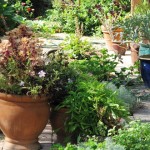
Jonathan, who just completed a four-year stint at Blue Velvet (two years as sous-chef and two years as head chef), looked at me and shrugged. Although he wasn’t involved in the design of the “garden,” Jonathan was tasked with figuring out how to grow plants in it. That has meant filling those pockets and grooves with soil and planting veggies in an artful way. There’s no denying this is an evocative design. “It pleases the eye,” Chef Jonathan acknowledges. “It has attracted a lot of attention.”

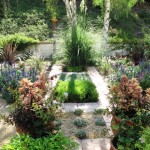
But – duh. Every square inch of this garden has to be hand-watered.

“In L.A.’s restaurant gardens, freshness is grown to order,” a May 20th Los Angeles Times Food article, Betty Hallock featured Blue Velvet’s rooftop garden, quoting its designer, architect Alexis Rochas: “The point was to experiment with how to turn infertile ground into a fertile one,” he said.

Chef Jonathan McDowell and Chef-photographer Rico Mandel

Chef Jonathan McDowell and Chef-photographer Rico Mandel

That’s an admirable goal. But the experiment has revealed that plants here don’t thrive against metal, and the absence of drip irrigation – that could direct moisture straight to root zones – is a negative. I’m worried that those hand-watering duties will likely be neglected when the guys in the kitchen get super busy!

Metromix Los Angeles recently featured “rooftop gardens” in a trend report by Krista Simmons. She included Blue Velvet’s in-the-sky garden, calling it “a sweeping silver flatbed . . . strikingly similar to the Walt Disney Concert Hall.” Simmons points out that the garden doesn’t generate enough to sustain the restaurant, but adds: “. . . McDowell does use the produce for tasting menus, amuse bouches and specialty holiday events.”

I applaud the rooftop restaurant garden. It’s a great vehicle to bring the “seasonal, sustainable and local” concept from garden to plate. To succeed, however, Blue Velvet needs a retrofit. Maybe getting an irrigation specialist up to that rooftop will help. Ask a professional market farmer or gardener to consult on how to better grow and sustain these poor little plants – they looked pretty stressed out! After all, part of the sustainable equation is to work with nature and create a supportive growing environment so that plants are productive and bountiful.

More reading: INHABIT, a design blog

In my own backyard: California’s Channel Islands

Sunday, May 24th, 2009
A view down the rocky coast of Santa Cruz Island

A view down the rocky coast of Santa Cruz Island

This won’t be a long post because it has been a long day. But I have some images to share from today’s field trip to Santa Cruz Island, which is part of a string of eight small islands forming the Channel Islands off the California coast (between Santa Barbara and Long Beach). Perhaps the most famous is the glamorous Catalina Island. But since I wanted to see nature and take a break from the freeways and noise, the remoteness of Santa Cruz was appealing.

My companion Paula Panich has ventured to Santa Cruz twice before by herself. She suggested a day trip over the holiday weekend and we both arranged to be away from our families for a good part of the day. It started by booking our passage through a commercial boating company called Island Packers. We each spent $48 for the round-trip journey. The boat left the Oxnard Harbor at 9 a.m. We boarded and sat up on the top deck, along with other pleasure-seekers, cameras and small video recorders around their necks. No one was disappointed by the 90-minute crossing, thanks to a playful performance from dolphins, including several that seemed to want to “surf” in the boat’s wake.

With my friend Paula, on the trail

With my friend Paula, on the trail

Paula had prepped me for this trip, helping dictate a list of what I should bring: 2 bottles of water; 2 bottles of Gatorade; a fanny pack and a backpack; nuts and dried fruit; a hat and sunscreen; polar fleece and a rain jacket; hiking shoes. I added my fav hiking food – hard cheddar cheese and salami, along with crackers.

The thing is, Santa Cruz is one of four northern islands that make up the Channel Islands National Park. The only amenities on this rocky, isolated destination are a few port-a-potties and potable water. You can plan ahead to camp or kayak here but everything you bring in . . . you must pack out.

We got off the boat at 10:30 a.m. and checked our watches: Four Hours. Before hiking, we wandered through the historic displays that covered Santa Cruz’s background dating to the first indication of human life there 2,000 years ago. Those humans were probably the ancestors of our local Chumash Indian tribe. European settlers had their moment in time here, too, unfortunately. This island was home to sheep, cattle and pig ranching over the years. Paula and I kept asking ourselves: Who would transport livestock to this island to “farm” when there was still a ton of good, undeveloped property on the mainland a century ago? Ridiculous.

The restored black smith shed

The restored black smith shed

A relic of undetermined provenance

A relic of undetermined provenance

But, of course, we were tickled to see the remains of a few “sheds.”

There you go. Sheds are everywhere.

The natural beauty of Santa Cruz, though, made everything man made look uninspired. The terrain blew our minds. I kept saying: “It’s otherworldly.” Finally, Paula said it reminded her of Iceland, an otherworldly place she visited last October. When we hiked up to a bluff overlooking the Pacific Ocean to the southwest and the Santa Barbara Channel to the northeast, I was struck by how varied the geography is here.

This blooming pinkish succulent carpeted the earth

This blooming pinkish succulent carpeted the earth

On land, it’s desolate, dry and hilly (the livestock ate most of the native vegetation, but there are efforts to reintroduce native plant species). On the perimeter, it’s rugged, weather beaten and dramatic, where the sheer face of the island exposes itself to the sea.

Here’s a paragraph from the National Parks brochure we picked up:

Santa Cruz Island: Here are pristine beaches, rugged mountains, lonely canyons, grass-covered hills, and some animals and plants that you have never seen before. This paradise is Santa Cruz Island, a miniature of what southern California looked like more than 100 years ago. The largest island in the national park, with 61,972 acres, Santa Cruz is 22 miles long and from two to six miles wide. A central valley splits the island along the Santa Cruz Island fault, with volcanic rock on the north and older sedimentary rock on the south. Today, the Nature Conservancy and National Park Service preserve and protect the island.

Rocky outcroppings, perhaps formed in an earlier millenia

Rocky outcroppings, perhaps formed in an earlier millennia

We spent most of our time just staring at the rock formations and speculating about what force of nature had shaped them in which millennium. The trails were narrow, single-file style, and perilously close to the edge of cliffs and bluffs. But we felt more exhilarated than frightened.

Our clock wound down to 2:30 p.m. and we had to make our way back to the pier to re-board the return boat. This morning, I worried about what on earth we would do to fill 4 hours on an island, one with no tree cover, few places to sit but on the ground, and lonely views of water and rock all around us. But breathtaking scenery, good conversation with a close friend, a zip-lock bag filled with nuts and dried fruit, a few cheese-and-salami bites and – wow – time flies.

I can’t wait to schedule a return visit. Just think, only 30 minutes away from home is the boat that will bring me back to the wild place called Santa Cruz.

A tale of a Wicked Plant (aka “The Case of the Poisonous Monkshood”)

Saturday, May 23rd, 2009

In preparing for a phone interview with prolific, bestselling author Amy Stewart to discuss her new book, Wicked Plants: The Weed that Killed Lincoln’s Mother & Other Botanical Atrocities, I came across a dog-eared manila folder in my office file drawer. Its label read “Emery’s Garden Monkshood.”

”]Autumn Monkshood - beautiful and poisonous [photo from Valleybrook Gardens Ltd.]And immediately, I recalled my own brush with a “Wicked Plant.” Before sharing my Q&A with Amy, I will indulge in the tale of Autumn Monkshood, aka Aconitum carmichaelii ‘Arendsii’.

In the late 1990s, I worked for a wonderful specialty nursery in Lynnwood, Washington, called Emery’s Garden. I had recently left business writing and a nonprofit communications gig to embark on my “garden writer” journey. Lucky for me, the people at Emery’s took me in and our relationship there flourished. I wrote and edited “The Weedy Reader,” our quarterly newsletter. I planned and produced our educational program and special events. I basically learned the horticulture business, thanks to Emery Rhodes, Marlis Korber and Amy Tullis.

After I left Emery’s in 2000 (that’s when I joined the team of The Herald’s “Home & Garden” section in nearby Everett), I stayed in close touch with my Emery’s pals. One day, in April 2001, I received a panicked phone call from Marlis, the nursery’s general manager.

Turns out, a customer purchasing perennials pointed out some odd tags on the 6-inch containers of Monkshood (Aconitum). The tag read: “All parts of this plant are tasty in soup.” The shopper had filled one of Emery’s carts with her two toddlers and three pots of the mislabeled (and wicked) perennial. “I thought this stuff was poisonous,” she said to our sales associate. “But this label says it’s edible.”

aconitum-story2aconitum010Needless to say, a check in Sunset Western Garden Book revealed the exact opposite to be true. Under “Aconitum,” Sunset warns: “All parts are poisonous if ingested.”

What resulted was a mini-international scandal and media frenzy. The common Monkshood, which is a beautiful, tall violet-blue ingredient in the cottage border, is NOT a tasty ingredient for soup or stews. Instead, it’s lethal.

The ensuing drama played out as you might expect. I got to play the role of Crisis-PR consultant while Emery’s pulled all the mislabeled plants, contacted the grower (a Canadian nursery), and soon discovered that the label mishap had been a stupid prank pulled by one of the grower’s employees! Within 48 hours, we were visited by the FDA; the Canadian authorities got involved; the plant recall went out over the wires; television, radio and print outlets picked up on the story and came to report on the scare.

In the end, it was a bit of a wake up call for Emery’s (and possibly other local nurseries) about the importance of using proper signage and labeling of toxic ornamental and landscaping plants. But I wonder, did anything really change? It certainly elevated consciousness at one nursery, at least for one season.

wicked012Now, however, with the advent of Wicked Plants, the evils of ingesting the flowers, stems or leaves of Aconitum are coming back to haunt me. The perennial is, in fact, the very first entry of Amy Stewart’s charming and horrifying new effort, published earlier this month. Amy writes:

In 1856 a dinner party in the Scottish village of Dingwall came to a horrible end. A servant had been sent outside to dig up horseradish, but instead he uprooted aconinte, also called monkshood. The cook, failing to recognize that she had been handed the wrong ingredient, grated it into a sauce for the roast and promptly killed two priests who were guests at the dinner. Other guests were sickened but survived.

Her scary narrative explains where the perennial grows and what to look out for (gardeners should wear gloves anytime they go near aconitum, Amy advises). The page is labeled “Deadly.”

Wicked Plants, is a compendium of horrifying stories and historical facts of the botanical world. If you have any question as to the deadly, illegal, intoxicating, dangerous, destructive, painful and offensive traits of the trees, shrubs, perennials and herbs growing on our planet, you’ll want to peruse this powerful little volume.

Between the pages of Amy’s 5-3/4 x 7-1/4 inch, 235-page book, which is bound in the same sickly green worn on the face of the witch Elphaba in the musical “Wicked,” are tales of death, destruction, war and more. I recently had a chance to chat by phone with Amy, and here is part of our conversation:

READ MORE…

Another amazing reason I’m starting to groove on Southern California

Monday, May 18th, 2009


For those of you who have known me for a l-o-n-g time, or even for ones who only occasionally stumble upon Shedstyle.com, it may be evident that I am torn between desperately missing Seattle, my home for most of the past 30 years, and embracing life in Southern California, where I’ve been living nearly 3 years now.

I’m learning that there is incredible beauty here in SoCal, especially if one gets off of the freeways and out into the raw, rugged nature. The same attributes that make me love the Pacific Northwest – the mountains, the ocean, the amazing plant life – are some of the ones that have made me begin to appreciate, value and (possibly) love my new home.

Yesterday was no exception. I slogged through 70 miles of freeway traffic on a mid-Sunday (which took 1 hour and 45 minutes, thank goodness for Prairie Home Companion or it would have been a lot worse!) to a place high above the ocean called Rancho Palos Verdes. When it comes to offering endless views of the Pacific shoreline, coastal beaches and blue ocean, it’s as breathtakingly gorgeous of a place as the more popular Malibu. Except, it seemed to me yesterday, with way less traffic and commercial development.

I met up with architect Ron Radziner of Marmol-Radziner, a Venice, Calif.-based architectural firm (which also has landscape architecture, interior design, furniture design and prefabricated design in its portfolio) to tour one of his projects. The property is called Altamira Ranch and the American Society of Landscape Architects recognized it with a residential design honor award in 2008.  My interview with Ron about the project will appear in a future issue of Landscape Architecture magazine. Suffice it to say that the approximately three sweeping acres of California native plants, surrounding a contemporary residence (also designed by Marmol-Radziner) is a study in excellent design. It is lesson that Bud Merrill, my former garden design instructor, would have so loved. He preached the gospel of “environmentally responsive design” – and I tell you, this project – home and landscape – makes huge strides in that practice of only “lightly touching” the earth.  Stay tuned for the full story.

The alluring labyrinth patterns are visible from high above the beach

The alluring labyrinth patterns are visible from high above the beach

The stone design, made by unknown hands

The stone design, made by unknown hands

After Ron and I finished the interview, Julie, the owners’ personal assistant, offered to walk the property with me.

She is a wealth of knowledge about native plants and how they perform in a residential setting – especially this tricky coastal site that is exposed to high winds, intense sun, frequent blankets of fog, and saltwater.

We paused at the edge of the bluff and looked down at the beach, which was probably 200 feet below us.

Julie pointed out the stone labyrinths that beachcombers have placed on the shore and she told me where to park so I could walk down to see them (she also suggested where I could grab some lunch; ironically, it was at the grill where golfers eat when they’re finished playing the greens at the Trump International Golf Club).

I hiked down to the beach and made my way across the uneven, rocky surface. It isn’t one of those “take off your shoes and stroll barefoot” kind of beaches. My shoes kept filling up with pebbles, but I couldn’t imagine going bare. The wind was brisk, which you’ll notice in the poor sound of the two short movies I shot. How else do you show the experience of a labyrinth without a moving picture?

At the Beach with Deb:

httpv://www.youtube.com/watch?v=BKYt9OW2iQE

Walking the Heart-shaped Labyrinth:

httpv://www.youtube.com/watch?v=HSxQm4iv_GA

Here’s my takeaway from yesterday’s unexpected hour on the beach: I was given yet another gift of California’s natural beauty. It was a vivid reminder that I am here for a reason. I am still discovering the reason(s), but isn’t having a chance to drink in this beach, collect a few of these stones and witness the creative way artistic humans have responded to them reason enough?